



Abstract
This study examines the organisational determinants influencing evaluation maturity in the Jordanian public sector, focusing on the interplay of leadership, organisational culture, structure and resource allocation. Grounded in the Resource-Based View theory, the findings indicate that organisational culture is the most significant determinant of evaluation maturity, while resource allocation also plays a crucial role. Although leadership initially demonstrates promise in influencing evaluation practices, its significance diminishes when contextual factors are considered. This suggests that effective evaluation practices are contingent on a supportive organisational culture and adequate resources. The implications of this study extend to public administration reform, emphasising the need for holistic approaches that integrate cultural and resource considerations to enhance evaluation maturity.
Introduction
Policy evaluation has become a vital instrument for promoting evidence-based decision-making, enhancing public sector performance and fostering good governance across the globe. The Organisation for Economic Co-operation and Development (OECD) asserts that practical policy evaluation is essential for governments to meet rising demands for accountability, transparency and effectiveness in public service delivery (OECD, 2017; Patton, 2008). Adopting and institutionalising robust policy evaluation systems have emerged as critical priorities for many nations, including Jordan (OECD, 2024). This study explores the interaction effects of organisational factors – such as leadership, culture, resources and structure – on the maturity of evaluation practices within the public sector. Although the influence of organisational resources and capabilities on performance is well-established in public administration literature (Bryson et al., 2007; Pablo et al., 2007), their specific roles and interactions in shaping evaluation maturity within authoritarian contexts remain poorly understood. Research on evaluation capacity building has demonstrated that organisations require certain fundamental elements to function effectively, including leadership, culture, resources and structural arrangements (Cousins et al., 2014; Nielsen et al., 2011). However, the mere presence of these elements does not guarantee organisational effectiveness, particularly in contexts in which formal institutions are weak. Bourgeoisois and Cousins (2013) emphasised that evaluation capacity development is a complex process influenced by organisational context and institutional arrangements. This complexity increases in politically constrained environments in which traditional organisational assumptions may not hold. Sirmon et al. (2007) argued that success depends not only on possessing resources but also on how they are structured and leveraged. This is particularly relevant in authoritarian contexts where, as Andrews (2013) demonstrated, organisations must develop capabilities despite institutional constraints rather than because of institutional support. King and Volkov (2005) further emphasised that successful evaluation capacity building requires more than just assembling basic organisational requirements; it demands understanding how these elements interact within specific institutional contexts. By examining these dynamics within the public sector in Jordan, this article moves beyond identifying basic organisational requirements to analyse how public organisations can develop evaluation capacity in environments characterised by institutional weaknesses. By addressing these dynamics, this study seeks to fill existing gaps in the literature and contribute to a deeper understanding of how to boost evaluation maturity in public administration.
Jordan, a middle-income country in the Middle East, is making significant progress in institutionalising evaluation practices (Brik, 2025). The Jordanian government has initiated reforms, with evaluation playing a central role in evidence-based decision-making and public sector effectiveness (Alsarhan and Al-Twal, 2024). The government has established several key evaluation structures and mechanisms (Brik, 2025). The creation of the Monitoring and Evaluation Directorate within MoPIC in 2006 was a significant milestone, serving as a central hub for evaluation expertise. The establishment of the Jordan Evaluation Association (EvalJordan) in 2014 has been instrumental in promoting evaluation culture and professional development (EvalJordan, 2023). These efforts demonstrate commitment to developing a robust evaluation framework while acknowledging areas for further improvement.
Three theoretical frameworks – Resource-Based View (RBV) (Barney, 1991; Sirmon et al., 2007), institutional theory (DiMaggio and Powell, 1983) and contingency theory (Lawrence and Lorsch, 1967; Mintzberg, 1979) – offer potential lenses for examining evaluation maturity within the public sector in Jordan; however, RBV proves most appropriate because of its emphasis on internal resource configurations in navigating authoritarian constraints. Institutional theory contends that organisations adapt to external pressures, including regulatory mandates, societal expectations and isomorphic processes, to secure legitimacy (DiMaggio and Powell, 1983; Steele et al., 2019). This assumption assumes a dynamic institutional environment in which external stakeholders, such as civil society or independent oversight bodies, catalyse reform, as observed in democratic settings with robust accountability mechanisms (Moynihan and Pandey, 2005; Patton, 2011). However, in the Jordanian context, centralised state control severely restricts external reform initiatives, prioritising regime stability over evaluation system development (Brinkerhoff and Goldsmith, 2002; Yom, 2013). Governance indicators reveal persistent challenges in transparency and accountability (Worldwide Governance Indicators, 2024), underscoring the limitations of institutional theory, which inadequately addresses how organisations foster evaluation capacity when external drivers are suppressed. Likewise, contingency theory posits that organisational effectiveness derives from aligning structures with external environmental contingencies, such as market dynamics or technological shifts (Lawrence and Lorsch, 1967; Mintzberg, 1979). This approach is effective in contexts with variable external conditions, where organisations must adapt to competitive or technological pressures (Denison, 1990). In Jordan’s stable yet restrictive political system, where environmental contingencies are tightly controlled by the state, contingency theory’s external orientation is less pertinent, as internal resource management becomes the primary driver of organisational adaptation (Rose-Ackerman, 2016; Schein, 2010). By contrast, RBV prioritises the strategic orchestration of internal resources – structuring, bundling and leveraging them to cultivate evaluation capabilities (Sirmon et al., 2011) – rendering it uniquely suited to Jordan’s constrained environment. RBV’s internal focus facilitates an examination of how ministries harness intangible assets, such as collaborative organisational cultures and peer-driven networks, to develop evaluation practices despite political barriers (Cooper et al., 2023). Diverging from leadership-centric paradigms that privilege top-down directives, RBV underscores the interplay of internal factors, including leadership, culture, resources and structure, aligning seamlessly with this study’s focus on organisational determinants. By elucidating how public organisations cultivate competencies to enhance legitimacy and service delivery efficacy (Pablo et al., 2007), RBV provides a theoretically grounded and practically actionable framework for analysing evaluation maturity and practices in authoritarian contexts.
According to the RBV, organisations with valuable, rare, inimitable and non-substitutable resources are better positioned to achieve competitive advantages and improve performance (Patton, 2008). In public administration, this perspective underscores the importance of human, financial and technological resources in fostering an environment conducive to practical policy evaluation.
Although RBV originated in Western business contexts, its application in authoritarian settings provides unique theoretical insights, particularly regarding how organisations develop capabilities when traditional assumptions about leadership autonomy face constraints (Barney, 1991; Brinkerhoff and Goldsmith, 2002). Research indicates that evaluation capacity often develops through informal networks and bottom-up processes when formal structures are weak (Bourgeois and Cousins, 2013; Cooper et al., 2023; Knies et al., 2024; Nielsen et al., 2011). This aligns with findings that organisations under institutional constraints can develop distinctive competencies through internal resource orchestration rather than top-down direction (Bryson et al., 2007).
In authoritarian contexts, public organisations often develop informal performance monitoring systems through peer networks and build evaluation capacity through informal learning communities that operate alongside hierarchical structures (O’Brien, 2006). While public organisations may not compete for market share, they do compete for resources, legitimacy and effectiveness in service delivery (Pablo et al., 2007). Studies have shown how public organisations develop key capabilities despite limited resources, including capturing societal needs and managing facilities (Melián-González et al., 2010) and developing learning capabilities through experimentation (Pablo et al., 2007).
The application of RBV extends beyond resource identification to resource orchestration– how resources are structured, bundled and leveraged (Sirmon et al., 2011). This is particularly relevant where organisations must develop capabilities despite institutional constraints rather than because of institutional support (Andrews, 2013). Understanding resource configurations becomes crucial when formal institutions are compromised by authoritarian control (Brinkerhoff and Goldsmith, 2002).
While several studies have explored RBV’s application to public sector outcomes (Piening, 2013), there remains limited understanding of how capability is shaped by internal organisational contingencies in authoritarian contexts. As capability is embedded in context, findings from market-oriented analyses are not easily transferable to public sector organisations. The theoretical value of RBV in this context lies in understanding how public organisations can develop and maintain sustainable evaluation capabilities despite institutional challenges, examining the complex interplay of resources and capabilities in challenging institutional environments.
Despite the growing recognition of the importance of policy evaluation in Jordan, a significant gap remains in the literature regarding the factors that influence evaluation maturity in the public sector. Existing studies have primarily focused on institutional frameworks and external factors, often neglecting the internal dynamics that shape evaluation practices (Steele et al., 2019). This research aims to address this gap by examining the organisational determinants of evaluation maturity in Jordan. Understanding the factors that influence evaluation maturity is crucial for developing effective strategies to enhance public sector performance and improve governance in Jordan. By identifying the key determinants that facilitate or hinder the integration of evaluation into public administration, this study seeks to provide valuable insights for policymakers, practitioners and researchers alike.
This study contributes to the broader discourse on public administration and governance by analysing the organisational factors that influence evaluation maturity. This research sheds light on the challenges and opportunities associated with fostering evaluation within the public sector. Furthermore, the findings of this study will be instrumental in developing strategies for improving Jordan’s governance and public sector performance. This research aims to support efforts to enhance accountability, transparency and effectiveness in public service delivery by highlighting the importance of organisational systems, culture and resources in shaping evaluation practices.
Literature review and hypotheses
Leadership and evaluation maturity
Leadership defined as strategic decision-making significantly influences the adoption of evaluation practices. Transformational leadership fosters accountability and continuous improvement, essential for embedding evaluation into organisational processes (Bass and Avolio, 1994; Van Wart, 2014). Ethical leadership enhances trust, encouraging engagement in evaluation (Brown et al., 2005). Leadership style also interacts with organisational culture, shaping values and behaviours that support evaluation (Schein, 2010). Democratic and adaptable leadership styles are particularly effective in fostering an evaluative culture (Bass and Riggio, 2006; Kotter, 1996). Therefore, this study proposes the following hypothesis: H1. Leadership style is positively associated with evaluation maturity.
Organisational culture and evaluation maturity
Organisational culture, encompassing shared values, beliefs and norms – inimitable resources – significantly influences the adoption of evaluation practices. Cultures valuing learning, innovation and communication facilitate successful evaluation (Kartika et al., 2022; Rehman et al., 2019). Resistance to change, however, creates barriers, as evaluations may be seen as burdens rather than opportunities (Kotter, 1996). Alignment between culture and evaluation goals fosters commitment and sustainability (Denison, 1990; Meyer and Allen, 1991). Shared leadership further enhances collaboration and evaluative culture (Pearce and Conger, 2003). Therefore, this study proposes the following hypothesis for the public sector in Jordan: H2. Organisational culture positively associates with evaluation maturity.
Organisational structure and evaluation maturity
Within the RBV framework, organisational culture and structure represent distinct determinants of evaluation maturity, despite their shared focus on organisational dynamics. Culture, as an inimitable resource, operates at the normative level, fostering collaboration and shaping shared values that support evaluation practices (Schein, 2010). In contrast, structure, as a structural resource, functions at the formal level, providing the institutional framework for evaluation through hierarchical arrangements, dedicated units and strategic integration (Mintzberg, 1979). Organisational structure significantly influences the adoption of evaluation practices in public sector contexts. Flexible and adaptive structures facilitate data integration and decision-making, while clearly defined roles enhance accountability and evaluation efficacy (Galbraith, 1973; Mintzberg, 1979). Conversely, rigid hierarchies can impede communication and collaboration, hindering evaluation processes (Child, 1972; Mintzberg, 1994). Decentralised designs empower employees, fostering evaluation and continuous improvement, particularly in dynamic environments, and digital tools further necessitate agile frameworks to support evaluation integration (Lawrence and Lorsch, 1967; Margetts and Dunleavy, 2013). Therefore, this study proposes the following hypothesis for the public sector in Jordan: H3: Organisational structure has a positive association with evaluation maturity when this leads to sufficient resources and allows for empowered employees.
Resources and evaluation maturity
Resource allocation is essential for the successful adoption of evaluation practices. Adequate financial and human resources, including funding for training, data collection and skilled personnel, are critical to meaningful evaluations (Argyris, 1996; Patton, 2011). Capacity-building initiatives and the integration of technology further enhance evaluation efficiency and impact (Bamberger et al., 2012; Patton, 2008). Effective resource allocation systems align with evaluation goals, embedding evaluation as a tool for continuous improvement rather than compliance (Kotter and Heskett, 1992). External funding also plays a significant role, as grants can support evaluation in resource-constrained organisations (Kegeles et al., 2005). Strategic resource allocation ensures that evaluation informs decision-making and planning processes, enhancing organisational effectiveness (Salamon, 2002). Furthermore, an organisational culture valuing evaluation prioritises resource allocation, fostering sustainable practices (Patton, 2008). Therefore, this study proposes the following hypothesis for the public sector in Jordan: H4. Organisational structure has a positive association with evaluation maturity.
The bundling of leadership, culture, structure, resources and evaluation maturity
The concept of ‘fit’ or complementary bundling of strategic actions is pivotal for adopting evaluation practices, as highlighted by Sirmon et al. (2007). The RBV theory underscores that the coordination of strategic actions, alongside effective resource and capability bundling, fosters a competitive advantage (Barney, 1991; Teece et al., 1997). This alignment integrates leadership, culture, structure and resources, creating a cohesive environment essential for evaluation maturity. Effective leadership fosters a culture valuing evaluation, empowering employees to engage in feedback and continuous improvement (Horton, 1999). A supportive structure ensures seamless resource allocation and integrates evaluation into workflows, while misalignment – such as rigid structures or indifferent leadership – can hinder adoption and learning opportunities. Thus, organisations must adopt a holistic strategy that leverages these interdependencies to enhance evaluation maturity. Hence, this study proposes the following hypothesis: H5. The bundling of leadership, culture, structures and resources has a positive association with evaluation maturity.
Figure 1 presents the Conceptual Model of Organisational Determinants of Evaluation Maturity, illustrating the hypothesised relationships among leadership, organisational culture, resources and structure within the RBV framework. All four determinants are hypothesised individually (H1–H4) as contributing to evaluation maturity, with their synergistic bundling represented as an integrative influence (H5).
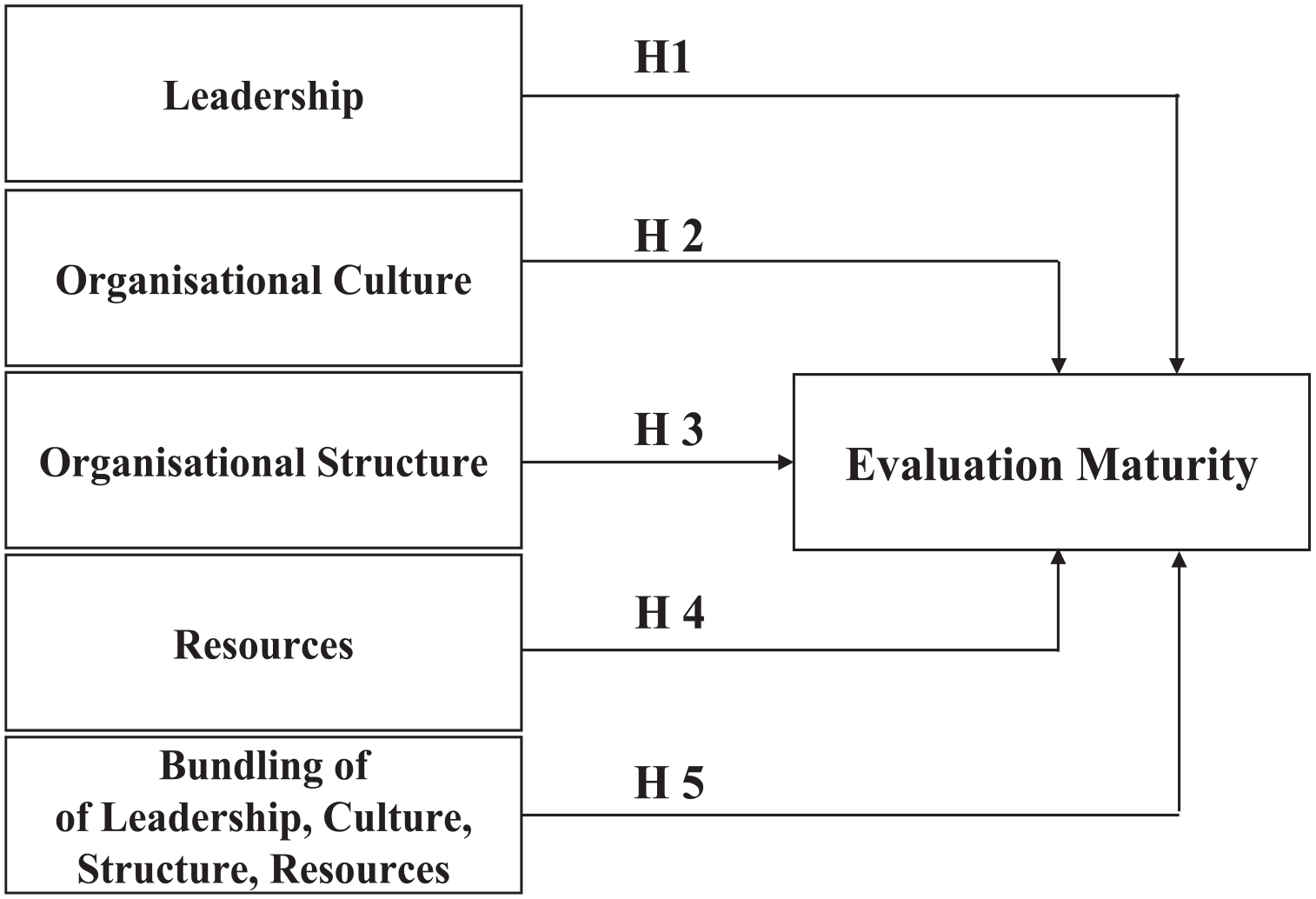
Conceptual model of organisational determinants of evaluation maturity.
Method
This study draws on original survey data collected from government agencies in Jordan to examine the organisational conditions that support the development of evaluation practices in the public sector. Between February and March 2024, a structured questionnaire was distributed to 122 government agencies across 24 ministries. A total of 92 agencies responded, representing over 75 per cent of the sample. The Ministries of Interior and Defence were excluded for security-related reasons. Respondents were senior management and evaluation officers, and the survey was administered electronically in Arabic. The survey measured the maturity of evaluation practices, as well as four organisational factors: leadership, culture, structure and resources. Responses were anonymised to ensure confidentiality, and the instrument was piloted and quality-checked prior to full distribution. Data were analysed using SPSS to explore relationships between organisational conditions and evaluation maturity. Statistical tests included descriptive analysis, bivariate correlations and hierarchical regression models to assess the predictive value of each independent variable. A full technical description of the questionnaire design, scale development, validation process, power analysis and statistical procedures – including robustness checks – is available in Supplemental Material S1 for readers interested in a detailed account of the methodology.
Results
Descriptive statistics
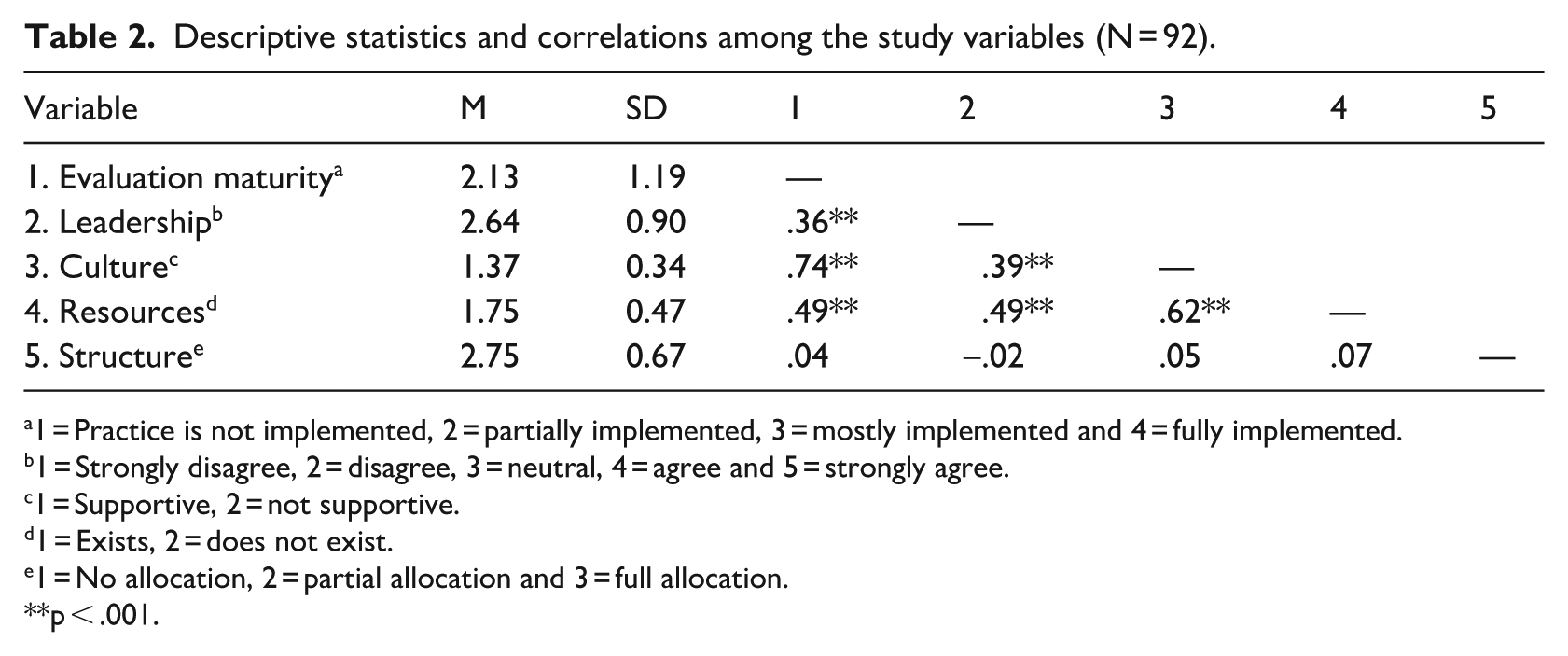
Table 2 presents the means, standard deviations and correlations among the different sets of variables that we used to test our hypotheses. Evaluation maturity (M = 2.13, SD = 1.19) indicates partial implementation of practices across the sample, with moderate variability. This variable demonstrated a strong positive correlation with organisational culture (r = .74, p < .001), suggesting a significant association between supportive cultures and more mature evaluation practices (Cohen, 1988; Table 1).
Trends in key government performance indicators in Jordan.

Descriptive statistics and correlations among the study variables (N = 92).
1 = Practice is not implemented, 2 = partially implemented, 3 = mostly implemented and 4 = fully implemented.
1 = Strongly disagree, 2 = disagree, 3 = neutral, 4 = agree and 5 = strongly agree.
1 = Supportive, 2 = not supportive.
1 = Exists, 2 = does not exist.
1 = No allocation, 2 = partial allocation and 3 = full allocation.
p < .001.
Leadership (M = 2.64, SD = 0.90) falls between disagreement and neutrality, exhibiting moderate positive correlations with both cultures (r = .39, p < .001) and resources (r = .49, p < .001). These findings align with previous research indicating that effective leadership is associated with more supportive organisational cultures and improved resource allocation (Bass and Avolio, 1993).
Organisational culture emerges as a central factor (M = 1.37, SD = 0.34) that was generally supportive with low variability. The strong correlations of culture with evaluation maturity and resources (r = .62, p < .001) underscore the critical role of culture in fostering both evaluation practices and resource management, which is consistent with Schein’s (2010) assertions about the pervasive influence of organisational culture.
Resource availability (M = 1.75, SD = 0.47) tends towards existence rather than scarcity, showing moderate to strong correlations with evaluation maturity, leadership and culture. This pattern highlights the interconnected nature of resources with other organisational aspects, supporting RBVs of organisational performance (Barney, 1991).
Notably, organisational structure (M = 2.75, SD = 0.67), which leans towards total allocation, exhibits no significant correlation with other variables. This independence suggests that structural aspects operate distinctly from other examined variables that are potentially influenced by or influenced by factors not captured in this study. This finding aligns with contingency theories of organisation, which posit that optimal organisational structure may vary independently of other organisational characteristics (Lawrence and Lorsch, 1967).
Hierarchical multiple regression analysis of factors influencing evaluation maturity
Hierarchical multiple regression analysis examines the impact of leadership, organisational culture, resources, structure and interactions on evaluation maturity. The analysis proceeded in five steps by adding new predictors to the model. We hypothesised positive associations between the predictors and evaluation maturity at each step.
Following Cohen and Cohen (1983), our analyses standardised all variables to reduce the potential effects of multicollinearity. The analyses employed a mean-centring procedure for all variables. In turn, the variance inflation factor for each regression coefficient was well below the recommended threshold of 10 (lowest = 1.00, highest = 1.85) (Neter et al., 1985), indicating that multicollinearity does not affect the weights of the controls or the hypothesised variables (Mason and Perreault, 1991).
This study employed a five-step hierarchical approach, introducing predictors in the following order: leadership, culture, resources, structure – treated as distinct predictors in the hierarchical regression analysis (Models 1–4). Their collective interaction is examined separately in Model 5 to assess the bundling effect (H5).
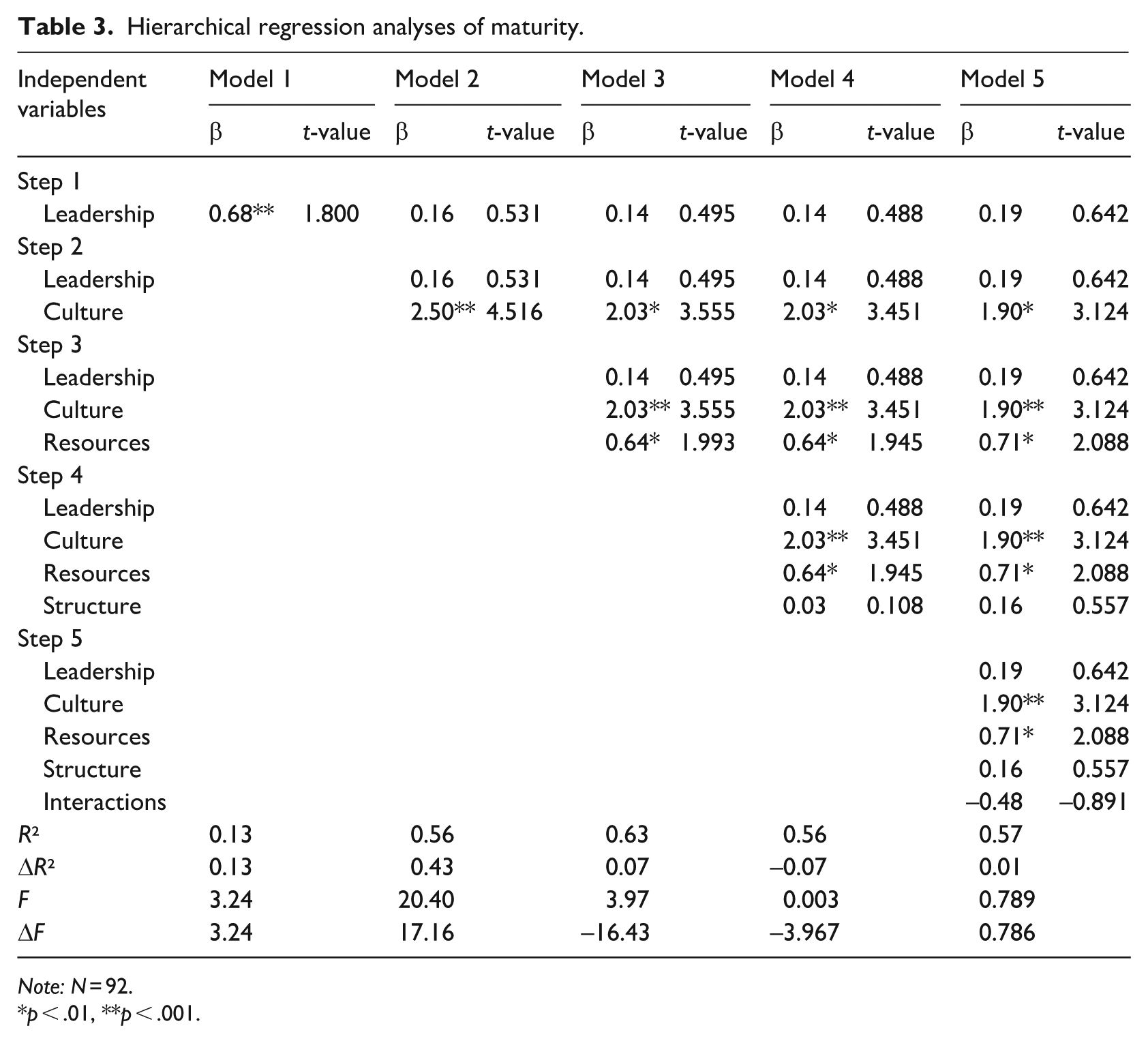
In the first step (Model 1), leadership was entered as the sole predictor, hypothesised to affect evaluation maturity positively. This model explained 13 per cent of the variance (R² = 0.13, F (1, 90) = 3.24). Leadership showed a significant positive relationship (β = 0.68, p < .01), supporting H1.
In the second step (Model 2), organisational culture was added and hypothesised to be positively associated with evaluation maturity. This step significantly improved the model (ΔR² = 0.43, ΔF = 17.16), explaining 56 per cent of the variance (R² = 0.56, F (1, 89) = 20.40). Culture emerged as a strong, significant positive predictor (β = 2.50, p < .001), supporting H2. However, leadership’s contribution became non-significant (β = 0.16, p = .601).
In the third step (Model 3), resources were incorporated and hypothesised to affect evaluation maturity positively. This step further improved the model (ΔR² = 0.07, ΔF = −16.43), accounting for 63 per cent of the variance (R² = 0.63, F (1, 88) = 3.97). Resources showed a significant positive relationship (β = 0.64, p < .01), supporting H3. Culture remained a significant positive predictor (β = 2.03, p < .001). However, leadership remained non-significant (β = 0.14, p = 0.626).
In the fourth step (Model 4), structure was added and hypothesised to associate with evaluation maturity. This addition did not significantly improve the model (ΔR² = −0.07, ΔF = −3.967), with the overall model fit decreasing slightly (R² = 0.56, F (1, 87) = 0.003). Culture (β = 2.03, p < .001) and resources (β = 0.64, p < .01) remained significant positive predictors. Structure (β = 0.03, p = 0.915) did not support the fourth hypothesis of a positive association.
In the final step (Model 5), interaction terms between leadership, culture, resources and structure were included and hypothesised to positively influence evaluation maturity. This step did not significantly improve the model (ΔR² = 0.01, ΔF = 0.786), explaining 57 per cent of the variance (R² = 0.57, F (1, 86) = 0.789). Culture (β = 1.90, p < .001) and resources (β = 0.71, p < .01) remained significant positive predictors. However, the interaction terms (β = −0.48, p = 0.385) did not support the fifth hypothesis of a positive association.
Across all models, culture consistently showed the most substantial positive influence on evaluation maturity, followed by resources, supporting our hypotheses. The initial leadership hypothesis was supported in Model 1 rather than in subsequent models. The results did not support the hypothesised favourable structure and association of interaction terms. The results are presented in Table 3.
Hierarchical regression analyses of maturity.
Note: N = 92.
p < .01, **p < .001.
Discussion
This study investigates the organisational determinants influencing evaluation maturity in the public sector in Jordan. It explores the interplay among leadership, organisational culture, structure and resource allocation in shaping evaluation maturity. The theoretical framework for this study is grounded in the RBV theory, which posits that an organisation’s ability to bundle and coordinate resources and capabilities is essential for achieving competitive advantage (Barney, 1991). In the context of public administration, RBV suggests that the maturity of policy evaluation is contingent upon the bundling of leadership, culture, resources and structure. The concept of ‘fit’ or complementary bundling, as articulated by Sirmon et al. (2007), emphasises the need for strategic actions to align and support one another to foster an environment conducive to evaluation.
The findings of this study underscore RBV’s capacity to explicate how Jordanian public sector organisations enhance evaluation maturity by leveraging internal resources. Notably, ministries with supportive organisational cultures utilise this inimitable resource to foster collaborative networks that facilitate knowledge-sharing among evaluation staff and embed evaluative practices within strategic decision-making frameworks. These cultural attributes, characterised by open communication channels and a collective commitment to evaluation objectives (Schein, 2010), enable public organisations to overcome resource scarcity and bureaucratic impediments, aligning with RBV’s premise that unique resources drive organisational capabilities (Barney, 1991). This process exemplifies RBV’s concept of resource bundling, wherein cultural norms synergise with human expertise to amplify evaluation capacity (Sirmon et al., 2007). Similarly, strategic resource allocation equips public organisations with the means to invest in data analytics platforms and capacity development for evaluation personnel. Such investments counteract external political constraints, including limited transparency and regime-driven resource prioritisation (Yom, 2013), by establishing resilient evaluation systems that support sustained organisational learning. Furthermore, RBV highlights the critical role of peer-driven knowledge networks in constrained environment, where centralised control often hampers formal evaluation mechanisms (Brinkerhoff and Goldsmith, 2002). These networks enable public organisations to disseminate evaluation expertise informally, fostering adaptive practices that navigate hierarchical barriers and enhance evaluation maturity (Cooper et al., 2023). This application of RBV diverges from leadership-centric paradigms, which over-emphasise top-down directives (Bass and Riggio, 2006), by emphasising the interplay of internal resources in mitigating external pressures.
The study reveals that organisational culture emerges as the most significant determinant, positively influencing evaluation maturity, while resource allocation also played a crucial role in enhancing evaluation practices. Although initially promising, leadership must maintain significance across various models, indicating a complex relationship between these variables.
The findings of this study reinforce the hypothesis that leadership plays a pivotal role in fostering an environment conducive to the adoption of evaluation practices. Transformational leadership has been linked to positive organisational change, yet its impact varies depending on contextual factors such as organisational culture and the specific challenges that public sector entities face (Bass and Riggio, 2006; Kotter, 1996). These findings align with the literature indicating that transformational leadership can enhance evaluation practices, but its effectiveness is often moderated by the organisational environment (Kotter, 1996; Yukl, 2013). In the context of Jordan, where political dynamics can significantly impact leadership styles, the need for leaders who prioritise evaluation and foster a culture of accountability is paramount. The results indicate that although leadership initially showed a significant positive relationship with evaluation maturity, its influence diminished when organisational culture and resources were introduced into the model. This suggests that effective leadership is necessary, but more is needed; it must be complemented by a supportive organisational culture and adequate resource allocation to enhance evaluation maturity. This finding aligns with previous research that emphasises the importance of leadership in shaping organisational culture and facilitating evaluation practices (Bass and Avolio, 1993).
Organisational culture emerged as a central factor influencing evaluation maturity, with solid correlations indicating that a supportive culture is essential to implementing evaluation practices successfully. A supportive organisational culture fosters an environment conducive to effective evaluation practices, encouraging open communication, collaboration and shared commitment to organisational goals (Denison, 1990; Schein, 2010). Moreover, a positive organisational culture can enhance employee engagement and commitment to evaluation processes, ultimately improving outcomes (Cameron and Quinn, 2011). This is particularly relevant in the context of public sector organisations, where cultural norms can either facilitate or hinder the implementation of evaluation practices. In Jordan, where public institutions often face challenges related to transparency and accountability, cultivating a supportive organisational culture is critical. The findings suggest that organisations that align their culture with evaluation goals are better positioned to integrate evaluation practices into their strategic frameworks. This alignment is critical in authoritarian contexts, where the fear of reprisal can inhibit open dialog about evaluation practices. Public institutions in Jordan can enhance their evaluation maturity and overall effectiveness by fostering a culture that encourages feedback and continuous improvement.
Furthermore, the interaction between leadership and organisational culture has been extensively documented, suggesting that transformational leadership enhances the positive effects of a solid organisational culture on performance outcomes (Bass and Riggio, 2006). This interplay is especially relevant in public sector organisations, where leadership often sets the tone for cultural norms and practices. Organisational culture, as an inimitable resource fostering collaboration, plays a pivotal role in shaping evaluation maturity within Jordan’s public sector. This cultural attribute facilitates the integration of evaluation into strategic processes by promoting a collaborative environment that transcends political constraints inherent in an authoritarian regime (Schein, 2010; Yom, 2013). Its significance underscores the urgent need for cultural reform in contexts where norms of accountability and transparency remain underdeveloped due to centralised control.
Following organisational culture, resource allocation also emerges as a pivotal factor in adopting evaluation practices, corroborating findings from previous research that emphasise the importance of adequate resources in facilitating organisational change and development (Bamberger et al., 2012; Patton, 2008). Effective resource management is essential for the successful implementation of evaluation practices, as it enables organisations to invest in necessary training, technology and infrastructure. Previous studies have highlighted the critical role of resource availability in enabling organisations to invest in training, technology and infrastructure necessary for practical evaluation (Bryson et al., 2011; Mason and Perreault, 1991). Organisations with sufficient resources are better positioned to implement comprehensive evaluation frameworks and sustain ongoing evaluation activities, suggesting policymakers should prioritise resource allocation as a strategic component of their efforts to enhance evaluation practices within public sector organisations.
Interestingly, the hypothesised positive associations for organisational structure and interaction terms were not supported by the data, indicating that structural aspects may not have a direct impact on evaluation maturity as previously assumed. The rigidity or complexity of organisational structures can impede the adoption of evaluation practices, particularly if they do not facilitate communication and collaboration among stakeholders (Lawrence and Lorsch, 1967; Mintzberg, 1979). However, structure’s impact is likely contingent on sufficient resource allocation and employee empowerment. Structures that allocate resources (e.g. funding for data systems) and empower employees (e.g. by involving evaluation staff in strategic planning) could enhance evaluation maturity, but such conditions are rare in Jordan’s centralised bureaucracy. This aligns with RBV’s premise that structural resources must be aligned with other capabilities, such as resources and culture, to be effective (Sirmon et al., 2007). The lack of employee empowerment, a cultural attribute, may further mediate structure’s impact, highlighting the need for integrated reforms. This lack of support for these hypotheses indicates a need to explore further how structural elements can be optimised to promote evaluation practices within public sector organisations.
The consistent prominence of organisational culture and resource allocation highlights the necessity for public sector organisations to cultivate a supportive culture and ensure adequate resources are available to facilitate effective evaluation practices. The limited impact of organisational structure underscores the complexity of the relationships between these variables and evaluation maturity. The findings regarding the organisational determinants influencing the adoption of policy evaluation practises in Jordan’s public sector are particularly significant when contextualised within the framework of an authoritarian regime. In such political environments, the dynamics of public administration can differ markedly from those in democratic contexts, affecting how organisational culture, resources, leadership and structure interact to shape evaluation maturity. The initial significance of leadership in predicting evaluation maturity, followed by its diminished role in subsequent models, presents an intriguing paradox that reflects the complex nature of public administration in authoritarian regimes. The subsequent decrease in leadership’s significance when other organisational factors are introduced suggests that while top-down initiatives may initiate changes in evaluation practices, more is needed to sustain them in the face of broader organisational and cultural factors. Furthermore, the diminishing significance of leadership across our models suggests that sustainable evaluation practices rely more on organisational culture and resource arrangements than on individual leadership initiatives. This finding extends our understanding of how public organisations develop evaluation capabilities, highlighting the importance of institutional mechanisms over personal authority. Organisational culture consistently emerged as the most substantial positive influence on evaluation maturity. This finding aligns with Bourgeois and Cousins’ (2013) emphasis on cultural factors in evaluation capacity development. When supportive organisational cultures exist, they can enhance evaluation maturity by encouraging reflective practices and valuing feedback (Patton, 2011).
Resource allocation also plays a significant role in supporting evaluation practices. Organisations that successfully develop evaluation capacity tend to establish effective resource management systems that support sustained evaluation practices. The relationship between structural elements and evaluation maturity suggests that organisations often develop informal mechanisms for evaluation capacity building that complement formal structures.
These findings have important implications for public sector evaluation capacity development. They suggest that effective evaluation practices emerge through the development of supportive organisational cultures and effective resource management systems. Future research could explore how organisations develop these supportive cultures and systems across different institutional contexts.
This finding challenges the traditional emphasis on strong, centralised leadership in authoritarian contexts and aligns with more recent scholarship on the limits of top-down reform in such systems. Our results extend this understanding to the realm of public administration, suggesting that while leadership can initiate evaluation reforms, sustaining and deepening these practices requires a more holistic approach that addresses organisational culture and resource allocation.
Throughout the models analysed, organisational culture consistently emerged as the most substantial positive influence on evaluation maturity. This observation is particularly relevant in Jordan, where public administration operates under a centralised authority that often prioritises regime values over participatory governance. In authoritarian regimes, organisational culture can be heavily influenced by the overarching political climate, which may stifle dissent and limit the scope for critical evaluation of policies and practices (Schein, 2010). A culture that promotes accountability and transparency may be less prevalent, potentially hindering the adoption of robust evaluation practices. However, when a positive organisational culture does exist, it can catalyse enhanced evaluation maturity, encourage employees to engage in reflective practices and foster an environment in which feedback is valued (Patton, 2011). The role of resource allocation in supporting evaluation practices is also critical in authoritarian contexts. In Jordan, where the state may tightly control public resources, the allocation of resources for evaluation activities can be influenced by political considerations rather than administrative needs. This can lead to a situation in which resources are allocated to support the regime’s objectives rather than foster genuine evaluation practices (Rose-Ackerman, 2016). Consequently, while the findings of this study indicate that resource allocation plays a significant role in enhancing evaluation maturity, the effectiveness of such resources may be contingent upon political will to prioritise evaluation within the public sector.
Although initially supported in the first model, leadership was needed to maintain its significance in subsequent models. This raises important questions about the nature of leadership in authoritarian regimes. In such contexts, leaders may focus more on maintaining control and ensuring compliance with regime directives than on fostering an environment conducive to evaluation and learning (Dahl, 1971). The initial promise of leadership in influencing evaluation maturity may reflect a superficial commitment to evaluation practices, which can dissipate when confronted with political pressure and the need to align with regime values. Moreover, the lack of support for the hypothesised positive associations between organisational structure and interaction terms suggests that the bureaucratic nature of public administration in authoritarian regimes may impede the adoption of evaluation practices. In Jordan, such regimes’ hierarchical and rigid structures can stifle innovation and limit the flow of information necessary for practical evaluation (Schein, 2010). This rigidity can create barriers to collaboration and communication that are essential for fostering an evaluation culture. As a result, public sector organisations may struggle to adapt to changing circumstances and may be less responsive to the needs of citizens, further complicating the evaluation process. The implications of these findings are profound, as they highlight how organisational determinants interact within the specific context of an authoritarian regime. Policymakers and public administration leaders in Jordan must recognise the complexities of their environments and work to cultivate a supportive organisational culture that prioritises evaluation practices. This may involve promoting transparency and accountability and ensuring that resources are allocated in a manner that genuinely supports evaluation efforts rather than serving political ends.
This study highlights critical considerations for policymakers and public administrators operating in Jordan and similar authoritarian contexts. Enhancing evaluation maturity within public sector organisations should be a primary focus, necessitating the cultivation of a culture that values evaluation and accountability. This can be achieved by implementing training programmes, establishing incentive structures and developing communication strategies that underscore the importance of evidence-based decision-making and critical evaluation. However, these initiatives must be meticulously designed to navigate the political sensitivities that characterise authoritarian systems, where the implications of such reforms can be profound and multifaceted (Yom, 2013). In addition to fostering an evaluation culture, strategically allocating resources is paramount in supporting evaluation practices. Policymakers must consider dedicating budgets specifically for evaluation activities, investing in robust data systems and developing human resources with skills pertinent to evaluation. Such resource allocation must be approached with a nuanced understanding of the political dynamics inherent in authoritarian regimes, in which control over resources often serves as a mechanism for maintaining power. This understanding is crucial for ensuring that resources are allocated and used effectively to enhance evaluation practices.
Moreover, reform efforts should not be limited to structural changes or leadership initiatives; instead, they should adopt a holistic approach that addresses culture, resources and structure. This comprehensive strategy may require long-term reform initiatives capable of navigating the intricate political landscape typically of authoritarian regimes. Theories of complex adaptive systems can be particularly useful in designing interventions that simultaneously influence multiple facets of organisational functioning concurrently, thereby enhancing the overall effectiveness of such reforms (Teisman and Klijn, 2008). It is also vital that reform strategies be tailored to the specific contexts of authoritarian regimes. Future policy initiatives must be grounded in a thorough understanding of the local political, cultural and institutional context rather than relying on generic, one-size-fits-all approaches to public sector reform. This aligns with the growing consensus that governance reform in developing countries should prioritise ‘best fit’ strategies over ‘best practice’ models, recognising the unique challenges and opportunities present in each context (Andrews, 2013; Grindle, 2007).
Enhancing evaluation maturity in authoritarian contexts requires a multifaceted approach that integrates cultural, resource-based and structural considerations. Policymakers must be acutely aware of the political sensitivities at play and must design contextually relevant and strategically sound initiatives. By doing so, they can foster a more robust culture of evaluation and accountability, ultimately leading to improved governance and public sector performance.
This study offer critical insights for public administration reform in authoritarian contexts beyond Jordan, where political constraints often impede evaluation maturity. The primacy of organisational culture as an inimitable resource suggests that reform strategies should prioritise fostering a collaborative cultural environment that aligns with evaluation objectives, even in regimes where transparency is limited (Schein, 2010). Such cultural reforms can involve developing incentive structures that encourage reflective practices and establishing communication channels that mitigate fears of reprisal, a common barrier in authoritarian settings (Yom, 2013). In addition, the mediating role of culture on leadership underscores the need for leadership development programmes that empower bureaucrats and political representatives to champion evaluation despite regime compliance pressures (Bass and Riggio, 2006). Resource allocation, while contingent on political will, can be optimised through adaptive strategies, such as leveraging international aid programmes to support evaluation capacity, a practice applicable to other resource-constrained authoritarian regimes (Teisman and Klijn, 2008). These strategies must be tailored to the specific political and institutional dynamics of each context, ensuring that reforms are both feasible and effective (Andrews, 2013).
Limitations and future research directions
This study provides valuable insights into the determinants of evaluation maturity in the public sector in Jordan, but several limitations should be considered.
The findings may not be directly generalisable to countries with different political, cultural or economic contexts due to the unique governance dynamics at play. Jordan’s centralised political structure, characterised by limited transparency and accountability (Worldwide Governance Indicators, 2024), shapes the externally contingent nature of structure and resources, which may differ in democratic settings where participatory governance and resource autonomy are more prevalent (Moynihan and Pandey, 2005). However, the emphasis on organisational culture as an inimitable resource fostering evaluation maturity holds potential applicability to other authoritarian contexts with similar governance challenges, such as those with constrained accountability norms (Yom, 2013). In democratic settings, where cultural alignment and resource allocation remain critical for evaluation maturity, the findings suggest that fostering a collaborative culture can enhance evaluation practices, though the mechanisms may differ due to greater institutional flexibility (Andrews, 2013).
Future research should adopt a comparative approach, examining how cultural and leadership dynamics influence evaluation maturity across diverse political systems. Studies comparing authoritarian and democratic contexts could elucidate how governance structures moderate the effects of organisational culture on evaluation practices, bridging macro-level systemic factors with micro-level organisational behaviours (Moynihan and Pandey, 2005).
The reliance on quantitative methods, while robust, may not fully capture complex variable relationships. Qualitative approaches, such as interviews and case studies, could offer deeper insights into evaluation maturity and public sector employees’ experiences. While the study focuses on internal factors such as culture, leadership, structure and resources, external influences such as political pressures, public opinion and international standards also warrant exploration.
Future research should investigate the moderating roles of resource allocation and employee empowerment in the relationship between organisational structure and evaluation maturity. Mixed-methods approaches, combining surveys with qualitative interviews, could provide deeper insights into how structural dynamics interact with resources and cultural factors in authoritarian contexts.
The cross-sectional design limits causal inference, as it captures relationships at a single point in time. Longitudinal studies could reveal how changes in organisational dynamics influence evaluation maturity over time. In addition, examining evaluation maturity in the private sector and non-governmental organisations (NGOs) could provide valuable comparisons and transferable best practices.
Future research could explore how global actors, including aid programmes and professional networks, interact with local dynamics to promote evaluation capacity. Comparative and interdisciplinary studies integrating public administration, political science and organisational psychology could provide a comprehensive understanding of evaluation practices in authoritarian settings, bridging macro-level systems and micro-level organisational behaviours (Moynihan and Pandey, 2005).
Conclusion
This study examines the factors influencing evaluation maturity in public sector organisations within authoritarian regimes, focusing on leadership, organisational culture, resources and structure as critical determinants. The research enhances the understanding of how these factors interact to shape evaluation maturity in public administration. Findings reveal that organisational culture is the most significant factor affecting evaluation maturity, supporting the literature on the importance of cultural dynamics in organisational behaviour and performance. A solid organisational culture fosters evaluation through open communication, collaboration and shared goal commitment. Although leadership initially appears influential, its impact diminishes when contextual factors such as culture and resource availability are considered. This challenges traditional leadership views as the primary driver of organisational change, especially in politically constrained environments. Resource allocation is also critical for enhancing evaluation practices, as effective management enables investments in training, technology and infrastructure. Public sector organisations must prioritise resource allocation to improve evaluation practices, linking this to broader economic development and democratisation discussions in authoritarian contexts. The study suggests that organisational structure may not directly influence evaluation maturity, as previously thought; rigid structures can hinder the adoption of evaluation practices by impeding communication and collaboration. This highlights the need to further explore how structural elements can be optimised to support evaluation efforts. The implications extend to public administration reform, emphasising the need for policymakers to cultivate a supportive organisational culture that prioritises evaluation practice. This involves promoting transparency and accountability while ensuring that resources genuinely support evaluation efforts. Fostering a culture of evaluation and accountability can enhance evaluation maturity in public sector organisations.
The implications extend to public administration reform, emphasising the need here also for policymakers to cultivate a supportive organisational culture that prioritises positive evaluation practices. This involves promoting transparency and accountability while ensuring that resources genuinely support evaluation efforts. Fostering a culture of evaluation and accountability can enhance evaluation maturity in public sector organisations, a strategy that holds relevance not only for Jordan but also for other authoritarian contexts where similar governance challenges prevail (Yom, 2013). In regimes with centralised control, cultivating a collaborative culture can serve as a transferable approach to overcoming political barriers, though it must be adapted to local political and institutional dynamics to ensure effectiveness (Grindle, 2007). By integrating cultural reforms with strategic resource allocation and leadership development, policymakers can foster resilient evaluation systems capable of improving governance and public sector performance across diverse authoritarian settings.
Supplemental Material
sj-docx-1-evi-10.1177_13563890251347270 – Supplemental material for Organisational determinants of evaluation maturity in the public sector: A resource-based perspective
Supplemental material, sj-docx-1-evi-10.1177_13563890251347270 for Organisational determinants of evaluation maturity in the public sector: A resource-based perspective by Anis Ben Brik and Mira Hussein in Evaluation
Footnotes
Declaration of conflicting interests
The author(s) declared no potential conflicts of interest with respect to the research, authorship and/or publication of this article.
Funding
The author(s) received no financial support for the research, authorship and/or publication of this article.

Supplemental material
Supplemental material for this article is available online.
References
Supplementary Material
Please find the following supplemental material available below.
For Open Access articles published under a Creative Commons License, all supplemental material carries the same license as the article it is associated with.
For non-Open Access articles published, all supplemental material carries a non-exclusive license, and permission requests for re-use of supplemental material or any part of supplemental material shall be sent directly to the copyright owner as specified in the copyright notice associated with the article.
