



Abstract
Realist evaluation is in essence a theory-building and testing approach. We argue that in practice, the theory-building potential of realist evaluation, review and research is not fully exploited in the field of global health. Our assumption is that the Structure-Agency-Culture explanatory framework of critical realist Margaret Archer could stimulate realist evaluators to conceptualize and systematically explore how structural and cultural conditions interact with programmes that aim at introducing social change. We propose step-wise guidance towards integrating the Structure–Agency–Culture framework into the development of realist programme theories. We present a worked example from an urban adolescent health study in poor neighbourhoods of Kampala, Mumbai, New Delhi and Cotonou. The guidance aims to bring to the fore the role of agency and context through the analysis of the interactions between structure, culture, agency and mechanisms. This is helpful in realist research in general, and in evaluations of complex interventions oriented towards social change.
Introduction
In 2008, Walt and colleagues found that the field of (global) health policy analysis was ‘lacking explicit theoretical or conceptual grounding’ (Walt et al., 2008). Twelve years later, Ridde and colleagues reinforced this point, arguing that global health interventions are not sufficiently supported by theories and analytical frameworks. Global health decision-makers, researchers and evaluators have been favouring impact evaluation over the evaluation of implementation processes, losing sight of the role of contextual conditions in implementation success (Ridde et al., 2020). Generally in global health, formative evaluations that can identify causal mechanisms and inform strategies that aim at social change are rare. More generally, a theorizing practice is largely absent (Gilson et al., 2011). Yet, we strongly believe that ‘Nothing is as practical as a good theory’ (Lewin, 1945), especially in the field of implementation research in global health (Ridde, 2016). Realist methodology, including research, evaluation and synthesis, is in essence a theory-building and testing approach (Emmel et al., 2018; Pawson and Tilley, 1997). Its current application in global health has helped in familiarizing researchers with the steps towards theory-building (Marchal et al., 2018, De Weger et al., 2020), but we argue that in practice, the theory-building potential of realist evaluation (RE) is not fully exploited.
In his article, on the practice of theorizing in social science, Swedberg (2014) stepped away from the reification of theory sui generis towards considering theorizing as a praxis. He argued that more transparency, and thus, guidance is warranted on how theory is generated. We respond to this call for guidance and aim at contributing to an improved practice of theorizing in global health research. Our starting point is that programme evaluations often fail to indicate why and how a programme works, and how and in which context conditions it could be scaled up successfully elsewhere. As a result, opportunities for taking lessons learned from implementation research to other programmes and contexts are missed. In this article, we examine how Realist Evaluation (RE) and realist research may offer pathways to address this issue. We explore whether the work of Margaret Archer, and specifically her Structure–Agency–Culture (SAC) frame, can help realist researchers in building more refined programme theories that locate the actions of the people involved in a programme in the structural and socio-cultural system in which they are embedded.
Investigating social change and the role of context in RE
RE has come a long way from its origins in criminology, where it was originally developed by Pawson and Tilley to find out how, when and why government-funded CCTV interventions as a way of deterring criminal activity in the United Kingdom were effective (Pawson and Tilley, 1997). Nowadays, realist methodology is being used in a wide range of domains, from food security (Lam et al., 2021) and advocacy interventions addressing sexual violence (Rivas et al., 2019) to coproduction for long-term care and carbon reduction strategies for health care organizations (Husein and Sidhu, 2021). This mirrors the rise of realist methodology in global health in recent years (Marchal et al., 2018). The increased use of realist approaches coincides with an increase in commissioning and funding of realist studies and evaluations by international agencies (such as the International Federation of Red Cross and Red Crescent Societies, the Overseas Development Institute, the World Health Organization, etc.), research councils in the United Kingdom, Belgium, Australia, Canada and New Zealand, private foundations such as the Bill and Melinda Gates Foundation (Munar et al., 2018) and even provincial health authorities (Flynn et al., 2021). Several institutions now organize courses for health researchers and practitioners, including the Centre for Evidence-Based Medicine, University of Oxford and the Centre for Advancement in Realist Evaluation and Synthesis (Emmel et al., 2018; University of Oxford, 2022).
The rise in RE and research is arguably related to the scrutiny given to impact evaluation designs in the world of development cooperation (Stern et al., 2012). Coronavirus disease-19 further exposed some of the limitations of the study designs underpinning evidence-based medicine (Greenhalgh, 2020). Another indication of the recognition of realist approaches can be found in the UK Medical Research Council’s guidance for evaluation of complex interventions, whose recently updated version explicitly mentions RE (Skivington et al., 2021).
Over the years, training materials and reporting standards on RE were developed by the RAMESES project (Wong et al., 2016), and further guidance on how to elicit the initial programme theory (IPT) has been presented (Smeets et al., 2022; Vincent et al., 2022). The increased use of RE has led to methodological innovations. This includes combining RE with randomized controlled trials (Warren et al., 2022) or with qualitative comparative analysis (Befani et al., 2007). Much attention has gone to the Context–Mechanism–Outcome (CMO) configuration (De Weger et al., 2020) and to what constitutes a mechanism, perhaps to the detriment of a better methodological guidance on the realist analysis of context (Dalkin et al., 2015; De Souza, 2013; Nielsen et al., 2022). Other methodological advances include the development of guidance on realist interviewing and how to conduct focus groups in REs (Manzano, 2016, 2022), the use of analytical software (Dalkin et al., 2021), or the use of soft systems methodology (Dalkin et al., 2018). Researchers have also sought ways to make RE more inclusive by making the process explicitly participatory, for example, through combining it with action research (Westhorp, 2011), while others framed RE in a post-colonial critique of global health (Gilmore, 2019; Renmans et al., 2022).
The increased use of realist enquiry in global health has not been entirely without its problems (Gilmore, 2019). First, evaluations of interventions funded or implemented by development cooperation agencies in Low- and Middle-Income Countries are often geared towards social change. Yet, we agree with De Souza (2022) that, in practice, not all REs in global health have taken sustained social change into account. This can be related to the desire of commissioners of evaluations and programme managers to demonstrate the effectiveness of their short-term programmes and to respond to demands for upwards accountability to donors (Ebrahim, 2003). Second, we argue that early applications of RE in global health and development have been primarily concerned with mechanisms at the individual behaviour level to the detriment of relational, organizational or higher-level determinants. In Lemire et al.’s (2020) review of REs published between 1997 and 2017, mechanisms were in 50 per cent of the cases presented as an individual’s psychological or behavioural response to the intervention. However, other applications of RE in development have grappled with social change, with realist evaluations of community empowerment and accountability and sustainability of outcomes as most notable examples (Feeny et al., 2022; Westhorp, 2014).
There has been a recent focus on the integration of critical realism in RE, which has been picked up by scientific communities at the interface between theory and practice, such as social work, education, management and nursing (Alderson, 2021; Blomqvist Mickelsson, 2022; De Souza, 2013, 2022; Frederiksen and Kringelum, 2021; Pease et al., 2009; Schiller, 2015; Scott and Bhaskar, 2010; Shipway, 2011) Their orientation towards transforming power dynamics and emancipatory change aligns well with the paradigm of critical realism (Boost et al., 2020; Tennant et al., 2020). In that literature, the most attention goes the work of Roy Bhaskar, a leading critical realism scholar whose transformational action model was used, for instance, to guide evaluations in education (Bhaskar, 1998; De Souza, 2013, 2022; Sharar, 2016; Sprague Martinez et al., 2018).
In this article, we explore how the work of Margaret Archer, another leading critical realist, may help in better developing theory within RE. Archer is a British sociologist and critical realist theorist who published numerous works, most famously arguing against the fallacy of conflating structure and agency in causal explanation in her 1995 work Realist Social Theory: The Morphogenetic Approach (Archer, 1995). Other influential work of Archer deals with agency, reflexivity and the place of culture in social theory (Archer, 1995, 1996, 2000, 2003, 2012). Pawson (2013) referred to Archer’s work as one of the ‘seven pillars of wisdom’ on which RE was built.
Central to any realist research is the development and testing of programme theories. A realist study starts from an IPT that presents the assumptions underlying the programme or situation under examination. It can be considered as a hypothesis, which is ‘tested’ through empirical research, leading to a refined programme theory (PT). This in turn is the starting point of a next study and, over time, insights accumulate leading to a PT that may shift to the level of abstraction of a middle range theory. Realist evaluators use the CMO configuration as a heuristic to identify how a programme triggered mechanisms that contributed to the observed outcome in a specific context (Pawson and Tilley, 1997).
RE and research can be considered as a methodology that is still under development. Realist evaluators are quite a heterogeneous group who often apply the above-mentioned realist principles in different ways. In other words, RE is a ‘broad church’ (Pawson and Manzano-Santaella, 2012). The question of what constitutes context and how mechanisms interact with the context of an intervention is not yet fully answered (Greenhalgh, 2020). There is, indeed, still room for a methodological discussion regarding the steps taken in realist analysis and the challenges encountered at each step (Flynn et al., 2021). This is where Archer’s SAC framework may prove useful (Archer, 2020; Archer et al., 2022). As we will discuss below, the SAC framework allows for investigating more precisely how a programme is embedded in its context and how the interaction between the programme and the context shapes the outcomes.
We first briefly introduce Archer’s morphogenetic approach and the SAC framework. In the second part, we will illustrate how the SAC frame can be integrated in RE and research through a worked example of the development of the IPT in a research project on accountability in adolescent health in urban poor neighbourhoods.
Archer’s morphogenetic/morphostatic cycle
Central to Archer’s work is the structure–agency debate, one of the core tenets of social theory. Sociological theorists adhering to structural functionalism emphasized that social structure determines agency. Sociologist Anthony Giddens argued that structure and agency cannot be separated as they constitute each other ( ‘structuration’) (Giddens, 1984). Archer argued that the two can and must be analysed as separate entities to explore their interaction. Archer’s morphogenetic/morphostatic cycle (Figure 1) focuses on the interdependence between structure, culture and human agency and indicates how the interaction between structure, culture and agency transforms (or not) a given social order. She stated that ‘the explanation of any social phenomenon whatsoever always comes in a SAC because it must incorporate the interplay between Structure, Culture and Agency, rather than causal primacy automatically being accorded to one of them’ (Archer, 2020: 142). Archer (1996: 142) considers structure (the material sphere), culture (the ideational sphere) and agency as entities that are not happening synchronously, but are, nevertheless, interacting. To demonstrate this interaction, they should be analysed as distinct categories. She defines culture as the propositions held to be true or false in society at any given time which mutually influence and interact with norms, meanings, preferences and other parts of the cultural system generated through cultural interaction (Archer, 1996). Human agency gives shape to structure, and in turn, structure and culture facilitate or constrain human agency and social action. In other words, culture and structure, such as entrenched power dynamics in a (health) system, are the result of past and continued human agency. Structure and culture both are ‘(human) activity dependent’, while agency is ‘context-dependent’: human action always has a context, happens at a specific time and in a specific place and has a historical background of past action, which is being re-interpreted and given meaning in the present (Byrne and Callahan, 2014).
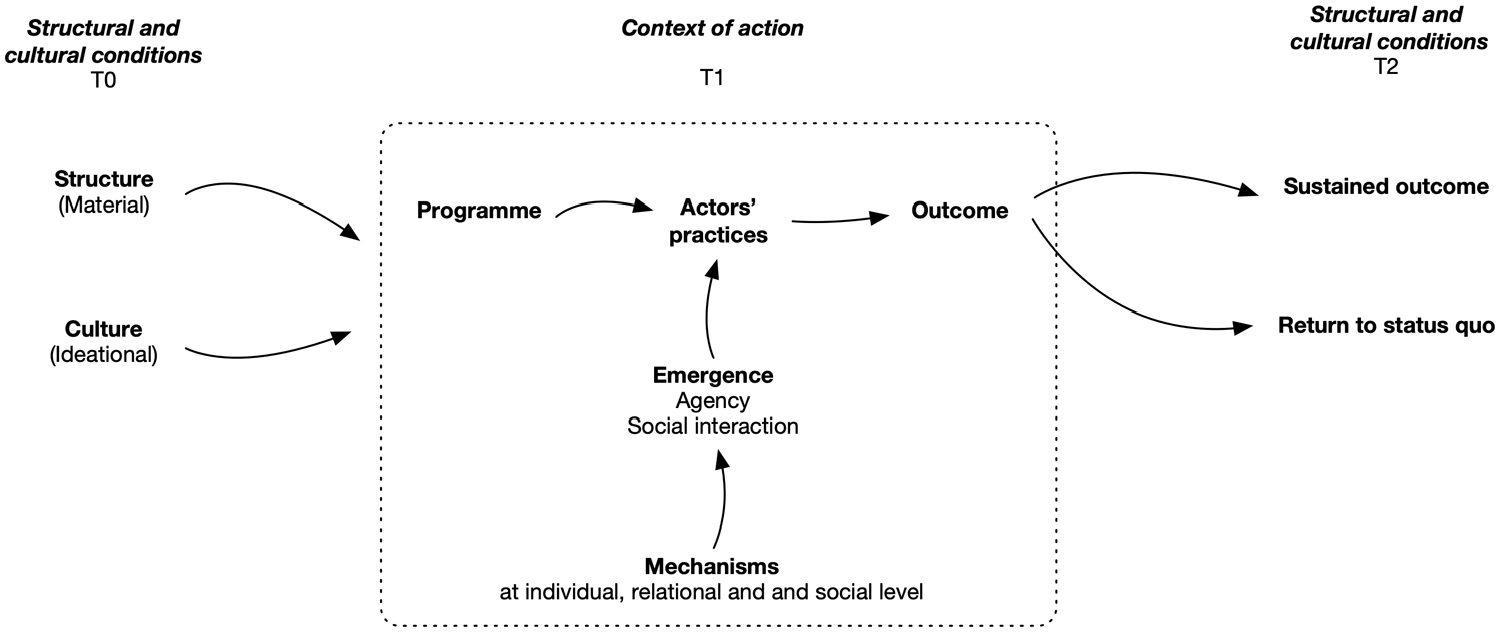
Applying the SAC rationale to programme evaluation.
In the morphogenetic/morphostatic cycle (social), structure refers to the material realm. It can be defined as ‘the whole of institutions and arrangements that exist within and through actors’ practices’ (De Souza, 2013). Culture refers to the cultural realm: ‘the propositions or ideas to be held true or false in society at any given time which interact with actors’ norms, preferences and other parts of the cultural system generated through sociocultural interaction’ (Archer, 1996). De Souza defines action as the circumstances in which the action or intervention occurs. We refer the reader to Mingers for additional information on critical realism (Mingers, 2000).
Using the SAC frame to develop causal explanations
To build a causal explanation, Archer proposes to analyse the interactions between the three constitutive elements of the social order – structure, agency and culture (SAC). Each element has causal powers. Each element is considered to be essential and none has causal priority over the other. Figure 1 presents how we adapted Archer’s conceptualization of the SAC framework to the context of programme evaluation. At Time 1, action occurs or, more specifically, an intervention is implemented in a context of action. The structural and cultural conditions predate the action (or intervention) (Time 0) and continue to exert a causal influence on what happens in the context of action. In the latter, human agency and social interaction lead to emergence. This emergent action leads to outcomes, which can either lead to sustained change in the sense of modified social and cultural context conditions, or to maintaining the status quo (Time 2). At the core of change is emergence, which generates the outcomes. Actors’ actual practices are crucial in instigating social change, and mechanisms underlying these practices can be triggered at the agential, relational and system level (Archer, 2020; De Souza, 2013).
Applied to programmes in health, Archer’s approach would situate a programme in pre-existing structural and cultural conditions and question in how far the programme affects prevailing structure and culture, as much as how structural or cultural conditions shape the programme and its effects. Researchers and evaluators need to extricate the causal mechanisms underlying the emergent action or practices triggered by a programme and examine how these relate to the structure and culture. Imagine a programme set up in a resource-constrained setting to reduce maternal mortality by discouraging the practice of delivering at home with unskilled attendants. The programme includes sensitizing communities and their leaders on the importance of antenatal care and skilled birth attendance, training of nursing staff and improving referral practices between first-line health facilities and the hospital. In addition, it initiates a dialogue between community leaders, health practitioners and service managers. The programme designers ultimately seek to influence prevailing social norms related to antenatal care, health seeking behaviour and delivery, and to induce the social change that is critical to achieve the intended outcome. The intervention to train traditional birth attendants (TBA) in detecting pregnant women with high risks of complications occurs in a context where TBA play a specific role and enjoy a specific social status. The intervention may intend to change their role from caregiving and counselling pregnant women to a more medical role of risk assessment and referring to a hospital. This will change the overall role distribution among health workers (affecting structure), but it may be resisted by the TBA and families, especially if regular health services are poorly accessible or deemed too expensive. If because of the intervention, the decision-making power of pregnant women within households or communities is increased, this impacts on power dynamics and could potentially lead to transforming the culture surrounding health seeking behaviour. To understand the causal pathways that may explain the desired changes, the researchers thus need to analyse how the agency and practices of actors in such a programme are circumscribed by interactions with the structural system (e.g. the health system in which TBA operate) and the cultural system (including the beliefs and practices related to pregnancy and delivery).
How to integrate the SAC framework in realist theory-building
In the remaining part of the article, we examine how the SAC framework can help in eliciting initial programme theories. The SAC framework is geared towards understanding the emergence of (non-) change through social interaction and it explicitly involves ‘looking one level up’: the researcher not only explores the causal configurations underlying the programme, but also how these have been shaped by and/or have changed the pre-existing conditions, and whether the change will be sustained (De Souza, 2022). Our assumption is that the SAC framework could stimulate realist evaluators to better conceptualize and explore the role of structural and cultural conditions in view of social change. We propose a four-step process and we will use one of our current research projects on adolescent accountability as an illustration.
Background: The urban adolescent health study
This study aims at developing a better understanding of the structural conditions and the mechanisms underlying accountability in sexual and reproductive health for adolescent girls and young women. The study focuses specifically on urban neighbourhoods marked by social exclusion and resource constraints in Low- and Middle-Income countries. We seek to better understand how past and current meso- and macro-level social processes (e.g. urban segregation, marginalization, gendered disempowerment) shape the outcomes of adolescent health interventions aiming towards social change. We adopted RE as the methodological approach. The IPT will be ‘tested’ in four different urban settings in three countries (Benin, Uganda and India) (Van Belle, 2022).
Step 1: Information- and theory-gleaning
Since the IPT should offer potential explanations of the effectiveness of the programme in question, researchers often combine methods to find relevant constituent elements of the IPT. According to the current guidance, the IPT can be elicited on the basis of a review of the existing knowledge (for instance, through literature reviews), programme document reviews, interviews with programme designers and implementers, and exploratory research (Marchal et al., 2018; Shearn et al., 2017; Smeets et al., 2022) The SAC framework requires the realist evaluator to identify theories that reach beyond the mechanisms underlying the programme to obtain insights into the structural and cultural conditions that may influence the actors involved in the programme. The above methods can be used to identify relevant structural and cultural factors and orient the search for theories that explain how structure and culture would influence the programme in question.
Since our study builds on a realist study of accountability in sexual and reproductive health at a local health system level (Van Belle, 2014; Van Belle and Mayhew, 2016), we used the refined PT of that study as the starting point. We further developed this PT on the basis of a scoping review on accountability interventions in sexual and reproductive health (Van Belle et al., 2018) and a realist-informed review on digital empowerment strategies to improve sexual and reproductive health (Goh et al., 2022). The scoping review pointed to the existence of a complex accountability ‘ecosystem’ wherein interventions attempt to transform the terms of engagement between the actors. We found that there is little understanding of the interaction between accountability interventions and this context. In the review on empowerment, we found that there is a notable under-theoretization of the urban space in LMIC and its meaning for adolescents. This led us to glean insights and theories from recent social science monographs and readers on solidarity (e.g. Oosterlynck et al., 2015), local urban informality and governance (Bevir, 2017), urban gendered space (Stavrides, 2019) and empowerment (Kern, 2021).
Step 2: Extracting causal configurations from the literature and other data sources
In the second step of developing an IPT and in line with the guidance of Pawson and Tilley, researchers often use the CMO configuration as a heuristic to identify mechanisms and context conditions that may plausibly explain the intended outcomes of the programme. The SAC framework demands a more systematic analysis of ‘context’ in terms of the intervention triggers individual, relational and societal mechanisms in specific structural and cultural contexts.
Many realists have been pre-occupied with the definition of mechanisms and have developed different ways to categorize and identify potential mechanisms, often neglecting the role of context, and under-developing the causal configuration of intervention, outcome, context and mechanisms (Marchal et al., 2018; Pawson and Manzano-Santaella, 2012; Wong et al., 2017). The challenge here lies in carefully examining and extracting the conditions under which a programme is expected to work when exploring the assumptions of the stakeholders and reviewing the literature. We recommend to be transparent about the selection of concepts and theories. It may help to involve social scientists who are knowledgeable about a broad range of social phenomena, paradigms and theories, and to embed the evaluation in a broader cycle of theory construction (Greenhalgh and Emmel, 2018; Jones, 2018; Marchal et al., 2012).
In our study, we would like to better understand how and why meso- and macro-level mechanisms in interaction with context shape accountability towards adolescents. Actors’ practices are at the core of our PT development, as our previous work showed that they perform various roles in the accountability system (Van Belle et al., 2018). Archer’s framework allows us to foreground the relational mechanisms that accountability interventions may trigger and which are situated in the interaction between structural and cultural conditions, on one hand, and agency of the actors, on the other. Different strategies are used to enhance accountability in the field of adolescent sexual and reproductive health and multiple mechanisms can be expected to come into play.
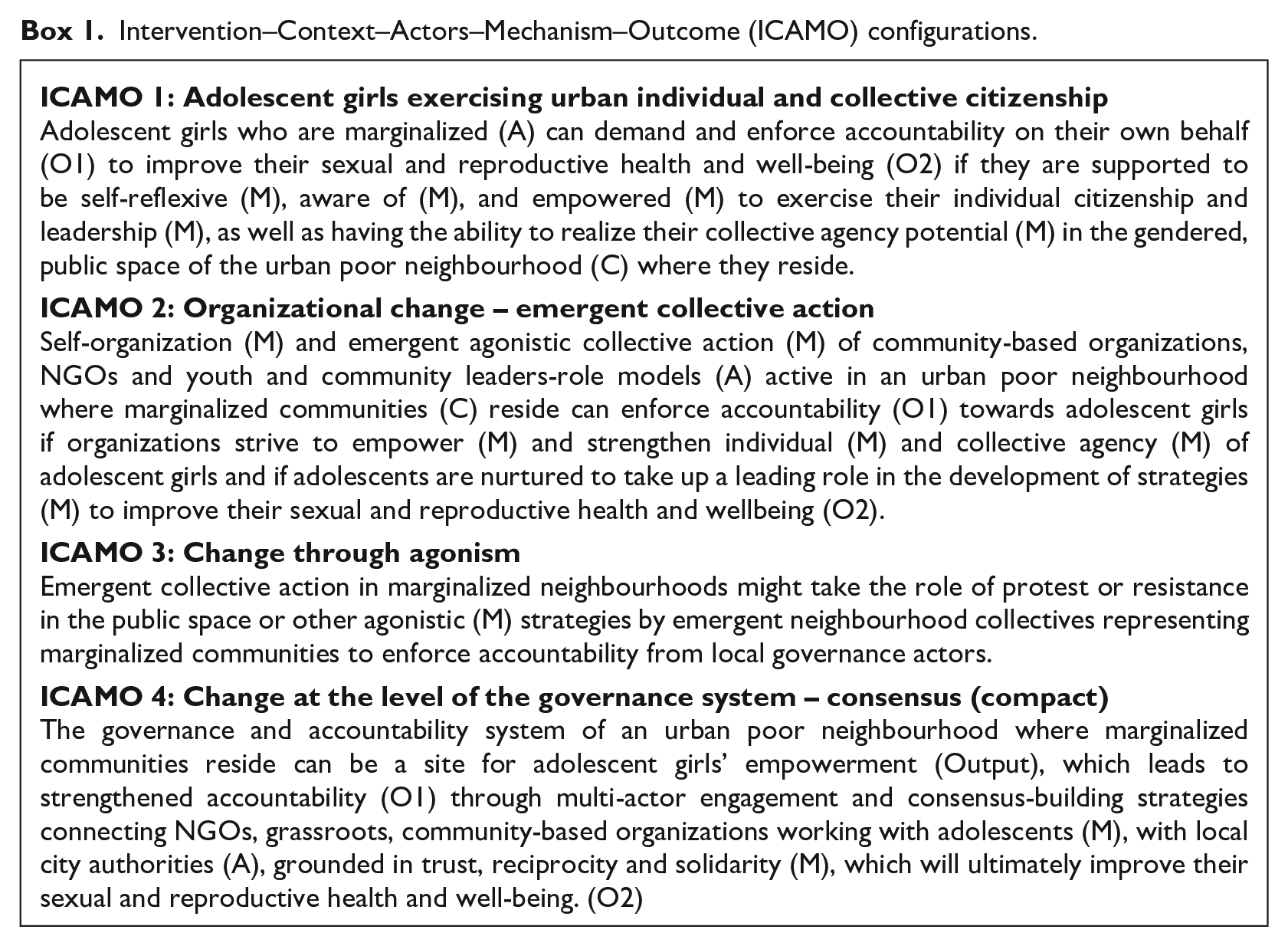
In practice, we started by using the Intervention, Context, Actor, Mechanism, Outcome (ICAMO) configuration to make sense of the findings of the previous step (Marchal et al., 2018). By adding ‘actors’ to the CMO configuration, we emphasize the role of human agency and actor orientation, critical to Archer’s work. Adding ‘intervention’ helps to stimulate the researcher to differentiate the ‘intervention’ from ‘context’. While working on the development of the ICAMO configurations, we found that the theories of Habermas (1987) and Mouffe (2013) allowed us to integrate and frame the results of the previous step at a more abstract level. This led to the identification of two main routes to achieve accountability – consensus-oriented strategies and agonism. Each has specific underlying mechanisms of collective action. While Kapoor (2002) considers these two approaches as opposites, we posit that organizations often use both strategies simultaneously. A non-governmental organization may organize protests in front of a local council, while organizing a dialogue between health providers and adolescents on adolescent-friendly sexual and reproductive health and rights (SRHR) services. For a more detailed discussion of the application of the theories of Habermas and Mouffe, we refer to earlier work (Van Belle, 2014; Van and Belle, 2022).
As an illustration, Box 1 presents the four ICAMO configurations we identified. ICAMO 1 situates the potential for change in the adolescents themselves: aware of their SRH rights and aspiring to take up leadership, they may catalyse collective action to enforce accountability from local governance actors. NGOs working in their setting may support the adolescents in realizing their potential. ICAMO 2 focuses on the role of NGOs, and community-based and grassroots organizations. If their strategies empower adolescents and the neighbourhood community to demand and enforce accountability, they can bring about change. ICAMO 3 assumes that change happens through agonistic strategies of emergent neighbourhood collectives, which enforce accountability from local governance actors. Finally, a fourth potential lever for change is located at the level of the governance and accountability system, where local governance actors interact and form a compact to initiate change. To be successful, these compacts or informal (governance) arrangements need to be grounded in trust, reciprocity and solidarity. By strengthening adolescent accountability, they ultimately may contribute to improving sexual and reproductive health and well-being of adolescents (ICAMO 4).
Intervention–Context–Actors–Mechanism–Outcome (ICAMO) configurations.
Step 3: Linking structure, agency and culture
While the ICAMO configuration proved to be a useful method to integrate concepts and insights from step 1, it is clear that it does not lead automatically to an exploration of how structure and culture (as separate analytical categories of contextual factors) shape the outcome under investigation, nor of the dimension of time and sustained social change. We propose the following roadmap for examining how structure, agency and culture are linked in the development of the PT (Box 2).
A SAC analysis roadmap.
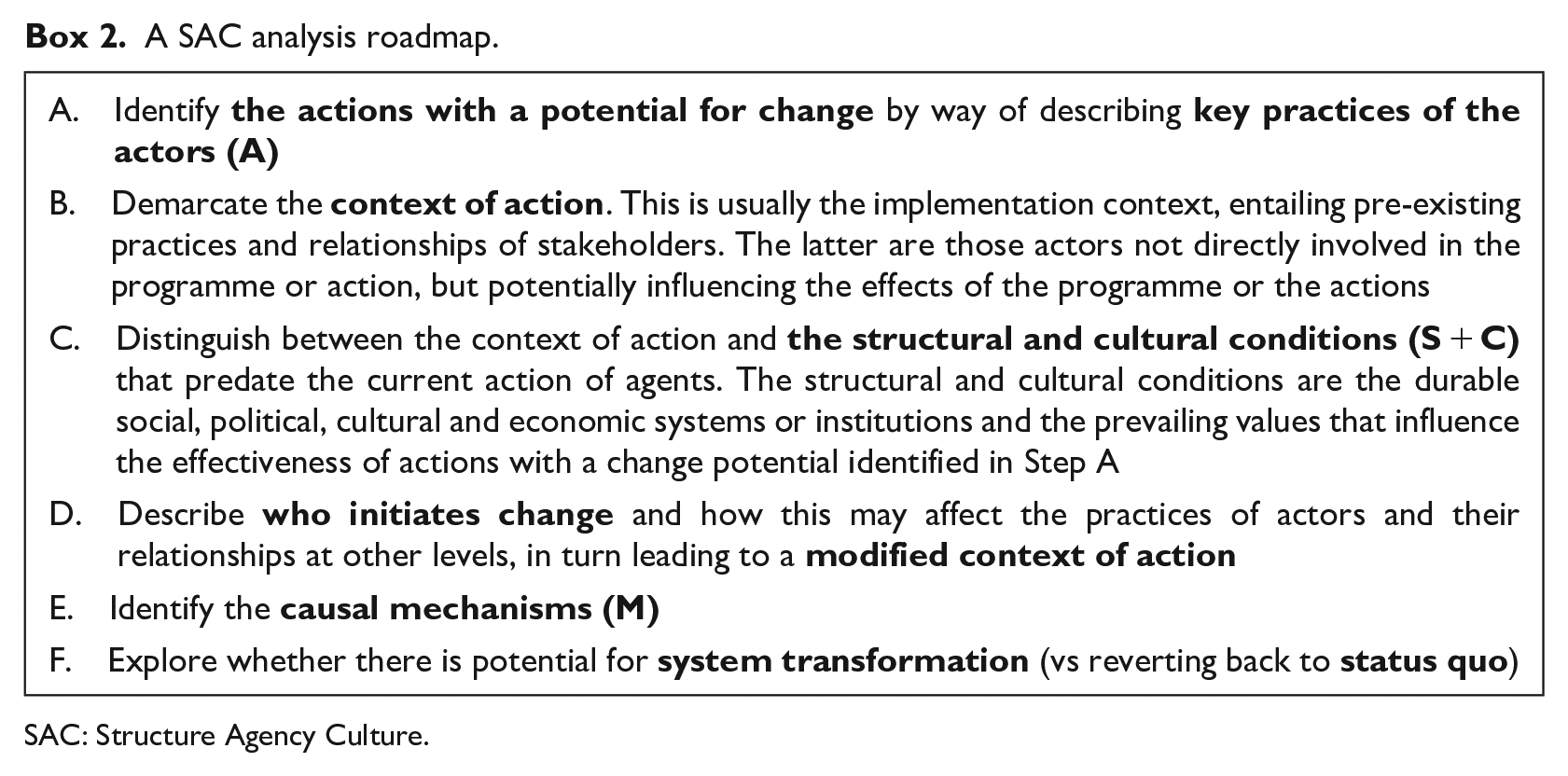
SAC: Structure Agency Culture.
Below, we apply these steps to our empirical case study:
(a) According to Archer (2012), actors decide on certain courses of action (agency) based on ‘reflexivity’, which she defines as the way actors ponder decisions, internally and with others, about which actions to take. Reflexivity culminates in certain practices (‘actors’ practices’) which lead to outcomes. We distinguish between agonistic and consensus-oriented accountability actions. These are the actions considered as having a transformative potential in terms of adolescents’ health status.
(b) We identified the context of action as the governance and accountability system, composed of the web of relationships, practices, processes and rules that is shaped by the social interaction between state and non-state actors, and which influence the daily life of adolescents in the urban poor neighbourhood.
(c) We identified the following pre-existing structural and cultural conditions. Structural conditions common to the four settings include (1) social exclusion based on layers of difference, such as ethnicity, socio-economic status, religion and gender, and (2) quasi-permanent resource scarcity. Cultural and moral norms that act upon accountability towards adolescent girls and common to the four settings are patriarchal norms, which in various ways intersect with religion, ethnicity, citizenship status and socio-economic status or perception of wealth. These structural and cultural conditions find expression in various ways and at different levels (Kern, 2021, Zaban, 2022).
(d) The initiation of change is in the first instance expected to result from the interaction between two entities: the adolescents and the NGOs supporting them in improving their health and well-being. In a second instance, actors directly engaging with the adolescents, including peers, family members, community leaders, communities, local government, other policy makers and NGOs working in the neighbourhood, may play an important role. Early signs of system change in the context of action can be identified by analysing the practices of stakeholders not directly involved in the emergent collective action. This includes practices of ‘early adopters’ – typically role models or actors with an important role in the social network of the governance system (Greenhalgh et al., 2004). For example, if providers were not involved in the initial action, one might seek out the practices and their positionality vis-à-vis the emergent action.
(e) In this step, we focus on causal mechanisms at relational level, such as trust, reciprocity, individual and collective empowerment, solidarity and organizational change. While trust, reciprocity and empowerment are mechanisms that have been often found to explain collective action, the potential causal linkage between reflexivity, solidarity and organizational change, on one hand, and action, on the other, is less obvious (Jagosh et al., 2015; Ostrom and Walker, 2003).
(f) Sustained change at the level of the social system or system transformation requires sufficient time, ownership and resources (Feeny et al., 2022). Capturing the sustainability of outcomes through RE has been explored. For example, Jagosh et al. (2015) and Nobles et al. (2022) analyse the potential of ‘ripple effects’ in the system.
Step 4: Drafting the IPT
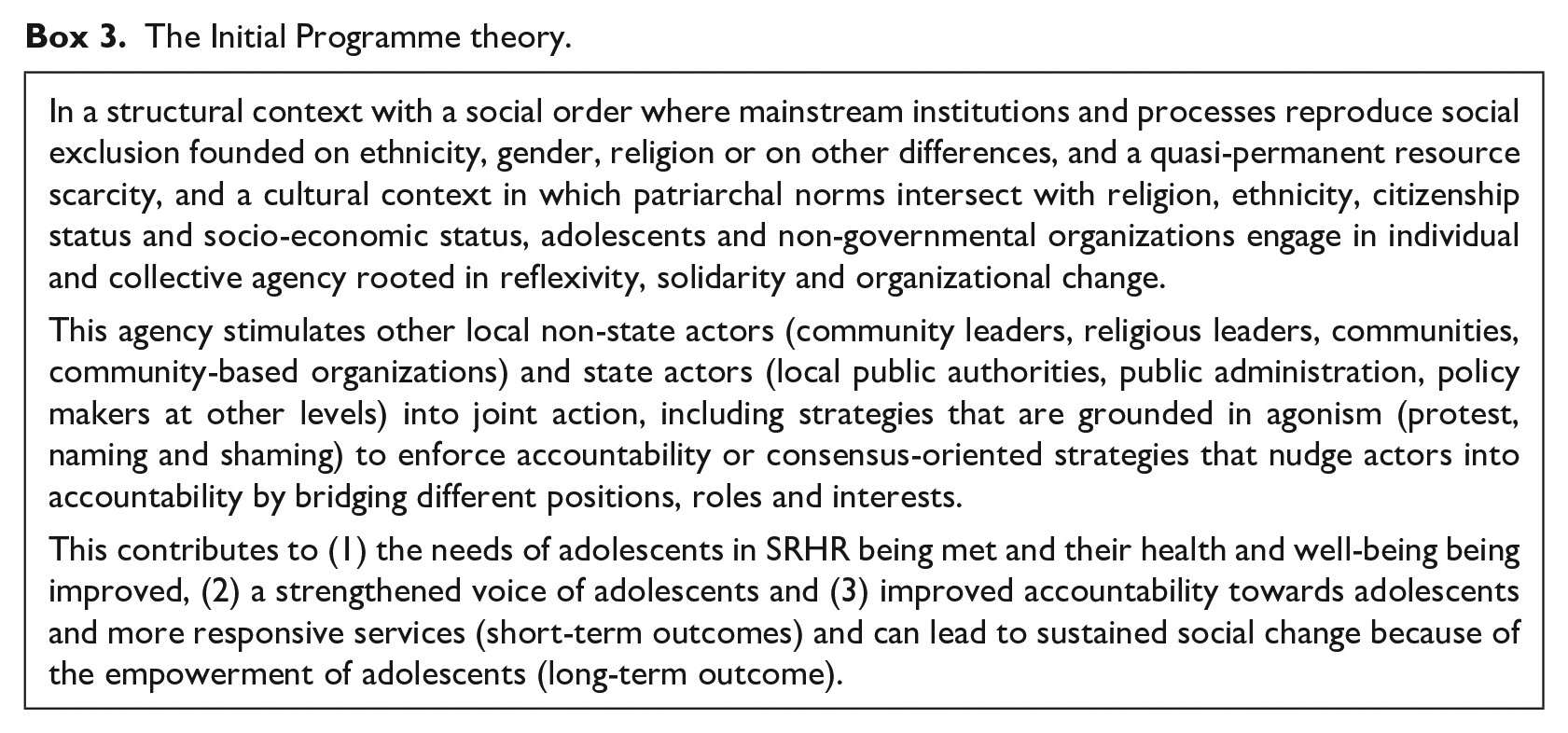
In this step, we formulate the IPT. Where realist evaluators often use the categories of context, mechanism and outcome in the narrative formulation or diagrammatic representation of the PT, we suggest to split ‘context’ in ‘structural context factors’ and ‘cultural context factors’, and outcomes into ‘short-term outcome’ and ‘long-term outcome’ (Box 3).
The Initial Programme theory.
Discussion
In this article, we set out to describe how Archer’s SAC frame could strengthen RE by providing a frame for the systematic analysis of the interrelationships between structure, agency and culture. We presented a four-step framework to integrate the SAC frame into the logic of RE and applied it in the elicitation of the IPT for a study on accountability in adolescent health. We argue that applying the SAC framework in RE not only allows for a systematic analysis of structure and culture as different context categories, but also of the dimension of time and sustained social change. Our proposed guidance demands the evaluator to actively look for explanations of how structure and culture shapes the programme (and vice versa), and of long-term change in existing theories and assumptions of the actors.
Intervention programme designers often aspire to modify pre-existing structural and cultural conditions (Sawyer, 2002). Using the SAC frame in RE provides a way to account for the impact of structural and cultural conditions through the analysis of causation across levels, from micro to macro, and macro to micro. Downwards causation originates at macro-level and includes social, technological, political and economic forces, and the cultural context, both acting upon the micro-level, defined here as individual and collective agency. Upwards causation includes change processes that are set in motion by groups of agents and contribute to lasting social change by acting upon the macro-level structure and culture.
Using the SAC frame in the process of eliciting the PT of the adolescent urban health study led us to investigate the role of the governance and accountability system as a structural context element in the effectiveness of accountability interventions. It also allowed us to explore the micro- and macro-level mechanisms that interact with context elements to shape accountability towards adolescents. As Orton and colleagues assert, these interactions are not easy to capture, especially when programmes rest on empowerment and emergent collective action from communities (Orton et al., 2017). We also found that the SAC frame offers a way of using social science theories more assiduously in PT construction in RE. In our study, we examined a wide-ranging literature in search of mechanisms (like solidarity), and to better describe the structural context elements of urban informality and the cultural context factors related to gendered spaces.
The challenge of theory adjudication, which has been identified in RE (Pawson, 2013) and can be described as the challenge of identifying the most relevant components of programme theories, may be amplified by the need to explain: first, the influence of both structural and social context elements and, second, the potential long-term effects in terms of social change. This process may demand more time than in ‘regular’ REs, and it requires research teams with the right skill mix and background to ensure ‘theory-informed pluralism’ (Greenhalgh and Emmel, 2018) or theoretical awareness. (Mukumbang et al. 2020) Finally, our application to the adolescent urban health study indicates that the SAC frame may help realists in moving programme theories towards contributing to middle range theories, in that it encourages the evaluator to search for, apply and test theories that explain the role of structural and cultural context factors that are situated at the level of the middle range (Greenhalgh and Emmel, 2018; Jones, 2018.
Conclusion
The use of RE and research for complex health interventions and settings has been on the rise in the field of global health and international development, providing an alternative for (quasi-)experimental evaluation designs. However, RE may have limitations for understanding social change, to which many global health interventions aspire or indirectly contribute to. We presented how Archer’s SAC frame can be integrated in the analytical process of RE and illustrated how we applied our five-step frame in a real-life example of a study on accountability interventions in informal settlements in low- and middle-income countries. More work is needed to finetune the guidance, but the SAC framework has the potential to increase the insights that RE can produce by focusing attention to structural and cultural context factors in explanations of long-term social change.
Footnotes
Declaration of conflicting interests
The author(s) declared no potential conflicts of interest with respect to the research, authorship and/or publication of this article.
Funding
The author(s) disclosed receipt of the following financial support for the research, authorship and/or publication of this article: Sara Van Belle is funded by a grant of the Flemish Fund for Scientific Research (Fonds voor Wetenschappelijk Onderzoek) FWO no. 1221821N.
