



Abstract
In recent years, the physical literacy (PL) journeys of children and young people (CYP) have become increasingly relevant to physical activity (PA), physical education (PE) and sport settings. While research has documented understanding of PL among specific stakeholders, such as physical educators and sports coaches, no such research exists regarding the voices of CYP across the island of Ireland (Northern Ireland and Ireland). As such, expanding beyond PL specifically and explicitly, this scoping review explored CYP's perceptions of lifelong PA, including factors they believed influenced their involvement in, or avoidance of, PA, PE, and sport (domains which all contribute to PL). The review examined 29 qualitative research studies conducted across the island of Ireland. Thematic analysis of the data led to the construction of the following five key themes in relation to lifelong PA as part of one's PL journey: (i) providing choice, (ii) fun, (iii) social influences, (iv) competition, and (v) barriers to positive PL experiences. Drawing on the insights generated by this study, we propose targeted PL promotion strategies that resonate with CYP in Ireland and Northern Ireland, with the goal of fostering their holistic PL development, and supporting sustained lifelong engagement in PA.
Introduction
The concept of physical literacy (PL) has become increasingly relevant to physical activity (PA), physical education (PE) and sports promotion internationally (Giblin et al., 2014). While numerous definitions exist worldwide for PL based on varying operational contexts and theoretical perspectives (Liu and Chen, 2021), PL has been commonly defined as ‘the motivation, confidence, physical competence, knowledge and understanding to value and take responsibility for engagement in physical activities for life’ (International Physical Literacy Association, 2017). PL can also be understood as the embodied relationship between an individual's movement competence (physical), motivation and confidence (affective), knowledge and understanding (cognitive), and their environment, which has the potential to shape long-term movement and PA behaviours (Cairney et al., 2019; Whitehead, 2010).
Researchers have acknowledged the issues of conflated terminology and definitional blurring (Hyndman and Pill, 2018). As such, conceptually, it is important to acknowledge that PL, PA, PE and sport are not synonymous terms (Lounsbery and McKenzie, 2015). Research documents that the relationships between PL, PA, PE and sport are complex, multi-dimensional, and multi-directional (Cairney et al., 2019). The paucity of empirical PL evidence to-date, however, makes it quite challenging to infer substantive claims of links between PL, PA, PE and sport (Carl et al., 2022). Critically, PL is often positioned as a holistic, umbrella term that is greater than the sum of its parts (Belton et al., 2022). It is partly this unique conceptualisation of PL which has led to the accelerated and growing popularity of the field.
In recent years, the promotion of PL has been identified as a potential key policy initiative for improving PA engagement and health among children and young people (CYP). As a result, in the last decade many countries, including Australia, Canada and New Zealand, have established working definitions for PL, as well as policy and practice approaches for PL development (Keegan et al., 2019a, 2019b; Sport New Zealand, 2020; Tremblay et al., 2018). In Europe, particularly outside of the anglophone countries, PL policy and practice have yet to feature prominently across political health agendas (Carl et al., 2023).
At a country case-study level, there has been increased momentum and attention to promote PL across the island of Ireland (Northern Ireland and Ireland), specifically with the publication of the All-Island Physical Literacy Consensus Statement (Sport Ireland and Sport Northern Ireland, 2022). In order to provide a consistent understanding of PL across the island of Ireland, this Consensus Statement has extended on the foundation work of the International Physical Literacy Association (2017), by defining PL as being ‘the motivation, confidence, physical competence, knowledge and understanding that enables a person to value and participate in physical activity throughout life’ (Sport Ireland and Sport Northern Ireland, 2022). This Consensus Statement highlights the value and importance of PL development and has ignited the need for PL to be integrated within policy, practice and research in both Northern Ireland and Ireland. The Sport and PA Strategy for Northern Ireland (Department for Communities, 2022) has additionally highlighted that PL development is a ‘key building block’ for all populations to ensure lifelong involvement in sport and PA. Similarly, the 2018–2027 National Sports Policy for Ireland (Department of Transport, Tourism and Sport, 2018) had already acknowledged the importance of PL as a key component in promoting population-wide participation in sport and PA, as well as the importance of involving multiple stakeholders for meaningful PL promotion.
While research has explored the PL understanding of stakeholders such as physical educators, sports coaches, teachers, and decision makers in Ireland and Northern Ireland (Belton et al., 2022), no comparable work has examined the voices of CYP. According to Jacquez et al. (2013), research which does not include the voice of youth might miss the necessary contextual input required to represent and capture the unique youth experience. Evidence has demonstrated the importance of qualitative, participatory research with CYP, particularly in marginalised and hardly reached communities, highlighting that subsequent findings can allow for a more holistic understanding of CYP's experiences in relation to attitudes, access to, and engagement in sport and PA (Emm-Collison et al., 2022). Voices of young people must be sought if we are to understand their PL beliefs, values and perceptions on issues such as: (i) if and why they choose to participate in PA, PE and sport, (ii) barriers that prevent them from taking part, (iii) obstacles on their PL journey that they encounter within their PA, PE and sport environments, (iv) types of activities they find most inviting, (v) who is most influential in their choice to participate in PA, PE and sport and (vi) how they might better be supported to be physically active across the lifespan. Despite the potential barriers to conducting meaningful children's voice research with rather than on young people, a recent systematic review highlights the importance and value of engaging young stakeholders to improve the development, implementation, and evaluation of PA interventions (Emm-Collison et al., 2022). It should also be acknowledged that children's voice research is not just good practice; actively involving CYP in matters that concern them is a fundamental human right (Lundy, 2007).
To critically examine qualitative findings published since 2010 relating to lifelong PA and the broader PL journey on the island of Ireland, this scoping review explored the experiences and views of CYP (aged 3–18 years) regarding the factors they deemed important in influencing their involvement in, or avoidance of, PA, PE, and sport settings. Given the lack of research explicitly focused on PL on the island of Ireland at the time this study idea was developed (2020, when notably it was not possible to conduct primary qualitative research with this target population due to COVID-19 restrictions), investigating these PL-related areas was (and remains) essential for providing broader context and a deeper understanding of young people's perceptions of the factors that may influence their lifelong PA and overall PL journey. It is important to note the complex nature of the ‘children's voice’ in qualitative research, which has been criticised for its potential to misinterpret and oversimplify children's views and experiences (Facca et al., 2020). This scoping review adopted a reflexive, qualitative approach, recognising that the views expressed by the participants are not necessarily an ‘authentic’ representation of all CYP's perceptions of PL, PA, PE and/or sport, and were open to being influenced by issues of inclusion, privilege, representation and power relations (Spencer et al., 2020). The insights generated from this scoping review have the potential to inform the development of PL policies and strategies in Ireland and Northern Ireland that are meaningful to CYP, and that support their lifelong engagement in PA and overall PL journey.
Methods
This scoping review was conducted in accordance with the Preferred Reporting Items for Systematic Reviews and Meta-Analyses extension for scoping reviews (Tricco et al., 2016). The aim of a scoping review is to map the existing literature within an area of research, by seeking to identify the types of available evidence, clarify key concepts, and analyse identified knowledge gaps (Gottlieb et al., 2021; Munn et al., 2018). Scoping reviews have become an increasingly popular approach for synthesising research evidence (Pham et al., 2014), and have also been utilised in related research with CYP on their experiences and perceptions of PA (Quarmby and Pickering, 2016).
Search strategy
Most peer-reviewed qualitative studies were identified through database searches (Scopus, SPORTDiscus, and ERIC), supplemented by manual searching of reference lists, key journals, and influential authors to capture relevant literature. Literature was also sourced from government websites, technical reports, research reports, and conference proceedings. This search, which was first conducted by Orlagh Farmer in July 2020 and re-run by Hannah Goss in October 2025, sought to identify studies with qualitative findings from Ireland and Northern Ireland published between 1st January 2010 and 24th October 2025 (date of last search), involving CYP aged 3–18 years old (see Table 1 for complete inclusion and exclusion criteria). Prior to 2010, PL publications were limited, conceptually inconsistent, and generally not empirically comparable to contemporary work. As the concept of PL has been defined, described and adopted differently throughout the literature, keyword search strategies were developed, including ‘physical literacy’, ‘physical activity’, ‘sport’, ‘physical education’ and ‘qualitative’. Variations for each keyword were combined with the ‘OR’ operator to maximise results that both explicitly and implicitly related to PL.
Inclusion and exclusion criteria.
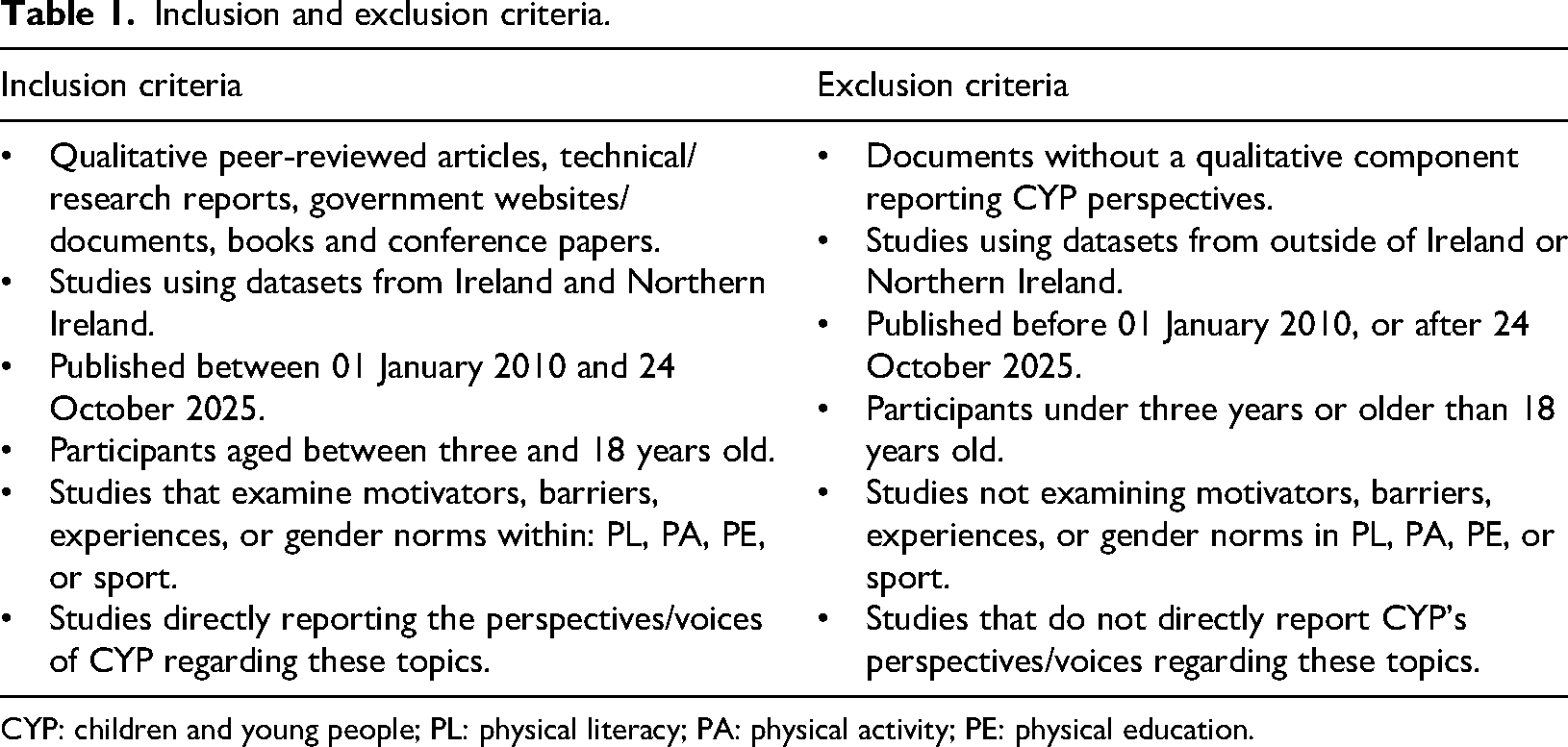
CYP: children and young people; PL: physical literacy; PA: physical activity; PE: physical education.
The eligibility of all relevant articles was assessed by a member of the research team (Orlagh Farmer in 2020, Hannah Goss in 2025) through an iterative process in accordance with the criteria outlined in Table 1. Duplicates of studies were manually removed, and all identified titles were reviewed in order to exclude articles which did not meet the inclusion criteria. For inclusion, it was required that published articles focused on or included an examination of PL motivators, barriers, experiences, and gender norms through the connected fields of PA, PE, and/or sport.
Data items and extraction
Data was synthesised through charting the data (Gottlieb et al., 2021). A narrative approach was used to create a chart for study characteristics, such as literature type, year, setting, participants, objectives, methods, measures, and results, extracted from each article. One of the authorship team (Orlagh Farmer in 2020, Hannah Goss in 2025) extracted a synopsis of the descriptive, demographic, methodological and results data from the included studies, and these data were checked and confirmed by the principal investigators (Wesley O’Brien and Hannah Goss).
Data synthesis and analysis
To provide an overview of the evidence, data were analysed using Braun and Clarke's (2021) six-phase reflexive thematic analysis framework, with careful attention to the study aim: to explore CYP's experiences and perspectives regarding factors they perceived as influencing their participation in, or avoidance of, PA, PE, and sport settings. The initial phases (i) data familiarisation and (ii) coding were undertaken by two members of the research team (Orlagh Farmer and Hannah Goss). During this process, data relevant to the research aim were systematically identified and labelled to generate initial codes. In addition to following the recommendations of Braun and Clarke (2021), the research team felt transparency, clarity and separation were necessary in this stage as some members of the current research team were authors of studies included within this review. Following this, and through reflective discussion with the wider research team, who acted as ‘critical friends’, the process of (iii) theme development involved clustering the coded data into broader categories to explore patterns and to identify overarching meaning. These clustered themes underwent (iv) further refinement and (v) were named, before progressing to the final phase of (vi) data write-up (Braun and Clarke, 2021). These robust steps supported methodologically coherent analysis that enabled the construction and reflexive exploration of major themes related to lifelong PA engagement and PL. The results of this process are outlined in the Results section below.
Results
Twenty-nine studies were included within this scoping review (see Supplemental Material for more information). Five themes were developed as follows: (i) providing choice, (ii) fun, (iii) social influences, (iv) barriers to positive PL experiences, and (v) competition.
Providing choice
Across the majority of studies reviewed, providing choice, as well as introducing new activities in school, were identified as influencing children's perceptions of lifelong PA engagement, as part of their overall PL journey (Coulter et al., 2020a, 2020b; Enright and O'Sullivan, 2013; Farmer et al., 2020; McGann et al., 2020; Ní Chróinín and McMullen, 2020; Parker et al., 2018). The provision of new activities was commonly cited by CYP within the qualitative literature where it was perceived positively in PA, PE, and sports settings (Carlin et al., 2015; Coulter et al., 2020a; Farmer et al., 2020; Tannehill et al., 2015). A teenage girl, self-identified as active, expressed this as ‘Some people just aren’t into running and they are getting forced to go out and do that [running] when they would rather be in school doing team sports or something. I just think it shouldn’t be compulsory to do certain things’ (Cowley et al., 2021: 17). Irrespective of gender, a large majority of physically inactive participants highlighted the need for novel activities to be offered to improve their respective PL journeys.
When contextualising settings for PL experiences, PE was sometimes viewed as an environment where student choice of activity was not being sought, which negatively impacted participant enjoyment (Corr and Murtagh, 2020; Enright and O'Sullivan, 2010). Offering students choice and/or the opportunity to provide input into the design of an activity can help increase participants’ personal relevance and connection to the activities, as part of their wider holistic PL. For example, male teenage participants reinforced the desire for PE to offer further variety and novel activities that were purposeful, new to them, and which some already enjoyed such as tai chi, judo, and hip-hop dance (Tannehill et al., 2015). Participants expressed that they ‘would like more choice of what to do in class’ as they ‘do only what the teacher likes’ (Tannehill et al., 2015: 453). Five Irish female secondary school students, who co-designed a PE curriculum with teachers in a school environment, emphasised the importance of individual and non-competitive activities (Enright and O'Sullivan, 2010). Within Ní Chróinín et al. (2023), autonomy went beyond activities alone, and through the development of personal goals was used as a collaborative learning process to promote value and meaning in PE. The potential of collaborative practice to amplify the voices of CYP, as demonstrated by Bowles et al. (2019), Enright and O'Sullivan (2010), and McEvoy et al. (2016), was perceived to foster a sense of ownership over planned initiatives (Corr and Murtagh, 2020; Enright and O'Sullivan, 2013). This sense of ownership encouraged participation, as CYP were able to enact their own ideas (Enright and O'Sullivan, 2010; Ní Chróinín and McMullen, 2020), thereby positively influencing their overall PL beyond the school environment. In another study, students’ perspectives of student voice pedagogies details how the approach can be used in an Irish context to engage young people in PE, for example: If a game didn’t work, you’d be able to talk to Ms. Cardiff about it and then in the next PE lesson, she’d say that, a lot of people didn’t really think this game worked. So we wouldn’t do it again, or we try and make it better with our own ideas, we try and … put some of our own ideas in it. And then we’ll see how that game goes again. (Cardiff et al., 2023: 667)
Fun
In capturing a positive PL journey, many CYP identified fun as a central component of meaningful participation in PA, PE, and sport (Carlin et al., 2015; Corepal et al., 2018; Corr and Murtagh, 2020; Enright and O'Sullivan, 2010; O’Leary et al., 2019). Enjoyment and fun, arising from feelings of acceptance, achievement, variety, involvement, and social interaction, were the most prominent and frequently reported outcomes across the included studies (Belton et al., 2014; Carlin et al., 2015; Corr and Murtagh, 2020; Farmer et al., 2018; O’Leary et al., 2019; Tindall, 2013).
Across all studies, fun emerged as an integral feature of collective PA experiences and broader PL development, often closely associated with social interaction and opportunities to have ‘fun outside with your friends’ (Coulter et al., 2020a: 209). Visual methods, such as drawings accompanied by written narratives, further illustrated the enjoyment linked to PA and sport, explicitly aligning with the social domain of the Australian Physical Literacy Framework (Scott et al., 2021). For instance, in Parker et al. (2018: 456), one boy noted: ‘This is a picture of me and my friends playing rugby. I like playing with them. I am in the pitch. We had a lot of fun’. In addition, participants reported experiencing fun through the creative variety and novelty of the activities offered (Corr and Murtagh, 2020; Scannell and Murphy, 2024).
Social influences
Peer influence
The influence of friends and peers was one of the most frequently recurring themes within participants’ overall PL journeys. Across primary and secondary school youth, regardless of gender, PA status, or geographical access to the named activity, participants consistently emphasised the social domain of PL, identifying participation alongside friends as a primary motivation for engaging in PA. Peers were perceived to play an important role in influencing participants to be active (Carlin et al., 2015), and from many of the included studies, friends appear to positively impact participants’ PL journey.
Having friends take part was an important means of increasing participation amongst low-active participants (Carlin et al., 2015), while not having friends also discouraged young people from returning. Girls with low PA levels, in particular, expressed a need for friends to be present in order to engage in PA (Brennan et al., 2024; Carlin et al., 2015). The opportunity to make new friends (Brennan et al., 2024; Carlin et al., 2015; Farmer et al., 2018) and socialise (Brennan et al., 2024; Carlin et al., 2019; Corr and Murtagh, 2020) was also deemed to be an influence on PL. For example: It's just like a wee [small] club that you can like go and talk to your friends while you exercise so it's like you don’t know you’re exercising so it's just like a wee [small] group, you’re like exercising without realising you’re exercising, you don’t really think of it that way. (Carlin et al., 2019: 7)
Some participants felt cautious about participating in PA and sport alone, but found sustained and higher levels of enjoyment when participating with others: ‘It's fun with someone with you and time goes quicker’ (Corr and Murtagh, 2020: 39). When examining positive PL experiences for participants, the evidence clearly indicates that PA and sport were perceived as more enjoyable when undertaken with friends, with peer-based social support encouraging higher levels of participation (Brennan et al., 2024; Carlin et al., 2015; Corepal et al., 2018; Farmer et al., 2018; Tannehill et al., 2015). Participants explicitly highlighted the motivational role of peers, noting that ‘it's about encouraging each other to do stuff’ (Corepal et al., 2018: 8). Furthermore, O'Sullivan et al. (2020: 130) identified peer learning as a valuable mechanism for developing fundamental movement skills with participants describing how ‘you had to watch the other person and see if they were doing the skill correctly. [We] became teachers’.
In contrast, peers could also have a negative influence on PA participation (Carlin et al., 2015; Farmer et al., 2018, 2020; McEvoy et al., 2016; McGann et al., 2020) and wider PL development, with some participants feeling increased levels of consciousness about how others viewed them when they were choosing to be physically active (Carlin et al., 2015; Corepal et al., 2018). For example: I actually hate it in PE, when no one picks you and you feel stressed because basically, you suck. (McGann et al., 2020: 272)
Participants suggested that social acceptance among friends could, at times, function as a barrier, potentially deterring future engagement in PA (Carlin et al., 2019; Farmer et al., 2020). This finding was particularly evident among low-active female participants, with Brennan et al. (2024: 5) highlighting the experiences of one teenage girl: 1 used to do gymnastics, but I didn’t stop for a reason that is because I didn’t like it. It's because I have no friends there. But I was really good at it. I used to be able to do the splits and all. Yeah, but I quit a really long time ago. But it was fun. But no one included me in anything, so I just left.
Similar experiences were echoed by Cowley et al. (2021) and by McGann et al. (2020: 273) in a younger age group, with one primary school–aged girl explaining, ‘I was in a club but then my friend [quit], so I didn’t want to do it anymore on my own’.
The influence of role models
Findings further illustrate that positive encouragement/support from family, role models and coaches bolsters participants’ levels of motivation for PA engagement (Carlin et al., 2015; Farmer et al., 2018; McEvoy et al., 2016). It is evident that family remains an important influence for participants on their PL journey, with participants commenting that parents and guardians often provide them with logistical support and verbal encouragement to be more physically active. The influence of positive role models was more commonly quoted by highly active participants, with many participants stating that observing famous sports stars or Olympians made them more determined to succeed at their chosen sports (Carlin et al., 2015) and sustain their respective PL journey. Coaches in sports-based settings were also referenced as influential in terms of overall PL experiences, with many participants retaining their sporting interests through approachable and friendly coaches (Carlin et al., 2015). Conversely, participants also cited how negative relationships with coaches increased the likelihood of dropping out from PA and sport (Carlin et al., 2015, 2019; Farmer et al., 2018; McEvoy et al., 2016; McGann et al., 2020; Tannehill et al., 2015). As a result, such experiences can reduce the likelihood of participants engaging in a positive PL journey.
Barriers to positive PL experiences
Time constraints
In terms of positive PL experiences for CYP, findings point to insufficient time, the demands of schoolwork, and too many other commitments, as being the main barriers for engaging in PA, PE, and sport (Belton et al., 2014; Carlin et al., 2015, 2019; Corr and Murtagh, 2020; Coulter et al., 2020b; Farmer et al., 2018; Tannehill et al., 2015). More specifically, and cited by both boys and girls, barriers included parents being too busy to transport them to training or matches, longer commutes to school, time spent doing chores, and among secondary school aged participants, having part-time job responsibilities (Belton et al., 2014; Carlin et al., 2015; Farmer et al., 2018; Sport Northern Ireland, 2016). In terms of the school environment as a setting for promoting PL, participants also felt that they did not receive enough lesson time for PE to make it worthwhile and enjoyable (Coulter et al., 2020a; Tannehill et al., 2015). Some female participants noted that the duration of each PE class was too short and that participating in PE only once every two weeks was insufficient ‘to make you get exercise and feel good’ (Tannehill et al., 2015: 456). Other students expressed how their PE classes were forfeited for study classes, with one female student stating, ‘In fifth year, we got PE, but in January they took away our PE lessons to make us study’ (Sport Northern Ireland, 2016: 25).
Lack of skill-related confidence
When reviewing the importance of physical competence as a core element of PL, it was evident that some participants identified a general lack of skill-related confidence to sustain their continued PA and/or sport participation (Corr and Murtagh, 2020; Coulter et al., 2020b; Farmer et al., 2018, 2020; Sport Northern Ireland, 2016). Some participants felt incapable of being physically active, due to their lower levels of perceived physical competence. Furthermore, in other studies, these movement skills were seen as only relevant for individuals wanting a future career in sports and not linked to other lifelong PA pursuits (O'Sullivan et al., 2020). One physically inactive primary school boy alluded to drop-out, linking this to having a lack of self-confidence and a low level of perceived motor competence: ‘You aren’t good so just stop doing it’ and ‘some people like … I can’t think of the word but you lose your confidence. Some people can say “You aren’t good so just stop doing it”’ (Coulter et al., 2020b: 213). Research by Brennan et al. (2024) highlighted that skills and confidence were central to girls’ self-identity in relation to PA, suggesting clear opportunities to challenge existing beliefs and positively influence future PA behaviour. Among younger children, providing choice and opportunities for adaptation allowed participants to make progress in their motor competence. As one child explained: I couldn’t get over the hurdles the first day we tried to do them and then when I kind of just, every time we had the personal time at the end I kept on practicing and then by the final day I was able to do the three hurdles. (Cardiff et al., 2023: 670)
This example underscores how confidence can be developed to improve perceptions, attitudes, and feelings towards PA.
Competition
Competition as a PA motivator for sustaining a positive PL trajectory
Competition and winning were central to participants sustaining their PL journey within sport experiences, especially among males (Parker et al., 2018). For example, in Corepal et al. (2018: 6), one boy suggested that competition served as a key motivator, encouraging them to work harder and engage more actively in PA: ‘That's [competition] what motivates me’. Similar perspectives were observed among secondary school boys, with one active participant stating, ‘the point of the game is to win’ (Coulter et al., 2020b: 212), a sentiment shared by others in the study.
However, when considering PL as a holistic concept encompassing multiple domains and constructs, some participants placed greater value on playing with friends than on winning. As one physically active male explained, ‘I don’t care if I win or lose as long as I’m having fun and my friends are playing’ (Tannehill et al., 2015: 452). Team-based competitions were sometimes seen as particularly effective in promoting PA and sport engagement, with participants noting that ‘you didn’t want to let your team down’ (Corepal et al., 2018: 7).
In contrast, girls tended to favour individual competition, using it as a personal benchmark rather than competing against others (Corepal et al., 2018; Corr and Murtagh, 2020). One participant in Northern Ireland highlighted the motivational value of PL, stating, ‘You keep going until you see an improvement … because you see an improvement, it's like it's worth it’ (Sport Northern Ireland, 2016: 24). In this context, competition was perceived as a healthy, incentivising factor that positively contributed to participants’ overall PL journey.
Competition as a demotivator for PA – a negative PL trajectory
For female participants in particular, competition and the prospect of winning were not as critical for PA engagement. For some, the element of competition could potentially result in a negative PL trajectory, by spoiling the fun of PA and, in some cases, leading to PA and/or sport discontinuation (Corepal et al., 2018; Farmer et al., 2018; Sport Northern Ireland, 2016). The notion of being too competitive was also alluded to by some participants as a demotivator for continuing sports and PA participation. For example, ‘the guys played and they just got really competitive and it was not fair’ (Belton et al., 2014: 7) and: Some people get a bit too competitive and that kind of like makes you feel not that confident, like, some people just get a bit too into it and yeah know pushing and shoving … and there might be a couple of injuries and competitiveness. (Farmer et al., 2018: 112)
Participants indicated that the perceived competitiveness of community sports-based settings also increased as they transitioned from primary to secondary school (Belton et al., 2014; Farmer et al., 2018, 2020).
Discussion
The intention of this scoping review was to examine the existing literature on CYP's (3–18-year-olds) PL journeys through their experiences and perceptions of PA, PE, and sport across the island of Ireland, with the specific aim of informing future PL policy and practice. Five key themes were identified following thematic analysis of the data. These themes were: (i) providing choice, (ii) fun, (iii) social influences, (iv) barriers to positive PL experiences and (v) competition.
Providing choice in activity content that is personally relevant was found to be significant to CYP in their PL journey, irrespective of gender or ability. Student- or athlete-centred approaches that require listening and responding to young people's ideas and interests can result in greater degrees of PL enjoyment, meaningfulness and autonomous motivation to participate (El-Sherif, 2014; Wallhead et al., 2014). In the context of the PE environment for PL opportunities, it was noted that students valued variety and the provision of novel activities. It is important that the offering of physical activities be varied and personally relevant to the participants. When people are provided with and experience variety in exercise contexts, they feel better and become autonomously motivated as part of their PL journey to engage in exercise and increase the frequency of their exercise behaviour (Barratt et al., 2026). Providing opportunities for participants to have greater responsibility and choice in their PA experiences may also support their PL journey as it lays the groundwork for young people to take the initiative and responsibility for their lifelong involvement in PA (Durden-Myers et al., 2018).
The reviewed literature also cited fun and competition as key PL motivators for PA participation. This is consistent with international findings, where, in a systematic review of adolescents’ perspectives on the barriers and facilitators of PA, fun was identified as a critical facilitator of PA involvement (Martins et al., 2021). In terms of competition as a PL motivator, it has been suggested that young people who are successful in competition enjoy testing their skills and abilities against others, and will often express their desire to make activities competitive (Duncan and Kern, 2020). As highlighted in the current scoping review, alongside other research (Martins et al., 2015, 2021), competition may also act as a PL barrier, however, where young people who lack the skills and abilities to experience success in competition may withdraw from competitive activities to avoid experiencing failure (Duncan and Kern, 2020) in their PL journey. As a means of promoting PL development and healthy competition, Duncan and Kern (2020) suggest that teachers and coaches promote the ‘fun’ aspect of PA (rather than the outcome or score), alongside recognising student effort and improvement. While competition is often associated with youth sport, it remains important to emphasise the aim of PL, which focuses on the realisation of individual potential and personal development, and does not place an emphasis on winning or losing (Lundvall, 2015).
As mentioned previously, when young people engage in competitive activities without possessing the necessary physical skills, they have a decreased likelihood of enjoying the activity or seeing the benefit in participating (Silverman and Mercier, 2015). As a result, PL interventions involving young people have traditionally and largely focused on the development and improvement of physical competence (i.e. motor skill competence) (Carl et al., 2022). This is based on the hypothesis that possessing low motor skill competence in childhood leads to a negative spiral of disengagement in PA, as evidence suggests that children who lack the competence and confidence to participate in PA may not enjoy participating in activities where they feel they will not be successful (Robinson et al., 2015). When seeking to improve the motor skill proficiency levels of children, however, it is still necessary to emphasise how attitudes are related to young people's motor skill learning and ultimately to their PL development (Silverman and Mercier, 2015). While it has been argued that the physical, cognitive and affective domains of PL interact dynamically and can demonstrate reciprocal developmental relationships (Cairney et al., 2019), research regarding PL promotion strategies has suggested that we should not target the development of these domains in isolation, and that we should instead view PL promotion as a holistic concept, which includes the equal development of the physical, affective and cognitive domains (Barratt et al., 2026; Bingham et al., 2025; Carl et al., 2022). According to Britton et al. (2023), the beauty of PL as a construct is that it encompasses the importance of physical competence alongside the other domains of motivation, confidence, knowledge and understanding, which are known to be interrelated and associated with PA.
Social influence from friends, peers and significant others was also identified as both an important PL motivator and barrier amongst CYP on the island of Ireland. Parents and friends have been found to influence the PA levels of adolescents through modelling behaviour and providing social support, where adolescents’ PA levels are directly associated with those of their parents and friends (Cheng et al., 2014). Consistent with international studies (Martins et al., 2021), CYP on the island of Ireland experience social influences through their PL journey, which may either increase or decrease their motivation to participate. Practitioners should also give consideration to the developmental differences which exist between younger and older children in terms of what they find to be ‘fun’ sporting experiences, where they must also seek to find a balance between facilitating competitive sport and opportunities for social recognition, which are meaningful to young people (McCarthy et al., 2008). In line with the Australian PL Framework, which includes the social domain as a key component of PL development (Keegan et al., 2019a, 2019b), aspects such as connecting with others through PA and fostering positive relationships with teammates and coaches were identified as being meaningful to CYP on the island of Ireland. These findings highlight the importance of the social domain for PL experiences, with the social benefits of PL having also been shown to be important to other stakeholders on the island of Ireland (Belton et al., 2022). Therefore, the positive role of peers and social support strategies should be considered key elements of PL promotion in both Ireland and Northern Ireland, with a focus on fun and friendships ensuring that the activities are socially stimulating.
Recommendations
The contribution of this scoping review for the island of Ireland clearly outlines that the development of PL should be considered a meaningful outcome that PE teachers and youth sports coaches (and others) can use to enhance CYP's experiences (Liu and Chen, 2021). According to Wilkie et al. (2024), how teaching is conducted when seeking to develop PL is as important (if not more so) as what PE teachers understand the concept of PL to be. Drawing on the perspectives of PA, PE, and sport shared by children and young people across the island of Ireland, this qualitative study offers clear recommendations for promoting PL, including the following:
Physical activities should be varied and personally relevant to meet the PL needs of the CYP in the specific context. Social engagement should be prioritised: fun, friendships, and peer support should be encouraged within socially stimulating environments to enhance CYP's PL development. Healthy competition should be integrated to motivate participation, alongside authentic celebration, validation, and recognition of effort. Collaborative practice between teachers/coaches and students/athletes/participants should be endorsed. Providing choice, input into activity design, and novel activities can enhance the PL experience. School-based PA should be encouraged and maximised throughout the school day (before, during, or after school), as insufficient time is a major barrier to positive PL experiences. Individual physical and psychological characteristics should be considered by practitioners through targeted motor skill practice and development of outcomes such as self-concept, social behaviours, and self-efficacy. Coaches and teachers should focus on creating positive experiences for CYP in PA, PE, and sport to support meaningful engagement and lifelong PL development.
This research summarises explicit PL recommendations from the included peer-reviewed and literature on the voices of CYP across the island of Ireland. The implementation of such strategies and recommendations may contribute to the operationalisation of the All-Island PL Consensus Statement (Sport Ireland and Sport Northern Ireland, 2022).
Conclusion
Our review of 29 empirical studies provides a synthesis of qualitative PL evidence, offering insights into what 3–18-year-old CYP in Ireland and Northern Ireland experience in terms of their PA, PE, and sport environments. The findings offer initial guidance for the implementation and prioritisation of meaningful PL development strategies on the island of Ireland over time. To optimise CYP's holistic PL journeys, this scoping review identified the importance of: providing choice, valuing fun, the impact of social influences, minimising/overcoming barriers to positive PL experiences, and enabling positive competitive experiences for CYP in Ireland and Northern Ireland.
When CYP experience provision tailored to their needs and interests, they are more likely to perceive it as meaningful. These considerations therefore offer a valuable framework for planning and delivering programmes that support young people's PL journeys. This scoping review demonstrates the importance of adopting a balanced approach across the various domains of PL. Moreover, it underscores the pivotal role of the pedagogical approach employed by PE teachers and coaches in facilitating meaningful participation in PA, PE, and sport. By listening and responding to the collective voices of CYP across Ireland and Northern Ireland, practitioners, parents, and other stakeholders will be better equipped to provide engaging, realistic experiences that promote and enhance CYP's ongoing PL journeys towards lifelong PA.
Supplemental Material
sj-docx-1-epe-10.1177_1356336X261427414 - Supplemental material for Perceptions of lifelong physical activity and the physical literacy journey: The voices of children and young people across the island of Ireland
Supplemental material, sj-docx-1-epe-10.1177_1356336X261427414 for Perceptions of lifelong physical activity and the physical literacy journey: The voices of children and young people across the island of Ireland by Wesley O’Brien, Sarahjane Belton, Orlagh Farmer, Orla Murphy, Elaine Murtagh, Sinead Connolly, Marie H Murphy, Kyle Ferguson, Lawrence Foweather and Hannah Goss in European Physical Education Review
Footnotes
ORCID iDs

Funding
The authors disclosed receipt of the following financial support for the research, authorship, and/or publication of this article: The research presented in this article was part of a larger piece of work commissioned by Sport Ireland and Sport Northern Ireland, in order to inform the development of the All-Island Consensus Statement on Physical Literacy. This work was commissioned by Sport Ireland, and Sport Northern Ireland through funding provided by the dormant accounts fund (Republic of Ireland) and the Department for Communities (Northern Ireland).
Declaration of conflicting interests
The authors declared no potential conflicts of interest with respect to the research, authorship, and/or publication of this article.
Supplemental material
Supplemental material for this article is available online.