



Abstract
Understanding how preservice teachers (PSTs) form their epistemological beliefs (EBs) is crucial for seeing how these beliefs influence teaching practices, particularly whether they encourage active learning or mere knowledge transmission. Building on this premise, this study aimed to examine the interplay between student-centred pedagogical strategies used in a 2-year physical education teacher education (PETE) programme and the development of PSTs’ EBs. Data were collected throughout the 2-year PETE programme using a longitudinal case study design, incorporating focus group interviews, reflexive logs, and participant observations with 11 PSTs. Findings revealed a non-linear trajectory across three phases: in the first year, peer-teaching, micro-teaching, questioning, and reflexive practices encouraged the development of more constructivist-aligned understandings. During the transition to school placements, PSTs experienced a ‘reality shock’ that led to temporary regressions towards control-oriented and authority-based beliefs. In the second year, however, PSTs re-engaged with earlier strategies, reconnecting with beliefs that emphasised student autonomy, collaboration, and active learning. These findings suggest that PETE programmes should deliberately design opportunities for autobiographical, experiential, and professional pedagogical strategies, while providing ongoing support to help PSTs navigate setbacks and progressively develop more sophisticated EBs.
Introduction
In the theoretical field of beliefs, epistemological beliefs (EBs) refer to individuals’ perceptions about the nature of knowledge and knowing (Hofer and Pintrich, 1997). By nature, EBs act as filters for interpretation, evaluation, and decision-making in educational contexts (Kuhn and Weinstock, 2002). Variations in EBs can shape individuals’ learning strategies, conceptual development, and problem-solving processes (Chan and Elliott, 2004). Indeed, individuals with more sophisticated EBs tend to promote critical thinking and active learning (Letina, 2022), while those with less sophisticated EBs often focus on knowledge transmission and shallow learning strategies (Otting et al., 2010).
Because of this, fostering more sophisticated EBs has become an important aim in teacher education. Practices such as structured reflection (Brownlee et al., 2001), integrating theory with practice (Schommer, 1994), and promoting critical interpretation (Kardash and Scholes, 1996) have been identified as supportive of preservice teachers’ (PSTs’) epistemological development. Yet despite these approaches, little is known about how specific student-centred pedagogical strategies might help PSTs transform their EBs towards greater sophistication.
Considering the substantial shifts from teacher-centred approaches towards active learning, there has been an increased recognition of student-centred approaches (SCAs) as part of contemporary pedagogical practice in physical education, supporting a stronger focus on students’ active role (Bessa et al., 2020). Accordingly, professional development initiatives have increasingly aimed to align teachers’ beliefs and classroom practices with constructivist approaches to education (Sengul et al., 2021). Rooted in discovery and inquiry, constructivism promotes learners’ active involvement and agency in their learning journey (Bybee, 2010). This approach supports one's recognition of the evolving nature of knowledge (indicative of sophisticated EBs) which can develop through experimentation and observation (Sengul, 2024).
In physical education teacher education (PETE) research has shown that it has often fallen short of challenging PSTs’ assumptions, tending instead to reproduce rather than disrupt their existing, and often less sophisticated, beliefs about the purposes, content, and teaching of physical education (Adamakis and Dania, 2020). A shift towards SCA-based practices represents more than a curricular adjustment; it involves rethinking how PSTs engage with knowledge. Through student-centred pedagogies, PSTs are encouraged to critically address their own beliefs (Lodewyk, 2022), reflect more deliberately, and avoid reproducing unexamined acculturation patterns (Schempp and Graber, 1992).
Given the long-standing call for teachers to foster critical thinking and active learning (Dyson et al., 2004), understanding how PETE pedagogical practices support or hinder the development of sophisticated EBs is essential. This is particularly relevant because it is theorised that there is an interplay between teachers’ epistemology and their instructional choices and pedagogical strategies, shaping students’ epistemological perspectives on knowledge and knowing (Hofer, 2001). Since PSTs act as both students and teachers, it is crucial to explore how their EBs develop in relation to student-centred strategies in PETE contexts.
Research has been trying to explore the connection between EBs and SCAs (Lodewyk, 2015, 2022). To the best of our knowledge, however, few studies have explored how student-centred pedagogical strategies in PETE programmes can challenge existing beliefs and may influence the development of more sophisticated ones (Ristow et al., 2023). Thus, this case study aimed to understand the interplay between student-centred pedagogical strategies and the development of PSTs’ EBs within a 2-year PETE programme. Specifically, this study addressed the following research questions: (a) What is the trajectory of PSTs’ EBs across the PETE programme?; and (b) How might the student-centred pedagogical strategies implemented at each PETE stage influence this development?
EB conceptualisation
EBs have been conceptualised in several frameworks (Limón, 2006), but in this study, we draw mainly on Hofer and Pintrich's (1997) multidimensional model, as it best captures the domain- and context-specific nature of beliefs. This situated perspective aligns with the view that investigating ways of knowing within specific domains is a crucial direction for educational research (Carlgren, 2020).
Hofer and Pintrich's (1997) theoretical conception comprises two dimensions: EBs about knowledge and EBs about knowing. The dimension of EBs about knowledge concerns views on evolving and transferable knowledge, including questions such as whether absolute truths exist, whether knowledge is continually evolving, and whether simpler theories are more desirable than complex and connected ones. Complementarily, EBs about knowing address one's belief about how knowledge is acquired and validated, such as the role of experts as authorities and what kinds of evidence are acceptable to support knowledge construction. These dimensions are often distinguished by their sophistication, with higher sophistication being frequently linked to better learning results than lower sophistication (Muis, 2004).
Research has shown a connection between EBs and teaching practices (Chan and Elliott, 2004), as EBs are thought to influence the preferences and use of pedagogical strategies (Richter and Schmid, 2009). In educational contexts, less sophisticated EBs are commonly linked to surface learning strategies (Schreiber and Shinn, 2003), as they reflect a belief in knowledge as unchanging, an accumulation of isolated facts, and the perception that knowledge comes from authoritative figures, often depending solely on trusting experts (Hofer, 2001). Conversely, sophisticated EBs are associated with deeper, more meaningful learning strategies (Schreiber and Shinn, 2003). Here, knowledge is seen as fluid, evolving, and developed through personal experiences and critical evaluation, involving reflexive judgment and consideration of multiple sources of information (Hofer and Pintrich, 2002). This highlights why student-centred pedagogical strategies that aim at fostering critical reflection, collaboration, and experiential learning can be crucial mechanisms for enhancing the sophistication of PSTs’ EBs during PETE.
PETE pedagogical strategies and their interrelation with EBs
Since ‘learning in the ways they are expected to teach may be the most powerful form of teacher education’ (Bransford et al., 2005: 76), PETE curricula may play a relevant role in impacting PSTs’ EBs. Signature pedagogies (Hordvik and Beni, 2024; Shulman, 2005) identify three categories of approaches that may support PETE in reshaping PSTs’ EBs: (a) autobiographical pedagogies, such as questioning and reflection, which encourage PSTs to engage with personal stories and challenge taken-for-granted assumptions; (b) experiential pedagogies, such as peer- and micro-teaching, where PSTs act both as learners and teachers in authentic settings that integrate theory and practice; and (c) pedagogies of professional learning, such as school placements supported by mentors, where PSTs collaborate and critically examine their own practices in professional contexts. Collectively, these approaches illustrate how pedagogical strategies can play a pivotal role in challenging PSTs’ EBs and fostering their progression towards more sophisticated understandings of knowledge and learning.
Building on such renewed approaches, pedagogical strategies that engage cognitive processes have been shown to influence PSTs’ teaching beliefs (Peralta et al., 2021) and to assist in deconstructing their beliefs about knowledge (Fletcher and Kosnik, 2016). Reflexive practices can provide environments for evaluating belief systems, potentially leading to the adoption of improved pedagogical strategies and the development of more sophisticated beliefs (Sengul, 2024). Likewise, the use of questioning techniques plays a vital role in fostering deeper reflection and helping PSTs derive meaning from their teaching experiences (Tsangaridou and Polemitou, 2015). As Azevedo et al. (2024) pointed out, questioning that encourages critical reflection can prompt PSTs to adopt a more relativistic stance rather than clinging to a rigid view of absolute truth. In line with autobiographical pedagogies (Hordvik and Beni, 2024), these practices allow PSTs to learn by reflecting on their own experiences, to challenge their assumptions, and to develop a more sophisticated stance towards teaching and learning (Hordvik and Beni, 2024; Shulman, 2005).
Howard et al. (2000) emphasised that hands-on experiences are essential for teacher learning, allowing PSTs to engage in constructivist teaching while learning about it. In PETE programmes, peer-teaching provides such opportunities, enabling PSTs to solve problems collaboratively and reflect on their learning in open, discussion-friendly environments (Wahlstrom and Louis, 2008). Peer-teaching is explicitly designed to challenge PSTs’ beliefs and values about teaching and learning in physical education and to encourage critical thinking and reflexivity (Hordvik and Beni, 2024). Similarly, micro-teaching offers PSTs the chance to step into the teacher role, test strategies, and reflect on their effectiveness within a supported and facilitated practice setting. In this way, experiential pedagogies bridge theory and practice, providing authentic contexts that help PSTs confront and revise their epistemological beliefs (Hordvik and Beni, 2024). This is also illustrated by ‘living the curriculum’ approaches, where PSTs experience teaching strategies as learners and as teachers, while observing teacher educators’ reflections and understanding the rationale behind pedagogical decisions (Hordvik et al., 2021; Sinclair and Thornton, 2018).
In addition to university-based learning, pedagogies of professional learning emphasise the importance of school placement as a site for EB development. Real-school context experiences provide formative situations that confront PSTs with the complexities of practice and the application of demanding pedagogical models (Sutherland et al., 2010). These experiences support PSTs’ ongoing interpretation and reinterpretation of teaching, enabling them to adapt their beliefs, try out emerging approaches, and further refine their understanding of teaching and learning (Lamote and Engels, 2010). When placements are supported by teacher educators and mentors, they provide the safe and collaborative environment that Hordvik and Beni (2024) describe as central to pedagogies of professional learning, encouraging PSTs to critically analyse their own practice and take risks in implementing new approaches.
Furthermore, PETE programmes should deliberately challenge PSTs’ preconceived ideas about teaching and learning, offering multiple opportunities to experience, observe, and critically reflect on different curricula and pedagogical strategies (Gurvitch et al., 2008). Nevertheless, it is important to keep in mind that while some strategies might be linked to epistemological reconfiguration, this development is neither automatic nor linear, but contingent on contextual factors and the broader ecological systems of teacher learning (Hordvik et al., 2019; Sutherland et al., 2010).
Study context
This project was developed in a 2-year PETE master's programme in Portugal, which targets PSTs with a bachelor's degree in sports science and grants an official teaching licence. The programme equips PSTs with comprehensive student-centred pedagogical strategies, critical insights into physical education, and practical teaching experiences, including lead teaching roles for a full academic year under the supervision of cooperating teachers. Its curriculum emphasises a balanced integration of theoretical knowledge and practical application, fostering a strong nexus between theory and practice. The programme encourages pedagogical innovation while maintaining a core focus on sports-specific content. As such, the course design promotes active participation and immersion in authentic settings, particularly within units dedicated to SCAs.
During the programme's first year, PSTs engage in activities such as research, reflection, and cooperative group work, exploring different SCAs and practicing questioning, argumentation, and feedback. These activities scaffold autonomy and help students transition from seeing the teacher as an authority to acting as a facilitator. They are implemented through peer-teaching and collaborative micro-teaching sessions, where PSTs act as learners and teacher-facilitators in controlled contexts, aiming to develop adaptable teaching strategies for the second-year school placement.
The programme's second year is centred on an immersive school placement, during which PSTs assume lead teaching roles for a full academic year. This placement is guided by a supervisory team composed of faculty teacher educators and a cooperating teacher at the host school. PSTs are responsible for all PE lessons in a class over the course of a school year, which helps them experience the complex, unified nature of teaching and the teacher's role. Through the cooperating teacher, PETE knowledge is connected to the school context, offering structured opportunities for reflection and discussion on practice, planning, challenges, assessment, and policies. To ensure this connection unfolds smoothly and remains cohesive with the programme's vision, cooperating teachers in this PETE programme participate in continuous professional education and specific courses offered by the same faculty.
Methodology
Participants
As the study is grounded in the interpretative paradigm, its relevance emerges from the depth through which it explores the socially constructed and inherently diverse nature of reality (Weed, 2009). 11 PSTs agreed to participate in this study, from a total of 120 students enrolled in this PETE programme (see Table 1 for demographic information). Participant selection followed purposive sampling to capture variation in prior experiences, ensuring diverse entry points into PETE. The PSTs brought different backgrounds in the PE field, which shaped their previously developed EBs.
Participants’ demographic information.
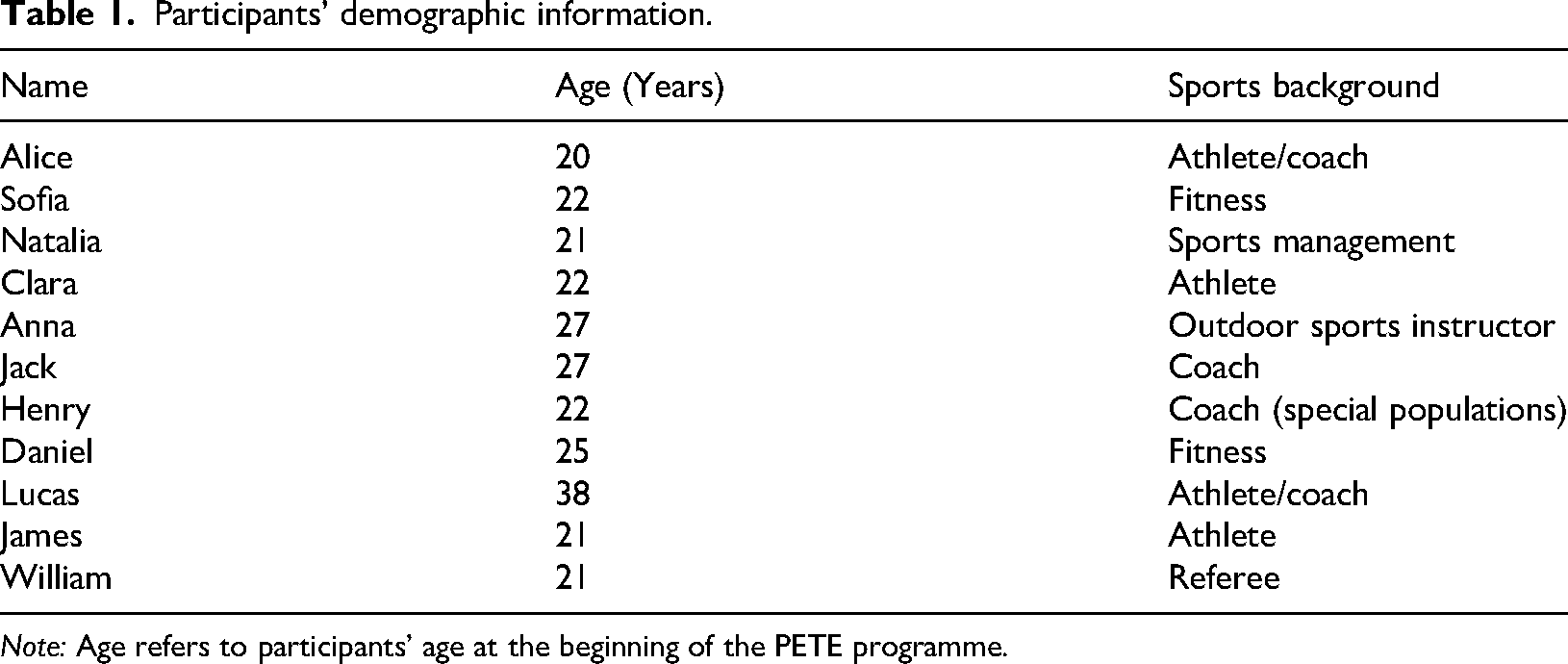
Note: Age refers to participants’ age at the beginning of the PETE programme.
The first author's background as a PETE graduate and researcher supported navigation of the data collection process. To ensure reflexivity and reduce potential bias, the investigative process, including conceptualisation, methodological procedures, and ongoing reflection, was collaboratively discussed with the other authors. These were two PhD supervisors who are teacher educators and university supervisors for PSTs in the programme's school placement, and one international expert who is a specialist in PETE teaching and research at an English first-language university. The study was approved by the host faculty's ethics committee (CEFADE 21 2021), with all participants signing informed consent.
Data gathering
This case study sought to capture the complex and often ambiguous interplay between student-centred pedagogical strategies and PSTs’ EB development. Because these strategies were naturally embedded in the PETE curriculum rather than introduced as interventions, the study focused on understanding how PSTs experienced them and how these experiences influenced their EBs. Data were collected through a 2-year longitudinal follow-up (see Table 2) involving focus group interviews (FGs), reflexive logs (RLs), and participant observations (POs).
Data collection timeline.
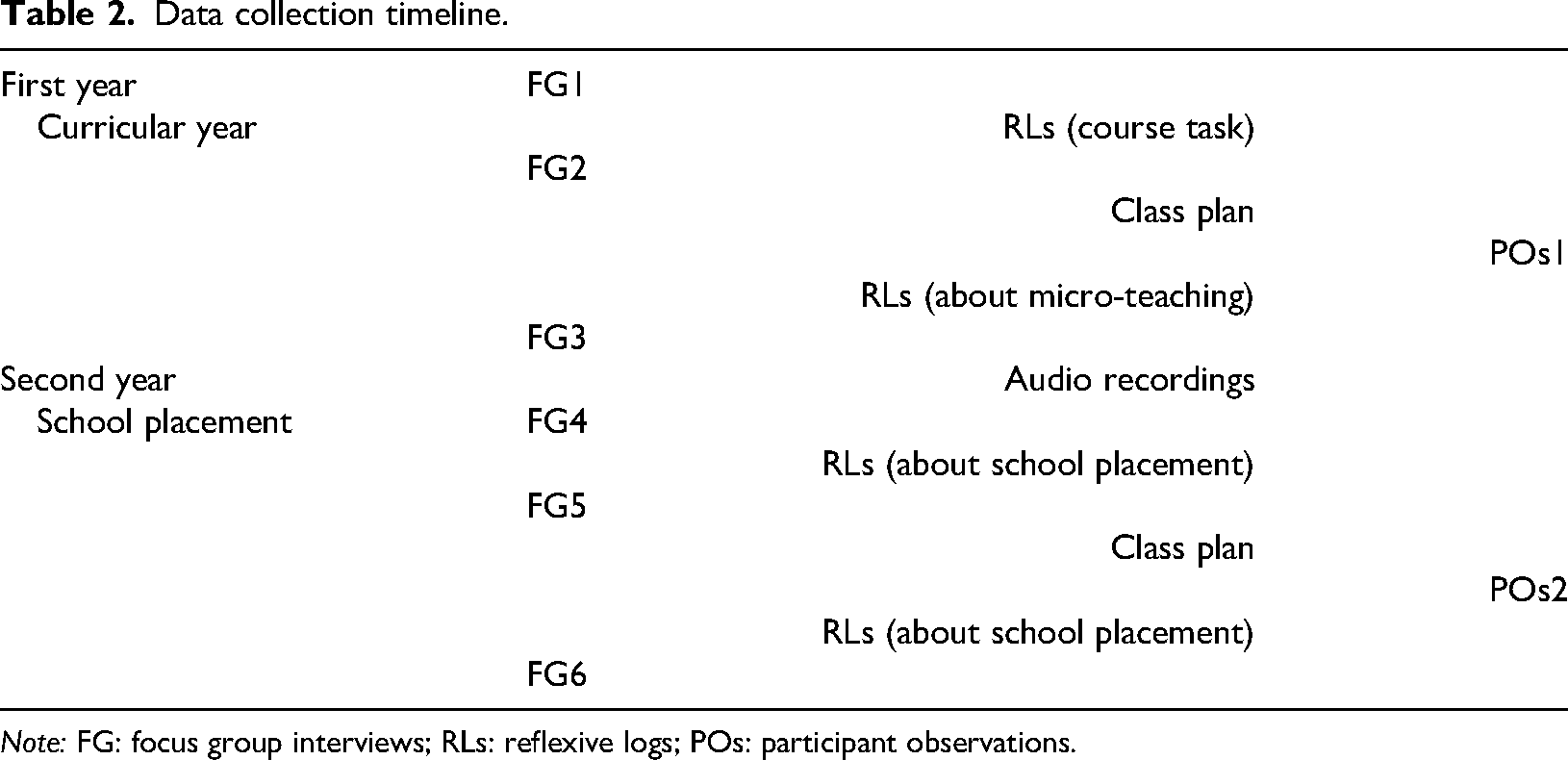
Note: FG: focus group interviews; RLs: reflexive logs; POs: participant observations.
FGs in this study were designed to encourage PSTs to discuss their beliefs about knowledge and knowing throughout their PETE programme experiences. Conducted three times per year (early, mid, and late PETE stages), each FG included three to four PSTs, totalling 18 sessions of approximately 110 minutes. All interviews were held in faculty settings, audio-recorded, transcribed verbatim, confirmed by participants, translated by the first author, and discussed with the research team to ensure accuracy and integrity. The interview guides were structured to consider the proposed objectives and relevant work on EB development (Hofer and Pintrich, 2002). FG1 focused on understanding PSTs’ initial EBs (e.g. What is the role of the PE teacher? How do PE students learn?). The remaining FGs (FG2 to FG6) followed PSTs’ journeys, preserving similar guiding questions while also exploring if, how, and why their EBs developed (e.g. How can you improve your students’ learning? Where did these new solutions come from? Which experiences from this PETE programme contradict what you thought about teaching PE?). Flexibility was maintained to explore emerging topics while ensuring balanced attention to each theme.
Individual RLs were examined at four moments across the PETE programme. The first occurred at the end of the Pedagogical Professionalism course (first semester), when PSTs completed an individual reflection titled ‘learning to be teachers’, in which they described how their own development as PE teachers had shifted during the semester. The remaining logs (completed after micro-teaching and before FG5 and FG6) focused on PSTs’ experiences with instructional decisions, feedback practices, and pedagogical options. All RLs were used with informed consent, and participation did not influence the courses’ assessments.
Additionally, at the start of the school placement, PSTs were invited to record an informal audio recording of their first experiences as lead teachers. This moment often brought new responsibilities and uncertainties, so the audio format allowed them to express early impressions more comfortably. The recording focused on initial expectations and challenges, was not linked to any PETE programme requirement or assessment, and was accessed solely by the research team.
POs were chosen to gain an understanding of how PSTs’ EBs were enacted, offering insights into aspects of teaching that may not emerge through verbal accounts alone (Öhman and Quennerstedt, 2012). By capturing teaching as it unfolded (particularly pedagogical decisions, class organisation, content delivery, and opportunities for student autonomy), POs complemented the other data sources and provided a more complete view of EBs’ development.
Two POs were conducted for each participant over the 2-year period. The first was during micro-teaching in real school settings, and the second was in the final months of the school placement, when PSTs had been leading their classes for over 6 months and were fully familiar with their students and school context. Field notes were used to capture subtle practice features. The observation protocols were guided by Hofer and Pintrich's (1997) EB dimensions and by each class plan (analysed beforehand) with attention directed to how the lesson was organised, how instruction and feedback unfolded, and how much autonomy students had.
Data analysis and trustworthiness
Thematic analysis was conducted following the systematic process outlined by Braun and Clarke (2021). This process was chosen because it supports an interpretive and flexible engagement with qualitative data, consistent with our aim to understand how student-centred pedagogical strategies shaped PSTs’ EBs across the 2-year PETE programme. We adopted a mixed inductive–deductive approach in which Hofer and Pintrich's (1997) framework and the pedagogical characteristics of the PETE programme provided conceptual guidance, while the analysis remained open to contextual insights from the data.
Over the 2 years of the PETE programme, the research team became deeply familiar with the dataset through sustained engagement with the verbatim transcripts of the FGs and audio recordings, RLs, and PO field notes, which were read multiple times to gain an overall understanding of PSTs’ developmental trajectories. Coding rounds captured segments that suggested the sophistication of PSTs’ EBs and/or their perceptions of the influence of programme pedagogy, reflecting on the relationships between their perspectives and experiences shaped by social construction and individual sense-making. All coded extracts were organised to support theme development.
Initial themes captured shared meanings in PSTs’ responses to the programme's challenges and forms of support. Given the longitudinal nature of the study and our aim to understand the development of EBs over time, these themes were subsequently organised to reflect the chronological progression of PSTs’ EBs throughout the PETE programme. Each theme was then reviewed in relation to both the coded extracts and the dataset to ensure coherence and analytic depth. Through this iterative process, themes were refined, merged, or discarded where necessary (e.g. Re-integrating PETE learning, building pedagogical flexibility, and evolving epistemological maturity were merged into the theme: The relevance of flashbacks in reconstructing EBs within the school placement).
Refinement of the final themes was supported by regular discussions within the research team, during which interpretations were negotiated. Themes were organised to reflect the progression across PETE's critical phases: the first curricular year, the transition into school placement, and the school placement itself. This chronological structure allowed the themes to mirror the evolving nature of the PSTs’ experiences and belief transformations over time.
Trustworthiness criteria ensured methodological rigour and minimised researcher bias. First, prolonged engagement and multiple data collection methods over time enabled data triangulation (Nowell et al., 2017). Detailed descriptions of the study's context, methods, duration, timeframe, and analysis were provided to facilitate a comprehensive understanding, ensuring the research process is transparent and well-documented (Tobin and Begley, 2004). The first author engaged in continuous reflexive dialogue with the research team, and peer briefings critically evaluated the process (Patton, 2015). Additionally, the other authors, all experienced in PETE, contributed to data analysis, interpretation, and critical review, providing valuable perspectives throughout. This collaborative process supported peer discussions and reflexive checks to critically evaluate the analytic process, minimise interpretive bias, and ensure data consistency and accuracy (Patton, 2015).
Findings
The student-centred pedagogical strategies implemented in this PETE programme shaped and revealed how PSTs’ EBs evolved over time. This evolution is presented across three themes, each corresponding to a specific temporal phase of the programme: the first year of PETE; the transition into the school context; and the school placement year. Together, these themes highlight the study's central focus on the longitudinal development of PSTs’ EBs and on understanding how particular student-centred pedagogical strategies influenced this progression.
First-year strategies to challenge one-sided teaching
PSTs’ initial perceptions served as a foundation for understanding the development of their EBs throughout the PETE programme. Upon entering the programme, PSTs demonstrated beliefs shaped by their experiences as students and assumed that those experiences provided sufficient knowledge of PE, which reflects an apprenticeship of observation: We have been studying handball and volleyball for 13 years as school and university students; we already know how to teach this content. (Sofia, FG1)
This statement reflected the assumption that prior experience alone was sufficient for teaching, implying a belief in fixed knowledge without acknowledging its evolving nature. PSTs also emphasised class control and knowledge transmission, believing authority was essential for effective teaching. These perspectives showed that PSTs prioritised content delivery rather than students’ individual learning needs: Teaching is transmitting knowledge (…) I have to know how to apply my ideas to the students and be seen as an example to the people to whom I will be transmitting my knowledge. (William, FG1)
During the first year, four student-centred pedagogical strategies emerged as influential in shaping PSTs’ beliefs about knowledge and knowing. These strategies were peer-teaching, questioning, micro-teaching, and reflexive engagement.
Peer-teaching appeared to support the development of more sophisticated EBs about knowing. It encouraged cooperation and teamwork by enabling PSTs to experience SCAs both as teachers and as learners. This strategy relied on team manuals and student roles, which helped create a collaborative learning environment: Henry: I am very motivated to make teams like in athletics. Natalia: I think it is important to learn to work with each other. Henry: The students themselves create more autonomy. I can have a captain, and you don't even have to warm everyone up because you split up into groups. They have the manual, and the captain guides it. William: It even ends up developing more cooperation within the group […] and they realise what each other can do. It happened to me in athletics. (FG3 discussion)
By practicing SCAs without the constraints of real school settings, both as students and teachers, PSTs built confidence and recognised that knowledge can be constructed from various sources through personal reasoning. Likewise, questioning emerged as a student-centred pedagogical strategy that appeared to support EB sophistication by providing opportunities for cognitive stimulation. PSTs’ reflections suggested that asking thought-provoking questions could guide students towards deeper understanding and independent reasoning, rather than simply eliciting correct answers: I used more questioning feedback on a one-to-one basis to help the student understand and come up with the answer […] This questioning was one of the things I wouldn't have done if we hadn't talked about it here in the master's programme. (James, FG3) I think it's beneficial […] it's often about asking questions like ‘what do you think this is for?’ In other words, asking questions not in such an evaluative way, but more from the perspective of whether they've really learned. (Henry, FG2)
Micro-teaching provided real-context experiences that highlighted the adaptable and pluralistic nature of knowledge. PSTs designed lessons with tasks that encouraged multiple resolutions and connections between activities, showing sophistication in their beliefs about knowledge: Knowledge developed in the exercises is transferable to the proposed tasks; dynamic exercises focusing on dribbling and passing, giving the student autonomy to choose the best option; evolution of the tactical and technical complexity of the sport in reduced-game situations. (Field notes from PO1)
This PETE programme's student-centred pedagogical strategy also cultivated flexibility in lesson planning. As Sofia observed in FG3, they could not be ‘afraid to adapt the plan if it was not working. Especially in handball, we often had to adapt because the kids were not keeping up’.
Lastly, reflexive practices contributed to the development of EB sophistication. Engaging in reflexive practices fostered personal negotiation and introspection, enabling PSTs to consolidate new understandings about their teaching role: I used to imagine teaching as a simple process of transmitting knowledge, but I soon realised that it goes far beyond that. Being a teacher is about helping students grow on their own. (Daniel, RL1) That more introspective and group reflection, talking, I think, had a great effect on our lesson plans, helping us adapt and change them. (Alice, FG3)
Not all forms of reflection, however, were perceived as relevant for this development. Indeed, group discussions and the exchange of ideas with peers were seen as more valued than more structured, written, and individual reflections: When we are talking with our colleagues, when we discuss things among ourselves about our realities, what we feel, and what we’ve done, I think that is much more beneficial than often having to write a reflection to submit. (Henry, FG3)
Even with this constraint, reflection, especially when carried out with peers and teacher educators, guided PSTs to better understand their progression towards viewing knowledge as flexible, evolving, and co-constructed, suggesting the development of more sophisticated EBs.
Navigating epistemological setbacks during the reality shock
As PSTs transitioned into their school placement year, they experienced a reality shock, often expressed through the recurring phrase, ‘They [PETE programme] threw me to the wolves’ (audio recording). This overwhelming shift into the school culture and profession pushed PSTs into survival mode. As a result, they reverted to teaching approaches that prioritised control and teacher authority, as they felt safer and more manageable amid the challenges they faced: I went there super motivated to give students autonomy and make them leaders of their own learning, but when I arrived, I realised I couldn't do that. The students need a lot of control. […] I have to teach a mix of things, from coaching to activities I used in PE classes when I was a student. (Alice, FG4)
Faced with the complexities of school realities, PSTs found it increasingly difficult to implement the student-centred pedagogical strategies they had been exposed to during the first year of the PETE programme. Instead, they reverted to interventions centred on the transmission of knowledge, such as direct feedback: I give direct feedback when refereeing a game […]. Perhaps it was from that experience that I derived this way of giving feedback. (William, FG4)
Moreover, the feeling of being unable to address the disparity in skill levels among students reinforced a more simplistic view of teaching that overlooked the adaptability of knowledge and did not involve differentiation or deeper consideration of students’ diverse needs: The students' ability levels are very different, which makes the lesson boring for the more capable ones, but I cannot resolve this. (Anna, audio recording)
This survival mindset highlighted the tension between their EBs and the realities of the school context, leading PSTs to simplify their practices and revert to more control-oriented strategies, returning to authority and fixed routines.
The relevance of flashbacks in reconstructing EBs within the school placement
Once the initial shock of the expectation-reality dilemma was navigated, the school placement year reinforced PSTs’ evolving beliefs, balancing the ones established at the start of the PETE programme with the sophistication developed during the first year. As a result, PSTs came to appreciate the importance of flexible teaching practices, adopting a more relativistic approach where they assessed multiple realities within each environment and tried to adapt their strategies accordingly: The first year was overwhelming; it gave me all the tools I needed. The second year showed me what school really is. The first year had both good and bad aspects, which in part helped me grow but also somewhat constrained me and gave me a school perspective different from what I encountered during the 2nd year […]. In this school, I could not do what I did last year, and for me, that was a bit of a shock, but it was important at times for me to define the person I am, how I think I should teach, the strategies I believe I should follow, and also to understand if those strategies work in that context. (Jack, FG6)
The school placement year prompted them to reconnect with their EB development from the first year, particularly on beliefs about knowing. As PSTs flashed back to their peer-teaching experiences, the desire to empower students to take responsibility for their learning became evident. All PSTs, to varying degrees, fostered student agency and engagement in the learning process—revealing teaching perspectives aligned with sophisticated EBs about knowing. Strategies like giving students specific roles, such as ‘the students who were outside acting as coaches’ (Anna, FG6) or as referees to ‘develop the sports’ culture about the rules and signals’ (Jack, FG5), promoted leadership and actively contributed to the class dynamics. PSTs also organised team-based activities that encouraged competition and accountability, successfully applying their sophisticated beliefs to the lesson contexts: The fact that it is a visible competition, posted on the wall, is something that motivates them from class to class […] they know that the work has a goal in mind, and they take responsibility. (William, FG6)
By aligning their practices with the SCA fundamentals they experienced during the first year, PSTs showed beliefs in different sources of knowledge and in the active role of the student in its construction: I opted for the Sport Education Model. There is a team manual, and the captain was truly responsible for implementing it, and they knew exactly what they had to do. If I was not in the class, by reading that, they could manage everything on their own, but it would require a lot of work outside the class. Each team had to organise a tournament to give them that aspect of the organisation, and some of the awards were also related to fair play. (Natalia, FG6)
Likewise, despite differences in school settings and cultures, PSTs recalled from their initial year that questioning was a student-centred pedagogical strategy to encourage students to reflect on their actions and think critically about their learning. As Alice noted, they ‘really tried to use questioning’ (FG6) to promote the self-construction of knowledge. James similarly stated: In my classes, I use a lot of questioning. Sometimes I let them experiment, then ask, ‘Why did you do it this way? Why didn't you do it another way?' Little by little, they gave me the answers and told me how they could do it more effectively. I think this also helps them to understand things. (James, FG5)
Drawing on micro-teaching experiences, PSTs relied on their views about evolving and adaptable knowledge to address the natural constraints of the school placement: The only thing I can say is that each class is different. We might come up with many ideas from PETE and say, ‘I will go there and teach all through the game’, but that is just nonsense. It might work, or it might not; I believe our role is to help students learn, and we have to come up with a strategy to make that happen, whether through games or more analytical exercises. In my view, all these beliefs need to be adapted to the class. (Lucas, FG5)
However, the process was not linear, as challenges persisted. Sometimes, PSTs struggled to adjust their lesson plans to the unpredictability of the context: He kept the class divided with a physical preparation activity, even when the field was available for all students to participate in the badminton tournament rotation, limiting exercise and involvement in the competition. Students crowded around net 1, leaving net 2 unused, resulting in unequal opportunities for practice. A line formed to access the main mat despite available space for individual practice. (Field notes from PO2)
When questioned, PSTs justified these choices by saying, ‘I didn’t know the space would be available, so I didn’t plan for that option’ (William, FG6) or ‘I didn’t realise there was free space at the net. I was focused on supervising and giving feedback’ (Daniel, FG6). These responses reflected a tendency to prioritise class control, suggesting a reliance on more established routines rather than adaptive strategies to the class's dynamics. Here, by reflecting on their experiences in collaboration with peers and cooperating teachers, PSTs reinforced their commitment to enhance the students’ active role and to contextual practices: There is a mix of thoughts and reflections that change over time, including beliefs that I altered to implement different teaching strategies that I am still trying to understand gradually. The knowledge, thoughts, and beliefs I have are of no use if they are only mine, so I now seek to discuss them and hear new perspectives because no matter how good I think they are, there is always something that can be improved. (Clara, RL about school placement)
Discussion
Through this longitudinal case study, we aimed to explore EB development across different PETE moments and to understand the impact of the student-centred pedagogical strategies used within this SCA-based curriculum. Our findings suggest that the development of PSTs’ EBs is best understood as a non-linear trajectory, structured across three interconnected phases: development, resistance, and rebuilding. Also, pedagogical strategies grounded in active student learning, cooperation and cognitive involvement promoted a gradual shift towards more sophisticated EBs. Here, the 2 years of the PETE programme have shown that the strategies experienced by the PSTs have carried over into their practices as teachers, nurturing a constructivist path in the development of the teaching profession.
Student-centred pedagogical strategies’ impact on EB fluctuations throughout PETE
PSTs enter PETE programmes with pre-existing EBs that act as powerful filters, shaping how new understandings are interpreted and guiding their future practice as PE teachers (Curtner-Smith et al., 2008). During the anticipatory socialisation phase, after 12 years as PE students and through other experiences as coaches and referees, our participants have constructed their EBs. Ultimately, these beliefs might lead PSTs to resist adopting SCA practices and to hesitate to fully take on the role of facilitator (Silva et al., 2021), and they often reflect dualistic views of knowledge—seeing it as fixed, simple, and transmitted by authority.
The first year of the PETE programme, however, opened spaces for alternative epistemologies, creating a sort of development phase for EBs. Early exposure to student-centred pedagogical strategies focused on collaboration and cognitive involvement began to disrupt these assumptions. This shift was evident in the PSTs' growing appreciation for student responsibility and teamwork. For instance, PSTs highlighted the value of assigning student roles, such as captains, and using team manuals to foster autonomy and cooperation – experiences they had during peer-teaching. Indeed, the implications of giving PSTs authentic opportunities during their early field experiences—both as learners and as instructors—have already been emphasised (Gurvitch et al., 2008). Also, by engaging in ways of knowing focused on the active student role, PSTs understood the importance of the students’ cognitive involvement in learning, thereby supporting growth in the sophistication of beliefs about knowing. Likewise, by engaging in planning and implementing lessons together in micro-teaching situations, PSTs began to perceive knowledge as evolving, adaptable and complex – sophisticated EBs about knowledge. The PSTs’ growing ability to adapt their strategies to meet students’ needs underscored their recognition of knowledge as evolving and co-constructed, further supporting Aypay's (2011) conclusion that teacher education may foster sophisticated EBs over time. These findings resonate with Hordvik and Beni's (2024) categories of autobiographical and experiential pedagogies, which challenge prior assumptions and allow PSTs to ‘live the curriculum' in ways that promote belief reconfiguration.
During the transition to a real teaching context in this PETE programme, PSTs took on the role of lead teacher for a class. This moment caused a reality shock and triggered a resistance phase in EB development, which highlights the non-linear nature of this process. In the initial confrontation with the profession's responsibilities, such as managing a class, the school's culture, and the human and material resources, the PSTs reported feeling helpless and overwhelmed with the assumed obligations. This experience has also been described in other contexts, where the beginning of school placement is characterised by difficulties in teaching tasks and a disconnect between anticipated expectations and classroom realities, often leading to the re-evaluation of ideals formed during the first year of teacher education (Valério et al., 2023; Veenman, 1984). Some PSTs reverted to pre-PETE beliefs rather than applying conceptions developed in the first year. This aligns with the already documented expectation that at the start of their school activity, teachers will resort to more teacher-centred approaches because those approaches facilitate class control (Mesquita and Graça, 2009) and because pedagogical strategies aligned with SCAs require solid content knowledge and leadership skills (Hastie and Mesquita, 2016). Although the PETE curriculum offered innovative practices, we are not naïve enough to think we have solutions to all the constraints of teacher education. This resistance demonstrates the non-linear nature of EB development, as setbacks form part of professional growth. As Stroot and Ko (2006) concluded, this return to more teacher-centred pedagogies happens regardless of PETE's innovative and critical practices.
This phase also connects with broader socialisation literature. The apprenticeship of observation (Lortie, 1975) and anticipatory socialisation frame how prior experiences re-emerge under stress. Teacher washout, described as the washing out of pedagogical perspectives learned during PETE programmes when incompatible with school culture (Curtner-Smith, 2001; Richards et al., 2014), often begins with reality shock (Banville and Rikard, 2009; Veenman, 1984). Thus, regression under this reality shock is not unexpected but a reinforcement of the already documented mechanism within teacher professionalisation.
Yet rather than abandoning their evolving EBs, PSTs actively engaged in reflection—drawing on first-year experiences, supervisor feedback, and peer discussions to make sense of these tensions. This rebuilding phase enabled a more nuanced and resilient form of EB, one that balanced pedagogical ideals with practical realities. Importantly, PSTs revisited their first-year experiences and applied student-centred pedagogical strategies more selectively and adaptively, signalling a maturation of their beliefs along the two dimensions. They revisited first-year strategies implemented in peer- and micro-teaching situations (such as questioning, accountability, and teamwork) as they resurfaced as reference points, now tested under real classroom constraints. As noted by Silva et al. (2021), short placements (such as those in the first year) often fail to address PSTs’ instructional limitations, whereas extended placements (such as a second-year internship) with a clear intervention focus enable significant professional growth and scaffold managerial and instructional domains.
Despite this maturation, translating beliefs to practice was not seamless. The PSTs’ doubts and insecurities align with Stran and Curtner-Smith's (2010) findings on early struggles in fostering effective learning and Hordvik et al.'s (2019) observations on reluctance to share leadership with students. Nevertheless, PSTs engaged in reflexive adjustments, gradually refining their approaches to align belief with practice in meaningful ways. As found by Azevedo et al. (2024), at the end of their professional internship, PSTs were able to critically reflect on their actions as they figured out who they were as teachers. Reflection operated not only to reconsider practice but as a regulatory tool, allowing PSTs to reconcile tensions between entrenched and newly emerging beliefs.
These findings underscore the value of early, authentic teaching experiences and structured reflection throughout the PETE programme. In fact, PSTs trained in environments guided by constructivist-inspired curriculum reforms tend to adopt strategies with greater student participation and guided discovery (Lee et al., 2013). While the transition from belief to practice is neither smooth nor linear, the interplay of practice, reflection, and support appears crucial in reshaping EBs towards greater sophistication. This re-building reflects Hordvik and Beni's (2024) pedagogies of professional learning, where extended placements and collaborative support enable PSTs to reconstruct more sophisticated epistemologies in context.
Impacting EB sophistication—recommendations for PETE
By foregrounding the non-linear nature of EB development, we argue that PETE programmes must go beyond linear growth models and instead intentionally scaffold, challenge, and reconstruct beliefs through iterative cycles of disruption and reflection. The findings suggest that PETE can play a key role in strengthening PSTs’ EBs, equipping them more effectively for the complex realities of today's schools, particularly when supported by the student-centred pedagogical strategies outlined here. As suggested, greater emphasis should be placed on integrating these strategies in the early stages of teacher education to better align PSTs’ beliefs with effective teaching practices.
Firstly, peer- and micro-teaching experiences in the first year, which may require further progression in the autonomy and responsibility of the teacher as a single intervener, fostered a smoother (though still troubled) transition into the school placement year and may have softened the impacts of the reality shock in terms of EB sophistication. Indeed, progressive school experiences, coupled with supervision and complemented by activities in the faculty, have been linked to the successful implementation of new ideas about knowledge and knowing (Brouwer and Korthagen, 2005). Nevertheless, attention should be paid to the management of expectations during the transition from first year to school placement, as one way to ease this transition is to be adequately prepared for the realities of the school context (Lawson, 1983).
Secondly, PSTs recognised that using thoughtful, open-ended questioning not only deepened student understanding but also supported the development of critical thinking. Since reflectivity is a well-established hallmark of effective teaching, the findings of this study may highlight the importance of teachers thoughtfully considering their actions and how these relate to deeper thinking and belief systems (Soleimani, 2020). The alignment with theoretical insights reinforces the view of questioning as a catalyst for both cognitive stimulation and the evolution of more relativistic, sophisticated EBs.
Finally, combining the above characteristics with a strong reflection component was essential for EBs to mature. Self-reflection, group-based reflection, and reflection with mentors acted not only as mechanisms for awareness but also as regulatory tools to reconcile tensions between old and new beliefs. These reflexive practices helped PSTs reassess their ideas and maintain the will to apply new understandings (Smith and Ingersoll, 2004).
Final thoughts
Through a 2-year case study, we learned that EB development is a non-linear process. While the first year appeared to foster the development of more sophisticated EBs, the initial challenges of school placement in the second year emerged as significant obstacles. During this period, a phase of renewed consolidation was observed, with PSTs demonstrating the capacity to return to first-year student-centred pedagogical strategies and re-align their practices to enhance students’ active role. Understanding these phases within a non-linear trajectory underscores the importance of PETE programmes that scaffold and rebuild PSTs’ beliefs. Our hope is that this new generation of teachers will believe in the empowerment and autonomy of their students and can continually adapt their understandings to facilitate the best possible environment for physical education.
Footnotes
Acknowledgement
The authors would like to thank the editor and the anonymous reviewers for their valuable comments on this paper.

Ethical approval
The study was approved by the Ethics Committee of the Sports Faculty of the University of Porto, under the code CEFADE 21 2021.
Funding
The authors disclosed receipt of the following financial support for the research, authorship, and/or publication of this article: This work was supported by the Foundation for Science and Technology (FCT, Portugal) through the 2021.04842.BD grant awarded to the first author.
Declaration of conflicting interests
The authors declared no potential conflicts of interest with respect to the research, authorship, and/or publication of this article.
Data availability statement
The datasets generated during and/or analysed during the current study are not publicly available due to privacy and confidentiality concerns related to the participants, but are available from the corresponding author upon reasonable request.