



Abstract
This article focuses on teachers’ responsiveness to changes in assessment policy and how new guidelines affect assessment and grading practices in school physical education (PE). The previous national curriculum in Sweden directed many teachers towards an atomistic approach to assessment. The reformed guidelines, in contrast, mandate that teachers should strive for holistic assessment. Thus, the purpose of this study was to generate an understanding of how teachers interpret and translate the policy for holistic PE assessment and discuss potential consequences of their policy enactments. Data were generated through six focus group interviews with 22 PE teachers working at different secondary and upper secondary schools. The theoretical framework used in the analysis is based on Ball et al.’s ( 2012a) work on policy enactment. The findings show that teachers view the policy for holistic assessment in PE positively. They claim that it enables them to concentrate on the bigger picture, weigh factors in terms of significance during assessment, and connect to students’ lives outside of PE. We discuss the potential consequences of the teachers’ policy enactments in terms of the backwash of the reform. On the one hand, the reform results in reduced transparency and a risk that certain areas of knowledge may be marginalised. On the other hand, the study suggests that teachers’ autonomy with respect to assessment increases. This autonomy, which ideally leads to valid holistic assessments and fair grades, is tailored to the students’ conditions and what they see as meaningful knowledge in life outside of school.
Introduction
The research interest in the current study is directed towards teachers’ responsiveness to changes in assessment policy and how new guidelines affect assessment practices in the school subject of physical education (PE). Teachers’ ways of interpreting and translating national assessment policy into practice can be understood in terms of policy enactment (Ball et al., 2012a). Since this study is set in Sweden, it is necessary to provide a brief description of the Swedish national context for teachers’ policy enactment in school in general and in PE specifically.
The previous national curriculum (The Swedish National Agency for Education [SNAE], 2011) resulted in many teachers grading aspects of students’ knowledge as separate entities, which could suggest a dominance of an atomistic approach to assessment being applied. The fact that even minor areas of knowledge could lower a student's grade led to students feeling that their final grade was based on their poorest performance (Gustafsson et al., 2016), a problem acknowledged in The Assessment and Grading Inquiry (SOU, 2020:43) in 2020. The proposed solution was to introduce compensatory grading, enabling teachers to conduct comprehensive assessments and assign the grade that most accurately reflected the student's overall knowledge. This recommendation was taken up in the new Swedish curriculum (SNAE, 2022), where the reformed guidelines now mandate that teachers should strive for holistic assessment.
This recent change has taken place against a backdrop of sustained research on assessment in Swedish school PE. This research has uncovered issues such as poor alignment between curriculum, pedagogy, and assessment, and a lack of transparency regarding what is being assessed (Annerstedt and Larsson, 2010; Redelius and Hay, 2012; Svennberg et al., 2014), issues that have resulted in debates concerning validity, comparability, and fairness. Despite assessment reforms, Modell and Gerdin (2022: 1048) claim that questions remain around ‘what is being assessed, how it is being assessed, how [students] can achieve the assessment expectations and have an equal opportunity to both learn and demonstrate these knowledge and skills’.
On one hand, moves towards alignment and greater transparency may lead to more equitable assessment practices. On the other hand, Tolgfors and Barker (2023) note that a shift towards a stronger culture of accountability could have unintended consequences. They discuss the potential implications of assessment standardisation in times of increased student diversity and heterogeneity: [B]oth comparability (the same for all students) and student-centeredness (unique to all students) can be presented as valuable characteristics of assessment in a text, and to omit one might invite critique. In practice, however, the attainment of one presents significant challenges to the attainment of the other. (Tolgfors and Barker, 2023: 12–13)
For this reason, PE assessment can prove problematic for PE teachers, even if they endeavour to adapt to a reformed assessment policy. Depending on teachers’ ways of complying with or resisting the reformed assessment policy, there are reasons to expect both intended and unintended consequences of the reform (cf. Aasland et al., 2024). The new policy might bring about a more compensatory approach to grading (SOU, 2020: 43) but, drawing on previous research (i.e. Modell and Gerdin, 2022), there is still a considerable risk that students will feel they are not being assessed in what they consider a fair manner.
Largely missing from existing literature on PE assessment is an understanding of the potential consequences of switching from an atomistic approach to a holistic approach, especially in terms of students’ learning opportunities, teachers’ assessment strategies, and how students and teachers perceive the reformed assessment practice. Consequences in these broad areas can be identified in the ‘backwash’ of the reform, since ‘[a]ssessment not only influences the teaching and learning process, it also defines an education product’ (Chan et al., 2011: 5). Thus, we investigate what characterises contemporary assessment practices of school PE once a holistic approach has been mandated and consider the backwash effect of the reform (SNAE, 2022). Specifically, the purpose of this study was to generate an understanding of how teachers interpret and translate the policy for holistic PE assessment and discuss potential consequences of their policy enactments. The following research question is addressed: How do teachers interpret and translate the policy for holistic PE assessment? The findings are then be discussed based on the question: What consequences follow in the backwash of the reform? In the next section, we will zoom out and locate our investigation within the broader research field of PE assessment.
Towards more holistic PE assessment
In the last two decades, the body of research literature focusing on PE assessment – both for accountability and for learning – has increased dramatically (Barker et al., 2025). The major purpose of assessment for accountability is to assign valid and fair grades, which means that certain assessments carried out in practice have a summative function (see, e.g. Borghouts et al., 2017). The major purpose of assessment for learning (AfL) is to promote learning and show how teaching should be adapted to the needs of the learners. This means that assessments that are carried out for learning have a formative function (see, e.g. Slingerland et al., 2024; Tolgfors, 2018). However, since both assessment for accountability and AfL should be integrated in the work of PE teachers, they need to be considered together, a point emphasised by advocates of instructional alignment (AIESEP, 2020; MacPhail et al., 2023). PE teachers who know what to assess (comprehension dimension), how to assess (application dimension), how to compare students’ achievements with relevant assessment criteria (interpretation dimension), and how to reflect upon potential implications of assessment (critical engagement dimension) are considered to be literate in assessment (DinanThompson and Penney, 2015; Hay and Penney, 2012).
In one sense, being responsive to the four dimensions of assessment literacy when conducting assessment for both summative and formative purposes could be regarded as important resources for teachers who are faced with any reform in assessment policy. In another, one of the reasons why SNAE launched a reformed policy proclaiming the importance of holistic assessment (SNAE, 2022) was that teachers had a narrow understanding of what, how and why to assess and were taking an atomistic approach to grading. This involved making continuous summative assessments of students’ knowledge and skills across several distinct components of the subject content and then assigning grades by aggregating the individual scores. Moreover, in the pursuit of accountability, there was a tendency to make summative assessments of what could easily be measured instead of evaluating students’ knowledge in a larger context (cf. Penney et al., 2009). In response to such an accountability culture, alternative approaches to PE assessment have been suggested (López-Pastor et al., 2013), some of which can be related to holistic assessment. It is widely recognised, for example, that school PE can contribute to students’ holistic development in the cognitive, psychomotor and affective domains. Some scholars propose that all three domains should be considered in PE assessments, which would imply a ‘move towards a more comprehensive and holistic assessment approach’ (Li and Zhang, 2024: 133353).
Holistic assessment can also be related to Hay and Penney's (2012) lifelong and lifewide perspectives. For Hay and Penney (2012: 98–99), ‘assessment for lifelong learning’ means that assessment tasks in PE play a part in ‘encouraging the ongoing acquisition of skills, knowledge and understandings, or their application in new contexts’. Assessment for ‘lifewide learning’ (Hay and Penney, 2012: 104) implies that assessment tasks in PE can be dealt with collaboratively between co-assessors such as the PE teacher, parents and sport coaches. The basic idea is to encourage students to reflect on their learning experiences in school PE as well as outside the classroom. The potential benefits and challenges of such authentic assessments have been discussed by several PE scholars (see, e.g. Barrientos Hernán et al., 2023; Georgakis et al., 2015; Mintah, 2003). It could be argued that this move towards ‘authenticity, relevance and meaning for students’ (Hay and Penney, 2012: 109) was a step towards more holistic PE assessments.
In this research project, we are open to different interpretations and translations of holistic PE assessment policy and curious about its backwash effects. For this reason, we have engaged with Ball's (2000, 2003, 2012a) theoretical perspective on policy enactment.
Theoretical framework
The theoretical framework used in the project is based on Ball et al.’s (2012a) work on policy enactments in secondary schools. The focus is on how current assessment policy, curriculum and other contextual factors at the macro level determine how teachers view their assessment mission in school. Ball (2003) has given voice to teachers’ ‘terrors of performativity’, when they find themselves stuck in a culture of accountability. Pressured by a control regime, some teachers not only contribute to this test culture on behalf of their students, but also do what they can to pass an inspection themselves: It is not the possible certainty of always being seen that is the issue, as in the panopticon, it is the uncertainty and instability of being judged in different ways, by different means, through different agents; the ‘bringing-off’ of performances – the changing demands, expectations and indicators that make us continually accountable and constantly recorded. (Ball, 2000: 2)
When teachers act in ways that bring ‘students, teachers and schools directly into the gaze of policy’, this technology of performance can be labelled ‘deliverology’ (Ball et al., 2012a: 139, 2012b). This concept refers to a general idea that teachers as policy actors should ‘deliver’ curriculum content and assess students’ knowledge in a literal manner according to the grading criteria. Some teachers might, however, resist policy expectations with which they do not agree and act more autonomously in the assessment practice. Thus, what becomes of a reformed assessment policy often depends on micro-political negotiations (Webb, 2006) in school, since ‘[p]erformativity works from the outside in and from the inside out’ (Ball, 2000: 4). This means any curriculum can contain certain guidelines for assessment, but teachers are likely to adjust these guidelines to their ‘school realities’ (Svennberg and Högberg, 2018).
Following Ball et al. (2012a), teachers’ policy enactment involves two creative processes: ‘Interpretation is about strategies and translation is about tactics’ (Ball et al., 2012a: 47, emphasis added). Interpretation refers to how teachers engage with the languages of policy and make sense of what the policy text means to them. Methodologically, this means we need to gain access to teachers’ interpretations of the policy for holistic assessment (SNAE, 2022) by encouraging them to describe their ways of understanding the new assessment guidelines. These interpretations form the basis for their assessment strategies. Translation refers to how ‘[t]he language of policy is translated into the language of practice, words into action, abstractions into interactive processes’ (Ball et al., 2012a: 48). Methodologically, this means we must also gain access to how teachers describe their translations of this policy into PE practice, which correspond to their tactics. Ball et al. (2012a) contend that policy discourses subjectify teachers and students. Thus, the reformed policy for holistic assessment is likely to entail teachers as ‘policy actors’ or ‘policy subjects’ (Ball et al., 2012a: 73), whose students can either be viewed as passive ‘policy objects’ or as active self-regulating subjects, discursively produced in relation to the ‘recipe for success’ (Ball et al., 2012a: 126). The concepts from this theoretical framework were applied in the analysis of the data material that was generated in the following way.
Method
Focus group interviews
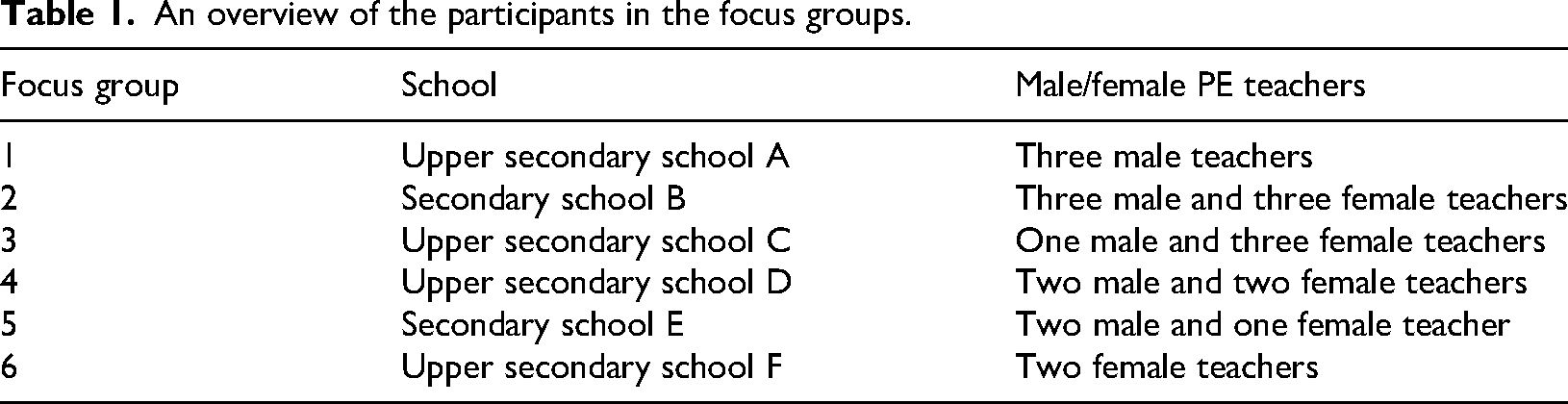
To gain access to PE teachers’ interpretations and translations of the policy for holistic PE assessment (SNAE, 2022), six focus group interviews were conducted. Morgan (1996: 131) defines focus groups as ‘a research technique that collects data through interaction on a topic determined by the researcher’. Policy interpretation is often a social process. Teachers rarely work in isolation – they discuss, negotiate, and co-construct meaning with colleagues. Thus, the choice of using focus groups allowed us as researchers to observe how ideas were shaped through interaction, revealing group norms, shared understandings, and tensions that might not have surfaced in individual interviews. In our study, the research method enabled the participants to complement each other's statements and, at times, offer alternative ways of looking at the issue rather than merely answering questions posed by the interviewer one by one (cf. Ennis and Chen, 2012). The focus groups were led by a moderator who introduced the research objectives and discussion themes and then ensured that the conversation remained focused on those objectives. All authors except one participated in moderating the interviews by collaborating in pairs with each focus group. While one researcher asked questions, the second researcher took field notes regarding viewpoints that were considered particularly significant. The focus groups consisted of two to six qualified PE teachers with varying degrees of work experience. The variation in the number of participants in the groups was due to the number of employed PE teachers at each school and how many agreed to participate in the study. The participants, 22 in total (11 men and 11 women), were recruited through purposeful sampling. Several participants had served as cooperating teachers during preservice teacher placements in three cities situated within a 50 km radius of the researchers’ university. Two focus groups included teachers from various secondary schools (grades 7–9), while four focus groups involved teachers from different upper secondary schools (grades 10–12; see Table 1).
An overview of the participants in the focus groups.
An interview guide was used to elicit PE teachers’ interpretations and translations of the reformed assessment policy (SNAE, 2022). The interview guide was based on the broad questions: How have you perceived the assessment reform? What do you think prompted the reform? Have your assessment practices changed as a result of the reform? How do you assess and document students’ knowledge within the different knowledge areas of the PE syllabus: movement, friluftsliv (outdoor education) and health? How do you make a holistic summative assessment and assign the grade that best corresponds to each student's knowledge? The interview guide also included a set of questions focusing on potential consequences of the reform for both PE teachers and students. The focus group interviews, conducted in Swedish, lasted between 60 and 90 minutes. They were audio recorded and transcribed verbatim. Selected quotations were later translated into English.
Research ethics
The research project underwent review by the Swedish Ethical Review Authority (Dnr 2024-05407-01). In accordance with the ethical guidelines of the Swedish Research Council (2024), informed consent was gained from the participants. This was done in writing as well as orally. The participants were also informed that they could cease participation at any time. Issues of confidentiality were considered throughout the project by ensuring that the participants’ identities were protected and that the names of the schools where they were employed were not revealed. All research data were stored on the university's password-protected research drive, where they will be archived for 10 years.
Analysis
The analysis began during the fieldwork. With the support of their field notes, the researchers who conducted each respective focus group interview discussed their overall impressions of what had been said in response to the research questions. Once the transcripts of the focus group interviews were completed by the third author, an analysis was made of these field texts too. All researchers in the research team familiarised themselves (Jones, 2022) with the material independently. During this familiarisation, we all read the transcripts through our designated theoretical lens. This meant we looked for examples of participants’ perceptions of the new assessment reform and comparisons with the previous one (coded as interpretations), as well as how they described their ways of working with the new policy for holistic assessment (coded as translations). The individual coding of the transcripts (Jones, 2022) was carried out in preparation for our joint comprehensive analysis.
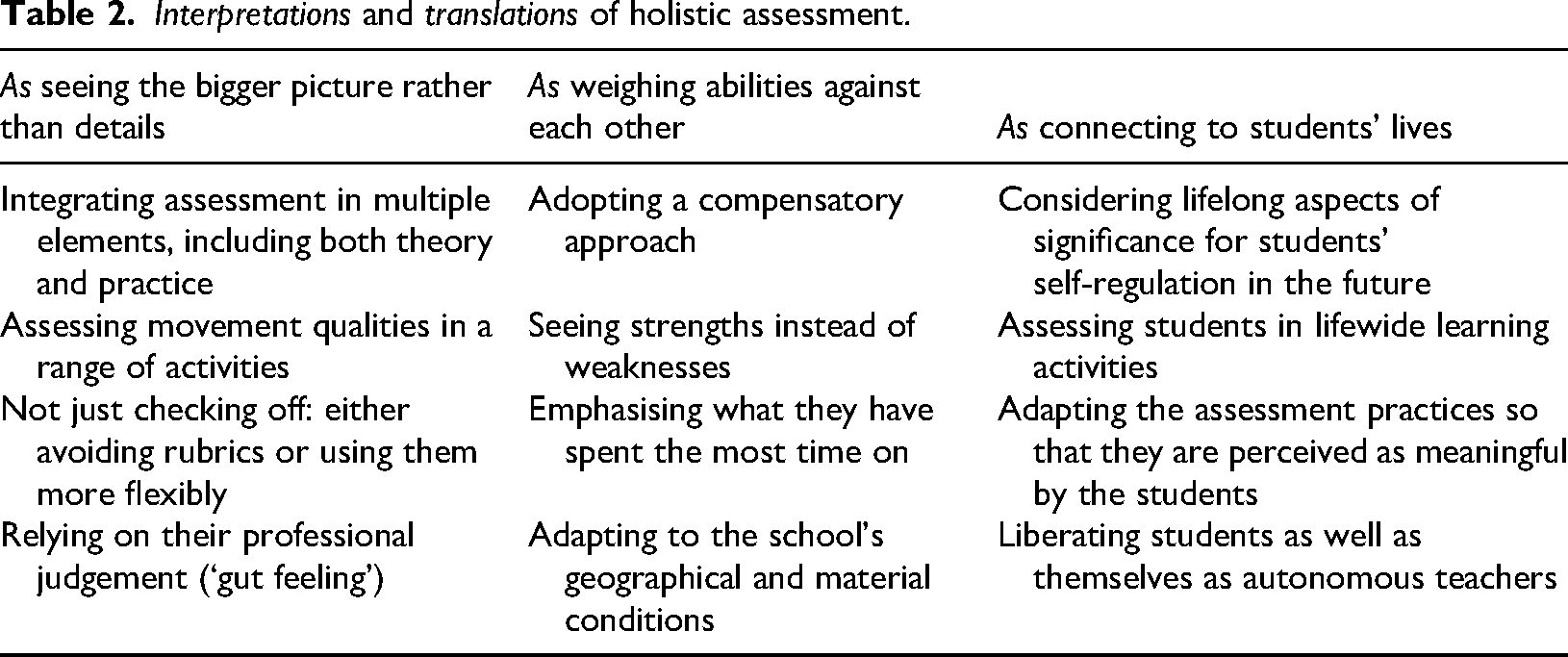
At our initial analysis meeting, the objective was to carry out a categorisation and thematisation of the empirical material (Jones, 2022). Two theoretically driven analytical questions were discussed: (i) How can teachers’ interpretations of holistic assessment be metaphorically understood as something? (ii) How are these interpretations of holistic assessment translated into assessment practices? Through our discussions, we agreed on a number of apt metaphors for holistic assessment, based on the interpretations we had identified in the transcripts as well as certain subordinate categories (i.e. translations). For the sake of transparency, we provide an example of how the analysis of a passage from the transcripts was carried out: We’ve seen hundreds of students. And the longer you’ve worked, the more students you’ve encountered, and the more refined your pedagogical skill becomes in noticing things. So, I really believe that the longer you’ve worked, the more you’re able to see. I walk through town and see someone run past. I look at how they place their feet, you know. Our eye is with us all the time. So, when people talk about gut feeling – I actually think it's really a form of pedagogical skill. And now it's being emphasised more in the new curriculum: that there's no one else but you who has had these students and can make this overall assessment, because you’re the only one who's seen them. You can’t really measure it in small parts. It's the whole picture we see, and that becomes a trained eye. (F2, upper secondary school F)
Analysis: The italicised meaning-bearing units in the excerpt correspond to codes which, together with similar statements from other teachers, were categorised as assessing movement qualities in a range of activities and relying on their professional judgement (‘gut feeling’) and thematised as seeing the bigger picture rather than details (see Table 2).
Interpretations and translations of holistic assessment.
After the initial analysis meeting, the first author produced a preliminary draft of the results based on the analysis conducted up to that point. In this draft, additional theoretical concepts from Ball's toolbox were also brought to bear on the data through tentative analytical questions: (iii) To what extent do the PE teachers position themselves as policy actors or policy subjects? (iv) How are the students positioned in relation to the reformed policy: as policy objects or self-regulating subjects? (v) How do teachers’ policy enactments within assessment practices appear when compared to Ball's concepts of performativity and deliverology? The answers to these questions are presented in an integrated manner in the Findings section.
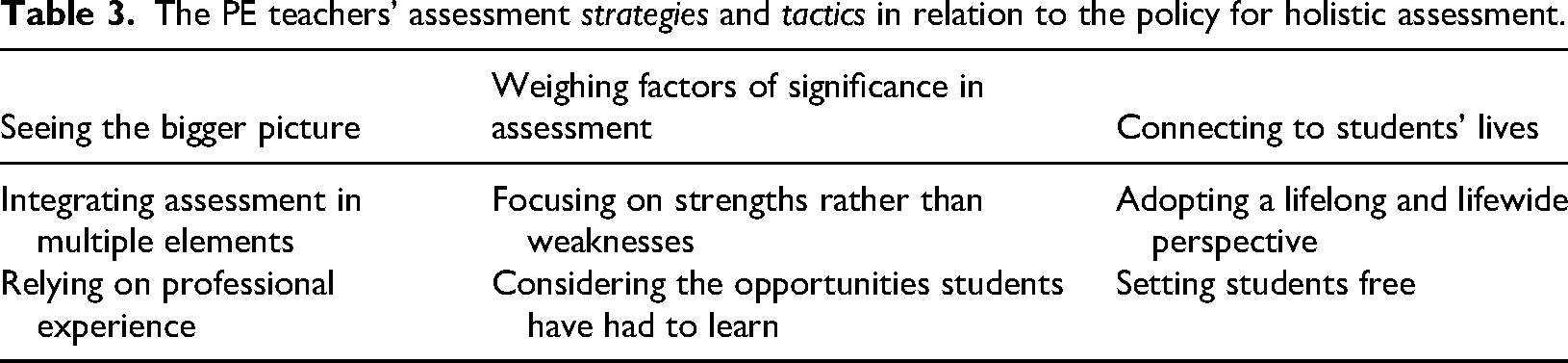
Two weeks later, all researchers convened for a second analysis meeting with the aim of reaching a collective agreement on the final analysis. This deliberative strategy (Goodyear et al., 2019) enabled us to discuss how the interpretations and translations identified in the previous step could be synthesised into fewer, yet more comprehensive, themes and categories. In accordance with the theoretical framework, we therefore regarded the PE teachers’ interpretations and translations as more concise strategies and tactics (Ball et al., 2012a) within the assessment practice (see Table 3). These strategies and tactics serve as headings and sub-headings in the Findings section.
The PE teachers’ assessment strategies and tactics in relation to the policy for holistic assessment.
As a conclusion to the second analysis meeting, we also reflected on the backwash effect (Chan et al., 2011) of the assessment reform and discussed what we considered most relevant to address in this paper. We agreed on three main issues related to the policy for holistic assessment, focusing on: (i) potential consequences, (ii) advantages and disadvantages, and (iii) reasons why PE teachers perceive the reform as they do. More concrete discussion questions are introduced at the beginning of the Discussion section.
Findings
The structure of the following section is based on three overarching assessment strategies, each of which includes two tactics for enacting the policy for holistic assessment in practice. In the Findings section, references to the theoretical framework are made since it helped us to produce the findings.
Seeing the bigger picture
Several teachers described how their assessment practice has shifted from a culture of accountability and performativity (Ball, 2003), where their focus was on individual performances that could be easily measured, to a more comprehensive view of assessing students’ knowledge and abilities in context. The teachers suggested that this holistic assessment strategy involved striving to see larger patterns in students’ performances and not simply focusing on one ‘moment’ at a time.
Integrating assessment in multiple elements
In comparing how reforms had impacted assessment practices, several teachers claimed that the most recent reform in 2022 had resulted in a change for the better: After the previous reform [in 2011], it was so fragmented. You had to assess small details in some way, but now I try to think in broader categories. (F2, upper secondary school F)
One tactic the teachers described was creating learning tasks that lead students to practice theory and reflect on practice, rather than treating theory and practice as separate: We rarely have theory lessons. We have a training assignment where we go through a bit more theory, but otherwise, we integrate the theory into the practical activities. (F1, secondary school B) Based on the new curriculum, it becomes easier to find time to connect with the theory in a different way because you’re not as stressed about checking things off in the same manner. Instead, it becomes easier to weave in theoretical tasks and have time to really work through them, work on leadership, and work on your own planning. That is, work on those parts where students get greater influence and take more responsibility for their studies. (M1, secondary school E)
Several teachers mentioned that the recent policy reform led them to ‘soften’ their approach to both the central content and the grading criteria in the curriculum. They no longer saw it as their duty to read the curriculum as literalist policy actors (Ball et al., 2012a), which was the case before, when their assessment practices resembled what Ball et al. (2012a, 2012b) call ‘deliverology’: Admittedly, clarity was nice. Some students absolutely appreciated clarity. It was easier to be, how should I say, more specific, but there was a risk in clarifying what a knowledge requirement meant. It could easily end up in very specific parts within certain movement qualities. And I think they [SNAE] wanted to move away from that, so it doesn’t focus on exactly how a movement is performed. (M2, upper secondary school D)
Most teachers referred to themselves as independent policy subjects (Ball et al., 2012a) after the reform, suggesting that they could autonomously form their own understanding of students’ knowledge and skills more easily than before the reform. Moreover, students were more frequently positioned as self-regulating subjects than as policy objects (Ball et al., 2012a), as their responsibility for planning and leadership had increased. The teachers repeatedly emphasised that these specific self-regulating abilities were highly valued in their assessment practices. They also suggested that it was both fairer and more accurate to assess students’ movement qualities across a range of activities rather than evaluate their skills in each individual sport: You don’t really see the finished activity, but rather the movement ability […] and you can observe it in various contexts. (M2, secondary school E)
The teachers maintained that collecting a range of assessment information from students’ performances across various movement cultures was both logical and appropriate. Integration was also evident in the teaching practices. For example, orienteering – previously assessed through a specific criterion in the curriculum – was now incorporated into broader outdoor activities. Instead of organising a traditional orienteering test, where students were required to reach a set number of controls within a specific time, the ability to orient oneself was assessed during nature excursions. One teacher explained how the approach to assessment had evolved with the introduction of new guidelines for holistic assessment: Regarding developing one's orientation skills – previously, the student might think, ‘OK, today determines my physical education grade one way or the other, and if it doesn’t go well today, I have to go out again and make up for it.’ […] Now it's more about looking at the entire process and seeing how the orientation skills develop. (M2, secondary school E)
The teacher's statement suggests that the holistic perspective influences both formative and summative assessment. There is less emphasis on measuring results at a specific point in time and greater focus on learning over time, which can be supported through feedback at the process level.
Relying on professional experience
After the reform in 2011, teachers often used rubrics to communicate with students about their progress and what they needed to develop to achieve a certain grade. After the 2022 reform, teachers tended to use rubrics rarely, and when they did use them, it was in a flexible manner. Rubric use tended to take place in conjunction with the annual cycle in planning and as a follow-up of the course, but rarely as a tool placed in front of the students to increase assessment transparency. As one teacher said, ‘assessment is not just checking off anymore’ (M2, upper secondary school D). The positive experience of no longer checking off knowledge and skills in an atomistic manner was a recurring feature in all focus groups: It feels less like a checklist than before, which allows you to relax more in the teaching and assessment situation. And it simply gets better because you have the opportunity to look at more things without being stressed about checking off these items; instead, it's a holistic approach. (M2, secondary school E) I’m thinking, there used to be a lot of rubrics and many different criteria, and it was a bit of a checklist system. This way, you get a bit more freedom, so it's not about ticking off things and then moving on to the next, but it becomes more dynamic in the grading. (M2, secondary school B)
After previously having been very detailed in documenting students’ knowledge, several teachers likened their current way of documenting to ‘using a broader brush’ (F2, upper secondary school F). They described relying on their professional judgement, often referred to as their ‘gut feeling’: You don’t make that overall assessment until the end of the course, so in each content area you have somehow made an assessment, which will then become a whole. My feeling is that the so-called gut feeling in the end becomes this overall assessment. (F1, upper secondary school F)
However, it is important to note that the teachers in the present study did not view gut feeling as something negative, but rather as a resource that comes with the experience of having assessed many students over a long period: ‘It's like seeing the whole picture with our trained eye’ (F2, upper secondary school F). This ‘trained eye’ was useful when teachers were assessing students in different movement activities in various settings: We spend a relatively large amount of time on movement compared to other knowledge areas […] because we want to have students in motion so that we can see them in motion and how they adapt movements in outdoor activities, football, dance, or similar. (M1, secondary school E)
This quote indicates that an appropriate tactic for conducting an overall assessment was to observe how students adapted their movements across a range of activities over time. The assessments carried out during the learning process were used for both formative and summative purposes, as teachers’ descriptions of their assessment practices suggested that they aimed to support students’ overall development while also generating a comprehensive understanding of their movement abilities.
Weighing factors of significance in assessment
The second strategy involves weighing factors of significance in assessment to determine which grade best reflects a student's knowledge. Additionally, teachers considered the learning activities they had spent the most time on and the geographical and material conditions that had framed the students’ learning.
Focusing on strengths rather than weaknesses
When teachers were asked what carries the most weight in their summative assessment, there was consensus that movement capability was the most important: The assessment of movement or movement qualities is, in some way, the core of our activities. (M1, upper secondary school C) It's the quality of movements. These are the kinds of things you look at. (F1, upper secondary school F)
A tactic when evaluating a student's quality of movements was to focus on what they can do instead of what they fail to accomplish: ‘Rather than looking for mistakes, you look for what is good’ (F1, secondary school E). One teacher described this tactic as ‘acquitting rather than convicting’ (F3, upper secondary school C). This line of reasoning was replicated by teachers in most focus groups: It shouldn’t be, so to speak, the student's lowest performance that sets the tone in grading, but rather what they might be best at that should determine if the student manages to achieve a higher grade. (M2, upper secondary school D)
While the previous grading system included certain thresholds that the student had to overcome to achieve a certain grade, the teachers felt that the current system allowed them to make an overall summative assessment of the students’ knowledge: If a student did not reach a C-level in a certain aspect, I feel that sometimes they were failed, and I hope that today, when I can make an overall assessment, I can disregard that or re-weight if all other aspects reach a higher level. (F3, upper secondary school C)
The statement reflects a compensatory approach that has emerged in connection with the policy for holistic assessment. The teachers showed a willingness to adapt the assessment to the students’ conditions.
Considering the opportunities students have had to learn
Most teachers asserted that they could only assess what they had provided opportunities for students to practice and learn. This meant the geographical location of each school, proximity to gymnasiums and outdoor areas, as well as access to appropriate equipment affected how the teachers weighed the students’ demonstrated abilities: You can look at all [movement activities], and then I might value ice skating a little less, because not everyone has the same conditions for ice skating, but those who can, can show their complex movements there. But […] we have very good conditions here for swimming. (F2, secondary school B) Yes, we have swimming, ice skating, and also outdoor life and orienteering. We are close to forests and everything. (M2, secondary school B)
The teachers at school B maintained that they were able to offer their students a wide range of movement activities, which could also be considered in a holistic assessment of the students’ abilities. This was not always the case in schools with limited locations and resources. Another crucial aspect of weighing is time: It depends on how much time you choose to spend on it. I think that can vary quite a lot. How much focus it gets. If it becomes a very small thing, then it won’t be given much weight either. (M2, upper secondary school D) I probably put more emphasis on certain things that I have over a longer period. The training log, for example. It's almost a five-week period. I just told the students that this is actually one of the most important tasks that I want to highlight. This is very important when you leave here. It should be some kind of umbrella perspective to be able to plan, carry out, and evaluate a type of physical activity. (M1, upper secondary school A)
The chronological order in which the students present various aspects of knowledge also played a role in the weighing. The teachers noted that knowledge presented later in the course has greater significance than that shown earlier: At the end of the course, the students create a larger training program for themselves, to show that they can train. I also want them to be able to show that they understand why they train the way they do. (M2, upper secondary school D)
As for the strategy of weighing factors of significance in the summative assessment, the PE teachers’ tactics include considering the opportunities students have had to learn things, depending on the time they have had available and when different learning activities were offered during the course. The rationale behind students being able to plan and evaluate their own training also aligns with the next strategy in holistic assessment.
Connecting to students’ lives
Many teachers emphasised that the overall purpose of PE was to create conditions for students to find an interest in various physical activities they can benefit from and enjoy even outside of school and in the future. Therefore, the third strategy takes various forms of authentic assessment into account, including considerations of what students perceive as meaningful and useful in life.
Adopting a lifelong and lifewide perspective
Teachers from different schools claimed that the new policy for holistic assessment had presented opportunities to create tasks that addressed students’ knowledge and skills beyond the framework of the PE course: What is it that you want to impart? Is it the ability to carry out the practical aspects or to have a mental understanding of what the effects are? (M2, upper secondary school D)
As an example of a lifelong perspective, a teacher explained that several learning tasks today include questions for students to reflect on, such as how they view their opportunities to engage in various forms of exercise or outdoor activities they have carried out in school as a natural part of their lifestyle. Another teacher encouraged students to reflect on how they could cope with the demands of their future career choices: My students work a lot towards a professional outcome and realise that training is very important for them to manage a working life and things like that. Then they understand that it's important to put in some effort when they go to the gym […] because they understand it can be important for them to have some strength or not get injured when they enter a professional life. (M3, upper secondary school A)
This teacher's comment, once again, indicates that students are viewed as self-regulating subjects, who are expected to take responsibility for their training habits and health in the future. As an example of a lifewide perspective, another teacher described how all classes in grade 9 prepare, conduct, and evaluate recess activities for younger pupils at a primary school in the city. Her own students, who were responsible for the physical activities during recess, were thus assessed in a broader context than would have been the case if only their own physical skills were subject to assessment. The steering documents had impacted her tactics for promoting students’ learning and generating relevant assessment material at the same time: My interpretation is that we have more room to actually steer a bit. We have done this now in the specialisation area we’re working with, where we focus on leadership and such. And it's not all schools that go to other schools and conduct leadership to assess children's physical, mental, and social development. (F1, secondary school E)
Although leadership was not explicitly listed as a formal grading criterion in the curriculum, the teacher believed she could include several aspects of knowledge in her assessment, as the students planned, conducted, and evaluated physical activities tailored to a specific target group. The learning task was also followed up with reflections on why it was important for children to be physically active, which usually led to a discussion about health in a broad sense. The teacher saw considerable benefit in the task and maintained that her students found it meaningful.
Setting students free
Teachers stated that prior to the 2022 reform, some students did not dare to show what they could do, out of fear of failing based on the predetermined success criteria in assessment rubrics. Some teachers also claimed that they felt pressured to devote more time to assessment than they actually thought was necessary. The policy for holistic assessment brought about a liberation from this control regime: After we were released from the chains, like set free, then we can end up a bit in different directions depending on how much we work together at the school. (M2, upper secondary school D)
On one hand, this statement suggests potential risks and problems related to comparability and equity of assessments. Another problem mentioned by the teacher was that not all students could manage increased responsibility: If we set many students free, we have quite a few who can’t handle that freedom, and therefore we need to guide them quite a lot. (M2, upper secondary school D)
On the other hand, most teachers indicated that the advantages of holistic assessment outweigh the disadvantages: I don’t know who feels freer, the student or myself!? Previously, as a teacher, I felt a great pressure to assess and document everything the student did to cover myself, as I had to be able to justify why the student received a certain grade. The student, in turn, became stressed by always feeling assessed. (F1, secondary school E)
This comment shows that increased freedom reduced pressure for both students and teachers. F1 seems to have personally experienced the ‘terrors of performativity’ (Ball, 2003), as a policy actor (Ball et al., 2012a) within the previous assessment system. Policy reform contributed to increased flexibility regarding assessment methods, creating conditions for teachers to position themselves as policy subjects (Ball et al., 2012a). Some teachers even suggested that assessment could be set aside to avoid negatively impacting the intended learning experiences they wanted students to have: The definition of friluftsliv is outdoor activities without performance requirements, and in some way, this can be translated to assessment. So now we conduct outdoor activities as an activity without assessment requirements. The assessment has been toned down significantly. (M1, upper secondary school D)
This line of reasoning suggests that some teachers base their outdoor education on an experiential logic, rather than a performance or training logic. 1 The former cannot be measured as easily as the latter two. It may also indicate that some teachers make a hard distinction between assessment for accountability and everyday learning and teaching, a distinction that the shift to holistic assessment is supposed to soften. Other teachers stressed that there are alternative forms of assessment to written examinations. Regarding the right of public access, a Swedish custom that grants people access to nature, one of the teachers described how rights and obligations can instead be discussed orally during nature excursions, which ‘contributes to a more relaxed atmosphere’ (M1, secondary school E).
Comments about the open approach to how knowledge can be both developed and assessed, through reflections in connection with various learning activities, serve as examples of how most teachers felt they can now choose teaching and assessment methods that are beneficial for students in life outside of school. This suggests that the policy for holistic assessment has a strong backwash effect, an idea we will follow up in the Discussion.
Discussion
The purpose of this study was to generate an understanding of how teachers interpret and translate the policy for holistic PE assessment and discuss potential consequences of their policy enactments. These consequences correspond to the backwash of the reform. To discuss various aspects of the backwash effect (Chan et al., 2011), we pose three discussion questions that are relevant both to the findings of our study and to previous research: (i) What consequences might arise from teachers relying on their professional judgement? (ii) What advantages and disadvantages might result from teachers adopting a compensatory stance? (iii) How can it be that teachers speak so positively about the reform, as a liberation for both the students and themselves, when much policy reform has been met with resistance and frustration by teachers (see, e.g. Aasland et al., 2024)?
Regarding the first question, our findings indicate that many PE teachers claim to have shifted from checking off students’ knowledge and skills in separate knowledge areas and movement activities to using their ‘trained eye’ and a ‘broader brush’ when documenting students’ knowledge and capabilities. This shift is in line with the policy for holistic assessment (SNAE, 2022). Yet this approach could be seen as a renaissance of traditional PE assessment practices and teachers’ legitimisation of their ‘gut feelings’, which have been problematised in previous research (Annerstedt and Larsson, 2010; Svennberg et al., 2014). Annerstedt and Larsson (2010: 112) argued that ‘Swedish PE teachers’ grading practices are tacit and implicit, and this leads to non-transparent grading processes'. The authors claimed that the implicit character of grading processes negatively influences the validity, comparability and fairness of the grades. In response to teachers’ reliance on ‘gut feelings’, Redelius and Hay (2012) emphasised the need for alignment between curriculum, pedagogy and assessment. Internationally, AIESEP (2020) reiterated that the antidote to a lack of transparency is instructional alignment – specifically, sharing learning intentions and designing assessments both for and of learning. The findings of our study suggest that holistic PE assessment involves a movement away from teachers considering an overly rigid approach to instructional alignment. A slightly different interpretation of our results is that teachers who value a high degree of autonomy find it easier to achieve instructional alignment when the curricular goals and assessment criteria are more openly formulated. This becomes evident when teachers describe their expanded opportunities to make autonomous decisions about how holistic assessments can be conducted, compared to the conditions before the reform when the previous grading system entailed a more atomistic view of assessment in isolated areas of knowledge. The question is whether this pendulum swing from control to freedom will be sustainable, or if the pendulum will swing back again when advocates for equality and comparability point out that not all teachers can be expected to have an equally ‘trained eye’. One teacher's professional judgement may be shaped by different aspects of students’ physical abilities than another teacher's professional judgement. If ‘a trained eye’ is predominantly developed through extensive professional experience, this raises questions about the place and value of PE teacher education in teachers’ development of assessment literacy (cf. DinanThompson and Penney, 2015).
Regarding the second question, the teachers’ possibilities for seeing students’ strengths rather than weaknesses can be interpreted as desirable in relation to Gustafsson et al.’s (2016) clarification that students used to be assessed based on their weakest performances, and Modell and Gerdin's (2022) observation that students perceive assessment in PE as particularly unfair. According to the assessment criteria (SNAE, 2022), students’ movement qualities should be assessed in a range of activities. Thus, the teachers’ view that ‘students cannot be good at everything’ can be seen as a fair starting point. A compensatory approach could, however, lead to teachers overlooking areas in which students can obviously improve. Teachers may, in other words, retreat from the ambition of promoting learning, which is the main idea of AfL (Slingerland et al., 2024). An alternative view is that several teachers expressed themselves in line with what Tolgfors (2018: 317) calls ‘AfL as empowerment’, as they saw AfL as a way to promote students’ own responsibility for their training, lifestyle, and health. Nonetheless, there is a risk that certain aspects and movement activities that previously carried significant weight in grading are now given much less value. For example, our findings show that orienteering is now not seen as a particularly important movement activity in Swedish PE, but rather as ‘merely’ an aspect of friluftsliv.
Regarding the third question, concerning teachers’ overwhelming support for the reform, one reason why teachers seem so positive is that they perceive the subject's open purpose as compatible with lifelong and lifewide learning (Hay and Penney, 2012) and more authentic forms of assessment (Barrientos Hernán et al., 2023; Georgakis et al., 2015; Mintah, 2003). Most teachers in our study indicated that their previous use of rubrics to clarify learning objectives and assessment criteria for students had both advantages and disadvantages. The rubrics made assessment more transparent but also put pressure on the students. Rubrics became problematic when too strong an emphasis was placed on the knowledge requirements, especially if this came at the expense of the joy of movement and meaningful learning experiences. After the reform (SNAE, 2022), rubrics were used as tools by teachers to support their planning and assessment but were rarely placed in front of the students. In this respect, transparency has decreased – but so has the pressure on both teachers and students. The teachers viewed the freedom to make autonomous decisions in their assessment practice very positively, and they claimed it resulted in meaningful learning experiences and reduced stress for the students.
Conclusion
This study has shown how teachers interpret and translate the policy for holistic assessment in PE by seeing the bigger picture, weighing factors of significance in assessment, and connecting assessment to students’ lives. In the backwash of these policy enactments, on the one hand, there is reduced transparency and a risk that certain areas of knowledge may be marginalised. On the other hand, the study shows that teachers’ autonomy increases, which ideally leads to valid holistic assessments tailored to the students’ conditions and what they see as meaningful knowledge in life outside of school. However, there is a need for further research on holistic assessment in PE, not least regarding students’ perspectives on its advantages and disadvantages.
Footnotes

Funding
The authors disclosed receipt of the following financial support for the research, authorship, and/or publication of this article: This research project was funded by the Swedish Research Council for Sports Sciences (Centrum för Idrottsforskning; grant number 2024/13 P2025-0095).
Declaration of conflicting interests
The authors declared no potential conflicts of interest with respect to the research, authorship, and/or publication of this article.