



Abstract
There is currently no literature that considers the practicalities of delivering physical education (PE) in alternative provision schools, nor the challenges that this might entail. As such, this paper offers a unique contribution to knowledge by highlighting the key factors that influence the delivery of PE within alternative provision schools in England from the perspectives of practitioners (i.e. those tasked with delivering it). Following a Freedom of Information request, an online survey was distributed to all alternative provision schools in England (n = 335, 48 responses). A purposive sample of practitioners (n = 14) was then invited to take part in online semi-structured interviews. Qualitative responses from the survey (extracted into an Excel spreadsheet), along with the transcripts from the interviews, were analysed using inductive and deductive procedures. The data were subsequently mapped to the socio-ecological model ( McLeroy et al., 1988) to identify what influenced delivery at multiple levels. This included factors at the intrapersonal level (e.g. staff confidence and competence, their pedagogical and content knowledge and feelings of isolation), interpersonal level (e.g. pupil needs/abilities, their behaviour and trauma, confidence, negative experiences of mainstream PE and lack of motivation), institutional level (e.g. spatial constraints, the facilities and equipment available and class sizes), community level (e.g. stigma and a lack of engagement with National Governing Bodies), and public policy level (e.g. recruitment of staff, financial constraints and attainment pressures). This paper presents a range of intersecting factors that influence what happens and how in PE in the context of alternative provision schooling.
Keywords
Introduction
Internationally, ‘alternative education settings’ (AES) is a term used to describe schools or programmes that serve children and young people who are not succeeding in traditional state-maintained school environments (Aron, 2006). These settings offer pupils an opportunity to achieve using different and innovative learning models (Aron, 2006). Fortems et al. (2023) suggest it is difficult to give an encompassing definition of alternative education because of the variety of options globally. In Finland, for instance, Flexible Basic Education (FBE) is used to support pupils who are at risk of not obtaining a basic education certificate. In Australia, programmes that cater to young people not attending mainstream school are called Flexible Learning Options (FLO). In contrast, the United States has alternative schools, which are designed to ‘address the needs of students that typically cannot be met in a regular school and provides non-traditional education which falls outside of the categories of regular education, special education, vocational education, gifted or talented or magnet school programs’ (U.S. Department of Education, 2002: 55).
However, in England, specifically, ‘alternative provision’ is the term used to refer to education arranged by local authorities for children and young people of compulsory school age (5–16 years old) who, because of reasons such as school exclusion, short- or long-term illness, or behaviour issues, would not otherwise receive suitable education in mainstream schools (Department for Education [DfE], 2013). Alternative provision was first introduced in the 1996 Education Act in response to national concerns about the social and educational outcomes of pupils excluded from mainstream school. In England, alternative provision includes settings such as pupil referral units (PRUs), alternative provision academies, alternative provision free schools, and hospital schools – all of which may differ in terms of size, scope, and purpose. For instance, PRUs typically offer short-term provision for those unable to attend mainstream schools. Alternative provision academies and free schools also tend to offer short-term provision but, unlike PRUs, operate independent of local authorities. Each of these are smaller than mainstream schools but may still resemble a typical school structure. In contrast, hospital schools operate (usually) within a children's hospital and provide education for pupils during periods of hospitalisation or rehabilitation.
Data from the DfE (2023a) suggest that during the 2022–2023 academic year, there were 335 state-funded alternative provision schools in England, with the majority of these (177) being PRUs. Interestingly, the number of pupils in state-funded alternative provision schools had increased by 13% since 2022 to 13,200 (DfE, 2023a). This includes pupils whose sole or main registration is in a state-funded alternative provision school. In 2023, most pupils were boys (71%) and over half were eligible for free school meals (58%), which compared to just 24% for the overall school population (DfE, 2023a). Importantly, a further 11,900 pupils had a dual subsidiary registration in state-funded alternative provision schools, meaning they had their main registration at another (mainstream) school. This meant there was a total of around 25,000 pupils enrolled in state-funded alternative provision (DfE, 2023a). However, there were also a further 40,904 pupils attending non-state-funded alternative provision – an increase of 15% since 2022 (DfE, 2023a). This includes non-maintained special schools (i.e. schools that charge fees but are not profit-making and are usually managed by a charitable organisation), independent schools, independent special schools, further education colleges and unregistered alternative provision settings. Regardless of setting, the number of pupils attending alternative provision is increasing and, with limited research available in this area more broadly, it clearly warrants further exploration as a significant setting in the lives of many children and young people.
Typically, young people attend alternative provision for a variety of reasons. This often includes a combination of academic, economic, behavioural, social, cultural, and/or emotional issues (Mills and McGregor, 2010), though the main route into alternative provision is through exclusion. Those attending alternative provision are often identified as ‘at-risk’ or marginalised, have experienced neglect or trauma during their childhood, or come from low socioeconomic backgrounds (Fortems et al., 2023). Most attend alternative provision on a short-term basis with a view to transitioning back into mainstream or specialist provision (Owen et al., 2021). However, some children and young people remain in alternative provision for longer than anticipated or even on a permanent basis (Kinsella et al., 2019; Mills and Thomson, 2018). Most alternative provision providers therefore seek to re-engage pupils with learning, as well as to promote their social and emotional development, with the aim of pupils ultimately reintegrating into mainstream education.
It is thought that physical education (PE) could play a key role here. For instance, PE, through the promotion of social and emotional learning, can help to teach a range of personal and social skills (e.g. managing stress, controlling impulses, resolving conflicts peacefully, respecting oneself and peers) (Wright et al., 2021), which can help support pupils when reintegrating into mainstream school. Similarly, Ayvazo and Aljadeff-Abergel (2019) suggest that PE is a fruitful setting for the learning of values and social skills, engaging pupils in activities which inherently require social interactions (e.g. team games) and the demonstration of social behaviours (e.g. treating others fairly) in emotionally stimulating situations. They argue that, under the right conditions, PE can serve as a therapeutic setting for learning and practising social objectives (Ayvazo and Aljadeff-Abergel, 2019).
In addition, PE offers a means of engaging young people in positive youth development (Holt, 2016), and provides opportunities for the development of healthy and supportive peer friendships and adult relationships (Eime et al., 2013; Vella et al., 2014). Research by Cullen and Monroe (2010) – conducted within a PRU – found that pupils who experienced football as part of curriculum PE demonstrated higher levels of pro-social behaviour, as well as openness to and engagement with learning, relative to their behaviour in the PRU generally. Hence, PE may represent a viable context for re-engaging disaffected youth within alternative provision settings and help to support the transfer of pupils from alternative provision back to mainstream schooling. However, there is currently no literature that exists which considers the practicalities of delivering PE in these unique settings nor the challenges that might be faced. As such, this paper offers a unique contribution to knowledge as it aims to explore the key factors that influence the delivery of PE within alternative provision schools in England from the perspectives of practitioners (i.e. those tasked with delivering it).
Theoretical framework
It is first important to recognise that those delivering PE – within alternative provision schools – do not operate in isolation, but within a broader social ecosystem. Within this system, various components connect and influence how PE is delivered. Viewing the delivery of PE in this way helps to highlight the contextual factors that impact on practitioners, ultimately shaping what they deliver and how. This perspective aligns with socio-ecological models for health promotion. Socio-ecological models emerged from ‘ecological’ models of health behaviour, which directed attention to both behaviour and its individual and environmental determinants (e.g. Bronfenbrenner, 1979). For instance, the socio-ecological model originally outlined by Bronfenbrenner (1979) proposed that behaviour is affected by a range of variables at the individual level and by the broader social, physical, and policy environments. Factors at the individual level can include demographic characteristics, as well as a person's beliefs and attitudes, while the social environment considers how supportive people around an individual are in relation to their behaviour. Physical environment factors include the space, structures, and accessibility to engage in the behaviour while, finally, the policy environment describes the laws and policies of the central and local governments that facilitate or inhibit behaviour. These influences on behaviour are thought to move from the most proximal to the most distal.
Some socio-ecological models have been criticised for lacking in specificity and for collapsing the physical and social environment into a single source of influence (Stokols, 1996). However, the socio-ecological model proposed by McLeroy et al. (1988) – building on the work of Bronfenbrenner (1979) – offered five distinct levels of influence while still recognising individuals as embedded within larger social systems. This socio-ecological model offers a multidimensional approach, incorporating the social and physical environment as well as admitting that personal aspects are important factors in shaping behaviour and influencing practice (McLeroy et al., 1988). Since the intent within this study was to identify and map the different influences on the delivery of PE in alternative provision schools, McLeroy et al.'s (1988) socio-ecological model was employed as a guiding framework. This drew on the following levels of influence: intrapersonal (e.g. individual characteristics, their knowledge, attitudes, skills and development history), interpersonal (e.g. an individual's formal and informal social network and social support systems), institutional (e.g. the organisational characteristics, and formal/informal rules and regulations for operation), community (e.g. the relationships among institutions and organisations including the informal networks within defined boundaries), and finally public policy (e.g. local, state, and national laws and policies) (McLeroy et al., 1988). Given the dearth of research in England or internationally, this paper offers theoretical originality as it explores novel insights into what shapes the delivery of PE in alternative provision settings and is the first to do so using a socio-ecological model that depicts different levels of influence.
Methodology
This paper draws from a broader study – comprised of three phases – that explored the role and value of PE in alternative provision schools in England. Following ethical approval from the lead author's host institution, the first phase of this broader project involved an online survey distributed to PE lead practitioners (those responsible for the design and/or delivery of PE) from all alternative provision schools across England. The second phase involved interviews with a sample of PE practitioners from those alternative provision schools that responded to the survey (n = 14). In addition to these individual interviews, the second phase also included a focus group interview with 15 PE practitioners who attended an event run by the Youth Sport Trust (a UK-based charity) and who had not completed the survey. The conversations for this focus group were centred around some of the key findings from the survey, mirroring many of the topics covered in the individual interviews. Finally, the third phase included case studies of children and young people aged 11–16 (n = 25), within four different alternative provision settings, who took part in focus group interviews using a range of creative methods. To address the aim of this paper, however – exploring the key factors that influence the delivery of PE within alternative provision schools in England from the perspectives of practitioners – we draw on data from the survey responses (phase one) and the individual interviews (phase two).
More specifically, in the first phase, a Freedom of Information (FoI) request was submitted to, and approved by, the DfE for the contact details of all alternative provision schools in England (335 at the time). The survey sought to identify how many alterative provision schools offer PE as part of their curriculum, what they deliver, and how this is supported. It contained a range of closed and open questions. The former included various multiple-choice, ranking, and rating questions, while the latter invited participants to elaborate on their quantitative responses. The survey took approximately 10 minutes to complete and was distributed by the Youth Sport Trust with incentives (a range of Youth Sport Trust resources) offered to those who completed it. In total, 48 individuals responded to the survey (response rate of 14%) and of those, 21 represented PRUs, 11 were from alternative provision academies, seven identified as other (e.g. independent social, emotional, and mental health [SEMH] schools), three were from hospital schools and two were from alternative provision free schools. Four did not state the type of setting they worked in. Those who completed the survey were also invited to take part in a follow-up individual interview.
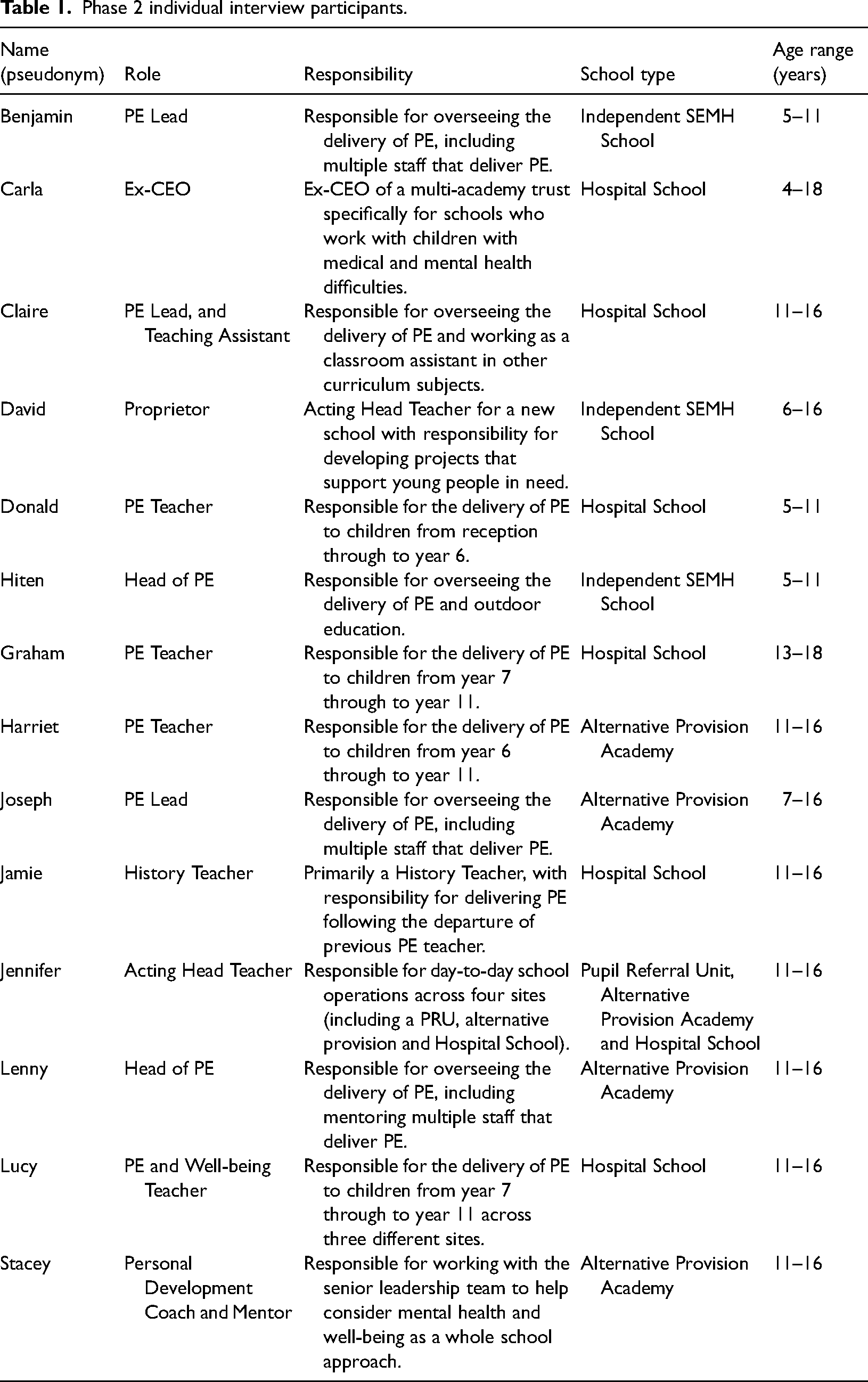
In the second phase, we sought a purposive sample of PE practitioners from a range of different alternative provision school settings. In so doing, we conducted 14 individual, online semi-structured interviews (with those who had completed the survey previously), lasting between 45 minutes and 1 hour 30 minutes. These were conducted by one of the first three authors, using Microsoft Teams, with each interview being recorded and the audio subsequently being transcribed verbatim. The individual interviews explored a range of topics including the role and value of PE, curriculum content, the delivery of PE, and resourcing and support, and posed questions including: ‘What are the key challenges of delivering PE in your setting?’ and ‘What influences the delivery of PE in your school?’ A table of participants who took part in the individual interviews is provided below (see Table 1). This included representatives from PRUs, alternative provision academies, hospital schools, and independent schools.
Phase 2 individual interview participants.
Data analysis
The qualitative responses from the survey (extracted into an Excel spreadsheet), along with the transcripts from the interviews, were analysed using inductive and deductive procedures (LeCompte and Preissle, 1993). To begin with, the first author independently read through the extracts from the surveys and each interview transcript to become familiar with the data. As part of this process, simultaneous notes and memos were created. Following this, the first author initially applied a deductive approach to explore the data in relation to the different multidimensional influences that shaped the delivery of PE in alternative provision schools. Any relevant quotes were coded and mapped to the five levels of the socio-ecological model – intrapersonal, interpersonal, institutional, community and policy level (McLeroy et al., 1988). An inductive approach was then applied (again by the first author) to ensure that the themes that were developed were strongly linked to the data, though this did not change the initial codes and themes created from the deductive analysis. Following this, the first three authors then came together to explore the thematic table that was generated. The 14 participants who completed the interviews were also invited to a dissemination event whereby they were encouraged to reflect on the draft table and offer additional suggestions or contradictions. This process enabled us to gain clarity and additional depth, serving as a form of member reflections (Smith and McGannon, 2018: 108) and, rather than aiming to verify results, it provided an opportunity for us to work together to develop a ‘more meticulous, robust, and intellectually enriched understanding of the research’.
Findings and discussion
Before presenting the findings, it is important to note that alternative provision covers a range of different settings, and therefore the contexts that practitioners find themselves in can vary significantly. However, collectively, the survey and individual semi-structured interviews enabled us to explore a range of factors that shape the delivery of PE in alternative provision schools broadly. These factors have subsequently been mapped to the socio-ecological model below, with pseudonyms used in any reporting of the data to protect the identity of participants. A summary of the key factors can be seen in Figure 1.
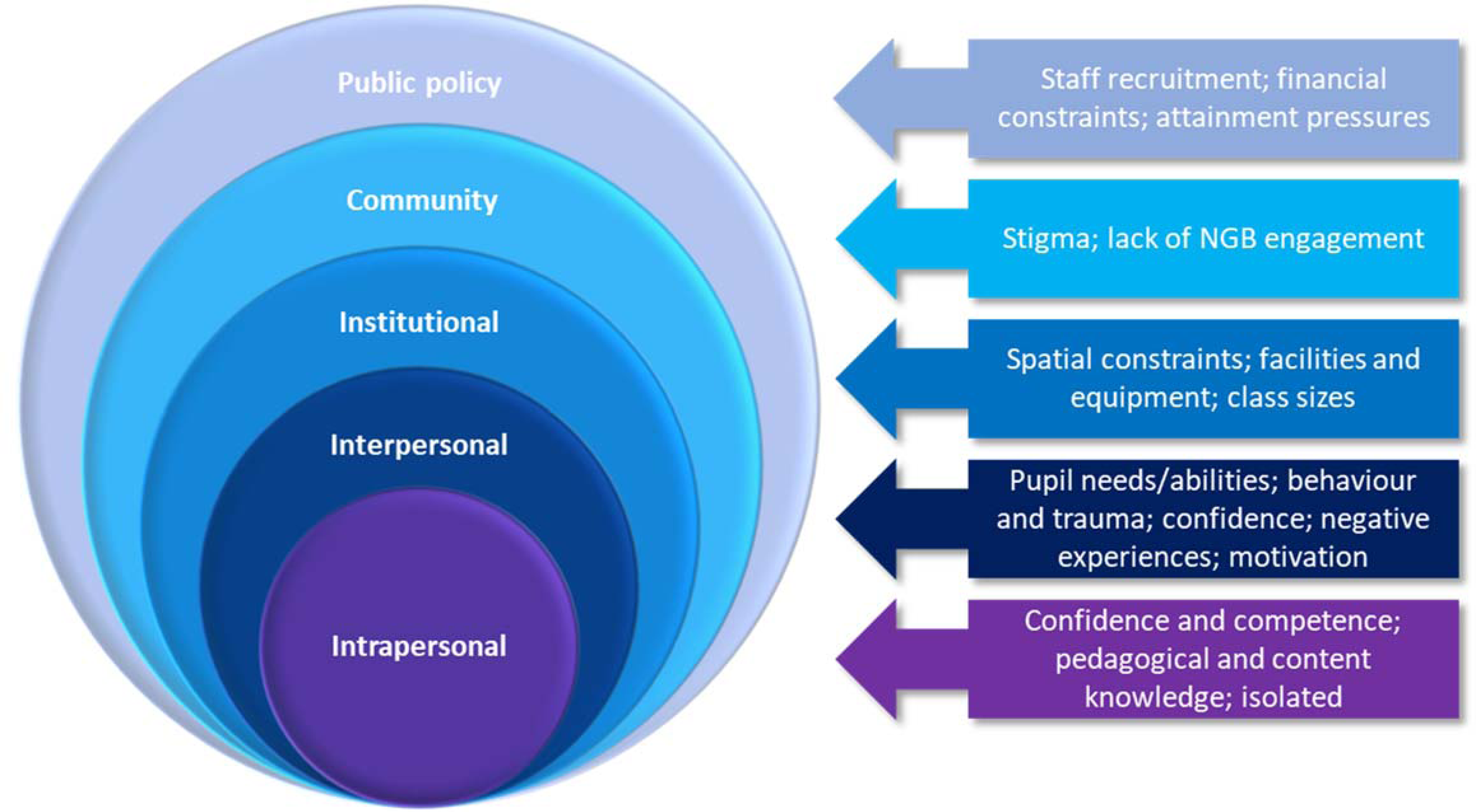
Factors influencing the delivery of PE.
Intrapersonal influences
As noted in the discussions above, the intrapersonal level of the socio-ecological model relates to individuals’ characteristics and choices, their knowledge, skills, and self-efficacy (McLeroy et al., 1988). Our research identified three distinct sub-themes at the intrapersonal level: (i) practitioner confidence and competence, (ii) a lack of pedagogical and content knowledge, and (iii) being isolated. In relation to the first sub-theme, participants across both the survey and the interviews reported a lack of confidence and competence in teaching PE: Confidence and competence for all staff to be able to deliver PE. Some newly qualified staff have joined us with very little training or none at all and are then expected to teach PE. It is possible to complete a PGCE or Teach First
1
course never having taught PE. (Harriet, Alternative Provision Academy) We did have a specialist PE teacher, but she retired and now it's become a little bit more fractured and it's up to us to deliver it. So, you know, I know the rules of cricket, I used to run football teams and things like this and so I can organise that and I can organise the rounders game. But we are by no means specialists. (Jamie, Hospital School)
This lack of confidence and competence stemmed from practitioners not being specialist-qualified PE teachers, yet still being asked to deliver PE. Some were passionate about sport more broadly and wanted to deliver it, but this was still without formal PE teaching qualifications. Interestingly, a House of Commons Education Committee (2018) report suggested that only 60% of teachers in alternative provision free schools were qualified, compared to 84% of teachers in PRUs, whilst 95% of teachers in mainstream schools had Qualified Teacher Status (QTS). In addition, pupils in alternative provision were twice as likely as pupils in mainstream schools to be educated by a supply teacher (House of Commons Education Committee, 2018). This is concerning since Morgan and Bourke (2008) and Morgan and Hansen (2008) have argued that some of the major barriers to effective teaching in PE (and thus high-quality PE experiences for pupils) include inadequate training, and low levels of teacher confidence – though this may be mitigated by high levels of interest.
Perhaps not surprisingly, due to a lack of formal education/training in PE, many practitioners also reported a lack of pedagogical and content knowledge when teaching – often not moving beyond delivering basic sports: …you get a lot of people that turn up and go, oh, I can coach so I can teach. And it's just they know how to teach a pass in football or, I don’t know, running in rugby or something like that, but they don’t know how to make it fit a curriculum and what should be in the curriculum… (Benjamin, Independent SEMH School)
This mirrors research from generalist (mainstream) classroom teachers who are often asked to teach PE. For instance, Tremblay et al. (1996) have previously argued that a lack of teacher preparation (including confidence and competence) was the greatest barrier to quality PE, while conversely, Randall et al. (2016) have more recently noted that professional knowledge was a key factor in determining teacher confidence and competence.
Equally, as Benjamin alludes to above, an increase in unqualified staff (in some instances, sport coaches) delivering PE meant that many also lacked knowledge and understanding of trauma and how this impacts young people's behaviour and attitudes: Because I think it's really important and, again, linking it back to sport and PE, I think that sport and PE, to be successful in an AP [alternative provision] setting, you need to have staff that have a really good understanding of trauma and distressed behaviour. (David, Independent SEMH School)
A lack of knowledge and understanding of trauma is particularly relevant when working in alternative provision since many children and young people there have experienced adversity (Fortems et al., 2023), which can manifest in their behaviours and actions. Not having an awareness of this within the context of PE can result in punitive responses which can exacerbate the problem behaviour and further alienate the child/young person (Cole et al., 2005; Ellison and Walton-Fisette, 2022; Quarmby et al., 2022). In mainstream schools, any lack of pedagogical and/or content knowledge would normally be addressed through continuous professional development (CPD). In mainstream primary schools, this would be supported by the Government's Primary PE and Sport Premium funding (DfE, 2023b). However, this funding is not always available for alternative provision schools as we explore later (see Public policy influences).
While a lack of pedagogical and content knowledge might also be enhanced via mentoring, many of those in alternative provision reported feeling isolated, not connected with others delivering PE in alternative provision, and sometimes not even aware they exist: I’ve chatted to the Head [Teacher], because he said, do you want to go and visit other schools and stuff like that and I’m like, yes, I’d love to. But the problem is there's no one else like us… (Graham, Hospital School) The PE specialists that are in post then almost becoming isolated as well without a network as such… (Survey response, Pupil Referral Unit)
Walters et al. (2024) have recently noted that feelings of isolation amongst PE teachers may result in them being less effective when teaching and more prone to attrition. While the practitioners we spoke to did not discuss attrition specifically, they did explicitly note that feeling isolated meant they were not easily able to enhance their knowledge, skills and understanding of the subject through networking and sharing ideas with others. Thus, their confidence and competence to deliver PE remained low.
Interpersonal influences
The interpersonal level includes the individuals that surround the practitioner charged with delivering PE in alternative provision. It encompasses the different interpersonal processes, the various social groups that might provide support or hinder the delivery of PE (e.g. the children and young people, other staff, school leadership, etc.) and the norms within those social networks (McLeroy et al., 1988). It is important to note here, however, that only factors associated with pupils (and not other school staff nor leadership) were identified by the participants we spoke with. As such, at this level, several sub-themes were identified, including (i) pupils’ varying needs and abilities, (ii) pupil trauma and behaviour, (iii) pupil confidence and competence, (iv) pupils’ prior negative experiences of PE, and (v) pupil motivation and being a ‘PE refuser’. More specifically, while pupils’ needs and abilities were a particularly pertinent issue for those working in hospital schools, there was recognition among the participants that planning for the different health needs and physical abilities of children and young people was problematic and unique to this context: The challenge that we have is how do we tailor sport and PE to the complex and diverse needs our young people have. (Survey response, Alternative Provision Academy) The children will also equally present, particularly with PE because of the nature of the lesson itself and it being physical, the children's conditions and health will mean obviously, there will be numerous barriers that will mean we have to adapt the lesson. (Donald, Hospital School)
Linked with this, pupil trauma and their resulting behaviours – as briefly noted above – were also a key influence when delivering PE. Ultimately, many young people attend alternative provision because of behavioural issues (and being excluded from mainstream schools) which makes teaching particularly challenging (Malcolm, 2018). Indeed, managing the behaviour of pupils is clearly an important part of the role of teachers in alternative provision (House of Commons Education Committee, 2018). Certain groups of young people – for example, care-experienced youth – are often over-represented in alternative provision (Malcom, 2018) and these young people are more likely to have experienced adversity and trauma (Quarmby et al., 2022). As such, the behavioural issues that led to young people being placed in alternative provision – and any behavioural outbursts that occur therein – could stem from their past trauma (Ellison and Walton-Fisette, 2022). This was reflected in responses to both the survey and individual interviews with staff noting how behaviour, whilst shaping their delivery of PE, could be attributed to pupils’ trauma: So, you’ve got to be hyper vigilant but at the same time you’re trying to deliver a lesson, you know…. Because we’ve had kids run off and we’ve had to grab their legs as they’re trying to throw themselves off bridges or running into the road. (Jamie, Hospital School) We’ve had, especially [here], some students that the behaviour wasn’t particularly great, as a result of maybe their autism diagnosis or just trauma that they’ve been through. So, one student only wanted to play football and he refused to do anything else, and he kicked off, told me where to go if we weren't doing football. Ultimately, it's like, well, do we do football or do I get abuse? (Lucy, Hospital School)
Anyone who has experienced trauma is likely to view themselves negatively, and have low self-confidence and low levels of perceived competence (Quarmby et al., 2022). Traumatic events can shatter an individual's confidence, leaving them feeling vulnerable, powerless, and unworthy (Quarmby et al., 2022). It is therefore perhaps not surprising that these were also noted as factors that influence the delivery of PE: So, I would say one of our overarching barriers to any engagement for our young people is based on low self-esteem and that goes through everything, that's why they don’t engage in maths, that's why they won’t have friends, that's a whole thing of it. (David, Independent SEMH School)
In addition, many of the practitioners reported that pupils frequently had negative experiences of PE in mainstream schools, which meant re-engaging them in alternative provision schools was a particular challenge. For instance, Claire (Hospital School) overtly spoke about mainstream PE being one of her biggest challenges: Well, they all come from mainstream, and they’ve had really negative experiences of mainstream PE, you know, being forced to get changed and all the rest of it. I spend a lot of time outside of the classroom telling them, you know, it's not mainstream, I make it fun, I’m not going to make you do bleep tests and push ups and sit ups, and I’m not going to make you go and run cross country. I just want you to have fun and just try, just give it a go, if you give it a go and you’re really struggling then that's fine, you’ve given it a go. Yes, so mainstream PE is my biggest challenge.
Coates and Vickerman (2008) have previously noted that negative experiences are often characterised by feelings of social isolation, restricted participation, and when children feel that their competencies are being questioned. While Coates and Vickerman's (2008) review focused on children with special educational needs, there is plenty of relevance here too. Indeed, this sentiment was echoed by others who spoke of how negative experiences of mainstream PE acted as a barrier to young people's engagement in PE now – especially when their behaviour meant they were excluded from PE or sport-related trips in mainstream schools: Lots of our students have obviously come from mainstream. They've suffered some kind of trauma from there as well, like just being excluded…. They've not been allowed to go on residentials, [it's] the first thing they get kicked off for some kind of bad behaviour, ‘Oh, that's it, you're off the PE trip, you're not doing this,’ PE time is taken away. We don't want that, it's never going to be during maths interventions, it's never going to be during any other time, is it? It's never shared out equally amongst a timetable. (Harriet, Alternative Provision Academy)
Inevitably, prior negative experiences of PE led to low motivation to engage in PE within the context of alternative provision, with some practitioners referring to those pupils as ‘PE refusers’. This meant that PE in alternative provision needed to ‘look’ and feel very different from what they had experienced previously: PE is delivered at key stage three and then a sports qualification offered at key stage four … and a lot of those children have probably been PE refusers over a series of time, so PE does not necessarily look like traditional PE. (Jennifer, Pupil Referral Unit) I like going in and changing what PE looks like, because quite a lot of students there have got high levels of anxiety, and they’re school refusers and PE is a massive trigger for them. Quite a lot of them are PE, no, no, no, shut down, shut down…. (Lucy, Hospital School)
Importantly, Simmons et al. (2024: 12) have recently noted that the introduction of novel activities that are regarded as ‘societally cool (e.g. surfing), in a novice group setting that is free from judgement’ may help to improve self-confidence and motivation and thus, lead to greater engagement in PE. They argue that this helps to reduce young people's perceived risk of failure (Simmons et al., 2024), which is particularly pertinent in this context.
Institutional influences
Institutional influences – in relation to this study – include the rules, regulations, practices, policies, and structures of alternative provision schools that constrain or promote the delivery of PE (McLeroy et al., 1988). Included in the institutional factors are also the physical and social environment, and it is here where the starkest differences between alternative provision settings (e.g. between a hospital school and a PRU) are evident. Notwithstanding these differences, key influences at this level included: (i) spatial constraints, (ii) the facilities and equipment available, and (iii) class sizes. The most pertinent of these sub-themes, cutting across all types of setting, was spatial constraints, with many practitioners discussing the lack of dedicated space to engage in any form of physical activity: I mean, in [name of city], for instance, [name of alternative provision school] it's on a third floor up the most horrendous stairs, I need oxygen at the end of them, so there is nowhere there…. The other one in [name of area], we have a yard, that's just like a postage stamp. And then in [name of area] we’ve got like a space out the back, again, you could spit on it. I know we’re all local and able to get into parks and things but, again, there is no sports hall where we could do things on the day. (Stacey, Alternative Provision Academy) In the three schools we have I’ve got one sports hall which is quite small and echoey. I have another hall, but it doubles as the dinner hall, and I have to put down the tables etc. and [at] the vocational site we don’t have a hall at all…. I suppose that's an additional factor which makes things harder for us and quite frustrating. (Joseph, Alternative Provision Academy) I’m stuck on the ward, I’m playing in corridors, depending on the ward, depends on what I can even do on a corridor which is a nightmare. Some of the wards are brilliant, some of the corridors are massive and it's better than some of the facilities I’ve got outside at other wards. (Graham, Hospital School)
Unlike most mainstream schools, this lack of space is not uncommon for many alternative provision settings. In contrast to mainstream schools, UK Government legalisation does not stipulate that an alternative provision school should have any dedicated indoor or outdoor space available for physical activity (DfE, 2013). This means that, currently, alternative provision schools can open in an office block, as Stacey alludes to above. In fact, the Area guidelines for SEND and alternative provision (DfE, 2015: 50) notes that alternative provision schools ‘will usually have a multi-purpose space for assembly, PE and dining’ but those with restricted space should ‘use sports spaces at a nearby school or community sports centre’. Moreover, the document states that external space can vary and ‘may be minimal in an urban setting’ (DfE, 2015: 70), thus restricting the provision of PE. Ultimately, and as recently highlighted by Maher et al. (2024), space (or lack thereof) may dictate what is taught (in terms of curriculum), and how (in relation to pedagogy), in PE, which may subsequently shape pupils’ positive or negative experiences.
Linked to a lack of space is the standard of facilities and equipment available in alternative provision schools. Harriet for instance – whose dining hall doubles as the sports hall – noted how she had to use a bin for a basketball net: I had a basketball team and didn’t have a basketball hoop [so] we took the inside out of a bin. I’ll be honest with you, inside the hall that we do have we didn’t have lines down, they wanted me to do GCSE PE and I had to masking tape down badminton lines. (Harriet, Alternative Provision Academy)
The final key influence at the institutional level relates to the class sizes and the number of pupils that attend PE. Combined with limited space, and poor equipment and facilities, practitioners noted how challenging it was to deliver PE when class sizes were very small and there were varying needs and behaviours to be considered: Because they’re such a small group and their relationships matter so much within their class, they can’t really then go against each other. [But if] you have 30 kids, and two children have an argument in a football match you can keep them away from each other, you know, it's not a problem. But when you’ve got eight kids, both of them can’t control their emotions and can’t regulate, and they have an argument, you lose a day of teaching. (Benjamin, Independent SEMH School) It is quite challenging in an alternative provision to get a game of football when you’ve only got two people in for your class, you know, so we don’t have the big numbers and that provides its own challenges, doesn’t it. (Jennifer, Pupil Referral Unit)
It has been suggested that alternative provision schools can provide for pupils’ needs more effectively than mainstream schools because of the smaller class sizes and higher staff-to-pupil ratios, which allow them to tailor their provision (DfE, 2022). Smaller class sizes have many benefits, including making it easier for teachers to build rapport and develop relationships with pupils (Thomson and Pennacchia, 2014). However, for the delivery of PE, this was noted as quite problematic, especially given that the delivery of PE is traditionally built on team games (Kirk, 1992). As such, the varying needs and abilities of pupils in alternative provision (interpersonal level), combined with the uncertainty about how many pupils the staff will have at any given time (institutional level), makes planning lessons especially challenging: I don’t have sets or the capability to be able to split the group up necessarily, so you might have somebody quite advanced in year nine and then somebody who, actually, has just started in year seven and has never done PE before. It's about finding something that works for all in that space…. (Joseph, Alternative Provision Academy)
Community influences
In this research, community factors consist of the relationships between institutions that influence the delivery of PE in alternative provision schools, coupled with the various social networks, norms, and standards of a specified area/locality (McLeroy et al., 1988). This may include relationships between teachers and parents/carers beyond the school or members of the broader local community. Here, the stigma associated with being an alternative provision provider (and the young people they work with) was identified as one of the biggest challenges to delivering PE off-site (when on-site space and facilities were restricted): …when I first started there, we were a PRU under a different name, then we rebranded as [an] Alternative Provision and now we are [name of school] School. Purely for some of the reasons I spoke about [before] that as soon as we mentioned PRU or AP we were turned away [from accessing community leisure spaces]. (Harriet, Alternative Provision Academy) I’ve written down here that we’ve got a PR problem, because if gyms are saying, ‘We don’t want your kids because we’re scared of them’ … we can all probably say we’ve got some really challenging young people, that is not surprising in some ways but, actually, as a sector, I suspect we’ve got a significant PR problem. (Lenny, Alternative Provision Academy)
Interestingly, the House of Commons Education Committee (2018: 3) report noted that ‘alternative provision is too often seen as a forgotten part of the education system … stigmatised as somewhere only the very worst behaved pupils go’. Like Harriet above, they have suggested that PRUs, and other forms of alternative provision, should be renamed in an effort to remove the stigma (House of Commons Education Committee, 2018). However, this stigma was not confined to the local community organisations (e.g. leisure centres and gyms), but also to National Governing Bodies (NGBs) of sport. For instance: I’ve recently been having some conversations with NGBs about what they can provide for alternate provision, and as soon as I mention alternative provision to them they're like, ‘Oh, you mean all the really naughty kids….’ (Jennifer, Pupil Referral Unit)
In addition to stigma, some practitioners also noted that NGBs did not engage with alternative provision settings because of the low number of children and young people they would end up engaging with: The other thing I found as well when I was talking to the NGBs is that they wanted to know what sort of numbers I could get them, because if it wasn’t worth it for them, in terms of numbers, because they have their own targets and stuff to reach. (Harriet, Alternative Provision Academy)
Stigma has been recognised internationally as an issue associated with alternative education (see, in the United States for instance, McNulty and Roseboro, 2009), whereby the stigma of attending alternative education is thought to reinforce student stigma. Here, stigma within the broader community about what alternative provision is and the young people that attend these contexts, along with a lack of support from NGBs, meant practitioners were not supported in delivering PE at off-site locations or by external bodies coming in to deliver sessions.
Public policy influences
The final level of the socio-ecological model centres on public policy (McLeroy et al., 1988) and, specifically within this research, those policies that may shape the delivery of PE in alternative provision schools. Key challenges identified here included (i) the recruitment of staff, (ii) financial constraints, and (iii) attainment pressures. Perhaps linked to the stigma associated with alternative provision – and reinforcing the interconnectedness of the levels of the socio-ecological model – a key issue was the recruitment of staff with expertise in PE. Indeed, some noted there was a ‘recruitment crisis’ affecting alternative provision in general: We’re in a recruitment crisis, and we’re struggling to just get people to apply for jobs in PRUs. (Lenny, Alternative Provision Academy) …maybe when they're going through their SCITT [School-Centred Initial Teacher Training] process, they have to do three weeks in an alternative provision setting or a special school setting. If we could get as many as possible to do it at an AP setting, I think they’d understand the value of it. I think sometimes PE teachers think, ‘OK, there isn’t a football team there, what am I going to do? How's that going to work?’ (Stacey, Alternative Provision Academy)
Another key issue identified by participants was the level of funding and finance available to support the delivery of PE. In England, for example, children and young people can be dual registered at more than one school. The most common example of dual registration is when a pupil attends an alternative provision school on a temporary basis. In this instance, a pupil may be mainly registered at a mainstream school and subsidiary registered at an alternative provision school. In this particular case though, the mainstream school that the pupil is registered at is the one that receives certain types of funding: But you only get the Sport Premium funding if your children are on your roll as sole roll. If they’re dual roll, you don’t. (Joseph, Alternative Provision Academy) That goes into another issue that in terms of PRUs and APs … our purpose is to work collaboratively to reduce permanent exclusion, so therefore across the country there are a lot more PRUs and APs that are doing intervention so as to support young people to remain in mainstream. That disadvantages us because they're dual roll. So, all the things that pupil premium, the Primary PE Fund, etc., we don’t benefit from, but what do we do? (Harriet, Alternative Provision Academy)
In England, the primary PE and Sport Premium funding is allocated to schools through a decentralised approach to policy implementation, whereby the funding is provided directly to primary schools that have the autonomy to spend it in ways that they believe will enhance whole school provision of PE (Lindsey, 2020). However, based on the responses provided above, it would appear that alternative provision schools – with dual-registered pupils – are missing out on this funding, making it more difficult to deliver quality PE experiences for young people.
Finally, there has been much national and international debate about the purpose and value of PE within mainstream schools (see e.g. Kirk, 2010), and it would appear there are similar concerns within alternative provision. For instance, given that a key focus of alternative provision is to support pupils’ transition back into mainstream school, it is perhaps not surprising that much of the focus is on education in more ‘traditionally’ academic subjects like English and maths. Consequently, these attainment pressures often resulted in PE being dropped: I would just like to say the way in which we’re judged, because the narrative is all around academic, the catch up is all about maths and English, and the first thing to go is the PE. Nobody says, ‘Oh, in catch up let's have more PE, let's have more active….’ Then for those of us working with students that are dual registered, the schools are saying, ‘We’re not interested in PE, we need their five GCSEs at this grade’, you know, ‘We’re expecting you….’ So, there's the external pressures then. (Lenny, Alternative Provision Academy)
Conclusions
This paper is the first to explore the influences (and in some cases challenges) – at various levels of the socio-ecological model – associated with delivering PE in alternative provision schools in England. In so doing, it has identified several factors that intersect both within and across the different levels. For instance, at an intrapersonal level, it was noted that teachers may lack confidence and competence, perhaps due to a lack of pedagogical and content knowledge and being isolated. Indeed, this is not helped by a perceived recruitment crisis at the policy level resulting in a lack of qualified PE teachers working in alternative provision, which might also be related to the stigma associated with this context. Similarly, across the interpersonal and institutional levels, planning for PE is particularly problematic when you consider that teachers need to be reactive due to the varying needs/abilities of children and young people, combined with small class sizes and uncertainty around how many pupils might ‘show up’ at any given time. At an institutional and public policy level, allowing alternative provision schools to open in office blocks limits the available indoor and outdoor space, making the delivery of PE incredibly challenging. Arguably, this lack of space was identified as the biggest challenge to delivering PE as it dictated what could be done (and how) in what space was available. As well as intersecting challenges across levels, different factors within levels also contribute to the delivery of PE and what is possible within a given context. For example, at an interpersonal level, it is likely that student behaviour is shaped by their previous trauma and prior negative experiences of mainstream PE.
Hence, this unique paper offers key insights into the influences (and challenges) associated with delivering PE in alternative provision settings. In keeping with the socio-ecological model that framed the findings of this paper, it is worth noting a range of recommendations, at different levels, that might support the delivery of PE within these settings. At an intrapersonal level there is clearly a need to support practitioners through CPD to help enhance their knowledge, confidence and competence. The development of national or regional alternative provision networks at the interpersonal level would support practitioners to reduce feelings of isolation, share what works and what does not, and help them in better promoting positive experiences for pupils within PE. A network that shared ideas and best practice would simultaneously enhance practitioners’ knowledge. At the community level, there is a need for community organisations and NGBs to be made aware of the realities of alternative provision to help reduce stigma and provide support (to space or resources) when necessary. This might also include Higher Education Institutions working more closely with alternative provision schools to support them and raise pre-service teachers’ awareness of this unique context. Finally, a key consideration for policy makers is that these findings suggest that the PE and Sport Premium funding is currently failing many alternative provision schools. There is a need for this funding to be revisited to ensure that alternative provision schools receive the required funding when pupils attend their setting. Similarly, we would urge the UK Government to bring about policy change, to ensure that there is sufficient space within alternative provision schools for children and young people to engage in PE both inside and out. Addressing these will also support factors associated with the institutional level (e.g. space, facilities and equipment).
Finally, further research is required that explores in rich detail (i) the aims and purpose of PE in alternative provision, (ii) the Initial Teacher Education (ITE) and professional learning and development of PE teachers in alternative provision, (iii) the ways in which the spatial constraints of alternative provision can be utilised to develop an embodied movement curriculum, (iv) the experiences and voices of children and young people in alternative provision, and (v) in line with the broad aim of alternative provision, how PE can support pupils in transitioning back into mainstream schools. Based on our experience in this and the broader study, there is also a need for longitudinal research in this area given the challenges associated with accessing these settings and working with participants – and young people in particular. We would therefore urge others undertaking research in these areas to work with alternative provision schools in a qualitative and creative, arts-based manner, to provide different platforms from which practitioners and pupils can share their lived experiences.
Footnotes
Declaration of conflicting interests
The authors declared no potential conflicts of interest with respect to the research, authorship, and/or publication of this article.
Funding
The authors received no financial support for the research, authorship, and/or publication of this article.
