



Abstract
This scoping review brings together, for the first time, research spanning five decades focusing on Muslim students’ experiences of physical education (PE). In taking stock of this work, it advances knowledge by mapping how understandings of the relationship between religion and PE have developed, whilst identifying new avenues of inquiry. Therefore, this scoping review is a useful resource for pedagogues and other stakeholders to reflect on current PE policy and practice to ensure they are best serving their Muslim students’ needs. Two questions are addressed: ‘How has research developed understandings regarding Muslim students’ experiences of PE?’ and ‘What lessons can be learnt to support more inclusive experiences for Muslim students?’ A six-stage methodological approach was utilised: (1) identifying research question(s); (2) searching for studies; (3) selection; (4) charting data; (5) summarising results; and (6) expert consultation. A systematic literature search using key words (Islam, Muslim, Physical Education) identified 141 outputs. Using inclusion/exclusion criteria, 47 remained. The findings offer (a) a summary of the characteristics of the work reviewed, including growth of the field, research location, contexts, participants and methodological issues, and (b) a critical commentary, identifying a preoccupation with particular identities, the significance of acknowledging heterogeneity, and the problematic positioning of Muslim students. The paper concludes with some future research recommendations, including the need for research exploring Muslim boys' and young men's experiences, adopting alternative theoretical approaches, exploring different contexts and re-orientating how research is undertaken ‘with’ young people.
Background
Within the United Kingdom, where the authors are based, particular groups continue to be highlighted as failing to reach nationally recommended guidelines for participating in sport and physical activity (Sport England, 2023, 2024). Girls and women, some socio-economic groups, disabled people, ethnic minority communities, and certain age ranges have been targeted for decades with interventions underpinned by health concerns (The Sports Council, 1982, 1988). Relatedly, physical education (PE), a subject with links to health and one tasked with providing young people with a positive, lifelong relationship with activity, has been scrutinised for its role in contributing to these disparities. Research suggests it is often in these earlier years that differences in physical activity engagement emerge with girls, disabled young people, and those from minority ethnic communities identified as having a problematic relationship with PE (Youth Sport Trust, 2023). Similar issues are reported in other Western countries (e.g. Australia, America – see Daraganova and Joss, 2018; National Physical Activity Plan Alliance, 2016).
Relational-type research in PE has explored why and how these differences occur. For example, access to safe spaces, boys’ dominance in PE, and societal expectations around femininity are noted as contributing to girls’ (dis)engagement (Flintoff and Scraton, 2006; Mansfield et al., 2018). White privilege and racial discrimination, including ‘race logic’ and stereotyping, are identified as structural barriers for young people from minority ethnic communities (Dagkas et al., 2019). Whilst useful, relational research is not without its challenges. By focusing on groups, ‘girls’ and ‘minority ethnic students’ for example, heterogeneity within these groupings can be overlooked, and the group labelled as a problem (Flintoff et al., 2008). We have found intersectionality, with its roots in Black feminism, valuable in this regard.
Intersectionality, a term coined by Crenshaw (1989), captures how overlapping identities and systems of oppression intersect to influence barriers, opportunities, and experiences. In our own work intersectionality has been useful in two ways. First, it acknowledges that young people embody a multitude of identities – ethnicity, social class, gender, sexuality, religion, culture, (dis)ability to name a few – all of which interplay to influence PE experiences in fluid, multiple and complex ways. Relatedly, labels like religion, Muslim, and culture can be unpacked to reveal a diversity of practices, beliefs, sectarian differences, histories, languages and degrees of religiosity which contribute to differences within communities, and individual daily lived social realities (Ahmad, 2011; Shain, 2003). For example, Cheng's (2019) research demonstrates how young women's religiosity is influenced and embodied in different ways, and how this guides their relationship with Australian Rules Football. Similarly, Walseth and Fasting (2003) explored how different interpretations of Islam had consequences for Egyptian women's involvement in physical activity and sport.
Whilst research around identities is useful in highlighting heterogeneity within groups, the second reason we find an intersectional approach beneficial is the recognition of context. As Brah (1995: 69) notes, ‘the micro world of individual narratives constantly references and foregrounds the macro canvas of economic, political and cultural change’. For example, Benn et al. (2011) illustrate the significance of location by bringing together research from Muslim and non-Muslim countries regarding different Muslim women and their participation in sport. The work of Hamzah (2012) is instrumental in highlighting the multiple and diverse relationships Muslim girls have with physical activity because of their positioning at intersecting discourses in their lives. Ahmad (2011) depicts the significance of different spaces (community, family, football and wider British society) to identity and experience for British Muslim female footballers. Relatedly, Maxwell et al. (2013) consider how changes to a community sports space facilitated the inclusion and exclusion of different Muslim women.
Without acknowledging diversity, context, and structural barriers, some young people's needs remain ignored or not fully considered within PE policy and practice (Penney, 2002). Worryingly, when these young people fail to reach particular standards, they become labelled as deficient. Comparisons with those achieving the standards serve to strengthen beliefs that this ‘group’ is the problem without interrogating the system that contributes to these differences (Flintoff et al., 2008). We propound that an intersectional lens is fruitful in moving away from a deficit model of blame to highlighting how societal structures and institutions create difference and inequalities.
This paper stems from our argument that more nuanced understandings regarding different kinds of young people and their experiences of PE are required if all young people are to be afforded an opportunity to develop an enjoyment of and meaningful relationship with the subject. Our motivation to undertake this research emerges from our own biographies, experiences of discrimination, social justice agenda, and research with students who experience inequalities in PE. For Annette, this has involved working with Muslim young women and disabled girls, and for Jonny, care-experienced young people seeking asylum. Within our research, we trouble taken-for-granted ways of knowing by actively working with young people as opposed to doing research to or on them. We engage with alternative epistemologies, methodologies and approaches including Black feminism, Critical Race Theory, intersectionality, and post-structuralism to produce counter-narratives that challenge deficit discourse regarding the young people we work with (Francis-Edge et al., 2023; Stride, 2014, 2016; Stride and Flintoff, 2017; Stride et al., 2018).
We continue our work here, focusing on a group often overlooked in PE research, policy and practice in Western countries, yet one that represents an increasing demographic within the United Kingdom. Recent data identifies the Muslim population growing by approximately 33% over the last decade, representing 6.5% of the total population (ONS, 2023). This figure accentuates the need for researchers, pedagogues and policy developers to be more cognisant of Muslim young people's needs in relation to their health and engagement in PE. By collating existing material, this scoping review offers a useful resource for these stakeholders to (re)consider PE and how they can better serve their Muslim students. Moreover, mapping studies regarding Muslim students’ experiences of PE offers an opportunity for scholars to reflect on this corpus of work. Despite nearly 40 years of research in this area, we argue that Muslim students remain relatively under-explored in relation to other groups of students. Thus, taking stock of existing material is critical to addressing this inequity and central in identifying new avenues of inquiry to ensure the continued growth and development of PE scholarship.
Methodology: doing the groundwork
A scoping review was deemed appropriate for this uncharted field to assess the size and scope of material (Grant and Booth, 2009). A scoping review enables a broad focus (Arksey and O'Malley, 2005), in this case, Muslim students’ experiences of PE. We also adopted a scoping review to chart the research, rather than evaluate it, 1 and to identify future research possibilities. For replicability, transparency, and rigour, Arksey and O’Malley's (2005) six-stage methodological approach was utilised: identifying the research question(s); search of relevant studies; study selection; charting data; collation, summarisation, and reporting results; and expert consultation.
Identification of the research question(s)
Underpinning our scoping review are two research questions: ‘How has research developed understandings regarding Muslim students’ experiences of PE?’ and ‘What lessons can be learnt by pedagogues to support more inclusive experiences for Muslim students?’
Search and identification of relevant studies
As an authorship team, we agreed on six journal databases for the search: Academic Search Complete; ERIC; ProQuest Education; SAGE Journals Online; SCOPUS; and SPORTDiscus. Jonny conducted the initial search, using the term ‘physical education’ paired with ‘Muslim’ or ‘Islam’. This search was compared to Annette's records, which she had kept updated since her PhD (a study closely linked to this area). A small number of papers were identified through the electronic search that had been missed by Annette. We also recognised that conventional subject searching could miss publications (Papaioannou et al., 2010). Thus, additional outputs were identified from the reference lists of papers signposted through the search.
Selection of relevant studies
Following an initial review of the literature, inclusion and exclusion criteria were generated (see Table 1).
Inclusion and exclusion criteria.
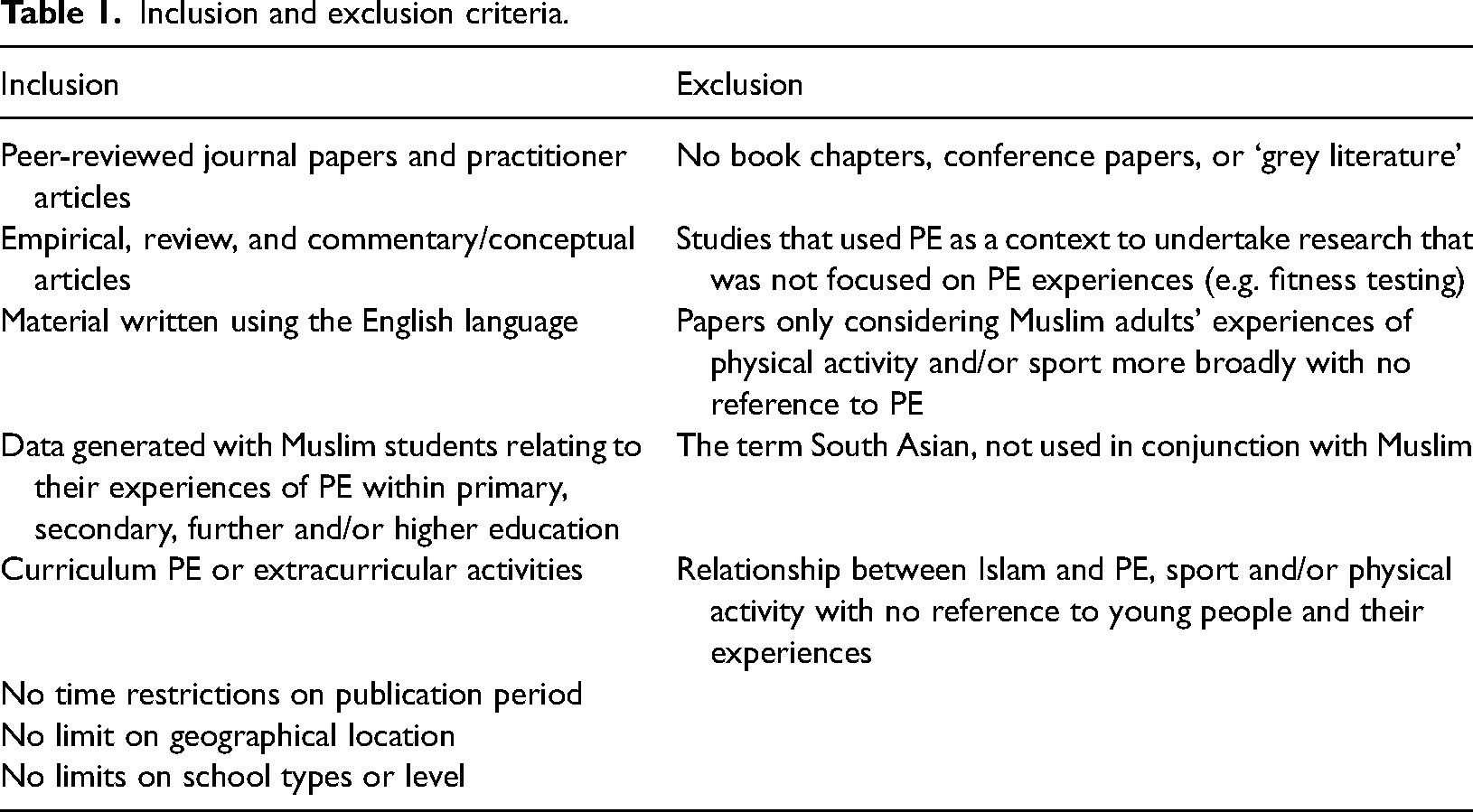
Only peer-reviewed journal papers were included alongside articles in practitioner journals. Book chapters, conference papers, and ‘grey literature’ (e.g. videos, policy statements) were excluded. Included material could be empirically based, a review, or a commentary and/or conceptual paper. 2 Any articles in a language other than English were excluded. Only those papers attending to Muslim students and experiences of PE (curriculum PE and/or extracurricular activities 3 ) were included. Those that did not consider experiences but used PE as a context in which to conduct research were excluded (e.g. studies involving a physiological or psychological focus, including fitness testing, and motor skill development). No time restrictions were placed on the publication period and no limits on the geographical location of studies. This search yielded 141 outputs, with 46 publications meeting the inclusion criteria. Figure 1 outlines the review process.
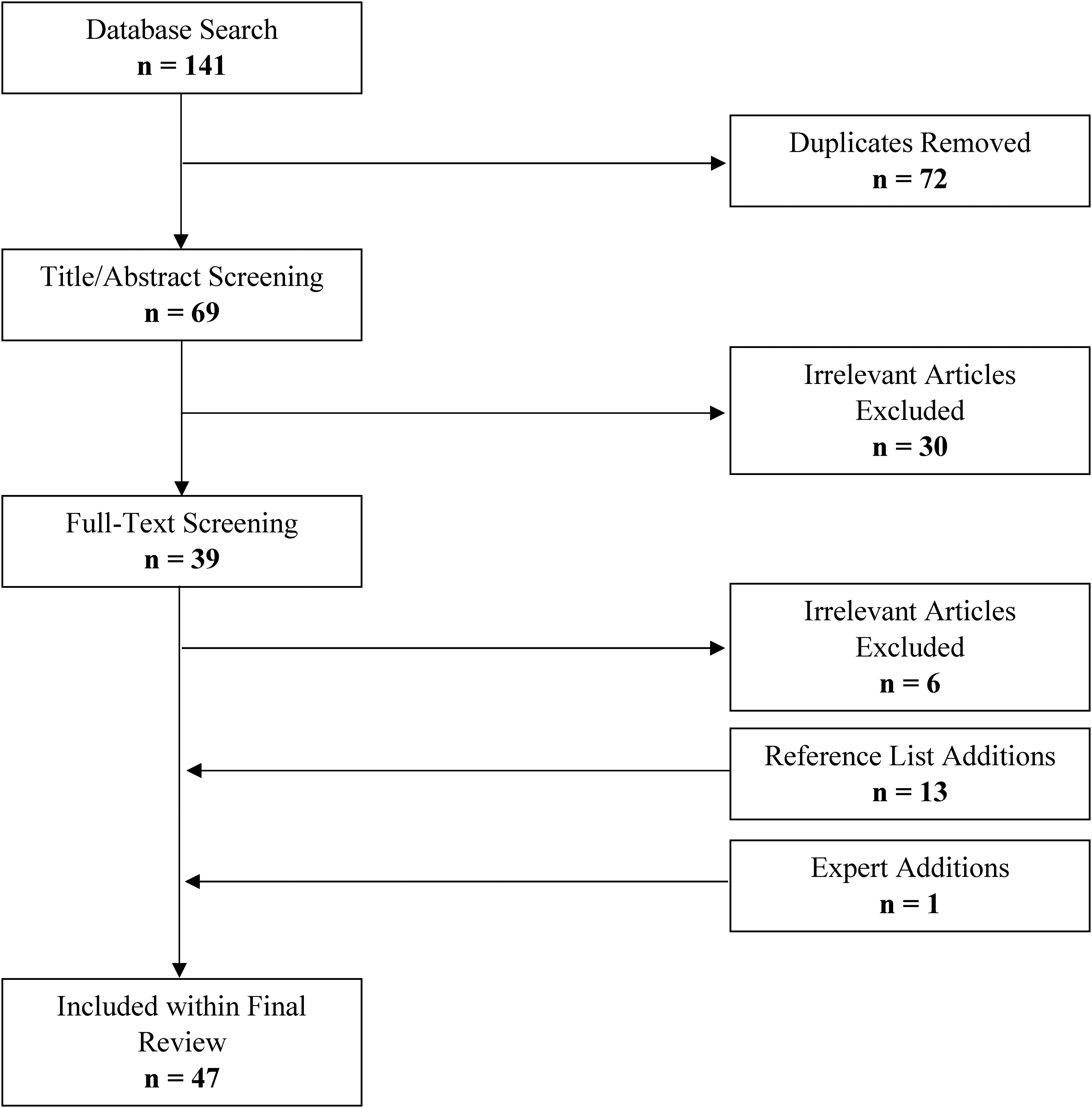
Process of review.
Charting of the data
We both read each paper independently. For consistency purposes, data were captured using an Excel matrix with 24 variables (author(s), publication year, paper title, journal title, country of origin, keywords, paper's purpose, geographical setting, context, sample descriptors, participant characteristics, age group, study design, study length, methodology, methods, data analysis, theoretical framework, findings, conclusions, limitations, research recommendations, pedagogy/policy recommendations, and ethical considerations). The matrix facilitated the collation of a high volume of information in a concise format and was useful for identifying similarities and divergences between the papers and potential discussion points. The matrix also helped to highlight differences in Annette and Jonny's data interpretation. For example, different interpretations of geographical setting and research context were identified when we met to compare reviews of the first 10 papers. These variables were clarified with us continuing to meet regularly to check understandings. Like others (Clish et al., 2022; Sperka and Enright, 2018), we assigned each publication a number which is used in the Results section (see Appendix 1 for the full list of numbered outputs).
Consultation with an expert
The final (and optional) stage involves consulting with an expert. We reviewed several possibilities, recognising that those researching issues of ethnicity and religion in PE is a relatively small group. Based upon the currency and quality of their work we drew upon the expertise of Ingfrid Mattingsdal Thorjussen, sharing our matrix of publications to identify if any had been missed. Ingfrid identified one further paper, leading to 47 publications forming this scoping review. Next, we provide a descriptive overview of the key characteristics of the corpus of literature. In keeping with our original intention to further knowledge, we follow this with a discussion offering our critical insights regarding six themes from our review of the papers.
Results: key characteristics
Five key characteristics of the body of work are summarised: growth of the literature and publication type; geographical location of the research sites; research context; research participants; and methodological issues.
Growth of the literature and publication type
The 47 publications span a period of just under 40 years (1985–2022) with a steady increase in publications over this time. Figure 2 demonstrates the field's growth using five-yearly time blocks.
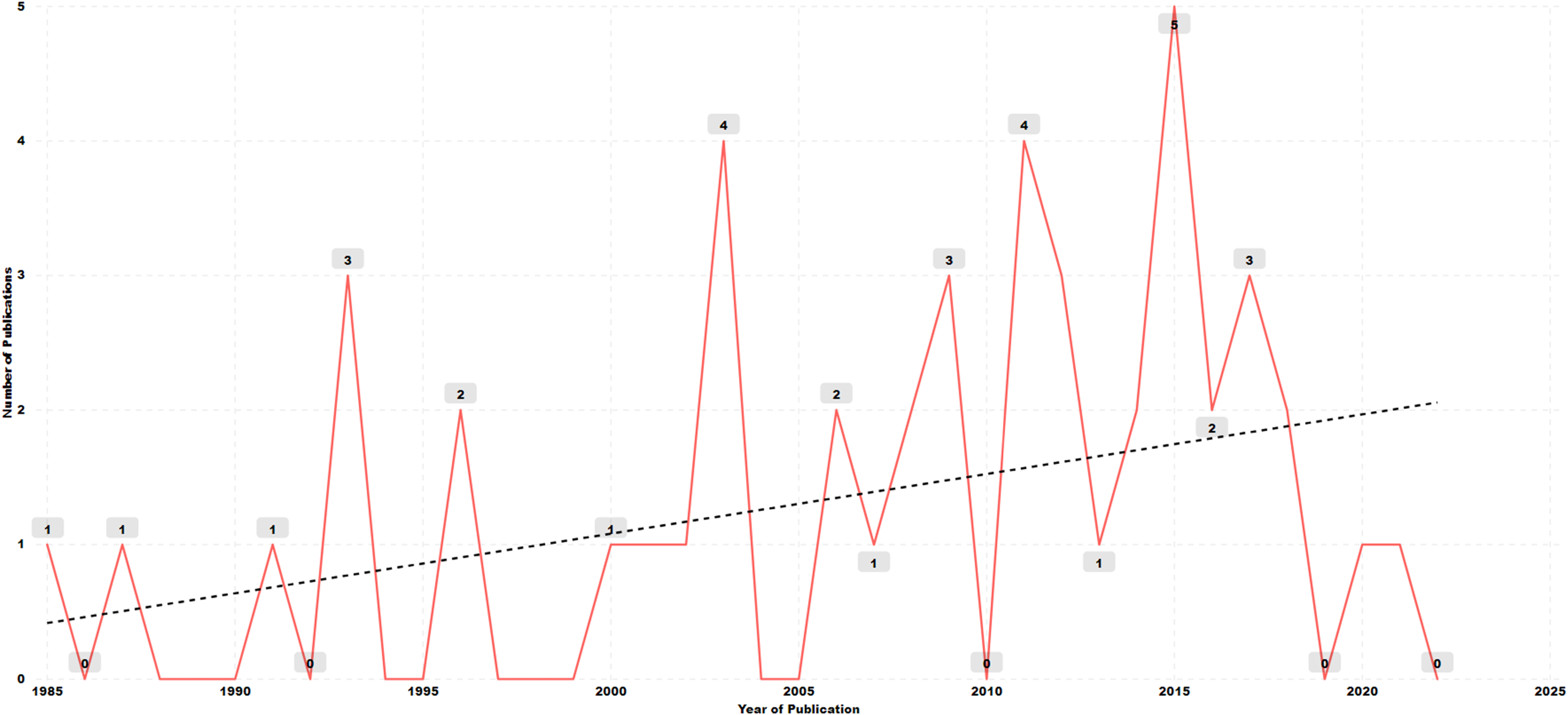
Growth of the literature (numbers and years of publications).
The earliest publications1,2 identified through this review occurred in the mid to late 1980s. These were joined by four publications3–6 between 1990 and 1994, and a further two7,8 during 1995–1999. At the turn of the century (2000–2004), the publication rate rose to seven outputs,9–15 an average of 1.4 publications per year. This trajectory continued between 2005 and 2009 with eight papers,16–23 representing 17% of the total papers reviewed. During 2010–2014, growth continued with an average of two publications per year (n = 10).24–33 However, 2015–2019 represents the most successful growth period with 12 outputs34–45 – 26% of the publications reviewed. Interestingly, from 2020, publications have declined (an average of 0.4 publications per year), with only two outputs.46,47 2022 had zero publications, the first time this has occurred since 2019. The growth in this body of work is dominated by empirically based publications – 37 of the 47 (79%),1,2,4,5,7,9–11,14,16–19,21–23,25–42,45–47 with two (4%)8,44 review based, and eight (17%)3,6,12,13,15,20,24,43 commentary/conceptual pieces.
Geographical location of the research sites
The world map (see Figure 3) displays the geographical dispersion of countries where research was undertaken. 4
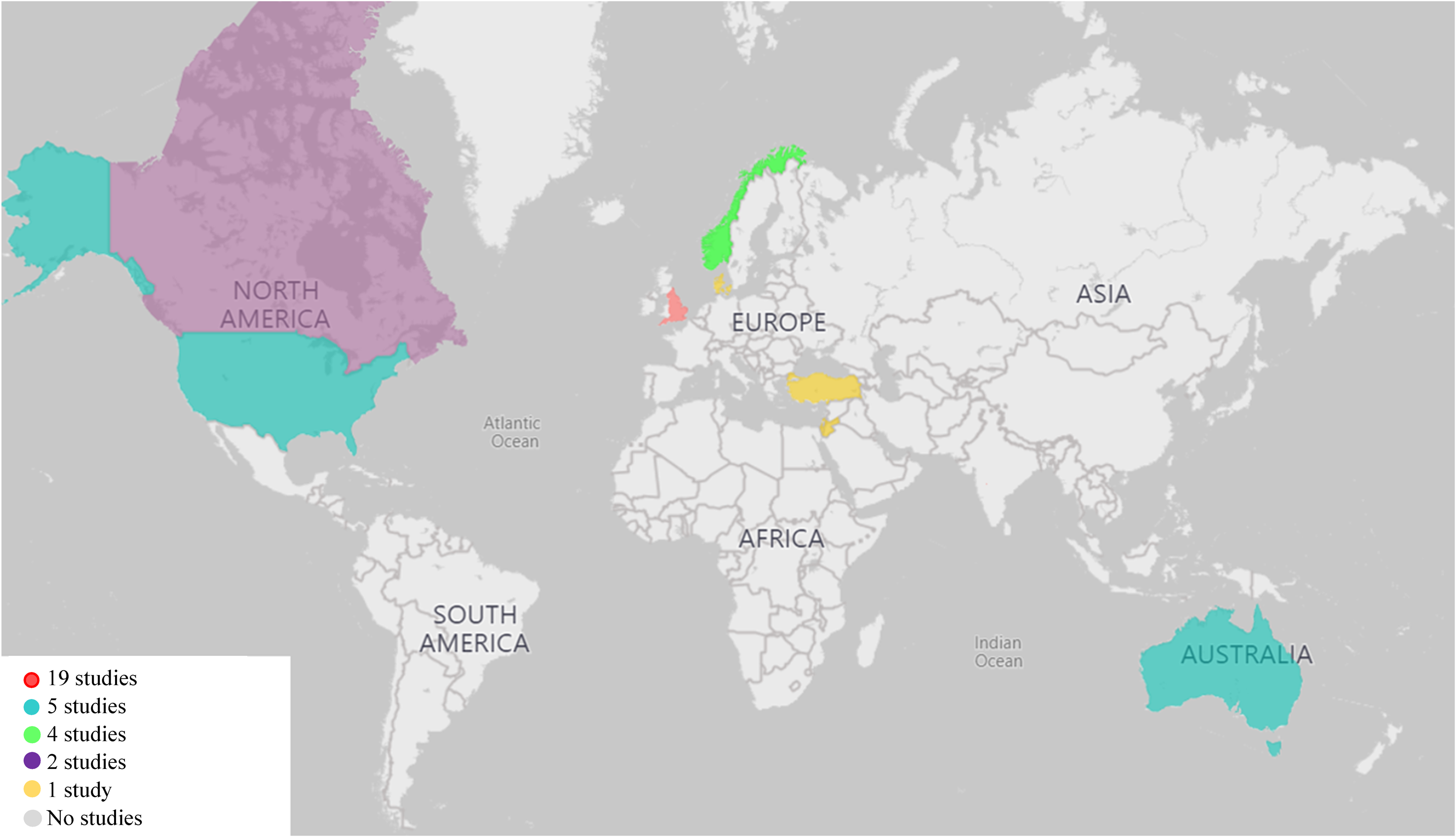
Geographical location of the research sites.
On first impression, it appears that research is being conducted across the globe. On closer inspection, the majority of research (n = 41, or 87%)2–7,9–19,21–35,37–42,45–47 occurred in Global North countries. Five publications (11%)1,8,20,43,44 were classified as ‘international’, reporting on research involving multiple countries. Only one output (2%)36 was located in the Global South 5 – Jordan. The continent where the majority of research was undertaken was Europe (n = 28, 60%),3–7,10,14,16–19,21,25–27,30–33,35,37–41,45–47 with a large number of publications based in England (n = 19, 40%).3–7,10,14,17,19,21,25,26,30,32,33,37–40 Other European countries where research took place include Norway (n = 4, 9%),35,45–47 and Turkey41 and Denmark,27 both with one output (2%). Three publications (6%) reported on research undertaken in a combination of countries – England and Greece16,18 and England and Denmark.31 Other Global North countries featuring in this review include the United States12,13,15,24,28 and Australia,2,9,22,29,34 both with five outputs (11%), Canada11,42 (n = 2, 4%), and Israel23 (n = 1, 2%). In essence, the geographical dispersion of literature reflects a Eurocentric, Western, and Global North bias. However, it would be neglectful of us to not point out that this is likely connected to the English language inclusion criterion rather than research not taking place in other countries.
Research context
With this review concerned with Muslim students’ experiences of PE, unsurprisingly, 64% of publications (n = 30)3–6,9,10,13,14,16,18,19,21–27,29–35,37,39,45–47 focused upon the school environment, mainly secondary (high) schools (n = 28, 60%).3–6,9,10,14,16,18,19,21–23,25–27,29–35,37,39,45–47 Five of these outputs (11%)19,25,26,31,35 reported on research that considered both secondary and primary schools, and in one case (2%)16 the study took place in one secondary school and a university. Four publications (9%)7,17,38,41 reported on research undertaken in higher education only. Three of these (6%)7,17,38 focused on PE teacher education (PETE), and the other41 explored experiences of a university PE department. One publication28 detailed a community-based project, one case36 explored international women's sport, one8 reviewed material covering school-based literature and organised sport projects, and one1 considered different contexts, providing an overview of Muslim women's sports participation across multiple countries (all 2%). Six publications (13%)2,12,15,20,43,44 did not specify a context. A large number of outputs focused predominantly on PE lessons (n = 34, 72%)2–6,9,10,13–16,18,19,21–27,29–35,39,40,42,44–47 and/or after-school clubs and extracurricular sport (n = 13, 28%)3–6,9,14–16,23,29,33,39,42. Some of these also considered other contexts away from school including physical activity, sport, leisure and recreation (n = 13, 28%).4,10,14,16,21,22,27,29,31,33,39,40,42
Research participants
Of the 47 outputs, 10 (21%)1,3,8,12,13,15,20,24,43,44did not involve research participants. Of the remaining 37, over three quarters (n = 30, 81%)2–6,9,10,12,14,16,19,21–23,25–35,37,39,45–47 reported young people being the research participants. In just under half of these cases (n = 17, 46%)4,9,12,14,22,23,28–30,32,33,35,37,39,45–47 young people were the only participants. A multi-stakeholder approach was employed in 17 outputs (46%).2,3,5,6,10,11,13,16,17,19–21,25–27,31,34 For example, 12 outputs (32%)5,6,10,13,18,19,21,25–27,31,34 drew on the voices of pedagogues (PE teachers and headteachers). Other outputs included university students (n = 10, 27%),2,7,11,13,16,17,38,40–42 family (n = 6, 16%),2,3,19,25,26,31 community members and religious leaders (n = 6, 16%),2,11,19,25,26,31 and academics/university staff (n = 3, 8%).13,17,20 Regarding the gender of research participants, this information was well reported (absent in only three publications (8%)19,25,26). 13 publications (35%)2,5,6,9,18,23,27,31,37,38,45–47 reported on research involving both male and female participants, with 16 outputs (43%)7,10,11,16,17,22,28–30,32–36,39,40 focusing on females only, and five outputs on males only (14%).4,14,21,41,42
Methodological issues
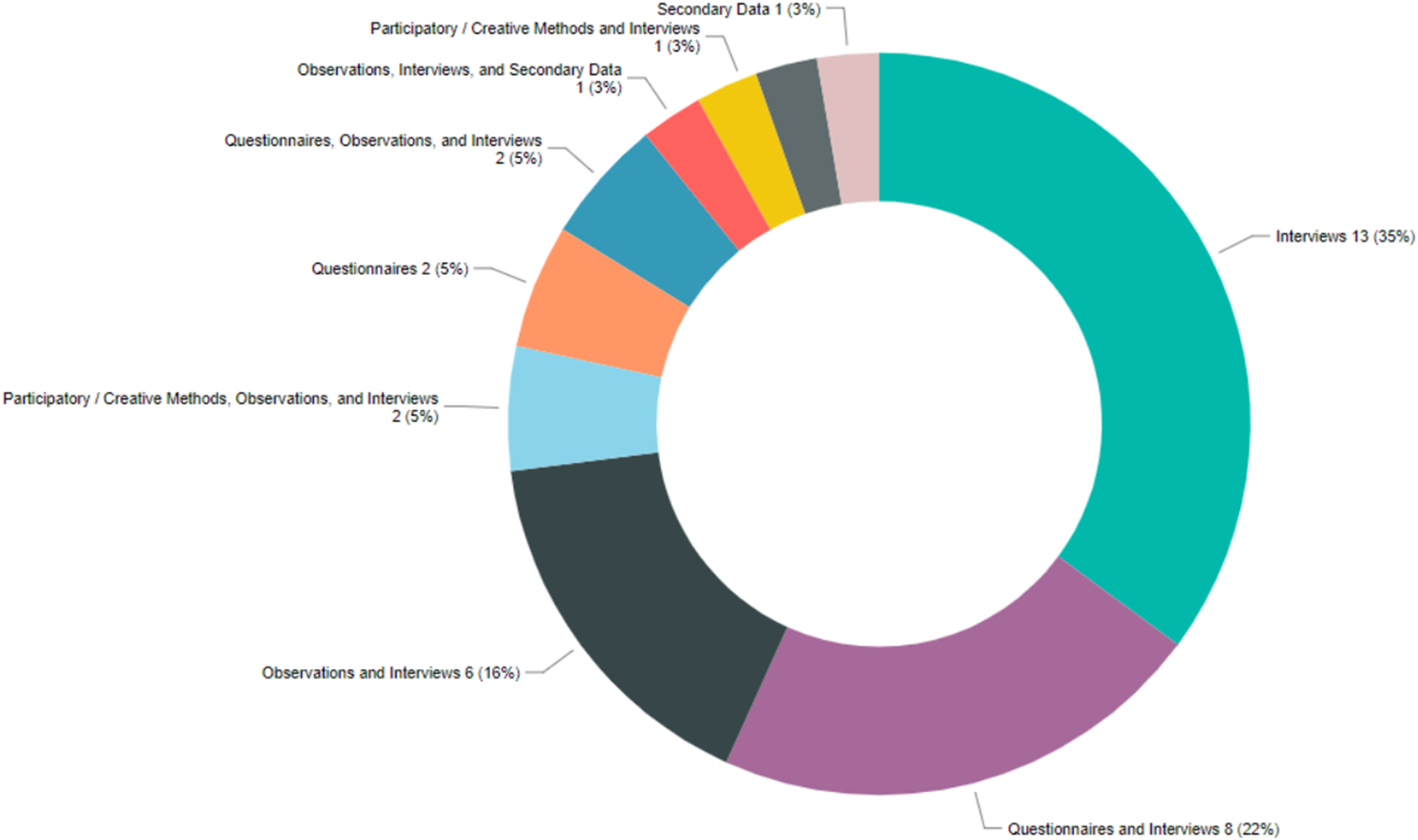
The 37 empirically based studies of this review employed various data collection methods (see Figure 4).
Data collection methods.
Interviews were the most common method, used in 34 of the 37 publications (92%).2,4,5,7,10,11,14,16–19,21–23,25–31,33–42,45–47 These were the sole means of generating data in 13 papers (35%).2,4,10,11,14,16,18,29,34,35,37,41,42 Interviews were also used alongside questionnaires (n = 8, 22%),17,19,22,23,25,26,38,40 observations (n = 6, 16%),5,7,30,45–47 and in combination with questionnaires and observations (n = 2, 5%),27,31 and observations and secondary data sources (n = 1, 3%).21 The most common type of interview described was semi-structured (n = 20, 54%)5,10,11,16,18,21–23,27,29–31,37,38,40–42,45–47 and focus groups (n = 10, 27%).14,19,23,25,26,31,33,34,37,39 As a sole method, questionnaires were used in only two cases (5%),9,32 and secondary data sources in one (3%).1 This is unsurprising, considering that this scoping review focuses on experiences of PE, a topic which lends itself to more qualitative approaches. Four outputs discussed the use of participatory and creative methods.28,33,36,39
It was interesting to note the limited conversation afforded to ethical considerations in empirically based publications with 15 of the 37 (41%)1,2,4,5,10,16,17,19,25,26,31–33,36,39 not mentioning ethics. When this did occur (n = 22, 59%),7,9,11,14,18,21–23,27–30,34,35,37,38,40–42,45–47 participants’ informed consent (n = 15, 68%),9,11,21,23,27,28,30,34,35,37,40,41,45–47 anonymity (n = 9, 41%),18,23,35,37,40,42,45–47 confidentiality,9,18,41,45–47 right to withdraw11,34,41,45–47 (both n = 6, 27%), author(s) reflexivity (n = 6, 27%),14,22,38,45–47 gaining ethical approval (n = 3, 14%),29,37,47 and voluntary participation (n = 2, 9%)27,34 were discussed.
Discussion: key insights
We extend our charting of this body of work by offering our critical reading of six themes from across the 47 papers: research focus; preoccupation with particular populations; acknowledging heterogeneity; positioning of Muslim students; methodological shifts; and pedagogical implications.
Research focus
The purpose of research is unique to each study, and this is reflected through the diversity of interests evident within this review. That said, there are some overarching similarities between the foci of outputs, namely: experiences of PE; relationship between Islam and PE; factors influencing engagement; improving opportunities; and the influence of identity. The most significant research interest (in one-third of cases) was experiences, with some taking a more explicit approach including meanings of (Macdonald et al., 2009), perceptions (Dagkas and Benn, 2006), and attitudes towards PE (McInerney et al., 2000). A quarter of outputs were concerned with the relationship between Islam and PE, attending to issues of religion and religiosity (Walseth, 2015), culture (De Knop et al., 1996), and tensions and conflicts arising when religious requirements are not met 6 (Benn, 1996). For example, Benn's (1996) research highlighted the repercussions of not addressing Muslim students’ different beliefs, linked to their religious and gendered identities, regarding mixed-sex teaching, clothing, and dance in PETE. Walseth's (2015) work with Muslim girls in Norway highlighted different preferences regarding mixed-sex swimming. Here, many of the Norwegian-Pakistani students wanted gender segregation linked to their internalisation of different cultures, beliefs about exercise with boys, and external reflections of faith linked to body modesty and dress codes.
A sixth of papers explored factors influencing engagement including barriers (Elliott and Hoyle, 2014), and Dagkas and Hunter's (2015) consideration of family, school, and religion. Disappointingly, less than one-quarter of papers discussed how opportunities could be improved for Muslim students (Benn, 2008; Elnour and Bashir-Ali, 2003). The review demonstrates a growing interest in identities, with gender, ethnicity, religion and culture considered (Farooq and Parker, 2009; McGee and Hardman, 2012; Thorjussen and Sisjord, 2018, 2020; With-Nielsen and Pfister, 2011).
Moving forward, we advocate for research that is more expansive in its consideration of influences on Muslim students’ experiences, attitudes and perceptions, including greater recognition of the social structures and how these influence choices and decision making alongside identity. For example, how do political and economic climates, technological developments, the media, religious beliefs and practices, cultural specificities and processes of globalisation influence how different young Muslims around the world understand their place in society, and the relevance and meaning of PE in their lives? This requires a consideration of different contexts within which young Muslim people reside, locally, nationally and globally, including research that explores how PE is structured and taught in Global South countries. This will unpack how different Muslims experience PE, illuminating heterogeneity to avoid over generalisations. We behove researchers to embrace this challenge which will support policymakers and practitioners to create safe and supportive PE spaces that meet a diversity of needs and aspirations.
Preoccupation with particular populations
The review reveals a tendency to focus upon Muslim young women, evident in over half of the outputs. Around one quarter considered males and females, and five publications did not refer to a gender, focusing generically on Muslim students. The review demonstrates limited research solely on Muslim boys and/or young men. Notable exceptions include: Farooq and Parker's (2009) exploration of masculinity construction in relation to Islam and PE; Sarac and McCullick's (2017) case study of one gay, Muslim man's experiences of a university PE department; and Nakamura's (2017) research exploring nine male Muslim undergraduate students’ PE, sport and physical activity experiences. In relation to age, nearly half of the papers focused solely upon secondary school PE, with none exploring only primary school. Much of the research in secondary schools was in state schools, with little taking place in different kinds of schools, the exception being Farooq and Parker's (2009) research in an Islamic independent school. Whilst the Bass project, reported in numerous outputs in this review (first reported in Miles et al., 2008), included Madrassas (supplementary schools for the Muslim community), data specific to this context was not reported. A small number of outputs considered experiences of PE for older students within higher education, including: Benn (1996) and Benn and Dagkas (2006), exploring barriers faced by Muslim women undertaking initial teacher education (ITE); Flintoff's (2015) exploration of Black and minority ethnic students’ experiences of PETE; and Sarac and McCullick's (2017) case study. We note limited attempts to capture data across the life course, aside from the work of Walseth (2015), Miles and Benn (2016) and Nakamura (2002, 2017).
The disproportionate amount of attention that young Muslim women of secondary school age receive in comparison to their younger, older and male counterparts, is of little surprise with much of the gender-based PE research tending to focus on young women's relationship with a subject that is at odds with the ideals they are expected to embody. Yet the preoccupation with Muslim young women, particularly in Western contexts, runs the risk of reinforcing Western tropes of them as homogenous, oppressed and passive bystanders in their lives. We concur with Hussain and Cunningham (2024) who argue that one means of dismantling such bias is to explore Muslim women in the Global South, providing a multiplicity and diversity of views and wider understandings that will be useful for those working with Muslim students. We also advocate for more work that considers: Muslim boys and their relationship with PE; how Muslim students experience PE in different kinds of schools (e.g. single-sex, coeducational, state, private, different faith schools, and Madrassas); how primary-aged Muslim children develop a relationship with the subject, and how this shifts and changes through the life course.
Acknowledging heterogeneity within Muslim communities
This review reveals how research has begun to recognise the dangers of homogenising students based on their religion. For example, Macdonald et al. (2009) and Knez et al. (2012) noted how the interplay of religion and ethnicity (shaped by links to other countries), alongside cultural and institutional discourses (connected to family, media, schooling, and community), influenced the different relationships young Muslim women living in Australia had with Islam and, in turn, PE and physical activity. For some, engaging in sport away from school was less available, whilst for others, school activities including dancing with boys proved problematic. Yet, these were not universal experiences across this group of girls. Dagkas and Benn's (2006) research highlights differences in PE experiences between British and Greek Muslim women, despite their shared religion. The authors attribute this to the different historical and socio-cultural contexts of the long-established Greek Muslim community compared to the relatively recent growth in British Muslims. They argue this is reflected in the more liberal interpretations of being Muslim in the Greek context, and the need to retain distinctiveness, and religious and cultural values for many of the British Muslims. Thus, whilst coeducational lessons and male PE teachers were of no concern to the Greek Muslim women or their families, the British students had a growing awareness of Islamic requirements around modesty, dress, and single-sex environments during adolescence.
Acknowledgement of heterogeneity is, in part, supported through the adoption of an intersectional approach that recognises the significance of the intersections of different identity categories to experiences (Crenshaw, 1989). Whilst intersectionality is a relatively new concept in PE scholarship, some earlier papers reviewed acknowledged different identities and/or structural issues, although did not label their work as intersectional. For instance, Benn's (1996) recognition of the ways gender, ethnicity and religion overlapped both as an identity and structural barrier to create inequalities in PETE. We argue that an intersectional lens is critical in gaining more nuanced understandings regarding the relationship different Muslim (indeed all) students have with PE, the multiple and fluid barriers faced, and opportunities for overcoming these. For example, Thorjussen (2021) and Thorjussen and Sisjord (2018, 2020) acknowledge the complex interplay of gender, ethnicity, religion, culture and class with teachers, activities, and peers to influence moments of inclusion and exclusion in PE.
By highlighting within-group differences, an intersectional lens is also useful in troubling stereotypes that circulate about particular groups. In turn, this can contribute to challenging the othering and comparing of groups that occur. For example, Stride (2014) demonstrates both diversity within a group of Muslim girls, and their shared experiences with White peers in PE, highlighting the need to move away from making problematic assumptions about Muslim students. Here, competitive team sports, bodies on display, and the irrelevancy of some activities were common concerns regardless of ethnicity, influencing both White girls' and their Muslim peers’ engagement with the subject.
Whilst research has begun to consider the interplay of different aspects of identity, including religion and culture, we argue that there is potential to unpack these further to continue to highlight heterogeneity within Muslim communities (see, e.g. Ahmad, 2011; Cheng, 2019; Maxwell et al., 2013; Walseth and Fasting, 2003 in sport settings). Different religious sects, degrees of religiosity, and cultural interpretations of Islam all offer further considerations and opportunities to challenge the grand narratives that cast Muslim young people in narrowly defined ways. In so doing, more sophisticated insights regarding the relationship different Muslim students globally have with their faith and PE can be presented to stakeholders.
The positioning of Muslim students in PE
This review reveals a positive shift in the ways young Muslim students and their relationship with PE have been considered. Early research adopted a deficit framework, with religion and culture unproblematically cited as reasons for lack of involvement (Carroll and Hollinshead, 1993). Siraj-Blatchford (1993) was pivotal in encouraging scholars to take a more critical and reflexive stance, shifting blame away from the student and onto the subject. Subsequent work has acknowledged how Western values delivered through PE curricula create barriers and challenges for some Muslim students wishing to be active. For example, Nakamura (2002) identified negative experiences when young Muslim women's needs in relation to sex segregation are not met. Public displays of ability and competency (McInerney et al., 2000), particular activities (Benn et al., 2011; Dagkas et al., 2011), PE uniforms (Elliott and Hoyle, 2014), and rigid school timetables (Lindsay et al., 1987) have similarly been identified as problematic. As we have suggested previously, to gain more holistic understandings, research is needed that considers PE spaces across different countries, Muslim and non-Muslim, Global South and Global North, to highlight how Western PE infrastructures contribute to discrimination and inequalities, and where lessons can be learnt from elsewhere.
On saying this, since Siraj-Blatchford's (1993) insights there has been a shift in research, moving away from a deficit discourse and one preoccupied with barriers to an acknowledgement that Muslim students are active, agile agents in finding solutions to challenges. For example, Macdonald et al. (2009) and With-Neilson and Pfister (2011) demonstrate how Muslim young women manage competing demands to be physically active. Knez et al. (2012) note how young Muslim women opted for inter-school sports programmes because of the choices offered. Hamzeh and Oliver (2012) identify how young Muslim women remained undeterred by ‘veiled-off’ opportunities, discovering alternative ways of being active, and Stride's (2014, 2016) research highlights girls’ agency through their running of an after-school dance club. Much of the research reflects Muslim students having a positive relationship with PE, providing pedagogical conditions can be met. Yet, we suggest that it is often young people themselves who are at the forefront of navigating barriers to be physically active. Much can be learnt from them in this regard, and we call upon policymakers and practitioners to consult with Muslim students, paying attention to their resourcefulness and aspirations to be active. In part, these shifts in understanding regarding Muslim students and their relationship with PE have been facilitated by how research has been undertaken, and this is focused upon next. What is concerning is that these messages have not always translated into practice, and this will be discussed later.
Methodological shifts in undertaking research
With the early exception of Benn's (1996) use of reflective diaries, the review demonstrates a bias towards more traditional methods of generating data (observations, interviews, focus groups, questionnaires). On saying this, the review highlights some growing interest in employing more participatory approaches to data generation. For example, Hamzeh and Oliver's (2012) use of digital photos, scrapbooking, and collages enabled them to better understand how young women negotiated different discourses to be active. Similarly, Stride's (2014, 2016) use of photo boards and mapping helped to unpack the diversity and fluidity of experiences. Stride (2014) also advocates for alternative ways of re-presenting data through critical non-fictional stories to increase sensitivity to difference and provide a medium for silenced voices.
We are strong advocates for research that encourages working with young people, rather than doing research to or on them, acknowledging them as experts in their own lives, and disrupting traditional beliefs about knowledge production. Less conventional methods are also important in revealing issues that are significant to young people, moving the focus from adult-centric research agendas (Flintoff et al., 2008). This review identifies the need for greater utilisation of creative methodologies that encourage the participation of Muslim students in research and a platform to centralise their voices. Moreover, working with these young people from the outset of a project to establish what is important to them, and how they would like research to be used, should be a priority. We argue that much can be learnt from Muslim students and their contributions in research are critical to developing more nuanced understandings about their experiences and providing alternative narratives about their relationship with PE.
Pedagogical implications
Three-quarters of the papers in this review offered pedagogical recommendations and/or policy considerations. Common areas of focus included clothing, Ramadan, changing arrangements, mixed-sex teaching, activities, and showering. For example, activities including dance and swimming were highlighted as areas of concern linked to modesty (Benn, 1996; Lindsay et al., 1987). Inflexible dress codes were noted as problematic, especially when not providing adequate covering of the body (Alamri, 2015; De Knop et al., 1996; Nakamura, 2002). Rigid school timetables that do not facilitate prayer times, and not appreciating the demands of fasting during Ramadan were also signposted as barriers to engagement (Ballinger, 2011; Daley, 1991; Kahan, 2003; McGee and Hardman, 2012). For Muslim young women, mixed-sex environments and the need for female teachers were reported (De Knop et al., 1996; Nakamura, 2002). The practices of showering and public changing were also linked to issues of body modesty for Muslim students (Dagkas and Benn, 2006; Kahan, 2003). 7
This review also links these areas of concern to teachers’ lack of knowledge. For example, Dagkas (2007) and Dagkas et al. (2011) highlight teachers’ uncertainties around the differences between religion and culture and the relationship between Islam and PE. Relatedly, teachers in McGee and Hardman's (2012) research varied in the ways they considered Ramadan in their teaching, and the young women in Alamri's (2015) study noted teachers’ ignorance of students’ Islamic needs influencing participation. Our critical readings of this corpus of literature reveal that despite years of research regarding Muslim students and PE, the findings from these studies are not sufficiently filtering through to teachers. We propound that this theory-praxis divide needs urgent attention, especially so considering the increasing diversity of student cohorts in schools in Western countries. We note a key opportunity for bridging this gap is during ITE. For example, the Whiteness of PETE in the United Kingdom, created through student cohorts, faculty, teaching, and school placements, currently fails to attract and retain different kinds of preservice teachers, nor prepares them for working inclusively with different kinds of students (Flintoff, 2015). Much can be gleaned here from Francis-Edge et al.’s (2023) insights regarding the process of becoming a teacher for students from minority ethnic communities, and the value these teachers bring to the profession.
Conclusions
We now draw this paper to a close by identifying four areas that offer further avenues of research.
Different students
We echo the observation of Robinson (2018) who highlights the need for more research around Muslim boys’ PE experiences. This absence is reflective of the gender-based research in PE, with few attempts to explore how different masculinities are embodied, reinforced, and challenged within PE (some noteworthy exceptions include Gard, 2006; Hickey, 2008; Tischler and McCaughtry, 2011), and ethnicity rarely featuring. We also note the lack of research exploring younger Muslim students’ experiences of PE at primary school. How do these early experiences inform Muslim children's sense of self, and their relationship with PE? Relatedly, how is the transition between primary and secondary schooling experienced and the role of PE in this process? Similarly, more longitudinal research that considers the meaning and place of PE for Muslim students throughout different stages of their lives is warranted.
Different theoretical approaches
In exploring Muslim students’ experiences, research must be cognisant of their multiple identities. Positioned at the axes of gender, ethnicity, religion, culture, age, disability, sexuality, social class, processes of globalisation, and cultural assimilation, these young people will not all experience their religious identity in the same way. Yet, little research has considered how religious identity intersects with other identity markers to influence PE experiences. Relatedly, there is scope for more work that acknowledges the differences and divergences within Muslim communities pertaining to religiosity, cultural interpretations, sectarian and regional differences, and religious denominations and how these influence access and opportunity. Aside from an intersectional lens, other useful theoretical resources including Islamic feminism, Critical Race Theory, transnational feminism, and Post-Colonial Theory can be utilised to problematise how Western values and infrastructures contribute to the construction of Muslim identities as problematic, and the othering and inequalities experienced.
Different contexts
The importance of space was noted in a number of outputs in the review, including Muslim women navigating the Whiteness of PETE (Benn, 1996), parents withdrawing daughters from PE lessons (Miles et al., 2008), young women negotiating ‘veiled off’ opportunities in their community (Hamzeh and Oliver, 2012), and girls creating their own after-school clubs (Stride, 2014). Whilst much of the work reviewed considered PE lessons, schools offer other under-explored spaces – playgrounds, corridors, and active travel to and from school. Different kinds of schools, including faith schools, special schools and alternative provision, also offer new spaces for research. Moreover, how Muslim young people choose to be physically active away from school offers important insights for practitioners to create more culturally sensitive, inclusive spaces. The empirical bias towards research in Global North countries also signposts the need to expand beyond Western contexts. In their scoping review, Hussain and Cunningham (2024) note the increasing interest in sports-based research in the Global South. We advocate for a similar direction in PE, one that will enable an exploration of how Muslim students within and across regions and countries experience PE, and what lessons can be learnt.
Different methods
A small number of papers recognised the benefits of engaging with young people to better understand experiences. Here, Hamzeh and Oliver (2012) discovered how young women are resourceful in being active. Knez et al. (2012) champion the involvement of young people in research and policy development. Yet, the review offers few examples of researchers working with young people, rather than undertaking research on them. Similarly, there was little evidence of working in more participatory ways that might better appeal to young people. We advocate for young people being involved in research from its inception, setting the research focus, deciding on ways to collect data, and how and where the findings should be presented. These offer fruitful opportunities to challenge the Eurocentric adult-led bias that currently dominates.
In returning to our original questions guiding this scoping review, it is clear that, whilst research has developed understandings regarding Muslim students’ experiences of PE to a certain degree, there remain gaps in knowledge. By attending to the areas we identify, more holistic understandings will be gained to enable an appreciation of different Muslim students’ experiences. Notably, our review draws attention to a theory–praxis divide. Thus, opportunities exist for researchers and pedagogues to better connect, ensuring the insights gained through research can be more effectively utilised by practitioners to support more inclusive experiences for all Muslim students.
Footnotes
Acknowledgements
We would like to acknowledge the support received from Ingfrid Mattingsdal Thorjussen in her role as the expert consultant during the search for publications.
Declaration of conflicting interests
The authors declared no potential conflicts of interest with respect to the research, authorship, and/or publication of this article.
Funding
The authors received no financial support for the research, authorship, and/or publication of this article.

Notes
Author biographies
Appendix 1: Code number for reviewed publications
Sfeir L (1985) The Status of Muslim Women in Sport: Conflict between Cultural Tradition and Modernization. International Review for the Sociology of Sport 20(4): 283–305. Lindsay K, McEwen S and Knight J (1987) Islamic Principles and Physical Education. Unicorn 13(2): 75–78. Daley D (1991) Multicultural Issues in Physical Education. British Journal of Physical Education 22(1): 31–32. Fleming S (1993) Schooling, Sport and Ethnicity: A Case Study. Sociology Review 3(1): 29–33. Carroll B and Hollinshead G (1993) Ethnicity and conflict in physical education. British Educational Research Journal 19(1): 59–76. Siraj-Blatchford I (1993) Ethnicity and conflict in physical education: A critique of Carroll and Hollinshead's case study. British Educational Research Journal 19(1): 77–82. Benn T (1996) Muslim women and PE in initial teacher training. Sport, Education and Society 1(1): 5–21. De Knop P, Theeboom M, Wittock H and De Martelaer K (1996) Implications of Islam on Muslim Girls’ Sport Participation in Western Europe. Literature Review and Policy Recommendations for Sport Promotion. Sport, Education and Society 1(2): 147–164. McInerney DM, Davidson N and Suliman R (2000) Personal Development, Health and Physical Education in context: Muslim and Catholic perspectives. Australian Journal of Education 44(1): 26–42. Williams A and Bedward J (2001) Gender, Culture and the Generation Gap: Student and Teacher Perceptions of Aspects of National Curriculum Physical Education. Sport, Education and Society 6(1): 53–66. Nakamura Y (2002) Beyond the Hijab: Female Muslims and Physical Activity. Women, Sport and Physical Activity Journal 11(2): 21–48. Kahan D (2003) Islam and Physical Activity: Implications for American Sport and Physical Educators. Journal of Physical Education, Recreation and Dance 74(3): 48–54. Crawford SAGM, Wolf M, Halas J, Johnson B, Van Es P, Tamborra C, Blake D and Runyon B (2003) In light of the article, “Islam and Physical Activity,” what accommodations, if any, should physical educators make for their Muslim students? Journal of Physical Education Recreation and Dance 74(6): 17–18. Bramham P (2003) Boys, Masculinities and PE. Sport, Education and Society 8(1): 57–71. Elnour A and Bashir-Ali K (2003) Teaching Muslim Girls in American Schools. Social Education 67(1): 62–64. Dagkas S and Benn T (2006) Young Muslim women's experiences of Islam and physical education in Greece and Britain: A comparative study. Sport, Education and Society 11(1): 21–38. Benn T and Dagkas S (2006) Incompatible? Compulsory mixed-sex Physical Education Initial Teacher Training (PEITT) and the inclusion of Muslim women: A case-study on seeking solutions. European Physical Education Review 12(2): 181–200. Dagkas, S (2007) Exploring teaching practices in physical education with culturally diverse classes: A cross-cultural study. European Journal of Teacher Education 30(4): 431–443. Miles H, Benn T, Dagkas S and Jawad H (2008). Research into Practice – The Bass Study: Muslim girls, physical education and school sport. Physical Education Matters 2(4): 10–11. Benn T (2008) Accept and Respect. Physical Education Matters 2(1): 60 Farooq S and Parker S (2009) Sport, Physical Education, and Islam: Muslim Independent Schooling and the Social Construction of Masculinities. Sociology of Sport Journal 26(2): 277–295. Macdonald D, Abbott R, Knez K and Nelson A (2009) Taking exercise: Cultural diversity and physically active lifestyles. Sport, Education and Society 14(1): 1–19. Arar K and Rigbi A (2009) ‘To participate or not to participate?’ Status and perception of physical education among Muslim Arab-Israeli secondary school pupils. Sport, Education and Society 14(2): 183–202. Ballinger DA (2011) “So, You’re a Muslim?” (not that there's anything wrong with that). Journal of Physical Education Recreation and Dance 82(8): 43–53. Dagkas S, Benn T and Jawad H (2011) Multiple voices: Improving participation of Muslim girls in physical education and school sport. Sport, Education and Society 16(2): 223–239. Benn T, Dagkas S and Jawad H (2011). Embodied faith: Islam, religious freedom and educational practices in physical education. Sport, Education and Society 16(1): 17–34. With-Nielsen N and Pfister G (2011) Gender constructions and negotiations in physical education: Case studies. Sport, Education and Society 16(5): 645–664. Hamzeh M and Oliver KL (2012) “Because I Am Muslim: I Cannot Wear a Swimsuit”. Research Quarterly for Exercise and Sport 83(2): 330–339. Knez K, Macdonald D and Abbott R (2012) Challenging stereotypes: Muslim girls talk about physical activity, physical education and sport. Asia-Pacific Journal of Health, Sport and Physical Education 3(2): 109–122. McGee JE and Hardman K (2012) Muslim schoolgirls’ identity and participation in school-based physical education in England. SportLogia 8(1): 29–41. Benn T and Pfister G (2013) Meeting needs of Muslim girls in school sport: Case studies exploring cultural and religious diversity. European Journal of Sport Science 13(5): 567–574. Elliott D and Hoyle (2014) An examination of barriers to physical education for Christian and Muslim girls attending comprehensive schools in the UK. European Physical Education Review 20(3): 349–366. Stride A (2014) Let US tell YOU! South Asian, Muslim girls tell tales about physical education. Physical Education and Sport Pedagogy 19(4): 398–417. Alamri AA (2015) How Australian Female Muslim Students Interpret Challenges in High School Sports. Journal of Muslim Minority Affairs 35(2): 215–229. Walseth K (2015) Muslim girls’ experiences in physical education in Norway: What role does religiosity play? Sport, Education and Society 20(3): 304–322. Hamzeh M (2015) Jordanian national football Muslimat players: Interrupting Islamaphobia in FIFA's hijab ban. Physical Education and Sport Pedagogy 20(5): 517–531. Dagkas S and Hunter L (2015) ‘Racialised’ pedagogic practices influencing young Muslims’ physical culture. Physical Education and Sport Pedagogy 20(5): 547–558. Flintoff A (2015) “Playing the ‘Race’ card? Black and minority ethnic students’ experiences of physical education teacher education”. Sport, Education and Society 20(2): 190–211. Stride A (2016) Centralising space: The physical education and physical activity experiences of South Asian, Muslim girls. Sport, Education and Society 21(5): 677–697. Miles C and Benn T (2016) A case study on the experiences of university-based Muslim women in physical activity during their studies at one UK higher education institution. Sport, Education and Society 21(5): 723–740. Sarac L and McCullick B (2017) The life of a gay student in a university physical education and sports department: A case study in Turkey. Sport, Education and Society 22(3): 338–354. Nakamura Y (2017) Sport and Muslim men in the Greater Toronto Area, Canada: An exploratory study. Sport in Society 20(11):1799–1814. Benn T (2017) Building Bridges: Reflections on Improving Inclusion in Sport Across Religious and Cultural Boundaries. International Council of Sport Science and Physical Education (ICSSPE) Bulletin: Journal of Sport Science and Physical Education 72(June): 11–16. Robinson DB (2018) Religion as an other(ed) identity within physical education: A scoping review of relevant literature and suggestions for practice and enquiry. European Physical Education Review 25(2): 1–21. Thorjussen I and Sisjord MK (2018) Students’ physical education experiences in a multi-ethnic class. Sport, Education and Society 23(7): 694–706. Thorjussen I and Sisjord MK (2020) Inclusion and exclusion in multi-ethnic physical education: An intersectional perspective. Curriculum Studies in Health and Physical Education 11(1): 50–66. Thorjussen I (2021) Social inclusion in multi-ethnic physical education classes: Contextualized understandings of how social relations influence female students’ experiences of inclusion and exclusion. European Physical Education Review 27(2): 384–400.