



Abstract
Swimming is a profound source of joy in life. The impact of swimming competence extends beyond leisure, encompassing aquatic skills crucial for the prevention of drowning incidents. The World Health Organization (WHO) strongly advocates for the proactive initiative of teaching basic swimming and water safety skills to school-aged children, which is recognized as a direct and effective measure in mitigating the risk of drowning. This article aims to investigate and quantify aquatic skills and swimming competence in 9–10-year-old primary school children. A study was conducted throughout the academic year of 2021–2022, as an integral component within the primary schools' physical education. The study design was tailored to facilitate large-group assessment, encompassing children from 69 primary schools (n = 2421) situated across three Norwegian municipalities. The assessments were administered upon the culmination of the fourth-grade learn-to-swim programs and carried out using the Swimming Competence Assessment Scale, involving six consecutive aquatic skills: water entry, swimming on the front, surface diving, float/rest, swimming on the back, and water exit. The results indicated that 62.5% of the children successfully met the predetermined criteria for swimming competence according to the Norwegian standard. Among the six assessed aquatic skills, proficiency in swimming on the front emerged as the most influential factor contributing to the overall competence level. This study emphasizes the pivotal role of swimming education for school-aged children. It highlights the need to prioritize swimming and water safety education, initiating children's learning journey toward being water-competent.
Introduction
Swimming is one of the joys of life, and a considerable amount of human physical activity, recreational pursuits, leisure activities, and sports unfold in water (Dudley, 2020), with several positive effects on health and well-being (Chase et al., 2008; Esteves and Lewis, 2021). In contrast to land-based forms of locomotion, physical activity in blue spaces represents unique challenges. These challenges include handling drag (due to water density), controlling buoyancy, and the limited availability of oxygen in water. Furthermore, proficiency in aquatic skills is a valuable means of engaging in physical exercise and is vital for drowning prevention.
The World Health Organization (WHO) has underscored the gravity of drowning as a neglected yet urgent public health issue, emphasizing its significant contribution to global unintentional injury-related fatalities (WHO, 2014, 2023). The burden of drowning represents a multifaceted and complex phenomenon that transcends geographical and cultural boundaries and affects individuals in all age groups, with a pronounced prevalence observed in children, especially in low- and middle-income countries (Bierens, 2014). WHO (2017) has formulated multisectoral interventions and strategies to mitigate the morbidity and mortality associated with drowning. It strongly advocates implementing basic swimming and water safety training programs targeting children aged six years and above (WHO, 2021, 2022). Certain studies highlight the potential benefits of engaging in swimming lessons and their association with a reduced risk of drowning (Brenner et al., 2009; Rahman et al., 2012; Taylor et al., 2020), and the apparent association seems self-evident. Despite these observations, the comprehensive efficacy of swimming in safeguarding against drowning is still not fully understood (Moran, 2013), which Brenner et al. (2009) also emphasize, noting that swimming skills alone are insufficient to protect a child from drowning. Still, according to Fernandes (2018), teaching school-aged children basic swimming and water safety skills is unequivocally understood as the most direct measure to reduce the risk of drowning.
In many countries, the regulatory framework for teaching basic swimming and water safety is mandated as a statutory requirement within the primary schools’ physical education (PE) national curriculums (Borgonovi et al., 2022), for example, in England (Department for Education, 2013) and France (Ministry of National Education, 2023). The directives usually outline objectives and benchmarks spanning the compulsory educational period, with a fundamental component of obtaining specific aquatic skills and being able to swim. Internationally, swimming is often defined by the ability to swim a designated distance, primarily from 25 to 200 meters, and occasionally involves demonstrating various swimming strokes (Garrido et al., 2016; Moran, 2013; Quan et al., 2015). There is no globally accepted definition of swimming competence (Moran et al., 2012); however, in Nordic settings, a conventional approach prevails, where individuals are expected to enter the water completely submerged and to swim a minimum distance of 200 meters in deep water, with at least 50 meters completed using some form of backstroke technique (Olstad et al., 2020; Vienola et al., 2016). The Nordic standard appears to be utilized in other nations as well (Reer and Schumacher, 2023).
In the Norwegian educational framework, swimming is incorporated into the PE curriculum, which emphasizes the importance of stimulating the lifelong joy of movement and fostering an appreciation of physical activity and movement based on personal qualities and abilities (Norwegian Directorate for Education and Training, 2020). The PE curriculum specifies a structured progression of swimming competencies that extends throughout primary and lower secondary schools, from grades one to 10. Typically, swimming education starts in year 2, targeting students aged 7 to 8, with competence aims that encourage water familiarization and playful engagement, facilitating a gentle introduction to the aquatic environment. In year 4 (9–10-year-old children), students are anticipated to demonstrate proficiency in swimming and acquire fundamental aquatic skills such as diving, gliding, floating, and navigating by themselves in water. The national benchmark for swimming competence is outlined in the PE curriculum and comprises six consecutive aquatic skills, which deviate to some extent from comparable countries. The Norwegian standard is clearly articulated within a specific competence aim (Norwegian Directorate for Education and Training, 2020: 6), stating that each child should: Show the ability to swim by falling into deep water, swimming 100 meters frontstroke, during which the student dives down and picks up an object with their hands, stopping and resting for three minutes (while keeping afloat on one's stomach, orienting oneself, rolling over, floating on one's back), then swimming 100 meters backstroke and climbing ashore.
From years 8–10, the curriculum places a stronger focus on improving swimming techniques, achieving specific distances, and acquiring life-saving skills applicable to various aquatic environments, marking the advanced stages of swimming education.
In an educational context, the diversity of aquatic skills embedded in the Norwegian standard is intricately connected to the concept of water competence (Langendorfer and Bruya, 1995; Stallman et al., 2017) and the perspectives of aquatic literacy (De Martelaer, 2023; Dudley, 2020), as all-round aquatic developmental approaches. The contemporary concept of water competence aims to catalyze a paradigm shift in the aquatic profession from focusing on swimming techniques, primarily associated with forward propulsion, to a broad spectrum of psychomotor, cognitive, and affective competencies (Stallman, 2017). Historically, the origins of the water competence approach stem from the dynamic systems perspectives on motor learning (Fernandes, 2018; Langendorfer et al., 2018), mainly the constraints model (Newell, 1986), where human movement coordination changes both dynamically and developmentally in the relation between the person, the task at hand, and the environment that together form an emergent and dynamic state of behavior.
Research targeting assessments of children's swimming competence has predominantly relied on measurement instruments other than in-water performances (Trindade Wizer et al., 2021). Primarily, self-assessments by children and proxy-reported evaluations of swimming proficiency by adults, including parents, PE teachers, swimming club instructors, and other stakeholders engaged in aquatic education in primary schools, have been employed (Mercado et al., 2016). To the best of our knowledge, only two studies have reported the recent trends in swimming proficiency among children in a Norwegian context. According to a survey by the Norwegian Swimming Federation (2021), 41% of 10–11-year-old children state that they can swim more than 200 meters. Similarly, Mordal Moen et al. (2018) discovered that 40.5% of children in grades five to 10 perceive themselves as having the skills required to meet the Norwegian benchmark for swimming competence in the PE curriculum. Nonetheless, specific variations within these grades were not explicitly reported. Expanding our perspectives to include Sweden, Lõhmus et al. (2022) revealed that 77% of boys and 78% of girls aged 9 to 10 self-reported being able to swim 200 meters. However, children born outside Sweden were excluded, potentially impacting the overall outcomes. Swedish PE teachers reported that 93% of sixth-grade (12–13-year-old) children fulfilled the curricular swimming competence requirement set by the Nordic standard (Skolverket, 2022).
It is essential to highlight that previous studies have revealed substantial disparities between perceived and actual aquatic competence (D’Hondt et al., 2021; Moran et al., 2012; Rejman et al., 2020); in particular, younger children tend to overestimate their actual aquatic proficiency (Costa et al., 2020), which may pose a significant safety risk within this demographic. Only a single study (Runge Larsen et al., 2018) examined actual in-water swimming competence in a Nordic context. Approximately 60% of 1245 Danish children across grades one to six demonstrated the capacity to complete a 200-meter swim in an indoor swimming pool. Furthermore, within the subset of children aged 9 to 11 years, 70% displayed the necessary competence. Beyond the Nordic region, an Australian cross-sectional retrospective analysis among a cohort of children enrolled in commercial swimming lessons revealed that 40% of 12-year-old children failed to meet the National Benchmark (Royal Life Saving Society Australia, 2019) of swimming 50 meters freestyle (Willcox-Pidgeon et al., 2021). Collectively, the overarching findings from studies in comparable countries suggest that a significant number of children do not achieve the national benchmarks for swimming competence. This shortfall potentially diminishes their capability to prevent drowning incidents. More specifically, research consistently shows that socioeconomic disparities strongly affect children's swimming proficiency (Görner et al., 2020; Pilgaard et al., 2020). This assertion is further supported by Franklin et al. (2015), who found an association between the success of children aged 5 to 12 years in a swim-and-survive program and various factors. These factors include the frequency of visits to aquatic environments and enrollment in private swimming lessons, which can be linked to the level of parental engagement, resources, and involvement in their children's aquatic education.
In the field of swimming competence research, the prevalent use of self-reported estimations could restrict our understanding of children's true swimming competence. Self-reports are subjective and may not accurately reflect a child's actual proficiency in swimming, leading to potential overestimations or underestimations of their capabilities (Costa et al., 2020; D’Hondt et al., 2021). The lack of research investigating actual swimming competence underscores the imperative for rigorous evaluations capable of providing more valid and reliable measures. Consequently, the primary objective of this study was to undertake a comprehensive assessment of in-water swimming competence among fourth-grade primary school students in Norway, in alignment with the national standard.
By investigating the swimming competence of children, this study bridges a crucial gap in existing research, laying the groundwork for contributions that span multiple disciplines. It underscores the significance of swimming not just as an educational concern, but also as a pivotal public health matter. It can contribute to informing policymakers and educators about the effectiveness of current swimming education methods. Furthermore, it could improve drowning prevention efforts by pinpointing precise aquatic skill deficits among children and facilitating the development of more targeted and effective safety interventions.
Materials and methods
This study used a cross-sectional survey design and data collected from swimming pool settings at one point in time. It aimed to conduct a comprehensive assessment of children's actual swimming proficiency within a large-scale sample, in accordance with the Norwegian standard delineated by curricular objectives for PE in primary schools.
Participants
Three municipalities in Norway's mid and northern region, representing 69 public primary schools (see Table 1), accepted the invitation to participate in the study. Municipalities with associated schools were selected through convenience sampling (Clark et al., 2021), primarily driven by their geographical proximity, accessibility, and size. The municipalities that were enlisted for the study comprised ∼14,800 in Municipality 1 (M1), ∼71,600 in Municipality 2 (M2), and ∼182,000 total inhabitants in Municipality 3 (M3). Within these populations, the participating students accounted for 1.1% to 1.2% of the overall demographic. The classification of the municipalities by size adhered to the criteria established by Statistics Norway (Kringlebotten and Langørgen, 2020). The study involved a cohort of 2421 students, consisting of 1187 girls and 1234 boys from the fourth grade in primary school (9–10-year-olds). In this study, 21.7% of the total number of students in the three municipalities did not participate in the data collection, primarily attributable to the COVID-19 pandemic restrictions. The inclusion criteria for participation in the study were based on active participation in the compulsory PE learn-to-swim (LTS) program throughout the academic school year. A reported physical, mental, cognitive, or developmental condition that impaired the ability to participate in the school's LTS program qualified as an exclusionary criterion for this study.
Characteristics of municipalities, schools, students, and swimming lessons.
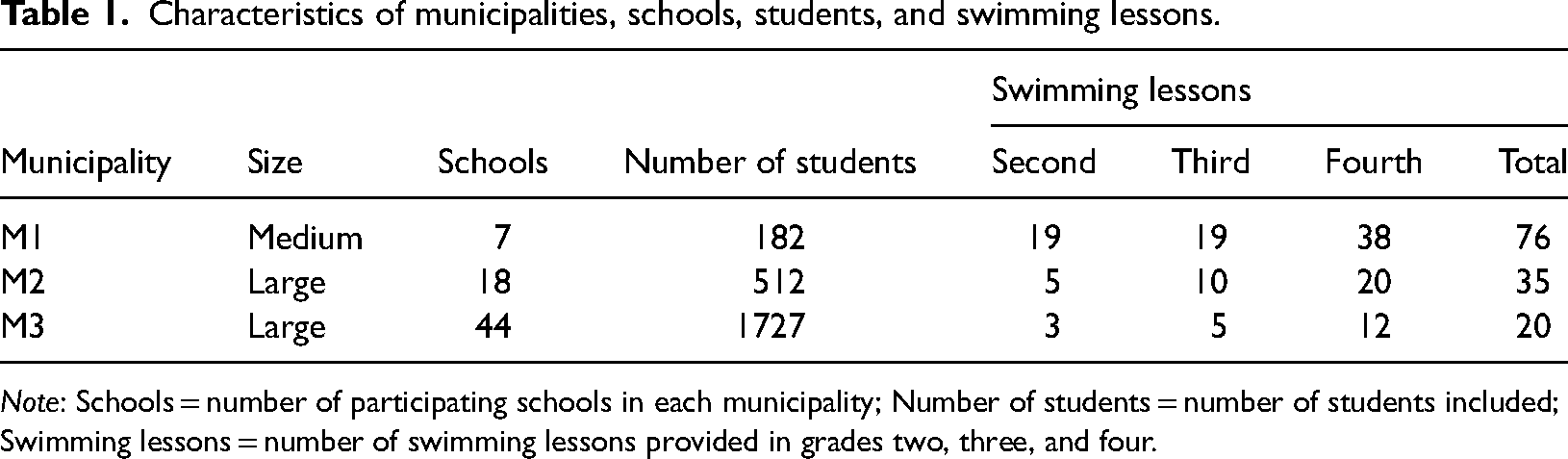
Note: Schools = number of participating schools in each municipality; Number of students = number of students included; Swimming lessons = number of swimming lessons provided in grades two, three, and four.
PE swimming education
All three municipalities implemented a model of outsourced swimming education within their PE curriculum, in which external providers were responsible for delivering the LTS programs. Instruction took place in centrally located swimming facilities within each municipality, with students being transported to these venues for their lessons. This model, whereby the municipalities engage external providers, reflects a broader trend within swimming education in Norway (Olstad et al., 2020). Consequently, the recruitment of schools to participate in this study was facilitated by the head swimming instructor in each municipality. The PE LTS programs exhibited variance in lessons, lengths of programs (six to 32 weeks), pedagogical methods, and didactical approaches. All three municipalities used 45-minute lessons within their respective LTS programs. In addition to the swimming education provided in the fourth grade, the students had previously engaged in aquatic education during the second and third grades of primary school. The head swimming teachers provided all the details pertaining to these programs.
Data collection
The Swimming Competence Assessment Scale (SCAS) was employed to evaluate the children's swimming proficiency levels. Developed by Sundan et al. (2023), the SCAS consists of an observation form, a coding sheet, and a set of procedures designed to conduct a standardized swimming proficiency test. The test aims to simulate an in-water self-rescue situation in a swimming pool and encompasses a sequence of six aquatic skills to be performed consecutively as follows:
Water entry. Begin by falling into deep water from a raised platform positioned 30 centimeters above the water surface. Swim-on-front. Swim 100 meters on the front (prone position), while employing any stroke without focusing on technique or time. Surface dive. While swimming on the front, execute a dive from the surface, descending to a depth of 1.3 meters to retrieve a dive ring from the pool floor. Float/rest. Stop and float/rest for three minutes, starting on the front, and then rotating to the back. Swim-on-back. Swim 100 meters on the back (supine position), while employing any stroke without a specific focus on technique or time. Water exit. After swimming 100 meters on the back, exit the water onto the elevated platform where the initial entry occurred.
The SCAS provides a structured framework for the assessment of children's swimming proficiency, enabling consistent and systematic categorization and scoring, where each aquatic skill is assessed on a four-point scale: very low (1), low (2), high (3), and very high (4). The SCAS is grounded on expert consensus and defined criteria, offering explicit guidelines for each task to assist raters in accurately identifying the level of competence and differentiating among scores. For a comprehensive understanding of the SCAS, see Sundan et al. (2023), who offer an in-depth exploration of the scale's development and application. Furthermore, the robustness of the SCAS has previously been examined, demonstrating strong psychometric properties, as detailed by Sundan et al. (2024). The results indicated a high level of consistency over time (test–retest) with an intraclass correlation coefficient (ICC) of 0.974, with a 95% confidence interval ranging from 0.947 to 0.987 (p < 0.001). Furthermore, the analysis revealed substantial agreement among independent raters, with an average measure ICC of 0.954 and a 95% confidence interval from 0.911 to 0.973 (p < 0.001). Additionally, the study reported high internal consistency within the SCAS, as demonstrated by a Cronbach's alpha coefficient of 0.79.
The data was collected during the 2021–2022 academic year, from September 2021 to June 2022. These assessments were made as an integrated aspect of PE during regular school hours at the culmination of the municipality's LTS programs. There were variations among municipalities regarding the LTS program models, which encompassed a spectrum of pedagogical approaches, distribution of teaching hours, and overall duration of the programs. However, each of the three LTS programs drew inspiration from the foundational principles of swimming education, specifically the four core pillars (diving, floating, gliding, and propulsion), as established by Madsen et al. (2019). The duration of the programs ranged from six weeks to nine months. More specifically, M1 featured an extended program spanning nine months, whereas M2 opted for a five-month duration across all primary schools, each with a standard frequency of one lesson per week. M3 adopted a more condensed model, with a program duration of six weeks for each primary school and a heightened frequency of three classes per week. Consequently, M3 generated data at frequent intervals, specifically every six weeks. In contrast, M2 generated data over one week in February 2022, and M1 extended its data generation period to two weeks in June 2022.
Thirteen municipal swimming teachers carried out the swimming proficiency tests and data collection. Notably, a designated PE teacher assumed responsibility for the overall administration of the swimming proficiency tests during data collection. At the same time, another teacher was solely responsible for assessing and scoring the children's performances. The children's performances were evaluated using a paper-based SCAS coding sheet. Prior to being made accessible to the researchers, these coding sheets were anonymized to ensure complete confidentiality. All swimming teachers received comprehensive training in the administration of the SCAS protocol. This training encompassed an introductory session and discussion led by the researchers, followed by practical training within the context of the municipal LTS programs.
Ethical considerations
This study adhered to the ethical standards established by the National Committee for Research Ethics in Social Sciences and the Humanities (NESH) and received approval from the Norwegian Agency for Shared Services in Education and Research (Sikt) as an integral component within a larger study (reference number 743751). In addition, the data protection officers in each municipality evaluated and approved the project, and the municipal education departments signed a collaborative, cooperative agreement unequivocally delineating all parties’ objectives, intentions, and responsibilities. Moreover, a detailed information letter translated into seven languages was disseminated to all children and their respective parents/legal guardians and distributed electronically via the primary schools’ communication platforms, with the primary school teachers playing an essential role in facilitating effective communication with the children.
The swimming proficiency test was an integrated element of the PE LTS program in primary school and was thus compulsory for all children. However, it is essential to underscore that children/parents had the right to withdraw from the study. To preserve the anonymity of the data, the LTS program teachers acted as intermediaries between the participants and the researchers. These coordinators were entrusted with the linking key, which was stored separately and unavailable to the researchers. In the context of this study, researchers were exclusively able to access aquatic skills data, devoid of any accompanying background information, such as gender, school affiliation, and other demographic details. Consequently, this approach prevented any direct or indirect identification of the participants, safeguarding their privacy throughout the research process.
Statistical analysis
All statistical analyses were performed using IBM version 29.0.1.0. The preliminary screening identified 2.1% missing values in the dataset (ranging from 1.6% to 3.1%, depending on the test item). In the coding sheet, all six checkboxes were mandatory for the raters to complete, and any missing values predominantly stemmed from instances where they were not checked during data collection, typically attributed to rater error. Furthermore, the dataset exhibited minimal missing values, and an analysis showed no systematic pattern. Missing values were treated by a multiple imputation procedure (Little and Rubin, 2002), which resulted in five multiple datasets containing their own set of imputed values. The estimates in each complete dataset were combined into pooled estimates, and the average value for these iterations was computed to replace the missing values for each case.
A total score was established by summarizing performances across SCAS test items, and based on this, a cut-off score for overall swimming competence was established: to qualify as swimming competent according to the Norwegian standard, participants had to attain a minimum score of three or four for each of the six test items. Consequently, participants who scored one or two for one or more of the items assessed, demonstrating a low or very low level of competence, were categorized as not swimming competently. To calculate the total score for overall swimming competence in accordance with the Nordic standard, the swim-on-front and swim-on-back components were exclusively considered, applying the identical cut-off criteria to the Norwegian standard calculations. The cut-off score aligned with the competency level delineated in the SCAS, where scores one and two describe an aquatic skill level whereby individuals need assistance to execute the tasks. For instance, during swim-on-front or swim-on-back, children may need support by standing on the pool floor or grasping onto the pool's edge, intending to rest and save energy.
A chi-square test of independence was employed to explore the relationship between swimming competence and the six aquatic skills test items. This analysis aimed to elucidate the association with swimming competence within a Norwegian and Nordic context and across various municipalities. Furthermore, Cramer's V-test was utilized to assess the strength of the relationships (effect size) identified in the chi-square test.
Results
The frequency distribution, mean, and standard deviations of the scores for the six aquatic skills in the SCAS are shown in Table 2.
Frequency distribution of scores for the six test items in the SCAS.
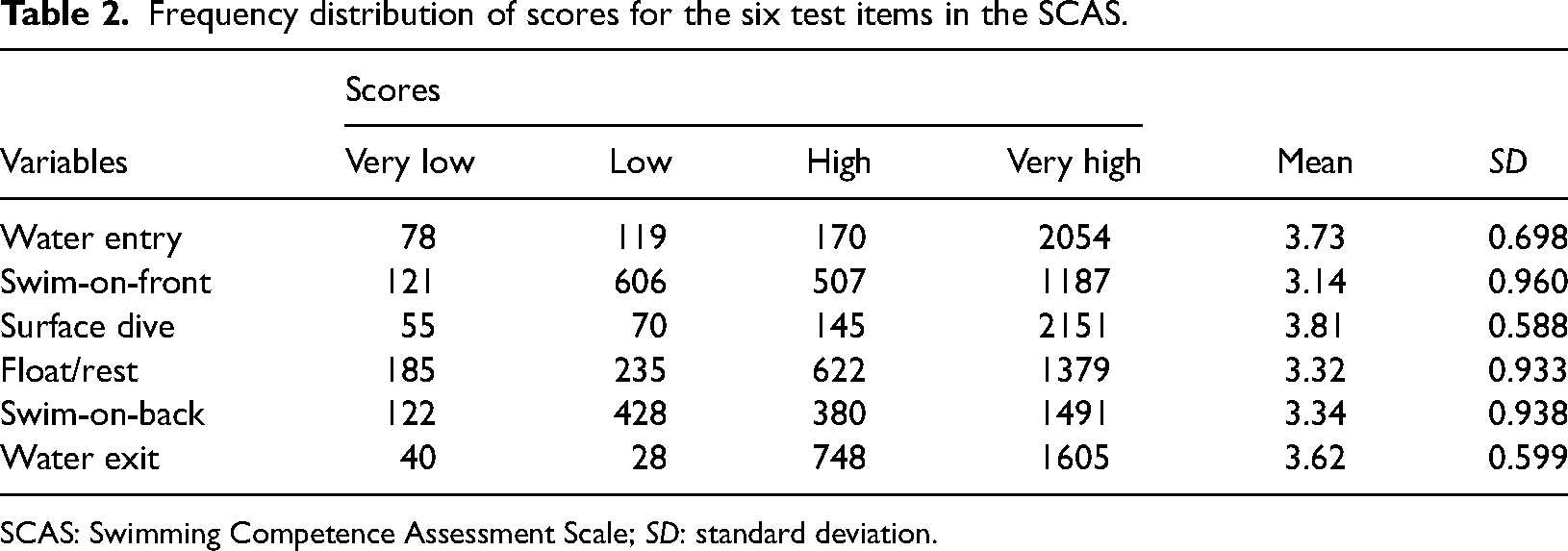
SCAS: Swimming Competence Assessment Scale; SD: standard deviation.
The descriptive analysis shows that the swim-on-front variable demonstrates the most pronounced level of variance in scores, followed by the swim-on-back and float/rest variables. Furthermore, water exit and surface dive exhibit the lowest variance, with 97% and 95% of the children achieving a high or very high level of competence, as shown in Figure 1.
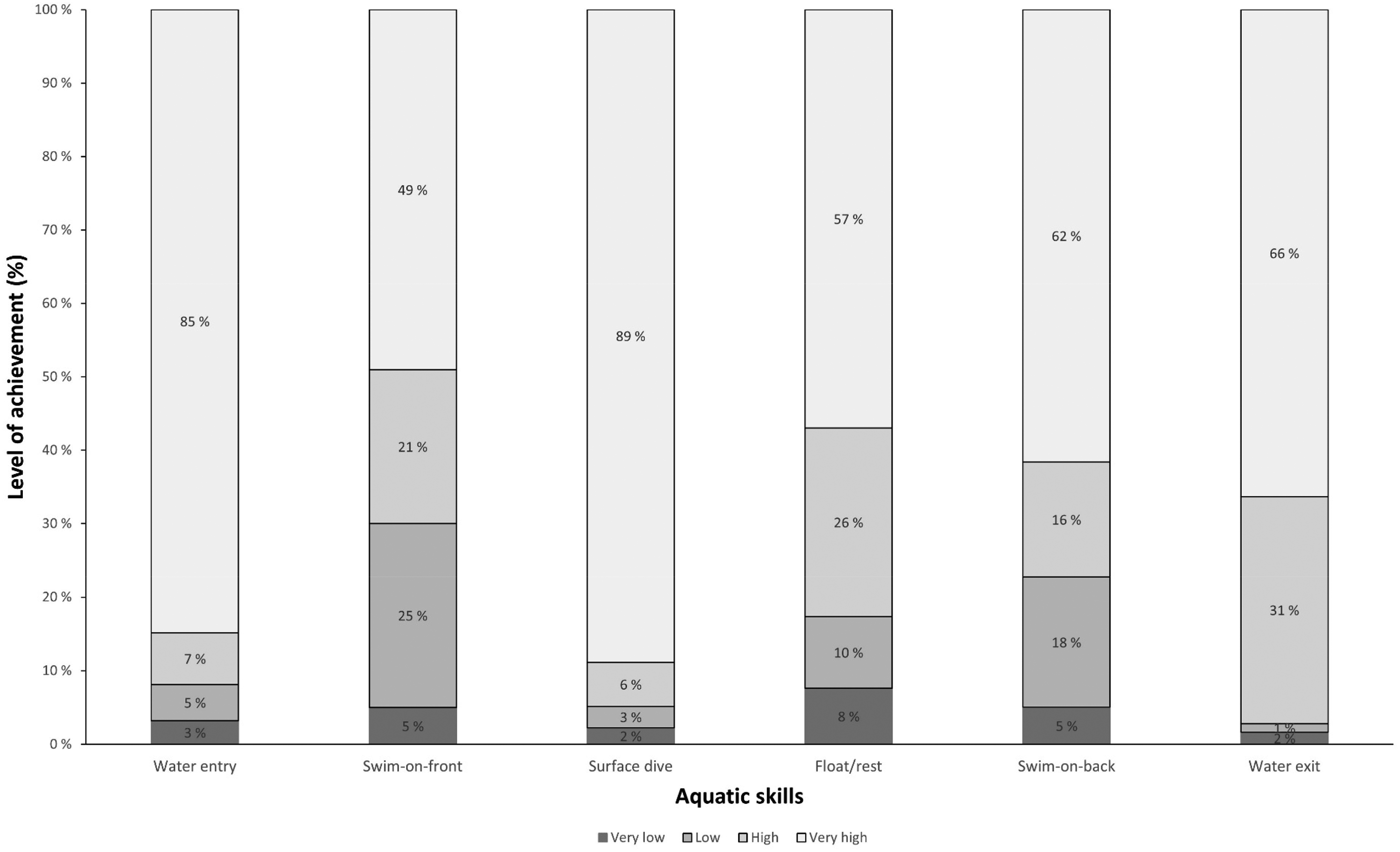
Distribution of achievement levels across the six aquatic skills assessed by the SCAS.
Figure 2 illustrates the distribution of children meeting the swimming competence criteria specified by the Norwegian and Nordic standards in the overall dataset and across various municipalities. Within the total sample, 62.5% of the children were classified as swimming competent, according to the Norwegian standard, with percentages varying from 61.1% to 68.7% among the different municipalities. Furthermore, 67% of the children met the Nordic standard for swimming competence, with achievement levels ranging from 66% to 72% among the participating municipalities. The findings indicate that a concentration solely on swimming on both front and back, in pursuit of swimming proficiency based on the Nordic standard, correlates with a small rise (4.5%) in the overall count of individuals exceeding the specified criteria and achieving the status of proficient swimmers. No significant differences between the Norwegian and Nordic swimming competence standards were observed for the total sample or within the different municipalities.
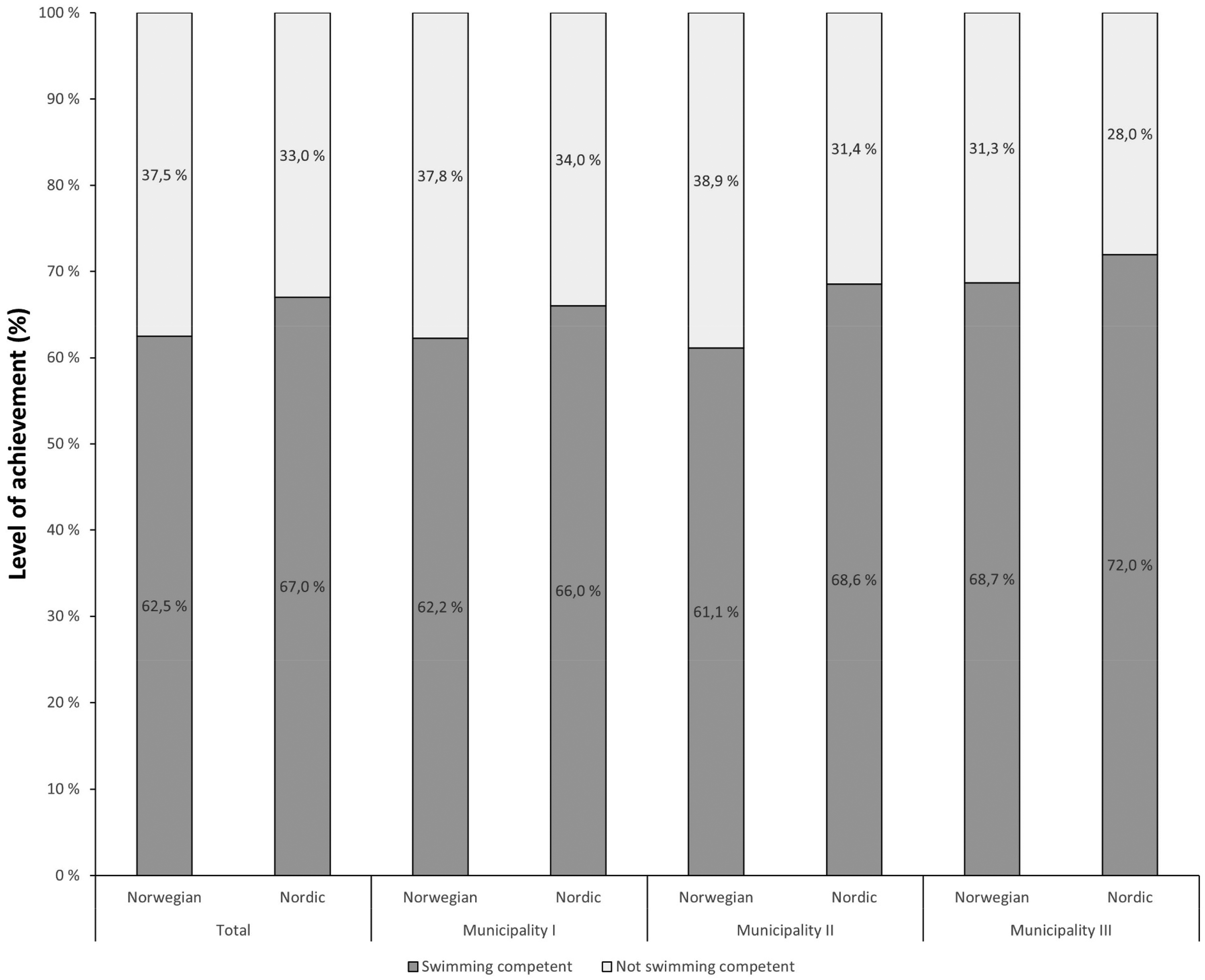
Swimming competence achievement levels across the overall sample and among municipalities adhering to Norwegian and Nordic standards.
A chi-square test of independence was performed to examine the association between swimming competence and the six aquatic skills test items. The relation between all variables was significant: water entry χ2 (3, n = 2421) = 432.67, p < 0.001, swim-on-front χ2 (3, n = 2421) = 1754.35, p < 0.001, surface dive χ2 (3, n = 2421) = 259.32, p < 0.001, float/rest χ2 (3, n = 2421) = 259.32, p < 0.001, swim-on-back χ2 (3, n = 2421) = 1272.22, p < 0.001, and water exit χ2 (3, n = 2421) = 167.41, p < 0.001. Cramer's V estimated the strength of the relationship in the chi-square test of independence, indicating a very strong association between swimming competence and swimming on the front (0.851), a strong association for swimming on the back (0.725) and floating/resting (0.617), a relatively strong association for water entry (0.423), and a moderate association for surface diving (0.327) and exiting the water (0.263). Notably, all of these associations were statistically significant (p < 0.001).
Discussion
This article examines swimming competence in children aged nine to 10 years, aiming to conduct an in-depth exploration of swimming proficiency among fourth-grade students in Norwegian primary schools. This investigation aligns with the curriculum's competence objectives in PE and adheres to the national standard in Norway.
The main findings showed that 1513 (62.5%) of the 2421 children in this study were classified as swimming competent, according to the Norwegian standards, by showing their practical in-water capability to adapt to six consecutive aquatic tasks in an indoor swimming pool. This finding represents a notable difference compared to earlier research by Mordal Moen et al. (2018), who reported a lower incidence (40.5%) of the perceived capability of children to perform specific aquatic skills coherently, as stated in the Norwegian PE curriculum (Norwegian Directorate for Education and Training, 2020). Moreover, when Norwegian school administrators were asked to report the percentage of their students who met the swimming competency criteria after completing the fourth grade, 61% of administrators indicated that, as a minimum, 76% of the students achieved swimming competency (Bergene et al., 2022).
In this study, when the Nordic standard was applied, a pattern similar to that observed for the Norwegian standard emerged. In total, 1622 (67%) of the students were classified as swimming competently, by covering a minimum distance of 200 meters in deep water, of which at least 50 meters were completed using some form of backstroke technique. This observation also stands in contrast to the results reported by the Norwegian Swimming Federation (2021). It is worth noting that the studies reporting lower percentages of swimming competence were based on children's perceived competence, which refers to the psychological dimension that encapsulates a young person's self-concept and beliefs about their ability or potential to effectively perform a given aquatic task (D’Hondt et al., 2021; Murcia and Pérez, 2008). The disparities between the findings of previous studies by Mordal Moen et al. (2018), the Norwegian Swimming Federation (2021), and Bergene et al. (2022) on swimming competence, as opposed to this study, could be attributed to methodological differences in data collection. Within aquatic education, a range of scholars have demonstrated that different approaches can result in disparate outcomes (Costa et al., 2020; Moreno-Murcia et al., 2020; Rejman et al., 2020). The distinction between studies assessing actual in-water competence and those relying on children's self-reported perceptions of their swimming competence indicates that children may have difficulty with accurately assessing their aquatic skills (Moran et al., 2012), potentially affecting the reliability of self-reported data. Conversely, this study's results align more closely with those of a Danish study by Runge Larsen et al. (2018), which utilized comparable in-water measurements. This similarity reveals that approximately 70% of the participants demonstrated a satisfactory level of swimming competence by completing a 200-meter swim test in an indoor pool. This comparison underscores the importance of distinguishing between actual and perceived measures of swimming competence to achieve a thorough understanding of the topic.
Another factor contributing to the lower levels of swimming competence observed in previous Norwegian studies could be the geographical spread of the samples, which encompassed a spectrum of schools across different regions. Prior research has identified geographical disparities in swimming competence among fourth-grade students, revealing that children at smaller schools tend to exhibit higher levels of proficiency (Bergene et al., 2022). Conversely, this study narrowed its focus to a targeted selection of municipalities within two specific regions, employing educated and competent swimming teachers and maintaining consistent LTS programs, factors that might potentially influence the outcomes.
The aquatic skills displayed in the swimming proficiency test conducted in this study revealed that swimming on the front exhibited the most variability, closely followed by swimming on the back, and the float/rest items. Furthermore, these three test items exhibited the strongest association with swimming competence. These three items encapsulate complex movement patterns involving diverse mechanisms employed by individuals to propel their bodies through the aquatic environments, in response to the interplay between propulsive and resistive forces, or by maintaining stationary buoyancy control, that is, inter-arm and leg coordination, balance, body roll, and breathing control (Seifert et al., 2009). Moreover, the aquatic tasks’ complexity makes them more challenging to develop and learn (Fernandes, 2018), which may explain the variability aspect. The development and learning of human movements may be understood by applying Newell's constraints model of motor coordination and control, which illustrates the dynamic relationship between individual personal characteristics, task demands, and environmental conditions (Newell, 1986). According to this current study, the adaptation of aquatic skills appears to be associated with a network of constraints. Mastery of front and back swimming and floating seems to enhance a child's capacity to adapt to various environmental and task-related challenges. Mastering these skills may increase the likelihood of 10-year-old children exhibiting more effective behavioral patterns (Potdevin et al., 2019). In contrast, proficiency in surface diving, water exit, and water entry skills seems not to impact the results in comparison to the three aforementioned aquatic skills. An ongoing discourse challenges the swim-centric approach of water safety education (Button et al., 2022), with a growing acknowledgment and embracing of the holistic water competence paradigm, which has gained broader international recognition (Langendorfer et al., 2018; Stallman et al., 2008). As part of the water competence framework, the psychomotor aspect includes all aquatic skills mentioned, that is, safe entry, breath control, underwater competence, orientation, and safe exit, as well as conventional propulsive competence (Stallman et al., 2017). The all-round concept of water competence is emphasized within the context of drowning prevention, defined by Moran (2013) as the sum of all personal aquatic movements that help prevent drowning, as well as the associated water safety knowledge, attitudes, and behaviors that facilitate safety in, on, and around water. Bearing this in mind, the cumulative effect of individual aquatic locomotion enhances the capacity for drowning prevention, underscoring the significance of incorporating all aquatic skills as outlined in the Norwegian Standard. This approach has profound practical and educational implications for instructional practices within academic institutions.
One strength of this study is its capacity to discern distinctions and identify nuances in swimming competence within a relatively large sample. Variations exist in the number of lessons provided by the municipal LTS programs. Specifically, the subgroup (M1) with the most extensive hours of training (76 hours in total from grades one to four) reported a higher level of swimming competence, surpassing the overall sample by 6.2%. However, no significant differences were obtained across the three municipalities. This observation offers valuable insight into disparities in swimming proficiency at both the individual and school levels, as well as within community LTS programs. Earlier research has identified several factors that are significantly associated with the development of children's swimming competency (Duke et al., 2023), where lower socioeconomic status at both individual and school levels is associated with lower odds of swimming competence among children (Franklin et al., 2015; Lõhmus et al., 2022; Pilgaard et al., 2020). This challenging background emphasizes the need for customized strategies aimed at bridging the gap in aquatic competence among diverse at-risk groups, where educational institutions and policymakers play a vital role in providing an important platform to incorporate all children in aquatic education.
Limitations and future directions
This research provides valuable insights into children's swimming competence. Moreover, acknowledging its inherent limitations, common to most studies, is crucial when evaluating its conclusions and implications. Achieving statistical generalizability demands meticulous attention to factors such as replication, sample size, sampling method, population characteristics, context, and the validity and reliability of measurement instruments and procedures. This study addresses many of these considerations, yet questions about the external validity of the research and the representativeness of its sample for the entire population of Norwegian fourth-grade students during the 2021–2022 academic year remain. The study's participants comprise 3.9% of the national cohort, with a demographic spread across municipalities that captures gender and geographical and socioeconomic diversity. The measurement instrument employed demonstrates strong psychometric properties, and the study's methodology is replicable. Nonetheless, the non-random sampling method poses challenges to generalizing the findings with certainty to a larger population.
Future research on swimming competence should delve into individual characteristics and further investigate the relationship between socioeconomic factors and actual swimming competence. Gaining a deeper insight into this area is crucial for identifying and supporting vulnerable groups by offering targeted swimming education. This approach could enhance specific aquatic skill levels and overall swimming competence across diverse populations.
Another potential limitation stems from the diversity in approaches within the LTS programs across various municipalities, encompassing variations in instructional methods, lesson duration, and frequency. Additionally, factors such as the inclusion of extracurricular water-based activities contribute to this variability and may influence the research findings, particularly when comparing results among the three municipalities.
Future research should also explore if and how swimming competence transfers across different aquatic environments, and examine the impact of these environments on the performance of specific aquatic skills. This is particularly relevant in the Norwegian context, where the majority of drowning incidents happen in open water (Norwegian Sea Rescue Society, 2024), indicating a more unpredictable and dynamic setting that may challenge the application of aquatic skills learned in indoor swimming pools.
Conclusion
In this study, 62.5% of the children achieved swimming competence according to the Norwegian standard, outlined in Norway's PE curriculum. For the six aquatic skills defined by the Norwegian standard, proficiency in on-the-front swimming was identified as the most critical factor in achieving swimming competence. This was closely followed by on-the-back swimming and floating/resting competencies. We argue that the implications of this study are relevant for public health and water safety education. A high swimming competence achievement rate could highlight a program's effectiveness in equipping children with basic swimming skills, potentially reducing drowning risks. Emphasizing front swimming, back swimming, and floating/resting skills can guide the design of community and recreational swimming programs, ensuring that a broader population benefits from essential water safety skills. Nevertheless, it is imperative to encompass all aquatic skills in order to foster comprehensive and holistic aquatic development, in alignment with the principles of water competence and aquatic literacy. The findings of this study are also relevant to informing policy development, promoting the integration of comprehensive swimming education across various settings, enhancing public safety, and encouraging lifelong enjoyment of aquatic locomotion.
Footnotes
Acknowledgements
The authors acknowledge the valuable time provided by all the swimming instructors and PE teachers in the LTS programs who participated in the study and sincerely appreciate the outstanding collaboration. We also thank all the children, who gave it their all in the swimming pool, for their efforts.
Declaration of interest statement
The authors declared no potential conflicts of interest with respect to the research, authorship, and/or publication of this article.
Funding
The authors received no financial support for the research, authorship, and/or publication of this article.
