



Abstract
Sustained motivation for Daily Mile participation at higher physical activity intensities may contribute to the attainment of children's daily moderate-to-vigorous physical activity (MVPA) targets and long-term health benefits. However, individual variability exists in the amount of MVPA accumulated by children during the Daily Mile. The current study explored children's motivation for participating in the Daily Mile at MVPA intensity, using a theory of planned behaviour framework. Twenty-five children (mean age = 10.07 ± 0.60 years) from the Northwest of England were recruited to the study; 52% were female and 88% were White. Participants completed a questionnaire, with an open-ended response format, probing behavioural, control, and normative beliefs for participation in the Daily Mile at MVPA intensity. Template analysis was conducted independently by two researchers to identify main themes and subthemes. Findings showed that children possessed a range of behavioural, control, and normative beliefs about MVPA participation during the Daily Mile. Prominent behavioural beliefs included fitness enhancement, implications for concentration and learning, positive affective states, and pain and discomfort. Key control beliefs included weather, space and health restrictions, and distractions from peers. Finally, peers and parents were salient normative beliefs. Children possessed a range of modal beliefs in relation to MVPA participation during the Daily Mile. Implications of the findings, and methods for practitioners seeking to maximise the contribution of the Daily Mile to children's daily MVPA targets are discussed.
Introduction
The health benefits of regular physical activity (PA) among children are irrefutable (Department of Health and Social Care [DHSC], 2019). However, within England, only 46.1% of boys and 16.6% of girls aged 9 to 10 years old meet the minimum recommendations of 60 minutes of moderate-to-vigorous PA (MVPA) per day, across the week (DHSC, 2019; Price et al., 2018). Schools provide an ideal setting for PA promotion among children, given the required attendance, accessible facilities, and presence of teachers to facilitate (World Health Organisation, 2008). Schools offer a range of PA opportunities such as physical education, active travel, active lessons, clubs, and break and lunch periods. However, some opportunities such as active travel are discretionary, and have lower uptake among those most in need of MVPA promotion, including those with a higher body mass index, lower household education, and girls (Salway et al., 2019). Moreover, other mandatory opportunities such as physical education often elicit modest amounts of MVPA (Beale et al., 2021).
Recently, the Daily Mile initiative has been implemented in schools across England as a pragmatic approach to facilitate PA participation. The Daily Mile affords children the opportunity to engage in 15 minutes of PA daily, at a self-selected intensity, within the school setting (The Daily Mile, 2018). Simplicity is a central tenet of the Daily Mile; it can be undertaken in any weather, in school clothing, without specialist equipment, and is inclusive of all children (The Daily Mile, 2018). In contrast to other school-based PA opportunities, the consistent context and daily repetition of the Daily Mile potentially provides an excellent opportunity for MVPA habits to develop (Gardner et al., 2022). Although a self-selected intensity is a central tenet of the Daily Mile, children are encouraged to adopt higher PA intensities (The Daily Mile, 2018), reflective of the positive dose–response relationship between PA intensity and health benefits (DHSC, 2019).
Evidence to date suggests that the Daily Mile is effective at promoting MVPA, increasing fitness, and reducing adiposity among children (Brustio et al., 2020; Chesham et al., 2018). However, the reporting of aggregated data within the aforementioned studies masks the individual variability of children's responses to the Daily Mile (Daly-Smith et al., 2019). For instance, Chesham et al. (2018) demonstrated that while 55% of children increased their MVPA through Daily Mile participation, 45% did not. Similar variability was observed by Morris et al. (2019), with the proportion of children's time spent in MVPA during the Daily Mile ranging from 33% to 100%. This disparity in Daily Mile MVPA attainment is supported by qualitative research employing interviews (Ward and Scott, 2019) and observations (Hanckel et al., 2019). Potentially the Daily Mile could contribute to a quarter of the recommended MVPA among children, yet a significant proportion do not self-select a corresponding pace.
Moreover, while children acknowledge the value of the Daily Mile, including the enjoyment and perceived benefits it offers (Hatch et al., 2021), other research has noted a lack of sustained motivation for engagement (Hatch et al., 2021; Marchant et al., 2020), which teachers frequently attempt to negate by adopting ad-hoc strategies (Hanckel et al., 2019; Routen et al., 2021). Sustained motivation for Daily Mile participation, particularly at MVPA intensities, may be important for long-term clinical benefits (Breheny et al., 2020). Thus, the investigation of the antecedents of children's motivation for MVPA during the Daily Mile merits attention.
To investigate PA motivation among this group, it is important to adopt a theoretical approach (Rhodes et al., 2019). Theory defines and depicts the relationships between variables (U.S. Department of Health and Human Services, 2018), enabling a context for comprehending, predicting, and intervening on PA behaviour (Rhodes et al., 2019). One established theory within the PA domain is the theory of planned behaviour (TPB; Ajzen, 1985). The TPB (Figure 1) contends that PA behaviour is a function of one's intention to perform that behaviour, which in turn is determined by three factors: attitude, subjective norms, and perceived behaviour control (Ajzen, 1985). Attitude refers to an individual's positive or negative thoughts concerning performing the behaviour, and is a function of the beliefs about the consequences of the behaviour (behavioural beliefs) and evaluation of these consequences (outcome evaluations). Subjective norms concern an individual's perceived social pressure to perform the behaviour, and are a function of perceptions about the expectation of significant others regarding the behaviour (normative beliefs), and one's motivation to conform to these expectations (motivation to comply). Finally, perceived behavioural control is the extent to which a person feels able to enact the behaviour, which is comprised of factors that may facilitate or impede behaviour such as resources, skills, and opportunities (control beliefs), and the influence of that factor on behaviour (power of control factor).
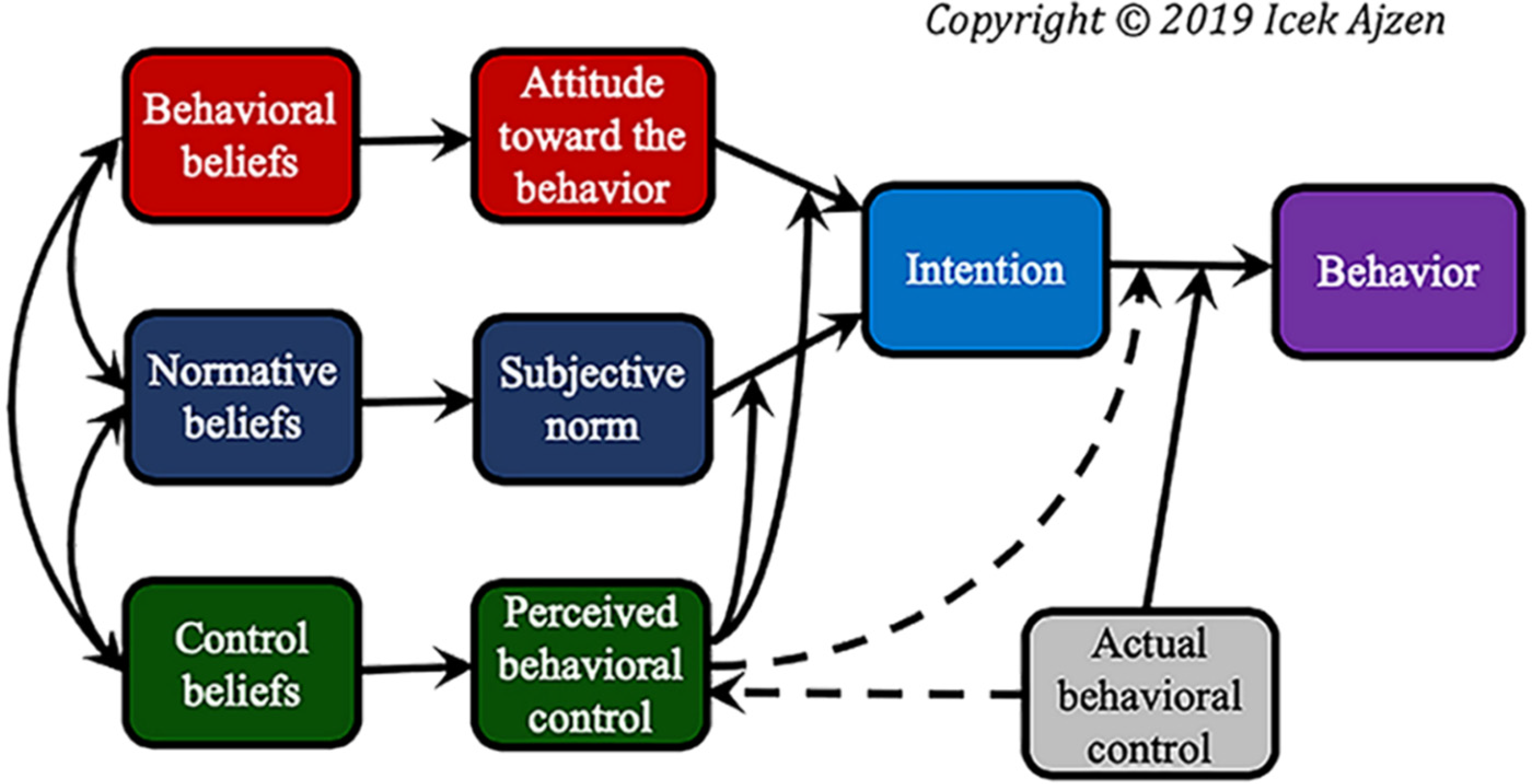
The theory of planned behaviour. From Icek Ajzen’s Theory of Planned Behaviour Diagram 2019 (https://people.umass.edu/aizen/tpb.diag.html). In the public domain.
The TPB has been used as a framework to identify children's salient behavioural, normative, and control beliefs for PA (e.g. Hagger et al., 2001), and has been shown to predict 74% to 76% of intentions and 35% to 50% of PA behaviour (Rhodes et al., 2006); however, no research to date has utilised the theory to explain motivation for the Daily Mile, or MVPA during the Daily Mile specifically. Moreover, there is a scarcity of qualitative literature exploring Daily Mile participation, particularly research utilising theory and facilitating children's perspectives. Taking cognisance of the importance of elicitation studies within TPB research (Downs and Hausenblas, 2005), the current study intended to address the aforementioned research gaps. This study, therefore, aimed to identify modal behavioural, normative, and control beliefs that underpin the three precursors (attitude, subjective norms, and perceive behavioural control) to children's motivation for the Daily Mile MVPA, using a qualitative methodology.
Methods
Ethics
Prior to data collection, ethical approval was granted by the Ethics Committee of the School of Health and Society, University of Salford and child assent and parental/guardian consent were provided.
Participants
Taking cognisance of the recommendations of Francis et al. (2004) for eliciting salient beliefs, 25 years 5 (n = 12) and 6 (n = 13) children from a primary school in a suburban area of Greater Manchester, England were recruited to the study. A minority of pupils attending the school are Black, Asian, or Minority Ethnic (15%), eligible for free school meals (10.8%), and/or have English as an additional language (7.5%). Initially, purposeful sampling was employed to identify a school that undertook the Daily Mile. Next, stratified random sampling was used to ensure adequate representation across gender and year groups. Inclusion criteria required participants to be: (a) attending the aforementioned primary school; (b) a pupil in years 5 or 6; (c) able to understand and write in English. Exclusion criteria included: (a) parental/guardian consent and child assent not being provided. Recruitment was achieved through liaising with the school to aid dissemination of parental/guardian and child information sheets to sampled children, and the return of completed consent and assent forms. All children identified from the sampling procedures agreed to take part in the research. The mean age of participants was 10.07 ± 0.60 years. Fifty-two per cent of participants were female. Eighty-eight per cent of participants were White, 8% were Asian or Asian British, and 4% were Black, African, Caribbean, or Black British.
Procedure
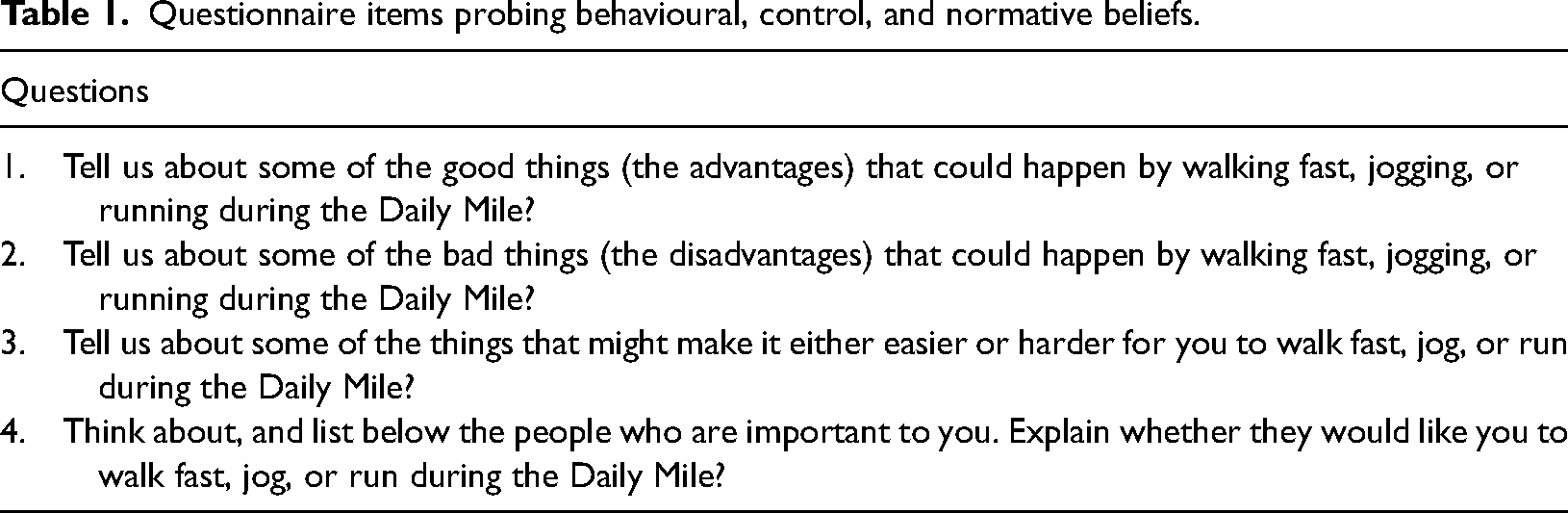
Data collection was conducted on one occasion in November 2019 and lasted approximately 45 minutes. It was undertaken in a comfortable and familiar environment within the school setting, with only the researcher (PG), a member of school support staff, and participants present. The researcher possessed 12 years of experience in qualitative methods within research and practice, holds a PhD in exercise psychology, and had no prior relationship established with participants. The session began with introductions, and an age-appropriate overview of the research and ethical considerations, including confidentiality and the right to withdraw. Next, a questionnaire to elicit salient behavioural, normative, and control beliefs was administered to participants. Questionnaires with open-ended questions and response formats have been used extensively within the health domain, and when well-designed, can elicit good quality data among children (Bell, 2007; Hennink and Kaiser, 2021). Development of the questionnaire was guided by the recommendations of Francis et al. (2004) for belief elicitation, and comparable in format to those previously used in the literature (Hagger et al., 2001). The questionnaire (Table 1) was comprised of four open-ended questions, each followed by a text box, enabling open-ended responses. Questions were worded to be simple and to avoid excessive demands on cognition and memory (Bell, 2007). Questions 1 and 2 elicited the advantages and disadvantages of participating in MVPA during the Daily Mile (behavioural beliefs). Question 3 elicited salient beliefs regarding factors that would impede or facilitate MVPA engagement in the Daily Mile (control beliefs). Question 4 probed participants regarding important referents (normative beliefs). Questions were previously pilot tested in a separate sample, and no refinements were required.
Questionnaire items probing behavioural, control, and normative beliefs.
Data analysis
Questionnaire responses were word processed and uploaded to NVivo V.12 software for subsequent qualitative data analysis. A template analysis approach was employed to derive salient beliefs. Template analysis is a codebook approach to thematic analysis (Braun and Clarke, 2019), characterised by hierarchical coding (King, 2004). The analysis includes the development of an initial coding template, typically from a subset of data, which is subsequently applied to further data, and refined (Brooks et al., 2014). The six stages proposed by Brooks et al. (2014) were employed by two researchers independently (PG and AE). AE holds a PhD in sport psychology and has over 11 years of experience in qualitative analysis. Stages 1 and 2 involved the researchers familiarising themselves with the data and undertaking an initial identification and coding of relevant segments of text. In stage 3, the researchers clustered codes to develop themes. These were subsequently organised thematically within pre-determined main themes of behavioural, control, and normative beliefs to align with the tenets of the TPB (Ajzen, 1985). This formed the basis of an initial template (stage 4) with several main themes and subthemes. Consistent with the suggestions of Brooks et al. (2014), stages 1–4 were conducted in a subsample of six transcripts. Subsequently in stage 5, this initial template was applied to further data, and modified where new data did not readily ‘fit’ the template. As such, new subthemes were inserted, and existing themes redefined, or deleted if proven redundant. This process was reiterated with further transcripts, until a clear template with a coherent structure was developed, with all relevant data attributed a code. Finally, the new template was applied to the full dataset, providing good fit; thus, the analysis was concluded.
Finally, to enhance trustworthiness in the findings, intercoder agreement (Cohen's kappa) was calculated, with scores of .7 or above indicating good agreement between the two independent researchers. To further enhance trustworthiness, the draft manuscript was subject to peer scrutiny, whereby a colleague at the University of Salford independently provided their perspective on conclusions drawn by the researchers.
Results
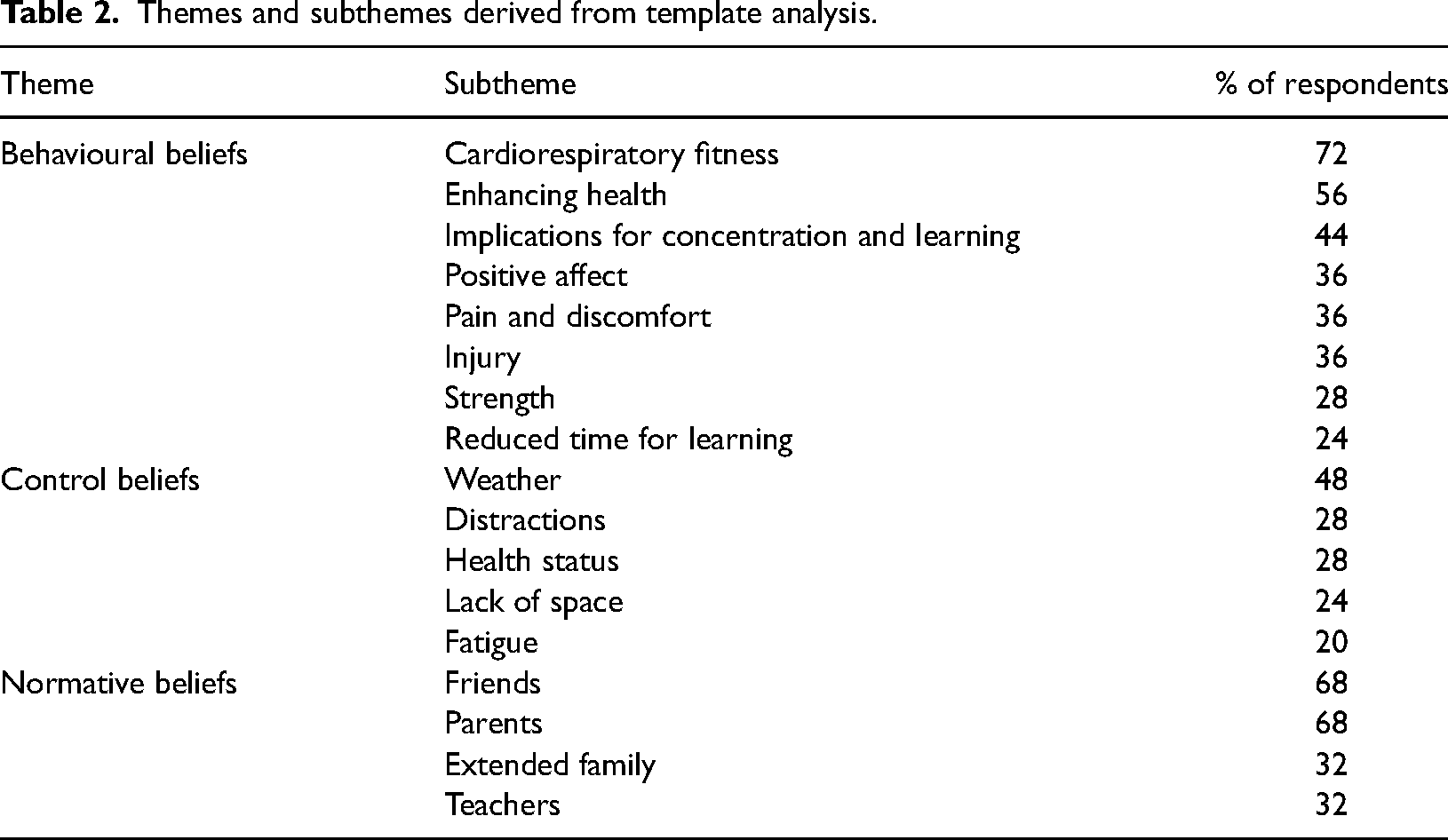
Themes and subthemes derived from template analysis.
Behavioural beliefs
Participants cited a range of behavioural beliefs pertaining to Daily Mile MVPA, consisting of both instrumental and affective components. Fourteen participants perceived the Daily Mile MVPA to enhance general health. Moreover, improvement in components of health-related fitness including cardiorespiratory fitness and strength were cited by 18 and seven participants, respectively. Comments included: One of the good things is like you get fit… running the Daily Mile can also make me stronger and I feel better. I build my stamina and speed up as well so I can get faster (Participant [P]1). Makes you healthy. It gets your heart pumping. It makes you feel fit and get very strong (P17). You can get fit and healthy. It's good for your body. You get to go outside and get time to be energised. You can go as fast as you want to, it helps with my strength for gymnastics (P19). You get the exercise, and you get your heart pumping. You can feel great while running wild and you don't have to stop no matter what (P13). It's good for your body. You get to go outside and get time to be energised (P19). When I run the Daily Mile, when I go into class, I feel calm and relaxed afterwards (P21). It helps you concentrate in class and helps you get off technology. You can see a huge difference when you do run the Daily Mile, it helps you to get to sleep at night (P6). You can concentrate in class better if you go harder in the Daily Mile… you can have a break in between lessons which will help you concentrate more. You will have freedom and not be in a hot class (P7). We can work hard in class if we do the Daily Mile. It helps us to learn and focus in class. It makes you feel good after jogging around the track (P12). We do not run for the full 15 minutes. As our health is important and we're missing out on our education. As we are in year 6, we need to get ready for our SATS (standard assessment tests) and we need to learn, but we need to get our energy out (P11). You might be getting fit, but if you are running outside you will miss your education, we also don't do it for 15 minutes sometimes we do it for less time. If we are missing our education by running, we will miss extra training for tests as the SATS are coming up for my class (P1). Because we are training for SATS, so we will miss learning time if we are out running in the Daily Mile. I think the 15 minutes should be less maybe 10 minutes (P6). You can't stop to catch your breath, and you can get stitches and get tired and your legs hurt (P13). When I am made to run in the Daily Mile, I get heart burn and feel like I can’t breathe properly. My legs sometimes ache in the Daily Mile (P22). The bad things, if you're really fast you have to watch out or you might fall over because you're sprinting (P15). Your shoelaces can get undone, and you could trip over. Your teacher keeps on saying ‘come on hurry up’. You might break a leg and you can't do it (P21).
Control beliefs
Participants cited a range of control beliefs, predominantly external control factors, that influenced Daily Mile MVPA engagement. This included the perceived impact of poor weather conditions on their capacity to engage in MVPA, which was cited by 12 participants. The following quotations exemplified this viewpoint: If it has rained, it will be wet on the playground, and muddy and slippy on the field and track (P1). The rain and mud might get in the way of running…something can get in your eye when it's windy, and getting injured and snow can stop us (P21). Also, my friends sometimes are not supportive as they talk and stop me from concentrating on the Daily Mile (P1). People that don’t want me to go fast, like my friends chatting (P22). Other people get in my way and stops me from going fast during the Daily Mile (P25). Other people might get in the way. Because when you're running you might bump into them, and they might push you and you might fall (P13). Some of the things that make it in the way of doing the Daily Mile are having an injury, having an ache … hypermobility, asthma, and illnesses (P19). If you are injured, or have a broken leg, or you have really badly hurt yourself (P4). Things such as getting out of breath (P8). One of the things that stops me is when I get out of breath (P17).
Normative beliefs
A range of injunctive and descriptive normative beliefs were cited by participants. Friends were seen both as descriptive and injunctive normative influences upon Daily Mile MVPA participation by 17 participants. Most participants reported friends as a positive influence, as reflected in the following examples: Shaun loves me doing the Daily Mile because he loves to run. Jacob loves me doing the Daily Mile because he wants to get healthy. Nathan likes me going fast in the Daily Mile also (P20). My friend… he likes me running the Daily Mile and my friend Paul as well because they want me to be healthy (P14). It's funny, friends, some of them do like me doing the Daily Mile faster and some don't (P13). Some of my friends like me doing it, but others do not (P12).
Parents were perceived as an injunctive normative influence among 17 participants. Participants perceived their parents to possess positive outcome expectancies regarding Daily Mile MVPA participation, including improved sleep, concentration, and aerobic fitness. This was exemplified by the following excerpts: My mum likes me running the Daily Mile fast because it helps me sleep at night. My dad likes it because it helps me concentrate in my learning at school (P9). My mum because I have asthma and she wants me to get fit. My dad, yes, because he likes to go jogging with me and if I do the Daily Mile, I can get fitter. My sister yes because she likes the run around with me (P7). …and my cousins they like it because it's fun and it's like a race… (P3). My great nan because she loves fitness and thinks it will help me (P19). My important people are my teachers. Yes, they like me jogging the Daily Mile because it helps my confidence (P11). …and teachers. They tell me to do the Daily Mile faster because it's building my strength up and I get really calm (P21).
Discussion
To determine the underpinnings of people's attitudes, perceived behaviour control, and subjective norms, belief elicitation is essential (Ajzen, 1985). The current study provides a novel contribution to the literature by exploring children's modal behavioural, control, and normative beliefs towards Daily Mile MVPA participation. Moreover, the research adds to the scant qualitative literature exploring Daily Mile participation, strengthened by its use of theory (Hagger et al., 2020) and facilitation of children's perspectives (Noonan et al., 2016).
Positive behavioural beliefs (Bélanger-Gravel and Godin, 2010) and attitudes (Wang and Wang, 2015) are important precursors for children's MVPA intentions. Within the current study, several salient positive behavioural beliefs for Daily Mile MVPA participation were elicited, including the impact on components of fitness, health, affect, and concentration and learning. These findings are consistent with the previous qualitative literature detailing teacher and pupil perspectives of the Daily Mile in general (Booth et al., 2020; Chalkley et al., 2020; Hanckel et al., 2019; Hatch et al., 2021; Ward and Scott, 2019).
Prominent behaviour beliefs noted by participants included cardiorespiratory fitness, strength, and health enhancement, which are unsurprising given the irrefutable causal relationship between MVPA and the aforementioned outcomes (DHSC, 2019). Recent experimental evidence has questioned the efficacy of the Daily Mile for improving cardiorespiratory fitness (Breheny et al., 2020). However, within this study, the Daily Mile dose was not carefully prescribed, and sessions were implemented at the teachers’ discretion. Thus, the lower fidelity of Daily Mile implementation, coupled with possible measurement error of fitness outcomes, render the findings of Breheny et al. (2020) susceptible to type 3 error (Dobson and Cook, 1980). Indeed, qualitative research (Malden and Doi, 2019; Marchant et al., 2020) highlights that schools may displace time spent undertaking physical education when implementing the Daily Mile, thus facilitating compensatory PA behaviours (Gomersall et al., 2012). In contrast, when the Daily Mile is carefully prescribed, with no displacement of other school-based PA, a dose–response effect on cardiorespiratory fitness is observed (Brustio et al., 2020), with optimal outcomes demonstrated at a minimum threshold of thrice weekly (Brustio et al., 2020).
Several participants indicated that Daily Mile MVPA participation invoked affective states including happiness, tranquillity, and refreshment. The positive association between MVPA and positive affective states among children has been previously noted (Wen et al., 2018). Although positive affective states may be diminished when nearing ventilatory threshold during PA, a rebound is observed post exercise (Ekkekakis, 2003). Children within the current study believed these positive affective states peri and post exercise contributed to enhanced cognition and academic performance. Acute responses in cognition among children have been observed in response to MVPA (Drollette et al., 2014) and the Daily Mile specifically (Booth et al., 2020), although evidence of chronic effects is conflicting (Booth et al., 2022; Breheny et al., 2020; Dring et al., 2022). The current findings lend support to the proposed mediating role of positive affective states in the relationship between MVPA and academic performance (Visier-Alfonso et al., 2021).
Several negative behavioural beliefs of Daily Mile MVPA participation were noted by participants, including perceived pain and discomfort, injury risk, and reduced time for learning, findings consistent with past qualitative research on Daily Mile implementation (Chalkley et al., 2020; Malden and Doi, 2019). Recent evidence highlights an increased risk of pain associated with higher PA intensities (de Aguiar Greca et al., 2021); nonetheless, the benefits of children's MVPA participation greatly outweigh the associated risks (DHSC, 2019), and when monitored in a school environment, injury risk is minimal (Nauta et al., 2015). Moreover, where progressive overload is adhered to, injury risk, and indeed perceptions of pain and discomfort, may be reduced (Powell et al., 2011).
Perceived behavioural control and its precursor, control beliefs, have consistently emerged as the strongest predictor of children's MVPA intention and behaviour (Bélanger-Gravel and Godin, 2010; Foley et al., 2008; Wang and Wang, 2015). Elicited control beliefs included the weather, lack of space, distraction from friends, health status, and fatigue. Participants noted poor weather often rendered the playground unsuitable for PA at higher intensities. The impact of weather conditions on children's objectively measured MVPA (Kharlova et al., 2020), and intention to perform PA within school (Santina et al., 2017) has previously been noted. Within the Daily Mile context specifically, qualitative research has highlighted the impact of weather on children's safety (Hanckel et al., 2019; Malden and Doi, 2019) and motivation (Hatch et al., 2021; Marchant et al., 2020), often exacerbated by inappropriate clothing and footwear (Hanckel et al., 2019; Malden and Doi, 2019), and can result in a quarter of sessions being cancelled (Hanckel et al., 2019). A lack of space to engage in higher PA intensities was also noted by participants of the current study. Space constraints are known to negatively predict children's intention to perform school-based PA (Santina et al., 2017), and prevent adequate implementation of the Daily Mile (Hanckel et al., 2019; Routen et al., 2021), and specifically higher PA intensities (Ward and Scott, 2019). Thus, providing pupils with a safe, uncongested space (outdoor or indoor) to perform the Daily Mile in all weathers appears fundamental to engagement at higher intensities. Interestingly, although research suggests that the opportunity to socialise is a perceived benefit of the Daily Mile (Hatch et al., 2021; Ward and Scott, 2019), several participants cited this as a control belief inhibiting their MVPA during the Daily Mile, a finding consistent with previous Daily Mile research (Hanckel et al., 2019). However, despite these control factors, the Daily Mile has the potential to reduce barriers to MVPA. For instance, competing priorities including other interests and homework have previously been noted as salient control beliefs to leisure-time MVPA in the TPB literature (Bélanger-Gravel and Godin, 2010). Moreover, the Daily Mile may increase MVPA opportunities among demographic groups who experience heightened barriers to leisure-time participation (Hanckel et al., 2019). Notably, it is encouraging that predominantly external, not internal control factors (such as self-efficacy), a key determinant of MVPA intention among children (Bélanger-Gravel and Godin, 2010), were identified within the findings of the current study. Thus, if the aforementioned external control factors are mitigated, this should theoretically increase intention and MVPA during the Daily Mile (Kidwell and Jewell, 2003).
Several modal normative beliefs were identified for participant Daily Mile MVPA, including friends, parents, extended family, and teachers. Although subjective norms have consistently been shown to be a non-significant or weak determinant of general MVPA intention in past quantitative research (Bélanger-Gravel and Godin, 2010; Santina et al., 2017; Wang and Wang, 2015), other research specifically in the context of the Daily Mile has highlighted peers and teachers as important referents for modelling behaviour and increasing motivation (Chalkley et al., 2020; Marchant et al., 2020). Despite parents emerging as a key salient belief, other research suggests that variability exists in parental attitudes towards the Daily Mile, underpinned by concerns for reduced learning time (Marchant et al., 2020).
Strengths and limitations
Several limitations to the current study warrant consideration. Firstly, despite purposeful and subsequent stratified random sampling being employed to ensure representativeness within the school population, readers should judge transferability of the findings to other settings, and their dependability (Stahl and King, 2020). Most notably, considering the sample characteristics of the present study, it is important to recognise that the findings may not apply to children who are non-English speaking or of a non-White ethnic group. Within England, approximately 10% of primary school pupils have not attained competency or fluency in English language (Department for Education, 2020). Thus, future studies could enhance inclusion and representativeness by including these children within the sampling frame and offering study materials in their respective native language.
Credibility may be undermined by the absence of member reflections, prolonged engagement, and data triangulation via observations (Shenton, 2004; Smith and McGannon, 2018), which may enhance rigour. Regarding temporal validity, given data was collected during the autumn term, it is unclear as to whether the findings can be generalised to other seasons. Moreover, the researchers approached the research from a TPB perspective, based on their own interests and perspectives. The utilisation of a priori main themes based on TPB constructs for the qualitative analysis may have limited theme development. A final limitation pertains to the description of MVPA provided within the elicitation study questionnaire (walking fast, jogging, or running). Although brisk walking is known to be of moderate intensity when considering absolute intensity (DHSC, 2019), it does not consider individual variability in relative intensity. Despite these limitations, the current study also possesses several strengths given it is the first to explore motivation for Daily Mile from a theoretical viewpoint, the focus on MVPA specifically, and the facilitation of children's perspectives. While scepticism regarding the application of intercoder agreement exists, with concerns raised about power imbalances among coders, challenges in defining units of text, and the impact of coder backgrounds (Smith and McGannon, 2018), its inclusion improved coding standards, fostered reflexivity, and encouraged dialogue within the research team. Moreover, it ensured that the coding framework extended beyond the perspective of a single researcher (O’Connor and Joffe, 2020).
Implications for research, practice, and policy
The results of the present study may furnish researchers, practitioners, and policymakers with an understanding of salient beliefs in relation to Daily Mile MVPA. For instance, teachers wishing to utilise the Daily Mile to maximise daily MVPA, consolidating and heightening knowledge of the benefits of participating at this intensity for health, fitness, affect, and concentration and learning, may improve behavioural beliefs and thus attitudes towards this behaviour. This could be achieved by employing a variety of behaviour change techniques (BCTs) from the BCT taxonomy (Michie et al., 2013), for instance, information about health, social, or emotional consequences (BCTs 5.1, 5.3, and 5.6) of participating at this intensity (Senkowski et al., 2019). Schools wishing to maximise MVPA during the Daily Mile should also take cognisance of, and mitigate against, salient control beliefs. For instance, using BCTs of problem solving (BCT 1.2) or restructuring the physical environment (BCT 12.1) to diminish the impact of weather and physical space barriers (Senkowski et al., 2019). Regarding normative beliefs, teachers may wish to utilise the BCT of information about others’ approval (BCT 6.3) to heighten injunctive norms, and social comparison (BCT 6.2) to improve descriptive norms. These BCTs could be employed through a range of modalities including written information or discussion. However, given that children's attitudes moderate the relationship between perceived behavioural control and intention, it may be pertinent to consider temporality, initially focusing on BCTs promoting positive behavioural beliefs, before subsequently targeting control and normative beliefs (Gourlan et al., 2018).
Future directions
The findings of the current research identified modal behavioural, control, and normative beliefs in relation to Daily Mile MVPA. This could inform the development of a questionnaire to test the TPB with respect to Daily Mile MVPA. Specifically, this could determine which beliefs significantly underpin attitudes, subjective norms, and perceived behavioural control, and the relationship between these constructs and intention and Daily Mile MVPA behaviour. Future interventions targeting these beliefs could be implemented and their impact on Daily Mile MVPA, or indeed leisure-time MVPA assessed, with the possible trans-contextual impact of the Daily Mile previously being noted in qualitative research (Chalkley et al., 2020; Marchant et al., 2020).
Conclusion
The current study identified children's salient beliefs with regard to participating in MVPA during the Daily Mile. This included a range of behavioural (e.g. fitness, positive affect, and implications for concentration and learning), control (e.g. space constraints and weather), and normative (e.g. friends and teachers) beliefs. Practitioners or researchers aiming to maximise the contribution of the Daily Mile to daily MVPA recommendations should take cognisance of these findings, by employing appropriate BCTs to target beliefs.
Footnotes
Acknowledgements
The authors would like to thank the editor and the anonymous reviewers for their valuable comments on this paper.
Declaration of conflicting interests
The authors declared no potential conflicts of interest with respect to the research, authorship, and/or publication of this article.
Funding
The authors received no financial support for the research, authorship, and/or publication of this article.
