



Abstract
Student voice pedagogies in physical education (PE) offer teachers a mechanism to promote meaningful experiences by actively engaging students in decision-making regarding their learning. Over one academic year, the experiences of one generalist classroom teacher's enactment of student voice pedagogies in their primary PE practice were explored within a Self-Study of Teaching and Teacher Education Practice (S-STTEP) frame. Data sources included post-lesson personal reflections, a researcher journal, and transcripts from meetings with a critical friend. Qualitative data was also collected from students (n = 19) over a shorter timeframe of six months, and took the form of student work samples, along with transcripts from focus group interviews (n = 2, with eight total participants). Findings show that the enactment of student voice pedagogies requires significant scaffolding for both the teacher and their students. The teacher needs to learn how to listen to, nurture, and act on their students’ voices, while students require assistance in developing their capacity to share their voices. Thus, the enactment of student voice pedagogies takes time, and necessitates a period of trial and error, to ensure the educator is providing authentic student voice opportunities in their practice. This study adds an additional layer to student voice research by providing a teacher's perspective of learning how to enact student voice pedagogies in PE. Furthermore, the findings add to the limited research into the use of student voice pedagogies at primary level.
Introduction
Grace: As a generalist classroom teacher, I find teaching physical education (PE) difficult. Despite having a largely positive experience of PE both as a student and a teacher, along with identifying as a ‘sporty’ individual, I often struggle to know how to teach PE effectively using engaging, inclusive pedagogies. The limitations in my approach to teaching PE were brought into focus by the continued disengagement of a small number of children; these pupils would often opt out of PE by choosing to sit out of activities or by creating excuses not to participate. My focus on teaching the content and achieving my end goals often meant that I did not consider how my pupils were experiencing PE. This realisation placed me at a loss of how best to approach PE, to ensure that it was inclusive and meaningful for all pupils. I began to consider the value of asking the children for their input and encouraging increased autonomy over their learning. However, while I wanted to facilitate opportunities for my pupils to share their voices, I was unsure how best to approach the enactment of student voice in practice.
Student voice in PE
Student voice has been described as ‘one of the most powerful tools schools have to improve learning’ (Toshalis and Nakkula, 2012: i). According to Mitra (2004), the term student voice refers to the processes in which students are actively involved in educational decision-making. Student voice empowers students to ‘speak and act…as critics and creators of educational practices’ (Cook-Sather, 2018: 17). Providing authentic opportunities for collaborative decision-making within the school setting helps to engage students in learning (Enright and O'Sullivan, 2012a; Mitra, 2004), while fostering the belief in young people that they can make an active difference to their own lives (Mitra and Serriere, 2012).
Benefits associated with the use of student voice pedagogies in PE practice have been reported in several studies (e.g. Enright and O'Sullivan, 2010; Iannucci and Parker, 2022a; Walseth et al., 2018). For example, student involvement in the curriculum-making process has been shown not only to enhance engagement, but also to help promote meaningfulness and counteract feelings of disaffection for students within PE (Enright and O'Sullivan, 2010; Howley and O'Sullivan, 2021). Even the use of simple choices within lessons (such as choice regarding activity selection, the order in which tasks are completed, and equipment used) can positively impact student engagement and perceived meaningfulness (Enright and O'Sullivan, 2010). Student voice can be seen as a mechanism to inform students’ educational experiences by affording students the autonomy and agency to directly influence and take responsibility for their own learning (Iannucci and Parker, 2022b).
However, educators must be cognisant of student voice pitfalls, which may lead to inauthentic, tokenistic practices (Lundy, 2007), wherein students appear to have a say but in reality have little to no influence. By eliciting students’ voices and offering choice without giving their voices due weight, student voice becomes ‘lip service’ (Iannucci and Parker, 2022b: 49) and ultimately may lead to student disillusionment and disengagement (Iannucci and Parker, 2022b; Lundy, 2007). Lundy's (2007) model of child participation in decision-making indicates the need for four elements to ensure authentic student participation in collaborative practices: space, voice, audience, and influence. A safe, inclusive space must be provided for children, in which they feel comfortable expressing their voice (i.e. space). Children must be provided with appropriate and relevant information to form their views and opinions (i.e. voice). Additionally, the voices of children must be communicated to someone with the responsibility to listen (i.e. audience), and their views must be considered and acted upon where appropriate (i.e. influence) (Lundy, 2007). Thus, student voice practices necessitate feedback and consultation with students, requiring that ‘their voice be listened to, understood and enacted in practice’ (Iannucci and Parker, 2022b: 42).
However, there is a dearth of research on the application of student voice in primary PE practice. Iannucci and Parker (2022a) highlighted how student voice has typically been used as a one-off data source, employed for the purpose of specific research projects, rather than enacted as a continuous, dynamic process of listening and responding within regular classroom practice. In addition, research and guidance available on the use of student voice pedagogies at primary level is meagre (Iannucci and Parker, 2022a) in comparison to that at post-primary (e.g. Enright and O'Sullivan, 2012b; Howley and O'Sullivan, 2021). Although a recently published article from Iannucci and Parker (2022b) provides comprehensive guidance on how student voice pedagogies can be enacted in primary PE practice, the experience of the teacher in enacting a student voice approach has not been explored. Indeed, teachers were rarely involved in the collection of student voice data within student voice research in primary PE (Iannucci and Parker, 2022a), further prompting the question of how educators experience the enactment of this innovative practice.
Meaningful PE and student voice
One pedagogical approach that positions student voice pedagogies as central in its design is Meaningful PE. In recent years, research on meaningful experiences in PE has gained momentum, offering clear descriptions of not only the why and what of meaningful experiences, but importantly, some evidence to support how teachers might do this (Beni et al., 2019b; Fletcher and Ní Chróinín, 2022; Fletcher et al., 2021). This research has built on the work of Kretchmar (2006, 2007), who described something as being meaningful when it holds personal significance or value to that person. The prioritisation of meaningful experiences in PE has the potential to increase engagement, strengthen pedagogy, and ultimately improve the quality of students’ lives by supporting a lifelong pursuit of physical activity (Kretchmar, 2000, 2006).
The Meaningful PE framework offers a means by which meaningful experiences can be fostered to help students ‘recognise the individual and collective value of their PE experiences and identify ways participation may enhance the quality of their lives’ (Beni et al., 2022: 2). In a large review of the literature, Beni et al. (2017) identified several common elements of PE experiences which children have reported as being meaningful (i.e. fun, social interaction, motor competence, personally relevant learning, challenge, and delight). Many teacher-researchers have utilised these features to guide their pedagogical approach to PE, with the hope that placing these features in focus within lessons would lead to more meaningful experiences for their students (Beni et al., 2019a, 2023; Vasily et al., 2021). The features have proven beneficial to support educators in the planning and teaching of PE lessons (Beni et al., 2023; Vasily et al., 2021) and in developing a shared language with students through which they can ‘discuss, express, and reflect upon the meaningfulness of their experiences in PE’ (Beni et al., 2022: 3). While the features can be helpful as a starting point to identify what students tend to recognise as contributing to a meaningful experience, pedagogical guidance regarding how teachers might promote these types of experiences must also be considered.
The Meaningful PE framework is aligned with two foundational pedagogical principles: democratic and reflective pedagogies (Fletcher et al., 2021). These principles offer guidance to educators on ways to personalise and individualise experiences for students, to find an approach that matches individuals’ preferences and promotes inclusivity (Fletcher and Ní Chróinín, 2022). Democratic approaches include the involvement of children in decisions about their learning and providing choices related to their participation (Dewey, 1916; Enright and O'Sullivan, 2010). Increasing an individual's agency, ownership, and control over a situation enhances their perception of meaningfulness and coherence of experience (Martela and Steger, 2016). It is within these democratic approaches that student voice pedagogies clearly reside. Reflective pedagogies have also been identified as an essential element in helping students become aware of, evaluate, and attach meaning and value to their PE experiences (Beni et al., 2017; O’Connor, 2019). Engaging in reflective practices with students allows them to realise the value of their participation in PE and see how these experiences can connect to their wider lives (Beni et al., 2017). The democratic and reflective pedagogical principles described by Fletcher and Ní Chróinín (2022) provide a foundation for educators who wish to support their students in finding their PE experiences meaningful.
This study draws inspiration from the work of Beni et al. (2019a, 2019b) in their examination of a teacher's experience in implementing a meaningful pedagogical approach. The use of self-study in Beni et al.'s (2019a, 2019b) research allowed for a deeper examination of the teacher's perspective in the implementation of an innovative practice, an approach which was also adopted in this study.
Self-study as a pedagogy for professional learning
Self-Study of Teaching and Teacher Education Practice (S-STTEP) 1 offers a means by which educators can engage in a personalised form of professional learning over an extended period (Fletcher, 2016; Ovens and Fletcher, 2014). S-STTEP has been used widely in the implementation of pedagogical innovation within the fields of PE teacher education (PETE) (Fletcher, 2016; Ní Chróinín et al., 2015; O'Sullivan, 2014) and PE teaching (Attard, 2014; Beni et al., 2019a). S-STTEP research allows educators to explore the ongoing processes of becoming, by enabling the exploration of how beliefs, identities, experiences, and relationships are interconnected (Pinnegar and Hamilton, 2009).
Several studies within the student voice literature have employed a self-study approach to explore its implementation in practice. Whitington (2015) engaged in self-study to explore the role of student voice in a university early childhood programme. The author explored their journey as a listening educator and detailed challenges in the enactment of a student voice approach at university level. These included the power relations between student and teacher, the feeling of discomfort from negative student feedback, and the need for authentic dialogue. A self-study approach also allowed van Cuylenburg (2021) to explore the intersection of science and drama in middle school, using student voice as a pedagogical foundation. Self-study allowed them to critically evaluate how they could nurture meaningful experiences for their students, while also exposing any problems in their practice. Similarly, Beni et al. (2019a) used self-study to explore their implementation of the features of meaningful experiences, in an attempt to promote meaningfulness in PE. S-STTEP has proven beneficial to many teacher-scholars in allowing them to critically evaluate their own beliefs and practices, subsequently leading to innovation in practice. As noted by Hamilton and Pinnegar (2000: 238), a significant advantage of the self-study approach is that it enables teachers to ‘change our practice without waiting for new research from others’.
While student voice has been shown to increase engagement and investment in learning and has the potential to lead to more meaningful experiences for students, further guidance on how student voice can be enacted in practice is needed. More specifically, there is a need to complete the student voice feedback loop by providing guidance on how educators can respond to voice in practice (Iannucci and Parker, 2022a). Furthermore, the voice of a generalist classroom teacher in enacting student voice pedagogies within their PE practice is absent from the literature. Thus, this research aims to explore Grace's experience as a primary classroom teacher in learning to facilitate student voice pedagogies within her primary PE practice, with the goal of providing further guidance on nurturing meaningful experiences for students.
Methodology
Research design
S-STTEP is a qualitative research methodology which requires the educator to be committed to ongoing professional development and learning, while being acutely aware of the influence of their beliefs, actions, and assumptions on their practice. Hamilton and Pinnegar (1998: 265) define self-study as ‘the study of one's self, one's actions, one's ideas, as well as the “not self”’ in which researchers consider literature, as well as their own ideas and experiences, in relation to their practice. Those engaging in S-STTEP must question their assumptions and be open to new ideas and possibilities within their practice (Casey et al., 2018). An S-STTEP frame was suitable therefore to capture and share an authentic and detailed account of a teacher's enactment of student voice pedagogies within their PE practice.
In order to study her experience of facilitating student voice pedagogies, Grace followed Samaras’s (2011) Five Foci Framework to ensure quality in S-STTEP research design. The components of Samaras’s (2011) approach are: (a) personal situated inquiry in which the researcher studies their own inquiry in their classroom, (b) critical collaborative inquiry which encourages the use of critical friends or a community to extend thinking, (c) improved learning in which teachers look to question the status quo to improve learning for themselves and others, (d) transparent research process which highlights the need to document the process in a clear and accurate manner, and (e) knowledge generation and presentation which encourages the publication and presentation of research. As part of this self-study, a ‘critical friend’ approach (Schuck and Russell, 2005) was adopted to support critical collaborative inquiry. The need for interactivity and collaboration has been continuously cited as a fundamental feature of self-study (LaBoskey, 2004; Samaras, 2011), with critical friendship presented as a common element of S-STTEP research.
Context and participants
This study was conducted in a large (n = 370 pupils), rural, mixed gender primary school in Ireland. The school drew students from diverse socio-economic settings and had DEIS 2 status. As the primary investigator in this study, Grace studied her teaching practice while teaching PE. Grace was the mainstream classroom teacher of 5th class students (aged 10–11 years) and the sole teacher of all curricular areas as outlined in the Irish Primary Curriculum (National Council for Curriculum and Assessment (NCCA), 1999). Grace holds an undergraduate degree in primary education and a Master's degree in literacy education. On commencing this project, Grace had five years’ teaching experience at primary level, both in Ireland and abroad. As part of her role as a generalist classroom teacher, Grace taught PE to her students while teaching in Ireland, while a specialist teacher was responsible for teaching her class PE during her one year teaching abroad. Students in Grace's class were also invited to be participants in this research (n = 19).
Grace conducted self-study research over a period of one academic year, during which she taught PE to her class as part of her regular teaching responsibilities. In accordance with the Irish Primary PE Curriculum (NCCA, 1999), Grace taught one 60-minute PE lesson each week (n ≈ 36) and covered the following content areas in 4–6-week blocks: athletics, games, gymnastics, dance, and outdoor and adventure activities. Grace's approach to PE was framed by the Meaningful PE approach (Fletcher et al., 2021), with particular focus given to the use of democratic and reflective pedagogies, in an attempt to facilitate student voice. Lundy's (2007) model of child participation in decision-making also informed Grace's use of student voice pedagogies, specifically considering space, voice, audience, and influence.
Ethical considerations
This research was approved by the Mary Immaculate College Research Ethics Committee, in Mary Immaculate College, Ireland (Ref: A21-039). Written consent was obtained from parents/guardians (n = 19) at the beginning of the project, and the children indicated their assent. In addition, non-consenting pupils could not be identified by their peers and continued to participate in the PE lessons as normal.
Data collection
A number of qualitative data sources were used in this study. Self-generated sources consisted of a researcher journal which Grace used to document her thoughts and insights, as well as personal reflections (n = 23, ≈ 34,000 words) which Grace completed after school on a weekly/bi-weekly basis following PE lessons. As this was her first time conducting a self-study, Grace used prompts to guide her reflections (such as ‘What tensions existed in enacting student voice as a pedagogical tool in PE today?’). These encouraged Grace to think more deeply about her approach to student voice and her experience of the implementation process.
Each month, Grace met online with her critical friend, Stephanie, an expert in the area of meaningful pedagogies in PE and someone who had also conducted a self-study on her experiences of using Meaningful PE in her practice (Beni et al., 2019a, 2019b). The purpose of these meetings was to facilitate critical and constructive discussion around Grace's personal reflections and to further challenge Grace's assumptions about student voice pedagogies and the Meaningful PE approach. Transcripts of these meetings (n = 7), along with Stephanie's written replies to Grace's reflections (n = 23), were also used as data sources.
For a period of six months (January–June), Grace's pupils kept a PE scrapbook (Enright and O'Sullivan, 2012b) in which they shared their opinions and responded to reflection prompts (such as ‘What worked well for you in PE today?’ ‘Is there anything you would change about today's lesson?’). The children's scrapbooks (n = 19, with approximately 20 entries each) were used as a tool for student voice, while also serving as a student data source. Although the scrapbook entries were not anonymous to Grace, the children were encouraged to be honest in their writing, and the entries were not used as a form of assessment.
Focus group interviews (n = 2, with eight total participants) were also conducted to garner more information about the children's experiences in PE and served as a data source. The focus group questions pertained to the children's experience of PE as a whole (such as ‘What parts of the PE lessons worked best for you?’) and to their experience of student voice pedagogies in PE (such as ‘What effect, if any, has being able to share your ideas had on your experience of PE?’). Focus group interviews were conducted, transcribed, and anonymised by a research assistant, who was unknown to the children, in order to account for teacher–student power dynamics and to further protect the identities of the children.
Data analysis
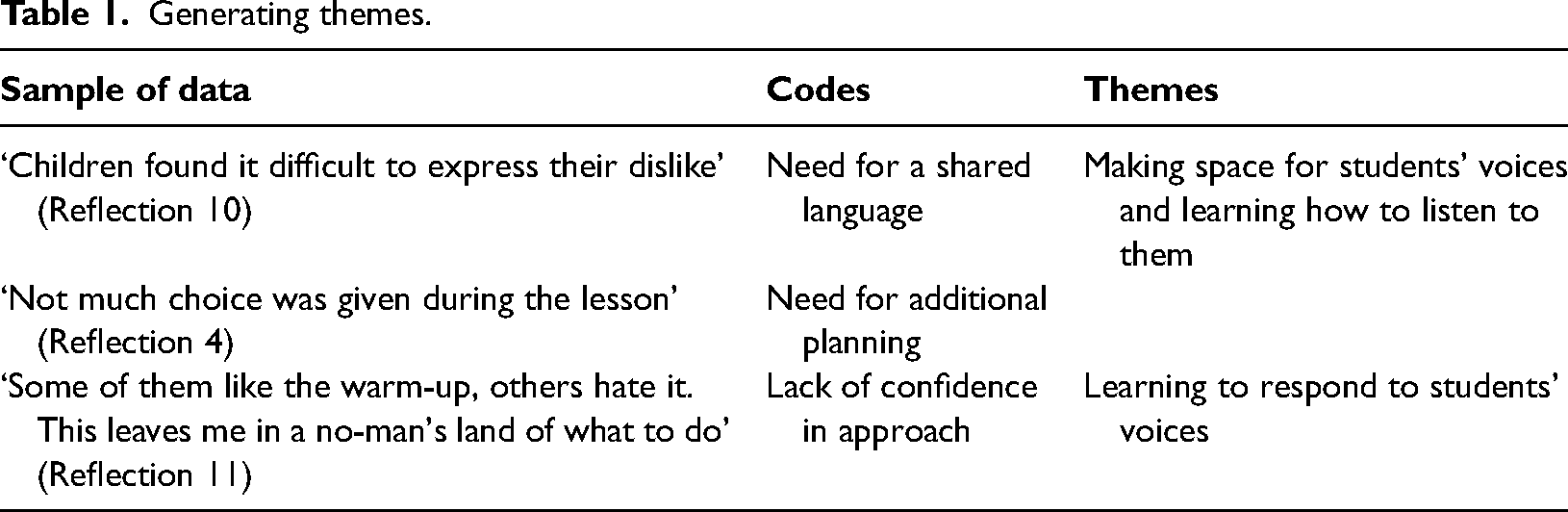
A reflexive thematic analysis of the data sources was guided by Braun and Clarke's (2021) six-phase approach: data set familiarisation, data coding, initial theme generation, theme development and review, theme refining, defining and naming, and writing up. As a self-study approach was employed in this study, the data familiarisation process was ongoing within the project, as Grace interacted with and reviewed her personal reflections regularly, both in conversation with her critical friend and as a tool for refining her practice. On beginning formal data analysis, Grace read and reread all data sources (i.e. personal reflections, critical friend meeting transcripts, focus group transcripts, and students’ scrapbook entries) before beginning to assign descriptive code labels to the data. The codes were reviewed and revised, and in consultation with co-authors, codes were grouped together to construct initial themes. Table 1 illustrates how codes were grouped together to form themes.
Generating themes.
The data and tentative themes were then revised and reviewed against each other and the data set. Themes were further refined before progressing to the final step in Braun and Clarke's (2021) approach: writing up. The co-authors of this paper helped to design and conceptualise the project, supported the analysis, and contributed to the writing process. The use of multiple, rich data sources allowed for triangulation of data and increased the trustworthiness of the analysis.
Findings
The findings of this research give insight into the experience of a generalist classroom teacher in the enactment of student voice pedagogies in primary PE practice. Findings will be discussed under two themes: making space for students’ voices and learning how to listen to them, and learning to respond to students’ voices. Throughout the reporting of the results, we have chosen to forefront Grace's voice as it was her practice being written about and examined. Thus, first-person language (I/my) is employed frequently in the results section. While the children's voices have been used to support some findings, their experience of student voice pedagogies has been explored in more detail elsewhere (Cardiff et al., 2023).
Making space for students’ voices and learning how to listen to them
Guided by Lundy's (2007) model of child participation in decision-making, I began to enact student voice pedagogies in my PE practice, by focusing on two elements of the framework: space and voice. My initial goal was to plan for opportunities which would facilitate the expression of the students’ voices, while simultaneously creating an inclusive space in which my students felt comfortable in expressing their views.
Although I set myself clear objectives to support the children in sharing their views and encouraging discussion in my PE lessons, this did not result in an immediate amendment to my practice. In my early post-lesson reflections, I frequently noted how I ‘completely forgot to ask the children’ for their views and thoughts, and how my intention of nurturing student voice during the lesson often ‘slipped my mind’ as my unconscious focus was on covering content (Reflection 5). To facilitate more intentional listening, I allocated a 10-minute period of discretionary curriculum time before PE lessons, in which I would communicate the lesson objectives to the children, share a suggested plan of activities for the upcoming lesson, and elicit input from the children. Despite my best intentions, this ‘listening time’ was often skipped or inadvertently overlooked during particularly hectic school days. Furthermore, the children often remained silent during listening time, either reluctant to share or not having anything to contribute. Thus, I was forced to reconsider my attempt to compartmentalise the space aspect of Lundy's (2007) framework into a neat 10-minute period each week. To facilitate the children in sharing their voices, I realised that I needed to try harder to provide space for voice within the PE lessons.
My approach to promoting space and voice in my PE lessons was guided by the democratic and reflective pedagogical principles of the Meaningful PE approach (Fletcher et al., 2021). Guided by Meaningful PE literature (Beni et al., 2019b, 2022), I initially employed simple decision-making practices and either/or choices in PE which encouraged the students to assert their voices. The children were offered choices regarding warm-up games, group organisation, and the length and order of tasks within PE lessons (Enright and O'Sullivan, 2010). At times, my unconscious need for control as a teacher threatened to undermine the choices I had given. On one occasion, when given a choice of warm-up activities, the children selected the same games that were played on multiple occasions in previous weeks. I noted how ‘I was tempted to choose something different on their behalf because surely they must be getting sick of those games!’ (Reflection 4). However, I resisted the urge to take control over aspects of the lesson that did not require my input. On another occasion, when I unintentionally began to introduce the lesson without first consulting the children, ‘one or two kids reminded me to let them choose the warm-up’ (Reflection 14). The interest shown by the children in their increasing influence and autonomy in PE served to encourage and embolden me in employing an increasingly student-led, democratic approach to PE.
Over time, as my unconscious need to control all aspects of the PE lesson lessened, offering choice and seeking the children's input became part of my regular practice and I began to move towards more open-ended approaches (Iannucci and Parker, 2022b). The children were given additional scope to share their ideas as I prompted them to alter the rules of games, modify activities to make them more/less challenging or create their own games to practice specific skills. My role gradually became more of an ‘activity broker’ (Kretchmar, 2000) in which I provided activities that the children could modify and adapt to match their personal needs and preferences, in an attempt to foster meaningful experiences.
The use of reflective pedagogies (Fletcher and Ní Chróinín, 2022) served to assist the children in thinking about and altering PE lessons to match their preferences while supporting my goal of providing the children with space and opportunities to share their voices (Lundy, 2007). Employing a variety of approaches to reflection, such as goal setting, exit tickets, post-lesson reflections, drawings, and group discussion, allowed for individual differences in how the children shared their voices, which has been shown to be advantageous in promoting student voice and encouraging reflection (Koekoek et al., 2009). Encouraging the children to reflect informally during lessons, by pausing and inviting them to think about how they could alter or modify an activity to suit their abilities and preferences, prompted the children to take ownership of their PE experiences. I also hoped that the use of post-lesson reflective pedagogies, such as written tasks and group discussions, would encourage the children to become more aware of and attach value to their PE experience (Fletcher and Ní Chróinín, 2022).
However, despite my consistent use of a variety of reflective approaches with my students each week, the children's responses to reflective tasks often lacked depth. At a mid-way point in the year, I noted: My students’ reflections are quite shallow. Today, at the end of the lesson, as the students began to draw their favourite part of the lesson, I told them to be very specific about why they liked that part. They don’t seem to have the language to explain why they liked something or not, or they are not fully reflecting on it themselves. They are definitely getting more confident in saying what they do and do not like, but the why remains a fuzzy concept. ‘I just liked it’ – Why? – ‘I don’t know, I just did’. (Reflection 10)
The language of the features of Meaningful PE (Fletcher et al., 2021) thus proved essential in nurturing my students’ voices. While the children were familiar with the language of the features of Meaningful PE (i.e. challenge, fun, motor competence, social interaction, personally relevant learning, and delight (Beni et al., 2017)) through its use in informal discussion and its presence on a classroom noticeboard, it was not until two–three months into the study that I began to more purposefully utilise the language of the features to aid the development of the children's capacity in both reflecting and contributing to decision-making. I modelled using the language of the features when I reflected aloud on my own thoughts during/after PE lessons, and I prompted the children to expand on their reflections, using the language of the features (e.g. ‘Was the task boring because it wasn’t challenging enough/wasn’t relevant to your life?’). The children began to use the language of the features in oral and written reflective tasks. In a written reflection, one child described an activity as being ‘a bit boring and it wasn’t relevant to my life’ (Child A, Scrapbook). Another elaborated on their enjoyment of a lesson by noting how it was ‘just the right amount of challenge’ (Child R, Scrapbook), while one child stated that getting to work with ‘new people I don’t usually work with’ (Child E, Scrapbook) was a positive aspect of the lesson for them. The Meaningful PE features served as a shared language through which the students and I could begin to discuss and reflect on different aspects of PE lessons (Beni et al., 2022), while also providing the children with a tool with which they could share their voice (Lundy, 2007).
While my approach to making space for and facilitating the students’ voices was guided by the Meaningful PE framework (Fletcher et al., 2021) along with student voice research (e.g. Conner, 2021; Iannucci and Parker, 2022b), the guidance in the literature on how to respond to the children's contributions was somewhat lacking.
Learning to respond to students' voices
As the children's opportunities to share their voices increased with the gradual enactment of student voice pedagogies, so too did their engagement in the approach. As noted by Karlsen and Ohna (2021), when students observe changes in teachers’ instruction as a direct result of their feedback, this may lead to increased investment and engagement in the process as they see their voice making a difference. The children began to share their thoughts and opinions more readily, and would frequently approach me mid-lesson, suggesting new games to play. To ensure their authentic participation in the democratic opportunities I was affording them, I had to act upon and provide due influence to their requests (Lundy, 2007). Often responding to their voices and contributions was straightforward: modifications could be made to the rules of games, group organisation could be reconsidered, and equipment used in tasks could be altered. For example, during a games lesson in which the children were practising striking a ball with a racquet, a brief whole group discussion allowed the trajectory of the lesson to be altered: ‘We reflected in action and moved away from a 1 × 1 rally as the children had not yet mastered striking the tennis ball yet. One child suggested moving back to hitting it against the wall individually for more practice’ (Reflection 6). This suggestion was listened to and enacted immediately. The process of reflecting during PE lessons served to inform my teaching, allowing me to take immediate action, while also enabling the children to make sense of and take control of their experiences in PE (Beni et al., 2022; Iannucci and Parker, 2022b).
Although I made a conscious effort in my practice to enact the children's ideas and give their ideas due weight and influence (Lundy, 2007), occasionally the children's suggestions required more thought and planning. At times, I did not know how or have the capacity to enact their suggestions immediately, while also facilitating the activity taking place. I noted how sometimes ‘I wasn’t really in listening mode…so, when approached by a child with an idea, I half listened and said we would talk about it later’ (Reflection 21). At other times, when children expressed a dislike of a certain activity, I found myself floundering to modify my lesson plan on the spot. In several post-lesson reflections, I began to recognise that while I was providing opportunities and space for student voice, the appropriate audience or influence was not being afforded to the children's contributions (Lundy, 2007): I have reflected for the past few weeks on what the children do and don’t like about dance. I still don’t know if I am REALLY hearing the students. Some of them like dance, some of them hate it…This leaves me in a no-man's land of what to do. So, I think I just continued with my own plans as I saw fit, with the guise of listening to the students but not really hearing them. (Reflection 10)
Further tensions arose in the enactment of student voice pedagogies when the children's suggestions did not fit with my plan for the lesson and/or would not lead to the fulfilment of curriculum objectives. For example, in one athletics lesson in which the focus was on running technique, several children requested to play dodgeball, stating that the game would allow them to practice both running and throwing (Critical Friend Meeting 1). While I listened to their idea, it did not fit with the curriculum objectives being covered and therefore the request was disregarded. At other times, when the increasingly student-led lessons did not meet my perception of a successful lesson, I found myself questioning my approach. In an end-of-unit lesson, the children were given the responsibility to create and organise a short activity with their groups based on the specific skills covered over the previous weeks. As I watched the first group of children ‘drag a lot of equipment out of the storeroom and set up a complicated obstacle course’ I quickly realised that I needed to put parameters in place and provide additional scaffolding in terms of game planning and organisation. After the lesson, I reflected on how ‘it was difficult for me to watch on the sidelines without trying to control or change the games completely’ particularly when the instructions given by the children were deficient, the rules were overly complicated, or the game/activity involved a lot of standing around (Reflection 22). I felt as though I had lost sight of why I was enacting student voice pedagogies, realising that I had ‘just wanted to focus on including voice, and I wasn’t really thinking about why’ (Critical Friend Meeting 5). I assumed that the more decision-making power and autonomy afforded to the children, the better my lessons would become. I realised that a delicate balancing act was needed, in giving due weight and influence to the children's voices (Lundy, 2007), and knowing when to say ‘no, this is actually not going to work…it's unsafe, or it doesn’t help us move towards curricular objectives’ (Critical Friend Meeting 1). Ultimately, I wanted PE to be meaningful for all of my pupils, and I began to realise that this may not mean affording them input in all teaching decisions made all of the time.
Discussion
This paper provides insight into the experience of a generalist classroom teacher in the enactment of student voice pedagogies in primary PE. The paper responds to calls in the literature for research which closes the student voice feedback loop, by using students’ voices to inform curriculum and pedagogy, and ultimately lead to more meaningful learner experiences (Iannucci and Parker, 2022a; Mitra, 2004). The findings illustrate how children can be provided with the necessary space and information needed to share their voice, while simultaneously ensuring their voices are afforded the appropriate audience and influence in practice (Lundy, 2007). The findings also demonstrate the processes of a teacher engaging with innovative pedagogies and capture the highs and lows, the doubts and the developing competencies that accompany this journey. The paper adds to the limited number of studies within student voice literature in which the teacher themselves, rather than an external researcher, is involved in the collection of student voice (Iannucci and Parker, 2022a).
In line with student voice literature (e.g. Enright and O'Sullivan, 2012a; Howley and O'Sullivan, 2021), Grace observed an increase in engagement in PE lessons, following the introduction of student voice pedagogies in her practice. Although the children seemed reluctant to contribute to discussions at the beginning of the project, when they began to observe their voices being listened to, they were eager to share their opinions and ideas with Grace and have their voices heard. This highlights the cyclical nature of student voice practices (Iannucci and Parker, 2022b) in which a continuous process of listening, responding to, and enacting children's contributions is required to ensure authentic student voice opportunities.
The critical role of reflective pedagogies in accessing students’ authentic voices was also highlighted in the findings, further supporting literature in the area (Fletcher and Ní Chróinín, 2022; Howley and O'Sullivan, 2021). Providing frequent opportunities for the children to engage in reflection not only allowed for the adjustment of Grace's practice in line with students’ preferences, but it also served to encourage the children to reflect on and take control of their PE experiences in a way which matched their needs and preferences. The democratic and reflective principles of Meaningful PE (Fletcher and Ní Chróinín, 2022) helped in guiding Grace in her enactment of student voice pedagogies, enabling her to move beyond merely providing choice to her pupils, to see the value of collaboration and reflection in nurturing a student-led democratic approach. The students’ consistent use of the features of Meaningful PE (Beni et al., 2017) in their writing and conversations indicated the important role played by this language in allowing for deeper engagement with democratic and reflective pedagogies. The language of the features of Meaningful PE proved to be fundamental in providing a shared language through which Grace and her students could collaborate and work towards creating more meaningful experiences in PE.
The enactment of student voice pedagogies in Grace's practice was not without challenge, requiring a significant shift in her beliefs and identity. The process of seeking students’ input on pedagogical decisions was not something which originally aligned with Grace's identity as a teacher. As outlined in the findings, Grace was often overwhelmed and at a loss as to how to modify lessons to match the preferences of the children or was reluctant to release control. Grace's pupils also had limited experience of student voice pedagogies prior to engaging in this project, perhaps providing a rationale for their initial hesitancy to share their input. The power dynamics at play within the classroom may also have been responsible for the reluctance of some pupils to share, with the presence of ‘big voices’ in group discussions often meaning that a number of children's voices were heard more than others (Turner et al., 2020). The power structures which exist between the teacher and their students must also be considered. Children often say what they assume they are expected to say (Rodgers, 2018), thereby making it difficult to ascertain whether their authentic voices are being heard. The enactment of student voice pedagogies thus presents a significant learning curve for both teachers and students; it requires a shift in the teacher's beliefs and identity and an acute awareness of the power dynamics at play in classroom, while also demanding a significant investment of time and attention in cultivating children's confidence and competence in using their authentic voices (Iannucci and Parker, 2022b).
Within the literature, student involvement in decision-making tends to be categorised along a spectrum or ladder (e.g. Hart's ladder of participation (1992)), implying that the more responsibility that students have for their learning, the more beneficial the approach is overall. We argue that quantifying student autonomy using a spectrum-like approach, with the goal of full child-initiated decision-making, may not always be a tangible or appropriate goal for educators, particularly those educators who are just beginning their student voice journey. Like most generalist classroom teachers, Grace was bound by the curriculum, and this often limited the choices the children had in terms of content covered. Furthermore, Grace was enacting student voice pedagogies as an ‘everyday’ pedagogy, in a consistent effort to encourage children to shape their PE experience to suit their preferences. While offering choices and making small modifications to lessons based on children's feedback may be viewed as a modest approach to student voice, these simple actions allowed Grace to learn and develop as a student voice pedagogue, within her learner capacity and in a way that was sustainable. At times, when Grace was overly focused on implementing an increasingly student-led democratic practice, she began to lose sight of why she was using student voice pedagogies, somewhat negating the benefits of the approach. In reference to child-led research, Davis (2009: 2) suggested that ‘rather than trying to achieve a “gold standard” of complete participation, it might be more helpful for you to look at what is realistic within your own context’. We believe this sentiment can be applied to the enactment of student voice pedagogies in the PE classroom. Echoing the words of Howley and O'Sullivan (2021: 13), the enactment of student voice pedagogies is not a fixed process, rather educators must engage in ‘a fluid continuum of practice that involves trial and error’, finding an approach that works best, based on the needs and capabilities of their students, and their own confidence and competence in enacting such an approach.
This paper contributes understanding of how teachers experience learning how to enact student voice pedagogies in primary PE. Findings highlight that learning to listen and respond to children's voice demands an intentional commitment and a consistent approach. Benefits for children's experiences were instrumental in sustaining teacher engagement with learning both how to listen and how to respond to children's voices.
Footnotes
Acknowledgements
Grace was supported by a Departmental Assistantship at Mary Immaculate College, Ireland.
Declaration of conflicting interests
The authors declared no potential conflicts of interest with respect to the research, authorship, and/or publication of this article.
Funding
The authors disclosed receipt of the following financial support for the research, authorship, and/or publication of this article: This work was supported by the Irish Research Council (grant number GOIPG/2023/3312).
