




Abstract
Enjoyment in primary physical education (PE) is a key factor in increasing children's physical activity engagement in PE and leisure time. While existing PE research has largely focused on a motivational PE climate and meaningful experiences in PE, research on children's perceptions of enjoyable teaching practices (TPs) in PE is limited. Therefore, this study aimed to explore primary school children's perspectives on TPs that foster PE enjoyment. In addition, we observed to what extent these TPs were applied in daily PE practice. Four focus groups with 10- to 12-year-old children (12 boys, 12 girls) from four primary schools were formed and inductive analysis resulted in 32 child-identified TPs categorized into 10 dimensions. Thirty-one PE lessons taught by 19 different PE teachers (11 generalists, 8 PE specialists) were recorded and coded using the child-identified TPs. Teachers regularly performed a substantial number of these TPs during their PE lessons. However, TPs such as the use of cooperative learning, instructional methods to promote children's (social) learning process, an emphasis on children's individual improvements, and consciously grouping were rarely observed. Moreover, PE specialists showed TPs supporting exploratory learning and children's individual learning processes more frequently than generalists. In addition, PE specialists provided challenging, differentiated tasks with a creative use of equipment more often than generalists. Including children's perspectives contributes to a comprehensive understanding of PE enjoyment and TPs that can promote enjoyable PE experiences. Children's voices need to be heard continuously by PE teachers to ensure enjoyable PE experiences for all children.
Introduction
Enjoyment of physical education (PE) is associated with PE engagement (Navarro-Patón et al., 2019) and the intention to engage in physical activities outside the school context (Hagger and Chatzisarantis, 2016; Huhtiniemi et al., 2019; Ntovolis et al., 2015; Pérez-González et al., 2019). Therefore, teachers should optimally support children's PE enjoyment. Children who enjoy PE perceive it as fun, interesting, and exciting (Cairney et al., 2012; Moore et al., 2009). Creating enjoyable PE lessons is challenging, as children vary in their characteristics, perceptions of the environment, and learning requirements (Barić et al., 2014; Marron et al., 2021). A comprehensive understanding of children's PE enjoyment (what makes PE fun?) is necessary to provide primary PE teachers, both generalists and PE specialists, with practical tools to enhance children's enjoyment in PE.
Children's PE enjoyment has been studied through several theoretical lenses, for example, through motivational theories such as the achievement goal theory (AGT) and the self-determination theory (SDT), and the meaningful PE (MPE) approach. According to AGT (Ames and Archer, 1988), differences in children's achievement goal orientations lead to differences in PE-related outcomes, such as PE enjoyment and engagement (Duda and Ntoumanis, 2003). Task-oriented children focus on learning, developing their competence, and gaining mastery in PE tasks using self-referenced standards. In contrast, ego-oriented children focus on outperforming others and demonstrating and validating their competence based on normative standards. Children's goal orientations in PE are influenced by individual goal preferences and the PE class climate. Compared to an ego-oriented PE class climate, a task-oriented climate is related to more positive outcomes, such as PE enjoyment, cooperation, satisfaction, persistence, embracing challenges, and autonomous motivation (Gråstén and Anthony, 2017; Jaakkola et al., 2015; Jaitner et al., 2019; Liu et al., 2017), and high levels of physical activity engagement in PE and outside the school context (Kokkonen et al., 2019).
According to SDT (Deci and Ryan, 2000), children differ in their levels of self-determined motivation. Children with low self-determined motivation participate in PE primarily because of the anticipated consequences, such as getting a reward or avoiding punishment. In contrast, highly self-determined, autonomously motivated children actively participate in PE because of the interest and satisfaction derived from the PE activities or the personally valued importance of the PE activities. Autonomous motivation in PE is positively associated with PE enjoyment (Huhtiniemi et al., 2019; Navarro-Patón et al., 2019; Pérez-González et al., 2019; Pulido et al., 2014). A need-supportive PE climate that fosters the satisfaction of the basic psychological needs, that is, competence, autonomy, and relatedness, is essential to enhance children's autonomous motivation (Chang et al., 2016; Chen and Hypnar, 2015; Pérez-González et al., 2019; Sun et al., 2017; Van Aart et al., 2015) and PE enjoyment (Chen and Hypnar, 2015; Curran and Standage, 2017; Pérez-González et al., 2019).
PE during childhood is regarded as important in providing meaningful experiences in physical activity to children (Beni et al., 2017; Kretchmar, 2006). According to MPE, PE experiences should have personal significance for children. PE teachers should emphasize the purpose and goals of movement for an individual, give attention to the personal significance of the emotional value of the experience, and provide a sense of coherence by connecting PE to experiences outside of school (Fletcher and Ní Chróinín, 2022). Enjoyment is seen as a key element for meaningful PE experiences in addition to social interaction, challenge, motor competence, personally relevant learning, and delight. Pedagogical strategies that facilitate these elements positively contribute to children's PE enjoyment (Beni et al., 2017, 2019; Ní Chróinín et al., 2018).
Recently, an increasing number of studies have blended principles of AGT and SDT (Chen et al., 2020; Di Battista et al., 2018; Jaakkola et al., 2017; Ommundsen and Kvalø, 2007; Vansteenkiste et al., 2014; Weeldenburg et al., 2020) for several purposes. Blending the principles of AGT and SDT in combination with the principles of MPE might result in a guiding framework for teachers to facilitate children's PE enjoyment. Di Battista et al. (2018) showed that a mastery-oriented, need-supportive PE climate leads to meaningful experiences and fosters children's PE enjoyment. Although these studies usually include some theory-based practical advice for teachers on how to create a mastery-oriented, need-supportive PE climate the number of studies on concrete teaching practices (TPs) to stimulate children's PE enjoyment is limited. In addition, it is unclear whether children value the theory-based implications as being the most crucial for influencing their PE enjoyment.
Children's perspectives on enjoyable PE are highly relevant in designing meaningful PE lessons (Harvey et al., 2018; Iannucci and Parker, 2022). Therefore, this study investigated primary school children's perspectives on TPs that foster their enjoyment. Moreover, this study focuses on the extent to which PE teachers put these child-identified enjoyable TPs into practice. In the Dutch primary school context, PE lessons are provided by PE specialists, generalists (classroom teachers), or a combination of both. It is unknown whether differences exist in applying child-identified enjoyable TPs between generalists’ and specialists’ teaching of primary PE. Therefore, we additionally studied the potential differences in bringing these TPs into practice by generalists and PE specialists.
Methods
Study design
The current study was part of the SALTO study, the Dutch acronym for Stimulating an Active Lifestyle Through physical educatiOn. This is a longitudinal study examining the relationship between PE characteristics and daily physical activity and sedentary behavior patterns among primary school children. The study obtained ethical approval from the Ethical Research Committee of Fontys University of Applied Sciences (reference number FCEO 24-03 Adank).
Of the 10 primary schools participating in this study, four schools work with PE specialists, four with generalists, and two with a combination of PE specialists and generalists. We used a mixed methods study design in which two successive steps can be distinguished. The first step (S1) was identifying TPs associated with children's PE enjoyment. The second step (S2) was observing PE lessons to determine the extent to which the teachers applied these TPs.
Participants
Focus groups
The identification of the TPs (S1) was based on input from end-users, that is, primary school children, obtained from four focus group interviews. Based on convenience sampling, four of the 10 primary schools participating in the SALTO study were invited to take part in the focus groups for children, all of which accepted. Each school was requested to select a group of six Grade 7 children (aged 10–12 years) for the focus group per school. Criteria for this selection included children's willingness to participate, verbal parental consent, three boys and three girls, and a representation of children that their classroom teacher considered to have different motor skill levels. In all, four focus groups with 24 10- to 12-year-old children (12 boys, 12 girls) were created.
Observations
For S2, PE specialists (n = 8) and generalists (n = 11) at the 10 participating schools that performed PE lessons for 8- to 12-year-old children, that is, Grade 6 and Grade 8 in the Dutch primary school system, were asked for approval to record regular PE lessons. All teachers gave permission for their PE lessons to be audio- and videotaped. To record PE lessons, parental informed consent was required as well. Children without parental written informed consent did not attend the observed PE lessons or participated in these PE lessons in areas not covered by the recording system. In schools with more than two classes within the same grade, a maximum of two classes per grade were observed. This resulted in 31 observed PE lessons, of which 11 PE lessons were with generalists and 20 with PE specialists.
Instruments
Focus groups
Each focus group session was conducted during school hours in a quiet room within the school by a trained moderator and an assistant moderator. The moderators discussed the purpose of the focus groups and the interview protocol, including the interview questions and procedure agreements. During the focus group sessions, the moderator guided the focus group, and the assistant monitored the digital voice recorder and the session duration, took notes, and observed children's non-verbal language. The moderator started the focus group session with a brief introduction in which the purpose and process were explained, and each participant was asked to introduce themselves briefly.
The focus group sessions were used to gain insight into children's perspectives of teacher-related factors that are linked to PE enjoyment. To achieve this, the discussion was semi-structured using four main topics, that is, current feelings about PE lessons; the enjoyable PE lesson; PE teacher practices in enjoyable PE lessons; and room for improvement. By using a “how” question (Adler et al., 2019) first, that is, “How do you feel about your PE lessons?” children were invited to share their feelings and experiences toward PE lessons. With the questions “How would you describe PE lessons you like?” and “What characterizes the teacher behaviors in PE lessons you like?” we went into more detail about PE lessons and PE situations that children experience as being pleasant and fun, and which PE TPs play a role in this. Finally, asking for teacher advice to ensure the class becomes even more excited about PE helped to further identify and understand TPs that contribute to children's PE enjoyment and PE engagement. The moderator then summarized the key points from the discussion and gave participants the opportunity to add an issue or opinion that had not been addressed in the discussion. The average duration of the focus group sessions with children was 46 minutes (standard deviation (SD) = 2 minutes).
Observations
In S2, PE lessons were recorded and observed. These lessons were recorded from the moment teachers started the instruction until they ended the class. A GoPro camera (GoPro HERO 5) placed on a high jump standard at a height of 2.25 meters in the corner of the gym captured the entire PE environment. In addition, teachers wore a voice recorder (Olympus digital voice recorder WS-851) as a necklace to capture their voices. The observer synchronized audio recordings and video recordings of each PE lesson prior to coding.
The 32 child-identified TPs derived from S1 were observed and scored. The observer indicated to what extent each TP was observed in the recorded PE lesson using a 4-point scale ranging from 0 to 3 (0 = never observed; 1 = observed sometimes; 2 = observed often; 3 = observed all the time). An observational guide was available for the observers in which each TP and the corresponding scores were clarified. For example, the TP “designs learning tasks with maximal learning time” was described as ensuring optimal physical activity time for children, for example, by using brief instructions before and during physical activities and using methods to avoid waiting in activities. To ensure reliability, the three observers practiced coding of the first recorded PE lesson with an observation guide including the TPs, PE examples for each TP, and scale description for each TP. After independently coding this PE lesson, the researchers discussed their coding differences, refined the observation guide, and collaborated to produce final ratings. This method was repeated for all other observations. Observer One, Observer Two, and Observer Three independently rated the 32 TPs for each recorded PE lesson. Based on the observers’ discussions, final ratings were agreed on for all recorded PE lessons. The final ratings were used for further analysis.
Data analysis
Focus groups
All focus group sessions were transcribed verbatim and analyzed using ATLAS.ti, version 8 (Scientific Software Development GmbH, Berlin, Germany). A general inductive approach (Thomas, 2006) was used to analyze the transcripts. Steps taken in the thematic analysis were based on phases described in Nowell et al. (2017). After reading the transcript of the first focus group session several times, two independent researchers assigned initial codes to relevant words and phrases. These codes were compared and discussed, leading to an initial code list. This code list was used by the first researcher to analyze the other focus group session transcripts, adding new codes to the list as needed. Next, the two researchers who were familiar with the four transcripts, the fieldnotes, and the code list, categorized the codes into several separate themes together, that is, 10 overarching dimensions. In the case of doubt, a third researcher assisted. Finally, codes saying the same thing in different words were merged into one code. The focus groups were conducted in Dutch. Quotes from the transcripts used to illustrate our findings were translated into English by the first author. The second author checked the translations to ensure children's voices are correctly conveyed in English.
Observations
Observation data were analyzed using SPSS Statistics version 27 (IBM Corp., Armonk, NY, USA). The mean observation scores per TP were used to distinguish TPs that were rarely seen in practice (mean score < 1.5) and TPs that were observed regularly (mean score ≥1.5). As the mean scores per TP were not normally distributed and the research group was relatively small, the Mann–Whitney test with Bonferroni correction for multiple comparisons (Noble, 2009) was used to compare the mean scores between PE specialists and generalists. The statistical significance was set at p < 0.05. The weighted Cohen's kappa was calculated to test inter-rater reliability. The inter-rater reliability between Observer One and Observer Two was 0.68 and between Observer One and Observer Three was 0.72.
Results
Child-identified TPs clustered into dimensions
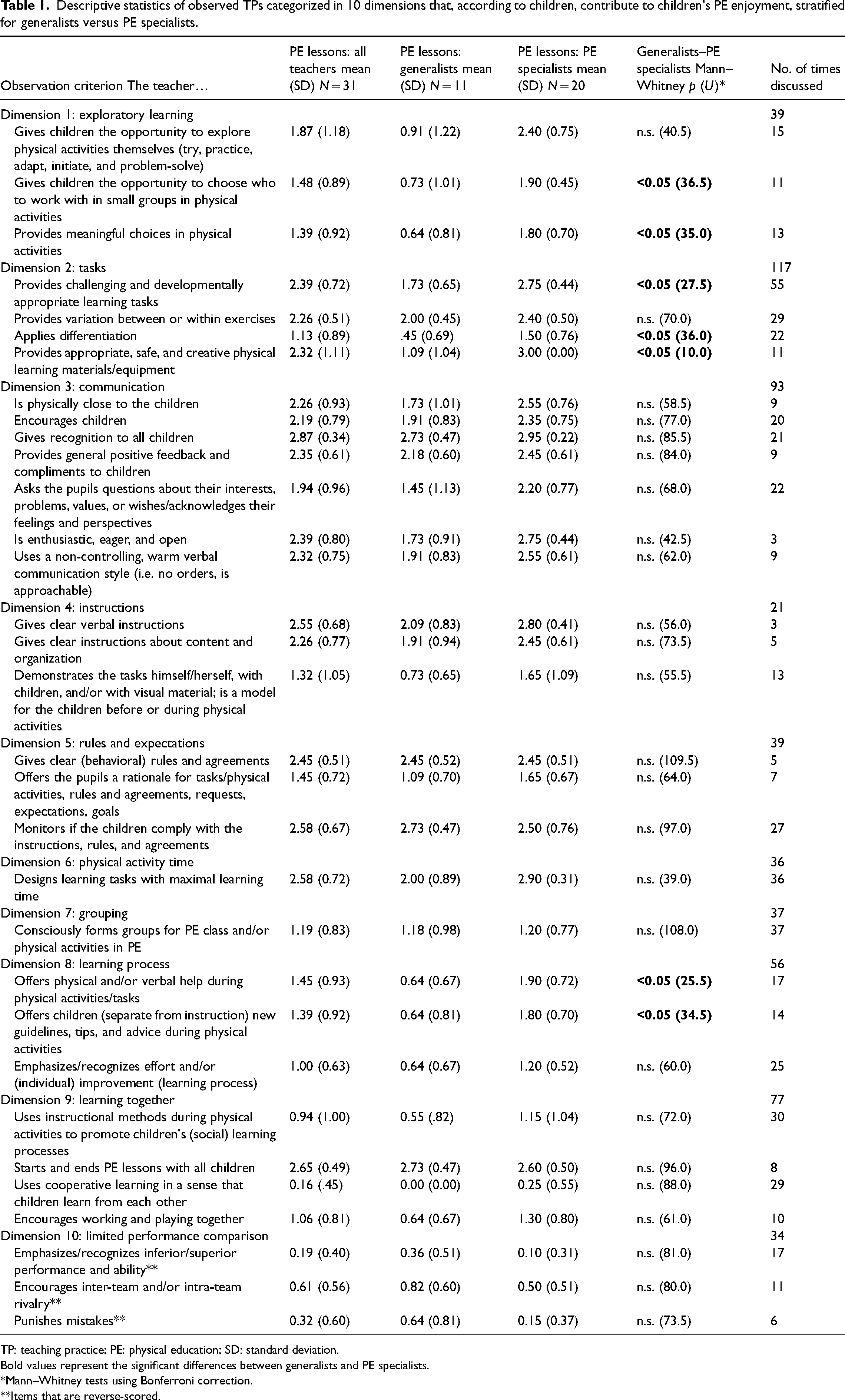
Children mentioned 32 unique TPs that positively contribute to their perception of PE enjoyment. These 32 child-identified TPs were clustered into 10 dimensions of PE enjoyment. Descriptive statistics for all dimensions and related TPs are shown in Table 1.
Descriptive statistics of observed TPs categorized in 10 dimensions that, according to children, contribute to children's PE enjoyment, stratified for generalists versus PE specialists.
TP: teaching practice; PE: physical education; SD: standard deviation.
Bold values represent the significant differences between generalists and PE specialists.
*Mann–Whitney tests using Bonferroni correction.
**Items that are reverse-scored.
Exploratory learning
Children reported that free choices between and within tasks and opportunities to explore physical activities contribute to children's PE enjoyment. Free choice is defined as an act or activity without direct instructions or without interference of the teacher. For example: When we play tag, then we are sometimes allowed to choose … for example add other rules to play with. If only it has to do with playing tag. I like that [FG1, child 6].
I like it when you are allowed to come up with physical activities yourself [FG4, child 4].
Children indicated that a sense of independence can not only be created by teachers, for example, by letting children initiate, adjust, and design physical activities, but also by letting children, when divided into small groups, choose who to work with and make teams themselves. For example: I would like it if we could also make groups ourselves, because then … then you have more fun [FG3, child 3].
Tasks
Variation and innovation emerged as influential task characteristics related to PE enjoyment. According to children in the focus groups, a variety of new and familiar physical activities and diverse situations with the same task difficulty contribute to children's enjoyment, whereas tasks that are offered repeatedly impact PE enjoyment negatively. For example: I get excited when we play with new equipment or when we learn to use things [materials] in different ways in a variety of physical activities [FG3, child 2].
I like it [PE], but if we play a game too many times, I don’t like it so much anymore [FG1, child 5].
Children acknowledged their differences in preferences, interests, skills, and ability levels. They emphasized their need for challenges and success experiences to enjoy PE. Children valued differentiated tasks and tasks that can easily be modified to every child's level. For example: I think it's important that everyone can join in the fun. And that, for example, children who are very good and the average children who are good but … just not as good as the others, that the teacher can help that group and … that the teacher gives the children who are a little better for example a more difficult task [FG4, child 5].
Communication
Children identified the interaction style between teacher and children as a factor related to their PE enjoyment. Children are stimulated to engage in tasks by teachers’ personal encouragement and praise, and proximity. Children reported that they value teachers who are capable of showing concern, enthusiasm, interest, and warmth. These TPs were mentioned as being important for building strong and positive teacher–child relationships that impact children's enjoyment. For example: When you receive a compliment [from the teacher] … such as “good interception or good catch,” you also get more motivation and then you also think more [about the game] … like … what would I do to do it right? [FG2, child 2].
Sometimes it is nice if you are a little sad or insecure and then … and then you do something good and [teacher's name] gives you a compliment. Because then it does something good [good feeling] [FG1, child 4].
Children highlighted that teachers should not only ask about children's feelings, preferences, ideas, and interests, but also listen actively, acknowledge their perspectives, and respond to their PE needs. For example: I asked the teacher to hang the rings lower, he only said “no, they hang well” … The teacher wouldn’t listen to me to lower them … I find that annoying [FG3, child 3].
The teachers always say to us: “If you have ideas for the PE lessons, say so,” but they never do anything with our ideas [FG3, child 3].
Instructions
The focus group sessions revealed that children want the teacher to provide understandable verbal and visual instructions. Children indicated that content and organizational information (who, what, where, when, why, and how) are necessary for them to start these activities with confidence and pleasure. For example: Sometimes I don’t understand every task, and then it becomes … I find it more boring [FG2, child 5].
In addition to clear verbal instructions, children reported that they also like to see a demonstration of the task by the teacher with or without children. For example: They [PE teachers] help us step by step … They show us how for example to put your hands, how to jump first … and what the final jump should look like [FG3, child 3].
Rules and expectations
Children noted that they perceive the PE environment as pleasant and positive if peers actively participate and behave as expected. Therefore, children value teachers who make clear what is expected of them and why, and what the consequences are for inappropriate behavior. For example: During the instruction there is one rule: we must be quiet. Sometimes there are a few children who keep talking through it [the instruction]. He [the PE teacher] then waits a very long time before he continues. We have to make less noise and I actually quite agree with that [FG4, child 6].
Additionally, children reported that the teacher should monitor if children keep to the rules and agreements and behave appropriately. They indicated that they want teachers to respond fairly, consistently, directly, and consequently to inappropriate behavior (e.g. arguing, interrupting, asking for negative attention, and not following directions), because this minimizes problems and contributes to enjoyable PE lessons and a positive learning climate. For example: I like PE, but I don’t like the fact that everyone is arguing sometimes, for example [about] who won, or that they are rude to each other and … everyone fights, and a lot of PE time is wasted [FG1, child 3].
Physical activity time
Children stated that physical activity during PE positively contributes to their feelings of enjoyment. Situations that are experienced as a waste of PE time were described as having a negative impact on children's PE enjoyment. Children emphasized teachers’ responsibility to ensure physical activity time, for example, by limiting waiting time, instruction time, and elimination games. For example: The teacher offers side activities, for example when you’re tagged in a game, or you have to wait in line. So we don’t have to stand still. I like that [FG2, child 4].
Grouping
Grouping strategies were mentioned as having an impact on children's feelings toward PE. Children value teachers consciously using a variety of grouping strategies. They indicated that groups could vary in size, for example, pairs, small groups or large groups, and in composition, for example, homogeneous groups based on gender or skill level or heterogeneous groups. They want teachers to group in a way that best suits the class and PE lesson objectives. For example: I like it when the teacher [groups us] … when the sporty children with the less sporty children are mixed a bit so that you have some sporty children and some less sporty children together … or for example children who are equally good are placed together in one team [FG4, child 5].
Children stressed the importance of grouping with care, meaning that the teacher ensures that children do not feel rejected when groups are formed, and children feel comfortable in their group. They also highlighted teachers’ responsibility in grouping. For example: I want the teacher to group us. Because then you also get for example to play with other children and then you can make some new friends, but … what I would say to … to the teachers … “he doesn’t get along with that [person], and he doesn’t get along with that one [person],” so that the teacher can take that into account [FG2, child 6].
Learning process
It was indicated that teachers’ individual feedback, help, and feedforward positively affect children's PE enjoyment. An emphasis on children's individual learning processes encourages them to engage in PE and continue practicing tasks. For example: I would like to get some tips [from the teacher], because then I would understand what I’m doing well … or what I can do to get even better [in the task] [FG4, child 2].
Children indicated that they find it motivating when the teacher recognizes, acknowledges, and respects children's efforts to master PE tasks. For example: It is nice when the teacher sees that you are trying something that you can’t do and that you are doing your best. It encourages me to keep practicing instead of giving up [FG3, child 2].
The teachers help if you don’t dare to do something. And then you get help and if you really don’t dare then you just move on to the next [task], they don’t mind. It's not that you have to do something, but you have to try [FG2, child 4].
Learning together
Teachers’ guidance in learning, particularly the social component, was reported as being an important attribute of children's PE enjoyment. Children expect teachers to encourage and guide them in physical activities to work together, learn from and with each other, and take social responsibility. For example: When we played soccer, I had to come to [teacher's name] and he told me to pass more because otherwise I was in ball position too often … And then I just … passed and that worked. I think it's good because now the other kids had the ball too [FG2, child 1].
Usually he [the teacher] gives tips about working together more … such as … “If you pass you probably reach the goal faster.” If we work together, games are more fun for everyone [FG4, child 3].
Children enjoy PE lessons in which everyone feels related, respected, and included. TPs that aim to create a sense of belonging are highly valued by children. For example: It is good if we learn from each other during PE. The teacher can ensure that everyone is involved in games by using specific game rules, e.g. playing with an agreed number of passes or passing boy to girl and girl to boy [FG1, child 5].
I like it when we start and end a together in PE lessons, in which we work in small groups or when these PE lessons are alternated with PE lessons in which we work with the whole group [FG4, child 6].
Limited performance comparison
Teacher behaviors such as encouragement of intra-team and/or inter-team rivalry, comparing children's performances and stimulating children to perform better than others, were indicated as preventing children from enjoying PE. The children reported that these teacher behaviors contribute to PE lessons in which learning from mistakes is not common and children feel pressure to perform. For example: Sometimes it's fun to do [competitive games] but … if you lose … some children are very glad that they have won and then they all cheer … but it shouldn’t be about … it should be about having fun playing and not about winning [FG4, child 6].
He [teacher's name] has an unfair rule, I think, because if you climb to the top [rope climbing] you get chocolate or … candy and some children are afraid of heights and that is very unfair [FG1, child 3].
Current use of child-identified TPs by PE teachers
Table 1 provides the mean score for each of the TPs in total as well as stratified by “type” of teacher, that is, PE specialist or generalist. Overall, teachers used many of the child-identified TPs regularly during primary PE lessons. The TP “giving recognition to all children” was observed the most. Nonetheless, within three dimensions, that is, exploratory learning, learning process, and learning together, child-identified TPs were observed rarely (M < 1.5). Other rarely observed TPs were the use of differentiation, the demonstration of tasks, rationale provision, and consciously grouping. The use of cooperative learning showed the lowest mean score of all TPs (M = 0.16; SD = 0.45) and was never observed in generalists’ PE lessons.
Significant differences in the occurrence of TPs in PE lessons between generalists and PE specialists were found. PE specialists provided children with opportunities to choose who to work with and to make meaningful choices more often than generalists. PE specialists provided challenging and differentiated tasks, and used equipment in a creative and appropriate way, more often than generalists did. Additionally, offering physical or verbal help and new guidelines were not observed as regularly in generalists’ PE lessons as in PE specialists’ lessons.
Discussion
This study aimed to investigate primary school children's perspectives of enjoyable PE TPs and the extent to which they were reflected in daily practice. Our study revealed 32 child-identified TPs, which could be categorized into 10 dimensions that may have an impact on children's PE enjoyment. TPs related to PE enjoyment are associated with pedagogical strategies to motivate children to engage and to learn in PE. Many of these TPs were regularly observed to be used by primary PE teachers, whereas some TPs were rarely observed, indicating room for improvement. These TPs were mostly found within the exploratory learning, learning process, learning together, and grouping dimensions. Substantial inter-teacher differences in TPs were observed between PE specialists and generalists.
The 10 dimensions and the child-identified TPs found in this study showed strong similarities with dimensions and teaching strategies from previous studies considering SDT (Curran and Standage, 2017; Haerens et al., 2013; Sun et al., 2017), AGT (Liu et al., 2017; Morgan and Hassan, 2014), the integration of SDT and AGT (Morgan, 2017; Weeldenburg et al., 2021) and MPE (Beni et al., 2019). Moreover, the child-identified TPs are related to social, cognitive, and motor learning challenges, consistent with the association between fun and learning in PE (Dismore and Bailey, 2011; Iannucci and Parker, 2022). For example, children mentioned the importance of being physically active together and learning from and with each other. This reflects the social component of PE. Previous studies also indicated children's need for social relations during PE (Domville et al., 2019; Quay and Peters, 2008) and the importance of social relationships in contributing to children's meaningful experiences in PE (Beni et al., 2017; Quay and Peters, 2008) and PE enjoyment (Domville et al., 2019). Therefore, teachers should emphasize the social component of PE in their teaching to promote children's PE enjoyment.
While including children's perspectives on TPs could be considered as highly valuable, it also comes with challenges. Some of the child-identified enjoyable TPs require a complex balancing act by PE teachers to satisfy children's needs. Children in this study preferred PE lessons with low ego-involvement, but at the same time, they liked competitive games. Teachers are therefore challenged to provide competitive PE situations while ensuring that everyone, regardless of their skills, abilities, or goal orientation, has equal opportunities and enjoyable learning experiences (Aggerholm et al., 2018; Wintle, 2018). Teachers should avoid an explicit emphasis on rivalry and outperforming others, because this might lead to basic psychological needs frustration and feelings of boredom in children (García-González et al., 2019).
A couple of child-identified TPs were only rarely brought into practice during PE lessons. Teachers rarely used consciously grouping strategies. Teachers often formed groups by giving each child a number corresponding to one of the group numbers leading to randomized heterogeneous groups. Although this could be a conscious choice, we assume teachers used this strategy because it is a quick, time-saving way to group and get started. Teachers might not be aware of the importance children attach to PE grouping and how grouping affects their PE enjoyment (Iannucci and Parker, 2022). Children indicated that they want to be in groups in which they can learn from and with others and in which they feel comfortable. Therefore, teachers are encouraged to thoughtfully use various grouping strategies aligned with children's needs and lessons goals.
Other TPs that were rarely brought into practice were the use of cooperative learning, encouragement to work together and the use of instructional methods that promote children's social learning processes. This might be explained by teachers’ lack of knowledge, skills, and priority given to guiding children in cooperative learning and taking social responsibility (Hortigüela-Alcalá et al., 2020; Quay and Peters, 2008). Knowledge about models-based approaches to PE, such as the teaching personal and social responsibility model (Pozo et al., 2018; Quay and Peters, 2008), teaching games for understanding (Barba-Martín et al., 2020), and the cooperative learning model (Bores-García et al., 2021; Casey and Quennerstedt, 2020) might be helpful in order to encourage the use of these TPs more often.
Finally, TPs supporting children's individual learning processes were rarely observed. Primary PE teachers in the Netherlands often provide a variety of physical activities in parallel, in different areas of the gym. This was also the case in the observed lessons. This places a significant demand on the organizational and class management skills of teachers. We speculate that, as a result, teachers must often switch between areas, leaving little time to monitor children's individual learning process, or analyze the group and individual needs and act accordingly. Nonetheless, children indicated that they value teachers’ personal attention and individual recognition of progress. The feeling of being seen and praised for individual progress contributes to children's self-confidence, their perceived basic psychological needs satisfaction, and their feeling of happiness (Leisterer and Jekauc, 2019; White et al., 2021).
This study further endorses the need for high-quality PE teachers in primary schools (Fletcher and Mandigo, 2012). Compared to generalists, the PE specialists in our study demonstrated practices that promote children's exploratory behavior more often. It could be that generalists have a stronger need for control during PE than PE specialists, which prevents generalists from providing free choices to children. The relationship between teachers’ feelings and their motivating teaching styles in PE has been confirmed by previous research (Burel et al., 2021). We also found a significant difference in the extent to which generalists and PE specialists provide challenging learning tasks, apply the safe and creative use of equipment, and give individual help and feedback during PE. The most likely explanation is that PE specialists, with their PE teacher education course of four years (240 European Credit Transfer and Accumulation System [ECTS]), are equipped with more PE-specific content and didactic knowledge, skills, and experiences than generalists, who have followed a shorter training course (40 ECTS) to become qualified to teach PE in primary school (Slingerland et al., 2019).
Strengths and limitations
A strength of this study is the use of a mixed methods design, including children's perspectives on enjoyable TPs in PE lessons with observations of PE lessons focusing on the extent to which these TPs were used in practice. Our study contributes to a comprehensive understanding of children's PE enjoyment and the TPs that, according to children, could enhance this. The observations revealed which child-identified TPs were rarely or regularly demonstrated by PE teachers. This exploratory study also provides insight into the current PE teaching differences between PE specialists and generalists. Insight into these differences can contribute to improving or adapting PE teacher education courses and equip pre-service teachers with the knowledge and skills necessary to enhance children's enjoyment in PE.
However, this study also has some weaknesses. Focus group sessions were only conducted with Grade 7 children from four schools. Additionally, the number of PE lesson observations, including the variation in observed PE teachers, was somewhat limited. This may have impacted the generalizability of our study. The inter-rater reliability between Observer One and Observer Two and Observer One and Observer Three was acceptable. All three observers observing the same classes, improving observation calibration and guidance for scoring the items, may enhance inter-rater reliability. Finally, our study has not considered variables that might have influenced teachers’ behavior during observations, for example, teachers’ awareness of being filmed, the physical PE environment, and available teaching time.
Conclusion
This study showed that listening to children's perspectives contributes to a comprehensive understanding of children's enjoyment in primary PE and TPs related to this. The child-identified TPs in this study strongly corresponded with teaching strategies mentioned in studies on PE motivation and meaningful PE experiences. This finding suggests that using multiple different perspectives helps to define TPs that foster children's PE enjoyment.
This study also showed that teachers did not regularly apply some of the child-identified enjoyable TPs, which was especially the case for generalists. Knowledge about TPs and dimensions related to children's PE enjoyment should be shared in teacher education and primary schools to encourage pre-service teachers and primary teachers to apply these TPs in their PE lessons. Further research into how teachers can improve their listening and responding to children's needs in practice is recommended.
Footnotes
Acknowledgements
We would like to thank the schools, children, and teachers for participating in this study and all research assistants for their help in data collection and analysis, in particular, Tess de Kok, Robin de Louw, and Maartje Andonyadis (Fontys University of Applied Sciences).
Declaration of conflicting interests
The authors declared no potential conflicts of interest with respect to the research, authorship, and/or publication of this article.
Funding
The authors disclosed receipt of the following financial support for the research, authorship, and/or publication of this article: This study was funded by the Netherlands Organisation for Scientific Research (NWO), grant number 023.011.063.
