



Abstract
Current physical literacy recommendations include a focus on enhancing teachers’ knowledge and understanding of the concept. This paper explores whether physical education (PE) practitioners in a country where physical literacy is not foregrounded in educational practice are naturally aligning their approach towards the creation of learning experiences that would nurture physical literacy. Ten in-service Spanish PE teachers delivering Educación Secundaria Obligatoria and Bachillerato education programmes to students aged 13 to 18 years (seven male, three female; mean age: 45 years; mean teaching experience: 17.4 years), unfamiliar with the concept of physical literacy, participated in semi-structured interviews exploring their experiences of delivering PE. Thematic analysis revealed teaching craft, curriculum implementation, differentiation strategies, assessment behaviours, utility of feedback, psychomotor development, and sensitivity to affective domains of learning as overarching themes. Findings provide insight into the practices and behaviours of PE teachers who self-identified as being unfamiliar with the concept of physical literacy. Results suggest that learners are well served through the provision of high-quality PE that ubiquitously satisfies the requirements of developing physically literate individuals, implying how teaching is conducted in relation to developing physical literacy is as important, perhaps more so, than what is understood of the concept.
Keywords
Introduction
The identity, purpose and scope of physical education (PE) has been, and continues to be, the focus of significant academic debate (Capel and Whitehead, 2013; Kirk, 2009; Wainwright et al., 2018). A developing body of research advocates educational opportunities in PE should be authentic, relevant to learner demographics and holistic in orientation (Durden-Myers et al., 2018a; Silverman and Mercier, 2015). Permeating this discourse is the concept of physical literacy (Edwards et al., 2017; Keegan et al., 2013; Whitehead, 2013a), which was reimagined by Whitehead (2001) in response to unease surrounding developments within PE and concerns pertaining to physical inactivity patterns in the United Kingdom. Common themes persistently articulated within the literature highlight that physical literacy involves equal consideration of movement competence, attributes, behaviours, knowledge, understanding and the valuing of interactions with the physical world (Wilkie et al., 2022). As a concept, physical literacy has gained in popularity globally, attracting extensive support within PE policy and practice (Durden-Myers et al., 2018b; Tremblay et al., 2018; Young et al., 2019).
Several authors have acknowledged the critical role that teachers fulfil in nurturing physical literacy in children and adolescents (Almond, 2013; Stoddart and Humbert, 2017; Whitehead, 2010a). Appropriate content and effective pedagogies within context are vital to the development of a favourable disposition towards movement. When done in the correct manner, learners come to value and enjoy being physically engaged (Robinson et al., 2018). Operationalisation of physical literacy has proven challenging, with numerous studies identifying practitioners who demonstrate unsophisticated or mistaken understandings of physical literacy and fail to fully comprehend the holistic, embodied intent of the philosophy (Almond, 2013; Stanec and Murray-Orr, 2011; Stoddart and Humbert, 2017). More recently, the concept has become more fluid, shedding some of the complexities linked to the underpinning philosophy of the concept (Young et al., 2019). The International Physical Literacy Association's (IPLA's) influential characterisation of physical literacy defines it ‘as the motivation, confidence, physical competence, knowledge and understanding to value and take responsibility for engaging in physical activity for life’ (IPLA, 2017). This devolved abstraction of the concept recasts physical literacy into something more adaptable and functional, with an increased capacity to align with the needs of varied contexts (Robinson et al., 2018).
Durden-Myers and Keegan (2019) suggest that physical literacy must be translated from research into practice to be effective and that this cannot be achieved in the absence of knowledgeable delivery and practitioners. Numerous authors strongly advocate the importance of the roles of PE programmes, and the professionals delivering them, to nurture the development of physical literacy (Silverman and Mercier, 2015; Whitehead and Almond, 2013). However, while the philosophical basis of physical literacy is attractive to those working in sport pedagogy research, it is perhaps too esoteric for many educators to adopt with confidence (Jurbala, 2015; Longmuir and Tremblay, 2016; Pot et al., 2018). Effectively supporting the development of physical literacy has numerous mutual pedagogical features that it shares with the delivery of high-quality PE and well-considered learning practice task design. These shared hallmarks of best practice within the field are perhaps responsible, in part, for Stoddart and Humbert's (2017) proposition that teachers, while not fully understanding the concept, are nonetheless implementing all elements of physical literacy into their teaching. Such an observation might provide an early indication that practitioners may be unknowingly creating learning environments and adopting pedagogical approaches that support the development of physical literacy.
By virtue of our school systems, teachers represent the sole compulsory custodians of PE and subsequently remain central to engineering a fulfilling physical literacy journey. To date, little is known about the necessity of physical literacy knowledge, understanding and application amongst teaching professionals in the creation of PE experiences that would foster learners’ physical literacy journey. An insight into how the physical literacy journey is enabled in practice from the perspective of practitioners would provide a rich narrative exploration of how young people's physical literacy journey is navigated within PE programmes. Haydn-Davies’ (2010: 165) proposal that ‘how teaching is conducted is as important, or possibly more important, than what is taught’, captures the potential that aspects of effective PE teaching practice may naturally complement the progression of physical literacy, even if it is unintentional. Consequently, this paper explores to what extent PE practitioners in a country where physical literacy is not explicitly foregrounded in educational policy and practice are naturally aligning their practice towards creating learning experiences that might foster physical literacy.
Methods
Research approach
This study consisted of one-on-one semi-structured interviews with 10 in-service PE teachers, with the interview data analysed using inductive thematic analysis (Braun and Clarke, 2013). The research approach adopted aligns with interpretive approaches to qualitative inquiry committing to epistemological constructionism and ontological relativism. Thematic analysis undertaken when aligned to a constructionist epistemological framework avoids focusing on the motivations and psychologies of individual participants, instead seeking to theorise the sociocultural settings that craft the accounts they provided (Braun and Clarke, 2006). The research approach in this study aligned with numerous desirable features for the realisation of high-quality qualitative inquiry, including rich rigour, credibility and resonance (Tracy, 2010).
Participants and procedures
Following institutional ethical approval, a purposive convenience sample of 10 Spanish specialist PE teachers was recruited through existing educational networks (seven male, three female; mean age: 45 years; mean teaching experience: 17.4 years). To establish whether interviewees satisfied the conditions for participation in the study, they were asked about their broader awareness of numerous contemporary concepts within the discipline field. Interviewees indicated their familiarity with fundamental movement skills, deliberate play and practice, teaching games for understanding, early specialisation, motor development, long-term athlete development, lifelong participation, and physical literacy on a 1 to 5 paper-based Likert scale (1=‘not at all familiar’ through to 5=‘very familiar’). Only teachers who self-identified as being unfamiliar with the concept of physical literacy were included in the final sample. Table 1 provides a summary of participant demographic information including pseudonyms used to ensure anonymity.
Demographic information of participants.
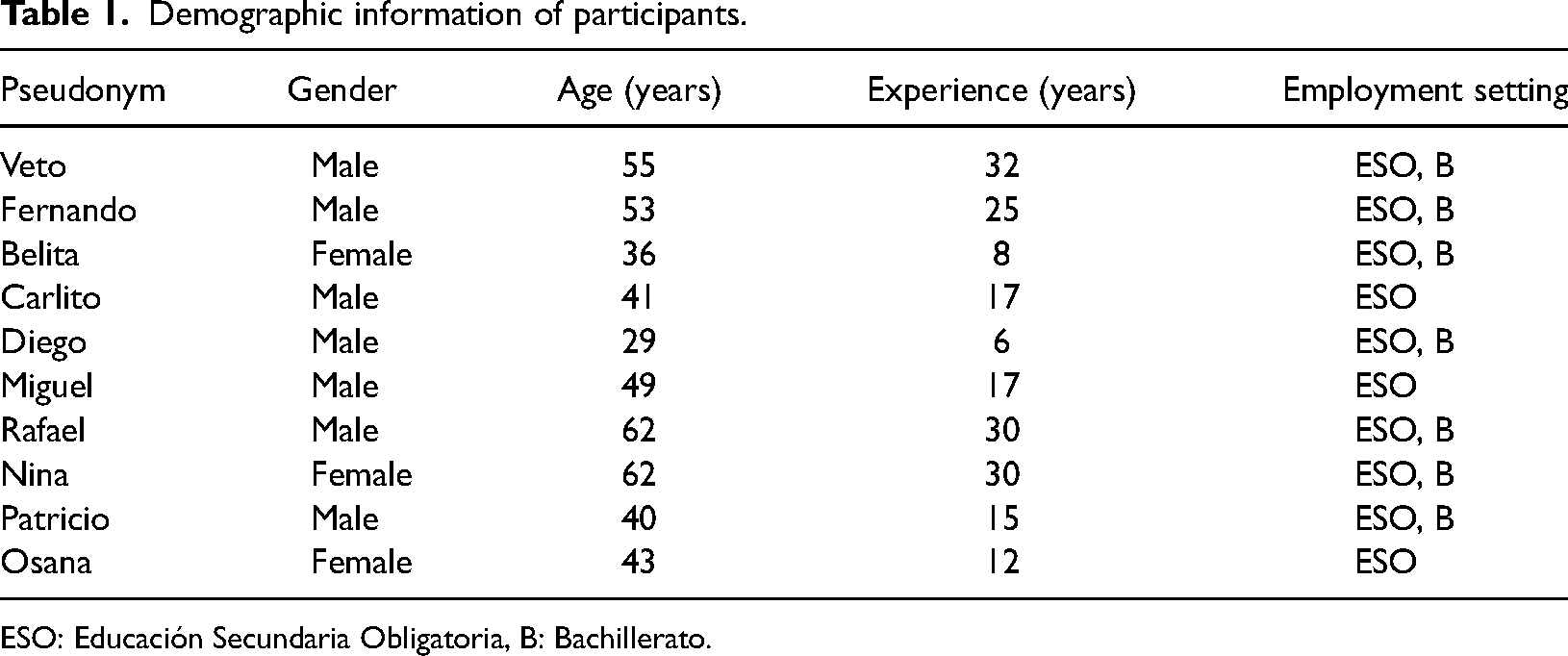
ESO: Educación Secundaria Obligatoria, B: Bachillerato.
All interviewees taught Educación Secundaria Obligatoria and Bachillerato education programmes to students aged 13 to 18 years. The Spanish curriculum encourages development of transdisciplinary competencies with a focus on cognitive, motor, and interpersonal skills. Knowledge and understanding are developed across six key areas: active and healthy lifestyles, organisation and management of physical activity, problem solving in practical environments, emotional self-regulation, traditional and contemporary sporting activities, and activity in natural and urban environments. Interviewees identified programmes of study typically operate over trimesters, resulting in the delivery of 5 to 8 units of work per year, with each unit lasting 4 to 8 weeks. Classes are typically scheduled twice per week, 50 to 60 minutes in length and have approximately 30 students in attendance. Curriculum activities include team sports (e.g. basketball, football, handball, and volleyball), individual sports (e.g. athletics, gymnastics, physical conditioning, and swimming), racquet sports (e.g. badminton, padel, and table tennis) and traditional or cultural sports (e.g. dance, beach padel, and wrestling).
The size of the sample was established inductively with additional recruitment and interviews completed until theoretical saturation was reached. This was operationalised as the point in data gathering where the processing of three successive interviews resulted in negligible or no generation of new information (Guest et al., 2006). The final sample size was indicative of a small–medium-sized project within thematic analysis and provided the required data to allow a thorough examination of the phenomenon under investigation (Braun and Clarke, 2013).
Interviews were facilitated by a member of the research team who sought to elicit responses to both wide-ranging and more specific questions devised from the empirical evidence in the field and the pedagogic knowledge of the research team. Participants were asked questions from a prepared interview guide, with the interviewer employing strategies including neutral prompts, paraphrasing, inductive probing and clarifying questions to stimulate detailed description of interviewees’ experiences and approaches towards teaching PE. Interview questions explored how learner progress and development were supported, personal qualities demonstrated by practitioners, rewarding experiences during teaching, and curriculum, class, and learning activity structure. All interviews were digitally recorded, averaging 47 minutes, 24 seconds in duration, prior to verbatim transcription. Transcripts were translated from Spanish to English by the research team and then cross-checked for accuracy by systematically comparing short sections (sentence-by-sentence) of the translated transcript to the original text.
Analysis
Thematic analysis of the interview data was subsequently undertaken by adopting an inductive data-driven approach (Braun and Clarke, 2013), resulting in the themes being constructed from the data without attempting to engineer conformity to established coding models or the investigators’ analytical preconceptions and bias (Clarke and Braun, 2017). Transcripts were reviewed by the lead author numerous times to generate familiarity with the data. Especially evocative features of the data were noted for further discussion among the research team. Familiarisation enabled preliminary codes to be established, identifying different characteristics of the teachers’ experiences with notable testimonials from the interviews selected. Provisional candidate themes were generated from these preliminary codes, identifying noteworthy aspects of the data, which were characteristically representative of some degree of patterned response and meaning within the data. Initial coding and candidate themes were subsequently grouped into potential general themes and subthemes. The research team discussed these constructed themes, allowing assumptions, interpretation and understanding to be reviewed and agreement established. After modifications and refinement, overarching themes were generated, representing the participants’ experiences of teaching PE. Morse (2015) suggested qualitative research is ultimately only credible or trustworthy if the reader determines it to be so. Taking inspiration from numerous authors (Braun and Clarke, 2013; Morse, 2015; Noble and Smith, 2015; Ravenek and Rudman, 2013; Robinson, 2014; Tracy, 2010; Yardley, 2017), the demonstration of specific research techniques, protracted engagement with the phenomenon of interest, immersion in the data collected, in-depth analysis, peer review of constructed themes, and the inclusion of rich verbatim interview extracts should help ensure the credibility and trustworthiness of the work.
Results and discussion
The Likert scale data revealed that participants had high familiarity with fundamental movement skills, teaching games for understanding, motor development, motor learning, and lifelong participation. In contrast, all participants indicated they were unfamiliar with the concept of physical literacy.
Seven overarching themes were derived from the analysis: (a) teaching craft, (b) curriculum implementation, (c) differentiation strategies, (d) assessment behaviours, (e) utility of feedback, (f) psychomotor development, and (g) sensitivity to affective domains of learning. Examination and critique of themes constructed from the analysis highlight teaching practices that could feasibly support physical literacy development within PE environments, while practitioners themselves were unfamiliar with the concept.
Teaching craft
PE teachers have a vital role to play in facilitating the physical literacy journey (Murdoch and Whitehead, 2010). They provide the solitary guaranteed contact point of structured physical activities for children and adolescents, they have expertise in developing movement forms, their classes have access to a wide range of physical environments and they can be highly influential in an individual's disposition towards activity (Almond, 2013). Many of the teachers were sensitive to the importance of the role they played in the development of learner competencies within PE. Comments including ‘They are not clumsy, simply no one is born taught’ (Nina), ‘we aim to change things in order to make the students avoid [negative] PE clichés’ (Belita), and ‘the aim…should motivate people to have a lifelong participation’ (Veto) effectively highlight the centrality of the educator's role within the development of locomotive competence. Implementation of varied communication approaches reflective of the situation was a constructed theme that captured both the knowledge and use of different teaching styles to moderate behaviours and progression. Interviews evidenced an extensive portfolio of teaching strategies utilised, with discrete examples of ‘Guided discovery’ (Fernando), ‘Command’ orientated teaching (Miguel), ‘Task assignment’ (Fernando), ‘Constraints led approaches’ (Belita), and ‘Delgado Noguera's classifications of teaching’ (Belita) provided. The capacity to adopt a repertoire of teaching and interaction styles is necessary to effectively teach PE (Haydn-Davies, 2010).
Flexibility in delivery, management and communication styles contributes to another of the general themes aligned with the delivery of engaging classes. The interviewed teachers in this study highlighted a variety of markers that might indicate levels of engagement. For example, Veto suggested: You realise the environment that is being created, you see the relationship between each other, and you already have some criteria to see how you go to start the lesson according to the level of briskness, tension, nerves, interest.
Associated with creating an environment that facilitates development and helps avoid disengagement is appropriate management of learning practice task design and the need to offer sympathetic guidance and authentic praise (Durden-Myers et al., 2018a). Management of the student–teacher interface is another prevailing feature of fostering physically literate individuals. One teacher expressed how they liked to ‘let them commit mistakes and try to let them find out how to solve it by themselves’ (Nina), consequently accommodating purposeful, experimental movement variance when seeking consistent execution outcomes, which could be considered an advanced illustration of practitioner insight and effectively aligns to teaching paradigms believed to foster knowledge and understanding in the physically literate individual (Almond and Whitehead, 2012).
Curriculum implementation
The teachers identified comprehensive curriculum provision and content that would seem well placed to support the physically literate individual. Teachers reported the development of fundamental movement skills, refined and sport-specific movement patterns, individual and team sports, and games and activities orientated towards lifelong participation. The following extract captures the scope of the curriculum: We focus on psychomotor and socio-motorical, also individual and collective games, coordinative skills with expressive content, by using corporal expression, theatre, dancing, those kinds of rhythmic abilities, so this means having temporal-space control. (Belita)
Breadth and balance in curriculum design are key. The interviews revealed a broad spectrum of physical activity experiences offered by the curriculum. Complemented by activities of a geo-cultural orientation, team and individual sports, invasion games, racquet sports and net and wall games were all identified as being taught. Learners should experience multiple contexts of physical activity, in addition to having adequate time to become acquainted with the opportunities and expectations of these settings (Murdoch and Whitehead, 2010). This aspiration creates a challenging discourse for professionals in the field to navigate. Achieving breadth within the curriculum regularly means potentially compromising the task mastery-orientated climate that is otherwise deemed desirable (Murdoch and Whitehead, 2013). The cyclic, episodic nature of the consequent curriculum diminishes certain domains of the physical literacy concept while reasonably satisfying others. All teachers, however, highlighted time, perceived value, and standing of the subject as being problematic with one participant effectively capturing the prevailing sense of frustration: ‘one or two sessions of 50 minutes per week. That's NOTHING! Totally insufficient’ (Nina), and another describing that the discipline area was ‘considered as a second division subject’ (Miguel).
Differentiation strategies
Physical literacy challenges a one-size-fits-all approach towards teaching, remaining attuned to the bespoke capabilities of the learners engaged in physical activities (Rudd et al., 2020). Individual capabilities, qualities, preferences and experiences should be recognised by teachers, resulting in the implementation of appropriate practice. One of the teachers highlighted both similarities and differences that exist in well-taught sessions, suggesting ‘the aims, the activities, even if they are similar the students already are different, their maturity is different, their experiences are different’ (Veto). Numerous differentiation strategies were articulated by teachers during the investigation, with the student experience anchoring chosen pedagogical approaches. For example, the management of task constraints to mediate learning practice task design was a common theme explained by teachers: ‘Doing different activities, doing activities that generate uncertainty but at the same time are possible, are achievable’ (Diego) and ‘I’m focusing on their successes and I first plan appropriate challenges for him, that he thinks he's capable of doing’ (Patricio). These extracts provide insight into the consideration of learner experiences and opportunities for enrichment provided by the embodied dimension as individuals interact with their world (Pot et al., 2018). Identified practices straddled the constructed general themes of skills-based organism constraints potential to moderate engagement and the creation of mastery, task goal orientation teaching environments.
Learner success and experiences, where goals are achieved, are essential for fostering individual physical literacy (Whitehead, 2013a). The participants provided examples of how they achieved differentiation through practice tasks; for example, ‘the challenges are individual to each student and every kid experiences it in their own way’ (Fernando) or ‘you plan activities in which each one (student) develops his maximum potential’ (Osana). There was also evidence regarding outcomes: ‘everyone learns at their own pace’ (Miguel) and differentiated teaching approaches: ‘some constraints or challenges for those who are capable of doing it well’ (Belita). Experience of success is crucial to promoting physical literacy (Whitehead and Almond, 2013). Engaging in or attempting skills and activities where children are ill-equipped for success impairs skill development and progress as well as influencing attitudes towards the task itself (Whitehead, 2010a). In such contexts, children transparently present their physical literacy due to the observed interactions between environment, organism and task constraints (Roberts et al., 2019). Teachers identified pedagogies such as ‘changing athlete court position’ (Carlito), ‘task simplification’ (Fernando), and ‘skilled distributive practice’ (Diego) as evidenced-based approaches demonstrating practical implementation of differentiation.
Assessment behaviours
For young people to achieve the potential of their locomotive vocabulary, they need well-considered, developmentally targeted, structured, purposeful movement episodes with opportunities for informed feedback (Silverman and Mercier, 2015; Whitehead and Almond, 2013), from formative and summative evaluations. Whitehead (2010a) recommends avoidance of evaluative approaches that would perhaps invoke a sense of failure, or where comparison with peers is undertaken. Such practice, and a focus on normative comparisons against performance-orientated data, is more closely aligned to an ego-involving learning climate. A mastery-orientated learning environment is deemed a more appropriate environment to nurture physical literacy (Almond, 2013). Such philosophies were captured effectively by Belita as she described how they ‘always focus on what they have improved instead of what they don’t know’. Differentiation, recognition of effort, individual progress and individualised ipsative assessment with informed feedback in a correctional or encouraging manner results in positive motivational temperament from students (Morgan, 2017). This was an approach described explicitly by one teacher, identifying ‘It's always crucial to begin with the student, for me that's fundamental, for me every student is different… we value attitude, behaviours and skill level’ (Diego). This adoption of a more holistic evaluation strategy was also captured in Fernando's commentary: ‘in summary my evaluation criteria will be: attitude, behaviour, individual progression and the theoretical content knowledge’. Such approaches could be linked to increased satisfaction, enjoyment and perceived competence. The overarching approach to evaluation and the mastery-orientated learning environment it can create is synonymous with facilitating physical literacy.
Discernible strategies adopted to cultivate a positive attitude towards physical activity were teacher emphasised, self-referenced improvement, and the recognition and celebration of effort. Commentary from interviews aligns with Whitehead's (2013b) suggestion that monitoring progress is a more suitable approach than an assessment of performance or comparison to others, for example: ‘what I value…is your progression departing from your starting point – the evolution’ (Nina) and ‘little by little, step by step he (the student) will be able to beat his own fears and that makes me (the teacher) the happiest guy in the world’ (Fernando). These quotes are indicative of the investment practitioners have in supporting students’ individual progression, reinforcing the creation of a mastery climate. Learner characteristics occupying the affective domain were also highly regarded by practitioners when engaged in evaluative assessments. Students’ demonstrations of motivation, persistence, resilience, effort, and engagement were frequently highlighted and appreciated. Recognition of these affective qualities included comments such as ‘the main value, is the desire… I have no use for you to be a phenomenon in an activity if you do it with reluctance’ (Diego). These more holistic evaluations and the subsequent celebration of progress and engagement are known to be persuasive in nurturing motivation, confidence and success in PE environments (Shearer et al., 2021).
Utility of feedback
Assessment behaviours and utility of feedback are inescapably linked in practice and naturally complement one another. Both themes speak to the notion of effective teaching being a craft, whereby numerous discrete skills, behaviours and approaches are informed by empirical and experiential knowledge. The dynamic, instantaneous exhibition of learner competency and subsequent interactions between teacher and learner are acknowledged by Rafael who stated, ‘PE is a subject where we have got plenty of ways for motivating and providing (students) feedback’. Wainwright et al. (2018) highlight the necessity of appropriately structured curricula with the opportunity for informed feedback in relation to developing movement competency. Although play and exposure to the natural environment will develop physical competencies, evidence suggests it is a misconception that by simply engaging in unstructured play, proficiency will occur naturally or potential will be realised (Barnett et al., 2016). The input of the teacher in scaffolding learning is critical, especially for individuals who are not yet able to make sense of their own performance or demonstrate knowledge of movement expectations. For example, Fernando commented, ‘the majority will make some mistakes so it's important to tell them to change those things and to make them realise why they are changing and for what purpose’. Demonstration of sensitive attunement to the learning environment and how it informs interactions with learners is vital for young people to achieve the complete potential of their locomotive vocabulary (Rudd et al., 2021). Rafael effectively captured how his attentive behaviour creates opportunities for learner development by ‘keeping an eye on the overachievers and giving them feedback sometimes but with the others you will need to spend more time and you need to encourage them to achieve the objective’.
Teachers articulated intelligent use of tailored feedback, moderating their interactions based on learner disposition. For example, Patricio identified situations where ‘there are some students with a more competitive, tougher and stronger personality, and praising them or using positive reinforcement with them is not as useful as challenging them’. Additionally, Miguel described through the employment of approval orientated feedback ‘praising them with measure, not for everything they do and also positive reinforcement for little successes is generating more motivation within the students’. All interviewees provided commentary aligned with the utility of feedback. There were recurrent examples of perceptive teacher–student exchanges, demonstrating an appropriate deployment of feedback strategies focused on the individual. Examples of personalised tailored feedback, employment of varied feedback strategies, encouragement, supportive praise, and timely intervention were evident in the data and have previously been associated with positively affecting learner motivation and competency development (Keegan et al., 2010).
Psychomotor development
Responses in the theme of psychomotor development included examples of interviewees referencing specific teaching models (Belita and Osana), sequenced progressions to develop skills (Belita, Nina, and Osana), employment of small-sided and modified games (Veto, Belita, and Diego), peer tutoring and coaching (Fernando, Belita, Diego, and Miguel), creating a respectful environment for learning and the management of social contexts to create productive PE settings (Fernando, Belita, Miguel, Rafael, and Patricio). The overarching pedagogies discussed throughout the interviews potentially enable learners to value and enjoy being physically engaged. Consequently, learners are well-positioned to progress in their physical literacy journey. Developing knowledge of a range of environments and the capacity to interact effectively with novel situations or circumstances can be helped by engagement in a wide variety of suitably structured activities (Robinson et al., 2018). Awareness of teaching strategies as well as orientating practice towards a student-centric curriculum is evidenced in the interviews; for example, ‘guided discovery lets every child focus and discover what they want, because maybe what's important for you (the teacher) isn’t so important for Susana or Juanito’ (Fernando). Informed learning practice task design generates affordances that effectively guide learners' exploratory behaviours. It allows children to regulate challenges and potentiates success effectively as teachers fulfil the role of problem setters and environment architects.
Breadth and balance are vitally important. Learners should experience the multitude of settings typical to physical activity while also having adequate time to become accustomed to these different activity scenarios (Murdoch and Whitehead, 2010). Breadth of experience needs to be evaluated against suitable commitments of time and effort to the mastery of discrete movement competencies. Teachers described rich curricula with regard to accessing a range of activity types and environments but recognised the compromises being made so that ‘not just repetition but real acquisition’ (Belita) took place. Wedding the complexity of movement mastery with providing a breadth of experience is a perpetual challenge faced by practitioners and one that needs to be overcome to guarantee secure, confident movement solutions are offered. One teacher recognised the challenge of developing competency stating ‘(if) I had to teach the unit from the start of the scholar year until they finally learn it, probably we are not teaching anything else’ (Nina).
Physical experiences within school education should build from previous achievements, setting challenges that are appropriate and potentiate learner development with regard to the specificity of movement patterns and capacities (Murdoch and Whitehead, 2013). The challenge offered should be centred on the individual's qualities and capability, which was commonly acknowledged as deficient during the interviews: ‘you could notice that many of the students had a very basic level and a very basic development of their abilities’ (Nina). To enable learners to capitalise on their embodied potential requires the astute evaluation of their current disposition towards physical activity, the recognition of their activity legacy and previous exposure, and the sensitive design of activities to allow learners to match their ability and preferences to differentiated goals and challenge (Pot et al., 2018; Whitehead and Almond, 2013). Statements such as ‘kids no longer know how to walk, the first thing I do is teach them to run’ (Carlito) and ‘It has to be him (the teacher), the one who teaches running, crawling, creeping, dynamic balances, etc … and that is not being done’ (Carlito) indicate the diverse capabilities of school children, specifically at the lower end of the movement spectrum. Practitioners were very aware that in addition to addressing where they perceived deficiencies, there was also the need to stretch high-performing students: ‘the goals are never reached because in PE it is always possible to improve a skill, there's not a ceiling’ (Patricio). This overarching awareness of learner diversity, alongside recognising the need for differentiated learning-task design to enable success in less capable children, while also challenging more competent individuals, aligns well with the physical literacy concept. The pedagogical foundations presented here are central to the development of learners’ enjoyment, progression, and confidence. Illustrations of practice highlight how students, regardless of ability or disposition, were accommodated with examples of teaching that would effectively engineer a positive physical literacy journey for everyone.
Sensitivity to affective domains of learning in PE
The affective domain of learning within PE is clearly connected to assessment, evaluation and the creation of mastery-orientated environments (Duda and Appleton, 2016). Approaches should focus on developing self-confidence, self-esteem and enthusiasm towards being active. If any of these traits are compromised, resulting in discouraging or unpleasant episodes of physical activity, there will be probable decreases in motivation and a decline in future commitment to participate (Whitehead, 2010b). Several teachers acknowledged their role, and the role of PE, in enhancing the affective traits of students. For example, Patricio noted: ‘the PE teacher has to progress towards a more supportive perspective… PE classes have to be that “trampoline” that potentially promotes the health of the bodies inside their capacities’, and Veto noted the aspiration that ‘students will be better people and not just better athletes’. Specifically, practitioners are encouraged to create a motivational (Keegan et al., 2010), empowering (Appleton and Duda, 2016) and caring climate (Fry and Gano-Overway, 2010) to foster physical literacy.
Whitehead (2013a) proposed that nurturing the triad of self-perception, self-confidence and self-esteem is crucial. PE settings focused on respect and kindness, emphasising the development of interpersonal relationships, may subsequently contribute to feelings of enjoyment and commitment (Fry and Gano-Overway, 2010). The following comment illustrates how a physically literate cohort situated in a supportive, motivational, caring climate might manifest itself: A high percentage of the class are not attempting the challenges with fears, when they are having the confidence that they are going to be successful… so there's no one that starts crying, no one creating a drama, no one putting excuses… but that all of them show some disposition independently. (Patricio)
The potential of physical literacy to underpin human flourishing, enhance engagement in fulfilling experiences, and improve quality of life (Durden-Myers et al., 2018b) was recognised by practitioners, acknowledging, ‘(the student) values your knowledge because you’ve taught her something, not only on a health spectrum but also in terms of coexistence, socialisation, sharing’ (Fernando). Almond (2013) identifies the benefits of connecting with learners in a manner that kindles interest, engages disinterested individuals, and offers activities that are intrinsically satisfying. As one teacher effectively summarised, ‘I don’t let them in any situation leave my sessions with a bad memory of it’ (Fernando). Cultivating motivation, confidence and competence is critical and recognises that while movement competencies are an important aspect of physical literacy, they remain only a single element of the whole and consequently should not consume the entire curriculum's or practitioners’ purpose and product (Whitehead, 2013a). Many of the testimonies referenced learner-centred practices and the embodied experiences afforded by PE. The following extract highlights this: ‘for us (teachers) the most important thing is transmitting good habits over sport performance, aiming that everybody in the way they are capable of doing, finds enjoyment while practicing sport’ (Patricio) and ‘(students) have a feeling of belonging to sport’ (Patricio).
Conclusion
Previous research has typically focused on establishing the knowledge base (or lack thereof) that teachers possess in relation to the concept of physical literacy rather than necessarily exploring whether they are providing experiences favourable to the advancement of the physically literate individual. Based on the overarching themes (teaching craft, curriculum implementation, differentiation strategies, assessment behaviours, utility of feedback, psychomotor development, and sensitivity to affective domains of learning), our results provide examples of teaching that would be well aligned to facilitating the physical literacy journey, despite teachers’ lack of familiarity with the concept. It would appear that how teaching is conducted in relation to developing physical literacy is as important, perhaps more so, than what is understood of the physical literacy concept in this population. Consequently, this study offers a critical review and questions the value of previous recommendations regarding the necessity of teacher knowledge and understanding of the physical literacy concept to guarantee PE settings are conducive to the development of physical literacy (Stanec and Murray-Orr, 2011; Stoddart and Humbert, 2017; Tristani and Fraser-Thomas, 2014). If the well-intentioned, yet complex, concept of physical literacy can be embedded within PE settings without practitioners having a thorough understanding of the wider theory, then policy makers and learners themselves will be well served through the provision of high-quality PE that ubiquitously complements the development of physically literate individuals.
Despite its strengths, our study had some limitations. For example, there was an occasional discrepancy between the pedagogical practices identified as being adopted and the examples of practice given. While both minor and infrequent, such testimony could query the legitimacy of the practices reported. Consequently, future studies could perhaps focus on the collection of ancillary research materials or artefacts obtained through observations of practice to supplement the findings of the thematic analysis produced in this study.
Footnotes
Declaration of conflicting interests
The author(s) declared no potential conflicts of interest with respect to the research, authorship, and/or publication of this article.
Funding
The author(s) received no financial support for the research, authorship, and/or publication of this article.
