



Abstract
Occupational socialization theory has been extensively applied to study the recruitment, professional preparation, and ongoing socialization of inservice physical education teachers. Less is known, however, about the socialization of physical education teacher education (PETE) faculty members. This qualitative panel study aimed to understand early career faculty members’ perspectives on their preparation for and experiences in the role of teacher educator. Participants included 23 faculty members and data were collected through interviews over five years. Research team members analyzed the data using both deductive and inductive analysis strategies. Data analysis resulted in three themes that unpacked participants’ experiences relative to teaching in higher education. The findings indicated that in the United States (US), PETE doctoral education provides teaching opportunities, but lacks explicit teacher education training. Moreover, doctoral education focuses on research, but initial positions tend to focus on teaching, and PETE faculty members are compelled to develop into effective teacher educators. Taken together, faculty responsible for leading US PETE doctoral programs should consider the importance of embedding intentional and progressive teacher educator-related opportunities supplemental to graduate program requirements.
Keywords
Background
Physical education teachers’ lives and careers have been studied for nearly 40 years through occupational socialization theory (OST; Templin and Schempp, 1989). This work is essential for understanding topics including how recruits’ backgrounds influence their conceptions of physical education (McCullick et al., 2012; Sofo and Curtner-Smith, 2010), receptivity to various pedagogical models (Curtner-Smith et al., 2008), and marginalization of physical educators and the subject in schools (Laureano et al., 2014). Comparatively, research on the recruitment, preparation, and ongoing socialization of physical education teacher education (PETE) faculty members is still developing (McEvoy et al., 2015). Scholars have heeded Lawson's (1991) advice more recently to extend OST to examine PETE doctoral students’ and faculty members’ perspectives and experiences (Graber et al. 2020; Richards et al., 2020; Russell et al., 2016).
This emerging research on faculty socialization points to the importance of professional learning communities (MacPhail et al., 2014), the challenges of transitioning to faculty member careers (McLoughlin et al., 2019), and developing effective teacher education pedagogies (Dinkelman et al., 2006b; Ritter, 2007). While these studies and initiatives provide an important starting point, additional research is warranted. This is particularly the case with United States (US) doctoral programs preparing candidates to assume future faculty member roles, thus highlighting this preparation period as critical to cultivate disciplinary stewards and advancing the respective field. In physical education, this stewardship includes preparing future physical education teachers, conducting research to advance practice in the discipline, and promoting physical education and activity in local communities (Golde and Walker, 2006; Lee and Curtner-Smith, 2011).
While teacher education is a significant component of most PETE faculty positions, doctoral programs may spend disproportionate time focused on research and not fully prepare future faculty members for the teaching component of the profession (McLoughlin et al., 2017). This has generated inquiries into the extent to which PETE doctoral students are prepared for the teaching component often required of US faculty (Graber et al., 2017). Understanding the preparation of PETE faculty members for their roles as teacher educators is critical as these faculty members help shape the beliefs and practices of future teachers. While many PETE faculty members begin teaching K-12 physical education, the decision to pursue academic careers often follows working as an inservice teacher (Woods et al., 2011). Apart from Self-Study of Teacher Education Practices (S-STEP) scholarship (Casey and Fletcher, 2012; North et al., 2022), literature about the degree to which faculty members perceive their background and doctoral education prepared them for teacher education is scant (Kosnik et al., 2011; Ward, 2016; Williams et al., 2011). We sought to fill this void by interviewing early career US PETE faculty members about their experiences relative to the role of teacher educator.
The theoretical framework adopted in this study, OST, presents a dialectical perspective on workplace socialization that seeks to understand how teachers’ and teacher educators’ interactions with the social world shape their beliefs and practices (Templin and Schempp, 1989). The dialectical perspective recognizes an individual's sense of agency and ability to resist elements of the socialization process with which they disagree. In contrast to other theories related to doctoral student and faculty socialization (Antony and Taylor, 2004), scholars using OST consider the influence of anticipatory socialization that helps to explain recruitment into and initial beliefs that precede doctoral education (Russell et al., 2016). When applied to the study of PETE graduate students and faculty members, therefore, socialization influences are typically grouped into three clusters related to anticipatory, doctoral education, and faculty socialization (Richards and Fletcher, 2019).
During anticipatory socialization, individuals experience an apprenticeship of observation (Lortie, 1975) whereby they begin to develop initial understandings of the responsibilities associated with being a teacher and teacher educator. For most, this includes time spent observing physical education teachers during their own formative education (Curtner-Smith, 2017). For those who enroll in PETE, formal socialization into the profession begins as they are trained to teach physical education and begin to understand faculty roles by observing their own teacher educators (Lee and Curtner-Smith, 2011; Russell et al., 2016). The doctoral education phase begins when individuals transition into PETE doctoral programs (Boyce and Rikard, 2011a). Doctoral students engage in a variety of formal and informal experiences whereby they begin learning some of the technical aspects associated with teaching, research, and service along with initial understandings of the sociopolitical aspects of faculty life (Gardner, 2007, 2008). While many PETE doctoral students have prior inservice teaching experience, the noted differences between teaching in school and higher education environments necessitate formal preparation for the role of teacher educator (Casey and Fletcher, 2012).
Individuals begin the faculty socialization phase when they complete doctoral education and transition into their first faculty positions (Merrem and Curtner-Smith, 2018). Faculty careers are typically conceptualized to include junior, mid-career, and senior phases that roughly align with the tenure and promotion processes (Russell et al., 2016). Beginning faculty members may experience challenges as they begin their first academic posts due to demands associated with developing independent lines of inquiry while also preparing classes and managing service responsibilities (Lumpkin, 2014). This may also be the first time new PETE faculty members have assumed teacher education responsibilities or served as a lead instructor (Ward, 2016).
Importantly, PETE faculty members have been conceptualized as disciplinary stewards who have the responsibility of ushering the profession toward a more favorable future (Golde and Walker, 2006). One central component of this responsibility is preparing future generations of inservice teachers. This role carries great responsibility relative to the future of the physical education profession, which highlights the importance of the process by which PETE faculty members develop identities (Dinkelman, 2011) and ideologies as teacher educators. The purpose of this study was to understand early career PETE faculty members’ preparation for and experiences with their roles as teacher educators. The following research questions guided this inquiry: (a) How do early career PETE faculty members view their preparation for teacher education? (b) How do early career faculty members experience the transition from doctoral student to teacher educator? (c) How do faculty members view their roles as early career teacher educators?
Methods
The current study was part of a larger, ongoing investigation into the socialization of US PETE doctoral students and early career faculty members (McLoughlin et al., 2019; Richards et al., 2022). The initial round of recruitment included 60 US PETE doctoral students, who participated in a previous study focused on doctoral student socialization (Richards et al., 2016). The current study included 23 of the 60 (38.33%) participants who held terminal degrees and were currently working as faculty members in US higher education institutions. The variation in structure and function of teacher education preparation during doctoral studies has impetus in the perspectives and experiences of the participants. Along with the larger investigation, we conceptualized this current study as a panel study with the goal of understanding a cohort of participants’ experiences in the social world they inhabited and moved through over time (Patton, 2015). A panel study design is when repeated data collection occurs across different points in time and specifically within a group of participants from a larger sample. Panel development of participants from a larger study allows researchers the opportunity to recruit a larger number of respondents and ease of access to data such as demographic, household, or behavioral. Accordingly, a social constructivist epistemology was adopted to understand how prior and current socialization experiences influenced their developing ideologies as teacher educators (Strauss and Corbin, 2015). Ethical approval for the investigation was secured through the Institutional Review Board at the lead author's university.
Participants and setting
Participants in this study (N = 23) were considered early career PETE faculty in the US, hold terminal degrees, and are often considered junior professors, in which they have yet to achieve tenure or promotion. Among the 23 participants (12 male and 11 female), the average age was 38.5 years (SD = 8.97), and over half (n = 13, 56.52%) had prior teaching experience. For those 13 participants, the average length of inservice teaching experience was 3.04 years (SD = 3.34). Most participants identified as White/Caucasian (n = 20; 86.96%), while others identified as Black/African American (n = 2; 8.69%) and Asian (n = 1; 4.35%). The participants’ initial positions were examined in relation to the Carnegie Classification of Institutions of Higher Education (Indiana University Center for Postsecondary Research, 2018). Based on the Carnegie system, three (13.04%) of the participants’ careers began at very high research activity (R1) institutions, nine (39.13%) started at high research (R2) institutions, and one (4.35%) at a doctoral/professional university (D/PU). In terms of master's colleges and universities, eight of the participants were employed at large programs (M1; 34.78%) and one at a medium program (M2; 4.35%). Lastly, one participant worked at a baccalaureate college/diverse fields (B/DF; 4.35%). Complete participant information is included in Table 1.
Overview of demographic information for the 23 participants included in this panel study.
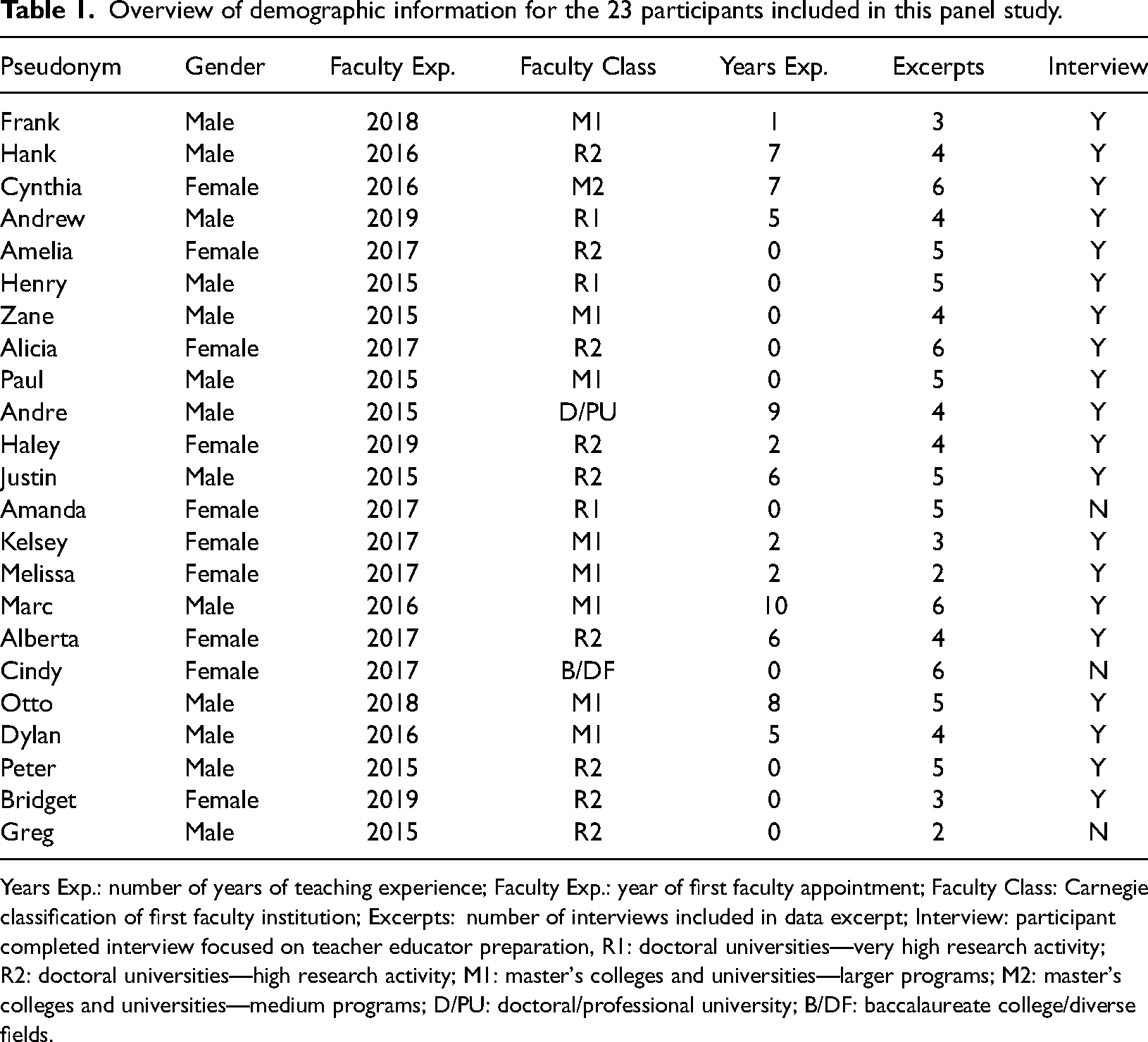
Years Exp.: number of years of teaching experience; Faculty Exp.: year of first faculty appointment; Faculty Class: Carnegie classification of first faculty institution; Excerpts: number of interviews included in data excerpt; Interview: participant completed interview focused on teacher educator preparation, R1: doctoral universities—very high research activity; R2: doctoral universities—high research activity; M1: master's colleges and universities—larger programs; M2: master's colleges and universities—medium programs; D/PU: doctoral/professional university; B/DF: baccalaureate college/diverse fields.
Data collection
Data were collected through one individual interview (n = 20) focused on the participants’ perspectives on and experiences of assuming the role of teacher educator and excerpts (n = 23) that were extracted from six previous rounds of interviewing (Table 1). The individual interviews provided in-depth retrospective accounts of doctoral training and experiences in teacher education, whereas research excerpts provided insight into participant identities as teacher educators over time. Given issues pertaining to geographic separation, most interviews were scheduled over the telephone, although some were conducted in-person at professional conferences and gatherings. Telephone interviews present some advantages because they overcome challenges associated with time, cost, and physical distance (Stephens, 2007). Concomitantly, we acknowledge challenges in developing rapport and reading non-verbal communication over the telephone (Irvine et al., 2013). We do believe, however, that the longitudinal nature of the investigation and relationships and trust developed with participants helps to address these limitations (Patton, 2015).
The first data source included semi-structured interviews (Patton, 2015) conducted with 20 teacher educators during the fall of 2019 and spring of 2020, focused on their preparation for and experiences in the teacher educator role. Each interview began with informal questions directed to spark conversation related to critical incidents that occurred in their professional or personal lives. Following the open-ended conversation, the researchers used a semi-structured interview guide to focus the conversations on the role of teacher educator while also allowing the participants to drive the conversation in relevant directions (Patton, 2015; Strauss and Corbin, 2015). Interview questions were framed through the lens of OST (Russell et al., 2016; Templin and Schempp, 1989) and examples included: “when you completed your doctoral degree, how prepared did you feel to undertake the role of teacher educator?” and “what are the courses you currently teach and how comfortable do you feel with each of them?” Interviews lasted for 45 to 60 minutes and were audio-recorded for transcription.
In addition to the interviews, data excerpts were included as a secondary data source in an attempt to capture participants’ perspectives and experiences related to teacher education over time. The excerpts were from a series of up to six interviews conducted with each participant between the spring of 2016 and the spring of 2020. Each of these interviews was approximately 45 to 60 minutes in length and followed an informal format (Patton, 2015) whereby the participant was asked to discuss critical incidents in their work and personal lives (McLoughlin et al., 2019). One research assistant screened and liberally identified pertinent data from each interview and collated the data into a single transcript file for each participant. For every participant, interview transcripts were collated into one document and reviewed prior to data analysis by two lead investigators. Again, the teacher educator excerpts only included past conversations related to fulfilling the teaching component as a faculty member in higher education. These conversations explored all facets of the faculty role (i.e. teaching, research, and service) with focused discussions on participants’ perceived ability to fulfill the teacher educator role based on their prior and current experiences and supports.
Data analysis
Two members of the research team analyzed the interview data using a multiphase approach grounded in deductive and inductive analysis (Richards and Hemphill, 2018). The process was deductive as the data were interpreted using OST (Russell et al., 2016; Templin and Schempp, 1989) as a guiding framework. The approach maintained an inductive component, however, as we actively sought to identify patterns that challenged or extended our understanding of the theory (Patton, 2015). The data analysis process began with open and axial coding, whereby two team members independently read different transcripts and identified initial patterns and connections (Strauss and Corbin, 2015). After three rounds of open and axial coding, an initial codebook was developed and continually refined following weekly research team meetings (Richards and Hemphill, 2018). The codebook was then pilot tested using previously uncoded data, with updates being made to reflect the team's evolving understanding of the data. Following the completion of pilot testing, the two-member analysis team used the split coding procedure by dividing the entire dataset into two groups with each team member coding a subset of the data using the refined codebook (Richards and Hemphill, 2018). Through this process, further changes to the codebook were made using the constant comparative method and through discussion during regular research team meetings (Lincoln and Guba, 1985). When all data were coded, we met one last time to develop a finalized codebook into themes that represented the participants’ experiences related to learning to be teacher educators.
In approaching the study, we sought to enhance rigor by implementing a series of methodological strategies focused on promoting trustworthiness (Lincoln and Guba, 1985). Researcher triangulation was facilitated by involving multiple researchers in data analysis and other members of the research team were embraced as peer debriefers. We also maintained an audit trail in a researcher journal to develop transparency through data collection and analysis. Participants were provided with an opportunity to review the final set of themes as well as a draft of the manuscript to comment on the extent to which the researchers’ understandings reflected their experiences. Some minor changes to the structure of the themes and the manuscript were made to reflect the participants’ feedback. Finally, we intentionally searched for negative cases through the analysis process; these instances are discussed as the main themes are presented.
Results
The participants generally believed that they were prepared to become PETE faculty members, specifically in relation to initiating their research agenda. Some, however, thought that their doctoral programs lacked key experiences or elements involving the teaching component of their current faculty roles. Three themes were generated following qualitative data analysis: (a) doctoral education provides teaching opportunities but lacks explicit teacher education training; (b) doctoral education focuses on research, but initial positions tend to focus on teaching; and (c) PETE faculty members are compelled to develop into effective teacher educators. These themes are presented with supporting quotations from participants who are identified using pseudonyms. All quotes are from the semi-structured interviews unless marked as excerpts.
Doctoral education provides teaching opportunities but lacks explicit teacher education training
Most participants noted that their doctoral program provided hands-on experience in assuming faculty roles through graduate teaching or research assistantships. Cynthia expressed her appreciation for the teaching opportunities afforded to her as a doctoral student: “I taught six credits a semester, and that really exposed me to teaching at the college level.” Amanda added that the “teaching experiences [during my doctoral education] have really built upon themselves, now I have the opportunity to be creative and really structure the curriculum and think very conceptually about how I go about everything.” Some participants noted the importance of teaching in various capacities during their doctoral education. Kelsey, for example, “had opportunities to teach as the instructor of record, a variety of courses ranging from 100-level activity course (1st year) to 300- or 400-level (3rd and 4th year) method and practicum courses” (excerpt). Other participants added that they “definitely had opportunities to teach in a variety of different settings” (Amelia) that included “a mix of practical classes, lectures, and seminars” (Haley). In the US, teaching opportunities for PETE doctoral students often include at least one lower division level (first year) course, in which they assume the role of lead instructor to teach a physical activity course (e.g. basketball, badminton, swimming, or physical conditioning).
While variety was important, it was the PETE-related courses that participants believed assisted them in preparing for the teacher educator role. Andrew explained, “what saved me, really, is having the opportunity to teach upper-level PETE undergraduate courses for the program during doctoral training.” These opportunities most mirrored their teaching assignments as assistant professors. Others, however, expressed frustration with the types of courses they taught. Several participants, including Frank, did not have the opportunity to teach PETE courses. As he explained, “it's really only been activity classes” (excerpt). While some participants lamented having only taught activity courses, Justin believed that these experiences “kind of eased you into higher education…it gives you an idea of running a class, developing a syllabus, and those kinds of things,” for which he was grateful.
Taken together, teaching experiences were viewed as valuable for becoming comfortable in instructional settings and practicing skills associated with post-secondary teaching. At the same time, however, these assistantships were often not constructed as intentional learning opportunities. For instance, Andre would have preferred direction regarding the “actual hands-on, here's how you do it. Here's how you become an effective teacher at a university level. I just never felt like I got much help.” Hank was adamant that there was “not a lot of teaching how to teach, let's put it that way…I just didn’t get any experience with the teacher education program really, even though I was teaching courses that were somewhat related to it.” As a doctoral student, Haley felt thrown into teaching and “never had opportunities where there was a mentor role…I never co-taught with a faculty member. I was often just kind of thrown into the deep end.”
Beyond assistantship responsibilities, the participants indicated that they were asked to address programmatic functioning and features as early career faculty members but did not learn about these roles during doctoral education. This was the case relative to elements such as identifying and scheduling field placements and reviewing the program curriculum. Alberta recognized that she was not prepared for program-related responsibilities during her first faculty appointment: “there's little things like running a program, accreditation, edTPA [educative Teacher Performance Assessment], things you don’t pick up in graduate school” (excerpt). In contrast to most of the participants, Frank enjoyed the lack of oversight because of the autonomy it afforded him. He explained, “I had a lot of freedom in constructing, developing, and teaching my courses, which is probably going to benefit me for treading water in my first gig.”
While several participants described a lack of intentional guidance, others acknowledged advisors and mentors who were instrumental in their path toward becoming teacher educators. Cynthia recalled how her advisor was “always willing to say, ‘okay. Here's the syllabus. Here's the textbook that we use…Here's what we’re really trying to cover with these students’” (excerpt). Along with faculty guidance, participants explained the importance of having peer support. Paul explained that his peers in the program “challenge my thoughts and ideas, which in turn makes me a better teacher” (excerpt). Taking advantage of “being in this cohort and knowing that I am not alone in my struggles and my challenges have been such a relief” for Amanda. Otto added the importance of “sharing knowledge, sharing of their person, people sharing themselves, sharing who they are, sharing what they know, sharing how they teach certain content” (excerpt) in how he learned about the role.
Doctoral education focuses on research, but initial positions tend to focus on teaching
Most participants indicated that their intentions to seek careers in PETE were based on the desire to educate future teachers. While some described well-rounded experiences during doctoral education when they learned both about research and teaching roles, extending from the first theme, others acknowledged that their programs primarily focused on research. For example, Kelsey mentioned that her studies were “less about the teaching…and only focused on the research” (excerpt). While reflecting on his doctoral education, Dylan noted that his program “focused more on the research component, which I think was valuable, but not for where I am at right now, being it is a very teacher-centered institution.”
Greg emphasized how doctoral education does not always match the jobs available to early career faculty members: “when you get out of those [research] institutions, it's like entering a different world because real PETE programs are much more teaching-oriented.” Other participants, such as Marc, reflected on this disconnect between preparation and his first job noting, “I honestly don’t think I was prepared for the teacher [education] side as much as the research side” (excerpt). Andre referred to his own teacher preparation explaining, “there was very little that either helped me learn to be a better teacher or the kinds of things that you would need to do to be a better professor in the classroom” (excerpt). Alicia believed the lack of preparation for the role of teacher educator led to stress and uncertainty during the academic hiring process, particularly when interviewing at teaching-focused institutions: “[the search chair's] expression to me was, ‘I don’t know if you’d be cut out for this. We have you teach several model lessons. We come observe you in your grad teaching.’ It was just extremely in-depth.”
When participants were trained in research institutions, but secured their first jobs in teaching institutions, they often felt as if they needed to learn how to teach on the fly. Dylan explained that “learning the necessary knowledge and skills required as a quality teacher educator is kind of like on the job training.” Others felt as if they were put in positions to either sink or swim when encountering elements of the teacher educator role for which they felt underprepared. Paul made an analogy explaining that learning to teach PETE had been “just like riding a bike…You’re going to wobble. You’re going to fall, but you just learn from those mistakes, and you have to get back on that bike.” Henry was a bit less positive, expressing feelings of insecurity related to fulfilling PETE program responsibilities: “there's just so many parts of this job. I am comfortable with the research element, but other than that…I feel like I’ve been faking it until I make it.” For Paul, adjusting to his new faculty position while learning the responsibilities of a teacher educator “was tough. You’re going by the seat of your pants.” He continued: I never really had too much experience with [the content I am teaching now]. So that was a challenge. But it meant me being in a new position, learning how university life is as an assistant professor, and then trying to learn this new content and how best to deliver it…figuring things out as I went along. (excerpt).
Cynthia explained that the institution where she completed her doctoral degree and the one where she secured her first faculty position “have very different philosophies and are very different schools…the culture is very different…it's just been a matter of adjusting to all of those factors.” While not always possible due to the underrepresentation of PETE positions in research environments, this speaks to the importance of identifying positions in environments that match an individual's aspirations and training. For example, Otto discussed the importance of person–place match in approaching the job market: “If you want to teach, be at a teaching university. If you want to do research, be at that type.” Given that each institution is different, most participants expressed some degree of “flying blind…like constantly” (Hank) as they learned not only what it meant to be a teacher educator, but what it meant to be a teacher educator at their specific institution. This reiterates the notion of learning on the fly because even if one feels prepared to assume the teacher educator role, institutional norms must still be learned. Accordingly, some of the participants noted that you can never be fully prepared for the responsibilities of a teacher educator because of the need to learn about local priorities, operations, and procedures associated with their institution.
PETE faculty members are compelled to develop into effective teacher educators
Through the interviews and responses to prompts, participants described having a strong commitment to teaching the subject of physical education that propelled them to continue developing their skills as teacher educators. For some, such as Otto, they were compelled and committed to deliver high-quality experiences that mirrored those they experienced as preservice teachers. Otto explained that he was focused on helping “young people develop their skills and attitudes towards all the things that helped me get to this point in my life,” and expressed that “this is where I want to be.” Further, the teacher educators consistently referenced their commitment toward students’ success as a driving influence. Andre stated, “I enjoy the interaction with the students. I love seeing them learn, and I’ve really enjoyed challenging them to go beyond their own little world, or their little area, and see how they can integrate different kinds of learning.” Extending the concept of a student-centered focus further, many acknowledged the importance of building relationships with students. Marc said, “I get a lot of gratification working with future teachers who…are going to be able to influence more [young people]. My reach is going to be further for those students if I can train high-quality teachers who really care.”
Along with having a strong desire and connection to students, some participants discussed the importance of being able to draw from prior experiences teaching K-12 physical education. Having had prior K-12 teaching experience was a source of confidence for many of the participants when discussing the teacher educator role. When delving into his lack of training in the university teaching setting, Otto reflected: I feel like my K-12 teaching experience and professional development opportunities and working with my colleagues in my district…I think the experiences that I have had will compensate for that and I feel I am prepared for translating content to my PETE students (excerpt). I feel I was prepared. But a lot of that actually wasn’t just my teacher ed. That was my experience teaching in schools…I do see that a teaching degree might not be enough. The years that I had teaching before coming back to do my PhD were valuable.
In addition to K-12 teaching experience, participants indicated that their core beliefs and philosophies about effective teaching in physical education served as a benefit. This sentiment is evident in a comment made by Andrew: “I care about what I do. I care about quality [physical education]. I believe in its place in education, in public education, K-12. I think it's a valuable subject and valuable content for students to learn.” Several participants delved even deeper into their philosophies. For example, Amanda discussed the importance of staying true to themselves: Explaining to beginning teachers, “No, it's okay to mess up. It's okay to not go on the lesson plans. Not everything is going to work perfectly and that's okay.” It's more important to be with them in the moment, be present and be with the kids and talk to future educators about the inequities of the system and knowing that they’re there. What they could be prepared for about what they might be up against when they come out, so they don’t have the disadvantages that I have.
The participants also described frustrations related to faculty teaching evaluations. Though many universities require evaluation of faculty teaching, the participants believed the evaluations were insufficient relative to their improvement as teacher educators. Alicia said: The system is awful. I get evaluated by my chair and then two other faculty once a year. There is a total of three people that check in. They tell me in advance, so I know the day they’re coming. They [administrators] only do it once and always during the same time of year every year which means they are often seeing the same exact lecture every year. I think we should have unannounced evaluations.
Discussion and conclusion
The purpose of this study was to understand early career US PETE faculty members’ experiences and perspectives regarding their preparation for teacher education following doctoral education. Grounded in OST, the findings of the qualitative analysis implied that early career experiences and PETE doctoral education might not adequately prepare individuals to teach upon entering initial faculty positions. This continues to raise questions about the development of PETE faculty in the US and whether doctoral programs adequately provide disciplinary stewards with the necessary knowledge and skills to transition into the teacher education role. Notably, the 2011 special issue of the Journal of Teaching in Physical Education examined the current state of affairs of PETE doctoral programs in the US (Boyce and Rikard, 2011b; Parker et al., 2011). Despite evidence identifying critical issues pertaining to the doctoral PETE curriculum (van der Mars, 2011; Ward et al., 2011), most PETE doctoral programs across the US remain unchanged and committed to students acquiring research-related knowledge and skills. Consequently, a majority of US PETE doctoral students shift to institutions with less emphasis on research (McLoughlin et al., 2019) and lack the necessary preparation to train future physical educators (van der Mars, 2011).
These findings echo similar concerns with PETE doctoral preparation (Ward, 2016), suggesting that attention should be placed on the content and structure of these programs. A set of collective guidelines related to doctoral student preparation has also been recommended and necessitates revisiting (Housner and Ayers, 2004), with guidelines situated around institutional and departmental contexts (Richards et al., 2020). Most noted significant differences in K-12 and university contexts, which required a shift in professional identity and pedagogies (Dinkelman, 2011; Dinkelman et al., 2006b; Ritter, 2007). Considering the biographies and backgrounds of this cohort, most concluded that being an effective physical education teacher would not directly translate to quality teacher education practice.
In the US, doctoral education often encompasses training across three professoriate components: research, teaching, and service. With this in mind, the type of institution and faculty position requirements that most doctoral students may obtain upon graduating in the US will likely require more teaching than research (Boyce and Rikard, 2011b; Richards et al., 2020). The increasing demand to produce research at institutions capable of granting PETE doctoral degrees may exacerbate the common issue concerning inadequate preparation surrounding the teaching component. Further, scholars should also consider the departments that PETE programs reside in, such as kinesiology, education, or sport and exercise science. This positionality has been found to influence teacher educators’ experiences in higher education, particularly in relation to marginality of both faculty members and programs (Richards et al., 2022). Accordingly, PETE professionals responsible for doctoral programs in the US must be concerned with teaching students how to effectively navigate the complex nexus of responsibilities and factors involved in teacher education (Williams et al., 2011) while also preparing them for the realities of working in a department unsupportive of physical education faculty or the field of PETE.
Learning to become an effective teacher educator is an ongoing, multilayered process in which one's background and current socialization experiences have significant influence (Lawson, 1991). The degree to which participants felt prepared was largely based on the guidance that was received from advisors, mentors, and peers once they transitioned into their first faculty position. Although teacher education faculty consists of individuals with varying specialization areas, contractual arrangements, and contextual constraints, engagement in continuous professional development opportunities and learning communities appear effective for physical education professionals (Keay, 2010; Parker et al., 2022). Moreover, our findings highlight the desire to improve their professional capacity as teacher educators by engaging in professional learning communities that were often self-initiated and tailor-made (MacPhail et al., 2019; Tack et al., 2018). During doctoral socialization, programs are responsible for preparing, supporting, and transitioning their respective students into faculty roles (Russell et al., 2016), yet students might enter with varied career goals and aspirations (Richards et al., 2018). Thus, existing PETE doctoral programs must make a concerted effort to ensure that qualified candidates are recruited and properly nurtured along the way.
Given the importance of preparing doctoral students to assume the teacher educator role, developing an understanding of the doctoral PETE students’ backgrounds, goals, and needs may enhance the overall experiences related to teacher education. Similar to previous work, scholars may consider Fletcher and Casey's (2017) research design by following individuals across the different stages of their careers in hope of understanding the path toward becoming a teacher educator over time, using alternative methods or theory. A few of the participants also described the importance of identifying and selecting qualified candidates with prior K-12 teaching experience to fill PETE positions, as previously suggested by Woods et al. (2011). Beyond positive mentorship, guided opportunities from program faculty, and recruitment of qualified candidates, several participants expressed an internal desire to help the field by preparing qualified health and physical education professionals.
As noted by Lee and Curtner-Smith (2011), the various phases of socialization assist in shaping doctoral students’ practices and perspectives on teaching in PETE. In congruence with the literature, early career teacher educators who are involved in myriad positive PETE-related experiences are more likely to both survive and thrive as faculty (McLoughlin et al., 2019; Richards et al., 2017). From a socialization perspective, further examination of diverses influences, for example, institutional policies or departmental culture on teacher educators’ experiences, is warranted. Altogether, the process of learning to become a teacher educator is framed in part by prior socialization (Richards et al., 2020) and in part by institutional context (Dinkelman et al., 2006b; Richards et al., 2022). Therefore, faculty mentors may consider teaching PETE doctoral candidates about OST to better prepare them for the sociopolitical realities of academia as well as the realities of preparing preservice teachers for contemporary schools.
Additionally, faculty members responsible for leading doctoral PETE programs should ensure that coursework specifically focused on teacher education and pedagogy is provided (Russell et al., 2016). Supplemental to pedagogy-related coursework, students should be provided ample experiences to teach throughout their doctoral studies. Meanwhile, faculty members should also concentrate on developing a positive mentorship relationship relationship that is “active, student-centered, attentive, and promotes self-reflection” (Russell et al., 2016: 442). A strategy outlined by Kosnik et al. (2011) showcased the value of developing a community focused on providing opportunities to engage in leadership, reflect upon and develop knowledge surrounding teacher education, and improve the pedagogical practices of beginning teacher educators. Another approach that has gained considerable attention in teacher education faculty scholarship includes the exercise of S-STEP (Attard, 2014; Garbett and Ovens, 2012). More recently, faculty in the field of sport pedagogy have acknowledged the importance of self-study research in assisting in developing one's professional identity through introspection and collaborative reflection (Diacopoulos et al., 2022).
Over the last decade, considerable efforts have been made to improve doctoral studies in Europe by establishing initiatives such as the Norwegian National Research School in Teacher Education (NAFOL) and the International Forum for Teacher Educator Development (InFo-Ted). The NAFOL, InFo-Ted, and other initiatives were developed in response to policies directed toward improving European doctoral education (European Commission, 2012, 2013) and may serve as a model for those leading US PETE doctoral and other teacher education preparation programs. While US-based PETE doctoral programs may differ in context compared to the traditional European doctoral model, NAFOL provides doctoral students with a network and additional support tailored to teacher education professional development (Smith, 2020, 2022). Similarly, InFo-Ted has gained considerable traction as a collaborative project aiming to provide positive experiences and grant individuals a space to exchange research and practice related to teacher educators’ professional development through concerted actions (Kelchtermans et al., 2018). Regardless of context and approach, addressing these changes in doctoral PETE training is critical to envisioning a more favorable future in which faculty have the necessary tools to prepare preservice physical education teachers.
A few takeaways from this study include devoting a portion of the curricula in doctoral studies to understanding the diversity in the different roles that faculty members undertake and providing early career teacher educators additional guidance and support relative to teaching. For instance, allowing doctoral students to assist with developing the syllabi, develop a PETE course, and supervise early field experience of preservice teachers. As suggested by our findings, doctoral programs that offer abundant practical experiences related to teaching in tandem with research and theory are instrumental in developing qualified PETE faculty. Finally, PETE faculty members responsible for doctoral preparation may consider introducing seminars focused on teacher educator approaches, accreditation, navigating the edTPA process, assuming an advisory role, and understanding the sociopolitical realities of higher education. Such conversations and opportunities may prepare doctoral PETE students for the complexities of managing the different role expectations required of teacher education faculty (Richards and Levesque-Bristol, 2016).
Although the mission and scope of US doctoral programs vary, faculty members must look to find creative methods to embed authentic experiences associated with the teacher education component during PETE doctoral studies. It is important to note that coordinating quality experiences for doctoral students is critical to the development of future PETE faculty and the future of health and physical education teachers. Therefore, establishing conducive climates that emphasize positive interactions among faculty, cohort members, and peers to advance faculty research agendas and teaching practices appears imperative. Lastly, scholars should take a closer look into PETE faculty preparation, points of matriculation into the profession and significant socializing influences in doctoral students’ respective programs, as further examination is warranted.
Footnotes
Declaration of conflicting interests
The authors declared no potential conflicts of interest with respect to the research, authorship, and/or publication of this article.
Funding
The authors received no financial support for the research, authorship, and/or publication of this article.
