




Abstract
Personal and social development constitutes an important goal of physical education (PE) curricula worldwide. Few studies have analysed how PE teachers perceive and operationalise personal and social development goals in their lessons. This study sought to investigate the implemented curriculum of in-service PE teachers, that is, how PE teachers perceive and operationalise personal and social development goals. In sum, 12 experienced primary school PE teachers participated in semi-structured interviews. Deductive-inductive content analysis was used to analyse the data. Findings are discussed under three themes. The first theme, goal versus means, relates to personal and social development as a goal in itself or as a means to achieve other goals. This duality is discussed in relation with how teachers organise their lessons, the tasks and activities they provide, and how they divide children into groups. The second theme, the teacher's role versus children's role, relates to the struggle PE teachers face with delegating responsibilities to children. Under the third theme, (lack of) curriculum line, we discuss the structure or curriculum line that is missing in the pursuit of personal and social development goals. Future research and practice should devote time and effort to training PE teachers to realise personal and social development goals in a more structured and systematic way.
Keywords
Introduction
Physical education (PE) is, due to its social character, considered ideal for developing personal and social skills (Bailey et al., 2009). At the level of official curriculum documents, i.e. the intended curriculum (McKenney et al., 2006), policy makers therefore prescribed PE-related learning goals related to this area of children's personal and social development (e.g. SHAPE America, 2013). Along similar lines, many have argued in favour of negotiated and student-centred pedagogies that allow the student to take ownership and responsibility over their learning (e.g. Lynch and Curtner-Smith, 2019). A recent overview of research on personal and social development (Opstoel et al., 2020) further confirmed that children could be taught personal and social skills, such as self-management and cooperation, through PE. The role of the PE teachers is vital as it is only through their interpretation of the intended learning goals that a curriculum aimed at realising personal and social skills can be meaningfully implemented in classrooms (Ross, 2017). Only a few studies have analysed this process of curriculum interpretation and implementation by PE teachers. Understanding how PE teachers interpret and operationalise personal and social development goals is crucially important to inform curriculum developers and teacher educators on how the realisation of personal and social goals can be boosted in the future. Therefore, this study tries to gain an in-depth insight into how PE teachers currently perceive and operationalise personal and social development goals.
Curriculum levels
A high-quality curriculum is characterised by harmony between the different layers (McKenney et al., 2006). These layers, or curricular representations, include the intended, implemented and attained curriculum, distinguished by Goodlad et al. (1979) and later adapted by Van den Akker (2003). The intended curriculum includes the ideal curriculum, i.e. the vision or basic philosophy underlying a curriculum, and the formal/written curriculum, i.e. the intentions as specified in curriculum documents and/or materials. The implemented curriculum includes the perceived curriculum, i.e. the curriculum as interpreted by its users, and the operational curriculum, i.e. the actual process of teaching and learning, or the curriculum-in-action. The attained curriculum includes the experiential curriculum, i.e. the learning experiences as perceived by learners, and the learned curriculum, i.e. the resulting learning outcomes of the learners. This study's focus was specifically the implemented curriculum, thus how PE teachers perceive and operationalise personal and social development goals.
Although the implemented level is the focus of this study, a brief discussion of the intended curriculum serves as a basis for this paper. In several countries, the intended curriculum of PE includes goals related to children's personal and social development. In the United States, for example, one of the five standards states that ‘The physically literate individual exhibits responsible personal and social behaviour that respects self and others’ (SHAPE America, 2013: 1). In England, children should be able to engage in competitive and cooperative physical activities, in a range of increasingly challenging situations (Department for Education, 2013). In the Netherlands, where the study presented here was carried out, it is a goal of PE that ‘children participate in movement activities in a respectful and cooperative way, make agreements about managing PE activities, assess their individual movement abilities and take these into account during activities’ (Ministry of Education, Culture and Science, 2006: 69). The personal and social development goals described in official curriculum documents, and thus part of the intended PE curriculum, are then interpreted and operationalised by the teachers. These two components of the implemented curriculum are described below.
Interpreting personal and social development goals
In the transition between what is authorised in policy and what occurs in the classroom, teachers play a vital role (Ross, 2017). Thus, how teachers interpret the curriculum is of great importance. Nevertheless, few studies have analysed the process of curriculum interpretation by teachers. An exception to this is the work of Ross (2017), who studied the processes that five classroom teachers used to interpret the Australian curriculum and the influences that impacted this process. The results indicated that the process from the intended curriculum to the teachers’ classroom plans was similar for all five teachers. However, in the subsequent step of curriculum enactment, the different needs of students led to different pathways and the teachers, who were all motivated to be responsive to their students’ needs, enacted their classroom plans in their own ways. More recently, Wright and colleagues (2021) studied how Scottish secondary PE teachers interpret and implement the aspect of the national curriculum that concerns social and emotional learning competencies. The study showed the curriculum is interpreted at multiple levels and teachers’ interpretation of the curriculum is mainly influenced by their prior experiences and organisational influences. The findings confirm the vital role of individual teachers as they make interpretations that guide the implementation of learning goals. The authors call for more studies on curriculum interpretation and implementation in other countries. The current study answers this call by exploring how Dutch PE teachers in primary education perceive and operationalise personal and social development goals in their lessons. Since it is the first step in understanding what occurs in the classroom, it is indeed important to consider teachers’ interpretations when evaluating a curriculum.
Operationalising personal and social development goals
For teachers who are committed to the intended personal and social development goals, certain teaching strategies are of particular interest. These include teachers allowing children to collaborate in small groups and learn from each other, providing children with opportunities to develop sensitivity to others, guiding children to make decisions, and facilitating opportunities to take on different responsibilities (e.g. managerial tasks or roles) (Metzler, 2017). Inherent to these student-centred pedagogies is the teacher's transition from teacher control towards student control, or an interactive form in between, by delegating some of the decision-making processes to the children (Wallhead and Dyson, 2017). By sharing responsibility and including children in decision-making (Mosston and Ashworth, 2008), teachers are facilitators of student learning and children are placed at the centre of the learning process (Metzler, 2017). A student-centred learning environment is associated with high levels of student engagement and empowerment (Perlman, 2015) and can facilitate learning in the domain of personal and social development. Many of the teaching strategies mentioned above are also reflected in the different pedagogical models (Metzler, 2017). Examples of student-centred pedagogical models that allow teachers to realise personal and social development goals are Sport Education (Bessa et al., 2019; Siedentop et al., 2011), Cooperative Learning (Casey and Goodyear, 2015; Dyson and Casey, 2012, 2016) and Teaching Personal and Social Responsibility (TPSR) (Baptista et al., 2020; Hellison, 2011; Pozo et al., 2018). Pedagogical models have received much support (Kirk, 2013) as they encourage teachers to adopt the above-described pedagogies and teaching methods in connection with the learning objectives that are to be realised (Aggerholm et al., 2018). Nevertheless, PE teachers in the Netherlands tend to use different strategies rather than strictly applying one of the models.
Present study
Understanding how PE teachers interpret and operationalise personal and social development goals is important to inform curriculum developers and PE teacher educators on how to boost the realisation of personal and social goals in the future. Similar to Ross’ (2017) work on Australian classroom teachers, this study's aim was to provide insight into how primary school PE teachers in the Netherlands interpret and operationalise the personal and social development goals of the intended curriculum. Two research questions were addressed: (1) How do experienced PE teachers perceive the intended curricular goals regarding personal and social development?; and (2) How do experienced PE teachers describe their approach towards operationalising the curricular goals regarding personal and social development?
Methods
Design and participants
This experiential, qualitative research (Braun and Clarke, 2013) used a cross-sectional design to investigate how experienced PE teachers perceive and operationalise personal and social development goals. Participants were recruited through purposive sampling. This sampling strategy involves the selection of cases based on the idea that they will be able to provide information-rich data (Patton, 2002). To select relevant participants, we contacted representatives of the six physical education programs in the Netherlands. These representatives were all teacher educators who have regular contact with the professional field for the placement of interns and who have an overview of their graduates, where they work, in what position and their teaching approach. The representatives were asked to list up to 10 names of teachers who (1) were certified PE teachers, (2) had more than five years of experience in primary education and (3) according to the representatives, explicitly addressed personal and social development goals in their lessons. The selection resulted in 31 PE teachers who were all invited. In sum, 12 PE teachers (eight male, four female) voluntarily agreed to participate. Teachers’ ages and years of teaching experience ranged from 29 to 61 years and seven to 30 years, respectively. Seven teachers taught four- to 12-year-olds (i.e. all primary education age groups), one teacher taught five- to 12-year-olds, and four teachers taught six- to 12-year-olds. The teachers had been teaching at different schools throughout the Netherlands, differing in school size, type of education and school area (i.e. urban or rural). Five teachers taught PE at more than one primary school. All teachers provided active consent. Prior to data collection, approval was granted by the ethics committee of the involved university.
Context of the study
In the Netherlands, PE in primary schools is mainly taught by certified PE teachers (Inspectorate of Education, 2018). Certified PE teachers finished a four-year educational track at one of the six academies for physical education. The Dutch Inspectorate of Education prescribes the guideline of 90 minutes of PE per week for children in primary education. Recent numbers showed that 77% of primary schools indicate teaching two 45-minute PE lessons per week (Inspectorate of Education, 2018). This also applies to the schools of the 12 participating PE teachers. The intended PE curriculum in the Netherlands includes two core objectives. Besides supporting children's motor skills, children are expected ‘to participate in movement activities in a respectful and cooperative way, make agreements about managing PE activities, assess their individual movement abilities and take these into account during activities’ (Ministry of Education, Culture and Science, 2006: 69).
Data collection
All teachers participated in semi-structured interviews in Dutch. The questions were based on four major topics: conceptualisation (RQ1) (e.g. ‘Can you describe this curricular goal in a few sentences?’); goals and objectives (RQ1) (e.g. ‘Do you set specific learning goals regarding personal and social development?’); teaching methods and practices (RQ2) (e.g. ‘Which learning activities did you use recently?’); and teaching and learning conditions (RQ2) (e.g. ‘Under which conditions can children develop personal and social skills?’). One pilot interview was conducted with an experienced PE teacher/teacher educator who was an expert in the field of personal and social goals. After the pilot interview, the teacher indicated that the questions were understood and the interview was of an appropriate length (Harding, 2019). The interviews were scheduled at the participant's convenience and took place in a private room at their school. All teachers were interviewed once by the first author. With one exception of 27 minutes, the interviews lasted between 40 and 69 minutes with a mean of 52 minutes. The interviews were audio-recorded and transcribed verbatim. All data were pseudonymised.
Data analysis
The transcripts were imported into NVivo (QSR International, 2021). Coding began with reading the full transcript thoroughly (Neuman, 2006). Deductive-inductive content analysis (Miles et al., 2020) was used to analyse the data. In line with Saldaña (2016), two cycles of coding were applied. The first cycle of coding served as ‘a way to initially summarise segments of data’ (Miles et al., 2020: 108) and included several rounds of reading and coding using multiple approaches (e.g. in vivo coding, provisional coding and sub-coding). A coding list with definitions was developed and discussed with the co-authors several times. This team coding method aided the definitional clarity of the coding list and served as an initial reliability check (Miles et al., 2020). The coding list (see Appendix A) includes five main codes around which the data were initially organised: (1) perceived curriculum, (2) operational curriculum – teaching, (3) operational curriculum – learning, (4) teaching and learning conditions, and (5) learning goals. Each main code consists of multiple subcodes (e.g. perceived curriculum – independence).
Next, the second cycle of coding, or pattern coding, served as the means for grouping the coded data into a smaller number of categories. In doing so, themes or patterns could be identified (Saldaña, 2016). In line with Miles et al. (2020), a matrix was set up in Word to display and analyse the data. Summaries of the coded data and direct quotes were added for each of the codes and subcodes. After rereading the summaries multiple times, three themes were constructed. Finally, a network was drawn as a way ‘to focus on multiple variables at the same time’ (Miles et al., 2020: 138).
Results
Three themes were constructed as a result of the second cycle coding: (1) goal versus means, (2) the teacher's role versus children's role, and (3) a (lack of) curriculum line. These three themes and the first cycle codes are displayed in the network in Figure 1. As depicted in the network (with an asterisk), some of the first cycle codes appear in two themes. For example, independence appears in the first and the second theme, as the teachers discussed it both as a goal (theme 1) and in terms of the child's role (theme 2). The first cycle codes are highlighted in italics throughout the results to reflect the structure of the network in Figure 1. In addition, throughout the interviews, the teachers referred to their experiences with different teaching and learning conditions which include both stimulating and limiting factors that relate to five categories: (1) the child or children (e.g. intrinsic motivation or poor work ethic); (2) the individual PE teacher (e.g. the teacher's organisation or ‘way of teaching’); (3) the classroom (e.g. a safe classroom climate); (4) the school (e.g. a common vision, (not) being able to share insights or ideas, or the classroom management of the classroom teacher); and (5) the movement time of children. These teaching and learning conditions surfaced in each of the three themes and are discussed accordingly throughout the results. The quotes presented below were translated from Dutch to English.
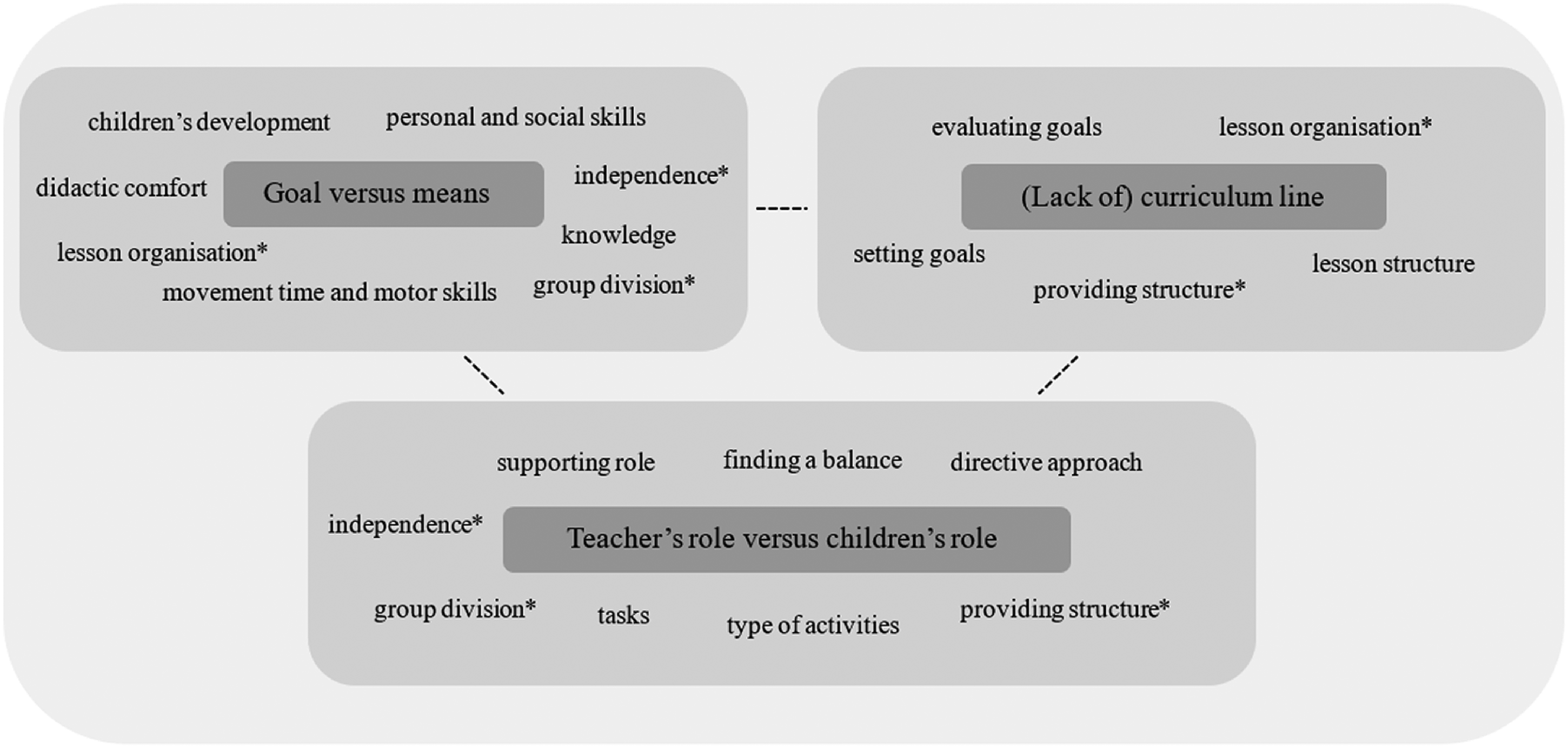
Network: A visual representation of the first cycle codes and second cycle themes.
Theme 1: goal versus means
The PE teachers in the current study perceive and operationalise the intended personal and social development goals by facilitating opportunities for children to manage PE activities independently. All 12 teachers mentioned children's independence when asked why it is important to teach children to manage PE activities. ‘So, the areas where I am not present, the children can do the activities independently’, as William said. The importance of children's independence is also evident in the following excerpt of Emma's interview: I think when you are a teacher, you are trying to make children more independent … because eventually education should be about that. So, they have to do it together– and there is not always someone like a mother or father or a teacher or whoever present who can regulate.
The teachers valued the opportunities for children to manage PE activities so they can learn to play, manage, experience, and solve things independently. In light of children managing activities independently, more than half of the teachers mentioned the transfer of children's independence to other contexts, i.e., after-school activities, the schoolyard, and the sports club. Furthermore, some teachers referred to a larger picture in terms of children's development, as they state that the curricular goal of managing PE activities is ‘essentially the development of the child’ (James) or ‘one of the main societal goals we have as educators’ (Ryan). Some teachers also refer to the importance of independence for the future, as evident in the following example of William: Because I think that if you teach children from an early age to manage activities, then of course they take it with them to the future and that is of course nice if you have learned that early on. And it can all be just small things, but this way, you try to pass that on to those children.
When it comes to children's development in relation to the curricular goal of managing PE activities, five PE teachers made references to a need for knowledge. According to these teachers, children need a certain knowledge of the activity (e.g. rules), the different materials, and the structure of a lesson to be able to manage PE activities by themselves (i.e. independently). Ryan, for example, said: ‘It is also their understanding of the activities. If they understand the structure, they can start to manage it independently’.
In addition to knowledge, as indicated by all 12 teachers, is the need for personal and social skills. Examples of skills that were mentioned are self-management, decision making, problem-solving, leadership, cooperation, communicating, handling winning or losing, respect, following rules and obeying a referee's decision. In addition to these skills, some teachers also value the opportunity for children to interact with others as evident from the following two quotes: ‘You do not have to be friends with everybody, but you need to be considerate of each other’ (Susan) and ‘Learning to interact with each other because sometimes you need to work with people you do not like’ (Aaron).
That teachers pay attention to personal and social goals by having children manage PE activities also became evident when asking teachers to clarify their lesson organisation. Rather than teaching one activity (e.g. swinging rope) per lesson, all teachers preferred working with three or more different activities (e.g. swinging rope, acrobatics and climbing) in one lesson. Children then either rotate from one activity to another or switch freely. According to the teachers, children have the opportunity to manage all types of activities, both individual and group activities. They can manage activities where one goes after another (e.g. swinging rope) and activities where you do something together (e.g. soccer). Central to working in different groups, for example groups of about six children, is the possibility for children to work in a self-regulated way.
Yet, from some of the teachers’ quotes it became clear that they not only organise their lessons this way to realise personal and social goals. When asked why they work in multiple groups, they mentioned two additional motives, i.e. comfort and movement time and motor skills. Four teachers referred to a sense of comfort, and said that this way of teaching enables ‘different activities to run smoothly’ (William), ‘providing a sense of calmness’ (Ryan) and ‘to make it easier for myself’ (Daniel). To illustrate, Daniel said: ‘Well, it just gives me a certain peace at a given moment. And if it gives me peace, then it shows too. And I think that is also reflected in the group’. We labelled this motive as didactic comfort.
The other motive is the need to maximise movement time and improve motor skills. Some teachers indicated that one of the reasons for working in different groups, and not with the whole class, is increasing children's movement time and intensity and preventing children from standing in line. To illustrate, the teachers said that this teaching method (i.e. children managing PE activities) results in ‘less time spent on instruction’ (Emma), inducing ‘more time to offer help where needed’ (Thomas), and ‘paying more attention to learning to move better’ (Susan). Along similar lines, some teachers choose to make groups themselves for the sole purpose of preventing disagreement among children and, as a result, maximising movement time. This is illustrated in the following example of Emma: Because then they get into an argument, and it never goes well. Then, you are actually more concerned with that than with actually moving, and that is just a shame. I do not prefer it because I want everybody to be able to play together. However, you cannot always do that.
For one teacher, Jack, the importance of movement time was also a reason to decide that it was not worth giving up movement time to apply what he had learned in a coaching course. Jack felt he did not have sufficient class time to have long conversations with children. He said: ‘I do not have time for that, I only have 40 or 45 minutes, and I want children to move’.
Theme 2: teacher's role versus children's role
As mentioned in the first theme, the PE teachers in the current study operationalised personal and social development goals predominantly by facilitating opportunities for children to manage PE activities. The teachers allowed children to manage and clean up the materials, choose their own rules (e.g. in a game), act as referees or mediators, provide help, and invent a game and explain it to peers. Interview data showed that some teachers even let children experiment with teaching their own lessons. For example, Emma said: ‘And they can teach the activity themselves. If they want. It is optional, it is voluntary. I do not want to pressure children who find it very scary.’ With these tasks, the teachers provide children with the opportunity to take on an independent role. When questioned about their role, the teachers indeed described letting the children work independently, such as letting them experiment and experience whether they chose a good rule to be able to play a game. In this way, they want to give children ownership and responsibility for their learning. They further described their role as being there when help or support is needed, letting go of things going on, not panicking quickly, ‘just standing next to it’, watching what happens and stepping in when things do not work. When a group cooperates well and can listen to one another, they can let go of things more. Continuing this topic, they also described the importance of providing structure to allow children to work independently. The teacher needs to provide structure and clarity, e.g. the rules of an activity have to be clear for children to manage it, and there must be a setting with sufficient variety and challenge. To illustrate, Charlotte said: ‘It's just, I have a certain structure. So that structure also includes managing activities [by the children]. The children do not realise that as being, ‘I am learning to manage activities now’, but that is just the structure in the lesson.’ According to the teachers, good organisation is needed for children to manage their own activities better. When teachers are well prepared and have set conditions, children can fill things in rather independently. Some teachers also mentioned finding a balance between giving some responsibility to the children but not letting everything get out of hand. Robert, for example, said: ‘I think I give children freedom in a structured way. I really offer a very clear framework and within that framework they have the space to manage activities.’ Looking back at previous experiences and forward to what is to come, some teachers indicated they should let go of things more and dare to take a step back, letting children think alone and make their own choices.
Despite the opportunities they provide for children to take on an independent role, some teachers recognised that they may sometimes have difficulties to refrain from a directive approach, which means being on top of things and taking the lead. Quotes from two teachers’ interviews illustrate this directive approach: ‘I regulate rather than allowing children to regulate themselves’ (Emma) and ‘I am still quite directing in that regard’ (Robert). When further explaining their teacher role, they indicated that they immediately step in when a group falls apart, in case of a conflict, when emotions are running high, or in cases of physical or verbal aggression. The tendency to lean towards a directive approach is particularly evident when groups need to be divided. Most teachers prefer to make groups themselves because, for example, it is important for the calmness of the group. Avoiding unrest is evident in the following example of Robert: ‘But I do see that it also gives the children a certain restlessness. And when there is restlessness, you as a teacher have to step in earlier and therefore there is less room for children's self-regulation.’
The teachers mentioned that it is not always feasible to give the responsibility of dividing groups to the children. The teachers mentioned that they often have to intervene ‘when it turns out the groups are really unfair’ (Charlotte) or when children fail to divide themselves into groups. As letting children divide themselves into groups can be tricky, some teachers like to stay in control by imposing rules, for example ‘a boy has to choose a girl and a girl has to choose a boy’ (Daniel).
Theme 3: (lack of) curriculum line
When asked how they structure their lessons, it stands out that most teachers said they do not set longer-term learning goals regarding personal and social goals. A reason for this is that the realisation of personal and social goals through having children manage their own PE activities ‘is just part of it’. The three teachers who do set learning goals, and evaluate these accordingly, choose goals that relate to dealing with winning or losing, cooperating with peers, working independently, and keeping agreements. In addition to these three teachers, some teachers have certain goals in their head, but these are not specified or written, or they only consider assessing the child's effort. The other teachers mentioned they do not set and evaluate learning goals. To illustrate, a quote of Daniel who said it entails a certain pressure to evaluate these goals: ‘I do not like to stick to certain learning goals, to evaluate these and to expect things. I try to stay out of this as much as possible. However, with motor skills, I have to’.
When questioned about the presence of a curriculum line, the PE teachers did recognise the importance of preparation, repetition, and good lesson organisation and lesson structure. Nevertheless, most teachers indicated not having a structured lesson format regarding the realisation of personal and social goals. Usually, certain elements are present in a single lesson, e.g. counting points. However, there is no specific structure or curriculum line and their structure is ‘not truly conscious’ (Susan), but rather ‘it develops over the years’ (Emma).
Some teachers choose to repeat activities for consecutive weeks. In this way, teachers spend less time on instruction, as children are supposed to know how to manage a specific activity. However, other teachers choose not to repeat activities, as illustrated in the following example of William: I actually want to offer as much as possible in one year, and there are all these new things on social media that I want to try. In addition, I just want to do as much as possible in the lessons.
Discussion
Personal and social development constitutes an important goal of PE curricula worldwide. At the intended level of a curriculum (Van den Akker, 2003), policy makers prescribe learning goals related to this area of children's development. In the transition from the intended curriculum to the implemented curriculum, teachers play a vital role (Ross, 2017) as they interpret the intended goals and operationalise these in their lessons. Understanding how PE teachers interpret and operationalise personal and social development goals is important to inform curriculum developers and PE teacher educators. Therefore, this study explored Dutch experienced primary school PE teachers’ perceptions and operationalisations in light of personal and social development goals. In the attempt to describe how PE teachers perceive and operationalise the intended curriculum, three themes were constructed.
The teachers in this study seem to predominantly address personal and social goals by having children manage PE activities (theme 1). This is evident from how they organise their lessons, the tasks and activities they provide, and how they divide children into groups. Their lesson organisation is characterised by offering three or more activities between which children rotate. Children work in small groups and are assigned tasks and roles to keep the activity going with limited help from the teacher. The teaching strategies used by the PE teachers in the current study are strategies of the different pedagogical models. That is, assigning management tasks and giving students choices and voices are at the core of TPSR (Baptista et al., 2020; Hellison, 2011; Pozo et al., 2018; Wright and Craig, 2011). Facilitating opportunities for children to take on different roles (e.g. referee in a basketball game) is an essential feature of Sport Education (Bessa et al., 2019; Siedentop et al., 2011). Emphasising interpersonal and small-group skills is an important aspect of Cooperative Learning (Casey and Goodyear, 2015; Dyson and Casey, 2012, 2016). In pursuing the intended goals, teachers stimulate initiative-taking, and they provide choices and room for experimentation. This brings us to the second theme, which shed some interesting light on teachers’ styles when working towards personal and social development goals. According to the research on Self-Determination Theory (Ryan and Deci, 2017), the strategies PE teachers rely on to address personal and social goals are part of an autonomy-supportive style (Reeve, 2009), which is considered highly motivating (e.g. Haerens et al., 2015). At the same time, teachers highlighted the importance of providing sufficient structure when stimulating children's responsibility so that ‘things do not get out of hand’. Such quotes relate to Aelterman and colleagues’ (2019) work on teachers’ motivating styles. This showed that many teachers are challenged to provide sufficient structure and avoid becoming passive, chaotic or too permissive when implementing autonomy-supportive strategies such as the stimulation of initiative from the students’ styles. Relatedly, some teachers indicated that they have difficulties to refrain from a directive approach. This was most eminent concerning the division of groups. Particularly if children started to have discussions, teachers tended to retake control. Similar findings were discussed by Casey and MacPhail (2018), providing a first empirical insight into using multiple models-based approaches to teach PE. The authors addressed the pitfall of too much guidance and discussed the need to reduce teacher involvement and make ‘a conscious decision to allow more space in lessons for student involvement’ (Casey and MacPhail, 2018: 304). Future research and practice should shed light on this struggle for teachers to foster autonomy and can further explore the concept of (de)motivating teaching styles concerning personal and social development goals.
The results further indicate that the strategies to develop personal and social goals are not systematically and structurally addressed by the PE teachers in the current study (theme 3). There appears to be a lack of knowledge of a framework or structure concerning how teachers can organise their lessons, as teaching strategies are applied in a fragmented, rather than purposeful, fashion. This reminds us of Casey and Quennerstedt’s (2020) work that argues for a more enduring approach, as cooperation cannot be learned simply by working in groups in a single PE lesson. The same reasoning might hold for teaching children to manage PE activities. An explanation for the lack of structure may be the multiple conditions or challenges PE teachers face daily. Examples from the current study are children's poor work ethic or lack of intrinsic motivation, challenging classroom management, and the school's vision of the PE curriculum. Referring to the use of pedagogical models, Casey and colleagues (2021: 10) pointed out that teachers ‘tend to work in a context where the reality of their daily survival as a teacher does not afford the time to consider and upskill on the numerous assumptions and intentions of models’. When dealing with these conditions or challenges, too often, the focus is on whether children are busy and happy and perform well (Placek, 1983). Indeed, the current study showed that PE teachers greatly value movement time, pleasure and good behaviour. However, children moving, enjoying themselves and behaving should be treated as conditions pursuant to learning (McCaughtry et al., 2008). Teachers are challenged to move beyond these conditions to serve actual learning outcomes, such as personal and social development. Another explanation for the lack of structure may be in the choice of a multi-activity approach. Therefore, pedagogical models can be useful, as they can support teachers when eliminating a long and enduring tradition of a technique- or multi-activity-focused curriculum (Casey, 2014; Casey and Goodyear, 2015). Keeping in mind the risk of falling into recipe-like instructions (Casey et al., 2021), a model-based approach can be valuable in creating a student-centred learning environment (Wallhead and Dyson, 2017) and allowing teachers to work for an extended period in an in-depth manner (Aggerholm et al., 2018). Regardless of the possibility to adopt a models-based approach, it is particularly important to systematically and structurally address the strategies to develop personal and social development goals. Therefore, it is essential to provide PE teachers with the necessary training and ongoing support as teachers lacking experience, confidence and competence often return to their traditional approach (Casey, 2014; Goodyear and Casey, 2015).
In line with previous studies (Wright et al., 2021; Hardman et al., 2014) which also found that teachers address the importance of motor development while focusing on acquiring personal and social skills, PE teachers in the current study considered motor goals at the centre of PE curricula. While some teachers allow children to manage activities with the clear goal of fostering personal and social development, others also have children manage the activities but do it to improve motor skills or maximise movement time. This predominant focus on movement time and motor learning sometimes makes teachers want to avoid disagreements or discussions as these take away time for possible motor learning moments. Part of children's personal and social development is the idea of learning how to communicate and solve problems with peers (Opstoel et al., 2020). Weighing the importance of different PE goals also resonates with some of the critiques that have been raised on the use of pedagogical models. That is, ‘the potential deleterious effect that student-initiated interactions can have on the pace and efficacy of content development that occurs within the small group structure of the (pedagogical) models’ (Wallhead and Dyson, 2017: 312). Nevertheless, earlier work on pedagogical models has also indicated that positive student interactions within small groups can facilitate learning in all three of the psychomotor, cognitive and affective domains (Casey and Goodyear, 2015; Wallhead and Dyson, 2017). Along similar lines, Dyson (2001), among others, has argued that movement does not occur in isolation from the cognitive, social or affective domains. Therefore, PE teachers are challenged to find a balance between maximising movement time for motor and health goals and allowing discussions for personal and social development goals.
Limitations and recommendations
The current study explored how experienced PE teachers perceive and operationalise the curriculum provided by Dutch policy makers. The intended curriculum level was briefly discussed and served as a background, and the implemented curriculum was examined in the current study (Van den Akker, 2003). However, the attained curriculum (i.e. the learning experiences and resulting learning outcomes of children) was not included in the present study. Therefore, we were not able to judge the constructive alignment of the curriculum or, in other words, whether the goals and learning activities align with the assessment (Borghouts et al., 2017). Additionally, this study used interview data to explore teachers’ point of view on personal and social development goals. We cannot judge whether and how the mentioned strategies are actually applied in the classroom. Future research should attempt to explore all curriculum levels to judge their constructive alignment and include observational data to link teachers’ perceptions to their classroom practices. Furthermore, to stimulate a more systematic pursuit, PE teachers can more regularly include an assessment of personal and social development goals (Borghouts et al., 2017). Future research can focus on developing evaluative measures to map the development of personal and social skills within the context of PE. This might be possible when the social and personal goals are more clearly defined and clarified (Krijgsman et al., 2019).
Another limitation concerns the focus on experienced PE teachers. Their views provided rich and detailed information on their teaching practices following years of experience. However, little can be said about less experienced PE teachers and how they might struggle with curricular goals. To understand the role of years of experience, future studies can include and follow teachers from early in their careers. Continuing the topic of experience, the PE teachers in our study graduated many years ago. As a result, we did not account for any changes in PE curricula made since then. Recently, the Dutch Inspectorate instructed a revision of the curriculum (Curriculum.nu, 2019). Future research can consider the extent to which personal and social development goals are emphasised in the renewed curriculum and their possible effects on changes to teacher education and the continuous professional development courses offered. In addition, as recommended by Wright et al. (2021: 83), ‘policy makers should consider the complex challenges that new curricula present for teachers, conduct a needs assessment to support teachers’ on-going professional learning, consider the allocation of time for reflection and foster a safe space for pedagogical innovation’.
Finally, the current study focused specifically on the Netherlands, a country where models-based approaches are less well known. However, little can be said about how personal and social development goals are perceived and operationalised in other countries, such as in countries where pedagogical models are more explicitly taught and implemented. Given the increasing importance of personal and social development goals, also evident from the resurgence of citizenship education (Garratt and Kumar, 2019; UNESCO, 2021), it might also be of interest for researchers of other countries to shed light on how personal and social development goals fit within a curriculum and to what extent teachers actually pursue these goals. A cross-cultural comparison would be highly relevant in this respect.
Conclusion
Despite the lack of formal training and the number of challenges PE teachers struggle with daily, teachers have found a way to pursue the intended personal and social goals by making children responsible for managing PE activities. While giving responsibility to the children, the teachers in this study struggle to provide sufficient structure and avoid intervening too fast. In most cases, their applied strategies seem to be more fragmented than goal-oriented strategies and a clear curriculum line is missing. The tension between realising different PE goals and applying an appropriate teaching style to pursue these goals complicates the operationalisation. Therefore, opting for a model-based approach might be a solution, as it is considered ‘an effective pedagogy with the intent of focusing on specific, relevant and challenging outcomes that allocate more time for learners to be engaged with learning’ (Casey et al., 2021: 6). The current study provides a first look at the curriculum interpretation and implementation of primary school PE teachers regarding personal and social development goals. To broaden our findings, it is worth exploring the implemented curriculum among PE teachers working in different contexts, for instance with more or less experience. As teachers are considered gatekeepers to curriculum implementation (Casey and MacPhail, 2018), future research and practice should devote time and effort to the training of PE teachers in pursuing personal and social development goals in a more structured and systematic way.
Footnotes
Declaration of conflicting interests
The authors declared no potential conflicts of interest with respect to the research, authorship, and/or publication of this article.
Funding
The authors disclosed receipt of the following financial support for the research, authorship, and/or publication of this article: This research was supported by the Special Chair ‘Pedagogy of Physical Education’ founded by the Royal Dutch Association for Physical Education (KVLO) at the Faculty of Social and Behavioural Sciences of Utrecht University in the Netherlands.
