



Abstract
Despite the prominence of fitness testing in school physical education (PE), there is a sparsity of research examining the antecedents of students’ affective experiences during fitness testing lessons. This study aimed to investigate the associations among task- and ego-involving motivational climates, perceived physical competence, physical performance, enjoyment, and anxiety during two different types of PE fitness testing lessons. Altogether, 645 Finnish students from Grade 5 (50% boys, Mage = 11.2, SD = 0.36) and Grade 8 (47% boys, Mage = 14.2, SD = 0.35) participated in two fitness testing lessons with different content (lesson 1: 20-meter shuttle run test and a test of flexibility; lesson 2: curl-ups, push-ups, 5-leaps, and a catching-throwing combination test). Students’ experiences were collected using short questionnaires immediately after the lessons. Structural equation modeling was applied to examine the direct and indirect associations among study variables. Results indicated that task-involving climate and perceived competence increased students’ enjoyment and decreased their anxiety levels whereas ego-involving climate had no effect on students’ enjoyment but increased their anxiety levels. In addition, students’ actual physical performance as a mediator between motivational climate and affects, or as a direct predictor of affects, was limited. Strategies advancing task-involving motivational climate and students’ perception of competence should be employed to increase enjoyment and decrease anxiety during PE fitness testing lessons.
Introduction
School physical education (PE) can have a considerable effect on building a mindset for lifelong physical activity (Sallis et al., 2012). This is because it is implemented by teaching professionals and therefore has the capability to generate positive experiences of engagement in physical activity uniformly for the school-aged cohort (Sallis et al., 2012). One commonly implemented curriculum element of secondary school PE is fitness testing (O’Keeffe et al., 2019); however, it is also a practice that has generated much debate among researchers and practitioners (Cale and Harris, 2009; Jaakkola et al., 2013; Naughton et al., 2006; Rice, 2007; Silverman et al., 2008; Simonton et al., 2019). Fitness testing may have the potential to increase students’ awareness of their physical fitness status and their willingness to maintain or increase their physical activity levels (Harris and Cale, 2006). It has also been suggested that fitness testing may have other positive effects such as enhanced levels of motivation (Jaakkola et al., 2013). On the other hand, some scholars argue that if fitness testing is done in isolation from the curriculum, it can have a negative impact on students’ interest in PE and willingness to be physically active (Cale and Harris, 2009; Rice, 2007). Despite an increased level of research being undertaken, the questions of how fitness testing affects students’ psychological and affective experiences are still mostly unanswered. Therefore, the aim of this study was to examine associations among social, physical, cognitive, and affective factors during fitness testing lessons.
During PE and fitness testing lessons, students’ perceptions of the social environment have a significant influence on their experiences (Ames, 1992; Duda, 1996; Nicholls, 1989). One representation of the social environment that is believed to influence individual motivational processes and subsequent outcomes such as affect is the concept of perceived motivational climate (Ames, 1992; Ames and Archer, 1988). Students’ motivational climate is often instigated through the actions of both teachers and significant others (Nicholls, 1989). The two main elements of motivational climate are task- and ego-involving climates (Ames, 1992). Task-involving climate is characterized by elements such as trying one's best, focusing on learning and self-improvement, showing effort, and working in co-operation with others. Ego-involving climate, on the other hand, is characterized by elements such as social or normative comparison and competition between students (Ames, 1992). Previous studies in PE have demonstrated that students’ perceived task-involving motivational climate is positively associated with a range of adaptive outcomes such as perceived competence and enjoyment (Cox and Williams, 2008; Gråsten and Watt, 2017). Students’ perceived ego-involving climate, however, has been found to be related to maladaptive outcomes such as boredom, anxiety, and feelings of less enjoyment (Carpenter and Morgan, 1999; Ommundsen and Kvalo, 2007; Papaioannou and Kouli, 1999). Despite the extensive research attention, there is a lack of research on motivational climate conducted specifically in PE fitness testing situations.
In addition to social influences, many other psychological and physiological factors such as perceived physical competence and actual physical performance have the potential to influence students’ affects during fitness testing lessons. Perceived physical competence can be described as the students’ own assessment of their ability to accomplish different tasks in given domains such as school, sport, or physical activity (Fox, 1997). According to Harter's (1978) competence motivation theory, perceptions of one's abilities are cumulatively formed when interacting with the environment. Individuals with high perceived competence are more persistent in chosen activities than those with low perceived competence (Harter, 1978). In previous studies, higher perceived physical competence has been linked with increased enjoyment in PE lessons (Carroll and Loumidis, 2001; Fairclough, 2003), and lower anxiety in test situations (Putwain and Symes, 2012). However, there is a lack of research conducted in a PE fitness testing context that has investigated the relationships between perceived competence and affective outcomes. One exception to this is a study by Lodewyk and Muir (2017) where they showed that self-efficacy—a central construct to social cognitive theory (Bandura, 1986) and closely related to perceived competence—was negatively associated with state anxiety and social physique anxiety.
Similar to perceived physical competence, the actual physical performance also influences students’ affects in PE. More specifically in this study, physical performance is operationalized as motor competence and health-related fitness. Motor competence refers to students’ locomotor (e.g. run and jump), stability (e.g. dynamic balance), and object control (e.g. throw and catch) skills (Donnelly et al., 2017). Health-related fitness includes students’ cardio-respiratory fitness and muscular fitness. A review by Ortega et al. (2008) demonstrated that physical fitness, especially cardio-respiratory fitness and muscular fitness in childhood and adolescence, are powerful determinants of overall health. Although previous research on the associations between physical performance and affective outcomes related to fitness testing is limited, a recent investigation by Simonton et al. (2019) demonstrated that students’ fitness test performance was weakly related to students’ attitudes and perceptions of enjoyment, boredom or anger towards PE.
Both situational social and individual factors, related to perceived physical competence and actual physical performance, can provoke negative or positive affects among students (Fairclough, 2003; Gråsten and Watt, 2017). One example of positive affect is enjoyment, which can be operationalized through terms such as liking, pleasure, happiness, and fun (Scanlan and Simons, 1992). It is also seen to represent more generalized feelings and not specific emotions such as excitement. According to Hashim et al. (2008), enjoyment can also be characterized as a multidimensional construct firmly related to enthusiasm and perceptions of competence. Moreover, Goetz et al. (2006) proclaimed enjoyment as a hierarchically structured concept meaning that perceptions of it may be different in general life than in specific contexts, such as in sport or in PE. Despite the substantial interest in enjoyment within activity settings and specifically in the PE context (e.g. Dishman et al., 2005; Hashim et al., 2008), there are only a few investigations of enjoyment concerning fitness testing situations. For example, Huhtiniemi et al. (2021) showed that Finnish 11–15 year old students perceived lower levels of enjoyment during fitness testing lessons than in PE in general, despite still being on average at the moderate level. Furthermore, O’Keeffe et al. (2020) demonstrated that Irish high school students (mean age 13.2 years) had positive attitudes toward a student-centered health-related fitness test battery.
Irrespective of the fact that the majority of students find PE fun and likeable, there might be some who experience negative thoughts and feelings during PE lessons (Barkoukis et al., 2005; Liukkonen et al., 2010). For example, fitness testing situations could be particularly stressful if performances are visible to others and scores are used in grading (Clarke, 2006). One of the most regularly studied negative affects in PE settings is anxiety. During PE lessons, there are many psychosocial factors such as lesson content, teacher's interpersonal teaching style, class atmosphere, and motivational climate that might cause a response towards anxiety (Barkoukis et al., 2005; Liukkonen et al., 2010). From a wider educational perspective, negative associations between anxiety in test situations, a range of behavioral and affective outcomes, have been consistently shown (Von der Embse et al., 2018). However, previous research concerning anxiety in PE fitness testing situations is limited. Recently Huhtiniemi et al. (2021) demonstrated that Finnish Grade 5 and 8 (11–12 and 14–15 year old) students perceived lower levels of cognitive anxiety and higher somatic anxiety in fitness testing than in general PE. They also concluded that levels of worry remained relatively stable between fitness testing and PE in general. Despite limited research concerning motivational climate in fitness testing, it can be hypothesized, based on previous findings, that task-involving motivational climate in PE should be associated with lower levels of anxiety, and ego-involving climate with higher levels of anxiety (Barkoukis et al., 2008; Cecchini et al., 2001; Papaioannou and Kouli, 1999).
Previous literature presents only a few studies that have explored motivational variables in fitness testing lessons in PE. Goudas et al. (1994) found that 12–15 year old students’ reactions to fitness testing vary based on their goal orientations, performance, and perceived success. They demonstrated that participants with high task and low ego orientation also showed high levels of enjoyment regardless of their performance in a 20-meter shuttle run test. Similarly, Garn and Sun (2009) investigated the effects of achievement and social goals on middle school students’ (aged 11–15 years) effort and test performance on the Progressive Aerobic Cardiovascular Endurance Run (PACER). They concluded that mastery-, task-, and friendship-approach goals have the ability to positively influence either effort or performance. Moreover, Jaakkola et al. (2013) conducted an investigation in which students performed three tests: 5-leaps, figure-8 running, and curl-ups. Results showed that students reported higher levels of autonomous motivation, and also higher levels of amotivation during fitness testing lessons than in the general PE program. In addition, they found that students’ fitness levels were positively associated with perceived competence which, in turn, was positively associated with intrinsic motivation during fitness testing. It is noteworthy that previous studies conducted on fitness testing in a PE context have mainly pertained to individual cognitive attributes such as goal orientations or motivational regulations.
Despite previous studies providing pertinent information concerning the motivational and affective experiences during fitness testing, there are several reasons for additional investigations. Firstly, there are no studies on fitness testing in PE contexts where the role of students’ perceived motivational climate has been investigated. Also, none of the previous investigations have considered the concurrent mediational roles of perceived competence and actual physical performance (Stodden et al., 2008) when predicting students’ affective experiences during fitness testing lessons. Such investigations are warranted as previous research has demonstrated associations between perceived competence and affects (e.g. Fairclough, 2003; Putwain and Symes, 2012), and between actual physical performance and affects (e.g. Simonton et al., 2019) in PE and test settings. Furthermore, some previous studies have focused on just one fitness test (e.g. PACER) (Garn and Sun, 2009; Goudas et al., 1994) which narrows the perspective as students might perceive different tests affectively in various ways (e.g. skill-related fitness tests might be more fun than endurance-related fitness tests). Hence, a wider battery of tests would allow not only more detailed investigations of students’ perceptions but also a more comprehensive selection of physical performance indicators. Stemming from these arguments, and to add to the current body of knowledge, we created a model to investigate how social factors (motivational climate) and individual cognitive and physical factors (perceived physical competence and actual physical performance) influence students’ affective responses during fitness testing lessons. More specifically, the aim of the study was to investigate direct and indirect associations among task- and ego-involving motivational climates, perceived physical competence, physical performance, enjoyment, and anxiety during fitness testing lessons. As it has been previously shown that fitness test type can have an impact on students’ affect-related attitudes towards fitness testing (Mercier and Silverman, 2014), the investigation was conducted on two different types of fitness testing lessons (lesson 1: 20-meter shuttle run test and a test of flexibility, lesson 2: curl-ups, push-ups, 5-leaps, and catching-throwing combination tests).
Methods
Study design and participants
This investigation employed a cross-sectional design. Participants of the study represented 12 schools and 36 classes that were recruited from different regions in the southern, western, and central parts of Finland. The description of the study with an invitation to participate was sent to the school principals and willing schools were recruited. There were 25 students (3.7%) who did not participate because they were absent due to sickness at the time of the study. This resulted in a total of 645 participants from Grade 5 (n = 328) and Grade 8 (n = 317). The mean age of students in the Grade 5 sample was 11.2 years (SD = .36) and in the Grade 8 sample 14.2 years (SD = .35). Both samples were approximately equal in terms of gender (50.0% boys in Grade 5 and 47.3% boys in Grade 8). Grade 5 and 8 students were selected for the study because fitness tests are a mandated part of the national curriculum at those grades (Finnish National Agency for Education, 2014).
Following common practice in Finland, students in Grades 1–6 were taught by classroom generalist teachers with non-specialist training in PE, and in Grades 7–9 by specialist PE teachers. All schools represented typical Finnish comprehensive schools, that is, Finnish-speaking, middle-sized (∼300–500 students) and not specifically profiled towards any subject area (e.g. sport or science). Moreover, all schools followed the same national core curriculum that states the mission, objectives, content, and evaluative practices in PE.
Procedure
The study was conducted in three phases. In phase one of the study, students’ perceived physical competence was measured via a short questionnaire during a regular PE lesson (contextual level). Two weeks later, during phase two, students took part in the first fitness testing lesson, and one week later, during phase three, they took part in the second fitness testing lesson. Immediately after the completion of the testing lessons students answered short questionnaires (∼5–8 min). Questionnaires were completed in the gym hall and students were specifically asked to reflect upon their perceptions of the lesson they completed (situational level). In order to study possible differences between the two types of fitness testing lessons, the situational questionnaires were completed after both testing lessons. The questionnaire were administered by students’ own PE teachers who were briefed regarding the research, and who followed written step-by-step instructions during the procedure. In order to protect confidentiality of the questionnaires data, participants used codes instead of names, and returned their answer sheets directly into a sealed envelope and not to their teachers. Students were allowed to ask for guidance if they did not comprehend some of the questions. Participation in the study was voluntary and students had an opportunity to withdraw at any time without consequences. Student assents and parental consents were collected prior to the study. The ethics committee of the local university approved the study protocol.
The first fitness testing lesson (90 min) contained a warm-up session, followed by a 20-meter shuttle run test which was conducted in two or three phases depending on the size of the class, and a short flexibility and mobility session where students performed squat, lower back extension and shoulder stretch tests. At the conclusion of the first lesson, a cool-down was performed. The second lesson (90 min) contained a warm-up session, followed by curl-ups, push-ups, 5-leaps, and catching-throwing combination tests, and a cool-down session. The protocol and test instructions (including the order of the tests) were obtained from the Move!—Finnish national monitoring system for physical functioning capacity that is a mandated part of the PE curriculum for all students in Grade 5 and 8 (Finnish National Agency for Education, 2014). Fitness testing lessons were taught by students’ regular teachers as researchers’ presence might have influenced students’ experiences. It is noteworthy that only the fitness testing protocol was instructed whereas teachers’ pedagogical and didactic actions, such as giving feedback or organizing tasks, were not instructed.
Measures
Enjoyment during fitness testing
The Finnish version of the Enjoyment subscale from the Sport Commitment Questionnaire-2 (SCQ-2; Scanlan et al., 2016) was used to assess enjoyment during PE fitness testing lessons. The scale items were modified to reflect the situational fitness testing lesson (e.g. “This fitness testing lesson was fun”). All five items were rated on a five-point Likert scale ranging from 1 = strongly disagree to 5 = strongly agree. The scale has been previously used among Finnish students in the PE fitness testing context with good psychometric properties (χ2(207) = 319.3, p < .000, CFI = .98, TLI = .98, RMSEA = .041, SRMR = .061) and factorial measurement invariance across Grade 5 and Grade 8 age groups (Huhtiniemi et al., 2021).
Anxiety during fitness testing
The Finnish version of the Physical Education State Anxiety Scale (PESAS; Barkoukis et al., 2005) was used to measure anxiety during the PE fitness testing lessons. The scale assesses three dimensions of anxiety, namely somatic anxiety, cognitive processes, and worry. Each dimension is formed from six items rated on a five-point Likert scale ranging from 1 = strongly disagree to 5 = strongly agree. Somatic anxiety refers to perceptions of physical symptoms (e.g. “I feel as if something is choking me”), cognitive processes refers to symptoms related to information processing, such as memory and attention, during the activity (e.g. “I find it difficult to memorize information regarding the tasks presented”), and worry refers to negative expectations from involvement in the activity and the consequences of possible failures (e.g. “when performing the tasks, I feel uneasy about potential mistakes”). In the questionnaire, the following item stem was used: “During the fitness testing lesson…”. All dimensions of the PESAS have been previously used with Finnish students in the PE fitness testing context and shown to have appropriate psychometric properties and factorial measurement invariance across Grade 5 and Grade 8 age groups (cognitive processes: χ2(302) = 441.7, p < .000, CFI = .95, TLI = .95, RMSEA = .038, SRMR = .068; somatic anxiety: χ2(308) = 628.1, p < .000, CFI = .91, TLI = .91, RMSEA = .057, SRMR = .080; worry: χ2(308) = 396.5, p = .001, CFI = .98, TLI = .98, RMSEA = .030, SRMR = .047) (Huhtiniemi et al., 2021).
Motivational climate
Motivational climate during fitness testing lessons was measured by using the Finnish version of the Motivational Climate in Physical Education Scale (MCPES; Soini et al., 2014). The scale items were modified to reflect the situational fitness testing lesson. The scale includes four dimensions, namely autonomy climate, relatedness climate, task-involving climate, and ego-involving climate. For the purposes of this study, only the task-involving (five items; e.g. “Learning new things makes me want to learn more”) and ego-involving (e.g. “During the fitness testing lesson students compete with each other in their performance”) subscales were used. Items were rated on a five-point Likert scale ranging from 1 = strongly disagree to 5 = strongly agree. In the questionnaire the following item stem was used: “During the fitness testing lesson …”. The Finnish version of the MCPES has been found to produce valid and reliable scores when used with adolescent students during PE lessons (CFI = .97, TLI = .97, RMSEA = .037, Cronbach's alphas ranged from 0.78 to 0.88) (Soini et al., 2014).
Perceived physical competence
To analyze students’ perceived competence towards physical activity we used the Finnish version of the sport competence dimension in the Physical Self-Perception Profile (PSPP; Fox and Corbin, 1989). The scale comprised five items that were each rated on a five-point Osgood scale from 1 = I’m among the best when it comes to athletic ability to 5 = I’m not among the best when it comes to athletic ability. The individual item stem of the scale is: “What am I like?”. The Finnish version of the perceived competence scale has been found to produce valid and reliable scores when used with students during PE lessons (χ2(5) = 22.67, p < .001, CFI = .98, TLI = .97, RMSEA = .074, SRMR = .020) (Gråsten, 2014).
Cardio-respiratory fitness, muscular fitness, and motor competence
Students’ cardio-respiratory fitness was measured using the 20-meter shuttle run test (Leger et al., 1988), also known as PACER (Plowman and Meredith, 2013). Muscular fitness was measured using the push-up and curl-up tests (Plowman and Meredith, 2013). Students’ locomotor skills were measured using the 5-leaps test (Jaakkola et al., 2012), and their object control skills were measured using the throwing-catching combination test (Jaakkola et al., 2012) where one throws a tennis ball to a specified target area on the wall (sized 1.5 × 1.5 m and situated 90 cm above the floor level) from a given distance (7 m for Grade 5 girls, 8 m for Grade 8 girls and Grade 5 boys, and 10 m for Grade 8 boys) and catches the ball after one bounce from the floor. All tests have been proven to produce reliable and valid scores among adolescents (Jaakkola et al., 2012; Olds et al., 2006; Plowman and Meredith, 2013). Students also performed three short flexibility and mobility tests (squat, lower back extension, and shoulder stretch test; Jaakkola et al., 2012) that were dichotomously scored (successful/unsuccessful). However, scores from these measures were not used in the analyses.
Statistical analyses
Normality of the data and possible outliers were examined during preliminary data screening. Descriptive statistics, with means, standard deviations and correlations, were established for the study variables. After the preliminary analyses, the direct and indirect associations between latent study variables were investigated using structural equation modeling (SEM). Two separate models were created in order to study the two fitness testing lessons with different content. A robust full-information maximum likelihood (MLR) procedure was implemented to estimate model parameters and to account for the possible non-normality of observations (Muthén and Muthén, 2017). Models were estimated using the TYPE = COMPLEX approach (Muthén and Muthén, 2017) which corrects standard error distortions caused by students being clustered in classes. To conduct mediation analyses in Mplus, MODEL INDIRECT command was used (Muthén and Muthén, 2017). Bootstrapping was applied to create confidence intervals for the indirect effects and to test the statistical significance of the mediation analyses (Hayes, 2013). Model fit was evaluated using the chi-square goodness-of-fit statistics (χ2), the comparative fit index (CFI), the Tucker-Lewis index (TLI), root mean square error of approximation (RMSEA), and standardized root mean square residual (SRMR). To interpret the fit indices, guidelines recommended by Hu and Bentler (1999) were used. The fit was considered good if the values for CFI and TLI were close to .95, for RMSEA < .06, and for SRMR < .08 (Hu and Bentler, 1999). All statistical analyses were performed using SPSS version 26.0 and Mplus version 8.2.
Results
A visual inspection of the histogram showed that the data were approximately normally distributed. Values for skewness and kurtosis were below 1.6. There were no significant outliers based on the standardized values ( + 3.0). Descriptive statistics and correlations among study variables are presented for both fitness testing lessons in Tables 1 and 2. Examination of the bilateral correlations between the study variables showed that enjoyment was positively correlated with perceived competence and fitness test scores, except for the 5-leaps test in the second fitness testing lesson. Additionally, there was a positive significant correlation between enjoyment and task-climate, and a nonsignificant correlation between enjoyment and ego-climate. In turn, all three anxiety dimensions were negatively correlated, or negligibly correlated with perceived competence and different fitness test scores. Furthermore, anxiety dimensions were positively correlated with ego-climate, and negatively with task-climate in both fitness testing lessons with the exception of the nonsignificant relationship between somatic anxiety and task-climate in the first fitness testing lesson.
Descriptive statistics and bivariate correlations among study variables in fitness testing lesson 1.
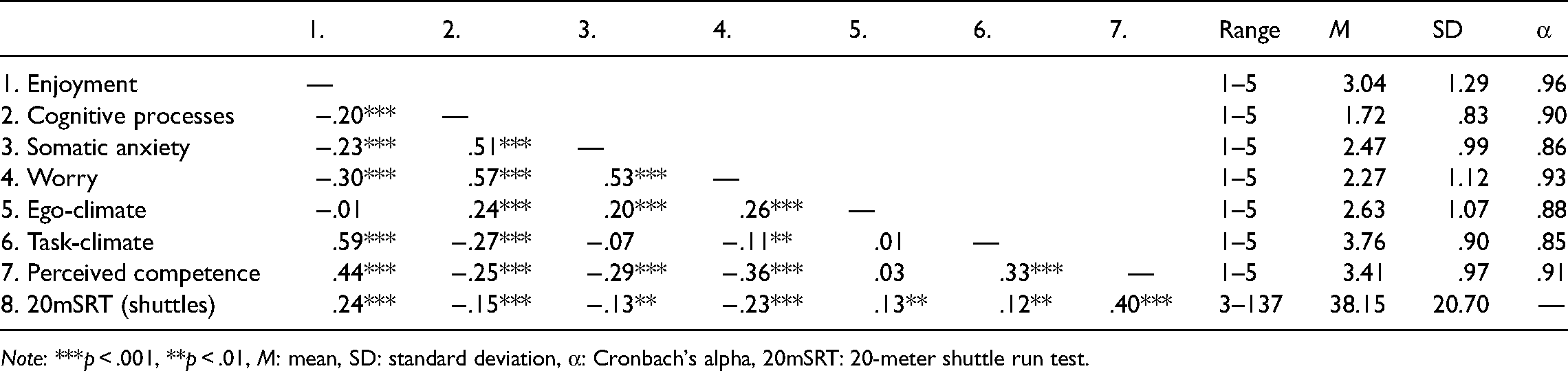
Note: ***p < .001, **p < .01, M: mean, SD: standard deviation, α: Cronbach's alpha, 20mSRT: 20-meter shuttle run test.
Descriptive statistics and bivariate correlations among study variables in fitness testing lesson 2.
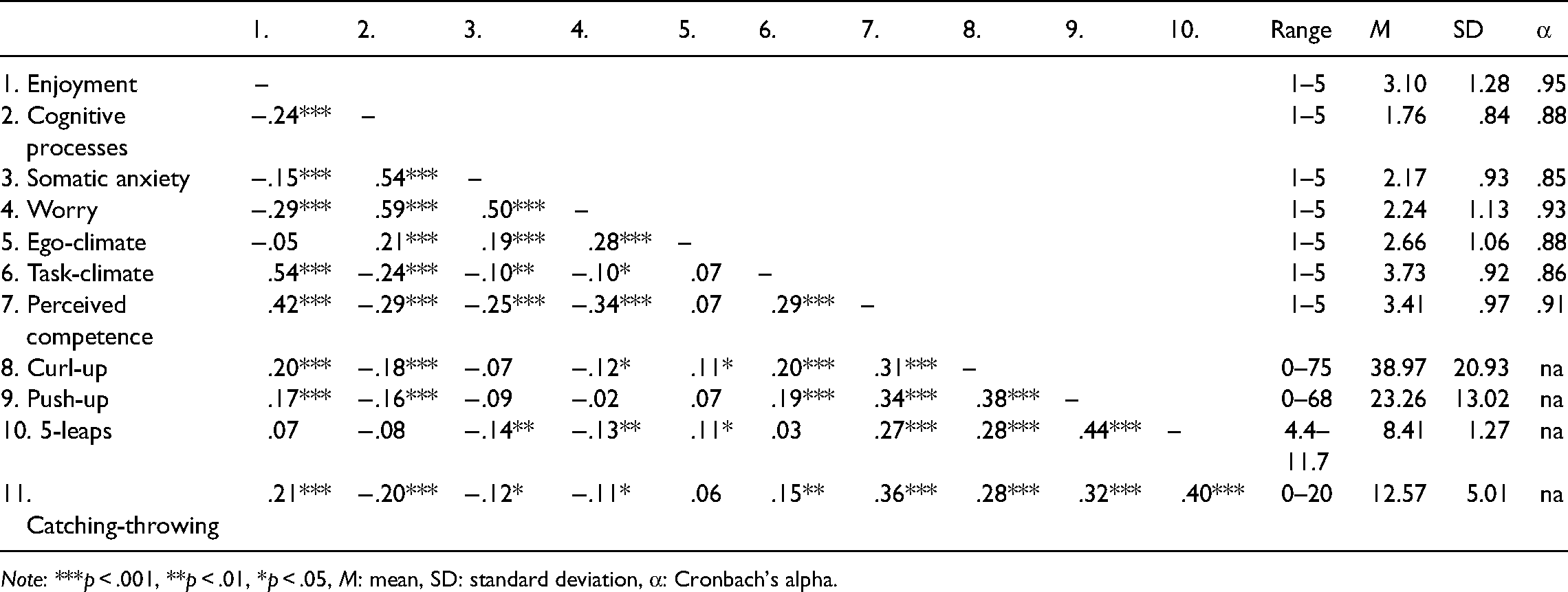
Note: ***p < .001, **p < .01, *p < .05, M: mean, SD: standard deviation, α: Cronbach's alpha.
Standardized total indirect and specific indirect effects of task and ego-involving climate for fitness testing lessons 1 and 2.
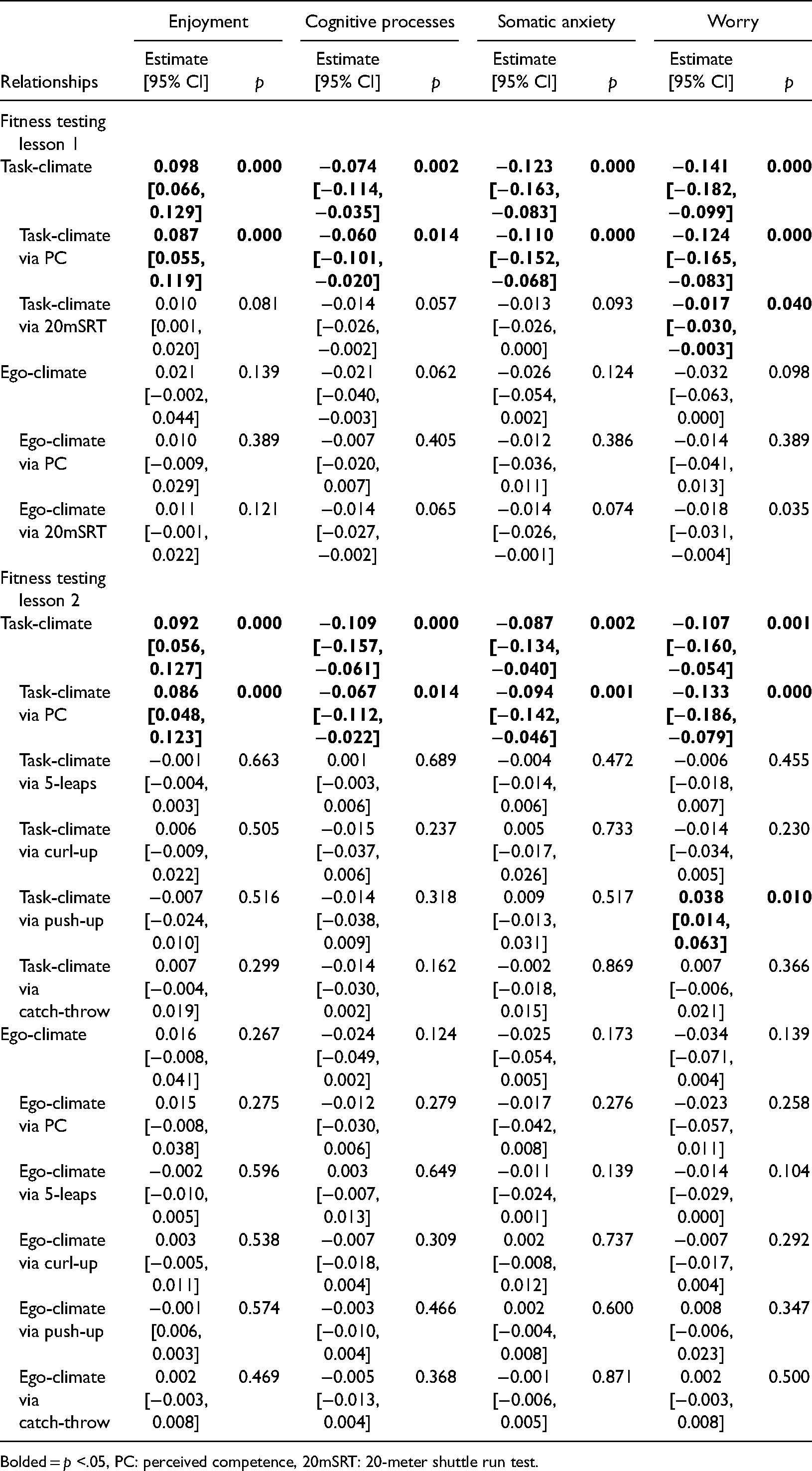
Bolded = p <.05, PC: perceived competence, 20mSRT: 20-meter shuttle run test.
Because students’ perceptions were assessed during two different fitness testing lessons with different content, we first established separate baseline models (measurement models) for both lessons. The model for fitness testing lesson 1 demonstrated a good fit to the data [χ2(645) = 1244.1, p < .000, CFI = .95, TLI = .94, RMSEA = .038, 90% CI [.035, .041], SRMR = .07] and the model for lesson 2 demonstrated an adequate fit to the data [χ2(762) = 1560.5, p < .000, CFI = .92, TLI = .91, RMSEA = .040, 90% CI [.037, .043], SRMR = .083]. After confirming the appropriateness of the measurement models, we proceeded to investigate the structural portions of the models by adding the regression paths between the study variables. Examination of the fit indices revealed that both final models had a good fit to the data [Fitness testing lesson 1: (χ2 (638) = 1160.8, p < .000, CFI = .95, TLI = .95, RMSEA = .036, 90% CI [.032, .039], SRMR = .057) and Fitness testing lesson 2: (χ2 (738) = 1412.5, p < .000, CFI = .93, TLI = .92, RMSEA = .037, 90% CI [.035, .040], SRMR = .066)]. The models revealed statistically significant direct and indirect paths between study variables as shown in Figures 1 and 2. The results of the mediation analyses with all specific and total indirect associations among study variables are presented in Table 3. Finally, squared multiple correlations showed that the model for the first fitness testing lesson accounted for 49% of variance in enjoyment, 20% in cognitive processes, 17% in somatic anxiety, 22% in worry, 15% in perceived competence, and 4% in 20-meter shuttle run test; and for the second fitness testing lesson, 46% in enjoyment, 19% in cognitive processes, 18% in somatic anxiety, 27% in worry, 18% in perceived competence, 10% in curl-up, 10% in push-up, 4% in 5-leaps, and 6% in catching-throwing combination.
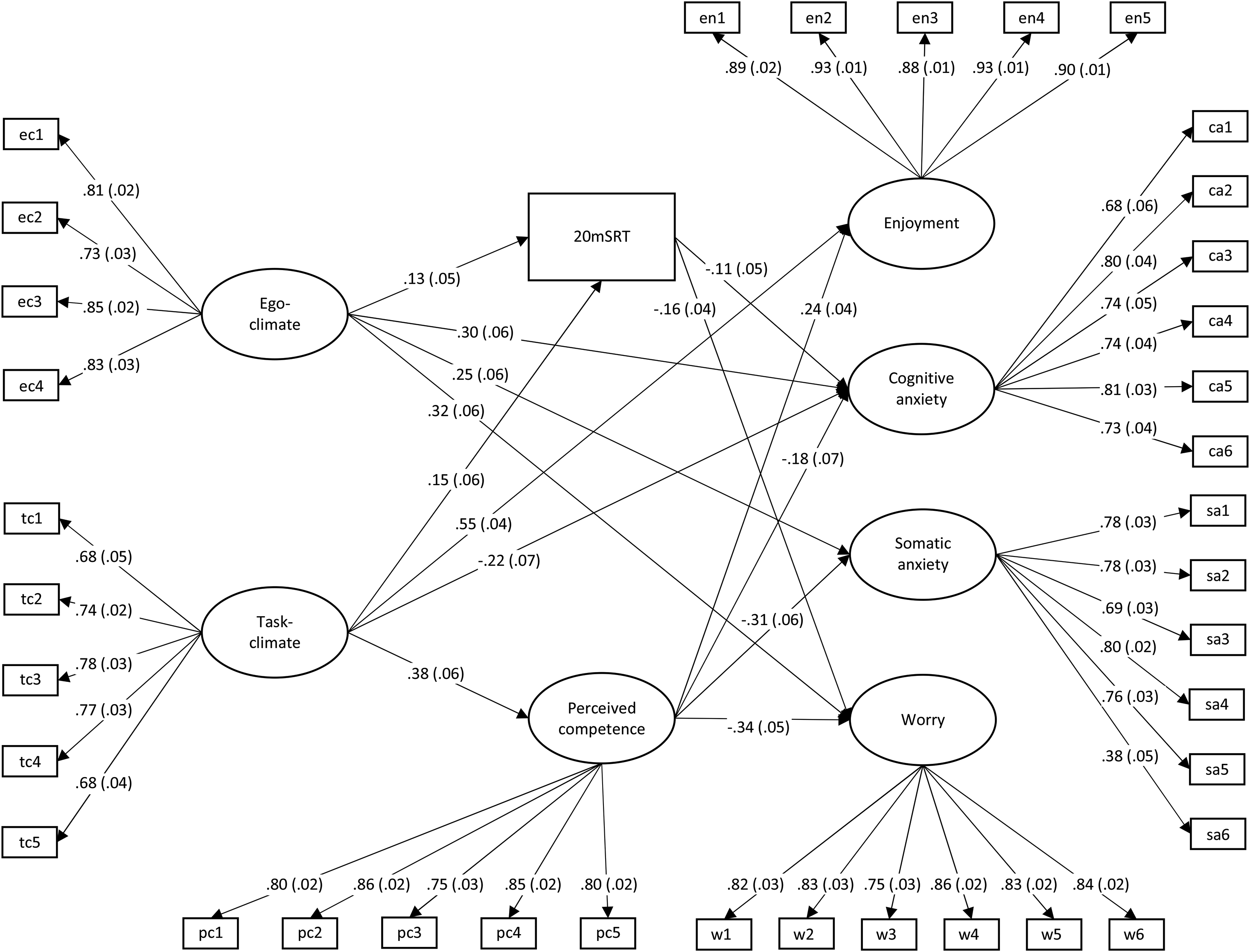
Structural equation model for fitness testing lesson 1. All paths are standardized and significant at the p < 0.05 level.
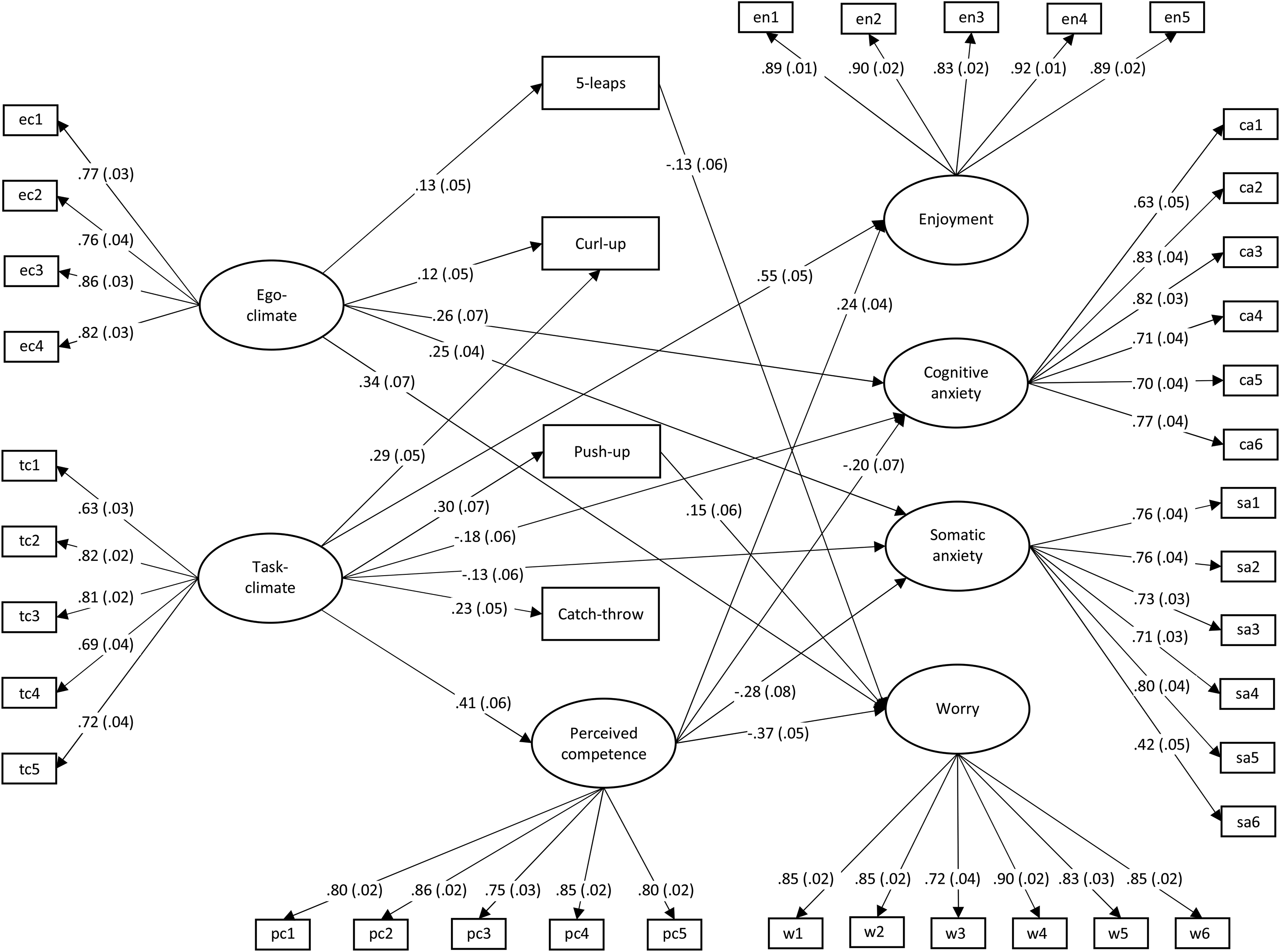
Structural equation model for fitness testing lesson 2. All paths are standardized and significant at the p < 0.05 level.
Discussion
The purpose of this study was to investigate direct and indirect associations among task- and ego-involving motivational climates, perceived competence, physical performance, enjoyment, and anxiety during two PE fitness testing lessons with different content. The first testing lesson included a 20-meter shuttle run and flexibility tests, and the second lesson consisted of curl-up, push-up, 5-leaps, and catching-throwing combination tests. Generally, the analyses revealed that task-involving climate and perceived physical competence increased students’ enjoyment and decreased their anxiety whereas ego-involving climate had no effect on students’ enjoyment but had a negative effect on their anxiety levels. Furthermore, the role of students’ actual physical performance was limited as a mediator between motivational climate and affects, or as a direct predictor of affects.
One of the most significant findings to emerge from this study was that task-involving climate and perceived competence directly associated with enjoyment in both fitness testing lessons. Besides the direct associations, an indirect effect was observed from task-involving climate to enjoyment via perceived competence. In other words, students who experienced factors such as effort, learning, and personal development during the fitness testing activities, perceived the lessons as more enjoyable. These findings support the theoretical assumptions of motivational climate (Ames, 1992) whereby task-involving climate is believed to promote positive changes in behavioral, cognitive, and affective outcomes. Interestingly, students’ actual physical performance was not associated with enjoyment, indicating that irrespective of whether students are performing at high or low levels based on actual test scores does not seem to affect their feelings of satisfaction and enjoyment. This aligns well with previous findings by Simonton et al. (2019) who demonstrated that students’ fitness test performances were only weakly related to enjoyment in PE, and also links with results by Goudas et al. (1994) who reported that students with high task and low ego orientation had high levels of enjoyment regardless of their performance in a 20-meter shuttle run test (PACER). Overall, these findings highlight the importance of emphasizing task-involving motivational climate and perceived competence while conducting fitness testing lessons. Previous intervention studies in PE have consistently shown that this can be accomplished, for example, by implementing elements such as personal development, effort, and co-operation from the TARGET-model (Barkoukis et al., 2008; Digelidis et al., 2003).
Another interesting finding of this study was the similar pattern of associations between motivational climates and anxiety subscales during both fitness testing lessons. More specifically, students perceived higher levels of cognitive anxiety, somatic anxiety, and worry when ego-involving climate was rated higher. Furthermore, task-involving climate was either directly or indirectly, via perceived competence, associated with lower levels of cognitive anxiety, somatic anxiety, and worry. These findings reflect both the theoretical assumptions of motivational climate (Ames, 1992) and previous findings in PE contexts in which ego-involving climate has been shown to have maladaptive associations, and task-involving climate adaptive associations, with affective experiences (Carpenter and Morgan, 1999; Ommundsen and Kvalo, 2007; Papaioannou and Kouli, 1999). Thus, to diminish feelings of anxiety in PE fitness testing lessons, teachers should focus on strategies that incorporate elements such as personal development, progression, and effort (Barkoukis et al., 2008).
While interpreting the results it is important to consider the differences and similarities between the two fitness testing lessons. In the first fitness testing lesson, students took part in a 20-meter shuttle run test where they are required to work near maximal aerobic capacity, and which some might understandably perceive as unpleasant (Silverman et al., 2008). In contrast, in the second fitness testing lesson measures were more related to skill and strength. For example, the throwing-catching combination test (Jaakkola et al., 2012) where students repeatedly throw a tennis ball at the wall could be perceived as a fun activity, and something many would like to do also during recess or free time. Despite the apparent differences in the content of the lessons, students’ perceptions were generally quite similar. It may be that aspects related to teachers’ actions such as their teaching style or didactic approach, and not specific content of testing, have a more pronounced effect on students’ affects (O’Keeffe et al., 2020).
The investigation of students’ perceived competence and physical performance as possible mediators between task- and ego-involving motivational climate, and students’ enjoyment and anxiety, revealed interesting results. Results showed that perceived competence mediated the relationships between task-involving climate and enjoyment, and between task-involving climate and anxiety in both fitness testing lessons. Students’ physical performance (i.e. motor competence and fitness test results), however, did not mediate these same relationships except for a few minor peculiarities. The PACER and push-up tests mediated the associations between task-involving climate and worry in the first and second fitness testing lessons. Yet, these findings should be interpreted with caution because of the small observed effect sizes. It should be noted that there were few direct links between fitness test scores and anxiety subscales. In the first fitness testing lesson, better performance in the 20-meter shuttle run test was associated with lower levels of cognitive anxiety and worry. Moreover, in the second fitness testing lesson, better performance in 5-leaps was associated with lower levels of worry whereas better performance in push-up was associated with higher levels of worry. These mixed findings could represent anomalies and should be interpreted with caution as the effect sizes were small, but some possible reasons are discussed below. For instance, it might be that high-performing students were less worried because the worry subscale taps into making mistakes or performing poorly (Barkoukis et al., 2005) and naturally these aspects are less evident if students are performing at a high level. Also, it is possible that the small worry-increasing effect of push-ups resulted from the different test protocol and different reference values for boys and girls (girls used knees and boys used toes as balance points; Jaakkola et al., 2012).
Limitations and future directions
Despite the merits of the current study, several limitations should be acknowledged in relation to the findings. Firstly, although the student cohort represented 12 schools from different geographical locations, the sample was not randomly selected which limited the generalizability of the results. Another possible limitation related to the sample was the use of both Grade 5 and Grade 8 students in the models. Previous research has demonstrated that students’ maturation level and developmental phase could affect their motivational and affective experiences during fitness testing situations (Garn and Sun, 2009; Nicholls, 1989; Wigfield et al., 2005). Based on this behavior, Grade 5 and Grade 8 experiences of fitness testing situations might differ. However, the sample was analyzed together as preliminary analyses showed similar patterns of associations among study variables for both grade-level groups. This also allowed a more parsimonious way to model the research data. The third limitation of the study was that there were no observations or recordings of the lessons available, and therefore, although the study protocol (including test order) was carefully presented to the teachers, there is no way of knowing how precisely they followed the written instructions. From that perspective, using observers or recordings to evaluate teachers’ actions during the lessons would have increased the reliability of the study. However, adding an external person or device to the situation might significantly affect students’ behavior, physical performance and cognitive perceptions.
Future research should consider examining possible group differences concerning the associations between motivational constructs and affects in fitness testing lessons. These subgroups might be based on gender, ethnicity, disability, level of perceived or actual competence, or fitness level. This would be beneficial for teachers who often work with heterogeneous groups of students while conducting testing in PE. In addition, intervention studies are needed to better understand how positive affects can be fortified and negative affects minimized specifically in fitness testing lessons. Together with subgroup analyses this information could contribute to an increase in both positive testing experiences, and willingness to maintain physical activity and fitness levels. In addition to students’ perceptions, future studies could also emphasize an examination of the pedagogical modalities used by teachers to better understand the specifics of their fitness testing implementation practices. Finally, longitudinal studies are needed to investigate the long-term behavioral, cognitive, and affective effects of regular PE-based fitness testing.
Conclusion
This study investigated the associations among task- and ego-involving motivational climates, perceived physical competence, physical performance, and affects during two different types of PE fitness testing lessons. Results indicated that regardless of the testing class content or students’ performance, task-involving climate and perceived competence were directly associated with enjoyment. Findings from this study suggest that students’ perceived competence has a greater influence on their affective experiences in fitness testing lessons than their actual performance level. This finding is especially important regarding low-performing students, as their test scores do not dictate their affective perceptions. From a practical perspective, strategies promoting task-involving motivational climate and students’ perception of competence are recommended to increase enjoyment and decrease anxiety during PE fitness testing lessons.
Footnotes
Declaration of conflicting interests
The authors declared no potential conflicts of interest with respect to the research, authorship, and/or publication of this article.
Funding
The authors disclosed receipt of the following financial support for the research, authorship, and/or publication of this article: This work was supported by the Finnish Ministry of Education and Culture (grant number 61/626/2016), the Jenny and Antti Wihuri Foundation, and the Finnish Sport Foundation.
