




Abstract
The purpose of this study is to explore students’ perceptions of visibility in physical education (PE) using a single cumulative case study approach. Data were generated from the descriptive field notes of seven participant observations (n = 77), individual semi-structured interviews (n = 13) and five focus group interviews (n = 18) with ninth-grade students (ages 14–15 years) from three classes in a public lower secondary school in Norway. The findings show that students perceive visibility differently depending on the context; some students like being visible in PE, while others dread it. Perceptions change rapidly and are situation-specific, influenced by the lesson content, the way the teacher facilitates the lessons, self-perception shaped by past experiences, the presence, actions, and attitudes of fellow students, body pressure and societal body ideals. The findings actualise the relevance of the transaction model of stress and coping ( Lazarus and Folkman, 1984) in determining when visibility in PE is and is not perceived as stressful. Consequently, the organization of the PE environment benefits from these insights.
Introduction
The feeling of ‘being watched’ may be a unique attribute of physical education (PE). Only in PE do students undress, expose their bodies and demonstrate their physical skills in front of others. This process may make them feel vulnerable and cause them to display different behaviors than in other school subjects. According to Tudor et al. (2019), some students perceive the public nature of PE as a stressful experience linked to social, physical, organizational and performance-related environmental stressors. The findings of Åsebø et al. (2020) show that visibility is a facet of the perceived teaching environment that acts as a contextual stressor. A stressor is ‘that which produces stress’ (Selye, 1976), or a source of stress. ‘Daily hassles,’ or less stressful experiences from everyday life that may irritate and distress students, and their cumulative nature may, according to Lazarus and Folkman (1984), be of significance to students’ health. According to the subject curriculum in Norway (Norwegian Directorate for Education and Training, 2020), the stated aim of PE is to promote mental and physical health. It should foster a positive self-image that can strengthen students’ identities and help them learn how to manage their own health. Considering the physical exposure inherent in PE, we seek to understand how students perceive visibility in PE, the significance of that context and why some students experience it as a stressor while others do not.
What is visibility?
We use visibility as a collective term denoting the public nature of performances in the PE environment wherein the body is used, displayed, assessed, and explicitly talked about. To understand the phenomenon of visibility, students’ perceptions of being watched are central to understanding how they feel visible to others. Power relations between and among students impact the social construction of the body in PE (Kirk, 2002). Foucault (1980, 1977) points to surveillance as a technique of power, which is demonstrated among PE teachers by other studies (Webb et al., 2004, 2008). Some students may feel socially controlled or threatened by the surveillance of their fellow students’ gaze in the PE environment. Such visibility is associated with challenging social situations, namely, judging, evaluating and othering (Røset et al., 2020b). However, visibility also positively fulfills the need to be seen and recognised by fellow students and PE teachers. In this study, we explore what it feels like to be visible, a core attribute of how PE is perceived in school. As social–critical approaches to PE seem to be hard to implement in practice (Felis-Anaya et al., 2018), elucidating different perspectives on visibility creates more awareness of how PE is presented in school.
Impact of daily stressors on adolescents
Most adolescents are confronted with mildly stressful situations in their everyday lives. The conditions that cause stress change as they grow older and develop (Seiffge-Krenke et al., 2009). Stressors stem, for instance, from students’ concerns about their identities (e.g. body dissatisfaction, bodily changes, appearance and performance) that emerge during early adolescence (Seiffge-Krenke et al., 2009). Lazarus and Folkman (1984) conclude that it is the complex transaction between the individual and the environment that causes stress. In the coping process, the individual attempts to manage the demands of a stressor appraised as taxing or exceeding one's resources and reduce the emotional distress imposed by it (Lazarus, 2006). Following Lazarus (1991), variation in students’ appraisal may be explained by different demands and resources within complex external environmental contexts and discrepancies in students’ available repertoires, values, goals, beliefs and experiences. According to Lazarus and Folkman (1984: 19), what is stressful for some may not be stressful for others, depending on their perception. Lazarus (2006: 77) proposes that ‘The more confident we are of our capacity to overcome obstacles and dangers, the more likely we are to be challenged rather than threatened and vice versa’. The revised model of stress and coping (Lazarus, 1991: 198) emphasizes the relevance of emotional experiences in appraisals.
Self-perception, self-efficacy and social comparison in PE
The various aspects of students’ self-perception and expectations of themselves, such as physical performance, social status, and appearance, develop and change according to how past experiences are understood and interpreted in a social context. Social recognition is essential for young people. They expend great energy to be accepted in various social arenas. As adolescents gradually become more aware of their bodies due to pubertal changes and compare themselves with others, dissatisfaction with their body image often ensues (Gestsdottir et al., 2018). According to Azzarito (2009: 19), modern society has constructed a world of bodily visibility in which cultural messages about the body are continuously produced and permeate young people's lives.
Perceived self-efficacy (SE) – that is, the belief about what one can do with one's skills in various circumstances – may affect how one feels, thinks and acts (Bandura, 2006). Students with high levels of perceived SE trust their abilities. They tend to conceptualize adversity, uncontrollable situations, or demanding tasks as challenges rather than threats. In contrast, students with low SE perceive challenging tasks as threats and tend to experience self-doubt and anxiety (Bandura, 2006). A student's self-perception reflects the way they think others view them; students are concerned about how others judge them and judge themselves based on social comparisons (Festinger, 1954). Consequently, they are keen to give others a particular impression of themselves, and ability is often an essential part of their self-presentation. Røset et al. (2020b) argue that PE class is a setting where constant comparisons, judgements and evaluations of sporting competence and physical condition or appearance by fellow students and teachers may affect students’ mental health.
The visible body in PE
Paechter (2011), in work on gender, visible bodies and schooling, argues that young people's bodies are made visible in schools and are rendered pathological by that visibility. Kerner et al. (2019) note that students’ body (dis)satisfaction influences how they experience PE lessons. Body satisfaction is the attitudinal component of the body image construct, focusing on how satisfied or dissatisfied one is with one's physical appearance or body (Thompson, 2004). Wiltshire et al. (2017) find that fellow students significantly influence an individual's PE experience and engagement. Poor performance is perceived as worthy of derision, which makes students reluctant to expose themselves through sport to avoid further embarrassment. Physically trained students, however, are on display through athletic appearance and sporting abilities. Wiltshire et al. (2017) show that making mistakes is socially damaging for ‘less able’ students, humiliation is a social experiment for girls, and fear of being watched is a reason for not participating in competitions.
Several studies have documented the pressure to conform to dominant gendered body ideals. Walseth et al. (2017) studied girls’ physical activities and how current fitness and sports discourses influence their identity construction in PE. They conclude that girls view PE as an environment where bodies are observed and judged by others. Some girls resent the attention they receive when exercising. The focus on the body as an object is especially evident in swimming, and tight clothing makes them feel undressed. Similarly, Cockburn and Clarke (2002) report that being physically active and performing in front of other students and their teacher is an uncomfortable experience for girls. Joy and Larsson (2019) explore the constitution of masculinity through body movements in Swedish PE classes. Both competence and incompetence are on display, determining who is ‘able’ and who is ‘less able’ in PE (Aasland et al., 2019). Casey et al. (2016) argue that dominant discourses on gender, performance, and healthism determine how adolescent girls construct their physically active identities and how they reproduce normalized bodies in PE contexts, referring to surveillance of the female body in terms of both physical performance and appearance.
Kerner et al. (2018) argue that future research should prioritize examining how contextual cues may influence students’ body image, participation, and engagement in PE. In this context, it is essential to address further issues related to the public nature of PE and its implications for students’ physical and mental health.
The PE environment
The balance between stimulating with motivation and causing stress through expectations rests on the interactions taking place in individual and contextual relationships (Lazarus, 2006). The culture or set of values developed by students and teachers influences stress in the PE environment. Achievement goal theorists commonly distinguish between a mastery/task- and a performance/ego-oriented environment (Ames, 1992; Nicholls, 1989, 1984). Effort, exploration and understanding are highly valued in a mastery-oriented environment, and making mistakes is regarded as a necessary and important part of the learning process. In contrast, a performance-oriented environment emphasizes achievement and encourages social comparisons. In such an environment, the most able students receive the most attention, and the focus is on demonstrating instead of developing skills or competence. Therefore, making mistakes is seen as a lack of competence. According to Stornes and Ommundsen (2004), the goal structure, or perceived motivational climate, in the class environment, is integral to the achievement goal approach. Students have different goal orientations. Performance- and mastery-oriented approaches have different aims and use different criteria for success (Ames, 1992; Nicholls, 1989, 1984). Mastery-oriented students choose moderately challenging tasks, are persistent in their pursuits and maintain interest. In contrast, performance-oriented students prefer less demanding tasks, give up when facing adversities or making mistakes, and attribute perceived failure to a lack of ability rather than a lack of effort (Ames, 1992; Nicholls, 1984, 1989). Skaalvik (1997) distinguishes between two types of ego-orientation: self-enhancing, the desire to display superior ability and be the best, and self-defeating, the desire to avoid negative comments from fellow students and avoid being the worst performer in class.
The current state of knowledge renders manifest that there is a need for more qualitative research concerning students’ perceptions of visibility in PE. Inspired by the transaction model of stress and coping (Lazarus and Folkman, 1984), we will explore visibility's facets and actuality within the PE context. By pinpointing students’ voices, we seek to understand the role of visibility in PE and how it is perceived by students themselves by addressing the following research questions:
How is visibility in a PE context perceived by ninth-grade students in Norway? If there is any difference, why do some students experience visibility as a stressor while others do not?
Method
The findings reported herein are part of a larger qualitative case study on PE stressors from a student perspective (Åsebø et al., 2020). We apply the case framework that Stake (2006, 2010) defines as an intrinsic case: our goal is an emic and etic understanding of a single case. Investigating the phenomenon in natural settings and triangulating various qualitative research methods provides a rich, detailed description and deep insights into students’ experiences and perceptions of visibility in PE, emphasizing the importance of context (Merriam and Tisdell, 2016; Stake, 2010).
Participants and setting
We obtained ethical approval from the Norwegian Centre for Research Data. We selected a public lower secondary school in western Norway through purposive and strategic sampling, considering the type, size and geographic location (Patton, 2015). A medium-sized (250–299 students) school at the lower secondary level (grades eight to 10, ages 13–16 years) was chosen within a specific geographical area. At this school, three ninth-grade classes (ages 14–15 years) merged and divided into two groups. When one group had a PE lesson, the other group had another subject. In PE, the groups split into two smaller groups of 17–20 students from all three classes, each with one teacher, allowing for slightly fewer students in each group and more teacher collaboration. Each class had one separate lesson per week. In the Norwegian PE context, girls and boys assemble in gendered locker and shower rooms where they must change clothes and shower in front of others.
Participants were recruited after obtaining approval from their principal, PE teachers and legal guardians. Based on an accessibility sample of students whose guardians provided written informed consent, purposive sampling ensured that participants were eligible according to the research questions (Patton, 2015). The selection was based on initial observations and collaboration with the teachers to ensure maximum variation and reflect the diversity among the students (Merriam and Tisdell, 2016). PE teachers’ knowledge about the students’ social cohesion helped create safe environments during focus group interviews, resulting in both gender-specific and mixed groups. Students of both genders and different ethnicities, grades, activity levels, experiences and PE participation levels took part in the focus group and individual interviews. All interviews occurred in a familiar location on the school's premises.
Cumulative research process
Data were collected through participant observation (Merriam and Tisdell, 2016) of seven 60-minutes PE lessons (n = 77), five focus group interviews (n = 18) and 13 individual semi-structured interviews (n = 13) between 13 March and 6 May 2019. Figure 1 shows the cumulative research process of this case study.

The cumulative research process.
Relevant to the understanding of the specific context, triangulation was used to enhance the study's trustworthiness and further describe specific incidents and behaviours pertinent to subsequent interviews (Merriam and Tisdell, 2016; Patton, 2015). A PhD candidate generated all the data, and an associate professor served as a co-moderator during the focus group interviews, taking notes, summarizing and asking follow-up questions.
The descriptive field notes from the participant observations were inspired by the checklist of Merriam and Tisdell (2016: 141–142), which includes the following elements that are essential for observation: (a) the physical setting, (b) the participants, (c) activities and interactions, (d) conversations, (e) subtle factors and (f) the researchers’ own behavior. Naturalistic observations (Hastie and Hay, 2012) focused on participants’ interactions, participation, verbal and nonverbal communication, and body language, as well as the way the teacher organised and facilitated learning. Field notes from informal conversations, supplementary documents (timetable and half-year plan), drawings and pictures of different arenas provided additional contextual information.
We conducted five focus group interviews (Halkier, 2016) involving 18 students (10 males and eight females). Each group consisted of three to four students from all three classes. Focus groups offer the crucial advantage of allowing access to social interactions and observations of how meaning is ‘negotiated’ – they allow researchers to consider the participants’ accounts in context (Braun et al., 2016). Inspired by Halkier (2016) and Gibson (2007), we strived to conduct focus group interviews that offered participants a positive experience. According to Kvale and Brinkmann (2015), the interactions in a focus group allow the emergence of various viewpoints, generating rich data that provide insights into students’ perceptions, attitudes, explanations, motivations, concerns and opinions of their experiences in PE.
We also conducted 13 individual semi-structured interviews (Kvale and Brinkmann, 2015) with seven female and six male students from all three classes. The participants in these interviews were different students than those who took part in the focus group interviews. Thanks to the study's cumulative process (Aase and Fossåskaret, 2014), we were able to follow up and gain even deeper and richer insights from observations and focus group interviews (Merriam and Tisdell, 2016). The advantage of conducting focus group and individual interviews is that they enabled us to listen to the students’ voices both as part of a group and individually.
Interview guides followed past research theory, field notes, previous teaching experiences, and piloting, resulting in context-bound questions pertaining to central themes. Following Kvale and Brinkmann (2015), we used semi-structured interviews with open-ended questions in both focus group and individual interviews, providing flexibility and offering students the opportunity to elaborate on questions essential to their subjective experiences (Sparkes and Smith, 2014). We operationalised theoretical concepts into more mundane items, inspired by Gibson (2007), using easy and open questions as icebreakers. We asked questions like, ‘Can you tell me how you experience PE?’, ‘Can you tell me about any negative/positive experiences in PE for you?’, ‘If you get stressed, what factors can trigger stress in PE for you?’. Based on our observations, we asked the following question: ‘Being the first in line, demonstrating exercises in front of others, performing in dance and relays are all examples of potentially visible situations in PE. How do you experience such visible situations?’. Especially in the focus group interviews, we used real-life vignettes about students’ experiences with PE found in stories on the website ung.no adjusted to fit our observations: ‘I like to train and be active, but I don't like to do things in front of others in the class. I’m terrified of making a fool of myself and that other people will think I’m stupid, weird, bad … etc. I don't know everyone in the class, and we sometimes have PE with another class’. Focusing on students’ positive and negative experiences and perceptions of PE and using vignettes (Morgan, 2019) helped them reflect on the topic and make it more lively. At the end of each interview, participants had the opportunity to talk about elements that had not been discussed.
Data analysis
With each participant’s permission, we took notes and recorded the interviews using a digital voice recorder (Sony ICD-PX370). All recordings were transcribed verbatim and imported into NVivo 12 Pro qualitative analysis software.
We applied reflexive thematic analysis (Braun and Clarke, 2006; Braun et al., 2019) and Braun and Clarke’s (2006) six-stage flexible process to acquire a rich and complex understanding. We familiarized ourselves with the data, listening to the recordings, transcribing interviews and repeatedly reading notes and transcripts. Next, we coded and developed several maps of themes and then redefined them through an iterative reading, writing and analysis process. We adopted a data-driven approach (Braun and Clarke, 2006) to identify subthemes inductively, remaining sensitive to the construction of new knowledge. We used the 15-point checklist of Braun and Clarke (2006: 203) for good thematic analysis and Nowell et al. (2017) to assess the quality and trustworthiness of the process. Overarching themes were coherent across methodical approaches. We agreed upon all quotes. Following Morgan (2019), the study's intent directed the analysis, and the analysis process was systematic, verifiable and reflective of the group context.
We also followed Merriam and Tisdell’s (2016: 259) strategies for ensuring validity and reliability: (a) triangulation using multiple methodological approaches, different sources and involving three researchers; (b) respondent validation by using a cumulative design and a self-reporting survey based on the preliminary findings (see Åsebø et al., 2020); (c) spending adequate time (over 2–3 months) in the field generating data; (d) researchers’ reflexivity throughout the process; (e) peer review within the researcher group continuously discussing the congruency of findings and tentative interpretations; (f) a detailed audit trail of the study; (g) contextualizing the study using rich and thick descriptions; and (h) a purposeful variation and diversity in the sample. To safeguard the participants’ anonymity, all quoted students have pseudonyms. All the quotations are verbatim transcribed and translated from Norwegian into English.
Findings
Visibility was evident in all the methodological approaches. We generated three overarching themes: (a) the teachers’ role, (b) body exposure and body pressure, and (c) being watched by fellow students (Figure 2). These themes illustrate the complexity of how visibility is experienced by students in PE.
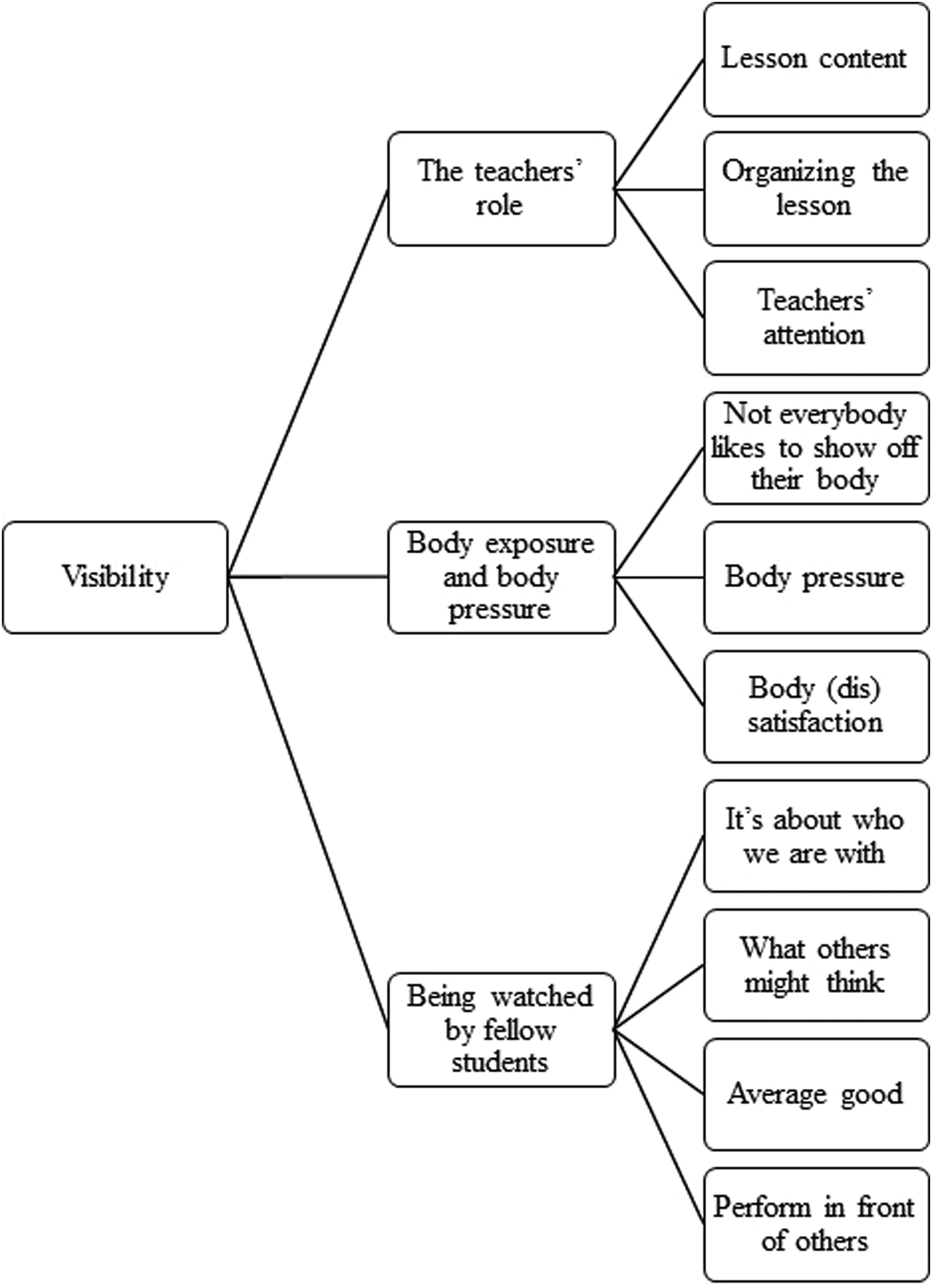
Mind map of themes.
The teachers’ role
Lesson content
Participant observations reveal that for some students, visibility is a potential stressor related to lesson content. Both focus group and individual interviews show that some lesson content and activities make students feel more visible and exposed, particularly activities where level differences between the students is obvious, such as competitions, like running, orienteering, and relays, team sports, such as soccer and handball, gymnastics and dance.
Observations during dance show that while creating choreographies and performing them, level differences and past experience are evident. Students who forget or have not mastered their choreography become visible, especially when skilled students set the choreography. When one team repeatedly loses all relays and contests, they stand out as the losing team.
In an individual interview (II), Sandra expressed her discomfort when exposing her skills during swimming lessons:
Sandra: I think swimming is awful, so I’ve been avoiding it. I’ve made many excuses […]. You must be fast, and there are many difficult things that people don't see as difficult, but they are. We do the same thing all the time, but some things are just difficult.
Researcher: Do you think swimming is challenging?
Sandra: Yes.
Researcher: Can you try to elaborate a little on why you think it's so awful?
Sandra: It's about finishing last, and I feel like it's so visible. And I feel ugly in a swim cap and stuff.
According to Isabel (focus group (FG) 2), ‘it's easier to get looks there [in swimming lessons] than it is in PE lessons’. This speaks to the importance of the context and the lesson content.
Organizing the lesson
The level of visibility depends on how the teacher organizes the lesson and its activities, such as line formation, spectators, use of space, facilities, equipment, group sizes, division of students into teams and skill differences within teams. These details impact the students’ experience. Exposing who finishes first and last makes teams slow and prone to mistakes during competitions. In the observations, two students repeatedly got caught during playing ‘Tag’ (you’re it). Large areas and running distances make it difficult to catch up with others, amplifying the differences between students and exposing those who are slower and lack stamina.
According to most participants, the teacher or skilled students demonstrate techniques, exercises, or new moves. The ‘skilled ones’ thus have the opportunity to show off their skills, emphasizing whom the teacher views as able or less able. Students are asked in advance to demonstrate but have the right to decline. Even though Elsa (II) likes to demonstrate, the option to decline makes her feel safe: ‘It's nice because we are asked in advance, and we have the opportunity to say no and “I don't want to”’. According to Mason (FG 3), the teachers are good at choosing who to ask: ‘They know that there is someone who may not like it so much, so he might say, “Hey, can you come forward to demonstrate?” Someone who might practice this in his spare time’.
When asked how to reduce visibility for those feeling uncomfortable, participants answered that students should be divided into groups or teams according to skill and that massive lines and many spectators should be avoided. They also suggested smaller groups, stations where everyone does ‘their thing’, the opportunity to choose levels or activities and good communication with the teacher.
Teachers’ attention
The importance of recognition, assessment, and the desire to get the teacher's attention to get a good grade and the opportunity to show off in ‘their’ sport was apparent during observations and interviews. Some students become stressed if they feel they do not demonstrate their skills, or the teacher has an incomplete picture of their competence. According to Isabel and Evie (FG 2), ability is important for their grades:
Isabel: It's very easy to see that those who are very good at sports get high grades. ‘You are very good at handball, soccer, you are good at most sports – ok, you get a six. While you, well, you weren't so good, so you get a four’. Something like that.
Evie: They don't see you, they say, ‘No, you cannot do that, so you’re not so good at it’.
The PE teacher thus has a significant role in the situational experience of visibility.
The next theme relates to students’ self-perception in PE.
Body exposure and body pressure
Not everybody likes to show off their body
The body becomes very visible in PE activities and in the locker room while changing clothes and showering. This theme concerns how students experience physical exposure in PE. In observations during swimming lessons, several students did not participate (five girls and two boys). Lucy (FG 2) said, ‘I think some people are dropping swimming lessons because they won't show [their bodies]’. Moreover, participating students, mostly girls, minimized exposure by getting in and out of the pool quickly. Jo (II) said, ‘It's quite fun, but when we must get out [of the swimming pool] to do exercises on the poolside, I would rather stay in the water’. Several girls confirmed that exposing their bodies, especially wearing tight-fitting swimsuits and in the locker room, makes them uncomfortable. Boys observe others hiding in the corner, waiting to go last in the shower, or fooling around in the locker room.
Phones are not allowed during school. Still, some students bring them into the locker room, causing others discomfort. According to Anna (FG 4), ‘You might be a little afraid that someone will suddenly take a picture or video of you’.
Body pressure
Many students, especially girls, experience body pressure during bodily exposure while changing and showering in the locker room. Daisy and Sophia (FG 3) reported feeling body pressure not only in PE classes but every day:
Daisy: It also has to do with body pressure about how one should be, how one is not, and how one compares one's body with others. It goes beyond leisure and – [interrupted by Sophia].
Sophia: You think about it every day, actually.
Daisy: Yes.
In Isabel's (FG 2) opinion, ‘many people feel body pressure, but it's perhaps not so visible’. Anna (FG 4) confirmed this: ‘I think that there may be many students who feel this way but don't dare to say it’. Body pressure is thus evident, although they do not talk about it.
Body (dis)satisfaction
Several girls reported feeling dissatisfied with their bodies when exposing them in the locker room or wearing tight-fitting swimsuits. Lucy (FG 2) said, ‘It's mostly that people aren't happy with their bodies, I think, so they won't change in front of others and expose them somehow’. Tyler (FG 5) also noted that ‘it can be difficult for people to accept the way they look’. Some girls cited significant bodily differences between individuals due to physical changes during puberty, body ideals disseminated in social media and body shaming comments. Indeed, body pressure and body dissatisfaction become more pronounced in lower secondary school due to physical development during puberty. In their individual interviews Jo and Sue said that their perception of their bodies changed negatively as they transitioned from primary to lower secondary school, causing them body dissatisfaction. Seemingly, many students, especially girls, struggle with their changing body during their pubertal development, especially because of the bodily exposure in the locker room and during swimming lessons.
Being watched by fellow students
It's about who we are with
Most students emphasized the importance of a safe class environment. According to Daisy (FG 3), ‘it's about who we are with’. In David's (II) words, ‘when you are in an environment with students you know well and are friends with, you are not as afraid of making mistakes, and you don't feel as embarrassed’. He explained that making mistakes is not as stressful as one might think, because others do not notice or simply accept mistakes. This mindset helps him stop worrying so much about what others think.
Evie (FG 2) emphasized the teacher's role in maintaining a safe class environment: ‘That’s where our teachers are pretty strict that things that happen there, stay there; they are not spoken of’.
Not feeling alone and having friends while performing makes students feel safer and less visible. Isabel (FG 2) said, ‘It is easier and better when you are in front of someone you know very well. When you are in a small class, you know everyone very well. You know what people can do …’. Being seen by skilled students and having their support forms an essential element of feeling safe in the class environment.
What others might think
Students’ self-perceptions and worries about what others might think during PE are of critical importance to them. A representative example is Sandra (II), who seems to be her own worst enemy:
Researcher: Is there anything other students do that causes you stress in PE classes?
Sandra: Not necessarily. It's what's in my own head.
Researcher: So, if I understand correctly, it's the thoughts you have about yourself?
Sandra: Yes.
Researcher: What do you usually think?
Sandra: That everyone looks at me and that I’m inferior to everyone else and stuff.
Researcher: Do you think others think that way [about you]?
Sandra: No, I don't know, but at least I do.
Sandra wants to do well; she does not want to be teased or talked about if she does something embarrassing, because she knows that she would have to face her fellow students again. Gina (II) feels the same, thinking she draws negative comments from her fellow students even when she does not. Some students feel more visible and under greater pressure to perform when their teammates cheer them on and expect them to perform well.
Sue (II) cited ‘bitch blinks’ amongst the girls as a perceived stressor in PE. This is when someone gives others angry, critical or hostile looks interpreted as negative or threatening.
Average good
Past experiences that made students ‘stand out’, such as when they lacked quality in executing different techniques, made mistakes, were slow, finished last or lacked knowledge, matter to them. Social comparisons are evident. James thought that it was obvious who did sports and who did not. According to Sandra (II), ‘you are one of those cool kids if you are good at sports and stuff, so it's kind of stressful trying to be good at many things even though you might be good at only a few things in PE’.
Skills and achievements are visible and easily compared between students. To Freddie (FG 5), it is important not to be worst or last: ‘Yeah, if everyone else gets it and you’re the only one who doesn't, it can get pretty stressful’. This prospect motivated some students, like Sue (II) in swimming: ‘I don't have to be better than others; I just have to be average good or normal. But I’m not very [laughs] happy about swimming in general’. She elaborated: ‘I tend to think that I’m still not the worst in class [laughs], so I can't be that awful!’. However, social comparison and visibility are not always perceived as negative. In Jon’s (II) view, ‘if you see someone doing it a little better, then you try to do the same to improve’. Accordingly, below average visual performances are stressful, while average ones feel safer. In some situations, social comparisons with good performers improve individual performances.
Perform in front of others
Students cited performing in front of others and fearing mistakes, losing, and embarrassing oneself as stressors. Sandra (II) said, ‘You feel so visible in competitions, and that others trust you to do well if you do something together. So, in a way, there is a bit of pressure to do well in PE’. In contrast, some students are strongly motivated to perform and enjoy being visible and showing off like James (II).
James: I liked it [demonstrating his skills]. It was nice to see that he [the teacher] could do something about me not being a soccer boy or handball boy. So yeah!
Researcher: So, it was good to show off a bit?
James: Yeah, to be a bit visible.
Researcher: So, visibility for you in that context was positive then?
James: Yeah.
Who students partner with, whether they master the activity, and whether they know what to do are crucial. Some students like being more visible when they know they are better at something than others. Daisy (FG 3) said, ‘If there are new people, people you don't know very well, or people that you feel are much better than you, then it's more stressful, and you would rather not be so visible. So that others look at you right’.
Students reported feeling a greater need to show off in lower secondary than in primary school, probably for their grades. While primary schools have no grade assessment in Norway, there was a change in students’ awareness of being watched for their performances in PE.
Discussion
This study contributes to our understanding of how ninth-grade students perceive visibility in PE. Our findings show that visibility is a common experience. It affects self-perception, body satisfaction and SE beliefs in various ways, highlighting the challenging complexities of promoting learning and development for all PE students. Visibility is perceived by some as a stressor, while it affords opportunities to those who like to perform. This difference might be gender-specific. Our survey results (t-test, N = 48) in Åsebø et al. (2020) show that girls are significantly more sensitive to factors related to visibility, such as being observed, body image pressure and spectators.
Three overarching themes were generated from the investigation of visibility in PE: the teachers' role (i.e. organization and delivery of PE), experiences of body exposure and body pressure (i.e. challenges in the school environment and society at large) and being watched by fellow students (i.e. quality of social relations between students).
The teachers’ influence
Our findings regarding the teachers’ role in the organization and delivery of PE resonate with recent studies by Røset et al. (2020a, 2020b). Our results show that the organization and facilitation of PE influence students’ perceptions of visibility. Didactic choices, such as the size of groups, waiting in line and watching others, distribution of students into groups and teams, choice of students to demonstrate different activities, degree of competitiveness and how it is reinforced by the teacher, use of facilities, space dedicated to an activity, type and quantity of equipment, rules of the game and reinforcement of desired actions by the teacher may influence students’ perceptions of visibility either in a negative way, by encouraging judgements and social comparisons, or in a positive way, by rewarding effort and development. Teaching practices may be experienced differently depending on students’ conduct in particular contexts.
The lesson content is a significant influencing factor, especially when it involves performance and activities that may enhance social comparison, such as those with specific skill requirements or where the body is on display. The observations indicate a wide use of sporting activities and competitions where performances are visible and easily comparable. Dominant discourses legitimizing the subject may elucidate the ways in which adolescents construct notions of their identities related to physical activity and normalized bodies (Casey et al., 2016).
Tudor et al. (2019) find that the performance environment of PE involves skill acquisition, and the public nature of performance indicates that the frequency of displaying physical skills and bodily appearance is a potential stressor. Precisely because of the public character of PE, where students’ performances, physical abilities and bodies are on constant display, a safe mastery environment may provide students with the opportunity to practice, acquire skills and reflect upon effective stress management. PE should offer learning opportunities to help students navigate their experiences and develop appropriate coping strategies. Tudor et al. (2020) highlight the need to encourage students to approach new challenges to promote positive outcomes and enhance their resilience to stressors. Teachers have the opportunity to see more aspects of the students and get to know the students better through physical, motor and social activities. They should acknowledge the complexity of teaching PE, be sensitive to the effects of perceived visibility and carefully consider how lessons should be organized and managed to build a mastery-oriented and health-promoting environment for the benefit of all students.
Body exposure and body pressure
Another notable finding reveals the importance of students’ own mindsets – their self-perception, SE, worries about what others think of them and social comparison processes. This is in line with studies highlighting the influence of fellow students in shaping one's identity (Røset et al., 2020b; Seiffge-Krenke et al., 2009). In need of a positive self-image, students compare themselves with others and worry about how others judge them. As an essential part of their self-presentation, social recognition and acceptance, it is vital for them to demonstrate ability and make a positive impression. These findings resonate with Wiltshire et al. (2017), emphasizing that fellow students have a significant influence on an individual's experience and engagement in PE.
Our findings show that some students have a strong desire to be looked at and show off their skills, especially in ‘their’ sport, to influence their PE grades. More self-defeating (Skaalvik, 1997) students prefer to disappear in the crowd. A student’s appraisal of a situation as ‘taxing or exceeding his or her resources’ (Lazarus and Folkman, 1984: 10) when exposing his or her body and abilities to others may be stressful. Many students are afraid of making mistakes in front of others. Different goal orientations and experience levels with activities play a central role. Knowing what to do and feeling comfortable in the moves and with those around them is important to many students.
In line with previous studies (Cockburn and Clarke, 2002; Walseth et al., 2017), our findings suggest that some students, especially girls, resent the involuntary attention during PE, especially in situations such as swimming and in the locker room, where their bodies can be observed and judged by fellow students and teachers. In swimming lessons, some girls feel naked in their tight-fitting swimsuits that expose their bodies without makeup. This is consistent with Kerner et al. (2019), who find that physically active/athletic students are more comfortable and satisfied with their bodily appearance in PE. These students enjoy being visible during lessons. In general, boys do not express the same concerns.
Youths are especially vulnerable at those ages when significant physical growth and development from pubertal changes pose additional challenges to accepting their bodies (Gestsdottir et al., 2018). PE provides ideal opportunities for teachers to discuss body-related issues, such as body image, pubertal differences, bodily experiences, skills, appearance, body dissatisfaction, and body exposure and pressure, to help students develop positive body images.
Social relations between students
PE involves a considerably greater degree of student interaction than other school subjects, which underlines its social aspect. PE is a setting of constant comparisons (Røset et al., 2020a, 2020b). Aasland et al. (2019) argue that visibility in PE reveals both competence and incompetence, determining who is ‘able’ and who is ‘less able’ in the group. This influences the power dynamics and social relations between students, creating a distance between ‘we’ and ‘they’ and a feeling of ‘otherness’ (Røset et al., 2020a, 2020b).
According to participants’ accounts, two types of skilled students can be distinguished: the former are self-enhancing (Skaalvik, 1997) students who like to win and are preoccupied with showing off their skills and being better than their fellow students, and the latter are students who use their skills to help support their fellow students (Ames, 1992; Nicholls, 1984, 1989). The social environment may be constructed by different goal orientations. Performance-oriented students seem to negatively affect others, making them feel unsafe, excluded and even more afraid of making mistakes. In line with Wiltshire et al. (2017), this finding suggests that fellow students significantly influence an individual's experience of and engagement in PE, where poor performance and making mistakes in front of others are perceived as socially damaging. In a safe social environment, poor performance and making mistakes are more acceptable. The teacher can, according to Ames (1992), encourage a type of goal orientation by providing certain signals, rewards and expectations that convey certain goals to the students.
Visibility in the PE environment
Attempting to understand why some students experience visibility as a stressor in PE while others do not, we find that exposure to visibility for PE in a safe class environment seems to strengthen some students’ resilience to visibility-related stressors. Thus, the experience of the social environment is crucial in associating visibility with either positive or negative emotions (Lazarus, 2006). Teachers’ efforts to build a safe and supporting mastery-oriented environment seem to be an essential success factor for promoting health in PE (Ames, 1992; Nicholls, 1989, 1984). Additionally, the opportunity for students to demonstrate their best skills enhances their acknowledgement and SE beliefs (Bandura, 2006). The transactional theory of stress and coping (Lazarus and Folkman, 1984) relates to variations in how students appraise the demands of the situation and their personal resources to meet these demands. Students used to performing in leisure activities have an advantage. Hence, to promote students’ strengths in diverse physical activities, individualization of the selection of activities through student engagement could increase positive emotions and students’ willingness to expose themselves to others.
Limitations and future research
It is possible that some students may have experienced insecurity in the interview situations and did not feel confident enough to speak freely, or the sample may not fully reflect students’ sociodemographic or ethnic diversity. Furthermore, the presence of only female researchers may have made students reluctant to discuss body-related issues freely. Even though students discussed visibility of their own accord, we specifically asked about it based on our observational findings. The crucial question is whether this technique amplified the issue. Further, although this study deepens our understanding of visibility, its findings are not necessarily generaliable to other schools. Further research is required to understand the complexities and consequences of visibility in PE. Future studies should examine coping strategies and visibility management in PE and the ways in which students plan their coping responses to deal with expected future stressors. This focus will improve our knowledge of the inherent processes of stress and coping dynamics and inform strategies for facilitating students’ learning, behavior and performance.
Conclusion
Visibility is a significant attribute of PE. Close attention should be paid to three factors: (a) teachers’ competence, experience and social–emotional skills; (b) body pressure and body image, influenced by the school environment; and (c) issues of support and inclusiveness among students. Visibility is more often associated with negative emotions, but it is also positively perceived by some – especially skilled – students. The impact of visibility on students’ PE experience is complex. Our findings highlight the importance of a safe class environment. To prevent the adverse effects of visibility, it is important to focus on creating a mastery-oriented class environment that limits performance-oriented goals, encourages improvement, good relations, and collaboration, and promotes body satisfaction. The findings actualize the transactional theory of stress and coping by Lazarus and Folkman (1984) to better understand the complexity of how visibility in PE is or is not perceived as a stressor.
Footnotes
Declaration of conflicting interests
The authors declared no potential conflicts of interest with respect to the research, authorship and/or publication of this article.
Funding
The authors received no financial support for the research, authorship and/or publication of this article.
