




Abstract
This paper uses ProQuest’s Entertainment Industry Magazine Archive (EIMA) to explore the use of the term ‘cinematic’ in games promotion in the decade 1990–1999. It offers a clear platform for linguistically aligned archival studies and charts the use of terminology as it emerged and changed within the period of study. Adding nuance to claims that the 1990s saw promotional convergence between games and film, this paper uses a language-oriented archival methodology to highlight how the notions of industrial convergence may be seen as incremental developments rather than sudden shifts in promotional discourse. In exploring how game promotion used terms associated with and emerging from the cinema, the paper maps the ways in which games promotion solicited and distinguished itself from a competing industry, drawing attention to the complexities of mediatised convergence and public versus industrial discourse. In highlighting and extrapolating key moments within the corpus, this paper identifies several areas of future study and serves as a call for further study into games promotion.
Introduction
The 1990s was a dynamic time for the videogame industry. Many significant franchises established in the decade still resonate culturally and economically to this day – for example, Mortal Kombat (1993), Tomb Raider (1996) and Grand Theft Auto (1997) – and have all since become entwined with the Hollywood film industry. Collectively they represent a manifestation of converged industrial logic, visible through franchising, marketing and promotional practices that all mirror those of the film industry.
More widely, the decade saw several promotional events physically and culturally encroach on the movie industry’s spaces and practices. Press releases and news articles make special note of games being advertised in particular ways within cinema spaces and with modes of address from established cinema practices. Announcements associated with promotional launches and press releases for new campaigns suggest a novelty in the approaches used: from the 1995 fanfare of PlayStation consoles being promoted with interactive stands in cinema lobbies and entrances (Consumer Electronics, 1995), to Wing Commander’s IV’s (1996) announcement that the game will be promoted on the cinema screen with a ‘movie style’ campaign (Jebens, 1996). Within such spatial incursions into existing entertainment spaces is a concerted attempt towards positioning games in the same manner as cinema. Mortal Kombat (1993) was promoted with a launch event that included the first videogame ‘trailer’ in cinemas (Vollans, 2017). The release event, coined ‘Mortal Monday’, implicitly borrowed the cultural association of cinema violence, while soliciting the same kind of moral panic (Church, 2022). Shortly thereafter, 1994 saw Sega launch a TV channel for interactive games, in a move that predates post-millennial streaming service business models (Shaw and Gurman, 2021). This was touted in industry press as taking ‘its cue from Sega’s aggressive video store distribution strategy’ (Silverman, 1994). By the end of the decade, Variety Magazine reported that the games industry’s revenue nearly matched that of Hollywood: USD $7.2b for games, while film generated USD $7.4b (Graser, 2000). Collectively, such events can be understood within a wider process of ‘remediation’, defined by Bolter and Grusin, who observed that this catalysed the speed of technological development in 1990s (1999: 5).
However, as Mc Glynn has recently observed, ‘many recent releases illustrate that a shift has taken place towards certain games’ stylistic harnessing and hybridisation of cinematic idioms that, in turn, transform the experience being marketed to gamers’ (2023: 108). Calling this a form of aspirational cinematic promise, Mc Glynn posits this as ‘the latent aspiration to evoke the sights and sonorities of contemporary Hollywood film that persists throughout the development and marketing of so many video games’ (2023: 109). This position is echoed in the popular press, with a special issue of The Economist (2023) noting that making a blockbuster game is akin to making blockbuster movies. Yet, in both cases, this is positioned as a recent development in the 2020s, overlooking the sorts of established and antecedent practices illustrated above. Within the 1990s melting pot of opportunity and industrial crossover, this cinematic promise exists quite clearly and can be understood as a remediatory practice indicative of converging industrial logic. Terms rooted within film industry promotion start being used within and alongside games promotion as a way of framing the novelty of the promotion as much as the legitimacy of the product. ‘Cinematic’ and ‘film-style’ are both used to promote one industry’s output in the language of another, while the kinds of promotion available start to mirror those of film.
In 2002, King and Krzywinska asked ‘is there a merging of languages, to some extent, as games influence movies and movies influence games?’ (1). The answer is undoubtedly: yes. Yet, within such research on this process of ‘merging’, there remains a focus on aesthetics. As Hay and Couldry (2011) note, the development of cultural studies, via McLuhan (1964) and Hall (1980), positions an understanding of media as a language, and as a system of codes through which meaning is made and shaped. Work has focused on the aesthetic ‘language’ of new media through the work of Bolter and Grusin (1999); King and Krzywinska (2002); Manovich (2002) and many more too numerous to mention. By contrast, Thurlow and Mroczek (2011) and Crystal (2001) have looked at language formation within new media, the use of written and spoken language as influenced by and through technology. Within the discourse is a logical area for further development. As new products – be they platforms or outputs – come to the market, promotional content circulates in advance, offering ways to conceptualise, understand and consume them. As Bolter and Grusin note ‘all mediation is remediation’ (1999: 55), it follows that the promotional mediation of product on the marketplace forms a site ‘of a specific practice, at a specific time’ (1999: 21). Here the specific time can be twofold, either the point in the promotional campaign (as related to the product) and/or the time at which that product comes to be (the wider industrial chronology). Focusing on the language (or ‘copy’) used in promotional materials offers another lens to view such converged media practices. It offers the tantalising possibility of being able to chart the moments of convergence and remediation linked to very specific moments in time.
This article offers an exploration of the linguistic ways in which promotional materials framed the videogame industry’s wares in relation to the film industry. To do this, it focuses on the use and context of the term ‘cinematic’, sourcing examples of suitable promotional materials from ProQuest’s Entertainment Industry Magazine Archive (EIMA), a database that includes digitisations of select UK and US Gaming and entertainment magazines. Combining these sources with wider supporting context from the larger Nexis newspaper archive, it explores the ways in which promotion and markers of converged industrial logic exist in the mundane, everyday ways a consumer might encounter them in the 1990s. In charting moments of promotional convergence this paper highlights an overlooked history of the games industry and identifies areas of further study. It acts as both an exploratory and historical study, but acknowledges the limitations and scope of the task, calling for further studies of promotion and language. Through focusing on terminology as both promotional and a form of articulation of an industrial identity, this article adds nuance to studies of converging media practices. It focuses on the specific ways in which convergence occurs linguistically, and over time. The lack of context, however, of first-hand industry accounts and production notes, for example, demands further attention and consideration of the tensions at work. Caution should be used in assuming language directly responds to or impacts industrial practice. Such a linguistic mapping is unlikely to be completed in one article, and unlikely to be centred neatly within a single decade. Yet, in making a clear contribution for the purposes of further discussion, this article draws attention to the ways in which the industry framed its wares ahead of consumption.
Why promotion; Why ‘cinematic’?
Studies of industry framing abound, and work has already explored the 1990s from several angles, notably gender and violence. Williams’ (2003) work maps the social construction of games, noting three frames at work 'coverage of designers or producers as auteurs, a “games as artistic” frame and a “technical quality” frame’ (529). Williams offers useful insight into the vilification and redemption of games as a threat to established norms. These frames and discussion therein emerge out of studies of samples of news and media coverage, while promotion is mentioned it does not form the sole focus. Similarly, McKernan (2013) has charted the counter-narrative to violent games, noting the educational framing at work and focusing on the ‘functional benefits’ (323). Here the educational focus is not on offering consumers a frame to discuss new technology, but rather the ‘instrumental value’ of gameplay (321). Similarly, Graeme Kirkpatrick has explored gaming magazine discourse from 1980 to the mid-1990s, focusing on the role magazines played in developing games culture. Kirkpatrick notes magazines form a site of discourse that is not ‘brought into being by the machinations of corporate marketing executives’ (2015: 2). I challenge this claim on principle, as it omits both the role of economics in editorial decisions, and the press release content which is interconnected with such marketing machinations. In doing so, I echo Therrien and Lefebvre who note the ‘blindspot’ (2017: 38). As part of an analysis of the news, letters and articles within the corpus, Kirkpatrick posits a ‘frame of indeterminacy’ in which technology usage is subject to variation, citing 1980–84 as a period of flux as consumers explore the possibilities of the media. Noting the application of such indeterminacy extends to value judgements: ‘people were not in a position to assess what made a “good” game because the frame of reference that would facilitate judgement did not exist.’ (12). Here, then, we can reiterate the focus on promotion, as a function of promotion is to make such claim and do so in a way that enables potential audiences to (ideally) agree. This (dis)agreement logically forms part of the gamer’s identity, a value judgement on the output.
Studies of games promotion exist, exploring framing practices and the construction of the idealised and problematic representations of gamer identity (e.g. Burgess et al., 2011; Condis and Morrissette, 2023), and similarly when discussing game violence (e.g. Scharrer, 2004). But these studies use promotion merely as supporting evidence for wider debates on violence and gender, rather than as the focal points of their respective studies. As Wright puts it, dedicated study of game promotion sits on ‘the margins of (digital) game history’ (2023: 33-51). That is, despite numerous recent research contributions to games promotion and paratexts, including a 2017 Kinephanos special issue on game promotion (Vollans et al., 2017), and recent work on games paratexts (Beil et al., 2021; Seiwald and Vollans, 2023) viewing promotion in its own right as an industrial discourse remains understudied within the field. Some key contributions do exist, though. Young (2007) talks about individual promotional aesthetics and charts the shift in presentation of gamers as part of the promotional rhetoric. Young notes the social-educational capacity of promotion, observing that ‘the purpose of advertising has changed from one of teaching users how to use the system to publicizing specific games in a manner very similar to film trailers’ (235. Cassidy, 2011: 298 also makes this point). Young also points to the possibility of using promotion to educate consumers about the market. We can draw comparisons between Young (2007) and Kirkpatrick (2015), seeing promotion as a mode of stabilising idealised use. Developing this, Švelch (2015) has sought to build a typology of game trailers, basing this on the relationship between the promotion and the product. In these cases, the focus is on the aesthetics of a particular promotional form. These contributions show the value of advertising and promotion, understanding advertising as sites of remediation, but remain rooted in the visual elements. By contrast, Vollans (2015, 2017) has focused on the linguistic, charting the term ‘trailer’ across multiple entertainment industries. Drawing attention to the first game trailer being couched in ‘the cinematic’, Vollans’ (2017) works through press archives to unpack a small part of game history covering a period from the 1990s–2000s. In this study, Vollans implies a light-bulb moment in which games suddenly became promoted through the lens of cinema. For Vollans, language is a data gathering tool used to chart specific instances of specific instance of converged promotion, but the term ‘cinematic’ is never fully interrogated. Beyond this, few studies have such linguistic emphasis. While work on remediation and interaction between games and cinema has developed, few have sought to provide critical analysis to the terms used, though occasionally such terminology has been critiqued (see Wright, 2017). While King and Krzywinska note that ‘cinematic’ is often used to suggest quality 2002, there is a lack of criticality in understanding how and where the term was used. While there are many possible terms to choose from for a focus, ‘cinematic’, in the public use meaning of or pertaining to the cinema, offers only one such starting point.
Methodology
As Wright notes (2023: 36) there is a dearth of dedicated archives that collect and preserve video game paratexts, and fewer still that remain accessible without travel (and the associated costs). For this study, online archival sources are used, in part for convenience, in part to encourage further study and engagement. ProQuest’s Entertainment Industry Magazine Archive (EIMA) holds a digitised collection of magazines organised by 5 thematically grouped collections, across 4 different industries: Music Radio & Stage, Film & TV 1, Film & TV 2, Music Folk & Hip Hop, and Video Gaming. The Video Gaming collection itself comprises 40 titles published between the 1980s and 2000s, but is not a complete archive of magazines across that period. Most of the digitised magazines are those published by Future Publishing Ltd, publishing all but 5 of the magazines archived. EIMA has UK and US editions of the same publication (PC Gamer), introducing the possibility of repetition in the content generated. Repetition is expected in the kinds of content sought however, these magazines are competing with each other for consumer attention, and advertising campaigns are likely to occur across different publications by design. Resultantly, advertising space might be bought as a block across different publications owned by the same company, and/or specific editorial stances within commentary may emerge. As the archive is incomplete, a complete and quantifiable grand narrative, isn’t possible. However, even incomplete archival work can identify trends and areas for future studies. In part composition limitations are a direct result of any archive. Archives privilege some content over others, pointing as Kaltman (2020) and Newman and Simons (2018) do in greater depth and with more nuance towards a need for sustained archival effort.
In using the EIMA, searches are bound by the architecture of the search mechanisms themselves. With many archives, searches may be dominated by the metadata associated with a specific archival entry. With the EIMA, Optical Character Recognition (OCR) is used as part of the digitisation process. When accurate, this allows for specific keywords in the text to be identified and included. The architecture of the EIMA prioritises linguistic framing over metadata, and this supports a language-based approach for this paper’s corpus generation. In short, it allows for a focus on promotional copy. As the focus is on promotional copy, using archives with OCR rather than metadata searches, better removes archival bias; pulling out phrases for analysis in context. A clear counterpoint, however, is that it may exclude similar phrases, synonyms and hypernyms that speak to the same effect. This method offers several challenges linguistically and methodologically. The identification of the initial search terms come from somewhere in advance of using the archive, and there is a risk of searching for search terms that then leads to artificial emphasis on those terms. Looking for linguistic instances and finding them risks falling victim to a fallacy of prevalent proof, and accusations of ‘cherry-picking’ data. Using the term ‘cinematic’ as a starting point for exploring games promotion offers a useful basis for corpus generation, enabling clear integration with existing work in the field. By no means a fool-proof method of mapping all the possible instances of antecedent convergence, it speaks to Mc Glynn’s (2023) notion of the ‘aspiration’ of the industry while offering the flexibility to interpret the degree to which ‘cinema’ is being evoked.
Corpus and analysis
EIMA ‘cinematic’ results.
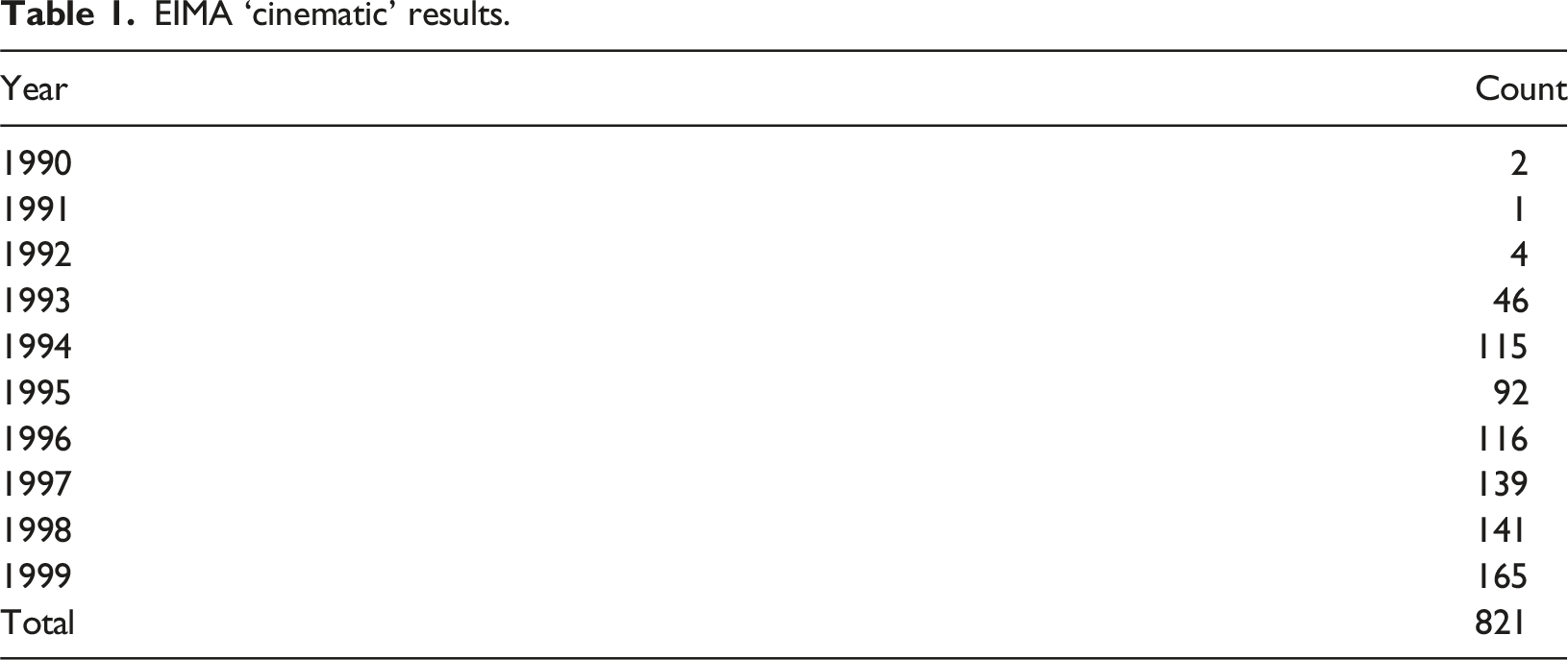
It is possible that specific games being released with these terms generate subsequent discussions using these terms. We can extrapolate from Kirkpatrick (2015) that there might be reader debates around ‘cinematic’ claims used in promotion, and without in-depth analysis of each instance, all we can say is that the frequency increases. Quantitative datasets alone omit context but indicate use of the term in magazines themselves, indicating a discourse. The overall frequency increase can be explained at least partly by archival gaps. Only one of the magazines included has a complete archive within the timeframe, with many magazines within this starting in the mid-1990s, where Kirkpatrick’s study ends. Interestingly, the mid-1990s coincides with the promotional content that initiated this study and opened this paper.
‘Cinematic’ results (Nexis).
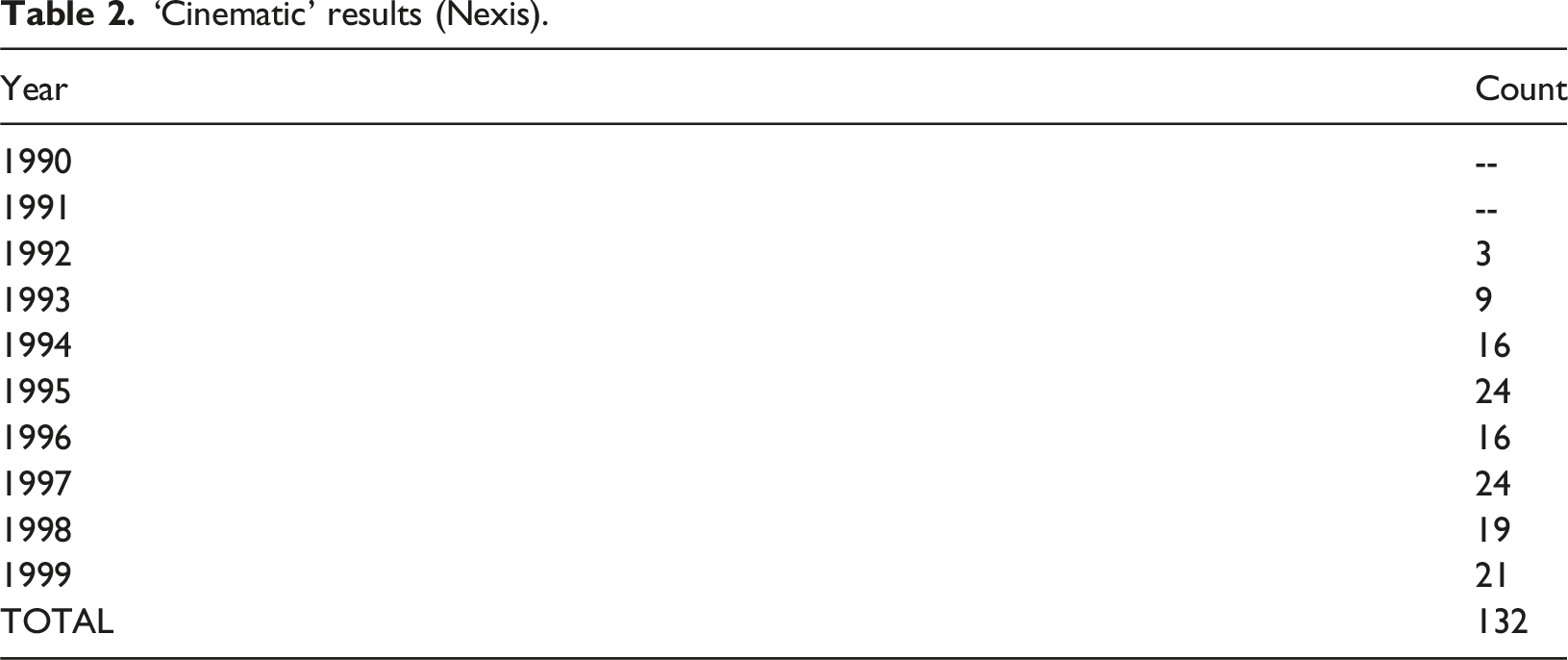
EIMA ‘cinematic’ in adverts.
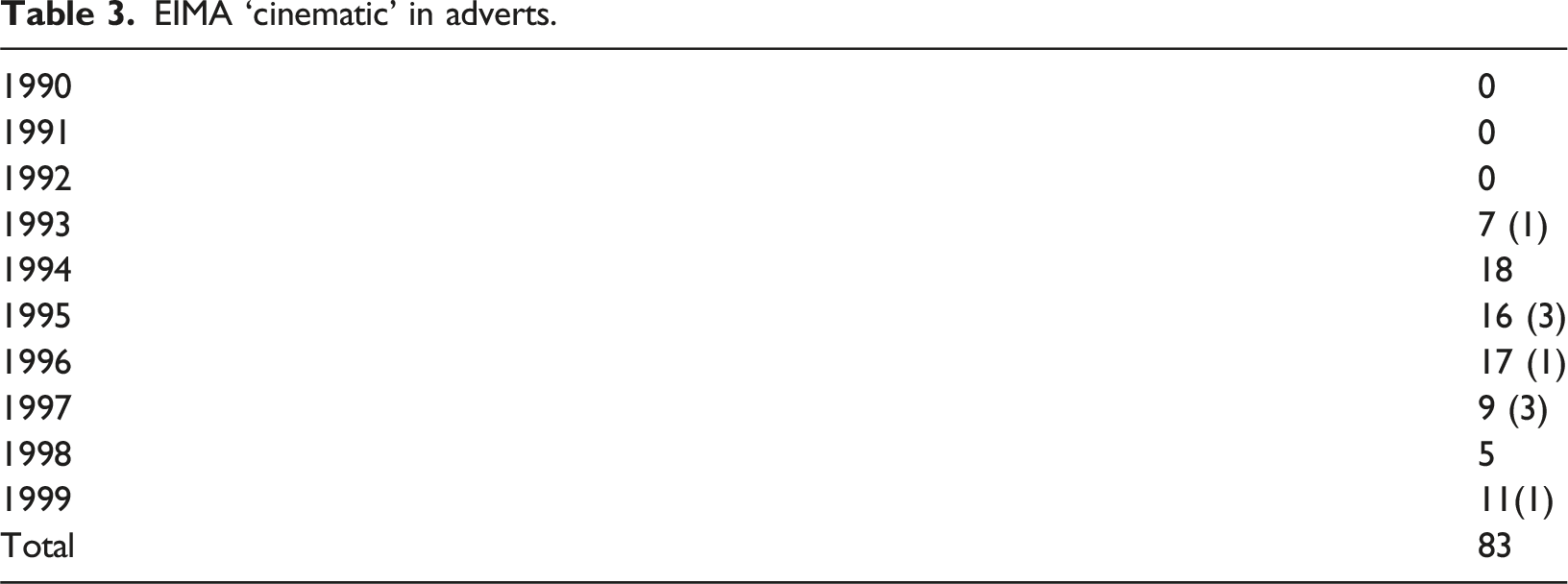
Job adverts
‘Cinematic’ job adverts (EIMA).
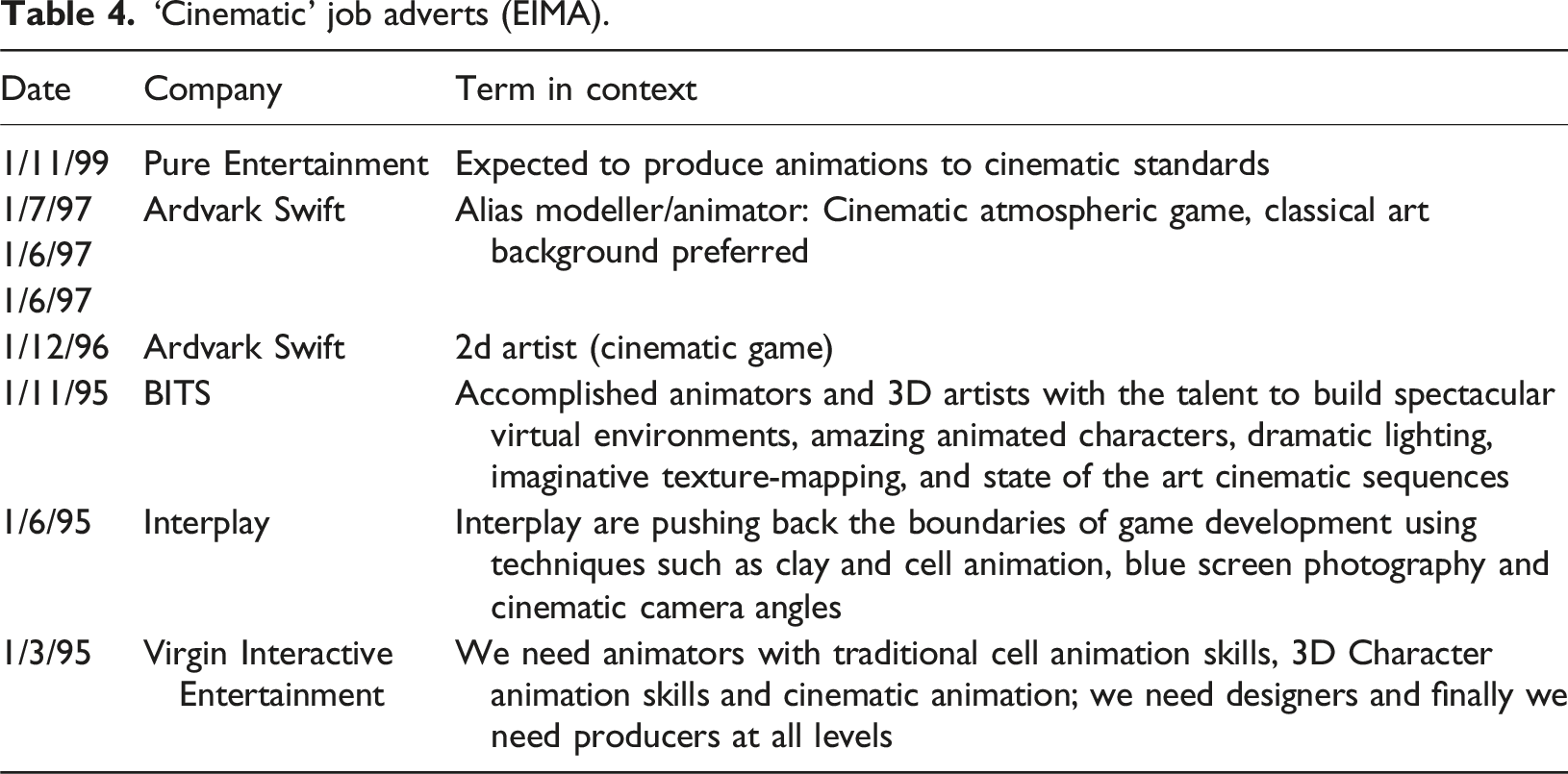
Within these instances we see this term is largely used as an indicator of the kind of animation required or anticipated within the company, though the 1996/97/99 instances denote the kinds of project, akin to a genre indicator. That animators were sought with skills that rival ‘cinematic standards’ suggests an industrial comparison, whether from shared technological skills, or from the same labour pool is unclear. That specific standards are sought in this instance suggests the industry is asking for a level of comparative quality and thus sees either the output or the skillset needed as being interlinked with the cinema industry. It is worth noting that the BITS advert calls for ‘state of the art cinematic sequences’, suggesting a similar level of quality-association with the term. These are not just cinematic sequences described at a technical level and in-keeping with a technical term’s use, but rather sequences that are ‘state of the art’. It is unclear how such ‘cinematic standards’ are enforced or evaluated in practice, nor what they are precisely, but seeking this otherwise unknown value in recruitment points to a level of shared knowledge between recruiters and applicant, indicative of industry norms. This, in turn, might give weight to the suggestion that as the decade progresses there’s an acceptance of what ‘cinematic’ means in the context of the games industry, but this claim requires caution and further triangulation.
The adverts prior to 1996, point to ‘cinematic animation’ or ‘cinematic sequences’ as being a component of the job rather than any explicit form of value attribute, suggesting this is a technical term or term to describe key industry skills or outputs. This theme appears elsewhere in the corpus. It is possible that such cinematic animations now operate under ‘cut scenes’ but without industry interviews and analysis of production notes it is difficult to support this claim beyond supposition. What these job adverts show is the use of specific terminology to both describe projects artistically, and to identify skills needed. Within the former, ‘cinematic’ is used to indicate the company or project’s artistic vision. Interplay uses the term alongside claims of ‘pushing back the boundaries’, though blue screen photography and clay/cell animation, technologies that are perhaps more immediately thought of as being skills from the film industry. The rhetorical claim here is that through their use, the company is inherently at the forefront of development in games. Importantly though this company is connected with the other outlier in the corpus. The small print of an Interplay advert (1996, Table 3) notes that ‘cinematic multimedia is a trademark of Interplay Productions Ltd’. This would suggest the brand identity is linked with notions of ‘the cinematic’. How such a connection compares with others in the industry at this time is difficult to say for certain. That the term is trademarked suggests a sense of regulatory control and proprietary ownership similar to the film industry (Staiger, 1984). Rationale for trademarking is complex (Castaldi, 2018), but can be seen as one indicator of industrial innovation (Mendonça et al., 2004). As will be shown later Interplay was promoting game-film adaptations at this time, and content creation would have occurred prior to the start of the timeframe of study.
‘Cinematic’ within the job adverts here falls into two key uses, on the one hand, we see a clear use of ‘cinematic’ as a technical term describing a functional element of the game, while we also see it being used in terms of an anticipated or ascribed quality. This suggests a duality in the kinds of rhetoric that might be at work elsewhere, a kind of context-dependent double articulation. One that speaks to the conditions of games’ creation; as a technical term that describes an element akin to a cut scene. And one that shapes the expectations of the kinds of experience available. This intertwined linguistic usage offers the possibility of a negotiated meaning shifting with an industry’s negotiated identity as it develops, and offers a potential frame for analysis of the remaining games advertisements.
The interconnected meanings of ‘cinematic’
‘Cinematic’ in games promotion (EIMA).
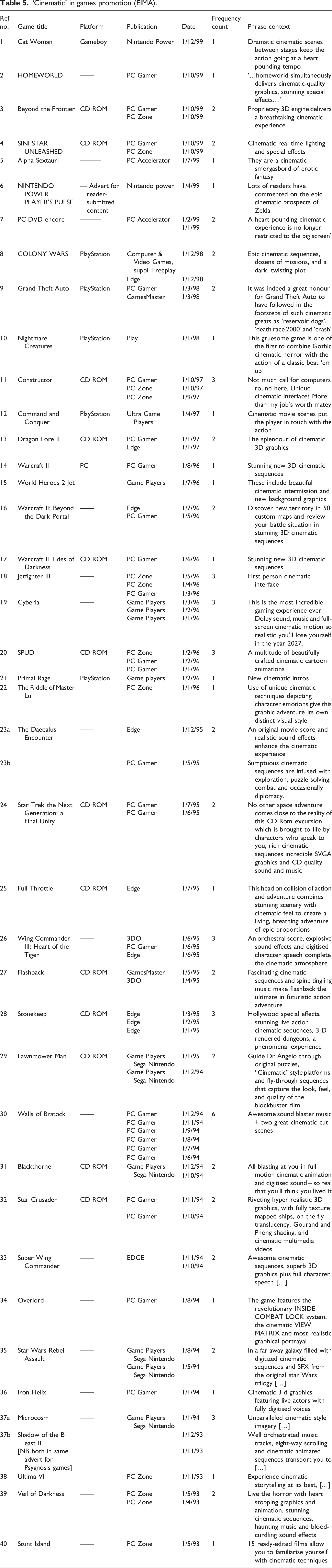
Attention can now turn to the bulk of the corpus that uses ‘cinematic’ within the promotional copy itself (Table 5). Following Mc Glynn (2023), the promise of ‘the cinema’ is one of the key lenses through which we can understand ‘cinematic’. Here the term is used in association with cathartic attributes, typically evoking the kind of experience on offer. Alongside ‘cinematic’ we see positive qualifiers, ‘[H]eart-pounding’ (1), ‘breathtaking’ (3), a ‘smorgasbord of erotic fantasy’ (5) and ‘sumptuous’ (23b). All emphasise elements of the game’s storytelling and experiential prowess. This framing of consumption suggests a forthcoming experience in a similar manner to cinema promotion. Consider the claims made historically within film promotion, as Kernan notes of early horror trailers ‘in which audiences were reminded of the power of horror films to assault them physically’ (2004: 22). The cathartic, experiential element transcends mere storytelling in a way that affects the audience. This style of promotional rhetoric is clearly found in historic and contemporary film promotion across all genres, though is most overt in horror. At the heart of this is that the story is to be consumed, and that consumption is largely talked about in terms of audience affect, in lieu of taste and flavour that we might see with other consumables. Here we can consider the work of Gregg and Seigworth ‘[a]ffect is in many ways synonymous with force or forces of encounter’ (2010: 2). Within the corpus there is a clear sense that the product on offer may leave a marked impression upon the user, and thus justify their time and financial investment. There is also the parallel logic here that having invested in a games system, games need to consistently justify the investment (and vice versa). Aspirational usage may also directly reference the cinema industry, ‘Unparalleled cinematic style imagery’ (37a). Here suggesting the technical prowess of the game’s content without treating the term as a technical characteristic of the game itself, these are not ‘cinematic images’ denoting a direct replication but an equation of a known experience in a different medium.
Frequence of ‘cinematic sequence’ (EIMA).
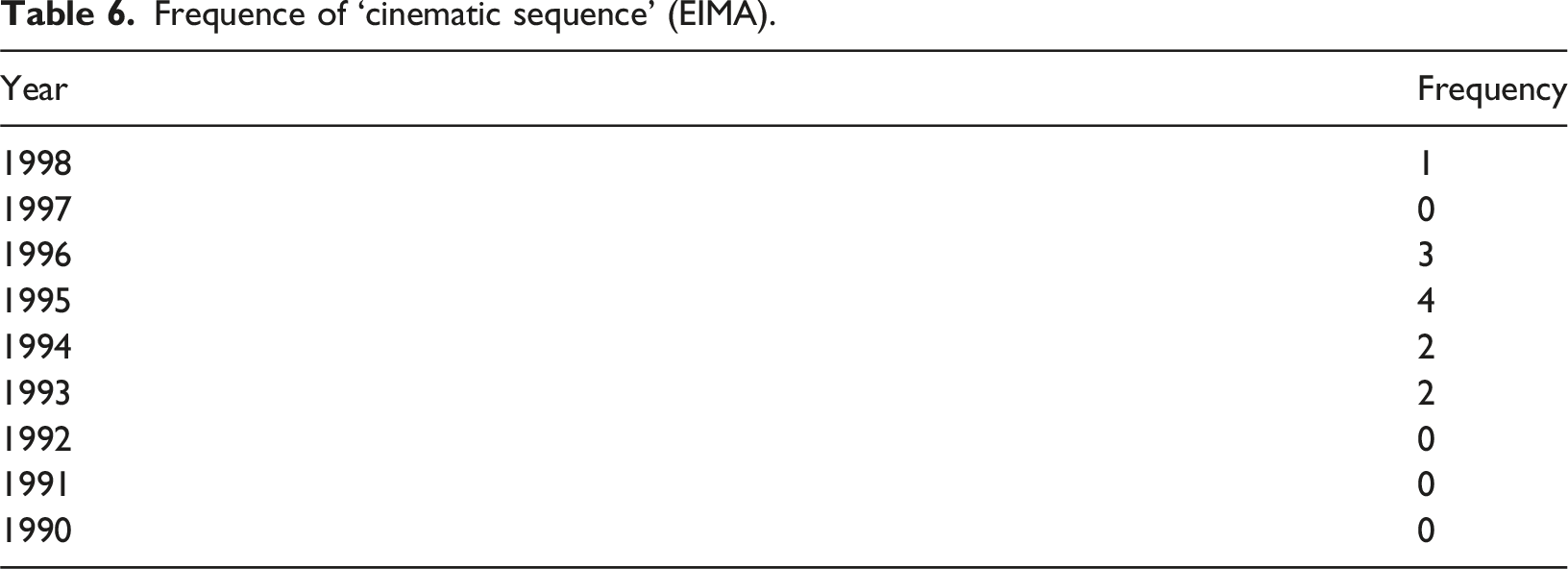
Certainly, other terms do not appear as frequently; ‘cinematic animated sequences’ (37b) ‘sequences’ (29) and ‘cut scenes’ (30) appear each only once chronologically early in the corpus suggesting a shift in technical terms at some point. Within the corpus, the term ‘cinematic’ is used in a manner we might now consider a cut scene, those sequences of footage so often cited as being indicative of cinematic convergence with the games industry, short [film] sequences often embedded within the wider narrative of a game. While histories of the cutscene exist (Klevjer, 2014) they never focus on the linguistic element, citing only the aesthetic emergence rather than the point at which the term became ubiquitous within the industry. In the EIMA corpus only one explicit reference to ‘cut-scenes’ (30) is found alongside ‘cinematic’. With most others using the term cinematic ‘scenes’ (1), cinematic ‘sequences’ (8) cinematic ‘movie scenes’ (12), or cinematic ‘intermission’ (15). Each of these phrases warrants closer inspection for subtle nuances and frequency across a differently formulated corpus. But it is tempting to see these terms as interchangeable, perhaps as indicative of a period of pre-standardisation of videogame terminology or indeterminacy to once again use Kirkpatrick’s term (2015). Another area of future study is the application of terminology by industry personnel. By way of brief exploration into this, a triangulatory Nexis search for ‘cut-scene’ (and linguistic deviations such as ‘cutscene’, and ‘cut scene’) points to only 82 mentions of the term prior to 31/12/1999, with the first games-relevant reference in 1996 (McKenzie, 1996) and the second in 1997 (Hellaby, 1997). Again, a further study here is warranted, exploring the use of ‘cinematic sequence’ in relation to ‘cut scene’. A search on Nexis for ‘cinematic sequence’ within 5 words of ‘game’ offers a year-on-year increase, dropping suddenly in 2020, and rising again in 2022. This would suggest that the two terms co-exist. The results are in the hundreds of thousands throughout the 1990s, increasing to the millions each year in the 2000s. Any possible narrative of ‘cut-scene’ replacing ‘cinematic sequence’ is therefore significantly challenged based on this cursory data.
What emerges within the corpus is the interplay of technology with games, as we might expect of the assemblage outlined by T.L Taylor (2009). In these instances, the cinematic sequences are posited as breaking down the barriers between audience and object, a form of early immersion rhetoric by another name: cinematic. This brings us back to the notion of ‘cinematic’ and affect. As the advert for Cyberia (19) notes ‘this is the most incredible gaming experience ever. Dolby sound, music and full-screen cinematic motion so realistic you’ll lose yourself in the year 2027.’ Here the emphasis on technical prowess, a development in image rendering is touted alongside Dolby sound – long associated with cinema. These kinds of claims though appear throughout the corpus. ‘Cinematic movie scenes put the player in touch with the action’ (12), ‘This head on collision of action and adventure combines stunning scenery with cinematic feel to create a living, breathing adventure of epic proportions’ (25). Such claims complicate the simplistic binary of either a technical or aspirational dichotomy at work. Collectively, they demonstrate the overlapping ways in which the technology of the game manifests the visualisation, and that such visualisation is seen in comparison to other technologies.
Within the corpus though, there are further notable anomalies: for example, the promotion for Grand Theft Auto (1997) (9). An advert for the game makes a virtue of the fact that it was rated as 18 by the British Board of Film Classification (BBFC), actively citing examples of films that received the same treatment and were also in some way controversial in terms of their content: ‘It was indeed a great honour for Grand Theft Auto to have followed in the footsteps of such cinematic greats as “Reservoir Dogs,” “Death Race 2000” and “Crash.”’ The advert positions this rating as a badge of honour, and a reason for the company to feel ‘proud’: ‘Grand Theft Auto is so good, it won a certificate before it was even released’ (9). This kind of interplay is interesting simply for being the anomaly within the corpus. At a time when other promotion has ambiguity around the kinds of appropriation at work, this is overt and specifically cultural, there is no mention of graphics or technical prowess, only ratings (both press and regulatory). However, such a discourse is not an anomaly in terms of Rockstar’s long-term position and branding of GTA’s promotional identity (for an overview, see Wright, 2022: 13-15).
Viewing the corpus in this light, all but a few are using the term ‘cinematic’ in a purely technical sense, with clear connections to the kind of technical specification. This trend also appears to have been used in a pejorative sense. Constructor (1997) (11), mocks the use of cinematic as a technical term for promotion: ‘Not much call for computers round here. Unique Cinematic interface? More than my job’s worth matey.’ It has ‘Mortar Combat’ in large block letters. This subversive use of ‘cinematic’ draws attention to the widespread use of the term suggesting a wider cultural awareness of it. The reference to Mortal Kombat is ambiguous, on the one hand it might be simply to denote the competitive nature of the game, or it might be a further commentary on the use of cinema to promote it. Without further analysis any conclusion on this point must be cautious.
Concluding notes
Within this corpus, it is perhaps the anomalous results that throw into relief the mundane. We see that ‘cinematic’ has a double meaning, but also that there is evidence of it becoming a (potentially negative) trope at this time. That a promotional copy alludes to this, suggests (1) that such a ‘cinematic’ trope was prevalent and widely understood; and (2) that there was a market justification for pushing against it. This would suggest a stability in the discourse of the term that is not played out in the analysis above. The corpus does not show a completely linear path, towards or away from the cinema, but rather a complex negotiation of technology, skill and terminology. We know such remediational negotiation happens, and much of this work can be discussed through Bolter and Grusin’s framework for remediation (1999). A key point here is that this double articulation complicates the idea that one medium might subsume another, linguistically we do not see ‘cinematic’ becoming the stand-in for games, rather we see it occupying specific places, specific types of games and skills. We see subtle nuances in the ways in which language is used to evoke, present and ultimately define the medium and its workers. Such positioning works ahead of the consumption of individual games or the start of individual projects and we can see a clear discourse that enables users to make value judgements based on prior experiences of the technology. This study noted King and Krzywinska's observation that interactions ‘were far from arbitrary’ (2002: 7). Here we support this claim, with no evidence of arbitrary use of ‘cinema’ but rather a complex interplay through which the games industry promotes its wares to the public. The corpus generated offers specific (in some cases weekly) touchstone moments between film and the games industry. If such a project could be expanded to other terms and other datasets it offers the possibility of conducting a focused history of remediationary practices and framing.
The degree to which overarching conclusions can be drawn is limited. We may never know the context in which the promotional copy for these adverts was written and approved, but we can start to chart the application of key terms as they appear. In drawing attention to where and when promotional copy started using ‘cinematic’, we can see the moment at which stakeholders decided to use that term, at that time, and thus partially in what context. In many ways the mode of analysis, with its focus on language has curtailed the kinds of conclusions that can be drawn. A focus on the linguistic is excellent for generating quantitative data, but lacking here are the qualitative and interpretive elements needed to clearly contextualise within this. To what extent is this frame of reference found in other sites of discourse? How might gamers have responded to this term? What was understood at the time by the term ‘cinematic’? These questions all lie at the heart of this historical discussion.
This paper has suggested a number of potential studies to further this one. Exploring the market roles available in the games market during this period would offer another dataset for both the skills and the framing of those skills. Of particular note would be entry-level jobs that might appeal to skillsets rather than those with established careers. With a focus on specific terminology further context is needed. It would be interesting to clarify the ratio of terminology used in press releases to newspaper content. Such an analysis might offer insight into broader market dynamics, and help to situate promotional copy within promotional campaigns more broadly while offering scope for seeing how popular some terminology becomes over others. This in turn, might provide additional context for the emergence of specific terms in the popular press. At the same time, inversely focusing on industry terminology (as opposed to promotional terminology) might also provide a clearer narrative for the ways in which certain outputs and skills were conceptualised and discussed. The study has pointed to the primacy of ‘cinematic sequence’ in relation to ‘cut scene’ and this represents one such example of how specific behind the scenes industry terminology might permeate the promotional copy, and thus enter public usage. Alternatively, this paper has highlighted how some companies, notably Interplay, sought to actively incorporate the notion of the cinematic; the extent to which other companies positioned themselves (rather than their wares) may offers a clearer look at the formation of the games industry.
These potential interrelated studies offer nascent sites for development. In understanding the promotional copy, at least in this instance, we have started to unpack the very nuances of remediation, of discourse as it leaves a (linguistic) trace across the industry. The data set here, 1990–1999, offers a snapshot of UK and US uses of the term ‘cinematic’ in promotional contexts. It shows that the term is overwhelmingly used in connection with the technology of the games industry, but further work is needed on the ways in which cinematic-sequence versus cut scene, or other terminology might play out.
As a mode of understanding the widespread discourse of games advertising in the 1990s the dataset has offered little beyond a series of possible further studies. But it does point towards moments outside the dataset and in doing so challenges the view implied that games promotion might have had a light-bulb moment in the late 1990s and pivoted to a new form of promotion. While work elsewhere has pointed to specific moments at which forms of cinema-style promotion emerged, this paper has offered a more muted suggestion that while a handful of campaigns did actively solicit the ‘cinematic’ to promote their wares overtly, many more simply did so as standard, suggesting not a whole shift in promotional convergence in the 1990s, but rather a few campaigns seizing a cultural zeitgeist and playing up to existing tropes within the games industry.
Footnotes

Funding
The author(s) received no financial support for the research, authorship, and/or publication of this article.
Declaration of conflicting interests
The author(s) declared no potential conflicts of interest with respect to the research, authorship, and/or publication of this article.