




Abstract
This article examines the experiences of women working in the Czech game industry, highlighting the structural inequalities, sexism, and organizational challenges they face. To this end, seventeen in-depth interviews were conducted. The research identifies both benevolent and hostile forms of sexism, with women frequently relegated to tokenistic roles, experiencing heightened scrutiny, impostor syndrome, and unequal pay. As a result, respondents adopt a range of coping strategies, including ignoring the problems, openly expressing dissatisfaction with the work environment or forming support networks. The aim of this article is to better understand the complex and multilayered nature of sexism in the context of game industry and game culture. It represents one of the pioneering studies on women in the gaming industry, providing valuable insights into their position within the Central European context.
Keywords
Introduction
Video game industry is still a male-dominated field. Even as it becomes more heterogeneous and inclusive (Chess and Shaw, 2015; Cote, 2020; Harvey and Fisher, 2015), the gaming culture is still based on the toxic traits that are present not only in the representation in games (Lynch, 2016; Tompkins and Martins, 2022) and in player cultures (Austin, 2022; Balakina et al., 2022; Fox and Tang, 2017; McCullough et al., 2020) but also in the industry itself (Cote, 2020; Weststar and Legault, 2018).
This fact stems from the quantitative (and qualitative) predominance of young, white, heterosexual men in all the aforementioned areas, but also from the invisible barriers that other groups, such as women, people of colour, or members of the LGBTIQA+ community, must overcome. Those who decide to skip these barriers and enter the game industry, face obstacles that delegitimize their choices and experiences or make the adopted path inhospitable. As an outcome, many of them develop coping strategies whether as players (Austin, 2022), game journalists (Fousek Krobová and Švelch, 2023) or even developers (De Castell and Skardzius, 2019). In addition, people belonging to minority groups often serve as tokens representing the group as a whole (Drenten et al., 2022) and they have to deal with structural sexism, misogyny, homophobia or racism (DeWinter and Kocurek, 2012).
In this article, I look at women game developers as a group of people 1 who must navigate and overcome numerous barriers across multiple areas of their lives. Its goal is to explore the experiences of women working specifically in the Czech games industry and their coping strategies to deal with the sexism. I begin by examining the role of women in the video game industry, focusing on the prevalence and impact of sexism. I explore how sexism manifests in game culture and the industry, using the framework of ambivalent sexism to illustrate its dual nature, oscillating between hostile and benevolent forms. In the empirical part of the article, I draw on seventeen in-depth interviews that I conducted with Czech women who work or have worked in the game industry in Czechia.
My two main research questions are: How do women in Czech game industry reflect their position in game culture? And what strategies do Czech women working in the Czech game industry use to cope with sexism? I will guide my qualitative analysis of the interview material using the dyad of hostile and benevolent sexism. Additionally, I will employ open coding and inductive analysis to develop a typology of respondents’ coping strategies (Benaquisto, 2008).
Women in game industry
According to the international IGDA satisfactory survey (2024), 61% of respondents working in the game industry identified as men and 30% as women. 2 The Czech game industry certainly follows these trends, even though it is a young and relatively small environment. According to the latest industry report, there were 2329 employees in 2021, of which only 19% were women (GDA, 2024).
In addition to quantitative disparities, there are also notable qualitative differences. For instance, women are less likely to work as developers and programmers and are more often found in roles within marketing or HR departments (Bailey et al., 2021; IGDA, 2024; Wolf and Perron, 2016). In general, they are expected to select professions characterized by soft skills that are often defined as feminine (DeWinter et al., 2017).
The different position of women in the game industry is related to the fact that the whole environment follows meritocratic and masculine traits and is associated with long working hours, crunch time or project-based work organization (Consalvo, 2008; Vysotsky and Allaway, 2018; Weststar and Legault, 2018). These discourses favour young (male) and childless workers and reproduce a culture that is unwelcoming to most women (Johnson, 2014), as they don’t fit the image of the ideal employee in a technology company (D’Anastasio, 2018).
These frameworks are certainly not unique to the game industry; rather, they can be understood as manifestations of broader cultural patterns that shape gendered experiences across STEM fields and other masculinized professional domains. Women’s underrepresentation in STEM reflects persistent stereotypes that associate scientific and technical competence more strongly with men and masculinity (Nosek et al., 2002). These gendered assumptions are deeply embedded in workplace cultures, where women face daily exclusionary dynamics and discrimination (Bolton and Muzio, 2007) affecting their recruitment, retention, and progression (Powell and Sang, 2015).
Similar dynamics are evident in programming, where the growing masculinization of the field leads to a decline in women’s participation (Abbate, 2017), and to still persisting framing women as outsiders (Condis, 2018; Cote, 2020; Nooney, 2013). The internalization of stereotypes has been shown to weaken women’s sense of belonging and motivation within computing (Cheryan et al., 2009; Fogliati and Bussey, 2013; Schmader et al., 2004), while media representations often reduce women’s presence in tech to their appearance or auxiliary and tokenistic roles (Payton and Berki, 2019).
However, it seems that the game industry pushes these frameworks to more intensified forms. One of the reasons is the influence of geek culture itself. Game culture can be seen as a safe space for ‘geek masculinities’ (Consalvo, 2003), which occupy a subordinate position in broader social contexts (Condis, 2018; Cote, 2020). Consequently, this environment tends to be masculine but also toxic and, at times, misogynistic. As Dickey observes, ‘the lack of female presence or representation, aggression towards female characters and players, and the eroticization of female representation have resulted in a “space” that is too often designed to construct players as male subjects with female representations being the object of male gaze’ (2006, p. 787). As an outcome, women playing (creating or writing on) games are consistently described as weaker, less intelligent or ‘fake’ (Condis, 2018; Drenten et al., 2022; Scott, 2019; Stermer and Burkley, 2015).
This cyclical reinforcement between the gaming environment and the representations found in game content, marketing, industry practices, development teams, and the player base is what Fron et al. (2007) describe as ‘hegemony of play’. In other words, the domains of game production, audience demographics, and game content interact in a reciprocal manner. Therefore, women players are less likely to identify as gamers, often out of the fear of stigmatization (Paaßen et al., 2017) or due to a lower self-esteem (Taylor, 2002). Those men who enjoyed playing video games are more likely to become game developers than women. As a result, this cycle is further reinforced and deeply entrenched (Williams et al., 2009).
Sexism in the game industry
All these dynamics are rooted in sexism, which simultaneously functions as an explicit manifestation of these forces. Even those working within the industry recognize sexism as a pervasive problem – in recent years, a high percentage of people working in the game industry reported that sexism in games, among players, and in the workforce contributed negatively to the games development (Cote, 2020; IGDA, 2022; Weststar and Legault, 2018). Moreover, 74% of IGDA 2021 respondents felt that there was not equal treatment and opportunity for all in the industry. According to the IGDA data, four times as many women reported being treated unequally in the promotion process and six times as many women described microaggressions in the workplace, including verbal, behavioural, and environmental humiliation (IGDA, 2022).
Thus, it can be said that sexism affects both players and the gaming industry at large. Women face discrimination in online gaming communities (Austin, 2022; Dickey, 2006; Drenten et al., 2022; Fox and Tang, 2017), e-sport tournaments (Balakina et al., 2022) or on live-streaming platforms (Ruberg et al., 2019; Zolides, 2021). Previous research has confirmed that women developers also face persistent sexism and harassment (Harvey and Fisher, 2015), and their competencies are often questioned (deWinter et al., 2017; Weststar and Legault, 2018). Even female game journalists, who exist somewhat outside traditional gaming culture, face significant pressure (García-Borrego et al., 2022). As found in the previous study (Fousek Krobová and Švelch, 2023), Czech women game journalists, who occupy expert roles as public figures, become targets of intense (gender oriented) criticism, sexism, and online sexual harassment.
While sexism in game industry often manifests in individual cases of sexual harassment, bullying, and discrimination within companies (D’Anastasio, 2018; García, 2021), it has more prominently culminated in more general events like the GamerGate controversy (Condis, 2018; Scott, 2019). Despite initial efforts to address the issues raised by this backlash against the increasing presence of women, LGBTIQA+ individuals, and people of colour in game culture, game journalism, and the industry, these problems remain highly relevant. The latest harassment campaign in the gaming industry described as ‘GamerGate 2.0’ (Farokmanesh, 2024; Parrish, 2024) can be, as Parrish (2024) points out, understood as ‘smaller and sadder’ version of the original controversy. Unlike the previous one, which claimed to champion ‘ethics in journalism’, this new movement has shifted its focus, targeting ‘wokeism’ as its primary antagonist.
Hostile and ambivalent sexism in the workplace
To understand how sexism is present in the game industry (or more broadly in the game culture as such), it is crucial to recognize its different forms and nuances. According to ambivalent sexism theory (Glick and Fiske, 2011), there are two different but complementary sexist ideologies: hostile and benevolent sexism.
The first mentioned is explicitly misogynistic and toxic, justifying male superiority by characterizing women in derogatory ways. It views women as manipulative competitors who seek to gain power over men. In contrast, benevolent sexism is more subtle and appears less negative at first glance. It views women as inherently connected to morality and nurturing but also as passive and weak. Consequently, benevolent sexism perpetuates the subordination of women by emphasizing their value as romantic partners who deserve men’s protection and admiration (Chawla et al., 2019; Stermer and Burkley, 2015).
In the context of game culture, that can be understood as the field exaggerated manifestations of sexism, the interplays between hostile and benevolent sexism are reflected in two harmful and similarly ambivalent roles that women frequently occupy in both gaming culture and the game industry. Benevolent sexism is exemplified by the role of the ‘sexy sidekick’ (Condis, 2018), where women – whether as players or professionals – are seen in supportive roles and as potential romantic partners. Their femininity and appearance are often idealized and praised (Yodovich and Kim, 2022). Conversely, hostile sexism manifests in the stereotype of the ‘fake geek’ (Scott, 2019). This reflects the belief that women don’t genuinely enjoy video games or their development but are only involved to seek attention, find a boyfriend, or make money. However, both roles ultimately position women as less competent and not truly part of gaming culture. As a result, some women may internalize these roles by adopting the ‘sexy sidekick’ role (Means, 2021) or by ‘proving themselves’ (Scott, 2019) to counter the ‘fake geek’ stereotype.
Both hostile and benevolent sexism manifest differently in the workplace. Hostile sexism can be observed through sexist jokes, discriminatory hiring practices, and sexual harassment. In the context of hostile sexism, women are penalized for engaging in behaviours that contradict stereotypical expectations of women, such as self-promotion (Rudman and Glick, 2001) or excelling in traditionally male roles (Heilman and Okimoto, 2007), a dynamic that is especially salient in the game industry, where women are frequently positioned as transgressing gendered norms. Furthermore, those in non-traditional roles are especially vulnerable to hostile sexism, which can contribute to lower job satisfaction, fewer recommendations for leadership positions and increased absenteeism (Fitzgerald, 1993; Sibley and Wilson, 2004).
Benevolent sexism in the workplace often manifests through the assumption that women inherently improve the work environment, team dynamics, or the content they produce. Such behaviours may appear harmless, such as suggesting that certain tasks are too difficult for women, praising a female colleague’s appearance, or complimenting her on her nurturing qualities (Dardenne et al., 2007). Benevolent sexism is also reflected in paternalistic attitudes, mansplaining, or so-called ‘affirmative actions’, where women, as tokens, are granted certain advantages. For example, a manager may assign more challenging tasks to male subordinates to shield female employees from stress, or withhold constructive criticism in an attempt to protect their feelings (King et al., 2012).
Even though benevolent sexism can be termed ‘friendly sexism’ (Warren et al., 2023), it can hinder women’s careers as well. Exposure to benevolent sexism is linked to increased self-doubt in women, leading to lower self-esteem and heightened perceptions of incompetence, which negatively impacts performance (Dardenne et al., 2007). The approach of protective paternalism that can be understood as one of the practice of benevolent sexism (Kuchynka et al., 2018) reduces motivation for social change (Becker and Wright, 2011) and decreases women’s self-efficacy, ultimately leading them to disengage from STEM disciplines. Ironically, the very type of sexism more frequently encountered in STEM environments (Kuchynka et al., 2018) may catalyze a further underrepresentation of women in these male-dominated fields, highlighting the complex and often insidious impacts of seemingly benevolent attitudes.
It is important to recognize that benevolent sexism is not only more socially acceptable but also considerably more prevalent than hostile sexism, making it a more insidious form of gender bias. As Chawla et al. (2019) points out, while explicitly aggressive behaviours occur sporadically (Fox and Potocki, 2016; Stermer and Burkley, 2015) and are more likely to be condemned (Cortina, 2008), harassment often takes subtle forms that may go unnoticed (Gabriel et al., 2018) or even be praised (Glick and Fiske, 2011).
In addition, benevolent sexism can lead to inducing or reinforcing impostor syndrome (Fousek Krobová and Švelch, 2023). This phenomenon is common among individuals who are tokens or minorities in their fields, so it is frequently observed among women working in STEM (Ibrahim, 2021; Rosenstein et al., 2020). While impostor syndrome can be independent of the work environment and an individual’s actual level of expertise, it is often exacerbated by the tokenistic nature of their position, external pressures such as harassment, and prevailing gender stereotypes in the workplace (Vaughn et al., 2020).
Methodology
To examine the position of women game developers in Czechia, I conducted 17 semi-structured, in-depth interviews between the years 2022 and 2024. Each interview took 45 to 150 minutes. All interviews happened in person, in places chosen by the respondents themselves. The interviews were conducted in Czech, and excerpts used in the article were translated into English. All respondents’ names are anonymized, and they were offered to select their own pseudonym. All participants provided verbal informed consent prior to enrolment in the study. This research was approved by the relevant research ethics committee. 3
Overview of respondents.
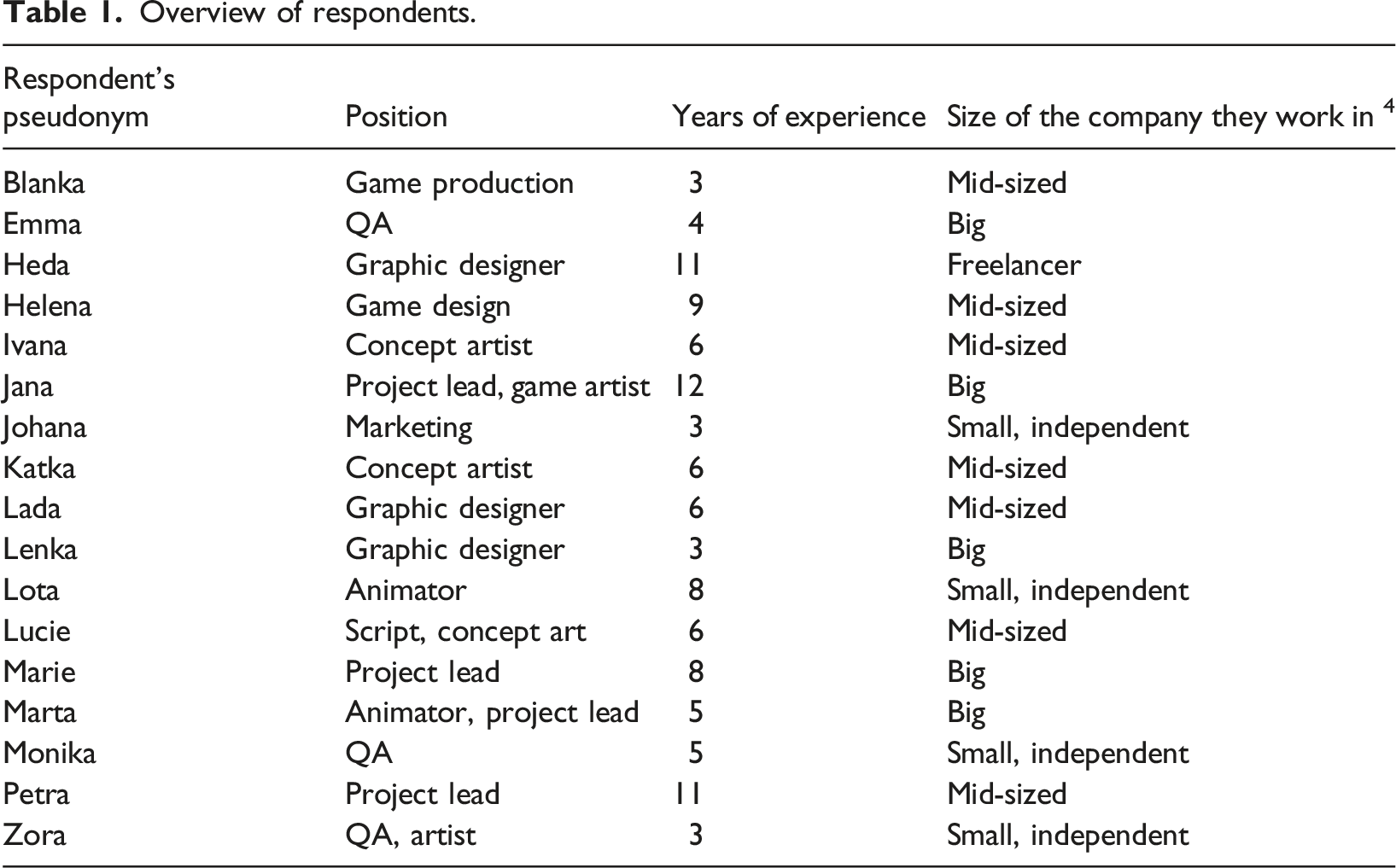
My analysis combined theory-driven and inductive approaches. To learn about the position of women in the Czech game industry, I propose two main research questions: • RQ1: How do women in Czech game industry reflect their position in game culture? • RQ2: What strategies do Czech women working in the Czech game industry use to cope with sexism?
The interview was structured into three main sections. First, I explored the respondents’ histories and gamer identities, focusing on their gaming routines and their role within gaming culture. The second section addressed their professional careers. I inquired about their journey into game development and the nature of their work. The final section covered their experiences with gender stereotypes or sexism, as well as the strategies they use to navigate these challenges.
The analysis was conducted as a qualitative content analysis, grounded in an inductive coding process. I began with open coding (Benaquisto, 2008), reading the transcripts and noting initial codes that captured recurring patterns, significant moments, and nuances in how respondents described their experiences. In the first round of coding, various manifestations of sexism emerged from the data. The recurrence and salience of these themes led me to use ambivalent sexism theory (Glick and Fiske, 2011) as a sensitizing concept for the next phase of analysis. This framework helped to make sense of the tension between open hostility and subtle forms of exclusion and devaluation.
Following the initial round, I proceeded with focused coding, in which the emergent categories were refined and organized into higher-level themes. During this phase, I paid close attention to contextual factors that seemed to influence respondents’ narratives – particularly seniority in the industry, size of the company and respondents’ identification with feminism. These variables were not predefined but emerged from the data and were later coded explicitly as part of a cross-case comparative analysis. I explored whether these factors correlated with differences in how respondents articulated their experiences of sexism. In the case of the relationship to feminism and company size, a correlation was found, which will be discussed further. Regarding seniority, its influence on the respondents’ feelings was not demonstrated.
Regarding RQ2, I followed the principles of analytic induction to create a typology from the empirical material. Using open coding (Benaquisto, 2008), I identified three strategies respondents use to deal with their role of a person working in the game industry. I observed that the choice of a particular strategy was related to their opinion on feminism. Therefore, I conducted several rounds of focused coding to extract common patterns of these associations.
Findings
Women in the Czech game industry
During the interviews, respondents discussed various trends and patterns within the Czech game industry. Overall, all respondents stated that the Czech game industry should be considered from a global perspective. Therefore, they do not believe that their position and the problems they face are influenced by the specific historical, political, and social development of the Czech Republic, but that they are universal in nature. Although I am still convinced that the Czech game industry has its own specificities – particularly in relation to women – stemming from distinct historical and socio-cultural contexts, none of the respondents perceived this difference as particularly significant, and therefore I will not address it further.
Only a few respondents (3) reported having employment relationships that according to the Czech labour law offer benefits such as social insurance or maternity leave. 5 The rest of respondents (14) work as freelancers without benefits or paid vacation time. The absence of employment contracts is also related to the vague definition of job positions and their responsibilities. Several respondents pointed out that without a contract, their working conditions are unstable, and while their workload increases, their salaries remain unchanged or do not adequately reflect the additional tasks. As Ozimek (2019) points out, these practices are prevalent across the broader game industry. In her analysis of the Polish game industry, she emphasizes the concept of ‘informality’, which manifests both in expected collaboration and the creative process, as well as in exploitative working conditions.
These ambiguities intensify workplace inequalities between men and women. Some respondents discovered that their male colleagues, officially holding positions with the same title, earned significantly higher salaries. Those who attempted to address this disparity or request higher pay reported being unsuccessful. ‘You have to be vocal to earn more, and women usually don’t say anything’, explains Jana. As respondents emphasize, women are not accustomed to negotiating their salaries, which contributes to the overall lower pay for women. Many respondents describe the working conditions in the game industry as fundamentally inflexible and unprepared for alternative work arrangements. They highlighted limited opportunities for remote work, an emphasis on the importance and inevitability of crunch periods, and the complex, hierarchical relationships within the office.
It can be stated that the Czech game industry continues to exhibit insufficient preparedness in addressing the specific needs and concerns of women, or even fully acknowledging their presence within the sector. For instance, some respondents have highlighted the issue of insufficient bathroom facilities within the workplace. Ivana shared that their office, housing 80 employees across three floors, only provided one female toilet stall.
These issues were exclusively described as a part of the culture of the bigger game companies and mentioned by respondents who work or have worked here. According to several respondents, these companies rarely address problematic issues such as crunch periods and harassment. ‘They don’t mean any harm; they’re just accustomed to their way of working and reluctant to change’, explains Katka. Many respondents pointed out that the main obstacle to industry-wide change is its narrow leadership. ‘The culture of the entire company is shaped by those at the top. Many of these leaders, who achieved success in the 90s, still believe they have all the answers’, Monika adds.
In contrast, several smaller companies were highlighted as examples of positive practices, both by current employees and those who have moved on. These ‘alternative’ companies were described as having a more inclusive environment, with clearly defined salaries and ongoing discussions about flexible working hours and crunch periods. For instance, one respondent mentioned that a pregnant woman was employed at one of these companies. Respondents also felt they had greater creative freedom and a more significant opportunity to influence content. ‘When you give your employees enough trust, they return it by working harder’, states Petra.
Although it is problematic to generalize, it can be said that women working in smaller independent studios tend to report more positive experiences than those in larger corporate environments. While the latter are often described as inflexible, hierarchical, and unresponsive to gender-specific needs, smaller studios are portrayed as more inclusive and transparent, with open discussions about salaries, working hours, and work-life balance.
Sexism in the Czech game industry
Sexism is a pervasive issue in the Czech game industry. Even it can be described with varying degrees of intensity, respondents shared strikingly similar stories. ‘This is such a universal thing – everyone keeps telling me the same stories. It’s awful how similar all our perceptions are’, describes Marta (pseudonym). On the other hand, some respondents who work on the same companies as those who describe its toxicity, do not address these issues. ‘I don’t know why some girls feel extremely unsatisfied and some are ok with everything. I don’t want to say they are blind because I don’t want to steal their experience but…they don’t feel the problem. And some of them just see it’, explains Emma. As will be discussed later, one key factor influencing sensitivity to sexism in the workplace is the respondents’ relationship to feminism. Those who identified as feminists or expressed a positive stance toward feminism tended to recognize and report instances of sexism more frequently. However, it is important to note that this research focuses on subjective understanding of the issues of the Czech game industry, not the social reality itself.
Respondents noted that the reality of working in the game industry differed significantly from their expectations of it being progressive and inclusive. ‘I was really disappointed to find that it's still a space obsessed with what a seventeen-year-old boy thinks’, Zora remarked. Although all respondents identify as gamers and were familiar with the sexism prevalent in gaming culture, they had hoped that gaming companies would offer a different experience. ‘I expected we would be just a group of nerds making games. Instead, it was much closer to the same kind of corporate nonsense I had encountered before, where you could play chauvinistic bingo every day’, added Marie.
Within the framework of sexism, respondents frequently find themselves in the role of token, often being the only woman in the group. ‘I constantly ask myself: do they see me as a person first, or do they see me primarily as a woman, and then everything else?’ describes Helena. Lota added: ‘I often feel that the default game developer is assumed to be male, with women seen merely as a variation of that norm’.
This normative framework is sometimes explicitly articulated. ‘My colleague told me I am good in making games – especially considering I’m a woman. Apparently, that’s the best compliment I could get: “You’re good, for a woman.” And they mean well’, describes Lota. In addition, some respondents are aware of the responsibility they have to all women working in the industry. ‘I often feel like I can’t afford to make mistakes – not just because I don’t want to mess up, but because I’m a woman. If I do make a mistake, it feels like I’m proving the stereotype that women aren’t as capable, as if my mistake represents all women’, describes Zora.
The tokenistic nature of women working in the game industry contributes to the pressure they experience. ‘Being a woman in the gaming industry means facing constant pressure, often greater than what men encounter’, notes Johana. According to the respondents, women are not taken as seriously as their male counterparts, leading many to feel they must work harder to gain recognition. ‘Man receive respect by default’, describes Heda. Even if this perception is not always fully justified, it significantly impacts how women working in the game industry experience their work environment. This feeling can significantly influence women’s work habits – they tend to work longer hours or check their work more frequently. Such outcomes, which stem from the tokenistic role of women, are also confirmed by Krnec (2013) in the case of STEM field or by our study of Czech women game journalists (Fousek Krobová and Švelch, 2023). In both instances, the fear of gendered criticism led them to spend more time working than their male colleagues.
As outlined above, there is a clear connection between tokenistic positioning and impostor syndrome. In other words, individuals – women in this case – who occupy token roles in the workplace and are thus forced to navigate stereotypes associated with their social group are significantly more likely to experience feelings of inadequacy, unbelonging, and fear that they do not truly deserve their place. Therefore, it is not a surprise that this concept of impostor syndrome was described by many respondents, either implicitly or even explicitly. ‘Every day, I go to work with the feeling that it’s a question of time when they find out that I don’t understand anything’, describes Katka. This feeling of inadequacy may stem from a desire to avoid inconveniencing others and to minimize any potential complications in their work. As Heda explains: ‘I feel like I’m faking everything I do. Additionally, I am a people pleaser, so I have a constant feeling that I’ve manipulated them into liking me, which is why I got the job’.
As previously noted, a key aspect of tokenistic positioning is the range of gendered stereotypes that tokens are required to navigate. These may concern both appearance and behaviour, and their underlying framework is deeply sexist. Gender stereotypes were described by respondents as pervasive, often reinforcing existing prejudices within their roles.
Typically, these stereotypes predominantly focus on women’s abilities and physical appearance. According to respondents, women in the game industry receive mixed signals about what a ‘real’ woman game developer should look like and how she should behave. Reflecting the ‘fake nerd’ stereotype (Scott, 2019), these signals suggest that women should neither be too masculine nor too feminine. As Marta explains, projecting masculinity can help women gain more respect from their male colleagues. ‘If I were more feminine, they wouldn’t take me seriously’. This somewhat ambiguous masculine appearance is seen as an advantage, a notion supported by Heda, who notes that her appearance and behaviour, which aligns more with traditional masculinity, also reflect her sexuality. ‘I’m a lesbian, and I present and act somewhat like a man. I think it helps a lot. I’m less confusing and less threatening. I’m seen as one of the guys, their “bro,” so we can talk about some things more openly’, she adds.
On the other hand, femininity often appears to pose a more substantial barrier. ‘I love dresses, high heels, and make-up, but I also know how to program. I can see how this confuses people’, Helena explains. In other words, there seems to be an unwritten standard for femininity that is considered ideal. ‘A woman must look like a woman – pretty, but not too much. You should be well-groomed in a casual way, not overly made-up. You can’t be a tomboy or overly girly. You’re expected to be the ideal “girl next door”: approachable, with a friendly smile and nice boobs’, adds Monika. Objectification was a recurring topic among the respondents. ‘You know they discuss your butt when you leave the room’, Marie describes. Similarly, Jana points out that she is often treated as a trophy in team-building photos. ‘Some detail of my body appeared in 90% of them’, she notes.
The pervasive objectification of women in the workplace should not be seen as an isolated phenomenon, but rather as an integral part of the broader sexist structures that shape women’s professional experiences. Practices such as tokenism, gender stereotyping, and objectification all operate within a discursive field of sexism. As shown earlier, women are frequently confronted with contradictory expectations about how they should behave or appear. These confusing demands reflect the logic of ambivalent sexism, which captures the double bind women experience as they navigate normative ideals that both reward and penalize them based on their gender. Therefore, it is essential to untangle the nuances of benevolent and hostile sexism to better understand the contradictions and ambivalent positions women face.
In the context of benevolent sexism, respondents felt they were treated as weaker and more vulnerable. ‘When the boss yells at everyone, he excludes me, as if he’s afraid I might cry’, Lada describes. Similarly, a sense of being perceived as less competent was common among respondents. ‘They assume you don’t understand, so they are more patient with you’, adds Petra. This approach fosters a form of paternalistic care often resulting in mansplaining.
Aligned with benevolent sexism, respondents often felt they were expected to embody nurturing and caring roles. ‘Everyone anticipated that I would be the friendly, supportive woman who would keep the team in good spirits’, Petra noted. This expectation also translated into specific ‘feminine’ behaviours that is often implicitly expected from. For instance, Helena describes how specific work qualities were expected from her: ‘We were working on a zombie game, and my colleagues asked if I could add some “feminine touch” – like putting flowers and trees on the streets’. This expectation also can take on more comical (but not less frustrating) dimensions. ‘During crunch time, my boss asked me to clean the dishwasher, claiming I knew best how to do it’, adds Blanka.
However, sexism can also manifest in a more toxic form of hostile sexism, which can be both implicit and explicit. Implicit hostility often involves perpetuating traditional stereotypes about femininity, such as women being seen as hysterical or overly emotional. ‘They frequently tell you to calm down and speak factually’, Petra explains. Similarly, Jana recalls: ‘When I disagreed or wasn’t in the best mood, they would say, “You’re being unpleasant today; you must be on your period.”’ This approach often extends to seemingly ‘innocent’ comments about women and their essential ‘nature’. ‘There are so many little things that you start to overlook – constant jokes about women being this or that’, Marie adds.
Explicit hostile sexism manifests as overt hostility and misogyny, taking the form of toxic behaviour, (micro)aggressions, workplace bullying, harassment, or even a rape and gang rape attempt. 6 This hostility is often pervasive throughout the work environment and can become ingrained in the company’s overall ethos. ‘The CEO routinely declared that women were not allowed to work here’, Monika recounts. She adds, ‘During the company’s 20th anniversary celebration speech, he said that women don’t belong in game development because men behave strangely around them. It was so embarrassing that the woman who was translating it for the foreign audience refused to interpret it’.
This hostility creates significant barriers to entering the industry. ‘In HR, they explicitly ordered that women’s CVs be discarded, claiming they didn’t believe women belonged in the game business’, Ivana describes. After all, negative experiences with HR were mentioned more frequently. For example, when respondents sought help for various issues, HR often failed to act. ‘At a company party, one CEO started hitting on me in front of everyone. When I didn’t respond, he said, “You’re here because you fucked everyone.” After the party, HR refused to address the incident, arguing that because alcohol was involved, it didn’t count’, Jana describes.
Overall, manifestations of sexism, the tokenistic positioning of women, and the resulting feelings of impostor syndrome significantly hinder not only women’s participation and career progression in the game industry but also their ability to simply focus on their work. Instead of directing their energy toward professional tasks, many are forced to expend it either on the emotional processing of such experiences or on navigating and managing them directly. The result is a significantly higher work and emotional burden, or increased levels of stress, which are typical for women across STEM fields (Conrad et al., 2021).
As a result of hostile sexism, respondents reported experiencing depression, increased alcohol consumption, quitting their jobs, or even leaving the game industry altogether. However, hostile sexism was reported less frequently than benevolent sexism, which appears to be pervasive and deeply embedded in workplace culture. Its true danger lies in its apparent harmlessness and banality. As discussed, this form of ‘friendly sexism’ is encountered daily and often goes unnoticed by its perpetrators. As the respondents describe, they do not even mean it badly and are just expressing the ‘natural state of things’. They then not only confirm this state but also draw from it themselves – whether it is men in the workplace, who hold any positions, or women who accept these stereotypes and agree with them.
Benevolent sexism in the gaming industry subtly shapes career progression and organizational dynamics, operating at both individual and institutional levels. Although often viewed as protective, it restricts women’s professional growth by reinforcing gendered expectations. Women are often praised for their ‘collaborative’ or ‘nurturing’ qualities, but these attributes frequently position them in roles with limited upward mobility, sidelining them from leadership positions. For example, some interviewees reported that despite excelling in their roles, they were overlooked for promotions in favour of male colleagues who were perceived as more assertive or decisive. Yet, it is subjectively experienced as draining and frustrating by women in the game industry and may serve to discourage potential entrants.
While benevolent sexism may seem to benefit women in the short term by offering a sense of security, it ultimately maintains gendered power structures. Men, particularly those in leadership roles, continue to benefit from these dynamics, as women are relegated to supportive positions rather than roles of true influence. Thus, benevolent sexism perpetuates the gendered division of labour, limiting opportunities for women to attain recognition and power in the workplace.
Copying mechanisms
Given the pervasive and multifaceted nature of ambivalent sexism in the gaming industry, it is crucial to explore the coping strategies that women employ to navigate these challenges and maintain their professional well-being.
First, some women chose to disregard the problems and focus solely on their work, while others made concerted efforts to disprove the stereotypes imposed upon them. ‘To earn respect, you have to go the extra mile’, Emma explains. ‘All I can do is perform better and prove everyone wrong, even if some people will never accept it’, adds Zora. It is important to note that this additional work, through which women cope with sexism, can, in turn, cyclically reinforce feelings of inadequacy or the previously mentioned imposter syndrome.
Second strategy involves actively combating the toxicity of the work environment. ‘Sometimes I tell them directly, “Just don’t be a moron,”’ Marie adds. Some respondents take a more proactive approach by openly criticizing the conditions they face. However, this often leads to them being labelled as unfriendly. ‘They call me boring because I’m the only one who doesn’t laugh at their chauvinistic jokes’, Johana notes. Those who try to fight back are also frequently branded as ‘woke’ and problematic. ‘When I spoke up, to negotiate a higher salary, to show that women can be loud as well as they requested, I was labelled a gold digger’, Jana describes.
The willingness of respondents to openly ‘fight’ for a change in the status quo was often influenced by their more general attitude to problems and inequalities in society. In general, it can be stated that at higher sensitivity to the toxicity of the company was influenced by the identification with feminism. For example, one of the respondents, who openly subscribes to feminism and is active in public life, more strongly criticized sexism in the workplace and received more critical backlash. ‘I have the label of the arrogant loud cunt. Feminist, left-wing cunt. I can collect all these labels as Pokémons’, Petra admits.
Third, the struggle against sexism in the workplace also manifested in a more positive way through mutual support among women in the industry. ‘We knew there were so few of us, so we had to stick together’, explains Blanka. Jana adds that they made efforts to support each other outside of work as well. ‘We used to grab drinks together and call them out for being toxic assholes, all while planning how we women would make the game awesome’, describes Jana. Several respondents also mentioned the existence of dedicated ‘women’s’ channels that serve not only a professional function but also provide emotional support. ‘These spaces act as our safe havens. I can share my ideas here, and others empower me to voice them more confidently’, describes Ivana.
Additionally, respondents highlighted broader initiatives aimed at supporting women in the gaming industry, such as the development of mentoring programs and efforts to consider gender balance in hiring practices. ‘When we’re hiring, I always advocate for including women in the candidate pool. It doesn’t mean I wouldn’t consider men, but I want to ensure women are not overlooked’, Marta explained. They also mentioned various events specifically targeting women in game development 7 and mentoring programs designed to support female professionals. For some respondents, empowering women with similar experiences has become a central mission. ‘I really believe that more women, LGBT people, people of colour or men who don’t behave as machos, especially in higher positions, would help a lot. Therefore, it makes sense to me to support these people to join us’, describes Helena.
Conclusion
While there is a growing consensus that video game culture and production are becoming more diverse and inclusive (Chess and Shaw, 2015; Cote, 2020; Harvey and Fisher, 2015), many persistent issues, such as sexism, continue to affect women working in the game industry. My findings indicate that respondents share experiences of discrimination and challenges primarily rooted in their gender, which significantly influences how they are perceived and judged. As an outcome, they need to carefully negotiate their roles within game industry.
The study reveals that sexism in the Czech game industry manifests in both benevolent and hostile forms, reinforcing gendered stereotypes that undermine women’s professional legitimacy. Tokenism emerges as a key issue, with women frequently occupying isolated positions within predominantly male teams, resulting in increased scrutiny, impostor syndrome, and the pressure to prove their competence. These dynamics are compounded by persistent gender-based pay disparities and the prevalence of hierarchical structures that perpetuate unequal power dynamics.
The findings also highlight instances of resistance and coping mechanisms employed by women to navigate the industry’s gendered landscape. Respondents described strategies such as ignoring sexism, actively challenging stereotypes, and building solidarity networks to counter workplace hostility. However, it is important to recognize that these strategies divert women’s energy from their work. Instead of focusing fully on professional tasks, they must allocate substantial effort to navigating tokenism and the persistent – if sometimes subtle – sexism of their environment, placing a greater burden on them than on their male peers.
This unequal distribution of emotional and cognitive labour is not incidental but symptomatic of the ambivalent sexism embedded in the game industry. Like in other male-dominated professions such as STEM, women must navigate a contradictory environment where they encounter both support and subtle barriers rooted in gendered expectations. While hostile sexism is often seen as overt and harmful, benevolent sexism – framing women as ‘nurturers’ or ‘pleasant colleagues’ – is equally dangerous. It masks itself as protection but restricts women’s professional growth and leadership opportunities.
Together, these dynamics compel women to constantly negotiate between idealized feminine behaviour and structural constraints that limit their advancement. This ambivalence fosters impostor syndrome, undermines recognition, and ultimately reinforces gender stereotypes, helping to sustain the industry’s status quo.
This research contributes to a deeper understanding of the complex and multilayered nature of sexism in the workplace through the real experiences of women. It demonstrates that sexism is not limited to its explicit manifestations but also includes various implicit remarks and even seemingly positive attitudes toward women at work. The interplay between hostile and benevolent sexism illustrates how gender inequality is sustained not only through explicit discrimination but also through the normalization of ‘friendly’ and seemingly progressive attitudes that position women as valued yet subordinate participants. These dynamics contribute to the illusion that sexism has been overcome once overt hostility disappears, while structural barriers persist.
Most importantly, this research situates the manifestations of ambivalent sexism and the responses to them within the broader context of video game culture and the game industry – an environment widely recognized as a distinctly masculine space in which women often occupy limited and predominantly negative roles. It demonstrates that the video game industry and game culture do not simply reproduce the gendered hierarchies found in other male-dominated fields but rather magnify them through their close connection to the cultural and symbolic dimensions of gaming. In this sense, the game industry functions as a microcosm of broader societal inequalities – a space where cultural representations, workplace practices, and gendered identities reinforce each other, rendering exclusion and devaluation both normalized and invisible.
While these mechanisms appear universal, the study also provides an important regional insight. It represents one of the first attempts to analyze the position of women in the game industry within a Central European context. It highlights that, although respondents do not emphasize this connection, the global nature of the gaming industry is closely linked to the historical and social dynamics of the respective country or region. However, this research explores the position of women within a broadly universal and globalized framework. For the respondents, region-specific differences – stemming from distinct historical and social contexts, the cultural status of games and the game industry in Czech society, and the broader position of women in technological fields – were not perceived as particularly relevant. It can be argued that the Czech game industry, to a certain extent, mirrors global industry trends, despite being significantly smaller in terms of female participation and notably younger. Therefore, I still believe that there is a room to explore how regional labour conditions or cultural factors shape experiences of women differently.
Footnotes

Ethical approval
This study was approved by the Commision for Ethics in Research at Charles University (n. 141/2024) on October 15, 2024. All participants provided verbal informed consent prior to enrolment in the study. This research was conducted ethically in accordance with the World Medical Association Declaration of Helsinki.
Funding
The author(s) disclosed receipt of the following financial support for the research, authorship, and/or publication of this article: The research for this article was supported by the Charles University program PRIMUS/21/HUM/005: Developing Theories and Methods for Game Industry Research, Applied to the Czech Case and ERC grant GAMEINDEX: Politics and aesthetics of indexical representation in digital games and VR (Grant agreement ID: 101169641).
Declaration of conflicting interests
The author declared there are no potential conflicts of interest with respect to the research, authorship, and/or publication of this article.
Data Availability Statement
The data is stored on a secure memory disk located at the Charles University office in Prague, with access protected by a password. All records will be permanently deleted in December 2027. Upon request, the data – including records and transcripts in Czech – can be provided.