




Abstract
Blockchain-tokenised media is kitsch. We examined OpenSea’s top 50 collections of non-fungible tokens (NFTs) as well as the first two NFTs acquired by New York’s Museum of Modern Art (MoMA). We concomitantly developed two concepts: oppositional kitsch, and historically informed kitsch. OpenSea’s profile picture collections exemplify oppositional kitsch: they are described by their creators as anti-normal, degenerate or animalistic. CryptoPunks and Bored Apes are the best-known examples. Historically informed kitsch is, by contrast, pleasant and reassuring. MoMA’s first two NFTs exemplify historically informed kitsch: they are produced by artificial intelligence (AI) models that rely on historical data. For Unsupervised – Machine Hallucinations – MoMA, Refik Anadol trained an AI model with images from MoMA’s GitHub archive. The Unsupervised NFTs are mementos of individuals’ encounters with the work at MoMA. For 3FACE, Ian Cheng created an AI model that draws on blockchain transaction histories. The AI model generates tokenised portraits of individuals based on their transactions. Oppositional kitsch and historically informed kitsch both valorise the individual consumer. OpenSea’s oppositional kitsch lets consumers identify with cartoon figures like CryptoPunks and Bored Apes that are marketed as avatars (alter-egos) and profile pictures. MoMA’s historically informed kitsch sells mementos of individuals’ experiences and portraits that are based on individuals’ consumption choices. Our conception of blockchain-tokenised media as kitsch is primarily informed by the philosophers Alain Badiou and Thorsten Botz-Bornstein as well as the media theorist Jean Baudrillard. These three thinkers treat kitsch as a category of sophistic, liberal-cum-libertarian culture.
Keywords
Introduction
Kitsch is associated with technological production, sentimentality, and figurative imagery that is easy to recognise and understand (Brayshaw, 2021; Kjellman-Chapin, 2010; Kulka, 1996). Kitsch is a relevant topic today (Belpoliti and Marrone, 2020; Botz-Bornstein, 2019), thanks to non-fungible tokens (NFTs), prompt-generated images by DALL-E and Midjourney, and the Meta Avatars Store (Botz-Bornstein, 2021; Smethurst et al., 2023). From 2018 to 2023, OpenSea was the dominant, global auction platform for NFTs (see the Appendix). In October 2023, New York’s Museum of Modern Art (MoMA) acquired its first two NFTs. Artificial intelligence (AI) models, trained with historical data, generated the images; the images were tokenised; then two of these tokenised images (NFTs) were donated to MoMA.
Our study is exploratory; therefore, it contributes plausible links between concepts and empirical evidence (Bamberger, 2018). It focuses on two organisations (OpenSea and MoMA), two media technologies (NFTs and AI), and two concepts (oppositional kitsch and historically informed kitsch). We first examined OpenSea’s 50 highest selling collections of NFTs and developed the concept of oppositional kitsch. We then examined the first two NFTs acquired by MoMA and developed the concept of historically informed kitsch.
OpenSea’s top 50 collections mostly consist of tokenised avatars (alter-egos) and profile pictures like CryptoPunks, Bored Apes and mfers (motherfuckers). The tokenised avatars and profile pictures are usually cartoon characters that self-identify as anti-normal, ugly and bad rather than normal, beautiful and good (Muniz and Segall, 2022; Sartoshi, 2022; Yuga Labs, 2024). We conceptualise this as oppositional kitsch. Oppositional kitsch differs from familiar, twentieth-century examples of kitsch, which are characterised by superficial pleasantness and easy digestibility (Brayshaw, 2021; Kulka, 1996). Sub-human apes, degens (degenerates), mfers (Figure 1) and punks are not just tolerated on OpenSea; they are marketed and promoted (Belpoliti and Marrone, 2020; Heath and Potter, 2004; Winecoff and Lenhard, 2023). Anti-art aesthetics: eight profile pictures from the mfers collection.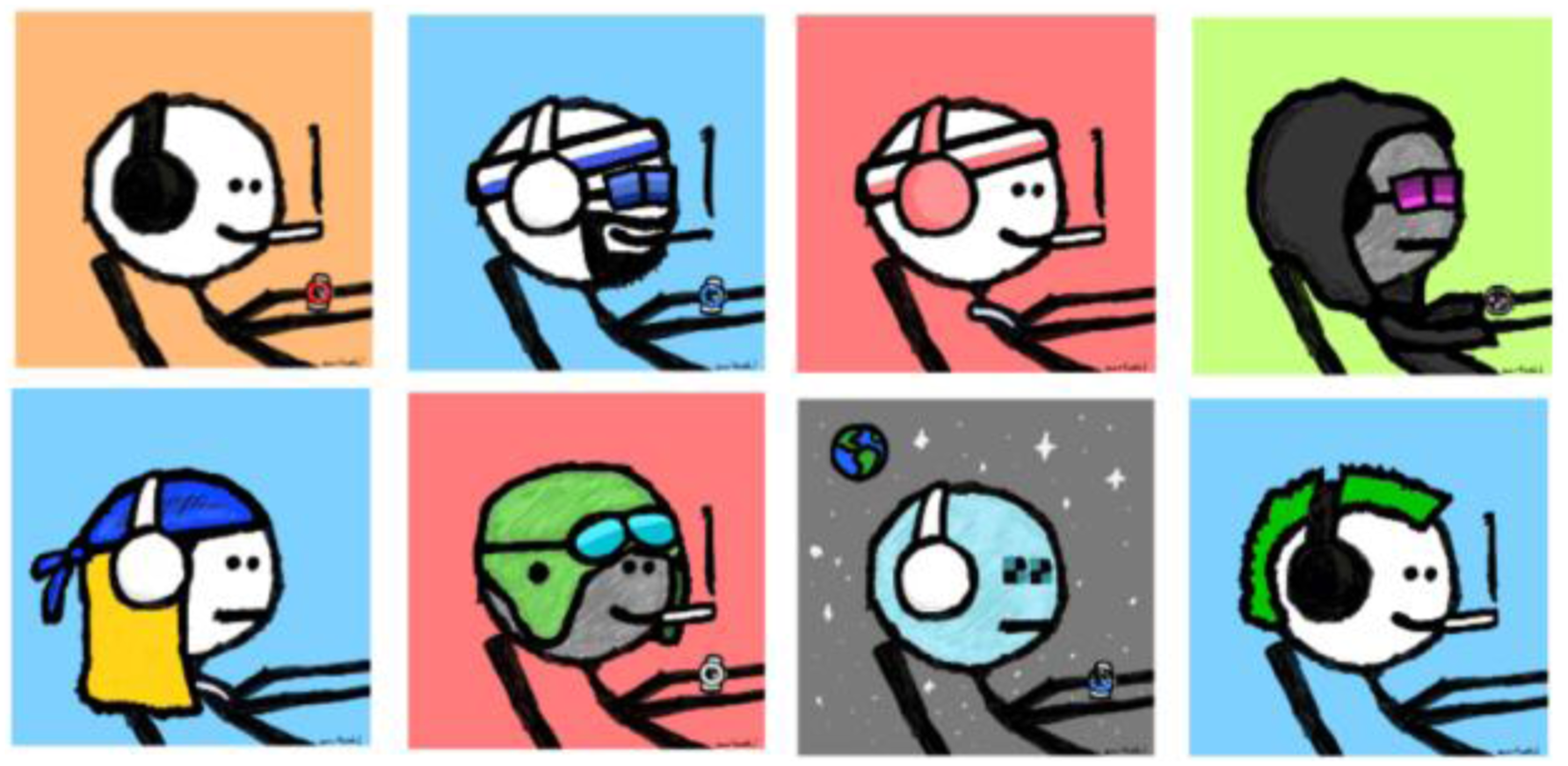
The best-known examples of historically informed kitsch are the costumed re-enactments, feel-good mementos, and teddy bear souvenirs sold by the heritage tourism industry (Baudrillard, 2017; Sturken, 2007). Our examples of historically informed kitsch are the first two NFTs from MoMA’s permanent collection (Liddell, 2023): Unsupervised – Machine Hallucinations – MoMA by Refik Anadol, and 3FACE by Ian Cheng. Both Unsupervised and 3FACE are historically informed, machine-generated media that valorise the individual. Our first example, Unsupervised, is an abstract, live video re-creation of MoMA’s GitHub archive – digital images of artworks that span over 200 years. Unsupervised also includes a series of 5000 NFTs, minted at the request of individuals to commemorate their first-hand encounters with the live video work at MoMA. Each NFT from the Unsupervised collection is thus a still image (captured from the live video at MoMA), a personal memento, and a kitsch collectible (Kuo et al., 2023; Liddell, 2023). Our second example of historically informed kitsch, Cheng’s 3FACE, uses an individual’s blockchain transaction history to make an abstract portrait of the individual (Museum of Modern Art, 2023) – ‘a kind of collector personality test’ (Kushnir, 2024: 193).
Our approach to blockchain-tokenised and AI-generated media is primarily informed by the philosophers Alain Badiou (2003, 2010) and Thorsten Botz-Bornstein (2019, 2021) as well as the media theorist Jean Baudrillard (2017). They each treated kitsch as a formal category (instead of a topic for critical-realist, historicist-contextualist or post-positivist studies of art-institutional policies and societal shifts of opinion). Within this formal category, Botz-Bornstein (2019: 2) placed concepts like ‘administrative kitsch’ and ‘communicative kitsch’, then he offered illustrative examples. Botz-Bornstein’s method is neither historicist-contextualist nor taxonomic-essentialist (Bailey, 1994). It is philosophical (Deleuze and Guattari, 1994; Hovey et al., 2022). We used the same method as Botz-Bornstein (2019); therefore, we treated tokenised kitsch as ‘a category of commercial presentation’ (Badiou, 2003: 12) and ‘Mass-Media Culture’ (Baudrillard, 2017: 124–131). Within this formal category, we placed the concepts of oppositional kitsch and historically informed kitsch.
Our article concludes with a description of its limitations as well as suggestions for future philosophical and media-theoretical research. The suggestions offer alternatives to liberal-cum-libertarian rhetoric about kitsch that celebrates the levelling of tastes.
Narrative review
Kitsch is ubiquitous (Belpoliti and Marrone, 2020; Botz-Bornstein, 2019), even among contemporary intellectuals and ‘the higher layers of culture’ (Agamben, 1999: 20). Clement Greenberg (1961: 12) referred to kitsch as a ‘mass product of Western industrialism’ and ‘the first universal culture ever beheld’. Thorsten Botz-Bornstein (2019: 1–2) described kitsch as ‘the predominant aesthetics of the twenty-first century’ and an unfortunate symptom of global capitalism’s ‘deculturation’. Alain Badiou (2010: 23–24) defined kitsch as ‘mass art’, produced by ‘insecure societies’ and ‘waning empires’ like Hollywood that exploit massive ‘technological resources’. Kitsch offers ‘an utterly nihilistic view of the future’, regardless of whether it is noisy and violent (like oppositional kitsch) or numbing and superficially pleasant (like historically informed kitsch).
Jean Baudrillard also emphasised kitsch’s nihilism. He associated kitsch with ‘an amiable, necessarily genial sharing of nullity’ (2005: 28). Kitsch’s nihilism makes it ‘all of a piece with the “gimmicky” gadget in the technical world’, which offers ‘an excrescence of useless functions, a continual simulation of function without any real, practical referent’ (Baudrillard, 2017: 130–131). According to Baudrillard (2017: 129), kitsch is a formal category that is difficult to define, due to its lack of substantive contents or essential properties. It is best grasped as a pure ‘appearance on the market’.
Our notion of tokenised kitsch specifically derives from Baudrillard’s notion of ‘the consumer society’ (2017: 129) as well as Badiou’s notion of sophistic culture. Sophistic culture is ‘homogeneous to the market’ and closely linked to ‘technology’ (Badiou, 2003: 12). Tokenised kitsch is homogeneous to an accounting ledger (blockchain). By definition, sophistic culture is truth-insensitive (Botz-Bornstein, 2021; Cassin, 2014): it celebrates ‘contemporary relativism’, ‘the democracy of opinion’, and ‘the expression of individuals’ inner selves and unique sensations’ (Badiou, 2022: 92–93). So, too, do the developers of tokenised avatars and profile pictures (Muniz and Segall, 2022; Sartoshi, 2022; Yuga Labs, 2024). Badiou (2022: 93) cited the selfie, ‘which is promoted in various quarters as an excellent medium for democratising artistic activity’, as ‘a perfect illustration’ of sophistic culture. Tokenised avatars, profile pictures and 3FACE portraits illustrate the same thing: the familiar, liberal-cum-libertarian culture of the self, its representations and its alter-egos.
Tokenised kitsch
Tokenised kitsch is faithful to its etymological origin, verkitschen – a German verb that means to sell and trade or to make cheaply (Brayshaw, 2021; Kjellman-Chapin, 2010; Kliche, 2010). Tokenisation allows kitsch collectibles – usually digital, sometimes physical (Hartwich et al., 2023) – to be bought and sold online, with transactions of NFTs registered on blockchains like Ethereum and Solana (Chalmers et al., 2022; Chohan, 2024). The best-known NFTs are algorithmically generated avatars and profile pictures like CryptoPunks and Bored Apes (Chohan, 2024; White et al., 2022). Botz-Bornstein (2021: 69, 75–82) described the best-known NFTs as kitsch artifacts of ‘late capitalism and populist aesthetics’. The Wall Street Journal wrote about NFTs as ‘kitschy collectibles’ (Alcántara, 2022). The San Francisco Examiner proclaimed, ‘NFTs are kitsch’ (Blue, 2022). The New Yorker referred to a NFT by Beeple (that sold for USD $69.3 million) as ‘Internet kitsch’ (Chayka, 2021a). Media scholars also wrote about NFTs as kitsch (Bautista and Sandico, 2022; Rivero Moreno, 2024; Wilson, 2022).
Decades before the emergence of blockchain-tokenised media, the cultural theorists Walter Benjamin (1999 [1940]), Clement Greenberg (1961 [1939]) and Matei Călinescu (1987) discussed kitsch’s three common themes: (1) technology for mass production and dissemination, (2) culture-industrial commodities, and (3) an uncritical tolerance for democratic opinion. Their work is prescient. Benjamin (1999: 126, 394) summarised kitsch as the production of ‘art forms’ by ‘technology’, intended for mass consumption. Greenberg (1961: 9–10) described kitsch as ‘popular, commercial’ culture that is produced by industrial technology. ‘Kitsch is mechanical and operates by formulas’, he wrote. Călinescu (1987: 8) defined kitsch as the mass production of cultural commodities by ‘capitalist technology’. He emphasised kitsch’s ‘all-embracing and blandly tolerant eclecticism’. According to Călinescu (1987: 243), kitsch ‘is fabricated by technicians hired by business; its audiences are passive consumers, their participation limited to the choice of buying or not buying’. It is a culture of pseudo-empowerment that panders to the liberal-cum-libertarian individual (Badiou, 2022; Baudrillard, 2017; Smethurst et al., 2023).
A brief history of blockchain-tokenised media
A non-fungible token (NFT), registered on a blockchain like Ethereum or Solana, is an extra-legal ownership claim to any physical or digital asset (Bodó et al., 2022; Hartwich et al., 2023). How one perceives NFTs is influenced by one’s predilection for either exchange-value or use-value. If one examines exchange-value, then one is led to the highest selling NFTs on the popular auction platform, OpenSea (see the Appendix). This is the familiar domain of blockchain-tokenised media like CryptoPunks and Bored Apes (Botz-Bornstein, 2021; Chayka, 2021b). Our article is confined to this domain. If, by contrast, one examines actual use-value (rather than imaginary or prospective use-value), then one ends up in the esoteric realm of crypto-asset exchanges and lending services (Barbereau et al., 2023). From May 2021 onwards, the Uniswap exchange used NFTs to represent the ownership of liquidity positions (Heimbach et al., 2023; Spinoglio, 2024). This utility-oriented, shadow banking material is far outside the scope of our article. It is not relevant to tokenised media.
The global sales volume of NFTs peaked in January 2022, together with the Google Trends global search volume for NFT (Figure 2). Both volumes significantly declined in 2023 (Rivero Moreno, 2024; Small, 2024). NFT sales volume and Google Trends global search volume.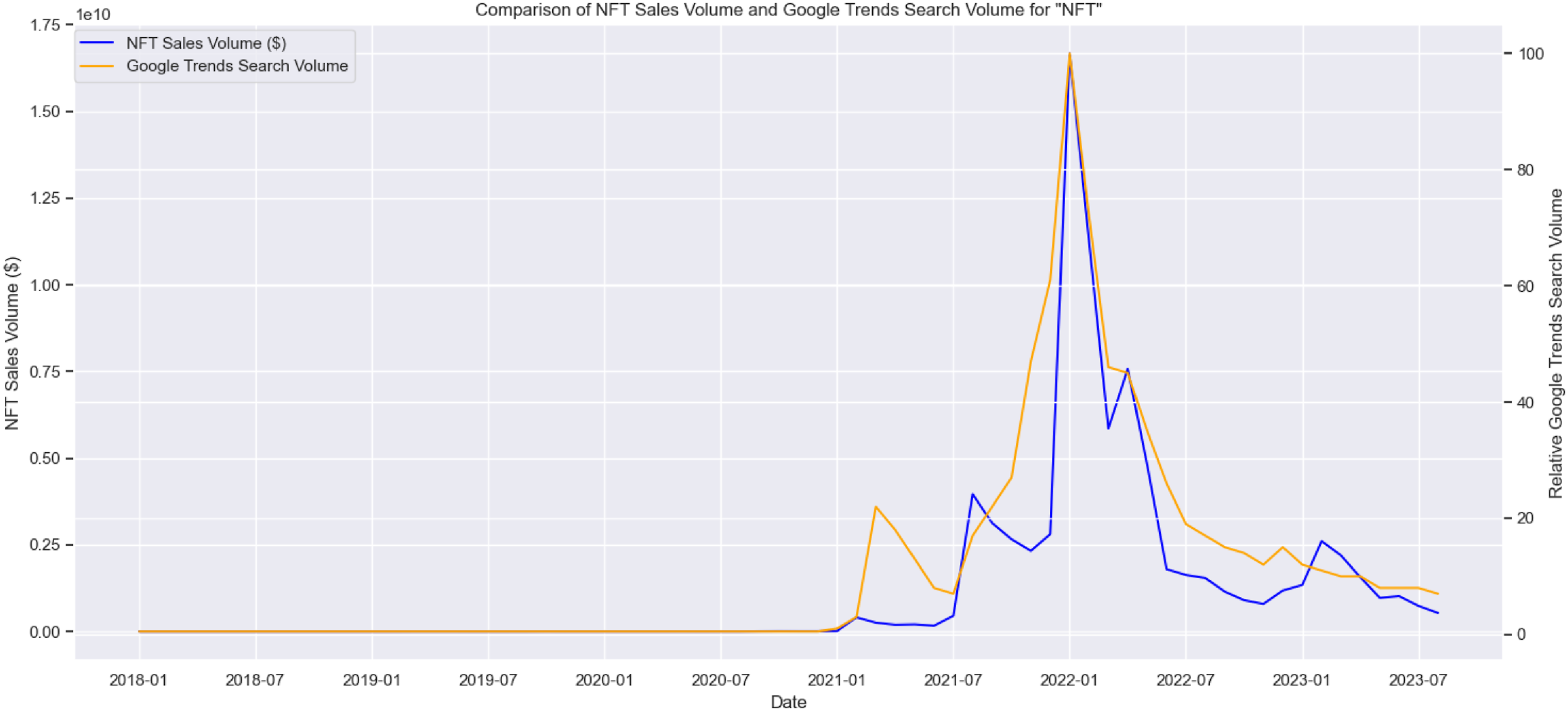
When the NFT market peaked in 2022, NFTs were less than ten years old. Kevin McCoy’s ‘Quantum’ from 2014 is the first blockchain-tokenised image (Thomas, 2023). According to hyperbole from Sotheby’s auction house (2021), ‘Quantum’ is not merely an animated neon octagon; it is the dawn of the ‘NFT era’. McCoy tokenised the animated octagon on the little-known Namecoin blockchain on 3 May 2014. He reissued ‘Quantum’ as an Ethereum token on 28 May 2021, which Sotheby’s sold for $1.47 million. According to Christie’s auction house, the collectible Curio Cards, issued on 9 May 2017, are the Ethereum blockchain’s ‘first ever’ NFTs. Christie’s described the Curio Cards as ‘a convoluted and motley array of surrealist-tinged kitsch’ (Davis, 2021).
Ethereum’s first collection of tokenised profile pictures, CryptoPunks, followed soon afterwards. CryptoPunks were released on 23 June 2017. The official website describes CryptoPunks as ‘24 × 24 pixel’ images that are ‘generated algorithmically’. ‘Most are punky-looking guys and girls, but there are a few rarer types mixed in: apes, zombies and even the odd alien’ (Yuga Labs, 2024). The apes from the CryptoPunks collection inspired Yuga Labs’ popular Bored Apes collection, released in 2021.
Since NFTs are not mutually interchangeable, their values are non-fungible (Peres et al., 2023). A NFT can be understood, at a minimum, as an issuer’s electronic signature (Chohan, 2024); or, as Botz-Bornstein (2021: 82) put it, NFTs are ‘bullshit’ (truth-insensitive) assets that bear ‘serious’ cryptographic signatures. If, for example, a NFT is associated with a mass-disseminated digital image, then the NFT’s value is analogous to an autograph, written with a cheap permanent marker on a mass-produced baseball cap. The signature alters the value (Conrad, 2015).
In 2014 (the same year, incidentally, as McCoy’s ‘Quantum’), Richard Prince’s New Portraits series toyed with the value of the signature. Prince’s New Portraits series highlights the difference between the value of a digital self-portrait photograph that is stored in the cloud (Instagram) and the value of the same image when it is physically printed, autographed by Prince, and sold by an auction house or a gallery. A value of $63,000, for example, pertains to an image that is printed on a canvas, ‘signed and dated “Richard Prince 2014” (on the overlap)’, and sold by Christie’s (2022). The value of $63,000 does not pertain to the initial, Instagram-hosted image that is not signed by Prince and not sold by Christie’s. The difference is clear. Prince’s signature altered the value.
The same can be said for the tokenised media sold on the OpenSea platform. OpenSea happens to sell electronic, blockchain-registered signatures instead of physical signatures (Botz-Bornstein, 2021), but OpenSea’s tokenised media and Prince’s New Portraits series share a basic proposition. Signatures are appended to digital media – typically, images associated with a personal identity or alter-ego – then a third party auctions the signed works. In addition to the value of signatures, OpenSea plays with the value of serial numbers and limited editions – familiar kitsch topics (Gover, 2015). Like the 10,000 serialised CryptoPunks from 2017, many NFT collections are limited to 10,000 electronic signatures and 10,000 unique images (Christie’s, 2018). The limit is arbitrarily determined by the issuer of the NFT collection. Blockchain developers refer to this as artificial scarcity (O’Dwyer, 2020; Said, 2023; Serada et al., 2021).
Oppositional kitsch
Baudrillard (2005) and Tomáš Kulka (1996) each emphasised the similarity between kitsch markets and post-modern anti-art markets. Post-modern artists like Jeff Koons and Julian Schnabel played with art markets’ acceptance of ‘anti-art movements’ in the late twentieth century; therefore, as Kulka (1996: 116) observed, their artworks ‘appear indistinguishable from kitsch’. Baudrillard (2005: 27–28) noted how post-modern art markets easily accommodate the negation of art – namely, anti-art’s deliberately amateur aesthetics, ‘banality, waste and mediocrity’. Many post-modern artists, like the manufacturers of kitsch, execute ‘a commercial strategy of nullity, one to which they give a marketable form, the sentimental form of commodity’. Along comes the twenty-first century, sentimental celebrations of oppositional identities (Badiou, 2009, 2022; Heath and Potter, 2004; Nagle, 2017), and a plethora of kitsch innovations, from prompt-generated images by DALL-E and Midjourney to the Meta Avatars Store and OpenSea’s tokenised profile pictures (Smethurst et al., 2023).
What distinguishes OpenSea’s post-modern kitsch from the early twentieth century’s superficially pleasant kitsch is ‘noisy nihilism’ (Badiou, 2010: 23) and ‘negative narcissism’ (Han, 2018: 2). An individual that identifies with cartoon figures like CryptoPunks, Bored Apes and mfers does not ‘love itself’ or perceive itself as good (Han, 2018: 2). This individual instead celebrates itself as animalistic, banal or degenerate. OpenSea’s cartoon punks, apes, mfers and other degens are marketed as explicitly opposed to normies (Muniz and Segall, 2022; Sartoshi, 2022; Yuga Labs, 2024). To be clear, kitsch’s consumers from the early twentieth century could celebrate bad taste as well, but they typically did this in defence of popular sentiments or to contest the judgements of elites (Kjellman-Chapin, 2010; Kulka, 1996). Oppositional kitsch, by contrast, opposes normality for the sake of opposing normality (Nagle, 2017; Tuters et al., 2024; Winecoff and Lenhard, 2023). It is vain. Putatively opposed to the ‘sameness’ of normies, oppositional kitsch generates ‘a show of pluralism’ as ‘entertainment’. It revels in ‘the outrageous and abnormal, the violent and the tabooed’ (Berman, 1989: 93). Over time, this becomes predictable and generic.
OpenSea’s CryptoPunks, Bored Apes, mfers and other degens follow familiar post-modern trends, from the ‘desublimation of art’ to the ‘aestheticisation’ of mundane life (Berman, 1989: 93). They are so grounded in everyday mundanity, from January 2022 until January 2024, a tokenised punk, ape or mfer could represent its holder on X (née Twitter). From May 2022 to March 2023, Facebook and Instagram also supported NFTs (Smethurst et al., 2023). Because of this, tokenised avatars and profile pictures are sometimes classified as digital identities (Muniz and Segall, 2022; Smethurst, 2023). It would be a stretch, however, to describe 10,000 tokenised identities like punks, apes or mfers, scattered across the globe, as members of new communities or societies. They lack a coherent discourse, a common ideology, or an organised set of cultural rituals (Dylan-Ennis, 2024). Token-gated communities of punks, apes and mfers are better described as aggregates of atomised individuals that share hopes and sentiments about an investment (Winecoff and Lenhard, 2023).
Monica Kjellman-Chapin (2013: xii) questioned kitsch’s ‘idea of community based on a shared (if insubstantial) sentiment’. According to her, the consumption of kitsch fosters ‘a fundamentally false sense of community of sentiment’. Barbara Cassin (2018: 123–124) put it best: One plus one plus one does not make a community, nor an assembly, nor a demos, a ‘people’, nor moreover a ‘multitude’ (a nomadic and differentiated anti-people), but a group of ‘idiots’, in the strict sense of the term, that is, private individuals (deprived of the public dimension), reduced to their singularity as simple particulars, to their ‘proper’ dimension of unknown and ignorant people.
Cassin’s concept of grouped idiots derives from the Greek idios, which means ‘private’ or ‘one’s own’. The term is apt for OpenSea’s punks, apes and mfers (Smethurst, 2023). Not only are these tokenised profile pictures privately held, they are idiotic and animalistic according to their own creators (Muniz and Segall, 2022; Sartoshi, 2022; Yuga Labs, 2024).
Historically informed kitsch
In Nation of Rebels: Why Counterculture became Consumer Culture, Joseph Heath and Andrew Potter (2004: 3) argued that, despite its reputation, the 1960s counterculture of ‘hippies’ and punks is not the opposite of the 1980s’ ‘yuppie’ consumer culture. ‘Hippie ideology and yuppie ideology’, they wrote, ‘are one and the same’. Counterculture only sells a pseudo-alternative to capitalist democracy (Berman, 1989; Nagle, 2017). The pseudo-alternative does not generate ‘any tension between the values of the counterculture and the functional requirements of the capitalist economic system’ (Heath and Potter, 2004: 3). The same can be said today about oppositional kitsch and historically informed kitsch. Oppositional kitsch follows the vain counterculture of punks and hippies; historically informed kitsch follows yuppie consumer culture.
Historically informed kitsch is an offshoot of the heritage tourism industry. ‘The tourism of history’, Marita Sturken (2007: 18) wrote, ‘is intimately caught up in the production and consumption of kitsch’. Contrary to histories of struggle and revolution (Badiou, 2012; Kojève, 1969), historically informed kitsch sells ‘innocence’ and ‘comfort culture’, such as ‘teddy bear’ souvenirs that promise to ‘make us feel better’ about history’s traumatic events (Sturken, 2007: 7, 18).
Generative artificial intelligence (GenAI) is a recent propagator of historically informed kitsch (Davis, 2023; Lossin, 2023, 2025). GenAI learns from historical training data and then feeds off its own outputs (Shumailov et al., 2024) – an ouroboros machine. Luke Tredinnick and Claire Laybats (2023: 100) stressed the importance for GenAI of historical information, rehashing and repetition. ‘As the creative sphere increasingly relies on generative AI’, they wrote, ‘we are perhaps condemning ourselves to endlessly recycle the culture of the past in an increasingly homogenised culture’. Jerry Saltz (2023b) observed GenAI’s tourist-like approach to art history: it can output ‘a suggestion of Impressionism, some cubic forms, more blobs and waves, modern art mashed together’. ‘It’s comforting’, Saltz (2023b) wrote, like ‘a narcotic pudding’, consumed in an ‘antiseptic setting’, which ‘has the virtue of not disturbing anything inside you’.
In other words, GenAI’s historical re-creations are intended for re-creational use only. Alternative, scientistic conceptions of GenAI’s outputs – valorised as artworks (du Sautoy, 2019; Epstein et al., 2023; Zhou and Lee, 2024) – are outside the scope of this article.
Findings and discussion
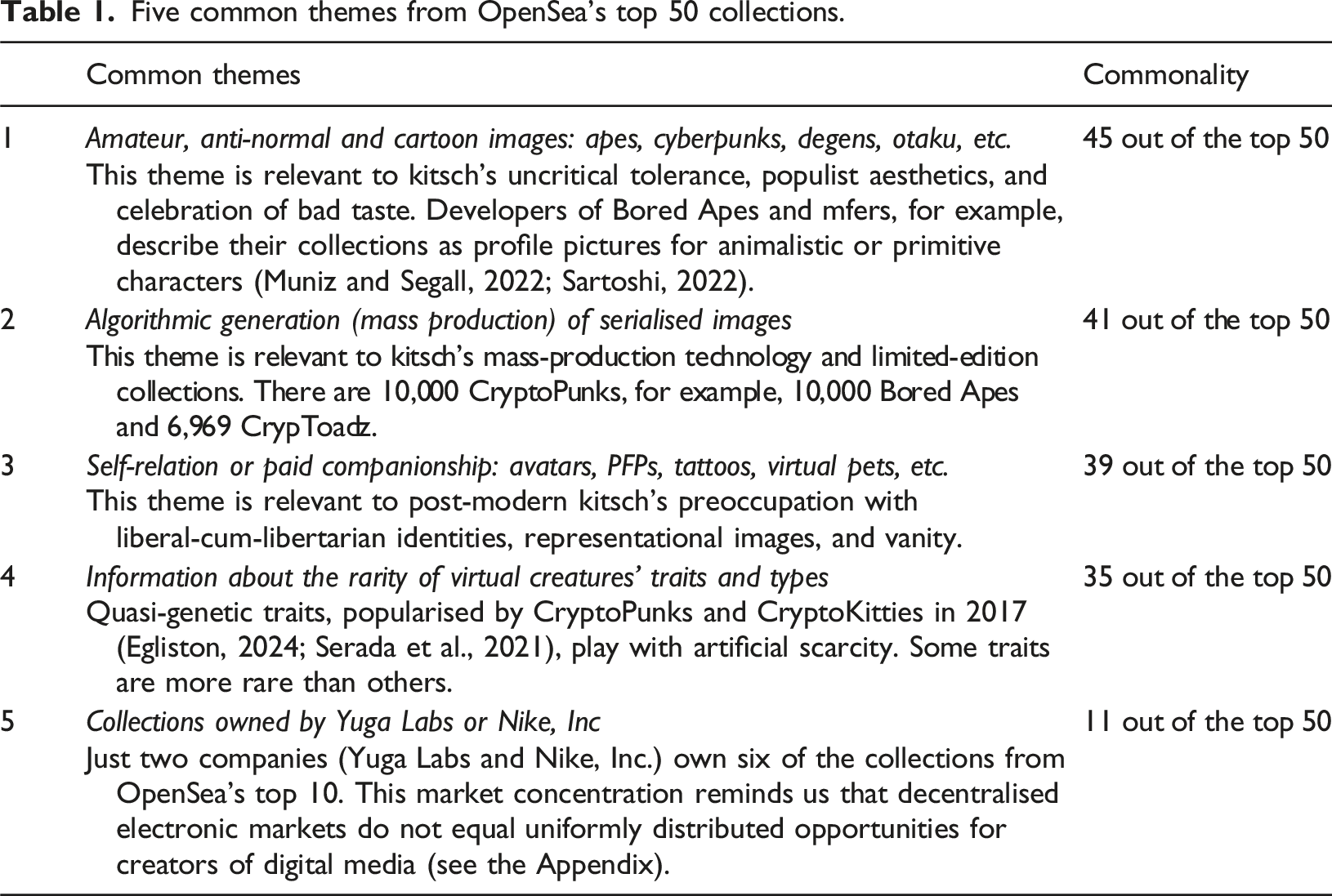
Five common themes from OpenSea’s top 50 collections.
OpenSea’s examples of oppositional kitsch
Oppositional kitsch is best exemplified by the first theme from Table 1: the celebration of cartoons, otaku culture, and populist aesthetics. The creator of mfers, Sartoshi (2022), said that his NFT collection intentionally uses ‘that stick figure motherfucker – nothing overly polished’. (Recall Figure 1.) Sartoshi (2022) associated the cartoon aesthetic with his ordinary persona and mundane life experiences. ‘The cartoon style fit everything I was doing and experiencing’, he wrote, ‘including creating memes related to NFT life’. Sartoshi then invoked a universe of oppositional kitsch. ‘What if we all have that motherfucker inside of us?’ he asked. ‘We’re all degens in our own way’. Finally, he linked kitsch’s bland tolerance and uncritical acceptance to the negation of authority. If we are all indeed mfers, then ‘there is no king, ruler, or defined roadmap’ (Sartoshi, 2022). This vain opposition to authority – opposition for opposition’s sake (Berman, 1989) – is the crux of oppositional kitsch.
The Creature World NFT collection by Danny Cole promotes a similar, uncritical universe and vain self-acceptance. The Creature World website described the collection’s protagonist, the Creature, as ‘a manifestation of the universal human spirit that exists purely without age, gender, or nation’. The Creature is a bald and bland stick figure. The website depicts six incarnations of the Creature holding hands and exchanging rainbow-coloured thoughts. The Creature World collection encourages token-holders to ask, ‘Who am I?’ This is another example of liberal-cum-libertarian vanity.
OpenSea’s quasi-Japanese, otaku-targeted collections are especially relevant to oppositional kitsch and market-friendly counterculture (Azuma, 2009). Otaku culture is closely associated with Japan’s 2channel imageboard, which inspired 4chan, the degenerate imageboard from the United States (Lütticken, 2018; Nagle, 2017). The Japanese word otaku is similar to the Greek word idios (Smethurst, 2023). Otaku denotes one’s own house or private domain. In the 1980s, otaku connoted shut-ins, basement dwellers, social rejects, and obsessive fans of animated films (anime), comic books (manga) and video games (Galbraith, 2010). In other words, the 1980s otaku consumers were proto-degens (Kinsella, 1998). By the 2000s, otaku culture reflected the power of post-modern cultural industries to not just tolerate bad taste but to exploit its profit potential (Azuma, 2009; Galbraith, 2010; Lamarre, 2013). OpenSea’s contemporary, otaku-targeted collections continue this post-modern marketing trend.
The philosopher Hiroki Azuma (2009) referred to otaku consumers as database animals. A database animal is ‘a new type of consumer in the post-modern information era’ who is not interested in profound ‘human’ or sacred narratives (Abel and Kono, 2009: xv–xvi). Instead, database animals create information systems and classify their favourite character traits. Jonathan E. Abel and Shion Kono (2009: xvi) explained: the cravings of ‘animalised’ otaku are satiated by classifying the characters from [Japanese] stories according to their traits and anonymously creating databases that catalogue, store, and display the results. In turn, the database provides a space where users can search for the traits they desire and find new characters and stories that might appeal to them.
Database animals are especially relevant to the fourth theme from Table 1: the classification and consumption of types and traits. The NFTevening website compiled a list of ‘20 NFT rarity tools to check NFT value and rank’ (Anderson, 2024). The list helps database animals appraise NFTs according to ‘the rarity of their traits’. 35 collections from OpenSea’s top 50 offer types and traits for database animals. The alien is the rarest type of CryptoPunk: there are only nine aliens. The beanie is the rarest CryptoPunk trait; therefore, only 44 out of 10,000 CryptoPunks wear a beanie. The choker is another rare trait: only 48 CryptoPunks wear a choker. The banality is striking (Yuga Labs, 2024).
Following a Hegelian philosopher named Alexandre Kojève (1969), Azuma (2009) designated this consumption of banal traits as animalistic. It is not human, in the Hegelian sense (Badiou, 2022). Azuma (2009) associated the emergence of database animals and otaku culture with post-War Japan’s decline of snobbery, formal values and pro-art philosophies.
Figure 3 highlights types from five profile picture collections that are in OpenSea’s top 50 list. The rows of black boxes indicate similarity or equivalence. Red boxes indicate dissimilarity or non-equivalence. The numbers indicate how many images from the collection conform to the type. (This is the rarity or artificial scarcity.) The meaning of each type is not significant. As Azuma (2009) foresaw, what matters is the otaku-targeted creation of catalogues – a database of types for tokenised media stored on a blockchain registry. Azuma (2009) described this quasi-bureaucratic counterculture as anti-human and animalistic; Barbara Cassin (2018) described it as anti-cultural. Either way, it is an apt example of oppositional kitsch: it is uncritical, not snobbish and deliberately not art (Azuma, 2009; Kojève, 1969). Repetition of profile picture types, from CryptoPunks (2017) onwards.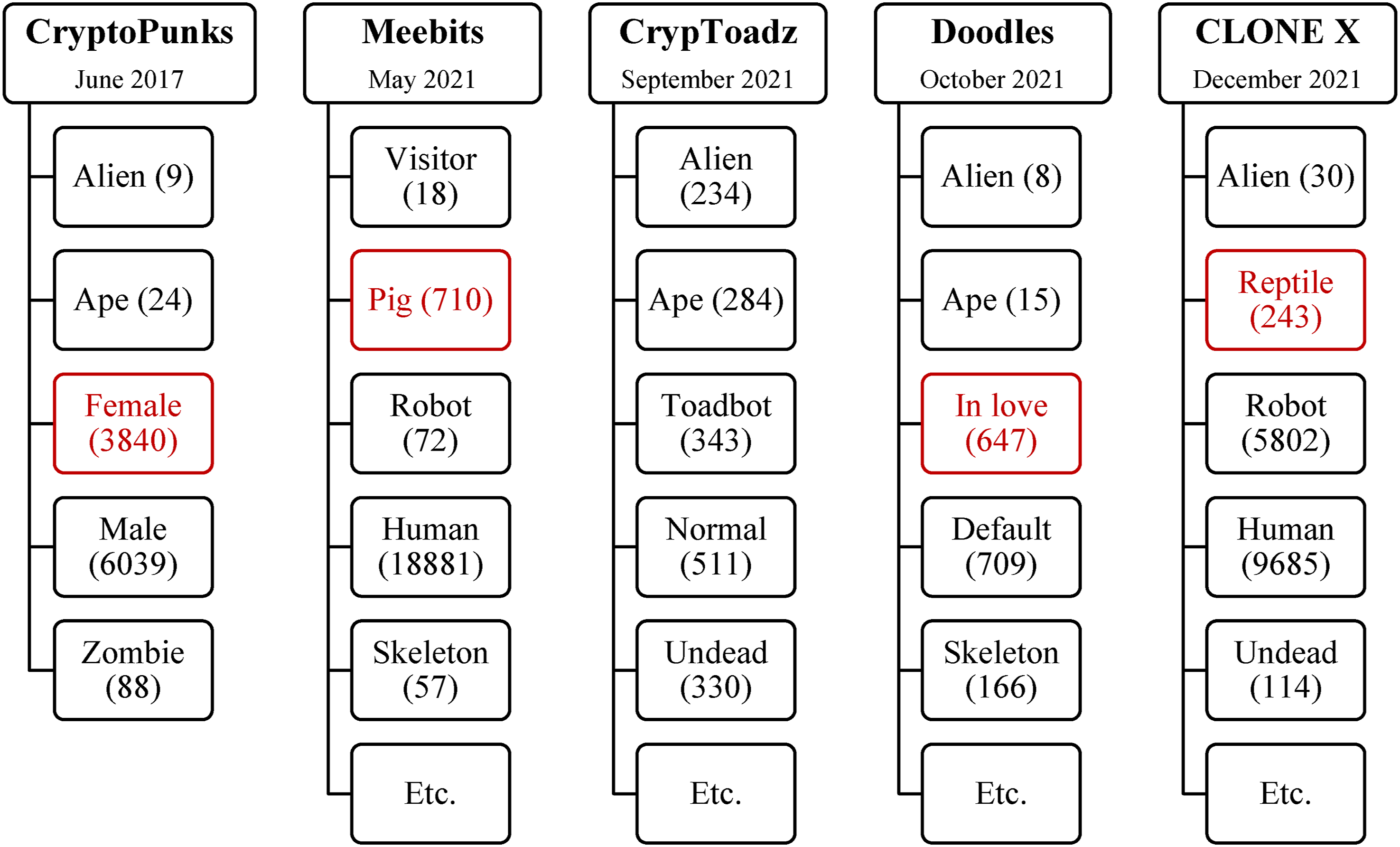
MoMA’s examples of historically informed kitsch
The 3FACE NFT collection by Ian Cheng exhibits a similar non-snobbish, database-friendly ethos, even though – this is important to note – it is associated with a well-known art institution (Kushnir, 2024). When MoMA (2023: 1) acquired a 3FACE NFT, they wrote, ‘3FACE analyses the wallet data of its web3 [crypto-asset] owner’s online behaviour to generate a visual portrait of the forces that compose the owner’s personality’. If you have a crypto-asset wallet, then you are a putatively empowered individual and a worthy portrait subject (Droitcour, 2022; Outland, 2022). 3FACE returns us – again – to liberal-cum-libertarian vanity. ‘3FACE is a new way to express the mess that is you’, wrote Outland (2022), the organisation that commissioned 3FACE.
3FACE adds a historical dimension to the portrait genre, specifically the portrait subject’s history of blockchain transactions. Outland’s didactic stated: 3FACE is an adaptive artwork by artist Ian Cheng. There are only 4,096 3FACE artworks available ever. Each 3FACE begins as a unique energy daemon. Once held, 3FACE reads your wallet’s public transaction history and infers the inner forces that compose your personality. Then 3FACE begins to adapt itself to you. […] As the history and contents of your wallet change, update your 3FACE to express changes in your personality. (Outland, 2022)
Outland’s editor-in-chief, Brian Droitcour (2022), situated 3FACE in a historical context of ‘rampant economic inequality’ and liberal-cum-libertarian self-assurance (rather than collectivist struggles). ‘Hard times’, Droitcour (2022) wrote, ‘prompt introspection, a desire for personal growth’. In Droitcour’s opinion, 3FACE is ‘a thought-provoking generative work that tells collectors something about themselves’. As Marita Sturken (2007: 7) foretold, works of historically informed kitsch like 3FACE exploit consumers’ desires for ‘emotional reassurance’ and personal meanings. Such works are not dedicated to historic struggles and revolutions (Kojève, 1969).
Unsupervised – Machine Hallucinations – MoMA by Refik Anadol is another example of historically informed kitsch. It drew on 138,151 records from MoMA’s GitHub archive (Anadol and Kivrak, 2024). ‘Anadol trained a sophisticated machine-learning model to interpret the publicly available data of MoMA’s collection’, explained the MoMA Magazine. ‘As the model “walks” through its conception of this vast range of works, it reimagines the history of modern art’ (Anadol et al., 2021). This is AI’s version of a kitsch historical re-enactment.
Unsupervised adds a consumer-friendly, personal touch by minting memento tokens (Liddell, 2023). MoMA’s website stated: Visitors to Refik Anadol: Unsupervised have an opportunity to commemorate their experience with a free, blockchain-based memento, available via QR code on the second floor outside the Marron Atrium. Please note that mementos are being minted in limited editions of 5,000. (Kuo et al., 2023).
The Unsupervised NFTs are not linked to the liberal-cum-libertarian self as obviously as a tokenised avatar, profile picture or 3FACE portrait; but Unsupervised NFTs are nonetheless associated with the self, for they are mementos of individuals’ lived experiences (Anadol and Kivrak, 2023; Liddell, 2023). Anadol’s avowed interest in NFTs reflects liberal-cum-libertarian values, such as ‘psychological fulfilment and empowerment’, ‘the customer’s overall emotional connection’ with NFTs, and sweeping scientistic promises ‘to address global issues’ (Anadol and Kivrak, 2023: 107).
As noted, a crypto-asset investor named Ryan Zurrer donated his tokenised memento from the Unsupervised collection to MoMA (Jacobs, 2023; Museum of Modern Art, 2023). MoMA receives 17% of the primary sales and five per cent of the secondary sales from the Unsupervised NFT collection (Davis, 2023). By accepting one Unsupervised NFT into their permanent collection, MoMA plausibly increased the value of the other 4999 NFTs from which they accrue sales revenue. This commercial strategy is faithful to kitsch’s sophistic ethos (Belpoliti and Marrone, 2020; Botz-Bornstein, 2019; Kulka, 1996).
So, too, is Anadol’s communication strategy on X (née Twitter). Anadol (2023) advocated kitsch’s populist universalism and its negation of criticality. In November 2023, the critic Jerry Saltz (2023a, 2023b, 2023c) referred to the live video from Unsupervised as a ‘half-million-dollar screensaver’ that is ‘banal’, ‘mind-numbing’ and ‘mediocre’. In a review for New York magazine, Saltz (2023b) referred to Anadol’s historically informed kitsch as ‘search-engine art’, a ‘glorified lava lamp’, a ‘pointless’ and ‘crowd-pleasing mediocrity’, and ‘some cross between relaxation exercise and euphoric TED Talk and NSA levels of data mining’. Anadol (2023) tweeted in response, ‘Your words has [sic] no meaning to me’. He then deployed kitsch’s sentimentality as a defence: ‘I create my work from my heart!’ Finally, he invoked a populist universe that excludes critics like Saltz: The world you coming from [sic] is changed! New world is bright, new world is inclusive, new world has no gates! I’m my community! I do art for everyone, anyone, any age and any culture! I’m everyone! You are no one! (Anadol, 2023)
In a populist universe such as this, ‘there is no longer any possible critical judgment’ (Baudrillard, 2005: 28). There remains plenty of room, however, for self-preoccupation and ‘paranoia’ (Baudrillard, 2005: 28).
Saltz is not alone. Other critics expressed similar reservations about Anadol’s work. Travis Diehl (2022) from the New York Times referred to Unsupervised as ‘just a screen saver’. R. H. Lossin (2023) situated Anadol’s work in a context of ‘bad art’ that promotes the technology used to make it. According to Lossin (2023), Unsupervised is a ‘fun, candy-coloured spectacle’ that obscures the fact that its sponsor, Nvidia, develops AI warfare technology for the United States Department of Defence – ‘tech boosterism at its best’. ‘It is not a coincidence’, Lossin (2025) wrote, ‘that MoMA installed Anadol’s Unsupervised (2022) in the lobby at a moment when the economic and political operations of Silicon Valley were becoming increasingly central to the organisation of our personal, economic, and social existence’.
Ben Davis (2023) from Artnet referred to Unsupervised as ‘art history, without the History’ – a reference to kitsch’s ‘pleasant’, ‘cheerleader-ish’ version of history that is wiped clean of the struggles and revolutions from Hegelian History. According to Davis (2023), Anadol’s historically informed kitsch is marked by uncritical ‘positivity’ and ‘untroubled techno-philia’. Leo Kim (2023) from ARTnews issued a similar statement: Unsupervised is superficially pleasant and ‘devoid of history or politics’. It exchanges humanity’s history of art for individuals’ feel-good experiences. This is precisely the purpose of historically informed kitsch.
Conclusion
We framed OpenSea’s top 50 NFT collections and MoMA’s first two NFTs as tokenised kitsch. Well-known texts by cultural theorists associated kitsch with technological mass production, culture-industrial commodities, and an uncritical tolerance of democratic opinion (Benjamin, 1999; Călinescu, 1987; Greenberg, 1961). The NFTs from OpenSea’s top 50 collections and MoMA’s permanent collection exemplify these things. OpenSea’s top 50 collections are generally marked by populist aesthetics and a preoccupation with anti-normal, oppositional identities; hence the proliferation of tokenised avatars and profile pictures like CryptoPunks and Bored Apes as well as animalistic, otaku-targeted collections (Azuma, 2009; Botz-Bornstein, 2021). This motivated us to develop the concept of oppositional kitsch – a fusion of counterculture and counting culture (Azuma, 2009; Baudrillard, 1994, 2005; Heath and Potter, 2004). MoMA’s first two NFTs, by contrast, exemplify historically informed kitsch – AI re-creations for re-creational consumption (Sturken, 2007). MoMA’s NFTs are generated by AI models that rely on historical data, yet they are more concerned with individuals’ feel-good experiences than they are with art history.
Limitations
Our article is exploratory and conceptual (Deleuze and Guattari, 1994), and its findings are non-replicable (Hovey et al., 2022). It is not addressed to critical-realist, historicist-contextualist or post-positivist social scientists who study art-institutional policies and democratic debates about kitsch. If our study is judged by critical-realist, historicist-contextualist or post-positivist criteria from outside its domain, it has three major limitations.
First, the concept of historically informed kitsch is exemplified by just two NFTs from MoMA’s permanent collection. Second, the study did not examine differences between online communities’ discussions of NFTs and art-institutional rhetoric about NFTs. Third, the article did not engage with democratic debates about kitsch or art-institutional policies about kitsch. As noted, the article instead treated kitsch as a formal category that derives from philosophical and media-theoretical literature (Badiou, 2003, 2010; Baudrillard, 2017; Botz-Bornstein, 2019, 2021).
If, in future, more NFTs are added to MoMA’s permanent collection, then social scientists can examine more than two examples. Social scientists can also examine NFTs from Dataland – a museum for NFTs and AI-associated media that Refik Anadol plans to launch in late 2025. The Dataland museum is expected to showcase works about the environment, generated by AI models that are trained with natural-historical data (Dataland, 2025; Schrader, 2025). This natural-historical material and affection for Mother Nature could become relevant to the concept of historically informed kitsch.
Future philosophical and media-theoretical research
When technophiles and innovation enthusiasts look at NFTs, they tend to see a reflection of their own values. They imagine, for example, contributions to the social good (Duan et al., 2021), utility-value (Rapela and Lehtinen, 2023), inclusiveness and fairness (Carvalho et al., 2023), and ‘tangible solutions to diverse global problems’ (Anadol and Kivrak, 2023: 107). Some even contemplate saving the oceans with NFTs (Regenor and Achtmann, 2022). This is both risible and sad. By contrast, followers of Baudrillard (2005: 27) will presumably dismiss NFTs, tokenised avatars and profile pictures as narcissistic ‘waste’ products. Badiou’s followers can affirm alternatives to post-modern kitsch, with its ‘utterly nihilistic vision of the future’ (Badiou, 2010: 23) and its preoccupation with the liberal-cum-libertarian self (Badiou, 2005, 2022; Han, 2018).
Future Badiouian research can invoke the classical triad of sophistry, philosophy and religion to distinguish: (1) tokenised kitsch as a category of sophistic, truth-insensitive culture, (2) philosophical affirmations of art, and (3) scientism’s redemptive and revelatory rhetoric about NFTs and AI (Reinhard, 2022). Sophistic culture is sufficient for liberal-cum-libertarian individuals and database animals (Azuma, 2009; Baudrillard, 2005; Muniz and Segall, 2022); art is necessary for a philosophical conception of humanity (Badiou, 2008; Kojève, 1969); and if blockchain solutions are promoted as redemptive (Anadol and Kivrak, 2023; Regenor and Achtmann, 2022), such rhetoric can be categorised as scientistic and quasi-religious (Badiou, 2011; Nachtwey and Seidl, 2024; Stenmark, 1997). We hereby commend the classical triad to researchers of blockchain-tokenised and AI-generated media.
Footnotes

Funding
The author(s) disclosed receipt of the following financial support for the research, authorship, and/or publication of this article: Research by Reilly Smethurst and Orestis Papageorgiou is supported by the Luxembourg National Research Fund (FNR) and PayPal (PEARL grant reference 13342933/Gilbert Fridgen; PABLO grant reference 16326754).
Declaration of conflicting interests
The author(s) declared no potential conflicts of interest with respect to the research, authorship, and/or publication of this article.