




Abstract
In 2017, Brazil launched the Geostationary Defense and Strategic Communications Satellite (SGDC-1), fulfilling the state’s long-held ambition to manufacture and operate a national communication satellite. This article investigates the main frictions surrounding the establishment, articulation, and representation of this large-scale infrastructural system, particularly regarding the federal government’s alleged commitment to deploying it to deliver broadband to public rural schools. Through open-source investigation and satellite footprint analysis, the study explores the political economy and governance dilemmas surrounding the SGDC-1 as a state-led project, revealing how its operations are framed and mediated through underserved publics and bolstered by televisual tactics under a populist logic. A critical analysis of disclosed documents, news stories, footprint maps, congressional hearings, and visual media uncovers the satellite’s dual complexity: it serves both as a flagship of publicly funded connectivity and as a discursive artifact that shapes public perceptions of inclusion through paternalistic space-telecom narratives. Considering the challenges related to public-private partnerships, militarization, and potential outages, the article calls for increased civic scrutiny and suggests the need for new policy strategies to ensure the project’s viability and long-term success.
Introduction
In recent decades, governments in the Global South have significantly scaled up their investments in domestic satellite programs and various kinds of space infrastructure. Numerous initiatives, frequently implemented through public-private partnerships, surfaced to strengthen signal traffic resilience, enhance national security, and expand remote sensing capabilities, all while promoting promises of economic development and revamping local technological expertise. Over the past decades, countries such as Argentina, South Africa, Ghana, and Vietnam have made significant advancements in earth observation technologies, supported by innovative funding models and strong political alliances at both national and international levels, often with taxpayer support (Wood and Weigel, 2011). The development and popularity of communication satellites, especially those in geosynchronous orbit (GEO), 1 which are more complex and costly to manufacture, launch, and operate, continue to emerge as a means of providing services such as TV broadcasting and, in more recent years, broadband connectivity. In 1976, Indonesia initiated this satellite trend in the Global South with the deployment of the Palapa system into GEO orbit, becoming the first nation in what was then called the ‘developing world’ to operate a domestic communication satellite system (Barker, 2005). Following this, countries with varying income levels and technological capabilities have expanded their communication satellite projects, strengthening their presence in outer space while prioritizing the strategic importance and potential benefits of these infrastructures on their domestic agendas. 2
Although communication satellites represent a form of high technology that remains largely inaccessible to the general public and is often associated with military tactics, they are deeply embedded in everyday life for information and communication technology (ICT) users – frequently evoking a sense of the spectacular and representing ‘the most earthly form of space technology’ (Evans and Lundgren, 2023: 3). To expand the media infrastructure literature of publicly funded satellite systems in the Global South, this article explores the major setbacks behind the promises presented by the Geostationary Defense and Strategic Communications Satellite (or SGDC-1, as abbreviated from the Portuguese acronym for Satélite Geoestacionário de Defesa e Comunicações Estratégicas) – Brazil’s most expensive domestic communication satellite project aimed at bridging the nation’s digital divide. Reiterated by cabinet-level officials as an artifact of public importance made by Brazilians for Brazilians, the SGDC-1, conceived by a presidential decree in 2012 and launched in 2017, has a civil-military mission. In alignment with telecommunication and digital inclusion policy frameworks such as the Electronic Government Citizen Services Program (Governo Eletrônico – Serviço de Atendimento ao Cidadão, GESAC) and Wi-Fi Brasil, one may argue that the SGDC-1 showcases Brazil’s technological expertise and national pride in its publicly funded infrastructures, as well as reflects the aspirations for a digitally connected future across its continental territory (Carvalho and de Oliveira Matos, 2019). This is especially relevant for one of the underlying promises of the civil capacity of the satellite: to deliver broadband connectivity to public rural schools where on-ground broadband infrastructure is challenging or not commercially viable (Figure 1). The entrance of an indigenous rural school in Pacaraima, in the northern state of Roraima, displaying a satellite dish installation in 2018. This school was among the first sites to benefit from SGDC-1’s broadband transmission in Brazil (Source: Tele.Síntese).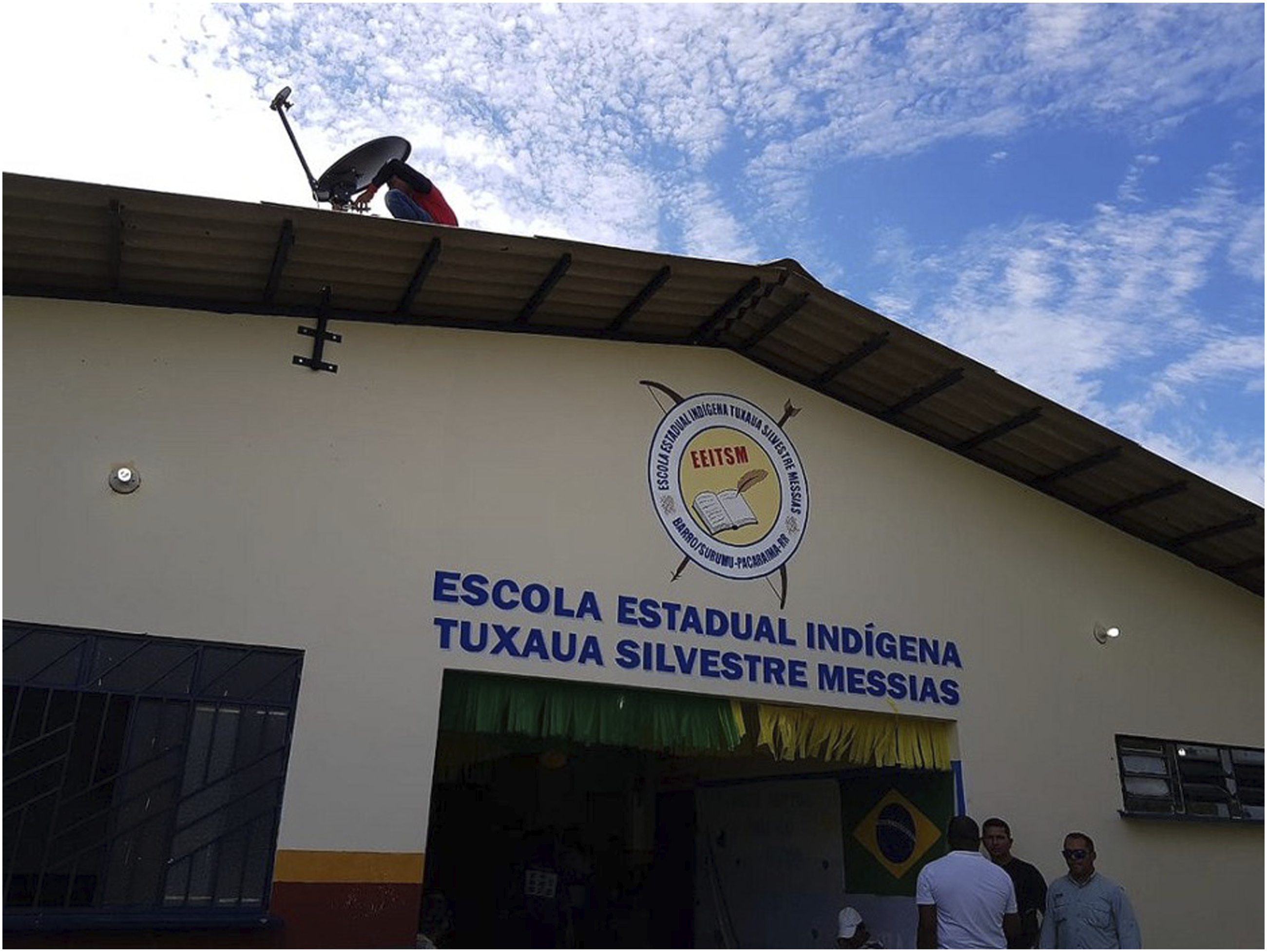
For decades, media and communication scholars have written about satellite technologies primarily through the lenses of distribution and deterritorialization of media, especially in the context of televisual cultures (e.g., Bovet and Këllezi, 2008; Damjanov, 2015; Evans and Lundgren, 2016; Lee Paul and Wang, 1995; Sakr, 2001). Media scholar Lisa Parks (2005, 2012) extensively explored in her scholarship how satellites are not merely conduits of information but rather function as high-capital infrastructures that enact unique forms of power dynamics across territories – even though they have remained until recently obscure objects in media studies. With advances in satellite technology and growing innovations in the provision of broadband, there is a growing need to understand the governance complexities of deploying these infrastructures within a state agenda – where infrastructural modernization, public anxieties, and socio-economic promises converge. While researchers have already begun addressing the privatization of space in the context of connectivity and armed conflicts (Abels, 2024), there is still a notable gap in examining the debates surrounding the promises of government-funded communication satellite projects in Global South contexts. Hence, the evolving governance trajectories of these infrastructural projects over time, coupled with the media narratives strategically constructed to shape their perception, are important dimensions to consider and untangle as future-oriented promises are made by those in positions of power.
In many Global South countries, satellite-enabled broadband is often promoted to strategically complement signal traffic in areas where terrestrial infrastructure – such as fiber-optic cable networks and microwave link towers – does not reach. More than ever, these innovations depend on public-private business models, with governments typically spearheading them as part of a larger state agenda (Silver, 2023). The substantial capital and technical expertise required to operate communication satellites also underscore the complexity of relationships necessary for optimizing operations and service delivery. Nevertheless, broader concerns about low public engagement with matters of media infrastructure reflect the challenges in the decision-making processes behind these large-scale infrastructural systems and mechanisms for accountability. In this sense, the antinomic nature of satellites may indeed underscore debates on freedom of information and sovereignty (Achilleas, 2002); yet for most of the Global South countries, it also introduces uncertainties in how governance, financial patterns, and discursive tactics unfold to capture the public’s imagination.
Against the backdrop of these reoccurring dynamics, this article contributes to the academic literature on media infrastructures by empirically showing how a publicly funded, large-scale project aimed at improving broadband connectivity in rural Brazilian schools reflects unclear governance structures and becomes a vehicle for state-driven spectacle through the televisual. Following critiques in the literature that advocate for more research on the socio-technical dynamics experienced by, and framed in relation to, communities at the ‘receiving end of infrastructure’ (Edwards et al., 2009: 371), this article questions the techno-fix nature of the SGDC-1 by examining the frictions relevant stakeholders – particularly government and private sector actors – and audiences, namely the final beneficiaries at the margins of connectivity. By techno-fix, I mean technological solutions that may aim to address complex social problems, such as the lack of broadband in rural areas, but can delay necessary structural reforms in the long run. In doing so, I draw on anthropologist Akhil Gupta's (2018) observation about the importance of analyzing the dynamics between human, non-human, social, technical, material, and ideological factors that infrastructures bring into play. As I demonstrate, a critical examination of the SGDC-1 reveals deep societal inequalities, power imbalances, governance challenges, and uncertainties surrounding public-private investment agreements, all of which are particularly poignant in Brazil, one of the most unequal countries in the world.
Given the multiple ways infrastructures can be studied, ‘the choice of methodology is a theoretical one’ (Larkin, 2013: 338). Therefore, to explore the SGDC-1 as a socio-technical system in relation to public rural schools in Brazil as case study, where the satellite’s promises are most prominent in civic discourse, I adopt a two-step approach. Firstly, I rely on open-source exploration to gather data on the satellite as an object of study – analyzing digital archives, engineering sketches, policy documents, and audiovisual content, among others – especially in relation to how the satellite and its operations are represented to the general public. 3 This involves sifting through diverse sources and triangulating data to address fundamental questions, mirroring practices in open-source human rights investigations and accounting for potential knowledge formation discrepancies (McPherson et al., 2020), while primarily contextualizing them in relation to the discourse and framing of government institutions. Secondly, I conduct a satellite footprint analysis of SGDC-1’s symbolic visual media contours on the ground, considering its implications as an infrastructural system. This approach focuses on the material and territorial dimensions of satellite technologies, not only describing the technological components, companies, and the complexities associated with territories but also exploring the cultural and symbolic constructions they can engender for the wider public (Parks, 2012). Using this critical method, the article challenges the prevailing view of SGDC-1 as a state project solely focused on bridging the digital divide and safeguarding strategic communications domestically – a perspective that limits debate to a quest for national pride achieved through a single piece of infrastructure.
The article begins by discussing Brazil’s history of communication satellite systems in the educational context, focusing on the SACI project from the 1960s–1970s and the later SGDC project from 2010 onwards. I then analyze the major points of public debate surrounding the SGDC-1, encompassing the main technicalities, policies, and challenges in the satellite’s governance. The article shows that, despite efforts to improve social and digital inclusion by connecting rural schools, three major challenges persist: (i) reliance on a costly, taxpayer-funded satellite with a limited lifespan; (ii) potential overuse of its full Ka-band capacity; (iii) and fiscal uncertainty stalling the manufacturing of a second satellite. Finally, I complicate these insights by focusing on the Brazilian government’s pre-pandemic televised events during rural school broadband inauguration ceremonies, which were performed by the satellite under the administration of former Brazilian president Jair Bolsonaro. As I demonstrate, these events offer unique insights into Bolsonaro’s government’s portrayal of SGDC-1 as a ‘paternalistic infrastructure’ – a construct intended to convey state assurances of adequate provision of services for citizens’ needs (Stevens, 2023) that is magnified under a populist logic. The article ultimately calls for a National Satellite Internet Strategy to address these concerns as the Brazilian state continue to rely on the potential of a future SGDC constellation to meet the challenges of broadband demands in a country of continental dimensions.
Orbit-bound learning: Communication satellites for the Brazilian educational system
While undersea telecommunication cables will remain for decades to come the backbone of global data exchanges (Starosielski, 2015; TeleGeography, 2023), communication satellites will increasingly play a strategic role in connectivity at large, especially in the rural and remote areas of the Global South. Developed first during the Cold War, satellites of this kind have become essential digital infrastructures that shape information flows and globalization paths (Slotten, 2002; Vedda, 2007; Schwoch, 2009). Since the Space Race era, researchers from various fields across the humanities and social sciences have extensively written about satellite systems, including Intelsat and Intersputnik, particularly within their respective geopolitical contexts. From 2015 onwards, privately launched low-earth orbit (LEO) satellites gained traction globally, often described as a part of a ‘New Space Race’ led by high-tech private firms (Pekkanen, 2019). Commercial projects such as SpaceX’s Starlink and Amazon’s Kuiper have sparked discussions on the impact of satellite systems on global digitalization, underscoring efforts to ‘connect the world from the sky’ and ‘connect the unconnected’ in underserved regions where satellites can help leapfrog development challenges such as education (Graydon and Parks, 2020; Smart et al., 2016; UNOOSA, 2022). In the face of these innovations, the current landscape of broadband connectivity calls for a more granular understanding of satellites’ rise and reception in the public imagination, especially in countries that are beginning to invest in and form alliances around space technology. As broadband connectivity attracts major investments and satellite companies revive the ‘promises of global coverage’ in their expansion strategies and capital accumulation (Evans and Lundgren, 2023: 156), the societal implications resulting from these promises remain unclear, particularly as they intersect with governments initiating their public-funded satellite projects.
To date, Brazil has made notable advancements in space technology compared to other Global South countries. Since 1967, international partnerships with nations such as China have paved the way for the country to enhance its local technological capacity and achieve significant local milestones. In 1983, Brazil established the Alcântara Space Center, a location commonly recognized as the world’s nearest launching base to the equator. In 1985, the Brazilian Telecommunications Company (Empresa Brasileira de Telecomunicações, Embratel) – then a fully state-funded and managed company – operated Brasilsat A1, the country’s first communications satellite in GEO orbit whose operations were mostly dedicated to data transmissions for telephony, as well as TV and radio broadcasting. Although the Brasilsat series of satellites had been built by the Canadian company Spar Aerospace and operated by Embratel under national jurisdiction to serve local operators, it did not result in any significant technology absorption or transfer to Brazil (Santos, 2014). Nonetheless, this trajectory of progress in satellite projects continued in 1988, when the collaboration between Brazil’s National Institute for Space Research (Instituto Nacional de Pesquisas Espaciais, INPE) and China’s Academy of Space Technology (CAST) led to the co-development of the China-Brazil Earth Resources Satellite (CBERS) series, which has been crucial for Brazil’s earth observation (Oliveira Lino et al., 2000). Subsequently, the initial development of space legislation in Brazil laid the foundation for the establishment and institutional strengthening of the Brazilian Space Agency (Agência Espacial Brasileira, AEB) in 1994. This institutional trajectory gained traction with state-led initiatives such as the 2006 mission of the first Brazilian astronaut, Marcos Pontes, to the International Space Station (ISS), and more recently, with the signing of the Space Activities Act in 2024. These milestones collectively reflect Brazil’s expanding engagement and capabilities in the space sector, ranging from telecommunications to space science (See Grosner and Froehlich, 2025). In paralell, Brazil has also heavily invested in training engineers at public universities to accelerate local technological expertise over the past decades. Despite these dynamics, since the privatization of the telecommunication sector in the late 1990s and until recently, the country mainly leased foreign communication satellites, incurring significant costs, especially in areas lacking terrestrial telecommunication infrastructure (Knight, 2016; Monteiro and Paraguassu, 2013). Hence, the SGDC project – aligned with Brazil’s defense policies – subsequently emerged in the 2010s with a strong governmental focus on enhancing technological self-reliance, communication autonomy, and national sovereignty (Harvey et al., 2011).
SACI Project: The experimental satellite initiative for learning
The use of communication satellite systems for education in Brazil began before the internet era, with the Advanced Interdisciplinary Communications Satellite Project (or SACI as abbreviated from Satélite Avançado de Comunicações Interdisciplinares), initiated in 1967. As the first nationally designed educational project prioritizing cost-benefit in audiovisual media distribution, SACI aimed to create a national tele-education system via communication satellites (Klein and Klein, 1972). Implementing this project across Brazil required international partnerships for technology transfer, capacity building, and feasibility analyses. A key part of this implementation involved U.S.-Brazil collaboration, enabling Brazilian entities to use the U.S. National Aeronautics and Space Administration (NASA)’s Applications Technology Satellites, particularly ATS-3 and ATS-6 launched in 1967 and 1974, to test the feasibility of GEO placement (Figure 2).
4
During Brazil’s tumultuous dictatorial years, international cooperation with NASA proved crucial in developing the socio-technical blueprint for a satellite-enabled education system, despite persistent inequalities across the country (Veloso et al., 2008). A 1974 collage depicts schoolchildren and classrooms along with a sketch of the NASA ATS-6 satellite used in the SACI project, with the original headline stating, ‘ATS-6 in Orbit: Via Satellite SACI will be in the Air’ (Source: INPE).
The motivations for the SACI project within the Brazilian government can be traced back to the Advanced System for Communications and Education in National Development (ASCEND) report, a product of an interdisciplinary Space Systems seminar at Stanford University’s School of Engineering in the 1960s, which had the participation of Brazilian engineers working for government agencies at the time. In its essence, the ASCEND report develops the notion of ‘how Educational Television via a satellite could be integrated into the nation’s educational programs, and how satellite techniques could be phased into present and future communications systems’ (U.S. Congress, 1969: 298), championing a vision of post-war modernization for developing countries. Essentially, the report detailed the promise of satellite-enabled tele-education for remote communities, spotlighting potential applications in Indonesia, Brazil, and India. In 1967, upon returning to Brazil, the engineers introduced the ASCEND findings to both Brazil’s National Council for Scientific and Technological Development and the Ministry of Education.
The SACI project closed in 1978 due to financial and governance challenges. Nevertheless, it laid the groundwork for using satellite systems to enhance school and student engagement with media content, despite ongoing inequality across the country. Although INPE aimed to develop a domestic communication satellite, a dedicated educational satellite did not receive sufficient priority (McAnany and Oliveira, 1980). By the end, INPE utilized only about 30 min daily of the ATS-6 satellite’s capacity, enabling the SACI project to broadcast approximately 1241 radio and TV programs to 510 schools in 71 municipalities by 1976 (Saraiva, 1996). While the project demonstrated the potential of space-based infrastructure for promoting inclusion and socio-economic development through education (INPE, 1973), its initial report largely replicated the ASCEND report with minimal modifications (De Paiva, 2013). As sociologist Laymert Garcia dos Santos (1980) observed, the report appeared more like a promotional pitch for technology rather than a thorough academic study or well-conceived state-funded plan.
Beyond the debates surrounding the integration of U.S.-centric views into Brazil’s educational and media practices, the legacy of the SACI project paved the way for the development of widely popular educational programs on open TV in Brazil, such as Telecurso (1978), TV Escola (1995), and Telecurso 2000 (1995) (Moreira, 2002). Importantly, the history of SACI highlights modernization efforts similar to those in Global North countries and underscores the need to consider the integration of media infrastructures across Brazil’s vast territory. Furthermore, examining publicly funded satellites during the era of expanding broadband and increased digital device access in Brazilian schools from 2010 onward offers a fresh perspective on earlier discussions regarding the use of communication satellites in educational contexts.
The birth of a national communication satellite
Over four decades after SACI’s pioneering role in satellite systems for education, the SGDC constellation project was initiated with three primary objectives: (i) to address Brazil’s digital divide under the National Broadband Plan; (ii) to strengthen governmental defense and strategic communication to ensure national sovereignty; and (iii) to advance Brazil’s space industry through key technology assimilation and domestic participation in future missions (Telebras, 2014). On May 4, 2017, the SGDC-1 was launched into orbit by Arianespace’s Ariane 5 ECA rocket from the European Spaceport Kourou, in French Guiana (Figure 3). Developed over 3 years in Cannes by Thales Alenia Space and overseen by Brazil’s Visiona Tecnologias Espacial S.A. (Visiona), the SGDC-1 stands as Brazil’s most expensive communication satellite to date, costing approximately 2.8 billion Reais (over US$660 million). Positioned in a geostationary orbit at 75° west and designed for a 15-year lifespan, this 5.8-ton satellite covers Brazil and parts of the South Atlantic Ocean. The allocation of its signal trafficking capacity is structured as follows: 70% is designated for civilian use, while 30% is reserved for the Brazilian Armed Forces, primarily for military and strategic communications (Dementicis, 2018). Operated by Telecomunicações Brasileiras S.A. (Telebras) and the Ministry of Defense, the satellite’s ground realization occurs through very-small-aperture terminal (VSAT) antennae provided by Viasat, a U.S.-headquartered company. High-level government representatives watching the SGDC-1’s launch in real-time from the Aerospace Command Operations (COMAE) in the capital city of Brasília. (Source: Força Aérea Brasileira).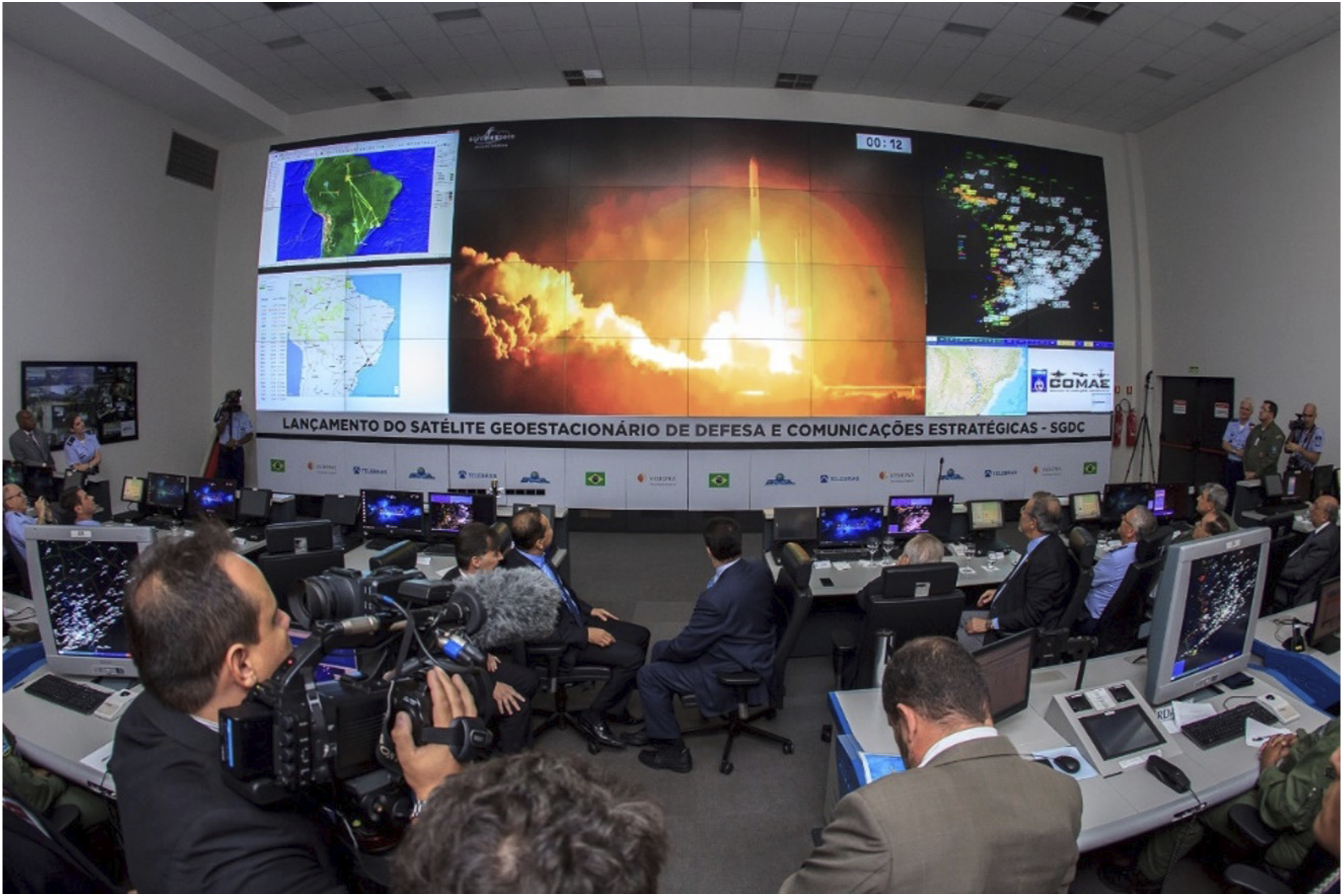
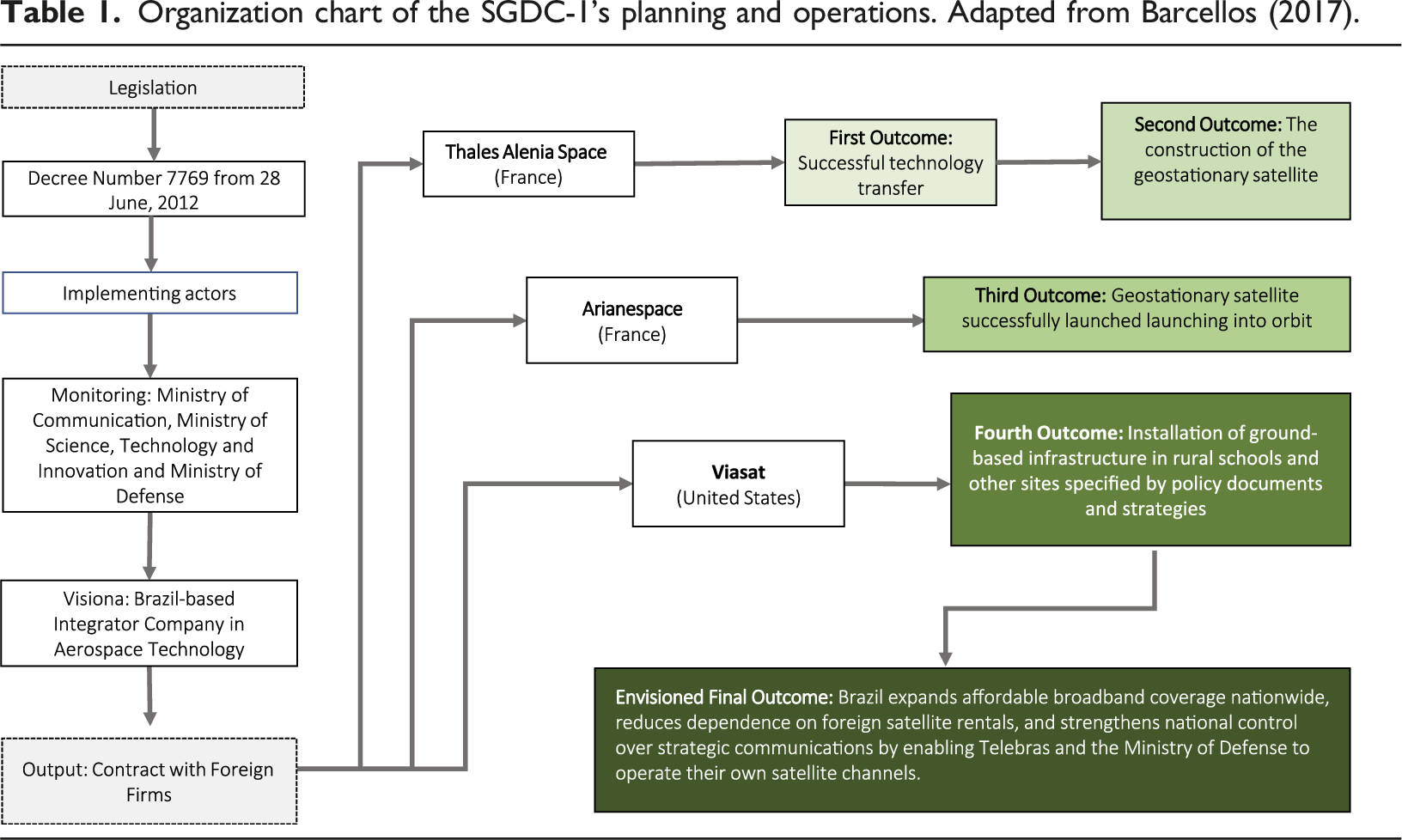
While the SGDC-1’s early operations in orbit garnered media and governmental attention, the project faced numerous bureaucratic challenges before its launch. In 2012, then-President Dilma Rousseff issued a decree establishing the SGDC’s governing Project Steering Committee comprising members from the Ministries of Education, Communication, Defense, and Science and Technology. Initially, the decree set the SGDC’s completion for December 2014, later delayed to 2016, and ultimately to 2017, when the satellite was launched. The decree assigned Telebras the responsibility for procuring goods, services, and engineering expertise necessary for the satellite’s manufacturing, launch, and signal transmission, as well as the development of essential ground infrastructure. Given Brazil’s lack of the required technical expertise, the decree also mandated that Telebras and AEB develop a joint plan for technology absorption and transfer.
In 2013, a year before Rousseff’s re-election, the SGDC’s Project Steering Committee greenlit a 1.3 billion Brazilian Reais (US$232.9 million) contract with Visiona to supervise foreign collaborators involved in the manufacturing and launching. Visiona, a joint venture between aerospace firm Embraer and Telebras, was established the same year the SGDC decree received formal approval. From its inception, Visiona aimed to be a global benchmark in crafting space systems for the Brazilian space program. In discussing the significance of the company within the Brazilian space industry, Fernando Barcellos (2017: 274) writes that ‘Visiona engenders space commerce because it can operate as a company and serves as an example for other companies in the space sector to emulate’. This multi-stakeholder perspective and levels of cooperation underscore the pivotal role of the SGDC-1 as it charts a path for future satellite projects and the nurturing of engineering talents that, in past decades, seemed unreachable.
As a multi-spot beam high-throughput (HTS) satellite, the SGDC-1’s civil footprint is configured through its 67 spot beams operating in the Ka-band made possible by 50 transponders. Unlike pico, nano, micro, and small satellites that are often cheaper to manufacture, the HTS requires much more sophisticated engineering, technoscientific know-how, and a set of on-ground segments for data transmission. Out of the SGDC-1’s 67 spot-beams, 58 have 0.5° (or diameter of 320 km), and 19 spot-beams of 1° (or diameter of 640 km) reach when covering the country’s territory. When integrated, these spot beams provide comprehensive coverage across the entirety of Brazilian territory (Figure 4) (Arianespace, 2017; Henriques, 2017). Furthermore, the satellite is equipped with seven X-band channels designated exclusively for military use, and for which there is little publicly available information. Map of the SGDC’s Ka-band footprint and the four major gateways located in the cities of Brasilia, Rio de Janeiro, Campo Grande, and Florianópolis. (Source: Telebras).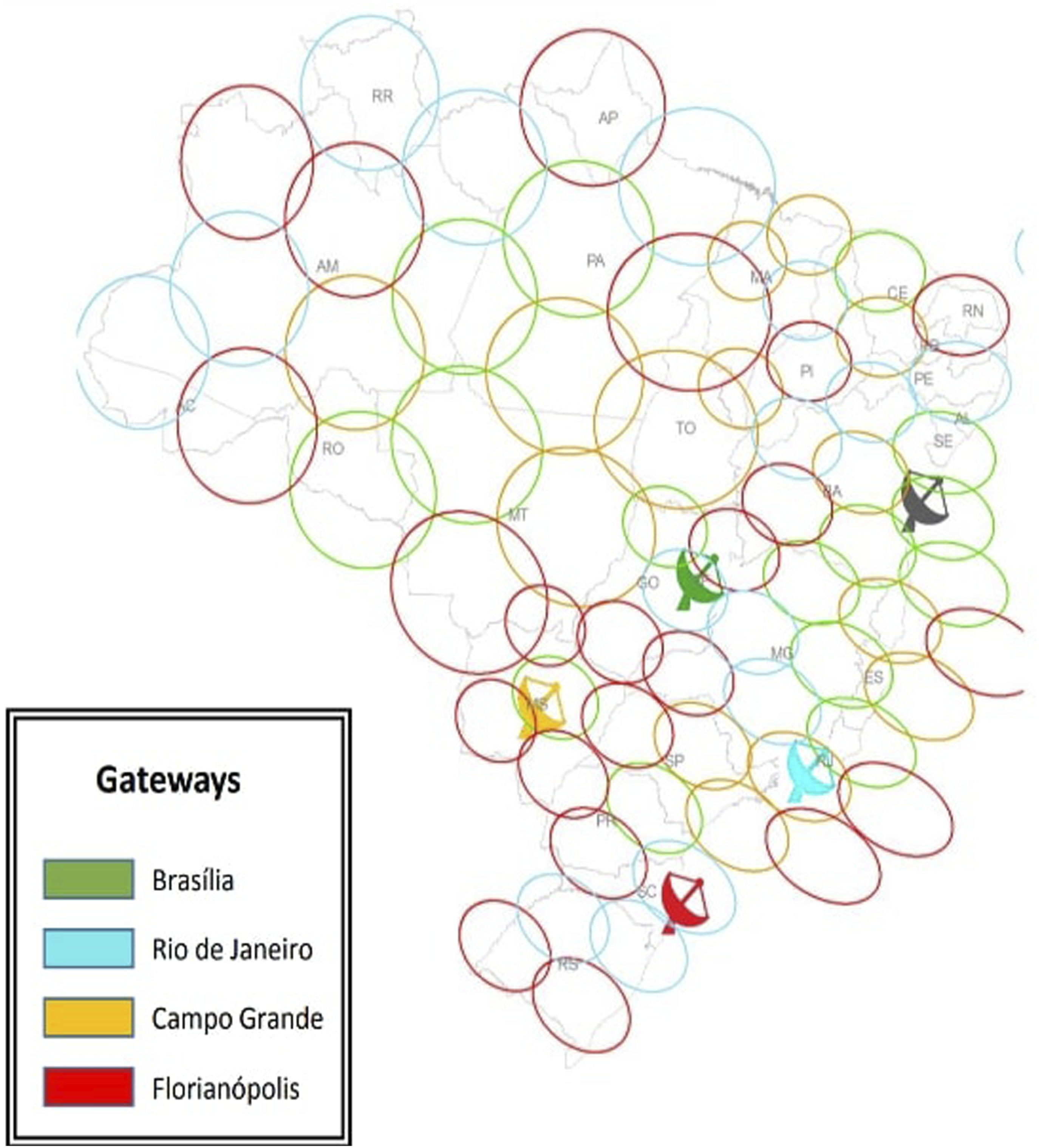
The SGDC-1 design, at least in theory, aligns with the Brazilian government-mandated objective of providing broadband connectivity to underserved communities, with a particular emphasis on public rural schools. As such, the SGDC-1 not only represents a significant milestone in local technological advancement but also reflects a strategic approach to addressing Brazil’s unique connectivity challenges across its diverse territory – a markedly different context from the 1960s, when the SACI project relied on U.S.-operated satellites mostly for audiovisual transmission.
Beyond the launch pad: Overcoming non-technical challenges and foreseeing potential connectivity outages
Despite extensive government promotion, the SGDC-1 project encountered major legal challenges even before the satellite’s launch. In February 2018, Telebras partnered with Viasat, known globally for its satellite communications expertise acquired since the late 1980s. However, after the SGDC-1 launch, Brazilian courts raised issues with the Telebras-Viasat contract, causing operational delays and a daily loss of approximately 800 thousand Brazilian Reais (US$136.9 thousand) from early March 2017, totaling 224 million Brazilian Reais by the end of 2018 (US$38.3 million) (Berbert and Bucco, 2019; Oliveira, 2019). These issues delayed civilian use of the satellite, drawing media attention but little government action. As legal issues persisted, Viasat opened an office in Brazil and worked to amend the contract in line with Brazil’s 1997 General Telecommunications Law, eventually positioning itself as Telebras’s sole private partner for SGDC-1’s civil capacity. While some citizens depicted SGDC-1’s broadband delivery as a “blackout” (Hetzel, 2018) high-level Telebras executives remained optimistic when engaging with the media, suggesting the project’s success was “written in the stars” (Gomes, 2018), hinting at its inevitability despite obstacles or financial uncertainties.
Organization chart of the SGDC-1’s planning and operations. Adapted from Barcellos (2017).
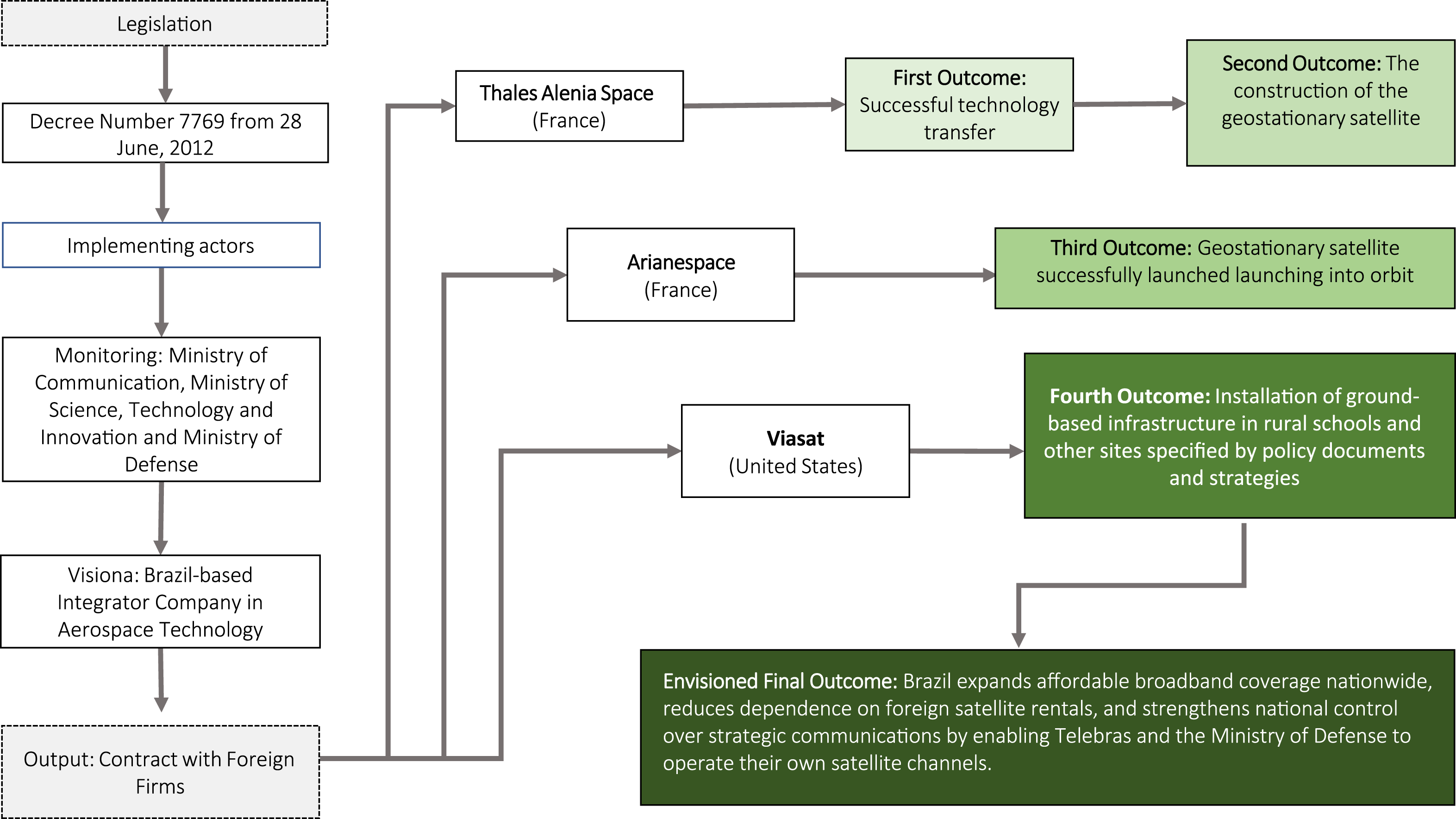
Notably, the Telebras-Viasat contract raises provocative questions that remain largely unknown to the public. To date, the information disclosed shows that out of the 70% civil capacity of the SGDC-1, 58% is currently being commercialized by Viasat. The strategy to commercially use the SGDC-1 gained traction during former President Michel Temer’s tenure, following the impeachment of previously elected Dilma Rousseff and preceding Bolsonaro’s administration. Indeed, the envisioned plan for the SGDC-1 was to support a domestic broadband plan that had been introduced in 2010 (Portinari, 2018). Despite that, the social and digital inclusion nature satellite’s footprint is, thus, concentrated in only 42% of the SGDC-1’s capacity for on-ground installations (Câmara dos Deputados, 2019), with Telebras giving a share of only 25.6% of revenue to Telebras and paying Viasat 138,64 Brazilian reais (US$27.7) monthly for each installed parabolic dish antenna on the ground until 2034 (TCU, 2019). Given that a foreign private firm currently manages a substantial portion of SGDC-1, a critical question arises: Is this taxpayer-funded satellite genuinely serving those most in need? While this question offers a fresh perspective on the SGDC-1, it highlights a familiar issue. In Brazil and across the Global South, digital inclusion policies are often shaped by political cycles and issues of financial uncertainty. Therefore, the commercialization of a satellite originally intended as a public service necessitates rigorous transparency and evaluation to ensure that it genuinely fulfills its stated digital inclusion goals.
After securing legal permissions for infrastructure roll-out in rural schools, Telebras and relevant ministries have regularly updated the public on the SGDC-1's broadband delivery milestones, intending to reach the full capacity of 50,000 connectivity points across the country. At an event in the state of Rio Grande do Norte in 2019, Telebras disclosed that 2 million students had been connected to broadband, with 7050 of the 8900 SGDC-enabled connection points being in schools (Amaral, 2019). Since then, it has announced further installations predominantly in the rural areas in the north and northeast regions. By 2023, under Luiz Inácio Lula da Silva’s new mandate as President, SGDC-1 was reported to have provided over 700 connectivity links within the first 100 days of his government (Ministério das Comunicações, 2023). This added to the previously established broadband links for 16,000 schools across Brazil, announced through the existing GESAC and Wi-Fi Brasil programs as part of a broader connectivity plan (Ministério das Comunicações, 2022). As is clear from these government announcements, there is a degree of uncertainty regarding both the exact number of connected points and the detailed descriptions of those points targeting rural schools and other communities – including Indigenous communities – that the satellite aims to cover through existing social and digital inclusion programs (Figure 5) Aerial view of a viasat satellite dish with telebras and GESAC logos at a rural school in 2023 (Source: Ministério das Comunicações).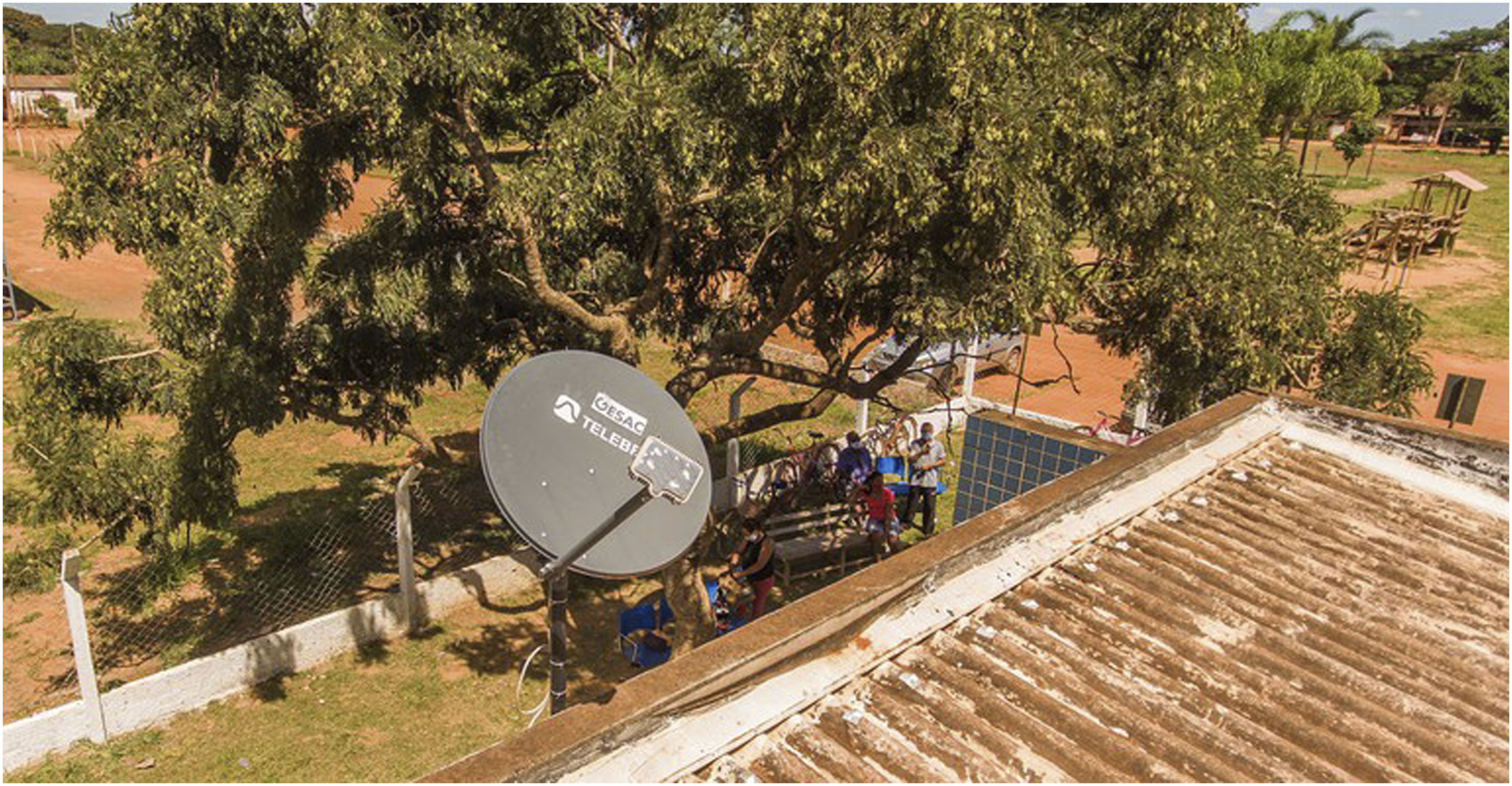
Although the SGDC project has successfully connected numerous public rural schools and students through inter-ministerial and public-private collaborations, its continuity faces three primary concerns: (i) dependence on a single complex satellite with a finite lifespan aimed at bridging the digital divide of an entire territory; (ii) the anticipated full use of the satellite’s Ka-band beams due to expanding agreements and uncertainties about shared usage; and (iii) the TCU’s suspension regarding the selection of the SGDC-2. These critical issues are largely absent from public discourse, despite the SGDC constellation often being referred to as a state project, thereby underscoring the satellite project’s embeddedness in a broader governmental context that has occasionally oversold telecommunications promises.
Back in 2017, Telebras began a process to obtain more information about the market to evaluate the feasibility and existing demand for a second satellite. During that time, the decision mandated that Visiona would be the satellite contractor for the SGDC-2, but that was eventually suspended due to the uncertain results of the SGDC-1. After months of unclarity about whether the SGDC-2 would be carried out, the TCU officially informed the suspension of the process for the selection of suppliers to build the country’s SGDC-2 by Visiona, as there were irregularities in Visiona’s choice in the Request for Information Process (RFI), as well as the Request for Proposal (RFP). The TCU document suspending the SGDC-2 construction notes that even though planning for the second satellite started in 2018, Telebras had contracted the RFI and RFP phases with Visiona when they were still absent. According to one of the rapporteurs, there would be no resources in the budgetary and financial planning of the country for 2018 and the following years that could be utilized by the government for the program. 5
Most importantly, there has been no officially disclosed mandate for manufacturing a second satellite as of early 2025, even though the SGDC-1 was initially conceived as a constellation of three GEO satellites, which initially included plans to launch a second one (SGDC-2) by 2020. This is factual despite the project’s mandate outlined in the 2012 decree and the recently approved government plan aiming to connect all schools by the end of 2024, a goal that, despite political endorsement through the workings of the satellite, was only partially fulfilled. With social inclusion relying on the SGDC-1 alone, project viability concerns continue to grow insofar as the lack of ongoing investment and continuous strategy oversight permeates the SGDC as a state-funded project. According to a former Telebras’ high-level executive, if the on-ground connectivity continues to grow at the same rate as it has since 2018, the SGDC-1 will soon reach its capacity, utilizing all the beams in the Ka-band. He also recognizes that if all the SGDC-1’s capacity is contractually sold ‘Telebras [will] break up’ (Aquino, 2019), reinforcing the necessity for the continuation of the constellation and manufacturing of other satellites. The observation suggests that beams covering northern Brazil may be fully occupied, hindering the installation of new connectivity points or expanding signal traffic at existing ones.
In addition, Telebras recognizes that the rise of 5G in Brazil will further strain SGDC-1’s capacity in certain areas. However, relying on a single satellite nearing its limit is not a promising sign of progress in connecting historically isolated and rural communities. This challenge is crucial for the mixed public-private business model under which Telebras operates and for costly satellite infrastructure projects such as the SGDC-1. Satellite projects of this scale tend to demand strategic planning due to their substantial financial expenditure, technological complexity, governance setbacks, and the necessity for precise coordination across manufacturing, launch, orbital control, and policy frameworks to achieve their objectives (Parks and Schwoch, 2012). Although Telebras had previously stated its intention to finance SGDC-2 primarily through its revenues, TCU reported that the company had already suffered a financial loss of 210.8 million Brazilian Reais (nearly US$50 million) and had consistently presented financial losses over the years, jeopardizing its status as ‘an independent company’ (TCU, 2018: 5). In response, Telebras informed the press that it had suspended the SGDC-2 project before the TCU assessed the program, emphasizing that, as a nation-state initiative, it was the federal government’s responsibility to establish a new Steering Committee and Executive Group for SGDC-2, similar to the process followed in 2012 when President Rousseff issued the corresponding decree.
As these dynamics suggest, the crux remains the lack of communication, uncoordinated participation between involved government agencies, structured data on performance, and uncertainties over the Brazilian state’s ability to designate part of the budget to the SDGC-2 or even SDGC-3. These socio-technical challenges could jeopardize the promised outcomes of the SGDC, social programs, and the state’s agenda for satellite-enabled broadband connectivity in rural public schools.
‘Switching on’ the broadband: A view of a paternalistic space-telecom infrastructure via the televisual
After uncovering the major governance issues and uncertainties surrounding the SGDC as a state project, I demonstrate next how a paternalistic narrative gains traction through the televisual, particularly in relation to public rural schools as key sites of analysis. In doing so, I dissect how the televisual reveals the state’s efforts to frame the satellite’s technological interventions as a means of addressing digital inequality. By discussing the images capturing the moments when the broadband is ‘switched on’ in selected rural schools – communities that often lack the necessary on-ground infrastructure for broadband access – within carefully orchestrated media events, I argue that Bolsonaro’s administration’s use of the televisual reveals tactics to reinforce its narrative of digital inclusion, but largely within the savior narrative and not necessarily related to social progression enabled by broadband connectivity. To evaluate this critically, I rely on Horace Newcomb and Paul Hirsch (1983) conceptualization of television as a cultural forum. Here, the televisual text is understood as ‘dense, rich, and complex, rather than impoverished… and that any section, any cut, any set of questions must account for what is not studied or measured, for the opposing meanings, for the answering images and symbols’ (Newcomb and Hirsch, 1983: 571). This framework enables an analysis of how media events, such as the SGDC-1’s symbolic activation of broadband captured through synchronous video conferences, function within Brazil’s media infrastructure discourse and counterbalance the governance setback discussed earlier.
In May 2019, before the wide use of videoconferencing platforms during the COVID-19 pandemic, high-level Brazilian officials convened national media to herald the SGDC-1’s achievement: the successful delivery of broadband connectivity for a million rural students (Figure 6). This came amid widespread public dissatisfaction during the then newly elected far-right President, Bolsonaro, who, among other controversies, spearheaded major financial cuts in education at the time. The announcement aimed to spotlight the federal government’s digital inclusion efforts achieved via the SGDC-1.
6
On this occasion, Bolsonaro conducted a videoconference with a rural school community in Cavalcante, Goiás, to demonstrate the SGDC-1’s transformation impact in the hinterlands of the country. In a staged moment, the internet link was symbolically ‘switched on’, and students and teachers were shown connecting to the broadband thanks to the workings of the SGDC-1 – orbiting over 36,000 km above the surface of Brazil’s territory. This choreographed performance utilized synchronous video to construct a narrative of instant inclusion and subsequent national pride, projecting an image of technological advancement orchestrated by state and made possible by the workings of a single piece of high-technology infrastructure. The resulting visual media, widely circulated through Brazil’s leading media outlets, reinforced the state’s discursive portrayal of the satellite as a beacon of Brazilian innovation, inclusion, self-reliance, and connectivity.
7
Photo capturing a video-conference meeting between Brazilian President Jair Bolsonaro, key ministers, and government officials with students and teachers from Escola Estadual Calunga I in Cavalcante, Goiás. (Source: Agência Brasil).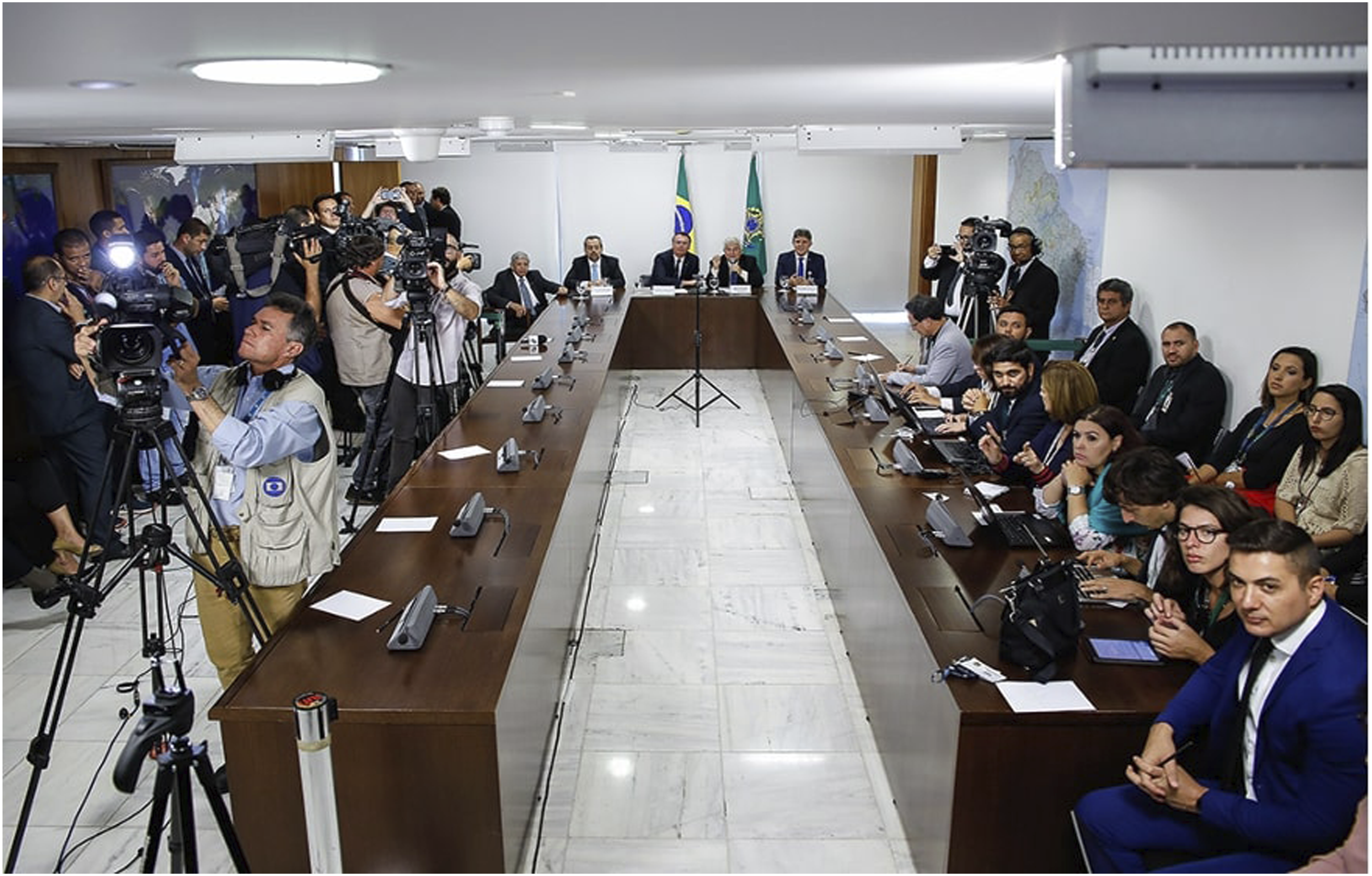
From the Planalto Palace in Brasília, the official workplace of the President of Brazil, a striking contrast emerged during the media event when viewed through the lens of the televisual. Politicians and their teams, dressed in formal clothes, faced a screen displaying students from an underserved rural community in Goiás located 320 km away. Dressed modestly and exuding uncertainty, students virtually interacted with the nation’s most influential political figures to demonstrate the power of broadband in their newly connected lives in the school setting (Figure 7). This juxtaposition of these two disparities highlighted the technological advancements being attempted: the connection of a previously unconnected school community through a space-telecom system that remains largely invisible. As these images cross-pollinated across blogs, news media, and social network sites, comments on the government’s channels revealed a spectrum of opinions. Some asserted, ‘This is something that the big and rotten media will not show’ (MCTIC, 2019b), giving support to Bolsonaro’s government efforts of unification with those at the margins of the digital economy. Others, on the other hand, pointed to the satellite’s political implications as a tool to attack Bolsonaro’s opposition. One commentator stated, ‘This is something that the previous left-wing governments never did’, which elicited responses such as, ‘But in which government did the satellite actually originate, huh?’ (MCTIC, 2019b). Such exchange sheds light on the fact that the satellite decree initiating the SGDC had been enacted under Dilma Rousseff’s administration (2011–2016), and with strong support of the Workers’ Party. View of the screen framing the school community in Cavalcante, Goiás, as seen by the government officials in the capital city of Brasília (Source: Agência Brasil).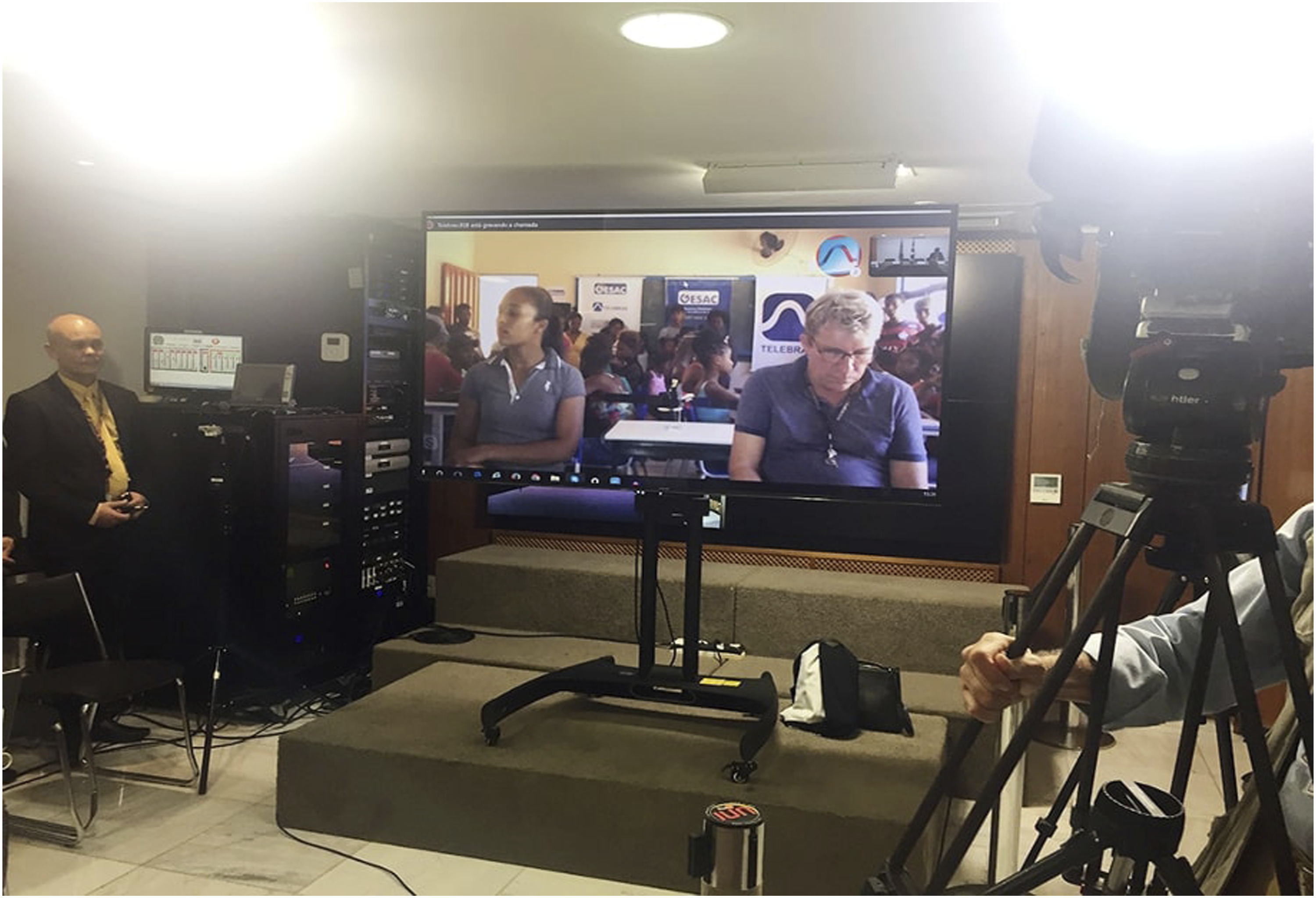
The broadband’s potential as a catalyst for social mobility became central to the rhetoric during the televisual engagement with the rural school. As the satellite connection enabled students in Cavalcante to achieve high-speed connectivity, President Bolsonaro emphasized that global internet access would significantly enhance their lives. This sentiment was echoed by a teacher participating in the videoconference, whose remarks were later shared on the social media channels of the Brazilian Federal government (Figure 8): ‘(…) I would like to thank God for this moment, and on behalf of our team in the school, I would like to thank you for bringing this program to us. With this [satellite-based] internet, we see it as a door that is opening to us. It will be a very important library that will help us guide our students... Given that our school lacks pedagogical materials, and it is located in a region of difficult access, we believe that broadband will facilitate the lives of students, teachers, and other members of the community’. (MCTIC, 2019b) Screengrab of the videoconference featuring former MCTIC Minister Marcos Pontes and former President Bolsonaro connecting with the school in the municipality of Cavalcante, Goiás (Source: MCTIC).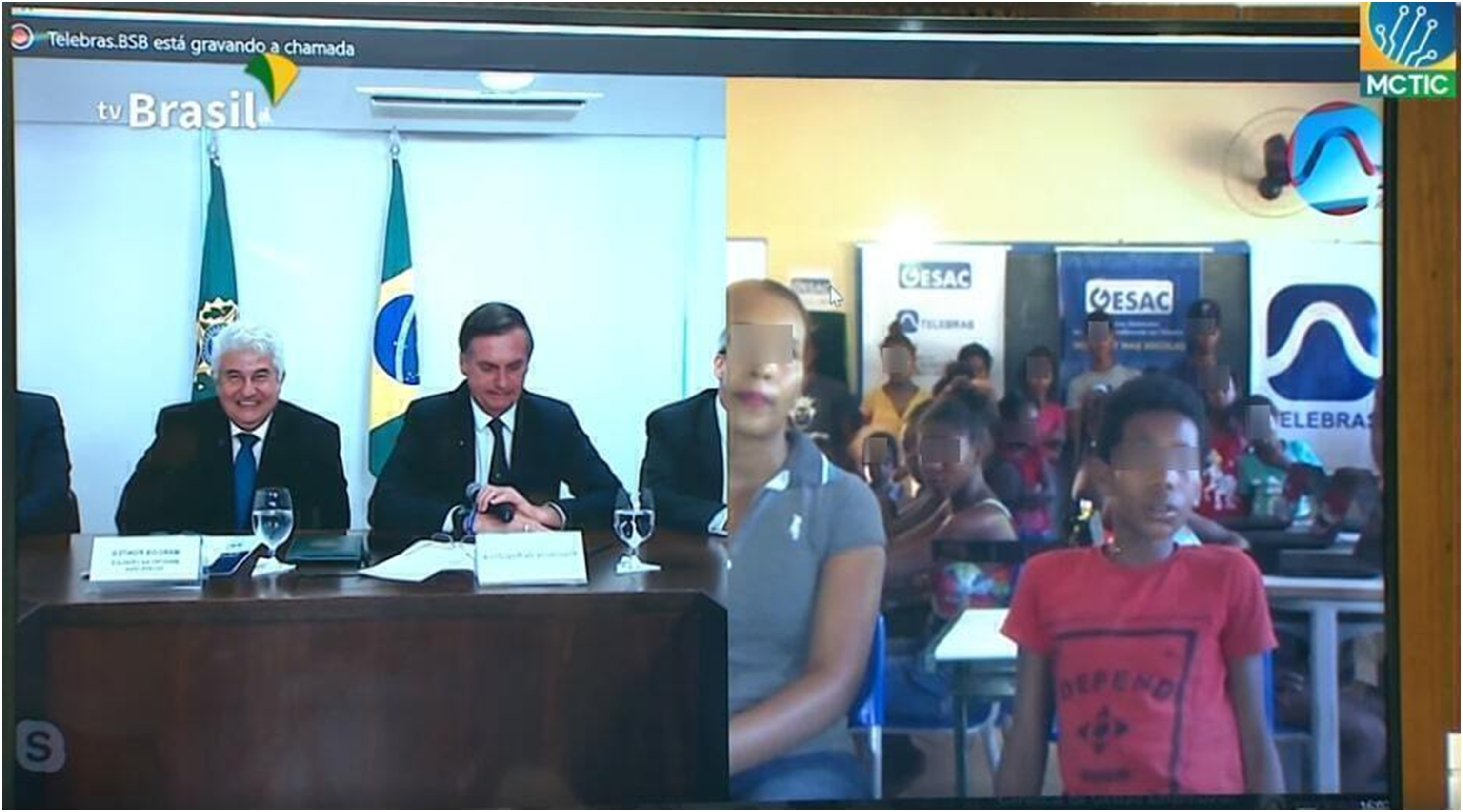
The satellite-enabled media event, reliant on both connectivity and televisual representation, illustrates how perceptions of geographic separation influence the conceptualization of the satellite as a unifying infrastructure. As the then-Minister of Science, Technology, Innovation, and Communications emphasized, Brazil ‘You are Brazil’s future – potential astronauts, doctors, engineers; your possibilities are boundless’ (MCTIC, 2019a). Such testimonies continued to unfold across multiple media platforms of the federal government and ministries under the auspices of Bolsonaro’s administration, reigniting whenever new televisual content emerged to report on the satellite’s ongoing efforts to deliver broadband connectivity to other rural school communities across Brazil. Nonetheless, this narrative of national cohesion through satellite technology obscures underlying digital inequalities that encompass more than infrastructure. Despite the provision of broadband to rural areas, challenges such as digital literacy and socio-cultural barriers to meaningful internet usage remain persistent and disconnected from the satellite promises.
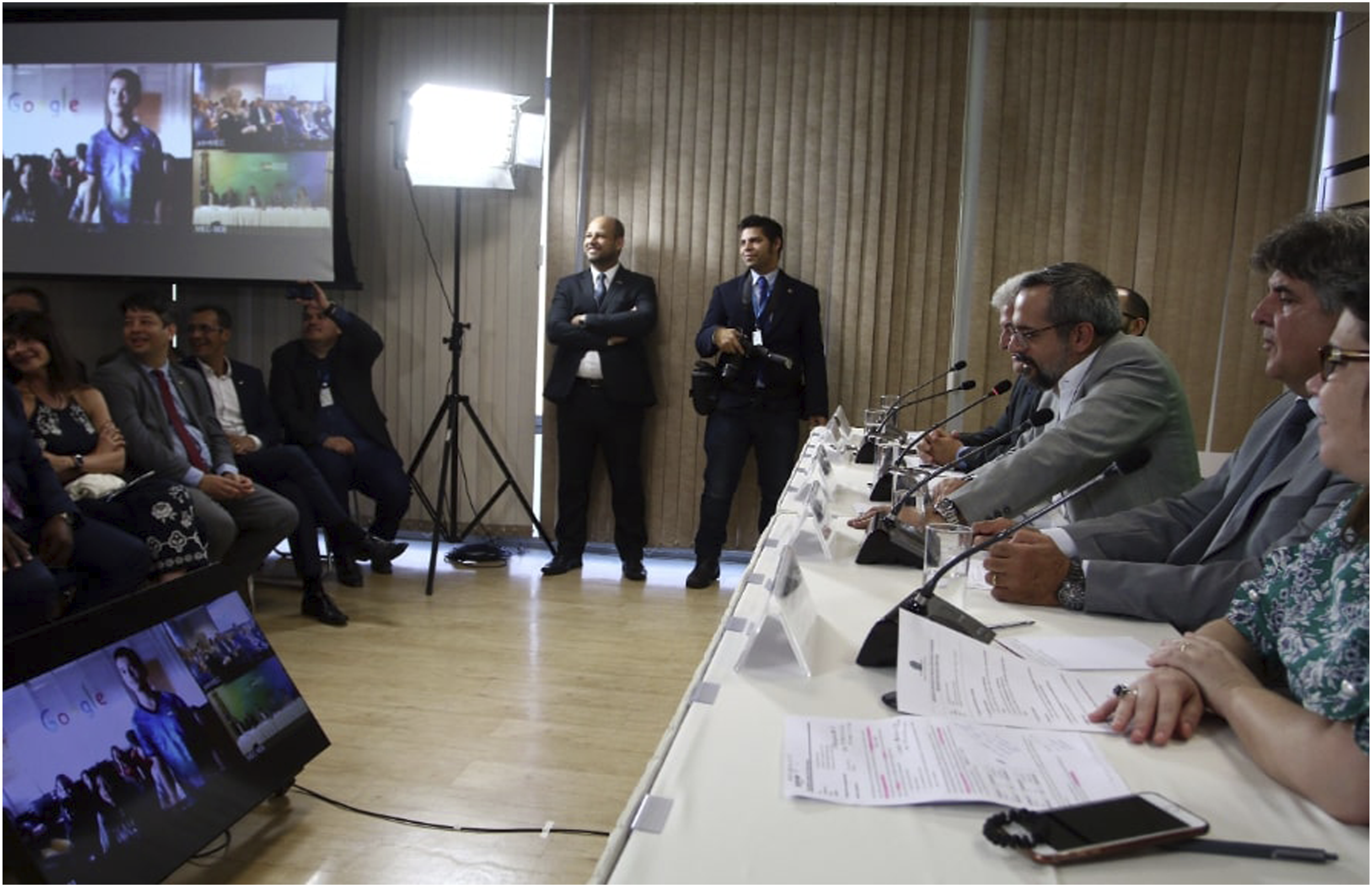
As similar media events continued to unfold, other government bodies at the federal level became involved in capturing these moments when the broadband was ‘switched on’. For instance, 5 months after Goiás’s first rural school videoconference, the Ministry of Education in Brasília hosted a live videoconference with students from Manacapuru, a municipality in the state of Amazonas, via the SGDC-1. The event symbolized a new partnership among Bolsonaro’s ministers, with the government pledging 60 million Brazilian Reais (US$12.3 million) annually to support Telebras’s efforts to connect rural schools through existing digital inclusion programs that were previously hindered by legal issues related to civil usage contracts. As the student shared his excitement, the Minister of Education interrupted, urging gratitude toward Brazilian taxpayers for enabling the SGDC-1 (Menezes and Pera, 2020) (Figures 9 and 10). In this orchestrated moment mediated by the televisual, the SGDC-1-enabled activation of broadband in real-time transcends ordinary internet connectivity, emerging rather as a spectacle that mobilizes media infrastructure as a symbol of national progress. By fusing the narrative of a new connectivity blueprint – mediated by the SGDC-1 as an infrastructural system – with state power, embodied by key controversial government figures, the event recasts inclusion as a top-down act that challenges entrenched digital and spatial inequities. Screengrab of the videoconference between federal government representatives and students from Escola Municipal São João do Ubim, located in Manacapuru, in the northern state of Amazonas (Source: Ministério da Educação). Photo of government representatives facing a screen displaying students from Escola Municipal São João do Ubim, Manacapuru, while engaging in a videoconference to celebrate the partnership between the relevant ministries on the use of the SGDC-1 (Source: Ministério da Educação).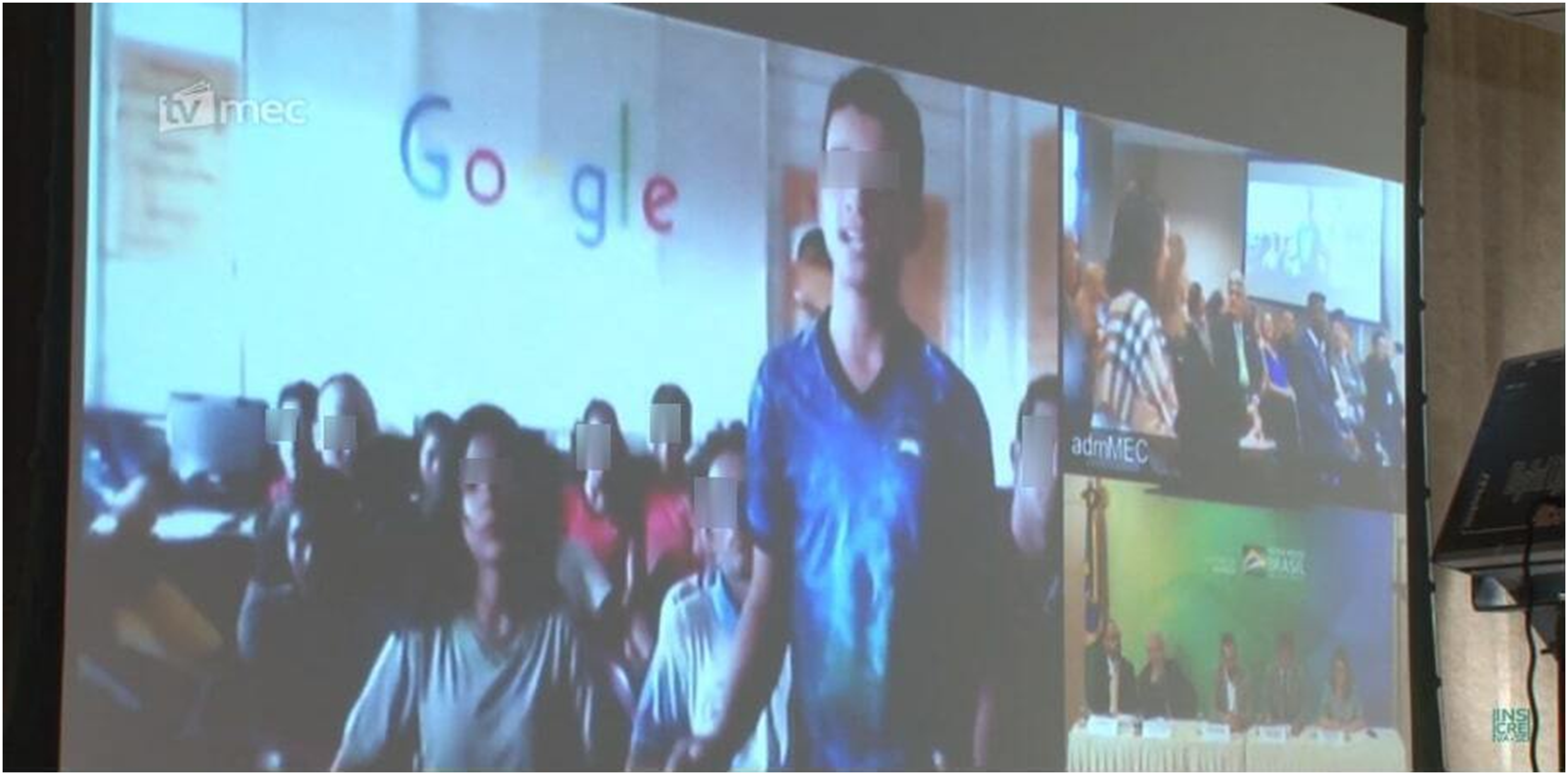
As these examples suggest, Bolsonaro’s administration employed orchestrated media events to promote a narrative of national integration where the government – not the private telecommunication operators let alone previous administrations of the ‘political left’ – is driving these changes. Events with the rural school communities in Goiás and Manacapuru depicted the SGDC-1 as a paternalistic infrastructure system aimed at driving positive transformation with idealized outcomes. This aligns with a specific view of the state, a subject studied by media and communication scholars, science and technology studies (STS) researchers, and anthropologists examining infrastructures. For instance, Hallam Stevens (2023) studied Teleview in Singapore during the late 1980s and early 1990s, a pilot digital computer network using the public telephone system to connect citizens to information, coining the term ‘paternalistic infrastructure’ to describe the connection between citizen engagement and state imaginaries. Thus, the orchestration of television in these SGDC-1 events demonstrates Brazil’s socio-technical prowess and benevolence. The SDGC-1 reflects a paternalistic mission of connectivity, portrayed through a persuasive, ideologically charged media performance, presenting the satellite as a symbol of broadband connectivity and national pride, especially through its synchronous televisual representation involving the communities it aims to serve.
Yet, they do not celebrate actual social transformation but rather the state’s potential to enact change through a techno-altruistic, future-oriented approach (Li, 2007). As other media and communication scholars have already articulated, bridging digital disparities in the Global South requires more than just access to computing devices and broadband infrastructure (Ames, 2019; Donner, 2015; Parks et al., 2022). These necessary efforts clash with authoritarian populist politics, which, similar to the videoconference moments captured by televisual media in this article, emphasized the government’s plans and optimistic projections through live interactions via social media, direct engagement with the public, and direct confrontations with media systems, the intellectual class, and the political opposition – whom Bolsonaro often categorized as the ‘corrupt’ forces responsible for Brazil’s socio-economic realities as a nation-state (Straubhaar, 2024). Although the SGDC project first gained traction during the Workers’ Party administrations of the early 2000s and early 2010s, Bolsonaro’s allies, by engaging directly with the public through the satellite’s civic applications, the government managed to reframe the satellite-enabled broadband delivery inclusion as if it were a product of their own efforts and strength – similar to how Bolsonaro’s engaged with other forms of propaganda and manipulation attributed to his administration (Wehner, 2023).
While the videoconference in rural schools celebrates digital inclusion enabled by the SGDC-1, it also risks oversimplifying the complex socio-cultural realities on the ground. As the framing of the televisual to capture the synchronous connections of satellited-enabled internet that enabled the video conferencing between politicians with a rural school community in Manacapuru, in the state of Amazonas, reveal the SGDC-1 may bring distant regions closer but cannot necessarily tackle structural inequalities affecting marginalized communities when it comes to broadband access. These communities were featured as part of strategic and synchronous televisual maneuvers via videoconferencing, with the SGDC-1 being presented as a flagship of broadband connectivity aimed at bridging social and digital divides. In this sense, a kind of dialectics of distance emerges as part of emphasizing the opposing forces at play: on one hand, the satellite brings distant communities closer in a symbolic sense, creating the appearance of unity and national cohesion through broadband access. On the other hand, the physical and social distances – manifested in ongoing digital divides, socio-economic disparities, and cultural separations – remain overlooked. This tension underscores the superficiality of providing technology without addressing underlying social, cultural, and infrastructural barriers that hinder reliable, high-speed connectivity. In other words, the dialectics of distance through the televisual reveals the contrast between the idealized narrative of connectivity and the persistent realities of inequality and exclusion.
Discussion
As internet access increasingly becomes central to human rights debates, it is vital to produce critical, globally informed, and locally situated scholarship on the large-scale infrastructural systems that support its expansion – from conception to deployment to adoption. Beyond the Global North narratives that have dominated the canon of critical studies of media infrastructures, Brazil’s experience with SGDC-1 as a state-funded satellite project underscores the need to untangle such debates through various methods and audiences. The analysis presented throughout this article attempts to bridge this gap by demonstrating how televisual media – both as theory and practice – reflects political subjectivities linked to these infrastructures that are frequently inaccessible to the public and often magnified in particular ways by governments. As I empirically demonstrated, despite promises surrounding SGDC-1 as a state project to tackle the digital divide, the reality is that there are many relevant intricacies that may hinder the success of the project, which largely remains unavailable to taxpayers who indirectly fund the project.
Through an open-source investigation coupled with satellite footprint analysis, this article examined how Brazil’s promises of broadband connectivity in rural public schools via the SGDC-1 satellite are inextricably intertwined with unclear governance structures that may ultimately limit the expansion of the constellation. While the SGDC-1 indeed holds the potential to improve broadband connectivity in Brazil’s rural areas where fiber cannot reach, it faces significant challenges that jeopardize its long-term viability, including capacity limitations, data-sharing obscurity, and funding uncertainties for future satellites. These challenges are emblematic of broader issues across the Global South, where state-sponsored projects often rely on techno-solutionist narratives that obscure deeper systemic problems. In sum, these dynamics raise critical questions about the role of digital infrastructure systems in shaping national agendas, the balance between digital development progress and state-driven discursive maneuvers, and the potential of such projects to either amplify or silence marginalized voices depending on the political establishment and enactment of media to capture people’s imagination. Furthermore, it explored how this is counterbalanced by tactics involving the televisual text constructs with the underserved communities it seeks to serve. These reveal the state’s strategies (and lack thereof) when deploying large-scale infrastructures, thereby reinforcing a narrative that positions the satellite as an inclusive and connectivity-enhancing technological apparatus within a logic of populist tactics.
More specifically, I demonstrated how a paternalistic space-telecom infrastructure tactic through the televisual promotes socio-economic integration by projecting a unified, technologically advanced national image; yet beneath this veneer lies the satellite’s militaristic aims and socio-technical shortcomings, which remain largely concealed. Furthermore, despite significant funding cuts to research and education at public universities, the Brazilian government under Bolsonaro continued to champion the SGDC-1 as a political mechanism reinforcing state power while often sidestepping accountability. As geographer Milton Santos (2002) observes, states and corporations exploit technical systems to perpetuate economic control, sidelining dissenters and binding them to an overarching system logic. The SGDC-1’s orchestrated media events and the resulting televisual presentation exemplify this dynamic, portraying the satellite as a beacon of national pride and broadband connectivity while reinforcing a paternalistic narrative of state-led progress. Such a techno-solutionist approach uses the televisual to transform rural, ‘unconnected’ communities into symbols of empowerment, while simultaneously masking deeper structural inequalities and promoting a centralized narrative of national progress through a savior narrative.
The critical analysis of the SGDC-1 developed in this article also further complicates the scholarly understanding of the rise of competing satellite technologies such as SpaceX’s Starlink constellation, which has rapidly expanded within Brazil and is now available and commercialized in 90% of the country’s legal Amazon region (Senra and Costa, 2024). How will this play out in the coming years and decades? How should the government act to guarantee that publicly funded infrastructure – such as the promised SGDC constellation – serves those who need it most, instead of being overshadowed by promises from foreign satellite companies operating in LEO orbit? While Starlink’s commercialization may broaden access, it could also undermine – even in the government discourse – the SGDC project’s social mission by ceding control over internet access to a commercial, foreign entity, potentially affecting rural schools and communities already integrated into national policy frameworks of digital inclusion such as the National Broadband Plan and GESAC. Furthermore, as digital infrastructures continue to intersect with populist movements toward particular media spectacles and global connectivity dynamics, more cases in the Global South must be taken into account by regulators and the broader public.
Within this analytical juncture, a comprehensive and strategic framework for a National Satellite Internet Plan in Brazil could potentially prioritize long-term satellite-enabled broadband, fiscal transparency, and accessible data for citizens, researchers, and policymakers, thereby facilitating accountability and increasing civic involvement in matters of satellite activities and connectivity plans. Furthermore, ensuring the system’s scalability and sustainability – through forward-looking capacity planning, integration with complementary infrastructures, and resistance to overly simplistic techno-fix narratives – has the potential to drive more nuanced broadband connectivity solutions for those at the margins of access. However, achieving this requires further research to explore the symbolic dynamics of these infrastructures as they intersect with end users and their social realities around connectivity. Such scholarship should emphasize the descriptive and normative contributions of analyzing media infrastructures, offering critical and policy insights that move beyond the limitations of techno-fix discourses and the idealization of future-oriented development goals.
In this light, combining interdisciplinary and creative methods in media research becomes a fruitful avenue for untangling these black-box dimensions and imagining possible ways forward. As countries in the Global South continue to adopt public-private partnership models around satellite technologies that may not always effectively serve those at the ‘receiving end of infrastructures’, and as televisual representation tactics evolve with new aesthetics and audiences, such an approach becomes a useful analytical tool.
Footnotes
Acknowledgments
I would like to express my gratitude to Lisa Parks, Paloma Duong, and Jing Wang (in memoriam) for mentoring and advising me when this project started as part of my master’s thesis at the Massachusetts Institute of Technology (MIT). My gratitude also extends to Camila de Moraes Paulino and Nicole Starosielski for their helpful comments on more advanced drafts of the manuscript. Additionally, I thank attendees of the ‘Media Backends: Network Relations and Place Transformations across Regions’ panel at the 72nd International Communication Association Conference in Paris; the Emerging Scholar Program at the 47th annual Pacific Telecommunications Conference in Honolulu; and the Global Governance in the Digital Era seminar series at Koç University’s Department of Political Science and International Relations in Istanbul, where I presented versions of this work and gained insights that shaped the article’s trajectory. Finally, I thank the anonymous reviewers for their recommendations and constructive suggestions. I dedicate this article to the memory of Jing Wang, whose mentorship left a last impact on my intellectual journey in academia and beyond.

Funding
This work was initially supported by the Jorge Paulo Lemann Fellowship at MIT. The later stages of the research and writing were supported by the United Kingdom’s Economic and Social Research Council (ESRC) and the Cambridge Commonwealth, European, and International Trust.
Declaration of conflicting interests
The author declared no potential conflicts of interest with respect to the research, authorship, and/or publication of this article.