




Abstract
This paper explores the visual politics of gender in electoral politics in West Bengal (WB). We examine how women political candidates visually construct their non-verbal political performance on social media, and how such visuals relate to social mores and societal expectations surrounding femininity. Drawing on theories of the social construction of gender and visual political communication, we conducted a content analysis of 1,033 visual artefacts from eight individual women candidates and 205 from the Facebook and X (formerly Twitter) pages of the four main political parties taking part in the January-April 2021 electoral campaign for state-level elections in WB. We analysed how these candidates construct gendered relationships with the electorate through different cues on the platforms, such as sartorial choices (traditional or Western attire), use of culture-specific religious symbols (sindoor or vermillion, bindi – forehead marking worn by married Hindu women), and gendered/non-gendered political actions like cooking or serving food, giving speeches or meeting constituents in political processions. Our findings about the visually performed politics show a combination of cultural, political, and gender signifiers, which are mediated and remain connected to societal expectations, and historical narratives. The candidates’ negotiation of these aspects, in turn, underscores a reproduction of colonial legacies and, in the present day, an ongoing production of societal differences. This study contributes to the growing body of literature on visual politics of gender, particularly in Asian contexts. It sheds light on the nuanced ways women politicians use social media to construct their visual identities, and how the deployment of body politics into the relatively ‘new’ online sphere reifies ‘old’ social, political, cultural symbolisms, and norms regarding gender. In this way, this article highlights the importance of considering pre-digital forms of gendered identity construction and visual representation when analysing the contested terrain of digital visibilities.
Keywords
Introduction
On 23 August 2023, the Indian Space Research Organisation (ISRO) celebrated a global scientific achievement, the success in landing a module on the moon’s south pole under the ‘Chandrayaan-3’ mission. Almost immediately after the event, a Twitter (now ‘X’) handle released a photograph of six women, all ISRO scientists, with the intriguing caption, ‘Dear girls, this is what feminism looks like’ (Maheshwari, 2023). Hours later, a post from another user (Bhardwaj, 2023) included the same image with two others, adding: #Chandrayaan3 proving that cultural values & success can go hand in hand & these ain’t symbols of oppression but strength!!!
This latter post began with a list of check boxes (denoted by a tick ‘✓’), a set of visual cues. These cues asserted how the women upheld ‘cultural values’ through certain ‘symbols’ of ‘strength’, rather than ‘oppression’: ‘Sari (✓) Bindi (✓) Gajra (✓) Sindoor (✓) Mangalsutra (✓)’
These posts reveal how objects on the bodies of the female scientists – clothing, marital anointments, flowers or jewellery – are interpreted to symbolise their ‘cultural values’, ones conforming to traditional femininity. Such objects, in part, seem integral to be seen as – what we term in this paper – a ‘good woman’ in contemporary India. In the case of the ISRO scientists, even if incidental, visuals on a social media platform proclaimed that women need not abandon ‘cultural […] symbols’ to partake in modern national achievements. The example assumes significance because of the symbolic, cultural, religious and social meanings it ascribes to women’s bodies. As women enter the hyper-visible space of social media from the relative privacy of offline physical spaces, the performative aspects of femininity intensify and the ostensible visual attributes of the ‘good woman’ become far more crucial. In this paper, we explore one such area concerning the presence and performance of women, namely, visual representations related to their participation in electoral politics. More specifically, we investigate the visual politics related to female politicians in social media-based communication during the 2021 campaign for assembly elections in the Indian state of West Bengal. 1 By focussing on this very specific cultural and linguistic context, our study investigates how visuals of female politicians aspiring for public office are constructed on social media platforms, and explores the relationship of such visuals with social mores. Our goal here is to examine the extent to which these visual representations of women politicians are circumscribed by societal expectations or resist them.
Digital visibility, gender and visual politics
Critical investigations of how women are scrutinised publicly in visual terms, including on social media, have been undertaken extensively and across various cultural contexts, (Bauer and Carpinella, 2018; Bird, 1999; Cardo, 2021; Devitt, 2002; Jungblut and Haim, 2021; McGregor et al., 2017; Santia and Bauer, 2022). Our investigation draws on the contested politics of gendered digital visibility that this body of scholarship has highlighted. In particular, we follow them in understanding that notions of ‘visibility’ must be positioned within wider debates on power relations, particularly the gaze of the other that scrutinises women in both public and private spaces.
Over the years, it was hoped that digital media would transcend the limitations of race and gender identities, leading to a more homogenised online presence. To the contrary, today, users exhibit and perform their racial and gender identities quite emphatically in digital spaces. This departure from the expectation, additionally, disrupts how only a few privileged people could curate their public personas in exclusive ways. In fact, the widespread availability of affordable smartphones in the modern era has empowered millions to visually construct digital identities as an integral part of their everyday lives (Hobson, 2016). Visuality of digital lives has emerged as a political and social phenomenon whose production is not just strategic, but also culture-specific (Creech, 2020) – a dimension we discuss in the forthcoming section.
To understand how visuals either reproduce or challenge power dynamics in electoral politics, we must view individuals and groups within particular regimes of social and political power. By focussing in on the context of electoral politics, our research concerns itself with the gendered nature of visual political communication. Visual politics itself is an emerging area of study (Bucy and Joo, 2021) and an increasing number of studies are being conducted into how politics is mediated through visuals on social media. These studies have sought to apply and extend previous theoretical and conceptual understandings of the role of visuals in politics (Debord, 1995; Gitlin, 1980; Goffman, 1959; Hariman and Lucaites, 2007). However, most remain concerned with North American or European contexts (See e.g. Grabe and Bucy, 2009; Lilleker et al., 2019; Veneti and Rovisco, 2023). 2 By bringing a perspective from an under-researched geographical, cultural and linguistic context, we are bringing new empirical evidence to bear on this growing area of study.
The centrality of visuals to political communication is hardly new. Their role in social messaging emerged in the pioneering works in the past (Barthes and Lavers, 1972; Boorstin, 1962; Guy Debord, 1995). As Grabe and Bucy (2009) posit, visuals have conveyed sense and meaning for millennia, and continue to operate similarly in contemporary social and political life. They play a vital role in how politicians, activists and citizens convey messages and connect with audiences (Cartwright and Mandiberg, 2009; Lilleker et al., 2019). What becomes important then, is how a communication landscape is influenced by cultural specificity, an aspect that Pauwels (2019) believes demands close scrutiny.
Visuals as culture-specific
Our investigation is premised on the fact that political visibility is not a thing that exists but an act that is performed. Moreover, we take this performance of political visibility as being culture-specific. This has been made evident in works of scholars like Udupa et al. (2018) who frame digital visual practices through lenses of cultural identity formations, ritualisation and sociality, to explore their the material implications across myriad societies. Additionally, Jari Kupiainen (2016) argues that digital visualities must consider pre-digital forms of identity construction and representation. Stocchetti (2017) uses a the concept of social representation to highlight how groups ‘visually construct meaning in the digital age’ (p. 38). Many other examples serve to reinforce the culture-specific nature of digital visual practices (Uimonen, 2013), for example, in how social norms observed in family scenes shape people’s consumption and understanding of political reality through visual means (Lilleker et al., 2019).
Seen from this perspective, it is crucial then to understand how culture inflects visual political communication. Shirin M. Rai’s conceptualisation of ‘political performance framework’ (PPF) is helpful in this endeavour. Rai delineates four constitutive elements – body, representation, auditory power, and labour – in her conceptualisation of political performance. She also argues for the need to map such performance from its production to its reception. Rai’s framework builds upon Michael Saward’s (2006) concept of ‘representative claim’. Its constituent elements, moreover, recall Judith Butler’s conceptualisation of gender as fluid and subject to constant reiteration, rather than stable (1990). Our study takes Rai’s work as its departure point in analysing how gender constructions are configured societally in visuals through body, representation and the labour portrayed focussing on production, and because of our emphasis on the visual, auditory power was not germane to our study.
Research on visual artefacts from the Global South (Favero, 2020; Hoskins, 2003; Hughes, 2003; Hussain and Howard, 2013; Olesen, 2014) underscores how visual media actively negotiate cultural meanings. Lina Khatib (2013) asserts that, rather than neutral carriers of information, visual media operate as the means for political actors to deliberately create and negotiate shifting cultural meanings. Huat (2007) argues that, in Asian contexts, ‘electioneering practices are unavoidably embedded in and hewed from the local cultural milieu’ (p. 3). Adapting a cultural lens then may be seen as indispensable when scrutinising gendered visual politics on social media, in the relatively young, Asian democracy of the Indian state. While investigating online political performances on platforms like Facebook and X, we do not lose sight of their tangible, real-world manifestations. In this sense, our research is premised on the fact that social media platforms complement, rather than replace, in-person performances (Butler, 1993; Nanabhay and Farmanfarmaian, 2011; Sassen, 2012; Gerbaudo, 2012).
Gendering the body in visual politics
Thinking through visuals in a culture-specific manner also necessitates understanding the gendered nature of the body as a figurative, formal, social, political and cultural symbol. Unlike the unmarked ‘universal’ body, the female body is thus marked by its gender identity as a social construct, where, following Simone de Beauvoir (‘one is not born a woman, but, rather, becomes one’) Judith Butler (1990) highlights the ‘compulsion of becoming’ a woman (p. 10-12). In this sense, returning to the idea of the body as a symbol and carrier of symbols, in her influential (and controversial) work on symbolism, through a ‘two bodies’ formulation (1970, p. 72), Mary Douglas explains the duality through which the physical body expresses situations and positions in ways appropriate to social categories. Douglas therefore showed how the figure of the woman and the female body operates as a signifier mythicised through its social and cultural symbolism. The woman politician therefore appears through two interrelated structures of an ‘image’ in ‘political processes’: a visual artefact [and] a form of knowledge. It is inscribed by the ‘distribution of roles […] established in society’, even within democratic structures (Boulding, 1973: p.105), but at the same time recalls how ‘gender’ signifies ‘difference’ at the societal level (Lorber, 1994: pp. 26–27). In the realm of visual politics, gender might then be seen as a form of knowledge realised through explicit cues in ‘imagery and display’. To understand digital identities in culture- and context-specific ways, we must then pay close attention to the societal and structural codes determining how the image of the woman politician as a form of ‘situated knowledge’, to recall Donna Haraway’s (1988) thesis. It is therefore constantly produced, reproduced, reified or even challenged via the modes and contents of visual representation (Kupiainen, 2016).
Digital visual practices is one way how politicians produce and perform their identities within ‘technospaces’, a concept Radhika and Venkataramana Gajjala use to describe social environments mediated by technology (2008: 1-2). Such practices are not independent material actions; they arise from principles and discourses of their societal contexts. Gajjala’s (2019) formulation of ‘gendered Indian digital publics’ thus keeps the production of culture and subjectivity in technospaces central to it, a concept helpful to examine how women politicians in West Bengal present themselves on social media. Rather than only iconic politicians (Banerjee, 2012; Khan, 2019; Navarro et al., 2023) looking at less-known figures helps to understand how digital personas are gendered, and how gender is actively, intentionally, produced, remembered and routed through renewed identifications.
Of the various identities that visuals on social media serve to amplify, suppress, or deploy for political communication, gender cuts across all units and scales of analysis. This is evident in how traditional media portray women politicians (Devitt, 2002; Kahn, 1994; Kahn and Goldenberg, 1991; Ross et al., 2013), which also impacts how first-time female political officeholders appear through their symbolic representation within the political landscape (Verge and Pastor, 2018). These show the importance of studying the visual nature of self-presentation by women political candidates (Mattan and Small, 2021). Understanding the unequal ways in which women operate in a particular societal context and how that society’s – here West Bengal’s – cultural codes impinge upon social media-based visual political communication (Udupa et al., 2018) then becomes paramount.
Politics and the (good) woman in (West) Bengal
In c.1905, long before ‘West Bengal’ was a federal entity in the Union of India that it is today, when the cultural and linguistic region known as Bengal was to be partitioned along religious lines in British India, a visual of the female figure was employed to powerfully express Bengal’s identity, integrity and values. At this time, the modernist artist Abanindranath Tagore painted an ordinary but chaste and ascetic yet goddess like woman with four hands, a figure he named ‘Banga [pronounced “Bawngo”] Mata’ (Mother Bengal). Art historians later read this painting as an explicit and powerful act of myth-making. By the 1930s, it was re-appropriated as a symbol of the Indian nation as ‘Bharat Mata’ or Mother India (Mitter, 1997), which is what the painting is known as today. This seminal visualisation of Bengal and subsequently the nascent Indian nation invoked notions of the ‘good woman’ as the Mother, powerfully correlating the geographical and imagined territory of the nation with the female body. ‘Mother Bengal’ holds metaphorical symbols spiritual life, peace and sacrifice, nourishment or nurturing, and knowledge in her four hands (Figure 1). ‘Banga (Bharat) Mata’, by Abanindranath Tagore (1905).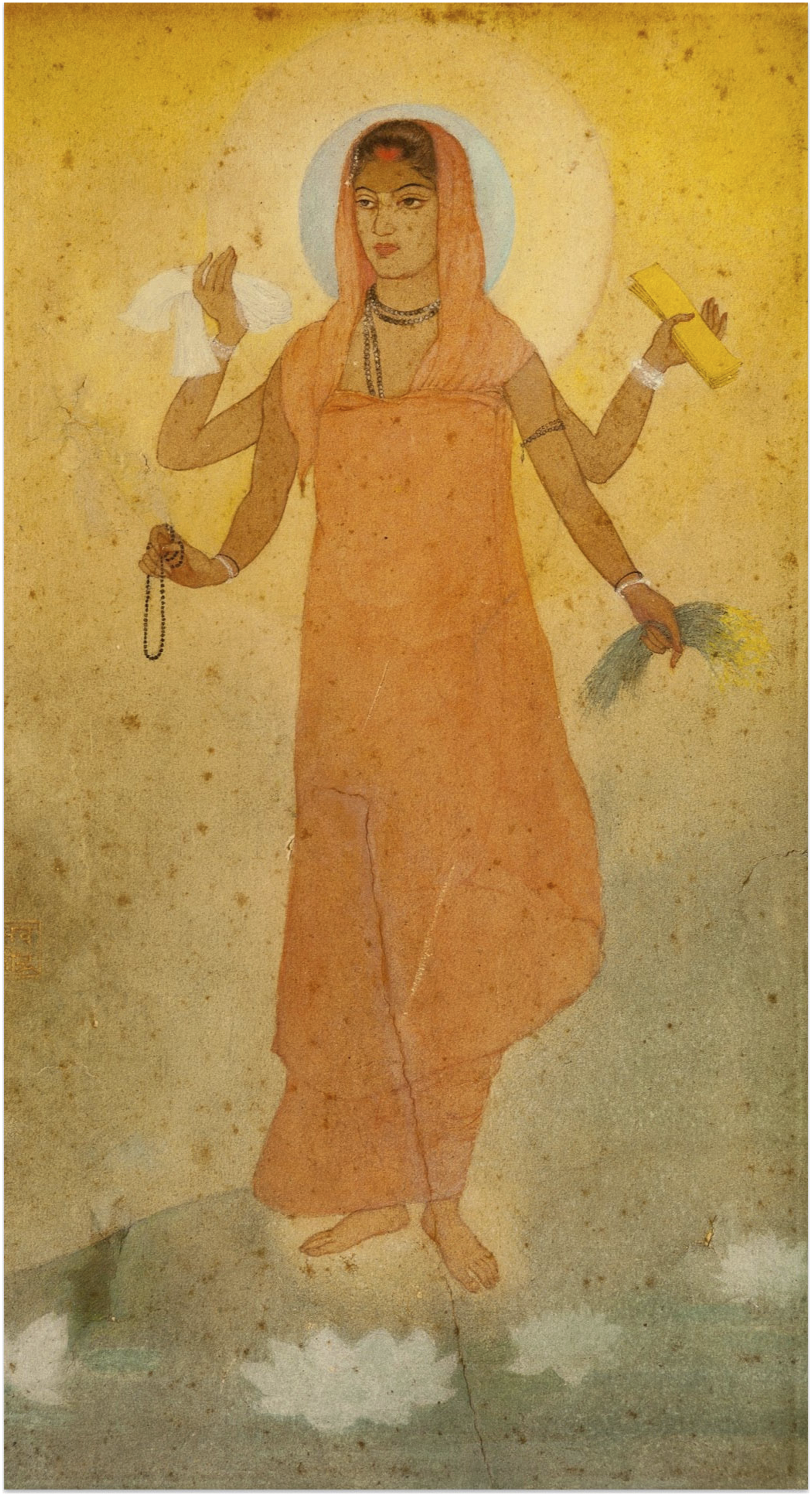
Of particular note is how A. Tagore’s construction of the figure of the woman invoked an image of an upper-caste and-class Hindu woman, thereby excluding a representation of the population marked by class and caste, even religion. For example, Muslim or lower-caste women of Bengal were conspicuously absent even in descriptions of A. Tagore’s symbolic construct of ‘Banga Mata’, as scholars of feminist historiographies in colonial India, examining the intersections of nationalism and gender in fields as diverse as literature and labour, have pointed out over time (Majumdar, 2021; Sangari and Vaid, 1990).
Such exclusions also figure in the scope of this study, where the two most followed political candidates from Facebook and X in West Bengal are upper-caste, upper-class Hindus. Yet, to an extent, sacralised inscriptions of the motherland gained currency even in less elite circles that lay beyond Abanindranath Tagore’s own socially privileged class and caste, and that of his intended audience. As Christopher Pinney (2004) suggests, among ‘subaltern’ populations, visions of Indian nationhood reveals evidence of being ‘driven by an intensely affective vision of the mother and her land [...] variously, in the forms of gender, visual symbol, visual style […] even through ‘popular imagery’ (pp. 103-104). During and in the decades that followed the partition of Bengal in 1905, the ‘image’ of a Hindu, Bengali, elite, educated upper-class woman became an ideal encompassed in the term ‘bhadramahila’, literally, ‘genteel woman’. 3
Characterised by softness, maternal instincts, patience and self-sacrifice, women were imagined as agents of perpetuating tradition (Bannerji, 2001). Interestingly, early-twentieth century invocation, perhaps even invention, of the ‘genteel or ‘good’ woman was prefigured in the social reform movements in the first half of the nineteenth century, such as the abolition of Sati, and introduction of widow remarriage and women’s education in the British-controlled parts of the Indian subcontinent. Such reforms were however, directed at changing practices that circumscribed the life of upper-caste Hindu women. Even so, as recent scholars argue, late-nineteenth and early-twentieth literary intellectuals who seemed critical of patriarchy and purportedly espoused liberal, emancipatory values for upper-caste women in universal terms also betrayed a conservative position (Majumdar, 2021). Moreover, the movements excluded a majority of the female population at the time, who were active as agrarian workers and in household enterprises like trade and production, and were governed by local or community customs unlike those found in normative scriptural texts associated with the Hindu religion such as the manusmriti (Menon, 2000).
What is also pertinent is how Tanika Sarkar (1984) argues that the bhadramahila was mythicised to ensure that patriarchal hegemony faced no threat from female education. Rather, it incorporated what Radhakrishnan (2009) refers to as ‘respectable femininity’. This form of moral signalling was also co-opted by the Gandhian nationalist movement of the 1930s, which advocated a vision of the woman as a dutiful wife and giving mother. In the decades that followed, invocations of the ideal – therefore, good – woman bolstering the ‘inner’ life of the household, supporting men in public life and national efforts, remained constant from anti-colonial to post-independence politics (Ghosh, 2007).
Ironically, despite a record of participation by women in activist political movements across British and independent India, Bengal’s societal norms limited their independence in the exercise of political choice and action. Well into the twenty-first century, this is reflected in how West Bengal’s women remained a minority in assuming executive roles in governance across the political spectrum (Rai et al., 2005). However, the idea that a good woman could only indirectly participate in politics was rendered unstable as the last quarter of the twentieth century approached. On the one hand, at the all India level, the ascent of a figure like Indira Gandhi as the Indian prime minister witnessed a reification of the khadi (coarse homespun cloth) sari-clad female political leader who consolidated around her unprecedented authoritarian power (Basu, 2015). Meanwhile in Bengal itself, defying the predictable historical image of a bhadramahila, rather than in the confines of the home, the female body appeared on the street – rallying against the male-dominated political regime in West Bengal (Sarkar, 1984).
In this instance too, the female figure appeared visually. The widely proliferated, now iconic, press images of Mamata Banerjee (now the chief minister of West Bengal) in her mid-30s, under physical assault – images that also found their way into political posters and murals – signalled a radical visual shift in West Bengal’s activist political culture. This phenomenon recalls what Kalpana Kannabiran (2010) discusses in the context of the struggle in feminist politics as how: ‘practices of violence are written on bodies, because the physical body bears the burden of the violence, as much as the mind retains a memory of it…’ (p. 121). The stark of visuals of Banerjee’s bloodied, bandaged head and body conveyed precisely such imprints of violence.
More recently, Banerjee’s self-presentation as a self-made woman politician, as an arguably unprecedented female founder of a political party in the Indian Union, the All India Trinamool Congress, and the complex interweaving of her personal, ideological and political stances, have received sustained scholarly attention (Mace, 2019; Ray Chaudhury, 2021a). This memory, of women in left-wing political activism and militant trade unionism, recalls labour strikes by women in jute mills or student protests during the early 1900s (Sarkar, 1984) and the Naxalite uprising in West Bengal.
The ‘image’ of a woman in Bengal’s (and later West Bengal’s), inherited visual politics may be reasonably expected to play a role in the current politics of visibility in the 2021 campaign in West Bengal state elections. The painting of ‘Banga/Bharat Mata’ and the visuals capturing the violence against Banerjee, while products of particular moments in history, represent contrasting ends of a spectrum of form and meaning given to the figure of women in politics. What has not been explored to any great extent so far is the question of what kind of gendered images lie between these two poles in West Bengal’s politics. In what ways do the bodies of women or the accessories these bodies bear visually perform in them? What labour, that is, actions are the women pictured as performing? How do the people who appear alongside women politicians help inscribe their visual meaning? In discussing the two bodies, physical and social, Douglas (1970) highlighted how political expressions are ‘generated in response to a perceived social situation’ and are ‘always […] clothed in local history and culture’ (p.76). In this study, we view the term ‘clothed’ in both literal and metaphorical ways, to help us explore the social, cultural and historical constitution of gendered bodies of women in the contemporary visual politics of West Bengal.
Research setting and questions
The questions we pose in our research lie within the particular setting of the campaign period of the 2021 West Bengal (WB) state legislature election. Remarkable for being one of the most bitterly fought political contests in recent history of the Indian Union, the campaign period coincided with the deadly second wave of the Covid-19 pandemic in India. Among the 19 parties contesting the election, four major political parties – the All India Trinamool Congress (AITC), Bharatiya Janata Party (BJP), which runs India’s union government, the Communist Party of India (Marxist) (CPI-M), and the Indian National Congress (INC), the last two in alliance – played the most prominent part of this campaign. Significantly, Mamata Banerjee of the AITC, a rare woman chief minister in an Indian state, 4 returned to power for a third five-year-term (having first won in 2011) with AITC’s resounding victory in this election. To effectively analyse the visual politics of the candidates and draw meaningful inferences, it is crucial to consider the political and religious ideologies, as well as the visions of development put forth by the four largest political parties that were in contention during the campaign.
The BJP, a right-wing, conservative party that espouses populist nationalism, currently holds a strong majority in India’s Union government, serving its second term since 2019. However, West Bengal, where the 2021 state assembly elections were held, was governed by the CPI(M) from 1977 to 2009, making it unique as India’s and the world’s only communist party to hold power for such an extended period. The INC, formed in 1885, is the oldest political party in India, initially representing centre-left social policies. However, in recent decades, the party has gradually shifted from a socialist to a neoliberal outlook. The AITC, a relatively new party founded in 1998 and currently governing West Bengal, distinguishes itself as an alternative, apolitical party (EPW Engage, 2021). Its leader, Mamata Banerjee, asserts herself as a representative of the Bengali ‘people’s’ will in an ideologically unmediated populist fashion, rejecting the values of the political elite. Notably, Banerjee’s political identity is reflected through her political asceticism as well as other cultural constructs, such as nativist political rhetoric and Hindu religious iconography (Ray Chaudhury, 2021b).
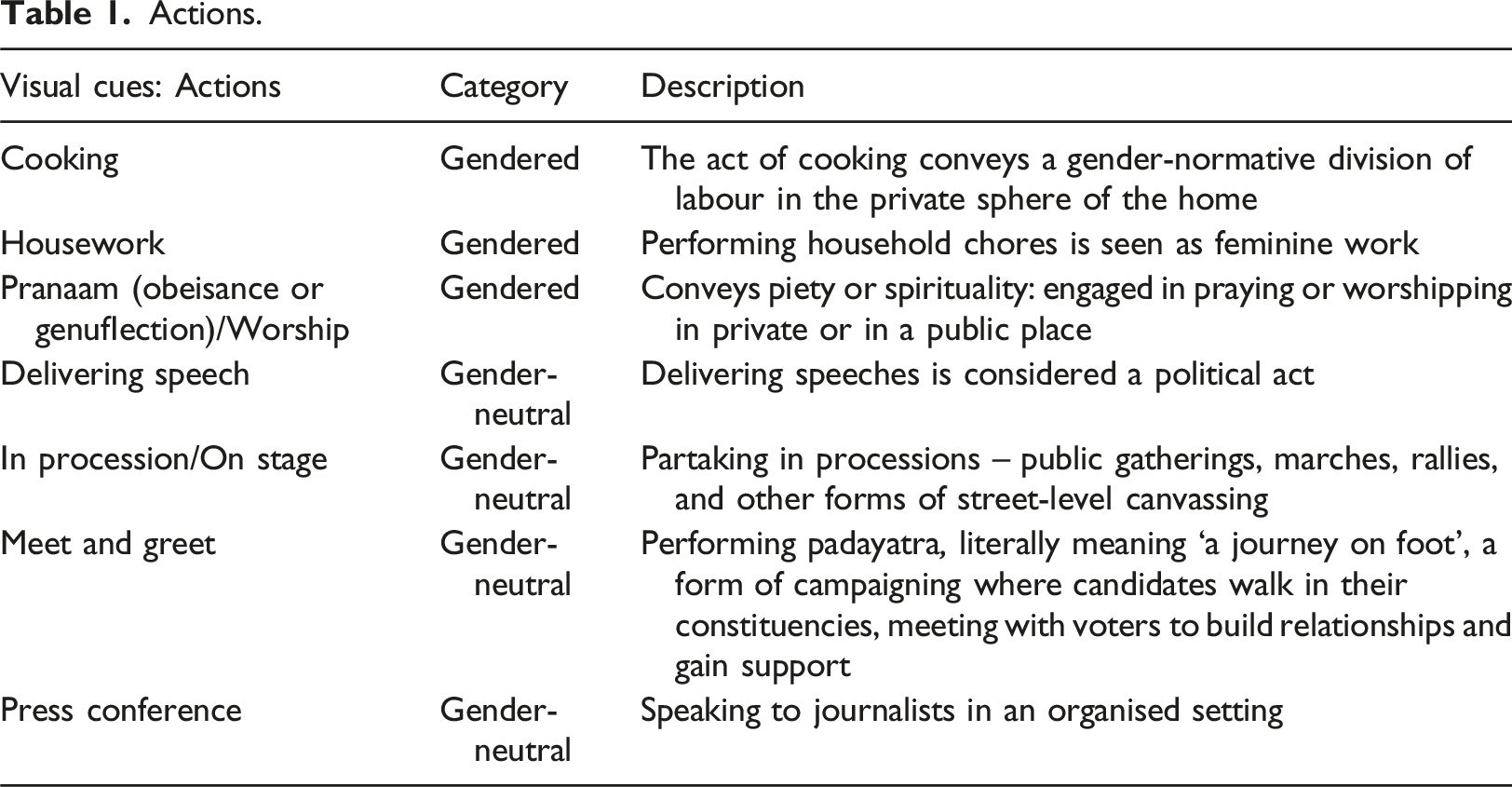
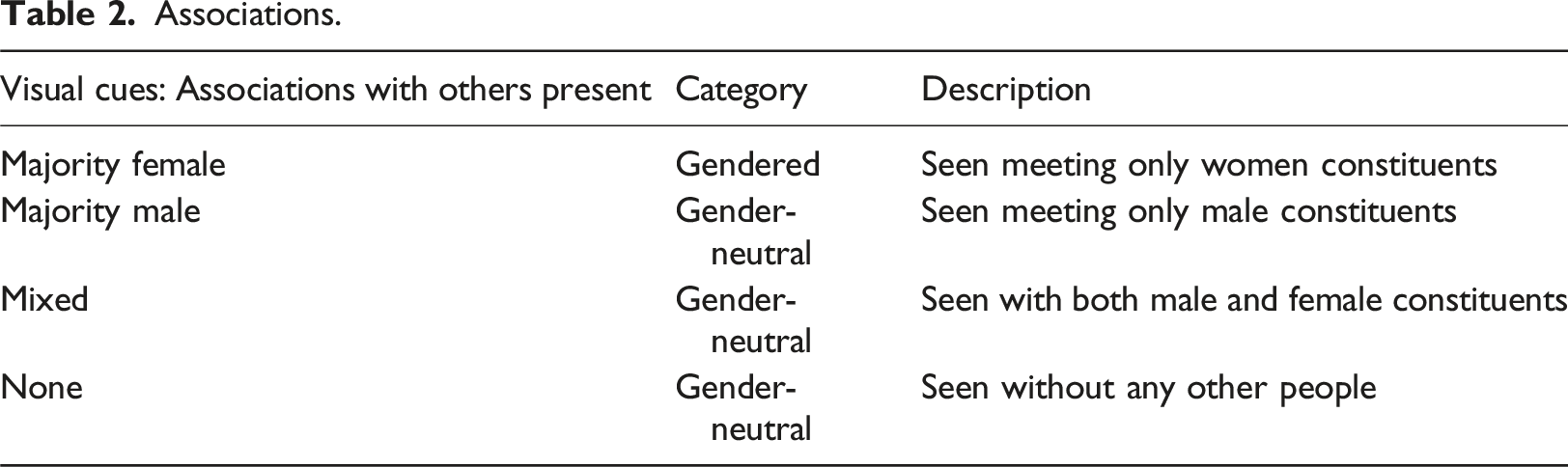
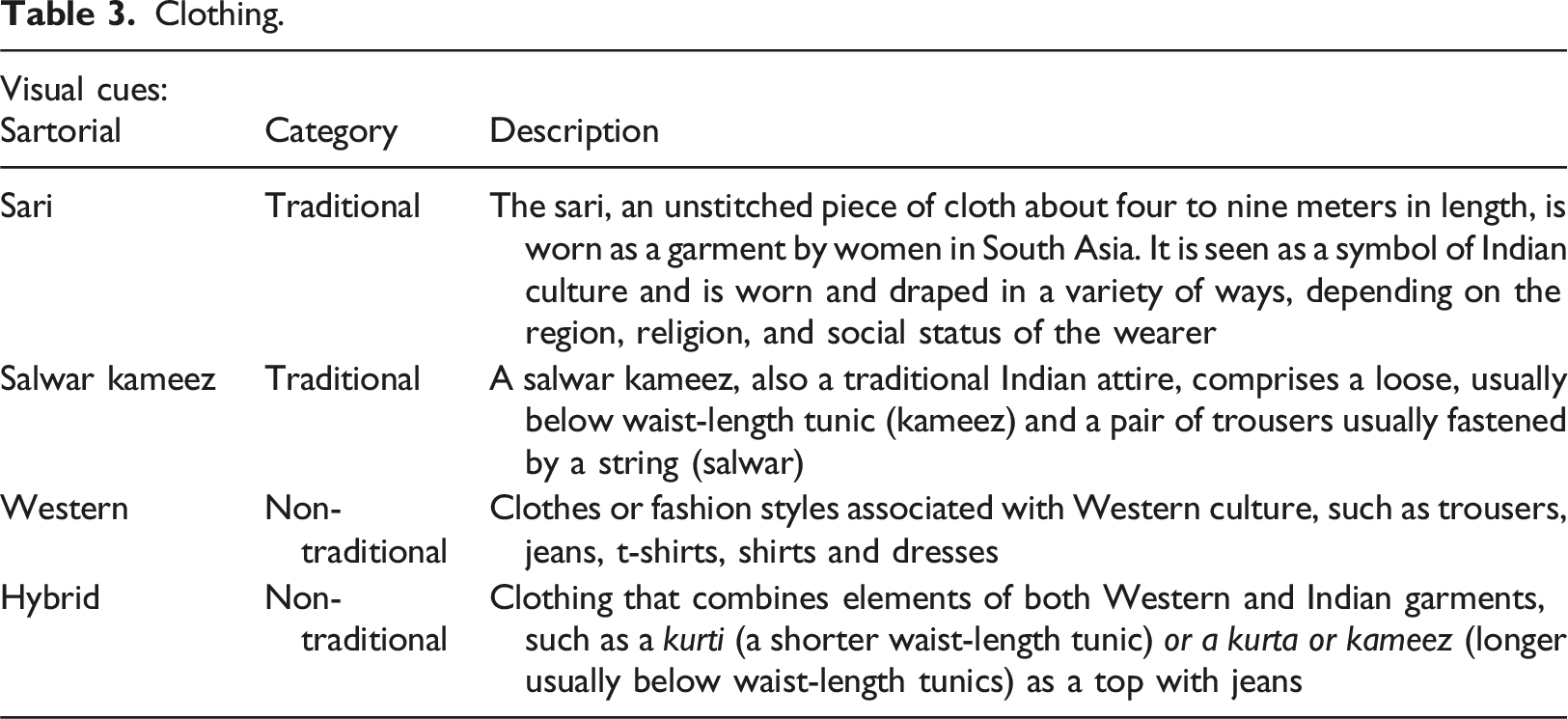
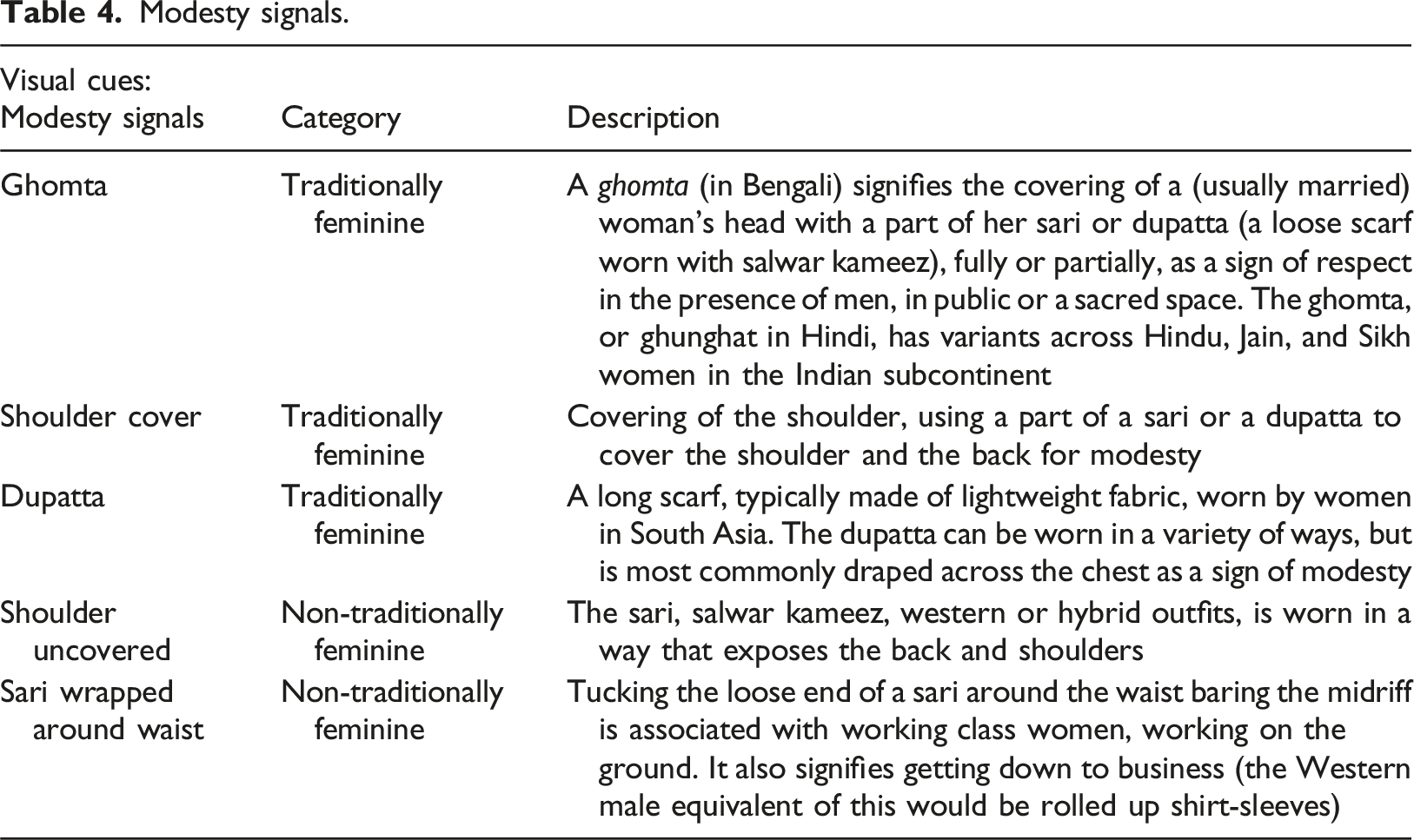
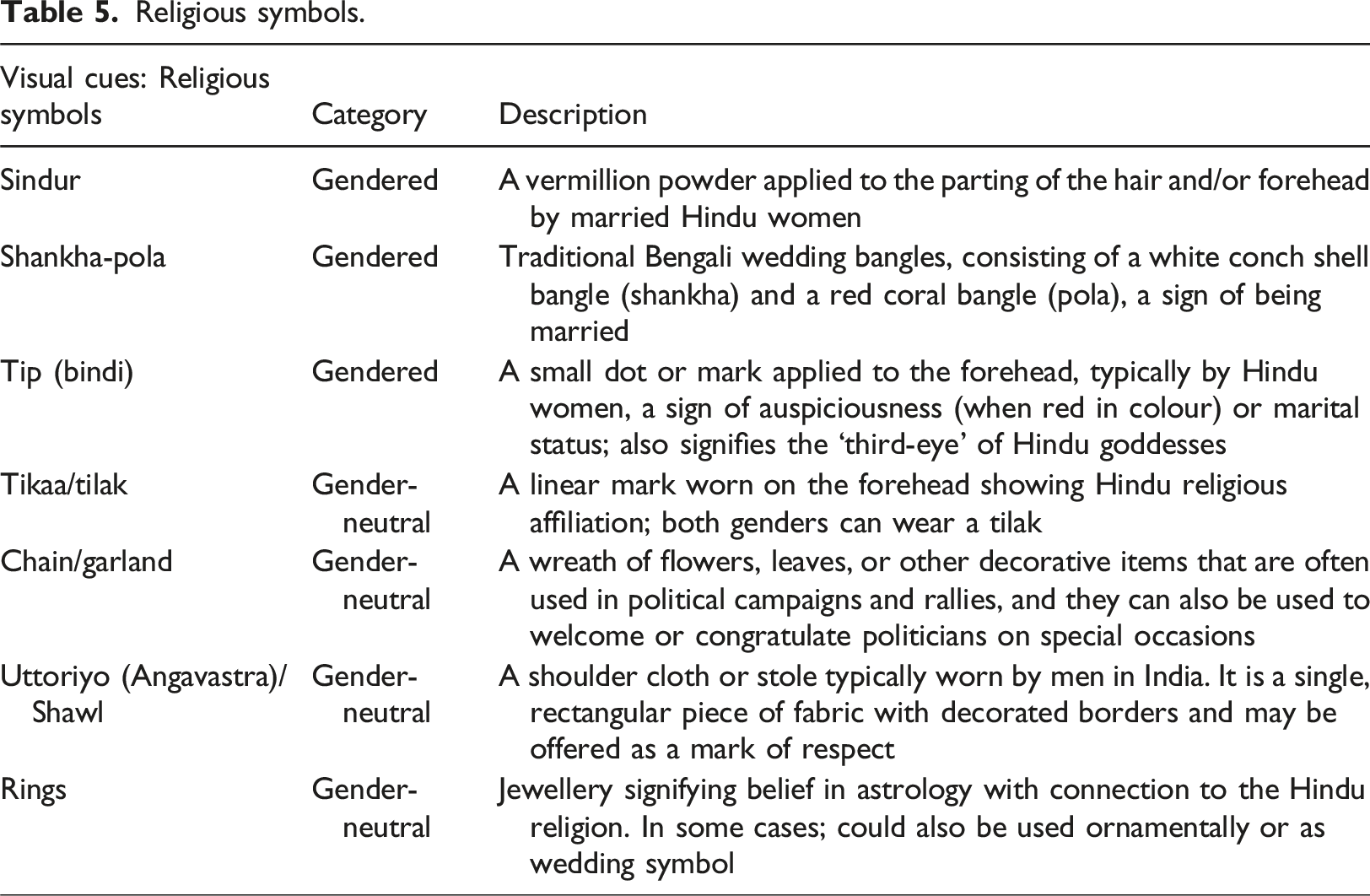
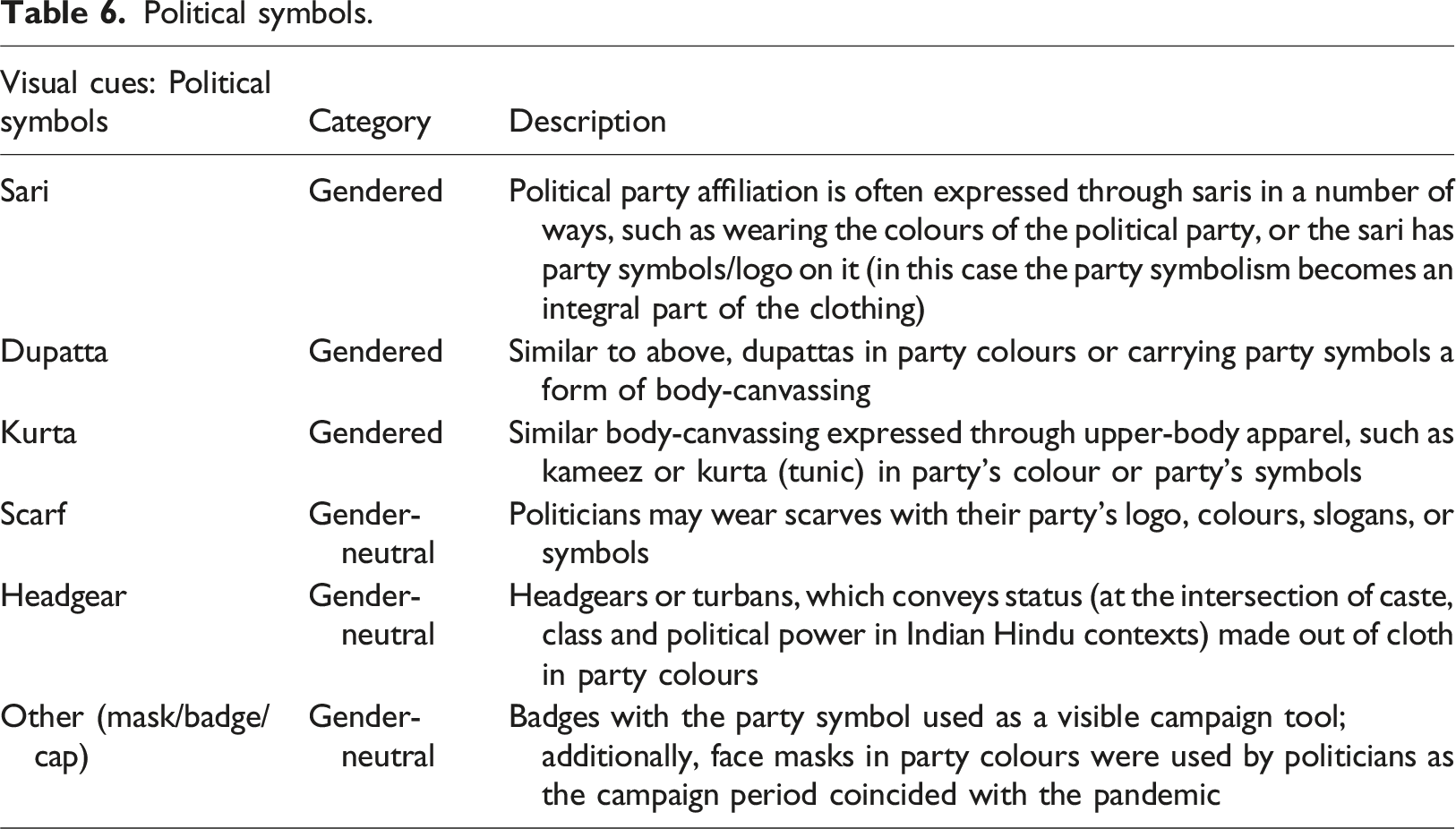
Drawing from our analyses of the discourses presented in above, we use the terms ‘traditional’ and ‘non-traditional’ to convey groups of contested visual rhetoric in examining political visibility as a performance (Tables 1–6 provide detailed explanations). Moreover, distinct political and ideological positions of the contesting parties becomes essential for interpreting the visual cues employed by the candidates and drawing meaningful insights about the political communication strategies adopted by each party. Located in the WB context, our study examines the actions and tactics involved in visual politics performed by female candidates on social media in the West Bengal election in relation to that of the parties they belonged to. These aspects served to identify the alignment or disjunction between their visual self-representation and their party’s official stances or beliefs. We also investigated how these candidates foregrounded gender in a visual political performance to understand particular frames such women sought to construct in relation to historical and cultural specificities of their societal setting. With party affiliations being crucial to individual candidates’ visual politics, at its core, our study queries the extent to which the visual politics of female candidates on social media align with or deviate from how their political parties portrayed them. Following the need to approach visual political communication in culture-specific ways, the duality of the gendered body and women’s political roles in Bengal’s cultural history, we articulated the following research questions: RQ 1: In what ways do non-traditional gendered visual cues appear when compared with traditional visual cues in the candidates’ and their political parties’ posts? RQ 2: How frequently do political parties convey traditional (Hindu religious) values in visual terms in comparison to the candidates themselves? RQ 3: How frequently do political parties portray non-traditional or gender-neutral values visually when compared to the candidates? RQ 4: In what proportion do candidates present themselves visually in traditionally gendered and gender-neutral ways? RQ 5: In what proportions do political parties represent their candidates visually in traditionally gendered or gender-neutral/non-traditionally gendered ways? Actions. Associations. Clothing. Modesty signals. Religious symbols. Political symbols.
Method
The methodology employed in this study responds to a pressing challenge articulated by Bucy and Joo (2021), where they emphasise the need for an ongoing dialogue between qualitative, interpretive, quantitative, and predictive approaches within the realm of visual analysis. Our research aligns with these principles by adopting an approach that combines these varied methodologies under the umbrella of studying visual politics. Qualitative methods, inherently non-top-down, necessitate adaptability when integrated with quantitative models, aiming not to directly support but to complement such findings (Bucy and Joo, 2021). In our study, the first author conducted an initial survey to discover codes through a process of data familiarisation. We then collectively revisited these codes, checked their validity against the actual data and refined them. The final set of codes used to analyse the visual artefacts was thus arrived at through an iterative and grounded approach.
The value of integrating inductive and interpretive methodologies lies in their potential to generate novel concepts and ideas, offering fresh perspectives within the field of visual politics. Although qualitative techniques may seem ‘impressionistic, intuitive and subjective’ (Rosengren, 1989: 27), we argue that it contributes to this study’s rigour and reliability. It allows us to position our study of a corpus of visual political communication within the specificities of the visual codes of gender-related cultural norms of West Bengal. In this way, we are able to harness our own lived experience and situated knowledge (Haraway, 1988) – that is, our own positionalities as a cis-gendered Bengali woman and a cis-gendered Bengali man from West Bengal as interpreters of the knowledge embedded in the visual artefacts. By exploring the interplay between these distinct yet complementary forms of information and knowledge, we aim to portray a comprehensive picture of culture-specific gendered visual politics in West Bengal’s electoral politics.
To achieve this goal, we examine visual artefacts on social media at their site of origin. We aim to discover how these artefacts, which, as Rai (2014) explains, produce a kind of political performance. We do not, however, attempt to reconstruct the volume and nature of user engagement representing the public’s reception of such performance that investigators of social media often undertake through network analysis. Accordingly, we retrieved the Facebook and X posts of the four political parties contesting the election and the two most followed female candidates from each party during the campaign period of the 2021 state election, which ran from 26 January to 27 April 2021. We only selected posts with visual elements. From official pages of the four parties, we collected 3574 Facebook and 1923 X posts. From the candidates’ own social media pages on these two platforms, we gathered 940 Facebook and 573 X posts. The two most followed female INC candidates on Facebook did not possess X profiles.
The data we collected, as Veneti and Rovisco (2023) suggest is often the case for non-western societies, as a whole confirmed a lack of coherence and curation unlike visual political communication disseminated on social media. Therefore, we implemented a selection process based on five criteria to reach a final sample suitable for analysis: legibility (to eliminate shaken or blurred images); singularity (the post is not a dump of multiple images of very similar content and composition); being photorealistic (not combined or superimposed with text and/or graphic illustrations); not being a collage composite (assembling multiple images or illustrations in a single canvas); and most importantly, we only included posts in the sample where female candidates were actually present. Our selection process yielded a final dataset of 205 posts from the parties’ official profiles – the smaller number indicating the underrepresentation of female candidates – and a total of 1033 posts from the social media profiles of the eight candidates.
The first author subjected this data to visual content analysis, following Gillian Rose (2001), and applied to the same content Luc Pauwel’s (2005) multi-modal framework for analysing digital media. Recognising that visual content analysis, being quantitative, could preclude exploring and explaining culture-specific nuances, we together provisionally evaluated how such nuances inhabited the visuals in both non-verbal and verbal ways. The verbal dimension was represented in the written text in Bengali (sometimes transliterated in Roman script) that was used to caption photographs. These captions served to fix meanings where ambiguities arose from examining the visuals solely. The captions were key to understanding the epistemological underpinning of the social media posts in West Bengal’s socio-cultural and political contexts. In this respect, departing from Pauwel’s (2005) formulation of ‘culture’ through technological affordances of various social media platforms, we derived an understanding of ‘culture’ through a grounded understanding of the meanings of words, expressions and phrases as well as the photorealistic visuals. In this sense, we both adopted and adapted Pauwel’s multi-modal framework to our empirical material.
To interpret the posts, we took cognisance of the varied layers of visual content, discerning their formal attributes and conveyed meanings. This examination laid the groundwork for the qualitative and grounded development of the culture-specific gendered visual cues and helped to code and organise the visual cues into categories, ranging from gendered/gender-neutral, traditional/non-traditional and traditionally feminine/non-traditionally feminine. Following the development of the visual cues and their categories, the first author coded the data. Utilising frequency counts represented as percentages, the quantitative component of our study helped us measure and compare the comparative preponderance of certain visual cues in the dataset.
The key to arriving at these quantitative comparisons, however, was the qualitative approach we took to understanding visual cues. These visual cues were developed by us for coding the social media posts by combining various conceptual lenses. West Bengal’s cultural and political history provided a significant frame of analysis. Our own situated knowledge and lived experiences informed our interpretation of how the female politicians constructed themselves in visually performative ways in the social media posts we analysed. Finally, we examined the extent and manner in which the political parties visually represented their women candidates on their official Facebook and X pages. In this way, we took a grounded and iterative approach to understanding the visual cues that were gendered in a culture-specific way. For example, if the sari emerged as the predominant attire of choice among all candidates, to further differentiate between them qualitatively, we investigated modes of draping the cloth over the body. 5 Then we moved on to even examine bodily accessories sported by the candidates through which different meanings were conveyed. Such nuances conveyed the presence or absence of modesty-related symbols. For instance, the ‘ghomta’ (head cover by extending the sari), could convey a traditional sign of modesty and deference (these aspects are explained further in Table 4 below). We began with analysing the actions of the politicians that the visuals portrayed as well as the associations with other people that the visuals indicated (Tables 1 and 2) to understand whether or not a particular post was a gendered or gender-neutral representation of the candidate. Whereas gendered actions were ones which were indexed in the gender hierarchies and norms of West Bengal, gender-neutral actions were those which both male and female candidates must engage in.
We then also sought to understand the strategic deployment of sartorial visual cues that invoked traditional or non-traditional gender norms through choices (Table 3), and the signalling of modesty in traditionally or non-traditionally feminine ways (Table 4), which included non-normative notions of femininity and the absence of such signals. Furthermore, we analysed the gendered and gender-neutral modes of carrying religious or political symbols by the women candidates (Tables 5 and 6). The findings that emerged help to answer our research questions related to the performance of political visibility by women politicians, and the way they construct value-propositions for the voter through these performances.
Findings
By reading the overall range of categories throughout all visual cues, key aspects about the nature of ‘body politics’ – recalling Douglas’s (1970) formulation – in the WB election campaign emerged. To answer RQ 1, we compared the average occurrence of the gendered visual cues among candidates presenting themselves and how their parties represented them. The comparison revealed that, irrespective of party affiliation, traditionally gendered categories of visual cues exceeded gender-neutral or non-traditional portrayal of gender under most categories. In posts by candidates (see Figure 2), the categories of sartorial choices and modesty signals representing traditional values were apparent in about 42.2% and 22% of the visual cues, as compared to only 9.5% and 3.4% of cues that were gender-neutral or non-traditional in nature. When it came to the category of actions, however, the cues that were gender-neutral amounted to about 24%, nearly five times as frequently as those that were gendered in nature (just over 5%). Average of non-traditional gendered cues and gendered cues in candidates’ posts.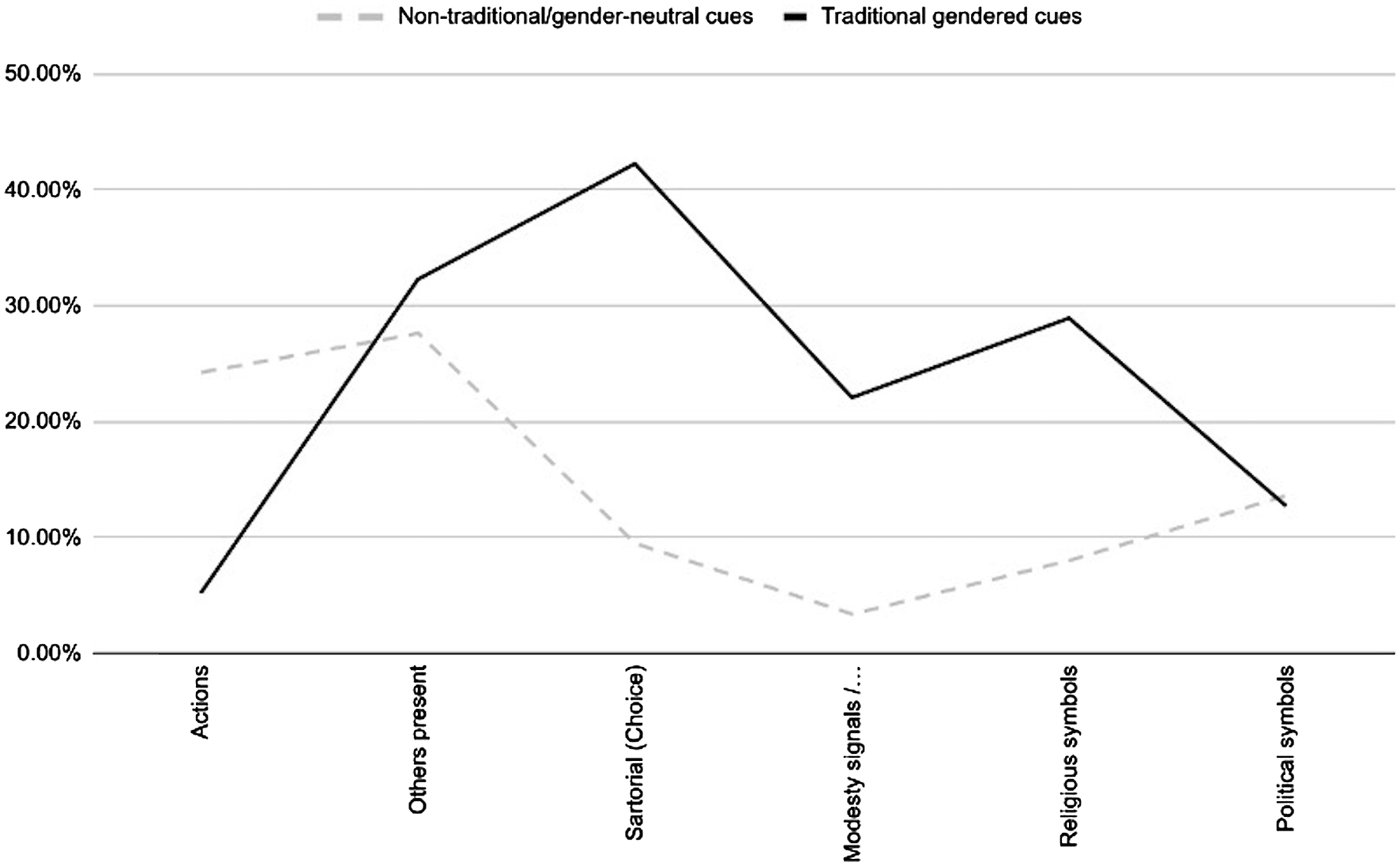
To continue responding to RQ 1, in the posts by parties (Figure 3), across the categories of actions, associations and political symbols, gender-neutral or non-traditional visual cues occurred more frequently. This difference was the most pronounced in actions of the candidates, about 21.8% of the total number of cues being non-traditional or gender-neutral, while only about 2.6% of them represented gender in traditional ways. Yet, even in the posts by the political parties, when it came to the categories of sartorial choice and modesty signals, gender appeared in traditional ways far more frequently, at 40.5% and 20.25%, respectively, compared to non-traditional attire (7.7%) and non-traditionally gendered or absence of modesty signals (only 2.4%). Average of non-traditionally gendered cues and gendered cues in parties’ posts.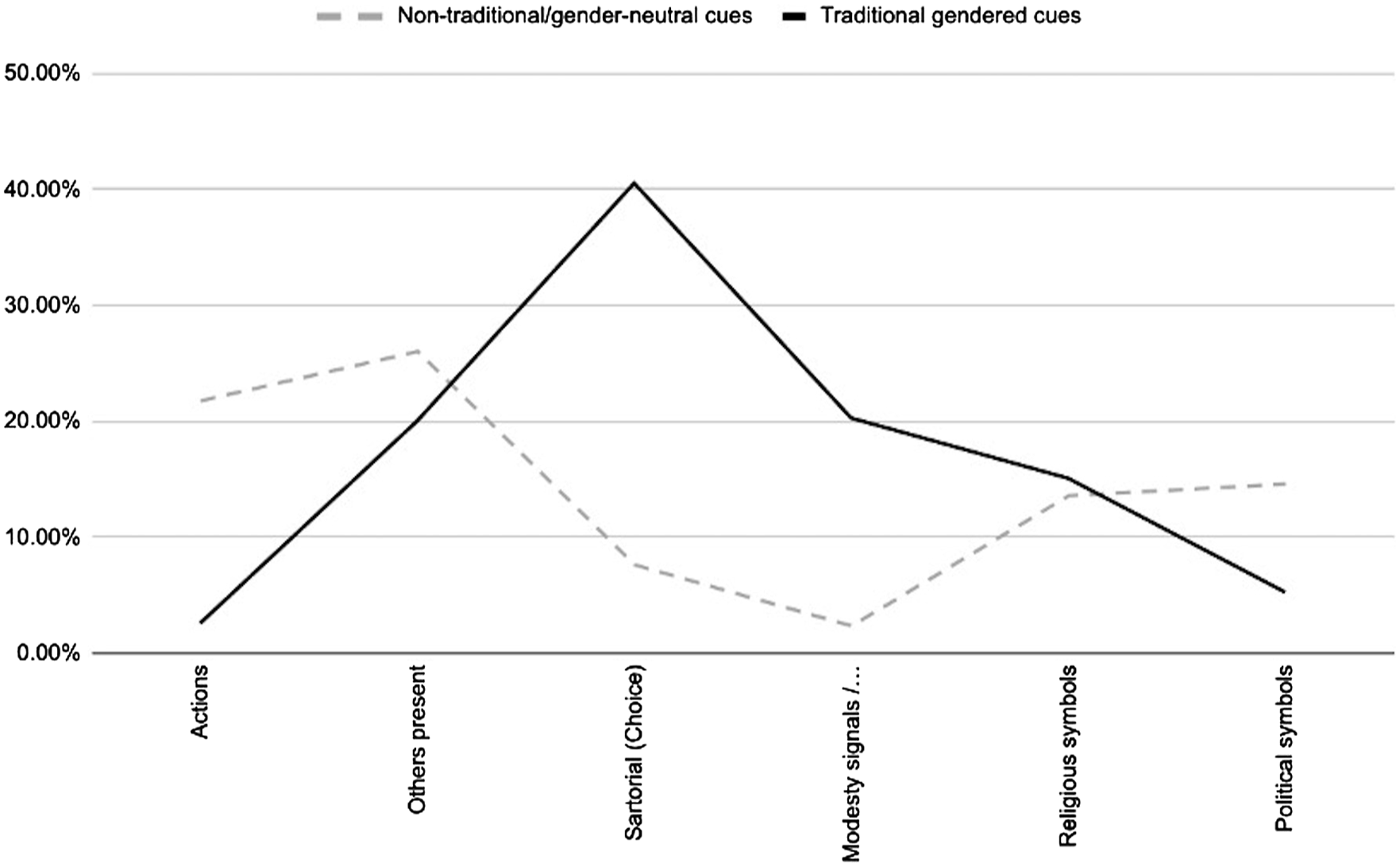
To answer RQ2, when the broader categories are resolved further, the body politics related to traditional values in the posts by the parties and candidates varied little when it came to gender-neutral or non-traditional gendered aspects, but significantly for gendered aspects.
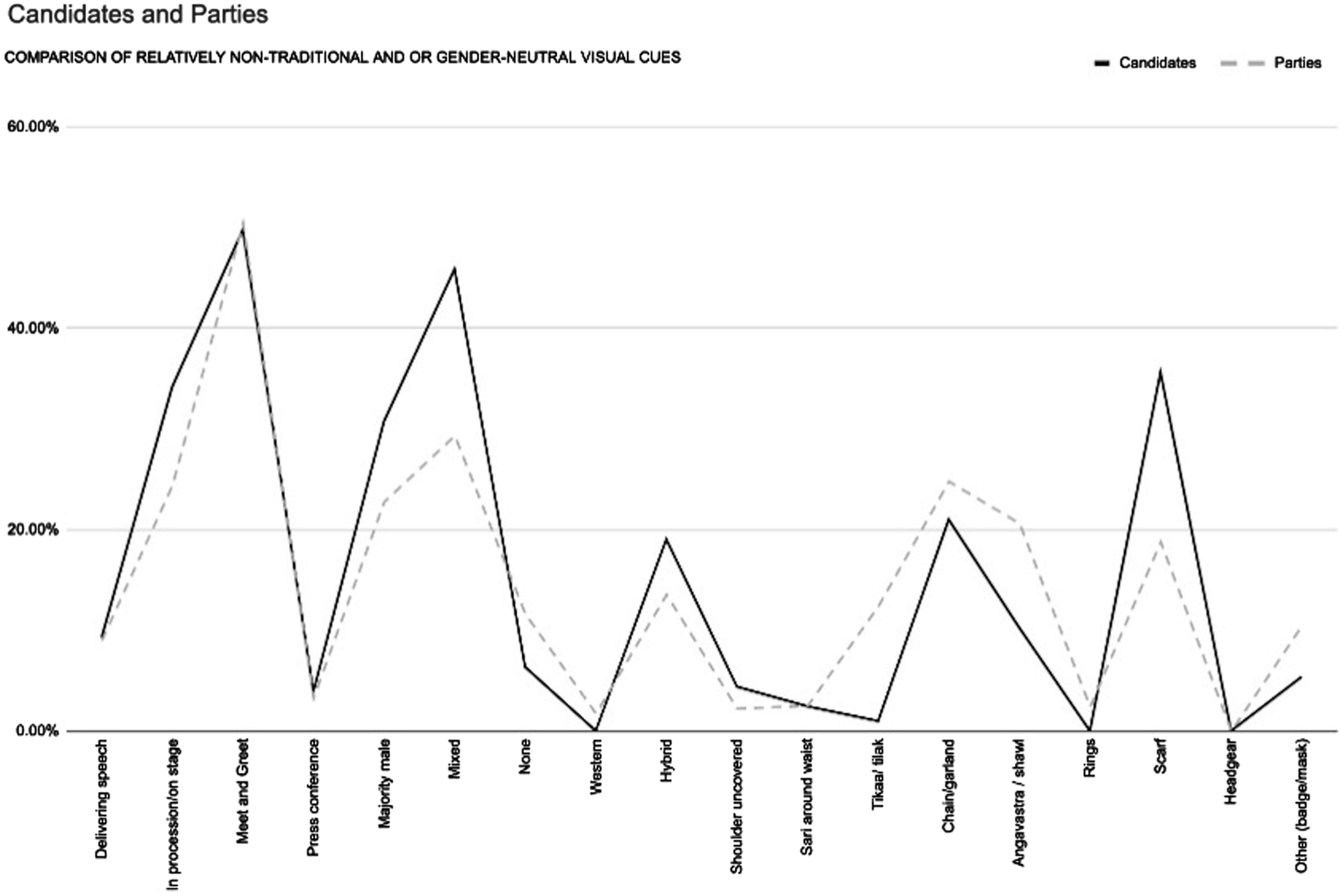
Again, for RQ 2 as well as RQ3, regarding frequencies of how traditional and non-traditional visual cues appear in posts by candidates and parties, we segregated the entire range of visual cues into those that convey gender through traditional values and femininity and those that are relatively gender-neutral, non-traditional in nature, or portray non-normative notions of femininity (Figures 4 and 5). In this respect, the body politics apparent in visual cues seen in posts by candidates and parties pertaining to traditional ideas of gender or femininity showed the most significant variations from visual cues within their parties’ posts when it came to the choice of attire, the display of modesty and marital symbols. Conversely, such differences were less pronounced when it came to aspects that were gender-neutral. Comparison of visual cues that are gendered to convey traditional (Hindu religious) values. Comparing relatively gender-neutral, or non-normative forms of femininity in visual cues.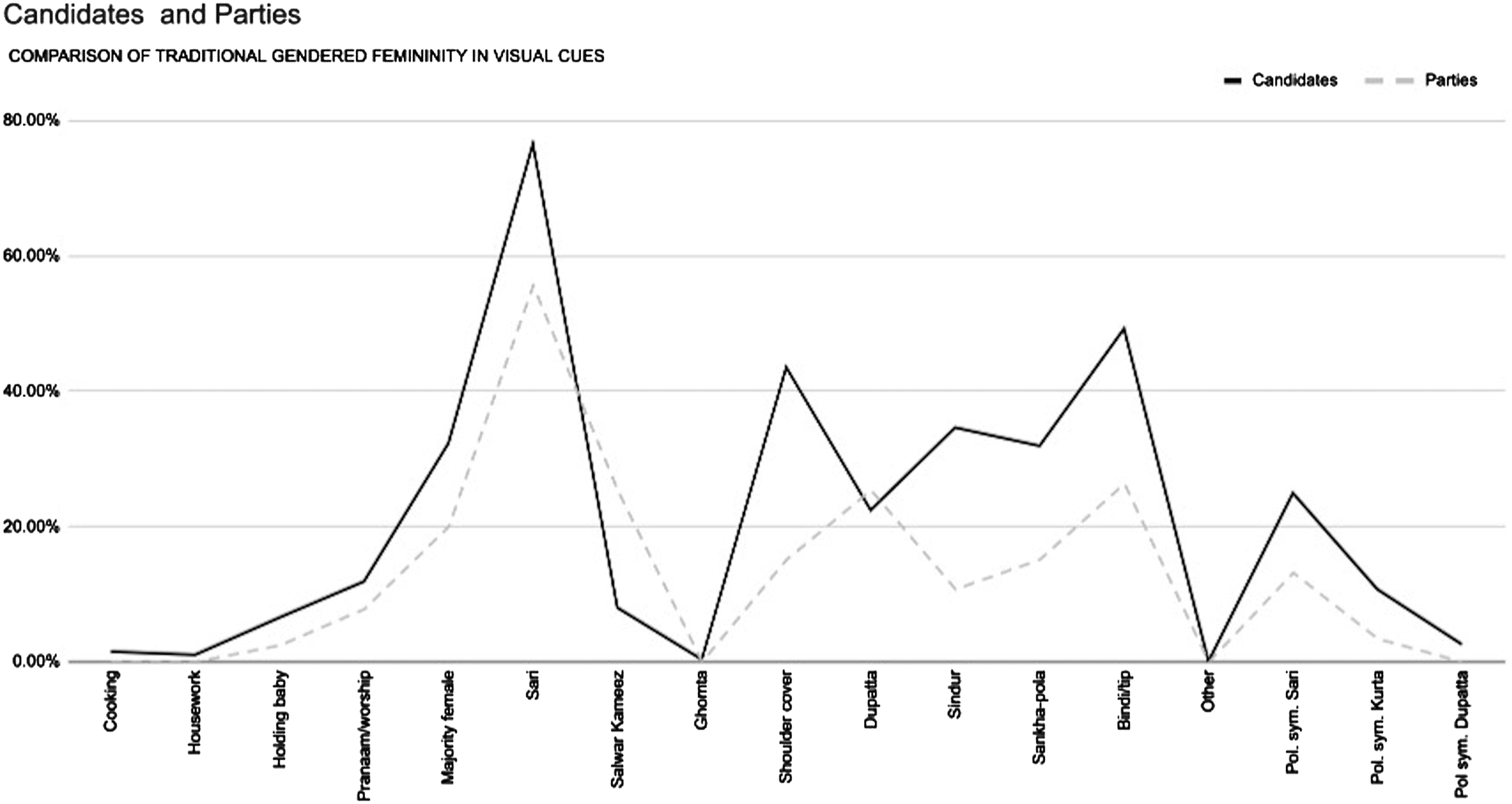
With respect to RQ 4, where we focus on how candidates present themselves visually in traditionally gendered and gender-neutral ways, our analysis revealed a clear predominance of traditionally gendered visual cues in how candidates fashioned themselves in their own posts (see Figure 6). Visual cues of how candidates fashioned themselves.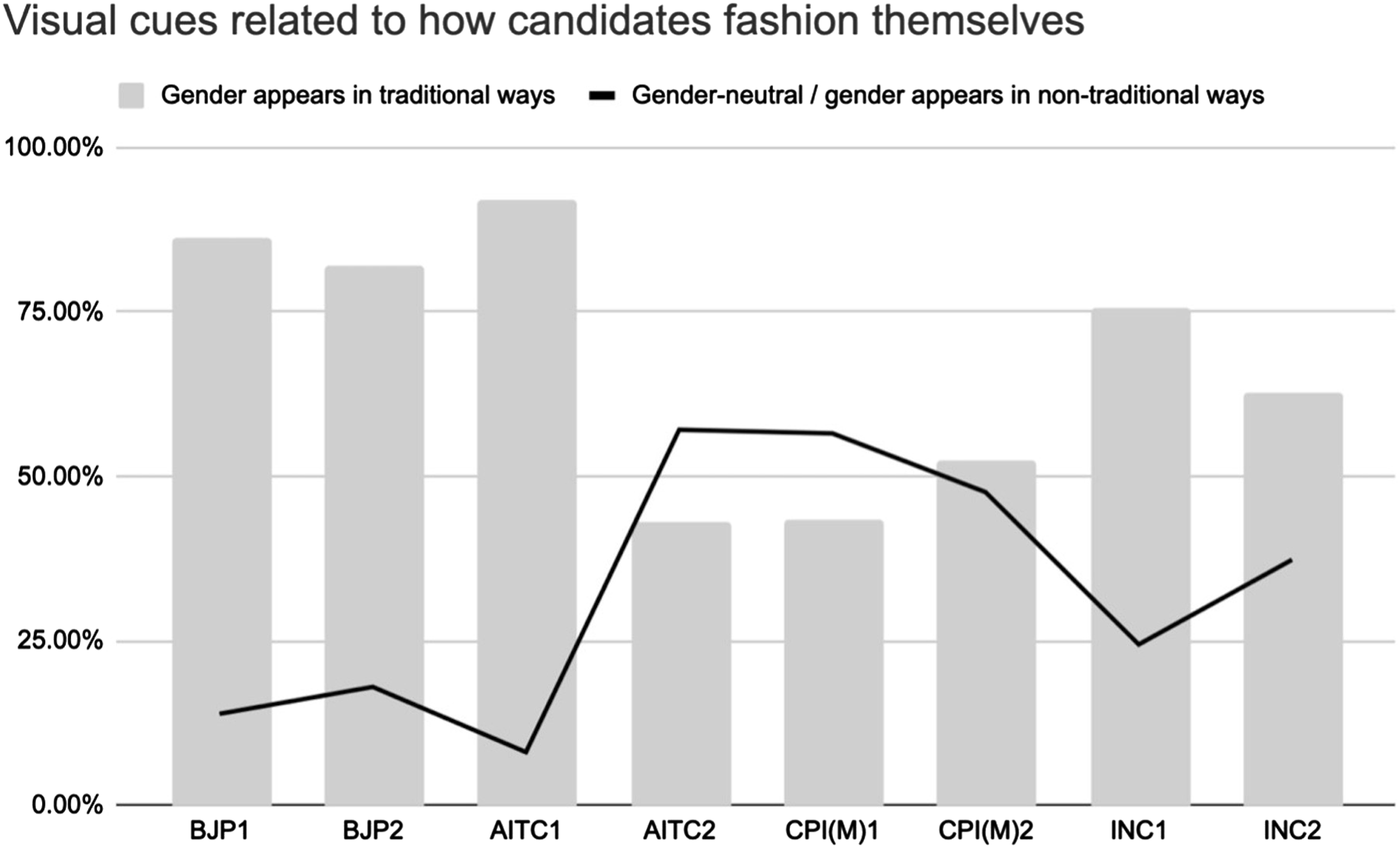
Particularly when elements of their sartorial choice, modesty signals, religious markers and even political symbols were considered cumulatively, the occurrence of visual cues under these categories far exceeded the cumulative appearance of gender-neutral ones, or where gender was portrayed in non-traditional or -normative ways.
To answer RQ5, where we compared the traditional and non-traditional gendered visual cues appearing in posts by parties, our analysis found that the sari, a traditional Indian unstitched length of draped cloth, was the dominant sartorial choice for representing female political candidates of most parties (Figure 7). On their party pages, the AITC featured the highest prevalence of the sari, no less than 22.22% across all categories of visual cues. The BJP followed suit, with candidates shown in their pages in a sari occurring in 14.75% of the total number of cues, suggesting they deliberately projected an image closely aligned with their party’s emphasis on traditional values and culture. The INC and CPI(M) trailed in this regard. In the parties’ posts, their candidates appeared in saris in about 6.3% and 5.4% of all cues, respectively. To answer RQs 4 and 5 in greater detail, in the personal pages of the two BJP candidates, the sari appeared in 14.23% and 12.88% of all visual cues, respectively. In contrast, the CPI(M) candidates exhibited saris the least in their own posts, occupying only 3.16% and 0.95%, respectively, of all visual cues. Yet, their coalition partners, the INC candidates, appeared in saris rather frequently, in 15.23% and 19.4%, respectively, of all visual cues. Remarkably, candidates wearing saris cut across all ages – the youngest being twenty-eight years old and the oldest sixty-six, across the four parties (ages in 2021).
6
But more expectedly in the socio-cultural context of West Bengal, younger candidates exhibited a significantly high frequency of clothing that was not gendered in nature, or did not portray normative ideas of femininity – which brings into the answer for RQ1 the dimension of age. For example, the younger AITC candidate featured Western clothing in about one in 1.14% of visual cues and one CPI(M) candidate showed the same in 1.42% of all visual cues. In their posts, none of the parties, however, featured their candidates in western attire, which are also often worn by Indian women in workplaces. Additionally, hybrid attire, blending elements of traditional and western styles, was most notable in how the two CPI(M) candidates portrayed themselves in their own profile posts, appearing in such clothing in 8.77% and 7.43% of all their visual cues. The younger AITC candidate, a celebrity who is a film actor, also displayed a preference for this hybrid attire, featuring it in about 7.7% of visual cues within her posts. Comparison of the proportion of traditional and non-traditional or hybrid attire in the posts by various candidates.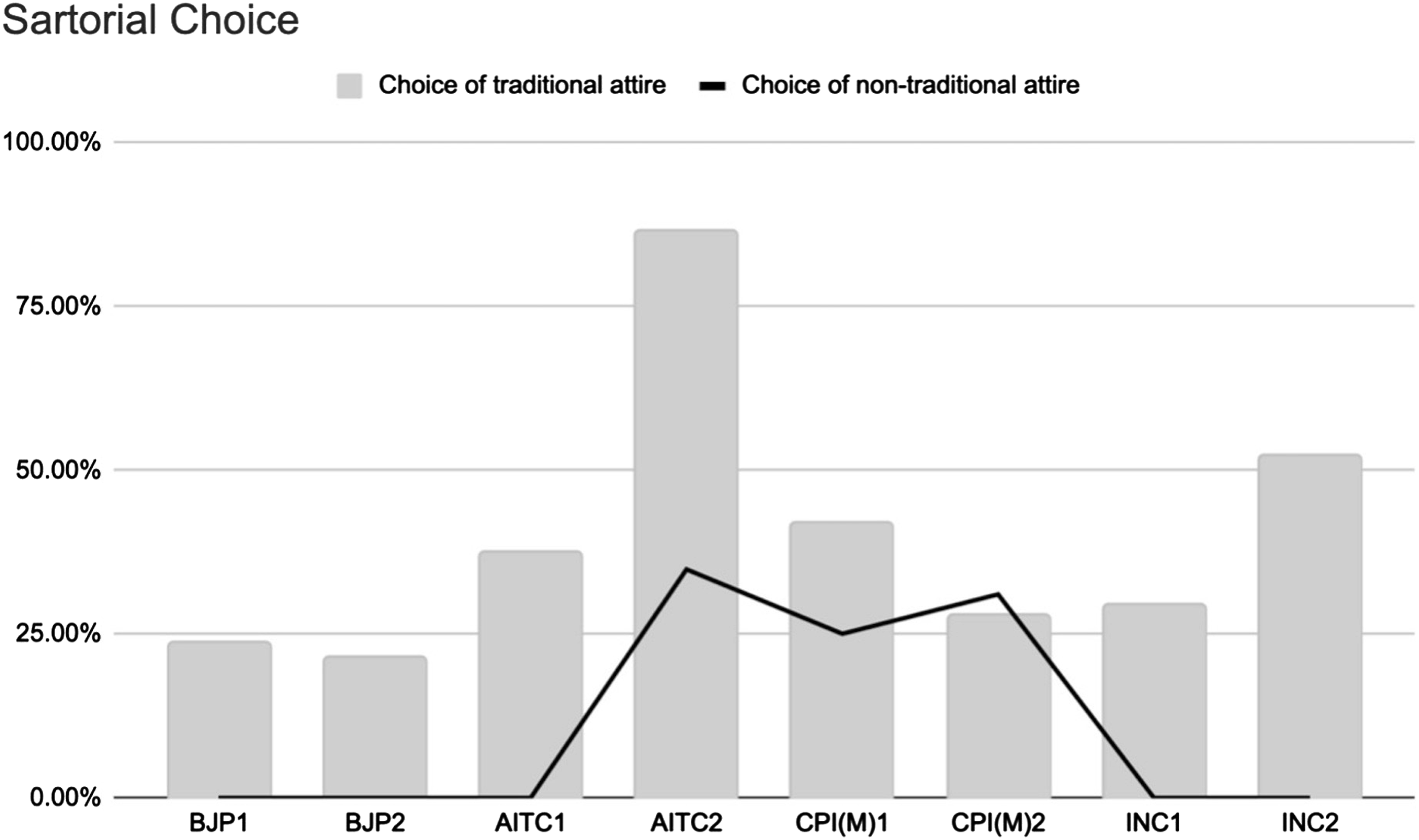
In this respect, the presence or absence of modesty-related visual cues reveals the kind of image the candidate presents or is represented by, by her party (Figure 8). For instance, the ‘ghomta’ was absent across all party posts, appearing nominally (0.21% of all visual cues), and only for just one candidate of the BJP. In the AITC party’s posts, 21.11% of visual cues showed the candidates covering their shoulders, with a majority of these images depicting its leader Mamata Banerjee. In contrast, only 1.88% of cues among the posts of the BJP and 1.14% of the INC’s posts displayed candidates with covered shoulders. Interestingly, while the visual cues appearing in posts of the older AITC’s candidate mirrored the party’s trend (19.32%), it occurred in only 1.85% of the visual cues apparent in posts of the younger AITC candidate’s. Conversely, the BJP candidates, one a former fashion designer and another a celebrity actor, were seen to cover their shoulders in 5.99% and 10.89% of the total visual cues. Additionally, covered shoulders can also be seen as a visual cue signalling modesty in relation to age, as strategically deployed by parties and candidates of different ages. For example, the older INC candidate too appeared covering her shoulders in 13.2% of all visual cues. The CPI(M) stood apart with only 0.581% of visual cues showing candidates expressing modesty in this way. Its candidates used a different expression of modesty however, given fewer instances of them being seen in saris. Both candidates carried dupattas, a loose scarf of light material worn with salwar kameez or with hybrid attire, seen in 8.06% and 7.43% of the visual cues in their own posts, and in 8.92% of the visual cues appearing in posts by the party. Comparison of the proportion of modesty signals representing traditional feminine values and their absence in posts from various candidates.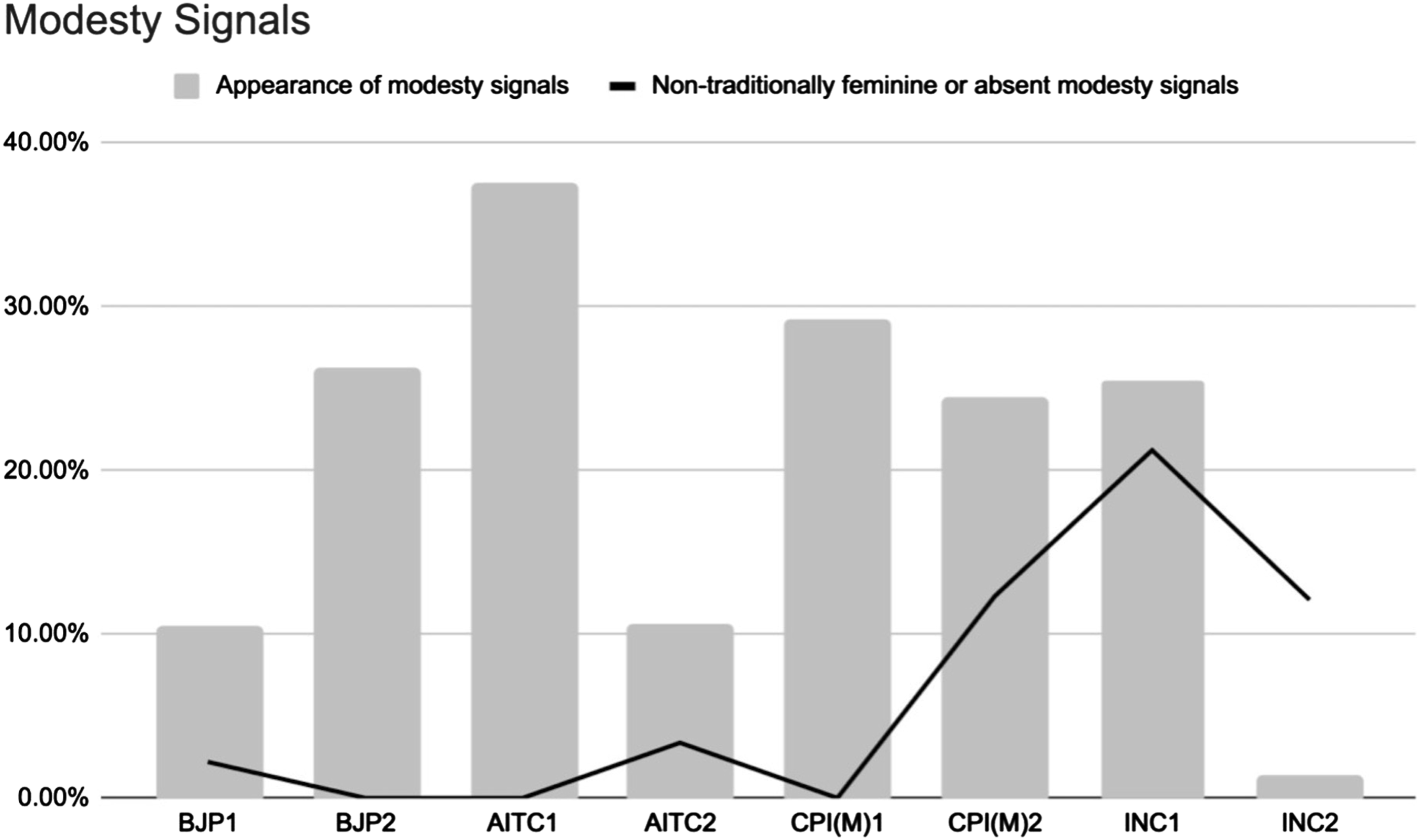
A key accessory visible on the bodies of BJP, CPI(M) and INC candidates was the tip, a forehead dot considered exclusively feminine in most Indian and Hindu Bengali, society (Table 5). On an average, the tip appeared in about 8.33% of the visual cues displayed by women in the posts analysed. Both BJP candidates (11.44% and 9.33% of all visual cues) and one CPI(M) candidate (9.95%) exceeded this mean and one of the INC candidates (3.05% of all visual cues) fell far below it. In this case, the AITC stood apart, however, where both the party and its candidates barely posted any visuals showing them wearing a tip (0% and 0.285% of the visual cues in their posts, respectively).
The ‘tip’, called a bindi in Hindi, is either drawn, mounted with light adhesive or both, on a woman’s forehead. Forehead adornments such as the tip is traditionally associated with the third eye, that is, inner or deeper vision, in case of divine female figures (but this is also true of male Hindu divinity; forehead adornments are also a caste mark for both men and women in other South Asian Hindu cultures). Yet, within South Asian (Hindu) traditions itself, the tip’s symbolism is variable. A bright red tip is deemed auspicious, even religious, often a marital symbol; in such cases, the tip could be both drawn with sindur (vermillion powder) or mounted. Conversely, if the tip appears in other colours (including red tones like maroon or pink) and is mounted on the forehead to complement clothing, it is considered fashionably feminine, conveying a sense of modern womanhood rather than religiosity. This distinction appears in the kind of tip BJP candidates sport, exclusively seen in all visuals with a large red one signifying religious attributes, as opposed to tips sported by CPI(M) candidates, smaller and dot-like in form, in black or other colours, thus not signifying traditional Hindu femininity.
A final and key finding of the study in relation to RQ 6 emerged from a granular level examination of how specific candidates distributed the portrayal of gender in traditional ways, through what they chose to wear, how they draped it, particular accessories signalling traditional images of femininity as well as the employment of body-canvassing (Figure 9). Through such an examination, juxtaposing the use of such visual cues in posts by candidates, we observed that some candidates utilised all four of these kinds of cues more frequently than others. A well-distributed use of these gendered categories as opposed to gender-neutral ones indicates a balanced approach not only in their clothing choices but also in their use of religious markers, political symbols, and modesty signals. This becomes very apparent in the posts of both BJP candidates across all four categories. Contrary to this pattern, in the case of INC and AITC candidates, the distribution of cues is uneven, with one form of presentation of gender in traditional way dominating the others. A comparison of how various visual cues are distributed in the candidates’ posts from the four parties.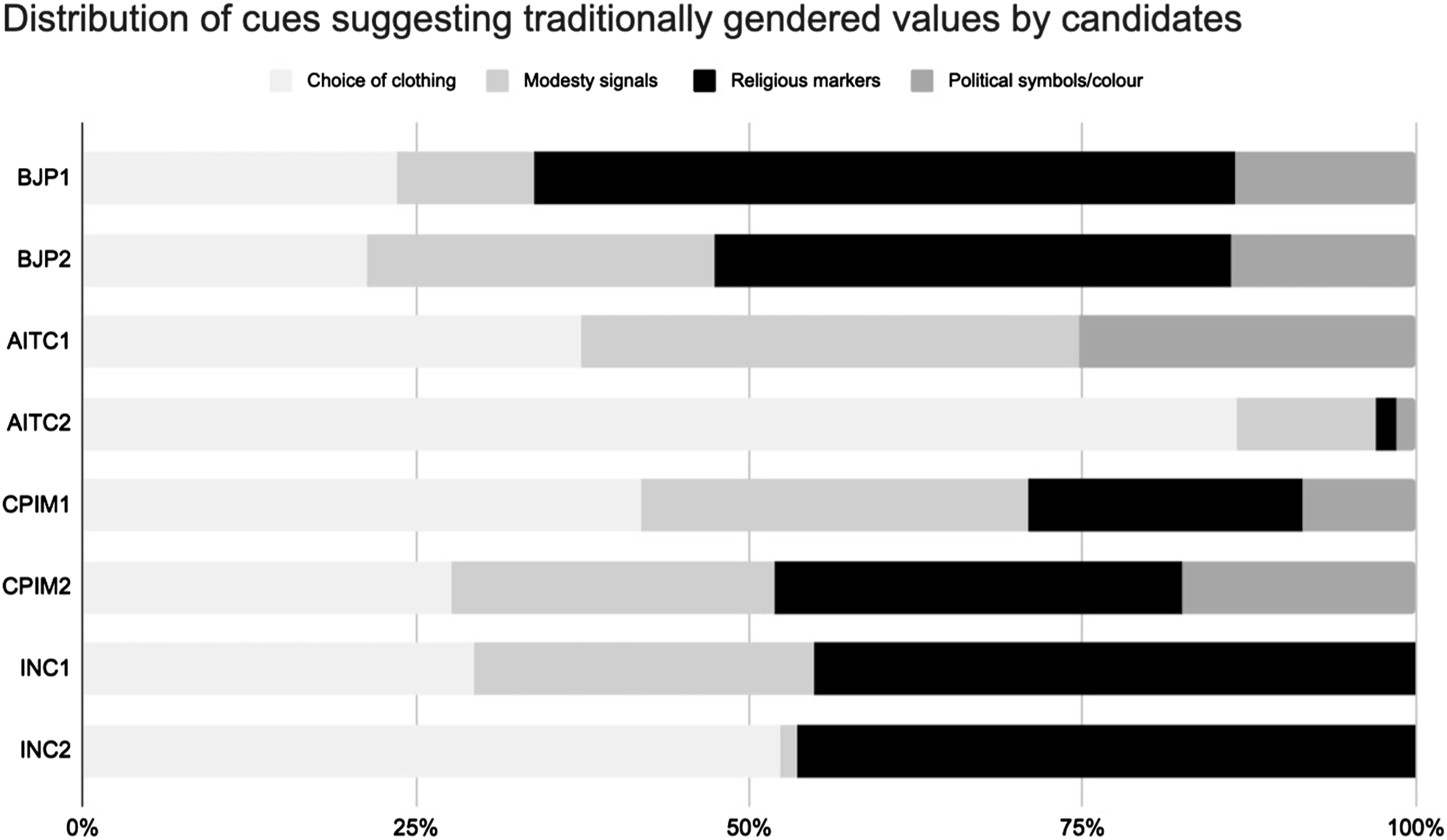
Discussion
Pursuing our research questions helped to critically examine and compare the various dimensions of traditional, non-traditional, gendered and gender-neutral visual cues apparent in posts by the parties and their candidates in the WB 2021 campaign, as apparent in the nature of body politics performed by them. This helps us make sense of how the candidates’ visual politics responded to Bengali cultural and social mores, sometimes leaning on but also transcending party ideologies and values. Seen in the context of our research questions, these findings reveal complex forms of intersections and departures between the self- and re-presentations of female candidates in relation to their parties. Our study has revealed how alignments and divergences of cultural, political and gendered significations between posts by candidates and parties, moreover, respond to particular dimensions of the societal and cultural context – which includes expectations, historical narratives and ideologies.
This aspect emerges eminently in the reasons for sartorial choices appearing so integral to the performed body politics of female individuals. It brings us to appreciate – as Douglas (1970) posits – how the physical body of the woman relates to her social body. Indeed, attire, head coverings, flowers or hairstyles women bear on their bodies operate as powerful signifiers of personhood, indicate individuality, celebrate culture, and affirm national identity, on the one hand. On the other, they also indicate societal scrutiny of their appearance. For a woman politician, attire could mark her as ‘good’ or ‘bad’, responsible or otherwise, professional or homely, normatively feminine or transgressively masculine. This is evident globally in even progressive cultures – with respect to Hillary Clinton’s pantsuits, Alexandria Ocacio-Cortez’s fashionable jackets and coats, or even Cecile Duflot’s floral dress in the European Parliament (Clemente, 2016; Ellen, 2012; Hoffman, 2018; Sim, 2017).
Notably, distinctions such as those of the tip (forehead dot) presented above extend into other codes expressing the nature of visibility of female politicians on social media. Sartorial dimensions emerge as central to the body politics the women candidates perform visually on social media. Yet, as the varying meanings of the tip affirm, these visuals cannot be seen independently of the ideological forces they draw from or are set within. This is precisely why, as these findings collectively also reveal, more complex interplays of the campaign’s politics of visibility necessitate an examination of how the female candidates fashion themselves in relation to their parties’ ideological positions.
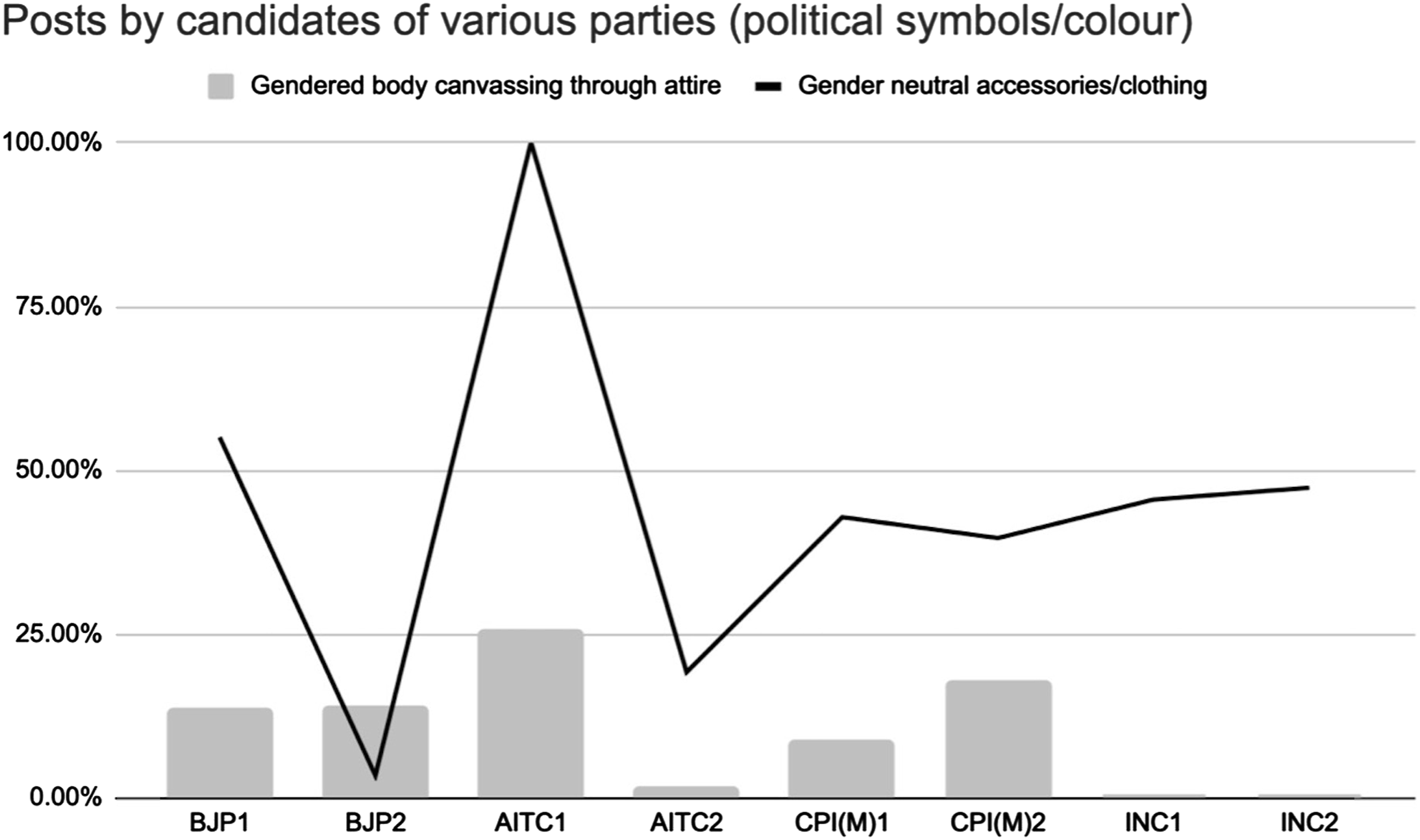
Gender-neutral convergences: The party’s values
To interpret the findings of this study in the context of our research questions, they make apparent a significant duality that seems to underscore the positions female candidates displayed. This duality is marked by them being visible carriers of not just the values their parties represent, but equally as representatives and agents of what the people (their electorate) value in them as women. Notably, these findings reveal how the parties’ ideological aspects emerge even within the candidates’ posts, where the proportion of non-traditional visual cues related to religious markers and political symbols exceed the traditionally gendered visual cues in these respects (Figures 10 and 11). Comparison of the proportion of gendered and gender-neutral religious markers visible in the candidates’ posts from various parties. Comparison of the proportion of visual cues representing gendered body-canvassing and gender-neutral forms of accessories containing political symbols in the candidates’ posts.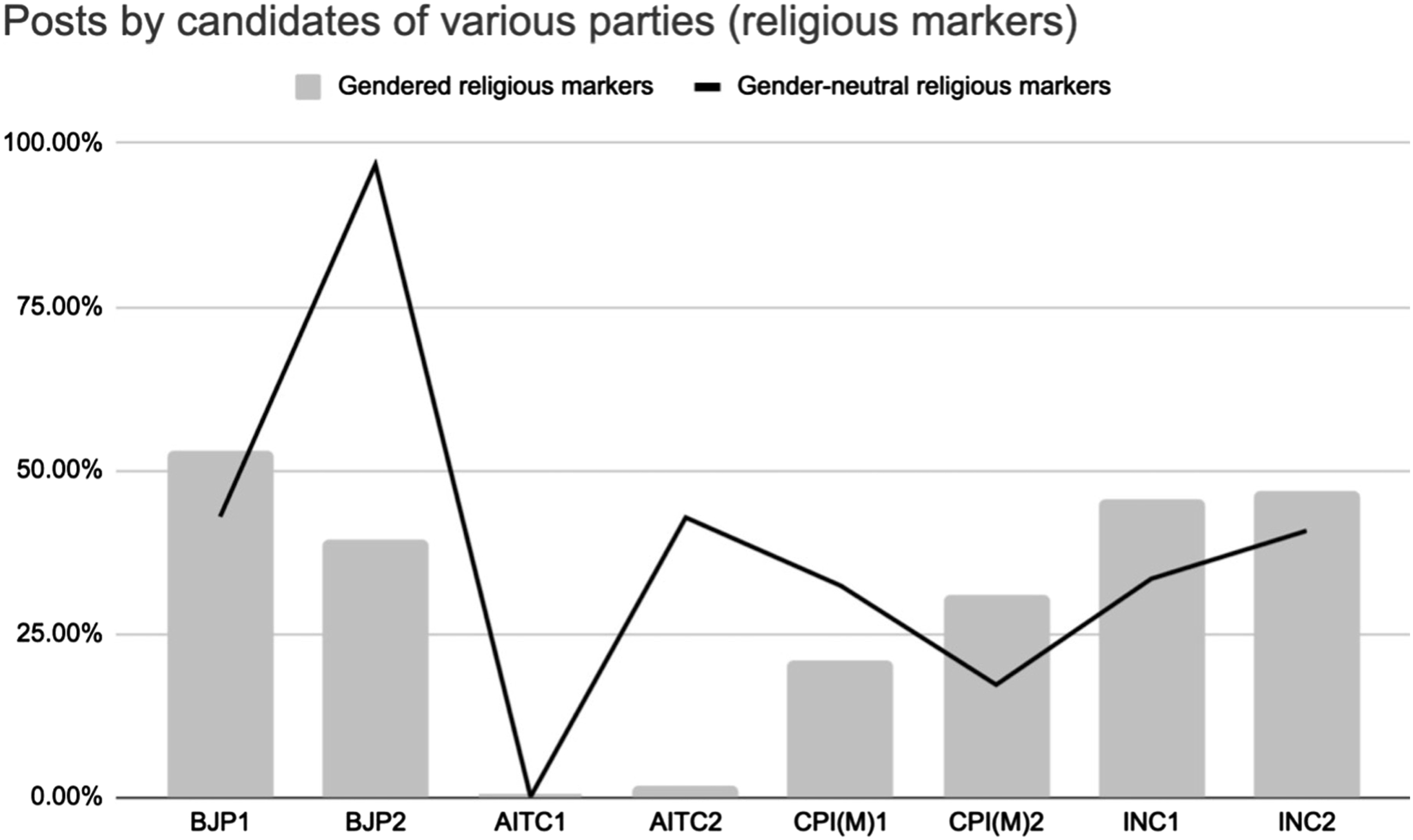
To make sense of the findings related to RQs 1, 3, 5, both candidates and political parties exhibited similar rates of appearing while delivering speeches, which appeared in about 9% of all visual cues, and meeting and greeting constituents – about 50% of all visual cues.
With respect to walking in processions or being seen on the stage, the proportion varied somewhat with 24.39% of cues in the parties’ posts and 34.15% of cues in the candidates’ posts showing them in this manner. On the whole, the proportions that appear suggest that visual cues that are gender-neutral relating to actions were consistently utilised to convey the political image of capability, regardless of its source. Press conferences were an exception to this trend. Posts from the official pages of the AITC, the ruling party of West Bengal led by a woman, showed the highest occurrence of its current chief in press conferences, 5.56 % of all visual cues. Conversely, the AITC’s key challenger showed its candidates performing such an action in as little as 0.536% cues. There were no cues of candidates in this action within the CPI(M)’s posts, and only in 0.286% of cues in the INC’s posts. This suggests the AITC was possibly projecting an image of a party led by a strong, competent woman.
The CPI(M), AITC, and INC placed emphasis on their relatively younger candidates being seen with voters, thereby building personal connections with the electorate. This suggests a convergence in the visual politics of candidates and parties. Candidates of these parties showed themselves this way in 16.6% of the total visual cues of the CPI(M]) candidates’ posts, an action that appeared in about 12.5% of the AITC’s and 11.1% of the INC candidates’ visual cues in their posts. This barely deviated from how the parties showed them. The high frequency of depicting direct interactions between candidates and their constituents also, in a sense, confirms how non-western societies place emphasis on direct, interpersonal and offline political communication.
Being seen by the people: Gendered divergences from party positions
In complex societal landscapes, the female politician navigate by balancing perceptions of her social and physical body. To the people, she must appear as a ‘good woman’ without failing to display her as a competence and professionalism as a potential parliamentarian. This delicate balancing act confirms how respectable femininity emerges through the notion of the bhadramahila in the digital realm. It can be seen in how the Bengali political candidates stand apart from western values while also distinguishing themselves from Bengal’s older, conservative order. In our study, the visual strategies the candidates used to invoke historical or traditional images of womanhood, even as they strove to establish themselves as modern, seemed less aligned with party-based political ideologies than assumed, a significant finding for RQ 2. Yet, by contextualising both gender and the expectations from its image, the data shows the contradictions evident in competing notions of femininity apparent in the visibility of the female body as a social, political and individual construct.
However, the answer to RQ 3 appears in the occurrences of traditionally gendered or feminine cues when it came to praying or worshipping, engaging in housework, or incorporating political and religious symbols within clothing – these patterns between candidates and parties’ posts are divergent. Unlike the notable convergence between instances of candidates and parties showing actions in gender-neutral categories, the use of gender in traditional ways varied significantly. Rituals such as cooking, albeit not appearing very frequently (on an average 1.45% of all cues) in the candidates’ pages were notably absent in posts from the parties. Similar visual cues such as holding a baby, representing motherhood and nurture, appeared nearly thrice as frequently (6.65% of all cues) within the posts of candidates compared to those by their parties (2.44% of all cues). ‘Pranaam’ (obeisance or genuflection to elders or divinity) and worship featured in about 12.55% of all cues in the candidates’ posts, two and half times as frequently as the posts by their parties, around 5% of all cues. Interestingly, despite the Hindu religion being central to their political ideology, the BJP’s party posts showed candidates in acts of worship in only 2.94% of all their visual cues, while the religiously agnostic AITC (ideologically) displayed candidates in the same act in nearly 20% of all visual cues. Yet, in their personal posts on an average, BJP candidates appeared more frequently in these acts than those of the AITC’s. Compared to all the parties’ posts, the older AITC candidate was displayed engaging in religious rituals the most frequently. Expectedly, not a single post by CPI(M) as a party or its candidates, showed worshipping or visiting temples.
What becomes apparent in these findings is how Indian women’s clothing choices reflect tensions and contradictions between the everyday practice of deciding what to wear and their gendered, symbolic role within the nation and nationalist projects. Our findings reveal that precisely these contradictions inhabit the visualities of women politicians on social media as active agents of electoral processes. When it came to body-canvassing, the trend shifted to the traditional use of gender by the women candidates (RQ 2). For example, in about 25% of all visual cues, the candidates used their saris, salwar kameez, or dupattas to portray their political affiliation through political symbols, party colours, and religious symbols. This use of one’s body to carry political symbols was more prominent within the candidates’ posts than those of their parties (RQ 4). Additionally, for RQ 4, religious symbols were also more commonly seen in posts by candidates than their parties overall, more than thrice as frequently (33.5%) among cues from candidates’ posts, as compared to only around 10% of cues within their party’s posts. Individually too, among the candidates, the conservative BJP candidates used their bodies to canvas political and religious symbols the most, as seen in 7.69% of all their visual cues. A unique sartorial choice emerged in the AITC’s older candidate wearing only a white sari. This has deeper meanings than just using one’s body to portray her party’s politics.
Beyond the male politician, female politician binary
On the whole, our study has uncovered that the expected distinction between male and female actors that dominates the study of visual politics, can be resolved into a more fine-grained cultural reading where the figure of the female politician itself is not unitary but variegated across a spectrum. Yet, most of the research that lies at intersections of visual politics and gender studies predominantly tends to overlook these dimensions. They concentrate on the narrative of pantsuits-based gender binaries and their societal acceptance within Western democracies. Through this study, we challenge this restricted focus and make a case for critically reassessing and expanding some prevailing concerns of research on visual politics. These concerns are enduring and problematic, and potentially flatten societal and cultural nuances. This is where it becomes imperative to recognise that the body politics and visual tactics of women politicians within a relatively small a historical, cultural and social context like West Bengal are still multifaceted, as made apparent in our study.
In this context, female political candidates in West Bengal perform a range of body political strategies that can be said to lie between two ends of a visual spectrum. At one end lies the symbolic ‘Banga Mata’ painting, a synthetic sacral political construction of the polity as a female body and its (equally imagined) sanctified social equivalent – the respectably feminine bhadramahila. At the other end lies the photorealist and reimagined visual image of the wounded Mamata Banerjee from the late 1990s (Ganguly, 2015) which in turn relates to activist left politics. We posit that the range of visuals within this spectrum bears testimony to an ongoing construction and reconstruction of the Bengali woman’s political and personal image. Our findings reveal how these female politicians navigate the poles of traditionalism and modernity, activism and conservatism, left and right politics, and individual identity and party affiliation. It delicately balances contemporary conservatism and modernity.
Parties and candidates, overall, displayed a tendency to converge when it came to strategic deployment of gender-neutral visual cues of actions such as giving speeches, attending processions, meeting and greeting constituents as well as conducting press conferences (RQs 1, 3, 5). This suggests that political parties recognised the importance of projecting an image of professional competence and suitability, a gain for both the candidates and themselves, regardless of the candidate’s gender. This convergence is also notable in women candidates being pictured in political actions by portraying them as supports – a kind of constant unstated scrutiny – assessed against a masculine standard. This confirms that they possibly navigated a complex dichotomy, where, as Campbell (1998) posits, they must ‘please like a woman and impress like a man’. In contrast to Western contexts, where the visual construction of female politicians often involves comparison to their male counterparts, in West Bengal, a form of competition is thus observed between the female candidates themselves, vying for the title of the ‘good woman’. Through this study, we argue that this is what lends currency and meaning to the specific visual strategies female politicians employ within the particular context of West Bengal.
Within the distinct approaches that emerge with their own set of visual cues and symbolic associations, the most enduring seems to be one associated with conservative or traditionalist politicians. The images of modesty, femininity, and traditional attire invokes late 19th-century Hindu nationalism (and indeed, the most visible candidates on social media are Hindu). The nation’s cultural identity therefore aligns with the female politician portraying an image of the Hindu middle-class woman and/or mother which also extends to unmarried and celibate women. Through their clothing, mother or not, married or not, such an approach moves beyond merely wearing a sari to curating a sartorial ensemble. Such an ensemble seeks to convey modesty and nationalistic femininity, an image portraying a dependable and relatable woman who upholds traditional values. This strategy, termed ‘controlled emancipation’ (Hansen, 1994), allows the female politician to navigate the complexities of traditionalism and modernity while still maintaining legitimacy in her societal context.
In some cases, visuals portray the female politician as a conscientious seeker of justice for the marginalised. In our study, these candidates showed themselves or were shown (by their party) in hybrid (Indo-Western) clothing. Even when wearing the more feminine saris or salwar kameez, they opted for subdued colours, symbolising solidarity with their constituents. Such visual cues symbolise the candidate’s rejection of her own privilege and their party, through their affiliation, as champions of the oppressed.
In Mamata Banerjee’s case, what appears novel is the combination of the streetfighter image with one upholding traditional value. Banerjee appears as a daughter of the land and a fiery guardian who could take to the streets to defend her people. This image possesses important visual dimensions more generally. Banerjee’s visual self-presentation, particularly her sartorial choices of white and blue saris, covered shoulders, and simple footwear, conveys an ascetic aura (Ray Chaudhury, 2021a). This asceticism harking back to the sacral image of the Banga Mata also seamlessly aligns with her image as a streetfighter-activist, rooted in her upbringing in a disadvantaged Kolkata family and her turbulent and ultimately victorious political journey against the once-formidable Communist Party of India (Marxist). Banerjee’s extensive use of gender-neutral cues (not wearing a tip, jewellery or being pictured in public activities) reinforces her position as the state’s leader to encompass many facets: a woman, a politically astute leader, secular yet religious, traditional yet modern, and a champion of social justice.
In the spectrum between Right and Left political ideologies, the candidates and parties used a variety of visual strategies to distinguish themselves. Individuals from older elite families of the state projected a blend of tradition and modernity. Their use of social, political, or religious symbols to signify their beliefs or marital status showed restraint. Although most were married Hindus, their portrayal leaned towards secularism. Instead of emphatically portraying their party’s fundamental principles, they positioned themselves as affable members, often a second or third fiddle, within their party. Their visual cues suggest a form of lower to upper-middle-class conservatism. Elite personas also appeared in another manner. All four parties fielded candidates who were celebrities, a recent phenomenon in the state when seen relative to the rest of the country’s politics. Their self-presentation (in the candidates’ posts), emphasised the individual rather than the party. As celebrities, these prominent candidates exuded confidence, underlining their public image by being shown with voters. What such candidates chose to wear varied based on their party affiliation. For instance, one party’s celebrity candidate, an actor, wore saris in a manner more revealing than the conservative-traditionalists. Such performances of ‘everyday activism’, to borrow an expression from Vivienne and Burgess (2012), reflect an ongoing construction of the self, positioning the otherwise inaccessible figure of the celebrity in public (offline/online) spaces. This form of representation, in some cases, becomes a deliberate political act. The candidates’ voluntary public appearance for visibility holds stronger significance than traditional or mainstream media. It allows them to control the narrative around their personas, while also drawing from conventions in entertainment media, thus reappropriating popular culture to construct an image that holds electoral value.
The answers to our research questions and the meanings behind these findings, in combination, suggest that the female body is both a material and a canvas for social and cultural expression in visual terms. This tension between the physical body and its social construction thus becomes central in considering the visibilities of female politicians on social media, through how they fashion themselves in relation to the ways their parties fashion them. Even within a single linguistic-cultural context, our study reveals how these women, as public figures, navigate the societal ways in which people evaluate their modes of carrying, covering, and on the whole portraying, their bodies. These processes bear testimony to a continuous negotiation between the physical and social body of the public figure of a female politician as a potential parliamentarian. They confirm how the body is under constant scrutiny from societal perception. Yet within these constraints, and sometimes transgressing them, the identity of the ‘good woman’ is one that continuously undergoes a process of reconstitution through the politics of digital visibility.
Conclusion
Our studies therefore reveal that self- and re-representation on social media platforms acquires political significance and provides an affordance for individuals and groups to control their public image. This shift in control over visibility subverts the power of traditional media gatekeepers to decide who can be seen and heard (Syme, 2015). Our study confirms that self-representation does indeed increase the ability of women politicians to control their visibility for their publics in ways that can both converge or diverge with their parties’ representations in the lead-up to elections. But such political image-making does not take place solely within the online world of social media platforms especially in a state like West Bengal where traditional media audiences are still very large. As such, further research will be needed to compare this control over visibility through self-presentation to their representation in traditional mainstream media.
Despite how social media potentially fosters the inclusion of women in political action and discourse, our findings reveal the ways in which this inclusion is also circumscribed. Female politicians in West Bengal largely continue to portray traditional norms of femininity and ideal womanhood; in their sartorial choices, actions, body politics, women candidates seem to align with the idealised image of the ‘good woman’, originating in India’s colonial-era nationalist politics. While these women may seem to possess agency in curating their self-representation, such a finding confirms that the criticisms of feminist techno-utopias – how the Internet provides unlimited possibilities for gender exploration – remains valid (Sveningsson Elm, 2009). While social media offers a platform for individual expression, it also operates within the confines of societal norms and expectations. As a result, women’s self-presentations on social media do not necessarily challenge these norms but rather reinforce them. Our findings about the visually performed politics shows a combination of cultural, political, and gender signifiers, which are mediated and remain connected to societal expectations, historical narratives. The candidates’ negotiation of these aspects, in turn, underscores a reproduction of colonial legacies and, in the present day, an ongoing production of societal differences. Unequal gender positions within West Bengal’s societal landscape therefore emerge as crucial to understand the imprints of media portrayals of women politicians.
In this sense, we propose both a methodological and empirical expansion in the scope and approach to study visual politics. Recognising cultural nuances becomes crucial to decolonise the study of visual political communication and extend its global reach. Our study therefore responds to Arvind Rajagopal’s (2011) argument, who distinguishes between a Western ‘disembodied gaze’ that sees data independent of the observer, and the non-Western societies’ reliance on symbols, objects, personas, and rituals which are made concrete only in relation to its audience (p. 15). Connecting the ‘knowledgeable’ and ‘naïve ways of seeing’ thus becomes especially relevant to examining how female politicians negotiate societal constructs in their modes of digital visibility in relation to political ideologies of their parties.
Second, we posit that this study contributes to the emergent and growing knowledge of how the study of visual politics intersects with gender, by foregrounding a particular South Asian context, but the relevance of taking such an approach arguably extends to many under-researched settings and societies beyond the (Euro-American) ‘West’. As Chakravartty and Roy (2023) argue, de-westernising studies of political communication requires deep engagement with enduring institutional legacies of colonial/racial power. These concerns are not unique to the Indian Union or the Global South and is true of marginalised contexts within the West as well. Theorists like Olúfẹmi O Táíwò, have highlighted the risk of ‘elite capture’ within contemporary U.S. identity politics (2022). Equally, the caution against the potential dilution of radical ‘decolonial’ endeavours rooted in indigenous and feminist movements in the Americas remains valid (Lugones, 2010).
Nonetheless, we believe there is both scope and an urgent need to de-centre the empirical basis of our understanding of visual political communication beyond the West to understanding it as it obtains in the Global South. Our study highlights how the growing area of the study of visual political communication can be enriched by culture-specific and gender-oriented modes of inquiry into how digital visibilities are performed by political candidates. In conclusion, the realities of cultural connection in these societies, forged in unique socioeconomic milieus, can greatly contribute to what may be referred to as global cultures in visual communication studies research.
Footnotes
Declaration of conflicting interests
The author(s) declared no potential conflicts of interest with respect to the research, authorship, and/or publication of this article.
Funding
The author(s) received no financial support for the research, authorship, and/or publication of this article.
