




Abstract
While a substantial body of research has explored the intricate relationship between journalists and metrics, there remains a notable gap in systematically understanding how evolving metrics over time influence journalists’ use of data as feedback. This study addresses this gap by investigating how alterations in the most valued metrics influence the utilisation of audience data for reflection and feedback in national and local newsrooms. The study spans multiple waves from 2012 to 2023 and comprises 72 interviews with Estonian journalists. It employs the Data Loop framework to analyse the circulation of audience data among media institutions, audiences, newsrooms, and individual journalists’ reflexive actions. Examining data reflexivity within newsrooms involves considering the interplay between newsroom culture, metrics-gathering technology, external pressures from changing business models, and journalistic agency. Over time, the metrics valued by newsroom managers have shifted – from prioritising clicks as a measure of audience interest to rewarding journalists based on minutes spent on stories or the acquisition of subscriptions. In this article, we argue that instead of considering the audiences behind the data, journalists and editors mostly use the data offered by metrics to reflect on their work. Noteworthy trends include journalists conforming to data dominance and shaping their work to align with prevailing metrics, particularly in the context of paywalls where individual article readership can be linked with direct income through subscriptions. Contextualising newsroom data within the Data Loop, this study illustrates how data serves as a source for reflections at both the individual and newsroom culture levels. Despite assertions of an audience turn, our findings indicate that a focus on metrics does not necessarily signify a focus on the audience but rather an unwavering interest in journalistic production.
Chartbeat (established in 2009), Google Analytics (established in 2005) and numerous other minor web analytics services have informed the global publishing market about user behaviour and suggested that using them will allow tracking user engagement and improved possibilities to monetise audience views. Media organisations operate in a multi-sided market, using journalistic content to attract eyeballs to their digital platforms and sell the perceived attention on the advertisement market. Integrating digital platforms with journalistic practices has brought these two sides of the market closer to each other with the help of audience metrics – a highly contested symbol open to diverse interpretations. While journalism research has investigated journalists’ relationship with these audience numbers (Fürst, 2020; Hendrickx et al., 2021; Vu, 2014) extensively, going even as far as warning journalists about the danger of romanticising audiences in favour of journalistic autonomy (Tandoc and Thomas, 2015), we will investigate the metrics from the perspective of Shannon Vallor’s argument (Adkins, 2023) of all technologies being mirrors of human values. We add to the discussion of (Christin and Petre, 2020), who demonstrate how the metrics, even if coming from the same source, have interpretative flexibility dependent on the news organisations’ social, cultural, economic and political contexts.
In more than 10 years of data collection, Estonian newsrooms’ interpretation of audience metrics has changed, reflecting the changing contexts of technology development, generational shift and business models. Our data demonstrate how audience metrics reflect different values across time and position, depending on the journalists’ skills, working topics, commercial trends and newsroom politics.
Studies contributing to the understanding of different newsrooms from around the world (not only the US or the UK) give us a better understanding of how audience metrics as a global phenomenon originating from the Western contexts work and get adopted in other newsroom cultures. In the fast-changing environment of post-Soviet Estonia, known for its tiny media environment, the journalists’ use of audience metrics changes together with developing skills and changing newsroom culture. How journalistic work is reflected in the audience metrics becomes part of a significant cultural change that needs studies anchored on individual attitudes and inquiries into the organisational viewpoint and larger contextual developments.
While existing literature provides valuable insights into the evolution of metrification and how journalists look and behave toward it, there remains a lack of a cohesive narrative that captures the broader changes in journalists’ attitudes toward metrification in the socio-technical context. Our study focuses on journalists and how they use audience metrics to reflect on their work and broader journalistic values. Rather than solely examining journalists’ opinions on metrification, our research investigates how their interpretations and interactions with metrics shape their emotional reactions and perceptions. Through this approach, we aim to offer a deeper understanding of the nuanced impact of metrification on journalists’ professional experiences.
We explore the question using 72 interviews from different Estonian newsrooms across more than 10 years (2012–2023) and investigate how the different factors of journalists’ personal capacity, interaction with metrics and newsroom culture provide contexts for interpreting metrics. In this article, we argue that instead of considering the audiences behind the data, journalists and editors mostly use the data offered by metrics to reflect on their work.
In the following sections, we frame the discussion about the metrics within the concept of the Data Loop (Mathieu and Pruulmann-Vengerfeldt, 2020) as it helps to look at the metrification processes as formative and transformative for the journalist’s work. In the original Data Loop, David Mathieu and Pille Pruulmann-Vengerfeldt argued that the formative and transformative processes occur both in the individual and the institutional context. With this article, we aim to unpack the reflexive work within the journalism institution’s context to show that even there, the individual journalists and editors have the agency to resist, negotiate, and agree with the metrics.
Literature review
In recent years, a notable shift in journalism has been marked by branding and advertising taking a new shape by adopting journalistic formats, including news or feature stories published on journalistic outlets. This branded content represents an additional dimension beyond traditional online advertisements, offering more space for advertising, often curated by journalists (Hardy, 2021; Serazio, 2021). The emergence of marketing and advertising departments in media organisations was evident in Estonian newsrooms as early as 2019, where Kõuts-Klemm with colleagues (2019) demonstrated a significant increase in the workforce within these departments.
Newsrooms have collected and processed audience information in three historical waves – the 1930s for the reader surveys, the 1970s for computer-assisted managerial decisions based on data, and the rapid proliferation of digital trace data (Zamith, 2018). Zamith (2018) distinguishes between audience analytics, the systems that capture information, and audience metrics – the quantified output by those systems that capture audience behaviours and preferences. While Nguyen (2013) differentiates between internal and external metrics depending on where the audience behaviour is expressed and captured, in this text, we look at the metrics as a whole, even if the analytics as systems have varied and evolved. Kristensen and Sorensen build on Picard (2005) to argue that media firms are dual-demand companies, serving both advertisers and audiences. In advertising, audiences become considered segments rather than potential publics. As metrics are in service of these dual systems, the infrastructure for enabling commercial viability of media, then of all the third-party appearances on media sites, the Analytics is second only to Advertisement (Kristensen and Sørensen, 2023). While overall, the metrics serve both commercial and content-oriented operations (Ferrucci, 2020; Lamot and Van Aelst, 2020; Petre, 2021), their use depends, among other things, on journalistic role orientation. In the newsrooms, the citizen-oriented role is perceived to be more critical, while metrics are perceived to be more helpful for the consumer-oriented role (Belair-Gagnon et al., 2020). Similarly, newsrooms with explicit click goals tend to be less free in their journalistic goals and more oriented to gathering clicks (Ferrucci, 2020; Lamot and Van Aelst, 2020; Petre, 2021).
Ever since the introduction of metrics in newsrooms, journalists, editors, and business organisations have found various uses for the metrics. Editors, managers and journalists may use the metric to change the headlines, decide on follow-up, and make decisions about news selection and prioritisation of resources (Kristensen and Sørensen, 2023). Metrics are also rationalised as a way of wanting to make better journalism by reaching the audiences (Cherubini and Nielsen, 2016). Additionally, Ferrucci (2018) highlights playful elements of metrics engagement, where metrics can be perceived as a game among journalists, where the aim is to break records. Zamith (2018) reviews a variety of uses of metrics in the newsroom, varying from occasional and overall distanced approaches to the central topic and source of decision-making. Organisations prioritising market demands tend to put more faith and value on the metrics than organisations with high levels of professional education (Zamith, 2018). This demonstrates the tension between the dual systems.
How metrics are handled – implicitly or explicitly, discussed or expected to be captured from the atmosphere depends on many factors, and organisational contextual factors are more influential than individual ones (Belair-Gagnon et al., 2020). Christin and Petre (2020) argue that the relational work of metrics is needed to break down traffic data and professional degradation. Such relational work from the editor’s side can, instead of downplaying the tension between metrics and professionalism, also acknowledge it and justify metrics as the cross-subsidisation to the quality journalism or even be overspelled, where metrics are used as the basis of monetary rewards (Christin and Petre, 2020). Both young and experienced journalists are receptive to feedback to understand the expectations the newsroom sets, especially when their work routines are developing (Ivask et al., 2017). When feedback is missing or lacking, the audience metrics fill the void of both managerial feedback and feedforward mechanisms in newsrooms (Ivask, 2018). The willingness to comprehend, adapt to and interpret metrics is influenced by journalists’ sense of isolation, especially in the evolving landscape of newsroom management expectations, where they may find themselves held accountable for the economic well-being of the news organisation (Ivask, 2018). Inadequate communication within the newsroom can lead to job insecurity for journalists, prompting them to prioritise generating clicks as a perceived solution (Petre, 2021).
Following (Ang, 1991) ideas, the institutional perspective of the newsrooms is mainly concerned with their survival and reproduction. Mathieu and Pruulmann-Vengerfeldt (2020: 123) rely on Hagen (1999) to argue that ‘images’ or ‘discourses of audiences’ are driving the transformative and formative experiences of the newsmakers. Considering the ideas of Litt (2012), the media industries could use the data to form a ‘mental conceptualisation of the people with whom media producers communicate’ (2012, p. 330) – the imagined audiences. Such imaginations of the audiences are not new; however, journalists have also not been particularly concerned with the actual audiences (Gans, 1979). Tandoc and Thomas (2015) and Ferrucci (2018) both caution that market-oriented news tends to fulfil what the audience wants, not necessarily what it needs, yet, Hendrickx and colleagues (2021) demonstrate that journalists are still hesitant and fearful about the data and the influence, if at all present is more prominently on the institutional level.
Returning to the opening idea of technology as a mirror to human values, we want to discuss what kind of reflections data has provided for people. Papacharissi (2018) argues that as human beings, we survive by telling stories and affirming our place in the social context through these stories. The sense of self is developed across the public, private and hybrid terrain, and humans draw on networks of connection to articulate a sense of self (Papacharissi, 2018). Among other things, journalists’ sense of professional self is developed through encounters with data. We draw on the literature on self-tracking to argue that the information provided by the software explicitly or implicitly promises to give the users solutions for their imagined everyday problems (Fors et al., 2019). The argument behind self-tracking software is that ‘people need data streams and algorithms to reflect on, and engage in, self-discovery and self-exploration’ (Ruckenstein and Pantzar, 2017: p. 412). Drawing parallels to mirrors – the first technological instrument that we as children encounter that shows us the otherwise invisible, our eyes, nose and ears – the instrument that allows us to compare ourselves to others (Fors et al., 2019: p. 61), we argue that the metrics in the newsroom provide similar space of reflection for the journalists.
The previously invisible audience numbers have become a way for journalists to tell a story about themselves, the relationship between self and others, and how to obtain value for themselves in the context of limited feedback. While previous literature has not used the concepts of reflexivity, we identified several practices where engagement with the audience data became part of the project of reflexive self. For example, screens portraying the number of clicks on stories in the newsrooms enforce the ‘competition’, ‘winners’, and ‘losers’ discourse among journalists (see Petre, 2021). Data become the mirror which journalists can use to reflect on their good or bad position in relation to management (both pointed out in research by Petre (2021) and Lamot and Van Aelst (2020)). Journalists might gamble with their autonomy to ensure the data reflection looks good and see themselves as a mere ‘tool’ for creating content (Lamot and Van Aelst, 2020). Playing with the headlines (Ferrucci, 2020) is one attention-grabbing strategy inspired by data reflexivity.
Another reflexive strategy is drawing the moral boundaries between the good (e.g. engagement, time spent on the story) and bad (e.g. clicks, page views) metrics, where the association between the traffic data and degradation of the journalistic profession is discursively broken by the journalists themselves or the metrics providers (Christin and Petre, 2020).
Retegui (2021) cautions against oversimplifying the complexities of journalistic practices with standardised scoring systems, emphasising the necessity of teaching journalists how to interpret and utilise metrics effectively.
Mathieu and Pruulmann-Vengerfeldt (2020) introduced the idea of Data Loop as a way to highlight the agency of the audiences in the face of datafication. However, in the data loop model, they also presented an analytical framework with domain theory (Layder, 1997) to give analytical differentiation as to where datafication can happen. We use this framework to systematise our findings and unpack how data about audiences is being negotiated in the newsrooms. Mathieu and Pruulmann-Vengerfeldt (2020, p. 122) argue that data about audiences are used as a mirror for the media producers, spurring formative and transformative actions in response to the data traces collected via digital channels. Investigating these challenges via four societal domains provides a sharper analytical lens. First, psychobiography stands for individual psychological characteristics (psycho) in combination with skills and experiences acquired over time (biography). Psychobiographies of journalists and editors show that personal experiences, reactions, and professional skills play a role in what the audience data shows to the individual. The situated activities domain brings interactions and conversations into the analytical focus, allowing us to demonstrate the daily encounters with data. As the third domain, social settings focus on the organisational culture, group discussions and social networks, and we use it as a lens to explore the changing landscape of social settings of the newsrooms (Mathieu and Pruulmann-Vengerfeldt, 2020: p. 121). We frame the analysis through the domain of contextual resources by taking a broader look at the changing conditions of journalism in Estonia. Doing this provides insight into how individual experiences, discussions and newsroom cultures shape the reflective power of data within the newsroom context.
Instead of looking at the institutional practices as a monolithic process of datafication as often portrayed in the context of critical data studies, our empirical data allows us to investigate changes across time and demonstrates stark differences between how data is viewed in the different social domains of the newsrooms. We look at the data reflexivity in newsrooms where the structures of newsroom culture, availability of metrics-gathering technology, and external pressures of changing business models (Villi and Picard, 2019) meet journalistic agency where individual literacy, the culture of (lack of) professional feedback (Ivask, 2018), and changing professional practice shape the reflexive work of journalistic professionals.
Estonian media market as a context
The Estonian media market serves a population of 1.3 million and can be described as the Nordic democratic corporatist model following Hallin and Mancini’s (2004) classifications. The media market comprises three dominant media organisations, a couple of smaller newspaper organisations and local newspapers that are either independent or belong to an affiliated group. Overall, for the media market and media organisation analysis, the Estonian case makes a ‘model organism’ to observe the digital transformation process with limited resources (conditions similar to several non-western and economically disadvantaged countries).
Three dominant actors share the small media market. Two leading commercial media organisations are Ekspress Group and Postimees Group, which provide newspaper(s), magazines, and online media. Postimees Group’s sister company, Duo Media Networks, includes 14 TV channels and six radio stations (Postimees Grupp, 2023). The third significant media organisation is Estonian Public Broadcasting (ERR), which has television, radio and online news but no newspaper. The digitalisation processes in Estonia have been driven by the three national dailies published in print, all with corresponding digital outlets, which were also among the first institutions to be online in Estonia (Pruulmann-Vengerfeldt, 2006). Furthermore, there are 25 local journalistic print outlets, the majority of which maintain an online presence (Ivask and Waschková Císařová, 2023). The local newspaper market still has a few independent newspapers, while other local media outlets belong to the Postimees Grupp and operate on their platforms. The daily Õhtuleht boasts the highest circulation number at 31,600, per publicly accessible information (Lill, 2023). Subscriber numbers are not publicly disclosed in Estonia, as they are considered trade secrets.
The total volume of Estonia’s advertising market reached €106.64 million, of which the Estonian local Internet environments claimed the largest share for the first time in 2022, capturing 27.4%, equivalent to €26.88 million, surpassing TV advertisement by approximately half a million Euros. Paper newspaper advertisements accounted for a total of €10 million (Kantar Emor, 2023). The small market size, ongoing commercialisation of the news, and dropping newspaper reader numbers have made the competition in the market fierce. The generally digital-first country was among the early adopters of free online news, which has meant that introducing paid content, paywalls, and online subscriptions has not been easy, making the newsrooms active in searching for ways of saving money and justifying costs (Himma-Kadakas, 2018).
Ekspress Group’s central digital outlet, Delfi, started as a separate digital-only platform but has always been connected to the daily newspaper unit Eesti Päevaleht; the brand connecting occurred in 2012 and 2013 (EPL/Delfi). Similarly, ERR was initially a digital-only news platform before becoming integrated with the newsrooms in television and radio broadcasts in 2016. Õhtuleht (belongs to Ekspress Group) joined its online and newspaper newsrooms in the 2010s. Postimees had separate online and print newsrooms; one of the substantial waves of integration of different mediums (including TV channels) within the group occurred in 2017, when Postimees Grupp and Eesti Meedia joined, taking the name Postimees Grupp.
Method
This study employs a qualitative approach using semi-structured interviews with Estonian reporters, editors-in-chief, and newsroom managers. Throughout this research, we collectively refer to them as reporters or editors and, where necessary, distinctly categorise between managerial and editorial levels.
We conducted interviews in the three major media outlets, Delfi, Postimees and Estonian Public Broadcasting, as well as independent local newspapers (Hiiu Leht, Meie Maa, Lääne Elu) and local newspapers that belong to the media corporation Postimees Grupp (Pärnu Postimees, Tartu Postimees, Sakala). There are approximately 1400 journalists in Estonia (Statistics Estonia, 2023), out of whom 70% work for the media organisations where we have conducted our empirical investigation. The aim was to capture diverse perspectives by including reporters-editors and managing editors. Given Estonia’s relatively tiny journalism market, our sample has included different newsrooms (occasionally repeating) over time and now provides a comprehensive landscape view. The interconnected nature of the Estonian media landscape means that working conditions, particularly those belonging to larger conglomerates, are often similar. To protect the anonymity of the respondents in the context of the small size of the Estonian market, we have opted to leave out details about how many informants were interviewed at each newsroom at a particular wave.
Although the newsrooms in our sample varied over time, we ensured comparability by considering three factors: affiliation with a larger media group that provides similar working conditions across the organisation, similar circulation size, and the presence of both print and online outlets. While the study is not longitudinal in the strict sense, where the same people are interviewed across multiple time-points, carefully selecting newsrooms allows for comparisons across time. In each time-point, the data gathering reached a point of empirical saturation, where subsequent interviews did not offer additional insights.
Overview of the conducted interviews and respondents.
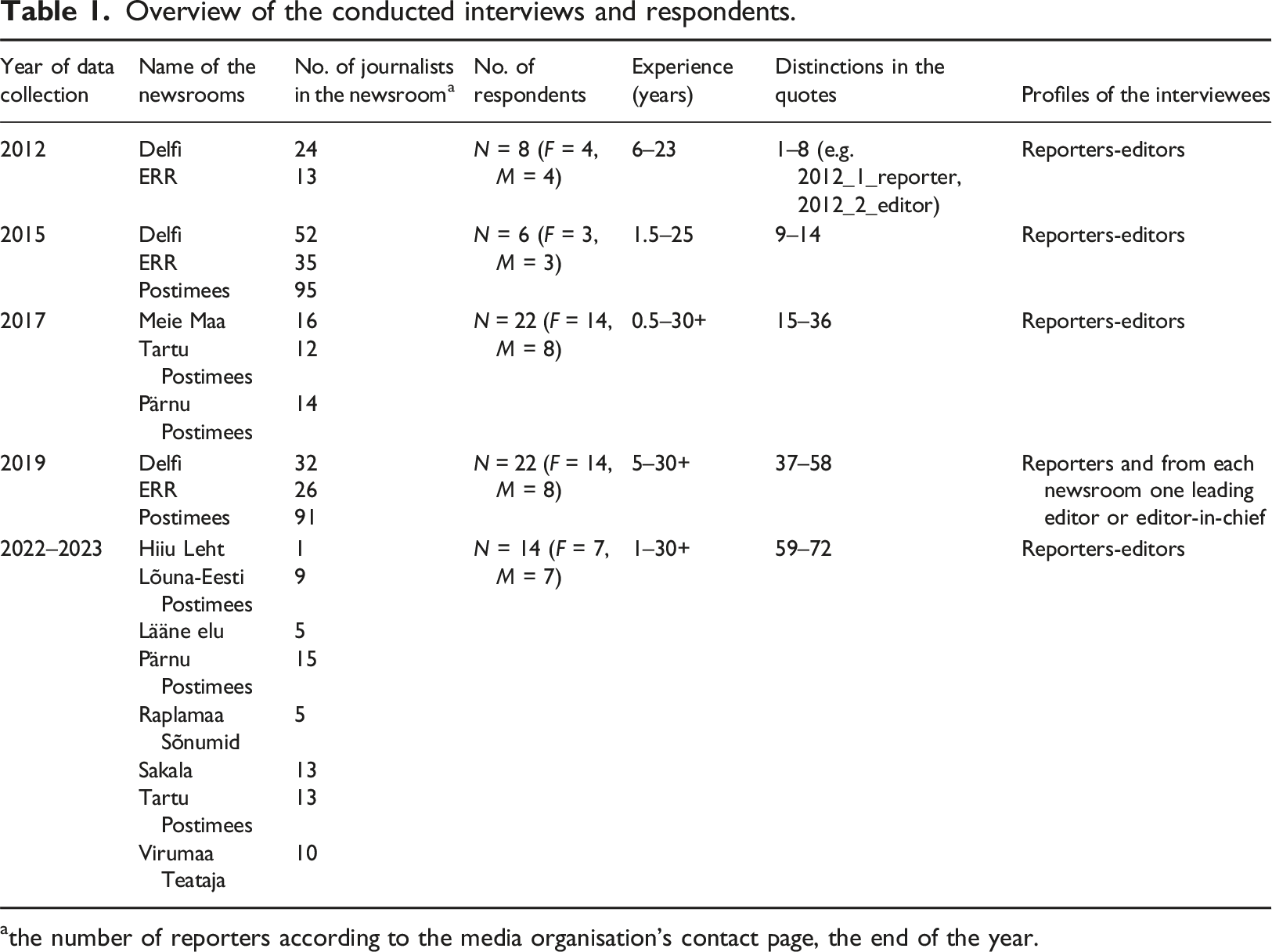
athe number of reporters according to the media organisation’s contact page, the end of the year.
Most interviews were conducted face-to-face, with exceptions in 2022 and 2023, where some interviews were held via Skype or Zoom.
Six students and one supervisor collected the data as part of an evolving collection of interviews about journalistic work practices at the Anonymous University, and they were reanalysed for this paper. The data collection process and analysis were overseen by two supervisors, experts in journalistic practice and organisational settings, including journalists’ working conditions. Their collaboration ensured that all the interviews remained rooted in journalists’ working conditions, how changing conditions affect them, and what other changes they have witnessed in the newsroom, allowing for a comprehensive exploration of the issues at hand.
Semi-structured interviews offered insights into journalists’ roles, the factors shaping their decisions, their reactions to shifts within the newsroom environment, and their perceptions of the connections between these changes and their well-being. We allowed journalists to articulate their narratives and draw connections between and attention to aspects that may have otherwise gone unnoticed. While the interview guides were not the same across all five waves of studies, the flexibility allowed the addition of new emerging themes to existing ones. The total duration of the recorded interviews amounted to approximately 85 h; the average interview length was an hour and 10 minutes.
The recordings were transcribed and analysed using MAXQDA qualitative analysis software. We follow the thematic analysis approach outlined by Braun and Clarke (2006). A combination of inductive and deductive approaches was employed. The six distinct phases of the analysis were: first, we familiarised ourselves with 72 interviews transcriptions, then we started coding (some codes we had generated from literature review deductively, others we generated inductively from the material, e.g. digital demotivation, skills, workload, routines). Next, we moved on to theme construction and review of themes and the definition and naming of themes, such as metrics and metrification, reporting production, convergence, etc. In the analysis, we organised the themes according to the domains to see where the experiences are located, meaning whether they are individual, shared on the level of interactions, shared on the level of organisational culture, or stemming from the contextual resources. In the following data analysis round, we presented the material chronologically to help the reader follow the changes over time.
Results
Tensions between traditional values and clickability: 2012
In 2012, on the individual or psychobiographical level, most journalists in the sample distanced themselves from the metrics, claiming that clicks mattered not to them but to their outlet or colleagues. It was also the time when metrics were first discussed in Estonian newsrooms. While online journalism first emerged in 1998, by the 2010s, it was clear that the business model needed to be changed (Himma-Kadakas, 2018).
All journalists in the 2012 sample openly acknowledged their commitment to executing tasks to the best of their knowledge, primarily focussing on rapid and prolific publishing (up to 55 news pieces per day). Out of the sample, most journalists admitted that the practice necessary to generate clicks is essential for the media houses’ economic well-being. Exceptions were the journalists from Estonian Public Broadcasting whose interest in clicks was lower and not linked with the economy.
The interviewees in the editorial-managerial position put more effort into the news with the potential to gather many clicks and less effort and attention to news that were not click magnets. ‘Well, there is that aspect of the number of clicks that show what people seem to enjoy, is there not?/…/Personally, clicks may not be my priority, but I acknowledge their significance for the newspaper. Additionally, if a news piece does not generate many clicks, we do not highlight it prominently; it remains with a lower readership. Consequently, the news does not carry as much weight’. (2012_1_reporter)
Echoing this, 2012_2_reporter sees clicks as a means for the advertising department to bring more money to the media house. The more click potential the story had, the better journalists positioned it on the outlet’s online page, for example, on top of the page, playing it out big and bold. The less click-bringing potential the story had, the less promotion journalists provided, meaning they did not put it somewhere on the ‘sweet spot’ of the page but kept it down and small. The clicks became an almost self-fulfilling prophecy where the lack of initial attention or potential clicks meant less effort was spent promoting the news.
The new metrics invited journalists to reflect on the tension between sellable news and the traditional understanding of news values. As clicks became the proxy for audience expectations, journalists saw themselves doing things for the reader rather than following their professional assessment of newsworthiness. ‘There are moments when I prioritise topics that I know cater to the reader's interests, even if I personally do not find them crucial or do not want to know them’. (2012_3_reporter)
Some interviewees reflected on the changing journalistic roles as the strategic collection of clicks by producing media products was deemed ‘too speedy for actual journalism’, as expressed by an editor in 2012. For some, quickly uploading incomplete information became part of the journalistic practice, as audiences returning to get the final version meant gathering additional clicks. ‘Throughout the day, we continuously updated it with various nuances to keep the news as current as possible. It brought in a tremendous number of clicks. Yes, a story in the process of being updated is often quite popular’. (2012_3_reporter)
While individual journalists might or might not concern themselves with statistics, the managing editor was responsible for workflow and topic selection, highlighting the significance of clicks in their decision-making process. Data became the mirror, which assisted in selecting the most attention-grabbing topics for the more prominent space on the online page.
In 2012 newsroom culture, the journalists were on their own with metrics: the editors and management did not have a clear position, and journalists managed online journalism expectations according to their understanding. ‘The editor is essentially a one-person orchestra, handling internal, external, economic, and crime news, designing the front page, blocks, managing Facebook, and more./…/The daily editor works all the time with everything and nothing specific’. (2012_4_reporter-editor) ‘Occasionally, there are some spontaneous suggestions, but [the managing editor] does not participate very intensively in daily work’. (2012_5_reporter-editor)
Within the contextual resources domain, the extent to which metrics were considered and their role and position in the editorial interactions were influenced by external shifts in the journalistic market. The sector consolidated – the different online platforms competed for their survival, and that trickled down to the newsroom and influenced the situated interactions. The newsrooms experimented with various formats, ‘keeping’ some news for the paper or the evening televised versions, releasing others online as soon as they were available. Journalists wanted to learn about online journalism, and the clicks gave fast feedback and reactions.
2015: The period of confusion and pushback
From the next round of interviews in 2015, a little pushback to clicks became more visible in the domain of psychobiography. A journalist could take pride in saying: ‘It does not matter if the news item will make it to the front page, to the top five, or will never be published; my contribution is still the same!’ (2015_9_reporter). Similar attitudes were visible in several interviews, indicating indifference and coldness towards following metrics. With experiences with what kinds of stories bring in a lot of clicks (e.g. accidents vs a story that much effort went into), the journalists could also learn to distance themselves.
While journalists developed a gut feeling about the potential popularity of the news, no stories remained unwritten or received more care. Moreover, while the clicks often confirmed the hunch, they became a source of happiness. Metrics data confirmed that a journalist managed to write something interesting or relevant. Thus, clicks reflected the quality and value of individual work, even if the journalists or the editorial boards (e.g. in the public service portal) tried to distance themselves from their importance.
In the 2015 interviews, journalists remain alone with the metrics, and reporters struggle to navigate the new opportunities. The editors praise the successful implementations but do not necessarily guide the reporters. In addition to the clicks, a new addition of interactions and visibility on social media becomes a mark of success. ‘But you can also see it in the comments or by how much the story is shared on Facebook. If there is a well-executed interactive map, people appreciate it. Even the bosses give praise’. (2015_11_reporter) ‘If the content can be expressed graphically, then I will try to do it. I could do more, but it is a somewhat cumbersome activity that falls victim to motivation’. (2015_12_reporter-editor)
The editor’s approval would confirm the success of social media, enforcing its position in the newsroom.
The ‘survival mode’: 2017
As in our 2017 sample, most journalists were from local outlets, and the palpable struggle was underscored by what can be described as a ‘survival mode’. By this period, work contracts included a clause delineating the quantity of content journalists were expected to produce for online platforms daily or weekly. Consequently, individuals traditionally focused on print media recalibrated their work routines to contribute to print and online outlets. The online journalism quota was met with a ‘producing’ content rather than a ‘creating’ mindset. ‘Well, the contract specifies a certain number. Therefore, approximately six or seven stories need to be produced online each week’. (2017_15_reporter) ‘We aim for ten online news stories in a month, but typically there are more, and sometimes significantly more. This cannot be overlooked, as we prioritise the online edition at the end of the day’. (2017_16_reporter)
In 2017, the stance toward the clicks was ambiguous. While acknowledging their importance, the nuanced perspective suggested that clicks were most valuable when their accumulation surpassed expectations. However, it is crucial to emphasise that the primary objective of journalists shifted from garnering clicks to fulfilling the ‘quota’ described in their contracts. Thus, new kinds of data points became a measure of their work.
In 2017, our interviews reflected the shift where online news overshadowed the previous privileged status of the legacy media. The need for routine-level guidance from the editors and management was evident as journalists grappling with the demands of both online and print found themselves multitasking with diverse responsibilities. The enhanced stress of trans-media production meant new tasks, such as promoting the newspaper on the radio. The struggle of what to publish, where to publish it, and in what form and frame persisted. Editors also worked closely with the advertising department, willing to move stories from the paper newspaper to online to make space for additional ads, thus undermining the individual balancing acts. ‘/…/It is also necessary to communicate with the advertising department because advertising brings in revenue for us. We receive our salary from it, and it enables us to publish the newspaper. Once the available space for articles in the paper is determined, decisions are made regarding who can do what and how much. That is when I also find out what tasks I can take on, and I proceed to work on them. If it does not fit in the newspaper, it can always be published online’. (2017_17_reporter-editor)
In the 2017 interviews, the ultimate metrics changed from clicks to engagement minutes, aiming to keep audience members on the page longer. The individual journalists’ success was rewarded with a monetary bonus. The shift in editorial expectations is reflected in the increasing demand for trans-media skills, as several journalists expressed that photos on the stories were acceptable, but videos were better. However, the interviews did not show the newsroom management taking an active role in developing journalists’ skills or helping them figure out how to achieve a more prolonged engagement.
Converged newsrooms’ starts interfering with metrics: 2019
In 2019, the interviews indicated a need to adapt to the diminishing newsrooms, and journalists worked under pressure where there was little time to reflect on the added value of their work or monitor the production’s popularity through clicks. The tensions between the online and newspapers had become even more visible despite the ongoing convergence for several years.
For the individual journalists, the convergence was marked by unclear goals, poor communication, and fuzzy expectations. ‘Again, it was this imposed thing that did not work because it was forced, but at the same time, there was not a clear vision of how it should function. Perhaps, indeed, for us, it remained unclear because there was not a common goal, so things did not fall into place’. (2019_40_reporter-editor)
For the editors, the resistance to the changes was seen as a mark of laziness. ‘/…/ accustomed to a pace of one story a day, they felt that the web was an additional obligation, and they resisted the influx of additional duties that came with it’. (2019_39_editor)
In the broader societal context, in 2019, media organisations engaged in a more overt competition, influencing editorial processes that were previously more implicit. The newsrooms entered the ‘technically converged’ period, where the technical side was organised, yet, new journalistic routines were yet to be developed. Editors acknowledged in interviews that their goal was to surpass other news organisations metrics-wise; it was essential to be faster than anyone else and be on the spot.
New and same metrics, old habits: 2022/2023
In the latest round of interviews (2022/23), the journalists were torn between following clicks and arguing that it did not matter, making a full circle to the interviews of 2012. As an alternative measure, the minutes spent with the story or subscriptions earned emerged, but for journalists, it was difficult to grasp (‘Of course, I would like to learn how to make people read the story more and how to structure it so that they would not spend just 15 seconds on it but rather 3 minutes, right?’ 2022/23_59_editor), therefore, clicks still dominated the discussion. ‘I must admit that I monitor the clicks very diligently, indeed. It is quite disheartening. However, I already know from a reader survey dating back that less than 10% of readers engage with cultural news and stories at all, and for art, it is less than five per cent or around that. Nevertheless, it is very disheartening to see when there are about 200 or 300 clicks, you know, and it is a great joy to see when a story has received 10,000 or even 20,000 clicks in that manner’. (2022/2023_62_editor)
In our sample were journalists who had been in the changing environment of the newsroom, some of whom indicated the need to pinpoint how they were doing, seeking feedback on or support for their work.
The journalistic process that is after speed because of the perceived competition has stayed the same, and online news remains plagued by errors. ‘Usually, it goes like this: if there is some breaking news and there is still competition with other publications, we put it online first. Once the initial news is on the web, we enhance it by adding pictures, changing the headline and introduction, and tweaking the text a bit. Then, a more polished version goes into print as a more refined piece, and the next day, a similarly polished version appears online again. Typically, we take down the initial version at that point’. (2022/2023_62_reporter)
The clickability of news was considered beyond the individual author’s control. Even if there was a monetary reward for the most clicked story, journalists believed that achieving this was influenced by the subject matter, for example, accidents or the death of a celebrity, more than their journalistic skills or the ability to craft a compelling headline. ‘Yes, there is a click bonus every week. To get that, there must already be something that is read immensely. The title does not play as much of a role because there must be news that is inherently so significant that people across Estonia would want to read it’. (2022/2023_63_reporter)
By 2023, online journalism has become a regular part of everyday work. Online provides information on how the story is doing (amount of clicks, minutes spent on the story). At the same time, the feedback from the paper only offers an overlaying circulation number. On the individual level, the mirror of data reflects a new kind of desirable journalist – as the role division between the ‘elite’ of paper and ‘slaves’ of online is disappearing. The early days of introducing metrics to the newsroom allowed some journalists not to care about metrics as the value of their work was communicated through publishing it in the paper version of the newspaper. Diminishing paper subscriptions, increasing share of online readership, and paywalls for monetising efforts for the digital content meant that in the converging newsrooms, journalists were less able to maintain the high ground of the legacy media. Today, the audience metrics reinforce the underlying division of topical interest, placing the journalists working on softer topics at the lower level of the newsroom hierarchy.
Concluding remarks
Our findings delineate the evolving role of metrics from 2012 to 2022/23, shedding light on their increasing pervasiveness and integration into newsroom culture. Utilising Data Loop (Mathieu and Pruulmann-Vengerfeldt, 2020), we showcased that the impetus for using data, capacities for individual reflections, and pressures to use data come from all four domains. The analysis underscores a shift in attitudes influenced by external factors such as economic pressures, changing newsroom structures, and changing perception of audience expectations relates to the changes in the contextual domain. The period marks a shift in tensions between legacy media (newspapers) and online platforms, as journalists, valuing print above digital news, could avoid looking at the metrics. Convergence, although a prolonged process, brings changing demands, and paying attention to the data becomes a coping mechanism when ideas of process and quality are changing. Thus, data integration also becomes part of the formative process proposed by Mathieu and Pruulmann-Vengerfeldt (2020).
Journalists wield significant influence in news creation, from selecting what to cover to choosing sources and framing topics. The metrics are presented within a competitive framework without differentiation based on genres, styles, or topics. The omnipresence of click-related data in this manner creates an environment where the quantitative success of an article takes precedence, influencing editorial decisions and journalistic focus and becoming part of the organisational culture. The journalists tend to interpret the input from clicks or other metrics as ‘what the audience wants and what interests them’. As the news creation begins with journalists making decisions, we argue that metrics also indicate how the choices journalists have made have played out. Thus, in this context, the metrics are not a way to see the audience or get feedback from the audience, but rather, the metrics become a mirror to the newsroom and the journalist. In this mirror, the dual values of media markets – citizen-oriented news values in professional journalistic work and market-oriented values of clicks and engagement minutes as currency the marketers sell reflect and distort each other.
Journalists are confronted with the clicks from the moment they engage with the publishing system for story dissemination. While the internal platforms have changed over time, the emphasis on the most-read article, as evidenced by the highest number of clicks, has been a constant presence since 2012. As the years unfold, the pervasiveness of clicks intensifies, seamlessly integrating into the very fabric of the workspace. Screens on the walls of bigger newsrooms now prominently display click counts and top lists, transforming metrics into a visually embedded aspect of the interior design.
Newsrooms grapple with the dual-demand pressure (Kristensen and Sorensen, 2005) of serving audiences and advertisers. Previous research shows that organisations prioritising market demands place greater trust and value in metrics, contrasting with those emphasising high professionalism (Zamith, 2018). Belair-Gagnon et al. (2020) argue that targeting a wider audience aligns more with a consumer-oriented role than a citizen-oriented one. Journalists battle the role orientations and rationalise the ‘new medium’ independently, often without clear communication from management or analysis of professionalism. Lack of direction and editorial-managerial feedback mediating audience metrics leave the journalists alone to navigate between the economic well-being of the organisation and the fulfilment of a citizen-oriented role. We argue that as ambiguous job demands and expectations lead to imagined job insecurity, journalists prioritising ‘survival’ are no less professional. Their interest and willingness to reflect on the data becomes also a question of the individual psychobiographies.
Belair-Gagnon et al. (2020) contend that organisational contextual factors exert more influence than individual ones. Expanding on Zamith’s (2018) concept, professionalism within the newsroom is a collective attribute that includes management, not solely journalists’ professionalism. Our interviews show that even if journalists take an imaginary professional distance from the audience’s expectations, the imagined expectations of the media organisations (the economic well-being) stress the relevance of the metrics. Thus, while journalists might not be interested in clicks or other metrics, the newsroom emphasises the metrics (and thus serves the advertisers) by providing monetary bonuses, etc.
Audience metrics as the mirror for journalistic practice is similar to the social status of the mirrors of olden times, where small mirrors were the technology for individual vanity. However, larger mirrors allow reflections of the social status and surroundings of the environment (Fors et al., 2019). The prominence of the data reflects the status and importance of the people in the newsrooms. While Christin Petre (2020) and Petre (2021) suggest that metrics have emerged as a significant tool for managing editors to motivate journalists to enhance audience engagement, in our study, journalists often start pressuring themselves. The editorial pressure is silent through the lack of explicit guidelines and the omnipresence of data.
Mathieu and Pruulmann-Vengerfeldt (2020: 122) argue that data about audiences are used as input for the media producers, spurring formative and transformative actions in response to the data traces collected via digital channels. Investigating these challenges via psychobiographies of journalists and editors, interactions in the newsrooms and the changing social landscape of the newsrooms, we see the individual agency of the journalists being strongly framed by institutional culture and audience metrics having interpretive flexibility (Christin, 2020). Throughout the interviews, there is no discussion that clicks are poor reflections of audiences’ needs and wants (Komerlink and Meijer, 2018; Pruulmann-Vengerfeldt & Meyer zu Hörste, 2020). Audience metrics reflect the journalistic work, specifically its advertisement and market-oriented aspect. More public discussions are needed to expose what values are reflected in the metrics’ mirror.
Footnotes
Declaration of conflicting interests
The author(s) declared no potential conflicts of interest with respect to the research, authorship, and/or publication of this article.
Funding
The author(s) received no financial support for the research, authorship, and/or publication of this article.
