




Abstract
The #nostalgiacores are a series of interrelated hashtags on Instagram and TikTok where users recirculate content from the digital and consumer cultures of the 1990s and 2000s – childhood play centres, dead malls, long-gone toys, and superseded game consoles and phones. In this article, we explore these digital cultures using a critical platform studies approach that involves a combination of network analysis and close textual analysis augmented with purpose-built machine vision tools. We scrape a collection of 359,150 images from Instagram that used one or more of 30 ‘-cores’ hashtags (such as #y2kcore, #webcore and #childhoodcore) that we chose following a period of immersive qualitative investigation of #nostalgiacore scenes on Instagram during 2021 and 2022. 10,000 Instagram images were then randomly selected and processed using a purpose-built unsupervised machine vision model that clusters images together based on their similarities. This research is part of a multi-year project where we develop hybrid digital methods for critically simulating and exploring the interplay between our image-making practices and the algorithmic systems that cluster and curate them. By combining computational approaches with critical platform and cultural studies approaches we speculatively explore both practices of curation and their interplay with the algorithmic classification and recommendation models of digital platforms. Our platform-oriented mode of textual analysis helps us to explore how our digital cultures are both symbolically and technically nostalgic. Instagram users in the #nostalgiacore scene recirculate images from the past as part of practices of critically reflecting on digital platforms and consumer cultures. At the same time those images are recuperated as archives used to train the algorithmic models that optimise attention on digital media platforms like Instagram.
Introduction
In the mid-1980s, Tetzlaff (1986) described MTV as a ‘triumph of pure presence’ that marked the emergence of a media culture characterised by an endless flow of always-on images and videos with ‘no beginning, no end’. This cultural imaginary persists in descriptions of social media platforms like Instagram and TikTok as a live feed of things happening now, minute to minute updates of everyday life, a sensation of endlessing ‘scrolling through nothing’ (Lupinacci, 2021). At the same time, social media platforms are also a repository of memories. As we use them for decades, they become archives of our lives that we scroll back through and that algorithms resurface (Lambert et al., 2018; Robards and Lincoln, 2017; Van der Nagel, 2018). In this article, we explore social media feeds that are ‘haunted’ by nostalgia for the digital and consumer cultures of the 1990s and 2000s. Practices of recirculating content from early internet culture is one example of vernacular digital cultures organised around sharing content not from our present or our personal social media archive, but from the popular archives of mass culture. We argue that these hauntological practices of sharing content about pre-millennial and millennial consumer and internet cultures is a form of everyday politics that expresses a vernacular critique of platformisation and connects it to larger concerns about global capitalism, inequality, climate change and other historically significant social, economic and ecological crises.
Social media platforms are home to the intimate publics of longing and dreaming through which we imagine other kinds of social worlds, but at the same time their models stimulate and tune ever-more associative, affective modes of intimate experience that sustain our scrolling and swiping in the present. In this article, we begin by describing the #nostalgiacore scene on Instagram and TikTok. The #nostalgiacores are a series of interrelated hashtags where Instagram and TikTok users remix and recirculate found content from the digital and consumer cultures of the 1990s and 2000s. We outline a critical platform studies approach that involves a combination of co-hashtag network analysis and close textual analysis augmented with purpose-built machine vision tools. This enables us to explore both practices of curation and their interplay with the algorithmic classification and recommendation models of digital platforms. We argue that digitally mediated nostalgia is both a product of our expressive practices and the technocultural process of algorithmic recommendation. We then explore the everyday practices of the #nostalgiacores, illustrating two forms of nostalgia: a reflective reckoning with the ruins of mass consumption and its dreams of utopian futures; and an effort to find comfort in the familiarity of the past against the alienation of the present. We relate these everyday expressions to the nostalgic algorithmic cultures of digital platforms and argue that the algorithmic model of digital platforms operates not only in a reflective or restorative nostalgic mode (Boym, 2001), but in a recuperative mode – using nostalgia as a resource that fuels the attention economy. We conclude by considering how the #nostalgiacores reflect an emerging mode of cultural critique that is both enabled and curtailed by the algorithmic culture of digital platforms.
The #nostalgiacore scene on Instagram and TikTok
Nostalgia haunts our Instagram and TikTok feeds. Some of us find ourselves on the ‘side’ of TikTok or Instagram that is characterised by streams of images and video of consumer and technological artefacts of the 1990s and 2000s. Rotating scenes of early 2000s childhoods – the playground, the classroom, now long-gone toys on TikTok. Comment sections of dead mall explorations on YouTube. Instagram carousels depicting images of outmoded tech – the PS2, Gamecube, and flip phone. Comments saying ‘I want to go there’ with a heart broken emoji. Dedicated accounts and hashtags on digital platforms channel inner, inscrutable nostalgic feelings for ‘others to consume’ (Tanner, 2020: 61). These attempts to communicate and connect with one another through shared feeling, mood and atmosphere unfold in feeds designed to keep fingers swiping and keyboards tapping (Carah and Shaul, 2016; Hillis et al., 2015; Jacobson and Beer, 2021; Niemeyer and Keightley, 2020; Papacharissi, 2015). We argue that the nostalgia for mass consumer cultures proliferating on digital platforms is shaped by the interplay between everyday image-making practices and platforms’ algorithmic attention economy. The #nostalgiacores are one instance of a larger production of ‘algorithmic nostalgia’ (Kidd and Nieto McAvoy, 2023) such as social media platforms algorithmically packaging memories, the reanimation and synthesis of historical photographs into moving and speaking characters, and the sharing of content from the archives of personal and mass digital cultures. Algorithmic nostalgia (Hoskins, 2011; Kidd and Nieto McAvoy, 2023) is a feature of an era where living with an ‘abundance of media’ means ‘living also with an abundance of past-ness’, where digital platforms engineer the curation, circulation and animation of texts from the intimate and public cultural archives.
Digital platforms’ algorithmic models are retrospective as much as they are predictive, trained on archives of late-twentieth century and early millennial imagery and fuelled by participatory cultures animated by reposting and recirculating ‘found’ content. Following Tanner (2021) we explore these practices of consuming and recirculating the past by focussing on a particular digital scene we call the #nostalgiacores on TikTok and Instagram. The #nostalgiacores are made up of interrelated ‘-core’ hashtags (such as #y2kcore, #webcore and #childhoodcore) which attempt to evoke nostalgia for the late-twentieth century and its forms of mass culture, consumption, and technology. The ‘-cores’ are significant because they express the commonplace sensibility of endlessly shifting ‘vibes’ associated with digital platforms’ vernacular cultures (Davis, 2022; Gibbs et al., 2015). There is a kaleidoscope of cores that overlap and continuously proliferate and shift – from well-known cores such as #cottagecore, to lesser-known cores including #fairygrungecore and #goblincore, #liminalcore and #dreamcore, #cybercore and #Y2Kcore.
Scholarly accounts of nostalgia online tend to focus on specific spaces, scenes, or ‘corners’ of the internet such as subcultural scenes and aesthetic movements like Vaporwave (Cole, 2020; Glitsos, 2018; Tanner, 2016), diasporic communities (Estévez, 2009), and reflections on national identities (Kalinina and Menke, 2016; Kaprāns, 2016; Rajagopalan, 2019; Yékú and Ojebode, 2021), including nationalist and populist agendas (McLeod, 2018; Szabó and Kiss, 2022). Other accounts of nostalgia online focus on the everyday and intimate practices of ‘memories’ and ‘on this day features’, where user’s content is archived and then resurfaced by platforms years later (Jacobsen and Beer, 2021) as well as ‘retrospective’ Facebook groups (Ekelund, 2022). We complement these accounts by examining the #nostalgiacores as a significant intimate public based on the curation and circulation of images, videos, sounds and texts found on the internet and sequenced together by users to evoke nostalgic affects. The #nostalgiacores illustrate the recirculation and remixing of found content as a pervasive form of expression on Instagram, which sits alongside selfies, memes, celebrity and promotional content and the documentation of everyday life. In the case of the #nostalgiacores this recirculation gives expression to an everyday politics marked by reflection on, and reckoning with, the crisis of futurity in contemporary capitalist cultures.
The #nostalgiacores scene finds and collects images, texts, and videos from the archives of the internet and curates them into posts. They ‘produce, capture, explore and make sense of’ their moods and emotions, in a practice of ‘cultivation’ that Siles et al. (2019) have described in relation to making Spotify playlists. For instance, this commenter under a #nostalgiacore Instagram post expresses the affective resonance of these practices of cultivation: I love your posts in some way i feel addressed by them and for me they express more than just the pure form of aesthetics. I see many of my own feelings and moods in these pictures and even use them in places to make others understand how I'm doing and how it feels.
Participants connect their own personal experience to larger structures of feeling.
For instance, in an Instagram post tagged #nostalgiacore (as well as other related hashtags) a series of dream-like and surreal edited images (see Figure 1) are sequenced into a video with ambient synth music and an AI-generated voice which says ‘sometimes when I wake up it’s like you are still here. But then a few moments later I remember. I think I will keep dreaming forever’. The unnarratable affects expressed are not made concrete through language or expressions of emotion but rather channelled through an assemblage of texts (Wissinger, 2007), these practices of curation often appear to address or mimic the associative logic of the algorithmic feeds of the platforms they are posted on. Screenshots from an Instagram video tagged #nostalgiacore.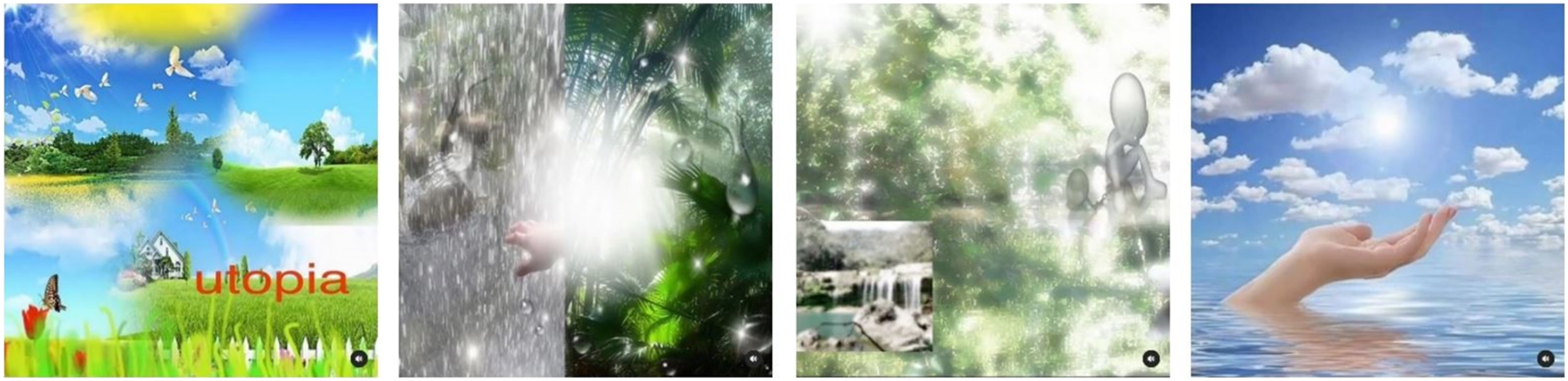
Using machine vision to explore the #nostalgiacores
This research is part of a multi-year project where we developed a purpose-built machine vision system called the Image Machine to ‘critically simulate’ the algorithmic models of social media platforms like Instagram. Our approach differs from machine vision approaches for describing and analysing social media data that have emerged in recent years (Peng et al., 2023; Williams et al., 2020) by building open-access software that clusters and visualises images from social media platforms using algorithmic models analogous to those used by the same platforms (Carah et al., 2023). Our aim is not only to use machine vision to explore the patterns in what people post to platforms like Instagram, but to also simulate how platforms themselves use machine vision. By combining computational approaches with critical platform and cultural studies approaches this methodology both describes images and speculatively explores the interplay between the creation, curation and circulation of images and the algorithmic architecture of platforms like Instagram.
Instagram deploys machine vision to support a range of platform features, one of the most central being the explore and home feed recommendation systems. In a recent corporate blog post, Meta engineers provide an account of the platform-scale multi-stage recommendation system that utilises both item-level and user-level algorithmic embeddings (Vorotilov and Shugaepov, 2023). While these posts are typically deliberately vague about the specific implementation of these algorithmic processes, they do indicate the use of large multi-scale neural networks that enable the codification of item-level images and videos and user-level profiles that can be used to shape users’ personal feeds. These systems are largely being optimised towards increasing ‘engagement events’, which is platform-speak language for activities that positively influence user attention and engagement.
Meta also employ user-generated content to train their own machine vision models that are then deployed as part of the wider content recommendation ecosystem (Mahajan et al., 2018). Take for instance Meta’s GrokNet, a computer vision system that can recognise product attributes across billions of images. It was trained with 78 million public Instagram images, as well as catalog images and promises to be an ‘AI lifestyle assistant’ (Meta, 2021) that can recommend products that reflect the ‘personal style’ of users. These AI-powered shopping systems ‘leverage state-of the-art image recognition models to improve the way people buy, sell, and discover items’ (Meta, 2021). The problem that emerges is that at the level of platforms’ corporate narratives we can see them promoting their use of machine vision in the ongoing development of automated recommendation and customisation, and at the level of everyday experience users ‘feel’ that their feeds ‘know’ what visual patterns they are drawn to. But, in the middle, the machine vision models themselves remain opaque.
Our approach is necessarily speculative then, because it is not possible to forensically show the direct link between our image-making practices and machine vision systems. Following Phan and Wark (forthcoming), just as algorithmic models use proxies in place of variables or qualities that cannot be measured, researchers and critics need to develop their own proxies for how algorithmic models work. Where we are unable for technical, commercial and political reasons to observe how models function, we must do the speculative work of creating ‘models of models’ as a ‘stand-in when one is precluded from accessing a model’s backend’ (Phan and Wark, forthcoming). This speculative approach to analysing algorithmic culture by proxy is necessary because it takes seriously the ‘intractable condition’ of approximation and association at the centre of both algorithmic models and our digital cultures. This is more than just a technical point about algorithmic models, it is also a cultural one in the sense that we need to open up ways of exploring the associative modes of expression that emerge in digital cultures that are themselves a response to the curation of cultural flow by algorithmic models (Amoore, 2020).
We follow this logic of approximation by exploring the associative clustering and sequencing of images that unfolds in both users’ creation and curation practices as well as unsupervised machine vision models. These digital methods involve critical exploration of the interplay between our image-making practices and the algorithmic systems that classify, label, cluster, sort and recommend them (Carah et al., 2023; Levy and Diamanti, 2023). For instance, in their exploration of how supervised machine vision models label Instagram images of graffiti Levy and Diamanti (2023) find that images are given generic terms that ‘obfuscate’ the meaning of these images in public space and the materiality of their production. Where they focussed on how machine vision systems ‘label’ objects in images, we explore how they associatively cluster images. Our approach also contributes to efforts to visualise Instagram’s visual cultures. Where, for instance, Cornelio and Roig (2020) use timeline tools to visualise the temporal sequences of images posted to Instagram from a music festival, we have developed a visualiser that enables us to explore how machine vision systems create clusters of images based on patterns in their pixels. This enables us to critically speculate about the multiple organisations of our images – temporal, spatial and associative – taking place as platform users and algorithms curate images. While users might understand flows of images with reference to temporality, location and narrative (Cornelio and Roig, 2020; Yilmaz and Kocabalkanlı, 2021), at the same time those flows are being shaped by machine vision systems that treat them associatively and are in turn used by platforms not to make meaning but to organise attention through their recommender systems.
This article uses the Image Machine to develop and undertake a critical textual analysis attuned to how texts are produced and circulated within algorithmic cultures. We examine an often overlooked aspect of creating and sharing images on Instagram – the remixing and recirculation of ‘found content’ from the past. While we could describe the nostalgic content of these images using a combination of machine vision and textual analysis, we deliberately take a speculative exploratory approach that considers how our cultural practices of curating and circulating images on digital media platforms is interrelated with the algorithmic systems that sort, cluster and recommend them. To understand nostalgia on digital platforms we need to apprehend how our practices of finding and sharing images of the past are in part a product of algorithmic models that are themselves retrospective (Tanner, 2020). They are trained on image archives from the past and put to work on platforms that need to engineer a continuous flow of content. Dredging up content from the archives of media, popular and digital cultures is arguably a practical necessity in the attention economy of platforms like Instagram and TikTok. Our proposition is that to understand the #nostalgiacores we need to see them as meaning-making practices that are entwined with and shaped by the algorithmic models of digital platforms.
We use our machine vision tool to approach the algorithmic culture of Instagram as one characterised by both the ‘use of computational processes to sort, classify, and hierarchise people, places, objects, and ideas, and also the habits of thought, conduct and expression that arise in relationship to those processes’ (Hallinan and Striphas, 2016). We do this by exploring both how the machine vision model arranges clusters of images in relation to users’ own curatorial practices. Rather than use machine vision to describe the visual cultures of Instagram or undertake textual analysis of Instagram images to investigate how well machine vision performs at classifying images, we aim to explore the entanglements between practices of visual expression and the machine vision models that shape them in the context of Instagram. Our machine vision tool helps us to develop a mode of textual analysis attuned to the algorithmic culture of digital platforms.
For this article, we began by scraping a collection of 359,150 images from Instagram that used one or more of 30 ‘-cores’ hashtags that we chose following a period of immersive qualitative investigation of #cottagecore and #nostalgiacore scenes on Instagram during 2021 and 2022. In this article we focus specifically on the #nostalgiacores, scraped from the following hashtags: #nostalgiacore, #childhoodcore, #cybercore, #webcore, #dreamcore, #liminalcore, #90score, #memorycore, #abandonedcore, #forgottencore, #strangecore, #oddcore, #weirdcore, #voidcore and #y2kcore.
We then undertook a co-hashtag analysis using Gephi to visualise which hashtags are used on the same images and are therefore associated with each other. Co-hashtag analysis enables the symmetrical analysis of the formation of ad hoc issue publics, and platform dynamics (Bruns and Burgess, 2011; Marres and Moates, 2015). In the context of #nostalgiacores this is a useful method of analysis for observing hashtag communities, and when brought together with the Image Machine, the extent to which the visual practices of specific hashtag communities are discernible to a machine vision model. Gephi’s default Louvain modularity algorithm was run over this network and determined the presence of 70 specific hashtag communities (M = 0.472), with 95% of hashtags grouping into 12 distinct clusters. Closer readings of these clusters allowed us to observe a separation in users hashtag practices between #cottagecore and #nostalgiacore scenes, including a distinctive cluster of #nostalgiacores made up of interrelated hashtags which exceeded the 15 initial #nostalgiacores hashtags we began with (see Figure 2). Gephi Map of the ‘cores’, with a zoom in of the ‘nostalgia-cores’ ecosystem.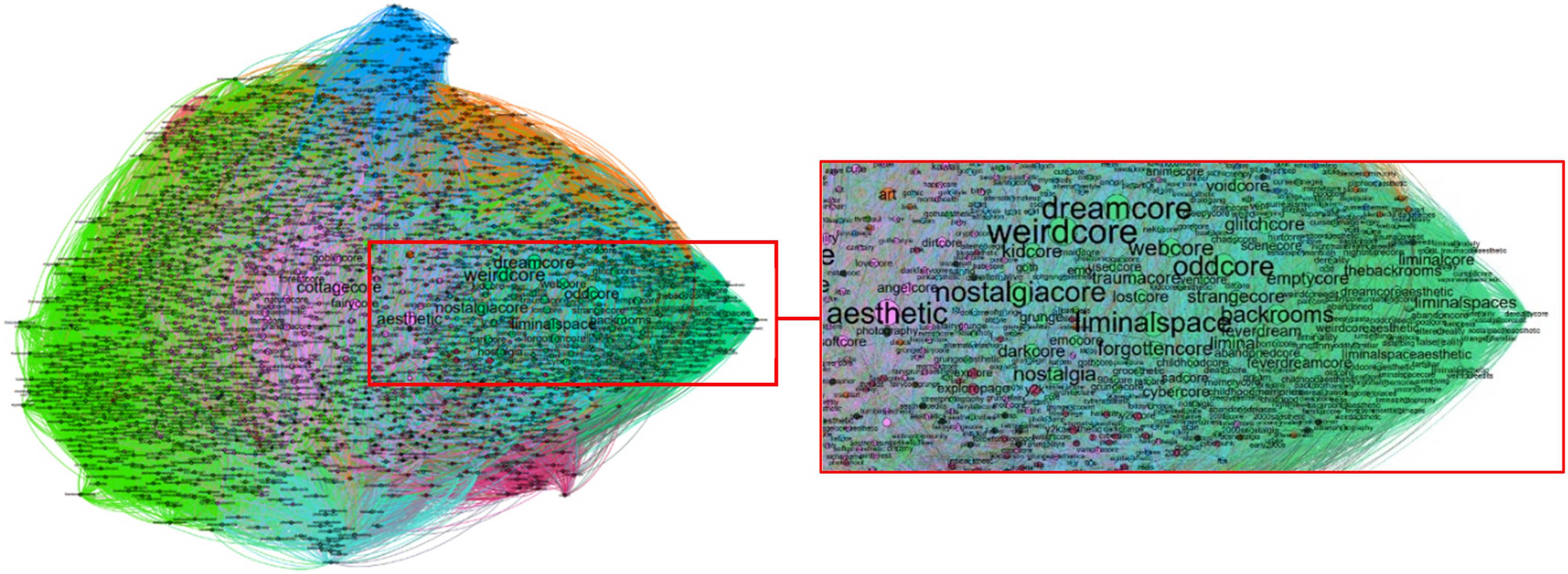
Given the limitations on the Image Machine clustering – it performs full pairwise similarity across the whole input dataset – it is impractical to cluster the entire image dataset. Instead, 10,000 images were randomly selected from the #nostalgiacore hashtags, processed ‘through a feature extraction algorithm to map the image bitmap to a feature vector (a long list of numerical values indicating properties of the image)’, and then processed to cluster images together based on their similarities (Carah et al., 2023). The ‘feature vector’ is the pre-trained algorithmic model’s interpretation of each image rendered into a sequence of numbers that can then be used to make direct mathematical comparison with other images in the dataset. The machine vision algorithm we implement is the popular VGG16 that Facebook has used as part of their ‘detectron’ framework (Girschick et al., 2019). VGG16 uses a convolutional neural network architecture and was trained on images from the ImageNet database. We do not use this model to ‘label’ features in the images, but rather use it to ‘embed’ images into a multiple dimensional feature space.
The process of ‘embedding’ is a concept from computer science that refers to the translation of a media object, such as an image, song, news article, or video, into a numerical hyperspace of many, possibly thousands of numerical dimensions (Mackenzie, 2023). In some embedding models these dimensions approximate known qualities of the data that may be able to be expressed using semantic labels, in others these dimensions are more abstract. The key here though is that the multi-dimensional hyperspaces are able to map multiple objects together based on the presence of latent qualities in the data, without the need for reductive labelling processes that may result in a loss of information.
Embedding therefore enables associative clustering where we can perform pairwise comparisons to calculate distances between any images in the dataset and use these distances to inform the clustering process. For this exploration we combined k-means and hierarchical clustering algorithms to group images together in clusters based on their relative closeness or farness. Our hierarchical k-means cluster defines k (in our case k = 9) centroids. These are artificial points within the same feature space as the images. Centroids can be thought of as hubs around which various subsets of the images belong. Each centroid is contained in one cluster, clusters contain multiple images, and each image will only belong to one cluster. Once clusters are set, we count the number of images in each, and if the number of images in a cluster is greater than k then the process is repeated within each cluster, creating k new centroids at this second, third, fourth, and so on, layer of the model, until such time that every branch of this model has a cluster with less than k images.
We use the nomenclature root-14-9-10 to indicate the specific sub-cluster, in this case, the top-most cluster is #14, the second level is #9, and the bottom most cluster (this is the one that now has less than nine images) is #10. These clusters are presented in a visualiser that enables researchers to explore how the algorithm has associated images with one another and traverse up and down this tree (see Figure 3). Our machine vision model is not pre-trained on the images in our dataset, and nor does it have any information about which captions, usernames or hashtags are associated with the images. Visualisation from purpose-built machine vision model.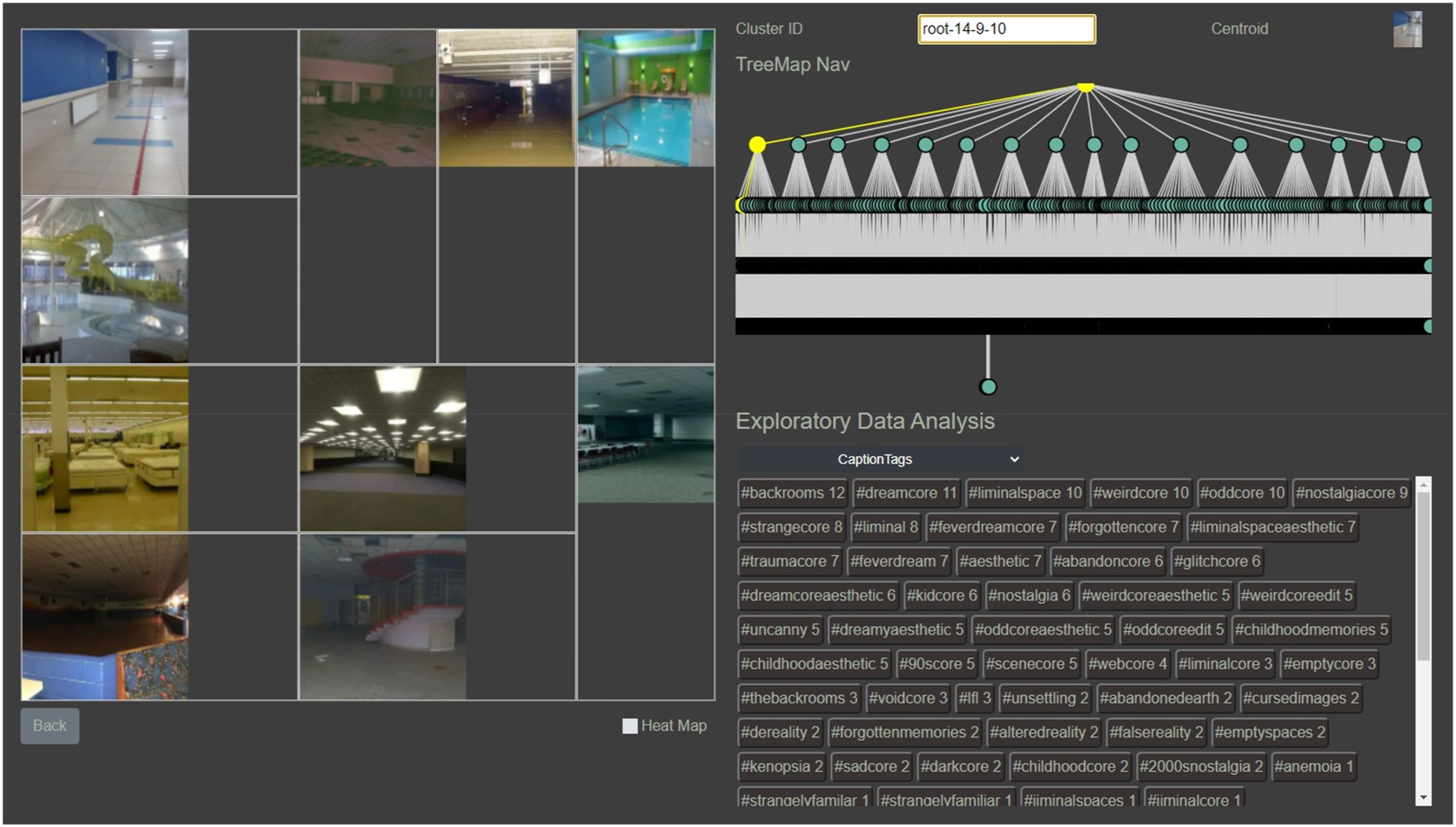
Exploring the value of these computational tools in undertaking analysis of the visual cultures of social media is an essential part of our research practice. For the purposes of this paper, we approach the purpose-built model as both a way to describe and investigate the #nostalgiacore scene as well as a means to speculatively explore how machine vision models shape nostalgic cultural expression on Instagram. This enables us to both explore patterns in the images, especially in social media cultures where the volume of images is too large to apprehend through manual textual analysis, and to reflect on how machine vision systems organise our visual culture. Another key aspect of the software interface is how it also summarises metadata specific to the sub-cluster being explored, such as the hashtags, user handles, like counts, or other relevant platform data. This interface provides a key link between the more speculative associative image model, platform-specific metadata and the place of images within platform feeds and profiles. While the model clusters images together based solely on similarities in their patterns of pixels, we also associate hashtag metadata with the clusters so that we can see whether the clusters created by the model correspond with #nostalgiacores hashtags (see Figure 3).
Once the model has clustered images, we use the visualiser to search through the clusters that are organised hierarchically in layers from large clusters of several hundred images down to smaller clusters with a single, or few images. By exploring these clusters, we observe and describe the recurring visual themes of the #nostalgiacore scene. We do so through inductive descriptive coding of each of the 256 clusters of images to emergently identify patterns, observe associations with #nostalgiacores hashtags, and purposefully select clusters for textual analysis. Once an image has been selected in the visualiser it can be ‘opened up’ to the original Instagram post that the image was scraped from. This is important because the images are ‘…inextricable from the social relations and cultural practices of social media users’ (Burgess et al., 2021) and must be interpreted in their cultural settings (Geboers and Van De Wiele, 2020). We observe the comments, captions and accounts associated with the images.
While the #nostalgiacore scene on Instagram precedes TikTok, it traverses both platforms in a fluid way. In order to examine this inter-platform scene that relies on the recirculation and remixing of found content across the internet we also explored TikTok. Once we had analysed the Image Machine visualisation and associated Instagram posts, we conducted an immersive qualitative investigation of TikTok using the fifteen #nostalgiacore hashtags previously identified – similarly observing the comments, captions and content of the videos. The images and comments we purposefully select for both analysis and illustration in the following sections come from the clusters created by the machine vision model, or screenshots taken during further investigation on Instagram and TikTok.
Through this close and purposive textual analysis, we aim to understand not just how platforms curate texts, but how users’ practices of expression anticipate and are shaped by the algorithmic attention economy of platforms like Instagram and TikTok. We develop this approach in the following sections in two steps. First, we explore the images posted on the #nostalgiacores hashtags. And then second, locate these practices of textual expression within the algorithmic culture of Instagram and TikTok.
From restorative to reflective: Contradictory forms of nostalgia in the scene
In the #nostalgiacore scene, images, sounds and videos are stained by time; they are imbued with an odd, eerie, and out-of-place affect. From images of a Toys R Us neon sign barely flickering in a now dead mall to the outmoded CGI of old Nintendo games and the hazy dream-like quality of old digital cameras. This disjuncture between past and present is key to the affects of nostalgia, where past events, moods, and dispositions are made meaningful when they are compared with the present (Davis, 1977). In our study of the #nostalgiacore scene, we found two distinct orientations in how people made sense of the present through nostalgia: a longing to find comfort in the past on one hand, a restorative nostalgia, and a critical yearning for lost realities and futures on the other, a reflective nostalgia on the other (Boym, 2001).
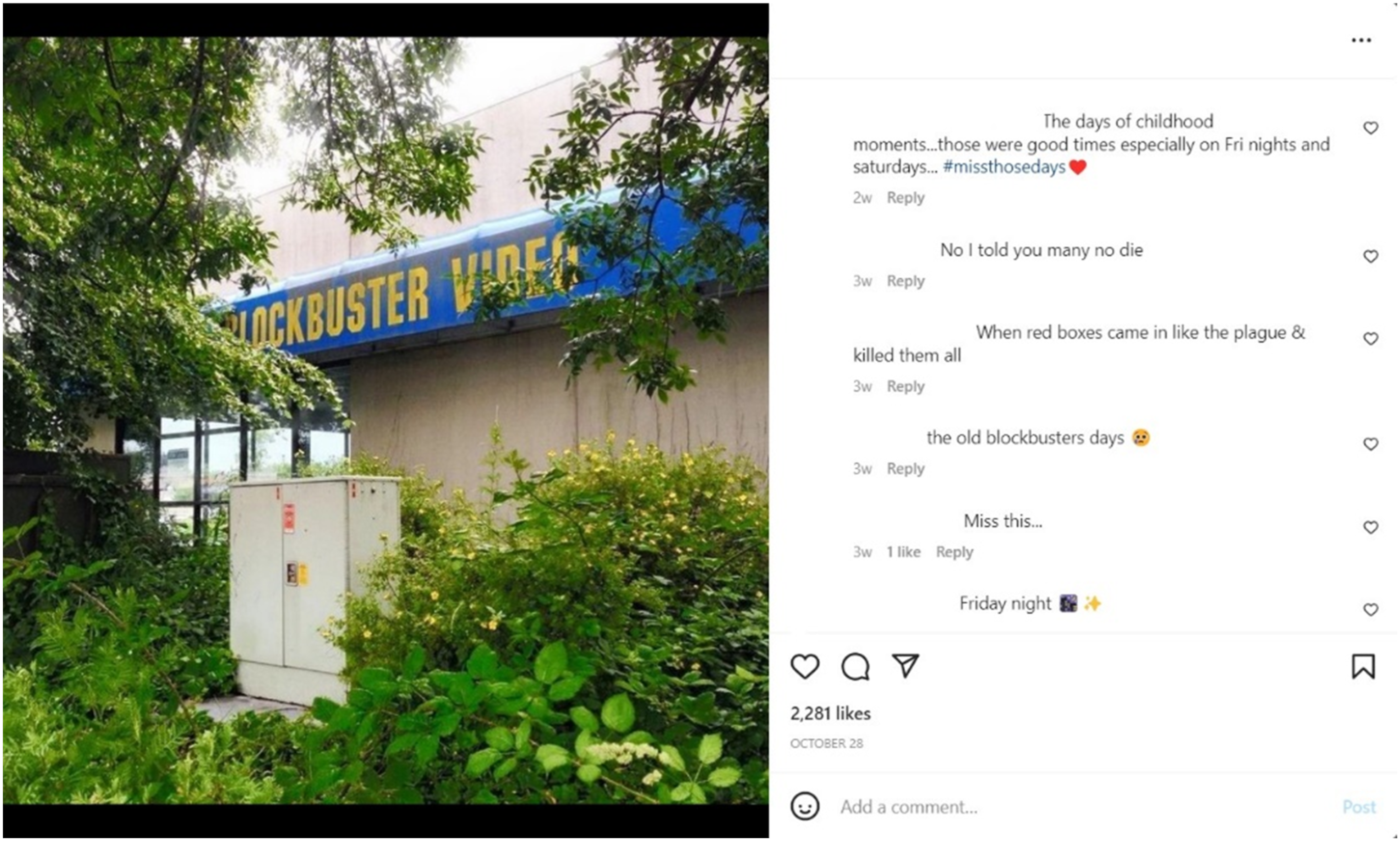
A common refrain in the #nostalgicore scene goes ‘I want to go to there’, often underneath posts consisting of a series of images of childhood memories: the flip phone, the interior of a Blockbuster, children sitting on the ground watching cartoons on VCR. Some in the scene find comfort in the ‘oddly familiar’ affects and memories of ‘better times’. In an Instagram post depicting an empty classroom taken in 2001 commenters express that they ‘can smell this room’ and remark about ‘simpler days’ (see Figure 4). Another Instagram post of a Blockbuster taken over by weeds is captioned ‘the days of childhood moments…those were good times especially on Fri nights and Saturdays…#missthosedays’ (see Figure 5). There is an element of escapism, a longing to go back to childhood, a yearning for the restoration of the past in the present. However, these are not always comforting feelings, as those in the scene attempt to reckon with their feelings of loss. Screenshot of an Instagram post depicting an empty classroom taken in 2001. Screenshot of an Instagram post depicting an abandoned Blockbuster.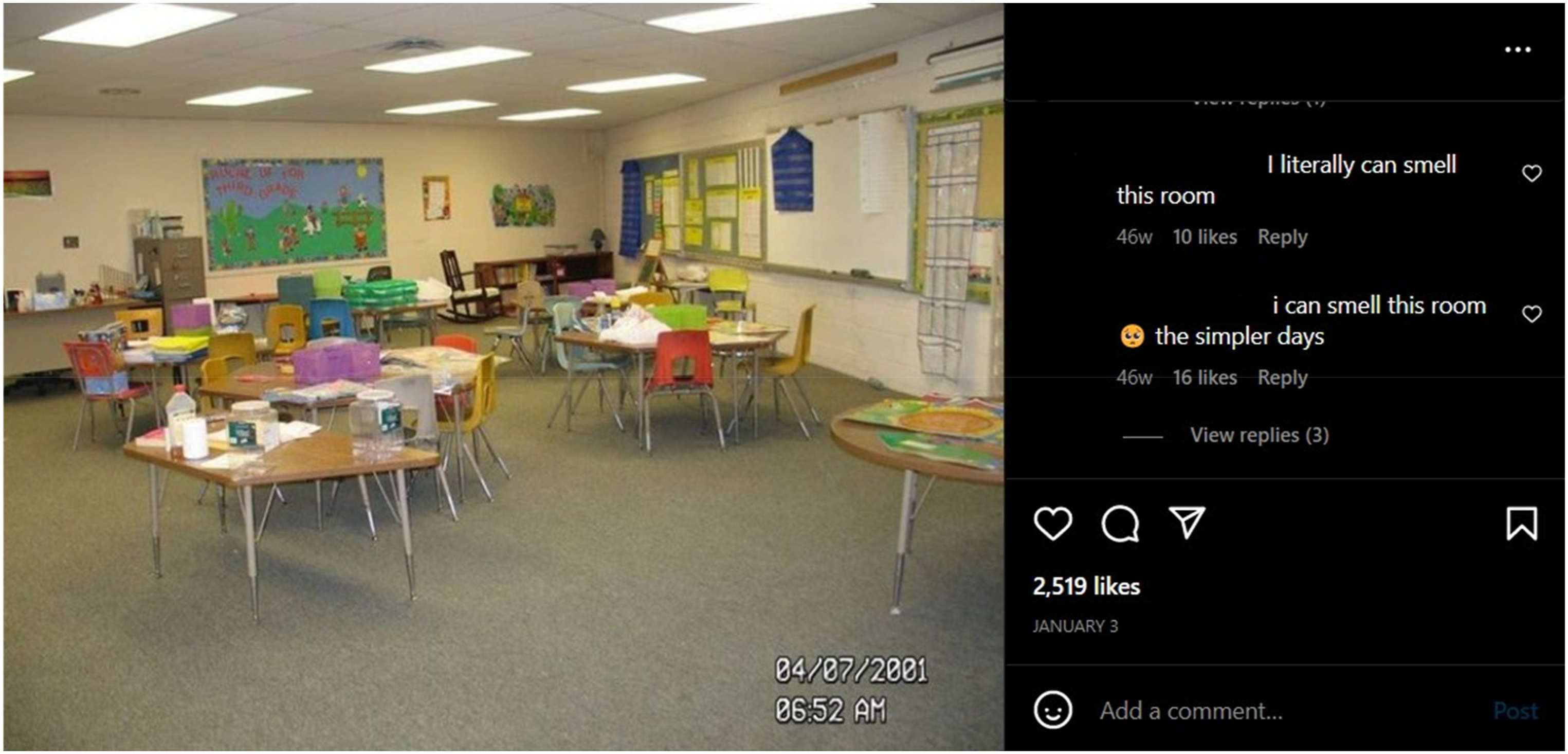
An Instagram post captioned ‘childhood photos you can smell’, depicting a series of images of playdough, Elmer’s glue, and crayons, spurred commenters to express that these reminders are painful. One commenter explains, ‘Why did this post give me feelings of disgust and hatred. I feel like I resent adulthood wishing I could step back in time for a day’, to which someone else replies, ‘this is my existence, and I can’t escape the dreadful desire to revert to childhood’. What becomes clear within this kind of nostalgia is a deep longing to return to the past – expressed through the entanglement of comfort and melancholia the images of collective childhoods evoke.
However, not all #nostalgiacore posters and commenters long to return to the past. Many express that the images and their associated affects invoke a critical reflection on the absent future of contemporary capitalism – a reflective nostalgia. Lost 20th century futures ‘bubble up’ (Fisher, 2013) in the #nostalgiacores. Take the Instagram post of ‘SONYA’ (see Figure 6), captioned with an excerpt from 1999 in Novum Magazine, ‘I-D Media created the virtual figure of SONYA, a three-dimensional avatar. Made up of 60,000 polygons, she presents Sony’s products in a futuristic atmosphere. One thing she demonstrates… is how to connect a mobile telephone to the Vaio notebook, so the user can send faxes, surf the net, or process digital images’. Things that once looked futuristic now appear uncanny and out-of-date (Cole, 2020), these visions of techno futures now reappear hallmarked by their era, the mass consumer dreamworlds that are now in ruins. Image from Instagram post of ‘Sonya’.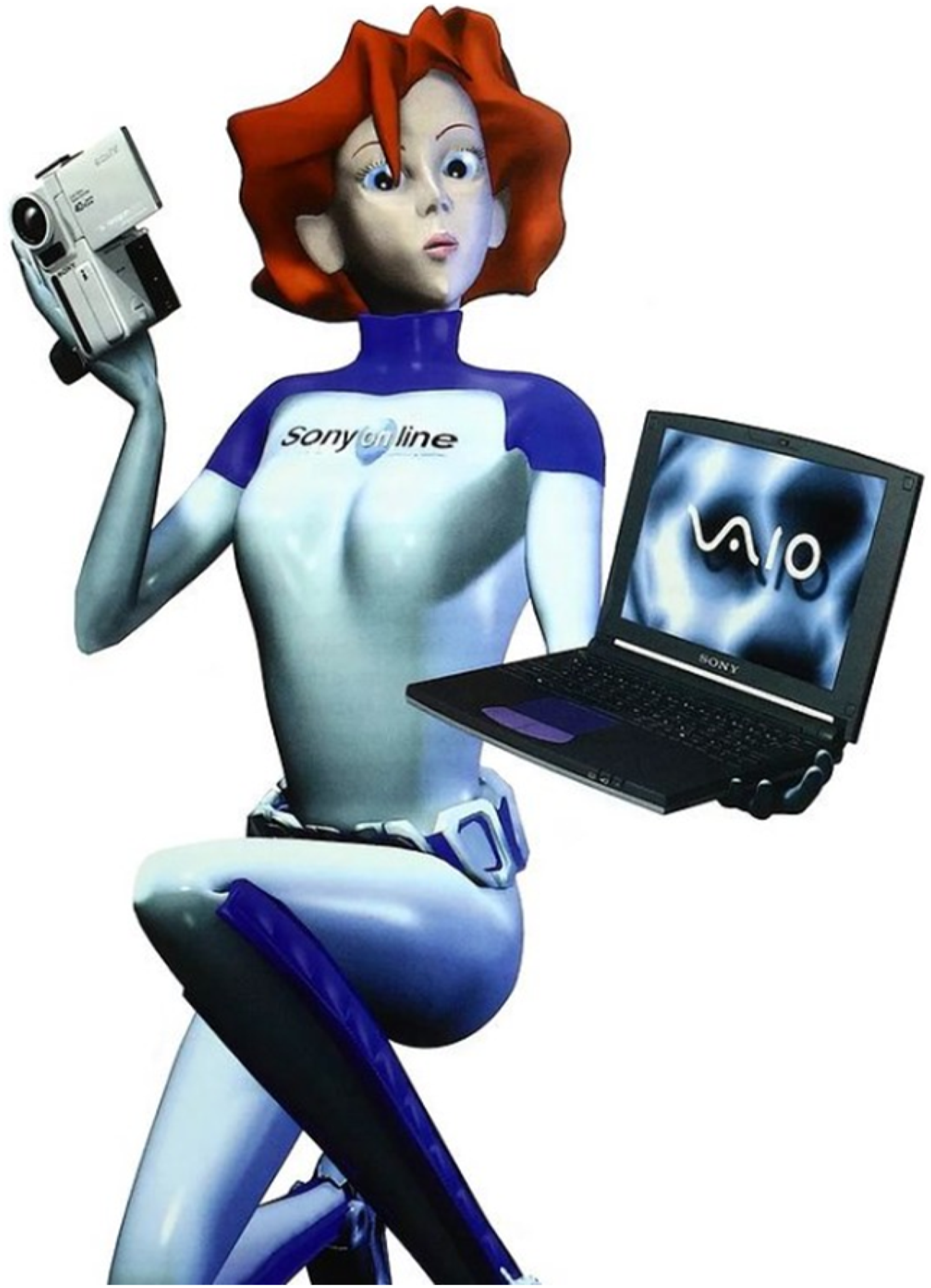
A (short-lived) trend that epitomises this fascination with outdated futures in the scene was the sudden popularity of the early 2000s aesthetic ‘Frutiger Aero’, an aesthetic that was prevalent from roughly 2004 to 2013, following the end of the Y2K era. It is characterised by Aesthetic Wiki (Frutiger Aero, 2023), a popular website for describing internet aesthetics, as use of ‘skeuomorphism, glossy textures, nature and humanism, water, bubbles, auroras, bokeh, flourish patterns, bright and vibrant colors (usually contrasted on a white or monochrome background), and glass’. The Frutiger Aero images uploaded by the scene include depictions of futuristic architecture and interiors (phone stores, waiting rooms, offices, hotels), graphic design of bright gleaming cities, fields of pristine grass and clear waters, and is epitomised in Microsoft Visa (see Figure 7). The sequences of images are often set to early 2000s songs including the debut single ‘All around the World’ by German Eurodance group ATC. These images and songs have a distinctly 2000s quality, a now other-worldly and outmoded utopia made with plastic, CGI, and photoshop in blue and green hues. Screenshots of Frutiger Aero videos on TikTok.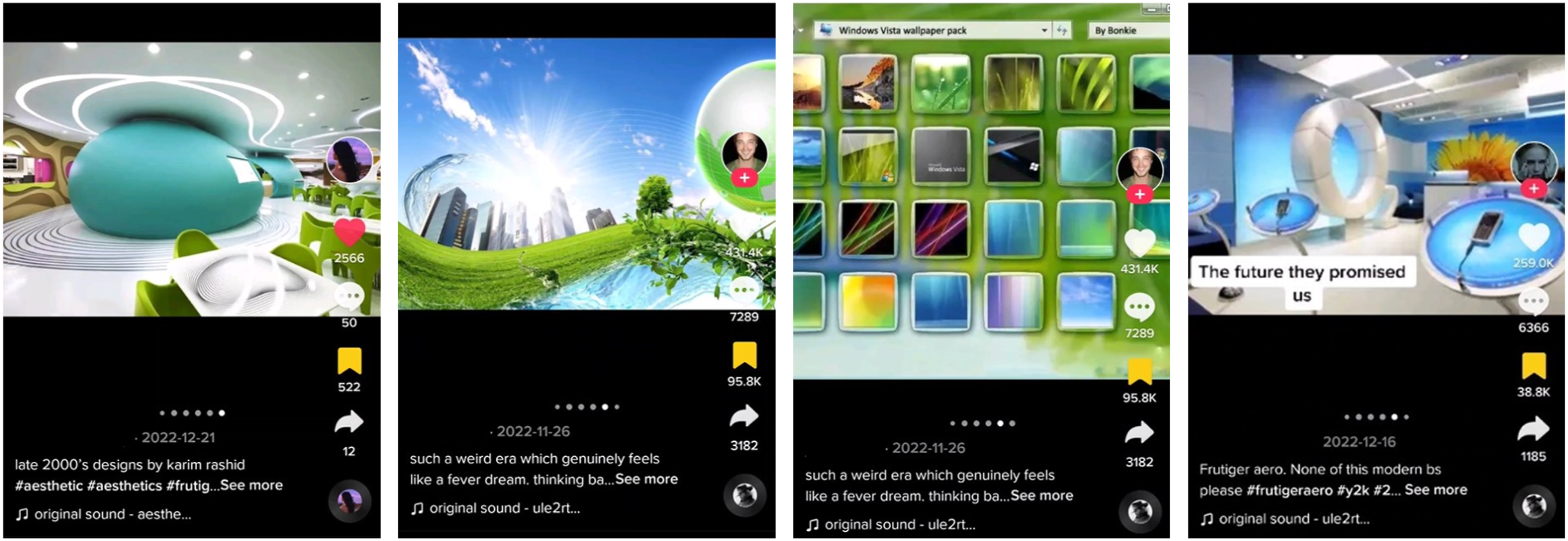
In one TikTok video, a series of images from ‘contemporary culture’ such as beige office interiors and iPhones are captioned ‘I don’t want this, I don’t want any of these, all I want is…’ The video then turns to images of Frutiger Aero with the caption, ‘the future we were promised’ (see Figure 7). While some commenters express that this, in fact, looks like their ‘personal hell’, describing the aesthetic being akin to a hospital or a pharmacy, many others remark that that this is what the future was supposed to look like, ‘It was supposed to be the future, now it’s a part of the past’, ‘the 2000s was the REAL future, how the heck did we go backwards?!’, or ‘throwback to a time where it felt like there was more hope’ and ‘We always felt like the bright future was just right around the corner. Everything was so mystical and sleek. Miss those days’. The curation of, and commentary on, these seemingly mundane images of outdated consumer-capitalist cultures has a political dimension, the feelings associated with Frutiger Aero and other outmoded techno futures and consumer-capitalist utopias become reminders of how the future was once collectively imagined.
Further, some expressions centre on nostalgia for iterations of the internet before large-scale platformization. For instance, a TikTok video tagged #webcore depicted a collage of images from the early 2000s internet – a windows XP screen, old versions of YouTube, references to outdated memes, and animated web series like ‘Salad Fingers’, ‘peanut jelly time’, and ‘Charlie the Unicorn’, set to a sped-up version of ‘Bunny Party’ a song by an animated German bunny ‘Schnuffel’ released in the early 2000s. The video is a series of intertextual references, chopped into a sequence that evoke the atmosphere of 2009 internet culture, accompanied by comments like ‘the internet not being like this anymore is when it all went wrong’.
The depiction of techno futures in earlier forms of internet culture acquire power as a memory for a ‘world that was supposed to be’ (Buck-Morss, 1995: 22-23). These ‘hauntological affects’, personal affective reminders of what mass futures once looked and felt like (Brown, 2023) have critical potential in a time when imagining the future is foreclosed altogether (Berlant, 2011; Boym, 2007; Buck-Morss, 1995; Fisher, 2009). As Cole (2020) writes on a similar aesthetic movement Vaporwave, ‘...such nostalgia is less for the past per se than the unrealized dreams of the past and visions of the future that became obsolete – a critical, utopian nostalgia that searches history with its telephoto lens in order to visualise alternatives to present disarray’ (Cole, 2020: 318). Re-materialising the fragments of the past into ‘harbingers of a utopian future’ (Kosmina, 2020).
These two forms of nostalgia – reflective and restorative, seemingly contradict one another. One yearns to be lulled by an atmosphere of familiarity and safety, while the other is animated by an orientation toward lost visions of the future. Both, however, are reactions to the crises of contemporary experience (Boym, 2007; Tanner, 2021). They both long for continuity, collective memory (Boym, 2007), meaning and stability (Tanner, 2021). One finds this in escaping to the past and the other in a desire to critically ‘reboot’ visions of the future. However, to further understand the politics of this digital nostalgia we need to examine who benefits from the cultivation, circulation and consumption of nostalgia found in the #nostalgiacore scene. We turn in the next section to examine how the #nostalgiacores play out on commercially driven platforms where algorithmic models shape these affective expressions. We examine digitally mediated nostalgia in the recuperative mode.
Recuperative nostalgic algorithmic cultures
The #nostalgiacores play out on platforms which, following Clough (2008), use algorithmic models to capture the ‘imperceptible dynamism’ of affect (2). The digital scenes we are examining are a part of larger algorithmic cultures that operate as ‘infrastructures of feeling’ (Coleman, 2018). Affects do not have to be narrated into language for digital platforms to extract, modulate, channel, and produce them (Karppi et al., 2016). On the other hand, TikTok videos and Instagram accounts themselves create eloquent juxtapositions of images in sequences that produce a mode of affect that defies narration. A TikTok video with a sequence of images of leopard print pumps, skull scarves, studded belts, energy drinks and flip phones as well as outdated consumer interiors and exteriors including Taco Bell and Walmart comes together to produce a nostalgic affect for outdated emo and indie scene aesthetics from suburban American culture in the early 2000s (see Figure 8). These sequences mirror the associative logics of algorithmic feeds. Screenshots of a TikTok video.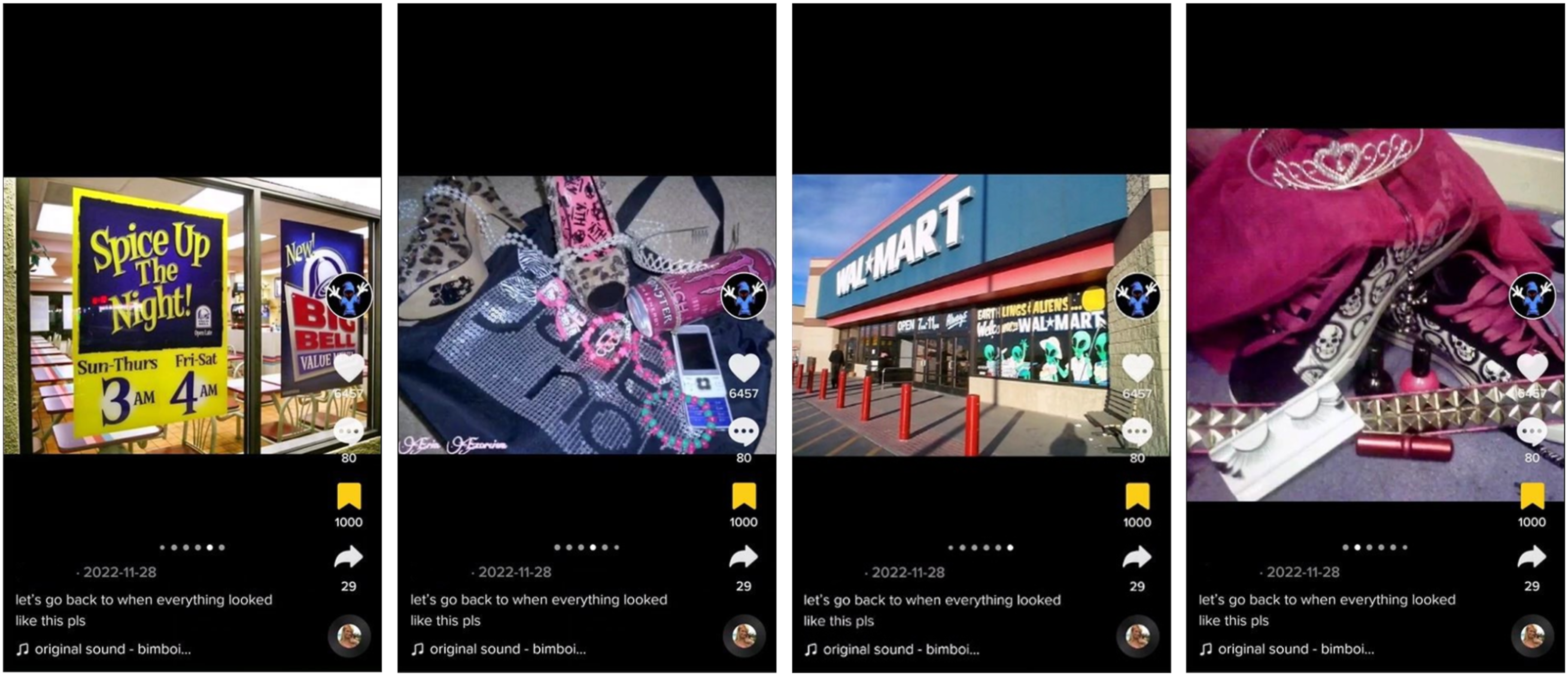
The affective flow is generated via the sequencing of images, sounds and video together. This logic of sequence or flow is found both in the algorithmically mediated feed of platforms and in the image-making practices of the scenes themselves. The two are deeply interconnected. As Tanner (2021) explains it is ‘…hard to tease out where the medium ends and the channelled experiences begin’ (131). The practices of users both curating carousels and videos of images, and the algorithmic models that organise these posts into sequences, reflect Jodi Dean’s description of Twitter even before it had an algorithmic home feed: ‘The flow of tweets transmits what exceeds any specific tweet, that is, a broader, less tangible, more general mood. One even gets accustomed to overlooking tweets in their singularity, enjoying instead getting swept into their flow’ (Dean, 2010: 24).
Tanner (2020, 2021) argues that the algorithmic architecture of platforms like Instagram and TikTok are inherently nostalgic because they function on archival data. This ‘training’ of algorithmic models on the cultural texts of the past is accompanied with our own practices of expression that reflect, if not mimic, the associative curation of images from the past. Algorithms seem predictive, but they are repetitive, recommending media that resemble prior preferences, trained on our past tastes and behaviours, ‘…the result is more of the same: a present that looks like the past and a future that isn’t one’ (Tanner, 2021: 173). In the attention economy nostalgia sells as both training data for models and as content that keeps fingers swiping – nostalgia is recuperated. Technology and nostalgia are fundamentally co-dependent, as Boym (2007) writes, ‘new technology and advanced marketing stimulate ersatz nostalgia – for the things you never thought you had lost – and anticipatory nostalgia – for the present that flees with the speed of a click…’. This anticipatory nostalgia is fundamental to the logics of commercial platforms which privilege the circulation of attention, suspending it in the flow of the feed. Our nostalgic expressions are entangled with the algorithmic architecture of digital platforms.
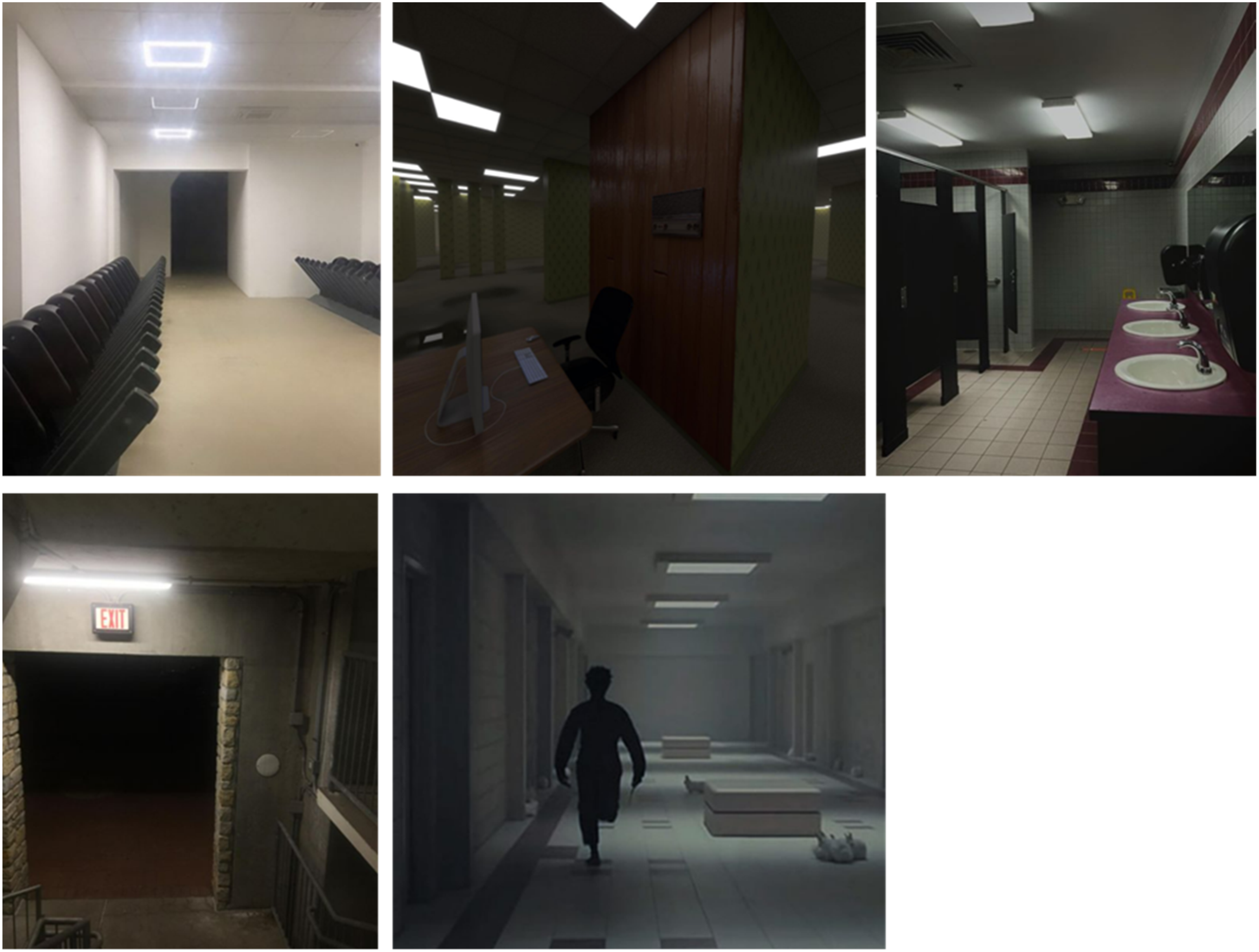
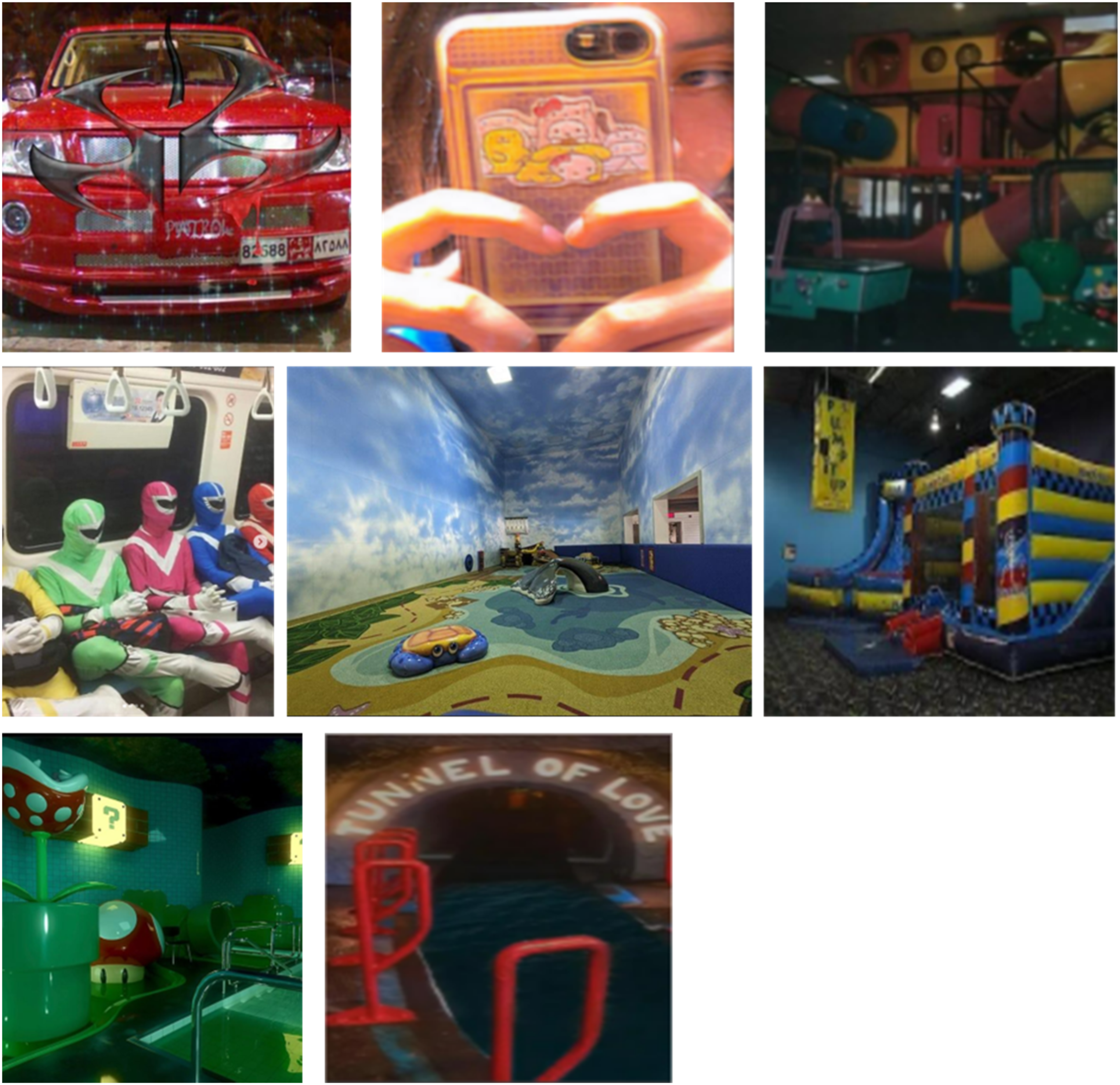
Through our purpose-built machine vision model, we are able to explore this interplay between users’ nostalgic expressions and the algorithmic models of platforms like Instagram. The machine vision model clustered together #nostalgiacore posts in ways which mirrored or reflected the associative curatorial practices of the scene itself. Images of barely lit, empty and liminal corridors stretching endlessly into a dark void are clustered together (see Figure 9), or images that that share a dark red, brown and grey colourway, LED lights, and empty liminal rooms – a bathroom, an office, the underground hallways from the film ‘US’ (2019) (see Figure 10). We also found instances in the model where there was no particular ‘object-orientation’ in the pattern of images the model clustered, rather the images have a particular ‘vibe’ that shared styles and moods expressed in colourways, textures, and filters. Images of playgrounds, jumping castles, cars, 3D artworks, water parks, a selfie and the power rangers on a subway have an aesthetic coherence in the red, green, blue, and yellow colourways, the plastic, and ‘shiny’ textures as well as a slightly blurry and hazy quality (see Figure 11). The machine vision model helps to illustrate both how the #nostalgiacores are ‘readable’ to platforms, but also how the #nostalgicores anticipate and reflect the algorithmic logic of platforms. The model enables us to develop a mode of textual analysis that it attuned to algorithmic media cultures. Images of dark hallways clustered together by the purpose-built machine vision model. Images that share dark red and grey colourway and depictions of empty liminal spaces clustered together by the purpose-built machine vision model. Images that share red, green, blue, and yellow colourways, plastic and ‘shiny’ textures and a slightly blurry and hazy quality clustered together by the purpose-built machine vision model.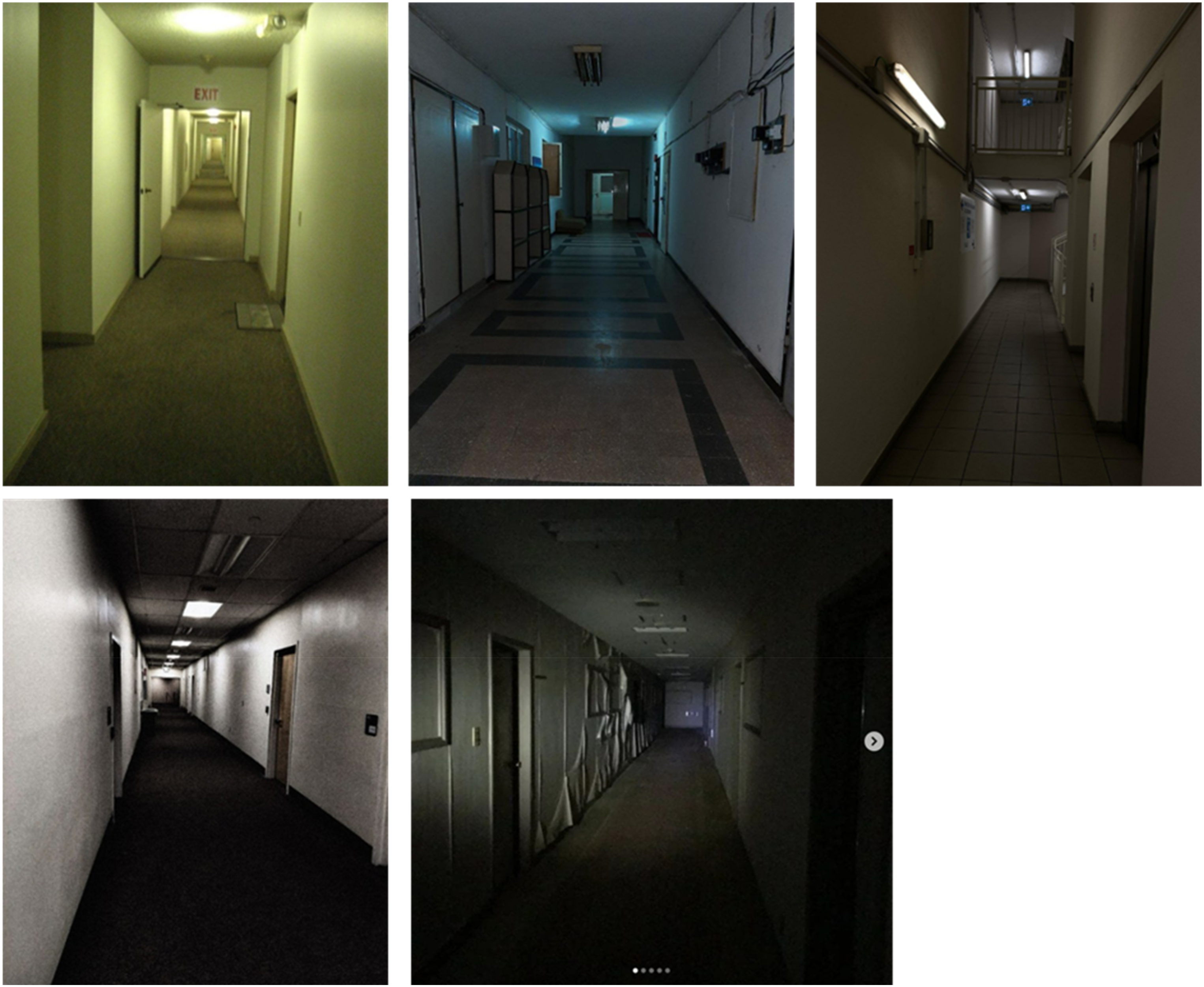
This mode of textual analysis unfolds in two ways. One is to explore collections of texts not just in terms of their meanings to the people who create, circulate and make sense of them, but also how they are processed by algorithmic models that further intervene in our practices of creation and curation. The other is that by always thinking about texts alongside how machine vision models process them as data, we can interpret the ‘algorithmic imaginary’ expressed in texts (Bucher, 2017). For instance, we found instances of algorithmically generated nostalgia as we explored the #nostalgiacores on TikTok and Instagram. A TikTok video by ‘Artiart lab.’ depicted algorithmically generated images of ‘scenes from 1990s/2000s British childhoods’ set to the indie classic ‘Kids’ by MGMT (see Figure 12). Commenters write ‘We are literally the last generation before technology and social media took over’ and ‘Growing up as a kid now days must be so depressing with phones and stuff’. The images, the commenters say, are familiar and relatable but at the same time, off, uncanny and unsatisfying. A TikTok trend recently turned animated series popular in the 90s and early 2000s, such as the Simpsons, Futurama, and South Park into ‘real-life’ 80s sitcoms using image generating models. These forms of algorithmically generated nostalgia are starting to become increasingly common; they are part of a larger cultural sensibility where the entanglement between our nostalgic longing for the past and the nostalgic algorithmic architecture of digital platforms are becoming more interwoven. We have demonstrated how we can see this within particular texts and in the human and machine curation of texts. This is significant as algorithmic models are beginning to shape our (nostalgic) sensibilities. They shape efforts to express our lived experiences in the era of data, digital, algorithmic capitalism – irrespective of our impulses and desires to return to the safety of the past, or to critically reflect upon it. Screenshot from a TikTok video by account ‘Artiart Lab’ of AI-generated images of British 90s and 2000s childhoods.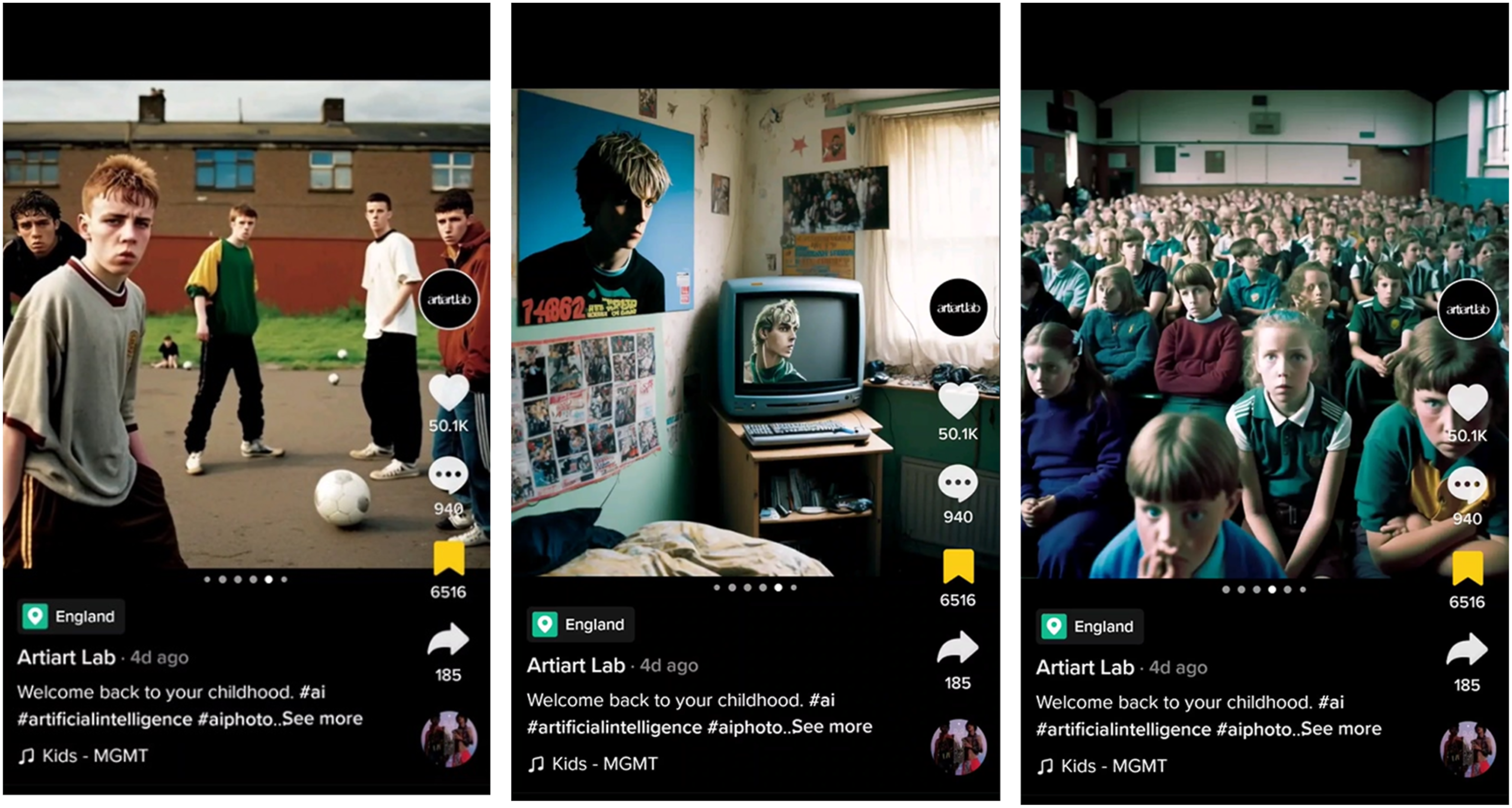
Conclusion
#nostalgicores work as creative efforts to channel lost realities and futures, at the same time, they appear to be calibrated for non-narrative algorithmic media cultures that are commercially tuned to extend the flow of affect and attention. What is the political potential of #nostalgiacores, and other digital intimacies’ nostalgia for the future, if it is unfolding amid the commercial imperatives of digital media platforms? While accounts of nostalgia often create a juxtaposition between comforting memories and unsettling reflections, in this article we have developed an account of the relationships between these nostalgic forms of cultural expression and the recuperative nostalgic techniques of algorithmic models. These affective reflections are not only subsumed into the platform but are also informed and shaped by the algorithmic logics of the platforms themselves. Could these critical reflections simply be more ‘chatter’, data points for an algorithmic system that endlessly metabolises all of human expression (Dean, 2010)?
For the post-millennial generations, who have grown up since the mid-1990s, ‘the internet complex has been the overarching means for not just neutralizing the insurgent energies of youth but for preventing youth from experiencing and knowing itself’ (Crary, 2022: 39). Waking time is enveloped in screens and feeds of content that ‘deny the possibility of the exhilarating discovery of one’s own uniqueness’ (Crary, 2022: 39). Crary’s (2022) withering account of the neutered and programmed digital intimacies jars with critical media and cultural studies’ impulse to affirm the capacities of young people to creatively adapt and use digital media platforms for self-expression and self-discovery. And yet, he points to a feeling that is clearly expressed in the #nostalgiacores. The #nostalgiacores reflect an impulse found throughout other digital scenes, an attempt to understand a larger cultural moment, in particular an attempt to understand the present through our recent ruins, through the recently outmoded and out-of-date. Critically, during a pervasive feeling of cultural stuckness, these digital scenes dredge up pieces of archival media, of given-up technological utopias, ruined mass consumer cultures, and dying collective dreams of better worlds, and curate them, breathing them into life in the present. Far from simply enveloped in screens that deny any kind of critical reflection essential for social transformation, this digital scene not only points towards the past but towards the future, reminding us of what it once looked and felt like.
The #nostalgiacores scene is also characterised by a critique of the medium of digital platforms, commenters often lament the internet is no longer like what it was in the past – particularly as a beacon for a better future. This vernacular medium theory critically and speculatively explores the conversion of cultural expressions into data that is processed by machines in an effort to modulate and commodify our capacity to give and gain attention. Our platform-oriented mode of textual analysis helps us to explore how our digital cultures are both symbolically and technically nostalgic – we share images of the past and those images form archives that train algorithmic models. Analysing textual expression in combination with a machine vision model helps to both apprehend patterns in our visual culture at platform-scale and to speculate about how our practices of expression anticipate and are shaped by algorithms. The model helps us to describe our practices of expression using a digital medium at the same time attend to how the medium itself operates. This is significant not just for understanding the visual algorithmic culture of the #nostalgiacores, but also for identifying everyday politics that aim at the entanglement between digital platforms, machine vision and capitalism.
Our method of doing textual analysis entangled with machine vision demonstrates how this hauntological mediation of the future found in the image-making practices of the #nostalgiacores is both curtailed and enabled by the algorithmic architecture of digital platforms. Algorithms foreclose the future through recuperating archives of the past, with no generation of genuine novelty. This sits in tension with the everyday politics of the #nostalgiacore scene who use the past to point towards the future, a mode of reflective nostalgia. But the scene does so through dredging up pieces of outdated media in the archive, curating images, videos and sounds into an assemblage, and circulating of feelings to grab attention – reflecting the logic of the algorithmic models themselves. These digital cultures in part rely on and are informed by the algorithmic architectures of platforms. What this demonstrates is that both recuperative and reflective forms of nostalgia contradict each other even as they are mutually entangled.
The nostalgia being created, circulated and consumed by the #nostalgiacore scene may benefit commercially driven platforms – in the attention economy nostalgia sells regardless of whether it is critically reflective or not – but this does not render the forms expressions as meaningless. As Fiske (2011) argues, we must not ignore the complementary and contradictory everyday practices of people, ‘…practices by which subordinated groups negotiate these structures, oppose and challenge them, evade their control, exploit their weaknesses, trick them, turn them against themselves and their producers’ (26). And we must now do the work of carefully asking ourselves how this critique, resistance, subversion, and opposition can play out on the platform, just as in the past cultural studies brought this nuanced analysis to other commercial and promotional cultural settings like the shopping mall and MTV. The #nostalgiacores demonstrate the complexity Fiske points towards – between restorative, reflective and recuperative forms of nostalgia. We need to both keep a critical eye on digital platforms that suspend us in an atmosphere of nostalgic longing, at the same time we keep a hopeful eye on the edges of our capitalist worlds (Tsing, 2015), where new potentials can grow from our nostalgic yearning for better futures. The consumption of nostalgia benefits platforms, but we must remember that it benefits us too – cutting against the current crisis of futurity, reminding us that the future is always in play.
Footnotes
Declaration of conflicting interests
The author(s) declared no potential conflicts of interest with respect to the research, authorship, and/or publication of this article.
Funding
The author(s) disclosed receipt of the following financial support for the research, authorship, and/or publication of this article: This research was supported by an Australian Research Council Discovery Project [grant number DP200100519].
