




Abstract
Video-on-demand (VoD) platforms have become primary spaces for encounters with transnational film and television, particularly among younger audiences. The expansion of global US-owned VoD services like Netflix has generated questions about the availability, discoverability, and prominence of domestic and European content, making the issue of how to analyse VoD catalogues pressing. Two perspectives are prevalent in VoD catalogue research: ‘back-end’ research emphasising composition and circulation; and ‘front-end’ analysing content presentation and discoverability. Quantitative methods facilitate comparative and longitudinal analyses of what is found on which VoD catalogues. Qualitative methods examine where and how audiences find content. This article, fostering synergy between the two, probes (1) the significance of VoD catalogue research in understanding the dynamics of transnational content flows and audience behaviours, and (2) its methodological possibilities and limitations. Focusing on British content in European VoD catalogues, it draws on two research projects: EUVoD (Aarhus Universitets Forskningsfond AUFF, 2021–2024), analysing the developing European VoD market within changing conditions of competition and policy; and Screen Encounters with Britain (AHRC, 2022–2025), investigating young Europeans’ use of British film and TV. The article utilises the European Audiovisual Observatory’s databases of European works and the streaming guide JustWatch.com, combined with systematic tracking of VoD landing pages. It thus maps content availability, popularity, and promotional strategies across different European markets and services, showcasing how patterns of presence, prominence and circulation shape probable audience encounters with non-domestic content. The article probes methodological considerations, complexities and caveats applicable to wider catalogue research into transnational media. In the case of British content availability on VoD, it shows how a vast number of ca. 15,000 individual UK titles available in European catalogues boils down to about 200 titles that can be easily found on Netflix, and 70 titles there of that young audiences (aged 16–34) recall as UK shows they know and remember.
Keywords
Introduction
Video-on-demand (VoD) services are emerging as the predominant spaces for encounters with transnational film and television, particularly among younger audiences who have enthusiastically adopted streaming over broadcast services. 1 The expansion of global US-owned services Netflix, Prime Video (Amazon), (HBO) Max and Disney+, which dominate the European subscription VoD (SVoD) market, has fuelled the development of streaming in Europe (Grece, 2021). Their vast catalogues offer content from many countries, but local public service VoDs also feature screen imports, particularly where market constraints limit domestic production. The extent to which VoD catalogues are fuelling or redirecting patterns of transnational content flows is a core concern for studies of audiovisual trade and consumption, and analysis of VoD catalogues is therefore important for understanding these shifts. First, investigation of catalogue composition across different service providers generates findings about strategies and competition among VoD players, improving our understanding of their strategies and market position. Second, catalogue research is important for transnational audience studies, because it allows us to consider the extent to which viewing of domestic and imported content is linked to both availability on VoD services and discoverability (McKelvey and Hunt, 2019).
In research on VoD catalogues two perspectives are prevalent. The first approaches catalogues as databases from the ‘back-end’, with questions about catalogue size, composition, content renewal and circulation. The second studies catalogues from the ‘front-end’ investigating the way they are presented to audiences through interfaces, algorithmic curation, or promotional strategies. Within these approaches, different methods are used to map content offers and structures, for example by using third-party data (e.g. Lotz et al., 2022), scraping of VoD catalogues (e.g. Kelly and Sørensen, 2021), reverse engineering of algorithms (e.g. Pajkovic, 2022), or textual analyses of interfaces (e.g. Johnson, 2019) and scheduling strategies (e.g. Bruun, 2021). To reach a full understanding of catalogues as spaces for transnational encounters a combination of perspectives and methods is necessary.
This article discusses the possibilities and limitations of catalogue research as a tool within the study of transnational media industries and audiences by bringing together approaches from two research projects. The EUVoD project (AUFF 2021–2024, PI Cathrin Bengesser) investigates the development of the European VoD market from a media-systemic perspective, analysing its impact on national audiovisual industries. The project Screen Encounters with Britain (AHRC 2022–2025, PI Jeanette Steemers) studies young (16–34 years) audiences’ experiences with British films and television shows across four European markets (Denmark, Germany, the Netherlands, and Italy), combining qualitative and quantitative audience research for market comparison (Bengesser et al., 2022). Underpinned by the projects above, the article uses British content as a common case study to illustrate the methodological possibilities and limitations of looking at the circulation, presence and prominence of content from different countries within Europe. The methods outlined could also be employed to look at locally-produced content, albeit with some caveats (as detailed below). As such both projects employ catalogue research as one step within a broader investigation into the circulation of VoD content and its consumption by different audiences in different locations. We define ‘catalogue research’ as the qualitative and/or quantitative investigation of content presence, discoverability and prominence within and across localised video-on-demand services. This definition deliberately spans investigations of the catalogue as database and catalogues as content-presentation (i.e. the materialisation of algorithmic, editorial and/or promotional logics applied to the former). Using British content in Europe as a common case study, this article reflects the necessity of catalogue research within media industries and audience studies using different quantitative and qualitative tools: the European Audiovisual Observatory’s (EAO) Lumiere VoD database, the streaming guide JustWatch.com, and systematic tracking of VoD landing pages. Combining these tools to investigate the presence of British content within European VoD catalogues, this article shows how potential encounters with non-domestic content, facilitated by different patterns of content availability and circulation, are filtered and presented differently across specific markets, services, and interfaces.
The article progresses as follows: First, we map the field of catalogue research and the methods employed therein. Second, we discuss the different steps of catalogue research employed by the two projects, taking the circulation of British film and television content on VoD services across Europe as a case study. These steps comprise an analysis of catalogue composition and content circulation across the EU using the Lumiere VoD database; an assessment of content availability and popularity using JustWatch.com in four European markets (Denmark, Germany, Netherlands, Italy); and a study of content promotion and presentation using landing page research across twelve VoD services in these countries in conjunction with audience research (surveys, interviews). The conclusion draws together the methodological insights and drawbacks of each tool. Our focus involves the methodological considerations involved in catalogue research, but we use findings on the circulation and consumption of British content to illustrate how catalogue research is a useful and necessary tool for larger-scale projects spanning media industries, policies and audiences. Although British film and television content is used as a case study, the article involves methodological considerations that are applicable to catalogue research in other European case studies.
The emerging field of catalogue research
In studies of VoD catalogues, a distinction can be made between research that concerns catalogues as (structured) databases, and research that is concerned with the presentation of items within catalogues through publication strategies, algorithms, or interfaces. Within the former, a first question concerns the definition of catalogues and the classification of their elements. Lobato (2018: 242) defines VoD catalogues as the ‘corpus of licensed or owned content distributed by a particular platform at a given time’. From this perspective, catalogues appear as a volume and collection of content that can be compared across countries and services. Lobato (2018) highlights the variations of Netflix catalogue sizes across countries, while Lotz et al. (2022) compare the availability of content from different countries of origin across Netflix catalogues in different national markets. Reports about VoD catalogues in Europe published by the European Audiovisual Observatory (e.g. Grece, 2022; Grece and Jiménez Pumares, 2021) assess levels of European vs. US content in accordance with European regulations. Considering also the temporal aspect of catalogues, Kelly and Sørensen (2021) assess renewal rates of content and compare them across public service platforms. Their mapping of content in rows, categories and collections also provides insights into how catalogues are spatially and thematically structured.
Looking at studies of VoD from the perspective of interfaces involves considerations of space and time, as well as platform affordances. Relevant analytical categories for mapping the space include the terms ‘decks’ (the horizontal categories that users are invited to browse), and ‘tiles’ (the thumbnails or other promotional images used to represent titles in the catalogue). Bruun and Lassen (2023) describe the ‘prime space’ occupied by the upper decks. Bruun (2021), Lassen (2023) as well as Johnson's (2019) study Online TV, stress how the linear logics of scheduling and continuity persist in the streaming environment. Johnson’s (2019) analysis of British VoD catalogues also highlights how VoD interface design constrains, limits, and directs the flow of content from vast catalogues directly to the audience by prioritising certain content over other content, encouraging audiences to watch what is presented to them rather than search the content database themselves. Platforms, however, differ in the ways they coordinate how users discover content (McKelvey and Hunt, 2019: 2), and these differences are often linked to their business models (Park, 2019) and service type (Chalaby 2022).
Different VoD business models alter the research approaches and questions posed in connection with them. Research into large global SVoD services like Netflix (Lobato, 2018, 2019; Lotz et al., 2022) is often concerned with mapping transnational flows of content. What emerges from this research is an awareness that global VoD catalogues are increasingly sites of transnational contestation and competition, crystallising broader anxieties about the unequal power of media flows, creating potential ‘Netflix imperialism’ (Davis, 2021; Elkins, 2019). Local VoD services, often emerging from broadcasters, adapt to global VoD competitors and changing audience behaviour within the constraints of their individual businesses and state of their national markets. Research into public service VoDs is particularly prevalent in Europe, asking how public service remits such as content universality or the focus on national culture and society align with trends towards content personalisation (D’Arma et al., 2024). Bruun and Bille (2022) examine how public service providers Danmarks Radio (DR) and TV 2 Danmark have prioritised documentaries to bolster their competitive standing against SVoDs. Comparing VoD publishing strategies across countries Kelly and Sørensen (2021: 82) find that while the BBC iPlayer (UK) is highly curated like ‘a small shop’, DRTV (Denmark) from DR resembles a ‘large supermarket selling bulk goods’.
For the study of catalogues from the back-end as well as the front-end perspective, the ephemerality of the medium becomes a key issue. Television has always been ephemeral (Holdsworth 2011: 1). The expansion of interfaces and catalogues, and the rise of the subscription economy, reinforces this dynamic with the threat of sudden loss or disappearance and poses a huge methodological question for catalogue research prompting a growing body of work on archiving VoD for research purposes (Bruun, 2021; Kelly, 2022; Stanfill, 2015; Thurman, 2021). Adding to the issue of ephemeral and ‘shapeshifting’ catalogues are personalisation and algorithmic opacity (Kelly and Sørensen, 2021). There is no single experience of catalogues, which more closely resemble a ‘series of national services linked through a common platform architecture’ (Lobato, 2018: 245). The algorithms steering content offer, recommendation, and personalisation appear as a ‘black box’ to both the public and academics (Bucher, 2016), which means that researchers often rely on experiments in ‘reverse engineering’ to ascertain how, for example, Netflix caters to different taste communities. Pajkovic (2022) explores the circular and economic logics of the Netflix Recommender System (NRS), raising concerns about its potential to standardise cultural preferences through feedback loops and filter bubbles, in what Arielli (2018: 86) calls ‘algorithmic self-confirming aesthetic consumption’.
Regarding the use of content presented by interfaces, other studies delve into user behaviour around content discovery (Frey, 2021; Matthew, 2020) and the effects of content placement using viewer data provided by third parties (Thurman et al., 2023). Matthew (2020) suggests that Netflix’s data-driven personalisation builds a highly constrained experience, leading to frustration, confusion, and misdirection. Likewise, Thurman et al. (2023) emphasise the role of choice architecture and content attributes in shaping user behaviour, highlighting subtle influences through visual thumbnails and programme prominence on VoD interfaces. Frey (2021) highlights, however, that few viewers rely on algorithmic recommendations alone in their choice of content.
To document and analyse catalogues, researchers have utilised diverse sources and methods, involving databases, third-party data providers (Lotz et al., 2022; Thurman et al., 2023), scraping data from individual or multiple platforms (Kelly and Sørensen, 2021), longitudinal in-depth interviewing with industry practitioners (Sørensen, 2020), monitoring specific services (Bruun, 2021; Bruun and Bille, 2022) or conducting textual analyses of interfaces (Johnson, 2019). They differ not only in the use of quantitative or qualitative approaches, but also in objectives such as archiving and descriptions of content availability, cross-country comparisons, or integration with other research methods. That said, a notable research gap is to be found in the combination of back-end and front-end research on VoDs.
This article seeks to address this gap by bringing together approaches to catalogue research developed within two research projects. The EUVoD project examines catalogue composition to map and compare patterns of content circulation across European countries and different VoD business models, seeking insights into the dynamics of European competition. Screen Encounters with Britain focuses on the availability and discoverability of content for younger audiences (16–34s), engaging with different services to understand how variations in content offer and presentation may affect viewers’ actual use of content (explored through surveys and interviews). By analysing the circulation of British content as a shared case study, this paper examines how the combination of back-end and front-end perspectives can generate a more nuanced understanding of how VoD platforms function as spaces for encounters with content from different countries.
Circulation analysis of UK content using the Lumiere VoD database
Considering the dominance of US-American content in Europe, the promotion of European programming has been high on the European media policymaking agenda ever since cable and satellite TV appeared in the 1980s. The Television Without Frontiers Directive (TWF) in 1989 established the principle that a majority of programmes on broadcast channels should be of European origin. The 2018 revision of the Audiovisual Media Services (AVMS) Directive extended European quotas to VoD catalogues, setting it at a minimum of 30%. The AVMS directive belongs to European policies seeking protection for domestic content producers from US giants (Broughton Micova et al., 2018). In addition to this regulatory approach, European cultural policy, mainly through the Creative Europe programme, seeks to promote European creative industries including the circulation of European fiction productions (Primorac et al., 2017). Despite Brexit, UK content is included in the AVMS’ definition of European works as it pertains to signatories of the European Convention of Transfrontier Television (Cabrera Blázquez, 2021: 14). This definition of European content may, however, be changed in the upcoming revision of the AVMS in 2026. In 2021, an unpublished EU document argued that British content could be excluded from the VoD (30%) and broadcast (50%) quota for European content to address potential ‘disproportionality’ of British content over European works from smaller countries (Boffey, 2021). The case of British film and TV highlights how questions of VoD content circulation are politically important and how political intervention in content flows may impact on national media industries.
European political interest in protecting and supporting European audiovisual industries has led to many reports about the shares and circulation of European content on broadcast and VoD (e.g. Grece and Jiménez Pumares, 2021; Grece and Jiménez Pumares, 2022; Mosoreanu et al., 2023). The European Commission and Creative Europe have also supported the development of ‘Lumiere VoD’, a directory of the availability of European content on VoD. Launched in April 2019 under the auspices of the European Audiovisual Observatory (EAO), this venture aims to promote the visibility of and access to European film (European Commission 2019). The database has expanded to include European television content in over 1200 VoD catalogues across 31 countries. The database contains all European film titles and TV seasons by country of origin, age, directors as well as name, country and business model of catalogue (SVoD, TVoD, FVoD). Sports and news content are not part of the dataset. The data is provided by JustWatch (see below) updated every 3 months. It therefore affords a snapshot into the availability of European works 2 in VoD catalogues in Europe. For research on the circulation of European content, Lumiere VoD data are useful for tracking patterns of content flows through the combination and cross-referencing of catalogue data from different countries.
To analyse the circulation of UK content, Lumiere VoD data on titles available on VoD as of 1 October 2022 were downloaded for services in 25 EU countries (excluding Luxembourg and Cyprus) plus the UK. The data include title, co-producing countries, name of the VoD service on which the title is available, the service’s target country, and its funding model. Before delving into the details of the data, a cautionary word on determining the country of origin of titles is necessary. To assess the availability of titles in the dataset by producing country, only the first listed production country was considered. This reduction was made under the assumption that the first production country would be the majority producer in most cases as the EAO’s Lumiere database aims to list production countries in the order of size of financial involvement and disclaims that this classification “is not an indication of the official nationality of a work as assessed by a national film fund or a national regulator” (European Audiovisual Observatory, 2024). This assumption is not always accurate as several UK minority co-productions like Baby Driver (2017) or Three Billboards Outside Ebbing Missouri (2017) have entered the sample with the UK listed first. However, a manual assessment of production countries would be unfeasible for 87,762 unique titles in the dataset, and less transparent than following the EAO’s assessment. The classification of country of origin based on funding reflects industry practice (and replicates listings in IMDb), but does not necessarily correlate with filming location, language or cultural ‘feel’ to audiences. Since the focus of this analysis is the competitiveness of titles emerging from within Europe, titles produced by first-producing countries who are not parties to the Convention of Transfrontier Television (e.g. the USA) were excluded from the analysis, even though European minority co-productions ‘count’ as European under the AVMS definition.
There are 20,489 unique British first-produced film titles and TV seasons in circulation across the 26 countries in the dataset, which reduces to 15,584 unique titles. On average, British first-produced content accounted for 29.5% of European first-produced films and seasons in catalogues outside the UK, but this share varies greatly across the EU from 17.9% in France to 56.1% in Ireland (Figure 1). The non-English speaking country with the highest share of UK-first produced content in its European content offer is Hungary with 37.5%. In larger European markets (Germany, France, Spain, Italy) shares of domestic content easily surpass British material (blue). In markets with larger same-language neighbours (e.g. Austria/Germany; Belgium/France) (yellow), UK content is also surpassed by these exporters. In all other markets, except Malta and Croatia,
3
UK content constitutes the largest proportion of European film and television content on VoD (red). This difference between large and small countries in Europe supports Screen Encounters with Britain's rationale for investigating the variations in engagement with British content in larger countries with sizeable domestic production (Germany, Italy) vs. smaller ones (Denmark, the Netherlands) where British imports play a larger role in fulfilling European content quotas. Share of UK first-produced films/TV series in European first-produced content on VoDs (October 2022, Lumiere VoD). Figure produced by authors.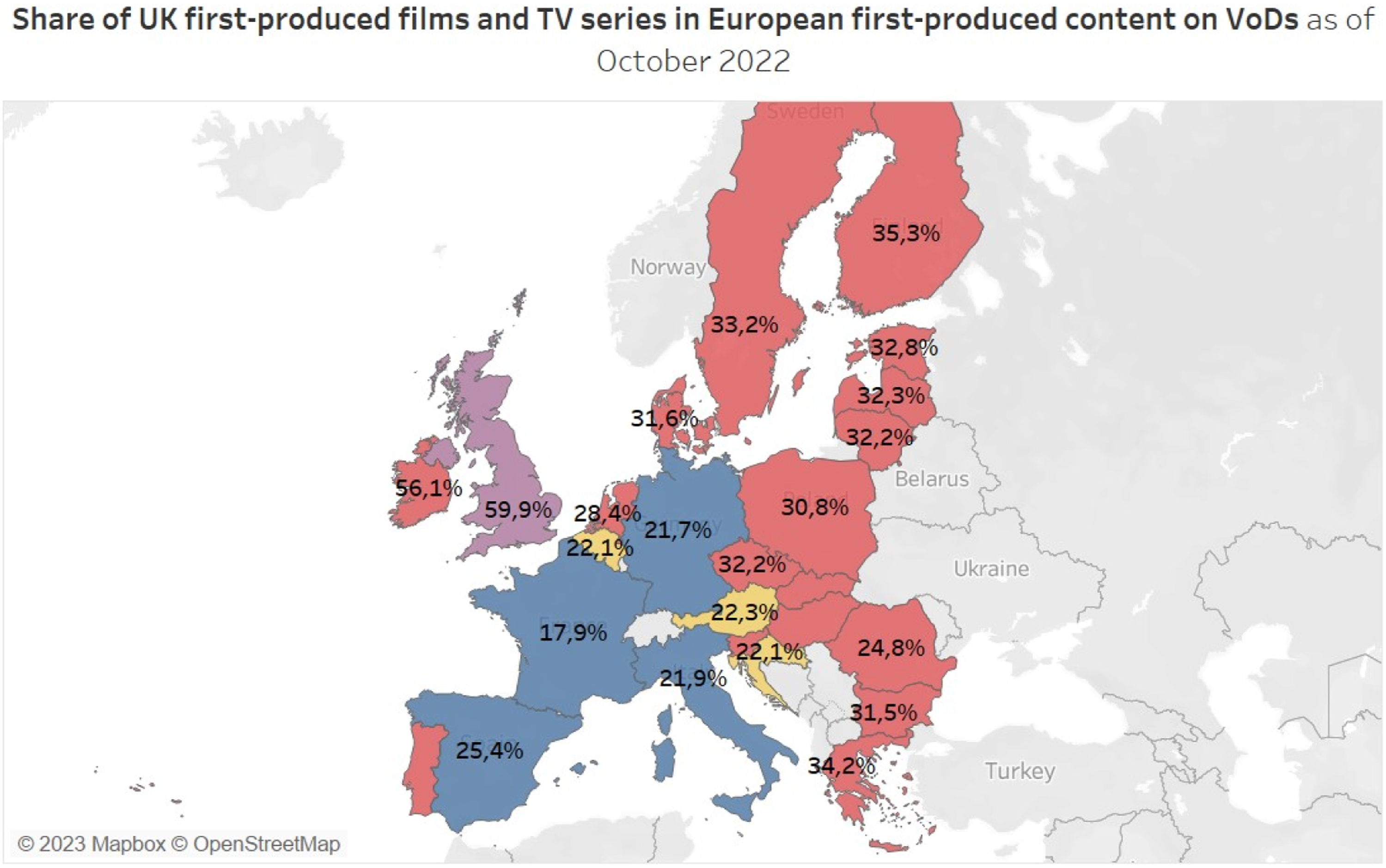
Using Lumiere VoD data we can also analyse catalogue composition of specific services to investigate patterns and differences in content strategies. In Netflix’s European offer (Figure 2), we see relatively similar shares of British content across EU countries averaging 27.9% and varying between 21.7% in Austria and 37.6% in Malta. Even against domestic content, British content is clearly the most prevalent European offer for EU audiences of Netflix. In Germany, the largest market, domestic content accounts for 19.4% of Netflix’s European offer, while British content stands at 21.6%. Considering the vast number of total British first-produced titles in VoD circulation (15,584 unique films and TV titles), the British content across all European Netflix catalogues consists of relatively few titles, namely 1165 unique British first-produced film and TV titles. This means that Netflix represents only 7% of all British first-produced films and TV titles in VoD circulation in Europe. However, these titles tend to circulate across many countries simultaneously. On average, each British first-produced title is available in 25 of 26 Netflix catalogues in the dataset. Therefore, we can hypothesise that Netflix plays an important role in exposing Europeans to the same British content across borders. Comparison of domestic and UK titles within European-first-produced films and TV seasons in Netflix catalogues for individual countries (Lumiere VoD, Oct 2022). Figure produced by authors.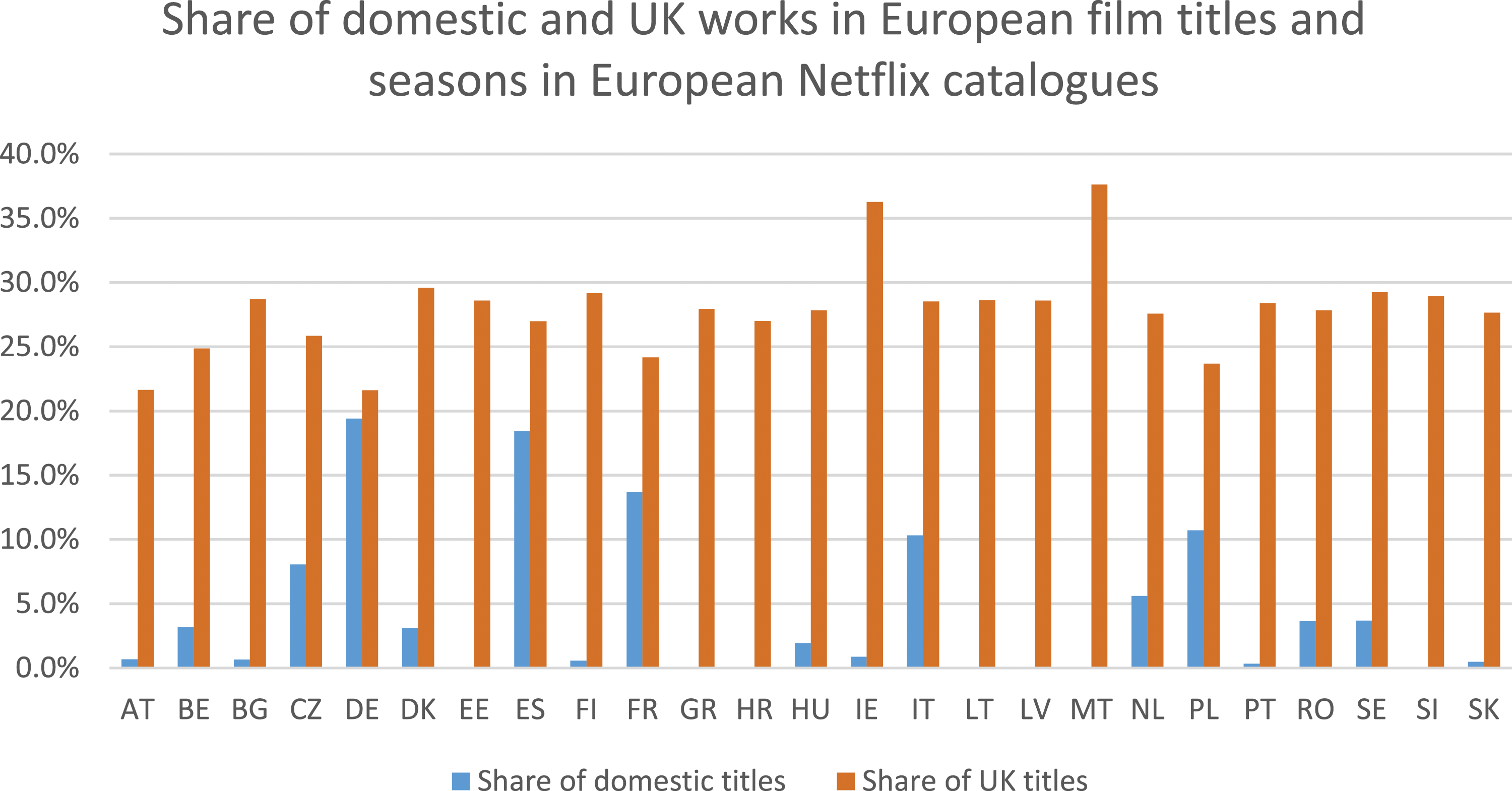
Digging deeper into the circulation patterns of individual titles, the Lumiere VoD data allow ranking of titles with the highest circulation, i.e. the titles available in the largest number of catalogues and countries. Figures 3 and 4 showcase the top 10 circulating UK first-produced films and top 10 UK first-produced series.
4
Nearly all these titles were available across all 26 markets surveyed. The split according to the financing model of the VoD service indicates that transactional VoD services like Google Play, iTunes, or Blockbuster play an important role in the circulation of British film (Figure 3). For series, SVoDs like Netflix or Prime Video are the main circulators while free VoD services play a minor role (Figure 4). Number of catalogues in which the top circulating UK first-produced film-titles were available in October 2022 by VoD funding model. Figure produced by authors. * Baby Driver has since changed attribution from UK to US in the Lumiere VoD database. Number of catalogues in which the top circulating UK first-produced series were available in October 2022 by VoD funding model. The number of catalogues indicates the average over all the series’ seasons available in the dataset. Film and TV series with more than two seasons are in capitals, showing an average across the separate seasons. Figure produced by authors.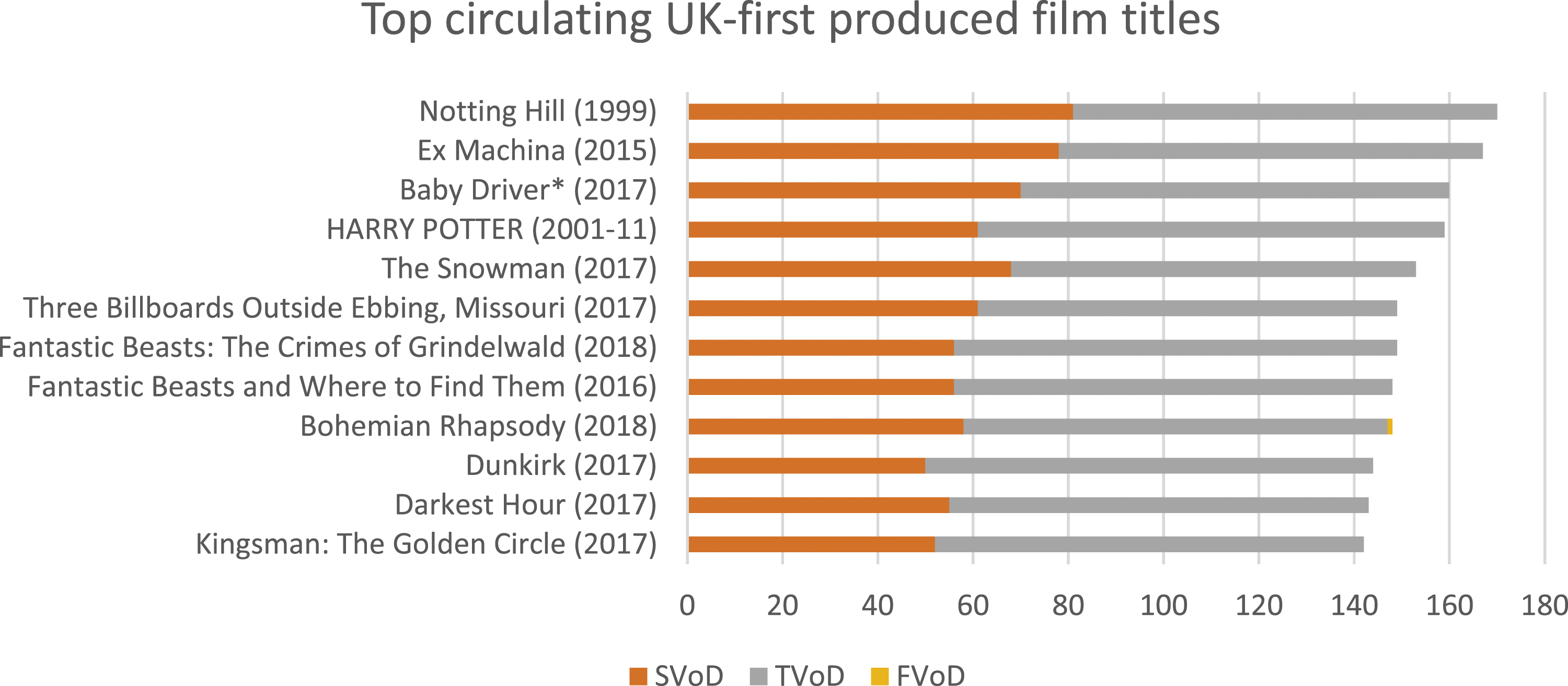
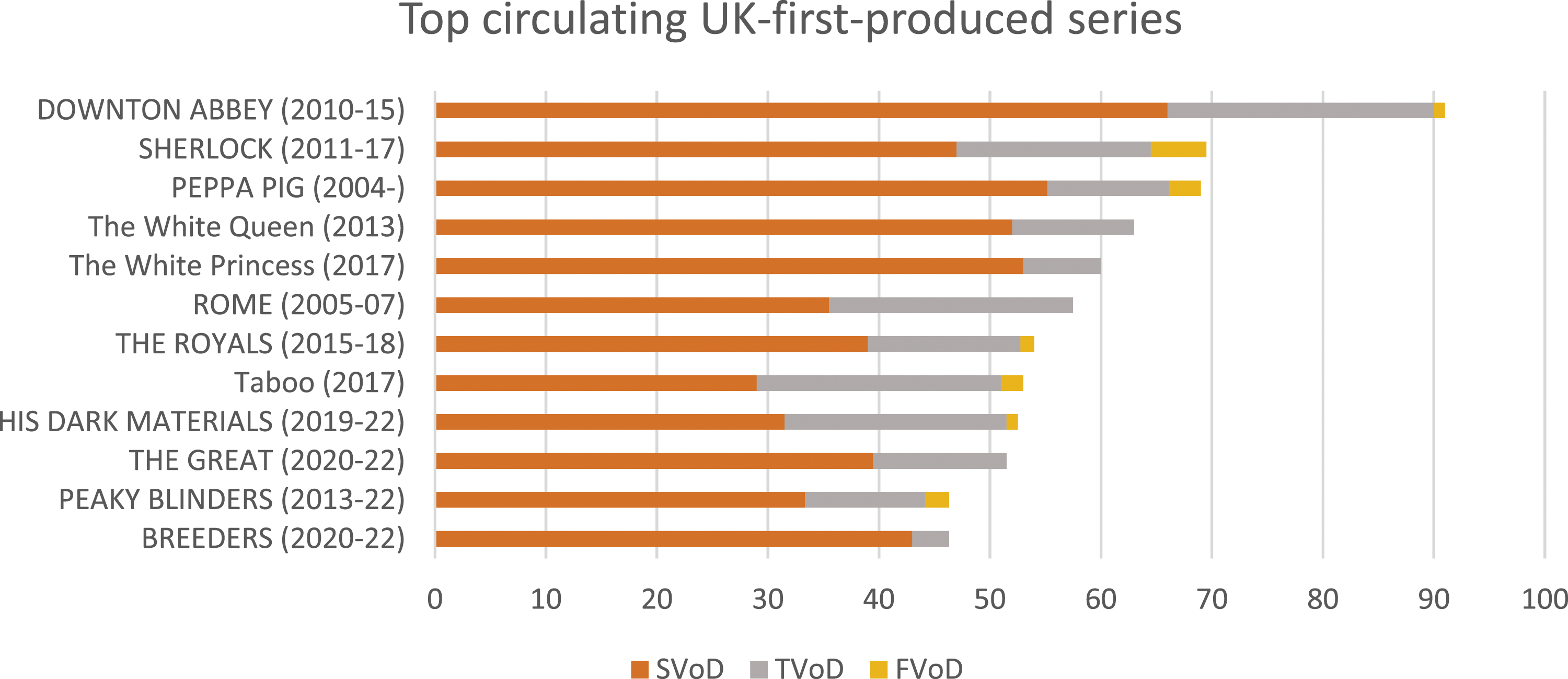
The top titles in circulation are a mix of older British material (e.g. Harry Potter [2001–2011], Downton Abbey [2010–2015], Peppa Pig [2004–present], Sherlock [2010–2017]) and relatively recent, but not brand-new productions (e.g. Bohemian Rhapsody [2018], His Dark Materials [2019–2022], Breeders [2020–2023]). The lack of recent titles in the lists can be explained by the importance of exclusivity for new releases, particularly for subscription-funded services (Lotz, 2017: 33–60). For the Screen Encounters with Britain project, this list functions as an indicator of titles that European audiences may have encountered on VoD services because of their availability. However, this does not necessarily indicate that they are the most viewed or popular titles.
The Lumiere VoD database provides valuable insights into the composition of VoD catalogues in different countries, as well as circulation patterns of content of different origin or specific titles. It is useful for analysing import/export flows of European content within Europe, particularly when assessing levels of catalogue localisation in domestic and geo-linguistic markets. Overviews of catalogue composition and circulation patterns can help to answer research questions arising from political concerns about European content, such as issues around British content’s prevalence in VoD offers or the presence of films from small markets on VoD services (Bengesser, 2024b). It is also useful for investigating and comparing European VoD industries (Bengesser, 2024a) and for building hypotheses about the role of catalogue composition among players with different business models, a core concern of the EUVoD project. For an audience research project like Screen Encounters with Britain, hypotheses concern differences in the status of British content in small and large markets, as well as pinpointing highly circulating titles that are likely to have shaped audience impressions of British films and TV programmes in Europe.
The big caveat of the data in the Lumiere VoD database is their exclusive focus on Europe; that is, content produced or co-produced by countries that are members of the Council of Europe. While this helps to show how European content circulates, it does not allow consideration of US productions which account for 49% of film titles and seasons on European VoDs (Grece, 2022: 10). Since Lumiere VoD offers no information about the size of the complete catalogues, it cannot be used for monitoring quota compliance of individual services. A further limitation of the Lumiere database is its policy of content updates since it only ever gives an insight into the composition of catalogues at that moment in time when the data were collected for display in the database. It is not currently possible to go back in time to compare catalogue composition over different periods unless one downloads the data at each content update. The three-month intervals between data updates also pose a challenge for the analysis of VoD platforms with high content turnover. New and potentially highly promoted titles can therefore be missed. Finally, there are gaps in the documentation of certain individual services, which became apparent when cross-checking between Lumiere VoD and the actual availability of titles on landing pages (see below).
The biggest consideration when using the Lumiere VoD database in audience-focused projects is the necessary distinction between availability and discoverability. The database contains many catalogues (1200), providing insight into the content accessible to European audiences. However, the relevance of these catalogues varies across individual markets. Looking only at the SVoD market in Europe, 63% of VoD subscriptions at the end of 2022 were attributable to only three services: Netflix, Prime Video and Disney+ (Bengesser, 2024a: 194). At the same time, there are important differences between countries. As per the European Audiovisual Observatory's Yearbook's pan-European data tables Prime Video, for example, is the most subscribed VoD service in Germany with 12.2 million subscriptions as of December 2022 (24% more than Netflix), but it is of low relevance in Denmark with less than a quarter of Netflix’s 1.2 million subscriptions. Content on services with low relevance has a lower chance of being discovered by audiences. In the context of audience research, the Lumiere VoD data on the numbers of titles circulating, as well as their availability in a given number of catalogues, must therefore be evaluated based on the relevance of services for specific audiences in individual markets. Lastly, and most importantly, the data about the composition of catalogues do not indicate the prominence or popularity of these titles on the VoD interfaces. To assess prominence effectively, the Screen Encounters with Britain project offers insights through its estimation of content popularity based on JustWatch and a closer Landing Page analysis of relevant services, complemented by audience surveys and interviews.
Catalogue analysis using JustWatch
As previously outlined, the Lumiere VoD database provides a useful indication of the numbers of British TV series and films available in VoD catalogues in different countries, both for large transnational platforms like Netflix or Prime Video (Amazon) and for smaller national services like TV 2 Play in Denmark. However, when documenting programming catalogues alongside audience research, important gaps emerge. The Screen Encounters with Britain project aims to provide an overview of precisely which British titles are available to audiences in the project’s case study markets at the time audience surveys and interviews are conducted. Yet the most recent and perhaps also the most prominent titles may not be present in the Lumiere VoD database, because it is only updated every 3 months. Second, in the case of some public service broadcasters in Germany, for example, listings of UK programming in Lumiere VoD have been very low. In Lumiere VoD data with a presence date of 1 October 2022, only one license for British content (the co-produced documentary, The Mole: Undercover in North Korea [2020]) was showing for the ZDF Mediathek, while an examination of the ZDF Mediathek on the streaming guide JustWatch revealed more titles. This discrepancy may be due to regulations that limited the availability of licensed content from Europe and overseas on German PSM VoDs to 30 days (see: MSTV, 2023 § 30). Analysis of JustWatch for all shows available on the ZDF Mediathek (numbering 215) on 16 February 2023 revealed 9 UK shows, including crime series like Death in Paradise [2011–present], Endeavour [2012–2023], Silent Witness [1996–present], Line of Duty [2012–2021], Trapped [2015–present], Father Brown [2013–present], and Shakespeare & Hathaway [2018–present], in the top five rows of JustWatch, many of which also appeared later in the Landing Page Research (see below).
JustWatch is a mobile application and website that allows users to see which films and shows are available on different platforms in particular territories, and to save these in a personal watchlist. The company is also a data provider to the Lumiere VoD database. We focused on data that can be gathered for free using the consumer-facing JustWatch.com website. JustWatch allows for an estimation of numbers of titles available on different platforms from all origins, including the US (unlike Lumiere VoD). Under the listing ‘Popular All’ it shows that transnational platforms have much larger catalogues (Netflix c. 6110–7303 in each of our four case study countries) than national providers (e.g. 215 for the ZDF Mediathek in Germany, 621 for NPO Start in the Netherlands, or 849 for DRTV in Denmark, see Table 1). The ‘Popular All' feature offers some indication of what is ‘popular’ in a particular country at a particular time through Justwatch users' searches and watchlists, but is not based on data about actual consumption/viewing. It does, however, serve as an indication of what viewers might be searching for on a particular day, close to or during audience surveys in any market, and where UK programming might rank against US programming, which usually appears in the top decks of ‘Popular All' listings.
A filtering system allows JustWatch users to further refine ‘Popular All’ by choosing availability according to services, new additions, and European content alone under the ‘Genres' category. Applying the ‘Made in Europe’ filter may function as a proxy for determining the share of European produced and co-produced titles within a catalogue. At time of writing, an additional filter for production country was only available in Germany for an extra subscription, and previous attempts to subscribe while based in Denmark and the UK were not successful.
For the purposes of the Screen Encounters with Britain project, JustWatch was used as a supplement for the catalogue documentation garnered from Lumiere VoD. Different platforms were documented on 1 day during the survey in each case study country to: (a) track the prominence of available UK titles during the Landing Page Research (see below), (b) check content availability against what survey and interview respondents stated they had been watching, (c) cross-check the availability of UK titles against concurrent promotional initiatives on social media including TikTok, Instagram, Facebook, Twitter, and YouTube
Selection of VoD platforms documented on JustWatch with total number of titles for ‘Popular All’ [all titles listed on JustWatch for the catalogue]; total for ‘Popular Made in Europe’; and estimates of UK titles/co-pros listed within ‘Popular Made in Europe’ for each platform
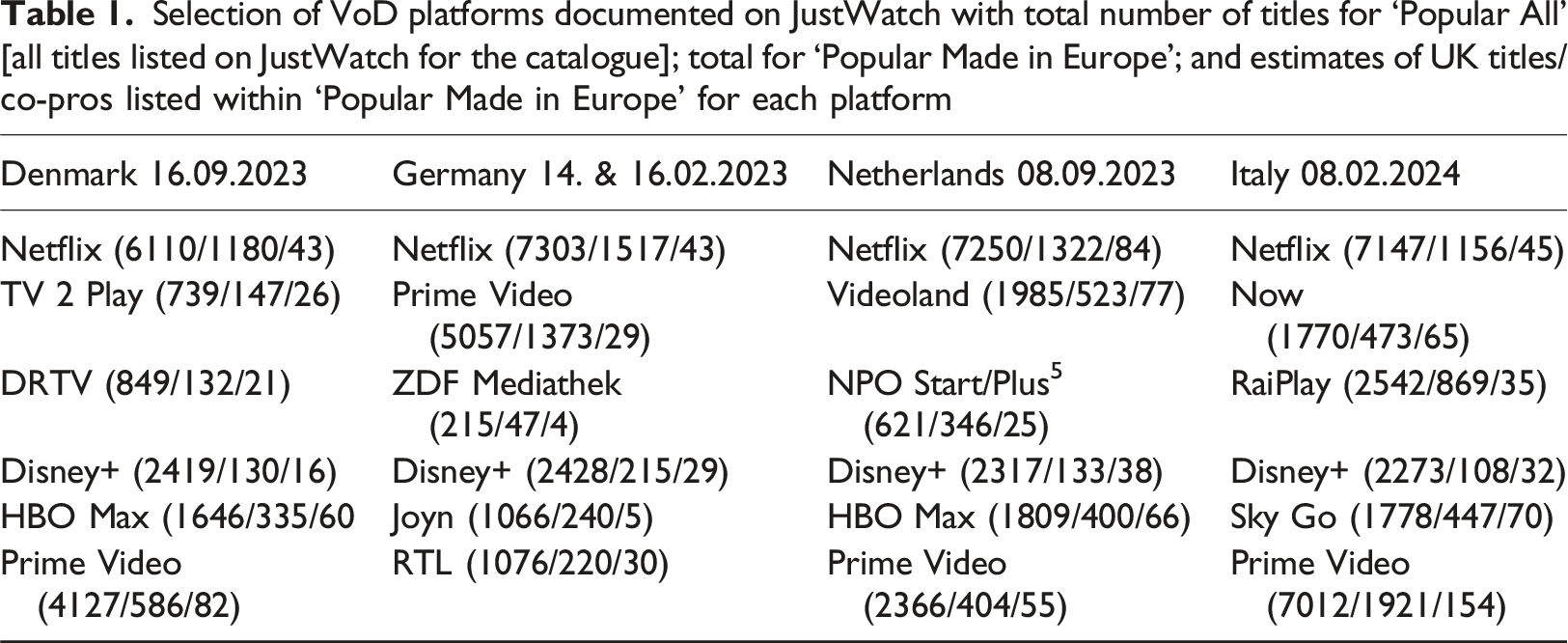
Documentation of UK content on JustWatch followed these steps. First, we took a vertical screen shot of ‘Popular All’ for all platforms in Table 1 to document the total number of titles available to the public and the number of UK shows listed in the top 25 rows. Next, we applied the ‘Made in Europe’ filter to the ‘Genres’ category to ascertain how many UK shows were listed within a European selection. For each platform we screenshot everything in ‘Made in Europe’ to establish which UK programmes were available and where they appeared in JustWatch’s popularity ranking. The data for each UK title was then added to a catalogue database, also containing data from Lumiere VoD and the Landing Page research (see below) for comparison. To keep the data collection manageable, we concentrated on unique titles rather than different seasons of the same show.
Taking a vertical screenshot of ‘Made in Europe’ on a particular day for a particular platform offers an estimate of the number and types of UK titles circulating within the European offerings of platforms on any one day. This allows some indicative assumptions to be made about the popularity of UK shows based on their ranking within the screenshot. UK programming often appears prominently in the top lines of any ‘Made in Europe’ search. For example, the top 5 decks for Netflix Netherlands ‘Made in Europe’ on 9th September 2023 revealed at least 18 UK titles out of 40. These include long-running, highly recognisable, but not necessarily new series and films, such as Peaky Blinders (2013–2022), The Crown (2016–2023) and Paddington (2014).
However, ‘Made in Europe’ also presents content that might not necessarily feel European or British to audiences, for example, The Hitman’s Bodyguard (2017). According to JustWatch the ‘Popular Made in Europe’ category is based on metadata from IMDb, TMDB [The Movie Database, a popular, user-editable database for movies and TV shows] and the Lumiere database. These tend to classify programmes as British or European, even if the UK has only been a minority co-producer (e.g. the US/GB film Baby Driver). Therefore, a mostly ‘American’ film (cast, setting, funding, story) with some co-production involvement from a UK or EU investor appears under the ‘Made in Europe’ filter. This caveat about what qualifies as European or British also applies to the Lumiere VoD data detailed above. Regarding the definition of British content, what mattered for the Screen Encounters with Britain project in terms of audiences was what respondents identified as British, regardless of how a programme might be classified on IMDb or Lumiere VoD. For example, costume dramas Bridgerton (2020–present) and Outlander (2014–present), featuring UK settings and UK casts, are often identified as British by respondents. However, they are not listed as European productions in JustWatch, or as UK productions in the Lumiere VoD database, and IMDb categorises them as US productions.
Documenting JustWatch enabled us to verify which UK titles had been recently added to key VoD platforms. It also gave us some indications of the content that audiences might be searching for in the given territory, which could then be cross-checked with survey responses. However, there are inconsistencies. JustWatch’s estimates of the total size of the Netflix catalogue in each country (6110–7303 titles) compared to estimates of content Popular Made in Europe (1180–1517 titles) in each country for Netflix, is much lower than the figures obtained through Lumiere VoD, which lists an average of just under 3000 European (co-)produced unique titles per Netflix catalogue. Additionally, the discrepancies between what is listed as European from screenshot searches within ‘Popular All’ against ‘Popular Made in Europe’ (see Table 1) suggests some caution is needed in how numerical totals from JustWatch are applied, whether for documenting transnational platforms like Netflix or other platforms.
As a tool for documenting UK content in VoD catalogues, JustWatch offers a useful complimentary snapshot of content offers on any given day, as well as a comparison of the size of catalogues in different territories. However, there are significant drawbacks. First, this is a time-consuming process, involving multiple screenshots and manual checking against IMDb and Lumiere classifications for country-of-origin data, which are not necessarily consistent in determining the lead country. It offers only an estimated temporal snapshot of what is available on 1 day, and what might be deemed more ‘popular’. For the purposes of the Screen Encounters with Britain project, this snapshot helped us to understand better which British content might be prominent and perhaps popular at the time when we surveyed audiences in different markets about the UK content they had viewed.
Landing page research
Alongside Lumiere VoD and JustWatch catalogue documentation, landing (or homepage) research (LPR) of the top VoD platforms offers a way of ascertaining what British content is being promoted at a particular time and space within the interface. For each case study country we picked three platforms that are relevant to our target audience, aged 16–34. These were the same as the first tier of JustWatch platforms, namely: • Denmark: Netflix, DRTV, TV2 Play • Germany: Netflix, ZDF Mediathek, Prime Video • Netherlands: Netflix, NPO Start/Plus, Videoland • Italy: Netflix, RaiPlay, Now
Our survey data among 16–34-year-olds, along with secondary data, indicated that three or four top VoD platforms – Netflix first, typically followed by YouTube and Disney+ – dominate both the streaming market and general long-form content viewing among this age group. Other VoD providers have substantially less presence or barely featured at all. There are variations among countries. Prime Video (Amazon) was less significant for survey respondents in Denmark, coming tenth in terms of use (Esser et al., 2023a: 11), but more important in Germany, coming third after Netflix and YouTube (Esser et al., 2023b), and in Italy where it came second (Esser et al., 2024, forthcoming: 11).
For each service over 7 days including a weekend, a research assistant located in the relevant country checked for British programming on landing pages across a range of categories, avoiding holiday periods. This research was timed to occur during an audience survey, but before digital diaries that tracked 5 days of viewing, followed by one-to-one interviews. The chosen platforms were searched daily for UK screen content using ‘pure’, newly created accounts with limited personal information (age) and no expression of genre preferences. Moreover, to limit personalisation as much as possible, browser data and cookies were cleared every day. However, it is by no means certain that this can be excluded totally. A vertical Landing or Home Page (LP) screenshot was taken daily for each platform, plus horizontal screenshots of selected deck categories on different days.
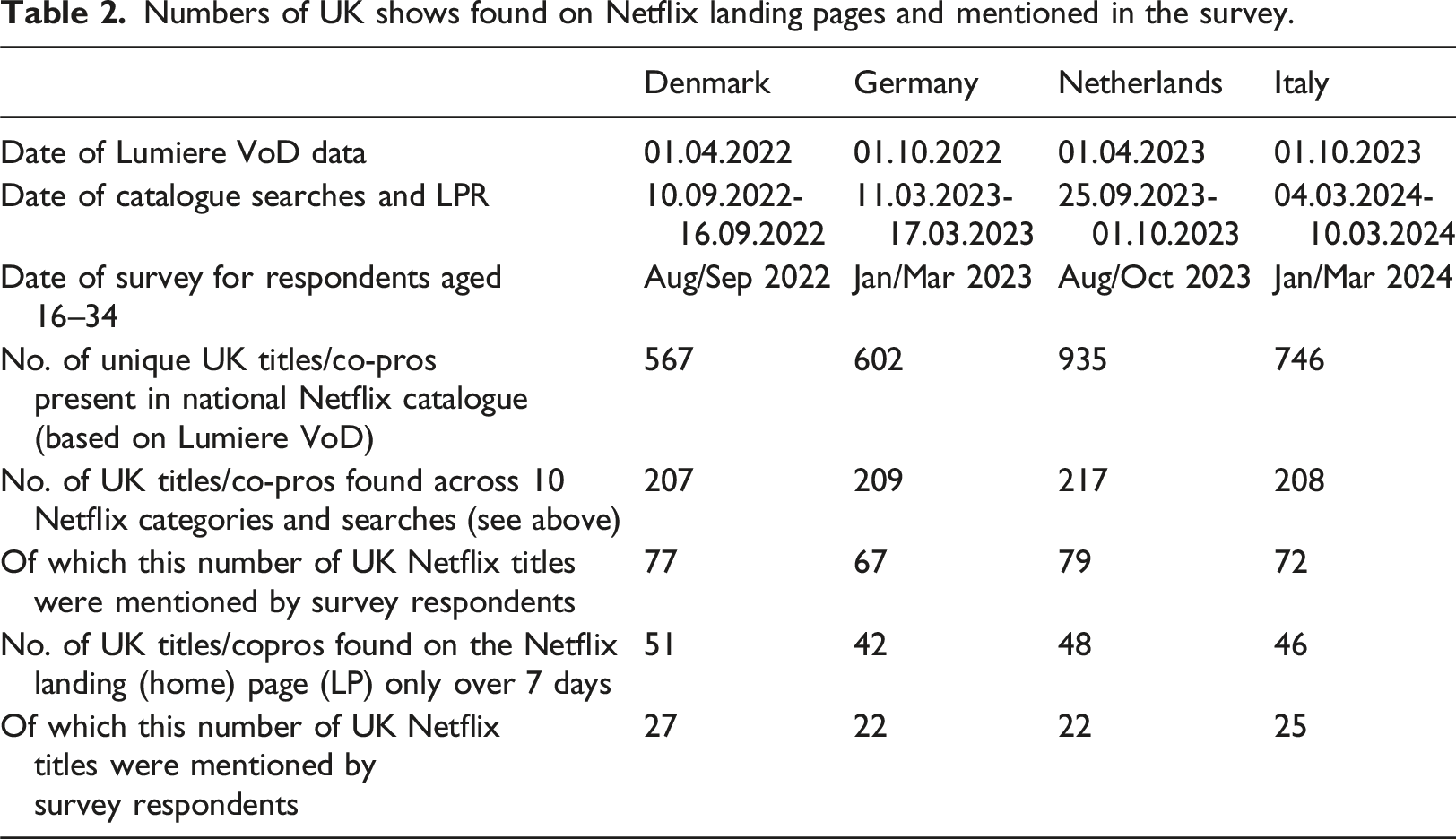
For Netflix, the only platform that was documented across all territories, a distinction was drawn between categories presented to viewers, and those that viewers had to actively search for. The categories documented on Netflix were chosen to provide a variety of shows that appeared prominently, and to create a sample that allows comparison across four countries. Since UK content prominence was the focus of the landing page research, we included screenshots of the following categories: • A daily vertical screenshot of the Netflix Landing (Home) Page including all horizontal decks, noting which UK shows were positioned closer to the top. • Top 10 TV Programmes for that day (daily) – not for Denmark • Top 10 Films for that day (daily) – not for Denmark • Top 10 TV Programmes for that week • Top 10 Films for that week • Popular on Netflix (the top 25 rows on 2 days)
Additional one-off searches were undertaken for the search terms ‘British Films’, ‘Popular in British Films’, ‘British Programmes’ and ‘Popular in British Programmes’, culminating in ten categories where UK content could be found.
Numbers of UK shows found on Netflix landing pages and mentioned in the survey.
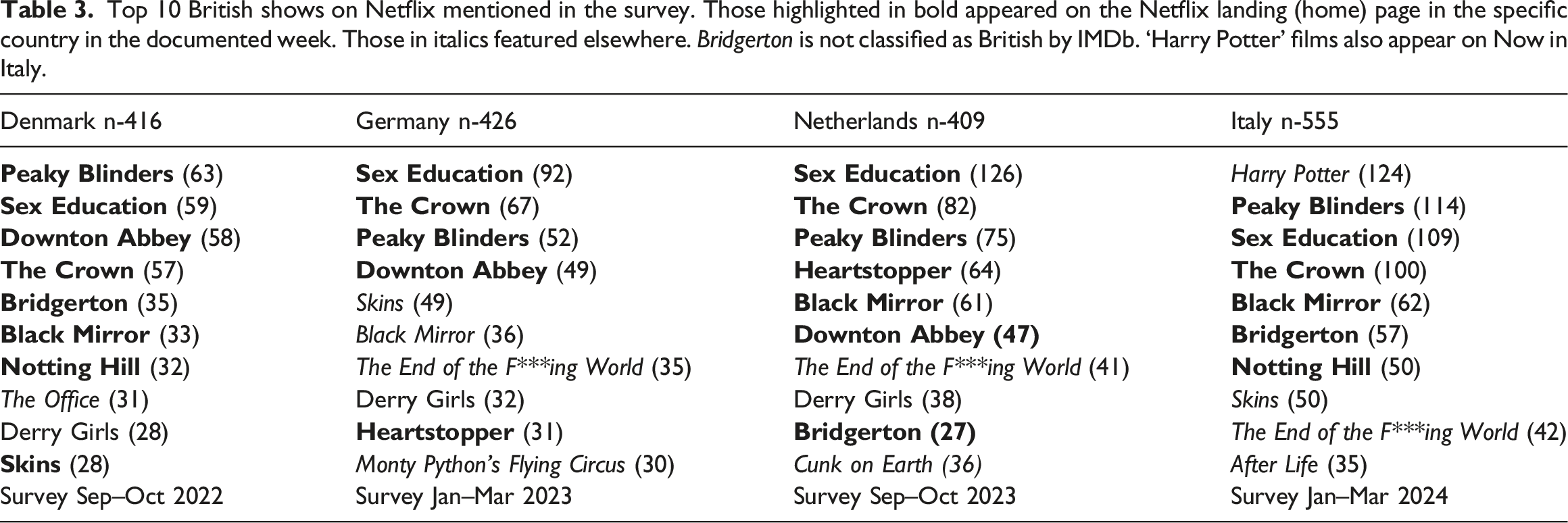
Top 10 British shows on Netflix mentioned in the survey. Those highlighted in bold appeared on the Netflix landing (home) page in the specific country in the documented week. Those in italics featured elsewhere. Bridgerton is not classified as British by IMDb. ‘Harry Potter’ films also appear on Now in Italy.
This process was repeated for the public service platforms DRTV (Denmark), the ZDF Mediathek (Germany), NPO (Netherlands), and RaiPlay (Italy), all of which offer far fewer British shows overall, and fewer shows that young people aged 16–34 are likely to mention. For example, five UK titles were found on the initial ZDF Mediathek landing page and a further seven shows were found in six search categories (e.g. thriller series, comedy series), but only two were mentioned by survey respondents: the police series Death in Paradise (2011–present, eight mentions) and The Chelsea Detective (2022–present, one mention). UK content featured more prominently on Danish public service VoD platform DRTV’s landing page with 21 titles including seven in the top five decks. Seven of the 35 British shows found on DRTV’s landing pages were mentioned by respondents in the Danish survey, but mentions of detective drama Midsomer Murders (1997–present; 51 mentions) far exceeded the next two series: crime drama Sherwood (2022–present; 6 mentions) and historical drama Sanditon (2019–2023; 3 mentions). Only four British shows appeared on the landing page of domestic commercial platform TV 2 Play, mostly factual and reality formats, and the only one with significant mentions in the survey was The Great British Bake Off (2010–present; 33 mentions).
The advantage of combining landing page documentation with survey data is that the information it provides enables us to develop hypotheses about how audiences get to know about, find and access UK content on different platforms. Appearances on the Landing Pages, particularly in higher decks, can be cross-referenced with survey mentions of specific titles, thus enabling hypotheses about what gets promoted and what is likely to be watched. These mentions can also be checked against promotions on social media (Instagram, TikTok, Facebook, YouTube, Twitter) and in interviews where respondents frequently mentioned social media notifications for certain series, for example, Sex Education (2019–2023) and Derry Girls (2018–2022). Derry Girls was mentioned often, but did not appear on searched Netflix landing pages. Unsurprisingly, as evidenced with Netflix, the most mentioned UK shows tend to be the most visible across landing pages.
Nevertheless, landing page research presents certain limitations. Interface monitoring provides only a snapshot of what is being promoted at a particular point in time, and its operation on a laptop, or at certain times of the day, may not replicate the app-based experience of searching on mobile phones, smart TVs or tablets. Unlike JustWatch, accessing the services requires someone to be physically present in the country. For complex sites like Netflix and Prime Video, documentation is time-consuming, subject to human error, and it is not entirely clear whether personalisation can be entirely removed. There is also room for human error in failing to recognise what is potentially British even if every show is manually checked against listings in Lumiere VoD, JustWatch or IMDb. In some cases, shows are incorrectly labelled as British by platforms themselves (e.g. Life in Pieces [2015–2019] and StartUp [2016–2018] on Prime Video in Germany). A week is also a limited period for investigation, and any deep-diving analysis of landing pages would require a dedicated project. As a temporal exercise linked to audience surveys, interviews and focus groups, landing page research adds richness to the insights about what is available and what is being promoted, but also raises questions about what counts as country-of-origin.
Conclusions
VoD catalogues are increasingly the main gateway to film and television content for audiences. This makes VoD catalogues a relevant object for research into media industries, policies and audiences. Catalogue research usually involves either a ‘back-end’ approach focusing on catalogues as a database of available titles, or a ‘front-end’ approach focusing on how content is presented to users. This article argues for the necessity of bringing both perspectives together and elucidates methodological strategies for bridging the gap between back-end and front-end approaches. Findings generated from such a combination help us understand how content is filtered on its way towards the audience.
The circulation analysis of British content conducted in the EUVoD project demonstrates the prevalence and diversity of UK content in European catalogues with ca 15,500 British first-produced titles available in the EU, often outperforming domestic content. An overview of top circulating British titles suggests a ‘canon’ of British films (e.g. Harry Potter) and series (e.g. Downton Abbey) available across all countries and many services. However, the analysis of prominence in VoD interfaces shows that only a small number of available British titles are presented on landing pages. On Netflix, British content plays an even larger role in European offerings, surpassing domestic content in larger markets as well, but only 7% of all British content in VoD circulation in Europe, can be found in Netflix’s European catalogues. Of this British content in Netflix’s national catalogues only about 200 titles can be reasonably found by audiences (across 10 categories and including searches for British content), while only about 50 titles are promoted on Netflix’s landing/home page. Combining this knowledge about the availability, popularity, and prominence of British content with results from the Screen Encounters with Britain project’s audience surveys shows that British content with high prominence on Netflix also tends to feature more highly among young audiences’ recollections of British titles. This finding emphasises how important questions of prominence and discoverability are for producers concerned with reaching audiences and marketing their content on VoD, as well as policy makers concerned about the circulation and exposure of European content. However, more evidence is needed about the algorithmic filtering and promotional processes happening between VoD catalogues as database back-ends and VoD landing pages as interface front-ends.
This article’s main concern are the methodological steps and challenges involved in connecting audience and media industries research with back- and front-end approaches to catalogue research. The steps from the Lumiere VoD catalogue database to the landing page research provide an increasingly fine-grained picture of how content availability and circulation translate into prominence of content. While the Lumiere VoD catalogue data provide a picture of broader patterns of content circulation and catalogue localisation, the documentation of JustWatch data and Landing Page research provides insights into the concrete titles that are easy, convenient, or likely to be discovered by audiences. However, each step can offer only a temporal snapshot of the situation at one moment in time, suggesting the need for more longitudinal studies to track shifts in promotion or consumption. Furthermore, the manual labour involved increases with each step, requiring an adjustment of sample sizes and periods. The methodological stages presented in this article supplement each other. However, perfect alignment is unattainable, as evidenced by the temporal delays between each step of the research and the challenge of identifying the country of origin. For an industry-focused account of production countries, classifications based on origin of funding – as provided by Lumiere – are relevant but also prone to error. When addressing questions of prominence in the actual presentation of content to audiences, the ‘look and feel’ of content becomes more relevant.
Combining back-end and front-end catalogue research helps us to identify how the appearance of content changes as we move from questions of availability to questions of prominence. The caveats of catalogue research include its snapshot nature, issues regarding sample size, definitions of country-of-origin ties and questions about how to account for algorithmic personalisation. These limitations can be addressed by combining catalogue research with different methods such as broader industry data, interviews with exclusive industry informants, and audience research that provides insights into patterns of content discovery and consumption.
Footnotes
Declaration of conflicting interests
The author(s) declared no potential conflicts of interest with respect to the research, authorship, and/or publication of this article.
Funding
The author(s) disclosed receipt of the following financial support for the research, authorship, and/or publication of this article: The research from Screen Encounters with Britain was supported by the Arts and Humanities Research Council [grant number AH/W000113/1], part of UK Research and Innovation (UKRI). The research from the project EUVoD was supported by Aarhus Universitets Forskningsfond; EUVoD.

Data Availability Statement
The data from Screen Encounters with Britain supporting this article has been deposited in the King’s Open Research Data Repository at 10.18742/22153928 with an access embargo until 30 September 2025. Earlier sharing will be considered on request.