



Abstract
Growing awareness of the ubiquity of algorithms online has established a new discursive space for making sense of their role in individuals’ lives and society writ large. Within this space, social media users have come to think of algorithms as uniquely powerful forces shaping everyday experiences. This article explores how people make sense of algorithms, as seen through (dis)belief in algorithmic conspirituality, where users ascribe divine significance to algorithmic curation on TikTok. We ask: how do users understand algorithmic conspirituality, and under what circumstances do they believe (or not) in the mystical power of algorithms? Drawing on focus groups and interviews with TikTok users (n = 25), we observed what we call reflexive ambivalence. This refers to a reflexive process in which participants examined their cognitive and affective responses to algorithmic conspirituality videos to untangle seemingly contradictory logical and mystical mentalities. With this insight, we complicate past work by demonstrating the co-occurrence and interdependency of rational, technical vs. affective, socially situated ways of knowing algorithms. We additionally highlight conditions under which belief in algorithmic conspirituality gained plausibility for our participants and how they rationalized the phenomenon as grounded in the worldly realm.
Keywords
Growing awareness of the ubiquity of personalization algorithms online has established a new discursive space for making sense of their role in individuals’ lives and society writ large. Within this space, social media users have come to think of algorithms as uniquely powerful forces shaping everyday experiences. TikTok has especially gained notoriety for perceptions of its For You Page (FYP) algorithm as capable of knowing users’ ‘deepest desires’ (The Wall Street, 2021). Such perceptions reflect increased epistemological investments in statistical ways of knowing (Burrell and Fourcade, 2021; Porter, 2020) and discourses about the sublime quality of complex artificial intelligence (Ames, 2018; Singler, 2020). Cotter et al. (2022) noted the convergence of these developments with the growing popularity of New Age spirituality and conspiratorial thinking (Cotter et al., 2022; Ward and Voas, 2011), giving rise to what they called ‘algorithmic conspirituality’, or ‘spiritualizing beliefs about algorithms, which emerge from occasions when people find personal, often revelatory connections to content algorithmically recommended to them’ (3). Algorithmic conspirituality videos invite users to assign a cosmically significant reasons for encounters with the messages they present – effectively, ‘if you’re seeing this, it’s meant to be’ (Cotter et al., 2022).
Existing work on how people understand social media algorithms tends to focus on knowledge of how algorithms work. Research has moved from assessing users’ basic awareness (Eslami et al., 2015; Rader and Gray, 2015) to more complex insight, for example, knowledge of data signals used for tailoring content (DeVito, 2021; Gruber and Hargittai, 2023) or recognition that highly engaged with content will appear more prominently in feeds (Dogruel, 2021). Some work has alternately documented other ways of knowing algorithms. For example, Bucher conceptualized the ‘algorithmic imaginary’ to position ‘experience and affective encounters as valid forms of knowledge of algorithms’ (2018: 94). Together, this body of literature suggests a variety of epistemologies at play in people’s understanding of and interactions with algorithms, though it tends to privilege those rooted in the mind via logical reasoning.
In this study, we explore mystical mentalities as an additional epistemology of sensemaking around algorithms, as seen through reflections on algorithmic conspirituality. We ask: How do users understand algorithmic conspirituality, and under what circumstances do they believe (or not) in the mystical power of algorithms? To answer these questions, we conducted focus groups and individual interviews with TikTok users (n = 25). From this work, we document the co-existence of affective-mystical and logico-scientific mentalities in our participants’ reflections on algorithmic conspirituality. Participants acknowledged TikTok’s FYP algorithm as a man-made technology programmed to deliver tailored content to their feed according to statistical computations. Simultaneously, they described moments in which they felt an intuition that the algorithm acted as a divine force to present the right message to the right people at the right time. The friction between logical and affective insights results in what we term reflexive ambivalence: the conflictual oscillations social media users experience as they seek to resolve tensions between the felt sense of the algorithm’s mystical possibilities and logical skepticism reflective of their awareness of the algorithm’s technical functioning and the political economy it exists within.
Algorithmic conspirituality
Conspirituality is the joining of the new age spiritual philosophical trends like Tarot and palm reading with the trend of more logic-claiming conspiracy theorizing as they both grew in popularity over time (Ward and Voas, 2011). The growth over time was girded by ‘political disillusionment’ and access to diverse ‘worldviews’ congruent with the spread of mass media (Ward and Voas, 2011: 103). In their original conceptualization, Ward and Voas (2011) characterized New Age practices as feminine and positive and conspiracy theories as male-dominated and negative, with the combination of these heuristics contributing to how people confront the ‘new world order’ in sensemaking practices. The spiritual component of conspirituality involves a person’s totality of mind, body, and soul. The conspiracy component emphasizes people’s desire to seek patterns in seemingly unrelated happenings and attribute events and circumstances to vague, but powerful, forces. These world views are grounded in ideas that nothing is random and everything is connected (Ward and Voas, 2011).
Algorithmic conspirituality represents the intersection of conspirituality and beliefs in ‘powerful’ algorithms (Cotter et al., 2022). The TikTok algorithm is a distinct target of such beliefs as it has become known for its knack of discerning highly tailored audiences. This has led many users to believe that the recommendation algorithm responsible for curating users’ main landing page, known as the For You Page (FYP), knows them even better than they know themselves (Mercado, 2021). Reflecting this understanding, some TikTok creators liken the algorithm to a spiritual force, or religious guide, explicitly suggesting their content should ‘be read as a “sign” to prompt viewers to engage in acts of self-improvement or self-transformation’ (Cotter et al., 2022: 2924).
Algorithmic conspirituality could be understood as users’ attempt to make sense of algorithms’ perceived capacity to deliver messages that seem to speak to their existential needs. Social media users have come to rely on the revelatory powers of technology in general, and of social media algorithms in particular (Singler, 2020). Technological innovation and mystical thinking tend to be seen as mutually exclusive where one can believe in magic or live in a society that is technologically advanced (Aupers, 2009; Gell, 1988). Yet, people often turn to mystical thinking in their attempts to make sense of technology. Mystical beliefs have been leveraged in contexts like journalism (e.g., Stahl, 1995) and business (e.g., Eilish and Boyd, 2018) to help describe complex technologies that would otherwise require a significant amount of additional knowledge to understand. Even developers at times invoke mystical explanations to describe the functioning and capacities of technologies they create (Aupers, 2009; Thomas et al., 2018).
Making sense of algorithms
What people know about algorithms has been explored through various frameworks that have identified cognitive, behavioral, and affective dimensions (Cotter, 2022; Kanthawala et al., n.d.; Oeldorf-Hirsch and Neubaum, 2023). Research has primarily explored understanding of algorithms under the heading of ‘folk theories’, or ‘non-authoritative conceptions of the world that develop among non-professionals and circulate informally’ (Eslami et al., 2016: 2372). Folk theories impact people’s behaviors and attitudes toward complex technologies (DeVito et al., 2017; Rader and Slaker, 2017), especially those that are opaque (Burrell, 2016). Folk theories emerge even in the absence of advanced technical knowledge about algorithms (Dogruel, 2021) and may not necessarily depict system operations accurately. They further tend to vary in terms of complexity of understanding, ranging from basic awareness to explanations of ‘causal pathways’ between datapoints and algorithm operations (Devito, 2021: 15).
Other research investigating ‘algorithm skills’ (Gruber and Hargittai, 2023; Klawitter and Hargittai, 2018), ‘algorithmic knowledge’ (Cotter and Reisdorf, 2020), and ‘algorithmic literacy’ (Cotter, 2019; DeVito, 2021; Oeldorf-Hirsch and Neubaum, 2023) further highlight ‘cognitive comprehension of [algorithms’] existence and functioning’ (Oeldorf-Hirsch and Neubaum, 2023: 4). For example, Gruber and Hargittai (2023) demonstrated that users’ awareness of data collection and knowledge generation do not necessarily coincide with the ability to explain how and why algorithms recommend content. Besides propositional insights like how/why explanations of algorithms, some work has highlighted behaviors indicative of algorithmic understanding. For example, creative entrepreneurs and influencers develop strategies for working with algorithms to sustain their financial interests on arts-and-crafts e-commerce sites and social media, respectively (Bishop, 2019; Cotter, 2019; Klawitter and Hargittai, 2018). Average users also report learning how to ‘train’ their algorithm to achieve relevant algorithmic recommendations (Siles et al., 2022). In turn, such behaviors play a role in shaping the algorithm, with an interdependency between user actions and algorithmic functionality (Raffa and Pronzato, 2021).
Some research has further explored affective understanding of algorithms beyond simple computational abstractions. Particularly, Bucher (2017) conceptualized the ‘algorithmic imaginary’ to provide a more situated and affective perspective on sensemaking around algorithms, encapsulating not just how people reason about algorithms, but how they ‘imagine, perceive and experience algorithms and what these imaginations make possible’ (31). Studies have noted feelings of surprise, frustration, joy, and pain amongst users’ responses to algorithms that orient them in different ways to their operations (Andalibi and Garcia, 2021; Bucher, 2017; Ruckenstein and Granroth, 2020; Siles et al., 2022; Siles and Melendez-Moran, 2021; Swart, 2021). One common response to algorithms is feelings of ‘creepiness’, in which users feel unsettled by an algorithm’s eerily accurate recommendations (Liao and Tyson, 2021; Ngo and Krämer, 2022).
Rationality vs. mysticism
Western society tends to view rationality and mysticism as mutually exclusive belief systems, though people regularly maintain them simultaneously (Magliocco, 2012; Tambiah, 1990). Historically, anthropological accounts situated within the rational-logical milieu of Enlightenment thinking positioned the latter as symptomatic of ‘primitive’ cultures, whereas the former represented an ‘evolved’ mentality (Tambiah, 1990). However, work demonstrating the co-existence of these multiple orientations to reality has since challenged this view (Lévy-Bruhl, 1926). Lévy-Bruhl introduced the notion of participation as an affective-mystical mentality complementary to causality as a detached logico-scientific mentality (Tambiah, 1990). Participation signifies a shift in consciousness characterized by an affective sense of ‘associations and connections between things, situations and feelings’ (Greenwood, 2009: 29) and ‘contact with a reality other than the reality given by the actual or everyday circumstances’ (Tambiah, 1990: 91). Causality, by contrast, signifies an ordering of reality through the lens of positive science, knowledge generated through an ideal of objective measures of causes and effects (Tambiah, 1990).
When or why people believe in supernatural phenomena depends on contextual factors (Magliocco, 2012). Feelings of anxiety and a lack of agency can activate a participatory consciousness (Magliocco, 2012). Rituals and storytelling, likewise, can draw forth magical or spiritual beliefs (Magliocco, 2012). Occasions like funerals (feeling the presence of a deceased loved one), sports games (not shaving for fear of losing a match), religious services (the sacrament of the eucharist), and romantic courtship (a predestined one true love) all tend to evoke otherworldly beliefs or mystical thinking (Tambiah, 1990). Even in these occasions, one might simultaneously ‘know’ that something is not true or real, but believe in it nevertheless (Magliocco, 2012). Thus, as Magliocco argued, ‘Participatory consciousness requires a suspension of disbelief, a willingness to engage the emotions and act “as if”’ (2019: 22).
Anthropological and folklorist approaches to belief have underscored the value of taking seriously ways of knowing beyond the cognitive realm. Likewise, research on user understandings of algorithms have documented multiple ways of knowing algorithms. The concept of algorithmic conspirituality offers an opportunity to further explore the varied ways of knowing algorithms by focusing on the possibility of mystical, conspiratorial mentalities rooted in intuitive, affective knowledge. Towards this end, we ask: How do users understand algorithmic conspirituality, and under what circumstances do they believe (or not) in the mystical power of algorithms?
Methods
Study design
To address these research questions, we conducted focus groups and interviews with TikTok users (n = 25). We chose focus groups to enhance the common experiences among users and enrich their shared knowledge about this phenomenon (Lunt and Livingstone, 1996), and interviews provided the opportunity to more deeply explore initial findings. We conducted three in-person focus groups, one focus group via zoom, and four individual virtual interviews. All focus groups and interviews lasted about 60–90 min, were recorded, transcribed, and anonymized for analysis. Focus groups ranged from three to seven participants. One member of the research team facilitated focus groups, while another took notes. The study received IRB approval from the research team’s institutions, Pennsylvania State University, University of Alabama, and University of Texas at Austin.
Data collection and recruitment
We followed a multi-pronged approach to recruitment. First, we recruited participants from undergraduate population in the U.S. at a large Mid-Atlantic university and a large South-Eastern university. Undergraduate students fall in the age range of frequent TikTok users (West, 2023). Initially, focus groups were organized according to participant availability and conducted in person on university campuses. Based on preliminary analyses of these focus groups, we decided to broaden our recruitment strategies to (1) include older users and (2) strategically sample for participants more or less likely to see the FYP algorithm as a ‘mysterious force’. For the latter, our screening survey asked participants to indicate the degree to which they agreed with the statement: ‘The FYP algorithm works in mysterious ways’. Responses to this question also allowed us to group participants according to similar viewpoints, thereby reducing the likelihood of ‘disbelieving’ participants influencing what ‘believing’ participants were willing to share, and vice versa.
We implemented our revised recruitment strategy via TikTok with two videos created by members of the research team that incorporated elements of algorithmic conspirituality. In this way, we made use of the platform’s FYP algorithm to disseminate the videos to relevant users (Kanthawala et al., 2022). Interested participants were invited to click the link to our pre-screening survey, after which the research team reached out to them individually for scheduling. Here, we included an option of participating in individual interviews for those who preferred to speak one-on-one or whose schedules did not align with focus group scheduling. Focus groups and interviews resulting from TikTok recruitment were conducted via Zoom.
At the beginning of each of these group or individual interviews, participants were shown a series of five TikTok videos fitting the theme of algorithmic conspirituality (stills of which can be seen in Appendix A). Video transcripts are available via OSF at: https://bit.ly/reflexiveambivalence.
Participants
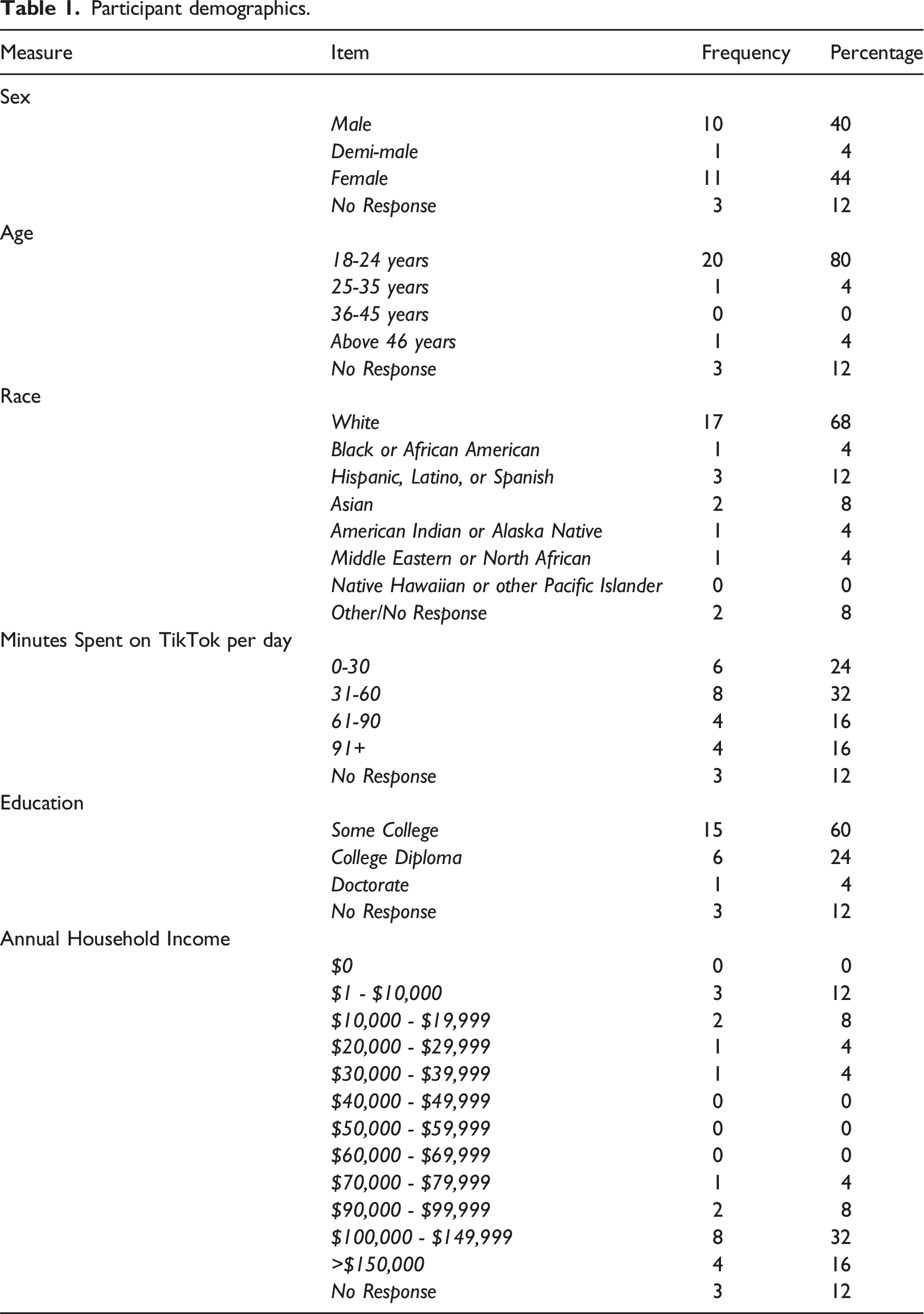
Participant demographics.
Data analysis
We conducted a thematic analysis through an inductive, iterative process, using the Braun and Clarke’s (2022) framework. First, each member of the research team read a different transcript and met to discuss general thoughts and reflections. Then, each member of the team conducted open coding on one transcript guided by this initial conversation. After discussing the codes generated from open coding, the first author created a codebook to capture prominent themes. Three members of the research team used the codebook to code one transcript each. Through discussion with the entire research team, we revised the codebook to add additional codes, collapse intersecting codes, and finesse code definitions. Next, all transcripts were divided among the research team and coded using NVivo. Finally, we examined coded passages for a more in-depth synthesis of the contents within each of our high-level themes.
Limitations
Our research utilizes focus groups as a key method of data collection. Given its social nature, this method has the potential to emphasize normative discourses that differ from people’s ‘private’ viewpoints (Radley and Billig, 1996; Smithson, 2000; Temple, 2014). As we will discuss, we observed more assertiveness from some participants in their skepticism of algorithmic conspirituality, which we interpreted as corresponding to normative commitments to rationality and scientific thinking in the U.S. These individuals had a subduing effect on those more inclined to express belief in algorithmic conspirituality. This dynamic was especially evident in the virtual focus group, where participants’ choice to keep their cameras off may have empowered some to express skepticism more emphatically. We attempted to moderate this by posing direct questions to hesitant participants, and stepping in if dominating individuals pressured group conversations in directions that were not agreed upon by the rest (Smithson, 2000). Later in the study, we aimed to prevent participants from being unduly influenced by those with opposing belief systems by introducing screening questions to help organize focus groups based on similar orientations to algorithmic conspirituality. We also conducted individual interviews to supplement our focus group data, hoping to capture more personal understandings and perceptions of algorithmic conspirituality.
Findings
Reflexive ambivalence
While all of our participants understood algorithmic conspirituality as, to some extent, absurd, many also acknowledged instances when they perceived elements of truth in it. As they shared their thoughts on algorithmic conspirituality, participants grappled reflexively with the tension between ‘logical’ explanations based on their understanding of algorithmic recommendation and what felt intuitively correct in the moment. Isabella’s reflections epitomized this experience, which we term reflexive ambivalence: Out of all the millions and billions of TikTok videos that could have been pushed out to me, the fact that this one was what came across when I opened the app or whatever, it did feel very targeted and almost personal while still operating with, there’s a math equation controlling this somewhere. I would almost want to talk myself out of it. It does feel kind of goofy to tell people. I think the algorithm or the universe is talking to me through TikTok.
Here, Isabella emphasized her understanding that ‘a math equation’ was responsible for her contact with a remarkably apt TikTok video, while in the same breath acknowledging the overwhelming sense of serendipity she could not discount. As another example, Jordan shared in a focus group: ‘I definitely don’t believe [in algorithmic conspirituality]. There was definitely a time though that [such videos] showed up so much that I was like, “You know what? Maybe it’s a sign. It’s trying to tell me something.”’ Like Isabella, Jordan could not easily resolve her reaction to videos purportedly predestined for her into a simple binary of belief/disbelief. For several participants, the truth resided in ‘both/and’ rather than ‘either/or’.
Participants exhibited intricate reflexivity, temporarily disentangling themselves from their intellectual and affective responses to algorithmic conspirituality videos to examine the contradictory beliefs that followed. For example, Aria brought up a TikTok trend of users sharing their personal delusions, or ‘radical self-belief’ in their ability to achieve some goal (Bhaimiya, 2023, bullet point 2). She argued that belief in algorithmic conspirituality reflected this trend, in that this content is ‘what more people are inclined to consuming at this moment’. This explanation located responses to algorithmic conspirituality in a liminal space between belief and disbelief parallel to how TikTok users share the ways they self-consciously ‘delude’ themselves. In a similar vein, Ethan described engagement with algorithmic conspirituality as a kind of ‘leap of faith’. As in Aria’s reference to the ‘delusional trend’, this framing exemplifies cases in which participates reflected on their own beliefs from a distance, treating algorithmic conspirituality as neither entirely true nor false.
Although participants described their (dis)belief in algorithmic conspirituality with reflexive ambivalence, they also highlighted conditions under which belief gained plausibility and offered rationalizations of the phenomenon as grounded in the worldly realm. We explain these points in the next two sections, respectively.
Belief conditions
Heightened affective states
Participants repeatedly referenced their and others’ emotional state when discussing moments of (dis)belief in algorithmic conspirituality. Participants explained that feelings of anxiety, fear, and uncertainty lent themselves to receptiveness. As Elena said: ‘I feel like there is that human component, an emotional component to that that makes you make [algorithmic conspirituality videos] more believable’. Further exemplifying the role of affect, in response to a question about whether participants attend to or engage with algorithmic conspirituality videos, Deirdre responded ‘I don’t really’, before quickly qualifying ‘I read a few if I’m really desperate’. Likewise, Loren shared in a focus group: Sometimes like if I’m having a bad day and I see something that’s like – I don’t know. It’ll tell me some kind of messaging and it’ll be so specific and I’ll think to myself, since I’m having a bad day, I’ll be like, maybe – I don’t know, maybe I should listen to this.
In the same vein, Lily said: When there’s something that I’m really worried or nervous about and I’m thinking about it a lot, and when I’m focusing a lot of my mental energy on it, even when I’m not thinking about it. So when I’m in a ‘situationship’ or when I’m stressed about something school related, because when I have something on my mind and I’m on TikTok to distract myself, if something comes up that could possibly be related, I’m like, well, let me just listen. Maybe it’ll have some insight maybe. I don’t know.
These reflections exemplify how several participants characterized algorithmic conspirituality videos as sources of solace and affirmation during times of distress. This was particularly true in cases like Lily shared where participants described themselves as seeking a way forward with some aspect of their lives. To this point, Isabella explained ‘when I’d been getting videos about [something] positive and it was coming true, or it felt very true, it was very reassuring’. Likewise, in a focus group, Allen also speculated that algorithmic conspirituality videos were ‘reassuring’ in agreement with Eli’s opinion that they ‘make[] [people] feel better, having that hope makes them feel a little bit better’.
Hitting close to home
For many participants, being recommended content that felt too apt to ascribe to a well-functioning algorithm inspired belief in algorithmic conspirituality. Aria captured this sentiment, noting ‘it’s scary sometimes because I’ll be like, “Wait, TikTok knows exactly what’s going on in my life or what’s going on in my head.”’ Loren similarly highlighted ‘freaky’ experiences, saying it felt like the FYP algorithm ‘kind of read my mind, but I know it didn’t, but…’ These reflections highlighted a common feeling among participants that TikTok’s FYP algorithm seemed extraordinarily in tune with their inner world, perhaps in a transcendent way.
Though some participants linked uncanny recommendations to TikTok’s data collection, with a vague, but unnerved sense of being watched, many also felt mystified by experiences they could not easily or immediately explain in technical terms. For example, in relation to algorithmic conspirituality videos in which creators specify they have not used any hashtags or captions to reach the intended audience, Isabella said: ...those kind of hit a little harder because it made me wonder, okay, so then how does this get pushed out and what does TikTok [do] behind the scenes, how are they capturing information out of this video to know to push it out? To me, that was what was crazy. It makes sense when I post on SwiftTok and I use Taylor Swift related hashtags, it makes sense that people that engage in those would get the video, but it really was like those no caption, no hashtag, those were the videos that I was like, oh God, there’s something to it. There’s something to it.
Moments like this provided ‘evidence’ that made algorithmic conspirituality ‘feel more real’, as Lily put it. Though, as Loren exemplified in their above quote, even when participants noted the ‘freaky’, somewhat inexplicable nature of recommendations, they recognized the idea of algorithmic conspirituality as illogical. Indeed, Isabella’s contemplations highlighted the tendency for conspiratorial speculation about TikTok’s data collection at the same time that participants felt a draw towards something akin to faith. In short, participants’ experiences pointed to moments in which algorithmic conspirituality felt true based on encounters with serendipitous content that ‘hit[] so close to home’ (Isabella), even as they simultaneously recognized it as untrue.
Religious and spiritual affinities
Some participants who received and interacted with videos that felt predestined for them also conceptualized algorithmic conspirituality through the lens of existing religious or spiritual beliefs. Some characterized algorithmic conspirituality as guided by a more traditional conception of a monotheistic God. For example, Oliver shared: I believe in a God and I believe that God can send me messages through anything. So do I believe that that particular person with that particular reading was an absolutely accurate representation of my personal truth? No, but I believe that if you look hard enough and you are actively seeking it, wisdom can be found from any source. So I don’t necessarily believe them, but I enjoy them because they encourage thought.
Oliver’s ambivalence here represents the intricate challenge of reconciling age-old religious beliefs with the rise of modern technology. His reflections suggest a willingness to entertain the idea that an algorithmic conspirituality video could contain a divine message, as one of the ways God speaks to and directs people in daily life. Simultaneously, he also seemed reluctant to accept this as completely true. This lingering hesitancy could have been a reaction to the outspoken skepticism expressed by the other participants in his focus group who derided those embracing algorithmic conspirituality.
Other participants gestured towards broader affinities for spirituality and the belief in a higher power beyond God. For example, Isabella described how her spiritual beliefs helped her make sense of algorithmic conspirituality: I think I’ve always been receptive [...] to seeing things in my personal life and being like, oh, that might be a sign...because I’m not religious, but I am spiritual. And so I would occasionally in my real life see things that I felt like, oh, that’s me being guided almost to move in a certain direction or act a certain way. And so when I started seeing these things [algorithmic conspirituality videos] on TikTok, it was a very similar feeling of like, okay, yeah, because the concept of the video was so spot on to whatever situation I was dealing with, it did feel like I was meant to see this, or I guess it didn’t start as ‘I was meant to see this’. It was like, wow, that’s a really great, good timing. And it kind of evolved from wow, interesting timing to like, oh, I was meant to see this.
For Isabella, the serendipitous quality of algorithmic conspirituality videos reminded her of occasions in her offline life when she felt guided by a higher power. This realization inspired her to view algorithmic conspirituality as a part of a broader, holistic force in her life. Lily similarly talked about numerology, the belief that numbers are the ‘spiritual ground of our very existence’ and that ‘life has its problems and applied numerology is a unique solution’ (Singh, 2020, Chapter 1; para. 2). She said: I have some angel numbers I associate with me, and if I don’t see those [in an algorithmic conspirituality video], then I’m like, okay, we’ll see. But if [creators] use them on there, I’m like, okay, maybe I will listen a little more. But I haven’t noticed that the numbers that I associate with myself have increased over time. I feel like I see more videos where they’re not there than where they are there, which also makes it feel a little more real, I guess. And not specifically just the algorithm. If it was like the algorithm is going to give you these numbers every single time, then I feel like I would’ve noticed that, but I haven’t done that.
With this explanation, Lily illustrates how her belief in numerology acts as a mechanism for validating whether and when she should believe algorithmic conspirituality videos carry a divine message. Like Isabella, she did not unconditionally accept the truth of algorithmic conspirituality, but supported her belief with spiritual insight.
Notably, when casting doubt on algorithmic conspirituality, participants characterized ‘believers’ as ‘superstitious’ and part of a rising interesting in ‘manifesting and astrology’, as one participant put it, especially on TikTok. Deidre explained that she thought pre-existing spiritual beliefs could create self-fulfilling prophecies, noting: ...if you believe something will happen, it will, and it’s basically making what you want in your head. And if you believe it or act like it’s going to happen, it will. I guess people are like, and it’s like signs and stuff like that so we’re seeing, ‘Oh, this is the sign’.
Similarly, Rohan discounted algorithmic conspirituality as a part of a broader rejection of spiritual practices in general. In a conversation about algorithmic conspirituality videos that predict or encourage manifesting professional or academic success, he positioned ‘hard work’ as the opposite of spirituality, saying: ‘I’m not that spiritual guy or spiritual person, really. I’m just kind of like if you work – if you work hard for it then you’re going to get it’. Thus, we can see that religious and spiritual beliefs offered some participants resources for understanding the FYP algorithm as divine. Conversely, those with more secular or agnostic convictions exhibited skepticism toward algorithmic conspirituality, viewing it as an extension of religious and spiritual belief systems with some reservation.
Bringing algorithmic conspirituality back down to earth
Creators’ motives
When participants exhibited skepticism regarding algorithmic conspirituality, they frequently justified their reservations by attributing them to their awareness of the underlying motivations of content creators in producing such videos. Some participants believed that algorithmic conspirituality videos simply reflected creators use of the algorithm to spread awareness about different issues to relevant audiences. For example, in response to a video in which the creator stated ‘No hashtags because if you’re seeing this then you’re either Autistic, Neurodivergent, or disabled’ (see Figure 3), Sophia shared, Being neurodivergent is so common, so much more common that I think anybody recognized in our society [can have it]. There are a lot of creators on TikTok who are trying to normalize psychological treatment, who are trying to normalize therapy, the diagnoses, and also get hits, attract followers.
Like Sophia explained, some participants felt that creators of some algorithmic conspirituality videos wished to spread awareness about societal issues. Moreover, while Sophia and other participants specified they did not believe in algorithmic conspirituality, they expressed an appreciation for creators who employed it as a creative device in the service of a public good. As Sophia put it: ‘I always try to support creators who are trying to educate others and trying to bring positivity into people’s lives. So, I think that the way that I use it, I’m probably drawn more to those kinds of video’.
Some participants recognized algorithmic conspirituality videos presenting a ‘diagnosis’ as simultaneously convincing and conniving. For example, Jackie said: My roommates and I definitely convinced each other we all had autism, from a TikTok video, to the point where I was calling my mom. I was like, ‘Do I need to go get tested for autism? Did you think growing up I had autism?’ I've done that with ADHD. I've done that with thinking I had COVID. In COVID, I would see videos, ‘If you're having these symptoms, it's an early sign of COVID. You need to go get tested’. And I think it's almost the scared factor. I'll see the [tarot] card reading videos, but I don't really get into those because I'm like, ‘There's no way the 7,000 people are liking this for them’. So, I definitely think with the more health related ones, it's kind of a scare factor.
Here, Jackie was careful to acknowledge her skepticism of algorithmic conspirituality for certain videos, while describing the strategy at play as a ‘scare factor’. In other words, Jackie believed that videos implying a viewer has ADHD, for example, encourages watching, sharing, and engagement with the video due to creators’ anticipation of viewers’ concerns related to such a diagnosis.
When discussing creators’ motivations as evidence of algorithmic conspirituality’s genesis in reality, participants frequently characterized videos as a cynical strategy creators implemented to increase their visibility via the algorithm. Elena described the videos as ‘clout chasing’: ...they’re so broad. The tarot card [video was] like, ‘Oh, somebody’s obsessed with you’. Anybody that sees that, it’s going to be applicable to them. If you know another person then, ‘Oh, maybe they’re obsessed with me’. I feel they’re so intentionally broad to get people to like it or believe it so that they get a lot of likes
Like Elena, several participants spoke about algorithmic conspirituality videos as explicitly designed to encourage engagement and, thus, amplify creators’ visibility. Eli highlighted the way one of the exemplar videos appeared to be designed to require viewers to linger and rewatch it to apprehend its message: ...like with the ‘option A and option B’ [videos; see Figure 4], some of them, there’s so much writing, where you might have to watch it a couple of times in order to actually read it. And so that was a short video that you showed up there. And so TikTok is going to see that and that we’re rewatching this a couple times and going to show it to more people. And get more people to see it.
As Eli explained, some participants shrewdly pointed to features of algorithmic conspirituality videos that they believed acted as mechanisms for generating signals of interest for TikTok’s FYP algorithm and, thus, increasing the content’s reach and impact.
Participants also noticed that some of the videos present widely applicable messages that purport to be personalized, which further encourages engagement. For example, Dylan shared: [I]t’s the generality [of the videos] and the fact that it’s easy to make those videos. Videos first of all, where it’s like, ‘Oh, if you get this post your soulmate is coming to find [you]’, you can make them in five seconds and then send out five of them and then yeah, I think it generates, people can comment and be like, ‘Oh, this is perfect for me’ and stuff. And I mean even just simple things like that, then it gets more views and interactions.
In addition to highlighting their effectiveness in generating engagement, Dylan’s statement emphasizes the ease with which some algorithmic conspirituality videos can be produced and disseminated. He also implied a view of creators exploiting people’s desire for positive outcomes, such as finding a soulmate. Lily made a similar point in relation to tarot card reading algorithmic conspirituality videos, saying: ‘[I] start being a little skeptical [of algorithmic conspirituality videos] when it’s only positive things all the time and it’s overly positive. I feel like you’re just saying this because people want to hear it’. Lily leaned more towards belief than other participants, but here when discerning creators’ worldly motives and tactics, she explained a context in which she would reject algorithmic conspirituality videos as having divine significance. That is, she recognized that when creators post content designed to stoke their audience’s desires, it is the creators’ way of working with and understanding the algorithm to ensure a wider audience. In such cases, Lily explained she was less likely to read their message as from a higher power.
(Other) humans’ nature
As participants understood algorithmic conspirituality videos as a kind of light social engineering performed by creators, they also communicated skepticism through expressions of concern for users who might be exploited. Participants repeatedly noted concern for younger users who they deemed more ‘susceptible’ to the videos, as Ethan said. He elaborated: I probably [did engage with algorithmic conspirituality videos] when I was younger and I didn’t really think about stuff like that, I probably did participate in it once or twice, but now I know it’s not going to do anything for me. It’s just a way for creators to get likes and boost their views or something like that.
Here, Ethan, who was 19 at the time of the interview, reflected back on an earlier time in which he perceived himself as more naïve. Other participants shared Ethan’s view of younger users as more likely to believe in algorithmic conspirituality and, potentially, fall prey to any associated manipulations.
As participants ascribed belief in algorithmic conspirituality to youthful ignorance, they implied its wrongheadedness. For example, Jordan grappled with how algorithmic conspirituality videos could even exist, eventually concluding ‘So it makes sense that [algorithmic conspirituality] exists because [the youngest TikTok users] would primarily be its target audience’. Likewise, Nate said that teenage users ‘are going to believe anything that you put in front of them’, while Aria shared that she viewed algorithmic conspirituality videos as more for a younger age group, as she observed her preteen cousins reposting them. In positioning themselves as older and wiser in comparison to those who embraced algorithmic conspirituality, participants affirmed their own rationality and worldly wisdom. In doing so, they revealed a normative belief that regarding algorithmic conspirituality videos as credible was seen as foolish and naïve.
Interestingly, we observed in focus groups that masculine-presenting participants tended to strike a more skeptical tone regarding algorithmic conspirituality. Across focus groups, these participants’ opinions loomed large and seemed to have a chilling effect on any expressions of belief in algorithmic conspirituality. Relatedly, three participants associated algorithmic conspirituality videos with women. For instance, Ethan said: Maybe friends that are girls get videos like that because those seem to appeal more to girl characteristics such as some of the videos mentioned having a slim body and that’s a narrative that’s pushed in today’s current society. So I could possibly see women having For You Pages like that. But my friends that are guys, I don’t think they would.
Likewise, Andrew explained ‘I feel like those videos are mostly targeted towards middle schoolers, high schoolers, and mostly women. And so it’s like your boyfriend will text you this, and it’s like I don’t have one of those, so it doesn’t really apply to me’. In associating algorithmic conspirituality with women, these participants seemed to refer to the content of the videos. Yet, they also implied, as men, the videos were not ‘for them’.
In the online focus group, two male-identifying participants expressed overt criticism of those who believed in algorithmic conspirituality, including a third participant, Oliver, who appeared more open to notion. Tellingly, Emir, one of the skeptics, expressed in distinctly gendered terms: ‘I think it’s just little kids that like those videos, that’s what I thought. No grown man like Oliver would?’ In context, this came across as an insult, disparagingly implying that belief in algorithmic conspirituality should be understood as feminine, not for men.
Although many participants insinuated the imprudence of belief in algorithmic conspirituality in the aforementioned ways, they also attempted to explain belief in rational terms. Several participants noted ‘tricks’ creators used to make their algorithmic conspirituality videos appear more credible, thereby facilitating belief. For example, Emir said I think [creators of algorithmic conspirituality videos] try and appeal to everybody. It always reminds me of a psychic that’ll say something super general that appeals to everybody and that way it gets everybody to like the post because it describes exactly what they’re feeling. It is super general.
Andrew made a similar point about some algorithmic conspirituality videos being ‘very general, but presented in a way that...it seems personal and specific’. He said: [I]f you give it any kind of thought, it just kind of falls apart and it stops making sense. But I think we as humans, if we see a video like that or a horoscope, our brain will almost filter out the stuff that doesn’t apply to us, and will reach for the stuff that does. And so after you look at it, you’ll say, ‘Oh, maybe it was accurate. Maybe it does make a little bit of sense’, but it I mean it doesn’t...
With this explanation, Andrew expressed a sympathetic view of belief in algorithmic conspirituality by characterizing it as following from a human tendency to see what one wants to see. In a similar vein, Oliver said: I think it’s important to note that the human brain is designed to find patterns. It is integral to us as a species, so we’re all about coming up with answers to questions that were never asked and finding deeper meanings to things. So that is probably a reason why videos like these have such a broad appeal.
Another participant suggested that algorithmic conspirituality content often acted as shaped and reinforced by pre-existing beliefs and desires. They explained that if people already were on the lookout for a piece of advice or insight, they would see it everywhere. For example, Sandra linked algorithmic conspirituality to a broader trend of ‘manifesting’ the life one desires (Zapata, 2022): ...if you believe something will happen, it will, and it’s basically making what you want in your head. And if you believe it or act like it’s going to happen, it will. I guess people are like, and it’s like signs and stuff like that so we’re seeing, ‘Oh, this is the sign’. It’s like I don’t know. It’s kind of related, all of that.
Thus, when explaining their skepticism towards algorithmic conspirituality, participants ascribed others’ belief to human nature. They specifically referred to the inherent human tendency to seek meaning and discern patterns even where none may exist, while also tending to disregard things that may not directly apply to them.
Overall, our participants acknowledged the broad appeal of algorithmic conspirituality content, while invoking logical explanations to debunk otherworldly elements. Further, to participants who expressed disbelief, ‘believers’ seemed naïve and ignorant.
Discussion
Our findings provide unique insight into the ways people make sense of algorithms, as seen through an examination of (dis)belief in algorithmic conspirituality. Among our participants, we saw an ongoing reflexive process of grappling with logic and mystical thinking that suggested reflexive ambivalence. Many of our participants spoke of moments in which algorithmic conspirituality drew them in, in spite of being informed about how TikTok’s FYP algorithm functions. Such moments prompted an internal dialogue regarding whether a higher power could be controlling what they saw, one that had the ability to know them better than an algorithm should. Participants’ reflections on algorithmic conspirituality, thus, revealed that many maintained both cognitive and affective epistemologies that intertwined with one another, rather than existing as discrete poles on a continuum, similarly to causal and participatory ways of thinking (Magliocco, 2012; Tambiah, 1990). Moreover, they expressed the ability to concurrently hold and acknowledge both belief and disbelief in the algorithm as an all-knowing oracle or deity. As they reflected on algorithmic conspirituality, participants described uncanny feelings that the algorithm knew them intimately, relating reflexive introspection around these beliefs to remind themselves that to believe in algorithmic conspirituality was delusional.
(Dis)belief in algorithmic conspirituality was contextual, reflecting the modulation of cognitive and affective epistemologies according to situational contingencies. Participants shared that they found themselves prone to embracing algorithmic conspirituality during challenging times. They described the idea of algorithmic conspirituality as a form of comfort during uncertainty, noting that life circumstances could make them more apt to embrace algorithmic conspirituality, overruling logic. For example, in moments of anxiety or fear, such as struggling with relationships or work, participants reported a tendency to accept videos as offering insight from a higher power.
Focus group discussions were also threaded with the idea that people saw what they wanted to see or merely confirmed their own wishes when consuming algorithmic conspirituality videos. Participants’ reflections on their and others’ (dis)belief characterized algorithmic conspirituality as tending to reinforce or extend existing religious or spiritual belief systems. For those people whose belief systems and social worlds included religion, algorithmic conspirituality was seen as an extension of a divine presence in everyday life as a guiding force. On the other hand, several participants also rationalized algorithmic conspirituality as part of content creators’ strategic labor to generate engagement and, thus, build a following that they could monetize. They saw creators as capitalizing on their understanding of the algorithm and preying on users’ penchant for looking for signs in the world around them, particularly amid struggle and strife.
Further, those who expressed firmer disbelief in algorithmic conspirituality tended to judge ‘believers’ as gullible and naïve, qualities they associated with superstition and New Age practices such as Tarot and astrology. These participants couched disbelief in rationality, which they positioned as the ‘correct’ mode of thinking. In fact, nearly all our participants exhibited a normative valuing of rational explanations of TikTok’s FYP algorithm, even as they admitted to moments of belief in algorithmic conspirituality. From this starting point, a few male-identifying participants further implied an association between masculinity and disbelief. This perspective echoes discourses rooted in Cartesian dualism and ‘the coupling of mind with maleness’, which naturalize rationality as both masculine and ‘higher order’ than affective ways of knowing (Grosz, 1994: 4). Interestingly, participants who more openly discussed instances of belief tended to identify as women. Thus, our data suggest that algorithmic conspirituality may be imagined as a gendered phenomenon, shaping the degree to which individuals orient themselves to and feel comfortable outwardly aligning themselves with belief in it. Yet, regardless of gender, all participants were careful to acknowledge an understanding of belief as irrational and, so, something about which they should be embarrassed. In this sense, we observed the Western ideal of knowing as rooted in logic and rationality (Barbour, 2004) firmly in place.
We complicate past work that prioritizes rational, technical ways of knowing algorithms by demonstrating their co-occurrence and interdependency with affective, socially situated ways of knowing. We likewise extend past work addressing the role of affect in users’ interpretations of algorithms (e.g., Bucher, 2018; Liao and Tyson, 2021; Schellewald, 2021, 2022; Swart, 2021), highlighting its entanglement with rationality. Our participants frequently shared insight on how TikTok’s FYP algorithm functions, which, through rational thinking, allowed them to recognize algorithmic conspirituality as absurd. At the same time, they admitted to sometimes accepting the purportedly divine messages of algorithmic conspirituality videos when they could not shake a deep intuitive sense of their significance. This aligns with the observation that sensory cues shape spiritual interpretations of intelligent machines (Loewen-Colón and Mosurinjohn, 2022). In many cases, participants linked belief to an existing proclivity for religion or spirituality, drawing on such belief systems to justify the possibility of contact with a higher power. In participants’ reflections, belief often resembled faith, with one participant even referring to a ‘leap of faith’. Many of our participants’ occasional belief in algorithmic conspirituality seemed to mimic a position articulated by Modern Pagans in Magliocco’s work: ‘it’s not true, but I believe in it’ (2012: 6). This position perfectly encapsulates the kind of reflexively ambivalent sensemaking around TikTok’s FYP algorithm we observed.
Consistent with past work, our participants’ perceptions of their own agency relative to the FYP algorithm were dynamic (Kang and Lou, 2022). Sometimes participants reported feeling in control of their feeds; other times, as Isabella put it, they felt only an ‘illusion of control’. Generally, participants seemed to struggle to disentangle their own agency with that of the FYP algorithm. Simultaneously, in moments when participants figured the algorithm as a higher power, we observed a tendency to perceive their agency as diminished, especially when they reported sending clear signals of their desires on the platform that did not register. Additionally, some participants’ experiences reflected ‘spiritually authorizing encounters’ (Loewen-Colón and Mosurinjohn, 2022) with the FYP algorithm, where they believed inferred patterns in recommended content had influenced their thoughts and actions. Although this influence can be interpreted as the product of interdependent human and algorithmic agencies (Bucher, 2018; Just and Latzer, 2017; Siles, 2023), our participants often viewed it in starker terms. When understanding the algorithm as sublime, questions of self-perceived ‘agency’ became questions of ‘free will’.
Given our U.S. sample, the American tradition of religious liberalism may have heavily shaped the spiritual character of participants’ sensemaking. Spirituality in the U.S. intertwines with a tradition of political liberalism, resulting in an emphasis on freedom, individuality, and a market-economic blending of eclectic spiritual practices and beliefs (Schmidt, 2012). Openness to mystical figurations of algorithms, and the particular flavor of it reported in this study, may not be evident elsewhere, as cultural context appears to shape people’s relationships to and interpretations of algorithms (Cotter, 2022; Siles, 2023; Siles et al., 2020). Our findings may also reflect a ‘privileged imaginary’ of our predominantly white, highly educated, and middle- to upper-class sample. Cotter et al. (2022) suggested that belief in algorithmic conspirituality may vary based on algorithmic recognition of users’ identity features, potentially minimizing marginalized groups' susceptibility to such beliefs due to issues of (mis)representation (e.g., DeVito, 2022; Karizat et al., 2021; Simpson and Semaan, 2021). Alternately, we noted a connection between pre-existing spiritual beliefs and belief in algorithmic conspirituality among participants. This connection suggests a possible broader receptiveness to algorithmic conspirituality, matching diverse adherence to traditional and new age spiritual beliefs (Gecewicz, 2018; Mears and Ellison, 2000; Silva and Woody, 2022). In sum, whether algorithmic conspirituality intersects with social position remains an open question.
Beyond reflexive ambivalence, our study highlighted the entanglement of algorithms and identity work on TikTok. In line with observations of TikTok’s unique affordances for identity work, we saw that encounters with well-tailored content sometimes forced participants to reckon with their own identities as refracted through algorithmic curation (Bhandari and Bimo, 2022; Kant, 2020; Lee et al., 2022). When eerily relevant to participants, algorithmic curation contributed to belief in algorithmic conspirituality, but also prompted introspection. As participants attempted to make sense of the algorithm, they described simultaneously making sense of themselves. For example, recall Jackie’s discussion of encounters with TikTok videos that convinced her she might be autistic. Here, the FYP algorithm enables ‘reflexive engagement with previous self-representations’ (Bhandari and Bimo, 2022: 9), fostering an understanding of the self as dynamic and co-constituted with the algorithm (Bishop and Kant, 2023; Kant, 2020; Lee et al., 2022). The possibility that TikTok’s FYP algorithm could contribute to identity crises like this indicate an intimacy with and high level of trust in the algorithm, perhaps a view of it as an extension of the self (Belk, 2013; Lee et al., 2022). In this way, the algorithm has the potential to act as a powerful intermediary of messages, as people anthropomorphize, cultivate affective relationships with, and identify with it (e.g., Siles et al., 2020; Siles, 2023). Moreover, creators may be motivated to produce algorithmic conspirituality content if they believe users will interpret it as offering critical insight for self-making and thus provide an opportunity to connect with and influence viewers.
Supplemental Material
Supplemental Material - If You’re reading this, It’s meant for you: The reflexive ambivalence of algorithmic conspirituality
Supplemental material for If You’re reading this, It’s meant for you: The reflexive ambivalence of algorithmic conspirituality by Kelley Cotter, Amy Ritchart, Ankolika De, Kali Foyle, Shaheen Kanthawala, Haley McAtee and TX Watson in Convergence
Footnotes
Declaration of conflicting interests
The author(s) declared no potential conflicts of interest with respect to the research, authorship, and/or publication of this article.
Funding
The author(s) received no financial support for the research, authorship, and/or publication of this article.

Supplemental Material
Supplemental material for this article isavailable online.
Appendix
References
Supplementary Material
Please find the following supplemental material available below.
For Open Access articles published under a Creative Commons License, all supplemental material carries the same license as the article it is associated with.
For non-Open Access articles published, all supplemental material carries a non-exclusive license, and permission requests for re-use of supplemental material or any part of supplemental material shall be sent directly to the copyright owner as specified in the copyright notice associated with the article.
