




Abstract
Despite discoverability and prominence emerging as crucial to contemporary industry and policy debates in relation to online and internet-distributed television, there remains relatively little rich, qualitative data about how contemporary audiences discover content. This article addresses this gap through empirical audience research focused on the ‘routes to content’ through which UK audiences find and decide what television to watch. Defining television broadly to include all forms of video content accessed in the home, we argue for the importance of thinking about discoverability as an audience activity, not just an industrial strategy. Building on TV audience studies’ longer history and more recent literature on engagement, media literacy, algorithms and technological affordances in contemporary media platforms, we argue for new understanding of the imaginaries shaping people’s habitual viewing activities. The article proposes four new concepts for thinking about discoverability as an audience activity. First, we explore technological affordances and default behaviour, developing the concept of the negotiated-null affordance to explain how technological affordances can be rendered invisible by habitual behaviours. Second, we focus on algorithmic literacies and propose a new dissonant algorithmic imaginary to explain our participants’ ambivalences towards algorithmic personalisation. Third, we unpack the dynamics of access that emerge in our participants’ negotiations of television technologies, services and content. Fourth, we examine the role of word of mouth and promotional paratexts, theorising a second-order algorithmic imaginary to help us understand how these forms of communication can often, themselves, be subject to algorithmic processes. In doing so, we argue for the need for further qualitative research that looks beyond the ‘savvy’ consumers that dominate audience research in order to unpack the technological, industrial, cultural and social processes that shape people’s routes to content in a platform-dominated media landscape.
Keywords
In a fragmented online video market, with easy access to countless video services to choose from, customers have become experts in finding not only the right content to watch, but also the right service where the content they want to watch is available (Gunnarsson, 2021: 7).
This quote, from MaginePro/Omdia’s ‘OTT Discovery’ report, is typical of industrial rhetoric that the new online video marketplace is one where audiences have increased agency in finding something to watch. This is what Mark Stewart calls the ‘myth of televisual ubiquity’ – the ‘touted ability to watch any television content we want, anywhere, anytime’ (2016: 692). Such rhetoric speaks to an industrial anxiety about how to ‘stand out from the crowd’ when ‘competition for a share of the viewer’s time and wallet is at an all-time high’ (Gunnarsson, 2021: 10). In policy terms, this anxiety has centred on debates around prominence, particularly in relation to public service media (PSM) (Ofcom, 2019, 2020a). Such industrial/regulatory anxiety about the discoverability of content is unsurprising given the transforming media landscape. The contemporary media ecosystem is characterised by complexity and volatility where access to, and engagement with, video is embedded within a wider internet culture (Johnson, 2019: 159). The range of services and devices available for watching video have rapidly expanded, making the question of how people find content a key problematic for industry and policymakers. Indeed, McKelvey and Hunt (2019: 1) argue that ‘Discoverability is a kind of media power’.
However, Mazzoli (2020) claims that the tendency to conflate prominence with discoverability limits policy proposals in relation to this form of media power. Mazzoli argues that while prominence addresses ‘facets of content curation, which concern […] the prioritised positioning of a channel, app or service on a given interface’ (309), discoverability is more broadly engaged with ‘how different actors can play a gatekeeper’s role in the circulation of content online and exert more or less control over a user’s journey to content, ultimately influencing what content is deemed worthy – economically, culturally or socially – to […] final users’ (310). It is this second set of concerns that has informed academic work exploring how interfaces, algorithms, data, technology, software and the broader industrial contexts within which they operate, have shaped which content is most visible (Chamberlain, 2010, 2011; Cox, 2018; Helberger, 2018; Hesmondhalgh and Lobato, 2019; Johnson, 2019, 2020; Napoli, 2011; Sanson and Strierer, 2019).
Despite discoverability and prominence emerging as crucial to contemporary industry and policy debates in relation to television, there remains relatively little rich, qualitative data about how contemporary TV audiences discover content. 1 We address this gap through empirical audience research focused on how people find and decide what television to watch. Our UK-based project deliberately defined ‘television’ broadly, including all forms of video content accessed in the home regardless of device, ranging from broadcast and streamed television to video accessed through social media and online video services (e.g. YouTube or Twitch). As a qualitative audience study, it aimed to interrogate the factors shaping people’s viewing choices in the home. Previous academic work on discoverability focuses on ‘how content discovery platforms coordinate users, content creators and software to make content more or less engaging’ (McKelvey and Hunt, 2019: 1). By contrast, we broaden the debate into what we term ‘routes to content’, asking how people themselves find and choose what to watch and addressing intersections between the technological, industrial, cultural and social factors that shape these processes. In short, we argue that industry/policy discoverability debates need a far greater empirical sense of audiences’ situated discovery practices.
We begin by indicating how the ‘Routes to Content’ audience studies’ project can be aligned with both longer histories of qualitative TV audience research and more recent literature on contemporary media platforms. We then briefly introduce the study’s methodological choices before turning to an analysis of the most significant patterns among people’s routes to content. These emerged from our data as audience members showed us how they negotiated, navigated and decided what to watch.
New platforms for television/audience studies: Media imaginaries, algorithmic imaginaries and imagined affordances
The qualitative audience research that forms the basis of this article responds to calls to apply the focus of earlier models of audience research on people and their experiences to work on media platforms, (S)VOD, algorithms and datafication (Livingstone, 2019: 179). Jonathan Gray (2017: 82) argues that audience studies ‘should return to some of its early, guiding questions. Scholars such as Morley (1986) […] provided canonical accounts of […] “the politics of the sitting room.” But what of today’s politics of the Netflix account […]?’ (see also Andersen and Lüders, 2021; Turner, 2019, 2021).
Although there is a significant body of work on media choice stemming from media psychology (see Hartmann, 2009 for a good overview), this has largely understood media choice through the psychological predisposition of individuals and overlooked the role of media structures (Webster, 2009: 221–2). Drawing on Anthony Giddens, Webster (2009, 2014) argues that the rise of an on-demand media environment characterised by greater user choice, demands consideration of the ‘duality of structure’ in which user agency simultaneously shapes and is shaped by media structures. Yet in his focus on media structures, Webster largely overlooks the impact of everyday life on TV-viewing. Meanwhile, an emergent body of literature within media and TV studies has extended concepts and theories from foundational TV studies’ analyses of television’s social, domestic uses (Morley, 1986) and TV consumption in the contexts of everyday life (Gauntlett and Hill, 1999; Silverstone, 1994) to analyse audiences’ everyday uses of broadcast and internet-protocol TV (Bury, 2017), video-on-demand services (Frey, 2021), contemporary digital TV services/brands (Mikos, 2016) and algorithmic personalisation more broadly (Kant, 2020). 2 Prominence as an issue has been somewhat overlooked in this literature, but discoverability has played a role in ongoing debates surrounding media/industrial/socio-cultural structures versus user agency. In particular, this preoccupation with media power emerges in debates about the extent to which TV audience agency is illusory, constrained or meaningful that have been played out through multiple strands of recent scholarship. Firstly, scholars have interrogated industry-audience dynamics of engagement and the ways in which audiences are ensnared by, or negotiate, the technological and industrial determinants of platform logics (e.g. Das, 2018; Evans, 2020; Hill, 2019; Natale and Cooke, 2021). Secondly, audience studies has examined the issue of media literacies and imaginaries, including how audiences manage algorithmic ‘intrusions’ (Mollen and Dhaenens, 2018; Ytre-Arne and Das, 2018) or ‘digital irritation’ (Ytre-Arne and Moe, 2021). And thirdly, the matter of technological affordances’ capacity to delimit audiences’ pathways through content has been addressed (Lüders and Sundet, 2021; Markham et al., 2019).
Studies of ‘engagement’ (Barker, 2021) have attempted to resituate the meanings of media consumption – why TV matters to audiences – into studies of the industry-audience dynamics of contemporary TV. Annette Hill argues that both media industries and audiences are ‘pathfinders’: ‘The industry pushes audiences into branded places and hopes to keep them there in one place […] However, audiences are also pathfinders, changing and refiguring their affective, temporal and geographical relations with media’ (2019: 187–8). Hill focuses analysis of these ‘push-pull dynamics’ (2019: 4) between the industry and audience on the ways in which people navigate geographic, economic and technological barriers to accessing online TV services/content, such as geo-blocking and territorial licencing. She argues that audiences understand their places in such pathfinding and ‘roaming’ via a ‘social imaginary’ or ‘media imaginary’ (2019: 2–3 and 36) of how society and the media operate. In Hill’s later work with Jian Chung Lee, Malaysian and Indonesian audiences are asked to physically sketch out their ‘media imaginary’ for the range of TV services they use; a recurrent image is Netflix drawn as a kind of parkland, capturing people’s sense of Netflix as a gated yet diverse space that contains all sorts of content but exerts power over them via costs of entry and controlling barriers (Hill and Lee, 2021: 2). Hill’s most recent work on media engagement with Peter Dahlgren offers up a yet more combative ‘media imaginary’ from one Malaysian respondent, who pictures Netflix as an ‘arms dealer’ empowering subscribers who nevertheless have to pay the price demanded, with the notion of being ‘armed’ signifying how ‘engagement has been weaponised by contemporary capitalist media’ via audience tracking, metrics and aggregated data (Dahlgren and Hill, 2023: 4). Despite a focus on metaphors of ‘roaming’, or even the exaggerated empowerment and conflict of ‘arms’, these audience studies focus far less on the everyday practices through which audiences make decisions about what to watch: our methodology was, by contrast, designed to examine micro-level actions, particularly in relation to technology use, such as considering how – and whether – audiences used their Electronic Programme Guide (EPG), for example. While this chimes with long-standing concerns in psychological research about media choice (Hartmann, 2009), in our focus on understanding audience behaviour within the context of both industrial-technological and socio-cultural structures the work of Lull (1982) offers the closest precursor to our micro-level approach to understanding audiences’ processes of content selection. And though it focuses on social media usage rather than television consumption, recent discussion of everyday life, engagement and platformized content that’s specifically chosen for mood management (Bengtsson and Johansson, 2022) has a resonance with our micro-level interests.
Where engagement studies (Evans, 2020; Hill, 2019) have empirically demonstrated tensions between industry and audiences, and focused on audiences’ ‘pathfinding’ as a matter of media power versus audience agency, this thematic has also been developed in work on media literacies and imaginaries (Mollen and Dhaenens, 2018; Ytre-Arne and Das, 2018). In the datafied platforms of online TV consumption, some critics have speculatively worried that algorithmically driven recommendations may ‘trap’ audiences in recursive loops of ‘unending consumption’ (Arditi, 2021: 17). Yet empirical audience work has shown that consumers are wary of being described as ‘dupes […] of […] big conglomerates’ (Tosca and Klastrup, 2020: 169). Brita Ytre-Arne and Hallvard Moe summarise how their survey respondents imagined algorithmic processes operating on their media consumption as ‘Irritating, but inescapable’ (2021: 819). There is a reasonably high level of algorithmic literacy on show in this data, and Kant (2020) similarly argues that algorithmic literacies may be performed through forms of ‘algorithmic capital’ where ‘there will increasingly be “right” and “wrong” ways [for audiences/users] to cope with algorithmic intervention’ (2020: 215). Where media imaginaries frame users’ sense of ‘pathfinding’ across platforms and content libraries, here algorithmic imaginaries mediate between industry forms of power and the situated agency of users. Routes to content may involve users navigating a ‘burden of choice’ (Cohn, 2019), but these routes are said to involve forms of ‘capital’ and more-or-less savvy tactics (Kant, 2020). In contrast to such assumptions or audience types, our ‘Routes to Content’ project was designed to involve non-self-selecting viewers, including those who were not heavy users or savvy technophiles.
Alongside engagement and literacy, a third strand of work on contemporary TV audiences has focused on the role of affordances, again in relation to media power versus audience agency. Taking its cues from Nagy and Neff (2015) on ‘imagined affordances’, such work argues that just as technical affordances imagine ideal users (e.g. that prominence will secure access to PSM) then so too do users imagine affordances, opening these up to audience tactics (Shaw, 2017). Indeed, Markham et al. (2019) apply ‘imagined affordances’ to user experiences of Netflix. Reading audience practices from an analysis of Netflix’s interface, rather than seeking empirical evidence of audience activity, they argue that Netflix produces narratives of individual user agency around its brand whilst actually delimiting use through the ‘soft conditioning’ structured into its interface (2019: 32 and 35). According to this analysis, audiences are increasingly enclosed in personalised content bubbles, their routes hemmed in, their capacity to ‘roam’ reduced.
Intriguingly, the exact opposite is argued by an audience study in which Daniela Varela Martinez and Anne Kaun conducted interview tasks with eight heavy Netflix users. Akin to our study, interviewees were ‘asked to turn on Netflix as they usually would and watch it for a while… reflect[ing] on what they were doing and why’ (2019: 202). This generated micro-level reflections, such as interviewees watching Netflix on a TV set criticising the physical difficulty of searching for content via the remote control (2019: 204). Martinez and Kaun conclude that ‘algorithmic logic expands the user’s experience since it suggests titles and content the user would not choose on first sight’ (2019: 210). However, the analysis of Netflix is markedly decontextualised from other forms of TV consumption and from the social contexts surrounding routes to content, being figured in terms of individualised consumer choice.
Several recent audience studies come closer to our approach in particular ways, given that we are concerned with how people who are not heavy users of TV or notably ‘savvy’ consumers find specific content, that is, within industrial, technological and socio-cultural contexts that are meaningful for them, and through imagined affordances and/or other types of negotiated imaginaries that are realised in everyday practices. For instance, Valiati (2019: 225–226) explicitly seeks to analyse the ‘information routes’ and consumption routines adopted by her 12 Brazilian interviewees. However, these respondents are all said to display ‘technical competencies’ and ‘adequate know-how in using the Netflix platform’ (2019: 228); they are satisfied consumers who display a ‘dominant’ use of affordances in Shaw’s (2017: 598) terms. Moving away from audience negotiation or oppositionality, then, this study lacks diversity in respondents, being focused on ‘savvy’ users. The analysis of ‘experiential affordances’ by Marika Lüders and Vilde Schanke Sundet avoids such limitations, but separates out online TV (SVOD) from other forms of television-viewing; this division is challenged in our work. Like Markham et al. (2019), though, Lüders and Sundet also draw on ‘imagined affordances’ (2021: 336) to analyse their 20 interviews with Norwegian participants. They combine attention to audience agency in the form of self-scheduled ‘deliberate watching’ with an awareness of how ‘interfaces and recommendations create paths through content libraries, yet in ways that elicit varied perceptions and reactions: from not considering these paths as influential to explicitly recognising these mechanisms and adjusting or resisting to adjust viewing behaviour accordingly’ (2021: 347). And they productively theorise ‘experiential affordances’ as ‘relationally contingent on technical materiality, viewer agency and social context’ (ibid.). In common with much work on contemporary TV audiences, this piece focuses on discoverability via issues of media power/structure and audience activity/agency.
Whether focussing on audience engagement, literacy or affordances, these strands of scholarship have been structured by a return to 1980s television/audience studies indebted to cultural studies – as is our work – as well as by a turn to multiple ‘imaginaries’ (media; algorithmic; affordances). Such concepts have enabled a focus on how industrial objects, texts, services and interfaces have interacted with audience projections and resistances – hence the various ‘imaginaries’ – rather than simply being used by audiences. Our findings build on this body of work to develop four new concepts for thinking about discoverability as situated audience activity (something achieved by people via specific ‘imaginaries’ embedded in ordinary, everyday practice) rather than as a matter of policy debate/anxiety (something imagined or assumed by industrial concerns). After Shaw (2017), we will introduce the negotiated-null affordance, where technological affordances are rendered invisible or effectively non-present by audiences routinely ‘tuning them out’. And following Ytre-Arne and Moe (2021), Kant (2020) and Lüders and Sundet (2021), we will propose a dissonant algorithmic imaginary in which algorithms are valued and feared at the same time. Expanding debates on discoverability beyond technological affordances, we draw attention to issues of access in routes to content by conceptualising a dynamics of access forged through people’s negotiation of technological literacies, household relations and content barriers. Finally, we conclude that a second-order ‘algorithmic imaginary’ is required to theorise how discoverability is articulated with a mediatised ‘word of mouth’ and paratextual array that has always-already been subjected to social media logics and algorithmic interventions.
Before unpacking our findings, we will introduce our study’s participants and the methodological choices we made to study their routes to content.
Methodology
The tendency within contemporary TV audience research to focus on self-selecting, often savvy/heavy media users is restrictive if scholarship wants to examine how audiences navigate the media ecosystem. Contra this dominant tendency, our participant recruitment method meant that our research was able to engage with participants with a range of TV technologies, including people who placed little value on television alongside far more invested participants. We were also careful to include a diversity of participants in terms of disability, ethnicity, age, class (determined here by their socio-economic group) and gender. 3 To achieve these criteria, 30 participants were recruited and screened by a specialist market research recruitment agency. This agency specialises in recruiting demographically representative participants via free-find methods (such as door-to-door, approaching people on the high street), ensuring they fit the criteria. We worked closely with the agency to create a participant screener document, which the agency then used when approaching potential participants to partake in the study. This document included screening questions on demographic information, engagement with TV, devices used for TV and services that participants used or subscribed to. Participants did not know the focus of the research prior to and during the screening process, to mitigate biases in the answers given regarding their behaviour and attitudes. Whilst there is always a risk with reported behaviour not reflecting genuine behaviour, this method allowed us to strive for as diverse a group of participants as possible, with a range of TV engagement behaviours and attitudes. Our open-ended moderation method (explored below) ensured that any potential discrepancies in screening answers could be explored during the interviews (although we found the criteria successfully provided us with a representative selection of participants).
Participant information.
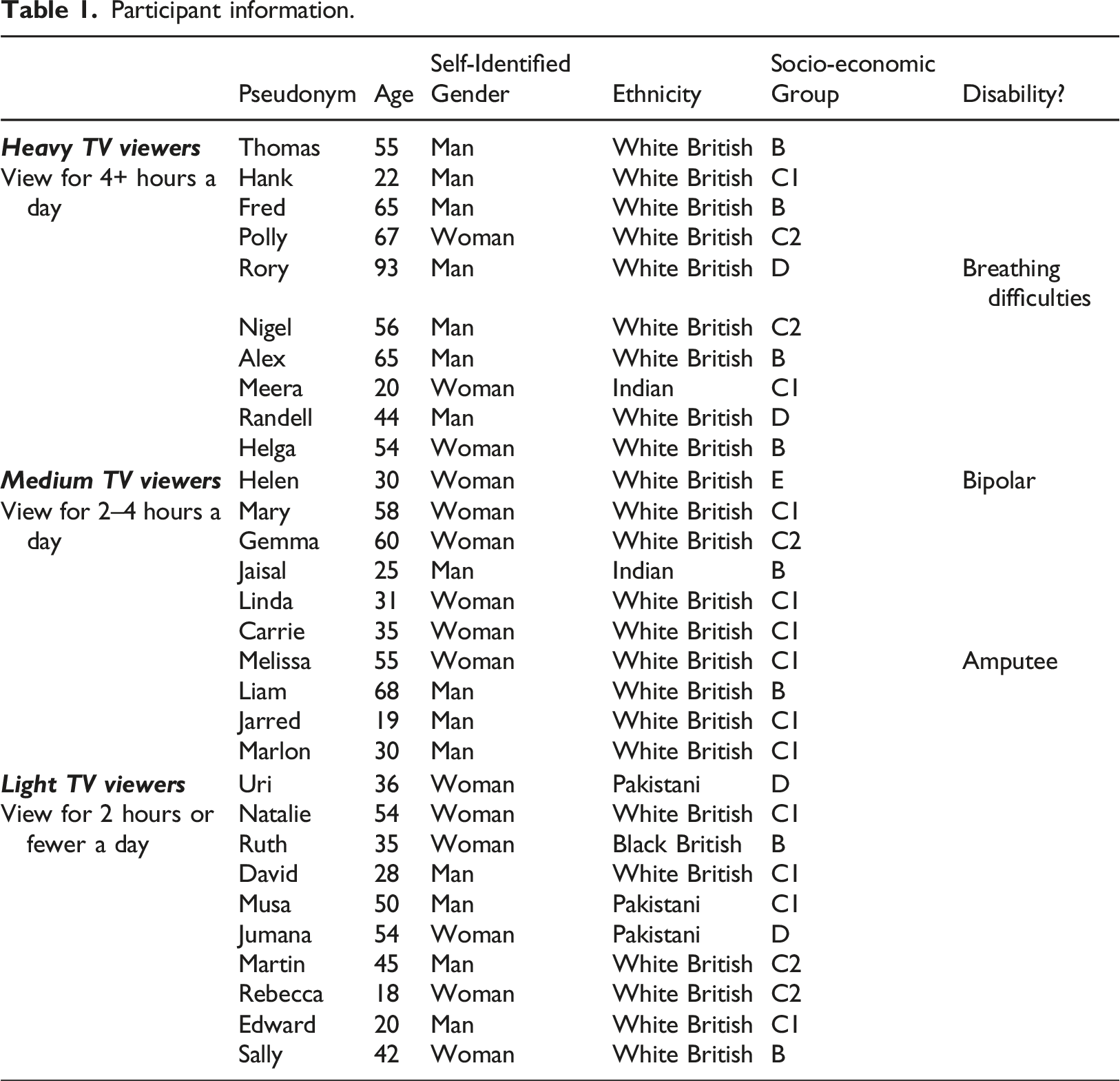
Within our sample of 30 participants, 28 reported watching TV on smartphones; 21 on tablets; 20 on Smart TVs; 20 on their laptop; 17 on voice search devices; and 8 on desktops. Three had Freeview built into their TVs, versus 27 who had a set-top box (such as Sky, Freeview, Virgin or Now TV). Seven also used a dongle, such as an Amazon Firestick or a Chromecast. 24 claimed to use BBC iPlayer; 21 used ITV Hub; 11 used All4; 5 used My5; and 4 used UKTV Play. With regards to paid-for subscriptions, 19 reported having Netflix; 12 had Amazon Prime; 5 had Sky Go; 4 had NowTV; and 1 had Virgin TV Go.
A pilot set of interviews were conducted in early August 2019, where six participants were visited in-home. We included this stage to provide the opportunity to ensure the discussion guide and research methodology were appropriate for the research, and make any necessary amendments to our approach. For instance, the pilot interviews demonstrated that when asked to talk about their TV routines, people often misremembered or simplified their routes to content, leaving out micro-level steps in terms of how they actually accessed TV content. We therefore asked that in subsequent interviews participants demonstrate how they accessed TV content and walk us through their typical routines. This provided us with invaluable insights into accessibility and routes to content that may not have been possible through simply asking them about their engagement. 4
Following this initial pilot stage, one member of the research team visited each participant in their homes in August and September 2019 for a one-hour semi-structured interview. The interviews operated according to an interview schedule that explored industrial, technological, social and cultural factors that might shape their decisions about what to watch. Participants were also asked to narrate and explain their actions as they turned on and used their primary TV-viewing technologies (from TV set and/or set-top box to tablet or games console) to navigate through associated user interfaces. This gave us a dataset of 30 approximately hour-long semi-structured interviews which were transcribed, thematically analysed and coded using NVivo.
Using this dataset, and building on the likes of Hill (2019), Hill and Lee (2021) and Lüders and Sundet (2021), we argue that the ‘push-and-pull’ between industry and audience extends to other aspects of the ‘pathfinding’ that people engage in when forging routes to content. This encompasses a wide range of activities and multiple forms of ‘television’. It involves the use of television-viewing technologies including smart TVs, mobile devices and add-on devices (such as set-top-boxes (STBs), connected devices and games consoles) to both find and watch television (Johnson, 2019: 7). It also involves the activities that take place around that technology use, such as the negotiations between household members about what, when and where to watch (Lull, 1982; Morley, 1986). While inspired by the media ethnographies of Morley and Lull, our methodology did not enable in-depth observation of household relations and dynamics. We were keen, however, to place as much emphasis on the social dynamics at work beyond the specific moment of sitting down to watch television. This includes conversations with friends, family and colleagues (on- and offline), as well as encounters with marketing, reviews, awards and other paratexts. To this end, our interviews included questions about the role of friends, family and peers in deciding what to watch, as well as questions about how viewing decisions are impacted by where and with whom viewing takes place. All of these activities are underpinned by interrelated social, cultural, technological and industrial factors that combine to shape how people find television to watch.
By examining these factors and the ways in which they intersect, this article demonstrates that there are multiple power dynamics at work in people’s routes to content beyond the role of technology, that has dominated policy discourse and academic research on prominence and discoverability, or the role of individual psychology, that has dominated research on media choice. We focus here on the four most prominent power dynamics that intersect as audiences find and decide what to watch. First, we explore technological affordances and default behaviour, developing the concept of the negotiated-null affordance to explain how technological affordances can be rendered invisible by habitual behaviours. Second, we focus on algorithmic literacies and propose a new dissonant algorithmic imaginary to explain our participants’ ambivalences towards algorithmic personalisation. Third, we unpack the dynamics of access that emerge in our participants’ negotiations of television technologies, services and content. Fourth, we examine the role of word of mouth and promotional paratexts, theorising a second-order algorithmic imaginary to help us understand how these forms of communication can often, themselves, be subject to algorithmic processes.
Where technological affordances meet default behaviours: The negotiated-null affordance
Research has sometimes argued that given an abundance of choice, users might be exposed to less diverse content (Helberger, 2018) because of the ways in which UI (User Interface) design and recommendations work to prioritise content. However, as Mazzoli (2020: 312) points out, because we have limited access to data on the content journeys of users, it is difficult to assess how placement strategies and prominence influence choice and the diversity of viewing experiences. To begin to address this, as part of our interviews we asked our participants to show us how they typically used their household technology to find something to watch. Observing the ways in which our participants used remote controls and navigated between and within different technologies, services and their related interfaces, drew attention to what Kleut et al. (2018: 125) refer to as ‘small acts of engagement’ that constitute the majority of audiences’ productivity and form a central component of people’s routes to content. Examining the small, everyday practices through which people navigate TV controls and interfaces is vital to challenging narratives that fetishise technology as a driving force of social change (Carpentier et al., 2014: 3).
Observing and talking with participants about their use of television-viewing technologies revealed the habitual or ‘default’ ways in which they tended to find and watch TV. Our research identified four such default routes to content: the ‘1-World default’; the ‘EPG default’; the ‘3-Digit default’; and the ‘3-Step default’. The 1-World default is associated with on-demand viewing and describes participants who would default to the ‘world’ of a particular technology (smart TV or connected device), VOD or pay-TV service. Once in the enclosed ‘world’ of their devices and services, our participants described using a range of features to find content, from search and categories to recommendations and watchlists. For example, David (28, M, White, C1) described how he would start by going to the homepage of his Sky STB: Interviewer: So this is where you would normally start from? From Sky? David: Exactly. This is, like, the Sky homepage. You’ve got ‘Home’ there. So you’ve got Dragon’s Den, Peaky Blinders, Untouchables – not even seen that.
And Ruth (35, W, Black, B) explained how she used the search function of her STB to locate content for her children: ‘When I’m in SkyQ world I will, I’ve now started to use my voice. […] So, if I’m looking for a film for the kids I’ll just put in, like, Incredibles and it’ll come up with all the Incredibles and stuff linked to it’. In both of these instances, the device and service provider (in this case, pay-TV provider Sky) plays a significant role in shaping viewing choices. For David, the prominence of programmes on the homepage makes new content visible to him. For Ruth, it is search results that lead her to new content. These are both elements of UI design that are shaped by a combination of algorithmic programming (where Untouchables might have been prominent for David based on analysis of his previous viewing behaviour, or Ruth’s search results might have been shaped by her previous choices) and economics (where content providers pay to have programmes/apps more visible within UIs and search results) (MTM, 2019).
Our description of the 1-World default seems to accord with dominant policy and industry discourses on discoverability, that is, that affordances and interfaces constrain people’s awareness of, and access to, content. However, our empirical audience research also suggested something else: that ‘default’ routes to content can lead people to entirely miss or ‘tune out’ prominent features in the UIs of devices and services. Although David was certainly influenced by the prominent programme recommendations on the homepage of his STB, he ignored other aspects of the interface. When the interviewer asked him about apps on the UI that he overlooked, David exclaimed ‘you’ve opened my world, just sitting here’. In a similar vein, when Polly (67, W, White, C2) showed the interviewer how she used her STB she completely ignored the ‘top picks’ that took up the first half of the homepage. When asked about this, she said ‘I don’t know why I’ve never noticed that […] but I will use it in the future’. Here, the familiarity and low cognitive involvement associated with habitual behaviour (Hartmann, 2009a) lead our participants to overlook and avoid the ‘attention-guiding mechanisms’ (Lüders and Sundet, 2021: 348) used by service and technology providers that aim to drive viewers to content. This is surely a ‘negotiated’ use of affordances/interfaces in Adrienne Shaw’s (2017: 598) terms, but it does not fit into her tripartite model (based on Hall 1980) whereby ‘imagined affordances’ either agree with industry-designed intent, actualise new unintended affordances or use affordances in unanticipated ways. Instead, affordances are quite simply negated: they are ‘negotiated’, and made manageable, by rendering them as null and void, hence acting as a form of negotiated-null affordance that users, empirically, seem not to see or recognise. This habitual, ordinary ‘screening out’ of designed affordances in favour of a self-limited palette ‘small acts’ within audiences’ routes to content has not featured meaningfully in industry/policy debates thus far, given that it requires detailed empirical analysis and cannot be ‘read off’ from industry design or associated cultural anxieties. Nor is such ‘tuning out’ of affordances immediately readable as audience agency: our viewers repeatedly seemed unaware of, and surprised by, their self-imposed limitations and characteristic dis-engagements.
Where the 1-World default was associated with on-demand television devices/services, other defaults were associated with linear television. The ‘EPG default’ describes habitual scrolling down channel lists, typically through an EPG. Musa (50, M, Asian, C1), for example, demonstrated his routine whereby he would turn on his television set, go to the EPG of his STB and then scroll through channels. Similarly associated with linear viewing, the ‘3-Digit default’ described habitual navigation to a preferred channel, but as an agentive way of oppositionally circumventing the EPG’s hierarchy of prominence. Jumana (54, Asian, W, D), for example, showed how when she turned on the television set, ‘the first thing I will do is put it on 503. There, [said with emphasis] that’s my channel’. The ‘3-Step default’ also related to linear television. Here, participants would default to recordings stored on their STB through a 3-step process: (1) turn on the TV set, (2) turn on the STB, (3) click on the ‘my recordings’ tab on the UI/remote. This section of the STB held programmes that viewers had previously set to be automatically recorded. For these viewers, the recordings section functioned as a library of content not dissimilar to a VOD catalogue and acted as a ‘navigational aid to find their shows and discover new ones’ (Mikos, 2016: 160). Indeed, for some people this was a space where they anticipated always being able to find something that they wanted to watch.
Observing this habitual behaviour demonstrated how our participants’ online and on-demand viewing behaviours were intertwined with linear viewing. Where studies of changing viewing behaviours have tended to focus specifically upon on-demand television (Giglietto et al., 2019; Martínez and Kaun, 2019; Steiner and Xu, 2020; Valiati, 2019), most especially via ‘binge-watching’ (Jenner, 2021; Perks, 2015), this overlooks the ways in which people’s TV use is embedded within long-standing habitual behaviours, with new technologies/services being integrated into, as much as transformed by, existing ways of watching television. Rather than categorising people as ‘broadcast’ or ‘online’ television viewers, most of our participants were what Rhiannon Bury describes as ‘multimodal viewers’ (2017: 53) assembling different kinds of television-viewing. Indeed, although the 1-World default was more commonly associated with younger participants, most of our participants adopted multiple default routes to content depending on viewing mode, time of day, content and technology. Randell (44, M, White, D), for example, explained that during the day, when he didn’t know what was scheduled, he would scroll through the EPG to find something to watch (EPG default). By contrast, most evenings he would go to specific channels to watch linear television based on his knowledge of the schedules (3-Digit default). However, several evenings a week he would browse Sky and Netflix because there was nothing on linear TV that he wanted to watch, or because someone had recommended a specific show for him (1-World default). Helen (30, W, White, E), meanwhile, used her Freeview TV set to watch linear television with meals (EPG and 3-Digit Default), but otherwise turned to her iPad where she could access VOD apps that gave her more choice and flexibility (1-World Default). Shifting in this way between default behaviours, our participants mirrored the ‘switching’ that Spilker et al. (2020: 615) observed in Twitch audiences as they jumped in and out of different streams or watched multiple streams at once. Our participants frequently switched between defaults, and the affordances associated with them, alternating between browsing or viewing in linear environments (EPG, channels) and utilising digital and on-demand environments (smart TVs, STBs, VOD services, connected devices).
Algorithmic imaginaries: From practical to dissonant
Our observations of default behaviour caution us to avoid ‘oversimplifying the interrelation between contemporary digital media platforms and the people appropriating these platforms’ (Mollen and Dhaenens, 2018: 45), especially where participants unpredictably, routinely and seemingly non-intentionally treated affordances as negotiated-null by blanking them. However, this does not mean that the affordances and services used by our participants had no impact on their routes to content. Indeed, our participants’ ‘algorithmic imaginaries’ revealed that most of them relied on and valued recommendations within on-demand services/devices, finding them useful in discovering new content to watch, and according with a ‘practical’ algorithmic imaginary (Ytre-Arne and Moe, 2021: 815). For example, Ruth (35, W, Black, B) stated: ‘That’s what I like about Netflix, […] it kind of just recommends loads of stuff, so pretty much everything that it recommends, I’m like “oh, I wanna watch that.”’ And Sally (42, W, White, B) described how ‘Recommended for you actually, on iPlayer, often does recommendations that are of interest to me’.
At the same time, some participants expressed concerns about the use of personalised recommendations. However, the level of literacy regarding algorithms varied markedly. Nigel (56, M, White, C2) was unsure about how recommendations worked in online TV services, asking, ‘Are they watching what you are watching so that they can suggest these things, or know your interests? It is a little bit unnerving’. Rebecca (18, W, White C2) demonstrated an ambivalent attitude, expressing value and concern about the ways in which digital surveillance is used to offer recommendations: BBC iPlayer does ‘if you watch this you will also like this’. And I used to be really snobby and be like ‘you don’t know what I’d like’. And then one day I was like, ‘Oh I’ll check that out’. And I was like, ‘Oh no! They do know what I would like’. This is worrying.
5
Nigel and Rebecca expressed concerns about surveillance, but at the same time they were not greatly agitated; for Nigel, it was only ‘a little bit’ of an issue, whilst Rebecca’s sense of being correctly recognised by iPlayer was expressed somewhat playfully as ‘worrying’ – her own previous rejection of the recommendation system was simultaneously devalued as ‘snobby’, indicating that she had been wrong to oppose its workings. By contrast, Jarred (19, M, White, C1) complained that the recommendation algorithm on Netflix was limiting the diversity of content he was exposed to: Because of the recommendations you can continuously get something, watch it, and then it recommends you something else. […] It loses that whole surprise element. […] it’s just like, oh, watch this, watch that, watch this. People like this. People like 13 Reasons Why, watch this. People like Stranger Things, watch this. And you almost feel compelled to like it, even if you don’t think it’s very good, or it’s mediocre.
Jarred’s vivid description of his experience of algorithmic recommendations echoes debates on exposure diversity (Helberger, 2018; Napoli, 2011) and reproduces the ‘confining’ algorithmic imaginary (Ytre-Arne and Moe, 2021: 814) by which services such as Netflix are understood to ‘seek to persuasively “hook” users, conflating user retention with user satisfaction’ (Markham et al., 2019: 40). Yet, despite taking a strongly critical position on this practice, Jarred nonetheless remained a regular Netflix viewer and expressed significant appreciation of much of the content that he discovered and watched there. While most of our participants did not understand or did not question how algorithmic recommendations worked, even those who expressed concerns about the use of their data, or the limiting of their choice through algorithmic recommendations, continued to use and rely on services underpinned by algorithmic datafication. This suggested an algorithmic imaginary that was neither dominant, negotiated or oppositional (Shaw, 2017), but rather dissonant, for example, Rebecca simultaneously expressing both the value of, and concern about, recommendations on iPlayer; Jarred criticising yet also appreciating Netflix’s algorithm.
Technological literacies, household relations and content barriers: Unpacking the dynamics of access
While degrees of algorithmic literacy varied in our sample, some of our other participants struggled with the basic technological literacies required to operate their TV devices. As with earlier studies on television viewing in the home (Gauntlett and Hill, 1999; Lull, 1982; Morley, 1986, 1992), we found that some of our older female participants, when we asked them to show us how they typically accessed television, in fact relied on their partners to use domestic viewing technologies. These issues of technological literacy were particularly apparent in relation to the main television set in the living room, which was often complicated by the number of remotes, devices and services that needed to be juggled and understood. Beyond working out how to use different remotes to operate television devices – particularly smart TVs, STBs and connected devices – there were also specific literacies related to understanding and using online TV. Natalie (54, W, White, C1) described her struggles to understand newer forms of on-demand television: ‘I’ve never really realised what it is, BBC iPlayer. What is that? And what’s ITV Hub? You see, I don’t even know what they are’. Meanwhile, Carrie (35, W, White, C1) described how Netflix was set up via her husband’s preferences, claiming ‘I’m going to have to try and figure out how to set up a Netflix account’. The multiplication of TV technologies and services has expanded the array of competencies that people now have to learn before they are able to experience the supposedly ‘easy access’ to television that Gunnarsson (2021: 7) proclaimed in this article’s opening quotation. While it would be prudent not to generalise from a qualitative study, these difficulties with technology were only evidenced by some of our older (35+) female participants. Given that this accords with earlier audience studies, this suggests that age and gender remain potentially important factors at play in the technological literacies shaping (and culturally limiting) routes to content.
It may be that our female participants were displaying the ‘calculated ignorance’ that Gray (1992: 151) speculated could lie behind her female participants’ lack of literacy in using video recorders. Gray, recognising the home as a site of labour for many women, suggested that their inability to use the VCR might be a deliberate strategy to ensure that operating this technology did not become another domestic task expected of them. Or it may be that our older female participants lacked the time within the home to learn how to use new technologies/services, particularly given the rate of change over the last decade or so. In addition, there may be social expectations in play, as evidenced by Melissa (55, W, White, C1) who claimed, ‘I rarely use the remote, right. It is mostly my husband that does the remote, as most blokes do’.
However, the use of TV-viewing technologies needs to be contextualised within a broader understanding of household relations. Lull (1982) and Morley (1992) both argue that the selection of television programmes within the home is shaped by domestic power dynamics. In these earlier studies, power is located primarily in the control of technology, with men being far more likely to be described as in charge of the main television set in the living room (Gauntlett and Hill, 1999: 243–4; Lull, 1982: 805–7; Morley, 1992: 140–5). From the descriptions of household relations provided by our participants, our research suggests that this gender dynamic has continued, with men more likely to be described as controlling the television set in the main living area. However, the multiplication of viewing technologies has altered how this power dynamic plays out. A number of the older women in our sample described portable devices, for example, tablets and laptops, as more accessible ways of watching television than the main set. Portable devices therefore enabled at least some older female participants to negotiate a lack of agency that they experienced in relation to the main television-viewing devices in their homes.
Similarly, while many of the adult children in our sample described lacking control over the main television set, rather than resorting to watching what their parents wanted to watch, it was common for them to watch on other devices in their bedrooms. Jarred (19, M, White, C1) described the hierarchy of devices within his home: This [main TV set in the living room] gets used by my mum and dad […] ‘cause this is almost like their room. ‘Cause we’ve got that room in there, which is more like my brother’s TV room. […] And then up in my [bed]room, that’s where I normally do my, like, streaming and stuff like that.
The proliferation of TV devices was seen as enabling participants to access a wide range of television services and content in their bedrooms, away from the control of their parents. Rebecca (18, W, White, C2) exemplified this, explaining: Most of my life watching TV would have meant sitting down in the evening with my parents watching either the news or like a documentary or something. Then I got a mobile phone [laughs] and a laptop and now watching TV just means mostly watching Netflix […] or stuff on iPlayer usually in the evenings in my room by myself.
Other participants described how portable devices enabled them to re-locate their viewing to another room when there were disagreements about what to watch. Linda (31, W, White, C1) discussed how ‘If [my partner and child] are in here and watching something on there [the TV set] and I want to watch something different, I’ll take my laptop into the bedroom’. This displays the kind of ‘use genres’ (Bakardjieva and Smith, 2001: 80) analysed by Jakub Macek in his qualitative audience study of Czech ‘post-TV’ audiences in the domestic sphere (2020: 248–9); Macek argues that couples combined TV set and laptop usage in order to watch together or apart without creating tension. Some of our participants used portable devices with headphones to continue watching television in the living room while their partner or child watched different programmes on the main TV set. These examples point to how viewing on the ‘main’ TV functions as a site of household negotiation. Although men were more likely to be described as in charge of the main set, decisions about what to watch in household spaces were negotiated for most participants.
The ways in which routes to content are negotiated extends beyond household dynamics to the user tactics adopted to navigate industrial limits on access to TV (usually because of licencing regimes). A number of participants described juggling between combinations of pay-TV and SVOD services to gain access to content. In line with uses and gratification research on the impact of cost in media choice (Scherer and Naan, 2009), typically, this involved balancing financial concerns against the desire to be able to see certain kinds of content. Carrie (35, W, White, C1) described how: We came to Virgin for BT Sports, but in doing so, I lost Game of Thrones. If we’d stayed with Sky, I’d have got Game of Thrones, but my husband would have lost BT Sports. […] It’s the same with Now TV and Netflix. We’ve pretty much done the same again and it’s, you know, a bit of a toss-up […] between the two, but you don’t seem to get everything in one place.
Here, Carrie describes a careful process of weighing up the affordability of, and content available on, different combinations of subscription TV service. Other participants were prepared to wait for or miss content that they wanted to watch if it was not available on a service they could access. Jarred (19, M, White, C1) described this behaviour in ethical terms: ‘I’ve never pirate streamed anything. […] Even if you’re very keen on seeing something, wait, you know what I mean?’ Others placed less value on the need to see a particular show. Gemma (60, W, White, C2) claimed that ‘I’d really liked to have watched one called The Crown […] but it was on something we haven’t got […] I have sort of let that one go and think “oh well, it will probably come back somewhere [else].”’ While Carrie, Gemma and Jarred evaluated their access to content through the services that were available to them, for other participants the most important thing was to be able to access specific content, regardless of where it was available. This was often described in terms of a lack of fidelity or allegiance to any particular service. For example, Jumana (54, W, Asian, D) claimed: It doesn’t matter to me [what website or service I watch on] because they’re all the same. As long as I can watch the episode that I want to watch, I’m not really bothered which one it is.
Whether choosing to juggle (Carrie), wait (Jarred), hopefully let go (Gemma) or seek out through informal/pirated routes (Jumana), these participants adopt tactics to navigate barriers to access erected by industry.
Indeed, what is at stake across the three areas examined in this section – technological literacies, household relations and content barriers – is the tactics deployed by people to access the technologies, content and services that constitute contemporary television-viewing. The variations in how our participants negotiated access to television speak to Turner’s (2019: 227) argument that the increased variety and customisation of television-viewing has made it harder to identify common patterns of consumption. As Turner argues, it is not just people’s choices of content or devices that are changing, but also the patterns of cultural practice growing up around TV-viewing, which, we argue, are informed by wider dynamics of access to contemporary TV.
Word of mouth and promotional paratexts: Towards a second-order ‘algorithmic imaginary’?
Along with platform and service features (such as recommendations and search), word of mouth was cited by our participants as the most important factor in deciding what to watch. Word of mouth here refers to both on- and offline inter-personal communication with friends, family and colleagues, as well as mediated communications from wider social networks online. Many participants valued word of mouth from friends and family because, as Edward (20, M, White, C1) explained, ‘you trust that they’ll know what you like’. Conversations with people about television also functioned as a useful way of learning about new shows. For many participants, talk about television formed a common basis for social interactions; some described watching shows in order to participate in conversations with friends or colleagues (see Valiati, 2019: 229). Mary (58, W, White, C1), for example, described how she started watching Downton Abbey even though she dislikes period dramas, because everyone was talking about it: I hate period drama, hate it. […] And I got that sick of people talking about Downton Abbey, I started watching it and then I had to go back to series one because I did get hooked. […] I actually bought the DVDs for that one.
The role that word of mouth plays in routes to content is embedded within the wider mediatised practices of everyday life.
6
For many participants, recommendations from friends are frequently encountered on social media. Meera (20, W, Asian, C1) described the role of social media in encouraging her to watch Power: I think it was when Power, season 5, when that was first coming out, loads of people used to just Tweet about it, and then you’re like ‘oh no, I need to watch it’. [...] I feel like when it’s loads of people as well, it makes you think oh, this must be really good, I think I should watch it.
Social media platforms also function as spaces for promotional paratexts, such as trailers, adverts and reviews, that were frequently described as operating alongside word of mouth in shaping decisions about what to watch. In talking about her decision to watch the new Lion King film, Ruth (35, W, Black, B) claimed: There’d been a lot of hype for probably about 6 months online […] and then even on the news, BBC news were talking about it, and then friends that’d been to see it: ‘oh my gosh you’ve gotta go and see the new Lion King’. And then I went and did my own [research], who’s the cast and had a look and I was like ‘oh this is brilliant’ and then actually some of the soundtrack was playing on the radio so it was like ‘oh great’.
Here Ruth describes a cumulative wave of different mediatised encounters, from news items to radio broadcasts, to recommendations from friends and family, all combining to create a sense of ‘hype’ around the movie (Gray, 2010: 3).
Participants often actively sought out promotional content to help them decide what to watch. Some followed the social media accounts of favourite actors, shows, channels or VOD services as a way of staying up to date with new content they were likely to enjoy. Others gathered information from multiple sources, such as professional reviews, trailers, social media, platform recommendations and searches, before committing to watching something. Helga (54, W, White, B) epitomised this behaviour, stating ‘I’m a researcher. I like to, if I see something I think, “oh I’ll find out a bit more about that.”’ Such ‘researchers’ often described themselves as TV literates who valued the respected opinions of professional review sites and were less likely to be swayed by word of mouth from friends and family. Alex (65, M, White, B) claimed, ‘I don’t get influenced at all by other people’s opinions. I kinda like to make up my own mind. But I’d be influenced by those threads that I see on The Guardian app. […] If you do the research, you’re gonna have better quality [content]’.
In addition to motivating participants to seek out particular programmes, mediatised word of mouth and promotional paratexts also informed the ways in which they selected content when navigating within TV devices and services. When showing the interviewer how she browsed on Netflix, Sally (42, W, White, B) described how she used trailers to decide whether to select recommended content: ‘Mindhunter, look at the trailer and then make quite a quick decision as to whether I actually fancy watching it or not’. Similarly, Meera (20, W, Asian, C1) claimed that when browsing on Netflix she would be more likely to try a programme or movie she hadn’t watched before if she had ‘heard something about it’. Even when navigating within the UIs of smart TVs, STBs, connected devices and VOD services, then, people are still drawing on an assemblage of informational resources, from reviews and marketing to word of mouth from friends, family and social media, that inform their routes to content. This speaks to Elizabeth Evans’ argument that one ‘consequence of content proliferating across media platforms and spaces is that the moment that we become aware of a media text may easily be lost within press announcements, social media posts or the glimpse of a poster or trailer’ (2020: 154).
Crucially, people’s encounters with these informational resources frequently take place in mediated spaces that are shaped by the platform logics determining how information circulates online (Van Dijck et al., 2018: 40-41). Meera’s and Ruth’s experiences of Power and Lion King as shows that everyone is talking about is shaped in part by the predictive analytics used by social media to determine which content they display to each user. As Webster (2014: 48) argues, we need to accept that our encounters with media might shape our preferences, particularly when the media is ‘actively engaged in cultivating our appetites and managing our exposure to their offerings’. Given that these encounters extend beyond the moment that we sit down to view, this means that policy/scholarship focused only on algorithms that are proprietary to given TV services (first-order or ‘personalising’ algorithmic impact) fails to address the contextualising, media-ecological role of second-order algorithmic interventions, where ‘word of mouth’ and ‘buzz’ in people’s networks can, in turn, itself have been shaped by a variety of platform algorithms.
Lüders and Sundet observed something similar in their Norwegian study, arguing that UI and algorithms’ ‘structuring forces persist… [but] we also note how these forces appear interwoven with peer recommendations, to the extent that separating between agency, peer recommendations and program[m]ed paths becomes impalpable’ (2021: 348). In the end, such separations might remain a matter of additional empirical exploration, but the intensely ‘interwoven’ nature of supposedly authentic ‘word of mouth’ and algorithmic ‘pathways’ was certainly present in our data. We would therefore suggest that scholarship needs a second-order algorithmic imaginary, reflexively considering how we, as scholars, might best imagine this algorithmic penetration of ‘word of mouth’ as well as analysing how audiences imagine algorithmic processes at their branded points of TV access.
Conclusion: Not only dominant affordances, not only imagined routes to content
We have argued that explorations of the power dynamics of discoverability need to bring an understanding of ‘how content discovery platforms coordinate users, content creators and software to make content more or less engaging’ (McKelvey and Hunt, 2019: 1) into greater dialogue with the lived experiences of audiences in forging routes to content. We have affirmed the importance of how TV services and devices utilise UI design, datafication and algorithmic personalisation to shape how audiences find and decide what to watch, but crucially we have also demonstrated that this is only part of the story: platform/service features form one part of a more complex set of power dynamics at play.
Specifically, we have drawn attention to the role of habitual, default behaviours in leading audiences to rely on certain aspects of UI design whilst unpredictably overlooking or ‘tuning out’ others (the negotiated-null affordance). Where previous studies of how users imagine, navigate and negotiate recommendations have tended to focus on self-selecting, savvy users, our participants displayed far less algorithmic literacy, leading to more practical or dissonant algorithmic imaginaries than the dominant, negotiated or oppositional positions proposed by Shaw (2017). Building on TV audience studies’ longer history, we have argued that focussing specifically on platform/service features also overlooks the ways in which television-viewing is embedded into broader dynamics of access. In particular, our research suggests that older female viewers might lack some of the agency often ascribed to contemporary TV audiences by industry rhetorics of ‘savviness’, both through ceding control of TV-viewing devices/services to their partners and through lacking the technological literacies to feel confident in using TV technologies/services to find and access content to watch. Here, mobile technologies offered some opportunities to circumnavigate household power dynamics, but in ways that could lead to increasingly individuated viewing. Furthermore, while industry rhetoric privileges discourses of increased content availability and ‘easy access’, our participants displayed multiple strategies to negotiate and navigate the industrial limits generated by exclusive licencing regimes. Finally, we argued that people use an assemblage of informational resources drawn from mediatised word of mouth and promotional paratexts to inform their decisions about what to watch. While this demonstrates one way in which audiences exert agency when forging routes to content, it also points to the role of wider platform logics. Any serious consideration of the power dynamics of discoverability, therefore, needs to look beyond the immediate moments of audiences’ use of TV technologies and devices, to examine how platformisation is shaping which informational resources are most visible and accessible to audiences leading up to their decisions to watch. Arguing against Lüders and Sundet (2021: 348) that this makes it impossible to distinguish audience agency from algorithmic structuring, we introduced the concept of a second-order algorithmic imaginary. This is intended to address how audiences don’t just encounter proprietary algorithms at the point of access (via Netflix’s UI, for instance) but also draw on mediatised word of mouth, always-already subjected to algorithmic logics of platformisation, to inform their content-viewing decisions. There is a recursiveness of algorithmic intervention here which any focus on singular UIs and services/brands fails to engage with.
Our study, connecting to the history of TV/cultural/audience studies and building on the turn to various ‘imaginaries’ in emerging literature, demonstrates two vital points. Firstly, industry/policy debates over prominence and discoverability are in danger of mistaking ‘dominant’ affordances (Shaw, 2017) for affordances tout court – the complexities of qualitative audience data can productively counter this. And secondly, industry/policy debates have shown a tendency to be driven by anxiety-fuelled and imagined routes to content (‘containing’ algorithmic imaginaries) in place of evidencing and responding to people’s actual routes to content. Though our work here has only made a small start, further qualitative audience research remains needed to counter this tendency by focussing on how engagement, literacies and affordances are experienced by diverse TV audiences, not all of whom are ‘savvy’ consumers in possession of algorithmic/digital capital.
Footnotes
Declaration of conflicting interests
The author(s) declared no potential conflicts of interest with respect to the research, authorship, and/or publication of this article.
Funding
The author(s) received no financial support for the research, authorship, and/or publication of this article.
