



Abstract
Chinese creators and Douyin (a prominent Chinese short-video platform) are building a strong relationship in cultural production. Based on the social exchange theory, this study tries to explore the process and mechanism of monetization in Chinese platforms. Using the app walkthrough method and in-depth interviews with 19 full-time creators, we contend that Chinese creators and Douyin engage in a repetitive but unequal exchange with the common goal of earning income. Douyin works with creators to cultivate their thirst for revenue over time, while mastering the creative labor, before finally tying them to monetary gains. Douyin not only binds exposure and allocates Internet traffic to new creators, but also develops Dou+, a traffic marketing tool that leverages the affordances of creative work visibility. Douyin first enhances the creators’ income expectations through this step. The platform then directs creators through the Star-Chart content trading system, and establishes the platform-advertiser-creator transaction chain. When the exchange between Douyin and creators becomes stable, the platform sets up an uncertain revenue mechanism. Douyin’s commitment to creating a standardized assembly line of production and financial benefit for creators has established an exchange mode between the platform and creators at the expense of innovation and diversity. We argue that this standardized labor process eliminates the autonomy of cultural production.
Keywords
Introduction
ByteDance announced a $180 million investment in Mountaintop Entertainment (泰洋川禾), which is a Chinese influencer agency, as part of a strategic partnership on March 12, 2020. ByteDance is the owner of Douyin, which is China’s most well-known short video application and the former parent company of Tik Tok (Weekly, 2020). ByteDance has emphasized that platforms with creative work as their primary business should develop mutually beneficial collaborations with creators. ByteDance will keep supporting creators on the platform with the hope that they will acquire financial value on platforms such as Douyin (Weekly, 2020).
Douyin is one of ByteDance’s most successful social media platforms. Over 600 million daily active users – nearly half of China’s population, according to an official report published by Douyin in January 2022 (OceanEngine, 2022) – are now active on the platform. The creators of Douyin have achieved very large financial rewards. In fact, during the 2nd Douyin Creator Conference, officials stated that a total of 22 million creators had generated $6.2 billion on Douyin (Douyin, 2020). These revenue results seem to confirm ByteDance’s expectation that the creators and the platform are forming a reciprocal exchange based on the common goal of generating economic revenue, and both parties seem to have the will to continue this exchange relationship.
Cropanzano and Mitchell (2005) state that reciprocal exchange, in which both parties rely on each other, is a defining feature of social exchange. This exchange relationship encourages both parties to work together in a stable and self-reinforcing cycle of mutual responsiveness (Molm et al., 2007). Nieborg and Poell (2018) proposed the platform dependency to describe the increasingly close relationship between cultural producers and platforms. They highlighted that platforms have changed the ecosystems in which stakeholders should deal with ‘a loss of autonomy, risk, and uncertainty’.
The inclusion of creators at the forefront of platformization introduces a complex dimension to their definition. Platforms allow ordinary people to present their daily practices as ‘vernacular creativity’ (Burgess, 2007) and to present craft content in the name of authenticity (Duffy and Hund, 2015). They also devote time, energy, and talent in developing and maintaining the ‘calculated authenticity’ on platforms (Pooley, 2010). Regardless of the status of the creators, they all share a similar perception of creative work on platforms: the fragmented, erratic, and independent nature of creative work cannot be isolated from the customized growth of the creative industries with platformization (Cunningham and Craig, 2019a; Koutsimpogiorgos et al., 2020).
The environment on platforms for creative work can be unstable and vary depending on the business strategies of the particular platform. Creators on Instagram are left in the dark about who will see their work because the algorithm distributes content in a ‘black box’, exacerbating uncertainty (Cotter, 2019). Creators on YouTube gain substantial economic value from the self-branding and commodification of content through visibility (O’Meara, 2019). These studies show a path of dependency on various platforms for creative work (Hudders et al., 2021). According to a previous study (Arriagada and Ibáñez, 2020), the authenticity and commerciality of the creative work are often shaken by the changes of the platform policies. The protection of the vulnerable and uncertain authenticity remains the main proposition of the creative labor studies (Duffy et al., 2019).
Existing studies (Tse and Shum, 2022; Alacovska and Gill, 2019) on creative work on platforms are mainly based on social media in Europe and the United States, such as YouTube and Instagram. They demonstrate the confrontation between self-expression and commercial strategies in creator-platform relationships (O’Meara, 2019). Additional studies on creative work in various geographical contexts, especially from the Global South perspective, are urgently needed (Milan and Treré, 2019). The development of Chinese studies on creative work indicates a distinctive landscape that differs from the Western-dominated studies (De Kloet et al., 2019). Chinese creative workers (‘Wanghong’) are a socially growing group, with active participation and a desire for stable remuneration (Lin, 2018), showcasing real life in different regions with the help of platform affordances (Craig et al., 2021). The ‘collaboration’ connecting platforms, guilds, and creators (Ye and Jin, 2021) for the common goal of making profits (Hou and Zhang, 2022), brings economic, symbolic, and cultural capital (Fung et al., 2022). However, limited attention has been paid to how these creators balance the authenticity and commerciality for building their distinctive labor process in China, and how this labor process affects the determination of the creative work’s economic value. This study on the labor process of Douyin creators will further explore what kind of exchange is accomplished between the Chinese platforms and creators.
This study investigates Douyin's activities and tactics in response to the unpredictability of the creative labor market. It also studies the collaborative labor process of Chinese platforms and creators, focusing on the business rules and system setups of the platforms. (1) How do platforms implement the measurement mechanism to launch the exchange with creators? (2) How do platforms fulfill the intermediary role between advertisers and creators? (3) How does the collaborative labor process between platforms and creators accomplish the transition from visibility to income? Using the social exchange theory (Cropanzano and Mitchell, 2005), this study aims to clarify from the perspective of platform-advertiser-creator how the exchange transforms uncertain creative effort into certain production and establishes sustainable content monetization.
According to this study, Douyin actually works with creators to cultivate their revenue demands over time, mastering their creative labor along the way before finally tying them to monetary gains. Douyin not only binds exposure and allocates Internet traffic to new creators, but also develops Dou+, a traffic marketing tool that takes advantage of the visibility of creative work on Douyin. It provides a paid service for creators to increase the visibility of their content based on their needs. Douyin first increases the creators’ income expectations through this step. It then directs creators through the Star-Chart content trading system, provides its services to creators who are willing to pay for a steady traffic flow, and establishes the platform-advertiser-creators transaction chain. This process helped to limit the unpredictable nature of creativity. However, it also led to the uniformity of the creative output.
From user pricing to platform metrics: How the monetary value of content is measured?
Exchanges between users frequently serve as a measure of the value of social media content (Lewis, 2015). In addition, the reciprocity has been identified as a positive norm in social media (Hwang et al., 2018; Pai and Tsai, 2016). Individual actions such as sharing and receiving information are ‘gifts’ within the platforms that promote the development of user interdependence and community cohesion (Yan and Jian, 2017). The determination of the content value also depends on the users’ assessment of its usefulness. Users reach a shared standard of value that satisfies the needs of both parties in terms of emotion or knowledge during the exchange (Ye et al., 2021).
The majority of social exchanges in social media networks are driven by mutual needs (Huang et al., 2018). Although social media metrics are one of the references for measuring value, they are not the only resource (Oestreicher-Singer and Zalmanson, 2013). The commercialization of cultural production pushes metrics to the forefront (Baym, 2018), and becomes a crucial standard to evaluate the visibility of the personal creative work or to measure user attention (Baym, 2013). In the new framework of metrics, visibility can be univariate (how many people commented), or multivariable (with the number of likes or retweets) (Bishop, 2021; Gandini, 2016). With the emergence of these quantitative evaluations, the user needs exchange as a dominating driver of content value measurement has given way to user attention statistics (Duffy and Sawey, 2022; Petre et al., 2019). To be eligible for monetization, the content should be evident to more people and have a measurable track through metrics (Hund and McGuigan, 2019). The degree of visibility is an important basis for the creators to monetize the creative labor. A highly visible content denotes higher metrics. Based on the visibility performance of the creators and their content, the advertisers will choose one to enhance the brand's ‘digital presence’ on social media (McCosker, 2017).
The platform ecosystem in which all types of users actively participate is configured by the multi-sided market and the emphasis on data-based mechanisms, that further strengthen the commodity characteristics of user-generated content (Nieborg et al., 2020). Platform operators are responsible for developing and managing interactive interfaces, and data models, as well as implementing internal exchange rules for commoditizing the platform. They also serve as proxies for both audience size and engagement (Baym, 2013). Visibility metrics such as the attention, data, and followers, have monetized valuations and serve as infrastructure to complete the cycle of the platform ecosystems (Van Dijck et al., 2018). Platform metrics provide detailed data on the performance of content or accounts, while reiterating the need for content distribution, marketing, and statistics (Carlson, 2018; Duffy, 2013; Napoli, 2014). This indicates that the platform’s development and calculation of metrics will play an important role in improving the performance of the creators and the visibility of their content.
The essential rationale allowing the platforms to implement datafication and commoditization, is provided by algorithms (Bishop, 2018; Cunningham and Craig, 2019b). Algorithms determine the level of visibility and are also embedded in the mechanism of promoting visibility, even in the cases of imbalance (MacDonald, 2021; Neyland and Möllers, 2017). The unpredictability of algorithms has prompted platforms to turn creative work into a ‘game of visibility’ (Petre et al., 2019). Continuously updated algorithms tend to favor platforms in unbalanced state, and the level of visibility seems to alter with the development of the platform (Gillespie, 2014). In fact, as a result of individual and institutional users' efforts to promote themselves and their work on platforms, the desire for visibility amplifies the commodification of user data, commodities, and services by platforms (Abidin, 2020). Liang (2022) deduced that metrics for visibility are essentially required for a fulfilling career of creators. In other words, platforms can use algorithms to further increase their control over the visibility of creators and their content.
Thus, in the context of platformization, the metrics used as a measurement tool for cultural production previously relied on the users’ information needs, to the degree of visibility. The platforms can further enhance their control over the visibility of creators and their content by using algorithms. Thus, this study highlights the ways in which Douyin’s algorithms and traffic tools create an environment that cultivates creators’ awareness of monetizing their work.
From self-employment to emotional labor: Creators as the platform gig workers
Many researchers focused on the labor status of creators on digital platforms, while emphasizing on how an unstable creative work is transformed into commercial value on the platform (Lin and De Kloet, 2019; Oestreicher-Singer and Zalmanson, 2013). They stated the exploration of the labor patterns of creators around two aspects. The first one is related to the atmosphere of the platform, where the creators are affected by the business strategies of the platforms, and therefore the labor patterns change (Johnson and Woodcock, 2019). The second one is that the platform measurements concretize the emotional relationship between the creators and audiences regarding visibility labor, or self-branding as a practice (Hatton, 2017). Existing studies on creative workers focused on the ‘workplace’ and ‘labor mechanism’ (Ye and Jin, 2021). This is consistent with the exploration of the ‘conversion movement’ in the labor process theory (Smith and Thompson, 1998), which emphasizes the entire process of transforming labor into commodities.
The studies on the labor process focused more on how to ‘launch’ the labor process to explore the relationships of employee autonomy in the workplaces (Knights and Willmott, 2016). The emergence of the ‘core theory’ shifts the studies to assess the role of labor skills and the control of the labor process, or the function of capital accumulation (Jaros, 2005). The gig economy is a new advancement of digital technology participation in labor. It completes the landmark shift regarding unpaid digital work, where the individuals involved in platform work are independent contractors and paid workers that participate in a capital-labor relationship under a platform organization (Friedman, 2014). Gandini (2019) argued that the studies on the gig economy on platforms should ‘focus on the conditions by which relations of production come to emerge within such context’.
Creative work is a significant component of the ‘gig economy’, as the platforms take on the role of traditional workplace. Creative work with self-employment is built based on the platform serving as a workplace and an intermediary between employers and employees (Gandini, 2016). The role of the platforms is to provide a closed infrastructure, reconfigure the initial supply and demand chains for creative work (Aris and Bughin, 2012), and regulating the social relations that define how labor is distributed and employed. Platforms ultimately benefit from this intermediation (Fleming, 2017).
The classical studies on the labor process consider the emotional labor as a professional skill in the process of social relationship management (Brook, 2013). The notion of emotional labor describes the need for employees to ‘induce or suppress feeling’ in order to create a particular emotion in their work when interacting with others, displays that affect others in desired ways (Hochschild, 1983). Emotional labor involves both the emotions of the employee performing the labor and the emotions of others to whom these emotions are addressed (Steinberg and Figart, 1999). Hochschild (1979) also argued that the emotional labor is ‘a gesture in a social exchange’, where the emotions of others as feedback determine whether the employee’s emotional labor works or not.
In the gig economy, the emotional labor manifests itself in the form of gig workers whose jobs will be evaluated by consumers through the system of feedback and rankings provided by the platform, generating a visible ‘reputation score’ (Graham et al., 2017; Hu and Ye, 2019). For example, the Uber drivers’ emotional labor is no longer exchanged for tips, but for ratings (Rosenblat and Stark, 2016; Glöss et al., 2016). Workers develop the labor process of ‘emotional management’ due to the platform metrics, which is also a quality enhancement of the labor under the control of platforms (Rosenblat and Stark, 2016). As for the creatorson on platforms, Duffy and Wissinger (2017) argued that emotional labors are also a job requirement for creators, who fulfill ‘passion projects’ to make a living. Moreover, the creators should carefully operate authenticity and self-expression through emotional management, where they compel themselves to express passion and maintain the level of intimacy with followers (Cunningham and Craig, 2017). The emotional labor catering to advertisers and audiences’ feeds into metrics that evaluate the creative work visibility (Bishop, 2019). They quantify the feedback from followers on the emotional labor that creators put in, which is closely related to the income level of the creators (Johnson and Woodcock, 2019).
Similar to the other gig workers, the creative work can be quantified through the platform's evaluation system. The emotional labor serves as a tool to connect followers and converttheir attention into commercial value. However, the labor process of commercializing creative work has not been studied yet. This study investigates the labor process of Chinese creators on Douyin, not only to demonstrate the monetization of their content, but also to explore whether the creators have developed a standardized content production assembly line under the platform design.
Methodology
This study uses the app walkthrough method and in-depth interviews to investigate how Douyin cultivates creators’ income demand and how creators profit from the business model and system settings of Douyin. The walkthrough method offers a direct approach to an app’s interface and delves into the underlying mechanisms and cultural implications (Light et al., 2018). By simulating the app’s everyday usage, this step-by-step observation allows for careful documentation of how users’ experiences are influenced by the app’s various screens and features. We use the app walkthrough method to collect information about the interactive interfaces, technical mechanisms, and realization path of cultural production on Douyin. Some studies on Chinese platforms (e.g., Wang and Lobato, 2019; Chen et al., 2021) have used this method to reveal the platforms’ operation mechanisms. We also set up a creator account on Douyin to gain first-hand experience of the monetization measures of Douyin.
This study also conducted interviews with 19 full-time creators working on Douyin, while their creative work is their only source of income. All the 19 creators have been working on Douyin for more than one year and each has more than 100,000 followers. Finding creators who meet the research objectives has always been a difficulty in platform labor studies, as mentioned by Glatt (2021). In September 2020, a recruitment notice was posted on Chinese social media platforms, hoping to get in touch with the creators of full-time content productionwith Douyin as the only source of income. In addition, the interviewees were encouraged to provide their accounts on Douyin as supplementary research materials. Thirteen creators were then recruited. Afterward, the snowball sampling method was applied. Creators who had been interviewed were asked to suggest or invite potential interviewees. Six more creators were discovered in the end. Each interviewee was given a pseudonym to protect their privacy. More detailed information about the interviewees is provided in the appendix.
In November 2020, in-depth interviews were conducted with each creator individually. It is important to mention that Douyin’s algorithmic recommendation system and advertising rules were also constantly adjusted during the interview. The impact of this uncertainty of the platform was experienced with the creators. During the conducted interviews, the complex emotions of the creators can be intuitively felt. They were always excited to share the benefits of their work and to show the enthusiastic feedback they received from their fans. However, exhaustion and fatigue were also written on their faces, and many of them asked to pause the interview to check their accounts or post content.
Due to the COVID-19 pandemic, except for three creators in Beijing offline, all the interviews were conducted online. All the interviews were audio recorded and followed a semi-structured interview protocol. Most of the interviews lasted more than one hour. The participants received a stipend of $25 at the end of the interviews as appreciation for their time. All the materials were then carefully read and the presented themes were discussed (Glaser and Strauss, 1967).
Findings
Based on the study on Douyin’s business strategies, and the in-depth interviews with professional creators, it is deduced that the platform uses multiple tools to monetize content, and progressively nurtures the revenue needs of creators. In addition, the creators’ reliance on emotional support from the followers is gradually weakening, instead of a production assembly line that transforms the independent and creative work into standardized content. This section discusses the labor process of content creation defined by the platform.
‘My content can be rewarded’: Cultivating and retaining creator revenue awareness
Visibility is also evident in the traditional cultural production, such as bestseller rankings, which is also a ‘reputation symbol’ for cultural products. Bucher (2012, p. 1164) referred to ‘new modalities of visibility engendered by new media’, which challenges the previous unpaid notion of creative work. Visibility is generally seen as one of the premises for creators to generate revenue. The creators’ commercial value, represented by the number of likes and followers, will be evaluated by both the advertisers and the public. It is also an important tool used by the platform to allocate visibility and facilitate the implementation of its business strategies. In China, the word ‘traffic’ is used to describe the scale of visibility, which refers to the exposure of individual accounts and to the overall visibility of the platform. Platforms that can attract more traffic lead to a consistently growing followers base and exposure, higher popularity among creators, and better revenue from posting content.
This is particularly consistent with Douyin’s publicity strategies, which aim to build a mutual beneficial ecosystem on the platform. One of the key tactics used by Douyin consists in creating an atmosphere where creativity is supported by the platform, so that creators will have higher expectations for the attention directed to their posts. Consequently, different ‘combos’ of policies are introduced to support content monetization, ensuring that newcomers to the platform can quickly realize that the platform has some control over algorithms and traffic, and thus traffic can be distributed or purchased at any time.
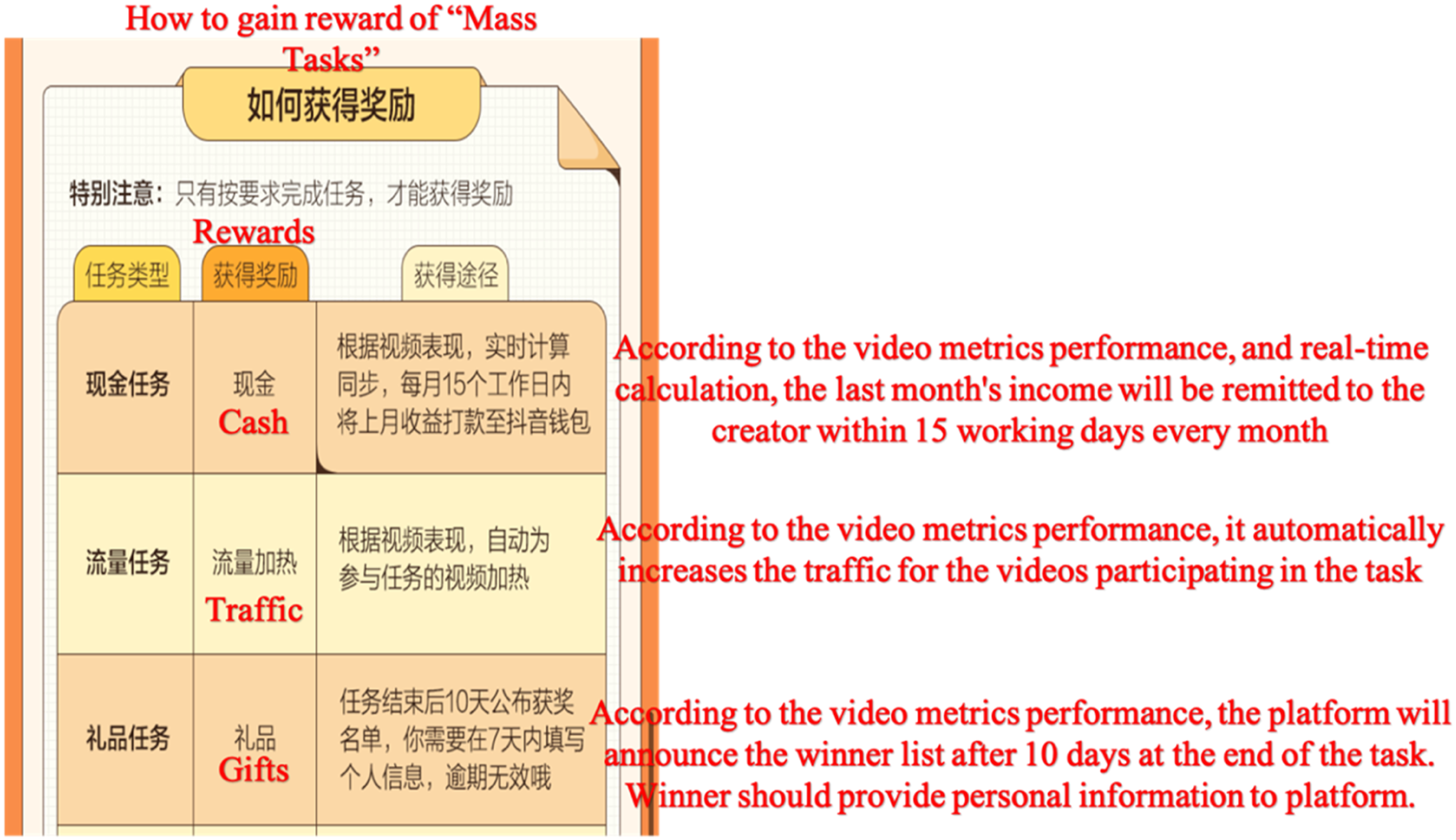
When creators enter the interface to edit and post content, Douyin first automatically identifies the uploaded video and image. Hashtags that match the content will then be recommended accordingly, so that creators can add to the content. For an uploaded roadside scene (Figure 1), Douyin automatically responds with corresponding hashtags, such as ‘wind and freedom’ and ‘passing scenery’, and specifies the previous view counts of each of the hashtags. Building a correlation between hashtags with concrete numbers is the first step in cultivating revenue awareness. This is a disguised incentive strategy, as creators who have received intuitive instructions are aware that hashtags linked with high visibility will drive more traffic and potentially higher revenues. Douyin has also launched the ‘Creator Service Center’, which provides multiple tools to help creators improve the visibility of their content. It has the ‘Mass Tasks’ function, which offers rewards for tasks jointly issued by advertisers and Douyin (Figure 2), and is open to all the creators. Once a video is created and posted according to the task requirements, the creators are rewarded with traffic of different levels, or even with cash. Posting interface of Douyin. Rewarding description of ‘mass tasks’.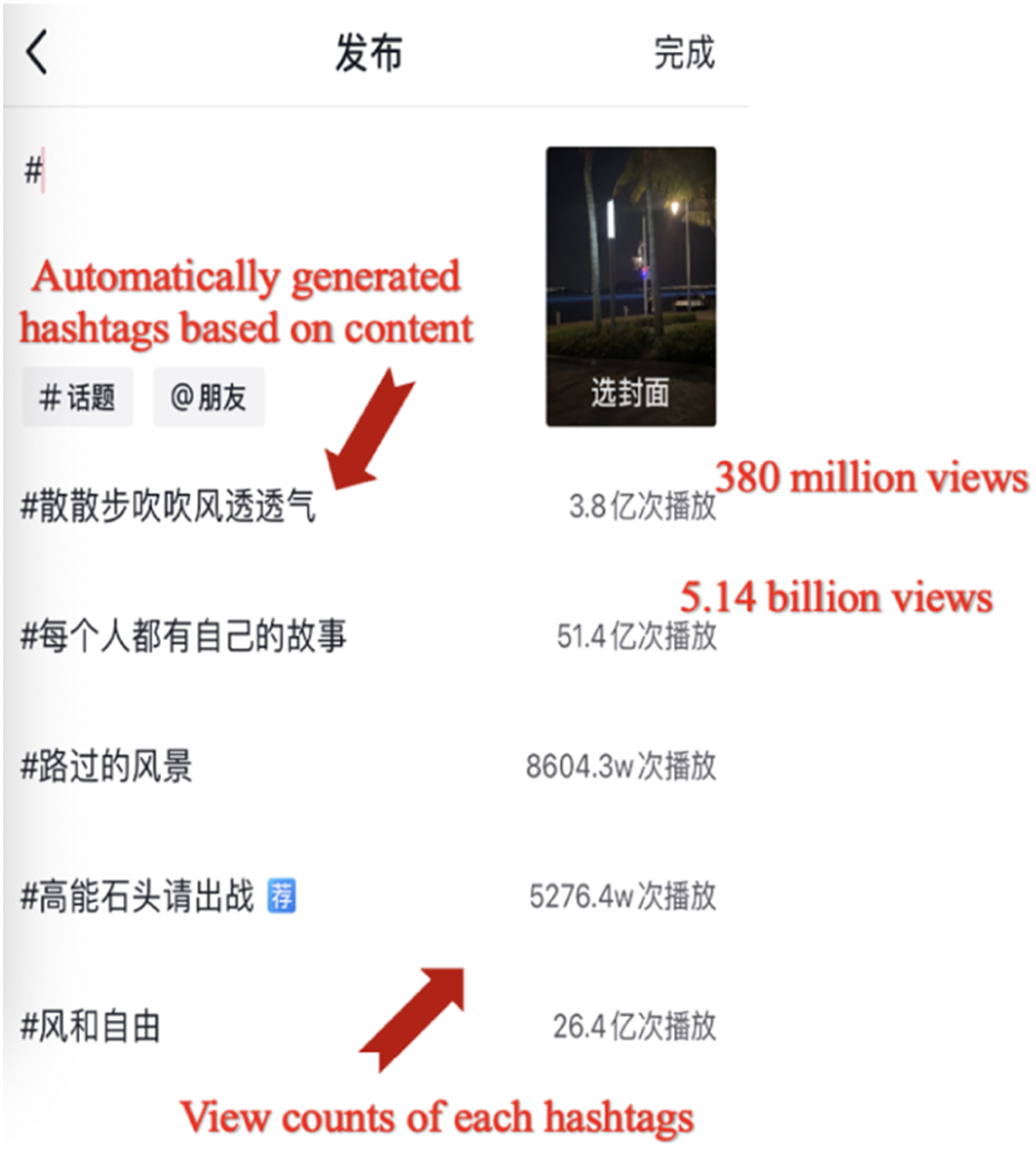
Moreover, Douyin has developed a traffic trading tool called ‘Dou+’, through which the creators can buy visibility for content or accounts with prices set by the platform. They can also choose the volume of exposure for specific content and the number of followers for individual accounts. A traffic order with a price of $4.4 will allow the content to be intelligently distributed to 2000 viewers (Figure 3). Creators can choose the level of visibility according to their needs. In other words, Dou+ allows the creators to understand that the visibility on the platform is a commodity sold at an explicit, marked price. The algorithms instruct the content distribution and allocation operations, while the platform uses hashtags, free tasks, and the traffic trading tool to demonstrate to the creators that the traffic on Douyin is controllable and tradable. Purchase interface of Dou+.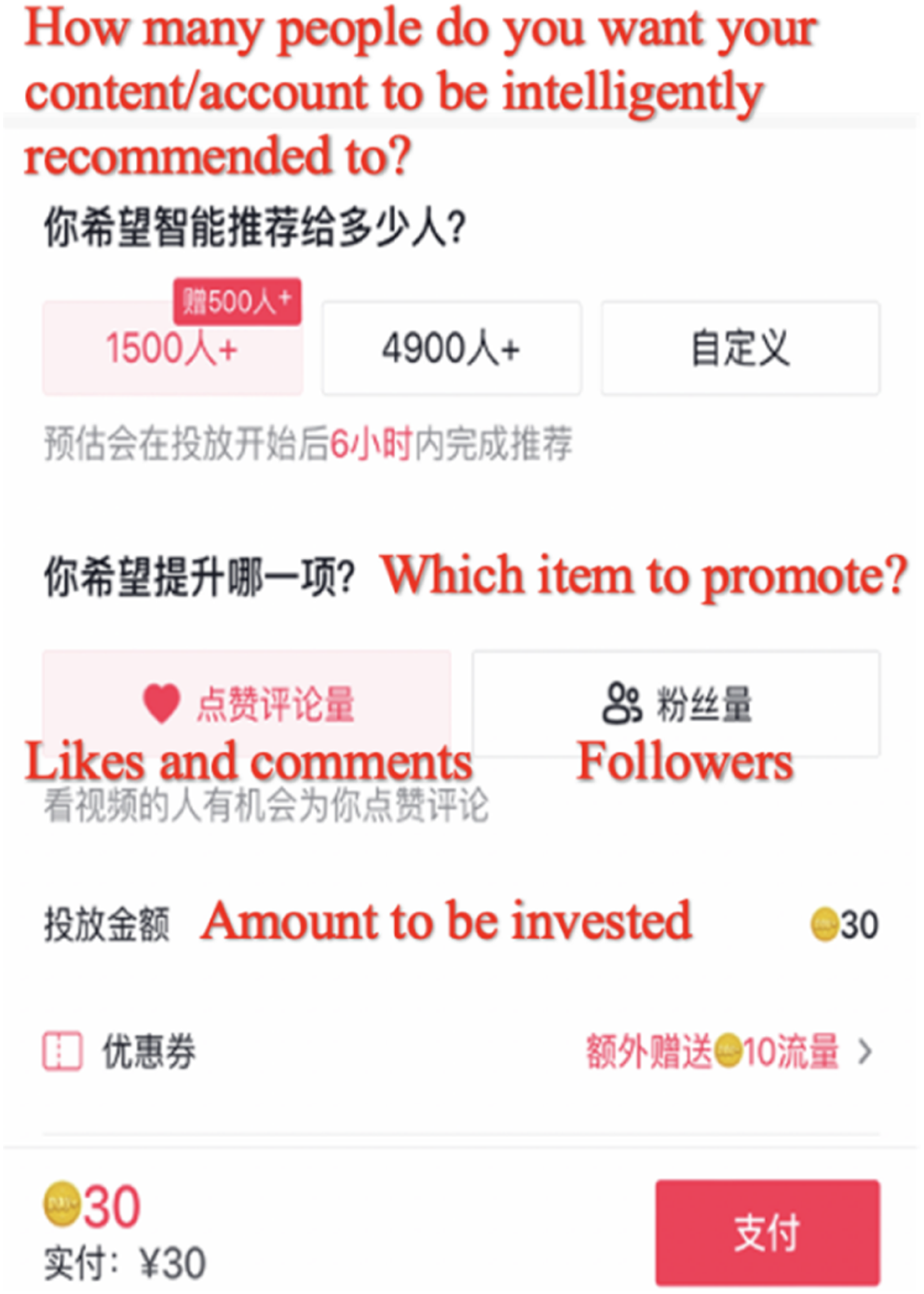
15 out of 19 interviewed creators expressed that they have tried hashtag selection, ‘Mass Task’ or purchased traffic through Dou+. Many of them believe that this is the best way to quickly accumulate traffic, and an important approach to evaluate the commercial value of Douyin. On the one hand, paid traffic can help creators ‘monitor the unit price of traffic on Douyin’ (#11), and calculate the economic value of the content they have produced on the platform. On the other hand, the combination of free to purchasable traffic seems to have created a natural monetization consensus for creators. It is implicitly encouraging to gain considerable traffic at a low cost as long as it meets all the requirements. It seems that Douyin provides desirable incubation conditions for content monetization, and minimizes the precariousness of visibility resulting from algorithms. After all, for the creators, a tangible and visible revenue is the engine that drives them to continuously produce content on the platform, as stated by interviewee #8: ‘In fact, when I first started (as a creator), I tried all the platforms: Zhihu, RED, and Weibo. I think Douyin suits me better. It is particularly strong in cultivating new creators like us. In the beginning, each piece of my content received about 10,000 views. ... I was approached by the advertisers after two assignments, so I stayed on Douyin and did not go to other platforms’.
Creators tend to learn about the platform’s rules through trial and error. Figure 4 shows the description of the 19 creators’ whole journey of six steps on Douyin, from opening an account to staying for creative work. All stages of creators’ perception and actions for Douyin business strategies.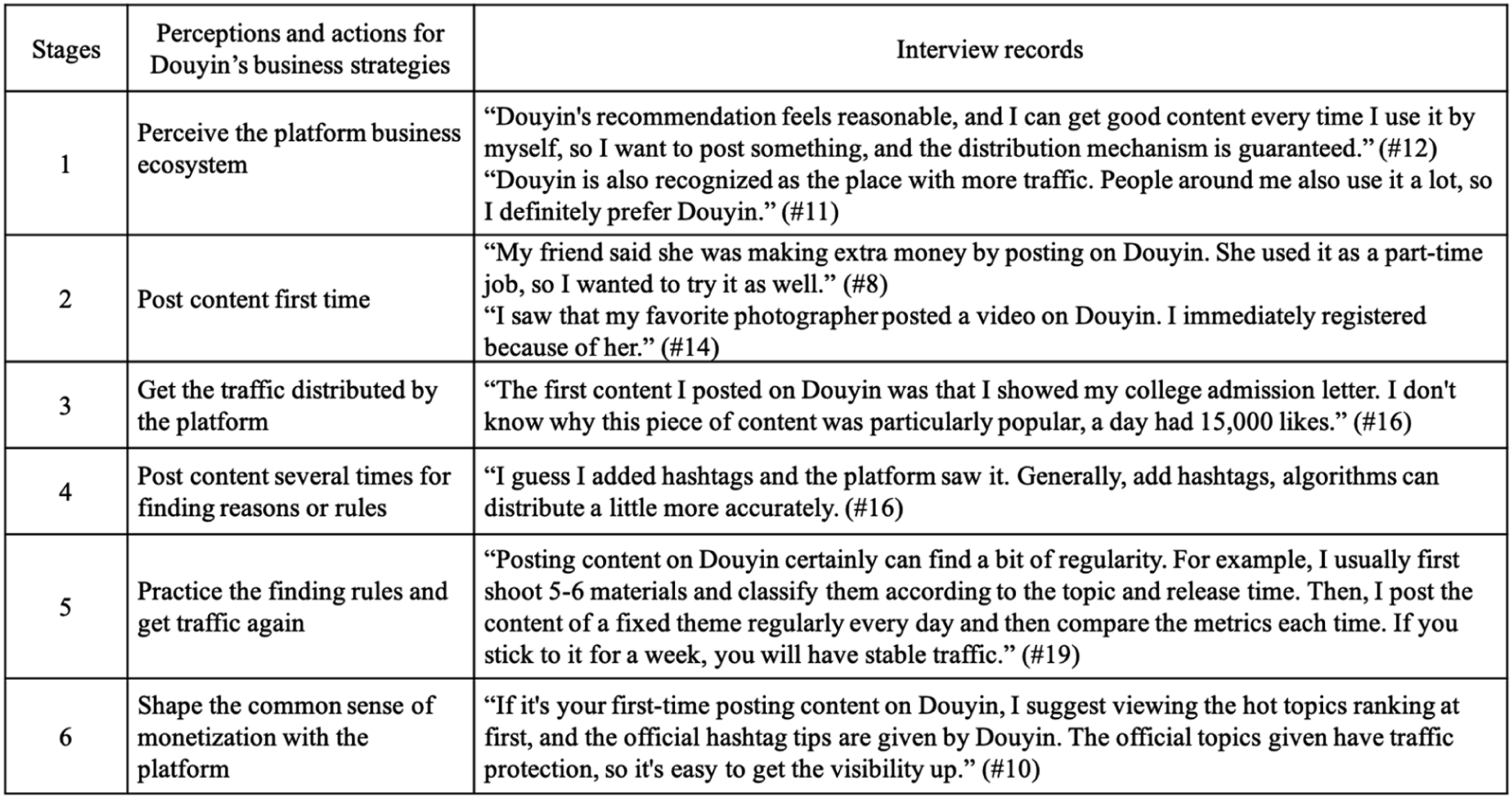
The newly registered creators with or without revenue needs are exposed to the rich commercialization means of Douyin. When they post their first short videos on Douyin, they will gain traffic reward from the platform (a mechanism i.e., similar to ‘Newbie Lucky’), which aims to encourage the creators to continue their exploration and experiment of winning traffic, until they establish a fixed cognition of Douyin and the algorithms behind its operation. With these combinations, the platform guides the creators to initially establish a strong connection between their creative work and commercial value.
Douyin and its algorithms jointly accomplish the mission of nurturing revenue needs and continue to use the uncertainty to drive the creators to find more possibilities of gaining traffic bonuses. During this process, the creators become aware that an emotional support from the audience is not necessarily the only solution to achieve higher visibility. Being recognized by the algorithm is the essential access to the revenue increase. Breaking the link between emotional labor and platform visibility is the first stage used by Douyin to cultivate creators’ revenue awareness.
‘My content can be traded’: The emergence of the platform-advertiser-creator transaction chain
When the creators receive positive feedback from the platform, they will choose to settle down on Douyin and monetize more creative work, which is the initial binding between them and the platform. Under the cultivation of Douyin, the creators start to consciously transform the self-expression into expected revenue and meet all the basic requirements set by the platform. After the creators decided to join Douyin and produce their content, it is expected that their accounts will witness an exponential growth in visibility. However, all the 19 creators said that they experienced that the traffic bonus started to shrink or even disappear after 1 to 2 months. Interviewee #15 referred to the platform’s rewards as the ‘Newbie Bonus’: no longer a newbie, no more free traffic from the platform. ‘When I first started posting on Douyin, for about a month, I could post anything with a hashtag recommended by the platform. Now, no matter what hashtags I added, the number of follows and likes did not increase much. I thought it was because I did not post the content as required by the platform. But later I found out that the “newbie bonus” had disappeared. The rewards of Douyin are only for new people, and we, as experienced ones, have to find other ways to make money’.
After the demand for sustainable revenue is formed, the random and irregular distribution of traffic bonuses become so inadequate. Creators urgently need to transform their long-term efforts of accumulating traffic into a steady income. YouTube launched the ‘YouTube Partner Program’ to insert similarly themed ads into creators’ content, making audiences’ attention to the ads an economically valuable part of the process and attempting to share ad revenues with creators. Caplan and Gillespie (2020) named this approach a ‘tiered governance strategy’ that YouTube imposes on creators. In addition, how to ensure a stable and sustainable creative work that highlights authenticity, as well as secure revenue, is more challenging and vital for the creators.
Douyin provides an alternative solution to this problem. In 2018, an advertising task system called ‘Star-Chart’ was launched. With Douyin as the matchmaker, a direct transaction chain between the advertisers and creators was established. Advertisers can unilaterally post advertising orders with a clear task index (specific amounts or actual view counts) in the system, which are accepted by creators. According to the requirements for Star-Chart access, creators can take advertising tasks only if they have more than 10,000 followers. In other words, creative work, enterprise marketing, and branding demand are directly matched with the platform's mediation.
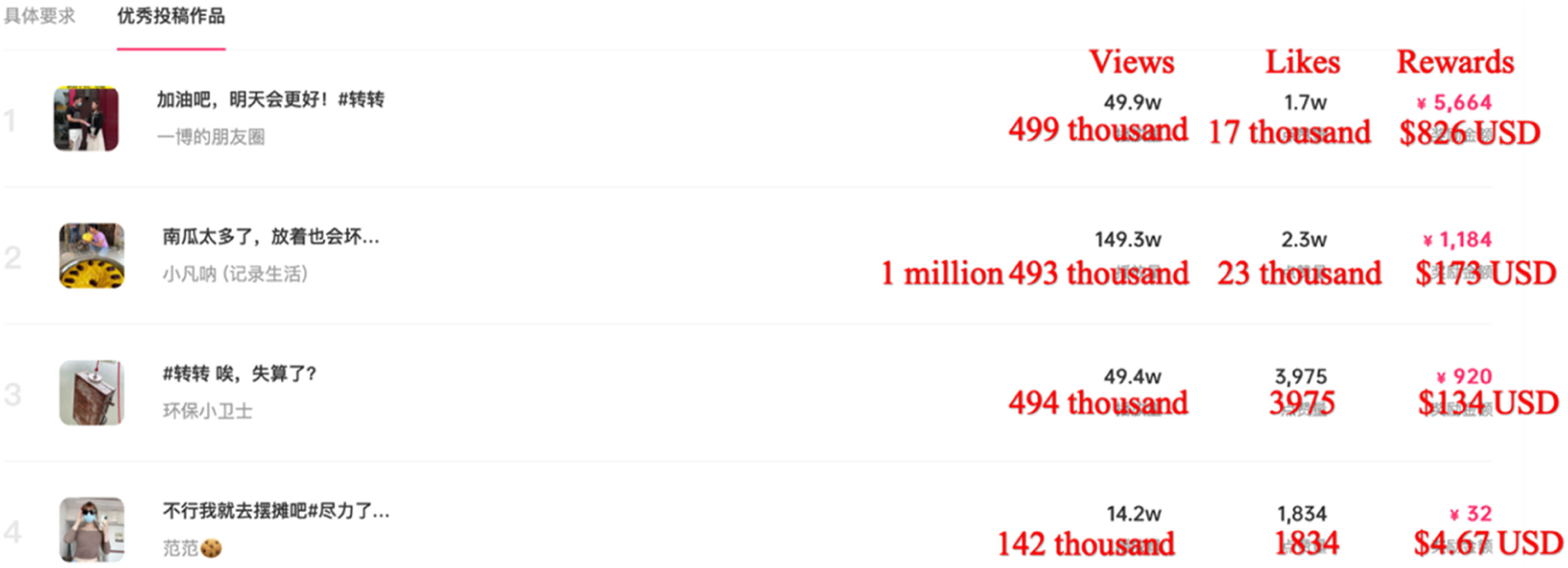
The qualifications of the advertisers are verified by Douyin before they can join the Star-Chart. Douyin provides advertisers with a template of the content task (Figure 5), which lists all the requirements, divided into ‘basic’, ‘necessity’, and ‘non-necessity’. The creators should meet the first two requirements when completing the task. The necessity requirements include the exposure of the specific brand, advertising length, spoken lines from the creator, specific hashtags, and style of the video. In terms of non-necessity requirements, the advertisers will provide information about their business range and advertising slogan for the creators’ reference, in the hope that the creators will post content that matches the advertisers’ branding appeals. The advertisers will also offer samples that include requirements for likes and views, the fulfillment of which will lead to a specific revenue (Figure 6). For example, a video with 500,000 views will be rewarded with $826. An advertiser in the Star-Chart launching task requirements. An advertiser shows excellent work that meets the criteria and earns income.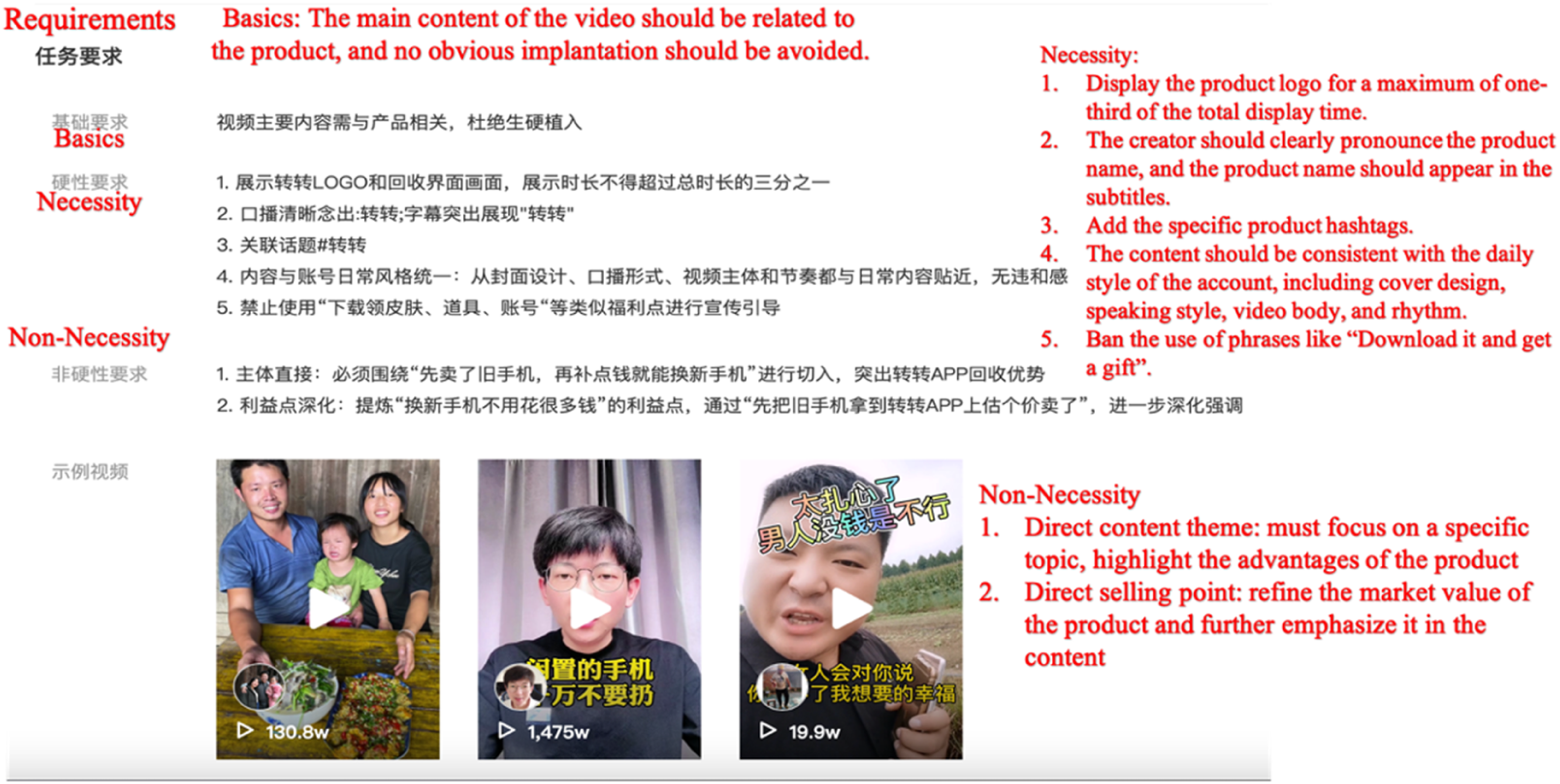
After the creators and the advertisers mutually confirm the order, a script of the video should be first be submitted by the creators in the Star-Chart system. Douyin will thoroughly examine the content based on its censorship system, such as sensitive words or traffic-directing words, while the advertisers will focus on whether the creator’s script meets the promotion standards. A video can only be produced if the script meets the requirements of both the platform and the advertiser. Creators will produce the video with the requirements of the task according to the script, and upload it for the second round of review where Douyin and the advertisers confirm that there are no sensitive words, no commercial risks, and the promotional ideas are satisfying. After the video is published on Douyin, the advertisers can check the data of the posted content at any time, to determine whether the creator’s task is completed. If the task is successfully completed, the creator will be paid accordingly, and Douyin will take a 10% commission.
Most of the interviewees saw Star-Chart as a new source of income provided by Douyin, and even the platform or advertisers guide and restrict their freedom of expression. They believe that Star-Chart or Douyin stabilized the process of turning creativity into revenue. Interviewees #9 and #12 said that the Star-Chart has largely simplified the process of turning content into revenue and made the creators’ work more fulfilling. ‘We are “bounty hunters.” Tick the boxes and done. Enterprises look for completion, followed by creativity. It is much easier than choosing topics and following hashtags. Much of my work now consists of integrating and editing original materials and uploading it as required. Every work can be guaranteed to have income’. (#9) ‘In the past, I was approached by brands to do promotion, which was very passive. Even though I have 500,000 followers, I don’t know how much I am worth on the platform, nor do I know what the brands expect the price of the ads to be. I couldn’t negotiate a price with a company by myself, and mostly I was passive and accepted their price. After joining Star-Chart, all this information is open and transparent, and I can price my own content and refer to the brand’s pricing’. (#12)
As described by Interviewee #12, while the platform's metrics demonstrate the quantifiable visibility of creative work, the ultimate commoditization is still not complete. The lack of criteria for determining the value of creative work makes it difficult for the creators to fully understand their economic value on the platform. Douyin uses Star-Chart to set several criteria to evaluate the value of the creators’ visibility, and to determine the value of creative work required by the advertisers. Star-Chart reduces the information gap between creators and advertisers, matches the needs of both creators and advertisers, and thus completes the commercialization of the platform’s creative work. Under the dominance of Douyin, the creators and the advertisers are firmly bound together on the basis of Star-Chart, which develops the platform-advertiser-creator transaction chain. It introduces a new content transaction pattern in which creators who decide to deal with advertisers must fully participate in order to facilitate the transactions between the parties, concerning the process, content, and price. Douyin provides feedback data on the transacted content, so that the creators can adjust the content at any time to meet the needs of the advertisers. Throughout the process, the uncertainty of attention market is minimized by the platform, while the strict setting of the system threshold and the quantified production standardization process are both highlight the business environment controlled by the platform. The concept of ‘creativity for trade’ is consolidated in this process, and Douyin helps the creators to understand that producing a content that meets the advertisers’ and platform’s requirements can lead to a steady revenue, instead of relying only on the support of fans to maintain their visibility.
Star-Chart can be considered as the stage of successful exchange between revenue-demanding creators and Douyin, where both sides seem to be insulated from the impact of uncertainty. The content transaction chain formed by platforms, advertisers, and creators is further tightened with the continuous trade of content advertising.
Conditional exchange: A standardized content production assembly line under the control of the platform
The platform creators’ labor process cannot be separated from authenticity, which is shaped by the emotions of others (Banet-Weiser, 2012): ‘How many people will like my content’. To some extent, the degree of visibility – ‘How many people could see my content’ – is tied to the level at which the creators accumulate emotions and expectations from their followers. The platform sets the stage for the self-branding of everyone, even if the financial and reputational rewards of such activity are highly uneven (Meisner and Ledbetter, 2020).
Douyin provides the creators with a stable income path, with an incentivized and purchasable design, which develops an ecosystem for creators to reduce the invisibility of the algorithms and income instability. In addition, Douyin brings in advertisers and provides income resources to ensure that capable creators can find revenue opportunities within the Star-Chart. According to the interviewees, the reason Douyin can provide such support is because the platform controls the access to content visibility. More precisely, (1) the platform can either reward the creators with traffic or stop distributing traffic at any time, (2) the platform cannot only help the creators find and match advertisers, but also unite the advertisers to censor the creators’ content. Creators can only rely on the exchange system of the platform and strive to complete a specific order to obtain a stable income. The platform collaborates with the creators to transform the creative work authenticity into commerciality, and to transform the original labor process of the creators in a way that weakens the emotional work. Through the following measures, creative work is expected to become a mature and replicable product under the cultivation of Douyin. (1) ‘I have to babysit my account’
The platform has enormous control over revenue design and channels. In other words, the platforms are both rewarders and punishers. They have the ultimate right to interpret and implement the business strategies, and can change the setting of content monetization at any time. The deep integration of creative work into income means that the creators have to cope with these changes, which can be sudden. Platforms are becoming a major source of uncertainty for creators.
Douyin has set up a special section of the ‘Rules Center’ at the entrance of the ‘Creator Service Center’ to release announcements about content censorship and account punishment on the platform in real-time. Douyin’s content censorship is not only the enforcement of government policies (Ye and Zhao, 2023). It also punishes the creators who do not follow the platform’s business rules. The creators will be announced whenever Douyin adjusts the rules of content production and distribution. However, such public information is a ‘weasel word’ (#9) for the creators. Their perception of changes in the platform's policies comes from feedback on the metrics of the content, or even from restrictions or penalties imposed on their accounts.
Interviewee #5 recalled that she had been posting content on Douyin for half a year and had enough followers to enter the Star-Chart for advertising transactions. However, her content visibility metrics are erratic. ‘I am being “restricted” by the platform. Douyin restricts my account. It only gives traffic to advertising content, not to my original content’.
Her experience is not unique, as the interviewed creators have all the experienced traffic restrictions to varying degrees. These professional creators already have thousands or millions of followers who can guarantee the visibility of their creative work. Even with access to the Star-Chart, they still face the uncertainty that their daily accounts management is subject to the distribution of traffic on Douyin. The metrics of each piece of content have a direct impact on how much the income creators can earn.
Interviewee #14 said: creators are sometimes like ‘sandwiched cookies’, struggling to balance the authenticity that followers expect with the income stability of the platform setting: ‘We cannot advertise every piece of content. Otherwise, our followers will scold us. Without advertising, the platform may not reward such content, and the result is that I was ‘limited by traffic’.
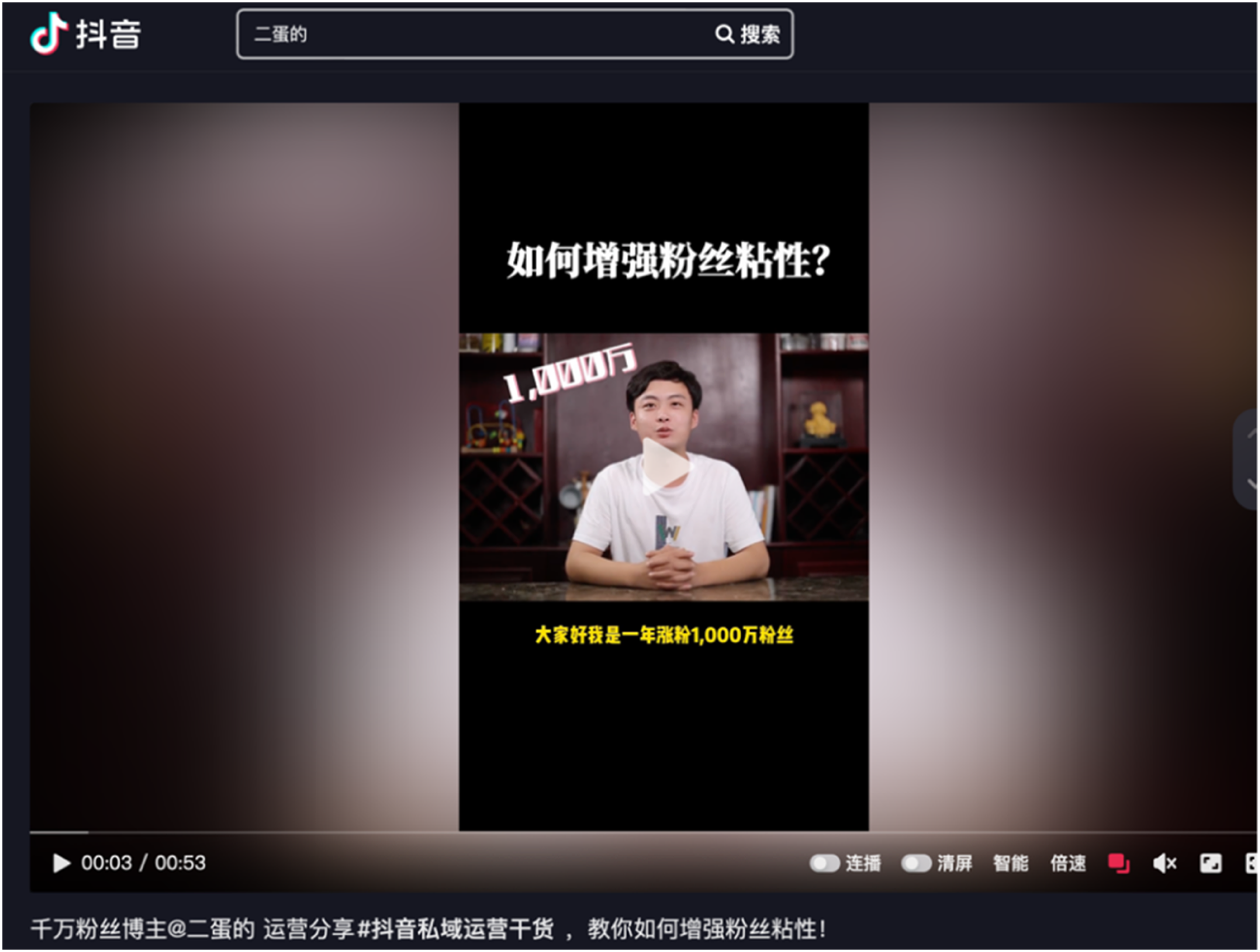
Douyin does not have an official definition of ‘traffic limiting’. However, it is concerned about the confusion that this uncertainty in traffic distribution brings to creators. It has recently launched the ‘Douyin Creator Learning Center’ (Figure 7) (Douyin, 2022), where creators are given official guidance on: (1) how to choose topics and craft stories to create a popular short video (content creation section); (2) how to use the monetization tools provided by Douyin to generate revenue (commercialization section); and (3) how to pass the platform censorship without breaking the rules (rules and mechanisms section). These three points are aligned with the findings of this study, and they demonstrate the standard of ‘creative work that meets the platform’s requirements’ that Douyin has officially recognized. The fourth section of the Learning Center, titled ‘Advanced Operations’, is an official guidance for monetizing the content after completing the first three ‘basic requirements’. For example, an instructional video with 3,491,000 views (Figure 8) is about how creators can build strong relationships with their followers to generate a revenue. It indicates a complete path for creators to be guided by Douyin, from making videos to running fans, thus turning their creative work into a commodity. These courses are taught by creators with 10 million followers, who are considered qualified creators by Douyin. The strategies they teach represent the direction that Douyin determines for commercially viable creative work. Douyin creator learning center. A video with 3,491,000 views, on how to enhance fans stickiness.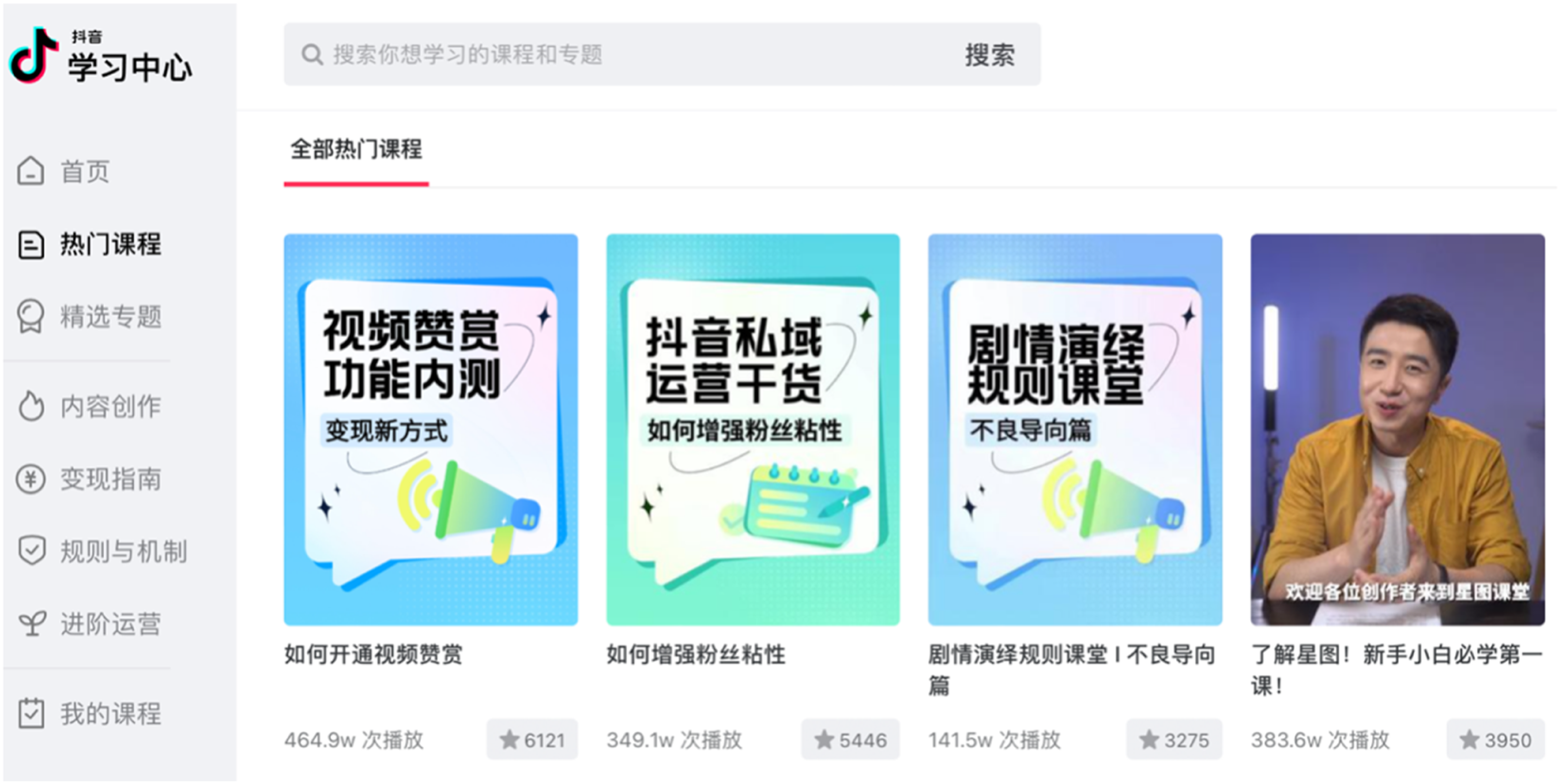
Douyin launched a manual for creative work. However, for the creators, it is not enough to deal with the ever-changing platform environment and algorithmic rules. On the one hand, the creators have to face the platform’s varying degrees of censorship (Ye and Zhao, 2023). The content of a particular topic will be sometimes affected by the policy and the interests of the company, and it will be removed from the platform. On the other hand, the Creator Learning Center does not explain the mechanism of traffic distribution by the algorithm of Douyin. Therefore, creator #14 thinks that the content of the Creator Learning Center is ‘too ambiguous and optimistic’. She has developed her own theories on how to deal with the platform’s ‘traffic limiting’, which she jokingly calls ‘babysit my account’. ‘The content must not violate the rules. You have to post content every day, @Douyin (inform the official account) in your content, and follow the popular hashtags on the platform. Do all this consistently, like babysitting. That way the platform is likely to skew the traffic to you because you are recognized by the platform as a GOOD creator’. (#14)
Although the interviewed creators have a fairly stable audience, they feel that ‘the distribution of traffic is not about followers’ (#13), but rather whether they follow the rules set by the platform or not. They wish for their content to be ‘recognized by the algorithm’ for traffic, and for their personal performance to be ‘recognized by the platform’. In other words, ‘how many people will like my content’ is gradually being replaced by ‘how can I be seen by the platform’, which has become the survival rule of creators in Douyin. It can be deduced that the emotional labor, which is considered as a link between the creators and their followers, is increasingly weakened under the influence of the platform revenue strategies. (2) ‘I feel like a product’
These findings show a kind of creative work labor process under platform transformation. It indicates how Douyin gradually develops creators’ demand for income, the whole monetary value of creative work. Douyin proactively provides creators with visible and purchasable traffic tools, such as Dou+, and stable and sustainable income functions, such as ‘Star-Chart’, giving them a full sense of the predictable content profit prospects. In the exchange process with the platform, the creators perceive the monetary value of creative work on the platform one by one, and determine the content production with the ultimate goal of increasing the income.
When the creators’ need for income is cultivated by Douyin, making money becomes a more important goal than gaining attention. Douyin provides several commercialization tools and profit expectations in exchange for the authenticity that the creators maintain with their emotional labor. On the one hand, Douyin strictly controls the conditions of content visibility and trains the creators to produce content that is visible to the platform's algorithm and recognized by the revenue mechanism. On the other hand, as the control center of the platform-advertiser-creator transaction chain, Douyin organizes the advertisers to cut individual creativity into detailed requirements in the form of reward tasks. In other words, the platform’s cultivation of creators’ income demand is mainly the use of self-built income tools and functions. Creators are willing to give up the right to operate on self-expression in favor of a set of structured and standardized content production lines.
This study summarizes four steps (Figure 9) where Douyin uses traffic distribution strategies and monetization tools to gradually transform the labor process of the creators, and represents a standardized content production assembly line under the control of the platform. (1) The content that could attract the attention of followers. Douyin helps creators to accumulate visibility through traffic rewards at the initial stage. At this stage, the creators feel that their creative work is receiving positive feedback from the platform and are willing to stay on the platform to continue their work. When the creators have a certain amount of attention, the platform regulates the creative content and sets several standards to perform commercialization. (2) Content that requires to be approved by the platform: whether the creator’s daily content release or the advertising content in the Star-Chart should pass the censorship policy and the requirements from the platform. (3) Content requiring the recognition of Douyin and algorithm to get traffic reward: creators should constantly meet the new tasks or new changes of the platform related income mechanism, becoming ‘behaved creator’ identified by the platform, in order to avoid ‘traffic limiting’. (4) Content that should meet all the requirements of advertisers: the ‘requirement template’ provided by advertisers in the Star-Chart is the re-regulation of the content. Standardized content production assembly line of Douyin.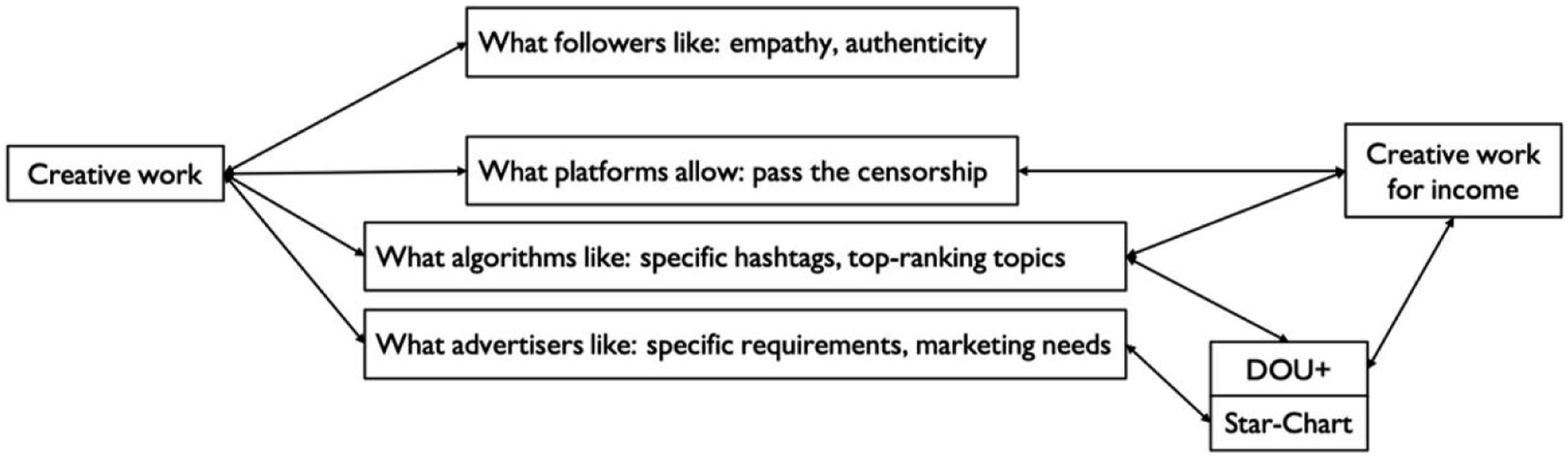
As the traffic bonus gradually disappears, the creators will strive to fulfill the last three requirements, hoping to receive recognition from the platform and advertisers, and get more commercial opportunities, rather than being ‘restricted’ by the platform. The last three requirements are also the basis of business cooperation between creators and advertisers, and meeting these specifications is the only way to commercialize. Therefore, creators have to give up the priority of self-expression in the light of the demands of the platform or the advertiser, and try to build their creative work into a mature product required by the latter.
This study believes that the labor process based on these creative work content requirements is a standardized content production assembly line created by Douyin. After cultivating the financial needs of the creators for their work, the platform guides the advertisers to jointly build the standard rules for creative work production. In addition, under the manipulation of traffic strategies, the platform guides the creators to practice this set of content production ‘to do list’, while exchanging authenticity for the content products that meet the platform’s interests. When this assembly line is running, the creators seem to gain stable traffic and revenue, instead of just relying on the unpredictable feedback from the followers.
In order to earn income, the interviewed creators strictly follow the standardized content production process, which weakens the authenticity part of their content. Most of the interviewees said that the content they post on Douyin every day has nothing to do with real life, and that they only run accounts for income. ‘I don’t have a private account and I don’t like posting about my life because I can’t earn money’. (#13)
It should take into account the requirements of advertisers in the Star-Chart and maintain the status recognized by the platform. Creators are also more likely to evaluate the effectiveness of their content in terms of ‘how much money will be rewarded’ rather than ‘how much will my needs be met’. The standardized assembly line of content production established by the platform proves that Douyin leads and controls the content production process, undermines the emotional labor of creative work, ensures the consistency and stability of content commercialization, and finally obtains revenue so that the creative labor becomes real ‘labor’.
Conclusion and discussion
Several researchers considered the creative work as a currency on the platform, and it can be found that an increasingly professionalized creative work is often cloaked in authenticity or amateurism (Duffy and Hund, 2015). As in existing studies, daily life and lifestyle, considered as elaborate commodities, have been sold to the audiences in a natural and accessible way. It gives rise to the practice and aesthetic of ‘Calibrated Amateurism’ (Abidin, 2017), which is the guidance for the attention economy. Creators with self-branding disguise the process of content monetization through intentionally decorated authenticity, which has been considered a proof of the professionalization of creative work (Hearn, 2010). However, this does not mean that creative work means stability. On the contrary, with the platformization of cultural production (Pooley, 2010), the creative work not only depends on the self-expression of creators, but is subject to the uncertainty of algorithms. Audiences’ feedback on creative content enhances the metrics of creator accounts, in which the emotional labor plays a crucial role. Therefore, some studies believe that creators do not belong to manual labor such as delivery workers, and the platforms cannot habitually control and copy the self-expression of creative workers (Shimpach, 2005; Scolere and Humphreys, 2016).
Considering Douyin as an example, this study deduced that Chinese creators and the platform engage in a repeatable and unequal exchange with the common goal of generating income. It is deduced that Douyin deliberately and gradually cultivates creators’ income needs and weakens the contribution of emotional labor to create a standardized creative work production process that can be controlled and replicated. It seems that Douyin helps the creators alleviate the uncertainty of emotional work. When the exchange between the platform and creators becomes stable, the platform in turn sets up a platform-advertiser-creator transaction chain. This allows the self-expression to circulate through the platform as a commodity that meets the requirements. On the one hand, the creators are required to strictly abide by the platform’s censored rules. On the other hand, Douyin jointly proposes detailed requirements regarding the specific creative ideas for business goals. Creators on Douyin should meet the three requirements of ‘approved by censorship rules’, ‘visible by algorithm’, and ‘satisfied by advertisers’, in order to obtain a higher metrics performance and complete the transformation of income demand.
This study shows that Douyin’s business strategies of traffic rewards, traffic pricing, and screening advertisers gradually spread a sense to creators at different levels. That is, the creators can diminish their emotional work to followers, and the platform will foster new labor processes that can be profitable. The multi-party beneficial exchange process between the platform, advisers, and creators is actually a series of secret content monetization mechanisms dominated by the platform to enhance its power. It firmly binds the creator’s demand and realization of platform income. In order to maintain a stable income, the creators should accept that the process of creative work is strongly controlled by the platform, and comply with a standardized structured content production process. This set of repeatable content production assembly line is not different from the labor process of delivery workers. The differentiated individual expression will eventually be output into homogeneous content commodities. Therefore, some researchers call it ‘emotional delivery’ (Ye and Jin, 2021).
The phenomenon of ‘Creators Economy’ is a process in which the creators seek to transform the visibility of creative work into content monetization opportunities, which is taking advantage of platformization to establish a new labor industry (Scolere et al., 2018), as well as new labor relations. Consequently, the creators and audiences build communities of interest and develop business models based on their emotional connection (Craig et al., 2021). When platforms use these personalized features as seeds and plant them in Petri dishes of content production, encouraging organized centralizing creative workflows, the self-expression of creative work will no longer exist. Homogenous individual expression leads to aesthetic fatigue and the constant search for ‘new faces’. However, when new faces enter the platform, they quickly involve in a systematic process of the commercial transformation, with the shedding of individuality. This is not ‘recording the good life’, as Douyin advocates, but ‘recording the sellable life’.
In 2021, a Weibo creator contributed a video entitled ‘Douyin, recording the same good life’, showing three different creators reciting the same lines, taking the same picture perspective, and even using the same video length. This video demonstrated the creators’ and users’ awareness and criticism towards the homogenization of content that the platform leads to and encourages. Although the video was later deleted, it has already sparked a lively discussion on the Chinese social media. To complete the monetization of content, this process of creative labor diminishes emotional labor through platform mechanism design. It guides creators to focus only on metrics rather than on social relationships. Thus, Douyin is creating a common logic for the operation of creators, which will shape the industrial form of cultural production on Chinese platforms.
Facing the constant change of the audiences’ preferences and needs, as well as the adjustment of policies and regulations, Chinese platforms cooperate with guilds to organize content production and monetization (Ye and Jin, 2021). In addition, they complete large-scale creators’ management through phased systems and algorithm settings. The intermediary relationship between the platform and creators (e.g., the MCN channel is conditionally opened by the Star-Chart) will affect the orientation and realization of content value. Douyin’s development indeed necessitates a re-evaluation of its intermediary role and cultural significance, which requires further explorations. Future studies could focus on the scope and boundaries of platform content monetization strategies in different countries, as well as cross-platform comparison of creator labor processes.
This organized mass-produced creative work process, which is widely conducted across platforms in China, forced the creative work to become a reproducible assembly line, with no protection for creators. Whether the creators should be treated as workers in current policies and regulations on the gig economy is debatable. Under the structured management of the platform, creative work is also gig labor for the purpose of profit, which is organized and replicable. We hope that the future studies will focus more on how the creative work can be incorporated into protected labor systems. In fact, this study on the creative labor process will facilitate this argument.
Footnotes
Author note
All authors have agreed to the submission and that the article is not currently being considered for publication by any other print or electronic journal.
Declaration of conflicting interests
The author(s) declared no potential conflicts of interest with respect to the research, authorship, and/or publication of this article.
Funding
The author(s) disclosed receipt of the following financial support for the research, authorship, and/or publication of this article: This work was supported by The National Social Science Fund of China (grant no. 19BXW098).

Author Biographies
Yang Huang is an Assistant Professor in the School of Journalism and Communication at Beijing Language and Culture University. Her research interests focus on platformization in China and content monetization on Chinese platforms, especially for Douyin.
WeiMing Ye is an Associate Professor of Communication and Media Studies at HSBC Business School, Peking University. Her research interests include new media and society, platform society and platform labor. Her papers have been published in international peer-reviewed journals such as ‘Information, Communication and Society’, ‘Journalism Practice’, ‘Discourse, Context & Media’, ‘Convergence’, and so on.