




Abstract
In 2004, artist David Firth launched the lo-fi animation Salad Fingers in the user-generated content sharing platform Newgrounds. The series, focused on a strange, unsettling narrative about a character that acts as a child but commits unhinged violent acts, went on to become viral in the earliest days of YouTube. Created with the software Flash (launched by Macromedia and then acquired by Adobe), which generates vector images, Salad Fingers is a significant stylistic and generic contribution to the early period of participatory digital cultures. The series operates as a bridge between analogue and digital artforms that privilege the sensorial over narrative cohesion, while also cultivating a distinctive ‘uncanny-weird’ mode tied to early participatory digital cultures, trends that perdure in contemporary animation. We articulate how Salad Fingers operates in the distinctive ‘digital uncanny’, an aesthetic and cultural mode that would become pervasive in visual media cultures on YouTube and beyond.
Keywords
‘I like rusty spoons’, proclaims a raspy voice, in pain and ecstasy, with a pronounced British accent. We see the heavily outlined shape of a green hand holding a spoon, and a lettuce leaf caressing the brown steel utensil. We quickly discover that our character is enraptured by rusty tastes and textures, and compulsively touches and licks metallic surfaces. The animation conveying our protagonist’s perverse sensory adventures is schematic, street-art-like. The dialogue is written on the screen in trembling letters. We see the main character and his peculiar features, rendered with minimal detail and thick, jittering lines: an oval face, bloodshot round eyes, teeth missing. ‘The feeling of rust against my salad fingers is almost orgasmic’, this enigmatic figure, Salad Fingers, continues, in a faltering, childlike voice. While the vocal tone is feminine, the character’s body shape and clothes are coded as traditionally male. The backdrop is an arid wasteland in pale colours, reminiscent in particular of the empty spaces of figurative painter Francis Bacon: think, for instance, of his Three Studies for Figures at the Base of a Crucifixion from 1944, or Three Studies of Lucian Freud from 1969. Perhaps, we infer from the graphically undetailed but evocatively barren setting, this is the aftermath of an apocalypse.
This is the opening scene from Salad Fingers, 1 an ongoing web series (13 episodes and a short) 2 created by British artist David Firth and launched in 2004 on the content-sharing platform Newgrounds (www.newsgrounds.com). Founded by American programmer Tom Fulps, Newgrounds (1995) is still an active platform hosting user-generated games, videos, and art. Salad Fingers went viral at the cusp of the mainstreaming of social media, which Firth claims was facilitated by the simplicity of this platform and the culture it fostered: ‘There were no shortcuts to viral content. No corporate fingers twiddling the algorithms. It was simply attention-grabbing and quality material that rose to the top’ (Fox, 2021). When it was released, Salad Fingers was described as ‘strange and demented’ (Grasscity Forums, 2006), and ‘shocking and gruesome’, yet ‘cool… in a way’ (Ironworks Gaming Forum, 2004). Media theorist Lev Manovich coined the term ‘Generation Flash’ to describe artists like Firth who thrived in this early 2000s period which saw the rise of accessible creative software. Manovich states that: ‘This generation does not care if their work is called art or design […] This generation writes its own software code to create their own cultural systems, instead of using samples of commercial media’ (our emphasis, 2005).
As we illuminate in this article, despite and indeed perhaps partly because of its lo-fi origins, Salad Fingers has since become one of the most influential examples of a distinctive mode of uncanny, weird Internet culture that navigates the pre- to early-YouTube period (Figure 1 Screenshot of Salad Fingers in Episode 1, “Spoons”. URL: https://youtu.be/M3iOROuTuMA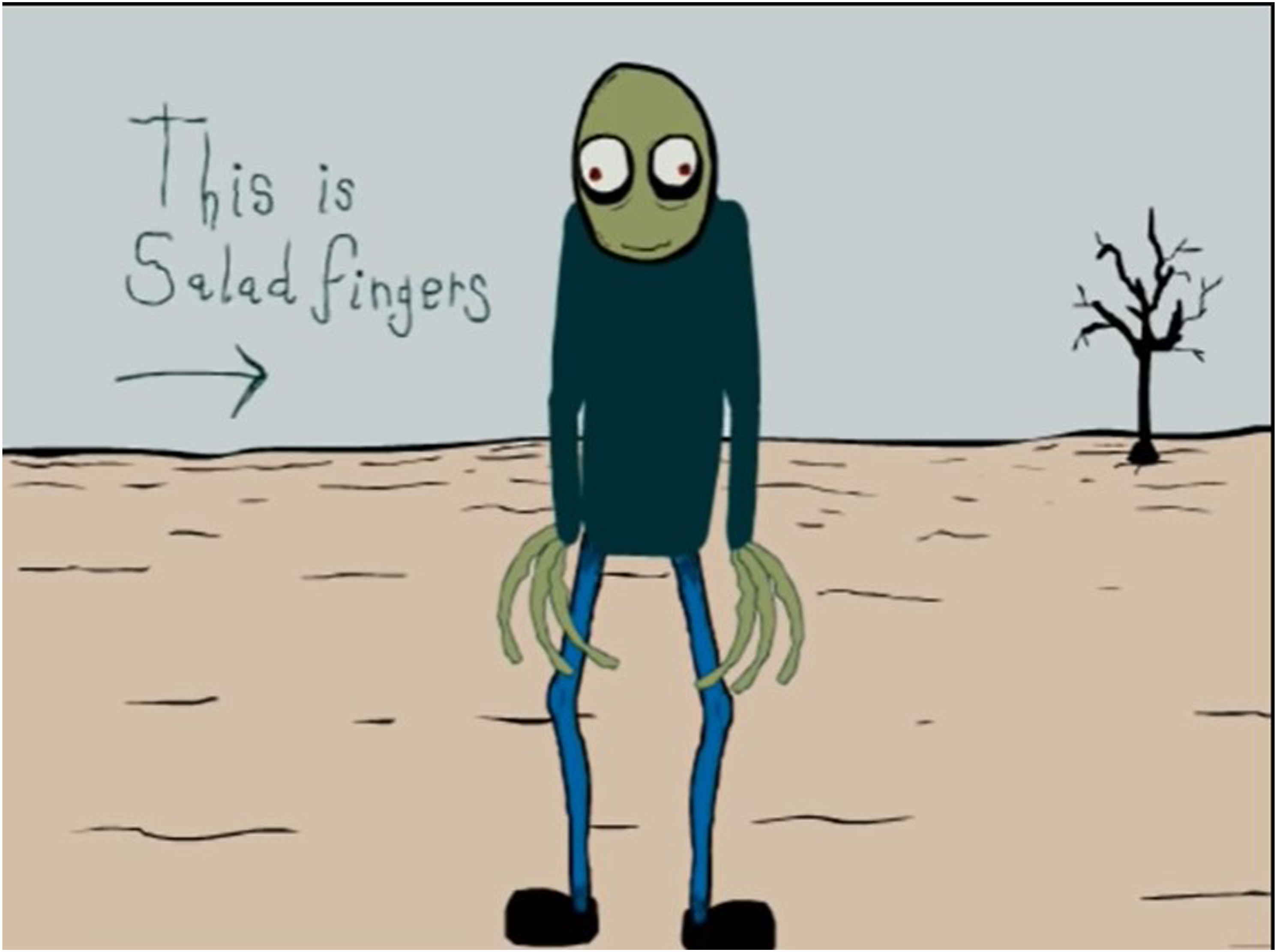
The lack of scholarship on Salad Fingers is striking given that the series’ subversively ‘weird’ mode would subsequently become a distinct movement across memes and YouTube, harnessing the Internet’s participatory freedom from legacy media approaches to content categorisation, production, and distribution. This weird mode continues to permeate participatory digital creativity, resonating in pervasive memetic examples from ‘Pepe the Frog’ (the subject of a feature film documentary in 2020 directed by Arthur Jones, Feels Good Man) to the ‘Stick Figure Violence’ meme (see KnowYourMeme.com, 2022). As is suggested by the ongoing popularity and relevance of the series 20 years after its initial release, Firth’s Salad Fingers operates as an ur-text for this enduring digital style.
The term weird, perhaps even more so than the term ‘uncanny’, is difficult to pin down in terms of how it operates as an aesthetic category with specific affectual resonances. As Lauren Lipski suggests, the term can ‘seemingly describe anything’ (2017, p. 59), and weird is thus in line with what Sianne Ngai terms a ‘minor aesthetic judgment’ (Ngai, 2015, p. 53) because it is attached to broadly defined aesthetic qualities and taste/value judgements associated with the subversion of expected norms, rather than being grounded in a specific movement, region, or period. Throughout this article, we outline how the uncanny and weird operate aesthetically in Salad Fingers, and in tandem we articulate how the series continues a long history of provocative ‘weirdness’ in visual art, film, and television while driving this longstanding mode in new directions associated with the dawn of the participatory web in the early 2000s. We argue that Salad Fingers is a foundational example of the ‘digital uncanny’, a concept that has been mobilised across a diverse range of contexts to describe how the digital can unsettle cultural and cognitive expectations (Coyne, 2005; Liu, 2010; Stamboliev and Jackson 2018; Ravetto-Biagoli 2019; Wasserman 2022). While the digital uncanny is not a fixed category, we contend that no genre or aesthetic mode is, because, as has been well established in genre studies, modes and genres are not stable (Altman, 1999; Naremore, 1998; Neale, 2000; Mittell, 2004). Despite this fluidity, the deep nexus of conceptual, techno-cultural, and aesthetic dynamics that propel aesthetic modes like the digital uncanny can be historicised, contextualised, and defined.
We develop our key arguments as follows. First, we position Salad Fingers within the techno-cultural juncture of the early 2000s, explaining how the software Macromedia Flash (later Adobe Flash after its acquisition in 2005) allowed Firth and other animators unprecedented technical freedom. We deal with issues of aesthetics and style, and, more broadly, with the cultural poetics of these qualities and their socio-cultural resonances, which necessitates some consideration of the reception of the series in publicly available social web platforms. Second, we situate Salad Fingers within a long visual cultural trajectory, arguing that it privileges a ‘logic of sensation’ over stylistic or narrative cohesion in ways that resonate with a rich tapestry of earlier and contemporary media at the art/entertainment interface. Extending from this, we situate Salad Fingers more specifically within the intersecting off and online traditions of surrealism, cult, and the avant-garde. Finally, we align Salad Fingers with the emergent ‘weird part of YouTube’ that has since become a nostalgically beloved and aesthetically influential mode on the platform and beyond, arguing that Salad Fingers was a trigger for this generic and discursive move.
Salad Fingers’ enduring cultural appeal: Flash aesthetics meets the digital uncanny
The uncanny in Firth feeds off the oneiric. He has said: ‘I like dreams because they’re inconsistent. And I feel like if you’re very consistent all the way through, and then you lose your consistency, it feels like a plot hole. But if you’re consistently inconsistent, you can get away with anything’ (Vinter, 2019). This ‘consistently inconsistent’ approach is vital to the darkly confusing style of Salad Fingers. However, we offer the reader our attempt to articulate the narrative outlines at this juncture to aid comprehension of our analysis. As suggested in our opening paragraph, the eponymous Salad Fingers exists in what seems to be a desolate, post-apocalyptic world, a product perhaps of nuclear conflict. Indeed, radiation sickness may explain the strangeness of Salad Fingers and the other key characters, who are otherworldly and deranged while bearing traces of humanity in physical form and speech. Most of the other characters seem to exist in Salad Fingers’ mind and on his fingers in the form of the finger puppets with which he regularly speaks. These figures also sometimes appear as human-sized beings in Salad Fingers’ fantasies. While Salad Fingers often appears alone talking to his imaginary finger puppet friends, he meets some other life forms in the desolate wasteland beyond his shack, including a ‘young child’ who communicates by screaming, a young girl called Mable, a nameless mutant creature with huge eyes who becomes fixated with Salad Fingers, and a rotting corpse that Salad Fingers refers to as either his ‘younger brother’ or ‘Kenneth’ (Figure 2 Screenshot of Salad Fingers and the corpse Kenneth in Episode 7, “Shore Leave”. URL: https://youtu.be/kQNRkdHeK1A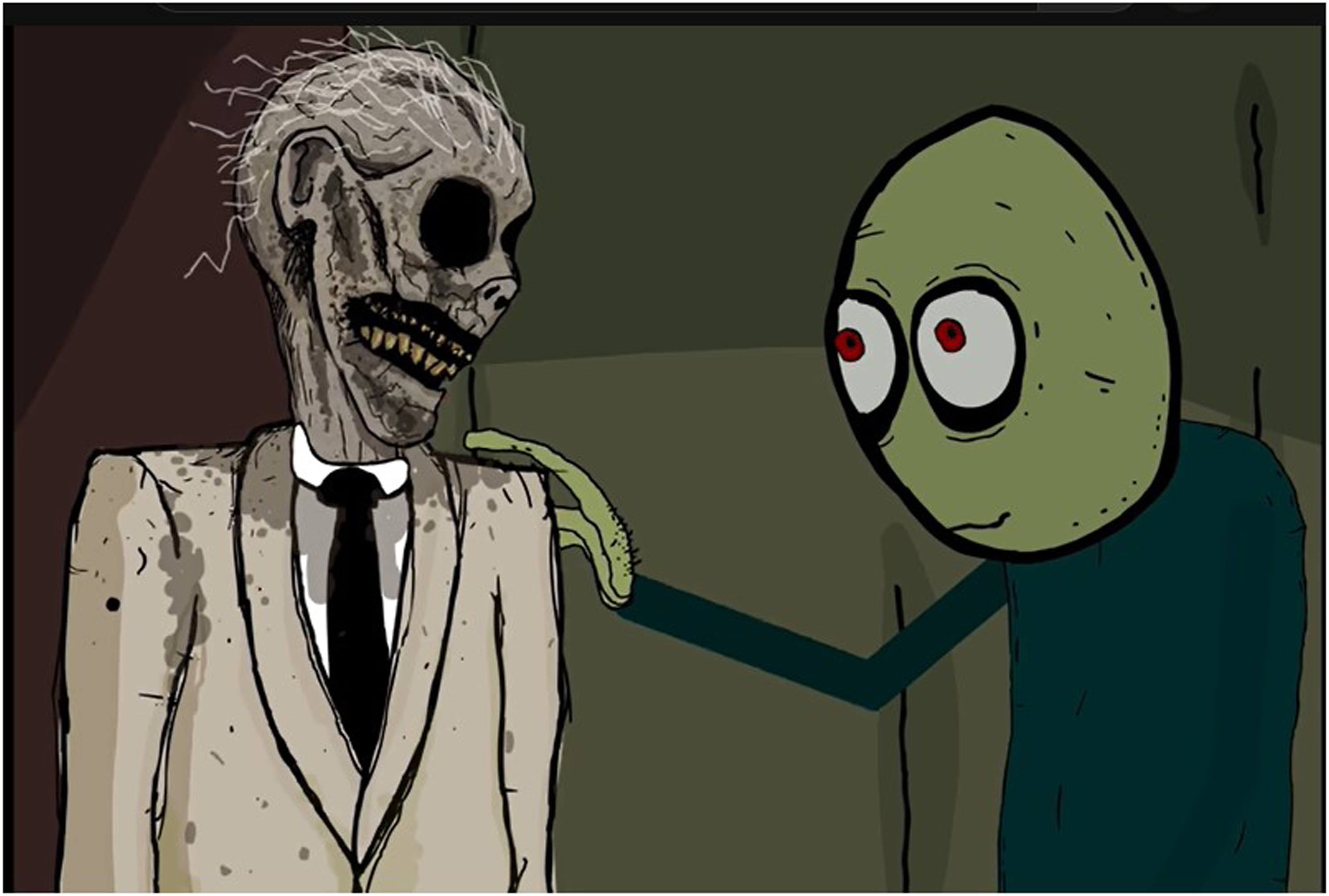
As a pivotal representative of the digital uncanny, Salad Fingers emerges from a particular techno-cultural juncture. Salad Fingers is an important example of how desktop animation and innovations such as vector graphics allowed for visual experimentation, grassroots production, and creative autonomy in the early years of the participatory web. Ready-to-use software made the creative act a more personalised affair than is typical of professionally produced animation. These tools thus enabled Firth to adopt a seemingly spontaneous, stream of consciousness approach to narrative and visual style borne of the technical and aesthetic assemblage of early 2000s digital animation software. Early animated web content was typically created with the software Flash (created by Macromedia and bought by rival company Adobe in 2005, and then discontinued in 2021). The capacity of Flash to work on personal rather than specialised computers allowed amateur animators to experiment with the medium, as algorithms were used to add movement, manipulate backgrounds, and edit scenes, processes that border on the artisanal in analogue animation, which requires artists to design one frame at a time at a minimum rate of 1440 frames for every 2 minutes of animation. As Anastasia Salter and John Murray state in their cultural history of Flash, early experimentation with the platform led to lasting changes in the industry: ‘the World Wide Web was about to provide the ideal distribution network for creators […] This shift and the combination of the power of Flash and the growing ubiquity of the web would transform the future of animation’ (2014, p.19). The use of Flash among animators became prevalent and standard, as the authors expand: ‘user-oriented features allowed Flash to stand toe-to-toe with existing drawing tools, and with the addition of a timeline and means to interpolate images, it would become viable as a stand-alone platform for creating animation’ (2014, p. 21).
Flash was much more affordable and needed less processing power and bandwidth for download than contemporary expensive alternatives such as Discreet Logic’s Combustion, Fire and Inferno software, which ran on Silicon Graphics hardware. Flash created vector images, which ‘consist of the mathematical instructions necessary to create the image […] it is not the image itself but its formula that is prepared for download; once the download is complete, the image viewer programme, the Flash Player, takes the information and recreates the image on the user’s computer screen’ (Strukov, 2007: p. 130). When Flash was laid to rest in 2021, Firth told the BBC: ‘You could make a full three-minute animation with multiple characters, backgrounds, sounds and music less than 2 megabytes (MB) and viewable from within the browser’ (Fox, 2021). As the longevity of Salad Fingers evidences, Flash’s visual influence is enduring and, as expressed by Will Bedingfield, ‘Its legacy lives on in Adult Swim cartoons and zany mobile games’ (2020). Contrary to the painstaking planning required for professional animation, whether digital or analogue – which involves blueprinting, outlining, colouring, and other highly specialised processes – Flash advocated for and facilitated a more performative and amateurish form of expression. As recalled by Firth: ‘So a bunch of us, well actually just two of us at first, we were just writing ideas and just doing the voice. We came up with a lot of ideas in that one session, some of the ones I’ve even made recently were still conceived in that early session. We were just throwing ideas out’ (Vinter, 2019). Firth experimented with Flash beyond Salad Fingers, including dream-inspired shorts and a 2014 music video, ‘Ready Err Not’, with the band Flying Lotus, which Rolling Stone says, ‘splits the difference between a Francis Bacon painting and Terry Gilliam’s gnarly Monty Python cartoons’ (Grow, 2014).
Firth’s decision to oppose the stylistic mainstream is thus tied to the economy and efficiency of desktop animation, but it also operates in intentional defiance of normative screen narrative styles and animation aesthetics. As he succinctly summed up in an ‘Ask me anything’ thread on Reddit, ‘I am bored with the shit-stream of bland culture that is being crammed down my throat from every angle. I think that is why I make the stuff I make’ (Firth, 2011). In an interview for Narc Magazine, he explains his approach with more precision. He says that he saw a ‘gap’ in ‘comedy cartoons’ – they were ‘either wacky or disgusting, but never kind of surreal. And if they were surreal, then they definitely take themselves very seriously. I want to make nonsense that is entertaining’ (Doyle, 2021). Here, Firth makes clear his interest in combining ‘mainstream’ comedy and cartoon styles with a more surreal edge, but a surrealism that is ‘playful’ in its ‘nonsense’. He unpacks the concept of playfulness by speaking of influences in children’s cartoons such as Rugrats (1991) highlighting how violations of generic boundaries – including a culturally troubling defiance of the boundaries between children’s and adult’s content – are critical to Salad Fingers’ playful melange of styles. Indeed, Firth weighed in when a teacher in Canada was briefly suspended after screening excerpts from Salad Fingers for his primary school class (Moore, 2019). He tweeted: ‘I fully support Salad Fingers being shown to children. In fact, it should be mandatory’ (Firth, 2019).
The Flash aesthetic of Salad Fingers is thus crucial to the series’ digitally uncanny identity: while digital animation was still considered state-of-the-art and technologically novel in the early 2000s, Salad Fingers’ aesthetic is not slick and crisp like the first computer-animated feature film, Toy Story (Lasseter, 1995) and Pixar’s subsequent critically celebrated releases, but crude, rough, and amateur. While it must be noted that 3D animations can also be uncanny due to their polished, crisp and at times almost the same but not quite nature of their representational capacities, Salad Fingers’ uncanniness resides in its ambivalent and crude stylistic qualities. This style taps into a persistent digital trend of amateurish, childish aesthetics that transgress cultural expectations about the separation or distinction between adult and child-oriented content in digital cultures. The series thus feels analogue despite its algorithmic, digital production. Thus, in this way and others, Salad Fingers aligns with Kriss Ravetto-Biagioli’s characterisation of the digital uncanny as a phenomenon that ‘unsettles and estranges concepts of “self,” “affect,” “feedback,” and “aesthetic experience,” forcing us to reflect on our relationships with computational media’ (Ravetto-Biagioli, 2019, p. 15). Salad Fingers certainly conjures related affectual responses through its rough-hewn but digitally generated animation style, which manifests creatures who seem human but in ways that uncomfortably defamiliarize human interactions. To articulate the specific dynamics of the digital uncanny in Salad Fingers, we build on Jessica Balanzategui’s explorations of how the digital uncanny constructs a haunted form of nostalgia in ways that violate boundaries between child and adult content (Balanzategui, 2019, 2020, 2021). This content is also uncanny because of its ‘vernacular’ and ‘weird’ aesthetic (whether it is professionally or amateur-produced), which foregrounds and celebrates low-cost digital modes of production and distribution such as Flash.
Salad Fingers thus was an influential early form of the type of digital content Balanzategui points to (2020, 2021) which performatively displays ‘absurd amateurism’ and ‘childlike aesthetics’ in its ‘intentional dismantling of the boundaries between content intended for adults and that intended for children’ (Balanzategui, 2020). In this respect, even though Salad Fingers seems intended for an adult audience because of its body horror and perversely sexual content (both graphic and implied), Salad Fingers the character acts and speaks like a child, and the rudimentary Flash animation is suggestive of children’s drawings. The series thus occupies a zone of moral and ethical indeterminacy, an unsettling liminality embodied by Salad Fingers himself, who is portrayed as naïve, childlike, and innocent even when committing heinous or grotesque acts. Salad Fingers in this way falls within the ‘weird’ as an aesthetic category, as the show’s setting and characters have some semblance of conventional, socially acceptable human form and interactions, yet a perverse and otherworldly element constantly intrudes on such normative behaviour. For instance, in Episode 2, ‘Friends’, Salad Fingers gets excited about cooking a fish for dinner. Yet, we soon come to learn that this ‘fish’ is instead a young child who has come to visit, who Salad Fingers cooks alive in the oven until he becomes a smoking, cindered corpse. Underscoring the discomfort of this moment is the lingering ambiguity about whether this behaviour is an accident or intentional, and whether Salad Fingers is aware of what he has done.
While Salad Fingers pre-dated YouTube by one year, the series became a phenomenon of the early period of YouTube-driven participatory video sharing culture, spawning many remix and parody videos which repurposed and recontextualised Firth’s oneiric spaces. Thus, the series’ influence on the digital uncanny and weird must be understood in relation to the transition from pre- to early-YouTube digital culture. An example of this vast wealth of Salad Fingers themed user-generated content is a video called ‘Salad Fingers Vs. Homestar Runner’ (The Brick, 2007), which has Salad Fingers interacting with another Flash animation character popular at the time, Homestar Runner (the Brothers Chaps, Runner, 2000-present) via a series of strange and comic scenarios. This kind of content can be seen as a precursor to the popular 2010s and ‘20s trend of family entertainment character mash-up videos (see Balanzategui, 2021), however, while this genre combines characters from major commercial franchises like Spider-Man and Elsa from Frozen, these early mash-up videos play with low-budget web content like Salad Fingers. ‘Salad Fingers Vs. Homestar Runner’ had 375.5 thousand views at the time of writing, and comments from the period of upload (March 2007) express support for the technical and creative abilities of the creator despite the amateurish style: ‘I can’t imagine how hard it was to fit everything together!’; ‘Very well written and made!’; ‘wow, that was pretty good editing. […] awesome job using sounds and whatnot’. Such content and enthusiastic support from viewers highlight how Salad Fingers tapped into and was harnessed by the vibrant participatory culture emerging around YouTube at the time, building from platforms like Newgrounds. The rough and playfully ‘amateurish’ style of the animation likely helped to propel this type of activity, as it suits the style of quickly and roughly put together remixes and mash-ups.
Salad Fingers and his analogue lineage: Surrealism, cult and the avant-garde
As foregrounded in the opening paragraph, Salad Fingers recalls the work of Bacon, whose oils captured an obsession with bodily sensation and the grisly deconstruction of the human form. While being tied to this Flash and pre- to early-YouTube period – a transitional, liminal digital cultural context to which we later return – we must also account for the long history of Salad Fingers uncanny sense of abstraction. In the early and mid-twentieth century, as Western artistic traditions veered from an emphasis on pictorial and accurate representation towards more abstract and expressive forms (Gortais, 2003) an emphasis was placed on the sensorial capacities of both materials and images. Across oils and other paints, canvases, and other surfaces, in the work of painters such as Francis Bacon objects became a form of tactile and sensory expression, rather than serving to represent reality in ways that construct a coherent narrative world. Despite being digitally animated rather than a product of a materially rooted, textural process, it is in this visual tradition that Salad Fingers is inscribed, facilitated by Flash.
To understand the disruptive nature of Salad Fingers, its influences, and its legacy, we mobilise Gilles Deleuze’s notion of sensation as developed in relation to Bacon’s work. Filipo Carraro explains Deleuze’s reading of art via Bacon’s paintings: ‘Deleuze outlines his comprehension of art as an aesthetic experience (which, thus, includes time and motion). Deleuze’s logic of sensation, in fact, assumes that modern painting produces “musical” and “rhythmic” effects’ (Carraro, 2014, p.45). Deleuze further explains that Bacon’s art stood in a liminal zone between narrative and representation, abstraction and sensation. In accord with our description of the eponymous main character of Salad Fingers, Deleuze develops the idea that Bacon isolated his subjects and figures from comprehensible settings so they existed in sensorial, rather than narrative, worlds. He writes: ‘Isolation is thus the simplest means, necessary though not sufficient, to break with representation, to disrupt narration, to escape illustration, to liberate the Figure: to stick to the fact’ (Deleuze, 2003: p. 3). By ‘the fact’, Deleuze refers to the sensorial essence of that which is represented. As Barbara M. Kennedy explains, ‘according to Deleuze, Bacon defigures representation and breaks the figure away from representation, with the aim of rendering “sensation” as more significant’ (2000, p. 110). For Deleuze, Bacon aimed for sensory impact rendered through a dissociation of the “figure” from representational operation as an ‘object of recognition’ (p. 110). In Salad Fingers, as in Bacon’s portraits and self-portraits, the essence is the network of sensorial links between objects, subjects, and materials (pixels and algorithms in Flash, and how the audio-visuals they produce act on the body). Further, there are clear similarities between Salad Fingers the character and Bacon’s dynamic, unsettling anthropomorphic figures, and also between the series’ barren, nondescript universe and the sterile atmospheres in which Bacon’s figures exist.
Salad Fingers lingers, seemingly half-dead, in a wasteland where he encounters corpses, objects, and puppets. It is in this sensorial regime that Salad Fingers operates as an audio-visual text. Firth’s world is ruled by the ‘logic of sensation’, the concept that the French philosopher used to describe Bacon’s work (Deleuze, 2003). By ‘logic of sensation’ Deleuze meant how Bacon’s work existed in an affective plane, where it is the senses, and not reason, which create and extract meaning. As John Marks explains of Deleuze’s use of Bacon to explicate the ‘logic of sensation’, the painter conjures ‘sensations that aim to act directly on the nervous system’, via figures that retain ‘elements that are recognisably human’ yet are ‘not a representational form, but rather an attempt to paint forces’ (Marks, 2010, pp. 23-24). Salad Fingers is similarly recognisably human but also, in line with Bacon’s figures, ‘deformed or contorted, sometimes passing through objects such as washbasins or umbrellas: the body seeks to escape from itself’ (Marks, 2010: 24). This bodily deformation is also manifested by the character’s unpredictable, sense-driven behaviour, a combination that forces the viewer to sensorially experience rather than understand his ways of being in his strange world. Chaos becomes orderly through images that become flesh: through Salad Fingers, the viewer navigates the series according to bodily impulse and sensation. Emphasising this, Salad Fingers narrates his experiences by describing his sensations, with accompanying visual and sonic cues that impel related sensory reactions from the audience: for instance, while the first episode introduces us to the character through his description of ‘the feeling of rusty spoons’ as ‘almost orgasmic’, Episode 3, ‘Nettles’, begins with his address to the viewer: ‘Today I’ve been enjoying the pleasures of nettles’, accompanied by images of him rubbing nettles against his red skin and sounds of lip-smacking and heavy breathing. The show thus operates on an affectual, sensory register rather than a logical one, echoing Bacon as well as longstanding traditions in Western art, music, and film that draw on a logic of sensation and the ‘weird’ to offer political critique.
This sense-driven ‘weird’ tendency became particularly pronounced in Western media navigating the lingering political and cultural divisions of the post-World War II period, in which logics of sensation were often mobilised to counter grand and authoritarian narratives (as famously theorised by Lyotard, 1979): and indeed, the ‘great war’ is referenced (vaguely) throughout Salad Fingers, signalling the series’ engagement with this context. While this aesthetic and discursive family tree is vast, a key such intertext for Salad Fingers is the ghastly animated characters, created by British cartoonist Gerald Scarfe, in the Pink Floyd cinematic rock opera The Wall, immortalised in Alan Parker’s film from 1982. As in the film Pink Floyd: The Wall, the grotesque in Salad Fingers operates as a provocation, a slap on the face of conservatism and normative notions of artistic beauty and value. In both texts, there are constant – but indeterminate – references to war as a source of individual and intergenerational trauma, and bonding through trauma. In Episode 7, ‘Shore Leave’, Salad Fingers encounters ‘Kenneth, back from the great war’, a decomposing torso. Salad Fingers has a conversation with Kenneth, who Salad Fingers says is his younger brother. This scene echoes Parker’s film, in which the main character, Pink, as a child, wears his dead father’s military uniform. In both texts, the memory of war works as the pharmakon, or the remedy and the poison, for loneliness. As Achille Mbembe has put it in his essay on the necropolitical nature of contemporary nation-States, war ‘has become the sacrament of our times, at this, the turn of the twentieth-first century’ (2019, p. 3), and both Salad Fingers and Pink ritualistically cling to the memory of it.
To express his curiosity when interacting with the world, Salad Fingers exhibits constant linguistic playfulness that recalls the psychopath Alex, the protagonist of Stanley Kubrick’s film A Clockwork Orange (1971), and his linguistic gymnastics and made-up words derived from the original 1962 novel by Anthony Burgess. Like Alex, Salad Fingers exists in a state of sense-driven ethical ambivalence. Whereas Alex finds as much beauty in murder and rape as he does in Beethoven’s music, Salad Fingers creatively acknowledges the beauty and sensorial delights in a desolate wasteland through the ‘orgasmic’ feeling of nettles and rusty spoons and imaginative play, while also enacting sadistic impulses to the point of child murder and cannibalism, as described above with the ‘fish cooking’ example.
As well as operating according to the logic of sensation, this subversive ethical indeterminacy continues an intersecting avant-garde, surrealist, and cult screen tradition. The Wikipedia entry (Wikipedia, 2023) for Salad Fingers sheds light on how the series is classified and consumed by contemporary online audiences. The entry describes the series as ‘adult-animated psychological horror’, and indeed the series is built around a pervasively uncanny tone and atmosphere. However, rather than neatly fitting the horror genre, it has an amorphous and hybrid genre identity, akin to other ‘cult’ screen texts. As JP Telotte indicates in his influential anthology on cult cinema, ‘“cult” has come to embrace a very broad narrative territory’ and cannot be coherently associated with the taxonomic systems of genre due to ‘the form’s varied stylistic and thematic elements’: ‘the cult film simply transgresses even the boundaries we usually associate with the very notion of genre’ (1991, 6). Rather than consistent conventions, the category of cult is underpinned by ‘an anti-mainstream sensibility’ (Hills and Sexton, 2015: 3), which Firth has openly advocated for.
Surrealist and avant-garde screen texts have similarly complex and transgressive relationships to ‘genre’ and narrative coherence, and, as Barbara Creed emphasises, ‘the horror film, of course, has for decades drawn, tongue-in-cheek, on the dark jittery side of Surrealism’ (Creed, 2007, 115). In her analysis of how surrealism has been taken up by directors like Davids Cronenberg and Lynch – who, like Firth, work at the intersections of horror and surrealism – as a ‘revolutionary art movement’, surrealism has long been concerned with ‘creating a specific emotional response, one that challenges the viewer to embrace the world of the marvellous, the dream, the abject and the irrational. Surrealism is first and foremost an attitude of mind, a desire to liberate the unconscious, to create room for the imagination, to confront the abject, to change the conditions of ordinary mundane reality’ (Creed, 2007: 115). Salad Fingers’ logic of sensation aligns with these features, and the series’ narrative is dream-, or more precisely, nightmare-like: a stream of (un)consciousness borne of a fractured mind. At its core, surrealism is more than a stylistic choice, and must be recognised as political in its synthesis of aesthetic, conceptual and poetic transgressions, which, from the movement’s inception in the 1920s, have sought to rebel against pre-established artistic and institutional norms in a way that is revolutionary (Short, 1966).
The anti-mainstream ‘cult’/avant-garde positioning of Salad Fingers can ironically be seen as key to it appeal. Despite its cult identity, Salad Fingers enjoys vast and sustained popularity beyond experimental animation aficionados: indeed, it is often recognised in major journalistic publications as one of the biggest ‘hits’ of early ‘Internet weird’ culture (Di Placido, 2018; O’Connor, 2018), and in 2005 was even listed in the San Francisco Chronicle’s pop cultural ‘year in review’, a testament to its mainstream impact (Chonin, 2005). Salad Fingers’ popularity and influence, despite its crudely avant-garde and experimental aesthetic, speaks of the disruptive qualities of participatory digital cultures of the mid-2000s, just prior to but at the cusp of YouTube’s mainstreaming of video sharing. As Devon Maloney puts it, ‘the series was so popular when it originally aired that it turned into an early creepypasta of sorts’ (2018). Like A Clockwork Orange, The Wall, and the work of Lynch, Salad Fingers thus lies in the liminal zone between avant-garde and mainstream, commercial entertainment. Refracting the rhythmic intensity above-described in relation to Bacon and Deleuze’s ‘logic of sensation’, the series’ dream logic underpins the tempo and (il)logic of the narrative: rather than a conventional narrative structure, throughout action accelerates, pauses, then rests at a seemingly unimportant detail, then speeds up again. The repetitive music and soundscape underscore this cyclical and sporadic structure. Throughout much of the series, the aptly titled song ‘Beware the Friendly Stranger’ by Scottish experimental electronic group Boards of Canada is played on a loop. This song itself is only 38 seconds long and comprises dissonant, broken synth chords. The effect is an uncanny and constantly busy sonic looping, which gently seethes alongside the strange, disjointed tempo of the narrative: a cyclic, manically ruminatory sonic effect. This looping is occasionally abruptly interrupted by loud screeching bursts of indistinct metallic sounds (courtesy of Firth’s own electric guitar) when Salad Fingers becomes upset, angry, or afraid. At such moments, the visuals also often ‘freeze’ momentarily, an audio-visual technique that has become common in experimental works since the 1960s French New Wave (an influential such work is François Truffaut’s 1959 film Les quatre cents coups).
This dream/nightmare-like approach to screen narrative echoes Lynch’s space and time-bending cinema in particular, namely, his most surreal and challenging works, Eraserhead (1977) – which also centres on a strange creature in an ambiguously barren industrial wasteland – Inland Empire, (2006), and Mullholland Drive (2001) Thus, as well as being reminiscent of the sense-driven ‘figures’ of Francis Bacon, the indistinct features of Salad Fingers and the other ‘humanoid’ characters in the series also echo the infamously strange ‘baby’ at the heart of Eraserhead, which, like the ‘child’ in Salad Fingers, screams unnervingly and looks more like a misshapen alien than a human infant.
While evoking the uncanny in similar ways to Lynch’s work, this surrealism also often leans into comic absurdism that resonates with sketch comedy programs popular at the time, particularly Tim and Eric Awesome Show, Great Job! (Heidecker and Warheim, 2007-2010) and its predecessor, the digital animation Tom Goes to the Mayor (Heidekcer and Warhem, 2004-2006). Firth’s Salad Fingers thus emerges at a similar techno-cultural juncture to Tim and Eric’s darkly subversive comedy, appearing online the same year (2003) that Tim and Eric’s own animated series Tom Goes to the Mayor started airing on Adult Swim. This moment saw the rise of social media sites MySpace and Facebook and the concomitant mainstreaming of meme and related forms of participatory digital creativity, which was about to expand with the introduction of YouTube in 2005. Like Tim and Eric’s tonally and structurally rebellious productions, Firth defies the standards and conventions of both film and TV in ways that performatively make use of the creative flexibility afforded by web-centred content production and distribution.
Heidecker and Warheim specialise in a particular style of screen comedy that Jeffrey Sconce relates to the meta or anti-comedy approach, which resists mainstream and conventional comedic styles in favour of an ‘alternative’ and ‘underground’ edginess. Sconce suggests that Tim and Eric’s television performs fake ineptitude in a showcase of ‘apparently authentic amateurism’ which elicits ‘confusion in the era of multichannel cable’ (2013, p. 77). Tim and Eric’s televisual aesthetics combine outdated styles that emulate and parody public access television in the 1980s as well as crudely made user-generated video content and memes, including rudimentary digital effects, fonts, and graphics, an aesthetic that seemed disjunctive for a network television program in the early 2000s, but captured the emerging vernacular digital aesthetic of the early to mid-2000s. As Alexandra Warrick explains in her definition of ‘anti-comedy’ shows like Tim and Eric Awesome Show, Great Job!, this style subversively and boldly champions ‘the true raucousness of the mangling, the inverting, or the absence of a “joke.” Anti-comedy commonly possesses a combination of a disappointing, irrelevant, incoherent or entirely absent “punchline” and intentionally severe aesthetic failure (poor production quality or woefully awkward acting)’ (2017, p. 4). Firth’s web series also is pervaded by this aesthetic of ‘failure’ – the raw animation style is accompanied by scribbles that appear on screen at random intervals to punctuate Salad Fingers’ interior monologues or exterior mumblings. The diegetic sound effects also often are jarring in their clunkiness or seeming ineptitude. However, this aesthetic of ‘failure’ sustains the unnerving but also comic effects of Salad Fingers, aligning with Tim and Eric’s screen ‘anti’-comedy, which also often dips into the uncanny and unsettling. The word ‘failure’ often comes with negative connotations, but as Jack Halberstam reminds us, ‘failure allows us to escape the punishing norms that discipline behavior and manage human development with the goal of delivering us from unruly childhoods to orderly and predictable adulthoods. Failure preserves some of the wondrous anarchy of childhood and disturbs the supposedly clean boundaries between adults and children, winners and losers’ (2020, p. 3). This ambivalence is key in understanding media texts like Salad Fingers.
Ultimately, both Tim and Eric’s comedy and Salad Fingers playfully disturb the boundaries between professionally produced television comedy and amateur, poorly produced nonsense. Both thus defied televisual standards and accepted metrics of quality in ways that tap into the defiantly ‘anti’-professional dynamics and aesthetics of much participatory digital content of this early Web 2.0 period. Notably, Tim and Eric’s careers, like Firth’s, were developed in the early era of the participatory web with their website, TimAndEric.com which, as Eric Warheim explains, was active before YouTube and was thus where they originally uploaded their video and animated comedy content (Nevins, 2017). Notably, Tim and Eric’s style also draws on the logic and aesthetics of memes, which, as Knobel and Lankshear indicate, operate as ‘collaborative, absurdist humor’ that also revel in ‘geek kitsch humor’ (2007, p. 210).
Salad Fingers similarly adopts a darkly surreal anti-comedy approach in which it is difficult to pinpoint what is meant to be read as a joke or as disturbing. For instance, in Episode 2, ‘Friends’, Salad Fingers introduces his finger puppet friends, and then abruptly starts tasting them and describing their flavours. While he says that Marjory Stewart-Baxter ‘tastes like sunshine dust’, he is evidently repulsed by the flavour of Hubert Cumberdale, who ‘tastes like soot and poo’. While we are forced to make ‘sense’ of this sequence via our ‘senses’, this scenario is so absurd that the viewer is left unsure whether the intended response is laughter, disgust, or fear. Notably, this sensory logic confusion filters through to how the show is reviewed, commented on, and (mis)understood online, with the most frequently asked questions about the show according to Google search at the time of writing being ‘Is Salad Fingers supposed to be scary?’, ‘Is Salad Fingers a children’s show?’ and ‘Why is Salad Fingers weird?’. Paralleling the strange anti-comedy stylings of Tim and Eric, Firth’s characters perform a sort of stream of consciousness where there are no clear incidents, climaxes, and resolutions, only loose actions that feel spontaneous and leave plenty of interpretative space. This approach exaggerates to absurd limits the opportunities of online content production and distribution just as the participatory web was becoming mainstream, revelling subversively in the space between established genres like comedy, horror, children’s television, and surreal, avant-garde screen content. Salad Fingers is thus not isolated as a weird cultural product that flirted with a mainstream appeal in the early to mid-2000s: it continued and contributed to a larger movement of cultural production that experimented with mainstream tastes and production standards at a juncture when they were being challenged by the rise of participatory digital cultures and aesthetics.
Salad Fingers and the ‘weird part of YouTube’
Salad Fingers must be understood as a predecessor to the now wide variety of weird, uncanny animated content that can be found on YouTube, as well as an early contributor to this mode. While YouTube is now highly institutionalised as a commodity and as a commodity factory, in its early years much of the appeal of YouTube was tied to its status as a wild and unpredictable ‘database for the unusual’ (Loy 2014, p. 10) that offered liberating freedom from the professional standards and top-down operations of legacy media. Burgess and Green describe this ‘weird’ part of YouTube as ‘a chaotic archive of weird, wonderful, and trashy vernacular video’ which operates in contrast to content associated with ‘branded and Big Media entertainment’ (2013, p. 91). Amy Loy articulates this duality along a different axis in her examination of ‘idiotic’ and ‘weird’ YouTube content, suggesting that while a wide range of genres on YouTube emerged that ‘recreate traditional television genres’, the more ‘chaotic’ domain of YouTube content is more ‘unique to the medium of online video’ (Loy, 2014, p. 3). This type of content, she notes, displays a cultural ‘interest in the absurd, the incomprehensible, and the just plain weird within video culture’ (p. 54). Loy explores how netizens define and engage with the concept of the ‘weird part of YouTube’ – which is now so commonplace that it has spawned both an ‘Urban Dictionary’ and ‘Know Your Meme’ entry – noting a marked phenomenon in which YouTube viewers are drawn to amateurish content that iteratively leads them to a ‘part of the network that becomes wholly unfamiliar and strange’ (p. 74). This journey into the uncanny, Loy notes, might not be registered until the viewer is deep within YouTube’s ‘weird part’, a realisation which belatedly activates a ‘self-reflective journey of how one gets to that place and how much time was spent getting there’ (p. 74). Salad Fingers has become emblematic in the cultural consciousness of this ‘weird part of YouTube’, which goes some ways towards explaining why it is so often described as a phenomenon of YouTube culture even though it pre-dated the platform. The array of memes, remixes, mash-ups and other forms of vernacular riffing on the series only helped to further cement Salad Fingers as a foundational text of the ‘weird part’ of YouTube.
As one of the most influential examples of this period’s ‘weird’ aesthetic turn, Salad Fingers was thus a pioneering force in the development of major genres and modes on YouTube. Lipski notes that while ‘weird’ often functions as a taste-based judgment used to ‘condemn what is strange and different’ from social norms, it can also be deployed in relation to specific aesthetic regimes, for instance ‘weird’ cosmic horror in the style of Lovecraft (p. 60). In attempting to define the weird as a useful ‘critical definition’ (p. 62), Lipski articulates how it ‘invokes elements beyond the natural’ and more precisely describes how the unnatural or supernatural intrudes on the natural or violates the dichotomous relationship of natural/unnatural (pp. 64-5). In Salad Fingers, this vacillation between familiar, conventional human behaviour and disconcertingly strange actions also aligns with the way the uncanny’s dynamic of the familiar becoming unfamiliar. Yet, the extent of the ‘weirdness’ of Salad Fingers’ behaviour pushes the uncanny into a more absurd and explicitly non-normative terrain. Thus, Salad Fingers revolves around a particularly weird form of the uncanny that directly and aggressively confronts the viewer’s cultural expectations.
It is in this way that Salad Fingers aligns with a specific mode of uncanny ‘weirdness’ associated with participatory online cultures. This distinctive ‘weird’ mode of amateurism has since emerged as a noteworthy aesthetic of participatory online visual cultures (Shifman, 2012; Douglas, 2014; Balanzategui, 2021). Nick Douglas calls this ‘Internet ugly’, and Limor Shifman indicates in her ‘anatomy’ of the aesthetics and form of memetic YouTube videos that weirdness is common as a form of ‘incompleteness [that] draws in and hooks the users into further dialogue’ (p. 198). This incompleteness, she argues, contributes to the development and spread of memes, and thus ‘the ostensibly unfinished, unpolished, amateur-looking and sometimes even weird video invites people to fill in the gaps’ or address the puzzles or ambiguity (p. 198). Douglas similarly notes that the ‘celebration of the sloppy and the amateurish’ (p. 314) operates as a definable aesthetic in meme culture, and this ‘Internet ugly’ is rebellious in the way it defies the aesthetic standards of ‘corporate produced content’ (p. 337).
Both the uncanniness and darkly comic absurdity of Salad Fingers is tied to this ‘weird’ and defiantly amateur aesthetic, and in ways that playfully disturb the boundaries between child and adult-oriented content in a rejection of the gatekeeping and classification processes of professionally produced legacy media. As Balanzategui argues, ‘distinguishing between child-oriented content and content that deploys childlike aesthetics and themes for comedic or unsettling effect can be difficult on YouTube’ (Balanzategui, (2020) and content like Salad Fingers that occupies the liminal zone between child and adult content has become a dominant trend in the vaguely defined ‘weird YouTube’ mode. While there are countless examples of this type of content – which includes even the controversial yet influential Pepe the Frog meme – Balanzategui references Funny Horsie (2007), which, like Salad Fingers, is an intentionally amateurish and absurd British animation which ironically defies legacy media quality standards and gatekeeping practices. This 3D digital animation operates as a darkly surreal and absurd parody of children’s educational programming focused on an ungainly horse afflicted by digital glitches that deform and contort his body. Both Funny Horsie and Salad Fingers can be seen as influential contributors to YouTube’s uncanny-weird aesthetic mode in the first decade of the platform’s existence, particularly given both deploy this aesthetic strategy in ways that perversely celebrate liberation from legacy media restrictions and standards via transgressions of the child/adult content boundary.
Conclusion: The digital weird and uncanny future of animation
Even with weird and performatively amateurish visual styles, Salad Fingers’ weirdness is carefully calibrated and orchestrated despite its amateur, vernacular aesthetic. Salad Fingers feels serendipitous, like a crude or even accidental pictoric performance or fever dream, and its rough ‘amateurish’ edges were efficiently facilitated by Flash. Nevertheless, it is a product of carefully premeditated creativity and technique. While the qualities of the digital uncanny and weird are tied to affordances and cultural dynamics of the early participatory web, as we have shown, this type of content does not exist in aesthetic or cultural isolation. We have illuminated how Salad Fingers relates to a wider movement of uncanny-weird screen content of the early-mid 2000s, and also continues an extensive lineage of visual culture that is intentionally unsettling and absurd to the point of being politically incendiary. Given the enduring legacy and popularity of Salad Fingers and related uncanny, weird content of the early 2000s, it is no surprise that we have recently seen an uptake in the production of more mainstream uncanny adult animations, such as Netflix’s Big Mouth (2017-present) or BoJack Horseman (2020), which, while more narratively coherent, exist in similarly liminal, sensorial zones as Salad Fingers.
Salad Fingers’ journey is not over. While the series pre-dated YouTube, Salad Fingers continues to be very popular on the user-generated video sharing platform: the first episode had over 41 million views at the time of writing, and, as we flagged at the beginning of this article, Firth released new episodes between 2019 and 2023. Highlighting the series’ enduring cultural profile, after COVID-19 restrictions eased across the Global North, Firth embarked on a Salad Fingers tour that included screenings of the first 11 episodes and a new short, ‘Market’, released in October 2021 (Figure 3 Screenshot of Salad Fingers selling rotten feces, flesh, and bones in the 2021 short “Market”.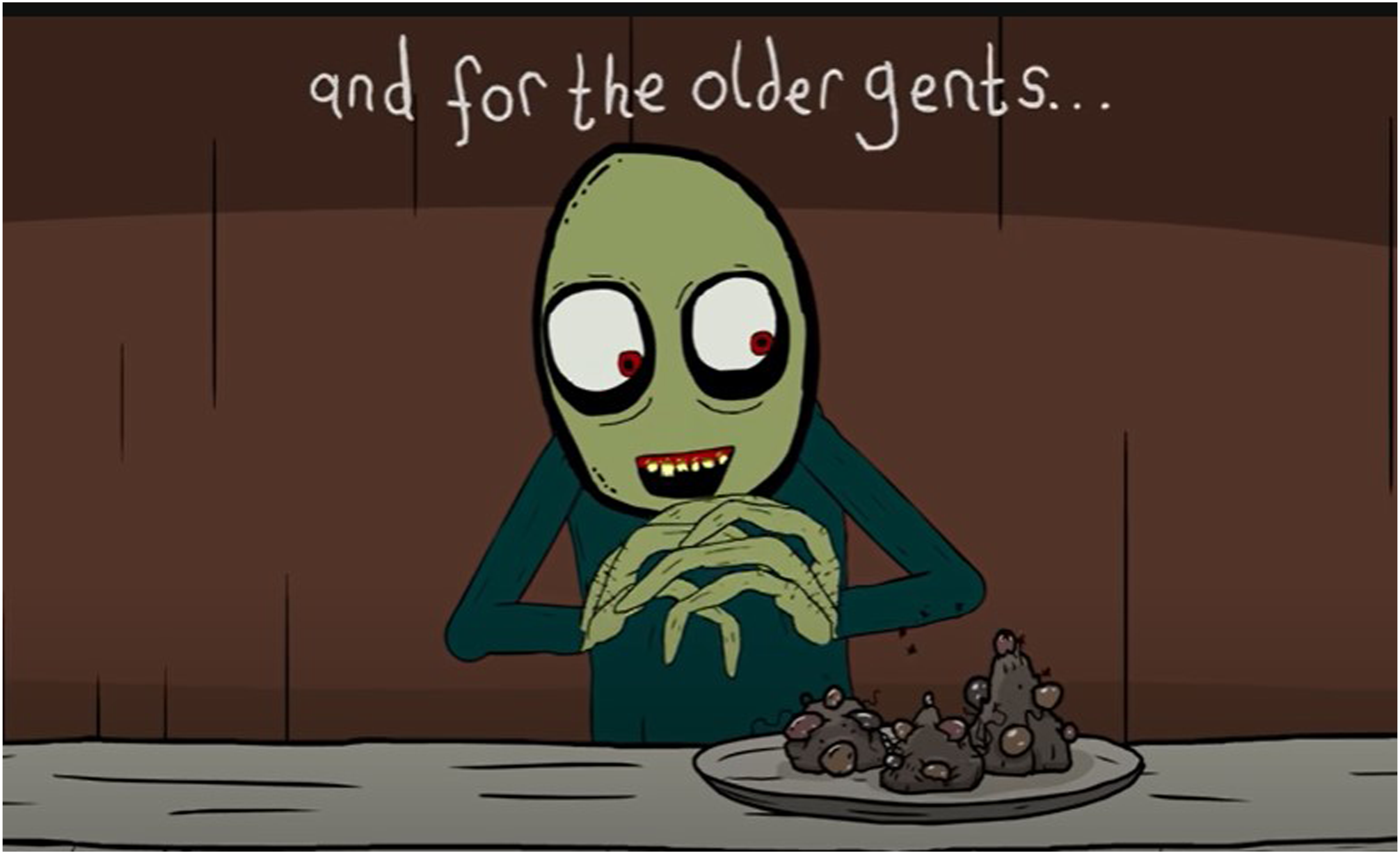
With Salad Fingers, as has been outlined, plots and characters are deployed in ways that refuse narrative coherence and instead activate the senses in provocative ways, especially when read in continuum and conversation with other texts. It is the bricolage assembled out of these elements that makes the series a watershed case study in not just online animated content, but visual cultures more broadly. Our tracing of these influences upon Salad Fingers – which itself inspired an extensive body of ‘weird’ YouTube content – highlights the deep archaeology and legacy of the YouTube weird mode wholesale. By arguing for the cultural significance of Salad Fingers, we have identified a crucial moment in the development of contemporary adult animation in which the uncanny and weird, as aesthetic categories, became mainstream, and opened avenues of expression for contemporary and future visual artists and practitioners.
Footnotes
Declaration of conflicting interests
The author(s) declared no potential conflicts of interest with respect to the research, authorship, and/or publication of this article.
Funding
The author(s) received no financial support for the research, authorship, and/or publication of this article.
