




Abstract
Blogs and social media sharing platforms like YouTube and Instagram have become increasingly popular in recent years, and they also have become an outlet for income generation. In this paper, we focus on what stories content creators share about their professional activities on social media and what self-image and narratives they draw about their work as content creators. Based on a content analysis of blog and video posts as well as semi-structured interviews conducted with content creators in Germany, we identified a specific ‘professional creator narrative’ that serves the purpose of reconciling contradictory demands from their audience, sponsors and platforms. Our findings indicate that constructing those narratives helps to justify their activities and thus is an essential part of working as a content creator.
Keywords
Introduction
Blogs and social media sharing platforms like YouTube and Instagram have become increasingly popular in recent years. Overall, social media serves quite different purposes. Those platforms not only offer information, communication and entertainment but can also be used for sharing stories about work and work experiences. Moreover, those platforms themselves open up new opportunities for income generation through the production and monetisation of so-called user-generated content leading to a specific form of platform work (Jarrett, 2022: 24). This type of platform work is, however, shaped by specific conditions. Content creation on social media platforms is not based on an ex-ante defined task that is then allocated to a worker through the intermediation of platforms set up to match the supply of and demand for paid work. Rather, content creation precedes and then builds on the monetisation of the visibility and attention gained on social media platforms.
At first glance, it is often not obvious how content creators can make a living from their activities on social media platforms. Much of the content they upload to their own blogs or social media platforms is available to the public free of charge. It is now widely known that a large part of content creators’ income is indirectly fed by advertising revenue. The number of viewers of a post gives it an advertising value, which is then monetised, for example, through parallel placed advertising clips or cooperation agreements with advertising companies. In the media coverage and public discussion about content creators, it is precisely this indirect and thus ‘hidden’ advertising-based nature that is criticised. Content creators are described as puppets of the advertising industry who, however, conceal this dependence from their (often young) audience (see, for example, Nymoen and Schmitt, 2021; Cornwell and Katz, 2021). In contrast – and this was the starting point for the research presented here – there are many blogposts and video clips on platforms such as YouTube that deal precisely with this topic and are intended to offer the audience a deeper insight into the work of content creators. Against this backdrop, our paper analyses the self-representation of content creators on social media platforms. The guiding questions are: (1) What stories do content creators share on social media about their work experiences as content creators? (2) What self-image do they draw and what narratives do they create about their work as content creators? We will examine these questions in two steps: First, we provide insight into the topics that emerge in blogposts and YouTube videos by content creators about (video)blogging as gainful employment. This is then complemented by semi-structured interviews with 18 bloggers and YouTubers to explore more in depth the perspectives of self-employed content creators on their work and the narratives they construct.
Content creation as platform work
Content creation is (paid) work that is situated in the so-called platform economy. Platforms can be understood as versatile technical infrastructures that enable interactions between platform participants (e.g. between producers and consumers of a service) (Zysman and Kenney, 2016). The platform economy is characterised by the emergence of ‘platforms’ as new actors that not only change existing markets but also open up new areas for work and employment. Ride-hailing platforms such as Uber can be taken as an example of the former: Previously, there were also taxi companies that provided a comparable service. The mediation of such passenger transport services therefore does not substantially change the offered service but above all their organisational handling. The platform providers are counting on being able to offer various advantages over ‘traditional’ providers through their new type of organisation and provision of services. The platform economy, however, embraces a plethora of different platforms and different types of platform-mediated workers (Jarrett, 2022: 22–28). In other areas of the platform economy, however, novel services are provided that were previously not possible without the digital infrastructure of the platforms. These include, for example, social media platforms. These platforms allow internet users to reach an audience with a variety of content – for example, a wide range of text, photo or video content. By making it possible for users to play an active role in the creation of such content and for these content creators to participate in platform revenues, the platform economy paves the way for new internet-based forms of work (Papsdorf, 2013: 19). Platforms as a new form of organisation can be described as the defining organisational model of the digital economy (Schüßler et al., 2021). While the future importance of platforms is generally considered to be high, at the same time, the overall prevalence of internet and platform work still seems to be limited (Piasna et al., 2022).
For the creative industries, value creation via platforms is already of prominent importance today. This applies, for example, to the distribution of music recordings, where today more than half of revenues are generated via streaming providers (Schrape, 2021: 9). Such shifts towards platform-centric value creation can also be observed in other media and creative industries, such as the gaming industry or journalism (Hesmondhalgh, 2019: 294–321). The central position of platforms has been a topic in research on creative work and the media industry for quite some time. In recent years, we see a growing body of literature within media studies concentrating on platform-dependent digital work in the cultural industries and the so-called ‘creator economy’ or ‘creator culture’ (see, for example, Cunningham and Craig, 2019; Duffy et al., 2019; Duffy and Wissinger, 2017; Poell et al., 2022). Although the proliferation of platforms and the platform labour markets that are emerging with them have also a firm place in labour research, the sociology of work in particular has so far paid rather little attention to these new areas of platform-based creative work. Rather, this research strand has mainly focused on working conditions and regulatory needs for work carried out on online labour platforms, including local gig work (e.g. delivery services) and online crowd work. Digital self-employment in the field of social media is, however, not yet part of the core of these reflections on platform work. However, there are some parallels between these two strands of research.
Several researchers argue that platforms are disruptively changing the markets of the culture industry (Burgess and Green, 2009; Hesmondhalgh, 2019; Poell et al., 2022) and thus create major challenges to actors and structures. The relationships between platforms and cultural professionals affect all important parts of the cultural value chain: Production, distribution, marketing and monetisation. Moreover, platforms not only change existing markets but also create entirely new ones. Platforms like YouTube constitute a market by collecting data on interactions and assigning them a value. This can be illustrated by the advertising value that the YouTube platform attributes to the individual videos. By the digital (data) infrastructure of the platform, it is possible to measure the interactions: Videos can be uploaded to the platform’s servers and accessed from there by an audience. At the same time, these videos are used for advertising purposes. The platform controls which videos are linked to which advertisements, and their algorithms structure the viewer’s attention. It can be argued that even before those platforms have existed, certain actors in the culture industry were also able to control attention and access to audiences and markets (for instance, traditional media agencies, publishers and labels; Poell et al., 2022). However, it is the openness of the platforms and the low entry barriers into these markets that constitute a significant difference.
Platform research in the sociology of work increasingly focuses on the characteristics of multi-sided markets and the relationships of the actors involved. Hertwig (2020) points to the structuring importance of Internet communities in the platform economy. Accordingly, values and orientations are formed through the exchange of actors on those platforms, which have a structuring effect on the platform labour market. Research findings for the field of work on social media platforms also point to the importance of communities: Using the example of sewing channels on YouTube, Gregg shows that social interaction with ‘others who identify or position themselves in the knitting community’ (Gregg, 2021: 511) is an important source of motivation for viewers to consume a certain content. Therefore, content creators strive to build such communities. The aim is to create a sense of community, which, on the one hand, binds the viewers together and on the other hand also generates a common interest with the content creators.
However, the constellations on multi-sided platform markets are not only characterised by aligned interests: Findings suggest, however, that platforms seek to maximise benefits either for potential customers or, more importantly, for themselves – and pay less attention to working conditions (Zysman and Kenney, 2017). From early on, critics stressed that platforms’ business models were often based on making strategic use of regulatory loopholes (Scholz, 2016: 7). Hokka (2021) describes such a behaviour on the platform YouTube: Here, even questionable content is sometimes tolerated, or controversial content is rewarded because this can increase the attention for advertising-relevant content. In this sense, social media platforms can benefit from questionable content, as long as it generates enough attention since generating attention lies in the core of their business model for selling advertising space. However, because social media platforms do not produce the content by themselves, they rely on user-generated content and its constant production in order to attract advertisers. In order to maintain the motivation of platform workers to produce this content, such companies are not completely independent and must ultimately also respond to the needs of these people (Roig et al., 2014).
It can be argued that one of the most important functions of platforms in the cultural industries (and even more so of social media platforms) is to direct and control the attention streams of the audience. As monetisation and earning opportunities are linked to the attention that content receives, the platforms influence the production and working conditions of content creators. Unequal treatment and disadvantages for certain content or producers therefore have a particularly negative impact and tend to lead content creators to prioritise mainstream-compatible or platform-preferred content (Bishop, 2018).
Platform labour markets – and in particular in those areas in which more complex and higher-skilled activities are performed – show similarities to the already prevailing and much discussed working conditions in the creative industries (Manske, 2016; McRobbie, 2016). This is the case both with regard to the motivation of the workers, who are highly committed and feel strongly connected to the content of their work. However, it also applies to the working conditions, which can often be described as precarious and are characterised by instability, low pay, delimitation of working hours, etc. As existing studies underline, creatives are nevertheless quite satisfied with their work due to their strong intrinsic motivation: They want to express themselves creatively and are for this reason willing to accept those working conditions (Abbing, 2008; Manske, 2016). Similar ambivalences are reported for content creation on social media platforms: working as a content creator is demanding, but fulfils one’s own demands for creativity, fun and self-realisation (Duffy and Wissinger, 2017). Platformisation of creative labour could lead to changes in this respect because platforms and the way attention is automatically directed by their algorithms limit the possibilities for creativity. Certain content and formats are supported and played out to potential viewers in a targeted manner, whereas other content, from which the platform expects less advertising revenue, is filtered and thus not visible to a broad audience (Poell et al., 2022).
Nevertheless, platformisation is not a trend that is driven solely by platform operators. The content creators who offer their services via platforms, advertisers and viewers also have an interest in using platforms. It can be argued that platforms increase the options for self-employment in the cultural industry since cultural workers are no longer dependent on the goodwill of a few publishers or media houses. However, especially when a platform becomes increasingly dominant in a specific segment, it can use its once acquired supremacy to maximise its own profits. The terms of use or the algorithms of the platform can be changed unilaterally and to the disadvantage of the platform workers (Rietveld et al., 2020). Due to the supremacy of a few platforms, platform workers have little bargaining power and must either bow to the conditions or leave the market. Another challenge is that the platform economy itself is dynamically evolving and different platform providers are trying to maintain their once gained supremacy by integrating new functions (Dolata, 2019). Past experience has shown, however, that once important platforms have lost their leading position and eventually had to cease operations. For content creators this means that they cannot rely on the use of only one platform but have to spread their activities over several platforms. However, since the platforms each have their own usage logic and, for example, an acquired ranking position on platform A cannot be transferred to platform B, such an undertaking is associated with a considerable amount of work.
Poell et al., (2022: 110) show with reference to successful internet personalities how an original ‘dream job’ becomes more and more a labour-intensive job over time. However, they limit this finding to the extent that the examples they cite (YouTube stars) are exceptions on this platform because most content creators cannot generate enough income via this platform to make a living from it. Several researchers underline that the creative platform labour market has a ‘precarious nature’ (Carter, 2017; Duffy et al., 2021; Hund, 2023). The precariousness of the work of platform-dependent creatives is typical of work in the cultural industry as a whole. There, too, personal commitment, further training, etc. have long been part of the professional requirements. This corresponds to the findings in the field of sociology of work, which discusses the increasing importance of such demands on employees with the terms ‘blurring of boundaries’, ‘subjectification’ and ‘marketisation’ (Pongratz and Voß, 2004).
According to Poell et al., (2022), these requirements have so far led to relatively high barriers to entry into professional employment in the cultural industries. This does not apply in a formal sense (e.g. because certain professional qualifications would be required) but rather in a practical sense: In traditional media markets a lot of effort was needed to establish contacts and networks to gatekeepers, which were essential to start off and to generate enough income to make a living. These requirements no longer apply to the area of content creation due to the platform-like organisation, where it is enough to register on relevant platforms to start off a professional activity. The narrative that the platforms like to use, that amateurs can feed in content on an equal footing with professional providers (Burgess and Green, 2009) and that anyone can become famous with YouTube, for example, further fuels this narrative. In addition, this ensures fluid transitions between content creation as a purely recreational activity and professional employment. This in turn not only increases the number of players involved in this field but also creates a lot of competition among content creators. However, the mere possibility of participating in the content creator labour market is not equivalent to economic success in this field and contacts and networks (e.g. for recommendations) remain important after initial registration (Ziewiecki and Schwemmer, 2019).
According to Poell et al., (2022: 125), platform-dependent creators try to cushion the unpredictability of their work by building up various competences. This is why they are active on several platforms at the same time. As also evident from our own empirical research (Hoose and Rosenbohm, 2022), this dispersion across different platforms also covers quite different activities, which are then woven together into an overall construct of social media self-employment. As a further factor for success as a content creator, the great importance of authenticity is emphasised (Van Driel and Dumitrica, 2021): only those who act ‘authentically’ and are not perceived as artificial figures of the advertising industry have sustainable success in gaining attention from the audience. Some content creators therefore deliberately focus on letting viewers participate in their ‘everyday life’. However, this might constitute a form of ‘staged authenticity’ (Hou, 2019: 548), which is meant to suggest a commonality between the respective content creator and the audience. For content creators the challenge is that such ‘calibrated amateurism’ (Abidin, 2017) can be perceived as an untrustworthy facade by part of the audience.
Two aspects can be concluded. On the one hand, authenticity and independence are required. On the other hand, content creators are dependent on advertising partners and platforms. If content creators want to make a living from their work, they depend on both sides (see also for existing contradictions San Cornelio et al., 2021). Therefore, content creators explain their work in many blogposts and video clips. They try to create an understanding of their work activities and engagement with advertising partners. A challenge remains in such descriptions: The content created should serve the purpose of entertainment and at the same time it should also retain an ‘amateur character’ (authenticity). In the following empirical part of our analysis, we therefore take a look at the self-descriptions of content creators. By focusing on German content creators, we try to expand the focus in the research on content creators on other geographical areas (see for an exception Cunningham and Craig, 2019).
Methodological approach and data collection
Our empirical analysis relies on a unique data set of YouTube videos and blogposts in which content creation was presented and discussed as work. We were interested in posts that were created by content creators in order to get insights into the self-representation of their work. Documentations by third parties (especially journalistic contributions) about the work of influencers were therefore not included in our data set.
The contributions were selected via controlled search queries using the following keywords ‘gainful employment blogger’, ‘self-employment YouTube’, ‘blogging as a profession’, ‘earning money as a blogger’, ‘YouTube as a profession’, ‘earning money with YouTube’ via Google.de 1 as well as via a search on the video platform YouTube. If such posts were found, other related posts in blogrolls, comment columns and suggestions on social media platforms were also identified and considered for analysis.
Overview analysed contributions. 3

The selected video contributions were converted into text form using automatically generated subtitles. The text corpus was then evaluated by means of word frequencies and keyword-in-context analyses 2 as well as qualitative content analysis in order to gain an insight into the self-representation of content creators. While the blogposts analysed were generally posts that dealt exclusively with the topic of our interest, this was somewhat different for many of the YouTube clips. The video posts (in some cases with a length up to almost an hour) sometimes also dealt with other topics. This was the case, for example, with videos in the so-called ‘Q&A’ format: For our research, an answer to the question ‘How do you earn your money with YouTube?’ was of interest, whereas questions about the next travel destinations for a travel YouTuber were not. Therefore, the video clips were screened before the evaluation and the relevant passages were identified. Only the transcripts of those passages were then included in the analysis.
The oldest posts included in our analysis date back to 2013, while the most recent blogposts and video clips were published in September 2019, before the Corona crisis hit. The posts analysed are spread across different thematic genres. In this context, it should be mentioned that ‘classic’ blogs and YouTube channels do cover different thematic issues: the topic ‘gaming’ plays a role almost exclusively on YouTube, but not on text- or photo-oriented blogs. The opposite is true for travel bloggers: many content creators in this area still rely on their own self-hosted blogs. This was one of the reasons why we decided to integrate not only YouTube videos but also blog post into our analysis.
The analysis of those video and blogposts was then complemented with semi-structured interviews conducted with 18 German (video) bloggers between November 2019 and May 2020. The interviews followed a semi-structured guideline focusing on motivations, entry paths, self-perceptions of working as a content creator, and work and life constellations. These topics emerged as recurring content in the previous analysis of the blog and video posts. The selection of the interview partners was based on the research and review of the blog and video contributions. All interview participants’ videos and blogposts were part of the initial analysis.
All interviewees pursue their working activities in the form of self-employment. Most of them run their blog alone and without permanent employees, so they can be characterised as solo self-employed. In three cases, the blog was started as a leisure project in cooperation with like-minded friends. These friends partly continue to support the work on the blog, but do not make a living from it. Three interviewees employed staff for their blog; in many other cases, regular cooperation with freelancers was also mentioned (e.g. for community management, photos, web design, etc.).
Among the interviewees are 14 women and 4 men who were between 24 and 43 years old at the time of the study. Once again, this gender imbalance is related to the observation that working as a content creator seems to be more frequently addressed by female beauty/fashion and family bloggers. Since the interviewees were recruited from the group of people for whom we have analyzed the videos and blogposts we see a similar tendency in our interview sample. All persons have several years of experience with professional (video) blogging, in some cases the activity has been practised for more than 10 years. For all interviewees, it should be noted that they use several platforms, however, quite often to a different extent. This covers not only YouTube, Instagram and Facebook, but also Pinterest, Twitch, Spotify as well as crowdfunding platforms like Patreon and Steady. All of these platforms have their own logic and require different approaches from content creators. Those interviewees who underlined that YouTube was their main platform (7 people) had between about 32,000 and about 157,000 subscribers at the time of our research. The number of followers on Instagram also varies greatly among our respondents: It ranges from a few hundred to around 100,000. However, this also reflects the fact that those platforms serve different purposes. For some, Instagram has become the platform that is most relevant for advertising cooperations. For others, Instagram is only one of several possibilities to draw attention to their blog websites. And still other respondents have an Instagram account but do not use it intensively; therefore, it only plays a marginal role for their professional blogging activities.
The interviews conducted had an average length of 75 minutes. In seven cases, the interviews were carried out in presence. Due to the Corona pandemic, 10 interviews took place as video interviews, and one by telephone. All interviews were digitally recorded, fully transcribed and content-analytically evaluated following the method of thematic coding (Hopf and Schmidt, 1993; Schmidt, 2013). We combined concept-driven and data-driven strategies for constructing our coding scheme. On the one hand, we derived codes from our interview guideline and the insights of our initial analysis of blogposts and videos. These topics served as main categories in our coding scheme. Based on several rounds of trial coding, our coding scheme was then further complemented by additional main categories and sub-categories, which derived from our interview material. The material was double-coded by two different persons and was checked for coding consistency.
Following on from the insights gained in the first step of the study, the interviewees can be assigned to different thematic areas and use different media formats and platforms (including blogs, YouTube, Instagram). The aim of our study is not to make statistically representative statements about the spread of this form of work. Rather, we aim to gain an explorative insight into the self-representation of content creators. In the following, we will discuss the content creators’ views of work, their portrayal of the form of self-employment as well as the reactions they receive from their audience.
Description of content creation as professional work
In the analysis of the self-representation of content creation, we will proceed in two steps. First, we will take a look at self-representation discovered in the blogposts and video clips before we analyse the interview material in order to describe individual aspects more in detail.
Description of content creation in blogposts and video clips
Frequencies of selected terms.
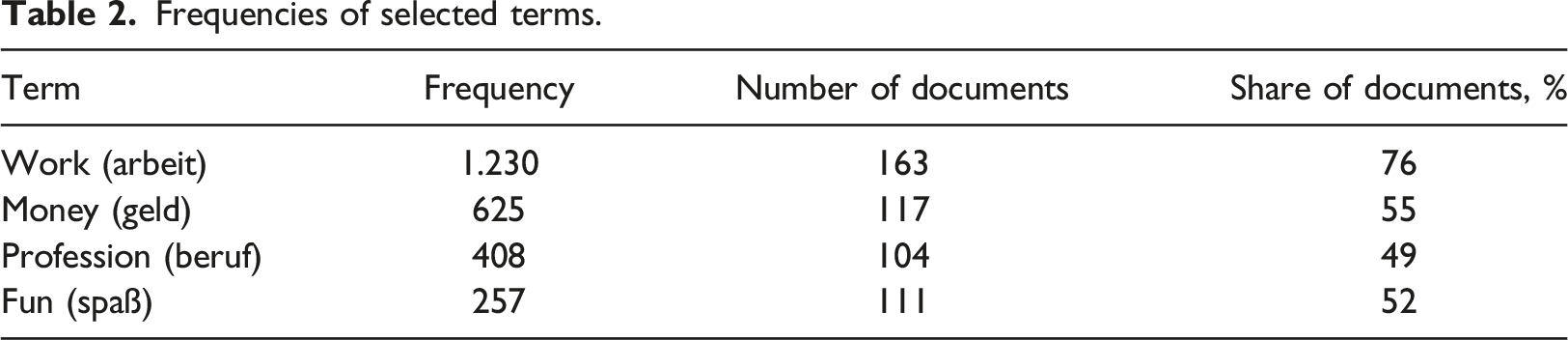
Keyword-in-context analyses are suitable for looking at the context in which the term ‘work’ is mentioned. Again, the analysis reveals that ‘work’ it is associated with ‘fun’ and ‘leisure activities’. It is often reported that the work as a content creator is fun because it corresponds to a personal passion for the topics dealt with (e.g. cooking or writing texts). This underlines that working as a content creator offers a high degree of self-fulfilment because this kind of work corresponds to one’s own preferences and ideas about how one wants to live and work.
Our additional qualitative content analysis reveals that such presentations of one’s own work as a content creator are often combined with statements that one must also earn ‘money’ with it. In this respect, it becomes clear that earning money is certainly an important motivation for these activities. It is underlined that generating income is also necessary so that the content creators are able to do this time-consuming work at all. Otherwise, it would not be possible to produce high-quality content.
It becomes clear that many of the posts analysed have a justificatory character: The content creators explain to their audience how their work functions and what requirements are associated with it. In particular, they emphasise that it is ‘real work’. In this way, they defend themselves against possible accusations that their work is just a leisure activity that anyone can do.
‘This accusation is probably even older than the old influenza/influencer joke. Quickly post a snapshot and hold a cup of tea up to the camera - BANG 1,000 € more in your account. And every day, of course, ten packages of designer goods arrive for free. That’s how at least some reporters imagine the blogger’s life. A pretty bold statement in my opinion. Of course, there are the “Instagram stars” who like to collect a few thousand euros for a picture. But it’s easy to forget that these people have usually built up their reach with a lot of effort’. (Quote from blogpost: ‘Is envy of bloggers justified?’)
4
‘I've often noticed lately how I immediately feel the need to justify my profession. To explain it. Because for a long time there was a bit of admiration for an exciting profession, now it's not uncommon to hear “You’re a blogger? Ah okay...” and being smiled at. And I find that incredibly unfortunate. For years we bloggers have fought for prestige, worked hard’. (Quote from blogpost: ‘ You are a blogger? Ahhh, you earn money with selfies’)
This motive of wanting to ‘explain oneself’ becomes apparent in many of the contributions. The content creators try to explain to their audience why they have to do certain things as self-employed professionals and what dependencies they encounter from platforms and their advertising partners. This shows the balancing act that professionals in this field have to manage: Content creators have to meet several requirements form the audience and their sponsors at the same time. Moreover, content creators often started their activities as amateurs themselves without being economic dependent on the success of their postings. As such amateurs, they could then be very critical of certain brands, products or even the platform. The greater the financial dependence becomes, the more difficult it is to maintain such critical attitudes. In contrast, their audience often demands that the content creators produce independent content that is not influenced by advertisers.
Based on our analysis of those video and blog post, these different demands are met in two different ways: The first aspect, as shown above, is that of ‘explaining’ one’s own work. The content creators describe in great detail what their work looks like and what steps are necessary to create their contributions. A recurring feature is the mention of work that is usually ‘invisible’ to the audience. It is explained how time-consuming, for example, the pre- and post-production of video clips is, what arrangements have to be made with sponsors and how important the interaction with the audience is.
‘I always try to make it clear to my sponsors that my authenticity is my capital and at the same time what distinguishes or should distinguish a blogger from classic advertising. If I lose my credibility as a blogger, I lose you as readers. And that is neither favourable for me, nor for my cooperation partners. That’s why I must always be allowed to give my honest opinion’. (Quote blogpost: ‘How do I earn money with blog & Instagram’)
The second way in which content creators manage their demands is through emphasising the importance of ‘authenticity’ in their blogposts and video clips on the topic. Here it is put forward that giving an honest opinion about products and being careful when choosing a sponsor is crucial when working as a content creator. According to the posts analysed, the latter means that only things that have been tested and found to be good and suitable are advertised. Advertisement is, however, a sensitive topic that content creators do not want to annoy their viewers with.
Self-critical views of self-employed work as content creators. Perspectives of the self-employed
The semi-structured interviews conducted with content creators also show that their self-employment is associated with a specific ambivalence: On the one hand, a high degree of autonomy is achieved with the activity, on the other hand, there are structural dependencies with regard to sponsors, platforms and their own community. The former is represented in the fact that ‘wanting to be one’s own boss’ is a strong motive for becoming a professional content creator. The focus is on being able to determine working hours and places as well as the content of work.
‘I am my own boss. I can live out my creativity. I simply couldn’t do that in my old job, and I simply realised how much I miss that. [...] So I’m glad that I took this step into self-employment and I’m also much freer and more creative now’. (Female food blogger)
Content creators see their own work primarily as a creative activity. Even though the income mainly derives from advertising cooperations, the interviewees do not define themselves by this in their self-understanding. Instead, content creators emphasise own claims to their work in terms of content. This is also reflected in the designations chosen by content creators for their activities. For example, they describe themselves as ‘blogger’, ‘editor’, ‘video producer’, ‘YouTuber’ or ‘content creator’. The term ‘influencer’ is widely rejected because of its negative connotation and its reduction to advertising aspects. This is an observation also made by Cunningham and Craig (2019: 68).
‘Well, I am a blogger. Clearly because I have a blog and that is important to me. I mean, I'm also an influencer, because, well, you can say it like that: Every blogger is an influencer somehow, but not every influencer is a blogger. I don’t like that word, almost nobody likes that word. Now all these made-up words like ‘content creator’ or ‘creative mind’ or blah, blah, blah are used. These are all just attempts to differentiate yourself from the others and maybe also to differentiate yourself from all these pink clouds and super retouched versions. If you want to call me an influencer, then you can, because it’s the term that’s been established. But in my understanding, I am a blogger and that is very clear to me’. (Female fashion blogger A)
For our interviewees, content creation is an opportunity to work creatively and independently. In this respect, content creation has a similarity to other forms of self-employed work. Self-employment research has already been able to show the importance of independence motives for taking up such activities elsewhere (Pongratz, 2020: 15). There are also similarities to other forms of self-employment in terms of existing challenges. These include, for example, long working hours and the requirement to constantly find sources of income in order to be able to secure one’s livelihood. At the same time, it becomes clear that content creation is characterised by special features. On the one hand, this concerns the close and constant exchange with the online community. On the other hand, this is due to the dependence on social media platforms and their rules and algorithms.
Economic success of content creators depends to a large extent on achieving the widest possible reach for their content. This requires their posts to be noticed in the millions of blog articles, YouTube videos, Instagram posts or TikTok videos. Advertising in the social media sector is more successful when the content creators are in a more intensive, direct exchange with their audience (see also Munnukka et al., 2019: 232; Stoldt et al., 2019: 3). Accordingly, our study shows that interaction with the community is a fundamental part of the work of content creators.
‘I know for example that the whole “reply to comments” thing is most important. I’ve learned for example that when the video is freshly posted you should be as active as possible for the first hour, so that YouTube notices that there is a lot of traffic and pushes it. So my priority is to be very active and reply to comments after a video is released and just interact with my community’. (Female food YouTuber)
The constant exchange with the audience includes not only a continuous observation of what is happening in the community but also a constant availability for questions and comments. Answering the numerous questions and comments from the community in the morning in bed before actually getting up or late at night on the sofa in front of the TV is therefore not uncommon.
‘I always answer them [members of the community] directly. In that respect, work doesn
’
t really end until you put your cell phone away and go to bed. […] when I receive any private messages, I try to answer them immediately. […] Yes, that
’
s a permanent demand every day and I don
’
t succeed well, I don
’
t succeed well in drawing the right line’. (Female food YouTuber)
It is repeatedly emphasised that for a good relationship with the audience it is important to remain ‘authentic’. This is a particularly challenging part of being a content creator. It is emphasised that the products recommended in blogposts and video clips are personal recommendations that one would also give to friends. This makes it less recognisable that content creation is professional work. This is challenging because on the one hand content creators want to achieve exactly this effect, but on the other hand the effort they have to put into creating content becomes increasingly invisible to the audience.
‘In fact, the audience has zero understanding of this “It’s the weekend or holiday or Sunday.” Zero. We always try to say that, along the lines of: We also say that we’re on holiday or something. But people don’t understand that, and I also understand why: because of course they don’t notice it at all’. (Male board gaming YouTuber)
Not least because of audience preferences and the framework conditions set by the platforms, there are incentives to extend working hours and to soften the separation between professional and private contributions. There are, however, also attempts to (re)draw boundaries, for example, by establishing the rule of not looking at the smartphone after a certain time in the evening or not answering to comments during these times of the day. Content creators thus find themselves in the dilemma of, on the one hand, making their work look like easy and enjoyable leisure activities. But, on the other hand, they are feeling that this is precisely what makes the value of their own work invisible.
‘Sewing is still my hobby. But is that working time or not? I hang out on social media, sure, all the time actually, I’m constantly on my mobile phone. Is that working time or not? Well, it’s totally blurred, and then I play with the kids for a while, then I’m on it again and answer a few emails, it’s totally blurred. I don’t know, I’m on 24/7, but somehow not permanently either. It’s really difficult to say’. (Female sewing blogger A)
In our interviews – as in the contributions analysed (see above) – it is repeatedly pointed out that one way of dealing with the demands of platforms and advertisers as well as the demands of the audience is to stay ‘authentic’. However, being able to maintain this, even if it is only ‘staged authenticity’ (Hou, 2019: 548), is demanding and this kind of ‘calibrated amateurism’ (Abidin, 2017) requires a lot of ‘authenticity labour’ (Maares et al., 2021), in which the balancing act is not to appear too much like a professional because this would distance them from their audience. This can be seen as the construction of an authenticity facade with which content creators try to build a boundary between private life and (professional) action in the social media sphere.
In principle, content creators are free to choose their cooperation partners, but they must be careful not to risk their reputation and authenticity by placing too much advertising or promoting products or services that are not appreciated by their audience. Thus, content creators face a double challenge (Van Driel and Dumitrica, 2021): On the one hand, they have to remain attractive to sponsors, as their livelihood depends to a large extent on this income, but on the other hand, they also have to remain authentic in order to retain the online community on which they depend to monetise their content.
The interviewees repeatedly emphasise that they do ‘real work’. Nevertheless, the content creators are always aware of the proximity of their work to leisure activities. And it is also partly reproached by the audience: Some viewers see content creation as an easy job where a lot of money can be earned quickly without working too hard. If additional products are advertised in the videos, this triggers criticism from parts of the audience.
‘In my opinion, there is a wrong image, and sometimes it looks to me as if you snap your fingers and get the money thrown at you. And hold a package in the picture and then it was like that. And that’s not how it is at all’. (Female sewing blogger B)
But content creators do not only have to explain their work to the audience, but also to their sponsors:
‘It’s just that most companies don’t say right from the start “Hey, come on, we’ll give you 500 euros when you show our product.” It’s usually a very long negotiating process until the companies are really willing to pay something. You often have to send in your media kit beforehand, which of course you have to maintain, which contains the latest data. And still, it often goes back and forth in the e-mail correspondence. Then, when such a cooperation comes about, I first have to prepare all the material. The client needs that for an overview. There are correction loops. If something doesn’t fit, I have to start over. Like any other self-employed person, I have to deal with tax issues or things like data protection. […] The blog always has to be up to date. It’s just office stuff that most people aren’t even aware of and most people, I think, actually think that somehow you get something sent to you and somehow you quickly take a picture in five minutes and then you’re a few thousand euros richer’. (Female fashion blogger B)
The fact that the interviewees do not see themselves primarily as advertisers is also reflected in their paths into self-employment as working as a content creator. Most of our interviewees previously held a regular employment relationship, which was then given up in favour of working as a self-employed content creator. Dissatisfaction and negative experiences with previous working and employment conditions were often decisive in making these decisions. At the same time, content creation had often been pursued as a hobby activity before. The first income generated came about partly by chance, was not based on an active search for cooperation partners and often represented an additional income that had not been expected before. The motives for starting to post content were therefore less about earning money, but more about being creative. Both the creative opportunities and the exchange with like-minded people have been regarded important. As content creation becomes essential for earning a living, creators’ perspectives on their work, however, starts to change. Our interviewees reported that they – after having made the transition from a hobby activity to a professional activity – became much more aware of the dependencies from platform companies and advertising partners. In order to mitigate these dependencies they have developed certain strategies for using non-advertising sources of income. This includes, for example, the use of crowdfunding platforms such as Patreon, which specialise in donation-based support for creators. Some content creators have even further expanded their self-employment, for example, by offering social media consulting services for companies, coaching, or as consultants for other content creators. Characteristic of the content creators interviewed is that they develop portfolio strategies. They combine different sources of income and constantly experiment with new revenue opportunities.
Overall, three demands have to be met: First, the rules and terms and conditions of the platforms have to be taken into account, as content creators inevitably rely on the platforms. Second, the expectations of the viewers must also be taken into account, as they want to consume high-quality content and do not want be overwhelmed with advertising. Third, the content creators are challenged to demonstrate their added value to the cooperation partners, especially compared to content produced by amateurs. To reconcile these different requirements, content creators create a specific narrative about their activities: we will call it the ‘professional creator narrative’. The narrative consists of three components: First, the distinction from amateur creators. In this context, the content creators emphasise that they are – since they rely on generating revenues – subject to certain obligations. They have to place advertisements and have to cooperate with sponsors. Second, the ‘professional creator narrative’ also includes an emphasis on authenticity. This attempts the balancing act of highlighting the particularities of professional content creation on the one hand, while at the same time pointing to shared characteristics and interests with the audience on the other. Third, the role of self-employment is emphasised. By referring to the associated freedom in the choice of topics, the autonomy to determine working places and working times, the content creators try to show that they can succeed in bridging economic dependencies with desires for authenticity claimed for by the audience. The professional creator narrative is used to react to the pressure of justifying themselves that arises from demands of the audience. For example, the content creators explain which advertising rules of the platform exist, how they have to obey to and what (limited) influence they have on them. They also describe and emphasise the amount of work for this reason of justification, but at the same time they want to emphasise the value of their work to advertisers.
Conclusions
Studying content creation as gainful employment is linked to several strands of research. On the one hand, there is a sociological perspective on work, from which we have approached the topic. From this perspective, the work of content creators can be classified as changes in self-employment: Self-fulfilment as well as being able to work in a self-determined way or ‘wanting to be one’s own boss’ are strong motives for working as a professional content creator. Research on self-employment also points to the tendency to dissolve boundaries in terms of working hours and places of work. This can also be observed in the work of content creators. A special feature of content creation, however, is the dependence on platform infrastructures, rules and algorithms. This has already been emphasised in the media studies research stream. The structuring and frame-setting role of the platform companies have become apparent. Content creators have to deal with the platform algorithms, and they have to behave according to the monetisation logics of the platforms so that their business model can function.
Content creators have to cope with the fact that their activities are faced with different interests of different actors. Therefore, they are challenged to create a balance between these requirements. To meet these requirements, content creators give explanations for their own working activities and try to justify them. In doing so, they position themselves in competition with other content creators (even those who are amateurs) to gain the attention of the audience, the platforms and possible sponsors. By choosing certain narratives to describe their work, professional content creators try to create certain expectations by these other actors, which can be described as ‘fictional expectations’ (Beckert, 2016). The descriptions used of their own work as ‘professional content creators’ are thus to be seen as signals for other actors and the creators aim to create their own story (‘narrative’) of how they want to be seen as professional content creators. This is an attempt to gain room for manoeuvre. For this purpose, it does not matter whether the self-representations correspond completely to reality. However, there is a risk that if reality and the story are not congruent, contradictions will be revealed. This can trigger criticism from the audience (and thus also have an impact on the attractiveness for advertising partners). But complete openness to the community can further blur the boundaries between private and professional life.
Furthermore, there is a strong need to present content creation as ‘real work’. Admittedly, this is not questioned in the media-scientific consideration of such creative work. But the current state of platform research from a sociology of work perspective only marginally considers content creation as platform work. This non-awareness of this kind of work is apparently also perpetuated by the audience and advertising companies. Activities that occur ‘behind the scenes’ remain largely invisible and the audience often does not reward content creation as work.
For the work as a content creator, it is necessary to present oneself because the audience must be reached in order to generate income. This authenticity work is particularly challenging, precisely because it has to be carried out across time and in all areas of life (e.g. also in private social media consumption). Our study underlines that one way of dealing with this challenge is to explain one’s own work with the narrative pattern of the ‘professional creator’. The demand for authenticity is cushioned, for example, by emphasising the professional requirements. This creates a distinction from amateurs who also post content on social media platforms. With their role as professionals, the content creators also explain to their audience that they have to meet certain requirements of advertisers just as much as they have to use the platforms in a certain way in order to remain visible and to be able to generate income. Self-representation of one’s own work is the only way for content creators to explain their work and to be able to justify themselves to the contradictory demands of the audience, the platforms and their sponsors. Precisely because these demands are sometimes contradictory, developing an answer to them – by creating a narrative about the role as a content creator – is at the same time an integral part of the work of content creators.
Footnotes
Declaration of conflicting interests
The author(s) declared no potential conflicts of interest with respect to the research, authorship, and/or publication of this article.
Funding
The author(s) disclosed receipt of the following financial support for the research, authorship, and/or publication of this article: This work was supported by Mercator Research Center Ruhr GmbH (An-2018-0045).
