




Abstract
This article presents emergent findings from an empirical research study conducted during Covid lockdown with 52 undergraduate students at a UK university November 2020–April 2021. The research study, which adopts a teacher-practitioner stance, builds on a 2012–2019 programme of research (represented by publications including Barnard 2019) which explores the potentials and dangers that digital technologies hold for pedagogy and education. It is located in the field of Creative Writing and uses the discipline’s pedagogical practice of ‘workshopping’ as a case study. The Creative Writing workshop centres on the exchange of information and critically informed comment by participating students (generally in small groups), and, as such, has similarities with seminars in other disciplines. Hence it is hoped that this article will be of benefit both in the home discipline and more widely. The contention of this article is that, to maintain quality in the delivery of participatory online teaching, it is necessary to ensure an ongoing feedback loop between individuals’ bodily existence ‘IRL’ (‘In Real Life’) and the section of cyberspace that they carve out and inhabit collaboratively during virtual seminar groups. It considers how the cliché of the ‘digital native’ can inhibit learning and the role of affect in enabling productive online and engagement. In taking initial steps towards development of a pedagogy of affect in which a ‘neutral terrain’ is established that enables students to apply and develop close reading skills in an online environment, it presents a new theoretical position on what constitutes effective pedagogy in the context of participatory virtual classrooms.
Introduction
When the Covid-19 pandemic and resulting lockdowns widely mandated remote learning in 2020, educational institutions across the world had to – suddenly and swiftly – move classes online. The confluence of difficulties faced by teachers at this unexpected juncture included the problem of how to adapt for online delivery teaching materials that had been designed for use in classrooms, face-to-face. Putting traditional ‘chalk and talk’ lectures online was generally considered to be quite straightforward, with the tutor delivering their lecture to a ‘gallery’ of students via (for example) Zoom or Blackboard Collaborate video links, sharing a PowerPoint presentation on screen as needed. However, the task of enabling genuinely participatory virtual workshops or seminar groups represented a significant challenge, one that was particularly difficult when an expectation was that students in small groups would collaboratively lead those sessions independently of the tutor. Two associated hidden problems are: the role of affect and the idea of the ‘digital native’.
According to the idea of the ‘digital native’ (Prensky, 2001a, 2001b), young people are at ease with new media technologies simply because they are young and hence grew up with it already in existence. Thus it could seem that a sudden transfer of pedagogy to an online environment will be primarily a problem for (old) school teachers and university lecturers and that (young) students who have the necessary equipment and digital access will adapt easily. However, the idea of the ‘digital native’ does not bear scrutiny. ‘Young people are not digital natives, indeed not all young people possess even basic digital skills’, note Wilson and Grant (2017, p. 6).
Furthermore, ‘Digital skills development starts offline and “offline” continues to be an important delivery method’ (Wilson and Grant, 2017: p. 62). Factors that contribute to the value of ‘offline’ in enabling digital skills development include affect, with something as simple as, for example, a trusted friend’s or tutor’s reassuring presence in the classroom having transformative potential (Barnard, 2017, 2019). It was known pre-pandemic that the challenges of ‘online’ can be alienating (Gere, 2012) and frightening (Barnard, 2019, 2019b). Due to factors including escalating death tolls, fear was a defining characteristic of the pandemic during its early months, with children’s play including a Minecraft ‘coronavirus clinic’ (Cowan et al., 2021: p. 14) and a Minecraft funeral (Thorpe, 2022), for example, and levels of loneliness and anxiety among young people reaching unprecedented levels (see, for example, Coughlan, 2020; Evans et al., 2021). Getting online is not on its own enough to enable effective workshopping. For this, students’ critical and creative engagement is key. Such engagement is hard if students feel fear. A key benefit of affect in the context of digital upskilling is that it can help mitigate the experience of ‘online’ as alienating and undermining, and reduce fearfulness. That is, at a point in history when beneficial affect was acutely needed to help students not just get online but stay online and learn effectively online, the opportunities to harness such affect were severely compromised.
This article presents emergent findings from an empirical research study that was conducted during Covid lockdown with 52 undergraduate students at a UK university November 2020–April 2021 (for the UK’s lockdown timeline, see IfG, 2021). The research study, which adopts a teacher-practitioner stance, builds on a 2012–2019 programme of research (represented by publications including Barnard 2019) which explores the potentials and dangers that digital technologies hold for pedagogy. The study that is the subject of this article is located in the field of Creative Writing and uses the discipline’s pedagogical practice of ‘workshopping’ as a case study. Creative Writing workshops centre on the exchange of information and critically informed comment by participating students (generally in small groups), and, as such, have similarities with seminars in other disciplines. Face-to-face interactions have historically been key for Creative Writing workshops, with affect playing a significant part, contributing as it does to an atmosphere in which it feels safe to expose drafts to comment. As McGowan notes, ‘it is immutable that affect cannot be physically passed between bodies in the context of digital media consumption’ (2022, p. 166). That is, affect experienced by students during face-to-face Creative Writing workshops in the classroom cannot be replicated precisely online. Moreover, online encourages ‘hyper reading’ (Hayles, 2012), whereby we skim texts, follow URLs, and jump between newspaper articles, friends’ messages and adverts. The type of thinking required for such speedy and complex cyber-manoeuvres may be thought of as ‘rhizomatic’ interlacings (Deleuze and Guattari, 1999), a ‘secondary orality’ (Ong, 1982), and/or a manifestation of ‘electracy’ (Ulmer, 2003) whereby technologies and social media platforms become extensions of our capabilities; this type of thinking is exciting, it can embed a playfulness in the work of engaging with new media technologies. The assertion here is not that hyper reading is less good, only that it is different. Importantly in the context of this article, hyper reading is the antithesis of and undermines the close reading that is needed for Creative Writing workshopping. Yet, Creative Writing workshops had to take place online during Covid lockdowns. Thus, an important question in Creative Writing was how to provide online methods of workshopping that could both mimic beneficial affect and enable close reading.
The research study that is the subject of this article, then, addressed the following research question: is it possible to transfer face-to-face Creative Writing workshopping practices to remote online learning environments with evidence-based effectiveness; if so, can effective practice be identified for wider application? The article sets out to, firstly, provide practical detail of a discrete pedagogical initiative that has been empirically tested for its effectiveness with supposed digital natives in enabling effective online participatory workshopping and which can be utilised as a template for online workshopping in the field of Creative Writing. As indicated, the discrete pedagogical initiative at the centre of the research study that is the subject of this article builds on and is informed by a programme of research spanning over a decade, which enables identification of general principles. Secondly, then, the article outlines general principles that can be applied to the task of transferring face-to-face seminar-based learning practices that require close reading and related productive human interactions to an online environment. These two practical contributions lead to a third. Observing that the ‘attention to detail’ needed for close reading tends to suggest that a ‘cerebral engagement’ only is needed, Cobley and Siebers note that, in fact, close reading involves a ‘bodily or distributed engagement’ (2021, p. 21); they argue for further research into ‘a “rhetoric of embodiment” as a new horizon for close reading – a pedagogy of affect in which a neutral terrain might be found in the bodily engagement with textuality between the hyper and deep modes of attention, between distant and close reading’ (ibid). The Covid lockdowns have lent particular urgency to such an exploration. This article takes initial steps towards development of a pedagogy of affect in which the kind of ‘neutral terrain’ in the ‘bodily engagement with textuality between the hyper and deep modes of attention’ that Cobley and Siebers propose can be established for students who need to apply and develop close reading skills in an online, collaborative environment. In doing so, it presents a new theoretical position on what constitutes effective pedagogy in the context of such participatory virtual classrooms.
The chief executive of the UK’s Office for Students, Nicola Dandridge, notes: ‘There are many ways for blended courses to be successfully delivered and it will be important to harness the lessons learned by the shift to online learning during the pandemic. We are, however, concerned to ensure that quality is maintained’ (OfS, 2022; np). A driving aim of this article is to harness lessons learned during the pandemic about how to effectively deliver a mode of pedagogy that has historically been dependent on classroom delivery, with affective benefits of classroom delivery successfully replicated online, to ensure quality. While the study is located in the field of Creative Writing, enabling meaningful engagement online for pedagogical practices such as workshopping is an important aspect of digital inclusion more generally, and so the task of establishing a method of enabling an effective online equivalent of workshop and seminar practice is relevant in other disciplines as well.
In summary, then, this article’s main contributions are to: • Demonstrate the beneficial role of affect in participatory online learning; • Provide a pedagogical template for delivery of workshops/seminars to mimic benefits of face-to-face delivery, which has been tested in the field of Creative Writing and found to be effective; • Provide general principles for application across disciplines regarding how to enable effective learning in participatory virtual classrooms, including collaborative close reading; • Present a new theoretical position on what constitutes effective pedagogy in the context of participatory virtual classrooms.
Before providing detail of the methodology utilised for the study considered here, this article provides context regarding: the nature of Creative Writing workshopping; problems associated with the idea of the digital native; the role of affect in enabling more confident and productive digital engagement.
Workshopping
Workshopping, whereby writers critique each other’s writing in a group setting, has been a key component of the pedagogy of Creative Writing since the turn of the 20th century (Myers, 1996). Workshops are where constructive criticism is given and received and where the art of criticism is developed and so too, as a direct result, skills in self-editing. They are a key component of pedagogical practice in Creative Writing because a writer’s ability to self-edit is so important. Self-editing is and always has been a hard skill to learn as editing tends to feel like a slog; it can be hard to see the rewards (Barnard, 2019: p. 122). To learn their craft, writers must engage in extensive, critical reading ‘putting every word on trial’, ‘pondering each deceptively minor decision’ (Prose, 2006: pp. 2–3). To workshop is to trial and ponder in a collaborative setting, giving and receiving constructive criticism on draft material that may feel raw; trust is key.
‘[T]o capture the precise feeling of the space, the affective landscape of the audience, the “smell in the room”, you really did have to be there’ (McGowan, 2022: p. 174). McGowan is talking about performance poetry events streamed via digital platforms such as YouTube, but his point is relevant here. A Creative Writing workshop is a live event, with emotions and atmosphere playing important roles. Such affect tends to build over the course of one or several workshop/s. It may include the scent of cups of coffee as students enter the room and begin to settle, for example, the tutor’s pencil clicking onto a table to indicate that the session is about to start, a side-wards glance of recognition, pages shuffling as words are read and responses formed, the sound of a chair scraping back at a moment of realisation.
As noted, the challenges that come with online can induce apprehension or even fear; added to this, fear was – as noted – a defining characteristic of the pandemic during its early months; moreover, the hyper reading that is associated with online activities is the antithesis of, and undermines, the close reading that is needed for workshopping. Thus, to move a Creative Writing workshop online is to ask students to develop editing skills in the very online environment that undermines the ability and desire to develop editing skills. Furthermore, such moves took place when it was widely assumed that online activity of any kind is easy for young students.
Digital natives?
Context
According to the concept of the digital native – which is generally attributed to Prensky (2001a, 2001b) – young people are at ease with new media technology because they have been immersed in it and, due to their early and ongoing interactions with technology, their brains have changed, they ‘think differently’ (Prensky, 2001b). Consequently, ‘digital immigrants’ (those who have not grown up immersed in technology) are not equipped to teach digital natives (Prensky, 2001a).
The concept of digital natives has long been under question (see for example: Bennett et al., 2008; Helsper and Eynon 2010; Selwyn, 2009). Further, Prensky’s 2001a formula no longer holds. If the start point of the new digital era was around 1980, digital natives are now teaching digital natives. During the pandemic, as governments worked to support and implement the mass move of businesses, citizens and educational institutions online, the idea of the digital native came under new scrutiny (see for example: Carmi and Pitt in HL, 2020a), with a House of Lords Select Committee on Democracy and Digital Technologies report proposing that ‘critical digital natives’ might be a more useful term, for example (HL, 2020b).
However, the concept of the digital native has entered the popular imagination. A quick Google search for ‘digital natives’ brings up about 678,000,000 results 1 , with most hits on the first few pages providing a version of Prensky’s definition, and some broadening the definition out to include ‘Millennials’, ‘Generation Z’ and ‘Generation Alpha’. That is, even if individual tutors or students did not, as the pandemic broke, buy into the idea of the digital native, the concept still held in society more generally, and it was in this societal context that tutors and students came to online learning. In April 2021, for example, one business magazine article titled ‘Digital Natives: Everything you Need to Know about the New Generation Z’ stated: ‘Who are the digital natives? These young people have a natural language and digital environment because they have adopted technology in the first instance’ (Perry, 2021, np). In language that recalls Prensky’s, Perry’s 2021 article asserts that the presence of digital natives has meant ‘a change in education. Today’s and tomorrow’s students do not fit in with today’s educational systems and learning processes. Teachers know less about technology than their students’ (Perry, 2021, np).
Importantly, in the context of this paper, if older tutors are, simply due to their age, incapable of possessing digital nativeness, they may feel themselves to be, and students may perceive them as unable to help (Helsper and Eynon, 2010: p. 518). Thus, the popular idea of the digital native can drive an unhelpful wedge between students and tutors.
Moral panic and skills transfer
Certainly, students who have grown up with new media technologies are likely to have different approaches to those technologies. Reports of such approaches include students watching online lectures at triple speed, for example, to ‘help them stay attentive’ (Katz et al., 2021: p. 133): ‘when they watch the recorded lecture in triple time, they are forced to concentrate on the lecture and are not tempted to multitask and access social media’ (ibid). As noted, Perry states ‘Today’s and tomorrow’s students do not fit in with today’s educational systems and learning processes’ [my emphasis] and that ‘Teachers know less about technology than their students’. These are the kinds of sweeping statements Bennett et al. point to as problematic: ‘Grand claims are being made about the nature of this generational change and about the urgent necessity for educational reform in response. A sense of impending crisis pervades this debate … the debate can be likened to an academic form of a “moral panic”’ (2008, p. 775). Clearly, if a kind of moral panic underpins a tutor’s pedagogical delivery, this is unlikely to empower the tutor or the students.
Perry adds the following detail to the traditional picture of the digital native: What makes digital natives different? Digital natives approach their work, learning, and play in new ways. They navigate fluently, are proficient with a mouse, use digital audio and video players daily, take digital photos that they manipulate and send, and use their computers to create videos, multimedia presentations, music, blogs, etc. They quickly absorb multimedia information from images and videos as well as, or better than, text. They consume data simultaneously from multiple sources, expect instant responses, constantly communicate, and create content. Digital natives love to do several things at the same time: they are multitaskers. (2021, np).
Whilst all this is true of many young people, two aspects of the description are of note in the context of this article. Firstly, the description attributes digital natives with qualities that seem daunting (or even mythical). This aspect of the description recalls observations made about digital natives by Selwyn: ‘From the 1970s’ phenomena of the “computer hacker” and “video gamer” onwards, perceptions of omnipotent young computer users have been instrumental in shaping public expectations and fears concerning technology and society’ (2009, p. 364). Thus, the digital natives of 2001 are succeeded by Millennials, Generation Z and Generation Alpha, who take on the digital-native mantle. As not just humans with good digital skills but, rather, beings who effortlessly ‘absorb multimedia information’ and ‘create videos, multimedia presentations, music, blogs etc.’, digital natives appear to have superpowers, they become yet more daunting for anyone tasked with teaching them online capabilities – and, for the supposed digital natives, admitting a lack in their assumed area of expertise can feel problematic.
Secondly, Perry’s description conflates work, learning, and play. The picture of young people who navigate the online world fluently, ‘take digital photos that they manipulate and send, and use their computers to create videos, multimedia presentations, music, blogs, etc.’ is accurate for many young people. However, skills developed in a leisure context do not automatically transfer into a learning or work environment – indeed, regardless of age, they may not even be recognised as valuable skills. Yates and Lockley point to ‘a disconnect between the use of technology at home and work. Individuals may feel they are digitally efficacious at home, but this may not transfer to work. This is important for both organisations and government, as it cannot be assumed that people are able to transfer skills from their everyday social use of technology to the workplace’ (2020, p. 399). Further, there may be reluctance to effect such transfers. Berardi (2009, p. 105) talks of ‘cognitive workers in their concrete existence’ as ‘bodies whose nerves become tense with the constant attention and effort while their eyes are strained in the fixed contemplation of a screen’; it is understandable if students prefer to keep their fun leisure use of social media protected and separate from a work context.
This leads to the third area for which context is needed.
Affect
Affect (or, the ability to affect and/or be affected) can be deployed to help enable more confident and productive digital engagement in two main ways. As indicated, affect can help mitigate fearfulness, and, linked to this, it can help in the process of transferring digital skills from a leisure to a learning context. Before discussing how, a few additional words on why ‘work, learning, and play’ (Perry, 2021) should not be casually conflated when considering online learning environments.
Prior to the pandemic, use of social media in the classroom was limited. Reasons educational institutions were slow to embrace it as a teaching tool include students’ own reluctance (Barnard, 2016). Bennett et al. noted in 2008 that ‘technology plays a different role in students’ home and school lives’ (p. 781). Hew’s conclusion in 2011 was that ‘Facebook has very little educational use’ primarily because students consider it ‘a tool to get away from study’.
However, anyone who develops digital skills in a leisure context has digital skills that may be transferred into a learning or work context. Affect can help in creation of a pedagogical environment in which they feel able, and safe to transfer them.
Simply placing a cup of tea beside the keyboard, for example, or enacting a physical movement such as a stretch before entering an online class may help allay fearfulness and establish instead a more comfortable learning atmosphere for an individual participant. Once the class has started, if an online task feels difficult, engaging with ‘old’ technologies that are easy to access and manipulate can help instil a feeling of agency. For one 2014–2016 pedagogical study which considered the role of affect in effective online learning (Barnard, 2017, 2019), for example, students were asked to search hashtags on social media and make data visualisations of their findings. ‘All the students could easily find their way around social media, but they were used to using it for socialising. When it came to shifting from the colloquial world of hashtags to the grids and tabs of Excel sheets, they seemed daunted. It wasn’t about interacting, it was about analysing. We went back to basics: pen, paper and discussion’ in order to – very quickly – enable students to sift through their findings and ‘re-imagine them as multicoloured graphs and pie charts’ (Barnard, 2019). In Electronic Literature, Hayles (2012, 88) foregrounds the importance of ‘focusing on the dynamics entwining body and machine together’. Angel and Gibbs (2013) too point to the importance of considering body and machine together, noting that ‘new media technologies reintroduce an animism and dynamism that re-engage the movement and gestures of the body in the scenes of writing and reading, rendering these processes explicitly performative’. If we can feel we have physically got hold of new media technologies, then we can feel that we are performing them rather than being performed by them.’ (Barnard, 2017: p. 281).
In multimodal environments that require movement between numerous different modes (text, image and sound, for example) and different devices, softwares and platforms (often at speed), to stay sure-footed, a (perhaps the) key enabling factor is a user’s own internal multimodality. ‘If we conceive of ourselves as multimodal beings then, when we are tackling multimodal problems, we can feel we are fighting fire with fire’ (Barnard, 2019: p. 5). When, a user acknowledges, accesses and deploys their internal multimodality (that is, all the mental work – conscious and unconscious – that is done before operationalising any medium), the channels of communication that work together are, in this context, primarily internal channels: intellectual enquiry, moods, sensations, for example (Barnard, 2019: p. 6). With a user’s own preferences and history factored in like this, memory can be foregrounded. Even a pencil was once new technology. We each have memories of having had to tackle something that was new to us.
Those memories can be drawn on in new online contexts. Thus, a user can work to ‘remediate’ his or her own practice. That is, as new challenges and opportunities arise, a user can look to existing skills and prior experience and adapt or apply them in new contexts as part of a process of, in effect, collaborating with him or herself (Barnard, 2017: p. 275).
The scale and ongoing nature of the challenge faced in helping supposed digital natives transfer social media skills out of a leisure context is indicated by this statistic from a recent Learning and Work Institute report (2021, p. 9): the majority of young people (62%) are ‘confident that they have the basic digital skills that employers need. However, fewer than one in five (18%) young people are very confident they have the advanced digital skills that employers need’.
Simply allowing the students time with their peers and tutor in a supportive classroom environment, and, giving students the option of selecting the name/title of the new activity, for example, can help empower the students, enabling a sense that they have physically ‘got hold’ of that new activity. For a 2018 pedagogical study whereby a small group of BA students were given the opportunity to run the Instagram feed of a UK university’s public-facing service for a day (Barnard et al., 2019), a first task was to build the students’ confidence that they had the skills to do this. In-class discussions over a series of weeks gave the students space to identify possibilities from their leisure experience and knowledge of social media that could be transferred. It is important of course that each student feels the amount and nature of such a transfer is appropriate and positive for them. For this group of students, the social media knowledge selected for transfer was the Instagram trend for ‘Takeover Tuesdays’, whereby a person or group outside an office or brand create and post social media content for that office or brand. Once the students had found the name of the trend to transfer to this new learning context (the initiative became ‘#TakeoverThursday’ due to the timing), the transfer of skills (or, ‘remediation of practice’, Barnard, 2017) built apace (later, the students added an entirely new interactive ‘button’, for example). Affect retained a key role throughout. For one image, a photograph of a leaf inscribed by hand with ‘#TakeoverThursday’ and balanced on an open palm was posted; this apparently incidental detail was noted by staff as making a significant difference, increasing engagement with the Instagram channel.
Having outlined the pertinent challenges and context, then, this article will now present the methodology utilised for the research study that is the subject of this article.
Methodology
The Covid lockdown study conducted with a total of 52 undergraduate Creative Writing students at a UK university November 2020–April 2021 provides the data that are the main focus of this article. As noted, the research study addressed the following research questions: is it possible to transfer face-to-face workshopping practices to ‘remote’ online learning environments with evidence-based effectiveness; if so, can effective practice be identified for wider application? The methodology used to consider this involved devising a longitudinal class activity (specifically, remote workshopping) with accompanying evaluation sheets.
The author has, via pedagogical pilots using social media commencing 2012, conducted a number of research studies into how to help students re-purpose existing leisure-time digital skills for use in learning contexts (Middlesex University, 2022). Findings from those studies informed the remote Covid lockdown Creative Writing workshops that are the main subject of this article and underpinned teaching delivery throughout. For example, students had already, prior to lockdown, as part of assigned class work, been invited to apply criticality to their social media use including via experiments such as giving each of the goats of Three Billy Goats Gruff voices on different social media platforms (say, Snapchat, Tumblr and Facebook) (Gee, 2021: p. 369); students had already been encouraged to consider their preferred combinations of old and new technologies at different stages of the writing process. From day one of the remote lockdown workshops, additional time was given for students to settle at the start of online sessions (with ice-breakers such as online mini-quizzes designed to encourage students to engage with the chat function from the start of classes). Findings from previous studies mentioned are evident in the planning of the lockdown online workshopping in three sample ways. Firstly, participating students were invited to choose the name of the remote workshops. The name chosen was Huddles, to introduce a human feel to the virtual environment. Secondly, each Huddle was provided with a Huddle Kit. This was a page of suggestions to be viewed by students as a starter pack for creating an atmosphere in the Huddles that was more akin to real life (for example, a link to YouTube recordings of library ambience; a photograph of a flower that might sit in a vase on a desk). The students could use, adapt or discard this kit as worked for them; the kit’s function was to help the students begin thinking about how to humanise their shared online environment. Thirdly, and most importantly, the assignment included a ‘Students’ choice’ online platform to use for workshopping (of which, more later).
The technical details of the Huddles were devised in consultation with the department’s E-Learning Co-ordinator and tested with the co-tutors prior to the use of Huddles with the students, with the Huddles’ affordances guided by the online education platform utilised by the institution, specifically, Blackboard Collaborate.
In summary, the Huddles operated as follows: students were divided into groups of around 5 or 6, with students able to state preferences for groupings that were accommodated where possible, to optimise the chance of groups bonding. Each group had its own Huddle on Blackboard Collaborate which was visible to each member of the group on their Blackboard shell (to gain entry, students clicked on the name of their Huddle); once a student was in their Huddle, tools they could access with fellow members included Group Wiki, Group Journal and File Exchange, and the members could email the group directly from the Huddle.
During each Huddle, the students were to take turns posting work for comment from and discussion with fellow Huddle members. So, for example, if a student posted a 500-word extract from a work in progress as a Wiki, the fellow Huddle members would either have pre-read it or would read it during the Huddle and they would provide thoughts and constructive criticism verbally via the Course Room audio and any written comments synchronously in the Huddle.
‘Huddles’: student evaluation sheets.
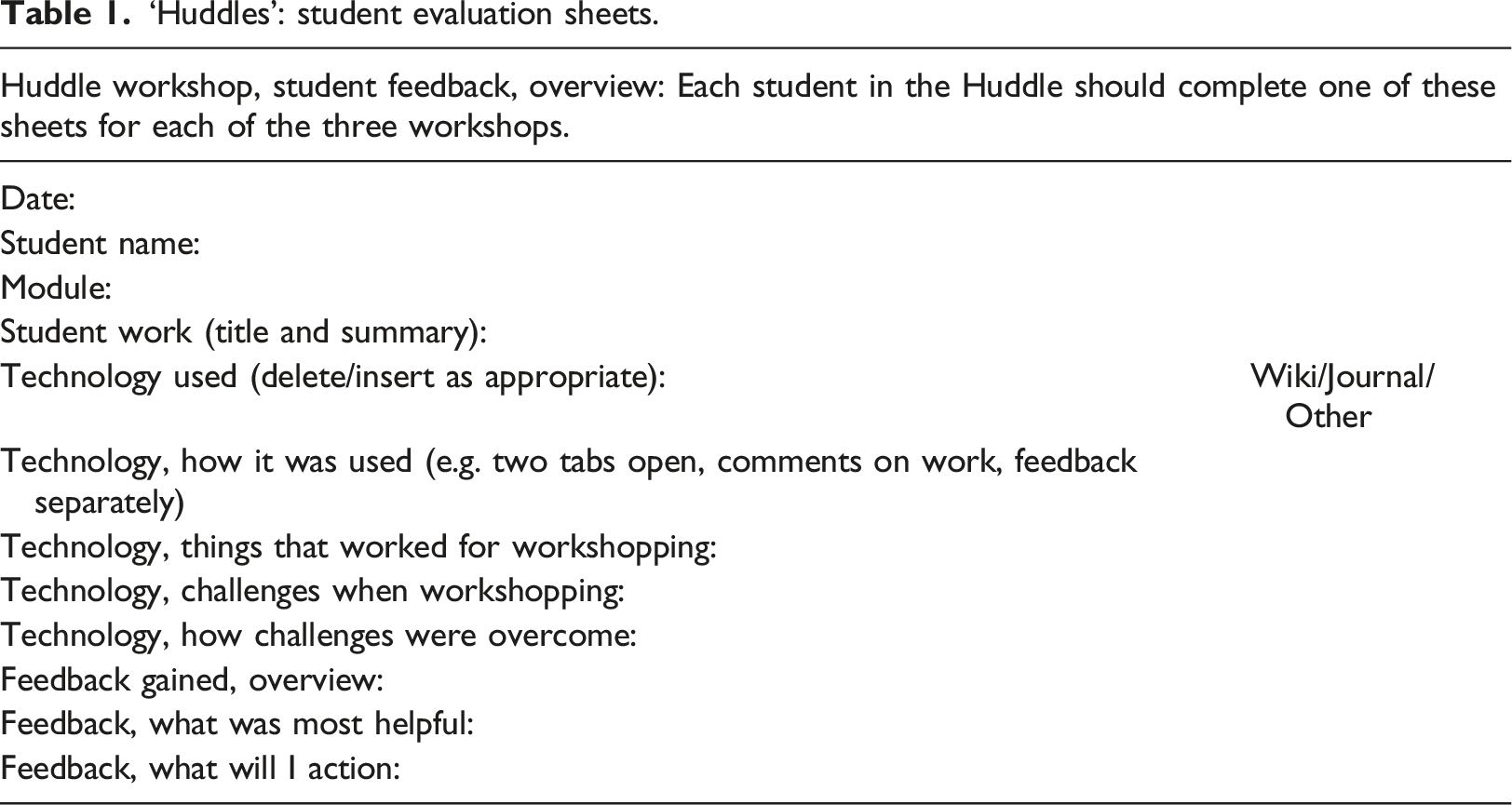
Prior to the start of the Huddles, students were given information and instructions that can be summarised as follows. Huddles information packs included sections on: • what constitutes constructive criticism/feedback; • workshopping and why it is important in Creative Writing.
Huddles instructions and step-throughs were provided regarding: • what work to bring to the session (for example, the draft opening of a new creative piece); • how to access the Wiki (for Huddle 1) or Journal (for Huddle 2); • how to approach Huddle 3, for which students were to select an alternative to the Wikis and Journals (‘For this Huddle, it’s Students’ Choice, how do you want to use the Huddle? You could try “File Exchange”. Perhaps uploading PDFs then capturing discussion on the whiteboard works for you (you could take screenshots of the comments). Alternatively, maybe you’ll upload via Google Docs and have that in a separate tab as you discuss in the Huddles. It is up to you, experiment’.); • the steps to be taken during each Huddle (‘Actions: Upload work > Feedback on each others’ work > Make notes on Huddle Workshop experience using Huddle Workshop feedback template > Decide who will feedback in class, rotating this “advocate” role’).
Discussion
The Huddles, practicalities
The ‘Huddles’ took place during a time of unprecedented global crisis which also saw unprecedented volatility in terms of what face-to-face teaching in UK universities was allowed, when, and with what health and safety conditions applied. There is not space here to detail all the changes, which were numerous and fast-paced. However, the UK’s lockdown timeline (IfG, 2021) gives an idea. The timeline shows, for example, that in the UK, following the first national lockdown (Spring 2020), ‘local lockdowns’ (tied to local levels of Covid) came into effect as of 29th June 2020, a ‘three-tier system of Covid-19 restrictions’ started on 14th Oct 2020, shortly before the announcement of the second national lockdown on 31st October 2020, with – 4 weeks later – a ‘stricter three-tier system of restrictions’ and on 21st December 2020 the introduction of additional ‘tier four restrictions’. This meant that through the Autumn term 2020, some face-to-face classes of reduced frequency and sizes were possible, with those classes embedding Government guidance. Students were required to wear face masks and socially distance, for example, and ‘to check in to [class] via the app and official NHS QR codes’ (Department for Education, 2021). The third national lockdown started on 6th January and remained in place through the entire Spring 2021 term, with students required to stay where they were from that date on, whether they were at a family home or in a University halls of residence.
The online Huddles that are the subject of this article were devised November–December 2020 (during the 2020 Autumn term). The first online Huddles took place during the week commencing 25th January (thus at the start of the 2021 Spring term) and continued to be the module’s method of workshopping throughout the Spring term, up to the point of the May 2021 final summative assessment.
As indicated, enabling the transfer of beneficial affect into a virtual environment was not by any means the only problem faced through this national period of mandated remote learning. Additional problems included basic technical issues such as connectivity: due to the sudden shift at the start of the pandemic in Spring 2020 of workplaces and educational institutions online en masse and the resulting strain on Internet providers, students regularly found that their connections cut out during class; it was often necessary for students to leave the virtual room and reconnect. Further, affect that is valuable in a classroom context is often transferred with the help of facial expressions; yet, a characteristic of remote teaching through lockdowns was student reluctance to turn on web cameras, so the ability for workshop participants to see one anothers’ facial expressions was almost always reduced and sometimes removed completely.
During the time-span of the research study considered here, the students were also negotiating other tutors’ and programmes’ methods of delivering remote teaching, for example Blackboard discussion groups and Microsoft’s file hosting and file synchronisation service, OneDrive.
Added to this, remote teaching was new to most tutors too. That is, at a time of uncertainty and often intense stress, students were having to negotiate different platforms for different purposes whilst factoring their own, peers’ and tutors’ uncertainties and difficulties with remote teaching. Comments made verbally and posted in the chat when students who had lost connection succeeded in re-entering suggested that they did not feel any innate digital nativeness when facing those difficulties; rather, they felt panic and anxiety until they were back in the virtual classroom.
A practical limitation of the online platform in this context was that students could not see or hear each other in the Huddle itself. It was necessary during the Huddles for students to keep the Blackboard Collaborate Ultra Course Room open on a separate tab so that they could talk to each other via the Course Room audio. Another practical limitation in the context of workshopping was that neither the Group Wikis nor the Group Journals allow students to annotate the text directly whilst leaving the original order and layout of the text intact (for Journals, for example, a student’s comment had to come after the text at the end with indication of what in the text the comment refers to and a note of who the comment was from).
A final discussion point for this section arises from what may seem obvious: workshopping online meant that, unless the students had downloaded texts and printed them off (and, due to the sudden nature of the lockdown, few students had access to printers), the texts used were also online. For some students hard copy text feels like a necessary part of the workshopping process. As Casselden and Pears note of an online survey undertaken at Northumbria and Durham Universities to investigate students’ ebook use, while students often choose e-books for reasons including convenience, accessibility, portability and navigability, ‘For many respondents there existed a “soft spot” for hard copy format, and there was a perception that this format enabled an authentic, “real” and enjoyable reading experience’ (2020, p. 616). If a student has such a ‘soft spot’ for hard copy texts, engaging fully in online workshopping requires them to move significantly outside their comfort zone. Conversely, for students who prefer the bite-sized approach provided by e-books and other digital texts – with keyword functionality enabling targeted searching of content ‘akin to Google searching’ (Casselden and Pears, 2020: p. 617), for example – Huddles may seem counter-intuitive, with such hyper reading both possible in the environment in which deep reading is being asked for and sometimes helpful (during the Huddles, students may sometimes want or need to go and do a quick Google search to check a fact, for example).
Thus the challenges were numerous and varied.
The Huddles, reflection on student engagement
To workshop their creative writing during Covid lockdown conditions, then, students were invited via online Huddles to inhabit a neutral terrain that was grounded by bodily engagement in their own individual real world contexts but which took place in cyberspace and employed hyper and deep modes of attention simultaneously.
Technical barriers
In the main, the technical barriers encountered were found to be frustrating and/or stressful, of course, but generally not too difficult to overcome. Although, overcoming them could take patience and tenacity. Student A, for example, noted connectivity as a problem for their group during all three formal Huddles. For the first Huddle, Student A noted this main challenge: ‘Connection issues (both lecturer and student. Mainly me to be honest). This means longer times to open documents, sometimes delayed/no audio or having to leave rooms to then reconnect’. For the second Huddle, the challenge listed embraced a solution: ‘Ensuring those with internet issues or mic[rophone] problems are caught up if things are moving too fast to type or if there are connection issues and they keep having to leave’. For the third Huddle, the problem of connectivity was there again, but briefly and with a note of acceptance: ‘internet issues (but that is a general given sometimes)’. Summarising the functionality and effectiveness of the online Huddles, Student A wrote: we just need to have 2 tabs open; 1 for the work we are to review and the other for the HUDDLE room. We can switch back and forth if we need to type feedback. But if we use our microphones it is easy just to stay on the work and talk and give our feedback verbally. I rather like this feature because of this. It gives a more realistic, 'in person' feel of what being in a class would normally be like and is a way of working I prefer in the entirety of online learning.
Human co-operation
Connectivity issues could have been a stumbling block that prevented learning. The students’ comments highlight a mixture of student co-operation and patience. As indicated by Student A’s comments above, students tended to contact each other by SMS text or WhatsApp, for example, if connectivity was lost, and then the group would pause to re-cap once connectivity was restored and the student was back. Reflecting on a Huddle that was conducted with Wikis, Student B wrote of the challenges faced and students’ solutions implemented: Wiki, ‘challenges’: ‘Speaking at the same time because we cannot see the physical signs that someone has something to say. Wiki, ‘how challenges were overcome’: ‘Polite treatment of other participants, clear verbal communication and concessions. … We mostly shared verbal feedback, limiting the amount we were adding to the wikis so it did not become overloaded with text.
Old technology
Connectivity issues aside, the practicalities of how to use Wikis as opposed to Journals were not generally a problem in and of themselves. Cutting and pasting text into a Wiki was easy enough. However, some student comments indicate that there could be a feeling of getting ‘tangled up’ in the online documents when it came to each posting different comments at the end of the documents and then scrolling up and down while trying to discuss them during the Huddle. Student C said: ‘This could be overcome by simply having a notebook and pen next to you and writing down comments from peers’.
Prior familiarity
As indicated, just as we develop ‘soft spots’ for particular items of old technology – such as a type of ballpoint pen or a moleskin notepad (for discussion, see Barnard, 2019: pp. 45–51) – we develop soft spots for particular technologies. The comments of Student D suggest that their group’s keenness to get down to workshopping led to a fairly swift rejection of Option 1 (Wikis), and an unwillingness to experiment with Option 2 (Journals) once Option 3 (Google Docs) had, as the default in face of technical problems with Option 1, been found to be effective. Student D’s evaluation of the Wiki in their groups first Huddle was this: Wiki, ‘what worked’: ‘A few people were able to confer about the work, it was good for conversing until we realised that not everyone could access it’. Wiki, ‘challenges’: ‘Not everyone could add comments onto the thread’. Wiki, ‘how challenges were overcome’: ‘We ended up using a different platform as some people were not able to comment and could not get around that on Wiki itself – it was easier to use a more reliable platform’.
Many of the students already had familiarity with Google Docs and were glad to be able to use this for the third session, when the technology used was ‘Students’ choice’. Thus for the second Huddle, of the Journal option, Student D wrote simply: Journal, ‘what worked’: ‘No work was posted as we established that we worked best on Google Drive’.
For the third Huddle, conducted using Google Docs, Student D wrote: Google doc, ‘what worked’: ‘Annotations were ideal for knowing exactly what people liked and didn’t like’. Google doc, ‘challenges’: ‘Some people had trouble working out how to choose where to annotate specifically’. G. doc, ‘how challenges were overcome’: ‘It was quick to resolve issues as everyone was familiar with Google Drive so could inform those who had not use it on how to properly navigate it’.
Convenience
Workshopping in class can seem daunting for some students, and the preparation needed to either email work in ahead of time or print it off to bring to class can feel time-consuming. Thus the on-the-spot nature of the online workshops was welcomed by a number of the students, and it seems the desire for this on-the-spot environment to work provided motivation to experiment. Wikis were new to most students, yet some embraced them immediately. The words used to describe having two tabs open (in order to see the work and hear peers’ comments, as detailed above) differed, not surprisingly, depending on whether a student was broadly in favour of Wikis or broadly against. For example, if the latter, the description might be of ‘having to have two tabs open’, whereas if the former, the description might be of ‘easily flicking back and forth from the chat to the work’.
Whilst for some students, the on-the-spot nature of the Huddles was helpful, for others, the fact that the technology gave the option of posting work and interacting outside class proved highly valuable. Students were at the time making decisions about the subject of their final submission, and some were glad of opportunity provided by the Huddles to gain peer feedback on changes of plans out of traditional work hours. Student E noted as a concluding overview comment, for example: ‘For my own project, I have been undecisive for most of the term’, then, at a point when the class was off for a week, ‘I changed my initial plan and wrote the first full draft of the new project. Because my Huddle have a Google Drive devoted to this module, I have uploaded the draft there and received annotations outside of workshop hours. Thanks to feedback, I know that I’m on the right track’.
Bonding
In a class environment, workshopping can seem tied to the tutor, with the tutor scheduling and overseeing the session; online the students had more agency. Student B noted as an overview comment for the formative submission: ‘Having Collaborate to conduct those discussions is useful as it unites students who otherwise might not have each other’s contact details, and provides a good space to talk about the feedback that is being given/has been given. Regardless of the technology used to post and review submissions, this has been a constant positive, and was probably the most useful aspect of all the Huddle meetings’. As noted, students could state preferences for groupings. Where it was possible to accommodate a preferred grouping, the chances of that group bonding were higher. However, even then, there was an element of chance, as a group may bond well in the classroom but have strong differences in preferred technologies, for example, or, one member of the group may dislike being sent work in advance (as opposed to seeing it on the day) just as fervently as another likes to have additional time to prepare. However, when a group did gel particularly well, productivity tended to be the same regardless of whether the Huddle used Wikis, Journals or Google Docs.
Commitment and trust
The resilience and determination that weaves through the students’ reflections on their experiences of using the Huddles is striking. Where there was commitment to a Huddle working, and when corresponding grit and determination was put in to overcome any technical difficulties, the Huddles felt to some students very much like face-to-face workshopping. One comment is initially surprising. Student A wrote of the Huddles: ‘Very much like the classroom style we were used to last year’.
McGowan quotes Margaret Wetherell, ‘who notes in her article “Trends in the Turn to Affect: A Social Psychological Critique”: affective practice is a moment of recruitment, articulation or enlistment when many complicated flows across bodies, subjectivities, relations, histories and contexts entangle and intertwine together to form just this affective moment, episode or atmosphere with its particular possible classifications. (Wetherell 2015: 160).
The movement of affect across media platforms and through digital networks facilitates a turn away from the notion of an affective encounter as a fleeting and specific experience, towards a global and sociological moment’ (McGowan, 2022: p. 174).
Student C comments on the Huddles: The tech, whether it be wikis, journals, or otherwise, is just the same as whether one peer brings their work in on paper, and another brings their work in on their laptop. It doesn't really matter. It is the participants of the peer feedback that matter the most, whether their heart is in it, whether they care about their writing and the writing of others and whether they trust each other, and trust the opinions given to them.
If the reason for using the technology (in this case, workshopping) is the main focus of participants and they are committed to doing the best they can, any technical stumbling blocks can much more easily be overcome. Two phrases in Student C’s comment are particularly striking: ‘whether their heart is in it’, and, ‘whether they trust each other’. As Ulmer (2003, p. 67) observes, trust and creativity are intertwined. Some students had shared trust before lockdown began. Others developed it in the Huddles during a lockdown context, via online chat functions, disembodied audio, comments that had to be scrolled to and development of strategies regarding how to ensure students who had been ‘booted out’ of the system could be not just included in the Huddle but embraced as a valued part of the group.
As noted, it is immutable that affect cannot be physically passed between bodies in an online environment, and, affect is an important element of Creative Writing workshopping. How can classroom and online workshops feel so similar? As McGowan shows in the context of online poetry events (2022), and as the emergent findings presented here show in the context of Creative Writing workshops, it is possible for beneficial transfers of affect to take place in an online environment.
Summary reflections
The reality that we each inhabit geographically on a day-to-day basis – or IRL (‘In Real Life’) in the language of social media posts – can appear to be entirely separate and distinct from cyberspace. The term ‘blended learning’ generally refers to a mix of online classes and offline classes that is binary, with teaching delivery taking place either online (in a remote, shared cyberspace) or offline (in a shared class space, in the real world). Actually, for synchronous online classes, tutor and students are simultaneously online and offline, working and existing both in cyberspace together in the remote learning environment that has been created and in their own individual living and work spaces, IRL. One danger of digital technologies in a pedagogical context is that, in the ‘Zoomification’ of teaching, the technologies take centre-stage while participating humans are sidelined. The contention of this article is that, to maintain quality in the delivery of participatory online teaching, it is necessary to ensure an ongoing feedback loop between IRL and cyberspace that begins during lessons’ planning stages. For example, with the cliché of the ‘digital native’ problematised at the outset, students’ own ambivalences about technology can be factored in, so too the opportunity for students to transfer leisure-time digital skills into a work context (and to do so in a way that protects their enjoyment of leisure-time digital skills in a leisure context). Students and tutors alike come to new online environments with pre-existing preferences for particular technologies and may consequently need some time to acclimatise to online tools that are new to them. Students will each come to, for example, a Group Wiki with different prior technological experiences and will have to negotiate those differences in real time in the context of the Huddles, while they learn and interact with other learners. If one student has prior experience of Group Wikis, they can offer tips and mentor other students. Alternatively, if all students are new to a particular platform’s function they may feel they are ‘in this together’; or, initial wariness of that function may entrench (in the face of the work involved in testing it, they may simply switch to a function they are already familiar with). Tutors can feel that they should come to a class with all the answers ready to be distributed. In the context of digital technologies, this is often simply not possible. Whether a tutor has up-to-the-minute expertise in InDesign or Photoshop, for example, is, in fact, not the central issue. Letter (2015) argues that the educator should focus on what will be – regardless of the individual technologies – overarching problems for all the students. Often, for example, in the face of technical problems, ‘the train of thought carrying [a student’s] great ideas seems to have derailed’, writes Letter (ibid, p. 185), who emphasises: ‘The role of the instructor here is clear. It is most explicitly not to solve the problem for the student … it is essential that the students learn to research and solve their own problems and that they become accustomed to the task-switching that creative work in new media requires’. Moreover, Letter (ibid, p. 184) argues, tutors should help students see their ‘technical difficulties’ as a form of artistic constraint, the ‘possible spark of a new stage in their creative process, rather than a wall that stymies progress’. ‘New media technologies can become collaborators’ (Barnard, 2019: p. 130).
As indicated, the discrete pedagogical initiative at the centre of the research study that is the subject of this article builds on and is informed by a programme of research spanning over a decade. This enables identification of general principles of pedagogical practice that can help in the delivery of participatory online teaching by facilitating an IRL-cyberspace feedback loop which, drawing on the discussion above, this section provides: The societal cliché of the digital native can bring difficulties for tutor and student alike. If the tutor problematises the cliché from the outset, this can free the tutor from a fear that they lack the digital know-how of their students and so will be unable to help their students. Simultaneously, this may free the tutor to be more open to differences in students’ digital expertise and difficulties the students may have, first, in identifying leisure-time social media skills as transferrable and, secondly, transferring those skills into a leisure context. At planning stages, the tutor can build in additional space for students to settle in to the online environment. Using ice-breaking exercises and/or inviting questions early on can help support students in tackling any nerves/fear and building confidence (if students’ cameras are off, it is worth allowing additional time for the ice-breakers, as there will be a lack of body language cues to help inform decisions regarding pace of delivery, for example). It is also helpful to devise and allow time to test alternative methods of enabling affective exchange with different groups of students. A chat function might work well with one group of students, for example, while a digital whiteboard might be better at helping generate lively discussion with a different group of students. Within set activities and homework, and during class, tutors can helpfully encourage students to identify a few pertinent digital skills developed for leisure activities and/or preferred technologies that can be remediated for use in (or, transferred to) an online learning context. The main example for this study is remediation of students’ leisure-time use of Google Docs. With that in mind, it is often helpful where possible to include elements of choice in technologies used for a class task, so that students can select one digital platform or tool that they feel more comfortable with in favour of another and so enhance their sense of agency. During class, tutors should factor in students’ individual real-life environments, doing a check, for example, on whether students are working on tablets, phones or desktop computers (this may dictate which of the virtual learning environment’s affordances they can use). Linked to this, it can be helpful to encourage students to embrace traditional tools, such as pens and pencils, to help support them in the task of staying grounded simultaneously in their actual work environment and in the virtual learning environment (perhaps taking notes on a hard copy pad during the online class will help some of the students engage, as was the case for Student C, for example, who noted the value of keeping a notebook and pen ready to write down comments from peers). During class, allow time for discussion intended to help the students take responsibility for developing good working relationships involving trust within smaller workshop groups. Whereas in a classroom, it is easy for a tutor to wander between tables and unobtrusively check that constructive dynamics are developing, it is difficult or impossible to do the equivalent in an online environment. Where a series of online participatory classes are scheduled with the same groups of students, build reflective assignments in, whereby the students reflect on how to ensure the online environment is used optimally for learning. This can help students develop agency, leading them to instigate changes in the online environment that they find helpful.
Together, these general principles can be conceptualised as tutor and students working together to erect humanising scaffolding in cyberspace, with affect serving as poles and connecting nuts and bolts.
In conclusion, then, this article has: • Demonstrated the beneficial role of affect in participatory online learning; • Provided a pedagogical template for delivery of workshops/seminars to mimic benefits of face-to-face delivery, which has been tested in the field of Creative Writing and found to be effective; • Provided general principles for application across disciplines regarding how to enable effective learning in participatory virtual classrooms, including collaborative close reading; • Presented a new theoretical position on what constitutes effective pedagogy in the context of participatory virtual classrooms.
The unprecedented move of educational delivery online due to Covid lockdowns was sudden and unexpected. It will take time to piece together case studies and reports from different disciplines and fields.
As noted, the chief executive of the UK’s Office for Students, Nicola Dandridge highlights the importance of harnessing the lessons learned by the shift to online learning during the pandemic, ensuring that quality is maintained (OfS, 2022; np). A driving aim of this article has been to harness lessons learned during the pandemic about how to effectively deliver a mode of pedagogy that has historically been dependent on classroom delivery, with affective benefits of classroom delivery successfully replicated online to maintain quality. Utilising the pedagogical practice of Creative Writing workshopping as a case study, it is hoped that this article represents a useful contribution in the home discipline and more widely.
Footnotes
Acknowledgements
The author would like to thank the study’s participating students and De Montfort University for institutional support. The author would like to thank: Jill Cowley, Professor Gabriel Egan, Professor Siobhan Keenan and Dr. Louise Peacock; Dr. Jo Dixon, Professor Simon Perril and Maria Taylor; Heather Conboy; Dr. Keith Scott.
Declaration of Conflicting Interests
The author(s) declared no potential conflicts of interest with respect to the research, authorship, and/or publication of this article.
Funding
The author(s) received no financial support for the research, authorship, and/or publication of this article.
