




Abstract
This article analyses discourses around procedural content generation (PCG) as automation of creativity in the games industry. PCG refers to techniques for creating game content algorithmically, by manipulating data through sets of computational operations and parameters. By producing scalable results with combinatorial diversity, procedural generation is touted as the future of content, yet flouted as the harbinger of technological unemployment in game art production. Critical scholarship on automation suggests that the real danger is not job loss per se, but the constitution of an underclass of artists whose vital work of conditioning algorithmic outputs is denigrated as derivative and ‘manual’. Framed by liberal humanist ideas of agency, PCG naturalizes trade-offs where the autonomy of generative machines is contingent upon the automatism of its human conditioners. This qualitative analyses of talks on PCG at the Game Developers Conference (2015–2020) shows how procedural systems bifurcate the creative work of algorithmic cultural production into affective and mechanical forms of conditioning that map onto stratifications of racial capitalism. Affective tuning resists documentation and is reserved for artists with technomasculine forms of cultural capital; mechanical tuning is relegated to automatable and outsourced labour and relies on replicable technique that is considered artistic but not creative. This article argues that PCG’s reclassification of creativity through racialised dialectics of human agency and machine automaticity overlooks the autonomy of procedural systems. PCG pipelines are organised less around the agency of human toolmakers and more around the autonomy of systems that assimilate tasks in the management of complex networks of dependencies. Instead of pitting artists against machines, this analysis politicises automation’s racial stratifications by examining the momentum of more-than-human systems in which toolmakers and tool users negotiate granularities of control and degrees of concession.
Keywords
At the Game Developers Conference in 2005, celebrated game designer Will Wright predicted that procedural content generation (PCG) could extend and extrapolate content generated by players, cumulating into vast, diverse, and engaging interactive worlds. Demoing an early version of the simulation game Spore (Electronic Arts, 2008), Wright showed how simple player inputs could seed the generation of complex worlds on both creaturely and cosmic scales. He called this the ‘Future of Content’ (2005). Wright anticipated that player demands for content could not be sustained by its labour costs. Instead of armies of human developers needed to create levels, tactical teams of developers could design PCG systems to generate game worlds by recreating and recombining User-Generated Content (UGC) such as characters, objects, and environments designed as part of play. With its sweeping scope and tantalizing potential, Wright’s talk has been hailed as reigniting 1 the games industry’s interest in PCG (Yannakakis and Togelius, 2018).
Today, PCG is routinely used throughout the games industry to create content such as levels, maps, music, and even dialogue and animations. PCG refers to the ‘algorithmic creation of game content with limited or indirect user input’ (Shaker et al., 2016: 14). This entails creating game content algorithmically rather than directly, by manipulating data through sets of computational operations and parameters. By automating some aspects of asset creation, PCG is used to meet increasing demands for content in blockbuster open-world games developed by large teams in AAA studios, games that are monetized as a service, and indie games developed by small teams with limited budgets. As game worlds expand and demands for content accelerate, PCG has been framed as a solution to a labour problem. However, when technical artists design PCG systems by formulating computational parameters and operations for generating content, they tend to devalue the work of artists, writers, and musicians who create and condition digital assets that are emulated at scale by automated processes as ‘manual’ forms of elaboration. This bifurcation of tasks to scale up content production compounds the documented stratification within the games industry: so-called core roles such as game design and programming are disproportionately filled by white men, while subsidiary functions such as art and animation are performed by women, minorities, and racialised people.
This article examines games industry discourses of PCG as automating creativity by qualitatively analysing industry talks presented at the Game Developers Conference (GDC) between 2015 and 2020. Fifty-four recorded talks with the keyword ‘procedural generation’ 2 were qualitatively analysed (Table 1). Presenters were from AAA, indie and academic backgrounds with roles ranging from programming and management to art and animation. These talks took the form of tutorials illustrating PCG techniques and postmortems reflecting on successes and challenges in the development process. The postmortem is an established genre in the games industry that frames experiences and aspirations through a problem-solution structure, which smooths over the messiness of creative production. With this limitation in mind, talks were transcribed by editing transcripts generated by a speech recognition software and was thematically coded according to general procedures for qualitative data analysis outlined by Lofland et al. (2006): sorting sections of transcripts into meaningful categories based on an iterative framework of ideas.
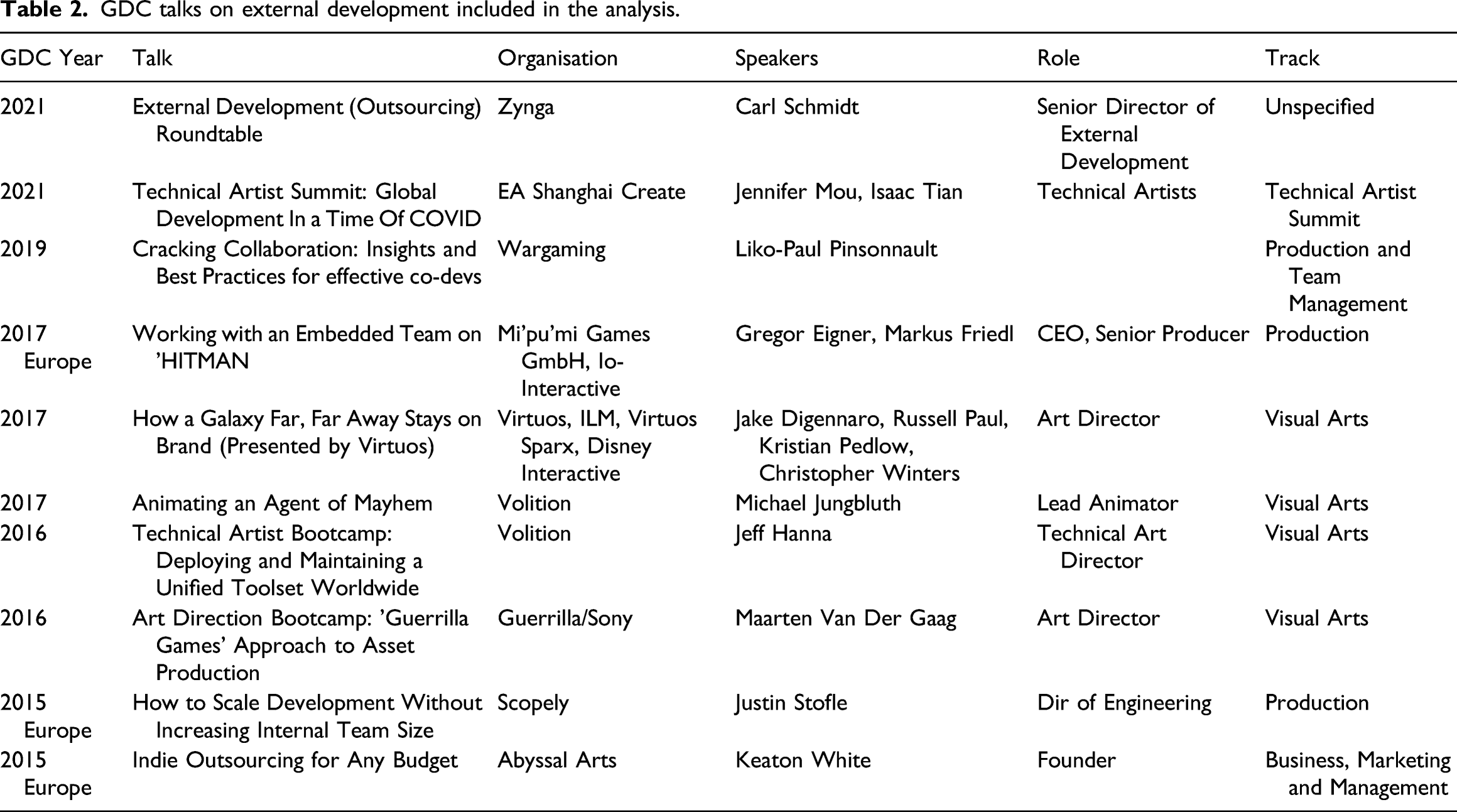
Categories emerged around theoretical commitments to labour justice framing attention to racialised articulations of value in how developers evaluated different types of work and workers. For example, emic codes emerged around descriptions of ‘repetitive’ work and references to the ‘hand’ that were analysed in relation to etic codes around justifications for automating tasks. These primary codes were combined and compared to form higher-order codes such as problems and solutions, control and concession, creativity and technicality. This iterative analytical process was informed by literature on race and automation, posthumanism, and critical readings of key texts in computational creativity. Emic comparisons between automated and outsourced tasks were probed by analysing a further 10 GDC talks on external development (Table 2). 3 These comparisons provided an interpretive aperture to understanding the racialisation of PCG within the limitations of the postmortem genre. Codes were iteratively formulated by comparing sections of transcriptions, in conjunction with diagramming, memo writing (Miles and Huberman, 1994), and synthesis with scholarly literature to form a set of arguments that were illustrated with key quotations. 4
This analysis suggests that trade discourses about automation through PCG bifurcate cognitive work into creative forms of conceptual design and derivative forms of algorithmic conditioning, which are required to make generalized procedures fit for specific purposes. PCG tools do not just make tasks more efficient; they transform the nature and value of those tasks. PCG gives rise to an underclass of creative workers whose vital work of habilitating algorithmic systems is itself seen as manual, mechanical, and even automatic. Engineers pitch PCG as benefiting artists by reducing rote work and securing them against outsourcing from China, India, and South America. However, rigging the art pipeline for scalability frames the skilled work of artists – in-house and outsourced – as equivalent problems of inefficiency to be automated.
Popular and policy discourses about the future of creative work pit the figure of the artist against automaton to validate the exceptionalism of human creativity (e.g., Bakhshi et al., 2015). At stake in these developments is not this clash between human and machine creativity, or in-house and outsourced artists per se; what is at stake is the stratification of human creativity into what developers distinguish as ‘ideation’ and ‘production’. PCG and outsourcing are modular ways – computational and operational – to scale up art production in the development pipeline. This criterion of scalability stratifies creative work into concrete forms of execution that can be trained and mimicked (by automated systems and outsourced labour) and abstract forms of conceptualization that must be lived and felt (by gamers turned developers). This valuation of abstract over concrete in PCG maps onto gender and race, human and machine, in familiar ways that have been critiqued by feminist science and technology studies (Strengers and Kennedy, 2021; Turkle and Papert, 1990) and critical race studies of automation (Amrute, 2016; Irani, 2018).
This article contributes to this line of inquiry by demonstrating how antagonisms between human agency and machine(-like) automatism miss how PCG tools are posthuman – in their processing speed, post-perceptual communication, and management of complexity. Pitting artists against (machine and human) automatons overlooks how PCG pipelines are organised less around human agency and more for the autonomy of systems that assimilate tasks to manage complex networks of dependencies. The labour politics of PCG requires frameworks of racial justice as well as posthumanism. Questions about the agency of human and machine creativity detract from critical considerations about the autonomy of tools, which render tasks automatic and stratify creativity in racialised ways. In response to this special issue’s call to politicise agency beyond humanism, this article argues that interrogating automation in game development requires grappling with the assimilative momentum of tools and their mediation of disparities between toolmakers and users.
Manual creativity
PCG refers to the creation of game content automatically (or semi-automatically), through algorithmic means (Yannakakis and Togelius, 2011). This automaticity is achieved through the definition of parameters, operations, attributes, and other input: for a PCG system to populate a virtual environment with, for example, bridges, it needs to be instructed on attributes of riverbanks, operations of bridging in relation to these attributes, and conditions under which to bridge. PCG systems range in sophistication – from a few lines of code to custom tools – and interrelate in production pipelines through complex networks of dependencies. For example, PCG range from the generation of natural-appearing textures using established computer graphics techniques, to the use of custom tools to generate detailed architecture of an entire city block. The use of generative techniques in games is not new. Since the 1980s, a genre of games known – after the game Rogue (Toy and Wichman, 1980) – as roguelikes have procedurally generated levels at the start of each play through. PCG is also used in indie games where generation of levels – including maps, characters, and events – occur at runtime and are part of the concept and appeal of the game. For example, a 2018 GDC talk by an indie developer commented that ‘our generative systems run really wild and it’s part of the aesthetic of the game and we can lean into it’.
This unpredictability of generative systems in indie games relates to stochastic forms of procedural generation. According to Phillips et al. (2016), stochastic PCG is programmed through broader parameters and general operations that instruct systems to produce, evaluate, and even adapt creations that are often unexpected. Stochastic generation in indie games draws from a broader field of computational creativity: defined by Colton et al. (2009: 11) as the study of building software – that exhibits behaviour deemed creative in humans – for ‘autonomous creative tasks, such as inventing mathematical theories, writing poems, painting pictures, and composing music’. A notable computationally creative game designer is ANGELINA, a multifaceted system written by Michael Cook that creates an entire game – from rules and game assets – from minimal human input (Cook et al., 2016). For example, a version of ANGELINA made simple platform games with sprite graphics against backgrounds of images of news articles from the Guardian by combining these elements in haunting and surprising ways (Phillips et al., 2016). Because of this element of surprise, rather than mere tools, computationally creative systems are often framed as collaborators or assistants to their human creators or users (Colton et al., 2009).
In contrast to the stochastic aspects of computationally creative game design in artistic and academic settings, the PCG commonly used in AAA games is often deterministic: programmed through narrower parameters with more specific instructions. Game artists use deterministic PCG to generate vast swathes of virtual environments without having to design and model individual units of content. Computationally creative systems are pursued in artistic and academic settings to experiment with ideas and techniques of human creativity (Colton and Wiggins, 2012). In contrast, deterministic PCG is often framed through the language of labour-saving and cost-cutting and is pursued in commercial settings for efficiency. Today, deterministic PCG is a staple in creating game content such as environments, sounds, and even game rules and narratives (Shaker et al., 2016). Togelius (2019: 106) describes organic landscapes in games such as trees, grass, clouds, and water as ‘background’ content, stating that their procedural generation is a ‘solved problem’ that can be taken care of by readily available software. The technicalities of deterministic PCG may be solved, but as Will Wright predicted in his 2005 GDC talk, growing player expectations for larger game worlds means that commercial game developers face a labour problem. In their textbook Artificial Intelligence and Games, Yannakakis and Togelius (2018: 152) offer this solution: Many of the costly employees necessary in this process are designers and artists rather than programmers. A game development company that could replace some of the artists and designers with algorithms would have a competitive advantage, as games could be produced faster and cheaper while preserving quality. (Original emphasis)
Framing PCG as a solution to a labour problem does more than justify mass layoffs as beneficial for a game studio’s bottom line – it devalues the work of digital artists, writers, and sound designers as manual forms of elaboration that are inferior to automated processes. For example, Yannakakis and Togelius (2011) contrast the automaticity and efficiency of PCG (and UGC) in the creation of game content as ‘less manual’ than other techniques of digital design. This disparaging of the ‘manual labour’ of content creation was used in many GDC talks. For example, showcasing a variety of PCG techniques, a technical artist stated in a 2017 talk: … the idea here is you’re taking things that no one wants to do. They’re kind of just shovelling assets through pipelines: all the boring and repetitive things, and all the little bottlenecks are the perfect candidates to be automated because it’s something so repetitive that basically, the artists can just shut off their brain.
Deeming certain digital tasks automatable relegates them not only as manual but as mindless. This was part of a patterned way of talking about PCG. For example, a 2020 talk by a AAA programmer described how implementing automation strategies to facilitate content production enabled their team to ‘add more variety and remove the manual labour from … designers for covering all of our interior spaces’, while also improving quality.
Although most GDC talks extolled PCG’s benefits for saving labour time, speakers took care to assuage what Benanav (2020) cites as automation discourses about ‘technological unemployment’: structural unemployment caused by technological change. Many speakers, such as a AAA technical artist reassured conference attendees in 2017 that ‘I do not necessarily believe that a lot of jobs are going to get lost’. Instead, this developer offered that automation generates more value in the games industry, which will see more projects that all need the expertise of artists, albeit in smaller teams. This sentiment was shared in another 2017 talk by an indie programmer: ‘We don’t have to look at procedural generation as a way to replace our artists. We can look at it as a way to augment them and to create more content’.
In contrast to recent economic studies of automation warning that technological unemployment will not be offset by job creation in other roles or sectors (see critiques by Benanav, 2020; Wajcman, 2017), PCG proponents at GDC talked about automation as a win-win situation where companies will save money, and creative workers will save time to do more expressive and fulfilling work. For example, in a 2018 GDC talk, a AAA programmer states: [Artists are] spending a lot of time adjusting curbs and doing stuff that isn’t a lot of fun for them. And all the buildings and cool stuff were outsourced… But we could also use this [procedural generation tool] and focus on creating more interesting spaces and focus on crafting new scenes and stories and be freed up from the little sort of minutia of making sure everything is lined up in [Autodesk 3ds] Max and be able to go back to the fun of being able to be an artist.
Mattern (2020) contextualizes that this is the party line in other creative industries such as fashion and architecture: proponents reassure that AI-driven design tools will not make human workers redundant, but will create better working conditions, saving them time from busy work for more meaningful forms of creation. A similar discourse dominates public discussions about automation in the entertainment industries. In a panel discussion about MetaHuman Creator, a cloud-based app that automates the animation rigging of humanoid 3D models, game writer and director Amy Hennig espouses that the app takes the ‘drudgery work’ out of the creative process: ‘[a]ll of these tools allow us, as creators, to not think about these production nightmares and just do the thing that creatively feels required’ (Unreal Engine, 2021). In the words of a AAA technical artist in a 2020 GDC talk, procedural techniques automate rote technical tasks to ‘keep the artists sane, so they don’t rage quit by throwing their keyboards across the room’.
PCG’s rendering of digital creation as manual and mindless is part of the legacy of automation’s pronouncement of divisions between skilled professional work that machines cannot do, and unskilled work that machines are in the process of taking over (Gray and Suri, 2019). This bifurcation of game production into creative and manual tasks devalues the work of artists, writers, and musicians who create game content through techniques that directly manipulate digital models, writing, and sound. Although both are performed computationally, asset generation is considered cognitive while modelling is deemed manual. Although both use digital tools, procedural generation is referenced in GDC talks through computational parameters, while design is referenced through human hands: hand-placed, hand-modelled, hand-built, hand-edited, hand-painted, hand-animated, hand-tracked, hand-authored, handcrafted, and even hand-designed.
This bifurcation of game production into automatic and manual obscures the constant human work needed to automate any process. After all, algorithms do not train, tune, and augment themselves like magic (Irani, 2015) but require ‘articulation work’ – getting things on track in the face of contingencies – invisible to rationalized models of work (Star and Strauss, 1999). In game development, the automation of creativity is constituted equally by human work of parametric design and digital conditioning. This is the paradox at the heart of automation (Gray and Suri, 2019): algorithmic systems like PCG are not simply designed, they also need to be conditioned by humans who clean up and after automated systems, seeding content, bridging processes, and tuning results that are too difficult or expensive for computational systems to undertake.
For example, a 2020 talk by a AAA software engineer on procedural generation for 3D modelling emphasises that these tools are ‘not perfect’ and that ‘artists have to hand author these models or tweak them a little bit after they’d been generated’. Similarly, in a 2018 talk on a custom tool for procedurally generating terrain, a AAA technical artist explains that even after layering automated tools for creating roads, fields, and vegetation, ‘of course there will still be some assets that will be needed to be placed by hand, like the house, shed, and vehicle here’. Gray and Suri (2019: xxii) call this the ‘paradox of automation’s last mile’, where ‘the desire to eliminate human labour always generates new tasks for humans.’ Just as robots require humans to transport and position them, PCG requires humans to fix their inevitable glitches and tune their outputs. Yet, this work of tuning algorithms is seen as unskilled and provisional by the aforementioned technical artist, who quips: ‘yeah, the level artists are not out of work, yet’.
From vision to practice, the conditioning of PCG by digital artists yield to the parameters and classifications set out by an elite class of technical artists. Like other automated systems, procedural systems are narrow forms of Artificial Intelligence (AI) that excel at defined tasks. The paradox of automation’s last mile is that humans are needed in the loop to make narrow AI functional and cost-effective. Even though this work of conditioning automated processes is vital to PCG, it is systematically devalued by technical artists, giving rise to an underclass of digital game artists whose work – denigrated as manual, uncreative, and even robotic – is always already on the cusp of redundancy.
The racialisation of creativity
Anxieties and reassurances about automation’s threat to artists’ job security and artistic control figure prominently in games industry discourses. Predictive studies of the US and the UK suggest that creative occupations are relatively future proof compared to other kinds of jobs (Bakhshi et al., 2015). This prediction depends on the job category, sector of deployment and applies especially to hybrid roles that combine creative and technical skills within teams. The game development pipeline is stratified into roles for technical, concept, asset artists, and more. Technical artists are responsible for building tools used by other artists, while concept artists often set the agenda for asset artists in-house and outsourced. In line with predictive studies about automation, technical artists from programming disciplines face less risk of losing their jobs. In contrast, fewer asset artists are needed in AAA studios because part of their work has been automated or outsourced. With this division of the game labour in mind, the real danger of automating creativity is not job loss per se, but the constitution of an underclass of artists, writers, and musicians, whose cognitive work is deemed ‘manual’ and doomed to maintain and be managed by algorithms.
This stratification of creativity into cognitive and manual, algorithmic and mechanical, is informed by racial capitalism. This racial stratification can be discerned from GDC discussions about PCG and outsourcing as ‘scalable art solutions’ that are functionally interchangeable. For example, a 2018 talk by a AAA programmer states that ‘props and things that we normally would be sending out for outsourcing, we just made in the scene because the [spline-based procedural] tools became that much more powerful and more freeing for us to focus on the creative aspect’. At the previous year’s GDC, a technical artist recounted an experience of onboarding an artist to a PCG system who compared it to outsourcing: ‘the guy was like, “listen, man, I went to China one time and then I had to train a replacement team; so basically, I came back and then I got laid off because basically I trained my outsourcers.” So, I feel like I am having the same conversation [with PCG]’.
PCG and outsourcing are frequently compared because developers use them both to meet demands of scale in AAA development of art assets. Most GDC talks discuss PCG as a way to scale up asset creation with a small team of artists. Even with procedural techniques becoming routine in the industry, AAA studios still rely on outsourcing. A 2021 talk by a AAA technical artist charged with managing external development described their Chinese-based team as providing ‘full pipeline technical support for vendors’ towards ‘the creation of scalable art solutions, which support many game studios throughout’ the parent company. According to a 2021 GDC roundtable, asset generation is more easily outsourced because ‘you don’t necessarily need to be integrated into the pipeline’ to the extent of, for example, engineering. According to an art director of an external development studio speaking at GDC 2017, art assets are built according to briefs in a modular way, with little context for how they will be used.
The modularity of asset creation in PCG and outsourcing contribute to the impressions that they are less central to game development than programmers or designers. PCG’s underclass of manual creators compounds this stratification, further bifurcating workforces into creators and custodians of automation (Irani, 2015) along existing gendered and racial disparities in the games industry. Industry-wide studies consistently show that less technical roles in game companies are more often filled by women, minoritised, and racialised workers. For example, in their analysis of closing credits of bestselling videogames by AAA studios operating transnationally, Bailey et al. (2021) found that even though more women were joining the industry, they were underrepresented in technical roles such as programming and overrepresented in art and animation roles. A study of the British games industry reports that while the games industry is more ethnically diverse than the general UK workforce, Black, Asian, and Minority Ethnic people are less likely to work directly on games in programming or design roles, and more likely to work in supportive roles such as IT (Taylor, 2020).
The manualizing and outsourcing of asset creation implies that constructing game worlds is understood in the industry as artistic but not creative. Just as the previously quoted technical artists denigrate hand-modelling techniques by studio colleagues as repetitive and boring, art directors deem the assets created by outsourced teams as skilful but unimaginative. For example, speaking at GDC 2016, a AAA art director advises: [Outsourcing vendors] have very skilled [art] assets, at least when it comes to the technical. But you can’t expect your vendors to do your visual design. You can’t expect them to do your art direction, either – they don’t know exactly what you want. You’re not paying them to be creative. So, if you send them ugly, I mean, you will get something ugly back, except that it will be very well executed. (Emphasis added.)
From the late 1990s to 2005, China’s formative game industry developed games pegged as copies or imitations of those by American and Japanese studios (Nakamura and Wirman, 2021). The early 2000s also saw China develop as a hub for global game publishers and entertainment conglomerates to outsource graphic assets. In the Western tech imagination, China’s labour force has long been associated with rote memorization and authoritarian compliance rather than the creativity needed to lead in the knowledge economy (Neves, 2020). More recently, China has recuperated its copycat image – known as ‘shanzhai’ – from connotations of counterfeit goods to that of skilled reproduction, providing an ‘an alternative to Western-centric notions of design and innovation’ and its ‘individualistic notions of authorship, ownership, and empowerment’ (Lindtner, 2020: 79).
Divisions between what is celebrated as creative and consigned as manual, automatable, and outsourceable are informed by racial capitalism. Racial capitalism foregrounds how global capitalist expansion assigns differential value onto labour, resources, and markets across regions and populations according to colonial divisions (Lowe, 2015). Irani (2018) describes how elite engineering schools in the US operate as if design was too ‘creative’ to outsource – to, for example, Asians who have long been cast as mathematical and rule-oriented producers more suited to industrial and mechanical functions. Similarly, Amrute’s (2016) research on IT workers in Berlin shows how workplace attitudes fall in step with a public culture that addresses anxieties about outsourcing by framing South Asians as less creative and more robotic.
Western cultures have long used creativity to benchmark personhood and even humanness. By casting outsourced art as mechanical and artists as robotic, game studios engage in racial capitalism’s everyday dehumanisation of Chinese workers. For this reason, several external development managers use GDC talks to humanise outsourced workers. For example, a roundtable organiser urged developers at GDC 2021 to overcome their fear of meeting vendors in person and treat them not as ‘faceless artists’ but as an ‘extended part of your team’. Dehumanising racialised vendors makes it more justifiable to split ‘ideation from production’, emphasised by the AAA art director mentioned above. According to this way of thinking, modularising the art pipeline can free AAA artists from the drudgery work of modelling and texturing – through a combination of PCG and outsourcing – to focus on creative tasks such as world-building. Breaking down human tasks into discrete modules that imbue them with a machinic quality frames certain forms of work and workers with a certain alterity. This alterity is necessary to valorise what counts as intelligent in machines and humans (Geoghegan, 2020).
The denigration of in-house artists’ work of maintaining automation as manual, and outsourced work of producing art assets as robotic, are two sides of the same coin minted by racial capitalism. The freedom to be creative has always been granted by the technological alleviation of ‘dull, dirty, repetitive, and uncreative work’ that was historically performed by what Atanasoski and Vora (2019: 4) call the surrogate: degraded and devalued others whose service was taken for granted because they were never considered fully human. These racialised, gendered, colonized workers and slaves undertook the manual, repetitive, and even reproductive labour that freed others to be creative. The subjugation necessitated by this freedom could only be justified by the invention of race to reconcile Enlightenment proclamations of equality with colonial instruments of injustice (Jones-Imhotep, 2020). The automation of drudgery in PCG is not innocent: the freedom that procedural generation extols is a debt owed by the liberal humanist subject to the subaltern, a debt now compounded in PCG’s artistic underclass.
Agency and autonomy in procedural systems
The freedom to be creative was forged long before PCG, in the Enlightenment notion of the liberal humanist subject. This subject’s freedom was constituted through self-determination and self-knowledge, and applied, at best, to society’s upper crust who had resources to conceptualize themselves as exercising their will through personal agency (Barad, 2006; Hayles, 1999). Agency is an organising logic of videogames, which are cultured by ideas about the freedom to choose, the obligation to be free, and to understand and enact one’s life in terms of choice (Muriel and Crawford, 2020, citing Rose, 1999). This mode of inquiry – which dominated the inception of game studies – is partly attributable to Murray’s (1997) operationalisation of player agency as the ability to take meaningful action and experience meaningful consequences. Nguyen (2020) calls games an ‘agential medium’ through which designers aestheticize forms of agency by sculpting systems of constraints and possibilities. Agency in the context of videogames is not absolute freedom or free will per se, but the alignment of player inclinations with a work’s dramatic probabilities constituted by its underlying computational model (Wardrip-Fruin et al., 2009). Games have thus been framed by some scholars as the art form of agency because they aestheticize and meritocratize human volition within computational constraints (Juul, 2013).
Drawing from postcolonial and queer feminists, game scholars have since critiqued preoccupations of agency in the design of games and practices of play. According to these critiques, the operationalisation of ideologies of agency through environmental, narrative, and performative mastery perpetuates colonialist, masculinist, and ableist modes of subjectivity (Keogh, 2018; Ruberg and Shaw, 2017). Games scholars have argued that the formal and narrative constitution of videogames allegorize informatic control (Galloway, 2006) and mythologize player choice, providing platforms for negotiating ideas about the character of agency in architected environments (Girina and Jung, 2019). Game scholars also urge less focus on pre-scripted narratives and mechanics of game texts – where agency is illusory – and more on interpretive and co-creative engagements in game communities (Stang, 2019), and creative interventions into game artefacts and code (Jennings, 2019).
Drawing from science and technology studies, Muriel and Crawford (2020) inform that games provide an aperture for understanding agency as relational and distributed processes enacted through assemblages of the human and nonhuman, synthetic and organic, bodily and infrastructural. Such posthuman approaches reframe agency in the analysis of games and play away from anthropocentric dualisms of active and passive, cause and effect (Girina and Jung, 2019). Citing Barad (2006), McKeown (2019) offers that games research requires a radical reframing of agency from a will exerted by discrete beings on their environments, to a decentralized and co-constitutional interplay of material, social, and psychic forces. Breaking free from liberal humanist framings means recognising agency as radically distributed, and cognition as co-constituted with tools and environments across boundaries of the body. This requires reframing human and machine creativity beyond mutual exclusion and anthropomorphism. Instead, posthumanism recognises how ‘[i]ntelligence and creativity are distributed processes that encompass assemblages of humans, technologies and ecosystems’ (Taffel, 2019: 8).
Their designers do not always recognise the distributed agency of procedural systems as posthuman assemblages. As aforementioned, most procedural techniques used by AAA developers are deterministic – they are programmed through narrow parameters that would not be considered computationally creative. The field of computational creativity studies how computers emulate behaviour seen as creative in humans. Within this field, creativity resides not in intrinsic characteristics of a work – which can be reproduced computationally – but from contextual meanings of the artistic process (Boden, 2010), which are rooted in liberal humanist understandings of human agency as a prerequisite to creativity. Colton and Wiggins (2012: 21) state that ‘creativity is one of the things that makes us human, we value it greatly, and we guard it jealously’, while intelligence is more readily emulated and automated through AI.
According to this engineering framework of computational creativity and game programming, computational systems can never possess agency, but with the right programming, may acquire autonomy: the deployment of autonomous processes towards unexpected and aesthetically interesting artworks. Soderman and Howe (2019) qualify that the autonomy valued by generative art is far from radical: it is controlled and parametrized to produce innovation without the threat of transformation. Tracing this distinction to the popularization of lifelike machines or ‘automata’ in late medieval and Renaissance Europe, Riskin (2018: 3) differentiates between agency as originating from within a thing as ‘an intrinsic capacity to act in the world’, and autonomy as a thing set in motion by external forces. Automatons, as embodiments of this definition of autonomy have since been understood as ‘the innocent and simple-minded cousin of agency’ (Jones-Imhotep, 2020: 6).
Game developers routinely invoked this figure of the automaton by anthropomorphising PCG to ridicule its simple-mindedness. For example, an indie designer commented in a 2018 talk that the procedural generation system used to connect authored narrative content in their game ‘doesn’t understand anything – obviously, it has no idea if you’ve repeatedly called [a thing] by the wrong name, it doesn’t, [or] if you’ve walked up and down stairs. It doesn’t know anything, really’. Phillips et al. (2016) note that systems such as Michael Cook’s ANGELINA and Joseph Weizenbaum’s ELIZA operate within a masculinist approach to tools that has a history of anthropomorphising and feminizing AI (Strengers and Kennedy, 2021), framing automation within derivative functions of iteration or efficiency. Such anthropocentrism permeates discussions about PCG’s limitations, but not its capabilities. The ways that even deterministic forms of PCG exceed human capacities through its speed of calculation (Beverungen and Lange, 2018) or post-perceptual communication (Denson, 2020) are taken for granted. Understanding automated systems only through human capacities is limited; politicising these systems requires de-familiarization from human cognition and creativity (Ng, 2021).
Procedural systems, its assemblage of manualized human tuners, and outsourced asset artists are treated as modern-day automatons: they have autonomy for skilful and scalable execution within art production. They do not however, possess liberal humanist forms of agency to perform the creative work of ideation. Game developers may ridicule this autonomy of procedural systems as simple-minded; however, once set in motion, PCG’s autonomy exerts an assimilative force over the rest of the pipeline. As aforementioned, procedural systems are never fully automated. Technical artists must design control points in procedural systems for asset, environment, animation, and other artists to tweak automated processes. These control points include parametrizing tuners and pipeline management tools that allow humans to intervene by modifying, adding, and adjusting content. A few GDC talks discussed the importance of control points to ‘empower’ artists using PCG tools. Yet, as suggested by this discussion of posthumanism, human control over the assemblage of automation is not as straightforward as it seems.
Endsley (2017) informs that automation needs granularities of control to be designed into systems because automation is seldom fully autonomous and often requires extensive human monitoring and direction. However, this control is part of a documented automation conundrum: ‘The more automation is added to a system and the more reliable and robust that automation is, the less likely that human operators overseeing the automation will be aware of critical information and able to take over manual control when needed’. (Endsley, 2017: 8) This is precisely because PCG automation is itself posthuman – exceeding human capacities not just in its speed and post-perceptual communication, but also in its management of complexity.
Several GDC talks cited these complexities, or dependencies between various systems within and beyond content generation (e.g., non-player character AI and game physics) that are best handled by the automated system. Some speakers recommended making changes to content indirectly through the adjustment of parameters and attributes within the PCG system to maintain efficiency and coherence. Demonstrating a spline-based terrain generation tool, a AAA technical artist stated in a 2018 talk that ‘too much manual control and things can become really time-consuming and difficult to manage’, and that allowing, for example, forest distribution and terrain shape to be automatically generated will create the most coherent results. Contrasting artist control and PCG autonomy, a AAA engineer advised in another 2018 talk that even though generation systems are imperfect, and artists need to constantly tune and tweak their results, ‘but I’ve got to say, you’ve also got to let go of control. I know animators love control. But really if you just let things happen, then, it just looks beautiful’.
Other speakers warned that changing something by hand outside of the planned workflow could trigger unanticipated repercussions throughout the world that would be difficult to debug. In a 2019 GDC talk, a AAA technical artist described their strategy: A strict workflow is best, but we need flexibility [to handcraft]. We want to lock procedurally generated elements with their dependencies as soon as possible. As soon as something’s locked, we’re done with it… It means that during this phase, artists and designers should not hand author anything that a procedural system generates. They must use the controllable parameters and inputs to the procedural system to effect change. If they don’t, they’re at the risk of losing work.
PCG’s posthuman capabilities and autonomy exert an assimilative force that complicates human control in struggles for labour justice. This assimilative force of automation has precedent in what science and technology studies call the ‘momentum’ of large sociotechnical systems. Hughes (2021) explains that what appears to be the unstoppable force of large technological systems is co-constituted with institutions such as corporations, governments, and industries that keep such systems going for financial, capital, infrastructure, and ideological reasons. ‘Once certain large systems are in place, it is much easier to keep them going and innovate “around the edges” than to radically change or abandon them altogether.’ (Hughes, 2021: 137) Once a procedural system is in place and generates assets with complex dependencies, it is much easier to tweak and tune around the edges within designated workflows than to redesign the system.
Although system size matters, the assimilative momentum of automation is not deterministic. Granularities of control can be prioritised in the design and implementation of automation tools, up to and including the rolling back of automation itself. This choice to tune away PCG was reported by an indie game designer in a 2015 GDC talk, which prioritised player experience over production efficiency. Responding to player feedback that game levels felt beautiful but empty, in their follow-up game, the studio went back to the drawing board and rolled back the PCG to focus on handcrafting the player experience. Instead of procedurally generated level maps, the studio made sure all the parts of a level were purposeful, cohesive, and gave players a sense that their actions had meaningful consequences. Reflecting on the purpose of PCG, the designer offered: ‘A given room had no idea what its purpose was… there just wasn’t any sense in the algorithm of what a room was at all. It was just geometry that was connected together and painted with a texture’. Many indie developers do not define success in terms of company growth or product sales. Instead, they define success as ‘the ability to sustain ongoing creative and collective processes – the social engagement related to both making games together as a team and sharing them with others’ (Whitson et al., 2021: 611). Instead of generating geometry and textures towards the default setting of efficiency, a posthuman labour politics of PCG must address questions of purpose at multiple scales.
This indie studio’s alignment of purpose over efficiency did not translate into the AAA context, at least in terms of labour conditions. According to the GDC talks analysed, time economised from the automation of modelling, texturing, and animating were not used to eliminate crunch for AAA artists. For example, a 2017 talk by a technical artist stated: You still have the regular game cycle, but you’re building more content, better games, more fulfilling experiences. And ideally, you’re changing the things in the beginning. So, you’re like alleviating the crunch … So, the idea with proceduralism is that you try to minimise all of those [lost work and crunch]. You’re still going to have crunch.
Posthumanism entails deliberating on the purpose of automated systems not just as toolmakers and artists, stakeholders and customers, but as constituents of assemblages that exceed human capacity, but not human obligation. Instead of an abstraction, Braidotti (2016: 29) emphasises posthumanism as the obligation to grounded perspectivism in positionalities of race, class, and gender: ‘The posthuman is just the question, the answer is what “we” are capable of becoming and this answer can only be a practical and pragmatic one’. Addressed in the next section, this practical and pragmatic answer to PCG’s labour justice question lies in racialised struggles over control of tools by those in positions of technical agency and artistic autonomy.
Inequitable granularities of control
Procedural generation locks game workers into a trade-off where the autonomy of generative machines is contingent upon the automatism of its human conditioners. The design and deployment of automation tell us a lot about our assumptions about the human (Suchman, 2006), in relation to ‘[w]hose cognitive labor is valued and devalued, displaced or replaced’ (Dick, 2019: 5). However, pitting intelligent machines against mechanical humans leaves out the autonomy of managed dependencies and the distributed agency of PCG tools. Instead of zero-sum thinking, posthumanism pivots towards grounded considerations of how race, class, and gender stratify granularities of control between PCG toolmakers and tool users.
Game production tools shape the relationships between different stakeholders by framing how we understand the material they process and therefore how we interpret the problem at hand (Werning, 2021). First and foremost, toolmakers define what tasks should be automated and what tasks require handcrafting. For example, PCG is most used for the generation of ‘unimportant parts of levels’ (Smith, 2017:1), such as transitional terrain that players cross to get from one quest level to another. Judgements about what are important and unimportant parts of levels are encoded into commercial 3D animation software such as SideFX’s Houdini, which has an extensive set of tools for procedurally generating terrain, rocks, bridges, and rivers. In this way, toolmakers define the value of different kinds of work: what is demeaned as shovelling assets through pipelines and what is reserved as creative work that artists find meaningful.
Many procedural tools in commercial or custom software developed by in-house engineers operate through visual programming interfaces, which minimise the need for artists to write code. Engineers (such as technical artists) steer artists into patterns of desired use by building additional layers of tools, scripts for shortcuts, and simplified interfaces to obscure the underlying complexity of game-making tools (Whitson, 2018). For example, in a 2019 GDC talk about teaching procedural techniques to game design students, an educator stated that they take ‘the opportunity to hide more technical overhead from [students] as I continue to develop [the course]’. In other words, the underlying code for systems students are designing in their game projects are available, but only if they pursue it. Contrastingly, at a 2020 GDC talk on game programming, an educator cautioned that: It’s fine to let Unity and Unreal do your rendering for you, do your input for you, do your whatever. It is not okay to let them do your math for you. Now, I think it’s fine to let them leverage the things that they do. But at some point, I think the math you actually need to be a game programmer or even a technical designer is not hard.
Even though PCG limits human intervention in order to manage dependencies, these systems still require some measure of human control to take over for automation’s proverbial last mile. Where procedural systems (and outsourced vendors) excel at rote and rule-based art production, a premium is placed on artists’ ability to tune and tweak generated results based on what ‘feels right’. This allowance for control based on the right feelings is not evenly distributed among artists – it derives less from trainable art skills and more from gendered and racialised forms of cultural capital. A 2020 GDC talk on procedural visual effects for dynamic environments presented a tool that allowed artists to: get instant feedback, and then you can go around and trigger the [visual effect] and see how it feels like, and then go back and keep iterating. And that really fast-paced innovation loop really allowed us to polish that kind of stuff… until it really sort of felt about right. (Emphasis added.)
Women, racialised, and minoritised people who do not wield technomasculinity may be skilled artists. However, their tuning of algorithmic cultural production will be limited to mechanical conditioning. In other words, minoritised game artists will operate not as controllers or complements but as extensions of automated systems. For example, a 2017 talk by outsourced vendors producing art assets for a franchise explained that ‘most of [our employees] are just skilled artists’ who need the training to maintain continuity in the brand’s transmedia art styles: In other parts of the world, [the franchise] is not quite as predominant… So, we have a special kind of methodology in place to coax some of that fandom out of our prospective teammates and members of the team … Yeah, they’re Chinese, they’re Vietnamese, they didn’t know what the brand was. So, we had to actually teach them about it. (Original emphasis.)
The speaker emphasised that the taken for granted nostalgia evoked by the established brand in anglophone developers was vital to game art. This nostalgia eluded Chinese and Vietnamese artists – training them in the branded art style and feeling was a significant challenge. Irani (2018) offers that creativity in ‘design thinking’ is assumed to emerge from personal biography – operationalised through creating spiritually meaningful, standout products through art, narrative, and design. Within this racialised vision of labour and personhood, claims about automation are frequently claims about kinds of people: ‘this vision of the machine – as in people, as in things – generated new visions of the properly human and less than human’ (Irani, 2018: 8). The bifurcation of art production into creative and mechanical along racial lines will be exacerbated by automated game development. Artists will increasingly condition generative systems – some according to their qualities as humans, others according to their designations as machines.
Conclusion
This article examined trade discourses about the racialisation of creativity in GDC discussions about the custodial work of maintaining procedural generation systems. Critical scholarship on automation implies that the real danger of computational automation is not job loss per se, but the constitution of an underclass of workers – such as artists, writers, and musicians – whose creative work is deemed ‘manual’ and doomed to maintain and be managed by algorithms. This analysis suggests that the paradox of automation extends beyond its last mile where humans are needed in the loop to make narrow AI functional and cost-effective: automation also naturalises trade-offs where autonomy of generative machines is contingent upon the racialised automatisms of its human conditioners. Framed through liberal humanism, game workers and PCG systems are locked in antagonisms where the agency of one entails the automatism of the other.
PCG automation is posthuman – exceeding human capacities in the management of complexity. Instead of the agency of human actors or the automatism of anthropomorphised machines and racialised workers, this analysis engages with posthumanism to politicise the assimilative momentum of automation, which racially stratifies algorithmic cultural production according to mechanical and affective capabilities. Trade-offs between scalability and manual conditioning – of generative machines and robotic humans – are informed by what Seaver (2021) identifies as an imprecise opposition between care and scale. Accordingly, art solutions diminish handcrafting and other forms of articulation work to declare themselves as scalability. However, care and scale can be decorrelated to recognise emergent forms of care within large scale projects (Seaver, 2021). Similarly, ideation and production in AAA art pipelines can be decorrelated so that asset creation and procedural handcrafting are not dismissed as derivative. Instead, these artistic roles can be recognised within more inclusive posthuman definitions of creativity. Using grounded examples from trade discourses, this analysis pivots away from game studies’ persistent inquiry of agency towards the politicisation of autonomy as the momentum of more-than-human systems by which toolmakers and users negotiate granularities of control and degrees of concession in assemblages of computational, material, and ethical dependencies.
Footnotes
Declaration of conflicting interests
The author(s) declared no potential conflicts of interest with respect to the research, authorship, and/or publication of this article.
Funding
The author(s) received no financial support for the research, authorship, and/or publication of this article.

Notes
Appendix
GDC talks on procedural generation included in the analysis. GDC talks on external development included in the analysis.
GDC Year
Talk
Organisation
Speakers
Role
Track
2020 Summer
How to Dissect an Exploding Spaceship in ‘Hardspace: Shipbreaker’
Blackbird Interactive
Richard Harrison
Technical Director
Programming
2020 Summer
Destructible Environments in ‘Control’: Lessons in Procedural Destruction
Remedy
Johannes Richter
Principal VFX Artist
Visual Arts
2020 Summer
Adaptive Placement of Dynamic Lighting Probes: Taking Full Advantage of Your CPU Using a Procedural Dependency Graph
Microsoft, Turn 10
Diego Garzon
Procedural Technical Lead
Visual Arts
2020 Summer
Ask Me Anything: Game Programming Q&A with Squirrel Eiserloh
SMU Guildhall
Squirrel Eiserloh
Lecturer
Programming
2020
Finding Space For Sound: Environmental Acoustics in ‘Tom Clancy’s The Division 2’
Massive, Ubisoft
Robert Bantin, Simon Koudriavtsev
Audio Director, Programmer
Audio
2020
Quad Mesh Simplification in Frostbite
EA, Bioware
Ashton Mason
Snr Software Engineer
Programming
2019
Marvel’s Spider-Man’: Procedural Lighting Tools
Insomniac Games
Xray Halperin
Senior Technical Artist
Visual Arts
2019
Advanced Graphics Techniques Tutorial: Four Million Acres, Seriously: GPU-Based Procedural Terrains in ‘Serious Sam 4: Planet Badass’
Croteam
Alen Ladavac
CTO
Programming
2019
Board Game Design Day: ‘KeyForge’: Creating the World’s First Unique Deck Game
Fantasy Flight
Brad Andres
Game Designer
Design
2019
Designing ‘Path of Exile’ to Be Played Forever
Grinding Gear
Chris Wilson
CEO
Design
2019
Exploring the Blockchain with the Ubisoft Strategic Innovation Lab
Ubisoft
Robert Falce, Pierre-Armand Nicq, Nicolas Pouard
Team
Business and Marketing
2019
Exploring the Tech and Design of ‘Noita
Nolla
Petri Purho
Co-Founder
Independent Games Summit
2019
Introducing the New Animation Rigging Features
Unity Technologies
Jean-Sebastien Campagna, Olivier Dionne, Dave Hunt
Technical Artist and Animator & R&D Engineer
Visual Arts
2019
Math for Game Developers: End-to-End Procedural Generation in ‘Caves of Qud’
Freehold
Brian Bucklew, Jason Grinblat
Co-Founder
Programming
2019
Math for Game Developers: Tile-Based Map Generation using Wave Function Collapse in ‘Caves of Qud’
Freehold
Brian Bucklew
Co-Founder
Programming
2019
Procedural Generation of Cinematic Dialogues in ‘Assassin’s Creed Odyssey
Ubisoft Quebec
Francois Paradis
Programmer
Programming
2019
Mobile Game Designers Notebook 2019
Independent, NYU Game Center, King, Playmatics, King
Alexander King, Eric Zimmerman, Kenny Dinkin, Nicholas Fortugno, Fawzi Mesmar
Mobile Summit
2019
Procedurally Crafting Manhattan for ‘Marvel’s Spider-Man’
Insomniac Games
David Santiago
Principal Technical Artist
2019
Stone Soup: Procedurally Mixing Student Projects to Teach
NYU Game Center
AP Thompson
Adjunct Lecturer
Educators Summit
2019
Super Powering Technical Artists Using Deep Learning
Unity Technologies
Cesar Romero
ML Engineer
Visual Arts
2018
Assassin’s Creed Origins’: Monitoring and Validation of World Design Data
Ubisoft Montreal
Nicholas Routhier
Technical Director
Design
2018
Heaven’s Vault’: Creating a Dynamic Detective Story
inkle
John Ingold
Narrative Director
Design
2018
Beyond Procedural Horizons: Exploring Different Uses of Procedural Content Generation
Spirit AI, Disasterpeace, Independent, Hello Games
Emily Short, Rich Vreeland, Loren Schmidt, Innes McKendrick
AI Summit
2018
Math for Game Programmers: Digging with Perlin Worms
The Guildhall at SMU
Squirrel Eiserloh
Lecturer
Programming
2018
Math for Game Programmers: Discrete Constructs in Endless Worlds
The Guildhall at SMU
Squirrel Eiserloh
Lecturer
Programming
2018
Math for Game Programmers: Staged Parametric Map Generation
The Guildhall at SMU
Squirrel Eiserloh
Lecturer
Programming
2018
Math for Game Programmers: The Power of Procedural Recipes
The Guildhall at SMU
Squirrel Eiserloh
Lecturer
Programming
2018
Physics Driven Ragdolls and Animation at EA: From Sports to Star Wars
Frostbite EA
Jalpesh Sachania
Senior Physics Engineer
Visual Arts
2018
Procedural World Generation of ‘Far Cry 5’
Ubisoft
Etienne Carrier
Technical Artist
Visual Arts
2018
Procedurally Generating History in ‘Caves of Qud’
Freehold Games
Jason Grinblat
Co-Founder
Independent Games Summit
2018
Spline-Based Procedural Modeling in ‘Agents of Mayhem’
Volition
Chris Helvig, Chris Dubois
Architect for Tools
Visual Arts
2017
Bound’: Emotions Through Ballet and Modern Art
Plastic
Michal Staniszewski
Unspecified
Visual Arts
2017
Building Worlds Using Math(s)
Hello Games
Sean Murray
Programmer
Programming
2017
Continuous World Generation in ‘No Man’s Sky’
Hello Games
Innes McKendrick
Lead Programmer
Programming
2017
Future of Art Production in Games
Naughty Dog (Sony)
Andrew Maximov
Technical Art Director
Visual Arts
2017
Game Design Tools: For When Spreadsheets and Flowcharts Aren’t Enough
Freelance
Katharine Neil
Indie Game Designer
Design
2017
It’s All in the Hands: VR Animation and Locomotion Systems in ‘Lone Echo’
Ready At Dawn
Jacob Copenhaver
Lead Gameplay Programmer
Programming
2017
PCG Shotgun: 6 Techniques for Leveraging AI in Content Generation
Tyler Coleman, Zach Aikman, Tanya Short, Tarn Adams, Mitu Khandaker-Kokoris, Luiz Kruel
Retora Games, 17-BIT, Kitfox Games, Bay 12 Games, Spirit AI, SideFX Software
AI Summit
2017
Practical Procedural Generation for Everyone
Kate Compton
Independent
‘Independent mad scientist/inventor’
Independent Games Summit
2017
Procedural Narrative Generation
Rogelio Cardona-Rivera, Chris Martens
North Carolina State University
Researchers
Game Narrative Summit
2017
Technical Artist Bootcamp: Introduction to Proceduralism
Luiz Kruel
SideFX Software
Senior Technical Artist
Visual Arts
2017
The Sound of ‘No Man’s Sky’
Paul Weir
Earcom
Sound Designer
Audio
2016
AI For Generated Worlds
The Molasses Flood, Epic
Damian Isla, John Abercrombie
Veterans
AI Summit
2016
Animating Quadruped Characters in The ‘Flame in The Flood’
The Molasses Flood
Gwen Frey
Tech Artist, Animator’ Co-founder
Visual Arts
2016
Forging The River in "The Flame in The Flood"
The Molasses Flood
Damian Isla
Engineer
Design
2016
Practices in Procedural Generation
Kitfox Games, Bay 12 Games
Tanya Short, Tarn Adams
Design Lead
Independent Games Summit
2016
Real-time Procedural Percussion Scoring in ‘Tomb Raider’s’ Stealth Combat
Crystal Dynamics, Independent
Philip Lamperski, Bobby Tahouri
Sound Engineer, Composer
Audio
2015
Animation Bootcamp: UFC Animation System
EA
Lee Dowsett, Geoff Harrower
Animation Director, Gameplay Engineer
Visual Arts
2015
Constructing the Catacombs - Procedural Architecture for Platformers
FourbitFriday
Tyriq Plummer
Creator
Independent Games Summit
2015
Galak-Z: Forever: Building Space-Dungeons
17-Bit
Zach Aikman
Lead Engineer
Advocacy
2015
Game Design Case Studies – One Designer | One Game | One System
NYU Game Center, Independent, NYU Game Center, Kitfox Games
Eric Zimmerman, Dan Cassar, Bennett Foddy, Tanya Short
Director
Design
2015
Level Design in a Day: Procedural Level Design in Eldritch
Minor Key Games
David Pittman
Co-Founder
Production
2015
Making Things Up: The Power and Peril of PCG
University of Denver, North-eastern University, New York University
Nathan Sturtevant, Gillian Smith, Julian Togelius
Educators
AI Summit
2015
Reimagining Simulation Sports as an Independent Developer
HB Studios
Peter Garcin
Executive Producer
Business, Marketing and Management
GDC Year
Talk
Organisation
Speakers
Role
Track
2021
External Development (Outsourcing) Roundtable
Zynga
Carl Schmidt
Senior Director of External Development
Unspecified
2021
Technical Artist Summit: Global Development In a Time Of COVID
EA Shanghai Create
Jennifer Mou, Isaac Tian
Technical Artists
Technical Artist Summit
2019
Cracking Collaboration: Insights and Best Practices for effective co-devs
Wargaming
Liko-Paul Pinsonnault
Production and Team Management
2017 Europe
Working with an Embedded Team on 'HITMAN
Mi’pu’mi Games GmbH, Io-Interactive
Gregor Eigner, Markus Friedl
CEO, Senior Producer
Production
2017
How a Galaxy Far, Far Away Stays on Brand (Presented by Virtuos)
Virtuos, ILM, Virtuos Sparx, Disney Interactive
Jake Digennaro, Russell Paul, Kristian Pedlow, Christopher Winters
Art Director
Visual Arts
2017
Animating an Agent of Mayhem
Volition
Michael Jungbluth
Lead Animator
Visual Arts
2016
Technical Artist Bootcamp: Deploying and Maintaining a Unified Toolset Worldwide
Volition
Jeff Hanna
Technical Art Director
Visual Arts
2016
Art Direction Bootcamp: 'Guerrilla Games' Approach to Asset Production
Guerrilla/Sony
Maarten Van Der Gaag
Art Director
Visual Arts
2015 Europe
How to Scale Development Without Increasing Internal Team Size
Scopely
Justin Stofle
Dir of Engineering
Production
2015 Europe
Indie Outsourcing for Any Budget
Abyssal Arts
Keaton White
Founder
Business, Marketing and Management