




Abstract
The concept warm experts originally referred to people who helped their friends and family to come to terms with home-based computers and Internet connections. As digital technologies have continuously come to permeate our everyday lives, the tasks for warm experts have grown in kinds and character. The present study contributes to our understanding of warm experts by exploring the learning process involving the warm expert and the less knowledgeable other(s). Drawing on interviews with older adults (70 to 94 years of age), the study specifically explores older users’ experiences of learning about digital media with children and grandchildren. The results reveal how interaction with warm experts constituted important learning opportunities for the older adults, in which they developed their skills in using digital media. However, establishing potential learning situations and learning from warm experts was not a straightforward matter, but surrounded by a multitude of barriers structuring the possibilities for learning. This shows how the role of the warm expert is fluid and materializes in different ways in different situations. The warm expert can take the position (or be positioned) as one who solves technical issues. The warm expert can be one who fails in teaching, or one who adopts the position as a warm teacher and contributes to learning among the less knowledgeable user. In order to also be a warm teacher, the warm expert needs to understand the specific learning needs and styles of the less knowledgeable other and adapt to these needs.
Keywords
Since the introduction of the home computer in the 1980s, via the spread of the Internet in the 1990s, on into today’s increasingly complex digital media environment, social support networks of family and friends have played—and continue to play—an important role for managing a digital everyday life (Bakardjieva, 2005; Hänninen et al., 2021; Murdock et al., 1992). Family members and friends who solve technical problems and contribute to learning among less knowledgeable users have often come to be conceptualized as warm experts. Bakardjieva (2005), who coined the term, defined the warm expert as a person accessible in the media user’s everyday life, who is more experienced and knowledgeable in issues regarding digital media and the Internet. The warm expert “mediates between the technological universal and the concrete situation, needs and background of the novice user with whom he is in a close personal relationship” (Bakardjieva, 2005: 99).
Existing research provides important insights regarding warm experts, primarily about who they are, the role they play, and the variety of tasks they perform (Bakardjieva, 2005; Barrantes Caceres and Cozzubo Chaparro, 2019; Courtois and Verdegem, 2016; Hänninen et al., 2021; Leong, 2017; Neville, 2020; Olsson and Viscovi, 2018; Oreglia and Ling, 2018). These studies have all offered indispensable information about how the role as a warm expert actually is being played out in concrete, digital everyday life contexts. Nevertheless, the research on the topic also needs to be further elaborated to better grasp both requisites for and actual practices contained in the role of the warm expert. This article offers additional insight into one such important aspect, namely, the learning process involving the warm expert and the less knowledgeable other(s). The actual learning process has so far gained very little systematic and in-depth attention in research on the warm expert. Most commonly, learning is instead merely mentioned as one thing among others that warm experts contribute, and what learning is about (which device or application). One example is Leong (2017) studying how smartphone apps are adopted in Myanmar and how certain people become central in this process. The article describes how these individuals downloaded and updated apps, and how they “felt an obligation and onus to educate their friends and family on how to use apps properly …” (p. 150). However, there is no analysis of the learning process per se (see also Olsson and Viscovi, 2018).
One problem related to the lack of in-depth focus on learning is that researchers usually write about the tasks warm experts perform using the vague word “help,” which can mean anything from help fixing a technical problem to help learning how to use digital media (see Courtois and Verdegem, 2016: 1508; Lüders and Gjevjon, 2017: 72). There is, however, an important qualitative difference to consider here. While receiving help to fix a problem indeed can be valuable, it does not equal learning. This article departs from the view that one central aspect of learning is about broadening one’s own competence and gaining personal autonomy, which is developed based on active involvement in the learning content (Illeris, 2017; see further below in Theoretical framework). One example of the use of the word help is the study by Lüders and Gjevjon (2017) focusing on older adults’ experiences of online communication, and how they receive support from family and friends: “Arne90 explains how his family helps him, because they are interested…. Morten75 shares how his son has helped him with photos and Skype” (p. 72). This certainly illuminates how older users are helped, but it does not tell much about whether the word “help” in these examples actually also implies learning.
Another limitation in previous research is a lack of focus on potential problems related to the role as a warm expert. Most studies center on the ways in which warm experts contribute to the use of digital media and paint this interaction as something rather unproblematic (Bakardjieva, 2005; Barrantes Caceres and Cozzubo Chaparro, 2019; Dolničar et al., 2018; Hänninen et al., 2021; Leong, 2017; Lüders and Gjevjon, 2017; Olsson and Viscovi, 2018; Oreglia and Ling, 2018). The warm expert seems to be consistently more knowledgeable and constantly warm, in the sense that they know about and consider the needs of the other, and that they are “immediately accessible in the user’s lifeworld” (Bakardjieva, 2005: 99).
There are a few exceptions in previous research. In a qualitative study on intergenerational connections in digital families, Taipale (2019) focuses in greater depth on learning and the problematic aspects of performing the role of a warm expert. Based on the perspective of warm experts—most often the younger family members—Taipale shows how they experience ambivalent feelings, how they find their work rewarding, but how they also sometimes feel inadequate. Experiences of frustration emerge when they need to repeat what they have taught, and when the learning process takes time. Taipale (2019) also highlights strategies for learning, which include encouragement and prompts to seek out information on how to solve problems.
The present article seeks to address the limitations in previous research sketched above, and by doing so, further our understanding of the role of the warm expert in the digitalizing society. First, the article provides a systematic and in-depth analysis of the learning process. Second, the study focuses on both opportunities and barriers for learning, thus also analyzing the potentially problematic aspects of the interaction. Learning about digital media can involve many different aspects, for instance, developing practical and technical skills in using digital technology as well as critical and ethical reflection (Ilomäki et al., 2016). In this article, we focus specifically on learning to use digital devices (such as smartphones, tablets, and laptops) as well as apps, computer programs, and websites for various purposes, which may involve practices such as taking a photograph with a smartphone or using an app to transfer money. The article is based on qualitative in-depth interviews with older adults in Sweden, focusing on their learning with younger family members (mainly children and grandchildren). The following research question guides the study: • What opportunities and barriers do older adults experience when it comes to learning about digital media in intergenerational interaction with warm experts?
Even though this study engages specifically with the notion of the warm expert, it is also a contribution to a larger field of research on digital media and social support (DiMaggio and Hargittai, 2001). Within this wider research field, studies have to a large extent focused on the ways in which social support relates to digital inequalities. These research efforts include analyses of factors predicting access to and use of social support networks (Helsper and Van Deursen, 2017) as well as the use of online support and factors explaining support-seeking (Micheli et al., 2020). Related studies have also paid attention to patterns of help-seeking and the diversity of support networks (Asmar et al., 2020). These studies very rarely look specifically into the learning process as an aspect of social support. One notable exception is Tsai et al. (2017) studying the role of social support in older adults’ learning to use tablet computers. They conclude that older adults primarily learned by “playing around” themselves and mainly received social support in acquiring and setting up devices. Hence, despite their interest in the learning process, they once again show the need of a more in-depth and systematic focus on the barriers and opportunities involved in learning, through social support in general and with warm experts in particular.
Learning in everyday life
There is a great variety of theories on learning (Jarvis, 2006; Qvortrup et al., 2016). As a consequence, there is no general agreement on how to define learning or how to understand the learning process (Qvortrup et al., 2016). To analyze older adults’ experiences of learning about digital media with warm experts, this article draws mainly on learning theory developed by the Danish learning researcher and theorist Illeris (2017, 2012). Knud Illeri’s approach is productive for the present study. Drawing on contributions from different theoretical positions (including activity theory, socialization theory, and developmental psychology), Illeris brings into focus the complexity of learning and the fact that learning always is situated in—and formed by—the social and cultural context.
In his model on the fundamental structures of learning, Illeris (2017) outlines two main processes: the interaction process, where the individual interacts with her surrounding environment, and the acquisition process, where the person integrates the impressions from the interaction with previous learning. Looking at the interaction process in more detail, this process comprises the close interpersonal level and the more overarching societal and cultural level, both of which shape the learning situation and the opportunities for learning (Illeris, 2017: 25, 90–92). The acquisition process, on the other hand, comprises a content element and an incentive element. The content element is that which is learned, which can be, for instance, skills, knowledge, understanding, and attitudes. The incentive element is what sets the acquisition process in motion, that is, the motivation and emotion needed to engage in learning (Illeris, 2017: 23). Illeris (2017: 3) defines learning as a process that results in change, that is, a more or less permanent capacity change.
The analysis pays attention to the two levels of the interaction process. First, the study centers on the ways in which the societal and cultural conditions shape opportunities and barriers regarding learning with younger generations in the family. Here, space and time serve as important factors for intergenerational interaction. In Sweden, as well as in other North European countries, older adults do not commonly live together with their adult children and grandchildren in multigenerational households (Bordone, 2009; United Nations, 2019). The different generations also commonly have different life circumstances, where the older adults are retired and the younger family members work or study and may have other family members to care for. The older adults and their younger family members may live close to each other or far apart. These contextual factors in different ways facilitate or hinder the establishment of potential learning situations between older users and warm experts.
Second, the analysis pays attention to the level of close social interaction including the older adults and the warm experts. Here, the concept of involvement is used in analyzing both opportunities and barriers for learning. For learning to take place, the person needs to be involved in her social, cultural, and material environment. Without this fundament, no learning can take place (Illeris, 2017; see also Jarvis, 2006). Illeris (2017: 94–95) sketches different forms of involvement, which range from perception, where the person is relatively passive and notes certain impressions, to active participation in goal-directed activities. Between these extremes, we find the forms of transmission, experience, imitation, and activity. Illeris (2017) points out that these forms are fluid and often overlap in practice. Relevant to this study are, however, not the details of forms but the fact that the quality of involvement has significance for learning. The level of involvement influences the learning process, so that “the more active one is and the more one becomes engaged, the greater is the chance of learning something significant, and that one learns it in a way that one is able to remember and make use of in relevant contexts” (Illeris, 2017: 95). Involvement serves as the basis for the acquisition process, where the person integrates new knowledge and develops her capacity to function in different relevant contexts, to manage life and everyday challenges (Illeris, 2017: 2, 25; Jarvis, 2006: 117).
As stated above, this study also pays attention to barriers to learning. According to learning researcher Jarvis (2006), one needs to acknowledge “the possibility of non-learning from social living” (p. 11). In this study, a barrier is defined as that which hinders involvement in the surrounding environment. Illeris (2017, 2012) argues that barriers to learning can emerge in the different parts of the learning process. Barriers can emerge for different reasons, some related to the social interaction and some more connected to personal factors. Mislearning happens when “the learning content is not taken in fully or correctly or not at all” (Illeris, 2012: 2479). This may be due to, for instance, inadequate communication and teaching, misunderstanding, lack of concentration, or insufficient prior learning (Illeris, 2012, 2017).
Defense against learning implies that the person rejects becoming involved in situations with learning opportunities, such that no learning takes place. This may be due to a lack of self-confidence, a belief that one cannot learn, or a perception that the content is too difficult (Illeris, 2017: 152; see also Jarvis, 2006). Defense mechanisms can also emerge in relation to the flood of information and the constant changes and challenges that permeate everyday life. To cope with living in contemporary society, one may need to defend already acquired knowledge and skills, and thus reject learning opportunities. Learning is directed to individuals’ fields of interest, which relate to their qualifications and future perspectives (Illeris, 2017: 25; Jarvis, 2006; Berger and Luckmann, 1991 [1966]). Learning in everyday life is characterized by the “pragmatic motive” (Berger and Luckmann, 1991 [1966]: 36, 56–59). That is, our attention is directed to what we are doing and plan to do in the world. Learning in everyday life occurs informally and seemingly by chance, when one goes along, “often busily absorbed in getting everything to function, and more or less understanding it” (Illeris, 2017: 203). One needs to navigate and select from the flood of impressions to “manage one’s life more or less smoothly” (Illeris, 2017: 203). What is relevant is what is close and what one needs to know in order to manage everyday life—knowledge is structured in terms of relevance (Berger and Luckmann, 1991 [1966]: 59).
Besides learning in everyday life, this study concerns intergenerational learning. Learning between generations is multidirectional, in the sense that learning flows in both directions. Through intergenerational interactions, knowledge, skills, and attitudes are transferred between older and younger. The generations also learn about each other’s perspectives through interaction (Boström and Schmidt-Hertha, 2017). This complexity is important to acknowledge in the present study, which has its primary focus on the flow of knowledge and skills from the younger to the older.
Method
This study is based on 21 in-depth interviews with 22 individuals between 70 and 94 years of age, conducted from September 2019 to January 2020. Follow-up interviews were conducted after approximately two months and served the purpose of gaining additional data, as well as clarifying information. Interviewing about learning has challenges, in the sense that individuals may have difficulties discussing their experiences as they form part of the flow of everyday life (Jarvis, 2006: 114). The combination of in-depth interviews and follow-up interviews, and the specific strategy in the interview situation (see further below) aimed at supporting memory and reaching detail and nuances in descriptions (Kvale and Brinkmann, 2009: 28–31). Observations of documents in connection with the interviews also form part of the data, which include instructions written by younger family members on how to use digital media.
Participants were recruited mainly in community centers for older adults located in urban, suburban, and rural areas in the south of Sweden. A few participants were recruited by providing information in libraries. Community centers were considered relevant for both practical and ethical reasons as they offered opportunities to contact groups of older adults in a less obtrusive way than, for instance, asking individuals on the street. However, it was a challenge to recruit men in these settings. Fewer men than women attend community centers, and few of those who were present chose to participate. Due to this, men were subsequently approached more directly by, for instance, attending activities attracting more men.
The participants were recruited using purposive sampling (Gobo, 2007). In order to participate, the older adults needed to have some experience of learning about digital media with younger generations, such as children and grandchildren. Besides this, the goal in the sampling process was to gain diversity among participants, primarily in terms of age, gender, and educational background. Among the participants there were 13 women and 9 men. Twelve participants were in their seventies, seven were in their eighties, and three were in their nineties (average age of 80 years). Their educational backgrounds ranged from secondary education to post-secondary education. All participants used digital media (computer, tablet, and/or mobile phone) regularly, mostly on a daily basis. Some had the latest technology and a broad media repertoire, while others owned older devices and/or engaged in a narrower range of digital activities.
The interviews took the form of the semi-structured lifeworld interview (Kvale and Brinkmann, 2009). After obtaining informed consent and after some background questions, the participants were asked open-ended questions centering on their media use, and their learning and interaction around digital media with younger generations. Follow-up questions were posed to get insight into the learning process, and to distinguish between learning and situations where family members solved the issues themselves. Experiences of barriers and opportunities for learning often arose spontaneously in the course of the interview, when discussing what they learned and did not learn together with younger generations. To get deeper insights into this, a compare–contrast question was posed (Lindlof and Taylor, 2011: 207) focusing on similarities and differences in learning with different family members. This elicited talk about what aided versus impeded learning. To aid memory and gain specificity and detail in descriptions (Kvale and Brinkmann, 2009), questions were directed at the participants’ current media use and how they started using this media. The fact that many of them had their mobile phone or tablet at hand facilitated this exploration.
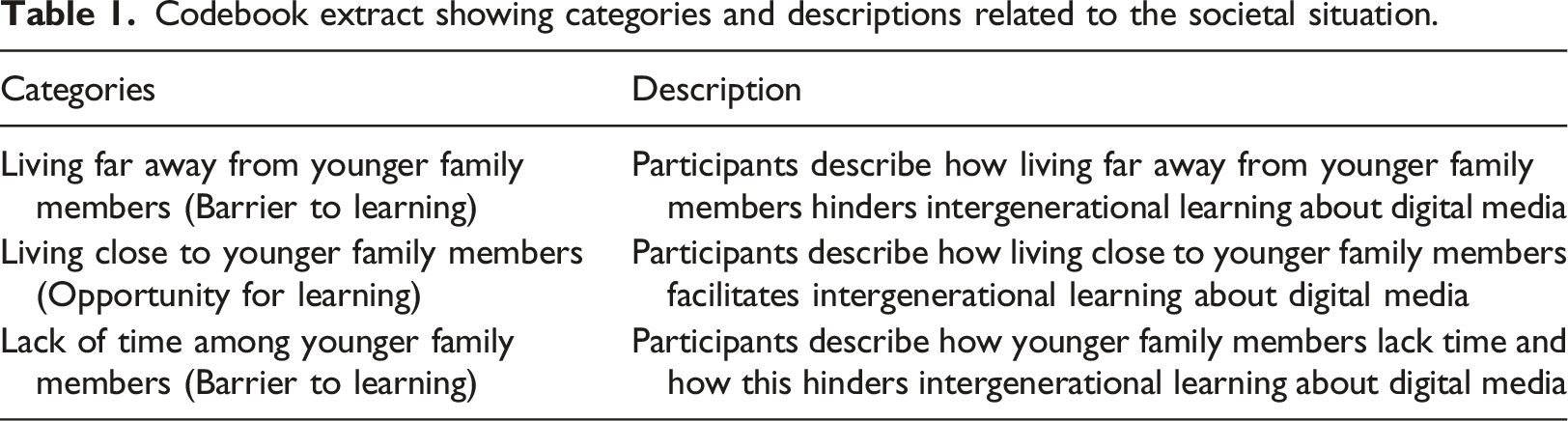
Codebook extract showing categories and descriptions related to the societal situation.
Codebook extract showing categories and descriptions related to close social interaction.
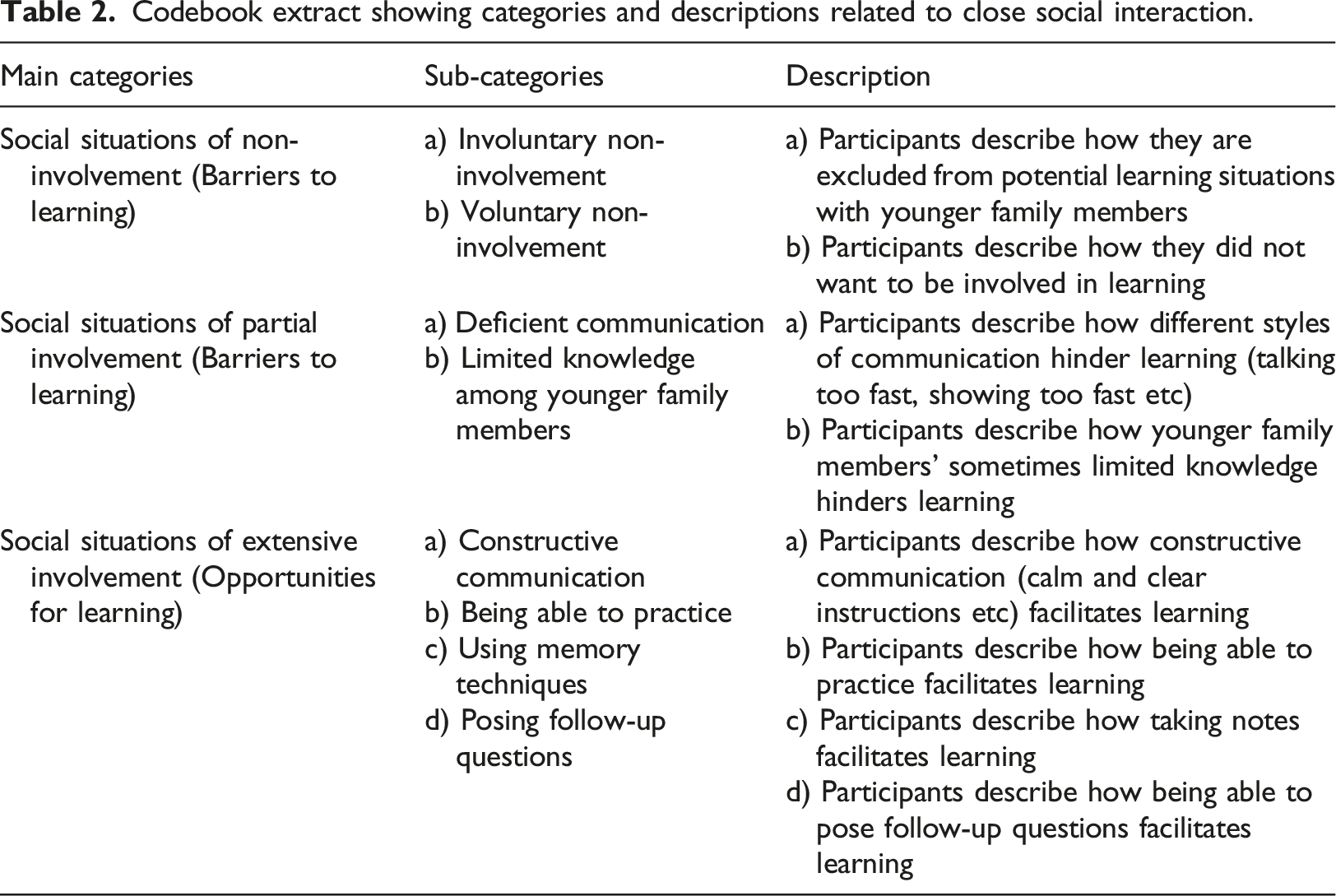
The identification of these different barriers and opportunities for learning—related both to the societal situation and the close social interaction—correspond directly to the research question of this study and form the structure of the following results section.
Opportunities and barriers with respect to learning about digital media in intergenerational interaction
The results section is structured around the two levels of interaction outlined in Illeris’s (2017) model. The section thus starts with opportunities for and barriers to learning related to the societal situation. The section then progresses to the close social interaction where learning may actually unfold.
Opportunities and barriers for learning related to the societal situation
The results show how sharing time and physical space was an important opportunity for establishing learning situations with and other forms of support from warm experts. Intergenerational learning and interaction around digital media most commonly took place in face-to-face interactions, primarily in the older adults’ own homes or in the homes of their younger family members. A few participants had experiences of learning outdoors, such as when going for a walk or riding in the car. There were only a few examples of learning through mediated communication—foremost over the telephone—concerning specific matters often following a previous learning situation. For most participants, it was mainly one or a few of the children and/or grandchildren who supported them in questions regarding digital media.
As learning and other forms of support were closely connected to interaction in shared space, living sufficiently close to younger family members to be able to meet more or less regularly was an important opportunity for intergenerational learning between older users and warm experts. Participants described how issues related to digital media arose—often unpredictably—in everyday life, and how on these occasions they could involve their younger family members living close by. Meeting regularly also gave the older adults the opportunity to bring up issues when they met, or younger family members to initiate a learning situation. Learning and other forms of support could also emerge spontaneously in interaction, and participants commonly described how they seized the moment when it arose.
At the same time, living far away constituted a barrier to learning in everyday life. Younger family members living further away in Sweden or abroad could be engaged sporadically when sharing space and time during holidays, or they played no role at all. The opportunity and barrier of space, that is, living close by or far away, is shown in the following quote: “But now he is moving away from [town] when he graduates this spring [laughter]. And then I don’t know what to do.” In this quote, an 81-year-old woman anticipates how she will be left without support when her grandson—who often taught her and supported her in questions related to digital media—moves far away for higher studies. Most participants in this study faced this situation, that younger family members living far away had no role, or a limited role, when it came to learning about digital media.
Hence, living close by and spending time together more or less regularly was an opportunity for learning. For some participants, it seemed as if they could just ask for support when needed. However, for other participants, establishing learning situations was not automatic or unproblematic. Participants commonly described how issues related to time, and the life circumstances of younger family members constituted barriers to creating these situations, structuring their access to warm experts. Participants described how the younger family members lacked time due to work, study, and other family obligations, and how they did not want to take up the younger people’s time. One participant, a 77-year-old woman, said about her grandson: “He doesn’t have time. He went to Stockholm the week before last week and this week he’s driving his mom to a birthday. I don’t want to bother him.” This experience, that they did not want to impose on the younger family members’ time, also made the older adults prioritize what to ask for. In the quote below, a man (82 years) says, I haven’t really asked them much for help, you know, because I am so afraid to intrude on their work or their personal lives. I don’t like that, so I am very careful. So when I do ask them for help, it’s really for something special.
In this quote, the man describes how he only asks for support if it concerns something special, so as to not bother his children and grandchildren. Learning from younger generations about digital media was thus sometimes surrounded by a worry about interrupting the lives of their younger warm experts.
Prioritizing also meant that certain digital interests that were not that pressing were not developed, as the older users did not ask for support. One woman wanted to learn more about layout and pictures but had not asked her grandson about this: “I guess it’s that I feel it’s a bit of a shame to take up any of his time for that” (Woman, 77 years). This shows the pragmatic motive dominating learning in everyday life (Berger and Luckmann, 1991[1966]: 36; 56–59). However, in this case the pragmatic decisions were not based on their own needs and plans for the future, but prioritized based on care for the younger generations. The older adults hence needed to balance their own personal learning needs with what they perceived as the needs of their family members.
The participants also experienced a lack of control over the learning situation with their warm experts. They faced uncertainty regarding when learning would actually take place. This involved waiting for potential learning situations, for instance, when a grandchild would come to visit again. There was an awareness among the older adults that meetings could get canceled, as family members might need to do other things, or could get ill or go on vacation. This made it difficult to predict when learning opportunities would occur, as they were dependent on several circumstances. There was also uncertainty in not knowing if the younger family members would actually have time for engaging in matters related to digital media when they met, and there were learning needs spoken about that never took place. Hence, learning did not always occur when the older adults needed it and might not occur at all.
Opportunities and barriers for learning in close social interaction
While societal and cultural conditions structure the opportunities for establishing potential learning situations, it is in the close social interaction that learning may actually take place, depending on the involvement of the learner. Three levels of involvement in close social interaction were identified in the analysis: social situations of non-involvement, social situations of partial involvement, and social situations of extensive involvement. The different opportunities and barriers for learning together with warm experts are discussed in relation to each level.
Social situations of non-involvement
Participants described how younger family members in some situations focused on fixing the problem or the issue at hand for them (such as problems with accessing the Internet, downloading apps, or tasks related to various online activities) and how they were not involved in what was going on. This can be understood as situations where the older adults had a perception of something taking place, but there was no involvement in the learning content, which thus constituted a barrier to learning (Illeris, 2017: 94). These situations could take place not only when the generations shared physical space but also when distanced from each other using remote control software to solve a problem.
Non-involvement could be either voluntary or involuntary. Starting with the former, participants experienced that younger family members excluded them from learning experiences they wanted to be involved in. In the following quote, one woman describes how her son does not involve her in his role as a warm expert: He’s hopeless – he does it himself [the son]. Comes here, there’s not a soul here, and then I say, “Could you help me with this?” And then he takes that thing [the iPad] and after 2 seconds “There, I’ve fixed it,” he says, and then he turns it over without saying a word about how he’s done it or anything. Then I have to throw myself over him and ask, ‘What did you do, what did you do, what did you do?” (Woman, 90 years)
The woman describes how she wants to become involved in the learning content, and how she struggles to become involved when excluded. Participants commonly described ambivalence toward these situations. On the one hand, they were negative towards being hindered from learning, while on the other hand, positive about the younger warm experts solving a problem. Participants reasoned about the motives for not being involved. They thought the younger family members found it easier to solve the issues themselves, or that they perceived the older adults as unable to understand, learn, and remember.
Regarding voluntary non-involvement, participants expressed that for different personal reasons they did not want to be involved in learning, and that they were happy with their younger warm experts solving the issue at hand. They thus described different defenses against learning (Illeris, 2012, 2017). One was not finding the learning content relevant, as they thought they would not need to perform the task again. One participant said: “She [the daughter] just installed it for me. She just did it, and I was happy with that. I did want to be able to use [the Swish payment app], but I didn’t need to know how to install it” (Woman, 79 years). Hence, due to her perceived needs in everyday life, one part of the process was perceived as relevant learning (how to use the app), while another part (installing the app) was considered irrelevant learning. In this way, she structured learning in terms of relevance (Berger and Luckmann, 1991 [1966]: 59), and selected from the flood of impressions to manage her everyday life smoothly (Illeris, 2017: 203).
Other defense mechanisms were related to the content at hand, such as finding the learning content too difficult or the content way above their level of knowledge. Some referred to their own capacities, that they could not understand and learn, and also mentioned their old age and memory issues. Other defense mechanisms were connected to the incentive element (Illeris, 2017); hence, they rejected learning due to “laziness,” or lack of patience or energy to engage in learning—it was simply easier to let the younger person solve the problem at hand. Defense mechanisms also related to a fear of messing up things they needed to function in their everyday lives, hence a fear of destroying or making something worse with their devices. The primary and pragmatic objective was in these situations to get the devices to work and get things done online.
When speaking of voluntary non-involvement, participants also sometimes mixed personal defenses against learning with interactional factors. When stating that they did not want to be involved in learning, they also commonly remarked that the younger family members did not want to involve them in learning. They mentioned, for instance, that the younger family members did not have the energy to teach them, that they found it easier to solve the issue themselves, that they thought that the older adults would not understand and learn, and that they were tired of repeating explanations. Thus, the participants discussed several factors underlying their non-involvement, which worked together in a spiral away from involvement.
Social situations of partial involvement
Participants also described situations in which they were involved in interaction with younger generations related to issues of digital media they were interested in. This level of involvement included elements of transmission and experience (Illeris, 2017: 95). However, this involvement was only partial, as barriers related to mislearning (Illeris, 2012, 2017) hindered full involvement.
Different aspects of deficient communication worked as barriers to learning. These barriers had to do with the ways in which the younger warm experts demonstrated and explained the learning content. The speed of hand movements and speech were important factors that hindered understanding. Participants experienced that some younger family members, in contrast to more pedagogical ones (see below), talked too fast when explaining and showed too fast on the devices, so that they could not follow. One participant said: “They [the grandchildren] do everything so darn quickly [laughs a bit]. They think we’re following, but we don’t at all” (Man, 83 years old).” In this case, it was the grandchildren, but in other cases, it was the children. The older adults commonly illustrated this tempo in the interviews by smattering with their fingers in the air or on the table, or by making fast swiping movements with their fingers in the air or on their hand.
Barriers in communication also had to do with deficient explanations, in the sense that participants experienced that the younger warm experts skipped information and steps in the instructions, and used technical language. Problems with explanations also had to do with not connecting to the older adults’ level of knowledge and skills, and not understanding what knowledge they lacked. The participants illustrated the younger family members’ deficient explanations in the interview situation with murmuring sounds in which meaningful phrases could not be distinguished. Participants also described negative emotions surrounding these situations, such as anger and stress on the part of the younger family members, and they reasoned about the possible causes. Among the causes mentioned were their young age and knowing digital media by heart and finding things obvious. Some said that their child or grandchild had too much expertise due to their work in IT, could not connect with their level of knowledge, and used technical language. Here, real expertise in digital technology was sometimes experienced as an obstacle rather a resource when it came to learning with warm experts.
In these situations of partial involvement, some participants gave up the attempt to learn from these younger family members. Other participants described how they took the role of the teacher and tried to educate the younger family members about how to instruct them better. The flow of knowledge between generations hence took the opposite route in these situations (Boström and Schmidt-Hertha, 2017). Some older adults experienced that their efforts to teach the younger people worked and that they became better at instructing, but some experienced that the barriers continued and they subsequently gave up their effort to try to learn from these family members. Some also observed that the younger warm experts got nervous and stressed when they had to explain slowly, which made it complicated for the older adults to educate the younger people about how to teach. They did not want to contribute to a negative experience, and care about the well-being of the younger generations was sometimes considered more important than trying to learn from them.
In addition to deficient communication, children and grandchildren’s sometimes limited knowledge worked as barriers to learning. Even though younger family members most often were more knowledgeable in the area of digital media, they did not always have the knowledge needed to understand the issue at hand and could then only partially involve the older users in learning. It might be certain technology that younger family members had limited knowledge of, for instance, the latest technology (voice-activated AI such as Google Home) or certain systems or brands (mainly Android versus iPhone). Being on different sides of the Android/iPhone divide—thus, living in different digital worlds—hindered adequate learning between generations.
Social situations of extensive involvement
Participants also described experiences of being more fully involved in the interaction around digital media with warm experts, in a way that facilitated learning. This level of involvement was characterized by elements of not only transmission and experience, but also imitation and participation (Illeris, 2017: 95). In these situations, the generations cooperated in mutual goal-directed activities, and the older adults tried to imitate the younger family members.
Different aspects of constructive communication worked as opportunities for learning. The participants experienced that some of their younger family members, who could be one of the children or grandchildren, were better at teaching them about digital media in a way that enabled them to understand. Calm, precise, and clear instructions, and pointing at the exact location on the screen enabled the older adults to become fully involved in the learning content. Explanations containing step-by-step guidance, not leaving out information and not assuming any previous knowledge, also facilitated the older adults’ involvement. In these interactions, the participants experienced that the younger family members had the time, will, and patience to enable them to understand. The participants commonly described these situations by quoting the younger family members and how they directed the older adults’ attention to the content matter. Catching and directing attention was commonly accomplished by using personal appeals such as “Mom” or “Grandma,” as seen in the following quote: Yes, they are very different those two little ones, because the youngest one, he does it himself. He takes the phone and then ssswhisss [imitates sound, something goes fast]. There, done. While the older one, the 13-year-old, he shows what to do, just like his dad. He is very pedagogical and shows. “Grandma, now you do like this” and “Now, it’s like this, Grandpa,” and so on. So he takes it calmly, but the younger one, he just ssswhisss [imitates sound], done. They are very different. The big one is like his dad. Very calm and shows. (Woman, 73 years)
In the quote, the woman describes how one of her grandchildren instructs her in a pedagogical way, in contrast to the other grandchild, who did not involve her in the interaction. Hence, pedagogical ability and effort, and not primarily the level of knowledge and expertise among the younger warm experts, were seen as important for learning. Based on the interviews, this pedagogical ability was not connected to either the age or the level of expertise among younger family members. Both children and grandchildren engaged in constructive communication. And, as stated above, family members with IT-related professions were described by some participants as being especially poor educators.
Another important opportunity for learning was being able to practice during the interaction, and being encouraged by the warm experts to do so. This could concern how to use an app to send money, how to send a text message, or how to take a photograph. With hands-on practice, the learning situation went beyond seeing and listening to also include manipulating the digital device, which meant further involvement in the learning content. The participants commonly described how this aided memory and made it easier to perform the activity when on their own again. In the following quotes, two women describe joint goal-directed activities involving practice: They are very precise about it. “Now you should do like this, mom. Wait a bit. Now you do this, mom. Press there and press there.” He stands beside me and then I get to press. And I want that, because I don’t think it’s right that they should do it, because then I haven’t grasped anything. So he stands by my side and then he says, “Now you press there. And look what it says there. And then you go in there. Now we have to go back. Now you go back and then blah, blah, blah.” Yes, so then I do that [laughter]. (Woman, 73 years) He [the grandchild] shows me … and then I say: “Now you have to let me do it, because otherwise it doesn’t work.” No, but then he has the patience to wait.… That means a lot, because as a result of having done it, it’s gone up there too [points to her head]. (Woman, 81 years)
In these quotes, these situations are described as characterized by constructive communication, cooperation, and practice. A positive atmosphere was also commonly connected to these experiences. The 73-year-old woman quoted above described how her son instructed her to right-click on the mouse and how she said: “‘What kind of nonsense is that? I’ve never done that.’ ‘Yes, but you have to, mom. You have to; otherwise, it doesn’t work’… So we’re having so much fun.”
In addition to this, participants experienced that memory techniques, that is, step-by-step instructions written with pen on paper, facilitated their learning. Hence, traditional analog media were important tools for learning about the latest digital technology. These notes made continuous involvement possible, in situations stretching beyond the interaction with younger family members. When on their own again, written notes mediated between the first learning situation and the next, where further practice took place. The participants commonly described how learning could easily vanish, as there could be a time lag before they needed to perform the activity again. As a result, learning was commonly experienced as fragile, and memory techniques were one way to make learning sustainable.
However, memory techniques as learning opportunities were also connected to practice. Receiving notes without being able to practice by oneself made the notes less relevant. One participant, a 94-year-old man, told how his grandson during one of his short visits explained how to use the grandfather’s new smartphone and wrote down instructions, but there was no time for practice together. In one of the instructions on how to take a photograph there was a note written by the grandfather afterward in the margin: “wrong?” When asked about this in the interview, the 94-year-old said that there was no time for practice: “He had so little time because he had quite a few lessons every day.”
Another possibility for continuous involvement was posing follow-up questions after the initial learning situation. Participants described how, by contacting younger family members and asking specific questions, they could clarify things they had not properly understood. This might concern, for instance, how to use the online bank, how to connect to Chromecast (a digital media player), or how to use social media such as Instagram. Follow-up questions were primarily posed in telephone calls. Mediated communication was considered appropriate for more limited and focused learning needs, after more extensive face-to-face learning situations.
Discussion
This study has explored older adults’ experiences of opportunities and barriers in learning about digital media with younger generations. The aim has been to further our understanding of the role of the warm expert by analyzing the learning process, including the potentially problematic aspects, more systematically and deeply. The results reveal how interaction with warm experts indeed constitute important learning opportunities for the older adults, in which they develop their skills in using digital technology for various purposes. However, establishing potential learning situations and actually learning from warm experts was not a straightforward matter, but rather surrounded by a multitude of barriers structuring the possibilities for learning.
Geographical distance between the generations and the opportunity to meet regularly face-to-face structured the opportunities for establishing potential learning situations. Even though living close by indeed constituted an opportunity for learning, the life circumstances of the warm experts—primarily a busy everyday life—and the older adults’ interpretations of these circumstances complicated the task of establishing learning situations. The older adults experienced a need to balance their own learning requirements with the perceived needs of the younger generations. Caring for the younger family members by protecting their time resources thus constituted a barrier to learning, and sometimes limited learning to the most immediate pragmatic needs.
When potential learning situations actually occurred, several interactional and personal factors worked to facilitate or hinder learning. This study has identified three types of social situations, which reflect different levels of involvement. In situations of non-involvement, the warm experts helped the older adults by fixing the issue at hand, thus preventing the older users from learning. This was sometimes preferred among the older adults, due to different learning defense mechanisms, but sometimes they were excluded against their will. Hence, by focusing specifically on learning, and not broadly on “help,” which may actually obscure our understanding of what is going on, we can identify phenomena that are important for comprehending older adults’ opportunities for learning, and thus their opportunities for inclusion in the digitalizing society. Future research need to look deeper into these kinds of social situations to understand why the older adults sometimes are excluded from learning that could develop their personal autonomy.
In social situations of partial involvement, the older adults were interested in learning about digital media, and the warm experts involved them to some extent in the issue at hand. However, deficient communication and sometimes a lack of knowledge among the younger generations worked as barriers to learning. In relation to deficient communication, the older adults could take the role of the teacher, instructing the younger warm experts on how to educate them properly, with varying degrees of success. Some older adults experienced that professional expertise in digital media among certain children and grandchildren hindered their possibilities of learning from them. Future research needs to explore this further, to gain better insights into the factors underlying deficient communication and a lack of ability or will to teach the older users.
In social situations of extensive involvement, the older adults experienced involvement in the social interaction and the learning content in a way that facilitated their learning. Constructive communication, hands-on practice, memory techniques, and posing follow-up questions—in an encouraging, calm, and positive atmosphere—contributed to older adults’ learning. Hänninen et al. (2021) argue that the continuing importance of the warm experts in today’s society is due to the increased complexity of digital technologies, as they provide motivation and technical support. The opportunities for learning identified in this study can be understood in a similar vein. The instructional techniques, primarily the characteristics of constructive communication and step-by-step lists, reduced the complexity of digital media for the older users and opened up opportunities for continuous learning.
So, how do these results further our understanding of the role of the warm expert on a more general level? The results reveal how the role of the warm expert is fluid and materializes in different ways. The warm expert can take the position (or be positioned) as one who solves technical issues for the older adults. The warm expert can be one who fails in teaching, or one who adopts the position as a warm teacher and contributes to learning among the less knowledgeable user. Bakardjieva (2005) defined the warm expert as one who “mediates between the technological universal and the concrete situation, needs and background of the novice user with whom he is in a close personal relationship” (p. 99). If mediation entails teaching, not only technical expertise is needed but also pedagogical ability and intention. To be a warm teacher, the warm expert needs to understand the specific learning needs and styles of the less knowledgeable other, and adapt to these needs. The study has shown how the close relationship is indeed an opportunity for learning, but also sometimes constitutes a barrier, as caring for the younger generations and caring for the relationship may be prioritized. This complicates the family as an arena for learning about digital media.
However, a better understanding among warm experts of how older adults experience learning to use digital media could improve their possibilities to become a warm teacher. First of all, warm experts need to be aware of the complexity of learning needs among older adults in the digitalizing society, and be proactive in asking about potential learning needs, as the older users may not want to bother them. Second, in the actual learning process, to serve as a warm teacher the warm expert can facilitate older adults’ involvement by speaking calmly, providing step-by-step instructions, encouraging the older users to practice themselves, and encourage asking follow-up questions on later occasions. These suggestions, based on the results from the present study, can be used in community-based projects involving intergenerational learning as well as in courses on digital media provided by municipalities and non-profit organizations.
As stated in the introduction, the learning process involving the warm expert has received little attention in previous research. One exception is the study by Taipale (2019), which sheds some light on learning processes, but from the perspective of warm experts. The present study complements this study by focusing on the perspective of the older users, and confirms and extends some of the findings, primarily regarding strategies for learning. However, while the present study develops our understanding of the warm expert, there are also limitations to this research. This study has focused on the role of the warm expert in the Swedish context. Some of the findings may therefore only apply to countries sharing similarities in intergenerational relations. Future research thus needs to make comparative studies and explore learning with warm experts in other countries, for instance, in the south of Europe where multigenerational households are more common (Bordone, 2009; United Nations, 2019). Furthermore, future research could study whether there are gender and age differences when it comes to learning with warm experts, an issue that was not analyzed specifically in the present article.
This study was conducted just before the outbreak of COVID-19. The opportunities and barriers for learning may not be the same in a context of social distancing. This study shows how learning about digital media primarily takes place in face-to-face interactions. Future research could explore whether new learning arrangements have emerged during the pandemic, or if learning with warm experts has been limited during this time. In this way, we may gain a better understanding of warm experts and the way they contribute to learning under extreme and changing societal conditions.
Footnotes
Acknowledgements
We want to thank Dino Viscovi and Ulli Samuelsson for their valuable comments. We also want to thank our colleagues at the Department of Childhood, Education and Society at Malmö university for their helpful remarks.
Declaration of conflicting interests
The author(s) declared no potential conflicts of interest with respect to the research, authorship, and/or publication of this article.
Funding
The authors disclosed receipt of the following financial support for the research, authorship, and/or publication of this article: This work was funded by The Kamprad Family Foundation for Entrepreneurship, Research & Charity [grant number 20180210].
