



Abstract
Pokémon Go is a hybrid reality game (HRG) that research suggests is played by families in the context of joint-media engagement. Yet, the game interface itself provides little information about how to approach the game. Given this and the fact that many parents play this HRG with their young children, we examine the process of parent online social learning to play Pokémon Go. Drawing on an original study of Pokémon Go conducted between August and November 2019, including a Facebook survey on a non-probabilistic purposive sample, and semi-structured interviews with a range of parents who play this HRG with their children, the aim of this article is to explore parent online social learning as a path to optimising in-game performance. In the main, we found that the frequency with which parents followed tips provided by individuals online related inversely to how well they knew them and was differentially linked to the sources of information parents used. We nuance these findings with insights from the interviews.
Keywords
Introduction
Research suggests that children today spend half as much time playing outside as their parents did (National Trust, 2016). This shift is exacerbated by the transition from childhood to adolescence (Crosnoe and Trinitapoli, 2008). During their teenage years, children go through a number of changes – cognitive, emotional, behavioural and social – which families then adjust to accommodate (Siyahhan et al., 2010: 415). At the same time, indoor activities now involve digital technologies, such as video games (Lenhart et al., 2005; Siyahhan et al., 2010). As Costa and Veloso (2016, 43) note, from around the turn of the millennium, digital technologies have started to become more deeply embedded in households (see also Bunz, 2012; De Schutter and Abeele, 2015). And this trend has not slowed down. Today, digital technologies are not only a central feature of familial life (Takeuchi, 2011) but are having a marked impact on the practice of parenting (Graber, 2019).
In response to this, a growing body of work now explores how parents incorporate media technologies such as video games into their daily lives (Carr and Puff, 2019; Cruikshank, 2019; Jennings and Wartella, 2012; Takeuchi, 2011), as well as partake in joint-media engagement (JME) with their children (Yip et al., 2016). Not all video games, of course, are the same. The hybrid reality game (HRG) Pokémon Go is a good example of this. Through the game device, physical space is overlaid with digital information and incorporated into the game experience. In other words, the game is played through physical ambulation. Importantly for our purposes, research suggests the locative affordances of this HRG make it suited to JME (Saker and Evans, 2021). Yet the game itself provides limited information about how it should be played (Tran, 2018). The aim of this article is, therefore, to explore parent social learning on social media to play Pokémon Go with their children as a path to optimising in-game performance.
In the following section we review the literature on both JME
Previous work
Intergenerational play and negotiating sources of information
Research markedly demonstrates the effect digital media technologies can have on the communicative practices of families (Schreiber, 2019; Siyahhan et al., 2010; Vanden Elzen and Vanden Elzen, 2019). The use of digital technologies within the domestic sphere, for instance, can lead to families occupying the same physical space, while being cognitively separate. As Siyahhan et al. (2010, p. 416) explain, though parents might employ mobile phones and the Internet to organise and coordinate their daily lives and to communicate with their children – amongst other things – children often use these same technologies to multitask between leisure, entertainment, information-seeking or socialisation activities. And these disparate activities can go on for a number of hours each day (Rideout et al., 2010). Consequently, the entrenchment of digital technologies in the domestic sphere might lead to a reduction in intergenerational interactions.
For many observers, an apparent ‘decline in opportunities for intergenerational interaction is a significant concern’ (Voida and Greenberg, 2012: 45). More specifically, for adolescents, intergenerational connections can provide an important opportunity to ‘expand the diversity of people with whom they interact’ (Voida and Greenberg, 2012: 45), reduce depression (Ruiz and Silverstein, 2007) and help combat ageist attitudes (Ruiz and Silverstein, 2007). Similarly, for older people, intergenerational connections can enhance their emotional well-being (Weintraub and Killian, 2007) and improve life satisfaction (Meshel and McGlynn, 2004). In either case, digital games can provide a bridge between generations, with benefits from usage accruing for both the young and old (Schreiber, 2019). Significantly, intergenerational play can also help families carve out a space to engage in quality time together (Cruikshank, 2019). For the most part, however, research in this field has tended to focus on video games that are played within the domestic sphere (Rogerson et al., 2019; Siyahhan et al., 2010). What is notably missing from this growing body of work is a consideration of locative games that extend beyond the screen and incorporate physical environments (Evans and Saker, 2017).
While locative games might appear novel, in reality they are not (De Souza e Silva, 2017). Locative media, including locative games, stem back roughly 20 year or so. As extant literature demonstrates, these applications can reshape how users relate to their environment (Gordon et al., 2013; Martin, 2014: 180), approach their social connections (Frith, 2014; Saker and Frith, 2018) and present themselves to others (Saker, 2016). More recently, advancements in locative media have paved the way for the release of the hybrid reality game (HRG) game Pokémon Go in July 2016. With roughly 5 million active players playing this HRG on a daily basis (Saker and Evans, 2021), Pokémon Go is unquestionably the most popular HRG to date. It is not only intrinsically social, but it is also played by parents and children alike in the context of JME (Saker and Evans, 2021; Sobel et al., 2017; Tran, 2018).
Significantly – for the purposes of this article – the game application itself provides very little information about how Pokémon Go should be approached and played (Tran, 2018). From a design perspective, this lack of initial information ‘focuses attention on the play of the game rather than on prior, frequently age-dependent knowledge’ (Rogerson et al., 2019: 49). At the same time, play is not simply intuitive. As Tran (2018) helpfully points out, learning to play has equally been ‘offloaded from the game and distributed across sites and resources provided by other players. These sites and resources include videos, wikis, guides and information shared on social networks’ (Tran, 2018: 114). And while children might have more ‘experience with games and technology’ (Cruikshank, 2019: 131), this does not mean they are necessarily able to impart this knowledge – nor do we suggest this is always the case. As (Chiong, 2010) explains, despite being deft video gamers, children are generally less successful at mentoring, ‘often giving fleeting responses and even ignoring their parents’ questions or comments. Accordingly, adult Pokémon Go players may find themselves having to learn how to play the game on their own (Tran, 2018).This insight forms the exigency of our article.
Moving forward, then, while the motive for this research is framed by developments in intergenerational play, our attention is more specifically on how parents and carers approach learning about the game; and more precisely, what influence parental socio-demographic characteristics might have on how parents and carers draw on collective resources pooled online by their game peers. Notably also, in game studies, social learning has been surveyed in research looking specifically into the cognitive and emotional development of young players (see the special issue by Rivers and McDonald, 2018). To be clear, then, Pokémon Go has been chosen precisely because it is a game played by families (Saker and Evans, 2021), and because it provides little interface-based information concerning how to approach the game, which might affect how parents and carers gain information about what to do. In the following section, and in order to develop a congruent framework to digest this process, we survey the theoretical framework underpinning the practice of social learning.
Social learning to play from social media peers
To date, theoretically cognate but empirically unrelated studies of social learning can be found in criminology (Miller and Morris, 2016; Pratt et al., 2010), organisational (Brown et al., 2005; Wenger, 2000) and environmental studies (Benson et al., 2016; Lotz-Sisitka et al., 2015), social-psychology (Molleman et al., 2014) and socio-biology (Kendal et al., 2009). At the level of the individual, social learning is a conscious process of observation, identification and imitation of a model (Bandura, 1977).
The study of social learning has concentrated on the influence that the group has on the individual (Pratt et al., 2010; Reed et al., 2010). An individual will develop social learning strategies reproducing the model of the most successful individuals in a group, majority behaviour or peer conduct that yields the largest payoffs sought (Hoppitt and Laland, 2013). Network theory, on the other hand, has approached social learning as a diffusion process. Social learning thus entails embracing an innovation (e.g. a new belief or conduct) provided one gains information from her network that testifies to the suitability of the innovation for the individual (DiMaggio and Garip, 2012: 96). Accordingly, social learning is more likely to transpire the more information is shared and thereby validated by ties in one’s network (Margetts et al., 2012; Messing and Westwood, 2014). Consequently, as we explicate below, we probed the relation of social learning with the frequency with which tips were posted by peers, online; the closeness of the relationship with those peers and the extent to which social cues had any relationship with the imitation of in-game conduct.
Learning a behaviour exhibited by others in a social context is a core process in social learning, designated as imitation (Bandura, 1977; Campbell et al., 1954). The likelihood that one engages in a particular conduct may be influenced by the example of one’s peers as well as any ‘knowledge, attitudes, beliefs and techniques’ they will share (Miller and Morris, 2016: 1547). The theory does not assume a deliberate effort on the part of the modelling influence to stimulate behaviour. Models may range from a close companion or relative to secondary peer groups encountered through the media and including online peers (Miller and Morris, 2016), for example, with whom one interacts on social media. For the purpose of this research, we regarded virtual peers to be users of online Pokémon Go forums and pages. We conceived of the latter in general terms – without distinguishing between their commercial or non-commercial character – as social media frequented by parents and carers, that is, social spaces where they are able to bond and participate in dynamic exchanges of information (Hinton and Hjorth, 2013: 21–22).
In this study, we asked whether the odds of imitation of in-game conduct bore any relation to the closeness of the relationship parents and carers have with modelling peers from secondary groups congregating on Pokémon Go forums and pages (
We further sought to explore the question of the extent to which social cues (Dvir-Gvirsman, 2017) influenced the imitation of in-game conduct (
Data and methods
This article draws on an original study of Pokémon Go conducted between August and November 2019. The study includes a Facebook survey (N = 352) on a non-probabilistic purposive sample, and semi-structured interviews (N = 24) with a range of parents who play this HRG with their children. The sampling strategy for gathering the quantitative data reflected our aim to research a hard-to-reach population – for which no sampling frame was readily available – sought for a set of unique, defining characteristics (Birnbaum, 2004; Stern et al., 2017). In the case of this investigation, that population was made up of parents and adult carers of young Pokémon Go players who followed a Facebook page dedicated to the game. We advertised the survey through posts on Facebook group pages. A total of 106 group pages were identified with the native Facebook search engine. The research assistant who conducted the search joined all the groups discovered with the query terms ‘Pokemon Go parents’ (n = 4) and subsequently the more generic term ‘Pokemon Go’ (n = 74). The assistant then proceeded to advertise the English-language survey on the group walls and later used the same Facebook group pages to recruit in-depth interview participants. The interviews acted as a complementary tool to gain richer qualitative information about the practice of familial locative play that could either extend or add nuance to the findings of our survey (Seale, 2004).
Survey data
In total, the survey was completed by 352 respondents. The majority of the respondents who stated their country of residence were from the US (51%, N = 130), the UK (29%, N = 73), Canada (8%, N = 20), Australia (6%, N = 15), Ireland (0.8%, N = 2) and other countries (1.2%, N = 3). Their age ranged between the following categories, ‘18–24’ and ‘85 or older’. The majority were between 35 and 44 (40.15%, N = 106). 217 (79.49%) respondents identified as female, 55 (20.15%) identified as male, and 1 (0.37%) preferred not to say.
On initial inspection of the survey data, we noticed multiple cases of breakoff. The term breakoff describes the action by respondents of starting but not completing and/or submitting an online survey (Blumenberg et al., 2018: 2; Stern et al., 2017: 716). The distinction between completion and submission stems from the design of the online survey, specifically whether respondents must complete the survey to be able to submit it or not. In our case, submission of incomplete surveys was possible.
We inspected the survey for any relation of breakoff with socio-demographic variables used previously to determine the extent to which breakoff introduces bias in the data (Sax et al., 2003; Stern et al., 2017). To this end, we created a breakoff dummy variable (breakoff = 1, no breakoff = 0) and checked for any bivariate correlations with age, gender, education and ethnicity. The tests revealed a weak positive correlation between age and education (Spearman’s Rho = 0.235, p < 0.01); and a similarly weak albeit negative correlation between gender and employment (Spearman’s Rho = −0.208, p < 0.01). None of the socio-demographic variables correlated with breakoff. A binary logistic regression with breakoff as the dependent variable similarly produced no significant results.
We consequently proceeded with examining breakoffs in three steps. First, we removed all breakoffs where less than two percent of the questionnaire had been completed (N = 64 or 18.3% of responses). We ran the same tests as above and again found no relation between breakoff and socio-demographics. In the second step, we removed all breakoffs with a completion rate between 2 and 25% (N = 32 or 9.1%) and ran the same analysis, which produced the same results once more. Finally, in the third step, we removed all breakoffs with a completion rate of between 25 and 50% (N = 56 or 16%). Again, we did not find breakoff to bear any relation to any of the socio-demographics. However, subsequent testing showed a drop in the number of cases of the dependent variable in the main analysis from step two to step three (N = 20). On further inspection, as the same held true for the independent variables in the main analysis, we decided to only remove breakoffs with a completion rate of less than 25%. Accordingly, the final number of surveys in the analysis was 256.
Ordered logistic regression: dependent and independent variables
In the main statistical analysis, we used ordered logistic regression to explore the odds that social learning, intergenerational gaming and socio-demographic measures would predict the frequency of imitation by parents and carers of tips retrieved on Pokémon Go forums and pages. First, to address the known problem of introducing bias in the analysis due to listwise deletion of missing cases in the logistic regression, we imputed unit nonresponses (Chadwick, Vaccari, & O’Loughlin, 2018).
Second, our main outcome variable was frequency of imitation of in-game conduct reported on Pokémon Go forums and pages. We asked respondents, ‘How often would you say you follow in-game tips you read on Pokémon Go forums and pages?’ Responses were ranked on a 1 to 4 scale with 1 = rarely and 4 = very often. Third, when probing the relationship between imitation of in-game conduct and differential association, we sought to understand the relative context of differential association on Pokémon Go forums and pages. To that end, we used an open-ended question asking respondents to name the main source for the majority of their information about the game. Answers were recoded into six dichotomous variables (1 = used, 0 = not used).
To measure differential association specifically on Pokémon Go forums and pages, we additionally asked respondents to describe the intensity of the (Miller and Morris, 2016: 1546) relationship with the user posting the tips with a 5-item scale (1 = know extremely well and 5 = not well at all). We measured frequency-dependent learning with an item asking respondents to rank the frequency of the posting activity of the users whose tips they followed. The variable – and likewise the outcome variable – was Likert frequency scales (Bass, Cascio and O'Connor, 1974). It reflected the insight from a similar online survey-based study that sharing in-game tips was one of the most frequent activities in which Pokémon Go players engaged, marginally lower than finding Pokémons (Paasovaara et al., 2017: 156). The scale ranged from 1 = regularly posts a lot of tips to 5 = posted one tip once. Lastly, to explore the relationship between majority-bias (Mesoudi, 2011) and imitation of in-game behaviour expressed as in-game tips (Paasovaara et al., 2017), we created a new survey item enquiring into the degree to which respondents’ inclination to follow in-game tips related to their subjective assessment of the proportion of people who appreciated those tips. The question thus asked respondents to state whether their inclination to follow in-game tips was informed by their own evaluation of the number of people who found them useful (‘If you follow any in-game tips are they tips that’, 1 = the majority of people on this Pokémon Go forum or page have found useful and 3 = a few people have found useful).
We controlled for frequency of videogame play with children, age, education, employment, ethnicity and gender. To take these in turn, frequency of videogame play with one’s children featured in early studies of this phenomenon (Mitchell, 1985), with related research demonstrating that parents and carers who see themselves as being gamers are more likely to play video games with their children, as opposed to restricting their children from play (Takeuchi and Stevens, 2011). More recently, a survey of 4,000 families in America found that 57% of ‘parents of gamers … play games with their child at least weekly’ (ESA, 2019). Likewise, the same study established that parental age relates to the kind of games played, the device used to support play, as well as the length of time individuals have played video games (see ESA, 2019).
The same was true of gender. As Siyahhan and Gee (2018, p. 3) point out, intergenerational play around video games is divided along gender lines, with ‘more fathers than mothers [still] playing video games with their children’, suggesting, in this context at least, that there has been little movement over the past 35 years (Siyahhan and Gee, 2018). At the same time, other studies have considered the educational level of parents to interrogate the role video games might play in the lives of young adolescents (Funk, 1993). Finally, research has also explored the impact of playing video games on older adults regarding employability, with commentators suggesting some parents are now turning this pastime into a viable career (see Rae, 2019).
Consequently, the survey asked respondents ‘How often do you play video games with your child/children?’ The question had five answer options on a scale from 5 = daily to 1 = never. Responses were recorded on a scale from 1 to 3, to decrease the number of cells with small or missing values. Respondent age was an ordinal variable with eight categories; education was an ordinal variable with nine categories, employment was a nominal variable with eleven categories and gender was a nominal variable with four categories. These variables were also recoded to reduce the number of values with small or missing values. All independent variables were introduced in the ordinal logistic regression model at the same time. Variance inflation factor (VIF) scores for the independent variables were between 1 and 2. We therefore concluded that there was no collinearity among the independent variables in the model and proceeded with the statistical analysis.
Semi-structured interviews
Our aim was to speak to a range of parents and carers who played Pokémon Go with their child or children. To this end, a purposeful sampling strategy was employed (Emmel, 2013). The exigency of the interviews was to flesh out the lived experience enveloped in our survey. Again, participants were recruited through posts on Facebook group pages. In total, 24 participants were interviewed. The majority of interviewees were from the United States (N = 15), the United Kingdom (N = 7) and Canada (N = 2). The age of interviewees ranged between 26 and 59 years old (mean = 38 SD = 9.7). 16 participants identified as female, and 9 identified as male. The number of children per household ranged from 1–5.
Interviews lasted roughly 1 h and were conducted over Skype. Interviews were semi-structured and revolved around the impact of Pokémon Go on family life. This included familial relationships, ambulation, sociality, parental concerns, motivations to play, the roles adopted and the rules established to facilitate intergenerational play.
After the interview data had been transcribed, we embarked on post-research thematic analysis using the qualitative data analysis computer software package, Nvivo. More precisely, each interview was read multiple times before meaningful sections of text were thematically coded into nodes that related to the interview questions (Gibson and Brown, 2009). We continued to refine our code as the remaining interview were analysed. This was done by relating coded data to the findings from our survey.
Findings
Descriptive statistics (see Table 1) indicated that more than two-thirds of parents and carers played Pokémon Go with their child/children between one and six times a week. And this volume of familial play was a theme that emerged in our interviews. For the most part, participants played this HRG at various times during the week while they went about their daily lives. We sometimes play it on the way to school. We’ll sometimes leave twenty minutes earlier and walk kind of a longer route to school. And if there’s like a raid that happens to be like ten minutes after school pick up, I’ll pick Tommy up and say oh there’s a raid, do you want to do it? And if he wants to...we’ll go do it from school (Paul, male, 28) Descriptive statistics for the social learning independent variables. aThe reference category is non-use. Count/percentages are for users of the individual source of information. 1Reference category set to 0.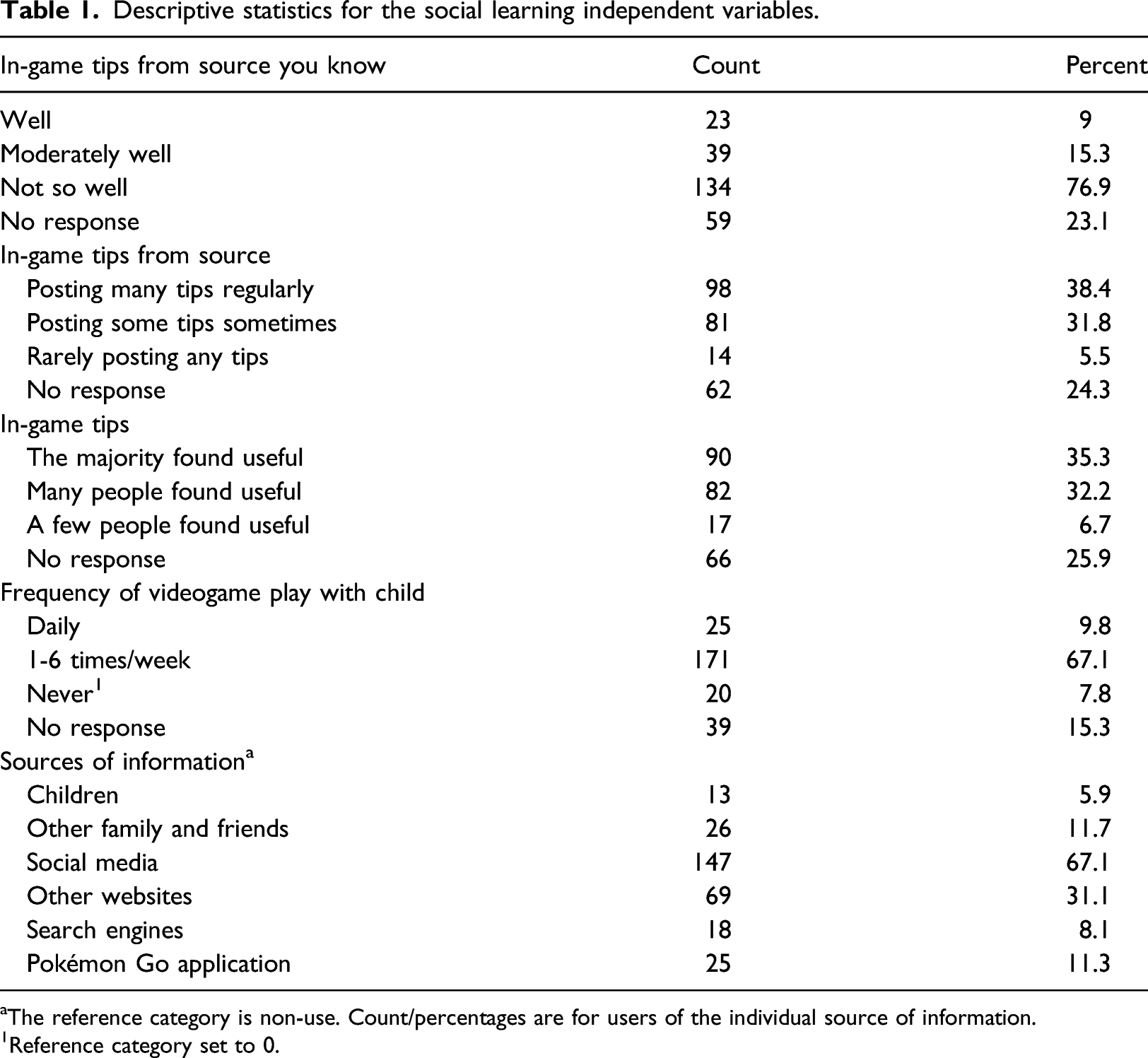
Likewise, participants also played this game over the weekend, when the experience was more of an event. There are events going on at weekends. So, that is when it gets really intense. So, if there is like a special event going on we will go out for the three hours to do the event or raid hour or whatever it is. We try and get involved with that. (Emily, female, 45)
The majority of survey respondents (52.5%) said they followed in-game tips that they encountered on Pokémon Go forums and pages. Almost a quarter of respondents (24.3%) said they rarely did so while almost as many (23.1%) did not provide a response. In a similar vein, just over a third of participants (37.5%) indicated that they used the game tips provided on forums and pages.
This insight aligned with the survey responses. Most parents and carers readily followed tips from sources they did not know so well and sources who regularly posted many tips. Table 1 furthermore reveals a socio-demographic distribution skewed toward women who represented more than seven in ten of the responding parents and carers. This division is similarly mirrored in our interviewee sample.
Mature-young parents and carers, of which a majority had an undergraduate degree and were in employment, survey respondents diverged from the profile we retrieved in the literature, most strikingly by the over-representation of women. On the other hand, the fact that most parents and carers were mature-young adults in employment who were nevertheless able to set aside time to play Pokémon Go with their children aligned with recent research from the US which put the average age of gaming parents at 33 (see above and ESA, 2019). Again, this echoes our interviewee sample, with the mean age of participants being 38. Of all the socio-demographic variables, only age was associated with videogame playing with one’s child or children at a positive and statistically significant level (Cramer’s V = 0.255, p < 0.05).
Ordinal logistic regression: frequency of following in-game tips.
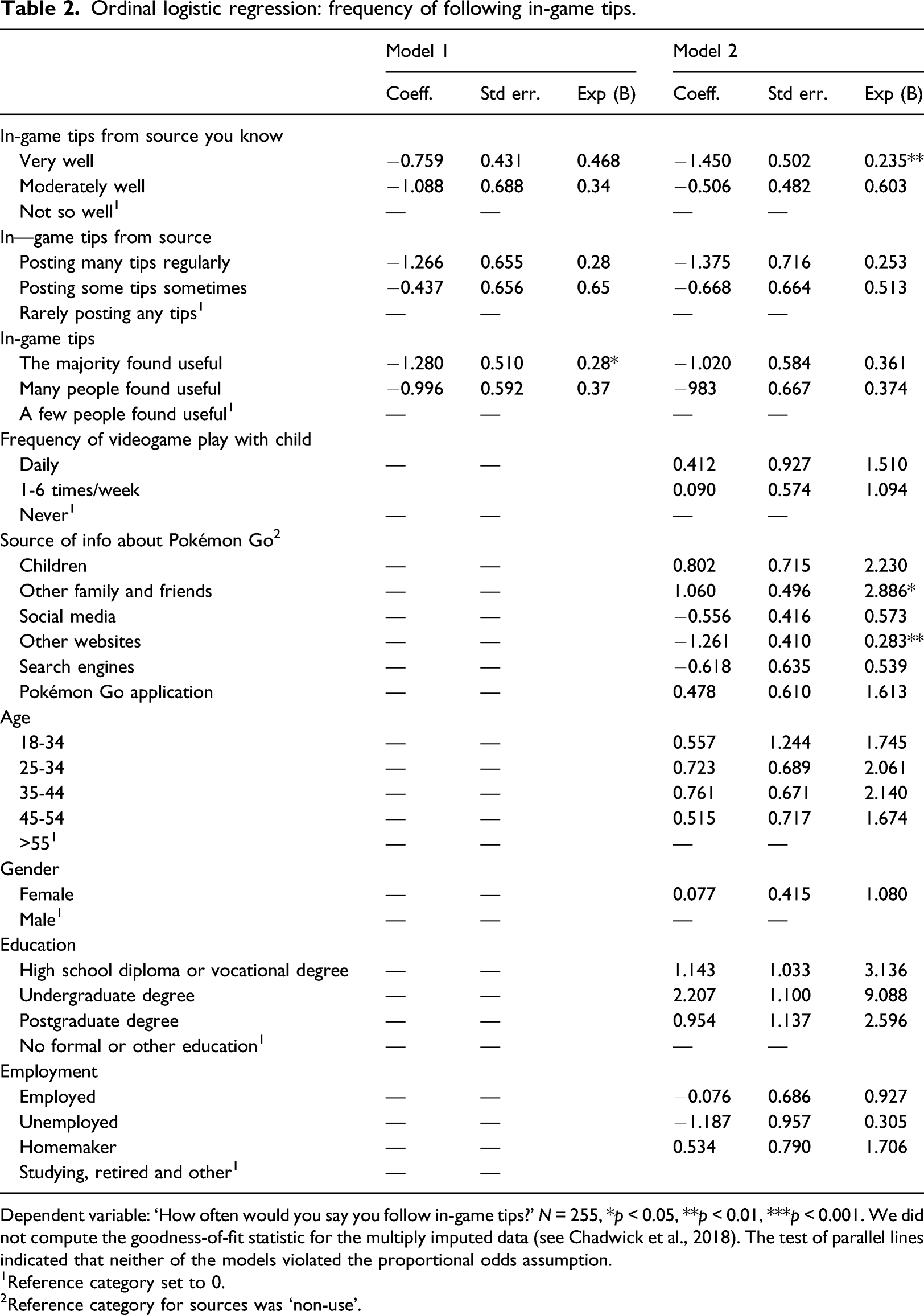
Dependent variable: ‘How often would you say you follow in-game tips?’ N = 255, *p < 0.05, **p < 0.01, ***p < 0.001. We did not compute the goodness-of-fit statistic for the multiply imputed data (see Chadwick et al., 2018). The test of parallel lines indicated that neither of the models violated the proportional odds assumption.
1Reference category set to 0.
2Reference category for sources was ‘non-use’.
In Model 2, controlling for all other factors, knowing the source of the tips well was a significant but negative predictor of the probability of following tips very often. The odds of parents and carers following in-game tips very often were 23.5% lower if these were posted by someone they knew very well. A similar theme was observed during interviews, with participants seemingly gaining information from individuals they did not know, but who had commented on related forums. Indeed, when the acquisition of game knowledge online was brought up, participants did not discuss forums in a manner that suggested familiarity with the individuals whose information they used. I try to do my research on the computer and see what people say about it. And what the community of people say about it. Because on Discord, the chat thing, I’ll go like is this place a good place to go to for Pokemon and you know, people will give their input, like those people that have been there before and what not. (Kim, female, 38) So, I’m the one that joined them and then I’ll, you know … I’ll be like, ‘Oh I heard on the forum that there’s a raid on this day’. (Jane, female, 42) Also things like Discord where we’ve got enough people who play way more frequently than we do, to give tips and say, ‘Okay, you’re going to have more success in this area if you head over here’. (Leona, female, 45)
Likewise, sourcing information from websites other than social media was a negative and significant predictor of frequent imitation. The odds of parents and carers following tips were 36% lower if they sourced their information about Pokémon Go from other websites than if they did not. Conversely, sourcing information from family members other than their gaming children and from friends was a positive predictor of following in-game tips very often. The odds of parents and carers following in-game tips were nearly three times higher if they sourced information about the game from other family and friends than if they did not. Frequency of posting by the source or the extent to which these were seen to be useful did not predict the odds of following in-game tips. None of the socio-demographic controls were significant predictors in Model 2.
Discussion and conclusion
Results from the ordinal logistic regression highlight multiple avenues for further exploration. First, reflecting on
In other words, frequency of imitation was predicted by differential association with secondary peers but not by the frequency with which these posted tips (cf.
Likewise, majority-biased learning (see
We did not find any socio-cultural patterning of imitation. However, we observed a significant dynamic in differential association which we submit for future investigation. The odds of following tips increased if parents and carers sourced information about the game from friends and family, which was linked to a decrease in the odds of sourcing those tips from someone on a forum or page who they knew very well. On this basis, we would hypothesize that primary and secondary peers reinforce imitation as parents balance in-game tips with other information about the game. In the last instance, this exploration invites further systematic treatment of social learning that expands the theoretical focus to include other social learning strategies; and that overcomes some of the methodological shortcomings of this article, to which we now turn.
Considering the limitations of our research design, two prominent ones were sample size and breakoff. A new iteration of the survey would have to address these issues while further expanding the pool of outlets where it was disseminated among parents and carers. To be clear, while the use of social media as a source of information about Pokémon Go did not bear a relation to the odds of following in-game tips, a further test of this relationship should be undertaken with samples recruited from a plurality of websites.
Equally, we would advocate further exploration of learning strategies, for instance to include payoff-biased learning in a survey experiment. Payoff-biased learning is the strategy of imitating highly successful individuals in one’s social group (Mesoudi, 2011). Foregoing experimental research into human social learning revealed payoff-biased social learning as the most likely strategy to be embraced by participants when presented with social information regarding both the most successful and the most popular solutions to a task (Mesoudi, 2011: 340). Importantly, our consideration of majority-biased learning was exploratory, relying on a single survey item. To advance this research agenda, we advocate the development of a learning strategy index for JME, for instance through an adaptation of Mesoudi’s (2011) general taxonomy of human social learning strategies.
Additional exploration along these lines was also prompted by our interview data. For the most part, interview participants seemingly followed information gained online from sources they deemed as being knowledgeable about the game – someone perhaps markedly different to themselves and their peers. For such participants, then, and perhaps predicated on the anonymity of online interactions (Amichai-Hamburger, 2013), we would suggest the acquisition of knowledge involved an imagined other deemed as being more successful at the game by virtue of their activity on Pokémon Go forums and pages. In other words, the actual success of others did not foreshadow imitation, but rather the assumption of this success. Future studies should, therefore, spend more time attending to payoff-biased learning in the context of this HRG, in order to reveal the intricacies of this process.
Finally, this study offers a meaningful extension of the scholarly work that commonly surrounds locative games such as Pokémon Go (Saker and Evans, 2021), with associated research generally attending to the physical, spatial, and social implications of pervasive play (Evans and Saker, 2017), as opposed to the social learning underpinning HRGs. Accordingly, the beginning of our article mapped out the field of JME, which has generally pondered the effect of play on familial relations (Schreiber, 2019; Siyahhan et al., 2010; Vanden Elzen and Vanden Elzen, 2019), rather than social practices that facilitate intergenerational play. While our direction is established from the offset, this is not to suggest that the current research does not underline the relational benefits of JME in this context. Both parents and carers of children alike were not just committed to playing Pokémon Go, but to playing this game together. By bridging these fields, we hope our research casts a more nuanced light on both intergenerational play and locative games. Moreover, it is our hope this project will lead to future studies that examine how social learning might facilitate the co-playing of games, and equally, how the pleasure of locative games might extend beyond explicit acts of play.
Footnotes
Funding
The author(s) disclosed receipt of the following financial support for the research, authorship, and/or publication of this article: This article was supported by City, University of London Research Pump-Prime Funding; grant no 330915.
