



Abstract
This article focusses on the musical history of the telephone, an aspect of telephonic history that is often overlooked and has not yet received systematic academic attention. The article is structured around two musical themes of telephonic history: (1) public performances of telephones as musical instruments and (2) the telephone network as musical instrument. Two historic periods are considered for both themes, (a) the late 1800s/early 1900s and (b) the late 2000s. The article’s approach draws loosely on media historic and media archaeologic perspectives to analyse existing material about telephone history (with a musical focus) alongside empirical field work on the musical use of mobile phones in the late 2000s. The results contribute to debates regarding the ‘newness’ of media, and to sound studies approaches to media histories. The article shows how the theme of the musical telephone has been re-occurring but often overlooked throughout its history, and also sketches out a future research agenda. The article contributes a new understanding of the musical uses of the telephone across history, relevant for both understanding contemporary uses of telephone technologies such as smartphones and the Internet of Things, and for a richer understanding of historic telephone uses.
Introduction
This article focusses on the musical history of the telephone, an aspect of telephonic history that is often overlooked and has not yet received systematic academic attention. The article loosely draws on Huhtamo’s (1996) and Parikka’s (2012) concept of ‘media archaeology’ to critically interrogate claims around the newness of musical uses of the telephone that were frequently made in the late 2000s when smartphones and apps became quickly popular in well-off cultures and countries. Huhtamo mentions the sense of deja-vu one experiences when encountering topoi in media history, as they are examples of a cyclical, not linear development (1997). I had one of those deja-vu moments when after my initial fascination with the ‘new’ way of using mobile telephones as musical instrument in the 2000s, I researched the history of the telephone and realised that its early days were actually very musical ones. This article re-examines existing media historic material regarding the early history of the telephone with a musical focus and then connects it to primary empirical field work around the musical use of mobile phones in the late 2000s. Together, the analysis of the material illustrates how musical uses of the telephone are not ‘new’ but a re-occurred throughout history.
Balbi explains how ‘the new becomes new through a phase of “astonishment” in which society sees a new medium as something disruptive with no ties with the past’ and the associated ‘shouting about newness helps to enforce it’ (Balbi, 2015: 239) and this will come through in the material analysed for this article, especially the press material. With its focus on (1) the early days of the telephone and (2) the phase of rapid uptake of mobile/smartphones, this article is looking at two moments of ‘cultural innovation – during which media develop new social uses’ which have not become ‘social mainstream – the point at which media are no longer new’, to use two steps of Peter’s five-step model (Peters, 2009a: 19). This long duréé approach is an example of ‘media scholarship’ considering ‘media as renewable (rather than as only new or not)’ (Peters, 2009a: 15). Goggin observes that ‘[m]any other aspects of telephone media were sketched out but not realised in the late 19th and early 20th centuries’ and I would argue that the musical use of the telephone is one of them – also with regards to resurfacing: ‘[a]t various times telephone media surface once more – yet nowhere as insistently as with the development of the mobile phone and the explicit emergence of mobile media in the 21st century’ (Goggin, 2011: 244).
This article also takes a sound studies (Bull, 2018) approach, in focussing on the sonic elements of telephonic history. In his chapter ‘Sound Studies for Historians of New Media’, Scott states: ‘Sound Studies supports an expanded scope of inquiry, new research questions and productive avenues of investigation for historians for new media, not only into neglected histories of audio media but also into the neglected audio of and among all media’ (Scott, 2011: 75).
Publications dealing with the cultural and social history of the telephone and communication technologies, or those focussing on historic aspects of electronic music, include minor mentions of musical uses of the telephone, but these are short and scattered across the literature. More recent musical uses of the telephone have been largely around mobile phones, and they have been discussed in the areas of mobile media/technology (Behrendta, 2012; Behrendtb, 2012; Gaye et al., 2006; Gopinath and Stanyek, 2014) but not within the context of telephonic history. Here, these perspectives and materials are brought together in a systematic way for the first time. It therefore contributes a new and sonic perspective on historic and contemporary uses of telephones and does so with an international perspective. The results could be of interest for researchers from several fields, including media and communication studies, history, science and technology studies, sound studies, musicology, and to a lesser extent, designers and computer scientists with an interest in musical and telephonic interactions across history.
Rather than following a chronological approach, this article is structured around two musical themes of telephonic history: (1) public performances of telephones as musical instruments and (2) the telephone network as musical instrument. Two historic periods are considered for both themes, (a) the late 1800s/early 1900s and (b) the late 2000s. This follows Balbi’s suggestion that ‘in order to fully understand the natures of media, old and new media must be studied together and cannot be perceived as two separate stages in media lives’ (Balbi, 2015: 244). Working comparatively across these periods and themes, ‘create[s] a fuller sense of the history of media that becomes possible only when considering more than one set of media practices’ rather than to just ‘show that we’ve been there before’ (Park et al., 2011: xv).
Methodology and material
In addition to the theoretical framing of media history approaches set out in the introduction, this article also loosely draws onto media archaeology in its methodical approach.
This article works with media archaeology as ‘a way to investigate the new media cultures through insights from past new media’, a way ‘where the past might suddenly be discovered anew’ (Parikka, 2012: 2–3), as its starting point was mobile phone culture in the 2000s, which is then further investigated by bringing in material from the late 1800s/early 1900s. Huhtamo and Parikka set out that ‘Media archaeology rummages textual, visual and auditory archives as well as collections and artefacts, emphasizing both the discursive and material manifestations of culture’ (2011: 3). The examples from the late 1800s/early 1900s discussed in this article are based on some archival rummaging, as explained below.
This article’s methodology is inspired by media archaeology’s work with topoi but does not use them as analytical tool. Instead, it takes an approach that uses ‘themes’ and ‘resonance’. For Huhtamo, topoi facilitate ‘a conversation’ between ‘media-cultural evidence for clues about neglected, misrepresented, and/or supressed aspects’ of both the past and the present (Huhtamo, 2011: 28). The themes identified in this article also facilitate such a conversation, but without exploring a topos in detail, that is, ‘a stereotypical formula evoked over and over again in different guises and for varying purposes’ that also ‘influence[s] the development of media culture’ (Huhtamo, 2011: 28). Huhtamo differentiates between three different roles of topoi in media culture. For this article, their role as ‘commentaries and elaboration of media-cultural forms, themes and fantasies’ is the most relevant (Huhtamo, 2011: 34) and informs its ‘theme’ approach. Huhtamo also suggests that topoi function ‘as a kind of discursive buffer softening the shocks caused by encounters with new media and the mediated environment’ (Huhtamo, 2011: 37), which is arguably the case for both historic periods under investigation here. This article’s themes also ‘mak[e] sense of this intriguing network of interconnections’ between past ‘cultural phenomena’ at different points in time (Huhtamo, 2011: 41). Drawing on sound studies methodologies (James, 2019), this article understands these themes as drawing out resonance across different points in media history.
For the first historic period this article considers (the late 1800s and early 1900s), it draws on material from existing contributions to the history of the telephone such as Ronell’s (1989) Telephone Book , an experimental book echoing the form of a switchboard where she asks us to ‘read with your ears’; Briggs (1977) chapter on the telephone broadcasting services, and Marvin’s (1990: 3) ground-breaking work. The article draws on these and other existing works on the telephone, focussing on material that relates to the musical side of telephonic history, plus some works from musicology that mention musical uses of the telephone, thereby bringing together material from the history of music (and musicology) with the history of communication technologies. A limitation of this approach is that it only draws on previous historical research, without using primary sources. For future research on this topic it would be interesting to carry out an analysis of primary sources, for example by engaging with material from historic archives.
For the second historic period, this article considers (the later part of the first decade of the 21st century), it draws on empirical field work carried out around two case studies in 2007 and 2009. For the case study, ‘Pophorns’, the material comprises observational field work conducted at a music festival in Sweden on the 7th–8th of September 2007, two interviews with the artists, and a variety of material from the project website. For the case study ‘iPhone Ocarina’, material was collected in 2009 and includes relevant press articles, the websites of the makers, forums contributions of ‘Ocarina’ players sharing their experience, and YouTube videos of people playing the ‘Ocarina’.
Public performances of telephones as musical instruments
In the mid to late 2000s, mobile phones, smartphones and ‘apps’ quickly became part of mainstream culture. As with most moments of rapid uptakes of technologies, there was a strong discourse around the novelty of using phones for all kinds of uses that were perceived as not previously have been ‘telephone’ activities or features (e.g. photo camera, torch, and diary.). Using mobile phones for making music was one of these perceived novelties. This section provides a detailed analysis of one of the early examples of mobile phone music making in the late 2000s – ‘Pophorns’ – and it is particularly interesting how important public performances and demonstrations were with regards to illustrating the ‘newness’ of music making to the public.
‘Pophorns’ (2007) by Sandelin and Torstensson (working together as ‘Unsworn Industries’) were a family of musical applications that you could install on your mobile phone. The project website explained ‘“Pophorns” acknowledge the mobile phone as a platform for active and social auditory creation, and aim to shorten the distance between pocket and musical action’ (Torstensson and Sandelin, n.d.).
Each of the three Pophorns was designed to do specific musical tasks. The software was written in the programming language Java and needed to be downloaded and installed on the phone. It was developed for specific kinds of ‘Sony Ericsson’ mobile phones. These hardware and software details show that this is an early example of mobile phone use for music making (Gaye et al., 2006); For other early examples see (Kirisits et al., 2008), compared to the mainstream smartphone and app use emerging a few years later.
The three different kinds of ‘Pophorns’ were called Ophonine, Boomshakular and Corduroid (see Figure 1). To play the Ophonine ‘Pophorns’, players had to press and hold the ‘cursor’ button to records sound. Upon release of the button, the recorded sound is automatically played as a loop (until you record a new sound or quit the application). During the interview I conducted with the makers, as examples, they recorded their own whistling, said ‘record a loop’, and knocked the phone on the table to create a rhythm. The Boomshakular Pophorn name was inspired by its sound ‘you can make Boom Shack [Makes this sound with the phone, imitating a rhythm of bass drum and hi hat]’, as Sandelin explains. Players create a rhythm by playing the drum sounds assigned to each phone’s keys, and then looping the beat ‘with the same timing’ by pressing the star key. The Corduroid Pophorn’s loops were made up of the buzzing sound of the vibrating alert of the mobile phone (length of key pressed corresponds to the length of the note). The surface you put your phone on changes the buzzing sound. For all three, in addition to the sounds produced, there was also a visual element, with a large comic-style face flashing in the rhythm of the sounds on the mobile phone screen (see Figure 2). The ‘Pophorns’ on a table at the ‘Full Pull’ Festival in Malmö. Author's illustration. Screenshot of the Ophonine ‘Pophorn’ on the project website and includes a partial image of the relevant mobile phone screen. Author's illustration. 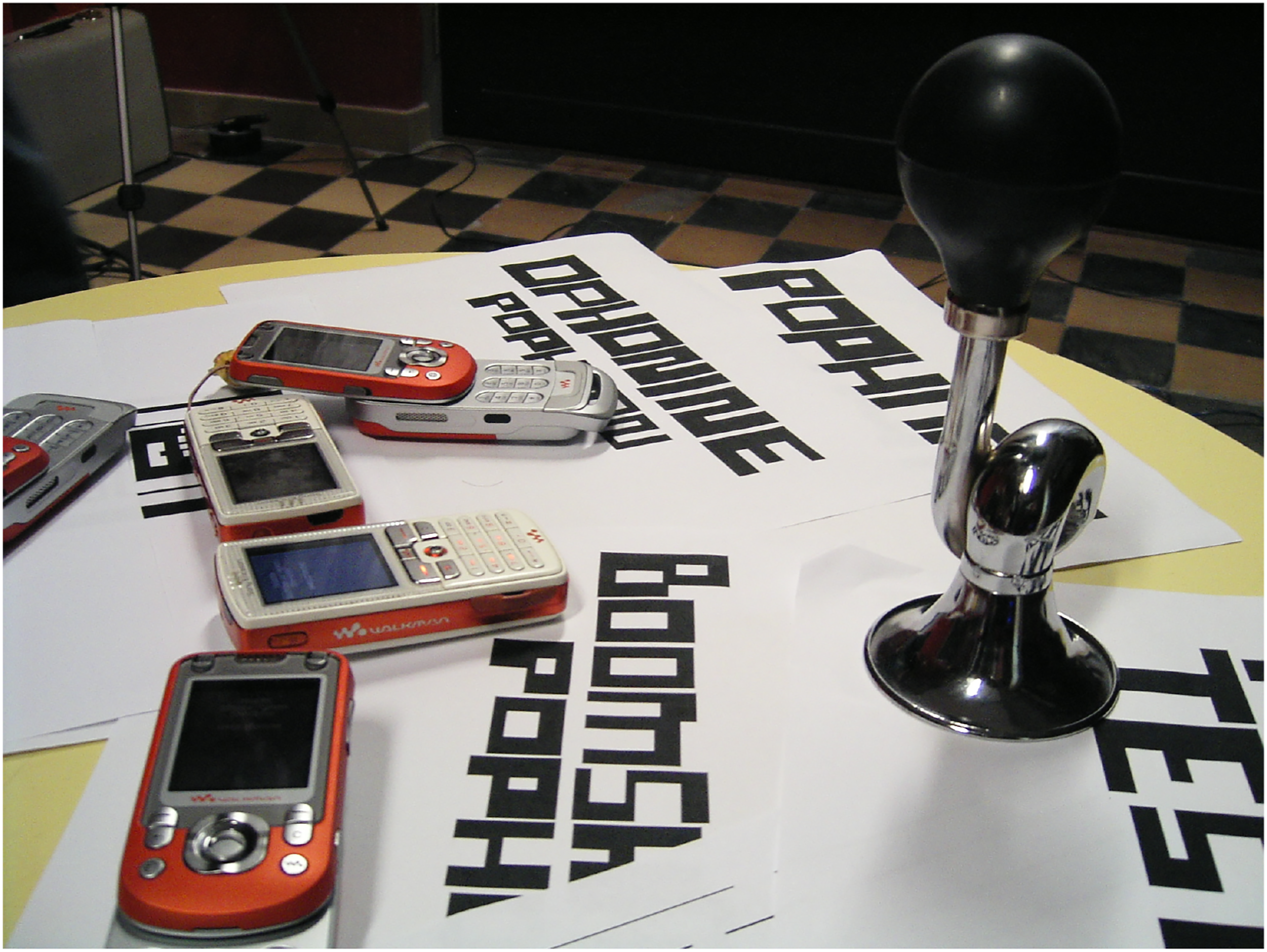
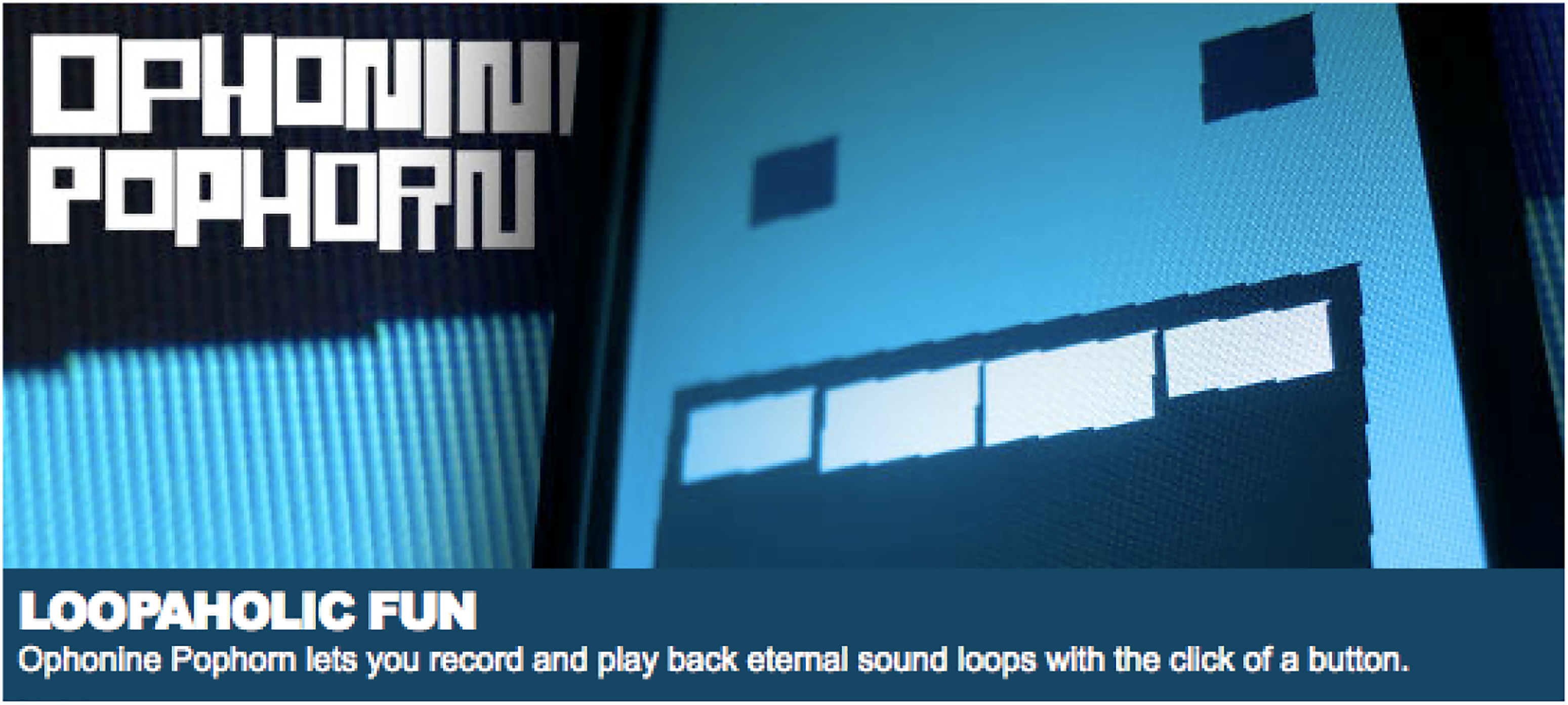
Torstensson and Sandelin were critical about making mobile phone versions of existing music software from the PC world, as those usually suffer from the small screen of the mobile devices. The artists are interested in ‘the way we use these things [mobile phones] way different than the PC. I don’t want to be performing while [gesturing, pretending to stare at the screen] like looking though a microscope’. The idea is that ‘Pophorn’ players do not need to look at the screen to play but it is ‘flashing [...] for performative purposes’. The 'Pophorns' shift the role of the screen from interface to performative display. It is interesting to note that the designers discuss the ‘Pophorns’ within the history of computer music making, rather than mentioning telephone history.
The ‘Pophorns’ do not take advantage of the network connectivity of mobile phones and for the designers this ‘offline’ use is an ‘important aspect […] the local, social attitude. I mean phones are mostly for communication across distances. But you see a lot of people hanging out at street corners and just listening to mp3s and stuff’. This means that it is the telephonic device that becomes the musical instrument, while the telephonic network is not needed for it.
One of the scenarios Sandelin and Torstensson envision for the ‘Pophorns’ are public performances/demonstrations of the ‘Pophorns’, where larger numbers participate. In the late 2000s, it was ‘new’ to make music with these mobile telephones, and the public‘Pophorns’ performances showed how this worked. Sandelin and Torstensson have presented them at festivals, as a kind of public installation or performance (e.g. ‘Bogotrax’ in Bogota and ‘Pixelache’ in Medellin, both 2007). At the public 'Pophorns' performance in Bogota, Sandelin and Torstensson connected the Ophonine 'Pophorns' to an amplifier and speakers. Sandelin recalls: ‘People normally, (...) don’t voice [their] opinion publicly. (...) And a lot of people were recording criticism towards the [local] government. So if you’re doing it through a phone, maybe it feels like something changes’. Figure 3 shows a similar set-up (to the one in Bogota) at a festival in Medellin where there were about 200 people on the square and ‘of course they weren’t really used to this set-up that you have to provide some input yourself. But then when there were less people more people dared to try’. A public ‘Pophorns’ performance at a festival in Columbia (2007). Photo by Eric Sandelin. 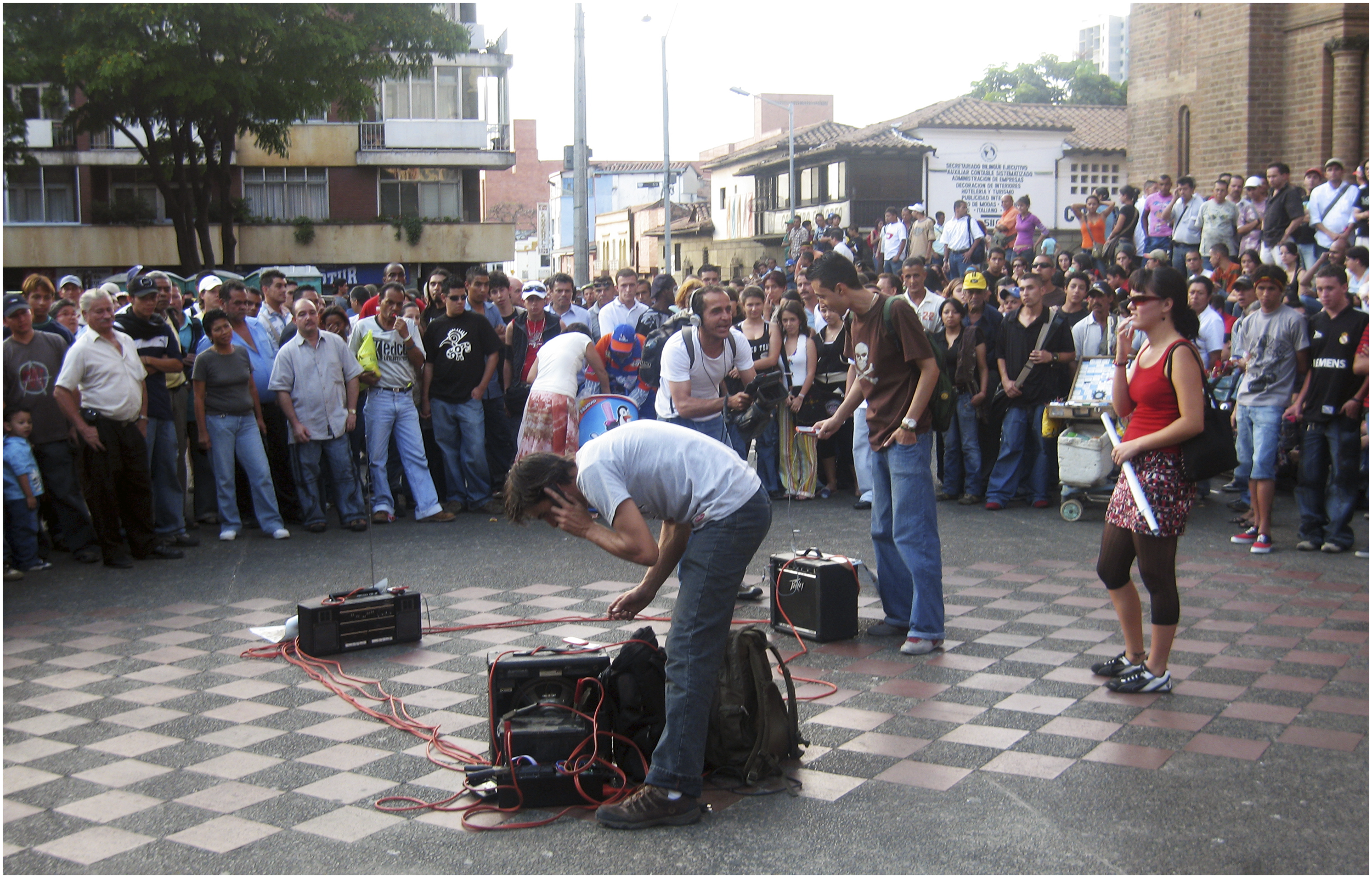
A second scenario for the ‘Pophorns’ is for them to be played by performers on stage and the musician ‘Bora Yoon’ used it in a performance in New York, as covered in the Wall Street Journal: ‘Cellphones are a notorious audience distraction at musical performances – ringing, buzzing and beeping and giving conductors fits’ (Sharma, 2007). And the article continues: ‘But for some avant-garde electronic artists, cellphones themselves are musical instruments that can be incorporated into rock, hip-hop and even modern classical music’ (Sharma, 2007) (see also Figure 4). ‘Pophorns’ in a concert performance in New York City (2007). Photo from article by Amol Sharma. 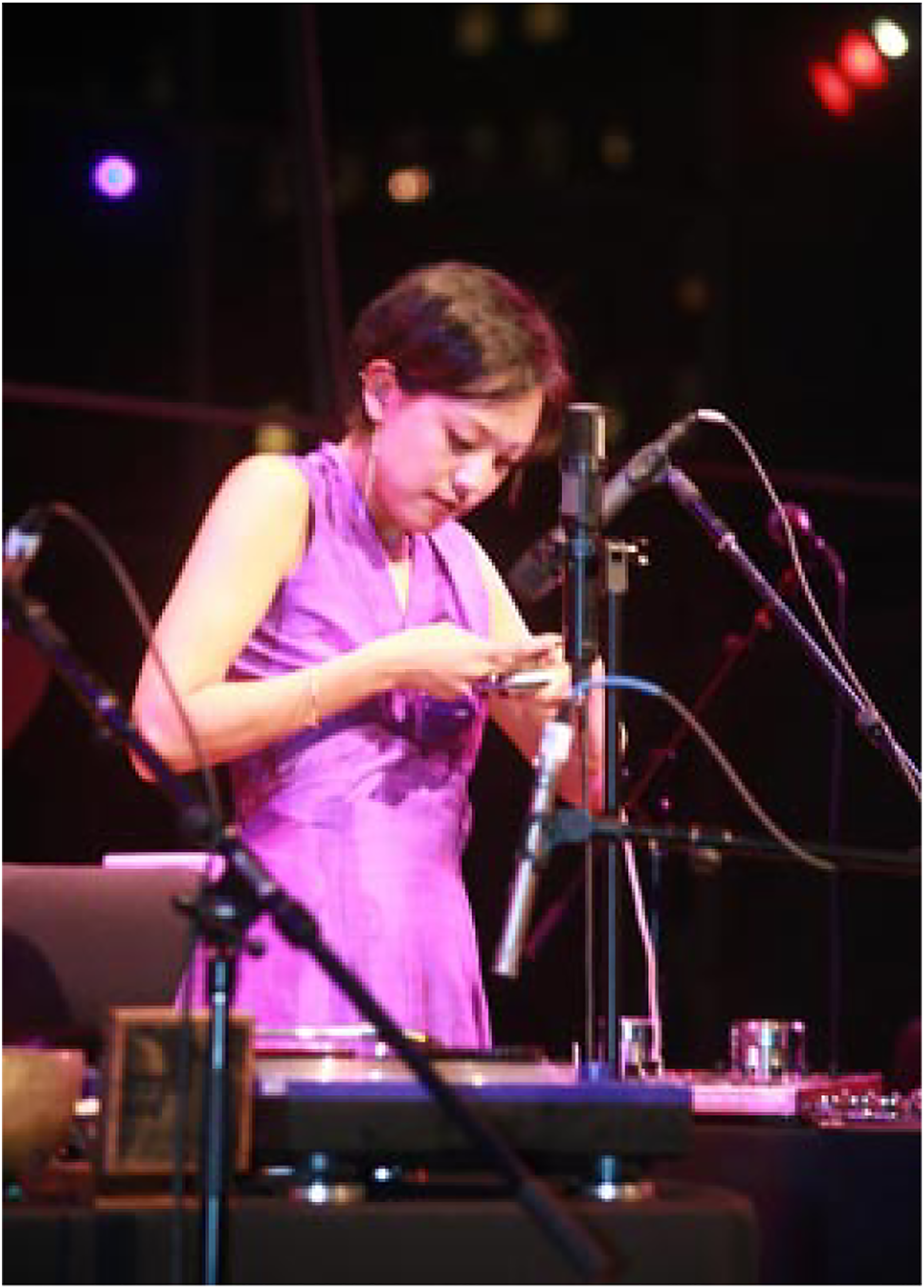
The 2007 material presented illustrates how public performances and demonstrations of the ‘Pophorns’ were a key aspect of showing to the public how the ‘new’ technology of using mobile phones for music making works. For the members of the public trying out Pophorns at festivals, there is a novelty factor to making music on phones, and the press coverage of musicians using the Pophorns calls the use of telephones for music making ‘avant-garde’. Using mobile phones for music making in public performances could be understood as part of a phase of ‘cultural innovation’ that new media go through and where ‘they develop new uses’ (Peters, 2009a). At the same time, there is also some resonance with Huhtamo’s media archaeological concept of the topos, specifically with one of topoi’s three roles: ‘commentaries and elaboration of media-cultural forms, themes and fantasies’ where they function ‘as a kind of discursive buffer softening the shocks caused by encounters with new media and the mediated environment’ (Huhtamo, 2011: 37). Topoi also facilitate ‘a conversation’ between ‘media-cultural evidence for clues about neglected, misrepresented, and/or supressed aspects’ of both the past and the present (Huhtamo, 2011: 28). This perspective informs the historic exploration of the theme of public performances of telephones as musical instruments that follows, identifying resonance between the 2007 telephone demonstrations of the ‘Pophorns’ and the role music played in the early days of musical history.
Discussing the origins of the term ‘Telephone’ Young states that ‘early associations were with music’ (1991: 2), and he lists several devices that were used to produce loud sounds, for example, fog horns on ships that were called ‘Telephone’ (see Figure 5). This non-electric fog-horn-like device transmitted information via sound signals and could be understood as another musical footnote of telephonic history as it seems to have operated in a similar fashion to Russolo’s ‘intonarumori’. The foghorn ‘Telephone’ (1844). Figure from: Young, Peter. Person to Person: The International Impact of the Telephone. Cambridge: Granta Editions, 1991.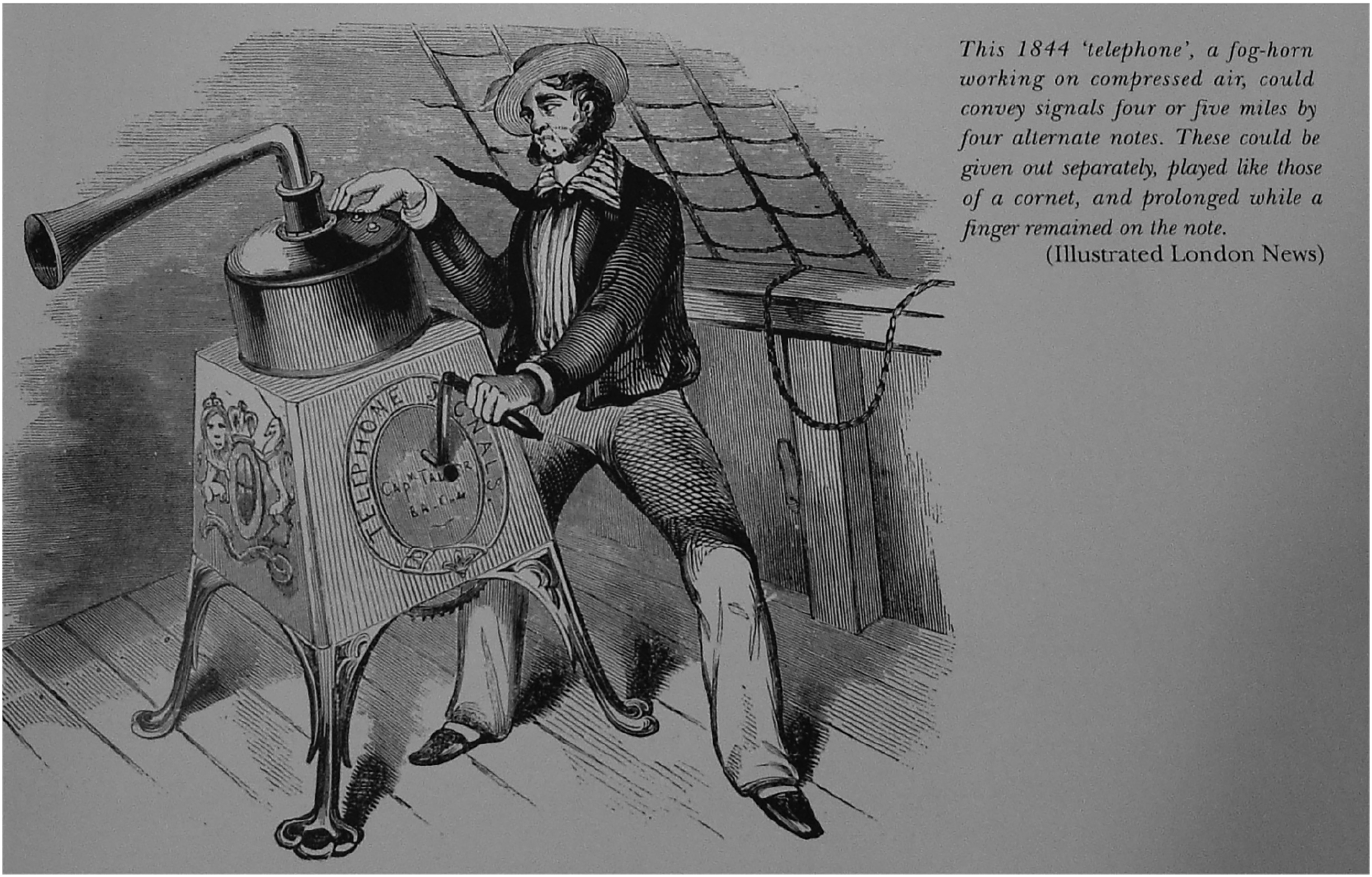
The invention of the telephone has been a long process and although Alexander Graham Bell tends to be given prominence, others also need to be credited (Aronson, 1977; Weidenaar, 1995; Young, 1991), including Gray’s patent for the ‘Electric Telegraph for Transmitting Musical Tones’ (1875) and his public concert with it in 1877 is often credited as the first ‘concert of electronic music’ (Jerusalem, n.d.) (see also Figures 6 and 7). Gray’s ‘Electric Telegraph for Transmitting Musical Tones’ (1875). Figure by Simon Crab. A concert with Gray’s ‘Musical Telegraph’ in 1877. Figure by Lauries Spiegel. 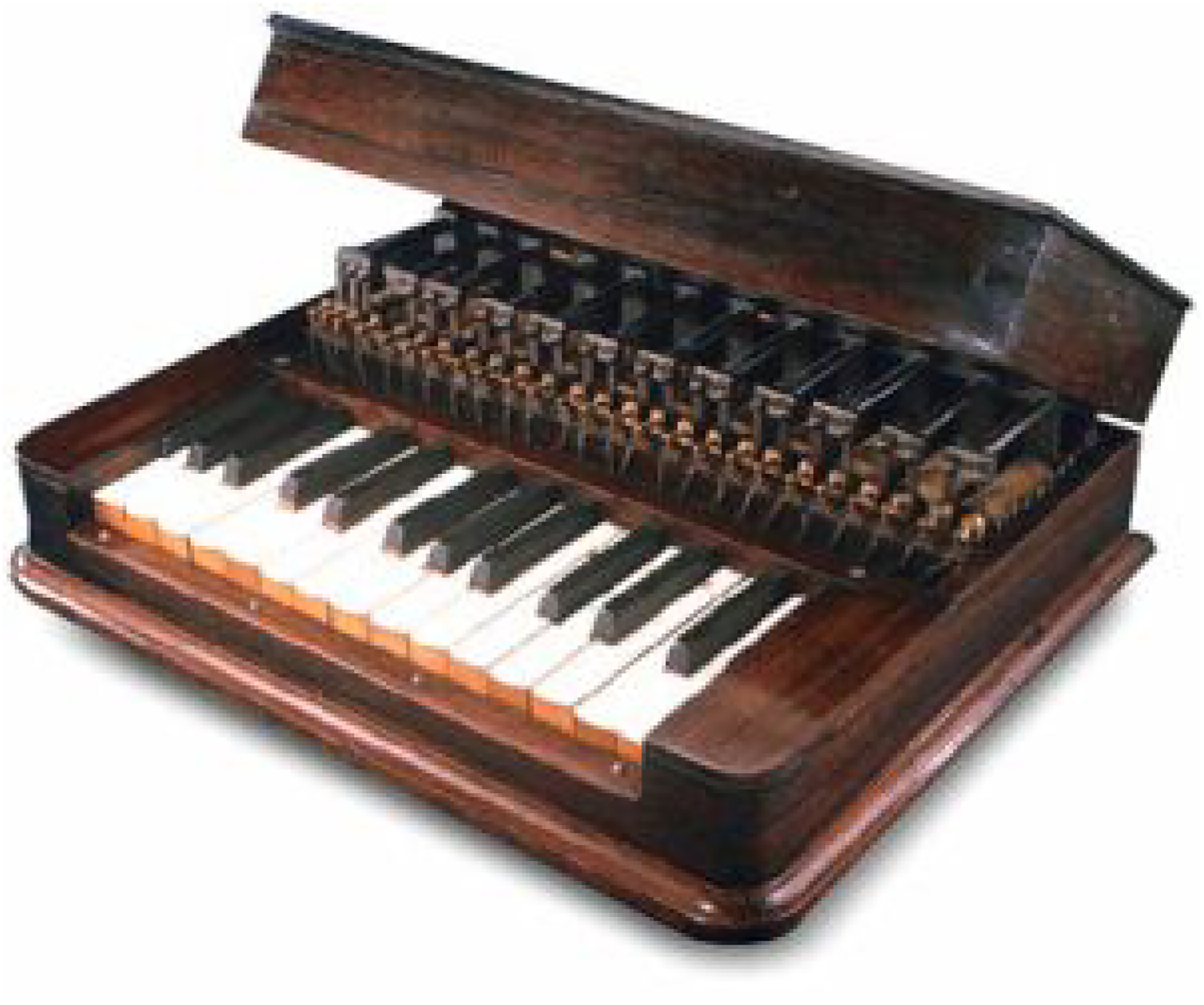
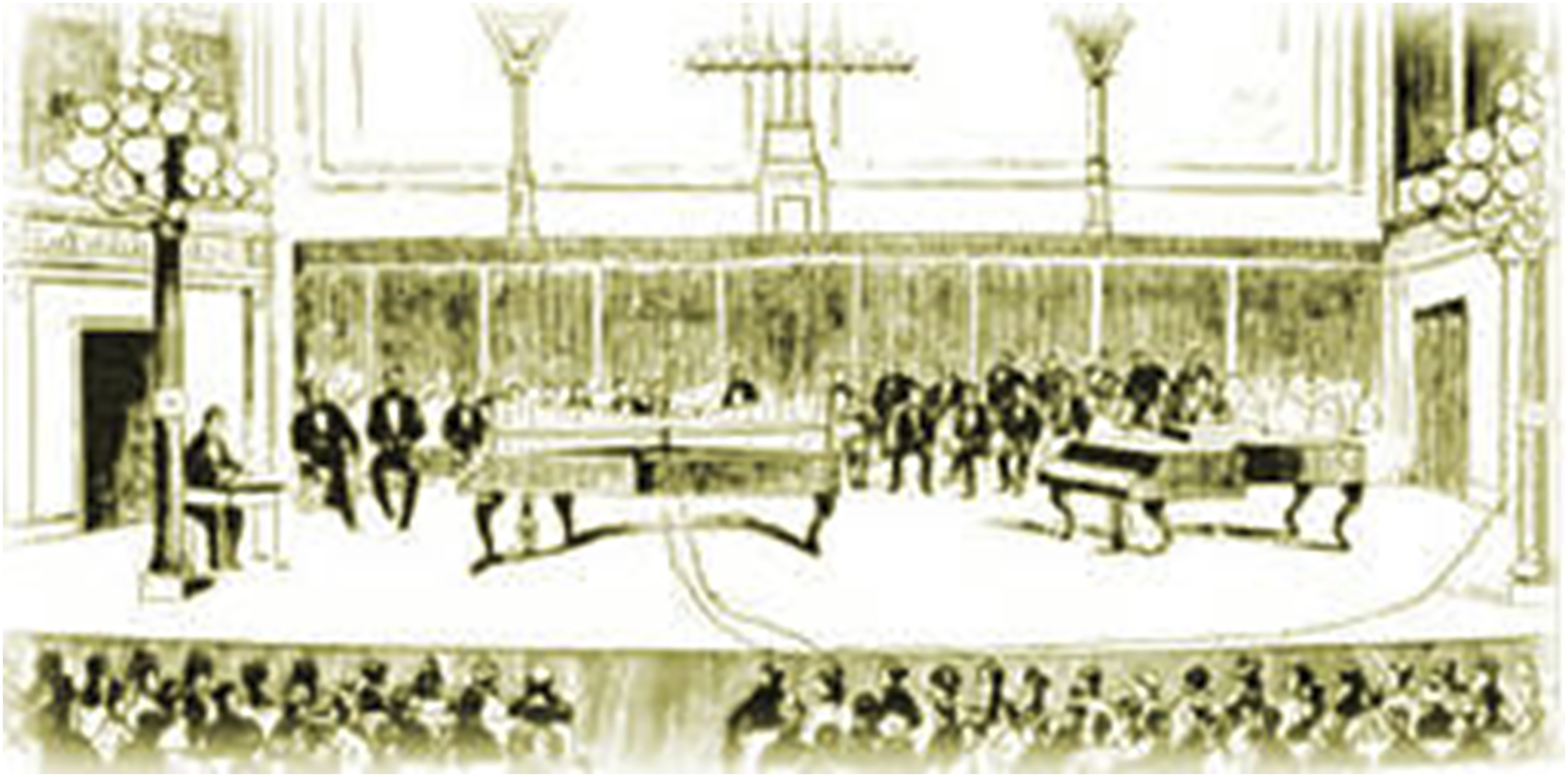
After Alexander Graham Bell had secured the Telephone patent in 1876 and developed it further, he needed to convince the public that this was a useful invention, in a time when most people found that the Telegraph served their long-distance communication needs nicely; and he chose public musical performances to make his case. Public performances of the telephone took place from the year of its invention onwards. For these occasions, Bell and Watson stage performances transmitted music from one place to the other: ‘in a series of double acts, with Watson some miles away bellowing and singing to the audience in the lecture hall. The favourite song with the audience was Do Not Trust Him, Gentle Lady’ (Young, 1991: 10).
Already for the first presentation of his invention, at a meeting of the American Academy of Science and Technology in 1876, Watson chose to transmit music, the song ‘Old Hundred’ played by an organ in his remote office. In the following year, he and Watson were touring the US doing these presentations of ‘Bell’s speaking and singing telephone’ (Fischer, 1992). Some of their performances even included a singer, brass band and a cornetist (Aronson, 1977: 21), and on one occasion, bishops and priests in the audience spontaneously sang back through the telephone when they heard a voice singing from the other end of the line (Fischer, 1992).
Aronson (1977) gives two reasons for Bell’s telephone music events. First, the inventor had worked on improving the phone’s quality by building separate receivers and transmitters, with the result that it was not possible to transmit and receive with the same device. The second reason was that Bell needed money and the telephone performances were an opportunity for him to earn some, and he continued the performances even after two-way-communication over telephone was possible by autumn 1876. Briggs describes how ‘telephone concerts’ were promoted where young ladies sing popular songs to private homes and ‘central premises’, which could even be in other towns (Briggs, 1977: 42).
The use of the telephone as a communication technology was not apparent for most people at the time when the telephone was invented as everybody was used to the telegraph for this purpose. Even the director of a big telegraph company dismissed the ideas as ‘electrical toy’ (Aronson, 1977: 16). In order to find subscribers for the telephone to make his business successful, Bell needed to educate the public about his invention. Fischer gives detailed descriptions how salesmen travelled from town to town demonstrating the telephone, often using similar events as Bell to persuade new telephone customers: ‘they often unveiled in flamboyant demonstrations, usually involving the broadcast of music and speeches from one place to an audience in another’ (Fischer, 1992). In those times it was not unusual to have stage events for new technological inventions. Marvin (1990), for example, describes Bell’s performances alongside public stage events featuring electricity, by drawing on a vast number of articles that covered these events in the 19th century.
This section has illustrated how the perceived newness of using telephones for musical performances in the 2000s can also be investigated ‘through insights from past new media’, in a way ‘where the past might suddenly be discovered anew’ (Parikka, 2012: 2–3). It discussed how in the early days of the telephone public performances were often used to demonstrate the use of this ‘new’ apparatus – and these public performances were often musical ones. While for the 2007 'Pophorns' it was not the mobile telephone as a device that needed to be presented to the public (it was part of everyday life already), but the use as musical instrument that did need to be demonstrated to the public as it was rare – and perceived as ‘new’ in the late 2000s. Both illustrated the theme of public performances of telephones as musical instruments.
Telephone network musical instruments
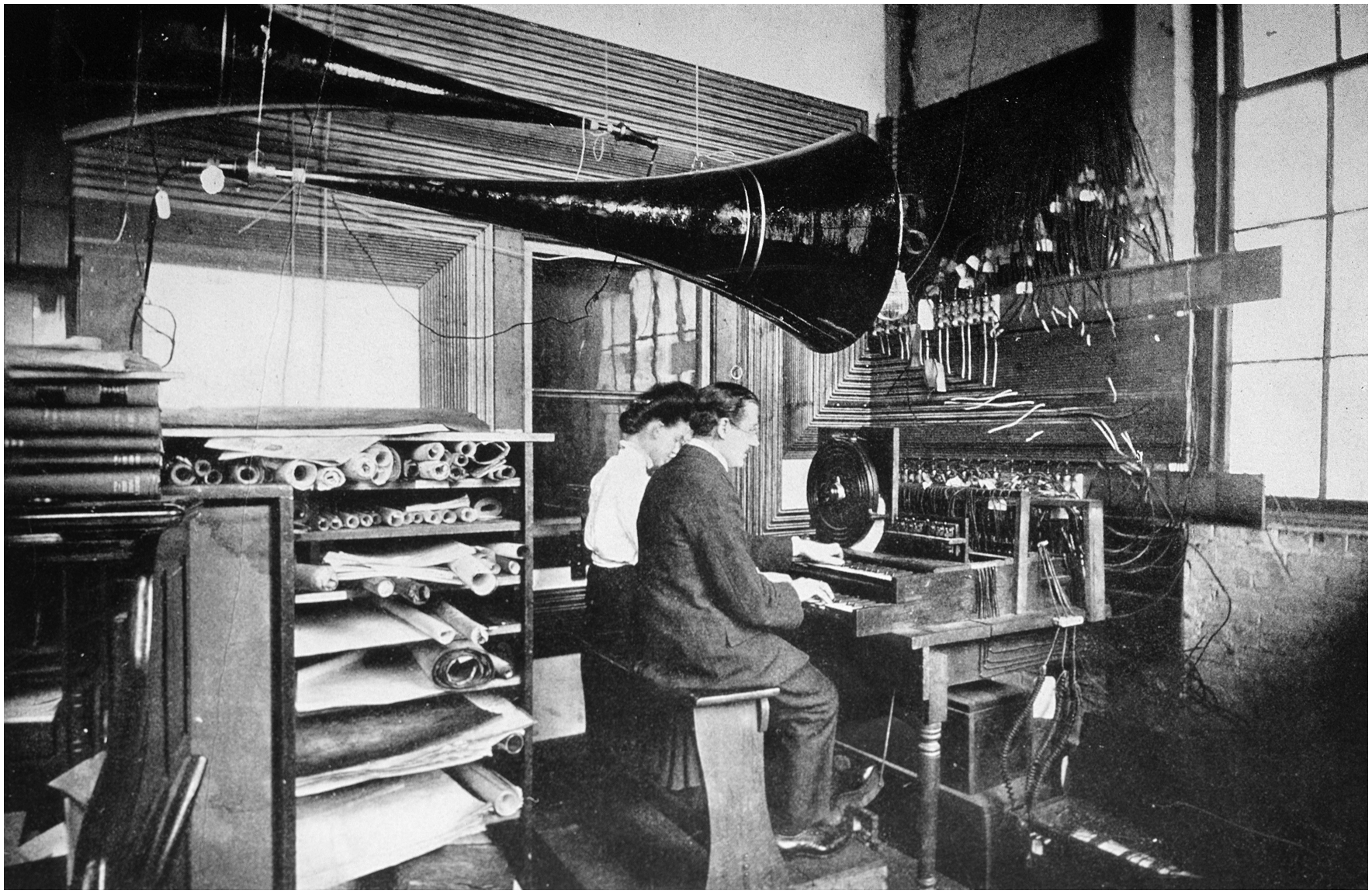
The following section focusses on the theme of using the telephone network as musical instrument, again looking at two moments in time (the 2000s, and roughly a century earlier). The 2009 musical instrument ‘Ocarina’ for mobile phones is still around at the time of writing this article, but its heyday was in the late 2000s, when the empirical material for this article was collected. The ‘Ocarina’ is an iPhone application (i.e. only available on these devices) and allows the users to play their phones in a similar way to a traditional ocarina and to perform it to remote audiences over the network. Familiarity with older and cheap musical pipe instruments means people intuitively understand how to play it, using the microphone as ‘mouthpiece’ and graphics on the touch screen as ‘finger holes’ (see Figures 8 and 9). The ‘Ocarina’ was released on 6 November 2008 (The Mule, n.d. a). The designer Wang explains the interface for playing: ‘“Ocarina” is sensitive to one’s breath (gently blowing into the microphone controls intensity), touch (via a multi-touch interface based on the 4-hole English Pendant ‘Ocarina’), and movement (dual axis accelerometer controls vibrato rate and depth)’ (2014: 493). Wang playing the iPhone ‘Ocarina’. Photo by Ge Wang. The ‘Telharmonium’ as portrayed in a contemporary newspaper article. Illustration by Reynold Weidenaar.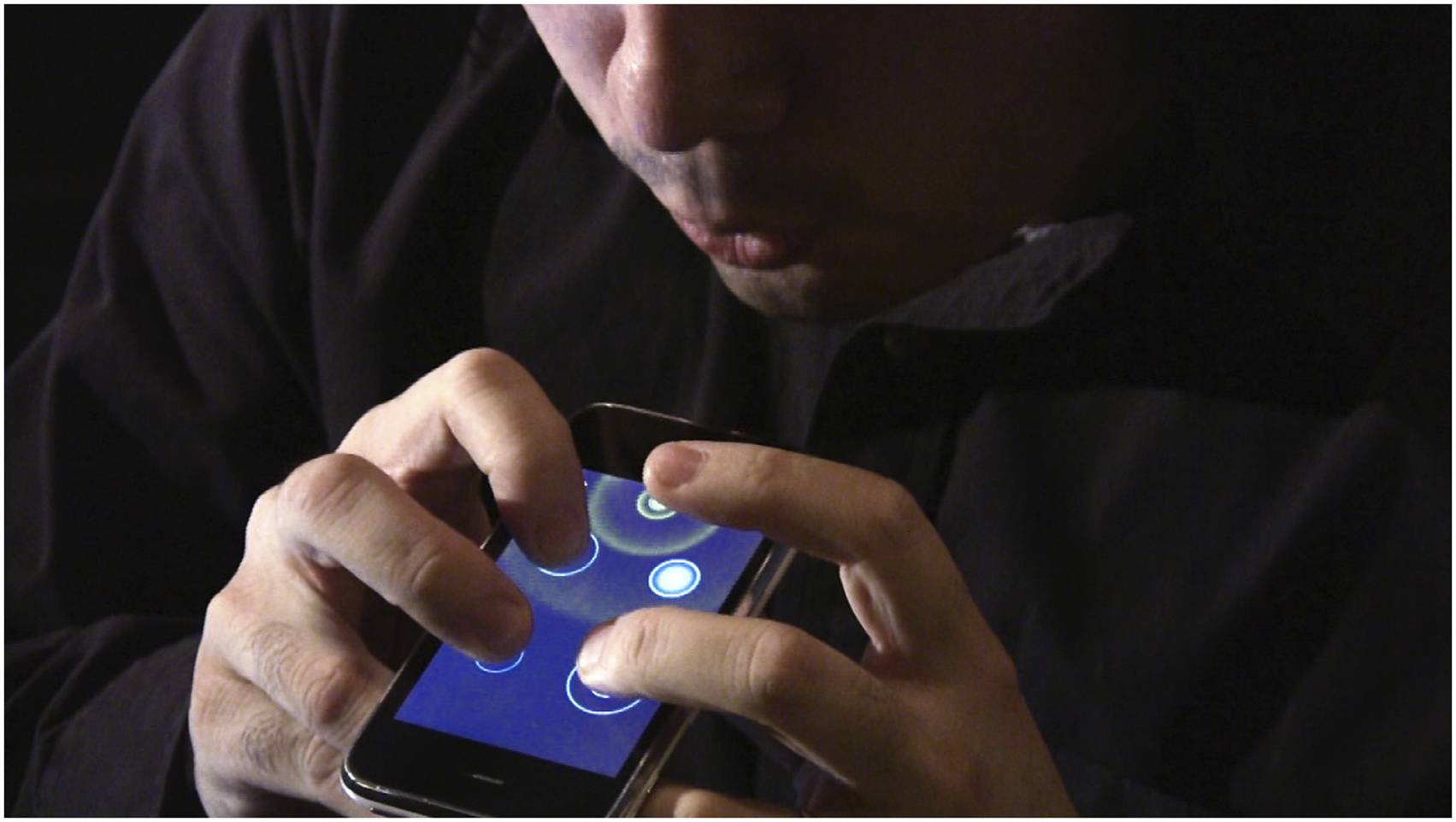
Taking advantage of the networked capabilities of the mobile phone, the ‘Ocarina’ also provides a networked element: ‘allowing its user to hear other “Ocarina” players throughout the world while seeing their location – achieved through GPS and the persistent data connection on the iPhone’ (Wang, 2014: 487). Another aspect of the ‘Ocarina’ is a web portal where players can share scores and other information. The ‘Ocarina’ application proved to be very popular: ‘Within 4 days of its release, it became the No. 1 best-selling app on the [Apple app] store’ Wang is cited in USA Today (Graham, 2009). By the end of November 2008, the application had been played on more than one million iPhones and in summer 2009 it was one of Apple’s ‘All-time top 20 Apps’.
The excitement in the press about the ‘Ocarina’ becomes apparent in the following comments: ‘The remarkable “Ocarina” app [...] transforms this most up-to-date of contraptions into an instrument that dates back 12,000 years by harnessing the iPhone’s built-in features in a wonderfully creative way’ writes the PC magazine (Topics and Camera, n.d.) and the New York Times notes: ‘It’s one of the most magical programs I’ve ever seen for the iPhone, and probably for any computer’ (Time, n.d.). The same author adds: ‘It’s a brain-frying experience to know that you’re listening to someone else playing “Ocarina”, right now, in real time, somewhere else on the planet. (And then you realise that someone, somewhere might be listening to *you*!)’ (Time, n.d.). These comments illustrate the usual buzz of ‘new’ technologies and media.
The press was also excited by the fact that this was a commercial success. There are numerous articles discussing the business side of the company behind the ‘Ocarina’, such as The Guardian: ‘The iPhone “Ocarina” is the sound of serious money’ (Naughton, 2009) or Newsweek that reports that smule is already profitable at the end of 2008: ‘Smule, which originally set a goal of taking in $100,000 in revenue this year, instead will end up making closer to $1 million’ (Walesa, n.d.). The press material serves as example of ‘shouting about newness’ in phases of ‘“astonishment” in which society sees a new medium as something disruptive with no ties with the past’ (Balbi, 2015: 239), or here, a ‘new’ use of (networked) music making for the medium of smartphones that was establishing at the time.
While the sales and download figures indicate that people had (and have) the ‘Ocarina’ on their phones, these figures do not tell us if and how people actually play it. But the fact that thousands of people took time to rate it in the app store, shows that people did actually play it and cared enough to write a comment: As of mid-October 2009, the ‘Ocarina’ had been rated 2783 times in the UK app store. Another indicator are videos that people took of themselves playing the ‘Ocarina’ and that they posted on YouTube. As of mid-October 2009, there are 921 videos tagged with ‘Ocarina’ and ‘iPhone’ on YouTube. Some of these ‘Ocarina’ players posting on YouTube had become quite popular online. One examples is @docjazz4 who after video posts of playing the real ‘Ocarina’ since 2006, has added postings of playing the iPhone ‘Ocarina’ with more than 30,000 views (as of mid-October 2009) (Docjazz4, 2009). For more detail about cultural context, the figures mentioned here and below would ideally be compared to other apps/posts/videos popular during the mid-late 2000s, but this information was not collected at the time.
The ‘Ocarina’ has also been featured in several public events and concerts, such as a concert with the ‘San Francisco Symphony’ (Mule, n.d. 2009). Anytime when I started the application on my iPod touch in 2009, there were other players performing at the same time, so I could listen to them. However, most of these were more akin to practising alone. If you do not like the performance you are listening to, you can skip to the next one. As one Blogger writes ‘you’ll probably be using this button often, as many of the people playing are awful’ (Kincaid, 2008).
The ‘Ocarina’ forum and its many contributors illustrate how active the player community was. The ‘Ocarina’ forum (Jeremy1026 et al., n.d.) was one of several smule forums, and had six sub-categories with more than 6000 posts combined (by mid-October 2009). The category ‘share your score’ had by far the largest number or posts (more than 3000), followed by ‘General Discussion’, ‘Ocarina Q&A’ and ‘Score Requests’ with between 600 and 700 posts each. There are 133 posts of ‘Ocarina Videos’ and two in ‘Ocarina Songbooks’. The most ‘loved’ ‘Ocarina’ performances are listed on the website as well. On the 13th of October 2009, the top performance was ‘A Whole New World’ performed by ‘Aladdin’ that was loved 196 times, and listened to 1489 times; followed by ‘Auld Lang Syne’ (by an unnamed performer), loved 184 times, listened to 2105 times. The list goes on until position 25 with an ‘Untitled Melody’ (by another unnamed performer) that has been loved 101 times and listened to 601 times. This gives us an indication of the number of people who were performing for others and also those listening and voting.
Another indicator for the popularity of playing the ‘Ocarina’ is the ‘Ocarina’ contest. This contest was organised by the company behind the app as a marketing activity and opened on 11 December 2008 (The Mule, n.d. b) and the first five winners were announced on 14 January 2009; another five winners were announced after the extended deadline on 16 February 2009, making it in effect a second competition (The Mule, n.d. c). The competition was initiated by a YouTube video posting that received 69 video responses (The Mule, n.d.), other figures for entries are not published. The 10 winners are featured on the ‘Ocarina’ website (The Mule, n.d. d) and the winning videos received between 6246 and 277,429 views, with a combined 424,615 views.
In summary, the iPhone ‘Ocarina’, was (and currently still is) a musical instrument that uses the mobile phone network. The playing, the listening, the judging, and the sharing of related information such as scores – all happen in networked, social situations. In the late 2000s, there was excitement that it was ‘new’ to take advantage of the networked capabilities of a telephone for turning it into a musical instrument, and the excitement of the ‘new technology use’ featured strongly in the press coverage.
‘Media archaeology rummages textual, visual and auditory archives as well as collections and artefacts, emphazising both the discursive and material manifestations of culture’ (Huhtamo and Parikka, 2011: 3).
Balbi and Berth (2019: 105) observe that ‘the telephone has been often seen as a tool to communicate at a distance from one point to another (a one-to-one medium)’ and I agree with their contention that ‘this mono-usage perspective has obscured other, alternative histories of the telephone’. The next section therefore identifies media archaeological resonance with another moment in history where the theme of using the telephone network as musical instrument was important, in a much earlier period of telephonic history. Built more than a century ago, the ‘Telharmonium’ was one of the first electronic instruments and it worked by using the telephone system for amplification and broadcasting. The ‘Telharmonium’ (sometimes also called ‘Dynamophone’) is predominantly discussed as part of the history of electronic music (Prieberg, 1956; Ruschkowski, 1998; Supper, 1998) and not of telephone history. This section therefore links secondary material from musical history sources with debates around histories of telecommunication. Weidenaar’s (1995) definitive contribution ‘Magic music from the “Telharmonium”’ traces the idea of broadcasting music via telephone back to Bellamy’s 1887 novel ‘Looking Backwards’ (Weidenaar, 1995). In 1894, Thaddeus Cahill worked on the invention of a musical instrument when he realised that he could use telephone receivers ‘as vibrating body to produce the sound’ and in the next step he also realised that ‘if the output currents could be transmitted by wire to a telephone receiver, they could be transmitted wherever wires might be run’ and he hoped to eventually reach thousands of people in many cities (Weidenaar, 1995: 15). He invented the ‘Telharmonium’ in 1900 and it was one of the first electronic instruments. As the name already hints at, it worked only in combination with the telephone. The ‘Telharmonium’ had enormous dimensions and was an immense technical apparatus: it weighed 200 tons and needed up to 35 steam-driven power engines producing 10,000 W of electricity altogether (Weidenaar, 1995: 69). Each of these generators produced a sine wave and each of the ‘Telharmonium’s’ sounds was an addition of sine waves, controlled by an operating unit that consisted of keyboards and switches. The telephone network did not use amplification at the time and voices were converted to low- current signals (just a few milliwats), which traveled through high-capacity wires that had very little resistance, so there was not much loss. The Telharmonium generated, at the source, high-powered signals (thousands of watts) by means of dynamos, many times stronger than telephone voice signals (Weidenaar, 1995).
The telephone was needed because in Cahill’s days there was no other electric distribution for sound. But the telephone’s invention was only one of the three technological requirements that allowed Cahill to build the instrument. In 1863, Helmholz had shown that it was possible to sum up sinus waves to create complex sounds, and in 1831, Faraday had invented the electronic generator that allowed producing the alternating currents needed to form these sinus waves.
The ‘Telharmonium’ used the public telephone network to distribute its sounds. The feedback after a demonstration of the first built instrument 1900 in Washington was positive and provided Cahill with investors for building a second, improved ‘Telharmonium’ (Weidenaar, 1995: 35). After a preview in 1906 (Weidenaar, 1995: 96), in 1907 it was opened to the public in NYC (Weidenaar, 1995: 121) and subsequently cafés and restaurants were amongst the first subscribers (Weidenaar, 1995). The suggested figures for fees (Weidenaar, 1995: 38) and numbers of venues (Weidenaar, 1995) were as optimistic as much of the press coverage (Weidenaar, 1995: 50ff). Mostly, popular classical music was played and there were even plans to expand the range of music by introducing four different channels each dedicated to one style of music.
Over time, the technical and legal problems of the system became more and more obvious, leading to a decrease in public interest. The biggest problem was that the transmission of music interfered with the regular use of telephone lines and jammed phone conversations. The companies behind the ‘Telharmonium’ aimed to install their own cables, but never did this on a larger scale. Despite many contracts with hotels, restaurants and other venues, there was not enough financing to put in all the wires needed for connecting them, as most of the money had gone into the ‘Telharmonium’ Hall (Weidenaar, 1995), and not into infrastructure.
The ‘Telharmonic’ Hall was a dedicated venue in New York City, where the instrument was performed to the public during two seasons in 1907 and 1908. A Depression hit at the end of 1907, and the ‘Telharmonium’ Hall in NYC closed after only its second 14-week season in 1908 (Weidenaar, 1995). Another aspect not to forget about is that the sound of the ‘Telharmonium’ was said to be quite annoying after a while, suggesting that the novelty of listening to the ‘Telharmonium’ might have worn off rather quickly. Cahill went on to build a third, more powerful ‘Telharmonium’ with a standard keyboard (the earlier incarnation had custom ones), presented to the public in 1910, but the reports of European Telephone Broadcasting Services, and the development of wireless services meant it was past its time, and the firms behind the ‘Telharmonium’ went into bankruptcy (Weidenaar, 1995).
Théberge perceives the idea of amplifying the ‘Telharmonium’s’ sound over telephone wires as ‘ill-conceived’ (Théberge, 1997: 43–44, 64). But he does not take into consideration that at the time of the instrument’s invention there simply was no other means of amplification available. Only later, when Théberge explains the rise of the Hammond organ he states that its success had been dependent on the miniaturisation of Cahill’s ideas. In the 1930s, Hammond was able to build a radically downsized version of Cahill’s 200-ton instrument because at his time electronic amplification was available. Therefore, I do not classify the ‘Telharmonium’ as a design error – it was the result of what was technically possible at the inventor’s time. We can also read the dominant views on the Telharmonium as an example of ‘media-cultural evidence for clues about neglected, misrepresented, and/or supressed aspects’ (Huhtamo, 2011: 28).
I would even go further and state the opposite of Théberge: The very fact of using the telephone system for the broadcasting of music was a ground-breaking design idea going far beyond many other electronic music inventions. Hammond built an electronic version of what was popular with musicians for a long time already: he built an electrified version of the piano or spinet. Whereas Cahill needs to be credited for inventing a radically new type of instrument that used ‘scattered broadcasting’. The telephone system was a crucial part of the instrument: Cahill hijacked it for his purposes, to use it for broadcasting. The incorporation of the telephone system into his instrument enabled Cahill to set up a subscription service. It is therefore limiting to classify the ‘Telharmonium’ only as the first electronic instrument. It needs to be analysed from a much broader perspective, as ancestor of radio and even modern streaming services such as Spotify. Ruschkowski (1998) rightly credits Cahill for being one of the pioneers in realising the economic potential of the cable network. He compares this with today’s Pay TV and the Internet. The ‘Telharmonium’ showed at a very early stage in the history of the telephone how musical uses of the telephone network captured the public’s imagination, something also established above for the iPhone ‘Ocarina’ in the late 2000s.
Conclusion
The musical history of the telephone has so far not received systematic attention and this article brought together a wide range of literature, sources, and primary field work to address this gap. By combining primary research material from the late 2000s with a new analysis of existing historic material with a focus on sound, this article has illustrated how musical uses of the telephone have been part of its history from the early days in the 1800s to the more recent era of mobile telephones in the 21st century. The findings contribute to recent research on how ‘[a] new telephonic past’ can ‘shed new light on past and present practices’ of media culture (Balbi and Berth, 2019: 111).
The article’s first theme, public performances of telephones as musical instruments, showed how in the early days of the telephone public performances were often used to demonstrate the use of this ‘new’ apparatus – and how these public performances were often musical ones. For the 2007 ‘Pophorns’, the mobile telephone did not need to be presented to the public as ‘new’ technology, but the musical use of this device did need to be demonstrated to the public as it was rare at the time – and perceived as ‘new’. The second theme, the telephone network as musical instrument, discussed the ‘Telharmonium’ from the first decade of the 20th century, and the iPhone ‘Ocarina’ from the first decade of the 21st century. In continuing the theme of the perceived novelty of musical uses of the telephone, both were described as ‘magic’ and ‘new’ by their respective contemporary press. Both themes, illustrate how media are ‘renewable’ (Peters, 2009b: 15) rather than ‘new’, and how attending to sonic elements of media can help trace different histories of media. These historic examples of musical uses of the telephone were long considered as oddities or overlooked, and this resonates with media archaeology’s practice of excavating ‘evidence for clues about neglected, misrepresented, and/or supressed aspects’ of both the past and the present (Huhtamo, 2011: 28). ‘[T]he telephone has been often seen as a tool to communicate at a distance from one point to another (a one-to-one medium)’, as Balbi and Berth (2019: 105) state, ‘and this mono-usage perspective has obscured other, alternative histories of the telephone’ such as the use as musical instrument. Of course there are other examples of using telephones for music making throughout history that this article has not considered, such as Robert Adrian’s 1983 ‘Telephone Music’ (Dietz et al., 2001), that could form part of a more extensive analysis of this in the future.
More research linking the musical history of the telephone to contemporary uses remains to be conducted, for example, connecting music streaming services (such as Spotify, Apple Music, Amazon Music or Google Play) to historic examples of telephone broadcasting services in Paris, London, Budapest and many other cities during the first decades of the 20th century (Briggs, 1977; Marvin, 1990; Young, 1991). A future research agenda on sound, history and the telephone would draw on historic (e.g. Bijsterveld, 2008) and media/communication (Bull, 2018) approaches to sound studies to further contribute to a more diverse understanding of the historic and contemporary cultures around telephone technologies. In addition to the broadcasting/streaming theme mentioned above, this could include more detailed research into the examples and case studies included in the article, and examples from outside the Western context, but also work on one of the many other areas relevant to music/sound and telephones such as, ringtones (Behrendt, 2005, 2014), voice interfaces, or Sonic Interaction Design (Rocchesso et al., 2008) that are relevant for understanding contemporary uses of networked technologies such as smartphones and the Internet of Things, but also contribute to a richer understanding of telephonic histories.
Footnotes

Author biography
Dr Frauke Behrendt is Associate Professor in Transitions to Sustainable Mobility at the Technology, Innovation and Society Group at the Eindhoven University of Technology. Her expertise is on smart, active and sustainable mobility as well as digital and sound culture. She has let several funded projects and interdisciplinary research teams. Previously, she worked at the Universities of Brighton and Sussex (UK) and the Rhode Island School of Design (US).