



Abstract
This article investigates the memory work concerning Michael Jackson on Reddit. By means of their posts, comments, and replies, people contributing to this site – Redditors – enter into a process we call mnemonic stabilization. This is a collaborative process in which networked individuals share their memories about, in this case, Michael Jackson. We argue that this process resembles Jackson’s dance technique called moonwalking: Redditors seem to go back in time, but they continually alter how Jackson is remembered and forgotten, depending on the (personal) context of the present and an imagined future. These theoretical observations are assessed empirically by a content analysis of comments and replies (N = 917) posted on the subreddit /r/MichaelJackson between June 25, 2009, and December 31, 2018. This revealed that most posts with a mnemonic dimension focus on personal memories of Michael Jackson’s music, performances, and (perceived) positive characteristics, rather than on how he should be remembered. These findings can be partially explained by Reddit’s socio-technical infrastructure.
The lyrics to Billy Jean fade away, but the song’s distinctive baseline continues. The spotlight in the otherwise dark stadium follows the lithe man wearing a glittering suit, penny loafers, and a black fedora. Michael Jackson swirls rhythmically to the beat, moving gracefully from one end of the stage to the other. Suddenly, after blowing a hand-kiss, he starts to walk backward. Or is it forward? From the audience’s perspective, the dancer’s legs and feet move to the right, while his body moves to the left. Michael Jackson is performing his signature move; he is moonwalking.
In this article, we theoretically appropriate moonwalking in order to describe the memory work of Michael Jackson enthusiasts online and, specifically, on Reddit. On the subreddit /r/MichaelJackson, fans have been sharing thoughts, feelings, and stories about of the so-called King of Pop since the page’s creation after his death in 2009. They have been engaging in discussions about Michael Jackson’s private and public life and debating how this controversial celebrity should be remembered posthumously. After the release of the documentary Leaving Neverland (Reed, 2019), which concerns Jackson’s alleged child abuse, such debates flared up further and more publicly. It is therefore important to state that this research, which is the first part of a larger project focusing on Michael Jackson’s evolving remembrance, focuses on a period before the release of the documentary.
The mnemonic practices of Redditors (Reddit users), we argue, metaphorically resemble Jackson’s dance technique. Moonwalking, as a figure of speech, captures these practices’ ambiguous nature. On the one hand, people engaging in the public construction of Michael Jackson’s memory go back in time. They use their own memories or media content to emphasize particular elements of his public or private persona. On the other hand, they continually alter how he is remembered and forgotten, depending on the context of the present, which informs and shapes this process. Working Michael Jackson’s memory, therefore, comprises active practices that go back in time, while also going forward, constructing an ever-changing image of this star celebrity. This dialectic is at the heart of any type of mediated memory work, from personal diary writing, to journalistic remembrance and national commemorations (Van Dijck, 2007; Winter, 2006; Zelizer and Tenenboim-Weinblatt, 2014). With the phrase mediated memory work, following Lohmeier and Pentzold (2014), we indicate the conscious and dynamic process of reconstructing the past in the present and moving it into the future through the use of media. This involves both individual efforts (only an individual is able to remember) and what Halbwachs (1992 [1952]) has called ‘the social frames of remembrance’. These frames are shaped by specific group norms and values and, nowadays, the logic and affordances of (social) media, which constitute a ‘new memory ecology’ (Brown and Hoskins, 2010).
Increasingly, social media platforms such as Reddit invite and mold different types of engagement with the past (Smit, 2020; Smit et al., 2017, 2018). As Smit (2020) argued, the phrase ‘digital memory work’ instead of ‘memory’, ‘remembering’, or ‘digital memory’ ‘immediately indicates the past as something “under construction” by not only individuals and groups, but also technologies and objects, who are all and equally socially and culturally embedded’ (p. 90). In similar vein, Hoskins (2014a) views ‘the highly mediated and mediatized memory of today’ as being networked and connective (p. 664). The hypothesis flowing out of this is that, since we as individuals and societies have become increasingly networked through social and digital media, so have our pasts and our memories thereof: the past is remade ‘on the fly’ and memory is in a constant state of ‘emergence’ (Hoskins, 2014a: 664–668). Moreover, this is not a stable or centralized network, but rather a flexible, changing, distributed network. As historian Daniel Lowenthal (2012: 2) asserts: ‘In the Internet universe, past, present, and future coexist at once […] The past becomes more and more like the ongoing present: messy, inchoate, and inconclusive’. With this, assumedly, comes a loss of hierarchy and authority in narrating the past: ‘No longer what elites and experts tell us it was, the past becomes what Everyman chooses to accept as true’ (Lowenthal, 2012: 3). In other words, authors such as Hoskins and Lowenthal assert that the emerging hyper-connective, post-scarcity culture, in which our mediated pasts are abundant and unconfined, is a place where ‘everybody’ (Shirky, 2008) – in principle – is able to participate in memory’s construction. Instead of a top-down form of mnemonic culture – which is institutionalized, fixed, hierarchical, and canonical – we are now facing a networked memory, which is more dynamic, made on the fly, more democratic and vernacular (cf. DeKosnik, 2016). In this article, we analyze Redditors’ digital memory work – their moonwalking – concerning Michael Jackson through a content analysis of their comments and replies. In multiple ways, Reddit can be regarded as representative of Internet culture: it is easily accessible, community-based, easy-to-use, and egalitarian. Its focus on specialized topics discussed by ‘crowds’ gives the platform specific ‘research affordances’ (Dieter et al., 2019) such as easy access to large amounts of user-generated material and the statistical and textual analysis of such engagements. These qualities and features, we contend, make Reddit highly suitable for studying digital memory work within specific communities. Moreover, we consciously chose to examine the memory work surrounding a global celebrity, because celebrities ‘help us understand issues of identity and norms within society’, especially in the ‘secular expressions of grief’, which follow a star’s death (Bennett, 2010: 232). Also, our choice for Michael Jackson follows Bennett’s (2010: 231) observation that his image is one that is emblematic of so many of the recurrent debates about celebrity: from the apparent physical, economic and social ‘excesses’ of stardom, to the ability of celebrities to represent what it means to be an individual in society.
A seemingly simple question that is rather hard to answer guides this investigation: What types of mnemonic comments and replies (i.e. those comments and replies engaging with Michael Jackson’s or the user’s past in relation to MJ) are shared on /r/MichaelJackson? By answering this question, we aim at revealing which aspects of Jackson’s private and public persona have more salience and prominence in mnemonic posts on Reddit. By persona, we mean the public projection of Michael Jackson’s personality and personal characteristics. By means of manual content analysis of mnemonic comments and replies, retrieved from the subreddit /r/MichaelJackson, we demonstrate which types of memories gain visibility in this socio-technical space. The article is divided into six parts. First, we discuss what we call the dynamics of mnemonic stabilization; that is, the paradox of how memory is continually changing because of the many actors aiming to stabilize it. Second, we focus on how these dynamics are changing in the face of digital technology and social media platforms. Third, we link memory work to celebrities and how individuals connect with each other through memory work concerning a celebrity. Fourth, we describe our research design and show how it contributes to the study of digital memory work. Fifth, we present the results of the content analysis and, finally, discuss these results and contrast them to previous existing literature in the field. Throughout these sections, we argue that Reddit is not a neutral tool that facilitates moonwalking, but that the platform sets the stage and shapes the public and collective performance of Jackson’s memory.
The dynamics of mnemonic stabilization
Memory – whether personal, collective, mediated or cultural – is never stable or fixed, something simply to be resurrected from the past. Rather, memory is ever flexible because it is actively and continually worked in the present by a vast range of human and technological actors (Smit, 2020; Smit et al., 2017, 2018). Memory work, then, moves back and forth, on a relational level, between self and others, the private and the public, the individual and collective, and the human and nonhuman. Moreover, in terms of time, it involves the present and future, as much as it does the past (Van Dijck, 2007: 22–23). Instead of regarding the past and present and the individual and collective as binary oppositions, we should place them on a scale. The balance might tip toward one of the two ends of the opposition, yet this does not imply that the other is not still at work. While memories will always be socially shaped to some extent, it still makes sense to say that some are more personal than others. Vice versa, while individuals remember, we can still claim that memory is always influenced by language and social context. The same goes for the dynamic relationship between past and future. While no memory can work without a tie to both past and future, we can still label instances as leaning more toward one than the other. For the purposes of this article, we briefly explore the relation between the individual and collective and between past, present, and future further, because it is on these levels that Redditors and Reddit intentionally and unintentionally work the memory of Michael Jackson.
We cannot remember without the frameworks provided to us by the social structures in which we are embedded as individuals, the so-called cadres sociaux de la mémoire (Halbwachs, 1992 [1952]). Therefore, Rigney (2005: 17) argues, memory ‘is an active and constantly shifting relationship to the past, in which the past is changed retrospectively in the sense that its meaning is changed’. Memory says more about the present than the past; to remember or recollect is to (re)construct the past in the present, which is inevitably the result of selection and of incompleteness of a remembered past. This incompleteness, though, is highly productive, as it is a precondition of memories being meaningful for specific groups of people (Rigney, 2005: 18). Pickering and Keightley ( 2013) link this structuring of our memories to the imagination. According to them, we uphold a clear distinction in our everyday understandings of memory and imagination. We link the former to the past, and the latter to the realm of the future. Yet, the authors argue, this view is a far too narrow as both faculties are intertwined: we need both in order to construct a mnemonic image. On the one hand, ‘imagination allows memory to move beyond a repetition of experience, either firsthand or secondhand’, enabling us to construct new meaning in the present (Pickering and Keightley, 2013:123). On the other hand, memory keeps imagination in check by providing a ‘commitment to the past’. Ultimately, this dynamic of memory and imagination, past and future, ‘enables us to grasp together the temporal senses and render them into new semantic totalities, while at the same time encouraging us to bring our mnemonic narratives into productive dialogue with those of others’ (2013: 123). This allows specific communities of memory to emerge, and, hence, ‘it is via mnemonic imagination that we are able continually to forge and reshape relations of communality and difference in and over time’ (2013: 123).
Especially in terms of the virtual community of Reddit, this is a key insight. The mnemonic imagination helps connect individuals and allows us to move the past into the present and future. Hypothetically, these dynamics, however, also lead to a paradox. By sharing information about the past, imagining part of it, and discussing it among each other, people within a community of memory attempt to stabilize or come to a common understanding of it. But this process of continuous stabilization is precisely at the heart of the dynamics of memory work. The more people who try to stabilize, for example, the memory of Michael Jackson, by means of sharing their personal memories or secondhand information about him, the more dynamic this memory becomes, leading to what Milner has called ‘pop polyvocality’ (Milner, 2013). The result is that although many mnemonic actors aim to stabilize the past, the outcome is the opposite: memory is always in flux. However, this is not to say that there are no hierarchies in memory anymore. Certain representations of the past may become dominant and some voices carry more weight, especially in the space of platforms, where administrators, algorithms, and user interactions partly determine visibility of content (Smit, 2020; Smit et al., 2017, 2018).
Memory work and social media
Media have historically played a role in memory work. Just before the arrival of the Web, our ‘main sources for recording, constructing, archiving and disseminating public and private histories’ were media like television, film, photography, radio, and print (Garde-Hansen, 2011: 1), and they still play an important role. How, then, does the existing communicative environment change the aforementioned dynamics of memory construction?
Our mobile, digital, and networked media create an environment in which connection is central (Esteve Del Valle et al, 2021; Esteve Del Valle et al., 2020a). In The Culture of Connectivity, José van Dijck (2013) demonstrates how the interconnectedness of social media platforms has given rise to a new ‘ecosystem of connective media’ that reshapes sociality into a ‘platformed’ sociality (pp. 4–5). In other words, digitally networked, and especially ‘social’ media redefine (‘engineer’ in Van Dijck’s terminology) what it means to be social to the point that it is equated with connecting to others and products through socio-technical practices such as liking, following, and sharing (Esteve Del Valle et al., 2018; Lioy et al., 2019; Esteve Del Valle et al, 2020b). The ‘culture of connectivity’ is a culture in which it is becoming the norm to be connected to social media platforms, all the time, during each activity; it is a culture that binds people to platforms and platforms to platforms. As such, this culture of connectivity increasingly shapes our memory work.
Hoskins has extensively contributed to the debate about the role of connective, new media in memory work. The use of social media platforms, he argues, meshes personal and collective, private and public pasts even further and this use ‘contributes to a new memory – an emergent digital network memory – in that communications in themselves dynamically add to, alter, and erase a kind of living archival memory’ (2012: 92). The ‘affective hyperconnectivity’ enabled by social and (portable) digital media thus results in the ‘immediate capacity to shape, extend, story, organize and delete “stuff” from which our individual and social memories are made and remade, through an array of pervasive interfaces with the network’ (Hoskins, 2014b: 53). In other words, the unique features of social and digital media shape existing memory work and enable new forms of it.
As Hoskins (2011: 272) argues, memory is now ‘generated through the flux of contacts between people and digital technologies and media’. Accordingly, the distinction between the personal and the collective, while already blurry, becomes even harder to maintain. The personal now has the potential to smoothly and rapidly become part of the collective. In addition, it has consequences for the past–present dynamic. Now that memory is ‘made and lost through an ongoing dynamic trajectory of hyperconnections rather than being merely residual (in brains, bodies, media)’, we find ourselves in ‘a continuous present and past’ (Hoskins, 2011: 272, 2016: 18). All this grassroots digital recording, storing, documenting, and archiving adds to the ubiquity of the past online, while, simultaneously, the age-old phenomena of selection and filtering are intrinsic to digital platforms. Thus, ‘the past becomes more – not less – messy, the more available and accessible it seems to become’ (Hoskins, 2014b: 60). Although memory has never been stable, Hoskins argues, digital and social media have further fragmented it. In other words, mnemonic stabilization has become even more dynamic.
This can also be seen in the ways in which autobiographical, personal, collective, cultural, and mediated memories entangle in a new media ecology. The internet and its wide range of associated technologies have transformed ‘the temporality, spatiality, and indeed the mobility of memories’ (Hoskins, 2009: 93). In a new media ecology, memory is still located in and interacted with using mass-produced objects, exhibitions, or museums, which ‘stand in’ for memory. Simultaneously, it is ‘vernacularly’ practiced, namely by the online shaping, adding, and editing of memories individually and collectively. Although memory has always been practiced, embodied, or performed, the scale, visibility, speed, and diversity with which institutionalized forms of memory are reshaped and contested characterize this ‘new memory’. The ‘continually emergent’ state of memory may also, at any point, ‘transform what was known or thought to be known about a person or event’ (Hoskins, 2014b: 54). However, as mentioned in the previous section, how the past is imagined is kept in check by personal memory and a community of memory.
On social media, this is facilitated by a combination of algorithms and group dynamics that together determine what becomes popular and therefore visible. Moreover, as data companies, social media themselves represent past posts to their users, which shapes how we view our past selves in relation to others (Prey and Smit, 2018). Such automatic processing and representation of our past leads Esposito (2017) to claim that ‘algorithms remember memories that had never been thought by anyone’ (p. 8). Digital memory may indeed be continually emergent, but it is increasingly shaped by the socio-technical parameters of platforms. Moreover, as much as such platforms dynamics can democratize mnemonic processes, they can also have harmful effects on, for example, the memory of conflict (Makhortykh, 2020; Rutten et al., 2013). This may also hold true for the past lives of celebrities such as Michael Jackson, whose remembered persona is very much the result of public negotiations on social media today. We will turn to this process of negotiating celebrity afterlife now.
Memory work, celebrities, and social media
A star’s image is constructed within, and through, a range of media texts (Dyer, 1992). This does not mean that this image is passively consumed by inactive audiences. A celebrity’s actions are weighed and measured in terms of existing social and cultural norms by a diverse range of active audiences. Talking about the American context, Kitch (2000: 173) writes: ‘If celebrity is a cultural space in which Americans negotiate their values and identities, then a celebrity’s death is a moment for public discussion of these qualities’. More often than not, these negotiations occur against the backdrop of people’s own biographies: ‘the memorialization of popular culture is, for fans and audiences, a “history of me” as much as it is a history of the cultural phenomenon in question’ (Burgess et al., 2019: 235). Celebrities are often intimately connected to the private lives of individuals and their deaths have instigated affective responses throughout history, ranging from the deaths of Elvis Presley to Lady Diana. This, then, can be linked to the personal memories that we discussed earlier. A celebrity’s death can be viewed as an important cultural event and a star’s posthumous life may bring different people together to mourn, commemorate, share lived experiences and knowledge of this person, and to discuss how he or she should be remembered, now and in the future.
When a star dies, this ‘media event’ often sparks intense debate about how he or she should be remembered in death, something we call meta-memory in the rest of this article. Following our argument so far, this meta-memory, which is always prescriptive in tone and content, changes over time and differs per place and per medium. For example, in her analysis of newspaper coverage on Michael Jackson’s death, Cathy Davies found that it ‘offered an opportunity not only to reflect on his celebrity whilst alive, but also to restore any ambiguities arising from his transgressions’, which aimed to ‘fix’ the identity categories associated with his persona (Davies, 2012: 190). As Davies’ research demonstrates, processes of forgetting, emphasis, and selection are highly important in the discursive construction of a celebrity’s posthumous identity. In the news, his death instigated coverage of his identity as a performer and musician (“The King of Pop”), the original source of his fame, rather than earlier negative coverage that focused on his frail body and “freakish” (“Wacko Jacko”) appearance (Davies, 2012: 190–191). Yet, as we have discussed earlier, social media today allow people to contribute to the constant destabilization and (re)stabilization of public memory. After discussing the specific social medium discussed in this article, Reddit, the rest of the article will focus on this.
Reddit and /r/MichaelJackson
Reddit is an online social content aggregation site that is commonly referred to as ‘the front page of the Internet’. By its own account, ‘Reddit creates and catalyzes culture’ (Reddit, 2020). Since its launch in 2005, Reddit has become increasingly popular, and as of January 2020 it ranks 18th in terms of global traffic and 6th in the United States (Alexa, 2020). According to its About Page (2020), the platform has 430 million average active users, more than 130 thousand active communities, and 21 billion average screen views per month. It is home to a vast range of user-generated content, and the nature of this content might be funny, serious, offensive, or anywhere in between. Moreover, Reddit is composed of subreddits in which Redditors discuss a wide range of topics (e.g. politics, economics, history, etc.). Subreddits have their own norms and rules regulating, for instance, what can and cannot be posted. Any Redditor can create, comment, and vote on posts. Comments are hierarchically threaded (by root comment and subsequent comments) and can be a response to a general post (root comment) or in reply to another comment. These can either be positively (upvoted) or negatively (downvoted) scored. By default, the posts with the highest score are displayed at the top of the page. Reddit is hence emblematic for the operational mechanisms of Web 2.0 platforms: the more interaction a post receives, the more visible it becomes and the more interaction it attracts, creating a vicious circle of popularity/visibility (Esteve Del Valle et al., 2020b).
The subreddit /r/MichaelJackson constitutes an example of one of these Reddit communities. It was created on June 25, 2009 and as of Winter 2020 has 9.6 k members, who are called ‘apple heads’ in the subreddit’s jargon, a term which refers to Jackson’s daughter. It is part of a fan community located somewhere between a Facebook memorial page and an intimate and subcultural online forum. As such, it is a hybrid space that affords both the sharing of personal feelings and public contestation of Jackson’s persona.
The community is governed by a set of five rules (No uncivil conversation; No harassment, inciting violence or bulling; No slander/liber; No personal or confidential information; No illegal content/copyright infringement; No self-promotion) which are enforced by 10 moderators (e.g. JanosNunez23, Thrilla87, etc.). The subreddit /r/MichaelJackson, which comprises our data set, is an ideal environment for our investigation of mnemonic practices online because it contains a large reservoir of discussions where Jackson’s fans share memories, thoughts, stories, and feelings. The access to these publicly available discussions opens a new window into the study of online networked memories.
Data and methods
In January 2019, the Python Reddit API Wrapper (v3.6.1) library (Boe, 2020), a Python package that allows for access to Reddit’s application programming interface and makes – by employing the Wrapper – its use easier, was employed to collect comments and replies from the subreddit /r/MichaelJackson. In total, we – within the limits of the Reddit’s API (see https://www.reddit.com/wiki/api), and taking into account the effects of these limits on the collection process – collected 20,431 comments and replies posted between June 25, 2009 (the day the subreddit was created) and December 31, 2018. We deliberatively decided not to collect data from 2019 onward, because we wanted to focus on mnemonic discussions about or related to Michael Jackson taking place in the subreddit before the airing of the two-part documentary Leaving Neverland (at Sundance film festival: January 25, 2019; broadcasted by HBO on March 3 and 4, 2019). Nevertheless, this data set did include anticipatory discussions about the documentary; fans knew about its production and its main subjects. Future research could investigate how online memories about Michael Jackson – on Reddit and in other networked spaces – were affected by this documentary.
The sampling process was intended to locate those comments and replies reflecting mnemonic activity. To do so, we employed a purposive sampling method, also referred to as judgmental sampling or expert sampling. The main objective of purposive sampling is to produce a sample based on expert knowledge of a population, which is selected in a nonrandom manner. Furthermore, as argued by Battaglia (2008) ‘purposive sampling is generally considered most appropriate for the selection of small samples often from a limited geographic area or from a restricted population definition, where inference to the population is not the highest priority’ (p. 525). This is precisely the case for our research, which deals with a mid-sized sample and where inference to the population is not intended. By using this sampling strategy, we collected all the comments and replies posted in the subreddit r/MichaelJackson containing the following words: ‘remember*’, ‘death’, ‘memory’, ‘past’, ‘anniversary’, ‘birthday’, and ‘forget*’ (the asterisk indicates multiple endings of the word). This resulted in a final sample of 917 comments and replies. The selection of sampling key words was based on concepts frequently discussed in studies on celebrity commemoration (cf. Davies, 2012; Kitch, 2000).
Next, we captured Redditors’ layered, messy, and complex digital memory work through a content analysis of 917 comments and replies. Naturally, content analysis is not a flawless method for the examination of digital memory work and simplifying complex theoretical concepts to quantifiable categories (Dahlberg, 2004: 32) can be an arduous task. Further qualitative methods, such as interviews, could be very useful for in-depth meaningful interpretations of memory work in this context. However, as our focus lies with the presence rather than thoughts and feelings toward digital memory work, the use of content analysis is suitable. First, content analysis allows for ‘making inferences by objectively and systematically identifying the characteristics of the messages’ (Holsti, 1969: 14). Second, the method has been identified as suitable for research on digital memory work as a cultural form (Smit et al., 2017) because it allows for the analysis of mid-sized data sets that cannot be automated (yet). The systematic nature of content analysis, vice versa, partly anticipates debates around personal interpretation and context of coders, thus creating an objectified inquiry into the message and its meaning (Spears and Russel, 1994). Table 1 below shows the original coding manual we developed:
Coding manual to capture Redditors’ online networked memories about Michael Jackson.
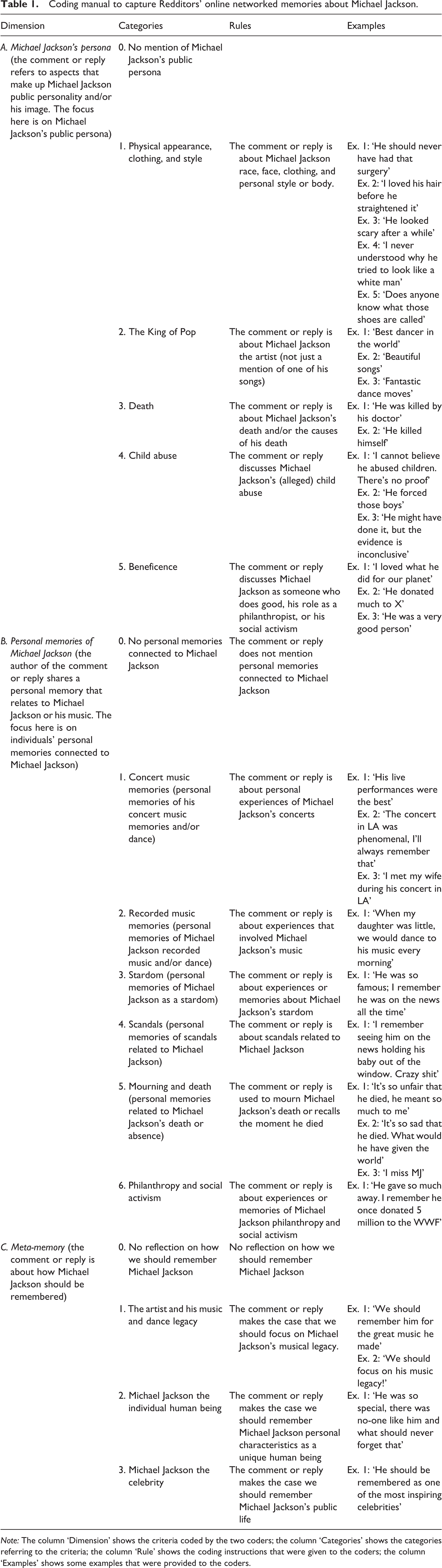
Note: The column ‘Dimension’ shows the criteria coded by the two coders; the column ‘Categories’ shows the categories referring to the criteria; the column ‘Rule’ shows the coding instructions that were given to the coders; the column ‘Examples’ shows some examples that were provided to the coders.
The coding manual is based on the previously discussed works on the relationship between (social) media, memory, and celebrity, specifically Michael Jackson (Burgess et al., 2019; Davies, 2012; Hartley et al., 2007). Redditors’ comments and replies comprised the unit of analysis. All the categories of the manual were measured (coded) through binary variables (e.g. 0: the comment or reply does not refer to Jackson’s Physical appearance, clothing & style; 1: the comment of reply does refer to Jackson’s Physical appearance, clothing & style). We employed a nonexclusive coding process, thus the comments and replies could potentially belong to all the categories used for coding. The two coders were aware of the literature in the area and the goals of the research. They were trained and supervised by the authors of this project. The reliability of the coders was tested by employing Krippendorff’s alpha, a conservative benchmark index commonly used to measure the validity and intercoder reliability in content analysis (see Krippendorff, 2011). Table 2 shows the results of the intercoder reliability for the 10% of the sampled comments and replies (N = 91):
Results of the intercoder reliability test (N = 91).
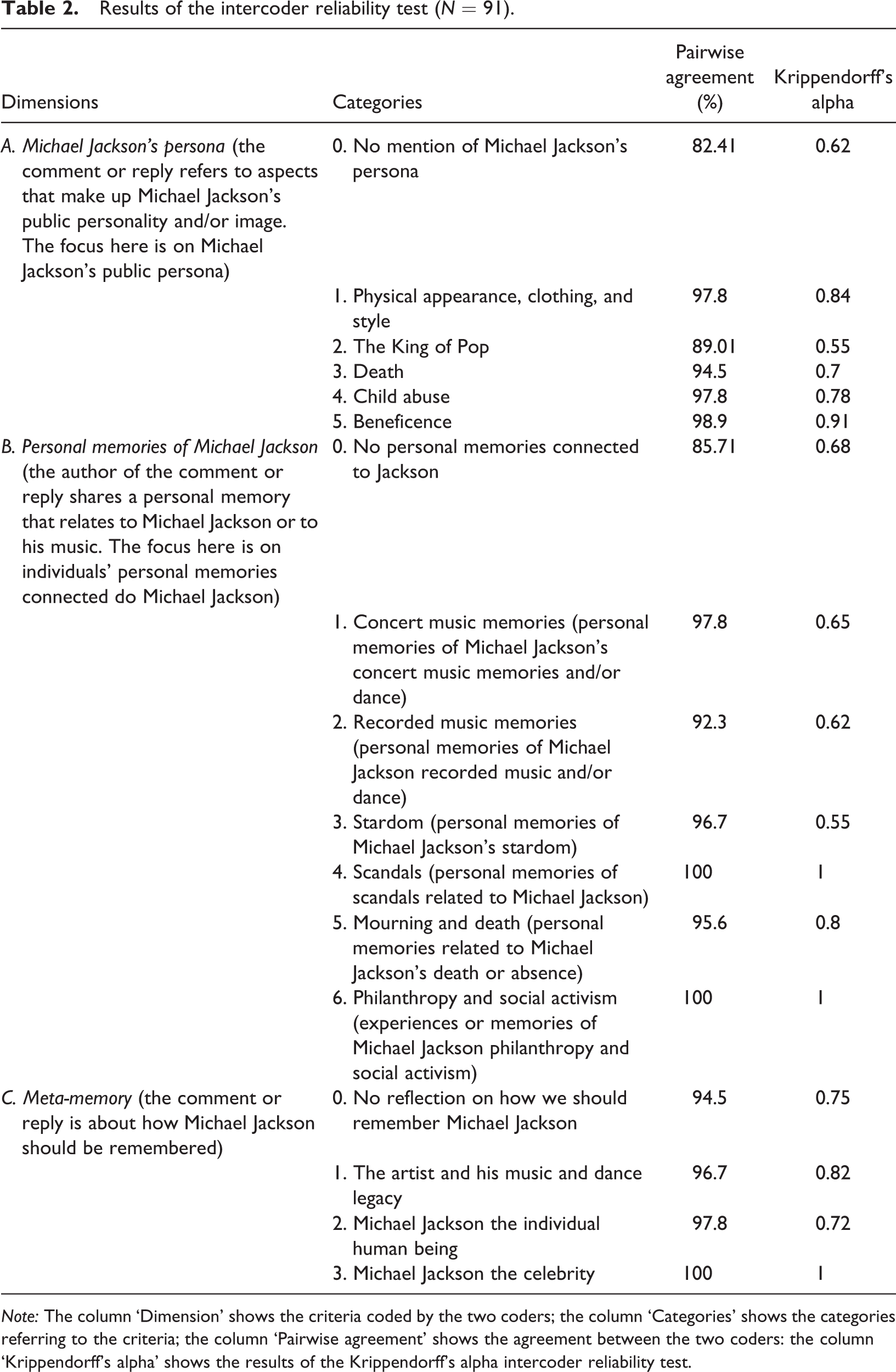
Note: The column ‘Dimension’ shows the criteria coded by the two coders; the column ‘Categories’ shows the categories referring to the criteria; the column ‘Pairwise agreement’ shows the agreement between the two coders: the column ‘Krippendorff’s alpha’ shows the results of the Krippendorff’s alpha intercoder reliability test.
The reliability scores of all the categories (except for ‘The King of Pop’ and ‘Stardom’) range between high intercoder reliability (1) and a value of 0.62 which is an acceptable level (Viera and Garrett, 2005). For exploratory studies like ours, these alphas are considered reliable enough to draw out and develop cautionary conclusions (Hayes and Krippendorff, 2007; Krippendorff, 2004). That said, the reader should paid special attention when interpreting the results of the categories ‘The King of Pop’ and ‘Stardom’ because the relatively low alpha levels of both variables (0.55; see Table 2) show some interpretative disagreements between the two coders (see, for instance, the pairwise agreement of the category ‘The King of Pop’; 89.01%). Future research can improve the alpha levels of these two variables by (a) clarifying the meaning of the words ‘artist’ and ‘stardom’ and (b) improving the instructions given to the coders during the training process. Either way should help increasing the agreement between the coders and subsequently the reliability of the variables.
Results
This article has set out to answer the question what types of mnemonic comments and replies are shared on /r/MichaelJackson. Although the empirical part of this article focuses on the outcomes of interactions on and with Reddit – its content – it is important to remember that the platform is not ‘just’ a neutral tool for communication. Rather, ‘content’ is the visible outcome of a complex set of relations and interactions between users, technology, and symbolic forms. This has consequences for which and whose engagements with the pasts become (dominantly) visible on the platform – our object of study. Before we discuss the results in the light of our theoretical framework and discuss qualitative examples from our data, we report on the quantitative findings step-by-step in this short, purposively descriptive section. Given the relatively small size of our sample and explorative nature of this study, the results of our content analysis are tentative. Nevertheless, they allow us to empirically engage with the three main subjects of our theoretical framework: the dynamics of mnemonic stabilization, memory work on social media, and memory work concerning Michael Jackson.
Our data reveals the existence of 370 individual posters who posted 510 comments and 407 replies related to the memory of Michael Jackson in the subreddit /r/MichaelJackson. Within our sample, 533 posts were labeled as having at least one mnemonic dimension. That is, 58.12% of the posts in our sample engaged in some form of memory work, which we defined as the conscious and dynamic process of reconstructing the past in the present by means of assembling historic facts, sharing personal memories, or otherwise aiming to stabilize Michael Jackson’s memory. The rest of the posts mainly discussed the album Remember the Time – the word ‘remember’ being the reason why these discussions were included in the sample. Figure 1 below shows the percentage of Redditors’ online comments and replies referring to memories about Jackson’s persona, personal memories related to Jackson and meta-memories about Jackson:
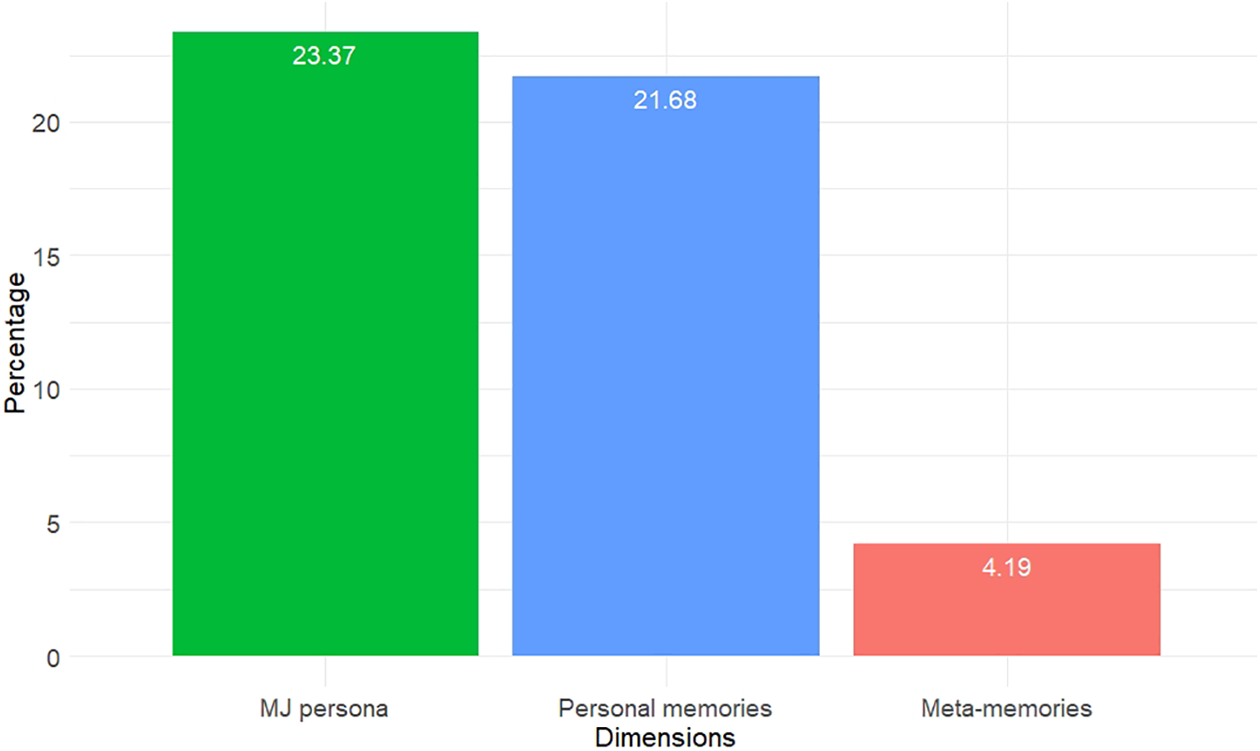
Percentage of Redditors’ memories about Michael Jackson.
As shown in the table, when Redditors engage in memory work, they are mostly sharing information about Jackson’s persona (23.37%), immediately followed by posts and comments containing personal memories related to Jackson (21.68%). This can be explained by the nature of the subreddit, which is dominated by fans of Jackson. Only 4.19% of the comments and replies in our sample were labeled as meta-memory, those posts that are concerned with how Jackson should be remembered. Redditors were apparently more concerned with how they remembered Jackson and how his life and his music were connected to their lives, than with moral judgments about his actions. More granularly, Figure 2 below shows the percentage of comments and replies in each one of the categories of the aforementioned dimensions:
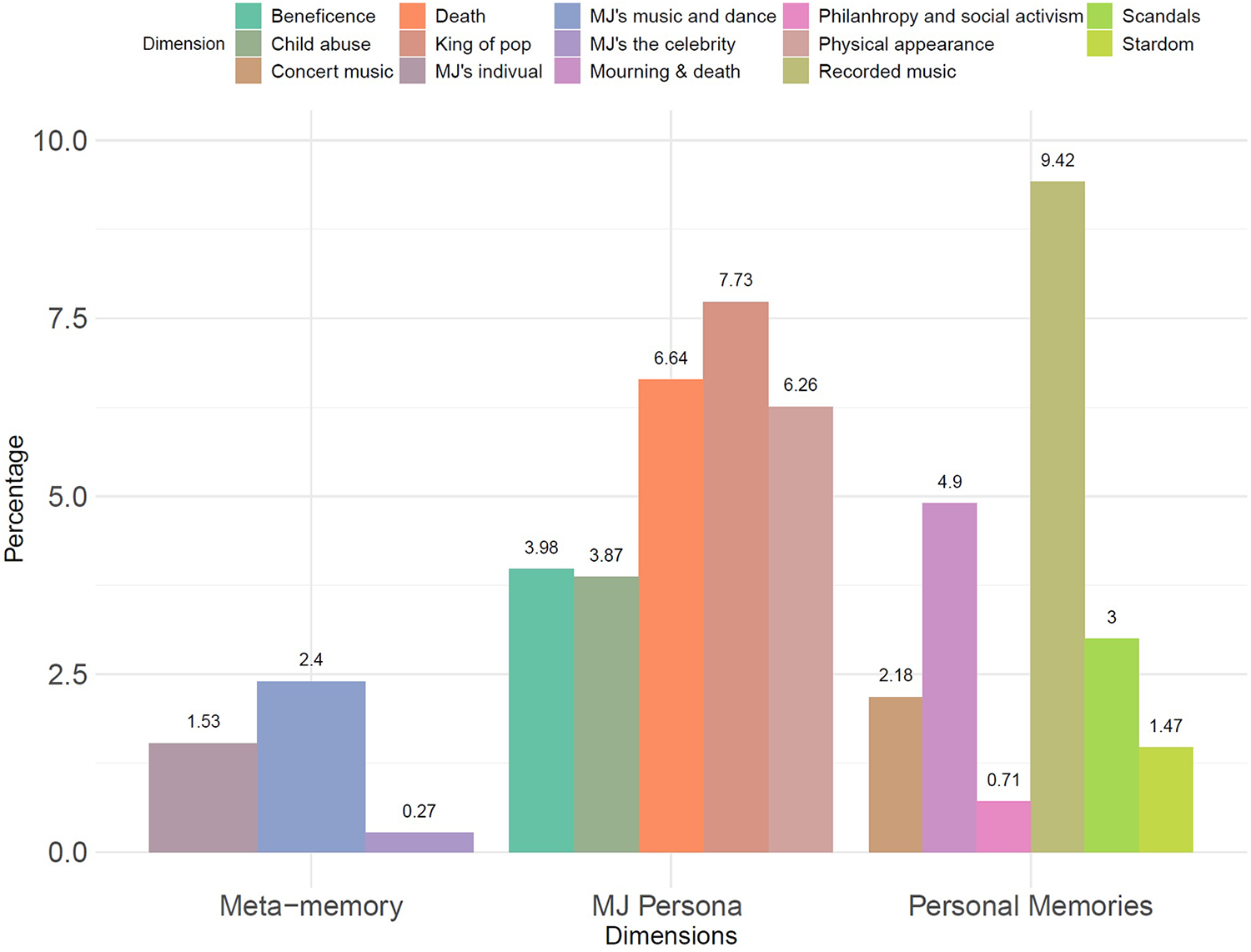
Percentage in the dimensions of Redditors’ memories about Michael Jackson.
For the dimension ‘Meta-memory’, our data shows 2.4% of the comments and replies to be related to Jackson’s music and dance. These are followed by 1.53% of comments and replies about Jackson as an individual. Lastly, 0.27% of comments and replies posit that we should remember Jackson as a celebrity, first and foremost. Regarding the dimension ‘MJ’s Persona’, our results show that the majority of the Redditors’ comments and replies – despite the relatively low agreement between the coders – are about Jackson as being the ‘King of Pop’ (7.73%). These are closely followed by the comments and replies about Jackson’s death (6.64%) and physical appearance (6.26%). Indeed, our analysis shows few comments on Jackson’s beneficence (3.96%) and child abuse (3.87%). Finally, concerning the dimension ‘Personal Memories’, our results reveal that Redditors’ online memories are clearly linked to Redditors’ personal memories about Jackson’s recorded music (9.42%), followed by their memories on his death (4.9%) and scandals (3%). These descriptive results require further analytical scrutiny in the light of our theoretical framework, and this is where this article turns to now.
Moonwalking together
If there is one thing that is striking about the posts in our data set is that many of them are lengthy. Redditors took the time to write down their memories, thoughts, and feelings about Michael Jackson. Moreover, the results show that Redditors are engaged in memory work related to Michael Jackson. Even though our sample is purposive – we aimed at locating mnemonic activity – the results show clear engagement with Jackson’s past. However, this is not so much done in a normative, prescriptive manner, as indicated by the low percentage of posts falling under the category meta-memory. That is, Redditors do not want to prescribe a particular way to collectively remember Jackson, but rather stimulate to post personal memories and what he and his music meant for individuals.
As one Redditor, ‘somethin1234’, put it: ‘I’m angry. Michael will never be acknowledged by the media. It is up to us to individually remember his greatness’ (emphasis added). As this section aims to demonstrate, the instances of digital memory work this article analyzed are very much reflective of this Redditor’s comment: through their networked individualism (Rainie and Wellman, 2012), Redditors are moonwalking together. Using their mnemonic imagination (Pickering and Keightley, 2013), they actively go back in time, while simultaneously going forward, slightly adding, forgetting, and emphasizing certain elements of Michael Jackson’s memory in the light of the present and their own lived experiences. Importantly, posts about controversial issues such as Jackson’s alleged child abuse gained less traction in this community of memory. Clearly, comments and replies that concerned personal memories and positive discussions about Jackson’s public persona attracted more interactions, which in turn made them more visible and attracted more interactions.
Here, we see how the platform’s technological and social mechanics support the sharing of personal, affective, and noncontroversial comments and replies. Moonwalking together clearly creates a feedback loop of positive mnemonic content. Thus, here the platform Reddit – constituted by an assemblage of users (and their norms and values), interfaces, and algorithmic techniques – emerges as a mnemonic agent. The platform itself aids in a particular stabilization of Jackson’s memory. If we would extend our metaphorical abstraction: Reddit functions simultaneously as the stage, concert hall, and audience for the public and collective performance of Jackson’s memory.
As we have seen, of the comments and replies with a mnemonic dimension, most are concerned with sharing memories that concern Jackson’s persona, or those that are connected to personal experiences. Often, these blend into the form of a post that is both informative and expressive of personal emotions. These posts create a dynamic of interaction between Redditors in which they exchange personal memories and facts about Jackson. This is facilitated and encouraged by Reddit’s operational mechanics and interface: more interaction with a post, comment, or reply increases its visibility on the subreddit, which increases interaction, ad infinitum. A comment by ‘Danjkeys’ exemplifies a type of mnemonic narrative that inspired other Redditors to share theirs: I was born in 98’ and I’ve been loving his music since I was in my mother’s womb thanks to my father; he saw him performing twice in his “Dangerous” and “HIStory” tours, he is a huge fan and passed down to me this passion for this amazing person and artist. All I know is that the day Michael died was the worst day of my life. I still remember how heartbroken we all felt. Michael will always be the greatest ever for me. They took away a hero, an inspiration, a genius and most importantly an amazing and kind soul. But his music and magic will live forever and this is the only thing that comforts me.
Our results especially revealed that discussions of Jackson’s public persona and personal memories about him allowed Redditors to share how he helped them cope with anxieties, insecurities, and precarious and emotional moments within their lives. The subreddit offered a safe stage for the performance of memory, which can be explained by the anonymity of users, but also by the positive feedback loop described earlier. For example, ‘Nightbird’ writes: As an elementary school kid, when I listened to “I’ll Be There,” I sometimes dreamed that if I called out, Michael would come get me and I wouldn’t be bullied at recess anymore. I was always awkward and dorky…thick glasses, horrible teeth, very quiet, a little too smart for my own good. I just knew Michael wouldn’t have teased me about any of it. He was doing some shopping in one of the music stores here, and as soon as my mom and I found out he was in town, we took a drive to the mall. Long story short, we managed to catch a glimpse of him:) The store he was in had to be closed though, so we could only see through the window. Could see him bop his head to the beat of a song of his that the store manager decided to play. No other celebrity who has been here has been able to cause such pandemonium, besides Nelson Mandela. * 12:00 pm EST – Coworker is telling people that TMZ is reporting that MJ is in the hospital. * I think it’s bullshit because it’s TMZ, and they really had no track record before this event. * About 3:00 pm EST – TMZ is reporting that he’s dead. No other outlet is confirming THAT, but some are admitting that he suffered from cardiac arrest. * About 5:00 pm EST – Now CNN is reporting that he died. No one, NO ONE, could fucking believe it. His London show was starting in a few days, he can’t be dead. * At 9:00 pm I’m getting off work and going home is when it hit me like a ton of bricks. I actually teared up while listening to a radio personality remember him because it was finally hitting me – we really did lose him. I remember where I was when I found out he had died. I was at work, and I spent the whole day in the back office crying. Awful. I’ve been crying quite a bit today also. His birthday is a hard day as well. It’s funny how a person can feel so close to someone they’ve never met.
Commemorating Jackson and sharing of memories of his death has a ritualistic dimension to it: most of such comments and replies were posted on or around his birthday and the day he died. As such, they also have a clear social character, allowing Redditors to connect to one another in sharing grief. Moreover, the details of such posts can be understood through Brown and Kulik’s (1977) concept of ‘flashbulb memories’, those memories that are the result of a very surprising, consequential, and/or emotionally arousing event. This is confirmed by our finding that Redditors invest in writing long comments and replies and share personal memories, which can both be read as indications of feelings attached to Michael Jackson, and thus that his death was (extremely) surprising, consequential, and emotionally arousing. Again, the platform is both supportive of and shaping these commemorative practices: comment threads were often started on Jackson’s dates of birth and death, which instigated mostly positively affective posting.
Conclusion
Our research confirms that the memory of Michael Jackson on Reddit is in a constant emergent state, which is the result of individuals’ sharing of affective content within this specific network. Theoretically, therefore, our case study sustains Hoskins’ (2014b) conceptualization of the ‘affective hyperconnectivity’ of memory in the digital age. As our results demonstrate, the heuristic categories of individual and collective memories collapse and convergence on Reddit. However, Hoskins’s observation that ‘the past becomes more – not less – messy’ (Hoskins, 2014b: 60) in a new media ecology requires some amendment. Our results indeed show that a vast range of individuals together create a ‘messy’, constantly changing pastiche of memory concerning Michael Jackson. However, there is order in this chaos on the level of type of content. This can be explained by this subreddit’s socio-technical infrastructure. Like other Web 2.0 platforms, Reddit operates on a popularity–visibility principle (Esteve Del Valle et al., 2020b). The more upvotes a post receives, the more visible it becomes. A popular post, in turn, attracts comments and replies, making the post even more visible. Additionally, the makeup of this specific community, its rules and norms, and its moderators partly explain popularity/visibility. Consequently, as our results show, certain types of posts are more dominant within the subreddit than others. The result is not messiness, but messiness ordered by the platform’s socio-technical mechanisms. Hence, the platform –constituted by users and technologies – acts a mnemonic agent: it offers the stage for the public and collective performance of Jackson’s memory.
The investigation of mnemonic leadership in combination with the ordering mechanism of platforms might therefore provide fertile ground for future research. Importantly, future research could also be devoted to investigating how the release of the documentary Leaving Neverland (2019) affected the content of posts in this subreddit. Based on the anticipatory discussions of this documentary in our data set, we expect that indeed more discussions will revolve around Jackson’s alleged child abuse, but in a way that separates the artist from his art or that tries to bring in nuance. For example, Redditor ‘Catch-up’ writes that in order to pass judgment on Michael Jackson, people should first thoroughly investigate his life and deeds. Moreover, this Redditor then shares a long list of what they consider reliable sources, among them Wikipedia pages, in order to ‘arm’ people with facts to ‘make strong arguments’. This takes dedication: Learning about Michael Jackson takes time and commitment and passion. There’s no way to absorb all of that above information in the matter of days, it takes months and months to wrap your head around it all. So I hope this post helps to set you on your journey in finding out all there is to know about Michael Jackson.
Moreover, we expect Redditors to keep posting comments on what Jackson meant for them individually, blending personal biography with Jackson’s music and his perceived positive character traits. For example, one Redditor, ‘Bexter_bj’, was already able to see Leaving Neverland and writes that they ‘personally enjoyed the first two parts of this the best, as it showed footage I don’t think I could have hoped to ever see of Michael as a child, teenager and a young adult’. ‘Bexter_bj’, clearly a dedicated fan, we think exemplifies fan responses to the documentary: It is my personal opinion that Michael was a pure soul. I do not believe in any way shape or form that he would hurt a child in any way and it makes me sick that the world is so focused on the things he was accused of rather than the amazing/good things he did for this world. […] I would recommend this to any Michael Jackson fan.
Our study is rooted within an emerging body of research that probes what Van Dijck (2013: 4–5) has called ‘platformed sociality’. Although digital memory work is only part of the vast range of practices and technologies that are associated with this new condition of social interaction, it is an important one, because our shared and individually experienced pasts remain a site for political struggle. Beyond the study of celebrities, then, the theoretical approach and coding manual developed here can be appropriated and applied to other contested pasts. Also, our chosen method – a content analysis of sampled social media data – can be easily repurposed and added to a broader methodological toolkit to investigate digital memory work.
To conclude, the empirical part of this article does support the theoretical observation that individual attempts to stabilize the memory on Michael Jackson are leading to its dynamic nature. This dialectic is at the heart of any type of memory work, but it is amplified by this subreddit’s community of memory and Reddit’s technological design. Importantly, though, we found that Redditors are not so much concerned with how Michael Jackson should be remembered, but rather how he is remembered by them individually. The community of memory emerging around Michael Jackson on this subreddit, then, revolves around the practice of sharing personal thoughts, memories, and feelings concerning him and less so on settling on a fixed memory of him. However, this does not mean that digital memory work is completely flattened. Reddit – as a complex assemblage of users, technology, and symbolic forms – favors particular ways or templates of doing memory and thereby produces hierarchies of visibility. Redditors are moonwalking together, but some are more in the spotlight than others, and Reddit sets the stage.
Footnotes
Authors' note
Both authors contributed equally to this manuscript.
Acknowledgements
We are thankful to Herbert Kruitbosch for helping us collect the data, Alex Soete and Jelle de Vries for working in the coding, and Marit de Jong for reviweing the literature in the field.