



Abstract
In addition to gaming, there are many other activities around digital games. These metagame activities have so far been studied from the perspective of single metagame phenomena and rarely from the perspective of the children who play digital games. This exploratory, qualitative study provides an overview of children’s metagame activities. A total of 142 children’s essays and lists of their metagame activities were analyzed using qualitative content analysis. The children’s metagame activities included game-enabling activities, strategizing activities, discussing activities, information-seeking activities, creating and sharing activities, and consuming activities. The results contribute to the body of literature on metagaming and provide an overview of children’s metagame activities around digital games, as well as new perspectives on digital games and learning.
Keywords
Introduction
Digital games are an increasing part of the lives of children and young people (Gee, 2007). In Finland, for example, 98% of boys aged 10–14 and 89% of girls of the same age play digital games monthly (Official Statistics of Finland, 2019). Digital games have been studied from various perspectives, such as game design (Salen and Zimmerman, 2003), parenting (Steinkuehler, 2016), learning (Ames and Burrell, 2017; Granic et al., 2014), and creativity (Hall et al., 2019). The decades-long debate about the issue of whether digital games contribute to violent behavior is continuing, and according to Ferguson (2015), no consensus has emerged yet. There are studies of the negative effects of gaming on children (e.g. Bradshaw and Nichols, 2004), but digital games have also been found to positively impact, for example, language learning (Hung et al., 2018), learning new literacy skills (Steinkuehler, 2010), and metacognition (Ouellette, 2019). Studies also show that playing digital games can promote the learning of so-called 21st-century skills (Sourmelis et al., 2017; Zimmerman, 2008), meaning skills needed in today’s working life (Voogt and Roblin, 2012). Digital games, in addition to their entertainment value, can also be seen as a learning environment (Gee, 2007) and their uses for learning are emphasized, for example, in the Finnish curriculum (Finnish National Board of Education, 2016). Some research results show that serious games can be functional and effective learning environments for different purposes (Connolly et al., 2012). However, compared to entertainment games, serious games struggle to compete in terms of entertainment value or quality (Gee, 2011).
Digital games are nowadays seen as gaming systems, consisting of game software and the metagame, which is the internal and external social environment around digital games, such as online forums, web pages, or strategy guides (Gee, 2011). Gee (2007, 2011) also argues that much digital game-related learning occurs not in the game itself but in the metagame. Research on digital games is often focused on learning from the game (software) (Garcia, 2017), although many researchers have argued that research should focus more on learning in the metagame (e.g. Kahila et al., 2019; Steinkuehler and Squire, 2014; Young et al., 2012)
Individual metagame phenomena, such as social interactions in multiplayer games (Kaye et al., 2017) and gaming affinity spaces, which are informal learning sites focused on gaming (Gee and Hayes, 2012), have been studied from various perspectives, but there is still a paucity of research on children’s metagaming as a whole. Understanding children’s metagame activities is important for forming an overall picture of what children are doing around digital games and what learning is involved. This study contributes to filling that gap in knowledge by exploring children’s metagame activities and providing an overview of children’s metagaming. That exploration was guided by the research question ‘What metagame activities do children engage in?’
Theoretical background
The concept of the metagame
The term metagame has many different definitions, which depend on the context of use, the game played, and community of use (Carter et al., 2012; Elias et al., 2012). Among gamers, the metagame concept often refers to pregame theorizing and currently popular strategies for playing the game (Carter et al., 2012; Donaldson, 2016; Elias et al., 2012). In role-playing games, metagaming refers to the use of real-world information, which is considered cheating (Carter et al., 2012; Salen and Zimmerman, 2003). A third common use for the term metagame is additional official game content (Carter et al., 2012).
Researchers have defined the metagame in different ways. Elias et al. (2012) see the metagame broadly as ‘a game outside the game’ including ‘all the activities connected with the game that isn’t part of playing the game itself’. Therefore, the metagame consists of such activities as reading strategy books, discussing strategy with others, using online game forums, spectating, modifying games, or even daydreaming about the game (Elias et al., 2012). Similar to Elias et al. (2012), Salen and Zimmermann (2003) define the metagaming as ‘the relationship between the game and outside elements, including everything from player attitudes and play styles to social reputations and social contexts in which the game is played’. Salen and Zimmermann’s definition refers to Garfield’s (2000) four categories of metagames: what a player brings to a game, what a player takes away from a game, what happens between games, and what happens during the game other than the game itself.
In addition to broader definitions, there are some more rigid definitions of the metagame. Carter et al.’s (2012) definition differs from the broader definitions by introducing the additional term ‘paragame’ to describe optional content within the official game and excluding activities that do not contribute to success in the game. Donaldson (2016) divides Carter et al.’s metagame concept further into the greater metagame, the local metagame, and the immediate metagame, and Debus (2017) divides the metagame into five categories: material, added, social, rule, and strategy metagames.
Metagaming occurs not only in digital games but, for example, in poker (Carter et al., 2012), in traditional sports, and in general wherever people play or compete together (Kline et al., 2003). As this study explores metagame activities in the context of digital games, the study adopted the ‘broader metagame’ concept as described by Elias et al. (2012) and Salen and Zimmerman (2003).
Existing research on the metagame phenomena
Previous research on the metagame mostly focuses on some particular games or a single aspect of the metagame. For example, Donaldson (2017) studied the League of Legends metagame, and Carter (2015) explored forms of propaganda in EVE Online. Some research has focused on game ‘mods’ and ‘modding’ (making mods). Mods are ‘customizations, tailorings, and remixes of game-based imaginations’ (Scacchi, 2010), they can target either the game software or hardware, and the changes to the game can be big or small (Sotamaa and Wirman, 2015). Consalvo (2017) described how some larger mods use the original game only as a game engine and create a completely new game around it. Modding has been described as a learning activity insofar as it can develop one’s 21st-century skills, such as design thinking (Gee and Hayes, 2012; Zimmermann 2008).
Digital games and gaming experience can also be customized in nontechnical ways by changing game rules or objectives to new ones (Boluk and Lemieux, 2017). For example, ‘speedruns’ are gamers’ attempts to complete a game as quickly as possible (Newman, 2008). The speedrunners community is one of the largest gamer communities on Twitch, a popular game-streaming service (Churchill and Xu, 2016). Other forms of gameplay videos and game streaming are very popular activities, too (Tammy Lin et al., 2019). There is also increasing interest in research on videos and streams; for example, Sjöblom and Hamari (2017) studied motives to watch digital game streams, and McRoberts et al. (2016) studied the audience engagement behaviors of young YouTubers.
In addition to studies of gamers’ use of social media such as YouTube and Twitch, there are also studies on sociability and social interactions in digital games, such as in massive multiplayer (MMO) games (Kaye et al., 2017)), and on social processes and gamers’ group flow experiences in gameplay (Kaye and Bryce, 2012). Stenros et al. (2009) studied sociability in single-player games, two-player games, multiplayer games, and massively multiplayer games, and Consalvo (2007) introduced and used the ‘gaming capital’ concept to discuss an individual gamer’s interactions with digital games, other gamers, and the culture surrounding digital games.
There is also research on the digital game acquisition process. Lee et al. (2016) explored how gamers find and select new games, and what information gamers want to know before acquiring a digital game. According to them, user-contributed reviews are one important source of information for gamers. User-contributed reviews have been also found to influence the commercial success of digital games (Livingston et al., 2011) and to provide valuable feedback to game developers (Lin et al., 2019).
Information seeking related to digital games have also been studied from other perspectives. Adams (2009) studied information-seeking behaviors and meaning-making in the City of Heroes MMO game, and Bullard (2013) researched World of Warcraft video strategy guides and, in particular, the LearntoRaid.com site’s video guides as a playful information source. According to her, playful video guides can provide the community not only with tips and ideas on gaming strategies but also with entertainment.
There are also studies on theorycrafting, ‘the art and science of investigating game mechanics that cannot be discovered through ordinary play’ (Choontanom and Nardi, 2012). Theorycrafting is often seen as a core part of the metagame (Debus, 2017; Paul, 2011) and has been studied, for example, in the context of massive multiplayer games (Choontanom and Nardi, 2012; Paul, 2011) and electronic sport (eSport) (Kow and Young, 2013). There is also research on art inspired by digital games, often referred to as fanart (Newman, 2008), and on game-inspired fanfiction: ‘writing that continues, interrupts, reimagines, or just riffs on stories and characters other people have written about’ (Jamison, 2013).
The metagame is a broad concept, and the research base on the different metagame aspects and phenomena is extensive. However, research is scattered and builds on separate areas, and there is a need to provide an overall picture of metagame activities. The aim of this study is to explore children’s metagame activities and to provide an overall picture of children’s metagaming.
Methods
Participants and procedure
The study was conducted in three comprehensive schools in Eastern Finland. Finland has a strong gaming culture: 76.1% of Finns play digital games at least sometimes, and 69.8% of 10- to 19-year-old people play digital games at least once a week (Kinnunen et al., 2018). Participants of this study were sixth- and ninth-grade students from eight school classes. Selecting these age groups enabled responses from two clearly different age groups: one age group from the primary school and one from the middle school. The focus on sixth- and ninth-graders was further justified by the use of essays for data collection: sixth-graders have the strongest writing skills of primary school students, and ninth-graders have the strongest writing skills of middle school students. As the participants were minors, permission for research and informed consent were requested from their guardians, of whom 52 never responded. Those students were excluded from this study. At the end, there was a total of 142 participants, of whom 73 were sixth-graders (31 females and 42 males) and 69 were ninth-graders (33 females and 36 males).
The corresponding author did all the data collection of this study. Data were collected during two 45-min class periods. First, the researcher introduced himself and briefly informed the participants about the study. Secondly, the participants were divided into groups of two to four students, and the groups were assigned to discuss and list possible activities related to playing digital games. Next, each group introduced their list of digital game-related activities to the others. After that, the groups were disbanded and, as the last task of the first session, each student wrote their own list of activities that they have done in relation to digital games. A break of about 20 min was then taken.
At the beginning of the second class, the students were first encouraged to complete their list of digital game-related activities and to add new activities if something more had come to their mind during the break. Next, participants were given written and spoken instructions to write an essay about their digital game-related activities, after which participants had about 35 min to complete their essay. The original data were collected and analyzed in Finnish, and quotes were later translated into English.
Data analysis
Data were analyzed using qualitative content analysis (Cohen et al., 2011) and Atlas.ti 8.4 software. The preparatory actions and initial coding were done by one researcher. Prior to data analysis, participants were given pseudonyms, and essays and lists of activities of each participant were merged into one document per participant. After that, all 142 documents were imported to the Atlas.ti software.
In the first phase of the analysis, the data were read several times to get a general sense of data, and then children’s metagame activities were coded without predefined codes. The data were revised, and many codes were merged and renamed several times during the process. At the end of the first phase, a total of 67 codes remained.
In the second phase, the codes were sorted into categories and subcategories. At this point, the results were discussed with two other researchers, to further develop the analysis and to ensure the quality of the categorization. This phase yielded 6 main categories and 18 subcategories.
In the third phase, 15 out of 142 (10.5%) documents were randomly selected for assessment of interrater agreement, and the codebook was introduced to the second coder. The second coder then coded the documents; differences and similarities were discussed between the coders; and finally, 98.5% agreement was established (McHugh, 2012). After that, for increased transparency, and for providing supplementary information and rough understanding of the popularity of metagame activities among participants, data about the number of occurrences of each category across participant files were retrieved from the Atlas.ti software.
Results and discussion
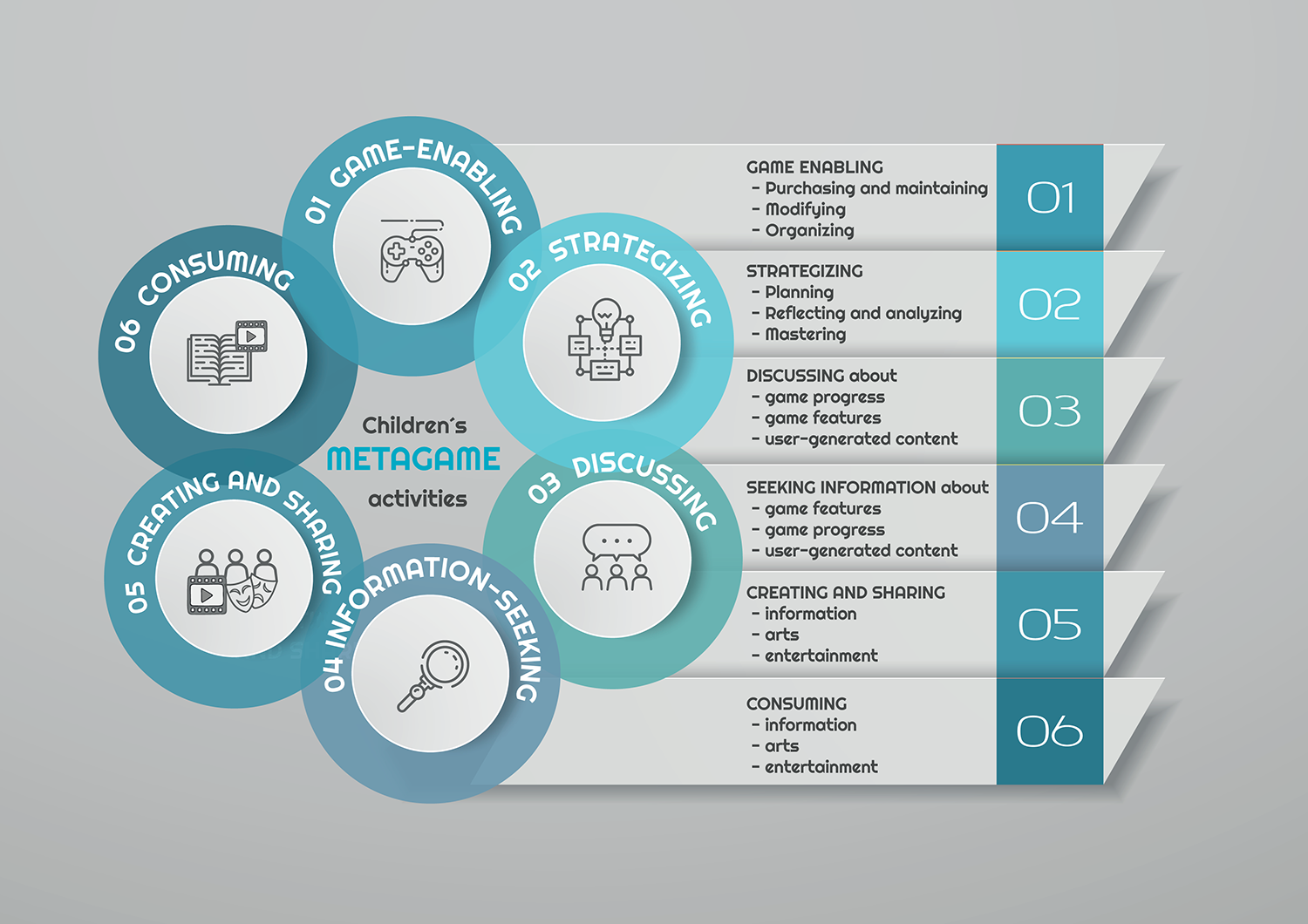
The results revealed a wide range of metagame activities that children engage in along with gaming. These metagame activities were divided into six main categories: game-enabling activities, strategizing activities, discussing activities, information-seeking activities, creating and sharing activities, and consuming activities. Figure 1 shows the categorization of children’s metagame activities.
Categorization of metagame activities.
Game-enabling activities
Before gamers get to play, they must perform various preparatory actions that enable gaming in some particular way. The first main category, game-enabling activities (mentioned by 96 participants), refers to these preparatory actions, which were further divided into three subcategories: purchasing and maintaining (86), modifying (41), and organizing (11).
The first subcategory included activities that relate to purchasing or maintaining digital games or gaming hardware. Participants, for example, assembled gaming computers and repaired game controllers and consoles. A ninth-grader, Nico, wrote the following: ‘I assembled my gaming computer by myself, I did it on a very tight budget’. Participants also, for example, bought, downloaded, installed, uninstalled, and updated digital games and altered their consumption patterns to save money for games or gaming devices.
Many of these pregaming activities are relatively simple, but others, such as budgeting and assembling a gaming computer, require more technical skills and money management skills. The existing research on metagaming mostly ignores this aspect of the metagame, but, as Garcia (2017) points out, many prerequisite activities take place before and between gaming sessions. The desire to get around to playing the game can be a powerful motivation to learn to do these required actions. However, these aforementioned activities were often not enough for gamers, and they wanted to do more, including modifying digital games and inventing alternative in-game goals.
The second subcategory was modifying. Modifying enables the digital games to be played in some particular way, easing gameplay, or providing an edge over other gamers. Participants modified digital games technically by using mods, cheat codes, and hacks, or by manually editing game files, but also by inventing alternative in-game goals and alternative ways to play a game. Digital games were modified for several reasons, but most often the purpose was to make the game easier, change its appearance, or add more content to it. A ninth-grader, Leo, wrote about his reasons for using mods as follows: ‘I use hacks and mods in some games to make them easier, more difficult, or to add more content to the game’. In addition to technical modifications, games were also modified by inventing alternative, unofficial in-game goals or rules. Some participants, for example, focused on ‘breaking the game’ by finding new bugs and glitches, and others had started a challenge to build the best house in Minecraft.
The use of technical modifications was commonplace. Participants liked to experiment with different mods and, for example, many Sims players considered the use of cheat codes to be the default way of playing. Gee and Hayes (2012) note that modern digital games often support and emphasize the gamers’ role as game codesigners, and the participants in this study had adopted that approach. In addition to the time spent on modifying games, participants also often made an effort to arrange their gaming session to their liking.
The third subcategory, organizing, included activities such as organizing shifts with a shared gaming device and organizing gaming sessions with friends. A ninth-grader, Joonatan, wrote: ‘Game nights, these have sometimes been arranged with a group of friends. More often, however, with relatives. We play different party games or multiplayer games. At the same time, we may feast on goodies’. In addition to game nights, which require more planning, organizing game sessions was often a casual activity, for example by figuring out when friends would be able to play online at the same time.
The results showed that participants often preferred to play with their friends rather than alone or with strangers, and they also made an effort to enable that by organizing common gaming sessions. Playing has become more and more a social activity, and previous research shows that playing together can strengthen feelings of social connectedness (Kaye and Bryce, 2012). By organizing these common gaming sessions, children also have an opportunity to practice, for example, their organizing skills and planning skills, both useful later in working life. Planning is discussed in more detail in the next chapter.
Strategizing activities
Gamers think about games and gaming during gaming sessions but also between sessions. The second main category, strategizing activities (59 participants), refers to game-related activities that aim to increase the chances of success in a game. This category includes the subcategories of planning (41), reflecting and analyzing (26), and mastering (12).
Participants often did not start playing unprepared, but they planned their gaming carefully. Typically, participants planned what kinds of things they were going to do in-game during their next gaming session, and planning strategies or tactics for progressing and succeeding in games was the most frequently mentioned activity. Planning was done alone or with friends or siblings. A sixth-grader, Katarina, wrote as follows: We plan our tactics carefully in Fortnite with my little brother. We think how high the risk is that we will be seen if we attack the other team. We also ponder which weapons would be the best for this match. We estimate the weapons according to the game’s Storm (an area outside of the current safe zone). We also predict where the next area could move (as the game progresses, the safe zone shrinks). If there is high ground in the area, our weapons are likely to be long-range.
Many participants enjoyed devising and introducing strategies in the game and perceived it as an intellectual challenge. Careful planning of the game strategy was a big part of the game and was considered to be essential for success in the game. This result is well in line with Garfield’s (2000) theory, in which gamers usually do not start gaming without preparation, but they bring something like a strategic plan to a game. However, strategizing activities were not limited to planning.
Participants reflected on their gaming after gaming sessions and also analyzed other people’s gaming; the second subcategory was ‘reflecting and analyzing’. Participants analyzed game events, game features, game mechanics, and strategies used by others and then reflected on their own gaming and game strategies upon those of others. A sixth-grader, Amanda, wrote about her post-game thoughts as follows: ‘Sometimes when I’m able to complete a level, I think how it could have been done better, or what it would have required for a full score’. Participants reflected on their gaming and what mistakes they have made in-game, and what would make them more successful.
The participants were motivated to reconsider their strategies and learn new approaches for developing and progressing in digital games. According to Gee (2007), good digital games are motivational learning environments that provide a suitable challenge and feedback that helps the gamers to develop their gaming. The results of this study cohere with Gee’s theory on gamers’ desire to build their expertise in digital games. In addition, the participants also built their expertise through other means, as discussed in the next subcategory.
The third subcategory under strategizing, ‘mastering’, was a small subcategory. Participants, for example, studied and tested the game mechanics and memorized the maps and places in digital games. A sixth-grader, Gabriel, wrote: ‘Memorizing places helps to find other players in some games. You can name places with your own names if it’s easier than the original names’. Modern games can be complex and contain a lot of information relevant to success in the game (Gee, 2007; Granic et al., 2014), and the results suggest that the complexity of modern digital games and the desire to master a game force gamers to build their expertise, for example, by actively testing game mechanics or developing their own memory rules for relevant in-game information. However, as the next chapter shows, this expertise building was not always done alone, but together with others.
Discussing activities
Gamers also discuss digital game-related topics during and between gaming sessions. The next main category, discussing activities (70 participants), refers to digital game-related discussions, whether via the Internet or face-to-face. The category was further divided by the subject of discussion into discussing game progress (56), game features (30), and user-generated content (8).
The first subcategory was ‘discussing game progress’. Participants wrote that they discussed, with friends, their progress and success in-game, their plans, and their experiences. Some discussed buildings they had built in Minecraft or Sims, and others discussed the characters they had bought in NHL19. Participants asked for help when they were stuck in digital games, and solutions and strategies were discussed together. Anna, a sixth-grader, wrote about her discussions with her friends as follows: ‘We have talked about how to progress in the game and advised how to do something; we talk about it when we play the same game’. Discussing game progress was seen as a nice and beneficial activity.
While most research on the sociability of digital games has focused on massively multiplayer games and online interaction (e.g. Kaye et al., 2017), in this study, discussions about game progress were often related to single-player games and happened as face-to-face interactions. Participants told stories about in-game events and their plans in the game, or they pondered together how to proceed in digital games. The results of this study confirm those of Stenros et al. (2009), who found that playing single-player games often involves more social interaction than is expected. However, game progress was not the only discussion topic for participants.
The second subcategory in the discussion category was discussing game features. Participants discussed and exchanged views on the implementation of digital games. Common discussions included, for example, graphics, story, music, difficulty level, and game mechanics. A ninth-grader, Frans, wrote: ‘I have talked with my friends about game graphics, game stories, pros and cons, game mechanics, strategies, cost of the games, and how it corresponds with the gaming experience’. Discussions about game features were often associated with recommending a new game to a friend or telling a friend about a game one had tried.
Participants often had discussions about game features before making a purchase decision, and knowledge about different digital games was valued by children. The high appreciation of game knowledge and the tendency to consult other gamers can be linked to the gaming capital theory, in which game knowledge and gaming skills increase a gamer’s cultural and social capital among other gamers (Consalvo, 2007). Gamers who know a lot about games and who can give tips on new games are appreciated by other gamers.
The last subcategory was discussing user-generated content, which refers to discussions about such metagame content as game videos and game streams, among other things. A sixth-grader, Julia, wrote about her discussions with her brother as follows: ‘I usually talk to my brother about games like that: who is streaming and when. (…) Sometimes we also talk about the Ninja streamer and when I can use his (my brother’s) PlayStation’. In addition, participants also discussed, for example, mods (user made modifications that change one or more aspects of a game), digital game-related drawings, and fan art made by others.
The content discussion was not limited to the children’s own gaming, but some participants were more interested in discussing digital game-related content created by their peers, YouTubers, game streamers, and modders (people who create mods). In addition to the face-to-face discussions, watching live streams is a social activity as such, because services like Twitch allow real-time communication between streamers and viewers (Sjöblom and Hamari, 2017). Therefore, face-to-face discussions about game streams add one more layer of sociality to an already social activity. In addition to social aspects of video streams, gamers also sought information and help from streams and videos for their gaming, as the following section reveals.
Information-seeking activities
Gamers often seek digital game-related information from the Internet, from books and magazines, or from friends and siblings. The fourth main category, information-seeking activities (91 participants), refers to those activities. The category was further divided into seeking information about game features (36), game progress (55), and user-generated content (28), based on what information was sought.
The first subcategory was seeking information about game features. Participants sought information about things such as what the game is about, its genre, with what device it can be played, and its price or age rating. Joonatan wrote: Sometimes if I’m interested in some game, I might seek information about it from e.g. Wikipedia or YouTube. I look at what kind of game it is (e.g. FPS, platformer). I also look at the popularity and reviews of the game. I also look at how much it costs if I want to buy it.
Finding information about the game features was often, but not always, about finding an interesting new game. Although a lot of information was searched in text format before the game was purchased, children generally preferred to see actual gameplay in the form of game videos or game streams. This result supports Lee et al.’s (2016) result that before purchasing a new digital game, it is important for gamers to see actual gameplay. Nowadays, when game videos and game streams are popular, this is also easy to implement.
The second subcategory was seeking information about game progress. Participants searched for information and effective strategies for multiplayer games but also for information on how to succeed and progress in single-player games. The information was sought when stuck and unable to proceed in-game without help, but also before the game was even installed and gaming was started. A ninth-grader, Maria, wrote about her information-seeking activities as follows: I have searched for information on the Internet in the form of texts and videos. Someone may say stuff in their blog, or someone may need help in some forum. Information and tips are also available elsewhere. YouTube is also a good place if you want to see how something happens in practice, which illustrates it better than reading the text.
Participants searched for information from multiple sources, such as gaming sites, forums, wikis, and friends, but YouTube videos and especially video tutorials were often seen as the best way to learn to play a digital game. According to Bullard (2013), text tutorials have some advantages over videos; for example, they are easier to browse during gameplay and are easily scanned for details. However, in this study, the participants appreciated watching actual gameplay videos and felt that it facilitated their learning and understanding. Bullard (2013) proposed that video tutorials often provide entertainment as well as information, and the results of this study concur that the line between information seeking and entertainment is sometimes unclear, and information seeking, especially from videos, is sometimes also perceived as an entertaining activity.
The last subcategory was seeking information about user-generated content, which refers to information seeking about metagame content around digital games. The most sought information in this subcategory was about modding and hacking digital games. A ninth-grader, Aleksander, wrote: ‘I have modded a lot of games, like Farming Simulator. It’s easy to get mods. Modifying is easy with videos and all kinds of tutorials’. Participants also sought information, for example, on how to make their own digital games or how to edit their game videos.
As discussed earlier, modifying digital games was a common activity among the participants, and in the same way as they sought information about digital games, they also sought information about modifications to find the ones they needed. However, finding the right mods was not always enough, because installing and using game modifications often requires technical knowledge and know-how (Ames and Burrell, 2017). Participants acquired the necessary skills either independently from tutorials found on the Internet or by asking for help from more experienced friends. In addition to seeking information about their peers’ products, participants themselves also created, produced, and shared content for others, as discussed in the following section.
Creating and sharing activities
In addition to playing digital games, gamers also create, produce, and share digital game-related content that they have made. The fifth main category, creating and sharing activities (79), refers to these activities and was further divided into the subcategories creating and sharing information (13), art (50), and entertainment (52).
The first subcategory was creating and sharing information. Participants, for example, wrote online game reviews and commented on digital games and game videos. A ninth-grader, Emilia, wrote about writing online game reviews: ‘When I’ve done enough of it and I’ve got the taste for it I might write a review so that others can take inspiration from my experiences’. In addition to reviews, participants produced and shared game tutorials in text and video formats and created presentations about digital games and digital game-related topics.
As mentioned above, the children discussed game features and recommended digital games to their peers, influencing their perceptions and decisions. However, sharing experiences and opinions did not remain within a circle of friends, but the information was also shared with a wider audience on the Internet, usually in the form of game reviews. Digital game reviews play a major role in the commercial success of digital games (Livingston et al., 2011) and are also feedback tools for game developers (Lin et al., 2019). According to Livingston et al. (2011), peer and expert reviews equally influence gamers’ perceptions of a game. Children’s game reviews can have a real impact, not only on their friends’ opinions and decisions but also more widely on the commercial success and development of digital games.
The second subcategory was creating and sharing art. Participants created and sometimes also shared their artistic creations with their friends or publicly on the Internet. The most common works were drawings about game characters and other game subjects. These works were often casually made for personal use, but some participants also shared their drawings. Game characters and game objects were also handcrafted, as a ninth-grader, Mikael, wrote: I mainly play games from the Sly Cooper series (…) last summer I sculpted from wood the rod used by the main character in these games. If you are interested in a look at it, you’ll find an image of it from Instagram user [username].
Despite the traditionally complex relationship between digital games and the arts (Newman, 2008), many websites are dedicated to fan-generated game art (e.g. Game-Art-Hq.com, n.d.) and according to Newman (2008), there are a ‘legion of fanartists who produce works inspired by videogames’. However, even though digital game-themed visual art was very common, and art was a daily activity of many participants, it was rare for them to share their works of art on the Internet. Most of the children’s digital game-related art was made for themselves and shown only to friends or siblings, if anyone. Given how common hobby digital game-inspired visual art is for children, there is very little research on that topic.
The last subcategory was creating and sharing entertainment. Participants created and shared their mods and skins for digital games, and designed and implemented their own digital games from scratch, for instance. The most common activities in this subcategory were creating game videos and sharing them on YouTube, and live streaming gaming on YouTube or Twitch. Toni, a sixth-grader, wrote: I have streamed several times already on YouTube and Twitch. When you make a video or are streaming for the first time, you may be tense. My videos already have 200 views and I have almost 100 subscribers on YouTube.
Participants who produced content for Internet video services were often proud of their videos and of the number of subscribers to their channels, and some of their YouTube and Twitch channels had hundreds of subscribers. According to McRoberts et al. (2016), YouTube is the children’s way to get their voice heard, and young authors are also often actively interacting with their audience and promoting themselves and their brand in the same ways professional YouTubers do. Regardless of their future success as YouTubers, in the process they learn the social and technical skills needed to produce videos and maintain their channels, providing them useful skills for the future. Having discussed children’s creating, producing, and sharing activities, the final section in the results chapter addresses children’s digital game-related consuming activities.
Consuming activities
Gamers are heavy consumers of media created and shared by others. The sixth, and the last main category, consuming activities (122), refers to the consumption of content created by others, and it was further divided into the subcategories of consuming information (34), art (5), and entertainment (117).
The consuming information subcategory partly overlaps with the information-seeking category because information seeking naturally precedes its consumption. Participants, for example, watched instructional videos, read tutorials made by others, and read digital game-related books. A sixth-grader, Nooa, wrote: ‘I read quite a lot of record books. However, I’m more interested in gamers’ editions. I like to look at game records and more’. In addition, children often read official game instructions and followed game news.
Participants bought, borrowed, and read digital game-related books, such as record books and strategy guides. In previous research, gaming has been found to promote digital literacy skills (Gee, 2007), but it has also been identified as one potential cause of children’s reading problems (Bradshaw and Nichols, 2004). The children involved in this study read traditional books in addition to digital material. This is in line with Steinkuehler’s (2010) argument that interest in reading books is often mistakenly connected with the ability to read. Children read books if the subject interests them enough.
Consuming art was a small category. Those participants browsed paintings, stories, and costumes created and shared by others on the Internet. A sixth-grader, Amelie, wrote regarding the fan pages of the Attack of Titan game: ‘There were drawings, cosplay, fanfiction, and more! I found it nice to browse the pictures and see the drawings of the characters’. In addition, participants watched digital game-related animations and game covers made by other fans.
Surprisingly few children reported consuming the art of other gamers, considering how many of them reported drawing or writing digital game-related works themselves. The threshold for creating digital game-related art appears to be much lower than browsing the work of others on a game’s fan pages. However, participants who reported being active on digital game fan pages were very dedicated. It is sometimes difficult to draw a clear line between art and entertainment, and some of the entertainment content in the next subcategory could equally well be categorized as art, too.
The last and biggest subcategory was consuming entertainment. Participants watched digital game-related movies and TV shows, followed eSports, went to game festivals, and read digital game-related cartoons. However, by far the most popular entertainment-consuming activity was to watch others gaming. A sixth-grader, Erin, wrote: ‘I don’t know the names of horror games because I’m not so interested and I’m not playing myself. It’s fun when you and the player sometimes get frightened at the same time’. In addition to watching recorded game videos, gaming was also watched live streams, or sat next to another gamer in the same physical place.
Watching gameplay videos and live streams was a very popular activity among participants (117 mentions). While digital gameplay has been watched for as long as digital games have existed, the rise of video services like YouTube and Twitch has exploded the popularity of watching others play digital games (Sjöblom and Hamari, 2017). Some participants wrote that they watch gameplay videos and game streams even though they do not play digital games themselves. According to Consalvo (2017), sometimes ‘games themselves become paratexts – supporting texts – to other more central media artifacts’. The popularity of game videos and game streams among participants supports this. That being said, the world also has many more sport followers and fans than active athletes.
Frequency of mentions of categories
The sections above introduced the children’s metagame activities that emerged from the data. Table 1 shows the number of participants who mentioned each category and subcategory. The category with the most mentions was consuming activities (122), the second most mentioned category was game-enabling activities (96), and the third was information-seeking activities (91). After this came creating and sharing activities (79), discussing activities (70), and strategizing activities (59).
Frequencies of mentions among participants.
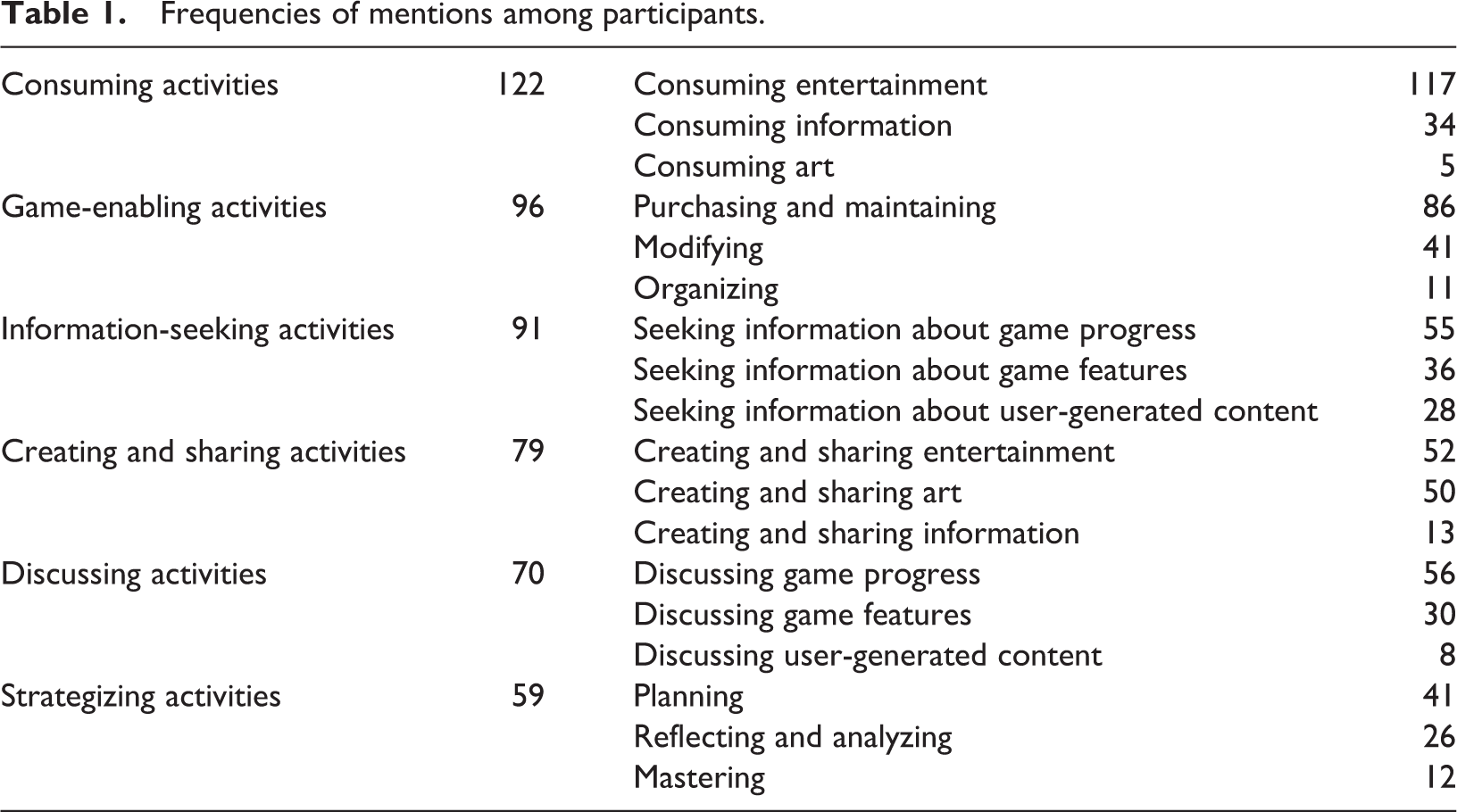
In terms of subcategories, by far the most frequently mentioned was consuming entertainment (117). The subcategories purchasing and maintaining (86), discussing game progress (56), seeking information about game progress (55), creating and sharing entertainment (52), and creating and sharing art also had fifty or more mentions each. The rest of the subcategories were mentioned less than fifty times each. Consuming art (5) and discussing user-generated content (8) were the least frequently mentioned subcategories among participants.
Conclusions
Previous research has presented a range of metagame frameworks and definitions. Common to the different definitions is the distinction between the game proper and all other activities outside or alongside the game. This study explored children’s metagame activities as reported by the children themselves, guided by the research question: what metagame activities do children engage in? Data used in this study were children’s essays on their digital game-related activities and activities they listed on the same topic. The results identify six categories of children’s metagame activities: game-enabling activities, strategizing activities, discussing activities, information-seeking activities, creating and sharing activities, and consuming activities. These categories are well aligned with the metagame definition by Elias et al. (2012), but they also paint a broader picture of metagame activities by adding more insight to areas that are not focused on mastering the game itself. These results indicate that metagame activities contain a broad spectrum of different activities with different aims. Categories overlap and complement each other, yet the differences between them are evident.
The definitions of metagame by Salen and Zimmermann (2003) and Elias et al. (2012) emphasize a distinction between the game proper and the metagame as an activity outside or alongside the game. The results of this study paint a more nuanced picture of the phenomenon, providing new insights into the character and relationship between game and metagame. On the one end of the spectrum, one might be a highly active metagamer without ever playing the game, just by watching game videos online similar to being a sports spectator. On the other end of the spectrum, especially with strategizing activities, the actual game is at the core of metagame; children devise, test, analyze, and improve strategies to master the game. This spectrum provides a picture of metagaming as an activity with different gamers and different goals. Gamers can just be searching for entertainment by watching others gameplay, or they can pursue mastering the game, developing their skills and strategies, and studying and searching for any and all information available. Between these ends of the spectrum lie endless combinations of these extremes and their elements. The results of this study provide information about different metagame activities. Profiling metagamers by their aims and goals and comparing differences in metagaming between age groups and genders will be an interesting area for future research.
Our findings show a wide range of activities around digital games. These results have a number of ramifications for research on learning from digital games, too. Studies by Sourmelis et al. (2017) and Zimmerman (2008) have shown a positive effect of playing digital games on learning 21st-century skills. This study supports their results by showing a horizon of different activities that children engage in via metagames. In their metagame activities, children engage in practices such as organizing events, developing solutions for digital game-related problems and challenges alone or together with their peers, planning game strategies, developing ICT skills, reflecting on their success in the game, creating artifacts, and seeking and creating information. These areas are typically seen as areas of 21st-century skills (see Voogt and Roblin, 2012), which emphasize skills for coping with changing working life: information-seeking skills and collaborating with people from different backgrounds. These skills are also highly important for children’s future studies. Findings also highlight that children reflect and analyze their learning and strategies to progress in-game and to learn solutions to in-game problems. This result supports Ouellette’s (2019) results, which showed that metagames can foster gamers’ metacognitive skills. In addition, as limiting children’s screen time has been widely discussed in the media and in the educational world (Steinkuehler, 2016), and as the popularity of digital learning environments is on the rise (Finnish National Board of Education, 2016), critical opinions have been voiced over digital learning environments and the use of digital games in education. Thus, this study also provides perspectives on how digital games as a learning environment for children also hold potential for off-screen metagame activities, such as discussion, planning, visual arts, or digital game-related outdoor play. However, to improve its usefulness, metagaming needs more research on how and when it supports gamers’ learning, how it can serve as a learning environment, and how metagame activities can be better harnessed for formal education.
The participants in this research were 12- and 15-year-old children. Some metagame activities that the children engaged in were quite demanding and sometimes exposed children to rather public positions. Children, for example, had their own channels on YouTube and Twitch, wrote game reviews, shared their art, and were altogether active on the Internet. These activities have an influence beyond their friends: young YouTubers can have lots of subscribers, game reviews are read by other gamers, and gameplay videos are watched before making purchase decisions. Studying how children deal with public visibility is an interesting and important area for future research. In addition, since metagaming also benefits the gaming industry (e.g. Scacchi, 2010), it would be interesting to study how children perceive it and how they deal with it.
This study was methodologically limited in that essays and lists of activities as data provide a good overview of children’s activities written in their own words, but as self-reports, they are highly subjective. Regardless, this study widens our understanding of children’s metagame activities and provides information, for example, for the school world and various professionals working with children, such as teachers and media educators. The study also contributes to the field of game studies by highlighting the diversity of metagame activities and the connections between digital games and other media, thus, also concurring with Consalvo’s (2017) suggestion that digital games should be studied more in relation to other media and other popular culture texts. It can also provide perspectives on, for example, designing digital learning environments and digital games, and it highlights many important future research topics. Overall, the results suggest that there is room for more research on children’s metagame activities from the perspective of learning, including, for example, children learning from game-enabling pregame activities, children’s strategy planning and problem-solving in digital games, and children’s digital game-related information-seeking behaviors.
