




Abstract
Although studies suggest that the use of social media can promote political participation (PP), there is a lack of theorizing about the psychological processes underlying this relationship. This article attempts to fill this gap by suggesting a social media political participation model. Taking a goal systemic perspective, the model specifies a set of interrelated processes that need to be realized so that social media use affects PP. Furthermore, key contingent conditions are outlined and insights into fostering PP are offered. The article explains ways of testing the model with surveys and experiments. Implications for future research are discussed.
The study of social media use (SMU) and political participation (PP) has been rapidly expanding (Boulianne, 2015; Ekström et al., 2014). Findings suggest that the use of social media can promote various forms of political engagement (Boulianne, 2015; Dimitrova and Bystrom, 2013; Dimitrova et al., 2014; Halpern and Gibbs, 2013). Despite this large body of research, there is a lack of theorizing about the psychological processes underlying this relationship. The lion’s share of research is based on cross-sectional studies not looking deeper into underlying mechanisms (Boulianne, 2015). The few experimental studies to date have also not fully outlined the psychological process behind participatory outcomes of social media.
This article attempts to fill this research gap by suggesting and discussing a social media political participation model (SMPPM). In developing the SMPPM, we take a goal systems perspective (Kruglanski, 1996; Kruglanski et al., 2002, 2014, 2015). Goal systems theory suggests that human goals are represented mentally as cognitive constructs which are linked to subgoals and means of achievement (Kruglanski et al., 2002). It explains how (competing) goals are chosen and pursued in a behavioral situation. As Kruglanski et al. (2015) argue, ‘attitudes toward objects, even if strong, or toward behavior, even if highly positive, are insufficient in and of themselves to incite action’ (2015: 2), instead, ‘human behavior is driven by goals’ (2015: 2, emphasis original). Thus, in order to explain PP, we need to understand how citizens form, activate, and implement participatory goals before and during a behavioral situation.
In a nutshell, for SMU to exert an effect on PP, a chain of contingencies must be realized (see Kruglanski et al., 2015): Citizens must expose themselves, either intentionally or incidentally, to political information they regard as relevant, they must conclude that there is a gap between a present state and an undesired/desired future state, they must regard a future state as attainable, which leads to a formation of an explicit participatory goal, and finally, they must activate this goal against other goals in a behavioral situation. However, even when no explicit participatory goal is formed, SMU may still foster low-effort forms of PP. The SMPPM explains why and how intentional and incidental exposure to political social media content can foster both low- and high-effort participatory actions.
The SMPPM integrates goal systems theory with the uses and gratifications approach (Katz et al., 1974), appraisal theory (Lazarus, 1991), and the priming paradigm (Higgins, 1996). It explains the psychological processes behind social media’s impact on PP, outlines and integrates the key contingent conditions for this impact based on prior research, and offers insights into ways to foster low- and high-effort forms of PP, short-term and long-term. Also, the SMPPM provides scholars with a comprehensive framework from which to derive and test hypotheses regarding exposure to political information via social media (and other media sources), the formation of explicit and implicit participatory goals, and the implementation of these participatory goals in behavioral situations.
Social media and PP
PP can generally be defined as any behavior ‘by ordinary citizens directed toward influencing some political outcomes’ (Brady, 1999: 737). Social media are highly personalized spaces and effects of social media depend on how people make use of them. Findings on motivation and user behavior indicate that demographics and predispositions largely determine how people use social media; people may either avoid or actively seek political information (Baek, 2015; Tang and Lee, 2013). But even if exposed to political content, users may not engage in PP. For instance, research has shown that the source (Nekmat et al., 2019) or direct recruitment information (Kim and Khang, 2014) plays a significant role in whether SMU leads to PP.
Overall, studies measuring political use of social media constantly found positive PP effects (Bachmann and Gil de Zúñiga, 2013; Ekström et al., 2014). However, studies investigating the effects of general SMU produced inconsistent results (Vitak et al., 2011; Xenos et al., 2014). Furthermore, in contrast to intentional exposure, even relatively uninterested users may get incidentally exposed to political information. Specifically, the ‘rise of social media has arguably further contributed to the phenomenon of accidental or unintentional exposure to public affairs content because such content are often “pushed” to people by their acquaintances’ (Tang and Lee, 2013: 2). Accordingly, research frequently looked at contextual factors increasing the chance of such incidental exposure. Tang and Lee (2013) suggested that direct connections to political actors increase exposure to shared political information and, thus, increase PP. They identified network heterogeneity as a predictor of PP. This is due to the fact that people embedded in a more diversified social network are usually exposed to a wider range of viewpoints and, thus, more likely to feel addressed. Similarly, sheer network size was assumed to increase the probability of being exposed to opportunities for PP (e.g. Gil de Zúñiga et al., 2012; Theocharis and Quintelier, 2016).
The lion’s share of research distinguished between online and off-line PP (e.g. Bakker and de Vreese, 2011; Bode, 2012; Kim and Khang, 2014; Towner, 2013; Valenzuela et al., 2009; Vitak et al., 2011). Online PP usually refers to activities such as signing an online petition or sending a message to a public office holder. Off-line PP refers to more traditional forms of PP, such as voting or working in a party organization. Some scholars argued that there is a qualitative difference between these participative activities which is not accounted for by the simple online versus off-line distinction. Specifically, certain online activities encourage the so-called ‘slacktivism’, characterized by inefficacious ‘feel-good’ forms of PP, that should be distinguished from more effective and effortful kinds of PP (Vitak et al., 2011).
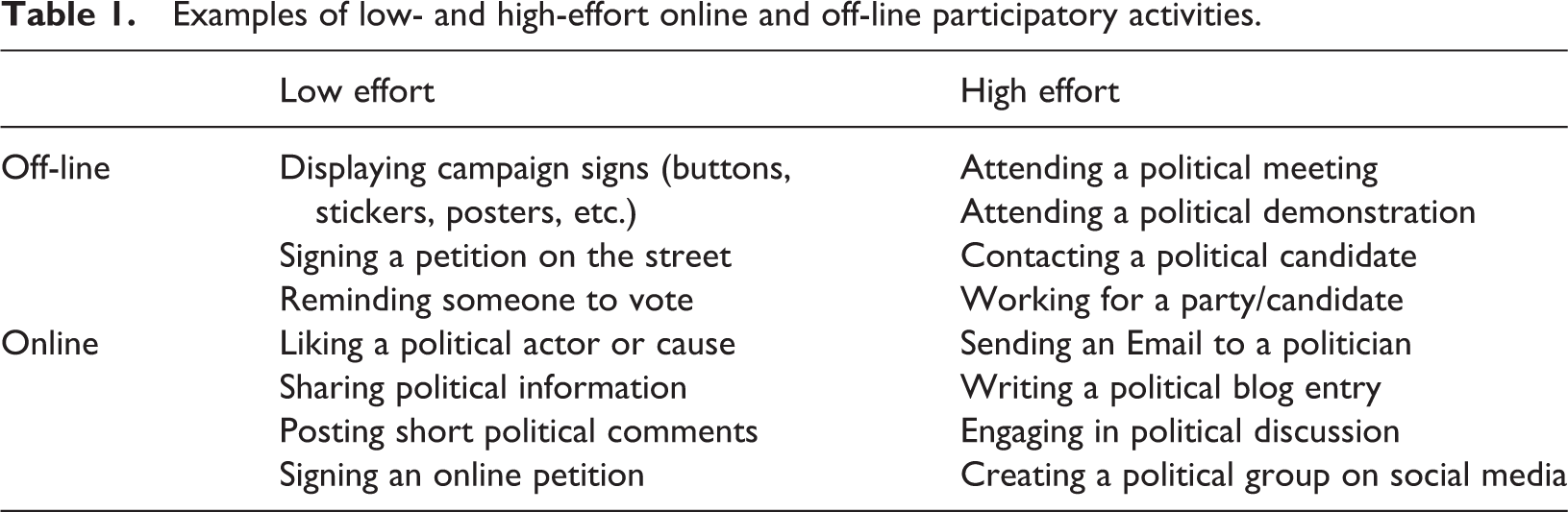
Against this background, we believe it makes sense to describe participatory activities in terms of the effort needed to accomplish them (for a similar approach, see Bakker and de Vreese, 2011). As a result, various kinds of PP can be predicted from user motivation since motivation is seen as an antecedent of effort (Naylor et al., 1980). For the SMPPM, we define effort as the amount of time and energy a person devotes to a specific participatory activity (Krishnan et al., 2002). Following this definition, it is possible to distinguish lower effort from higher effort PP (see Table 1). Whereas low-effort PP pertains to all activities requiring a relative small amount of time and energy (e.g. sharing political information, signing a petition), high-effort PP refers to more time- and energy-consuming ones (e.g. protesting, writing a blog entry; Krishnan et al., 2002). This distinction is crucial because PP, as a behavior, is clearly driven by goals (see Kruglanski et al., 2015). The implementation of goals depends on the amount of necessary effort. This effort is crucial for the question of whether someone acts or not, rather than the distinction between online and off-line.
Examples of low- and high-effort online and off-line participatory activities.
It is important to note that most studies investigating the relationship of SMU and PP employed cross-sectional research designs. Clearly, such designs provide only a snapshot in time and do not account for long-term effects. The few existing panel studies indicated that general SMU does not or weakly trigger PP in the long run (Theocharis and Quintelier, 2016). These studies challenge the view that social media’s capability in facilitating social ties, providing space for personal expression, and encouraging social interaction is sufficient to exert longer lasting influences on PP. As will be seen in the remainder of this article, the SMPPM extends these arguments.
Objectives
The key aim of the SMPPM is to predict under which conditions exposure to social media fosters PP. Since the effects of SMU can depend on a chain of different contingencies, we formulate five basic objectives that guide our work. The first is to subdivide the communication process into four consecutive phases (e.g. Petty and Cacioppo, 1986; Slater, 2007): First of all, media use is subject to the influence of prior existing motives (pre-exposure). To be affected at all, users secondly have to be exposed to some media content (exposure). Exposure, then, is usually followed by some kind of information processing (reception). Finally, information processing can lead to specific behavioral outcomes (behavioral situation). At any of these four phases, an effect of SMU on PP can be impeded. If, for instance, citizens form an explicit goal based on social media reception, this goal may be overridden in a behavioral situation by competing goals. We thus need to consider all four phases in one theoretical model.
Looking at the second objective, social media users get either intentionally or incidentally exposed to political content (Kim et al., 2013). This is a key objective, because ignoring either intentional or incidental exposure would lead us to an incomplete understanding of social media. In fact, one key asset of social media is that citizens can get exposed to political information via their networks, without intentionally looking for it. We believe such incidental exposure is a key path in order to understand why social media can spur PP outside exposure to classic mass media which, by and large, are used more intentionally than social media.
Third, our goal is to differentiate higher effort from lower effort PP because the effort associated with PP in a given behavioral situation is a key characteristic for an effect of social media. We argue that this distinction is more theoretically precise than speaking of online versus off-line PP. As Table 1 shows, both online and off-line PP can be high effort or low effort. From a theoretical perspective, what is needed to explain PP is the amount of necessary effort, not the technical characteristic if it is off-line or online. Still, our model can be used to explain online and off-line PP (depending on their effort).
The fourth objective concerns the specification of boundary conditions. Previous research has shown that SMU affects PP, given certain circumstances (Boulianne, 2015). A deep understanding of the involved processes requires the knowledge of moderators. Any model explaining PP must therefore incorporate key moderators with respect to recipient, source, network, and message characteristics.
Fifth, a social media PP model should be able to predict short-term as well as long-term effects. Researchers typically focus on the former as they are easier to measure and confirm. Yet, some longitudinal studies were able to show longer term effects, too (e.g. Ekström et al., 2014). Thus, the SMPPM needs to explain how exposure to social media can increase PP over time. We develop a model containing 28 theoretical propositions that explain how and when SMU results in increased PP. Explaining the ‘how’ and ‘when’ is the primary role of theory (Slater and Gleason, 2012). Beginning with SMU, we explain its motivational origins with reference to the uses and gratifications approach (Katz et al., 1974). Based on this, we propose two routes to PP differing in their degree of information processing (explicit vs. implicit). The SMPPM understands PP as goal driven. Psychological theories on explaining behavior through goals are applied (Kruglanski et al., 2015), linking information processes and their outcomes (goals) to behaviors. The cognitive and motivational processes derived from goal systems theory are modeled along appraisal theory (Lazarus, 1991) and the priming paradigm (Higgins, 1996).
Propositions
Motivation to use social media (pre-exposure)
According to the uses and gratifications approach, people have certain needs that they are aware of (Rubin, 2009). For instance, people may feel the need to relax or the need to become informed about a political issue. Among other opportunities, they may select specific media as means of gratification. As a result, media usage can be seen as goal-directed. It can be explained by the existence of specific needs that lead to specific motivations of media use (Rosengren, 1974). Needs are determined by users’ basic biological and psychological requirements in combination with their personal and situational dispositions (Rosengren, 1974). Personal dispositions encompass all individual characteristics such as personality traits, emotional states, users’ sex, age, or long-lasting preferences learned throughout one’s life. A general interest in politics serves as an example (Rosengren, 1974). High political interest may increase one’s general motivation to use social media for political purposes. Furthermore, past research has shown that predispositions may also determine the kind of political information people are motivated to expose themselves to. For example, states of anxiety may make people more likely to expose themselves to crosscutting opinion, whereas anger make them more likely to expose themselves to attitude-consistent content (MacKuen et al., 2010). Situational dispositions refer to all societal, social, and technological configurations a person is embedded in when choosing means of gratification (Lin, 1993; Rosengren, 1974). A group of friends may evoke a need for social interaction whereas a greater breadth and diversity of web content may encourage browsing motivation (Lin, 1993). Personal and situational dispositions have been confirmed as important predictors of users’ needs for various kinds of media, including social media (e.g. Orchard et al., 2014; Rubin, 2009). It follows (see Figure 1): P1: The motivation to use social media is determined by personal and situational dispositions.
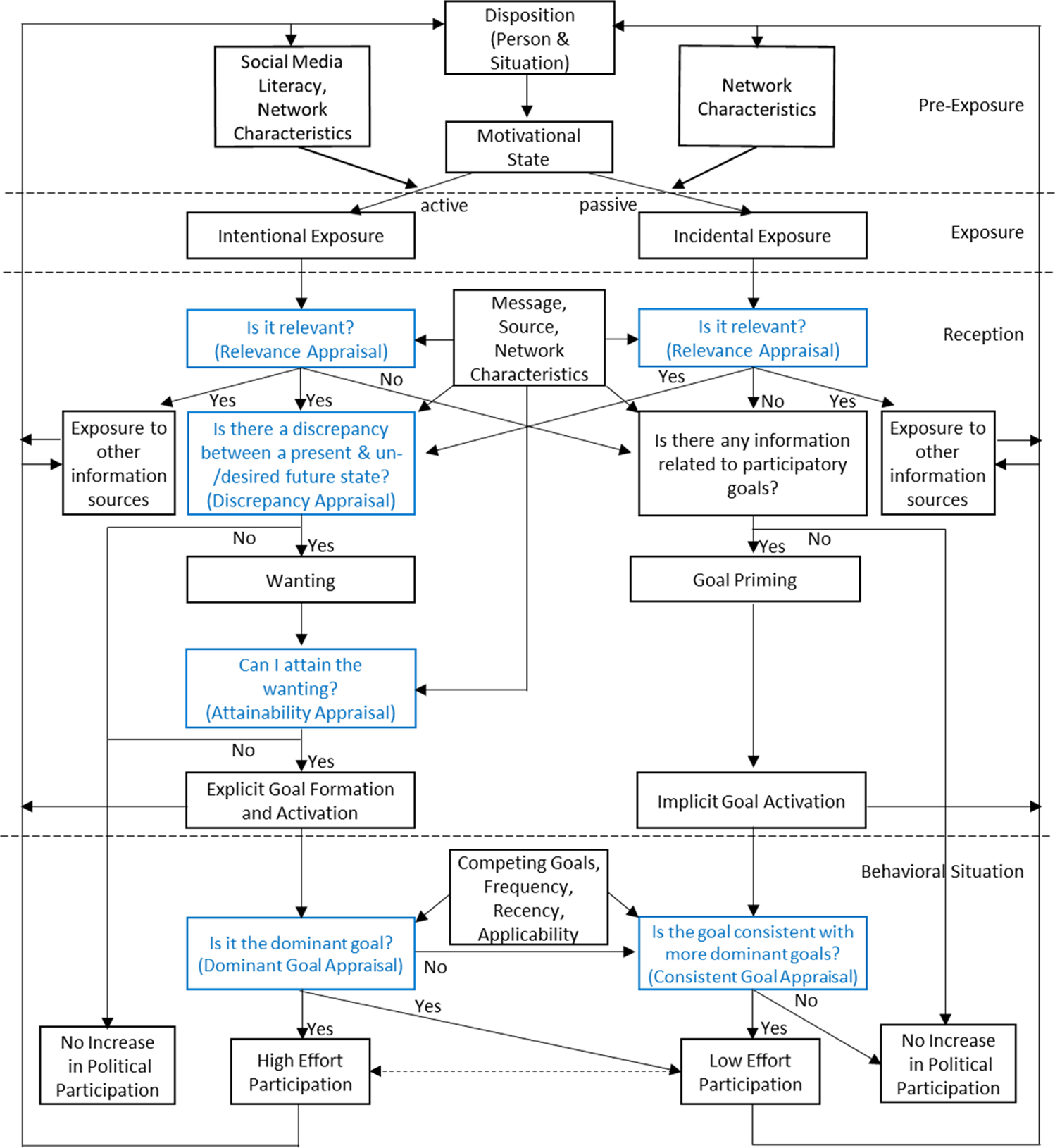
Social media political participation model (SMPPM).
Uses and gratifications researchers have established various kinds of media motives typologies. They mostly linked these motives to the use of specific media (Rubin, 2009). However, ‘overall, the literature consistently confirms a similar set of motivations for U&G regardless of media type. […] Fundamental motives for media use generally include fulfilling needs for information, personal identity, entertainment, and social interaction’ (Kim et al., 2015: 183; see also McQuail, 1983). Important to note, these motives are understood as broad categories encompassing various submotives (McQuail, 1983). For instance, entertainment includes submotives such as escaping, relaxing, diversion, emotional release, filling time, or sexual arousal (see McQuail, 1983). Looking specifically at social media, expression is typically added as a fifth, unique motive (Skoric et al., 2016). This is due to the fact that social media enable their users to create their own content and express themselves to peers or a broader audience. Hence, social media are often used to precisely fulfill this need (Park and Lee, 2014).
Exposure to political content
Depending on their current motivation, social media users engage in a wide range of activities. Researchers often distinguished two fundamental pathways (Boulianne, 2011; 2015; Mitchelstein and Boczkowski, 2010; Tang and Lee, 2013; Xenos et al., 2014). The first one is actively seeking political information, intentional exposure. For example, users may use the search function of a social media site, scan their own newsfeed for political content (Halpern and Gibbs, 2013), look at Facebook news sites, or access the profile of a political party or candidate (Larsson, 2017). In contrast, the second pathway refers to incidental exposure accounting for the fact that such content is frequently shared by acquaintances (Tang and Lee, 2013). Users who are relatively uninterested in politics only need to be connected to a handful of politically engaged others to be regularly presented with incidental cues about politics (Xenos et al., 2014). In the context of a political election, users who are primarily motivated to engage with entertainment content on social media may still see campaign posts posted from friends in their network. We assume intentional exposure to occur when a person feels a need for political information, a need to work on his or her political identity, or a need for political expression. In all of these cases, users will engage in an active search for political information (Pingree, 2007). Given users want to be entertained, look for social interaction, feel a need for politically unrelated information or expression, or work on nonpolitical parts of their identity, we assume that they expose themselves incidentally to political content. P2: Political information as well as political expression motivation and being motivated to work on one’s political identity lead to intentional exposure to political content. P3: Entertainment motivation, social interaction motivation, nonpolitical information motivation, nonpolitical expression motivation, and being motivated to work on one’s nonpolitical identity lead to incidental exposure.
Importantly, both exposures are moderated by the characteristics of a user’s network. Networks can be understood as a person’s connected acquaintances within a social media site as well as the interconnections among those acquaintances. Users can actively manage their network by hiding posts and by blocking, unfriending or unfollowing people from their network (Zhu et al., 2017). For example, some users with strong political affiliations may be more likely to engage in filtering their personal newsfeed and hence expose themselves to a more attitude consistent newsfeed (Yang et al., 2017). Besides this social dimension of networks, we include their technological facet, too. It mainly refers to the personalized presentation of content via software algorithms: In digital media, content information can be stored in a database, allowing users to access or be presented different messages based on software algorithms. This allows for mass messages to be cheaply and easily personalized […] based on that user’s preferences and profile information. (Beam, 2014: 1022)
Moreover, personalization may include the preferences of connected acquaintance linking both dimensions of networks (Hennig-Thurau et al., 2012). Relevant network characteristics are, for instance, the size, the heterogeneity, or the political affinity of one’s network as well as the personalized presentation of content. Research shows that a user’s network size positively predicts exposure to political content and increases PP (Tang and Lee, 2013). Both increase opportunities for exposure and engagement. Similarly, more heterogeneous networks are assumed to present participants with a wider range of information increasing possibilities for engagement (Tang and Lee, 2013). Looking at political affinity, users differ in the number of connections with politically engaged users, politicians, and political organizations. Since all of them tend to share political content, political exposure increases with the number of such connections (Tang and Lee, 2013). Finally, personalization of content represents a further crucial network characteristic. It addresses the fact that social media sites try to expose users to information closely aligned with their preferences (Beam, 2014). Depending on their profile information and/or past browsing behavior, users are more or less likely to be exposed to political content (Hennig-Thurau et al., 2012). Because intentional exposure involves actively looking for information, we assume this process to be moderated by social media literacy. It encompasses users’ capacity to access, understand, evaluate, and create communication within social media (Lee et al., 2013). For example, some users may be more competent to identify and integrate high-quality political information in their newsfeed, while others may be politically motivated but only stumble upon less qualitative information, such as from populist politicians (Heiss & Matthes, 2017). Thus, social media literacy has been identified as an important prerequisite to facilitate intentional exposure (Lee et al., 2013). P4: The relationship described in P2 is moderated by users’ social media literacy and users’ network characteristics. P5: The relationship described in P3 is moderated by users’ network characteristics.
Reception of political content
Upon exposure to political content, recipients appraise its relevance (i.e. relevance appraisal). Appraisals can be understood as cognitive processes through which people evaluate encounters with their environment in terms of their impact on their own well-being (Lazarus, 1991). They fulfill the ‘adaptational task of integrating the realities of environmental demands, constraints, and resources with personal interests without giving short shrift to either’ (Lazarus, 1991: 168). People constantly scan their environment to check whether the occurrence of stimulus events requires further attention and adaptive reactions (Scherer, 2001). In terms of systems economy it seems useful to engage in expensive information processing only upon detection of a stimulus that is relevant for the organism and consequently requires attention. In consequence, relevance detection is considered to be a first selective filter a stimulus or event needs to pass to merit further processing. (Scherer, 2001: 99)
Following this reasoning, social media users have to constantly decide which information is sufficiently relevant to deserve more extensive processing. The specific evaluation checks thereby operate on different levels of information processing (Lazarus, 1991). However, initial relevance checks are mostly stimulus driven and operate more or less automatic at low processing levels enabling easy and rapid decisions (Scherer, 2001). According to Scherer (2001), three major kinds of stimuli elicit positive processing decisions: (1) novel information, (2) intrinsically pleasant or unpleasant information which evokes strong feelings (e.g. extremely negative messages), and (3) information that is important to the momentary goals of a user. In all cases, the information has to pass a certain threshold to initiate further processing (Scherer, 2001). Since the relevance appraisal is thought to be mostly stimulus driven, we assume the specific political message, its source, and all visible network characteristics (e.g. shared by a friend) to be influential factors. In line with this, social media research has shown that users primarily select political information based on message matching personal interests (Yang, 2016), credible and reputable sources (Sundar et al., 2007), and network cues (e.g. social recommendations; Yang, 2016). For instance, political content may be perceived as relevant when currently looking for political information or when the message is accompanied by a high number of likes. Furthermore, certain content may evoke negative feelings, such as anxiety. A number of studies have shown that anxiety can trigger information processing and increase the perceived relevance of an issue (e.g. MacKuen et al., 2010; Valentino et al., 2008). Other content can instantly evoke pleasurable feelings, for example, because it was shared by a good friend and therefore be perceived worthy of processing. This is even more the case when looking for social interaction. However, the very same message may be deemed irrelevant when beginning to read and detecting its familiarity. This is due to the fact that appraisals are understood as an ongoing process involving appraisals and reappraisals (Lazarus, 1991). P6: If exposed to political content, users appraise the relevance of the content depending on its message, source, and network characteristics (relevance appraisal).
Explicit processing
Given that political content is appraised as relevant, more extensive processing ensues. In addition, users may expose themselves to other information sources including online and off-line media as well as interpersonal communication. According to Boulianne (2011), social media appears to be particularly suitable to increase users’ political interest. They actively engage with the content which increases interest and stimulates further attendance to other information sources. In addition, social media contents may motivate interpersonal communication. Also, interpersonal communication may encourage further media use as communication partners may feel a need for advanced information (Nguyen Vu and Gehrau, 2010) P7: If political content is appraised as relevant, users expose themselves to related political content in other media or interpersonal communication.
Once social media users start to extensively process the political content, they are likely to evaluate its implications (Scherer, 2001). We refer to this appraisal as the discrepancy appraisal. The user evaluates whether he or she perceives a discrepancy between a present state and a future desired or undesired state (Carver and Scheier, 1982). The evaluation is based on the respective political content and activated knowledge structures. That is, a Facebook post may inform users about an increase in environmental pollution. If users perceive this increase as undesired and discrepant when compared against the present state of pollution, they will develop a wanting to reduce this discrepancy (Carver and Scheier, 1982). ‘Wanting’ refers to greater (approach) or lesser (avoidance) liking for a possible future state relative to the current state. That is, wanting appears when the anticipated assessment (like or dislike) for the future state is either more or less positive than that of the current state. Simply put, wanting arises from a discrepancy between liking for the present versus the future state (Kruglanski et al., 2015).
Only if both appraisals – the discrepancy and the attainability appraisal – are positive, a goal is formulated and activated (Kruglanski et al., 2014). Accordingly, a goal can be defined as ‘a desirable future state of affairs one intends to attain through action’ (Kruglanski, 1996: 600). It is represented as a knowledge structure and usually contains multiple, interrelated memories including the end state and means of attainment (Fishbach and Ferguson, 2007). Understanding goals as knowledge structures, the same principles that apply to knowledge acquisition, change, and activation can be applied (Kruglanski, 1996). Comparable to the relevance appraisal, both the discrepancy and the attainability appraisal are influenced by the political content’s message, its source, and visible network characteristics. The first seems obvious, as only the message can contain the respective discrepancy or elements of it (e.g. a desired future state). In addition, the message may contain means of attaining or preventing a future state and, thus, influence the attainability appraisal. This is rather likely since news articles generally present not only problems but also possible solutions. The same applies to mobilizing posts of candidates. Looking at the source of the political content, a credible source is more likely to convince users of a desirable or undesirable future state (McGuire, 1985). In doing this, it influences the discrepancy appraisal. The same applies when convincing users to attain or prevent the respective state (attainability appraisal).
Finally, network characteristics impact both appraisals as they enable users to see what friends or other reference persons think or do about an issue. Vitak and colleagues (2011) were able to show that exposure to the political activity of ones’ Facebook network positively predicted online and off-line PP. Influenced by significant reference persons, users are more likely to view respective future states as more desirable or undesirable (Knoll and Schramm, 2015). In addition, these reference persons may influence one’s internal efficacy and thereby affect the attainability appraisal. According to Bandura (1997), people are frequently convinced by others into believing that they have the necessary capabilities to attain a goal. Next to internal efficacy, external efficacy may also be affected. For instance, a political actor from one’s network may directly respond to one’s demands rendering the attainability of future goals more likely. Finally, collective efficacy can be influenced, too. Social media enable after all the continuous surveillance of political groups and movements. Using social media changes one’s perceptions about a group’s capability and power (Heiss and Matthes, 2016; Lee, 2010). P8: If political content is appraised as relevant, users appraise whether the message contains a discrepancy between a present state and a un-/desired future state depending on the message, source, and network characteristics of the political content (discrepancy appraisal). P9: If political content is appraised as discrepant, users develop a wanting. P10: If a wanting is developed, users appraise whether they can attain the wanting depending on message, source, and network characteristics of the content (attainability appraisal). P11: If the wanting is appraised as attainable, users explicitly formulate and activate a goal. P12: If political content is appraised as nondiscrepant or nonattainable, users show no increase in PP.
Behavioral situation
Given a goal is explicitly formulated and activated, users appraise whether the goal is the dominant goal once they are in a behavioral situation (Kruglanski et al., 2015). We refer to this appraisal as the dominant goal appraisal. The appraisal pertains to the fact that people usually activate multiple goals but lack time and ability to achieve all of them at the same time (Fishbach and Ferguson, 2007). A goal related to PP may be overridden by other goals. This includes situations in which an individual lacks the ability to participate, or, in which other goals are stronger. Imagine, for example, a person intending to participate in a protest but currently feeling hungry. This person is very likely to still his or her hunger first and then go to the protest or skip the protest. The dominance of a participatory goal is dependent on its level of activation in relation to activation levels of competing goals (Kruglanski et al., 2015). The stronger the activation of competing goals, the greater the inhibition of the participatory goal (Shah et al., 2002). Activation is dependent on accessibility and applicability of goals (Higgins, 1996). Accessibility, in turn, is influenced by the recency and frequency of prior goal activation. The more recent and frequent a goal has been activated, the greater is its accessibility (Higgins, 1996). Applicability refers to the overlap of features of stored goals and features of the behavioral situation. The stronger the overlap is, the greater the applicability (Higgins, 1996). To participate in a protest against environmental pollution may, thus, be a dominant goal if a user just read about the protest on Facebook or read about it frequently in the past, if the protest is about to happen soon, and if there are not any other pressing matters the user has to attend to. P13: Being in a behavioral situation, users appraise whether their explicitly formulated and activated goal is their dominant goal (dominant goal appraisal). P14: The dominant goal appraisal is the more likely to be positive in its result, the more frequent and recent prior goal activation has been, and the more applicable the goal to the behavioral situation is.
Formulating and activating a goal entails deciding explicitly to commit to a goal (Kruglanski et al., 2014). Hence, users – at least at first – rather aim for high than for low-effort PP with the former being far more effective in goal attainment (Kruglanski et al., 2015). This is further supported by the fact that people tend to show a general inclination toward optimism. They are often convinced that they can initiate and maintain effortful behavior without any prior experience (Kruglanski et al., 2014). If such high-effort PP appears to be unattainable at a later point in time, it can still be adjusted. In addition, users may perform low-effort PP next to high-effort PP increasing the probability of their goal attainment as long as they dispose of the necessary resources (Fishbach and Ferguson, 2007). P15: If an explicitly formulated and activated goal is appraised as dominant, users perform high- and low-effort PP.
Given a goal is appraised as nondominant, users may yet pursue it. This refers to the fact that people often aim for multiple goal attainment (Fishbach and Ferguson, 2007). A prerequisite, however, is that the attainment of the nondominant participatory goal is consistent with the attainment of more dominant goals. A goal is said to be consistent with other goals if it is not opposing their attainment (Huang and Bargh, 2014). We refer to this appraisal as the consistent goal appraisal. Comparable to the dominant goal appraisal, users first appraise the activation of competing goals in relation to the participatory goal. That is due to the fact that a nondominant participatory goal has to be primarily consistent with more dominant but not with less dominant goals. Mainly higher priority goals tend to inhibit lower priority goals given they interfere with their attainment (Fishbach et al., 2003). As the priority or dominance is dependent on goals’ activation levels, this process is again influenced by the recency and frequency of goal activation as well as their applicability (Higgins, 1996). Depending on the appraised order of goals, users appraise to which extent the participatory goal and the more dominant goals compete for users’ attention, commitment, and effort (Fishbach and Ferguson, 2007). Participatory goals are appraised as consistent if they do not inhibit the attainment of more dominant goals by pulling away too much resources (Fishbach and Ferguson, 2007). For instance, the goal of signing an online petition may be considered consistent with the more dominant goal of online shopping as it is relatively easy to do the signing besides browsing various online shops. When appraised as inconsistent, more dominant goals are likely to shield themselves from participatory goals by reducing their accessibility (Shah et al., 2002). P16: If an explicitly formulated and activated goal is appraised as nondominant, users appraise whether it is consistent with the attainment of other more dominating goals (consistency appraisal). P17: The consistency appraisal, specifically the reference of consistency, is dependent on the recency and frequency of goal activation as well as the goal’s applicability to the current situation.
Given the participatory goal is consistent, users perform low-effort PP. This refers to the fact that users’ motivational and behavioral resources are limited (Fishbach and Ferguson, 2007). Consequently, users tend to save energy for more dominant goals putting little effort in less relevant ones. Importantly, these more dominant goals include current as well as salient future goals (Shah, 2005). Given a participatory goal is appraised as inconsistent and opposing to the attainment of such goals, its accessibility is lowered shielding the more dominant goals (Shah et al., 2002). No PP ensues. P18: If a nondominant goal is appraised as consistent with the attainment of more dominant goals, users perform low-effort PP. P19: If a nondominant goal is appraised as inconsistent with the attainment of more dominant goals, users perform no PP.
Implicit processing
Next to explicit processing and generating participatory goals, we propose an implicit route to goal activation (see right-side Figure 1). Imagine social media users who encounter political content – intentionally or incidentally – but appraise it as irrelevant. No extensive processing will ensue. Instead, users will direct their attention to other more relevant content (Scherer, 2001). However, the political content may yet influence their cognitions (e.g. goals), even though it was only short and/or unconsciously processed (Fishbach and Ferguson, 2007). Like any kind of knowledge structure, goals may be activated by priming (Fishbach and Ferguson, 2007). This includes the goal itself as well as related memories like, for instance, means of goal attainment (Fishbach and Ferguson, 2007). Understanding priming as a procedure that stimulates or activates stored knowledge (Higgins, 1996), a participatory goal can be primed if social media users scroll through their newsfeed scanning its content. As long as this newsfeed contains information related to participatory goals (e.g. a post about an upcoming online petition), respective goals can be activated. Another example is users looking at private profiles. Even though they may be interested in keeping up with the latest gossip, they may be exposed to political information, and a related goal can be implicitly activated. The stronger the association between the primed memory and the goal, the more likely the goal is activated (Shah, 2005).
However, a goal can only be primed if users have a chance to perceive goal-related information. Even though goals usually contain multiple memories increasing the likelihood of goal activation (Fishbach and Ferguson, 2007), a lot of political information is evidently goal unrelated. Some online content simply makes fun of politicians. Other content shortly informs users about the latest political events but is completely unrelated to participatory goals. And still other content may theoretically be related to a participatory goal; however, users do not hold such goals in memory. This refers to the fact that goals can be implicitly activated through priming; however, they cannot be newly formulated or created. Goals contain end states, evaluative information about these end states (desire), and means of attainment (Fishbach and Ferguson, 2007). Formulating and connecting these entails explicit processing. P20: If political content is appraised as nonrelevant, a participatory goal may be primed, provided that the message contains any information related to participatory goals. P21: If the message contains no information related to participatory goals, users show no increase in PP. P22: Priming of participatory goals leads to implicit goal activation.
Extensive conscious processing of a stimulus can lead to stronger activation of related knowledge when compared to peripheral conscious processing or unconscious processing (Bargh and Chartrand, 2000; Petty and Cacioppo, 1986). We consequently assume that implicitly activated goals show generally lower levels of activation when compared to explicitly formulated and activated goals. Since people usually activate multiple goals (Fishbach and Ferguson, 2007), implicitly activated goals are most likely to be nondominant goals. This is further supported by the fact that political information related to a high priority or dominant goal would not have been appraised as irrelevant in the first place (cf. relevance appraisal). For instance, if information about the environment is judged as irrelevant by the individual in the relevance appraisal, saving the environment will not be a dominant goal. We, thus, assume that implicit activation produces only nondominant goals. Their pursuit depends on their consistency with more dominant goals. Just as for explicitly formulated and activated nondominant goals, users appraise their consistency with more dominant goals. P23: Being in a behavioral situation, users appraise whether their implicit activated goals are consistent with the attainment of more dominant goals.
Given a positive appraisal, users perform low-effort PP. Given a negative appraisal, users show no increase in PP (cf. propositions 17 and 18). In a subsequent behavioral situation, once low-effort forms of political expression may then lead to more effortful ways of PP (Shah et al., 2007). This is due to the fact that users strive for consistency in their expressions and actions as well as that they perceive social commitment to their expressed views (Pingree, 2007). Accordingly, various researchers were able to show that lower effort forms of political expression lead to higher effort forms of online and off-line PP (Skoric et al., 2016). P24: Low-effort PP may subsequently affect high-effort PP.
Feedback processes
In line with more sender-focused effect models, we assume that information processing and thereof resulting behavior influence personal dispositions and future media use (Pingree, 2007; Slater, 2007). These feedback processes are caused by activated goals as well as PP. The activation of goals goes hand in hand with increased accessibility of goal-related knowledge (Fishbach and Ferguson, 2007). Understanding perception as involving the continuous categorization of our environment, activated goals are likely influencing the accessibility of perceptual categories. They, thus, affect users’ perception (Fishbach and Ferguson, 2007). Accordingly, activated goals direct people’s attention to goal-related stimuli in their environment. People search for possible means of goal attainment. The process is understood as a form of compensatory response to activated, but yet unattained goals (Moskowitz, 2002). Transferring this to SMU, users are likewise assumed to direct their attention to social media activities related to the attainment of activated goals. The same applies to the use of other information sources. P25: Both, explicit and implicit goal activation, influence users’ future motivation to use social media or other information sources.
Looking at PP as a cause for personal dispositions, Pingree (2007) argues that PP in form of political expression may result in reinforced attitudes, that is, personal dispositions. Specifically, users tend to ‘draw inferences about their own traits or beliefs from their own expressive acts’ (Pingree, 2007: 453). These inferences then manifest in longer lasting perceptions of one’s own dispositions. In other words, the expression is affecting the expresser (Pingree, 2007). Similarly, Slater (2007) argues that outcomes like PP may stimulate further interest in related domains which, in turn, leads to new media use. P26: Both, high- and low-effort participation, influence personal dispositions and the specific future motivation to use social media or other information sources.
Low- and high-effort PP also influence one’s network characteristics. First, users are likely to extend their personal networks when participating politically. That is due to the fact that PP usually involves collective activities – particularly when it comes to social media (Lee, 2010). These new acquaintances may, in turn, influence the information a user is exposed to by sharing specific content. Second, software algorithms are likely to present users with information fitting past online activities (Beam, 2014). As soon as these activities or information are related to politics, users are likely presented with similar content. P27: Both, high- and low-effort participation, influence users’ network characteristics.
Taking a long-term perspective, the feedback processes described in P25–P27 and the exposure, reception, and behavioral processes described in P1–P24 should be mutually reinforcing over time. That is, social media users engaging in these processes should tend toward continued or increased exposure to political social media content. This should lead to the strengthening of PP, leading, in turn, to continued or increased exposure to political social media content and so on, just as a reinforcing spiral (Slater, 2007). P28: Motivation to use social media for political purposes increases exposure to political content, which increases PP, which, in turn, increases motivation to use social media for political purposes.
Cumulating empirical evidence
According to Berger and Chaffee (1987), ‘scientific theories are useful to the extent that they can be tested to assess their validity’ (1987: 102). Theoretical constructs must be measurable and propositions must be capable of being proven false (Berger and Chaffee, 1987). We formulated the model with respect to social media only. This enables the formulation of precise hypotheses without the necessity to include a high number of boundary conditions making the model notoriously difficult to test. We suggest testing the propositions independently or jointly, either with experiments or with (panel) surveys. All our propositions can be interpreted as causal relationships or moderators of these. We, thus, advocate for testing the model experimentally. It may be tested step by step, each step focusing on one or multiple of the proposed relationships. In fact, hardly any studies on SMU and PP have employed experimental designs (see Boulianne, 2015: 11). For instance, our two routes to exposure can be investigated by manipulating users’ viewing motivations and logging their clickstreams when subsequently browsing a social media site. User characteristics such as social media literacy can be collected, too, testing assumed moderators (Hastall and Knobloch-Westerwick, 2013). Subsequent processes of information processing and goal activation can be verified conducting priming experiments (implicit goal activation; Bargh and Chartrand, 2000). The more explicit way of goal activation may instead be investigated by conducting a series of individual experiments (see Kruglanski et al., 2015). Finally, behavioral effects can be assessed logging online activities or presenting participants with opportunities for off-line PP (Hastall and Knobloch-Westerwick, 2013). For example, participants can be presented with an interactive web interface featuring the possibility to like, comment, or forward a political post. Reponses can be collected free from any self-reporting bias. Looking at off-line PP, participants can be presented with an opportunity to sign a petition when leaving the laboratory.
Next to experimental designs, we advise the use of (panel) surveys. Surveys can investigate whether personal and situational dispositions (e.g. political interest) predict motivation and if motivation, in turn, predicts exposure. Besides exploring users’ motivation, panel surveys are able to reveal longer term effects. Measuring SMU and PP over a series of time points provides insights on their change or stability. Moreover, it is possible to assess if politically related SMU indeed promotes PP over time or the use of other media. In addition, the strength of the influence can be compared to other promoting factors (e.g. education). A long-term perspective also matches the general understanding of political socialization as an enduring, cumulative process (Chaffee et al., 1970). Finally, causality can be assessed due to the temporal ordering.
Discussion
Instead of proposing a direct link between SMU and PP, we argue that a series of steps need to take place. First of all, social media users have to be exposed to political content. This can happen intentionally or incidentally depending on their motivation. Given users appraise political content as relevant, extensive processing ensues. They will only engage in PP after processing the content if they develop an attainable wanting. A participatory goal is explicitly formulated and activated. However, this is still not sufficient to entail PP. A goal has to be the dominant goal or at least be consistent with more dominant goals to evoke PP. Next to extensive processing, political content can implicitly be processed when content is appraised as irrelevant in the first place. Given this content contains any information related to participatory goals, these can be activated via goal priming. Again, implicitly activated goals have to be consistent with more dominant goals to evoke PP. In sum, the model’s contribution lies in describing the main processes behind an influence of SMU on PP. Its predictive power arises from stating the factors that influence these processes and forecasting their outcomes depending on various moderators. It is important to note that intentional and incidental exposure can, under some conditions, lead to the very same outcomes. They may thus have the same effects. However, the underlying processes may be completely different. When testing theories, the underlying processes are key. The reason is that several theories or models may be used to predict one outcome. In order to determine which one best describes the empirical reality, the processes matter. Moreover, we assume a goal priming process for incidental exposure. Goal priming is something completely different than explicit goal formulation, and it leads to low as opposed to high-effort participation.
The need for an SMPPM
One could argue that there is no need for a specific SMPPM as there are already other media participation models (e.g. Shah et al., 2007). In fact, some already existing models may overlap in parts with the SMPPM. However, this is due to the fact that all models involve humans processing mediated information, so the models inevitably share similarities (Walther, 2009). Looking at the involved media, we are convinced that specific media exhibit differences that need to be addressed separately. Incorporating several media into one model may lead to an enormous increase in complexity and may make the model easily falsifiable. Moreover, the SMPPM seeks to explain the psychological processes taking place during the full cycle, from pre-exposure to PP. These processes are influenced by a number of social media-specific characteristics, which have not yet been addressed in a single model. For example, the O-S-R-O-R (Orientation-Stimulus-Reasoning-Orientation-Response) model includes online messaging, a key variable of SMU (Shah et al., 2007). However, it does not explain the detailed psychological processes which may explain participatory outcomes. The scope is thus completely different. The SMPPM is hence more complex for a good reason: It combines existing theories of general media use and participation with psychological theories and, most importantly, incorporates social media–specific characteristics. Focusing on processes allows a much more precise theory testing than focusing on outcomes only. Again, the same outcome may be explained with different theories. Yet different theories make different assumptions about underlying processes.
Our model also contains other characteristics that solely pertain to social media. Looking at pre-exposure, the motivation of expression has been identified as a unique social media motive (Park and Lee, 2014). Looking at exposure, the model emphasizes incidental and intentional exposure. Incidental exposure is a very likely feature of social media (Tang and Lee, 2013), although forms of incidental exposure exist for other channels and even for interpersonal communication more generally. Incidental exposure depends on one’s network characteristics, another unique characteristic of social media. Peers as well as algorithms regulate the content one is presented with (Tang and Lee, 2013). These network characteristics also determine the impact of political content in the reception phase. Looking in contrast at traditional media, their impact mostly depends on the message, the source, and the recipient. Furthermore, implicit processing is less important in traditional media as compared with social media. Media environments are typically less cluttered presenting one item at a time (Sundar et al., 2007). Also, there are unique feedback processes in social media. Participating politically will immediately affect one’s future information environment as well as the network a user is integrated in (Beam, 2014; Lee, 2010). Both affect future PP (Slater, 2007). So even though parts of the model (e.g. incidental exposure) may also be applied to other communication channels, online and off-line, the theorized moderators (i.e., network complexity and social media literacy) are unique to social media. The explanatory value of a social media model is higher than for a generalist model applying to all kinds of mediated or interpersonal communication. In the latter case, a high number of different boundary conditions need to be taken into account which is clearly beyond the scope of a single model.
From online to off-line
Although we distinguish low- from high-effort PP, our model can also explain online and off-line PP. Previous studies revealed effects on online and off-line PP (e.g. Bode, 2012; Towner, 2013), effects on online PP only (e.g. Vitak et al., 2011), and a mediating role of online PP between SMU and off-line PP (e.g. Kim and Khang, 2014). Important to note, most of these studies thought of online PP as a rather low and off-line PP as rather high effort. All these results may be explained by the model. Looking first at effects on online and off-line PP, users are assumed to execute both behaviors if they explicitly formulate and activate a goal. In addition, the goal has to be the dominant one in a behavioral situation. Think, for instance, of a highly engaged user seeking to change a troubling matter. Due to the user’s explicit goal, she will execute any behavior bringing her closer to the goal (Kruglanski et al., 2014). This includes online and off-line PP. In contrast, users may engage in (low effort) online PP only, if a goal has been explicitly activated but is not their dominant one. That is, other matters are currently more pressing (e.g. hunger). As long as the specific kind of online PP (e.g. liking a post) is consistent with these more pressing matters, online PP will ensue (Shah, 2005). The same procedures apply when a goal has been implicitly activated like, for instance, by scanning one’s newsfeed. Finally, the mediating role of online PP may be explained by the fact that lowly engaged users, at first, pursue (low effort) online PP only. However, as outlined above, this kind of PP can influence high-effort PP in subsequent behavioral situation as well as one’s dispositions, future media motivation, and network characteristics. As a result, at first lowly engaged users may become more interested in and committed to politics over time. The model, thus, provides an explanation for why online PP may influence off-line PP. Besides, it accounts for the fact this is not automatically the case.
The role of affects
Affects are particularly influential at four stages of the model. First of all, affects (or rather the needs for affects) strongly impact users’ motivation. Experiencing affective states and regulating one’s affects are seen as key drivers media use (Bartsch et al., 2006). Sensing a need for entertainment, users explicitly seek emotional experiences throughout their media use. They selectively expose themselves to such content which most likely promises a positive, mood-like meta-emotion (Bartsch et al., 2006). In this case, users are more likely to be incidentally exposed to political content since news or comparable content usually do not come to mind first when looking for strong affective experiences (Bartsch et al., 2006). By contrast, user who are experience feelings of anxiety have been found to be more likely to engage with different political views, elaborate on them and are hence more likely to be intentionally exposed to political information (MacKuen et al. 2010; Valentino et al., 2008). Depending on their emotional need and their current emotional state, user may either follow the incidental or the intentional route of exposure. Second, research has also shown that emotions elicited by the content of the news feed may influence the relevance appraisal. For example, positive emotions have the potential to increase attention but also to distract from political content (Matthes, 2013). Negative emotions can also stimulate in-depth elaboration (e.g. anxiety) or increase the likelihood of relying on heuristics, such as party affiliation (e.g. anger) (MacKuen et al., 2010). Third, affects are undoubtedly involved when it comes to developing a wanting. Defining a wanting as the relative liking or disliking for a future state, affects are essential to wantings (Kruglanski et al., 2015). In incorporating valence, affects enable the representation of evaluative information in the first place (Schwarz and Bohner, 1996). That is, wantings and goals are by definition associated with (positive) affects (Fishbach and Ferguson, 2007). In fact, the positivity or negativity associated with them is what makes affects inherently motivating. They eventually ensure that goals influence behavior (Fishbach and Ferguson, 2007). Only if a desired future state is accompanied with positive affects, people may develop a strong wanting and develop attainable goals. Conversely, if a potential future state is associated with strong negative feelings (such as anger or anxiety), people may develop a strong wanting to prevent developments which lead to the undesired future state. For example, if people are exposed to populist messages which elicit fear of refugees, this feeling of fear may not only increase the relevance of the message but may also motivate a wanting to preserve the current state (no more refugees), mobilize resources to attain this wanting, and make the participatory goal especially dominant in the behavioral situation (e.g. writing a post on Facebook or voting on election day). Fourth, users are likely influenced by their current affective condition when evaluating the desirability of a future state. Being in a good mood, for instance, may result in more positive evaluations, whereas a negative mood may result in negative evaluations (Schwarz and Bohner, 1996). There is evidence that the attainment of goals gives rise to positive affects whereas nonattainment entails negative ones (Higgins, Shah, and Friedman, 1997). In case of nonattainment and negative affects, users may try a different strategy of attainment. They may substitute their current goal by other ones in order to cope with negative affects (Kruglanski, 1996). Looking at attainment and positive affects, users are likely to further engage in PP. That is due to the fact that positive affects usually go hand in hand with a tendency to further approach an object (Frijda et al., 1989).
Implications
We believe there is no simple, direct link between SMU and PP. Instead, we propose a ‘rocky road’ running across a series of complex and interconnected contingencies (Kruglanski et al., 2015). Hence, SMU does not necessarily increase PP (Ekström et al., 2014) and it is not the frequency of SMU, but rather the specific kind of use that drives PP (Bode, 2012). This calls for a turn away from looking at simple effects to a perspective that captures interrelated conditional processes. The SMPPM embraces the complexity of personal, source, and context factors and calls for a holistic perspective on SMU and PP. Looking at single parts of the SMPPM without taking this whole complexity and a broader picture into account may lead to an overestimation of effects. Due to the models’ complexity, we argue for a set of interconnected experiments and studies manipulating and measuring the SMPPMs’ contingencies and processes.