




Abstract
This study examines how a file sharing system affects its users’ sense of community (SOC). It was expected that the file sharing system would increase members’ knowledge about and participation in the file sharing network which, in turn, would increase their SOC. The aim of this study was to identify the barriers that hinder community building in file sharing networks, by examining how use of a specific network – Direct Connect++ (DC++) – affects its users’ SOC. It was our hypothesis and expectation that extended use of file sharing system would increase members’ knowledge about, and participation in, the file sharing network, and this in turn would increase their SOC. However, although DC++ was found to have a number of properties that coincide with the theories of SOC, two barriers were found that hindered DC++ from working as a genuine community. These barriers were related to anonymity and elitism among community members. The findings challenge previous idealistic theories about the development of an SOC but nonetheless demonstrate the positive effects of network membership.
Keywords
Introduction
Several network systems, such as Gnutella and FreeNet, have appeared following the revolutionary rise and fall of Napster at the end of the millennium. This phenomenon has drawn attention to questions of unlimited access to free music, as well as copyright law issues, which stem from the popular usage of these systems (Lessig, 1999). Alongside the copyright issues, it has been shown that there are other problems permeating peer-to-peer (P2P) network systems. Reaching a satisfactory level of cooperation in a network system, where both large scale and a high level of anonymity are common characteristics, has become problematic. This, of course, leads one to ask how an acceptable level of cooperation among the actors within this type of network can be achieved (Adar and Huberman, 1998; Gupta and Kim, 2007; Ma and Agarwal, 2007; Xia et al., 2012). In the article Free Riding on Gnutella (Adar and Huberman, 1998), it was stated that only 10% of network users were satisfying the needs of the majority of users. This shows that the common attitude toward Gnutella is strongly individualistic in nature; since anonymity is possible in the network, egoism begins to emerge among the majority of the users. This egoism takes the form of ‘grab n’ run’ behavior, where the individual satisfies his or her own needs, without showing any need to reciprocate by offering any of his/her own material to others within the network. In this arena, responsibility lies with the individual and his or her ability to manage information. The individual is not encouraged or motivated to share information, which he or she has stored.
One alternative system, which has evolved from the individually based model represented by Gnutella, is Direct Connect++ (DC++). The creators of this software had a vision for creating a ‘community-orientated’ file sharing process within the network. For example, the so-called ‘free-riding’ behavior is virtually eliminated, because most networks require a certain amount of files to be shared in order to log in. Whether or not DC++ was created in reaction to Gnutella is difficult to say. Nevertheless, indications suggest that a sense of community (SOC) exists, due to the formation of the DC++ network structure. If a community-orientated model is the solution to the problems that permeated Gnutella as a network, then the question is whether or not DC++ fulfills the characteristics of a community. If not, what obstacles hinder DC++ from taking the final step and truly forming, according to its own definition (and vision), a working community? The aim of this study was to identify the barriers that hinder community building in file sharing networks.
Many scholars have explored the rise of file sharing networks from a legal perspective (e.g. Lessig, 1999). To this end, issues regarding copyright have been explored in some detail, while issues relating to the formation of these file sharing networks remain largely unexplored. To address this gap in the literature, this study draws from the SOC literature (Blanchard and Markus, 2003) employing a social realist approach (Hsieh et al., 2012) to study a specific file sharing network.
The article is organized in three sections as follows. First, we present related research on online communities and a theoretical framework on the SOC. Second, we present the findings from our own study. In the final section, we present some key conclusions from our line of inquiry.
Theoretical framework
The theoretical framework we present is taken from McMillan and Chavis (1986) and their descriptions of the SOC construct, which defines SOC as an individual’s feelings of membership, identity, belonging, and attachment to a group. Their descriptive framework of SOC has been widely accepted, because of its theoretical base and its empirical support in studies of work organizations (Burroughs and Eby, 1998; Chavis and Pretty, 1999; Clark, 2002) and studies of virtual communities (Blanchard and Markus, 2003; Koh and Kim, 2003; Roberts et al., 2002).
The term community has a long and rich tradition and is used in many different disciplines for many different purposes. Bellah et al. (1985: 333) stated that a community is a ‘group of people who are socially interdependent, who participate together in discussion and decision making, and who share certain practices that both define the community and are nurtured by it’. Such communities can exist both off-line and online. In spite of the challenges of building communities online, we can see many examples of communities that exist primarily online. In recent years, much work has been published online or on virtual communities, covering a wide array of topics (Preece, 2000).
Rheingold (2000: 5) states that there is a definite connection between the introduction of a specific technology and peoples’ behavior: ‘whenever computer mediated communications technology becomes available to people anywhere, they inevitably build communities with it’. Discussions on the Gnutella phenomenon show that users have an individually based relationship, which in this case is expressed through a disproportionate distribution between the givers and the takers – Free Riding (Adar and Huberman, 1998). In order to identify the barriers that hinder community building in file sharing networks, we find the theory of SOC (McMillan and Chavis, 1986: 9) is potentially helpful. McMillan and Chavis define SOC as, ‘a feeling that members have of belonging, a feeling that members matter to one another and to the group, and a shared faith the members’ needs will be met through their commitment to be together’. Empirical research on virtual communities has identified representative factors that are complementary to the theory of SOC (e.g. Preece, 1999). The most accepted description of the SOC framework comes from McMillan and Chavis and includes four dimensions:
Feelings of solidarity
A feeling of solidarity develops through the formation of community boundaries. This is explained through the notion of ‘outsiders’ (McMillan and Chavis, 1986) who enable the boundaries of a community to become apparent. Aspects that affect the members’ conception of feelings of solidarity are partly related to emotional stability and confidence, which may reflect the degree to which a member dares to openly show how he or she feels – in addition to factors such as a sense of belonging and identification with the group that affect how well individual members feel accepted by the group and whether they can identify with the rest of the members within a community. The identification processes within the system accordingly often deal with the creation of an identity, in order to facilitate recognition by the other members (e.g. Blanchard and Markus, 2003). In relation to feelings of solidarity, degrees of attachment are also important, such as a pronounced symbol system. The degree of attachment is shown through how much time a member spends within the framework of a community. A common symbol system, such as a common language or a specific logotype/symbol, provides a focus and identity to which all members can relate.
Feelings of influence
This dimension is based on the theory that a member should be able to influence, as well as be influenced by, other members within a community. This means that the members should have incorporated the feeling that happenings, structures, and social processes within the group can be influenced. Thus, a primary factor is that the actors should feel motivated to influence processes within a community (McMillan and Chavis, 1986).
Cooperation and satisfaction of needs
This dimension refers to the degree that community members think that prolonged membership and extended participation should generate some sort of reward, such as higher status within the group, or increased competency concerning knowledge of behavioral patterns. Reciprocal support among the members is often a vital factor. This is so that the lone individual may satisfy his or her eventual needs as well as reciprocating with others.
Emotional togetherness
The primary factor for this dimension is the importance of a feeling of togetherness among the members. This feeling is strengthened if the actors can communicate regularly about such topics such as their background or other common interests. Through the emotional ties that draw members closer, the feeling of solidarity will increase within the community. Further, if a member is honored in front of the group, then that member will have an increased feeling of attachment to the community (McMillan and Chavis, 1986). The opposite is true, if a person is disgraced.
The theoretical framework presented here is the basis of the search for community barriers in this study. In order to show how DC++ file sharing network communities are developing, and whether characteristic traits for a community are met or not, we have chosen the theory of SOC as fundamental to our study. By further examining the individual-based versus community-orientated perspectives, we attempt to identify underlying factors that may raise barriers and their consequences. In order to generate an understanding of how users see their relation to DC++ in terms of a community, empirical results from interviews with users of the network are presented.
SOC in peer-to-peer file sharing networks
Background and research methodology
DC++ is a file sharing system that allows users to exchange digital media with each other. The network has a community-orientated P2P structure, which is steered, controlled, and maintained by the users themselves. The network is of a decentralized character, but the focus on a community approach distinguishes it from other P2P applications. DC++ is built around ‘hubs’/servers, which the users themselves can create. Likewise, they can log in to existing networks in order to assimilate other digital media. A hub is owned by the operator who, upon creation, defines the rules of allowed behavior as well as requirements to log in to the hub, for example, a defined number of files of a certain character may have to be shared or a fast connection may need to be demonstrated before a log-in to the hub is allowed. A user is free to choose among existing hubs, until he or she can meet more demanding requirements. In general, the faster the connection speed and the more data a user shares, the more hubs that person is able to log in to. Further, a list is displayed on-screen that shows general user preferences, visualized in the form of usernames, connection speeds, and the amount of shared media for each hub. Based on this list, users can choose, in private, to make contact with other users who are logged in. An alternative possibility for communication can be found in the private chats that spin off from the public main chat. If a user chooses to make use of the main chat, this in turn can lead other logged in users to participate (Figure 1).
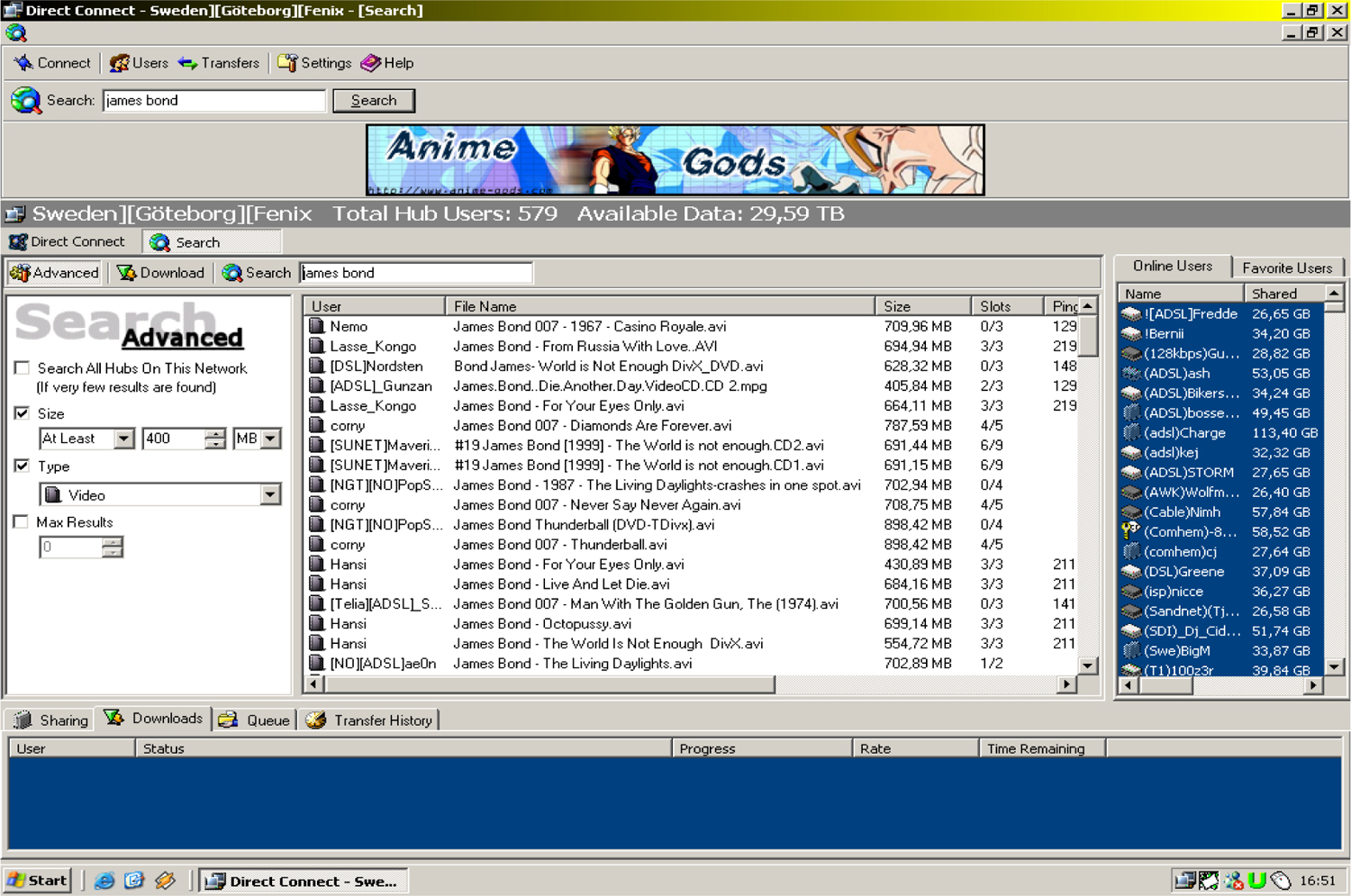
Screenshot from Direct Connect++.
In order to facilitate the identification of barriers, an analysis of how interactions and social games are expressed within DC++ was vital. In order to gain a deeper understanding of the community, we decided that a qualitative approach would be appropriate. The underlying rationale for approaching file sharing networks in this fashion was an interpretive approach. Interpretive researchers often use an underlying theory for both framing and analyzing research data (Holmström, 2005; Walsham, 1993), and in this case, we draw upon SOC framework to guide the data collection, analysis, and reporting. In an interpretive case study, the researchers become integral to the research method and are obliged to acknowledge their influence over it (Golden-Biddle and Locke, 1993; Klein and Myers, 1999; Mason, 1996). With respect to the use of existing theoretical constructs to guide theory-building research, we worked within the explicit conceptual SOC framework. Such a framework becomes a ‘researcher’s first cut at making some explicit theoretical statements’ (Miles and Huberman, 1994: 91). In the context of our study, the use of the SOC framework as an orienting framework helped us make sense of occurrences and ensured that important issues were not overlooked. However, while early identification of possible constructs allows them to be explicitly used in the interview context (Eisenhardt, 1989), it is equally important to recognize that the identification of constructs is tentative in theory-building research. We found this to be true as new factors were found during data collection that needed to be added to the analysis. An important issue to resolve for reaching closure is when to stop conducting interviews. Ideally, researchers should stop adding cases when theoretical saturation is reached (Eisenhardt, 1989). Theoretical saturation is the point at which incremental learning becomes minimal because the researchers are observing phenomena seen before (Glaser and Strauss, 1967). In practice, we decided to stop conducting interviews when new interviews did not add to what we already knew.
To do the analysis, we built on and theorized around the SOC concepts. We followed the recommended procedures for qualitative research and grounded theory (Eisenhardt, 1989; Miles and Huberman, 1994; Strauss and Corbin, 1990). Specifically, we adopted the ‘Straussian’ approach toward grounded theory, which explicitly permits researchers’ exposure to related literature to guide the data analysis process (Strauss and Corbin, 1994). We followed an iterative coding process that involved identifying the emerging concepts, examining empirical evidence for support, consolidating similar concepts to create more refined ideas, and collecting more data until theoretical saturation was reached. In practice, we conducted a total of 41 qualitative interviews with DC++ users, of semi-structured character since, as noted by Miles and Huberman (1994), semi-structured interviews strive more to discover than to control, which was the aim of our study. The initial contact with the informants was made via e-mails, in which we briefly described the aim of the study and the role of the informants in the process. In order to document the audio interviews, as well as concentrate on responses, we used a tape recorder to record the interviews. All interviews were between 30 and 50 min long and were later partially transcribed. We secured anonymity for the informants, and all informants gave written informed consent to participate in the study, since the legal aspects of using DC++ are still uncertain.
The DC++ file sharing network as a virtual community
In order to illustrate the extent to which DC++, with its pronounced community approach, fulfills the characteristic requirements of a virtual community, we chose to structure the empirical data under the four community pillars: feelings of solidarity, feelings of influence, cooperation and satisfaction of needs, and emotional togetherness.
Feelings of solidarity
The structure and functionality of DC++ make it possible to define the boundaries for its community within the network. Within the framework of every hub, there is a list displaying all logged in users. This means that one can easily collect information about the present number of users. Every hub allows only a certain number of users to be logged in at one time, and when the maximum number is reached, users are directed to other hubs. In relation to McMillan and Chavis’s (1986) theory of ‘outsiders’, this means that there are two potential possibilities: a user can either be logged in to a hub or not. If a user is not allowed to log in to a hub, he or she clearly lies outside the perceived solidarity within the hub. With regard to interactions with other members of a hub, all informants report that there are virtually none, in terms of being known to one another outside the framework of DC++.
It is possible to recognize a number of actors through usernames or through the main chat. Beyond this, there seems to be disinterest in making contact or beginning a relationship, in order to make an emotional connection with other actors. One of the interviewees (Inf. 2) expressed this lack of interest as follows: ‘I am not interested in getting to know other people who I cannot actually see, I have a life outside of DC++ too (laughs)’. In the rare cases that the informants, on their own initiative, chose to make contact with another actor, it was often temporary and often reflected the actor’s own interests. Such contact may be initiated by a user having a specific file that is in great demand. Inf. 10 reports, ‘it has actually happened that I have asked people if they have a specific file or a live recording I have been looking for’. Based on this reasoning, it seems that the informants did not feel a deeper connection with other actors within a hub. The unwillingness to create an identity in connection with the maintenance of relations within the network leads one to conclude that users are more likely to identify with the shared material than with the members themselves. The identification of users within DC++ is, in more explicit terms, more closely tied to the information available rather than any social phenomena.
Although the informants say that they make contact with users sporadically, they are also in agreement that communication mainly involves answering one or a few questions directed at them through private chat. This is reflected in a general disinterest in participating in the main chat. Inf. 34 summarizes why the main chat is less attractive, ‘There seems to be a certain group of users who chat in the main chat and therefore it feels uninteresting to get to know the group’. Although it has been pointed out that some in the main chat ‘seem to be very knowledgeable’, it is media outside of DC++ that are often used in problem-solving activities. Sharp criticism of the main operators of the hubs has also cropped up, which may also partly explain why the main chat is not used actively. Indeed, Inf. 5 refers to these operators as ‘bullies’, so there is no possibility of turning to them if problems arise. This sentiment is due to hub operators not wanting to be bothered or confronted with issues that they regard as ‘commonplace problems’. The informants state that no one takes any interest in participating in the main or private chats just to talk. If conversations occur, it is often because users have come into contact with each other outside of the framework of DC++. The emotional insecurity that appears among the informants can extend to the groups within DC++. Taking the step of connecting to these, reportedly does not feel ‘real’, due to a feeling of insecurity that the informants experience, based on the belief that emotional security is built upon the requirements of the real world, such as physical contact. Further, users are anxious about revealing weaknesses in their use of the software, which can result in disparaging remarks and a poor reputation among the hub actors, even if only for a short while.
Within every hub, there is a pronounced symbol system, in the form of clearly stated rules and restrictions the users must obey. This framework sets limits on the material that can be shared, the language that can be used in the main chat and, as Inf. 26 mentions, ‘on DC++ there is a quality control of the material. If you share the wrong stuff or if you fake the type of film you have, you are out!’ Most hubs even require each user to share certain number of files in order to log in. Restrictions are also imposed regarding the connections that are allowed. Modem connections are often prohibited, and in certain cases, broadband companies that are seen as having too slow connection speeds are also not welcome. ‘Because I use Sunet, my log-in is banned from the beginning. Your IP is banned, it says. You can, apparently, mail the operator if you want to come in, but that does not really feel right’ (Inf. 7). These restrictions and the common language foster an atmosphere in which a set of morals and ethical conventions are favored (or imposed), but functionality is also highly prioritized. However, functionality has some dubious aspects, since in many cases preconceived notions exist among the operators with regard to the actor’s connection speed. This results in some broadband companies not being accepted, even if in certain cases they meet the requirements.
Finally, the level of attachment shown by the informants is reflected in almost daily connection with the software. Inf. 8 states, ‘I use DC++ almost every day’. This can be seen as a sign that the users feel an affiliation with DC++, although this appears to be (as stated earlier) probably an affiliation with the material rather than with the actors within the hubs.
Feelings of influence
The informants consider it difficult to influence behavior within a hub. If existing rules and restrictions are going to be changed, many actors must attempt to make the changes together. This is difficult when little connection is felt among members. Hence, a sort of nonchalance is expressed toward attempts to influence rules within a hub. Inf. 2 points out ‘I have difficulty seeing how you can influence anything, but I have never really been inspired to try either’. Inf. 9 states that the structure does not encourage change: If someone came up with an idea and put it out in the main chat, the message would just sit there for a certain amount of time, then be forgotten. Yes, if someone else writes in something, then my message will disappear, I mean.
The ability to affect and influence behavior is also reduced by the strict rules, which in many cases limit the possibilities for interaction. Inf. 5 criticizes the system by pointing out In all fairness, I think they should take away some of the restrictions. They are increasing all the time, especially in the hub I am in. They raise the minimum share, which means that you have to upgrade your hard disk just to have a chance to stay in there.
Placing this reasoning in the framework provided by McMillan and Chavis (1986) indicates that the structure within DC++ affects the belief of users that it is possible to effect change. This is because the operators within the hubs manage them according to their own needs, which in turn affects the users’ feeling of commitment to the hubs and hence a loss of motivation to change, explaining why interviewees experience a feeling of indifference.
The informants reveal that they themselves have been influenced in certain respects. For example, they can give their connection speed in conjunction with their username within a hub. Users also choose to structure shared materials into categories, such as music and formats associated with films. This is done partly for their own convenience but also partly to provide an easily searchable structure for other users. Inf. 10 states In the beginning I did not structure my material, but after I went into a metal-hub and they had the unwritten rule that said you should structure your files in order to make it easier for others to be influenced, so I did. Later, you hope that others will do it too.
Another informant stated, ‘How serious can one be if they refuse to follow any method when they categorize?’ (Inf. 8). All informants had, on several occasions, assimilated material from users where the categorization seemed of a satisfactory nature. One of the informants reported a discussion about a morally poor use of DC++, which sparked discussion (and influenced informants’ feelings) about whether or not to close the connection of a user attempting to download material. It is clear that more respect is given to users who make a serious impression through moral behavior and the proper structuring of shared materials. These users are seen as ‘worthy’, and in turn they influence other users to follow similar procedures.
In this context, the bullying, patronizing behavior of the hub operators (see above) does not help to establish mutual respect between file sharers, or adherence to either current rules and restrictions within the network or favored behavior. Measures that foster trust and reliability are far more effective for promoting acceptance of rules and encouraging users to supply relevant material.
Cooperation and satisfaction of needs
All the informants agree that the total time they have spent in DC++ file sharing networks has generated knowledge of behavioral patterns and the unwritten rules that apply within it. Every hub has different rules regarding what is allowed, but after a time of working within DC++ a feeling regarding what is acceptable and unacceptable across the network is gained. A key aspect is to give and take in certain hubs, even if behavior that does not consider the general good prevails.
Disconnecting a user while he or she is downloading a file leads to a certain amount of discord. Inf. 4 states, ‘I have been disconnected. You get unbelievably irritated, especially if you have been downloading for 2 h. You do the same things yourself, but you learn to give and take, as they say’. Most informants use two or three hubs regularly, within which they find a satisfactory selection of material. On occasions when informants choose to use a hub where they do not feel ‘at home’, no direct consideration is taken of other logged in users. This is shown through the informants’ choice to log in and only satisfy their desires to access material they want, then log out of DC++, regardless of whether or not other users are downloading from them at the same time. Inf. 33 states, ‘If I am logged into a hub where I do not usually log in, I don’t care if people are downloading. I get out when I am finished’. Hence, little if any cooperation or consideration of others is shown when using these hubs, and little need to show any is recognized. There does not seem to be a need to be accepted among actors within the hubs, which in turn fosters grab n’ run behavior.
The behavior that the informants adopt within a hub they think they will not return to differs from their behavior in the hubs they use regularly. The logging out process from DC++ begins when the informants have downloaded the files they want. When using regularly used hubs, all informants then generally send a message that they plan to log out. Further, they often choose to wait to log out if another user is downloading something from them, and only a small amount of time is needed to finish the download. In such cases, if the informant is asked by an actor to be allowed to complete the download, the informant often agrees.
Inf. 12 says: Sometimes someone will ask if they can download a CD or something similar although I was thinking about logging out. I decide to stay on. Asking like that becomes a little more personal, a little more interesting and then you have to stay around.
In regard to this situation, two informants went to the Kazaa network stating that since no one is watching within this network, you can just download what you want, then log out.
One may conclude that there are greater possibilities of recognition within DC++, which results in care be taken when logging out, in the hope that this behavior will also be adopted by others. This hope also generates a feeling of cooperation within the hubs, due to the users becoming aware of accepted behavioral patterns. This results in a more personal integration, which contributes, in turn, to a more courteous atmosphere within the hubs.
Emotional togetherness
All the informants indicate that they do not feel part of ‘the group’ within DC++ file sharing networks. Nevertheless, all the informants are also convinced that a community feeling does exist, in part, among the different actors. Although none of the informants feel a need to create an identity through communication and contact with others, they are of the opinion that there are many users who succeed in forming strong connections, due to the same names recurring in the main chat. The informants go on to state that they see no other potential ways of creating an identity, except through the main chat, which they have chosen to avoid. Inf. 19 states: On some hubs there are tons of people, but because I do not care about the (main) chat, how else will I take part in the community? It is not like you can send tons of messages to private members you don’t know just to chat.
These responses indicate that there are tendencies for emotional exchanges to occur within DC++ file sharing networks, but this feeling of community seemed to be centered on a group of users who do not take the initiative to include new users.
Concerning aspects of attachment to DC++, certain doubts seem to have appeared. One informant had, at one point, considered asking others within the hub a question: Because they seemed very knowledgeable on DC++, I asked about a problem I had. I asked the question in the (main) chat, but because no one noticed the question, it felt stupid to ask the same thing again. Actually, I don’t know who I asked or even who answered! (Inf. 5)
To resolve such problems, a permanent place is needed where general questions, as well as DC++-related questions, can be discussed.
All the informants mention that, in certain cases, they have been rewarded in the form of gratitude for supplying one or more actors with material. The informants also unanimously state that they have adopted this behavior toward other actors.
Inf. 2 pointed out, ‘Just recently I found a CD that I have been looking for forever. When I downloaded the album, I thanked the guy who had it. I don’t know, but it feels great to get the same in return’. The feeling of attachment to a hub apparently increases, according to McMillan and Chavis, if appreciation is directed toward the users. The opposite is true when users are ignored. This is because repeated questions generate a feeling of dissatisfaction and users can be left feeling stupid.
Discussion
The reflections that surround whether or not the phenomenon DC++ can be placed within the framework for a virtual community leads to the discussion around the differences between virtual settlements and virtual communities (Preece, 2000). Although the facts of this study have generated indications that the maintenance of relationships and the spirit of community exists within DC++, to a certain extent, it has also made clear that two barriers exist that work against any ambition to form a community. I will refer to these barriers as anonymity and elitism within DC++. The aspect of anonymity is grounded in the fact that there exists a limited feeling of attachment to other actors within the hubs.
A relevant distinction when considering whether or not the DC++ should be regarded as a community is that drawn by Preece (2000) between virtual settlements and virtual communities. Although this study has generated indications that relationships are maintained and a spirit of community exists to a certain extent within DC++, it is also clear that there are two barriers that hinder the formation of a true community: anonymity and elitism within DC++.
The anonymity is grounded in the users’ limited feeling of attachment to other actors within the hubs. The difficulty and unwillingness to create an identity within the network leads to a connection of the actor with shared materials rather than with other actors. The identification process within DC++ file sharing networks is seldom connected with the information offered, and social interplay is often avoided. This results in contact being sporadic, temporary, and largely connected to the users’ own interests. The users regard the interactions within the network as impersonal, leading to very few encounters of an emotional nature. Making direct contact with others, in order to converse about common interests or the like, which could be viewed as a step in the direction of creating an identity, is seen as somewhat embarrassing and generates a feeling of unease. The creation of identity is largely restricted to users creating a profile for themselves through a ‘nickname’. However, since the use of the main chat area is not attractive, there is little concern about the difficulties of distinguishing oneself. Since use of this forum is not seen as attractive, the creation of another forum within the framework of DC++ where identity and general thoughts can be discussed seems like a viable option. Through such a medium, it would be possible to generate long-standing and interesting discussions, which could result in a less complex identification process, and foster more significant social interplay.
Concerning elitism within DC++ file sharing networks, there are several distinctive aspects. In general, DC++ is built in such a way that it fosters a hierarchical structure. This can be seen in the variations in criteria imposed for joining the network’s hubs, which can lead to the exclusion of actors who have limited performance capacity (low storage capacity, slow connections, etc.). Further, the feeling of elitism is strengthened by the belief among users that they cannot influence processes within the hubs. However, since certain groups do appear to make emotional connections, other hubs, together with their operators, may have the potential to change and influence processes more widely. In this context, it should be noted that while operators have a central position of power, the emergence of later groups may influence them to make decisions that meet some of the concerns of dissatisfied or disinterested users. The motivation may be to try to encourage actors who have lost interest and been alienated to venture inside the ‘boundaries’ of the elite. This, in turn, could result in actors experiencing a feeling of worthiness and lead them to participate in attempts to influence processes within the hubs. An initial hypothesis was that the elitist structure within DC++ fostered democratic processes within it, with an emphasis on mutual influence. Instead, however, a sort of segregated net community has been formed, separated into two layers – an elite and the majority of actors with little influence.
From the individual- versus community-orientated perspective, the question arises as to why DC++ cannot be placed within the framework of a virtual community. Rheingold (2000: 5) states that, ‘…whenever computer mediated communications technology becomes available to people anywhere, they inevitably build communities with it’. The results of this study show that this argument can be strongly questioned. Merely creating a virtual meeting place in the belief that human actors will adapt their behavior to the technology is doomed to failure. This is because an information technology (IT)-focused view leads to the placement of the individual’s ability to manage and process information as the key attribute. In the absence of consideration of social interplay and the understanding that the creation and distribution of information is socially constructed, the individual is not encouraged to communicate and confront other actors as part of the exchange of information process. These arguments are supported by the identified barriers that hinder community building within DC++ file sharing arena. These barriers illustrate the importance of the social context in the establishment of successful information exchanges. The difficulties raised by anonymity and elitism within DC++ file sharing arena are associated with actors failing to identify with other users and (hence) acting for the common good. Social coordination of the network’s actors is not enabled, because anonymity has created a feeling of insecurity.
If the social interactions (and their shortcomings) are not critically considered, then important aspects of the file sharing network will be overlooked. The structure within DC++ file sharing networks does not foster trust and communication that are essential parts of the foundations for a successful community. This is seen in the lack of will or motivation to share experience and knowledge. Communication between the actors is viewed through a narrow, IT-focused perspective, which does not encourage any initiative to attempt to influence or generate innovative processes. The actors tend to prioritize their own interests over the maintenance of relationships or community. The parallel with the problems within the Gnutella network, where actors adopted an egotistical focus partly because of awareness of their anonymity, is obvious (Adar and Huberman, 1998).
Currently, DC++ network actors are not encouraged to create and maintain contact, because the structure only allows temporary communication. While the functionality of the file sharing system is satisfactory within DC++ file sharing networks, it can also be said that there is not an atmosphere with a sense of a virtual community surrounding DC++.
Conclusions
In this study, we have explored a file sharing network from a community perspective. We have also addressed a gap in the literature on file sharing networks, drawing on studies of SOC and employing a social realist approach (Hsieh et al., 2012). We have identified that DC++ has some of the properties of a community. The informants, who were the primary source in this study, were ambivalent about whether DC++ was a virtual community or not. However, their daily use of DC++ has led to behavioral patterns that strengthen (to some degree) feelings of togetherness and social interplay. All informants are also in agreement that the social interplay is connected with small, specialized groups.
Although DC++ has a number of properties that are consistent with the theories of SOC, there are also two barriers (related to anonymity and elitism) that hinder DC++ from working as a virtual community. The coordination of human resources within this IT-based phenomenon can be seen as a vital factor in effectively spreading information and knowledge. However, an aspect that tends to be overlooked is how social factors influence one’s relationship with technology. The importance of these factors is clearly illustrated by the results of this study.
The barriers hindering community development identified in this study, anonymity and elitism, also hinder realization of the ambition of the DC++ founders to establish a community-orientated network. The existence of these barriers and strong influence from individual hub owners obstruct the building of a successful virtual community.
Current arrangements do not provide the necessary conditions for creating trust and communication, the basis for a working community. Thus, when building a P2P file sharing network with the aim of establishing a virtual community, the choice of how one will coordinate human resources is critical to success. These findings stand in sharp contrast to Rheingold’s (2000: 5) somewhat idealistic idea that ‘…whenever computer mediated communications technology becomes available to people anywhere, they inevitably build communities with it’ and contribute to a social realistic understanding of virtual communities.