




Abstract
This study investigates empirically if access to high-speed broadband infrastructure is of importance for the supply of accommodation establishments across all 290 municipalities in Sweden. Control factors include time, population growth and road density. Disaggregated data from several official registers are linked together for the analysis covering the years 2011-2023. Results from the fixed effects Poisson estimations with spatial lags show that there is a significant and positive relationship between the number of hotels and cottage villages on the one hand and the high-speed broadband access on the other, although no associations are found with hostels, conference facilities or camping sites. The significant relationship is nonlinear, indicating increasing returns above a certain threshold. Strongest effects appear for cottage villages, as well as municipalities close to ski resorts or in decline. A spatial dependency exists for the hotels and high-speed broadband access.
Keywords
Introduction
Described as a typical enabler, high-speed broadband infrastructure resembles the notion of a general-purpose technology (Bresnahan and Trajtenberg, 1995). With access to high-speed broadband, it is, among many other things, possible to efficiently process and distribute large amounts of data, work from home, engage in e-commerce, do e-banking, contact public authorities as well as book restaurants, events and accommodations (Briglauer et al., 2024, 2025). Thus, there are presumptive benefits for businesses as well as for individuals that, for instance, reduce transaction costs. Given its features, high-speed broadband technology is commonly employed in attempts to improve regional competitiveness and attract new establishments (Canzian et al., 2019; Deller et al., 2022; Hagsten and Falk, 2024; European Commission Digital Strategy n.d).
There is also evidence that high quality broadband infrastructure may increase the performance or attractiveness of certain businesses in rural areas, including hospitality and accommodation establishments (Brandano et al., 2023; Duvivier and Bussière, 2022; Duvivier et al., 2021; Falk and Hagsten, 2018; Lu et al., 2025; Schmidt et al., 2025). However, the bulk of these analyses mainly refers to the early generation of broadband (McCoy et al., 2018) and there is a high degree of heterogeneity in the relationships investigated between rural and urban areas as well as across local characteristics (Duvivier and Bussière, 2022). Despite the extant literature on the demand for high-speed broadband connectivity at accommodations (Magasic and Gretzel, 2020; Mellinas and Nicolau, 2020), less is known about how this industry, including its different sub-groups, reacts to improvements in the digital infrastructure.
The accommodation sector itself is heterogeneous and consists of hotels, conference facilities, hostels, cottage villages as well as camping sites (Source: Statistics Sweden and Swedish Agency for Economic and Regional Growth n.d.), implying that the reaction to improved high-speed broadband infrastructure may also vary in this respect. Previous studies often use aggregate establishment data for restaurants and accommodation and do not account for nonlinear or spatial relationships.
This study investigates empirically if the access to high-speed broadband infrastructure is important for the supply of accommodation establishments across all 290 municipalities in Sweden. High-speed broadband infrastructure is defined as the proportion of establishments (workplaces) with access to a minimum speed of 100 Mbps. Control factors include physical infrastructure (road density), population growth and time effects. The equation is derived from the theoretical and empirical literature on location attractiveness factors, although it seldom targets accommodation establishments specifically (see Puciato, 2016; Yang et al., 2014; for exceptions). Panel count data models with spatial effects are applied to a linked dataset based on disaggregate information from several official registers in Sweden covering a time period of 13 years (2011-2023).
The study contributes a timely and detailed analysis on how the supply of place-bound inseparable accommodation services reacts to improved high-speed broadband access based on linked official register data. The timeliness means that the development of the high-speed broadband infrastructure during the Covid-19 pandemic is included in the analysis. Present study also takes into account the heterogeneity within the narrow accommodation sector (Brandano et al., 2023) and across municipality characteristics. In practice, the former aspect implies that a presumptive variation in the relationship across different kinds of accommodation establishments can be identified, while the latter means that municipalities in decline or with other specific characteristics can be taken into account. The use of spatial lags reveals if there are geographical concentrations of accommodation establishments stretching over the municipality borders and whether the access to high-speed broadband infrastructure might function as a competitive advantage for these specific businesses. Theoretically, the analysis also contributes to how investments in high-speed broadband infrastructure align with the theory of diminishing returns (Ahlfeldt et al., 2017; Briglauer et al., 2021; De Clercq et al., 2023) as well as to what extent factors of location attractiveness and regional growth are applicable to the different fractions of the accommodation sector (Arauzo-Carod ect al., 2010).
The structure of this study is as follows: Section two introduces the theoretical embedding and Section three describes the empirical approach. In Section four, the data sources and the descriptive statistics are presented while the results are reported in Section five. Section six concludes.
Theoretical embedment
Present study uses the literature on factors of location attractiveness and regional development as a main starting point (Arauzo-Carod et al., 2010). Within these fields, there are studies that find a positive relationship between broadband infrastructure and start-up activity or establishment dynamics using regional data (Audretsch et al., 2015; Conroy and Low, 2022; Hagsten and Falk, 2024; Briglauer et al., 2024 for a recent survey). Another common finding is that high-speed internet improves business activity in rural areas (Mack et al., 2024) and that broadband availability is significantly and positively related to GDP across regional borders (Briglauer et al., 2021).
However, since the kind of services offered by the accommodation sector (room, food, drink and entertainment, for instance) is difficult to separate from its consumption (Moeller, 2010) and the entities are place-bound, it could be considered a special case of the location attractiveness and regional development. This means, for instance, that an accommodation establishment cannot improve its performance by relocating. Instead, it must rely on other measures, such as making good use of available high-speed broadband access.
Typical location factors for regional business or start-up activities in the accommodation and hospitality industry include amenities, GDP per capita and geographical distance to transportation hubs (Yang et al., 2014). Better road transport and density improve access to tourism destinations and facilitate business activities (Khadaroo and Seetanah, 2007; Tian et al., 2022; Wu et al., 2024; Yang and Wong, 2012; Zhang et al., 2025).
Population is another factor of importance for the supply of accommodations since it measures the size of the municipality and thus reflects the level of service that may be expected (Boto-Garcia et al., 2023). Agglomeration effects, indicating, for instance, complementarities within an area, could also be crucial for the location of tourism businesses (Baum and Haveman, 1997; Yang et al., 2012).
An additional discussion of importance is whether the presumptive effects decrease with a certain broadband speed or quality (Briglauer et al., 2024). The neoclassical regional growth theory treats technology exogenously and predicts diminishing returns to the production factors (Abreu, 2021). Endogenous growth theory, on the other hand, considers technological change and human capital as endogenous drivers of growth and thus envisages rising returns to investment (Martin and Sunley, 1998).
Several studies confirm that the relationship between broadband speed and local outcome indicators is nonlinear. One of the first analyses to find diminishing returns to high-speed broadband is within the context of regional property prices (Ahlfeldt et al., 2017). Others demonstrate a waning relationship with regional GDP or employment as broadband penetration or internet access increases (Briglauer et al., 2021; Wu et al., 2024). To the contrary, De Clercq et al. (2023) demonstrate that the proportion of households with high-speed broadband access in rural but not urban regions is characterised by increasing returns to scale in a panel data study covering 1,348 EU NUTS 3 regions.
Overview of previous studies.
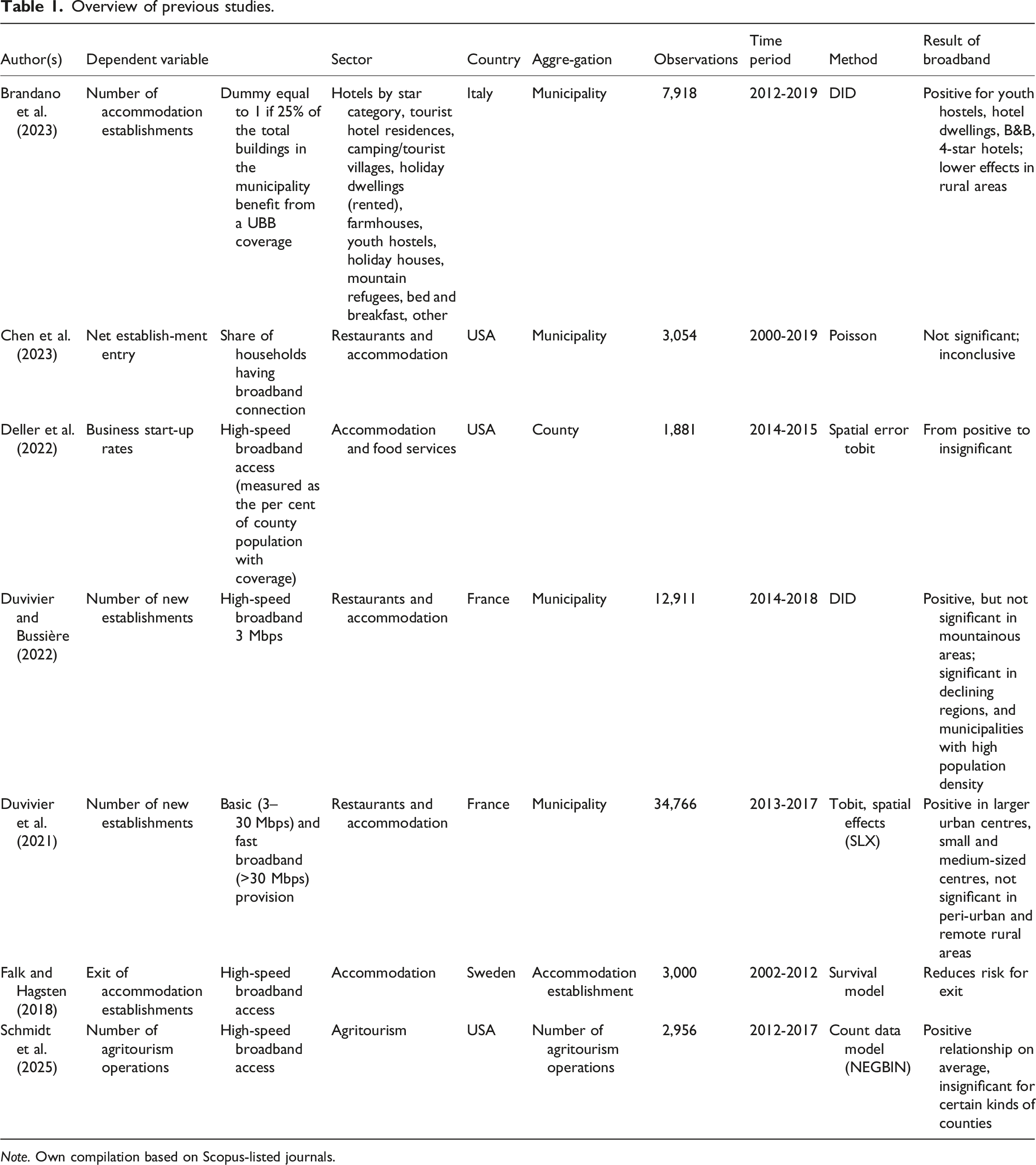
Note. Own compilation based on Scopus-listed journals.
Although most studies refrain from separating restaurants and accommodation establishments in the analysis of broadband infrastructure access, there is one exception: By employing a difference-in-differences approach on data for 7,918 Italian municipalities, positive effects are found for a certain group of accommodations (Brandano et al., 2023). A second difference-in-differences analysis with long time lags undertaken by Schmidt et al. (2025) focuses solely on agritourism operations. Results from this study indicate that access to county-level fast-speed broadband in the early period is significantly linked to a larger proportion of operators five years later, although the effect is weak in rural areas. Thus, these results indicate that heterogeneity in performance may not only appear across regions but also within narrowly defined industries (Bartelsman and Doms, 2000).
It is common to employ composite digitalisation indexes for studies of the relationship with business activity in the tourism sector, although they tend to give mixed results (Hao et al., 2024; Zhang et al., 2025). In China, for instance, the strength of the link between tourism and digitalisation varies across regions, indicating that overall industry composition, rather than the tourism businesses, determines the quality of the digital infrastructure (Zhang et al., 2025).
Empirical approach
Given expectations that the workplace proportion of high-speed broadband infrastructure is of importance for the local accommodations supply (Brandano et al., 2023), a fixed effects Poisson estimator is employed (Wooldridge, 1999) in combination with the Spatial Durbin Model that encompasses both lagged Y and X values (Elhorst, 2014). The mechanism of this spatial model allows the proportion of the workplaces with high-speed broadband access in the neighbouring municipalities to be taken into account. Fixed effects models explicitly account for unobserved time-invariant location factors and are, therefore, preferable to cross-sectional regression models.
Explained by the group of time-variant variables, the number of establishments 
Some municipalities are small and thus do not supply all kinds of accommodations. This means that the dependent variable is an integer with a certain proportion of zero values and a skewed distribution. Because of this, a panel count data model with fixed effects is required for the estimations. Across the municipalities, three per cent do not have hotels and eight per cent no cottage villages, while there are only conference facilities in three out of five municipalities (Statistics Sweden and the Swedish Agency for Economic and Regional Growth, n.d.). Thus, the Fixed Effects Poisson estimator with cluster-adjusted standard errors (at the municipality level) is employed (Wooldridge, 1999), including the spatially weighted variables in the second step (Elhorst, 2014). Fixed effects models explicitly account for unobserved time-invariant location factors (such as the topography or distance to population centres) and are therefore preferable to cross-sectional regression models. Spatial econometric modelling (SLX) of establishment births is also employed by Duvivier et al. (2021), although in combination with a Tobit model.
The issue of endogeneity is commonly raised in relation to the impact of broadband deployment (Chen et al., 2023; Kim and Orazem, 2017). Haller and Lyons (2019) argue that, unlike adoption, access to broadband infrastructure is external to the institution and therefore does not raise endogeneity or unclear causality concerns in the short term. Despite this, endogeneity of broadband access cannot be fully ruled out. Previous studies show that internet provision is significantly positively related to city size, metropolitan status and knowledge intensity (Tranos and Gillespie, 2009).
Chen et al. (2023) combine the Poisson count data model with the control function method to address the endogeneity problem, in which the penetration rate in the neighbouring county is used as the instrumental variable. A similar approach is employed for this study, where in the first stage the proportion of workplaces with high-speed broadband access is regressed on the proportion of households with high-speed broadband access in the same municipality, its spatial term, number of inhabitants and yearly dummy variables. This instrumental variable is chosen because it correlates with the workplace broadband access but is less likely to influence the supply of accommodation establishments. Population growth is another variable independent of the number of accommodation establishments, but with a relationship to the expansion of broadband infrastructure (Kolko, 2012). The two-way fixed effects model can be used to estimate the first stage of the control function approach. A t-test on the residuals of the first stage regression is used as a control for the endogeneity of high-speed broadband access (Lin and Wooldridge, 2019). Endogeneity can be ruled out if the coefficient of the fitted residual is not significantly different from zero.
Data sources and stylised facts
Information on the dependent variable, the number of accommodation establishments at the five-digit NACE 2 industry level for the years 2011-2023, is available from the regional database RAPS-RIS. This database is maintained by the Swedish Agency for Economic and Regional Growth together with Statistics Sweden (n.d.). Establishment data are particularly useful for spatial analyses since information is based on geographic location rather than on legal entity and issues concerning ownership, mergers, acquisitions, associations or location of headquarters do not apply. There are seven categories of accommodations available in the database: (i) hotels with restaurants, (ii) conference facilities, (iii) hotels without restaurants, (iv) hostels, (v) cottage villages, (vi) camping sites and (vii) other lodgings. Hotels with and without restaurants are used as one group in present analysis and the category of other lodgings is excluded due to the small number of observations.
Data on workplace and household broadband access of a minimum speed of 100 Mbps to the premises can be found in the Mobile Coverage and Broadband Survey by the Swedish Post and Telecom Authority (n.d.). This dataset is superior for analyses of broadband deployment since it circumvents the fact that the market and investors encompass a myriad of private and public actors at the local, regional, national and international levels (Swedish Ministry of Enterprise, 2016). Information on the number of inhabitants originate from the Statistics Sweden Population Statistics (n.d.). These data are also employed to identify municipalities in decline during the period of time studied. Road area in hectares originates from the Statistics Sweden Land Use (n.d.). However, these Statistics are only reported every fifth year, starting in 2010.
Google Maps is the source for the geographic longitude and latitude of the centre of each municipality for the calculation of the spatial matrix (Google Maps, n.d.). The spatial weight matrix W is based on the geographical distances between the core of each municipality and the exponential decay function (Kondo, 2021). This means that a large distance between two cores is given a smaller weight in the spatial effects. For the baseline analysis, the inverse geographical distance of the 290 × 290 municipality matrix is employed. In order to investigate the sensitivity of the results, two different cut-off points for the distance are tested (150 km and 200 km). Due to large, sparsely populated areas in the country, shorter distances than this are not reasonable to use.
There are 290 municipalities in Sweden with a median size of 22,000 inhabitants (Statistics Sweden, n.d.). One in five municipalities, mainly in the north and north-east, is declining in number of inhabitants during the time window of the analysis (Figure 1(a)). These declining municipalities are smaller with 7000 inhabitants on average (Statistics Sweden, n.d.). The three largest municipalities in Sweden are Stockholm, Gothenburg and Malmö, with 987,690, 605,000 and 360,249 inhabitants, respectively, in 2023 (Statistics Sweden, n.d.). Declining municipalities (A), distribution of accommodation establishments (B) and proportion of workplaces with access to high-speed broadband (C) in Sweden. Note: (A): Decline is measured as a reduction in the number of inhabitants over the time period studied (2011-2023). Several of the declining municipalities can be found in typical winter sports areas. Grey shade implies neither declining nor winter sports destination, light blue is a winter sports area, red means declining and dark red means both a winter sports area and a declining municipality. (B): The distribution of accommodation establishments is illustrated by use of a three-level scale, where the light (pink) shade represents municipalities with the median or lower number (15) of establishments in 2023, the medium pink shade refers to municipalities with 16-99 establishments and the dark red shade is the three municipalities with more than 100 establishments (Stockholm, Gothenburg and the Island of Gotland). (C): In 2023, the lower quartile broadband access is 72% of workplaces in a municipality (light blue shade), while the upper quartile of the distribution is a proportion of 92% (dark blue shade). Medium blue shade represents municipalities with the proportion of workplaces in between. Source: Statistics Sweden, Swedish Agency for Economic and Regional Growth as well as Swedish Post and Telecommunication Agency.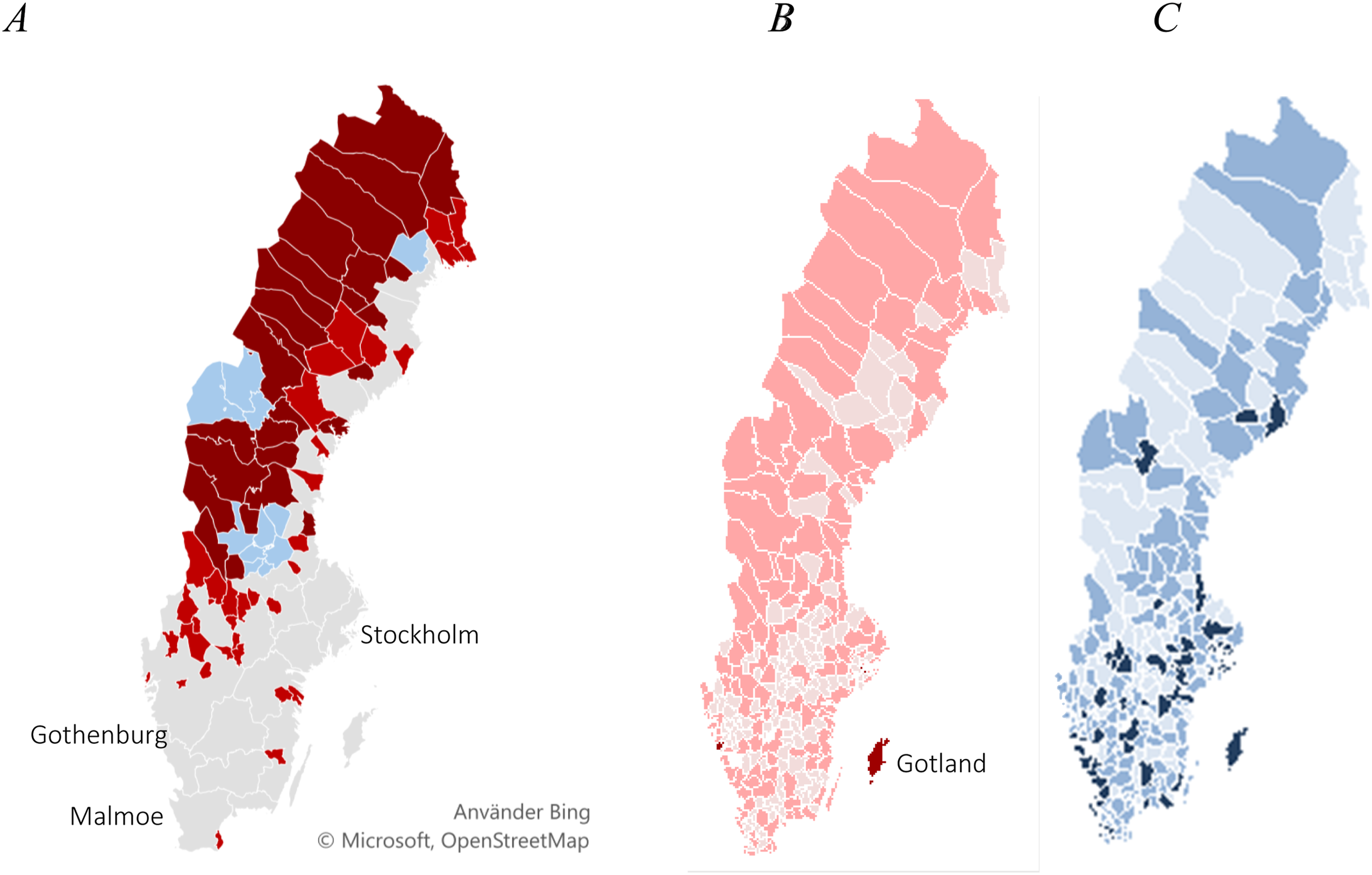
Descriptive statistics.
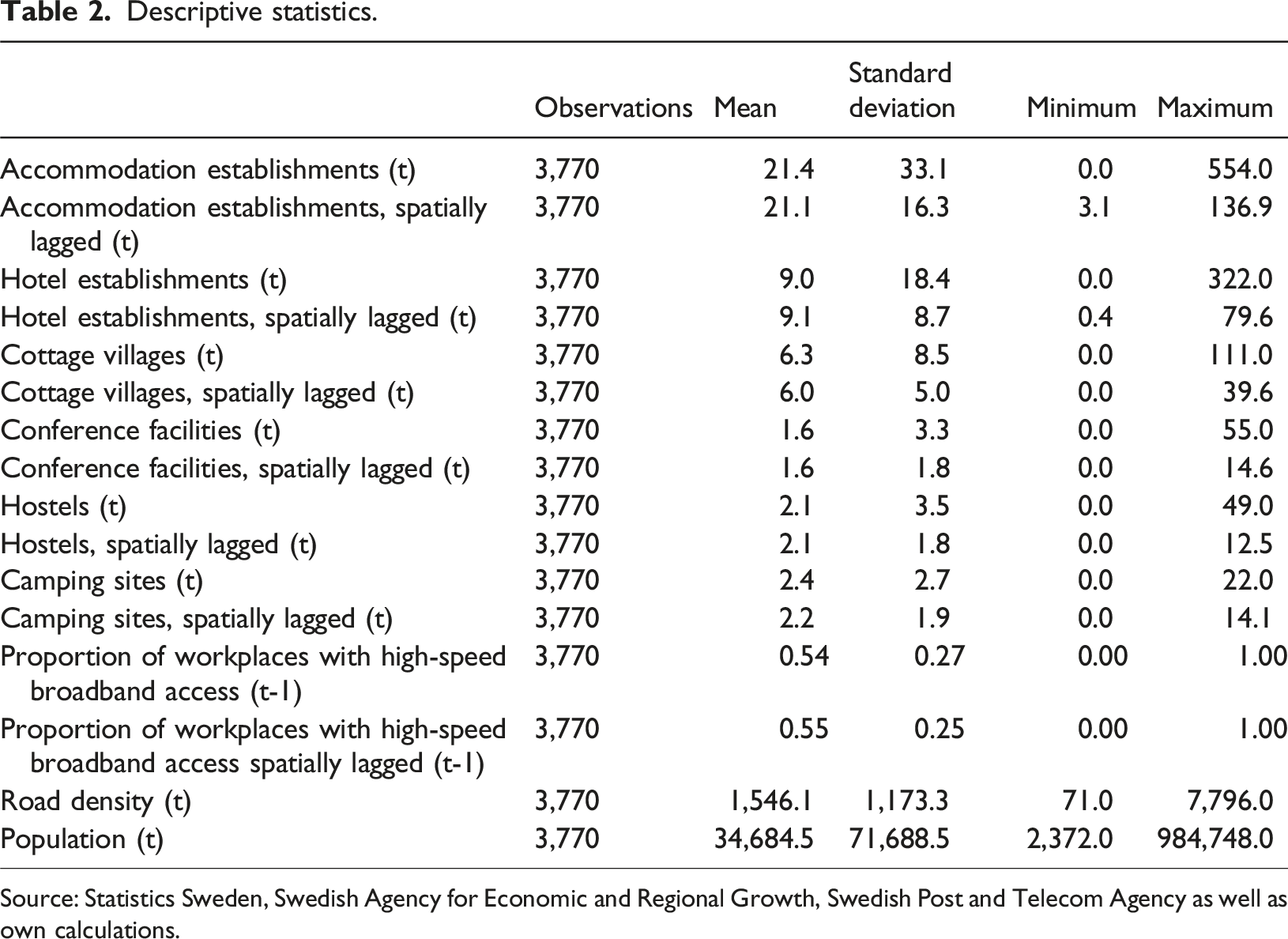
Source: Statistics Sweden, Swedish Agency for Economic and Regional Growth, Swedish Post and Telecom Agency as well as own calculations.
While the proportion of workplaces with access to high-speed broadband increases from a low level to more than 80% during the time period studied, no such expansion can be expected by the different kinds of accommodation establishments (Figure 2). Instead, the movement over time across these establishments exhibits two distinguished patterns, the one with no change at all and the other with a clear increase. It is the number of cottage villages and hotels that accounts for the apparent increases over time, while no similar development occurs for the smallest groups of accommodation establishments: hostels, camping sites and conference facilities. For these groups, the supply is almost constant over time. Development of number of accommodation establishments (left axis) and high-speed broadband access (per cent, right axis). Source: Statistics Sweden, Swedish Agency for Economic and Regional Growth, Swedish Post and Telecom Authority as well as own calculations.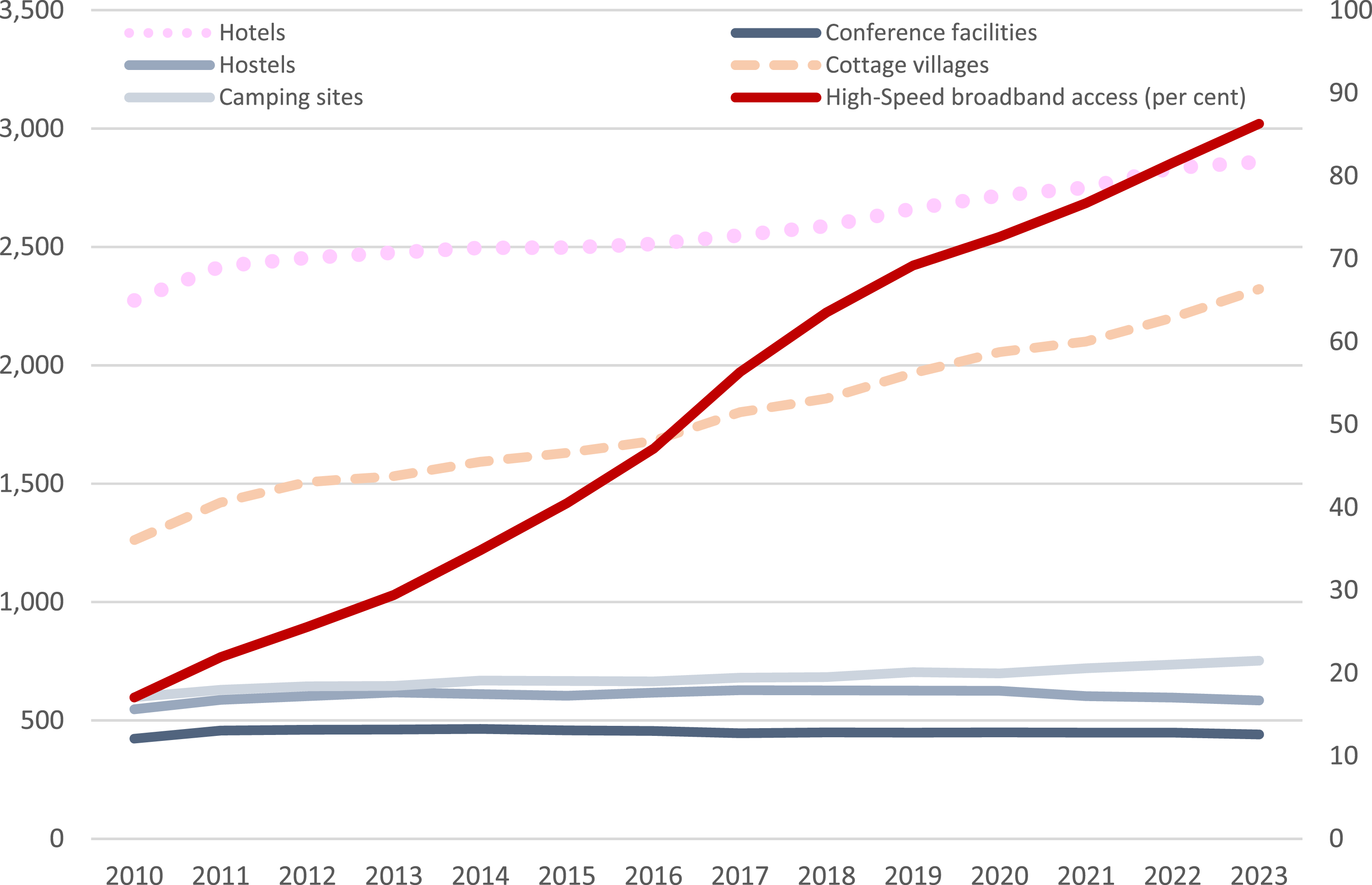
To gain an initial understanding of the possible spatial autocorrelation of the key variables, the global Moran’s I statistic may be calculated (Anselin, 1995). This statistic renders coefficients for the broadband variable between 0.23 and 0.34 at a significance level of 1%, implying a small degree of clustering (autocorrelation). The estimates for the accommodation establishment variable are not significant at conventional levels, meaning that there is neither a correlated clustering nor a spread. Important to remember though, is that this test does not take the municipal fixed effects into account, despite the highly skewed distribution of the dependent variables. Thus, focus is put on interpretating the estimates from the spatial Durbin model introduced in the methods section.
Empirical results
Relationship between the number of accommodation establishments and high-speed broadband access, fixed effects Poisson estimations.
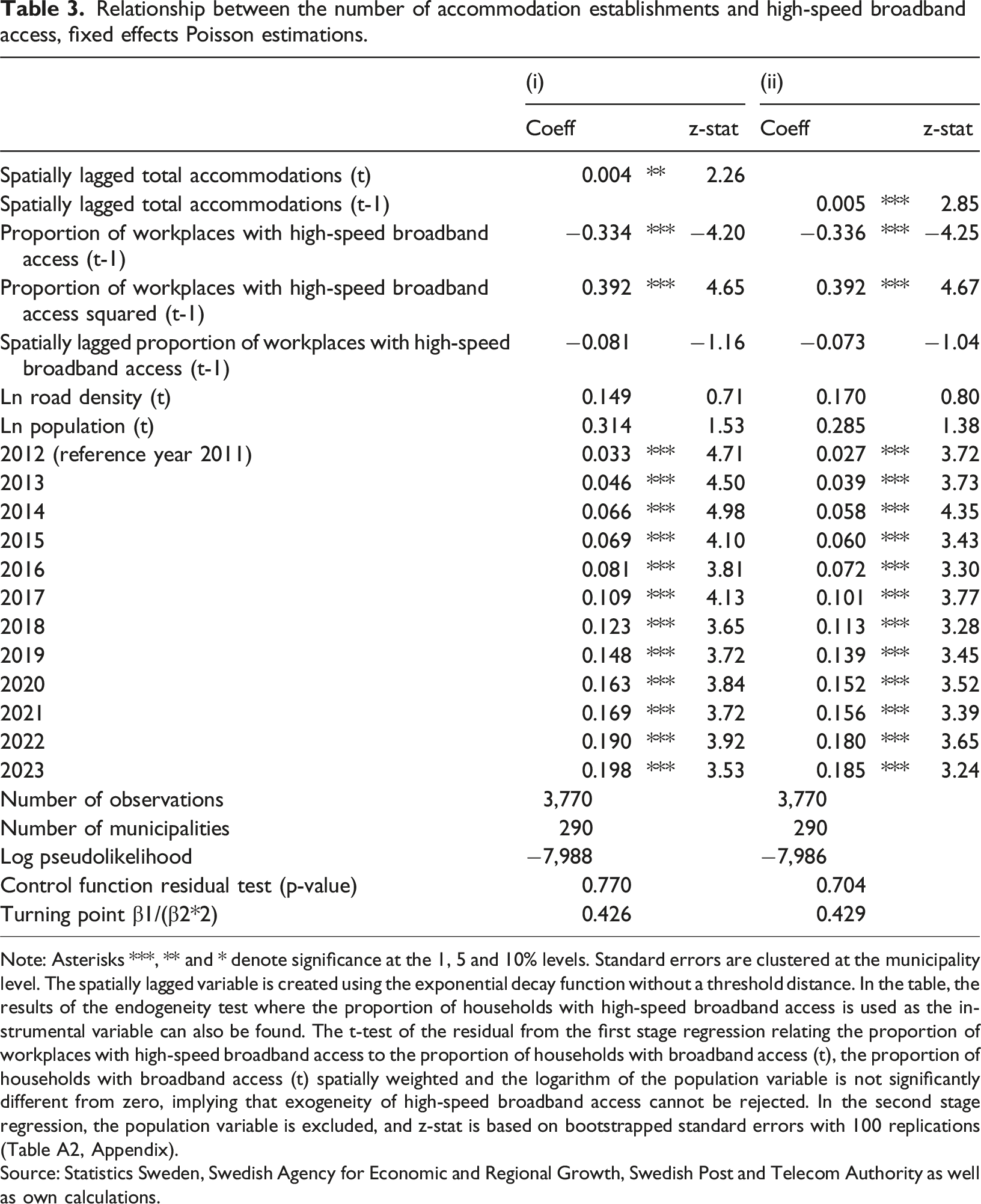
Note: Asterisks ***, ** and * denote significance at the 1, 5 and 10% levels. Standard errors are clustered at the municipality level. The spatially lagged variable is created using the exponential decay function without a threshold distance. In the table, the results of the endogeneity test where the proportion of households with high-speed broadband access is used as the instrumental variable can also be found. The t-test of the residual from the first stage regression relating the proportion of workplaces with high-speed broadband access to the proportion of households with broadband access (t), the proportion of households with broadband access (t) spatially weighted and the logarithm of the population variable is not significantly different from zero, implying that exogeneity of high-speed broadband access cannot be rejected. In the second stage regression, the population variable is excluded, and z-stat is based on bootstrapped standard errors with 100 replications (Table A2, Appendix).
Source: Statistics Sweden, Swedish Agency for Economic and Regional Growth, Swedish Post and Telecom Authority as well as own calculations.
Relationship between the number of accommodation establishments and high-speed broadband access, hotels and cottage villages, fixed effects Poisson estimations.
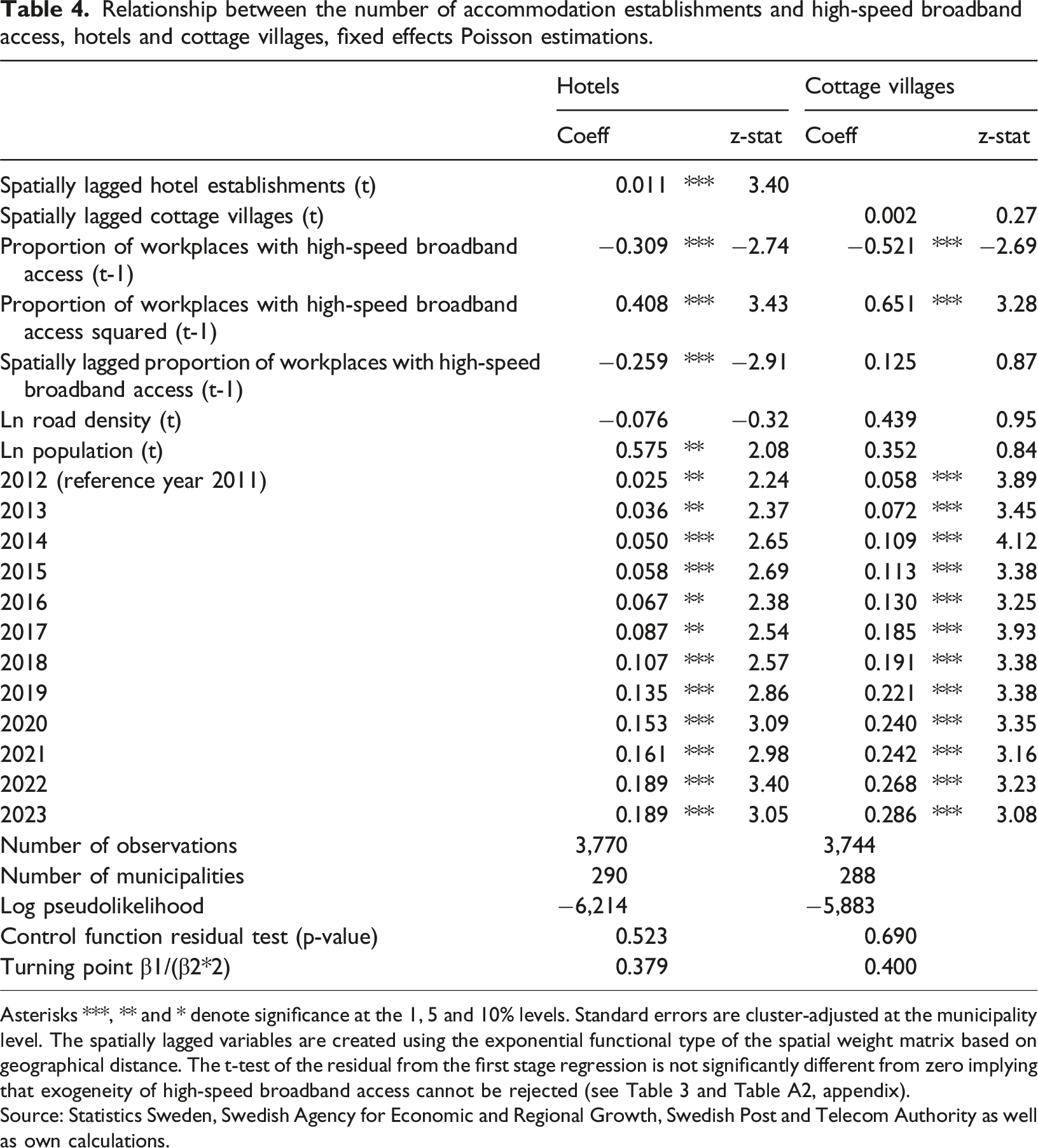
Asterisks ***, ** and * denote significance at the 1, 5 and 10% levels. Standard errors are cluster-adjusted at the municipality level. The spatially lagged variables are created using the exponential functional type of the spatial weight matrix based on geographical distance. The t-test of the residual from the first stage regression is not significantly different from zero implying that exogeneity of high-speed broadband access cannot be rejected (see Table 3 and Table A2, appendix).
Source: Statistics Sweden, Swedish Agency for Economic and Regional Growth, Swedish Post and Telecom Authority as well as own calculations.
The spatially lagged dependent variable is positively significant for the total number of accommodation establishments as well as for the hotels (Table 3, Specification i and Table 4). The results are robust even when a time-lag of 1 year is considered (Table 3, Specification ii). Typically, these results could relate to agglomeration effects, as suggested by Baum and Haveman (1997), implying that a destination is larger than the single municipality, as is often the case in the metropolitan as well as in the ski resort areas in the north of Sweden. The larger Stockholm region, for instance, encompasses 33 municipalities (source: Statistics Sweden, n.d.). This same argument might also explain the significant spatial lag of the high-speed broadband variable specifically for hotels. Thus, the negative estimate means that the quality of the broadband infrastructure could be used as a competitive advantage. None of the control variables, such as population of the municipality or road density, is found to be of importance for the overall supply of accommodation establishments, but for hotels, where population is significant at the 5% level. All yearly dummy variables are positive and significant with a magnitude that increases over time, suggesting a steady growth.
The nonlinear concave relationship means that turning points are identified, although they are not necessarily significant. Because of this, focus is put on interpreting the main significant results across the distribution of high-speed broadband access. These results appear above certain thresholds, below which no gains for the supply of hotels or cottage villages from high-speed broadband access can be found. The thresholds (consisting of the averages across municipalities and over time) are approximately 60% of workplaces with high-speed broadband access for the hotels and 50% in the case of the cottage villages (Figure 3). A significant but negative relationship is detected for the lower levels of high-speed broadband access, although only a marginal number of municipalities can be found in this group and thus the results should be interpreted with caution. The identified development does not support the theory of diminishing returns. For municipalities with a proportion of high-speed broadband access of 70%, an increase by one percentage point leads to a surge in the total number of accommodation establishments by 0.2% and an increase in the number of cottage villages by 0.5% (Figure 3). Marginal effects of high-speed broadband access on accommodation establishments A. All accommodation establishments. Notes: A dotted line introduces the threshold point from which the marginal effects are positively significant. The marginal effects are calculated using the delta method based on the estimates presented in Tables 3 and 4.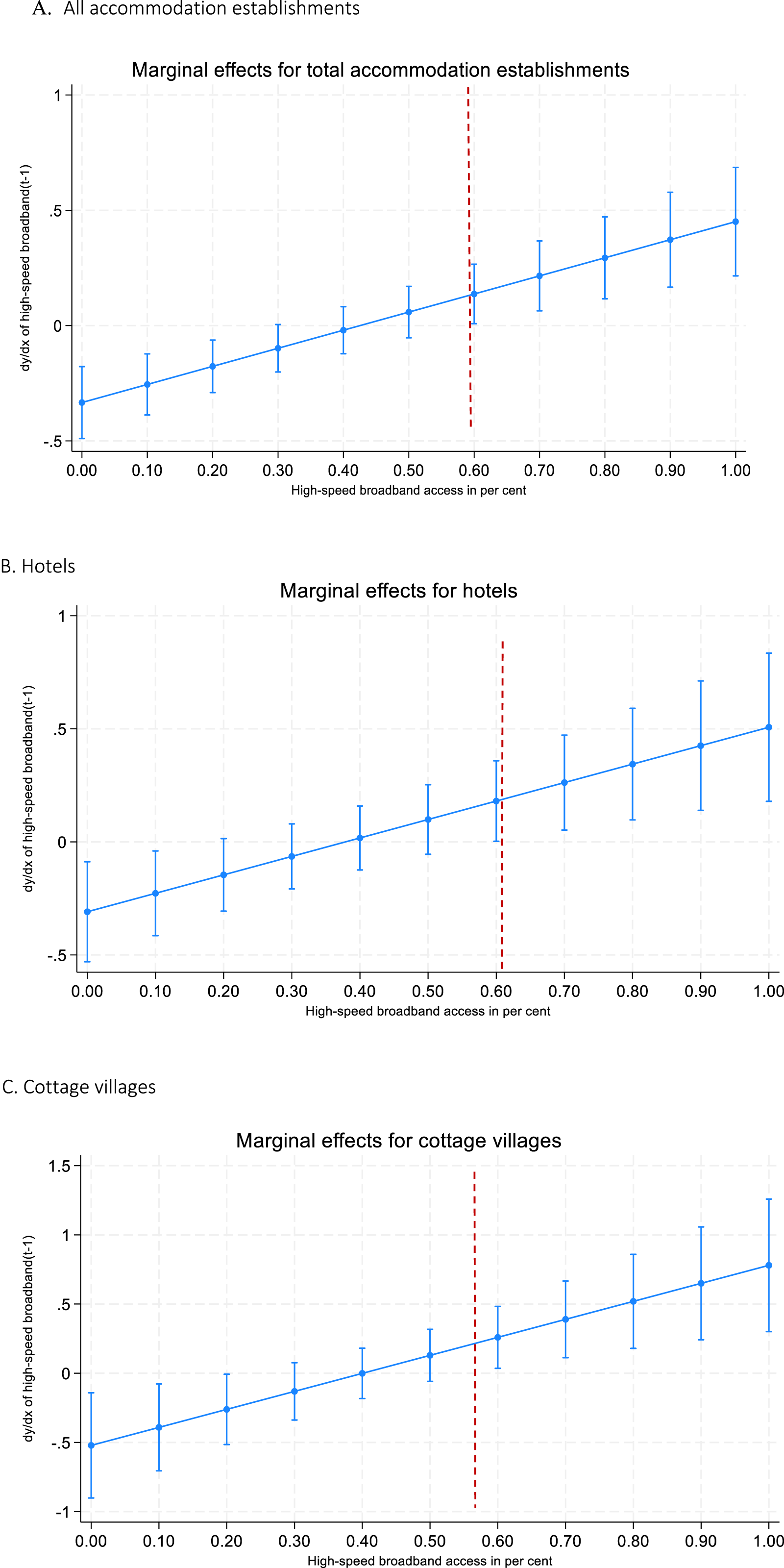
While there is a significant and positive relationship between the number of hotels and cottage villages on the one hand and the high-speed broadband access on the other, no significant links are found to the number of hostels, conference facilities or camping sites (Table A1, Appendix).
The endogeneity control of the high-speed broadband access by using the proportion of households with access as an instrument does not reject exogeneity of the variable (Table A2, Appendix). In the first stage of the control function, the two-way fixed effects regression shows that the high-speed broadband access is significantly positively related with the proportion of households with broadband access as well as its spatial lag (Table A2, Appendix). Population measured as the number of inhabitants is also significant and positive, as predicted by the theory. The F-test verifies the joint significance of the instrumental variables. When the residual of this estimation in the second step is regressed on the proportion of workplaces with high-speed broadband access, the relationship is neither significant for hotels nor for cottage villages (Table 4).
The results reveal that high-speed broadband access may improve the business activity in certain areas, although there is a certain degree of heterogeneity in the relationships (Hagsten and Falk, 2024; Mack et al., 2024). Yet, the inseparable characteristics of the services provided by the place-bound group of different accommodation establishments make the comparison with firms in general less suitable since the alternative to relocate is not available. There are, however, indications that the accommodation establishments benefit more from the high-speed broadband access than other workplaces since the magnitudes of the estimates (when significant) are far larger than those in related but not identical studies (Falk and Hagsten, 2021; Hagsten and Falk, 2024). Duvivier et al. (2021) document that high-speed broadband access stimulates the birth of establishments within the food and accommodation sector. However, it is not clear by which sub-industry these results are driven. Present analysis informs that it is mainly the hotels and the cottage villages that react to increased access to high-speed broadband. Brandano et al. (2023) demonstrate evidence of increased supply of four-star hotels and bed and breakfast establishments in rural Italian areas from improved high-speed broadband access, although this study relates to older data and a bivariate measure of the broadband variable. Spatial effects or possible nonlinear relationships are also not considered. Schmidt et al., 2025 report a relationship between high-speed broadband access and the number of agritourism operations in the United States, where the association is weaker in rural counties. None of the cited studies employs timely data on high-speed broadband access that stretches over the Covid-19 pandemic.
The finding of increasing returns to high-speed broadband stands in contrast to the general literature (Briglauer et al., 2024) with one exception. DeClercq et al. (2023) demonstrate that high-speed broadband coverage in European rural regions exhibits increasing returns to scale in relation to growth. Increasing returns to scale (as well as spatial spillovers) contradict the neoclassical growth theory on diminishing returns to investment in technology. Yet, it is difficult to align the results with the endogenous growth theory given that the control function does not reject the high-speed broadband access as an exogenous variable.
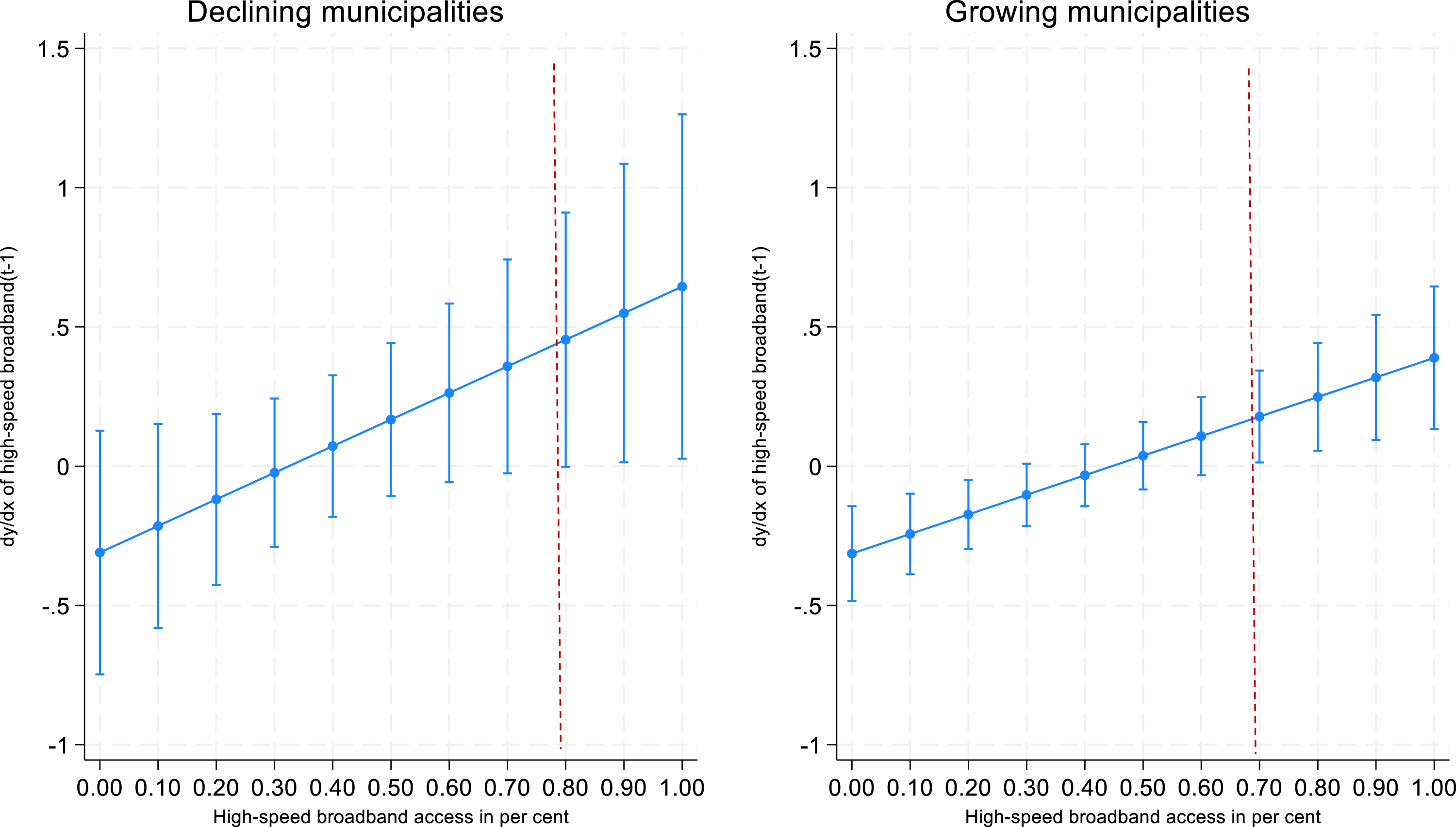
Several robustness tests are being carried out. First, separate estimations are conducted for municipalities close to winter sports areas identified as being within a short drive to a downhill resort. This group includes 39 municipalities. The results show that the relationship between high-speed broadband access and the number of accommodation establishments is generally higher for municipalities in the winter sports regions (Figure 4). Yet, the same pattern of significance occurs in this case, where the positive effects are only observed for municipalities with an above average proportion of workplaces with high-speed broadband access. A second robustness check estimates the accommodation establishment equation for declining and growing municipalities separately, based on population data. The former group includes 62 municipalities. Estimation results demonstrate that the effects are larger in declining regions, although only if the high-speed broadband access is above average levels (Figure 5). Marginal effects of high-speed broadband access on accommodation establishments in municipalities with or without ski resorts. Note: The number of municipalities with a ski resort in the area is 39. This group includes Arjeplog, Arvidsjaur, Berg, Bjurholm, Boden, Borlänge, Bräcke, Dorotea, Falun, Gagnef, Gällivare, Härjedalen, Jokkmokk, Kiruna, Kramfors, Krokom, Leksand, Ljusdal, Malung, Malå, Mora, Norsjö, Orsa, Ovanåker, Pajala, Ragunda, Rättvik, Sorsele, Storuman, Strömsund, Vansbro, Vilhelmina, Älvdalen, Älvsbyn, Ånge, Åre, Östersund, Överkalix, Övertorneå. Detailed estimation results are available on request. A dotted line introduces the threshold point from which the marginal effects are positively significant. Source: Statistics Sweden, Swedish Agency for Economic and Regional Growth, Swedish Post and Telecom Authority as well as own calculations. Marginal effects of high-speed broadband access on accommodation establishments in declining or growing municipalities. Note: A dotted line introduces the threshold point from which the marginal effects are positively significant. The number of declining municipalities is 62. Detailed estimation results are available on request. Source: Statistics Sweden, Swedish Agency for Economic and Regional Growth, Swedish Post and Telecom Authority as well as own calculations.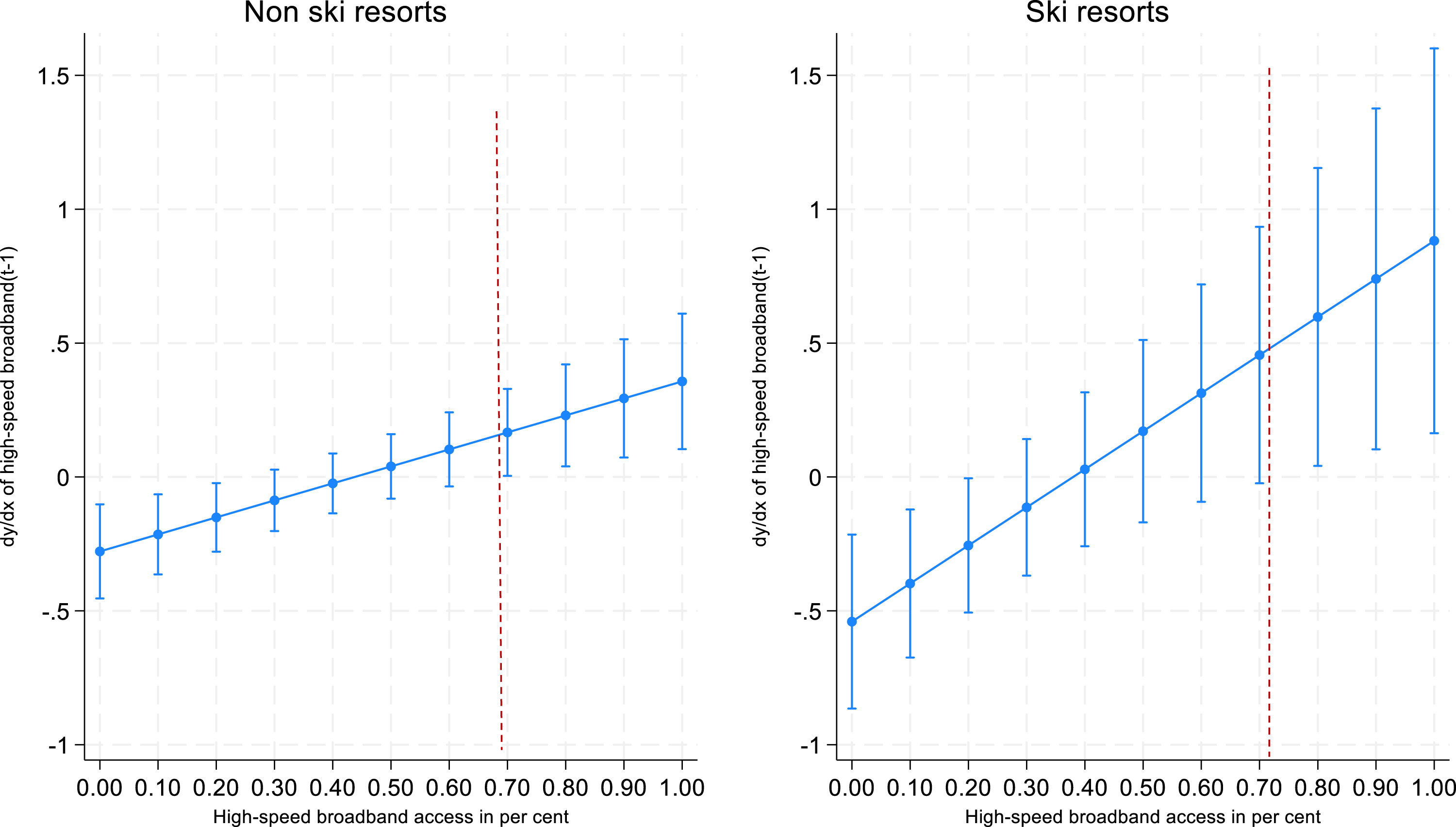
Public investments in transportation infrastructure and amenities are other underlying crucial aspects of the accommodations supply (Arauzo-Carod et al., 2010; Bhat et al., 2014; Brandano et al., 2023). While the physical infrastructure on the one hand is improved, it is common with new protected natural areas (Source: Statistics Sweden). Thus, the third robustness check includes local public investments and presence of national parks as well as a dummy variable for municipalities that are located in the vicinity of the new airport in Dalarna from 2019 onwards. None of these variables is significant at conventional levels and is therefore not included in the final specification.
In a fourth verification of the results, distortions due to the Covid-19 pandemic are investigated. Although Sweden experiences no lockdowns, it is possible that the supply of accommodation establishments in the initial phase of the pandemic slightly slows down, while the diffusion of high-speed broadband infrastructure accelerates. Because of this, the baseline equation is estimated for a shorter period of time, 2011-2019. This exercise renders results similar to those of the baseline estimations, only with slightly higher marginal effects of the high-speed broadband access and a somewhat lower turning point (Table A3, Appendix).
A final robustness check explores if the results depend on the choice of the threshold distance for the spatial weight matrix. To examine this, a threshold difference of 150 km and 200 km is used. The cut-off value of 100 km cannot be employed because this would lead to the exclusion of the island of Gotland. Based on the threshold of 150 km, the spatial variable of total accommodation establishments is not affected (the coefficient of 0.0038 and the z-stat of 2.27 is only slightly different). Similar results are obtained with the distance threshold of 200 km (with a coefficient of 0.0038 and a z-stat of 2.26). The spatially weighted high-speed broadband access variable (lagged 1 year) is insignificant for the total group of accommodations irrespective of how the cut-off point for the spatial weight matrix is chosen.
Conclusions
This study investigates empirically if the proportion of workplaces with high-speed broadband infrastructure access is of importance for the supply of accommodation establishments across all 290 municipalities in Sweden. Control factors include road density, local population growth and time effects. For the purpose of the analysis, disaggregated data from several official registers in Sweden are linked together covering a time period of 13 years.
Results from the fixed effects Poisson estimations with spatial effects show that the link to high-speed broadband access mainly varies across the different kinds of accommodation establishments, and to a smaller extent, characteristics of the municipality. The relationship is nonlinear and driven by hotels and cottage villages. This means that the workplace high-speed broadband access is only beneficial for the number of establishments in municipalities where the broadband infrastructure is already above the average of 54%, suggesting increasing returns for hotels and cottage villages.
The results also indicate that the workplace access to high-speed broadband can be used as a comparative advantage in relation to the neighbouring municipalities, while control variables population and road density are not significant. The stronger relationship for cottage villages could possibly be explained by longer stays or larger groups of individuals frequenting these facilities, while the insignificant results for camping sites and conference facilities may relate to another level of maturity in these markets. A test of endogeneity implies that exogeneity of the broadband variable cannot be rejected.
An important policy implication is that establishments that provide non-separable goods, and are bound to a certain place, may benefit more from an improved digital infrastructure than other workplaces. A fast broadband connection at a tourist destination may enable remote working and online business meetings and can thus lead to an extension of the trip. It is also apparent that the digital infrastructure is more relevant than the physical one. Thus, public investment projects in physical infrastructure may not always be the most efficient solution for improved growth in a region.
Theoretically, even place-bound businesses providing inseparable goods can be analysed through the lens of a location attractiveness or regional development framework, although the importance of different drivers may vary. In this specific context, it also appears that the expected decreasing return to the exogenous digital investments does not occur. The finding that the impact of high-speed broadband access is nonlinear and heterogeneous even in a narrow industry such as the accommodation sector emphasises the importance of considering different sub-groups and avoiding the use of linear models.
This study has several limitations that need to be considered. Firstly, the accommodation offer depends on many factors, of which a number cannot be taken into account due to data deficits or choice of model. Possible factors of importance include new tourist attractions or building restrictions. Competition from Airbnb properties may also play a role in certain, but not all, areas. Future research could consider the number of employees of the accommodation establishments. Unfortunately, due to major changes in definitions of employment in the official statistics in recent years, no time series without breaks is available, and thus could not be considered in present analysis.
Supplemental Material
Supplemental Material - Local supply of accommodation establishments heterogeneously affected by high-speed broadband infrastructure
Supplemental Material for Local supply of accommodation establishments heterogeneously affected by high-speed broadband infrastructure by Eva Hagsten, Martin Thomas Falk in Tourism Economics.
Footnotes
Acknowledgements
The authors would like to thank the participants of the Surrey 2023 conference “Bringing Hospitality, Tourism, Transport, and Events Back for Good” and of the conference “Tourists as Consumers, Visitors and Travellers” at the University of Alicante in November 2024 for helpful comments on an earlier version of the manuscript. The conclusions drawn in this study are solely those of the authors and should not be mistaken for any official views of their institutions.

Funding
The authors received no financial support for the research, authorship, and/or publication of this article.
Declaration of conflicting interests
The authors declare no potential conflicts of interest with respect to the research, authorship, and/or publication of this article.
Data Availability Statement
The data used in the analysis are from publicly available sources.
Supplemental Material
Supplemental material for this article is available online.
Author biographies
References
Supplementary Material
Please find the following supplemental material available below.
For Open Access articles published under a Creative Commons License, all supplemental material carries the same license as the article it is associated with.
For non-Open Access articles published, all supplemental material carries a non-exclusive license, and permission requests for re-use of supplemental material or any part of supplemental material shall be sent directly to the copyright owner as specified in the copyright notice associated with the article.
