




Abstract
Overtourism is a complex issue affecting destinations in various ways. This study identifies the main causes and presents a framework using eight indicators related to transportation, accommodation, cultural and natural resources, and economic factors. Focusing on EU Mediterranean regions, the research applies this methodology at the municipal level in an Italian region with high seasonal tourist traffic. The findings highlight overtourism risk indicators, detailing the economic impact of tourism and destination vulnerabilities, and emphasize the need to rethink tourism growth models for better balance between local community welfare and visitor satisfaction.
Introduction and relevant literature
Tourism has become essential globally, with Europe leading as the top destination before the COVID-19 pandemic, attracting 713 million arrivals and contributing significantly to GDP and employment (WTTC, 2022). As international travel recovers, many EU regions in 2023 have surpassed pre-pandemic figures. However, tourism also leads to challenges such as pollution, land exploitation, and tensions between tourists and locals, a phenomenon termed “overtourism” (Bergantino et al., 2023). Destinations like Rome, Barcelona, and Dubrovnik experience negative impacts, diminishing residents’ quality of life and visitor experiences (Frey and Briviba, 2020; UNWTO, 2018). Environmental hotspots like Cinque Terre are particularly affected. Factors contributing to overtourism include reduced transportation costs, leading to increased visitor volumes and environmental degradation, as well as the rise of Online Travel Agencies and social media, which attract “selfie tourists.” Seasonal spikes in demand can inflate prices and displace local businesses, while peer-to-peer accommodations contribute to gentrification (Peeters et al., 2018). Addressing these challenges requires urgent strategic action (Assaf and Scuderi, 2020; Buongiorno and Intini, 2021).
The literature has examined overtourism and its effects on tourist destinations. Muler Gonzales (2018) discusses the challenges facing Venice since its UNESCO World Heritage listing. Rangus et al. (2018) highlight conflicts between tourists and locals as part of overtourism. Postma and Schmuecker (2017) associate crowding in Hamburg with issues like overwhelming cruise tourists and rising housing prices. Cardoso and Silva (2018) note negative impacts such as inflation and disturbances from increased tourism. Costa et al. (2018) emphasize sustainable strategies to combat overtourism in Portugal. The concept of tourist carrying capacity (TCC) is crucial for understanding overtourism, indicating the maximum number of tourists an area can handle without negative effects (Getz, 1983). This capacity involves economic, social, and environmental factors (Mihalic, 2020). Many advocate for qualitative growth in tourism, promoting localized value with less impact. Amore et al. (2019) and Croce (2018) emphasize using visitor data and valuing cultural assets. Panayiotopoulos and Pisano (2019) warn of tourism undermining its own attractions, while Seraphin and Ivanov (2020) point to ineffective revenue management as a contributor to overtourism. Adie and Falk (2020), using Flash Eurobarometer data, discovered that individuals living close to cultural sites, along with those who are well-educated and possess higher social status, are more inclined to perceive tourism as a threat to heritage, despite its beneficial effects on the local economy.
Methodology and case study
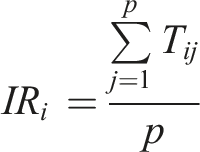
This study tackles overtourism by examining metrics beyond environmental impacts, such as air travel intensity, economic tourism value, short-term rentals, and proximity to UNESCO sites (Baldin et al., 2024). We employ a multidimensional approach to assess the vulnerability of tourist destinations at the municipal level in an Italian region known for high overtourism risk among 40 European Mediterranean areas. This is the first study to use a multidimensional evaluation at this level, providing a replicable tool for local administrations. We used a new Synthetic Index of Tourist Pressure (TPSI) using Eurostat data (2022) on tourist flows, comprised of total annual overnight stays, average annual tourism growth over the past decade, and seasonal peak factors. This index captures the spatial and temporal concentration of tourists, allowing for ongoing comparisons across regions over time. The construction of the composite index required the normalization of data through the Min-Max method. The synthetic indicator has increasing values and is summarized in formulas for the ith units by:
The Synthetic Index was then used to rank EU Mediterranean regions based on their vulnerability to overtourism. We calculated the median values for each of the three dimensions considered: overnights, annual average growth rate, and seasonal peak factor. Then, we extracted the only regions from the top-ranked regions that showed all three indicators above the median.
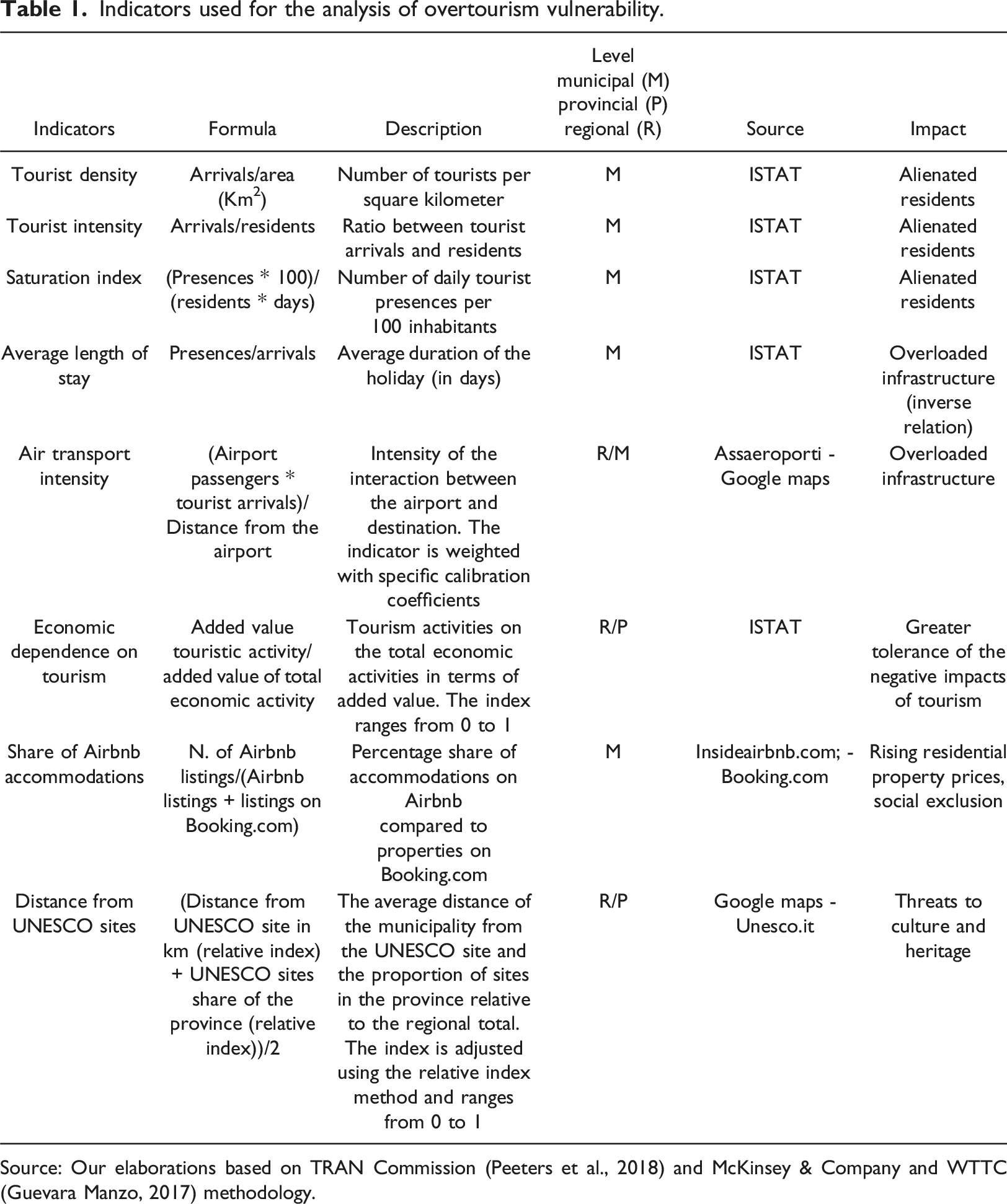
Figure 1 shows the median values for each dimension of the TPSI. The distribution exhibits a positive skew, which is more pronounced for overnight stays compared to the annual growth rate; this is indicated by their respective means surpassing the medians—14.7 million overnight stays in 2022 and 1.84% for the annual growth rate over the decade from 2013 to 2022. From this analysis emerges that the Puglia region is the only Italian and Euro-Mediterranean region with metrics above the median across all dimensions, attracting 16.118 million visitors in 2022, reflecting a 2.1% growth rate over the past decade and a seasonal peak factor of 3.41. Puglia has seen significant tourist growth, only surpassed by Sardinia, uniquely exceeding pre-pandemic visitor levels. Notably, it enjoyed a 4.4% increase in arrivals compared to 2019, driven by a robust recovery in air travel post-COVID-19. Given these factors, Puglia presents an intriguing case study for understanding and addressing overtourism challenges in similar destinations (Pambuku et al., 2024). For this reason, we focus our analysis on Puglia at the municipal level. To analyze the risk of overtourism at the municipal level, we refer to the indicators and methodology recommended by Peeters et al. (2018), which were applied at the NUTS 2 regional level in the European Union as part of a study commissioned by the TRAN Commission. Table 1 describes the main variables used in the study. Box plot with median values, quartiles and outliers of the three metrics. Source: Our elaborations on Eurostat data. Indicators used for the analysis of overtourism vulnerability. Source: Our elaborations based on TRAN Commission (Peeters et al., 2018) and McKinsey & Company and WTTC (Guevara Manzo, 2017) methodology.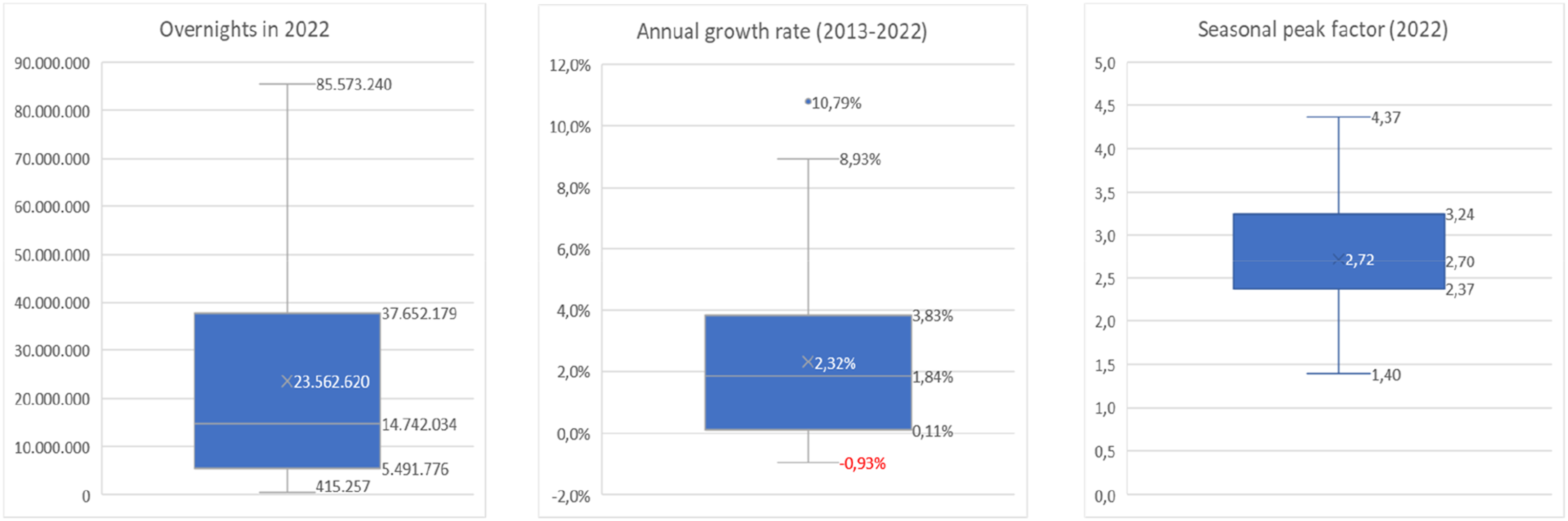
By grouping and categorizing results, we can gain a clearer understanding of the circumstances surrounding different destinations and identify risk factors. Following the methodology of McKinsey & Company and the World Travel & Tourism Council, the data were divided into quintiles to classify destinations according to their overtourism risk.
The kth percentile index is described as follows:
The fifth percentile method categorizes monitored destinations into five levels of risk associated with overcrowding issues. Based on indicator values, level 1 (minimum risk) encompasses the lowest 20%, while level 5 (maximum risk) includes the highest 20%. It’s important to understand that these levels do not reflect good or bad conditions, but rather the potential risk of overcrowding. Figure 2 illustrates these results for the 15 top summer destinations in Apulia. Overtourism vulnerability across the 15 top summer destinations in Puglia. Source: Our elaboration on ISTAT data and other sources.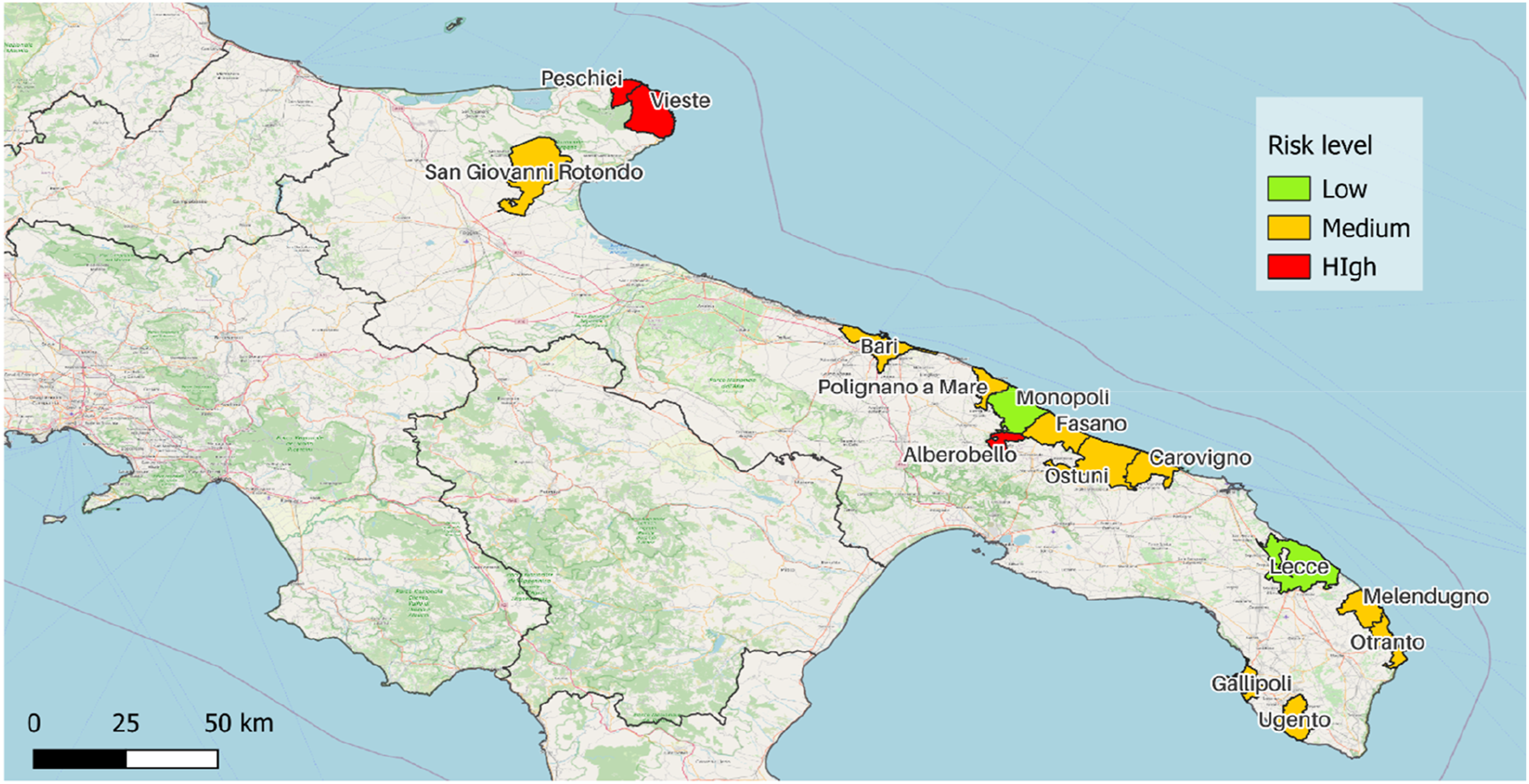
From the analysis, we found significant variations in overtourism vulnerability across Puglia’s 15 top summer destinations, as highlighted in Figure 2. The study identified Peschici, Vieste, and Alberobello as the most vulnerable destinations due to their high levels of tourist density, economic reliance on tourism, and significant seasonal peaks. Conversely, larger cities such as Bari, Lecce, and Monopoli demonstrated lower risk due to their economic diversification and more stable population dynamics. The study found that the prevalence of short-term rentals, particularly in Ostuni, has contributed to housing affordability issues, further exacerbating tensions between residents and tourists. The saturation index revealed that peak summer months saw significant overcrowding, with certain municipalities experiencing daily tourist populations exceeding resident numbers multiple times over. Another critical factor was air transport intensity. Destinations closer to international airports, such as Bari and Brindisi, exhibited higher vulnerability due to increased accessibility, which facilitated mass tourism flows. Furthermore, the proximity to UNESCO sites was found to be a strong predictor of overtourism risk, as municipalities near these cultural landmarks often experienced a disproportionately high influx of tourists. The economic dependence on tourism varied significantly, with some municipalities generating over 50% of their economic output from tourism-related activities. While this provided financial benefits, it also made these destinations highly susceptible to fluctuations in visitor numbers, economic downturns, and shifts in travel trends. The results underscore the need for more sustainable tourism policies that balance economic growth with environmental and social well-being.
Conclusions and policy indications
Overtourism is a multifaceted phenomenon that requires continuous monitoring and context-specific interventions. This study demonstrates the importance of a multidimensional framework for assessing the vulnerability of tourist destinations, offering local and regional authorities specific tools to better understand critical pressures and guide more informed and targeted policy responses. This is foundamental to provide solutions sensitive to local contexts and tailored to the distinct features of each destination (Hall, 2011).
Key findings reveal that destinations such as Peschici, Vieste, and Otranto are under considerable tourism pressure due to high visitor density, economic dependency on tourism, and pronounced seasonality. In these contexts, policymakers should encourage product diversification and a more balanced spatial and temporal distribution of demand and consider pricing mechanisms to regulate tourist flows. However, destinations like Alberobello and Bari—characterized by high density and short average stays—require tailored strategies to extend visitor overnight stays, revise pricing models, and mitigate the impact of day-trip tourism. Strategies such as promoting low-season travel, expanding the range of available attractions, and introducing caps during peak periods are necessary to reduce pressure on local infrastructure and communities and improve the overall quality and sustainability of the tourism offer. These considerations point to the need for integrated planning processes that combine resilience-oriented tourism governance with broader goals of regional development and cultural heritage protection (Koens et al., 2018). Short-term rentals emerge as another critical concern. In cities like Ostuni, the rise of platforms such as Airbnb has contributed to housing market distortions and resident displacement. Effective responses may include stricter regulation, targeted taxation, and spatial zoning, supported by robust stakeholder engagement and participatory governance processes (Cheung and Li, 2019). Accessibility via air transport is another key determinant. Municipalities near major airports, such as Bari and Brindisi, face greater exposure to mass tourism flows. Strategies to mitigate this may include regulating low-cost air traffic and incentivizing visitation to lesser-known destinations.
While tourism remains a critical source of employment and economic vitality, over-reliance on the sector introduces vulnerabilities. Diversifying local economies and fostering community involvement in tourism planning are, therefore, fundamental to long-term resilience.
Footnotes
Acknowledgements
The manuscript reflects only the authors’ views and opinions, neither the European Union nor the European Commission can be considered responsible for them. Angela S. Bergantino acknowledges the “Micro and peer-to-peer shared mobility for Urban Sustainability and Accessibility - MUSA project”, within “Progetti di Ricerca di Rilevante Interesse Nazionale” (PRIN) – D.D. n. 104 -02/02/2022. Mario Intini acknowledges the “SUITABLE (SUstainable mobIliTy and AccessiBiLity in pEriurban environments) project”, within “Progetti di Ricerca di Rilevante Interesse Nazionale” (PRIN) – D.D. n. 104 -02/02/2022.
Declaration of conflicting interests
The author(s) declared no potential conflicts of interest with respect to the research, authorship, and/or publication of this article.
Funding
The author(s) disclosed receipt of the following financial support for the research, authorship, and/or publication of this article: This study was carried out within the GRINS—Growing Resilient, INclusive and Sustainable project and received funding from the European Union Next-GenerationEU (NATIONAL RECOVERY AND RESILIENCE PLAN (NRRP), MISSION 4, COMPONENT 2, INVESTMENT 1.3—D.D. 1558 11/10/2022, PE00000018, CUP: H93C22000650001, Spoke 7 Territorial sustainability).
