




Abstract
We use three waves of census data containing detailed characteristics of the entire population of Austrian farms to examine the causal effect of agritourism on farm survival. To control for self-selection into agritourism, we exploit regional variation in tourism intensity that is exogenous to individual farms. On average, agritourism causally increases survival probabilities by 10.9 percentage points per decade, which is economically and statistically significant. Marginal effects differ by farm characteristics, reaching up to 15.3 percentage points for certain sub-populations. Consequently, policies that support entry into agritourism can be effective in keeping farms in the market and thus in preserving the tourist appeal of many rural regions. Our analysis indicates that the magnitude of the estimated coefficients is severely biased unless endogenous self-selection into agritourism is properly addressed. This underscores that even with large microdata sets, an appropriate identification strategy is critical to derive causal and thus policy-relevant conclusions.
Introduction
Agritourism plays an important role in rural areas from a structural and tourism policy perspective for many reasons: It promotes concepts such as sustainability and soft tourism (Ammirato et al., 2020; Van Winkle and Bueddefeld, 2021), and the often participatory nature of agritourism can strengthen identification with a region through experience value co-creation (Brune et al., 2021; Zhou and Chen, 2023). Agritourism therefore promotes the preservation of the cultivated agricultural landscape (Stotten et al., 2019), which would be lost without the continued existence of agriculture and which is often an essential element of the tourist appeal of a rural region (Andéhn and L’Espoir Decosta, 2021).
However, it is uncertain to what extent agritourism can contribute to these goals in the future. Significant efficiency gains and economies of scale in the agricultural sector are evident in all EU countries and most nations worldwide, leading to large-scale industrial agricultural production. The number of farms in the EU-27 decreased by 5.3 million holdings (37 %) between 2005 and 2020, with the vast majority of the exiting farms being small. The average farm size increased substantially over this period, and large farms are the only size category experiencing growth in numbers (see Eurostat, 2023, for details). However, these larger industrial farms are not typically those that attract tourists (Zhang et al., 2023). For agritourism to continue playing a vital role in rural destinations it is essential for traditional smallholder farms to engage in agritourism to survive in the market. This is the case only if (i) agritourism increases the profitability of farms and (ii) the increase in profitability is large enough to ensure these farms’ survival in the market.
Against this background, this article examines the causal effect of agritourism on farm survival. We use farm survival as a consistently observable measure of long-term profitability. Our empirical analysis is based on three waves of census data from the Farm Structure Survey (FSS), which covers all farms in Austria at intervals of about 10 years. We focus on farm-stay accommodation as it is the predominant form of agritourism in Austria and (unlike most of the many other facets of agritourism) is explicitly documented in the data. Since the decision of farms to engage in agritourism is endogenous, we use an instrumental variables (IV) approach based on a recursive bivariate probit model. The IVs used in the analysis proxy local demand for tourism services and are available at a fine spatial scale (municipality level). Local demand for tourism services differs substantially across regions, has a large impact on farms’ decision to offer farm-stay accommodation, and is plausibly exogenous to farmer heterogeneity in unobserved characteristics. This framework thus allows us to identify the causal effects of agritourism on farm performance.
Our results show that agritourism causally increases the probability of farm survival by more than 10 percentage points per decade. We find substantial heterogeneity across farm types, with larger effects for farmers lacking formal agricultural training, conventional (rather than organic) farms, and farms in disadvantaged regions. The results for the intensive margin (i.e., the number of beds) suggest an inverse U-shaped effect, indicating that the positive impact on farm survival peaks at moderate bed capacities. The results illustrate that agritourism increases the competitiveness of farms, particularly in tourist regions, thereby contributing to slow down structural change in agriculture and to preserve the tourist appeal of many rural destinations.
The empirical literature on agritourism is extensive (see Bhatta and Ohe, 2020, for a comprehensive review). Most of this literature evaluates the characteristics (Holland et al., 2022; Jeczmyk et al., 2015), determinants (Bagi and Reeder, 2012; Joo et al., 2013; Khanal and Mishra, 2014; Lupi et al., 2017; Yeboah et al., 2017) or the motives (Holland et al., 2022; McGehee and Kim, 2004; Nickerson et al., 2001; Quella et al., 2021) of farms to engage in agritourism. A different perspective is taken by Carpio et al. (2008); Hill et al. (2014); Ohe and Ciani (2011, 2012) and Santeramo (2015), who examine the demand for (or demand-related aspects of) agritourism. Regarding the relationship between local tourism demand and the decision of farms to offer farm-stay accommodation, empirical studies document that the surrounding landscape (Lupi et al., 2017), proximity to cities (Yeboah et al., 2017), and to land enrolled in conservation programs (Bagi and Reeder, 2012)—variables that could be interpreted as indicators of tourism demand—influence the decision of farms to engage in agritourism.
However, only a few articles examine the influence of agritourism on farm performance econometrically: Joo et al. (2013), Khanal and Mishra (2014), Schilling et al. (2014) for the U. S., and Chang et al. (2019) for Taiwan. Schilling et al. (2014) and Chang et al. (2019) find that agritourism is positively associated with farm performance. Joo et al. (2013), on the other hand, document a positive association only for small farms, but do not find a statistically significant relationship for large farms or for the full sample. Khanal and Mishra (2014) evaluate two diversification decisions simultaneously (offering agritourism and taking up off-farm work) and find that household income is highest when farms choose to diversify in both dimensions rather than just one.
This paper adds to the literature in several ways: First, we contribute to the articles evaluating the impact of agritourism on farm performance by offering a more plausible empirical approach to identify the corresponding causal effects. The existing literature has relied on a selectivity correction method (Khanal and Mishra, 2014), on matching techniques (Joo et al., 2013; Schilling et al., 2014), or on the double robustness regression model, which relies on assumptions similar to those of matching (Chang et al., 2019). The crucial assumption for applying matching methods is that selection into the treatment (i.e., engaging in agritourism) depends only on observable variables, with no unobservable factors influencing both the decision of farms to participate in agritourism and their profitability. However, it seems plausible that unobservable variables such as a farmer’s ability, effort, managerial or entrepreneurial skills, or attitude towards risk-taking influence both selection (into agritourism) and outcome (farm performance), leading to an omitted variables bias. 1 We therefore use an instrumental variables (IV) approach and use indicators of local demand for tourism services as IVs. These variables are plausibly exogenous to unobserved farm and farmer heterogeneity and the empirical application shows that they are important determinants of farms’ decisions to engage in agritourism. This allows for a causal interpretation of the empirical results.
Second, we contribute to the discourse on how to apply increasingly available large data sets, such as “big data”, in empirical economic research in general (see earlier contributions by Einav and Levin, 2014; Mullainathan and Spiess, 2017; Varian, 2014) and in tourism research specifically (e.g., Zheng et al., 2024). Our analysis is based on an extensive microdata set with over 360,000 observations, covering numerous farm and farmer characteristics. We demonstrate that relying solely on the vast quantity of observations and potential controls in a simple regression framework can yield statistically significant and highly robust, yet entirely inconsistent results. Parameter estimates change substantially when addressing the endogeneity of farms’ decisions to offer agritourism. This highlights that even with large microdata sets, a sound identification strategy grounded in economic theory is required to achieve meaningful and thus policy-relevant results.
In addition, the article adds to the existing literature by drawing on detailed data on the tourism intensity at a highly disaggregated regional level, which is novel to the existing literature on the determinants of agritourism supply. Furthermore, we are the first to provide evidence on the effect of agritourism engagement at the intensive margin (i.e., the impact of bed capacity on farm survival) in addition to the extensive margin. Moreover, our data differ substantially from other empirical contributions estimating the impact of agritourism on farm performance because we use three waves of full population census data, which allows us to identify farm survival as an indicator of revealed competitiveness. While other studies rely on cross-sectional data (Chang et al., 2019; Schilling et al., 2014) or short panels (Joo et al., 2013; Khanal and Mishra, 2014), we use data covering a long period of 21 years and are therefore able to provide a long-term perspective on the relationship between agritourism and farm success. Finally, we provide the first empirical evidence for a country in Europe where the agricultural sector is much more characterized by small-scale farming than in the USA, for example. While we focus on Austrian data, the analysis can be replicated by researchers and practitioners for other EU countries, as the FSS is conducted with similar methodology in all EU member states.
The remainder of this article is organized as follows: The research design and the identification strategy are discussed next. Following that, we present the data used in the empirical analysis. Subsequently, the main results and the sensitivity analysis are reported and discussed. The last section concludes.
Empirical approach and identification strategy
This article analyzes the impact of agritourism on farm survival and evaluates whether agritourism contributes to slowing structural change in this industry. Identifying the causal effect of agritourism is challenging because the farm makes both the decision to stay in the market and the decision to offer farm-stay accommodation. Both decisions are influenced by unobservable farm and farmer characteristics (e.g., a farmer’s ability or managerial skills). Thus, whether a farm offers agritourism or not is endogenous due to an omitted variable bias. To account for this endogeneity, we follow an instrumental variables approach and instrument the (endogenous) decision to offer farm-stay accommodation with indicators of local tourism demand. Local demand for tourism services is well-suited to serve as an instrument because it is highly correlated with a farm’s decision to offer agritourism (see below for details) and varies considerably at a fine spatial scale. We are confident that the indicators of local tourism demand are not only strong (i.e., highly correlated with agritourism) but also valid instruments (i.e., they provide an exogenous source of variation): First, an individual farm cannot directly influence (local) tourism demand. Second, it is not plausible that farms relocate to regions with more favorable tourism levels, since the (transaction) costs of moving a farm to another region are prohibitively high. Thus, endogenous sorting is not an issue. Third, the instruments could affect farm survival through other channels in addition to their impact on agritourism. This is the most serious potential threat to exogeneity in our context. We are confident that we can adequately control these other potential channels and address this issue in detail at the end of this section. Next, we provide stylized facts about the relationship between local tourism intensity, farm decisions to offer accommodation services, and farm survival that guide our analysis. This is followed by a formal presentation of our empirical model and a summarizing discussion of the strength and validity of our instruments.
The decision of farms to offer farm-stay accommodation is closely linked to local demand for this kind of tourist services. Descriptive evidence, provided in Figure 1 for Austrian municipalities, supports this notion: In regions with low tourism intensity (less than 50 overnight stays relative to the resident population per year) less than 5 % of all farms offer farm-stay accommodation. The share of farms offering agritourism increases sharply at an intensity of around 100 overnight stays per capita, and almost 25 % of all farms rent out rooms and apartments in municipalities with a tourism intensity of more than 150. It is important to note that tourism intensity varies at a small spatial scale and that only about a quarter of the variation in intensity at the municipality level can be explained by variation between districts (the next higher statistical regional unit), while most of the variation is between municipalities within districts. Correlation between local tourism intensity and the share of agritourism farms. Notes. The figure shows the non-parametric relationship between the share of farms offering farm-stay accommodation (in percent) and the ratio of overnight stays to the resident population in 1999 and in 2010 at the municipality level. The local polynomial smooth is based on an Epanechnikov kernel with a polynomial smooth degree of 0 and a bandwidth of 50.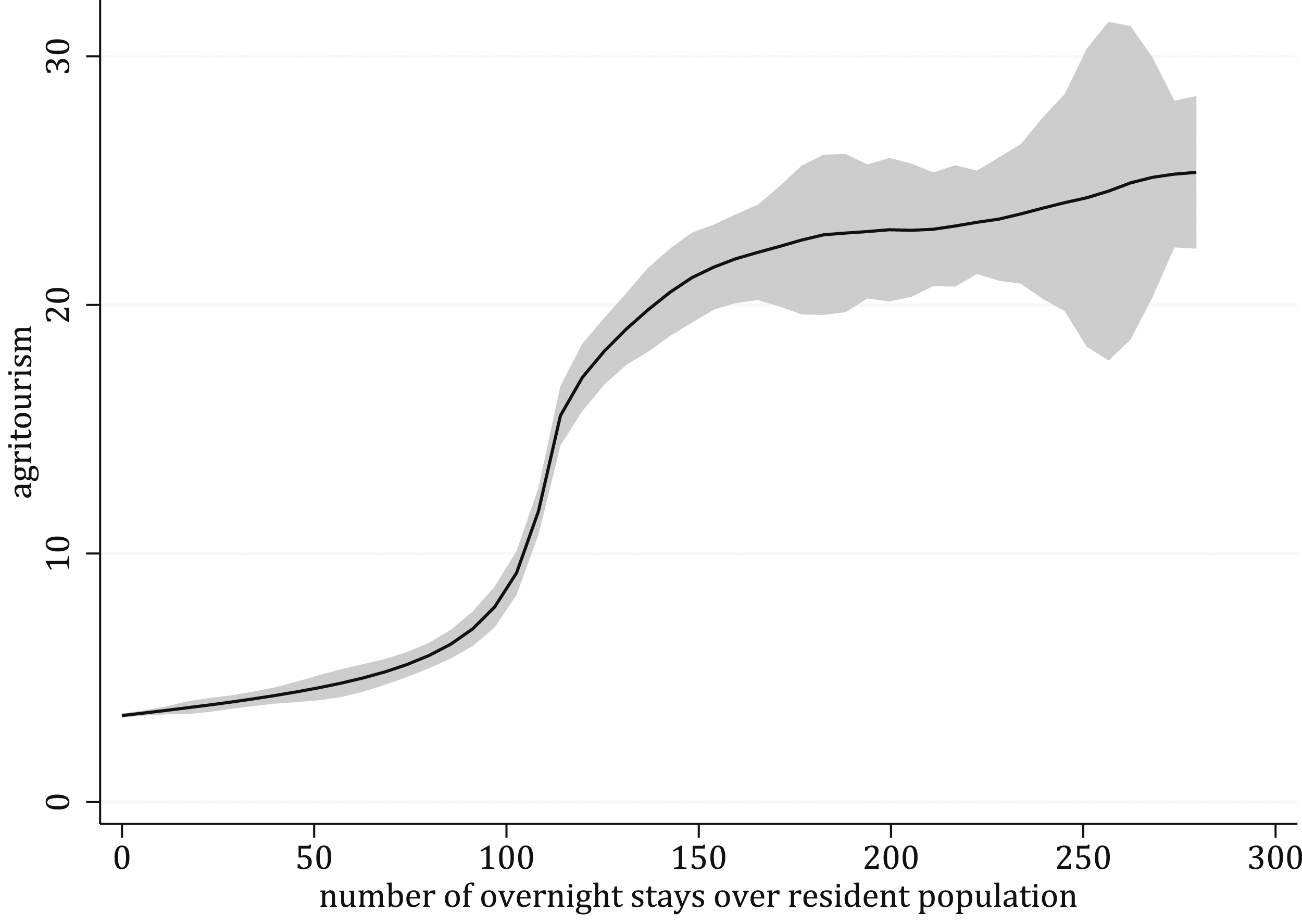
Figure 2 shows the relationship between the level of tourism and farm survival rates between two census waves (a period of about 10 years) at the municipality level. Panel a) shows a scatter plot and a linear regression between these two variables, indicating that survival rates are higher in regions with intensive tourism. The positive correlation is even more evident in Panel b), where we narrow the range of the survival probabilities (the vertical axis). This figure suggests that an increase of 100 overnight stays per capita is associated with a 1.1 percentage point increase in farm survival rates. When we divide farmers into two groups depending on whether they offer farm-stay accommodation or not, we find substantial differences between these groups: The survival rate of farms offering farm-stay accommodation is 86.3 %, which is about 11.3 percentage points higher than for farms without agritourism. However, the survival rates of either of the two groups of farms are not significantly related to the intensity of tourism in the region, as illustrated in Panel b) of Figure 2. The higher survival probabilities in areas with intense tourism seem to come only from a larger share of farmers offering farm-stay accommodation, suggesting that the product diversification associated with agritourism may indeed increase the competitiveness of farms and slow down structural change by allowing a larger share of farms to stay in the market. Correlation between local tourism intensity and farm survival (a) all farms (b) farms with and without agritourism. Notes. The figures show average farm survival rates (in percent) between 1999 and 2010 and the ratio of overnight stays to the resident population in 1999, as well as survival rates between 2010 and 2020 and the ratio of overnight stays to the resident population in 2010 at the municipality level. The straight lines in panels (a) and (b) show the prediction of average farm survival rates from a linear regression of survival rates on the ratio of overnight stays to the resident population at the municipality level. The dashed line and the dashed-dotted line in panel (b) indicate predictions of the average farm survival rates for farms offering farm-stay accommodation (dashed line) and for farms not offering farm-stay accommodation (dashed-dotted line). Gray areas illustrate the 95 % confidence intervals.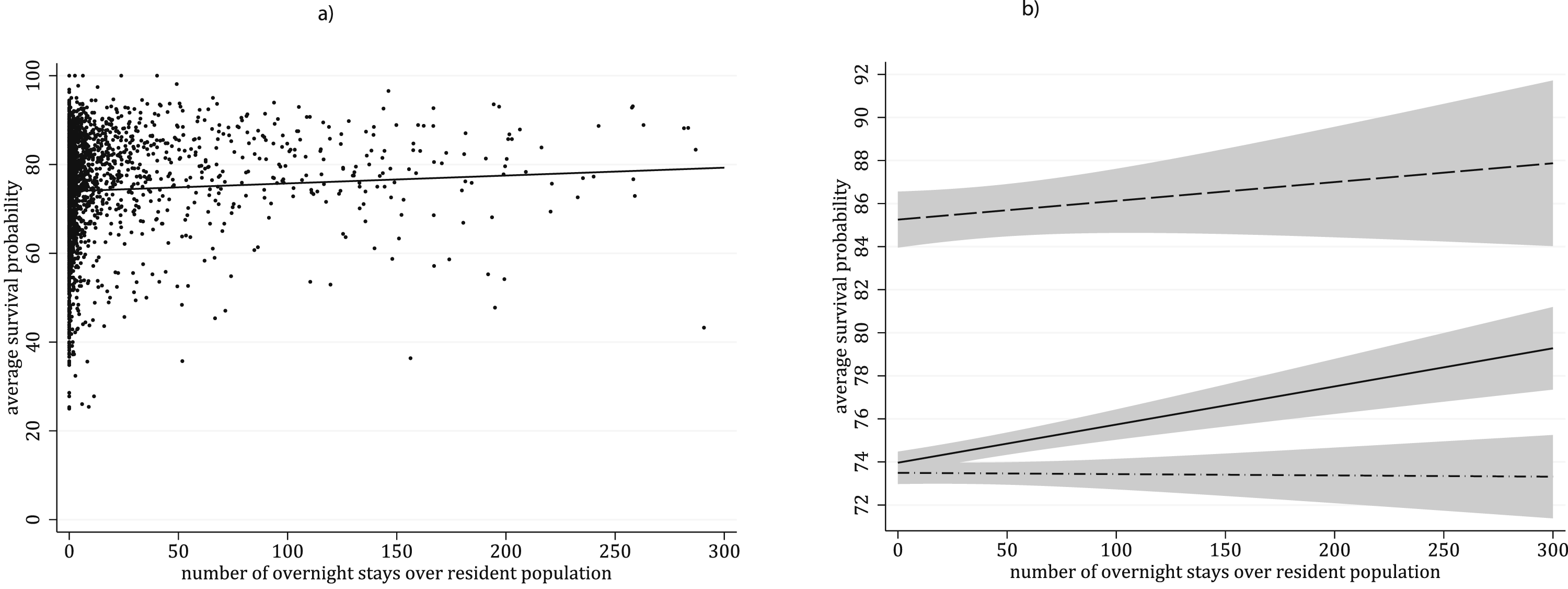
To model farm behavior in a formal way, we are interested in profits of farm i in year t (captured by the latent variable

There are several approaches to estimating farm survival (or, conversely, farm exit) over time. Data limitations do not allow us to observe the exact date when farms exit the market. Rather, we observe whether farms left the market between two census waves. We can therefore use a binary choice model, since in each discrete time period only two outcomes are possible: either a farm survives or it exits. Alternatively, farm survival could be estimated using survival (or duration) models (see Cameron and Trivedi, 2005, chapter 17, for details). Because farm survival is grouped into discrete time periods in our data, we could only estimate discrete-time (rather than continuous-time) survival models, which can be transformed into binary choice models (see, for example, Allison, 2014). We therefore estimate the probability that a farm survives, i.e., Prob(y1,it = 1|y2,it,
However, when estimating the probability of farm survival, it is problematic to simply include the decision of farms to offer agritourism as an additional explanatory variable, as this variable could be endogenous. Whether a farm offers agritourism or not (y2,it = 1) depends on the unobserved latent variable

Due to the potential endogeneity of offering agritourism, the correlation of the error terms, corr(ϵ1,it, ϵ2,it), may be different from zero. A simple binary choice (e.g., logit or probit) model on farm survival will therefore give inconsistent parameter estimates for β1. We thus estimate a recursive (“triangular”) bivariate probit model (see Greene, 2011: 786, and Coban, 2020: 23, for details). With this approach, the binary variable on whether farm i offers agritourism in year t or not, y2,it, is treated as an endogenous variable when estimating the probability that a farm survives, Prob(y1,it = 1|y2,it,
We are confident that the variables capturing local tourism intensity are strong and valid instruments. With respect to their strength, we observe a high correlation between local tourism intensity and the probability that farms offer farm-stay accommodation (see Figure 1). Regarding their validity, the descriptive evidence presented in Figure 2 suggests that local tourism intensity does not influence farm survival through channels other than the supply of agritourism. However, other mechanisms are possible. In particular, the tourism industry could influence a farmer’s decision to stay in the market by providing off-farm employment opportunities. This could make working in agriculture less attractive or, conversely, enable part-time farming thanks to the availability of part-time jobs in tourism. However, labor market areas typically cover regions much larger than municipalities. Dummy variables at the district level, which correspond more closely to labor market areas, are included in the preferred model specifications and allow us to control for the potential tourism labor market opportunities in the region. We also provide statistical tests on the strength and validity of our instruments: As a sensitivity analysis, we estimate equations (1) and (2) as a linear probability model (LPM) via 2SLS, which allows us to provide test statistics on the exclusion restriction and on the quality of the instruments.
Data
To evaluate the impact of agritourism on farm survival, we use data at different levels of aggregation from two different sources: First, we use the three most recent waves (1999, 2010, 2020) of the Farm Structure Survey (FSS) general census for Austria, which covers the full population of farms (“agricultural holdings”) in Austria at the time of the survey. The FSS is carried out in all EU member states with a common methodology on a regular basis. Every 3 to 4 years, the FSS is carried out as a sample survey, and once in 10 years as a census. In Austria, the FSS is collected by the Austrian Statistical Office (“Statistics Austria”) and provided by the Federal Ministry of Agriculture, Forestry, Environment and Water Management (BMLFUW) for this project. Second, we use data from Statistics Austria’s “Accommodation Statistics” for the years 1999 and 2010, which provides information on tourism at the regional (municipality) level. This information is used to construct instrumental variables for the regression analysis (as captured by matrix
Farm-level data
Data from the FSS include detailed farm-level characteristics (size, soil quality, labor force, output by product, type of farming, farmer characteristics, topography such as terrain difficulty or alpine pastures, eligibility for specific farm-level subsidies) and local geographic information (municipality characteristics, municipality code). The FSS data for Austria also contain detailed information on agritourism, namely whether farms offer lodging services and (if so) how many beds they rent out. Each farm has a unique farm-level identifier (ID) that remains constant over time, unless the farm is acquired by another farm business or if the agricultural business is given up. Therefore, farm survival can be measured straightforwardly: If an ID appears in one wave of the survey (in period t) and also appears in a subsequent wave (in period t + 1), the farm has survived in the market. Summary statistics (see Table A1) and a detailed discussion of all variables included in the analysis are provided in Supplemental Appendix A.1.
We prefer using farm survival over other measures of farm performance for several reasons: First, for agritourism to contribute to rural development, farm survival is the most relevant measure of farm success. Second, while the FSS covers a rich variety of data at the level of individual farms, it lacks other measures of farm performance. This is because in many countries, including Austria, farms are exempted from the obligation to keep accounts and balance sheets. Farms can decide to keep accounts on a voluntary basis, but these accounting data are not collected by the FSS. There is only a rolling sample of farms that keep accounts voluntarily and are surveyed regularly. However, these data are patchy and the composition changes annually, making it unsuitable for a long-term analysis. Third, the economic performance of farms is notoriously difficult to measure in a meaningful way. Farm performance (such as profits, sales, or return on investment) is critically dependent on highly volatile prices and favorable weather conditions. Weather conditions can vary on very small spatial scales (thunderstorms, hail, drought) and affect different crops differently. Thus, short-term farm performance may be only loosely related to long-term farm success. Finally, depending on location and terrain, subsidies can account for a substantial share of farm income. This reduces the relevance of standard business performance indicators. In summary, we focus on farm survival because it is an easily observable and interpretable measure of long-term farm performance.
Farm survival and agritourism.
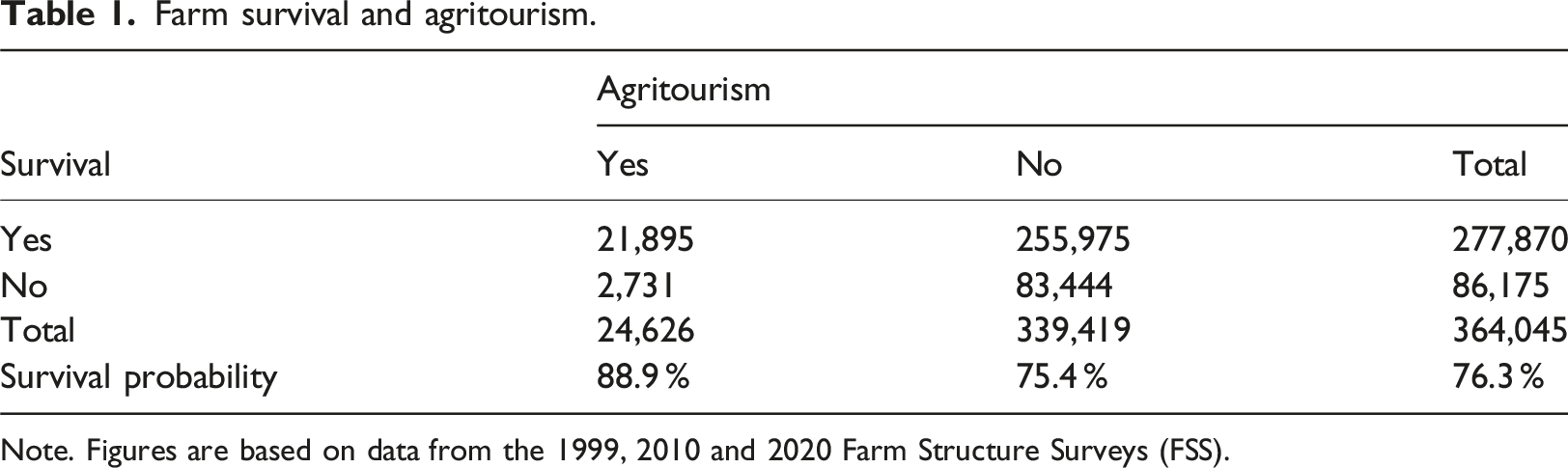
Note. Figures are based on data from the 1999, 2010 and 2020 Farm Structure Surveys (FSS).
Regional data on tourism
To derive indicators of local demand for lodging services, we use regional tourism data from 1999 and 2010. These data contain information on the capacity and volume of tourism services at the municipality level. Capacity information includes the number of accommodation establishments and the total number of beds. Additionally, these data include the number of overnight stays. For privacy reasons, data are not reported if the number of overnight stays in the municipality is less than 1000 or if there are fewer than three lodging establishments.
Descriptive statistics of variables on tourism at the municipality level.
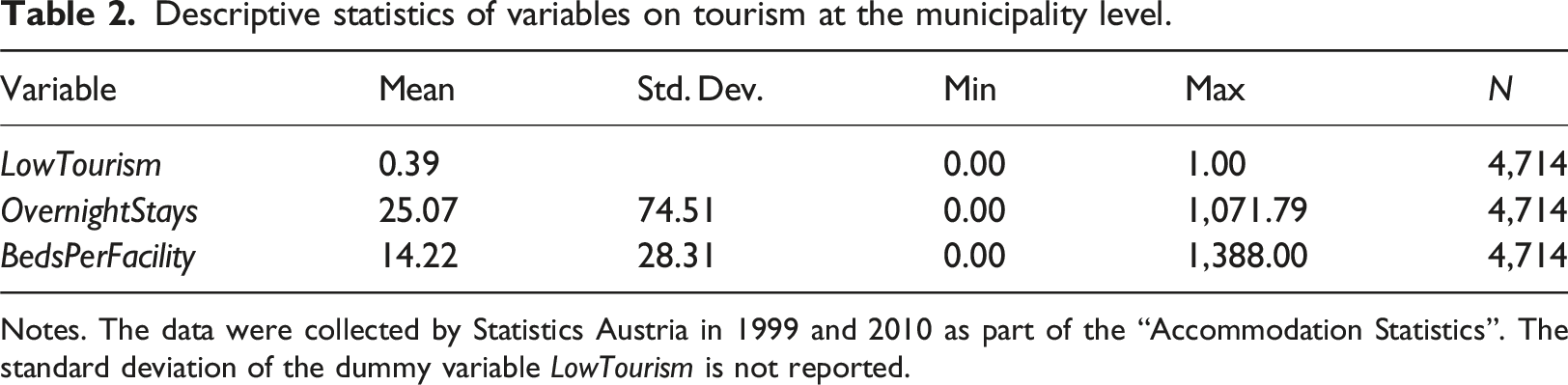
Notes. The data were collected by Statistics Austria in 1999 and 2010 as part of the “Accommodation Statistics”. The standard deviation of the dummy variable LowTourism is not reported.
The two variables OvernightStays and BedsPerFacility are highly right-skewed. Therefore, we use the logarithm of these variables in the empirical analysis, as recommended by Cameron and Trivedi (2005), among others. By using the logarithm, the skewness of both variables is reduced to almost zero and the distribution of the variables comes close to a normal distribution. Both OvernightStays and BedsPerFacility are not reported for municipalities with low tourism (i.e., when LowTourism = 1). These missing observations are replaced by zeros. 3
In addition to farm and farmer characteristics, (off-farm) labor market opportunities and sociodemographic characteristics of the resident population may also affect the probability of farm survival. To account for these and other unobserved region-specific characteristics, district-level fixed effects are included in the main specifications. Additionally, various external shocks from economic events to natural disasters that shape local tourism dynamics, will be captured by these district fixed effects. In Austria, the district level corresponds to the tier between the higher NUTS 3 and the lower municipality (LAU) level. 4
Results
In discussing the results, we first provide descriptive evidence from simple probit models. A probit model regressing farm Survival on participation in Agritourism provides biased results if a farm’s self-selection into Agritourism depends on unobservable characteristics that also affect the probability of farm Survival. In this case, the error terms of equations (1) and (2) are correlated, meaning that the parameter estimates for Agritourism cannot be interpreted causally. Therefore, in the subsequent section, we present and discuss the estimation results based on recursive bivariate probit models that take into account the (possibly endogenous) self-selection of farms into agritourism. After that, we examine potential heterogeneity of the effects across several sub-populations. Finally, we provide results on the intensive margin to evaluate whether the number of beds in agritourism farms also affects their performance.
Descriptive evidence: simple probit models
Marginal effects of simple probit models.
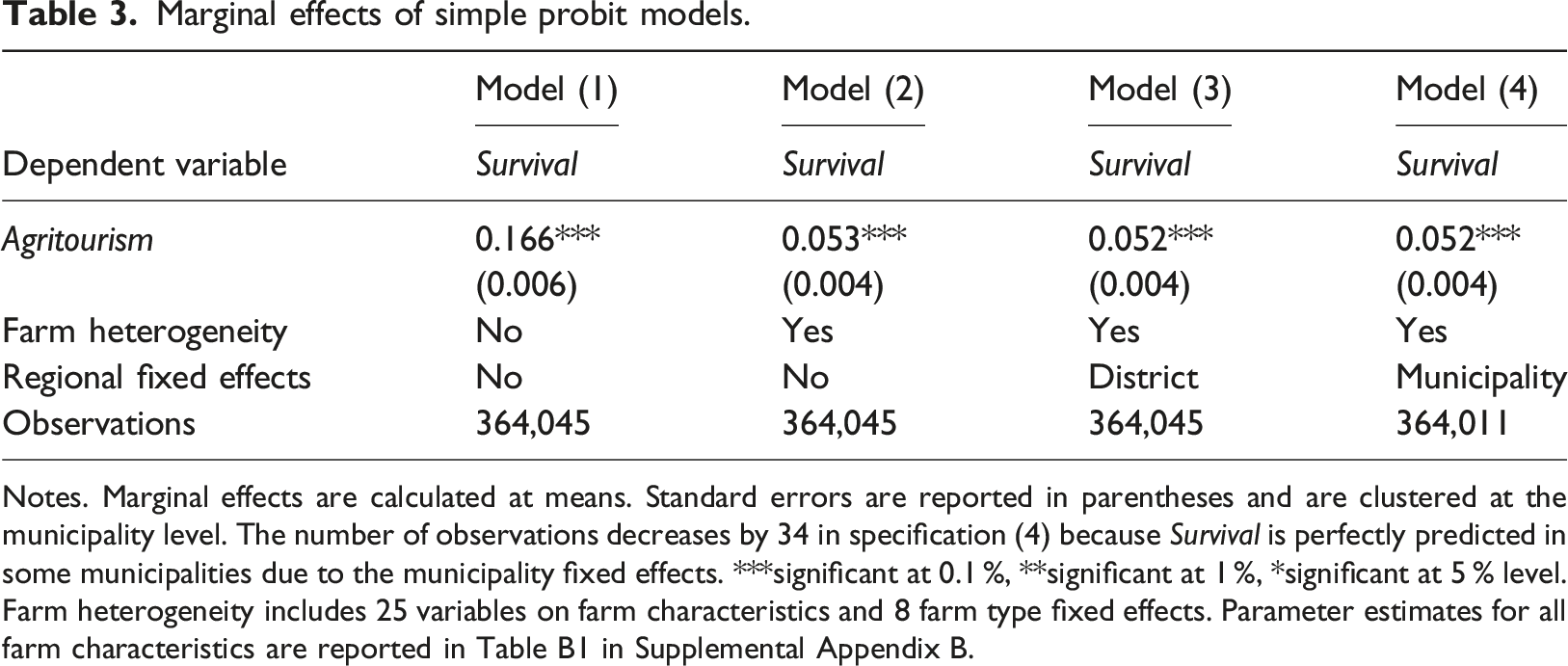
Notes. Marginal effects are calculated at means. Standard errors are reported in parentheses and are clustered at the municipality level. The number of observations decreases by 34 in specification (4) because Survival is perfectly predicted in some municipalities due to the municipality fixed effects. ***significant at 0.1 %, **significant at 1 %, *significant at 5 % level. Farm heterogeneity includes 25 variables on farm characteristics and 8 farm type fixed effects. Parameter estimates for all farm characteristics are reported in Table B1 in Supplemental Appendix B.
Causal evidence: recursive bivariate probit models
Marginal effects of recursive bivariate probit models.
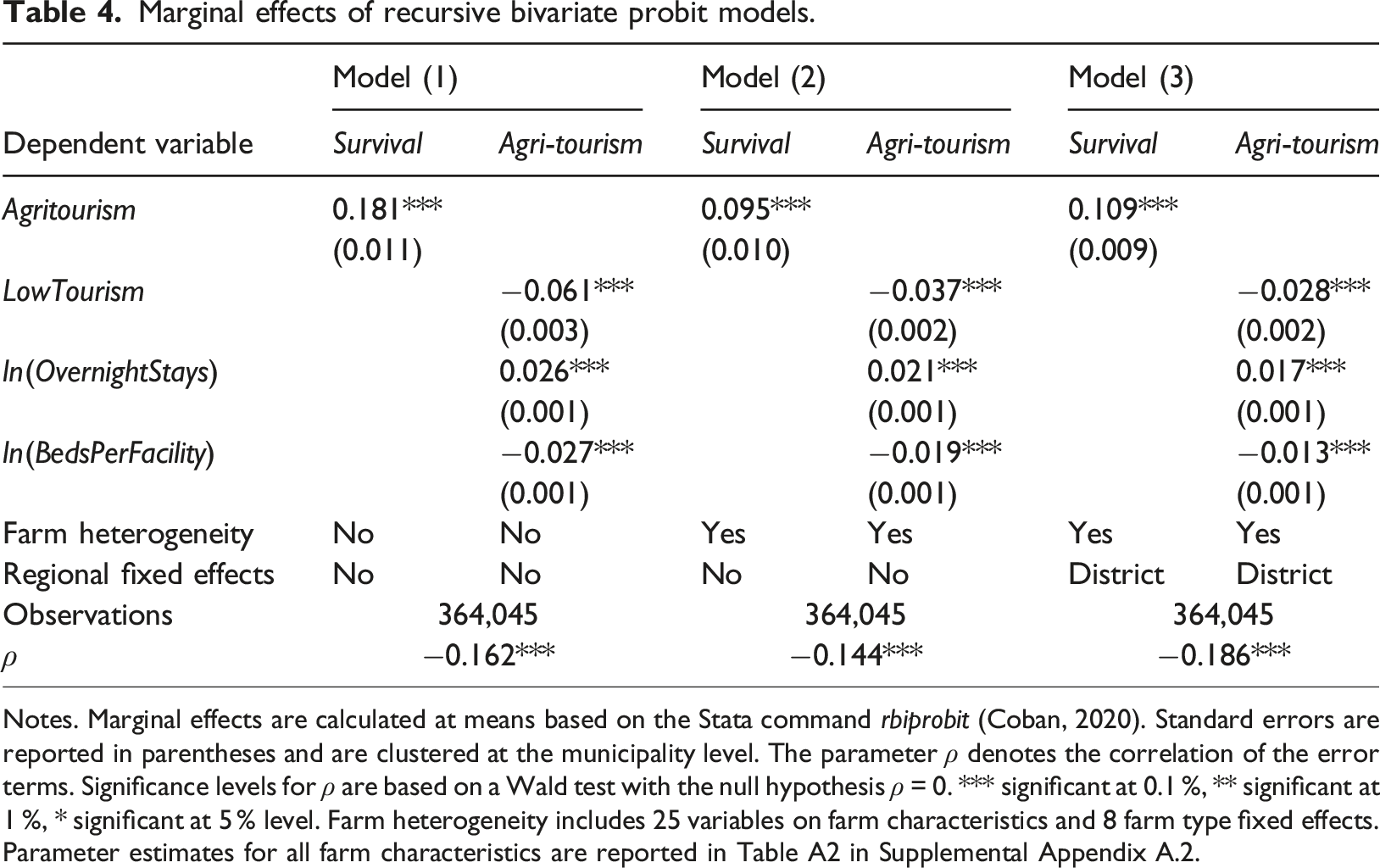
Notes. Marginal effects are calculated at means based on the Stata command rbiprobit (Coban, 2020). Standard errors are reported in parentheses and are clustered at the municipality level. The parameter ρ denotes the correlation of the error terms. Significance levels for ρ are based on a Wald test with the null hypothesis ρ = 0. *** significant at 0.1 %, ** significant at 1 %, * significant at 5 % level. Farm heterogeneity includes 25 variables on farm characteristics and 8 farm type fixed effects. Parameter estimates for all farm characteristics are reported in Table A2 in Supplemental Appendix A.2.
Again, specification (1) includes Agritourism as the only regressor in the Survival equation, while municipality-level tourism data are the only explanatory variables in the Aritourism equation. The resulting marginal effect of Agritourism on Survival is 18.1 pp. This coefficient is nearly halved to 9.5 pp when farm-level characteristics are added to both equations of the recursive bivariate probit model in specification (2). The size of the marginal effect is again robust to the inclusion of regional fixed effects and changes only by a small and statistically insignificant amount to 10.9 pp when district fixed effects are added in specification (3). 5
The results for the identifying variables on local tourism in the Agritourism equation are shown to have strong explanatory power and have the expected signs. Being located in a LowTourism municipality reduces the probability of farms engaging in Agritourism by about 2.8 pp in the preferred specification (3). A one percent increase in tourism intensity, as measured by OvernightStays per resident, increases the probability of participating in Agritourism by 0.017 pp. In turn, a one percent increase in the average number of BedsPerFacility in tourism establishments reduces the probability of Agritourism = 1 by about 0.013 pp. Thus, farms are more likely to provide tourist accommodation in municipalities with smaller rather than large-scale accommodation facilities.
The importance of estimating a recursive bivariate probit model rather than a simple probit model to determine the impact of Agritourism on the probability of farm Survival is emphasized by two results. First, the marginal effects in the simple probit models are around 5 percentage points, about half the size of the corresponding effects based on the recursive probit models (when farm characteristics are taken into account). This comparison shows that the bias due to self-selection of farms into Agritourism in the simple probit model is substantial. Second, the correlation of the error terms of the two equations in the bivariate probit model, parameter ρ in Tables 4, is strongly (between −0.19 and −0.14, depending on the specification) and statistically significantly (at the 0.1 % level) negative. The negative values for ρ indicate that the unobservable variables that increase the probability of farm survival decrease the probability for farms to engage in agritourism. This implies that not accounting for self-selection of farms with (ceteris paribus) lower survival probabilities into agritourism should lead to an underestimation of the effect of Agritourism on farm Survival, which is exactly what we find when we compare the results of the bivariate probit and probit models.
To test the strength and validity of our instruments (which is infeasible in the framework of a bivariate probit model), we estimate equations (1) and (2) using a linear probability model (LPM). Since the parameter estimates are quite similar, we relegate the regression results (see Table A4) and the corresponding discussion to Supplemental Appendix A.3. A Hansen-J statistic for overidentification cannot be rejected for our main specification of the LPM, suggesting that the instruments are uncorrelated with the error term (and thus valid). Tests on underidentification and weak identification are clearly rejected, showing that the instrumental variables on tourism demand are important in explaining farms’ decisions to engage in agritourism. All test statistics thus support our claim that the instruments are valid and strong, and back up a causal interpretation of the regression results.
Heterogeneous effects analysis
Although we control for a large number of variables (namely 25) to account for farm and farmer characteristics, include 8 dummy variables to capture different farm types as well as 83 district fixed effects, the marginal effects of Agritourism are restricted to be homogeneous across all farms in the previous section. To relax this strong assumption and to examine the potential heterogeneity of the effect of Agritourism, we estimate specification (3) of the recursive bivariate probit model from Table 4 for different sub-populations of farms with respect to key farm(er) characteristics as well as for different sub-periods. Specifically, we analyze heterogeneity across groups for those control variables that were found to be strong predictors of farm survival and/or agritourism supply in the bivariate probit model (see Table A2 in Supplemental Appendix A.2 for details). This analysis is descriptive in the sense that we present different treatment effects for sub-populations, but do not explore in more detail why these differences exist.
The results of this analysis are shown in Figure 3. In this diagram, the dots denote the point estimates of the marginal effects of Agritourism on Survival, and the vertical bars illustrate the 95 % confidence intervals. The effect estimated for the total population is shown as a benchmark on the far left of the figure. The point estimates show considerable heterogeneity in the marginal effects across different sub-populations, although the differences are not always statistically significant. We do not find significantly different effects between male and female farmers, between different age cohorts, or between full-time farmers or legal entities and part-time farmers. Marginal effects for sub-populations. Notes. The figure illustrates the marginal effects of agritourism on farm survival along with the 95 % confidence intervals. Parameter estimates that are not significantly different from zero at the 5 % level are indicated by hollow circles, and the corresponding confidence intervals have been omitted for better visualization. The estimates are based on a recursive bivariate probit model that controls for farm heterogeneity and district fixed effects. The first marginal effect (“Total”) corresponds to specification (3) in Table 4. All other marginal effects are based on regressions with the same explanatory variables for the corresponding sub-populations.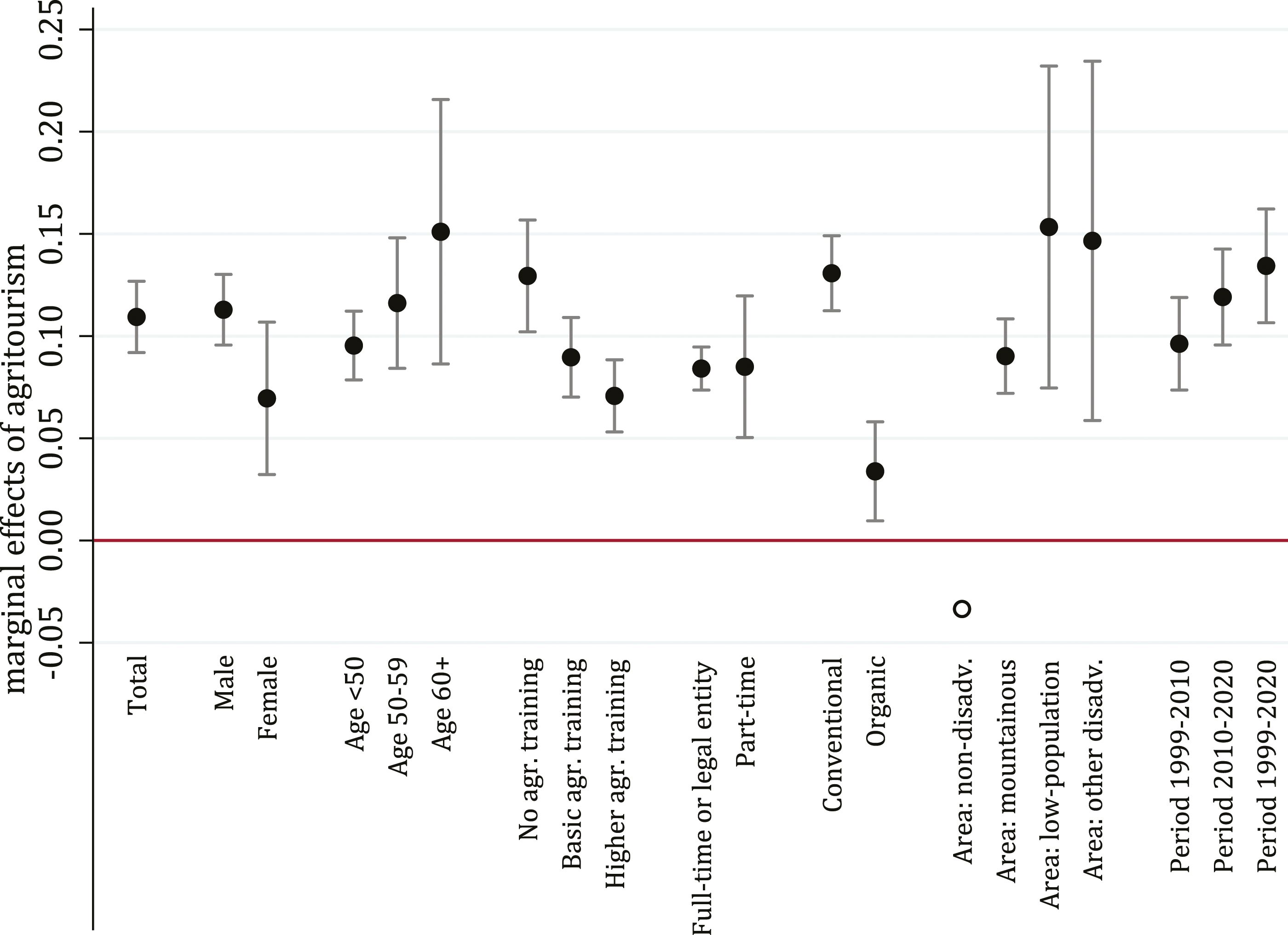
In contrast, there are statistically different effects with respect to formal agricultural training. The effect of Agritourism on Survival is substantially stronger for farms managed by a farmer without formal agricultural training (+12.9 pp) than for those with basic (+9.0 pp) or higher (+7.1 pp) formal agricultural training. 6 The difference is significant at the 5 % level between farms managed by farmers without training and those with higher training. Similarly, large differences are found between organic and conventional (non-organic) farms. The effect of Agritourism is significantly stronger for conventional farms (+13.1 pp) and much smaller for organic farms (+3.4 pp). Agritourism has no significant effect on farms in non-disadvantaged areas, while the effects are significantly positive in all three types of disadvantaged areas. Among the latter, farms in low-population (+15.3 pp) and other disadvantaged areas (+14.7 pp) benefit most from Agritourism, while the effect is somewhat smaller in disadvantaged mountainous areas (+9.0 pp). Differences between disadvantaged and non-disadvantaged areas can probably be explained by better opportunities for farmers to earn off-farm income in non-disadvantaged areas. The lower effect for mountainous areas compared to sparsely populated and other disadvantaged areas could be due to the higher subsidies for farms in steep and alpine terrain.
While we pool the 1999–2010 and 2010–2020 periods in our main analysis, the far right end of Figure 3 also shows the marginal effects for three different (sub)-periods. It is slightly lower for the 1999–2010 period (+9.6 pp) than for the 2010–2020 period (+11.9 pp). The long-run period 1999–2020 shows the highest effect of Agritourism on Survival (+13.4 pp). However, these differences are not significantly different from zero at the 5 % level. This illustrates the stable and robust impact of Agritourism on farm Survival across different decades and over the entire time period observed.
Summarizing the results for the different sub-populations, the highest marginal effects of Agritourism are found for farms managed by persons with no formal agricultural training, for conventional (non-organic) farms, and for farms located in sparsely populated and other disadvantaged areas. Farms in non-disadvantaged areas, on the other hand, do not have higher survival rates due to Agritourism.
Intensive margin of agritourism
The analysis so far has been devoted to examining the causal effect of Agritourism on farm Survival at the extensive margin. While the analysis has found overwhelming evidence of a substantial average effect, some heterogeneity of this effect at the intensive margin also seems reasonable. On the one hand, due to the fixed costs of providing accommodation, it seems plausible that there is a non-linear relationship between profitability and the number of beds provided. An increase in the number of beds is expected to have an increasingly positive effect Survival. On the other hand, a (very) high number of beds may promote the exit from agriculture and the transition to a pure tourism business in the long run. In summary, these two countervailing effects warrant a more detailed analysis of the intensive margin.
We use information on the number of Beds for tourists for each farm (again from the FSS data) as an indicator to measure a farm’s intensity of agritourism. For the 24,626 obervations of farms offering tourist accommodation, the number of beds ranges from 1 to 450, with a mean of 11.2 and a standard deviation of 11.7 beds. The 5th (95th) percentile is 3 (30) beds. To quantify the effects, we estimate a probit model on farm Survival for the sub-population of farms involved in Agritourism. All other variables are the same as in specification (3) of the main results reported in Table 4. Regression results for the coefficients from this analysis are provided in Table B5 in Supplemental Appendix B.
As reported in Table B5, the parameter estimate of log(Beds) is effectively zero when this variable is included as a linear term only (specification (1)). When log(Beds) is considered in a linear-quadratic way (specification (2)), the coefficient of the linear term becomes positive and the quadratic term becomes negative, both at the edge of 10 % significance level (p-values of 0.102 each). The point estimates suggest an inverse U-shaped relationship between the number of Beds and farm Survival, albeit estimated with considerable statistical uncertainty.
The estimated survival probabilities, conditional on the number of beds, are shown in Figure 4. Again, the results indicate that the effect between the number of beds and the Survival probability is characterized by an inverse U and peaks at about 10.3 beds. The Survival probabilities for farms with a very small or a rather large capacity are about 2 pp lower than for farms with about 8 to 12 beds. This is consistent with the expectation that providing only a small number of beds will be less profitable, and that a very large bed capacity may encourage an exit from agriculture in favor of a tourism-only business. However, the effects are not precisely estimated and are not significantly different according to the 95 % confidence interval. The confidence bands are particularly wide at both ends of the distribution due to the small number of observations. In summary, although we find some evidence of heterogeneous effects, the extensive margin (offering farm-stay accommodation) appears to be more important than the intensive margin (the number of beds a farm rents out). Predicted farm survival probabilities depending on the number of beds. Notes. The figure illustrates the predicted farm survival probabilities (in percent) along with the 95 % confidence interval. Predictions are based on a probit estimation of farm survival for the sample of farms offering agritourism. Parameter estimates for all farm characteristics are reported in specification (2) of Table B5 in Supplemental Appendix B. All variables except the number of beds are set to their sample means.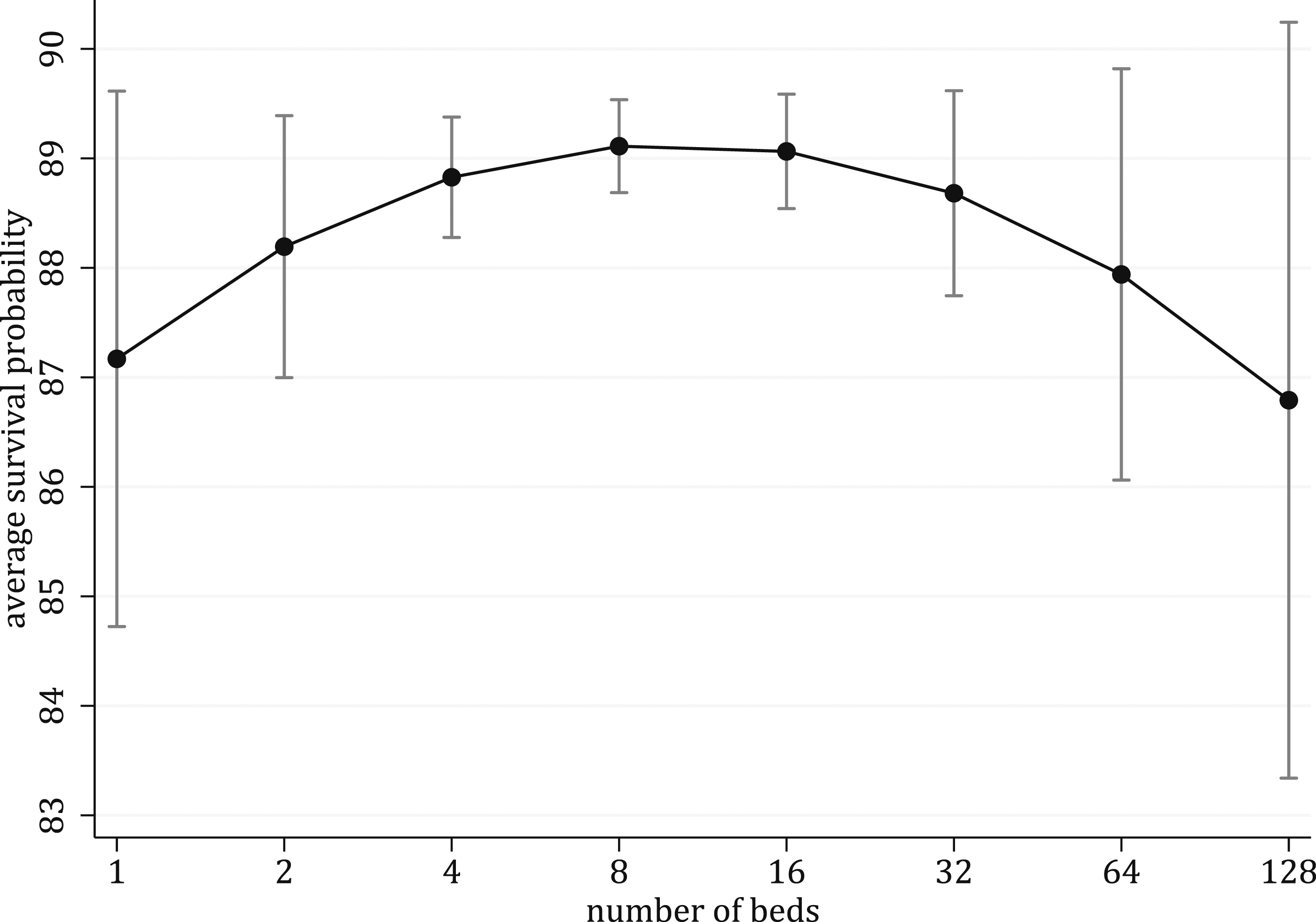
Discussion and conclusions
In this article, we investigate the impact of agritourism (farm-stay accommodation) on farm survival. The chosen empirical framework allows a causal interpretation of the results and shows that offering farm-stay accommodation is an effective survival strategy. On average, it increases the probability of survival by more than 10 percentage points over a time period of about one decade, and by more than 15 points for some sub-populations. It appears to be particularly effective for conventional (non-organic) farms, farms in disadvantaged locations, and for farms managed by farmers without formal agricultural training. Thus, entering agritourism can be seen as an effective strategy to diversify the farm portfolio, increasing overall profitability beyond the threshold of market exit. Our analysis of the intensive margin indicates that the effect depends on the intensity of agritourism on the farm. Regression results suggest an inverse U-shaped relationship between the number of tourist beds and the probability of farm survival, with the largest positive effect occurring at a moderate size of approximately 10.3 tourist beds, although estimated with considerable statistical uncertainty.
Our article also contributes to the discussion on how best to use the wealth of information (big data) that is becoming increasingly available in economic research in general and in tourism economics in particular. The empirical analysis is based on three waves of farm census data. This large microdata set covers the entire population of Austrian farms and includes 364,000 observations and numerous farm and farmer characteristics. For each specification within the probit, recursive bivariate probit and linear probability models, the estimated effects of engaging in agritourism on farm survival are highly significant and robust to the inclusion of additional farm characteristics or fixed effects at different regional levels, once we control for the main farm(er) characteristics. However, the magnitude of the estimated coefficients is heavily biased as long as we do not adequately account for endogenous self-selection into agritourism: The simple probit model underestimates the effect of agritourism on farm survival by about 50 %.
It appears that unobserved farm or farmer characteristics that positively affect farm survival (e.g., the farmer’s ability, effort, managerial or entrepreneurial skills) decrease the likelihood of offering agritourism. This explanation is intuitive, as providing farm-stay accommodation usually does not require special formal skills and abilities, and can therefore provide an easily exploitable source of income for less productive farmers who would otherwise struggle to generate sufficient income from agricultural production alone. Moreover, this explanation is consistent with the negative correlation in the error terms when estimating the determinants of participation in agritourism and farm survival in the recursive bivariate model, as shown by the parameter ρ < 0 in Table 4. As pointed out by Mullainathan and Spiess (2017), using large data sets and adding more variables without an appropriate identification strategy may help predict the outcome variables accurately, but it does not lead to meaningful causal—and therefore policy-relevant—estimates of the key explanatory variables.
Our findings have important policy implications, as agricultural subsidy programs for portfolio enlargement and vertical diversification aim to increase farm profitability to prevent farm exit. This article suggests that subsidizing entry into agritourism is a promising tool for policy makers to help farms stay in the market. The heterogeneity of the effect among sub-populations is informative for policy makers: Subsidies to help farms provide on-farm accommodation could also be targeted to farms with observable characteristics that showed the highest survival effects in the sub-population analysis, such as conventional (non-organic) farms, farms in disadvantaged locations, and farms managed by farmers without formal agricultural training. Moreover, the effect appears to be greatest for farms with a moderate tourist capacity, i.e. farms with a capacity of around 10 tourist beds. Therefore, policies that promote concepts with moderate number of tourist beds should be prioritized. In summary, targeted agritourism subsidies can significantly contribute to keeping farms in the market, particularly if directed to farms with specific characteristics that make them more likely to benefit from such diversification and that are less likely to offer agritourism without subsidies.
By increasing farm survival rates, agritourism contributes to slowing structural change in agriculture and preserving a smaller-scale agricultural structure. In many rural and alpine regions, the landscape dominated by such small-scale farming is an essential element of the tourist appeal of the destination (Ohe, 2020). Thus, policies supporting agritourism not only increase the income and profitability of farms but also generate positive externalities in rural destinations.
A limitation of this paper is that we define and interpret agritourism exclusively as the provision of lodging services. While farm-stay accommodation is readily observable in the FSS data and is the most common form of agritourism in the country studied, agritourism in general includes a wide range of services and experiences beyond farm lodging, such as educational tours, gastronomy, and direct farm sales. As a result, our findings do not fully represent the diversity of agritourism activities. The impact of accommodation services on farm profitability may be stronger than for other forms of agritourism, as the former may generate a higher income compared to other activities. Future research should thus incorporate a broader definition of agritourism to capture the full range of potential opportunities and their contributions to farm survival. Similarly, future research could examine the effects of other forms of non-agricultural diversification of farm activities.
Supplemental Material
Supplemental Material - The causal effect of agritourism on farm survival
Supplemental Material for The causal effect of agritourism on farm survival by Matthias Firgo and Dieter Pennerstorfer in Tourism Economics
Footnotes
Acknowledgements
The authors thankfully acknowledge the helpful comments by an anonymous Associate Editor and nine anonymous referees, Martin Falk, Franz Sinabell, and the participants of conferences and seminars in Innsbruck, Munich, Olhao, and Vienna. The authors thank the Austrian Federal Ministry of Agriculture, Forestry, Environment and Water Management (BMLFUW) for providing access to farm-level data as an in-kind contribution and Dietmar Weinberger for his help with data preparation.
Declaration of conflicting interests
The author(s) declared no potential conflicts of interest with respect to the research, authorship, and/or publication of this article.
Funding
The author(s) disclosed receipt of the following financial support for the research, authorship, and/or publication of this article: This work was generously supported by the Austrian National Bank (OeNB) Anniversary Fund (Project-Number: 17658).
Ethical statement

Supplemental Material
Supplemental material for this article is available online.
Notes
Author biographies
References
Supplementary Material
Please find the following supplemental material available below.
For Open Access articles published under a Creative Commons License, all supplemental material carries the same license as the article it is associated with.
For non-Open Access articles published, all supplemental material carries a non-exclusive license, and permission requests for re-use of supplemental material or any part of supplemental material shall be sent directly to the copyright owner as specified in the copyright notice associated with the article.
