




Abstract
In the franchising market, transactions involve franchisees paying franchisors for the right to use their business models. In such transactions, the franchise fee functions as the transaction price, which is a critical component of profitability and the long-term survival of franchise brands. Based on Ohmae’s 3Cs (i.e., cost, competition, and customers) model, this study investigates how strategic pricing approaches influence franchise fees. The empirical results suggest that franchise fees are influenced by the cost-based and the value-based approaches but not by the competition-based approach. Furthermore, among the approaches, the cost-based approach is found to have the greatest impact on the franchise fee, followed by the value-based and the competition-based approaches, respectively. Additional analysis found that the different pricing approaches are used depending on the business characteristics. By delineating the pricing mechanism of the franchise fee, these findings contribute to the literature on franchising in the hospitality industry, strategic management, and marketing and have important implications for industry practitioners.
Introduction
Franchising is recognized as a successful organizational structure, especially in the hospitality industry, because it is an effective and efficient way for brand owners and prospective small business owners to grow their businesses (Mathewson and Winter, 1985). Brand owners can develop and grow their businesses with small business owners’ capital, which enables efficient business expansion (Choi et al., 2018; Park and Jang, 2018). Likewise, small business owners can utilize brand owners’ established operating procedures and know-how to set up their own businesses (Bradach, 1997; Brooks and Altinay, 2011). The benefits for both parties motivate them to meet in the market and execute mutually beneficial transactions (Yeung et al., 2016). This type of market can be defined as a franchisor–franchisee market, a type of business-to-business (B2B) market where transactions between two businesses take place.
According to statistics released by the International Franchise Association, (2021), the number of franchise establishments has grown steadily for decades (except in 2020 due to COVID-19), indicating that franchising continues to attract interests from both existing and prospective entrepreneurs. As a result, a growing number of transactions between the businesses have been made in the market (Seo, 2016). This real-world phenomenon surfaces a need for research on the mechanism of exchange between franchisors and franchisees. In each exchange, the franchise fee is the transaction price; yet, the rationale for how franchise fees are determined remains unclear, and uncovering the mechanism continues to be a core theoretical and empirical interest (Calderon-Monge and Huerta-Zavala, 2015; Kaufmann and Dant, 2001).
In previous research, scholars typically have adopted the agency problem perspective to investigate how franchise fees are determined. It is commonly understood that fee structures are formulated and adjusted to minimize risks and possible moral hazards in contractual relationships between franchisors and franchisees and to induce the best efforts of each party during the contract period (e.g., Brickley, 2002; Lafontaine and Shaw, 1999; Maruyama and Yamashita, 2012; Mathewson and Winter, 1985; Roh, 2000; Vázquez, 2005). These studies highlight the role of the franchise fee as a vehicle for executing successful contracts and provide valuable knowledge about the determinants of franchise fees from this perspective.
However, this study argues that the price-setting mechanism of the franchise fee is not yet well understood. Although previous literature recognizes the franchise fee’s role as a price during exchanges between franchisors and franchisees, it does not address how that price is determined. Pricing is defined as a strategic process of identifying the amount of compensation that matches the value provided by sellers and perceived by customers in exchanges. Research on B2B marketing stresses the importance of pricing in firms’ profitability and survival (Lancioni, 2005). As a price, the franchise fee plays an important role in exchanges in the franchisor–franchisee market, as it affects profitability and helps solve agency problems (Altinay et al., 2014). On average, a 5% increase in price results in a 22% improvement in operating profits, far exceeding the performance of any other operations management tools, although the numbers could differ depending on business characteristics (Hinterhuber, 2004). Acknowledging its important role in the franchising market, this study proposes to investigate the pricing mechanism that determines the franchise fee.
An extensive review of prior research on strategic pricing reveals three major categories of pricing practices: cost-based, competition-based, and value-based (e.g., Avlonitis and Indounas, 2006; Amaral and Guerreiro, 2019; Ampountolas et al., 2021; Hinterhuber, 2008; Ingenbleek et al., 2003; Indounas, 2009; Raju and Zhang, 2010; Shipley and Jobber, 2001). Drawing on empirical and theoretical evidence, researchers have compared the effectiveness of each category. Although the cost-based approach is most commonly used in making pricing decisions, the competition-based approach has been found to yield competitive advantages, and the value-based approach is thought to be the most useful for determining price premiums.
However, these discussions mostly focus on the use of each approach discretely, rather than considering how these approaches may be used by firms simultaneously. Although firms do not necessarily pursue a single strategic goal when setting prices, studies have not accounted for the possibility that multiple approaches could be adopted concurrently (Avlonitis and Indounas, 2006). Recognizing this gap, this study adopted a multi-dimensional perspective and proposes that franchisors may employ all three approaches when determining franchise fees. Ohmae’s (1982) 3Cs model provides a theoretical framework for this investigation. According to Ohmae (1982), firms need to evaluate strategic decisions from three perspectives (i.e., company, competition, and customer) to maximize effectiveness. Pricing is an important strategic decision (Shipley and Jobber, 2001) and thus needs to be evaluated from the three strategic perspectives to be successful. The current research explores pricing practices used by franchisors to determine franchise fees from these three perspectives.
Taking a closer look at franchisors’ pricing practices raises another important question. Avlonitis and Indounas (2006) noted that certain factors influencing pricing decisions can be more critical than others. To execute effective pricing, franchisors may incorporate all of them; however, they may not play equivalent roles in inducing the best strategic outcome. That is, each pricing approach is likely to have different magnitudes of influence on franchisors’ pricing decisions which raises the following question: Which of the three approaches has the greatest influence on franchise fees? Answering this question enables us to develop a fine-grained understanding of the pricing mechanism for franchise fees.
The main objectives of this study thus are twofold: 1. To explore the influences of the three main pricing approaches (cost-based, competition-based, and value-based approach) on franchise fee decisions. 2. To examine and compare the magnitudes of influence of each pricing approach on franchise fee decisions.
This investigation of the pricing mechanism for franchise fees enriches the hospitality literature on determinants of franchise fees and extends Ohmae’s (1982) model to the franchising context. Findings from this study could help business executives recognize pricing decisions as a strategic responsibility with long-term implications and could help them adopt appropriate pricing strategies in line with their strategic goals. Furthermore, government agencies responsible for regulating the market could apply this information when developing policies to ensure fair trade in the franchise market.
Literature review
Determinants of franchise fees
The typical franchise contract consists of an up-front fee and ongoing royalties (Brickley, 2002; Cunill and Forteza, 2010; Dant and Berger, 1996; Lafontaine and Shaw, 1999). An up-front fee is an initial lump sum paid by a franchisee when a franchise contract is signed. It covers fees and expenses associated with implementing the business model and accessing franchisors’ services until franchisees establish their new businesses (Blair and Kaserman, 1982). Ongoing royalties are paid regularly by franchisees during the contract period for the use of the business model and services such as advertising and marketing (Bhattacharyya and Lafontaine, 1995). Although this fee structure is generally used in most markets, it can be modified for specific firms, markets, or countries. Different markets may have different franchise fee structures due to diverse market cultures and/or different franchising regulations in different countries (Blair and Lafontaine, 2005; Maruyama and Yamashita, 2012; Zeißler et al., 2022).
The franchising literature includes many theoretical explanations for how franchise fees are determined based on the perspective that they can be used to allocate risks and mitigate moral hazard problems in a shared contract (Bhattacharyya and Lafontaine, 1995). Specifically, prior literature has focused heavily on the agency problem perspective (e.g., Brickley, 2002; Kashyap et al., 2012; Mathewson and Winter, 1985; Maruyama and Yamashita, 2012; Roh, 2000) along with arguments rooted in labor economics (e.g., Sen, 1993) and property rights (e.g., Windsperger, 2001), as royalty rates are associated with monitoring costs to induce franchisees’ best efforts (Lafontaine, 1992; Sen, 1993), and the structure of a franchise fee depends on the distribution of intangible assets between a franchisor and franchisees (Windsperger, 2001). These studies generally view the franchise fees as a contract factor to facilitate productive relationships between parties and emphasize that franchise fees are formulated to incentivize franchisors and franchisees to perform at their best (Brickley, 2002; Jell-Ojobor and Windsperger, 2017; Sen, 1993).
Determinants of the franchise fee have also been studied in the hospitality management literature. Roh (1998) identified a franchisor’s strategic positioning characteristics (i.e., brand name capital and competency) as determinants of franchise fees in the fast food context. Later, Roh (2000) conducted a detailed investigation by focusing on royalty rates from a monitoring costs perspective, showing that when monitoring activities are challenging and/or costly, franchisors tend to lower royalty rates to incentivize franchisees’ efforts. The findings suggest that franchisors’ strategic features as well as their intentions to reduce franchisees’ opportunistic behavior critically influence the determination of the franchise fee.
Another line of research has emphasized that the franchise fee can be understood as the price of a franchisor’s business model (Calderon-Monge and Huerta-Zavala, 2015; Kaufmann and Dant, 2001; Lafontaine and Shaw, 1999; Michael, 2009). Kaufmann and Dant (2001) acknowledged that franchisees purchase a business model because they expect to make future profits by using the franchisor’s trademark; therefore, the franchise fee is the price for usage rights. In other words, franchisees may evaluate franchisors’ models and service offerings and compare the value they could derive from the offerings to the franchise fee they would have to pay, highlighting the critical role franchise fees play in franchise model selection (Caves and Murphy, 1976). Thus, it is necessary to consider the franchise fee as a price to extend our understanding of its role in exchanges in the franchise market.
Strategic pricing
Typically, scholars draw on either economics or marketing theories to analyze the mechanics of pricing, and propositions and supporting evidence reflect these different points of view. Economists who draw on neoclassical economic theory have insisted that the optimal price is the point where marginal revenue equals marginal cost (Diamantopoulos and Mathews, 1994; Guerreiro and Amaral, 2018). Marketing scholars have criticized this proposition, arguing that customers’ perceived value must be measured to ensure successful pricing (Hinterhuber, 2016; Smith, 1995). Beyond this theoretical debate, empirical studies in the fields of accounting and marketing have found that firms most frequently use the cost-plus-margin method (Avlonitis and Indounas, 2004, 2005; Indounas and Avlonitis, 2011; Mills, 1988). Evidence regarding the most effective pricing approach has been inconclusive, fueling ongoing debate.
Marketing scholars have examined several pricing-setting approaches which fall into three main categories: cost-based, competition-based, and value-based (Avlonitis and Indounas, 2007; Collins and Parsa, 2006; Calabrese and Francesco, 2014; Hinterhuber and Liozu, 2012; Shipley and Jobber, 2001). Researchers generally have presumed that the approaches conflict with each other and have attempted to identify which one is superior. Accounting data suggest that the cost-based approach is primarily used to determine prices, and the cost-plus-margin method has been extensively applied in practice to set prices (Indounas, 2014, 2015). Indounas (2009) observed that the popularity of this method may be due to its simplicity and further highlighted its drawbacks, such as ignoring market conditions. Relatedly, Avlonitis and Indounas (2004) identified the relationship between market structure and price objectives, and later investigated the influence of environment on price policies (Avlonitis and Indounas, 2007). These studies suggested that external factors such as competition have a meaningful influence on pricing practices and imply that the competition-based approach needs to be considered. The value-based approach has been a focus of marketing research. Highlighting the disadvantages of the cost-based approach, such as focusing solely on internal factors and ignoring what customers think about prices, Hinterhuber (2004, 2008) argued that the value-based approach provides a better foundation for effective pricing strategies. However, some researchers have criticized this assertion by pointing out that customers’ perceptions of value are subjective and difficult to assess, making the value-based approach difficult to use in practice (Töytäri et al., 2015).
Applying Ohmae’s 3Cs model to pricing
Pricing reflects each firm’s overall strategy which is continuously optimized to address environmental conditions and customers’ needs as they evolve over time (Calderon-Monge and Huerta-Zavala, 2015; Hinterhuber, 2004; Shipley and Jobber, 2001). The pricing process can be understood as part of an individual firm’s strategic orientation to achieve its goals (Avlonitis and Indounas, 2006). Therefore, pricing approaches could be dissimilar between firms with different goals. Notably, different pricing approaches are not necessarily conflicting (Guerreiro and Amaral, 2018), and firms typically pursue multiple strategic goals simultaneously. Thus, firms may adopt multiple pricing approaches to achieve desired outcomes, although each approach could be weighted differently.
Ohmae’s (1982) 3Cs model takes a holistic view to explain a firm’s decision-making process by integrating several different perspectives. This theoretical framework emphasizes that firms should consider all three perspectives—company, competition, and customer—when making strategic decisions to best achieve their goals (Ohmae, 1982). Specifically, the model clarifies that firms need to analyze internal factors of a company, external factors associated with competition, and external factors associated with customers (Ohmae, 1982) to yield optimal operational outcomes. Combining the model with the three types of pricing approaches identified in the marketing literature (Hinterhuber and Liozu, 2012) enables us to investigate how franchisors determine franchise fees and the relative influence of each of the three approaches in these decisions.
Hypotheses development
Cost-based approach
The most common factor considered when making pricing decisions is the cost of products and services. Evidence from empirical studies shows that many companies adopt pricing policies by computing their direct and indirect costs of producing products (and/or services) and adding a specific margin (Govindarajan and Anthony, 1983; Sammut-Bonnici and Channon, 2014; Ziari et al., 2022). By adopting this perspective related to an internal factor, a company is better able to focus on controlling costs and identify a specific range of possible prices to obtain desirable margins (Cavusgil et al., 2003), thereby increasing profits (Courcoubetis and Weber, 2003; Hinterhuber, 2004). Such pricing decisions are primarily influenced by accounting data, and cost-based pricing is considered a basic strategic orientation of organizations (Ståhl et al., 2018; Ziari et al., 2022).
To that end, this study contends that pricing a business model in the franchisor–franchisee market requires adopting a cost-focused perspective. Franchisors primarily need to focus on internal practices to set prices that can ensure profitable operations. From this perspective, a firm needs to consider information about costs associated with developing the business model, managing the brand, and operating the business, as well as information about the costs of providing services and support to franchisees to determine a correct price (Sun and Moon, 2023). This calculation enables franchisors to clearly understand their current capacity to generate profits. Firms with lower costs are able to charge lower franchise fees, whereas firms with higher costs must charge higher franchise fees to generate profits (Schmidgall, 2016). This information can be used to determine the appropriate franchise fee to maximize profits and achieve strategic goals. For this reason, the current study hypothesizes that a positive relationship exists between franchisors’ operating costs and their franchise fees.
Franchisors’ costs have a positive influence on franchise fees.
Competition-based approach
The competition-based approach focuses on market conditions wherein competitors’ anticipated or observed actions shape pricing decisions (Hinterhuber and Liozu, 2012; Ziari et al., 2022). According to Sudhir (2001), in a competitive marketplace, an effective price is determined not only by its absolute value but also by its value relative to competitors. Existing market factors such as competition intensity and the number of players in a market play a crucial role in pricing strategy (Aguiló et al., 2003; Das et al., 2009; Jena and Jog, 2017; Price, 2007; Tianhu et al., 2017; Ziari et al., 2022). This information enables firms to incorporate external conditions into strategic pricing actions, thereby potentially increasing profits (Tsay and Agrawal, 2000; Ziari et al., 2022).
Findings from the aforementioned literature regarding the role of competition as a determinant of price can be applied to the franchise fee context. According to industrial organization research, competitive market conditions are shaped largely by the market structure, which determines the overall distribution of participants’ power (Dess and Beard, 1984; Zahra, 1991). The relative power of each franchisor within a market typically is a function of its market share (Shervani et al., 2007). An individual franchisor’s competitive condition differs based on a firm’s own competitiveness, even among firms in the same market. Considering this aspect of competition at the firm level (Cool and Dierickx, 1993; Chen, 1996; Sun and Lee, 2021), the condition of rivalry has been introduced and used as a construct in the strategic management literature. It reflects the degree to which a firm perceives competitive tension and/or power in the market (Cool and Dierickx, 1993) and emphasizes that firms in the same market face different conditions of rivalry, which in turn affect their strategic directions (Price, 2007; Ziari et al., 2022).
A franchisor that perceives a high level of rivalry may have relatively lower market power than its competitors. In this case, it would be hard for the firm to set the franchise fee at the desired level; given its power deficiency within the market, the firm would be pressured to set a lower price. Likewise, a franchisor that perceives less rivalry could confidently set its franchise fee as high as it wants. In this sense, the level of condition of rivalry could negatively influence the franchise fee.
The condition of rivalry has a negative influence on franchise fees.
Value-based approach
Value-based pricing is a powerful approach that captures a customer’s perspective (Töytäri et al., 2015). Previous studies generally indicate that value-based pricing can be a superior method for maximizing profit (e.g., Monroe, 2002) and gaining competitive advantage (Dutta et al., 2003). Rather than setting prices based on costs or competitors, this approach focuses on how much value a firm creates for customers and their willingness to pay for that value (Hinterhuber and Liozu, 2012). The fundamental principle of the value-based approach is that customer value is not related to a company’s costs (Hinterhuber, 2016). Such an understanding of value enables firms to charge prices that exceed costs but still satisfy customers (Guerreior and Amaral, 2018). Hinterhuber (2016) also pointed out that managers should focus on increasing customer value rather than controlling costs to ensure profitable pricing.
In the franchisor–franchisee market, customer-perceived value can be defined as the benefits potential franchisees can receive from a franchisor. Value-based pricing thus requires a deep understanding of franchisees’ needs and their perceptions of the value provided by a franchisor (Sun and Moon, 2023). Franchise research on the relationship between brand and price noted that brand is a main driver of value in the franchise business (Calderon-Monge and Huerta-Zavala, 2015). Research based on signaling theory contends that potential franchisees learn about the value of a franchise chain through signals such as brand recognition (Dant and Kaufmann, 2003; Weaven and Frazer, 2006). Highly recognized brands can provide value to franchisees specifically by reducing brand development and commercialization costs as well as operating risks (Liang et al., 2013). In addition, well-known brands enable franchisees to differentiate their businesses from competitors, accelerate growth, and decrease their financial risk (Quek, 2011). Brand power is considered a signal of these combined benefits, that is, the values franchisees think they can derive by purchasing a certain franchise model. Therefore, it can be inferred that franchisors with higher brand equity are likely to be perceived as providing high value by franchisees, which enables the franchisors to set their fees higher than competitors. This study hypothesizes the positive influence of brand equity on the franchise fee.
The brand equity of a franchise has a positive influence on franchise fees.
The varying degrees of influence of the three pricing approaches
Based on Ohmae’s (1982) framework, the current study argues that firms adopt all three price-setting approaches in the pursuit of strategic objectives rather than a single approach. Avlonitis and Indounas (2006) criticized previous research on pricing policies for examining these constructs in isolation and found that different pricing strategies can complement each other. Pricing can be a powerful strategic capability that enables firms to achieve multiple objectives (Piercy et al., 2010), indicating a target level of profitability, competitive power, and strategic positioning by providing specific value to customers. In this vein, the current study assumes that pricing approaches are not mutually exclusive and that multiple approaches are adopted simultaneously as firms make strategic decisions about franchise fees.
This study further asserts that the strategic approaches could have varying magnitudes of influence on franchise fee decisions. Organizations do not necessarily assign equal importance or weight to all objectives; thus, approaches aligned with more important objectives are likely to be more influential than others. The weights of strategic approaches can be determined based on industry and/or firm-level characteristics, macro-economic conditions, or stakeholders’ interests (Zollo et al., 2018). Avlonitis and Indounas (2006) noted that pricing decisions are influenced by several factors, and certain factors can be regarded as more critical than others. The resources allocated to each approach may reflect the relative importance of firms’ strategic objectives. Thus:
The three approaches have significantly different magnitudes of influence on franchise fees.
Methodology
Data
The sample for this study includes franchise restaurant firms operating in the Korean market. This study focuses on the restaurant industry because it is well-recognized as representative of the franchising industry (Zamora-Appel and Jubran, 2021). Also, focusing on a single industry limits heterogeneity caused by different characteristics across industries, which could produce bias in the estimation (Xie, 2011). Data were collected from restaurants’ Franchise Disclosure Documents (FDDs) filed with the Korea Fair Trade Commission (KFTC), a governmental regulatory authority. The sample period was limited to the years 2017 to 2021 due to data availability. FDDs contain data from three consecutive years including the year field, and the KFTC provides FDDs for the most recent 3 years. FDDs are used to report franchisors’ financial and franchising-related information.
Variables
Franchise fee
This variable was measured as the amount of the franchise fee charged by each franchisor. The franchise fee typically consists of two parts: the up-front fee and ongoing royalties. However, the structure could differ in different markets and countries (Blair and Lafontaine, 2005; Maruyama and Yamashita, 2012). In the Korean restaurant market, franchisors typically only receive the up-front initial fee as the price of the business model; thereafter, most profits are implicitly derived from the margins associated with supplying ingredients and brand-specific resources to franchisees, similar to a wholesale business model. In other words, most franchise brands in Korea explicitly stipulate that they do not receive ongoing royalties. In a recent study, Lee and Seo (2022) examined franchise contract conditions in the Korean market and explained that franchisors try to secure a one-time initial payment or attempt to incorporate margins into the price of raw materials rather than charging ongoing royalties. In this context, potential franchisees typically consider the up-front fee as the price of the business model and compare that price to other brands when making purchase decisions. Therefore, up-front fees can be used as a proxy for franchise fees in this market. Up-front fees were calculated by combining registration fees, training services fees, and other fees for support services to help establish new properties.
Cost-based variable
Franchisors’ cost structures were used to examine how costs influence the price of the business model. Specifically, cost structure was measured as the ratio of operating expenses to revenue, which indicates how efficiently a firm manages its primary business (Schmidgall, 2016). This calculation is widely recognized as a representative measure of cost structure in the pricing literature (Govindarajan and Anthony, 1983; Hanson, 1992; Indounas and Avlonitis, 2009, 2011; Nobel and Gruca, 1999; Shipley, 1983). Operating expenses were measured as the total costs involved in running the franchise business, including developing the franchise model and providing support services to franchisees.
Competition-based variable
Based on the industry categorization defined by the KFTC, restaurants in the sample are categorized into six sub-industries: bakery, chicken, pizza, coffee, hamburgers, and mid-scale restaurants. Firms in each category regard each other as competitors because each sub-industry represents a market wherein firms are providing the same type of food and similar services. Therefore, the competition-related variable was measured based on this industry classification. Cool and Dierickx’s (1993) rivalry index was used to measure the specific condition of competition for each focal firm. Each firm’s degree of rivalry was calculated by excluding the squared value of a firm’s market share from traditional concentration measures (Shepherd, 1972).
Value-based variable
The value perceived by customers was operationalized as brand equity. In the franchising context, customers are franchisees who purchase a franchisor’s business model. Therefore, in this study, it is reasonable to define value as potential franchisees’ perceptions of the benefits of partnering with a particular franchisor. According to Calderon-Monge and Heurta-Zavala (2015), the ability to utilize franchisors’ already established brand recognition and trademarks is acknowledged as the strongest motivation for entrepreneurs to become franchisees rather than run independent businesses. Operating a business under a well-recognized brand enables franchisees to attract many customers without engaging in any specific promotion or marketing efforts, even when first launching their businesses. In this sense, firms with higher brand equity can be viewed as providing more benefits to franchisees, and thus offering greater value to them.
Brand equity was measured using the Korea Brand Power Index (K-BPI), a national indicator of a firm’s brand power, collected from Korea Management Association Consulting (KMAC). As the oldest measure of brand power, K-BPI is recognized as the representative measure of brand equity in Korea and has been widely used as a reliable measure in previous research (e.g., Lee et al., 2021). KMAC conducts annual interviews with 12,000 consumers regarding their perceptions and attitudes toward brands operating in Korea and produces an index for brand equity. The evaluation process is executed based on Keller’s (1993) model, which defines brand equity as comprising the dimensions of brand loyalty and purchase behavior. Specifically, consumers are asked to respond to items about brand awareness, brand image, purchase intentions, and preferences, and their scores are combined to create the index.
Control variables
Network size, franchising experience, franchise contract period, the degree of franchising engagement, and average franchisee performance were included as control variables. Network size, measured as the number of total outlets (Panda et al., 2019), was employed to control for confounding effects among the three independent variables (i.e., costs, concentration, and brand equity) and franchise fee (Roh, 1998). The number of days operating as a franchisor was used as a proxy for franchising experience (Sun and Lee, 2016). Prior experience can affect a firm’s ability to manage the entire system comprising multiple reservoirs of related knowledge (Calderon-Monge and Huerta-Zavala, 2015; Forman and Hunt, 2005), which can play an important role in determining the franchise fee (Panda et al., 2019). The length of the franchise contract period (in years) was used in the model because it can affect the relationship between pricing factors and the franchise fee (Roh, 1998). The degree of franchisors’ franchising engagement, measured as the ratio of franchised outlets to the total number of outlets (Sun and Lee, 2019), was used to control for the influence of the strategic importance of the franchising strategy on pricing decisions. Franchisees’ average annual sales of a brand were included as a proxy for franchise operating performance, which could be a critical factor affecting franchisees’ purchase decisions.
Econometric estimation
Since the dataset was structured based on firm-year observations, panel data estimation was conducted to control for unobserved effects associated with unique characteristics of each firm and year, which may produce heterogeneity and inefficiency in the estimation (Greene, 2017). Also, because the estimation included a time-invariant variable at the firm level (i.e., contract period), a fixed-effects model was not appropriate in this case (Paek et al., 2021). Therefore, a random-effects model was used. According to Verbeek (2004), using a random-effects model can be beneficial because it enables the effect of a time-invariant variable to be tested and inferences to be made with respect to population characteristics.
Furthermore, to prevent endogeneity issues possibly embedded in the model due to competition-related variables within sub-industries, cluster-robust standard errors were used. Clustered standard errors account for heteroskedasticity in the unexplained variation in the analysis model, thereby enabling consistent and efficient estimation (MacKinnon et al., 2022). Finally, Wald-test was applied to the estimates—that is, one-sided z-tests were used to compare the coefficients of the independent variables (Ward and Ahlquist, 2018). The proposed model is presented below.

Results
Descriptive statistics
Descriptive statistics.
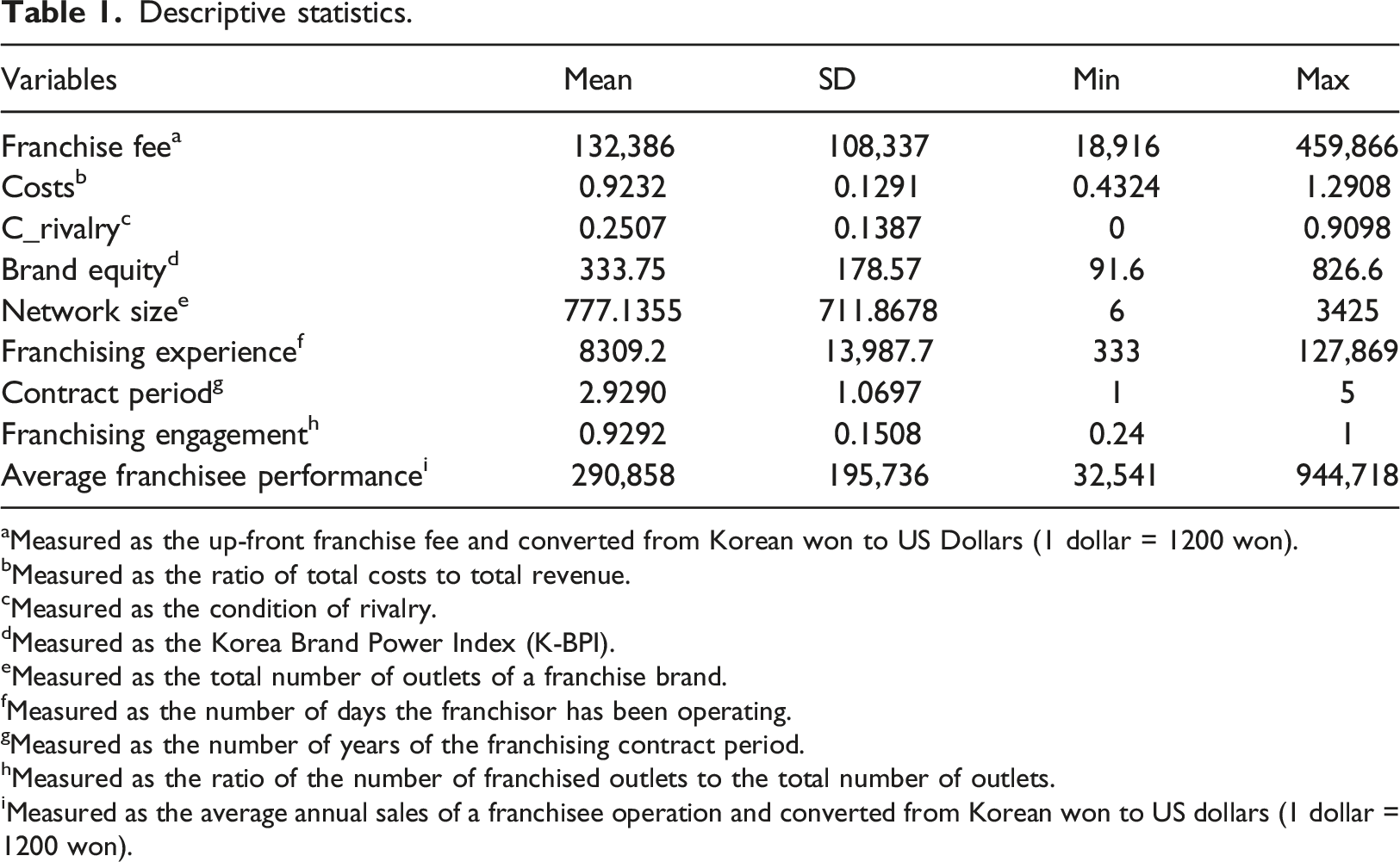
aMeasured as the up-front franchise fee and converted from Korean won to US Dollars (1 dollar = 1200 won).
bMeasured as the ratio of total costs to total revenue.
cMeasured as the condition of rivalry.
dMeasured as the Korea Brand Power Index (K-BPI).
eMeasured as the total number of outlets of a franchise brand.
fMeasured as the number of days the franchisor has been operating.
gMeasured as the number of years of the franchising contract period.
hMeasured as the ratio of the number of franchised outlets to the total number of outlets.
iMeasured as the average annual sales of a franchisee operation and converted from Korean won to US dollars (1 dollar = 1200 won).
Results of Pearson correlation testing.
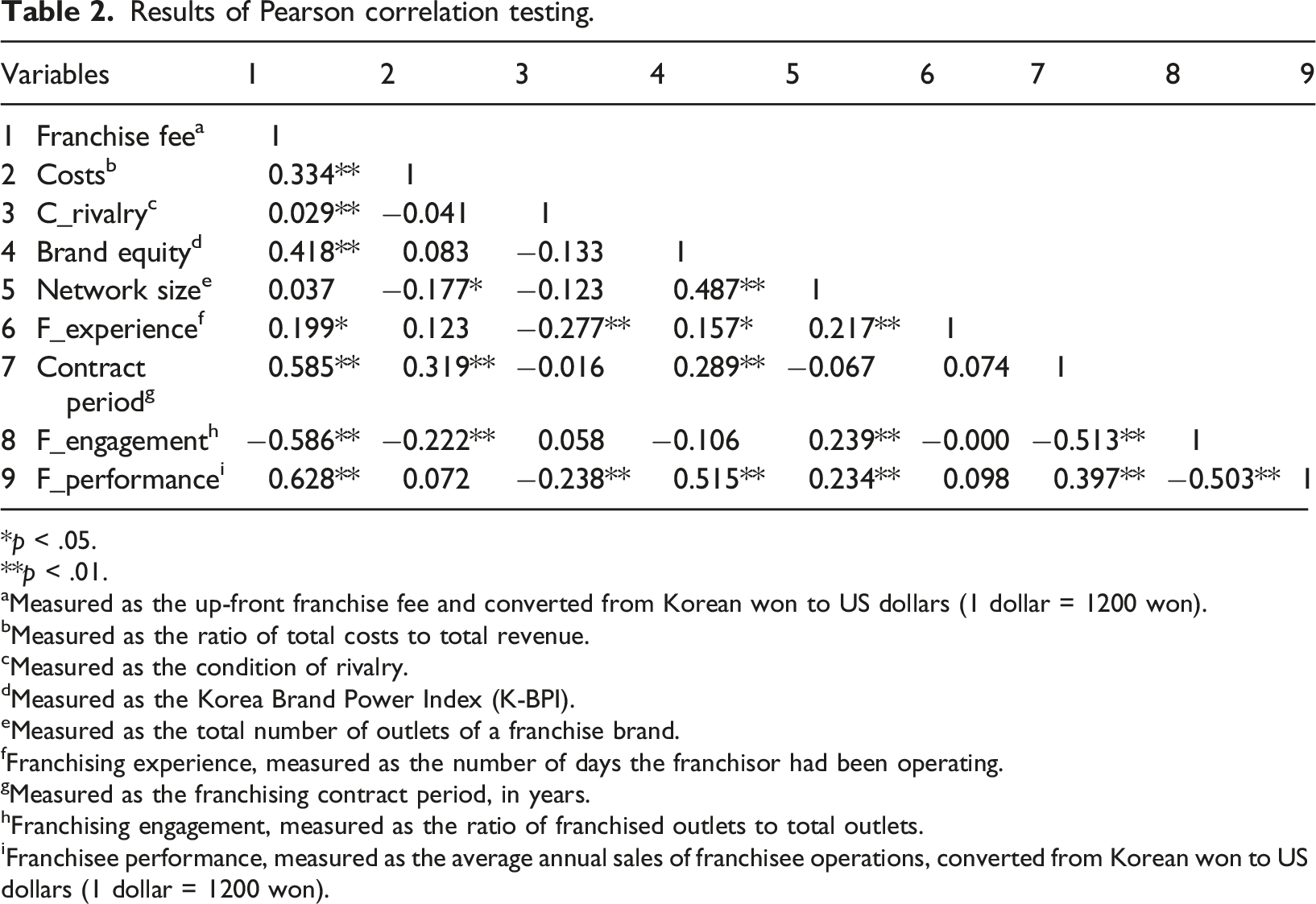
*p < .05.
**p < .01.
aMeasured as the up-front franchise fee and converted from Korean won to US dollars (1 dollar = 1200 won).
bMeasured as the ratio of total costs to total revenue.
cMeasured as the condition of rivalry.
dMeasured as the Korea Brand Power Index (K-BPI).
eMeasured as the total number of outlets of a franchise brand.
fFranchising experience, measured as the number of days the franchisor had been operating.
gMeasured as the franchising contract period, in years.
hFranchising engagement, measured as the ratio of franchised outlets to total outlets.
iFranchisee performance, measured as the average annual sales of franchisee operations, converted from Korean won to US dollars (1 dollar = 1200 won).
Main analyses
Results of the main analyses.
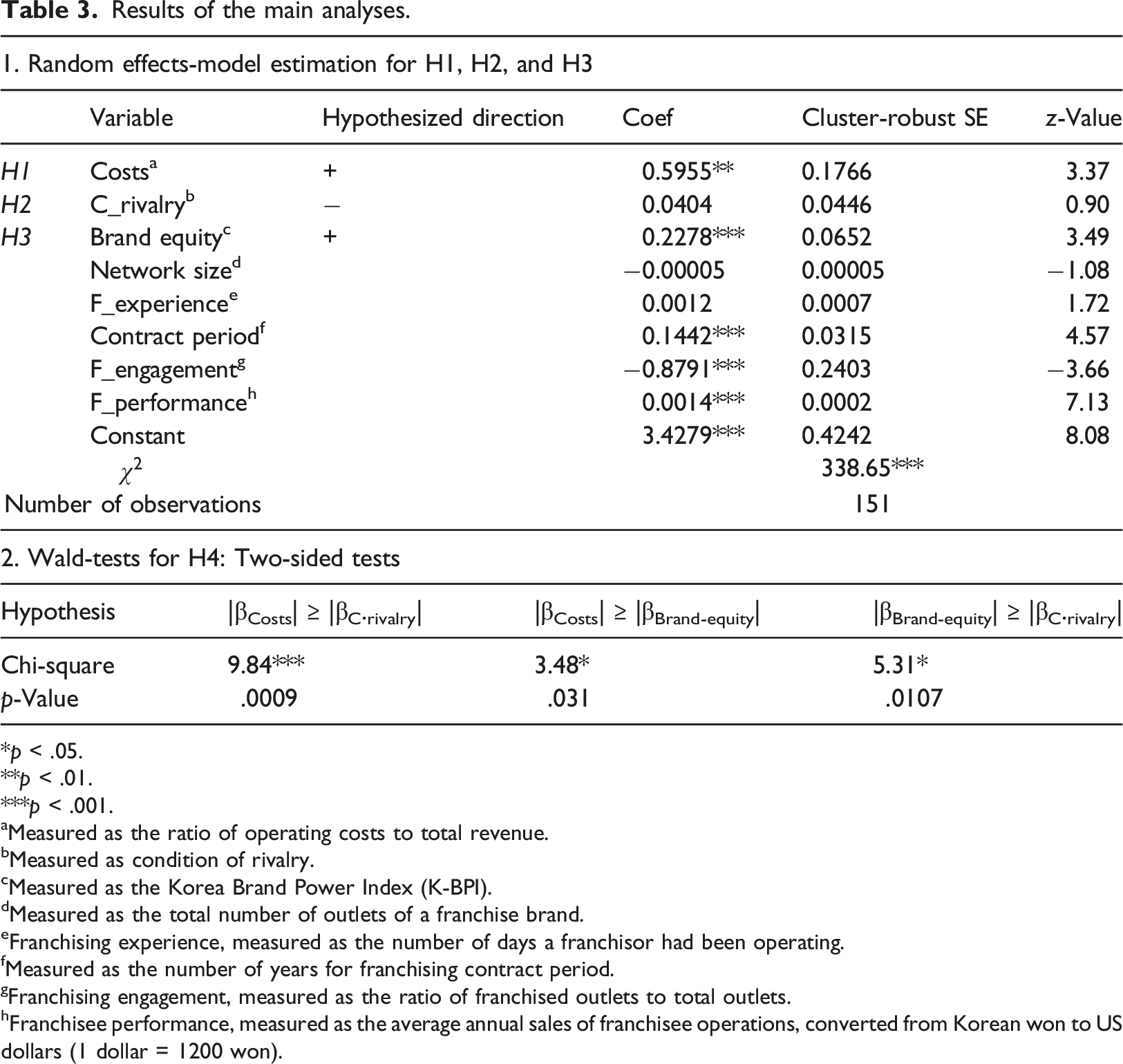
*p < .05.
**p < .01.
***p < .001.
aMeasured as the ratio of operating costs to total revenue.
bMeasured as condition of rivalry.
cMeasured as the Korea Brand Power Index (K-BPI).
dMeasured as the total number of outlets of a franchise brand.
eFranchising experience, measured as the number of days a franchisor had been operating.
fMeasured as the number of years for franchising contract period.
gFranchising engagement, measured as the ratio of franchised outlets to total outlets.
hFranchisee performance, measured as the average annual sales of franchisee operations, converted from Korean won to US dollars (1 dollar = 1200 won).
To test H4, the coefficients of the three variables were compared using Wald tests. Table 3 shows significant differences among the three coefficients of the variables at the 0.05 level. These results support the hypothesis that the three approaches have significantly different magnitudes of influence on franchise fees. The results also provide directional evidence, showing that the coefficient of costs is significantly greater than the coefficients of condition of rivalry (p-value = .0009) and brand equity (p-value = .031). Moreover, the coefficient of brand equity is significantly greater than that of condition of rivalry (p-value = .0107). In conclusion, the three approaches show significantly different magnitudes of influence on franchisors’ pricing decisions. Specifically, costs have the greatest influence on the franchise fee, followed by brand equity and condition of rivalry, respectively.
Additional analysis
Additional analysis was performed to gain a deeper understanding of how franchisors make fee decisions. In addition to examining whether the three pricing approaches influence fee decisions in the overall franchise restaurant sample, this study delved further into understanding how these influences vary depending on the type of restaurants. For this analysis, the sample was divided into two sub-samples based on restaurant type (i.e., dining restaurants and café & bakery establishments), and separate estimations were conducted to examine how the approaches influence franchise fees within each subset. Dining restaurants include places where people mostly eat full meals, whereas café & bakery establishments include coffee shops and bakeshops where people usually purchase light refreshments and beverages.
Results of the additional analyses: random-effects model estimation.
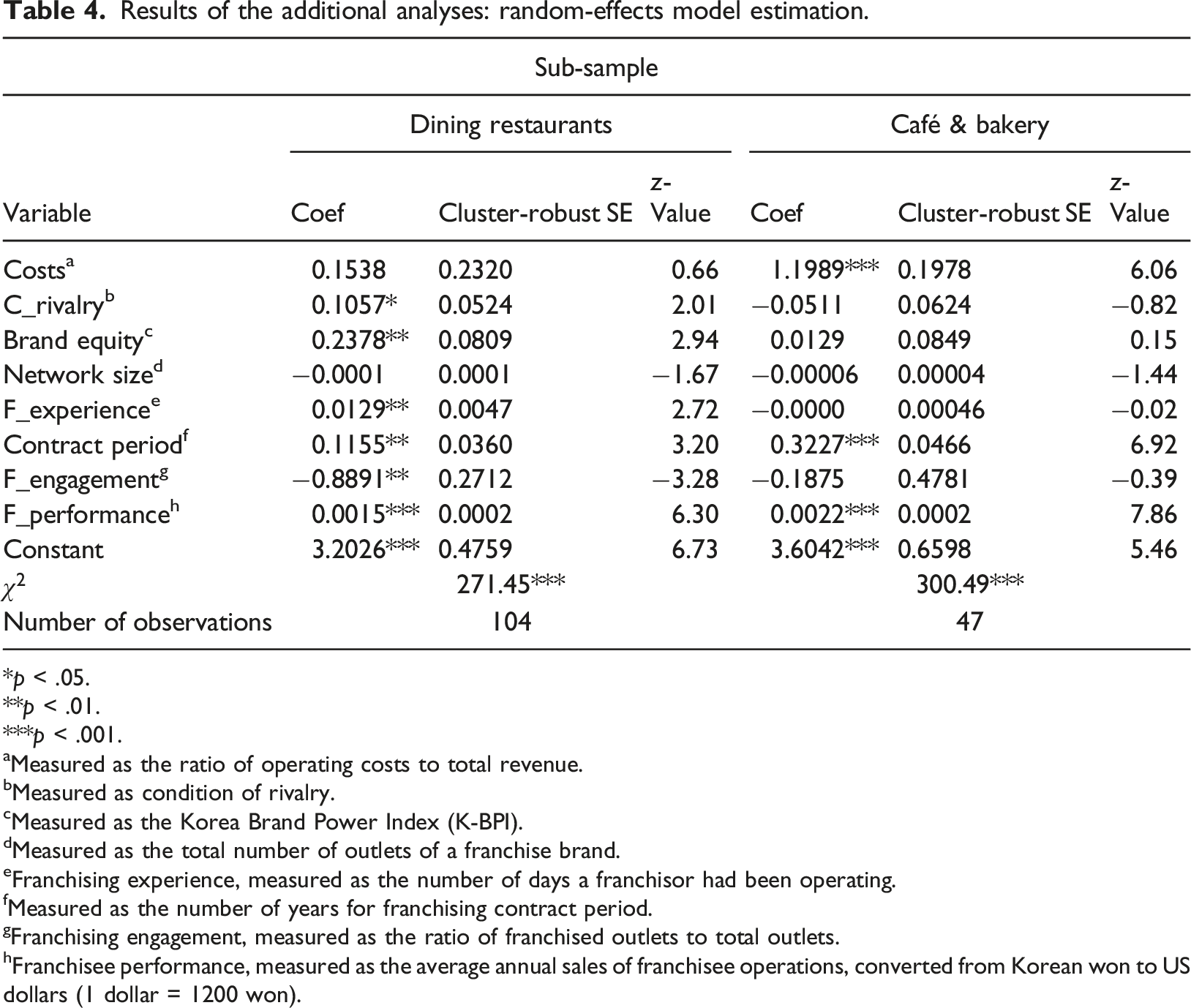
*p < .05.
**p < .01.
***p < .001.
aMeasured as the ratio of operating costs to total revenue.
bMeasured as condition of rivalry.
cMeasured as the Korea Brand Power Index (K-BPI).
dMeasured as the total number of outlets of a franchise brand.
eFranchising experience, measured as the number of days a franchisor had been operating.
fMeasured as the number of years for franchising contract period.
gFranchising engagement, measured as the ratio of franchised outlets to total outlets.
hFranchisee performance, measured as the average annual sales of franchisee operations, converted from Korean won to US dollars (1 dollar = 1200 won).
Discussion and conclusion
The aim of the current research was to investigate the pricing mechanism for franchise fees. Moreover, based on the characteristics of the franchising market, this study attempted to compare the extent to which different pricing approaches influence franchise fees. Data from franchise restaurants in Korea provide evidence that the cost-based and value-based approaches have statistically significant impacts on franchise fees (H1 and H3), whereas the competition-based approach does not (H2). Furthermore, among the three approaches, the findings suggest that the cost-based approach has the most influence on the franchise fee, followed by the value-based and competition-based approaches, respectively (H4). These findings are mostly in line with suggestions in the marketing and strategic management literature that emphasize the importance of paying attention to factors associated with the company, competition, and customers to maximize the effectiveness of pricing decisions (Hinterhuber, 2008; Indounas, 2009; Ohmae, 1982). However, one finding does not align with the previous literature: competition was not found to be a significant factor in this study. Moreover, the findings help us understand franchisors’ strategic pricing practices when making decisions about franchise fees.
With regard to costs (i.e., a company factor), the results indicate that higher operating costs are associated with higher franchise fees (H1). This supports the notion that incorporating cost-related information is a fundamental pricing practice (Hinterhuber and Liozu, 2012; Ståhl et al., 2018; Wang et al., 2016; Ziari et al., 2022) and suggests that the cost-based approach is applicable in the franchise industry. Lower prices can be a significant competitive advantage for franchisors when other conditions are fixed because price could be a critical factor for franchisees when making purchasing decisions. The franchise fee is thus influenced by the extent to which a franchisor efficiently produces products/services and manages its business, which contributes to competitive advantages (Arbelo et al., 2017; Porter, 1980). Efficient franchisors incur lower expenses to produce outputs, which could help them set their prices lower and attract more franchisees. Overall, the results confirm that cost-based information influences franchisors’ pricing decisions.
With regard to competition, the results show that the relationship between the condition of rivalry and the franchise fee is not statistically significant (H2). Drawing on the marketing and strategic management literature (Cool and Dierickx, 1993; Ohmae, 1982), this study proposed that the competitive condition of an individual firm affects its franchise fee and empirically tested this relationship. However, the condition of rivalry was not found to exert a significant influence on franchise fee decisions. Although this finding contrasts with previous suggestions (Indounas, 2008; Ziari et al., 2022), it might be explained by the customized nature of services in the B2B market (Grunenwald and Vernon, 1988; Indounas, 2008). The transactions in this market involve franchisors providing franchisees with access to their brands, marketing and administrative services, and supports, which are unique and tailored to franchisees’ needs and may not be easy for competitors to copy. To that end, the condition of rivalry may have a diminished influence on pricing decisions in the franchising context.
With regard to the customer-related factor, the results show that a positive relationship exists between a franchise’s brand equity and the franchise fee (H3). Based on the previous literature, it is assumed that potential franchisees consider brand equity as a signal when evaluating the possible benefits of partnering with a franchisor (Dant and Kaufmann, 2003; Weaven and Frazer, 2006). A franchisor with greater brand equity is recognized as providing greater value to franchisees by reducing costs to develop a new business and promote a new brand, mitigating operating risks, and helping to accelerate growth (Liang et al., 2013; Quek, 2011). Higher brand equity informs potential franchisees that the franchise can offer high value, thereby enabling a franchisor to charge a higher franchise fee. This finding corroborates the findings of previous research that customer value analysis is key to profitable pricing because it can be used to justify price increases (Hinterhuber, 2004). Likewise, the value perceived by franchisees is a critical factor to consider when setting the franchise fee; franchisors need to consider their customers’ perspective because doing so helps maximize profit (Monroe, 2002), and competitive advantage (Dutta et al., 2003).
Additional interpretation of the Wald tests yielded interesting findings, showing that the three approaches have significantly different magnitudes of influence on franchise fee decisions. The results confirm that the cost-based approach has the greatest impact on the franchise fee, as suggested by some prior studies (Hinterhuber, 2016; Ingenbleek, 2007). Due to its role in establishing the lower boundary for prices, cost-related information can be considered the most important factor in franchise fee decisions. Also, since cost information is easily accessible from accounting data, it can be more easily incorporated into the decision-making process than other approaches. The value-based approach was found to be the second-most influential in franchise fee decisions. This result reflects the characteristics of transactions in the franchisor–franchisee market. Franchisees purchase business models and sign contracts lasting several years; thus, transactions have long-term impacts on how much income they could earn. For these reasons, they consider what a franchisor’s model can provide—that is, the value they can derive from the franchisor’s brand. Franchisors identify this factor and incorporate related information into the price-setting mechanism in the form of price premiums. Third, the results show that the coefficient of the condition of rivalry is the smallest, although the value itself is not statistically significant. This indicates that the competition-based approach likely has the least impact on franchise fee decisions, potentially due to the customized nature of services in the B2B market, as discussed above.
Last, the additional analyses conducted with sub-samples, specifically dining restaurants and café & bakery establishments, shed light on franchisors’ pricing approaches to determining franchise fees. Generally, the results show that the methods for determining franchise fees vary depending on the type of restaurant. For dining restaurants, the results indicate a significant relationship of competitive conditions and brand equity with franchise fees. Conversely, for café & bakery establishments, cost-related factors were found to have a significant impact on franchise fees. These disparities in results can be attributed to the distinct business characteristics within each market segment. Dining restaurants typically offer complete meals involving complex processes from cooking to customer service, which requires extensive knowledge transfer within the franchise system (Brooks and Altinay, 2017; Lavie, 2006). Therefore, to maintain quality standards across the entire franchise system, franchisors of dining restaurants likely put more effort into facilitating knowledge transfer for quality controls, which may in turn support successful franchise models and higher brand equity, attributes franchisees consider to be critical for their businesses. Franchisees acknowledge the importance of these factors when evaluating franchise fees among different brands (Dant and Kaufmann, 2003; Weaven and Frazer, 2006). Interestingly, competition plays a critical role in decision-making within the dining restaurant industry, even though it did not emerge as a significant factor in the overall sample. Given the emphasis on customer-perceived value (i.e., brand equity) in dining restaurants, franchisors facing intense competitive conditions are more likely to differentiate their business models by providing superior service to their franchisees. This effort can enhance their competitive edge, resulting in higher fees for the brand. Therefore, it can be suggested that competition-related information influences franchisors' fee decisions for dining restaurants. In contrast, café & bakery establishments primarily offer light refreshments and beverages, which may not involve complex production and service processes. Additionally, menus tend to be relatively similar among establishments in this industry, making it challenging for them to differentiate their business models. These factors lead franchisors in this category to prioritize cost leadership to gain a competitive advantage (Garg et al., 2013; Porter, 1980). Consequently, cost-related factors emerge as the sole significant determinants of franchise fees, highlighting the significance of a cost-based approach for cafés & bakeries. In summary, these findings demonstrate that franchisors' pricing strategies can vary significantly based on the distinct characteristics of different restaurant types.
This study makes several theoretical contributions. First, it provides empirical evidence that the three pricing approaches suggested by the marketing literature as well as Ohmae’s (1982) 3Cs model are applicable to the restaurant franchising context. Although the results do not show that a competition-based approach is not as relevant in franchising as it is in other contexts, they confirm that both the cost- and value-based approaches influence the franchisor’s pricing decisions, thereby extending this knowledge to the franchising context. Second, this study documents and delineates franchise restaurants’ strategic orientations regarding pricing practices in more detail. By comparing the influences of the three approaches, this study found that the cost-based approach is the most important determinant of franchise fees, followed by the value- and competition-based approaches, respectively. This goes beyond prior research by providing a better understanding of the extent to which different strategic orientations are reflected in franchise fees.
The findings also have several practical implications. Information about franchisors’ pricing behavior can be useful to industry practitioners (i.e., franchisors). Because pricing strategy is a key variable in financial modeling, understanding how franchise fees are determined could help franchisors optimize revenues, profits, and reinvestments to ensure their firms’ long-term survival. It is important for business executives to recognize pricing decisions as a strategic responsibility with long-term implications (Piercy et al., 2010). This information can also be useful to potential franchisees by revealing the logic underlying franchise fee decisions. Because franchisors’ business models are intangible and not easily compared to those of other brands, it is difficult to evaluate whether the price of a certain franchise is fair relative to others. Knowledge about why a certain franchisor charges a specific amount could be invaluable information that could help potential franchisees make better decisions.
Suggested future research and limitations
The study has several limitations that present opportunities for future research. The up-front franchise fee was used as the price of the franchise model even though the franchise fee typically also includes ongoing royalties. The up-front franchise fee was used in this study because the explicit fee structure only includes initial fees in the Korean franchising market; in most cases, royalties are implicitly included in the sales margins of raw materials. Therefore, it is assumed that potential franchisees in the Korean market would only recognize the initial fee as a price. Even though estimating the value of an implicit component of the franchise fees is incredibly challenging (if not impossible), initial fees may not represent the total franchise fees. This is a limitation of this study, and in future research, scholars are strongly encouraged to find a way to incorporate ongoing royalties into the price, which could enhance the validity of the construct and improve the generalizability of the results.
In addition, this study used secondary data to measure franchisors’ strategic features and customer-perceived value. Although employing these variables can have advantages in terms of ensuring objective measurements, it can be difficult to verify whether they completely represent the constructs. In this vein, the proxies used for the three pricing approaches in this study may have varying levels of relevance to each construct, as they are not direct measurements of each strategic action. The different levels of relevance possibly influenced the results. In future studies, therefore, scholars may collect data in other ways, such as by conducting interviews and/or using questionnaires, or may employ other methods to measure strategic orientations, and customer-perceived value, more directly.
Supplemental Material
Supplemental Material - How do strategic pricing approaches influence franchise fee decisions?
Supplemental Material for How do strategic pricing approaches influence franchise fee decisions? by Kyung-A Sun and Seoki Lee in Tourism Economics.
Footnotes
Declaration of conflicting interests
The author(s) declared no potential conflicts of interest with respect to the research, authorship, and/or publication of this article.
Funding
The author(s) received no financial support for the research, authorship, and/or publication of this article.

Supplemental Material
Supplemental material for this article is available online.
Author biographies
References
Supplementary Material
Please find the following supplemental material available below.
For Open Access articles published under a Creative Commons License, all supplemental material carries the same license as the article it is associated with.
For non-Open Access articles published, all supplemental material carries a non-exclusive license, and permission requests for re-use of supplemental material or any part of supplemental material shall be sent directly to the copyright owner as specified in the copyright notice associated with the article.
