




Abstract
We examine the effect of the decomposition of tourist demand on tourism receipts. We find that tourists from OECD economies or from countries that have strong trade connections with the host economy tend to spend more money in emerging economies. However, tourists from countries that have sociocultural or geographic linkages, such as sharing the same border, having the same religion or language, or have the same ethnicity as those in the host country, tend to spend less money.
Introduction
International tourism receipts accounted for approximately 4% of all international trade in 2017, and it is expected to grow by 5% annually (Dogru et al., 2019). This progress is valuable, especially for emerging countries by providing opportunities to have higher economic growth, increase in welfare (Grangnon 2020; Arslanturk 2011). The World Economic Forum found that 12 of the top 15 most-improved countries in 2017 among tourist destinations were emerging markets. In 2018, tourist arrivals into emerging economies stood at 45.8% of total international tourist arrivals for 2017. This was an increase of 7.2% from 2016. China and India led this change, with Brazil experiencing a rebound after a few years of decline in their numbers. Change in the perspective regarding travel for growing middle classes in these emerging markets have enabled them to travel to other emerging countries, thus flourishing the industry further. While tourism receipts are an effective measure of tourism, investigating the quality of these receipts is also of utmost importance. Quality of tourism receipts depends on deviations of tourism receipts, whether these receipts are a stable flow of income which a country can rely on or whether these are an instable and hence an unreliable source. This concept was Sinclair and Tsegaye (1990), who studied stability of tourism receipts in a range of industrialized and developing economies. It was argued that the instability of tourism receipts can either offset or amplify the instability of traditional merchandise export receipts. As governments rely on their net export receipts to improve their balance of trade, an offsetting impact by tourism receipts would be of vast economic significance. A scant amount of literature has investigated these deviations in tourism receipts since then. Brohman (1996) links the quality of tourism receipts to the quality of cultural and environment development which is associated with tourism. Meng et al. (2013) argue that tourism is a risky source of earnings. This is because tourism receipts do not seem to follow a smooth predictable path over time. Deviations caused by shifts in consumer tastes, technology or factor supplies can be useful, but significant deviations from a fixed level are undesirable as they trigger fluctuations in other long-term variables such as government investments (Wilson, 1994). Zuo and Huang (2018) divide tourism quality into two dimensions: level/size and quality/structure. The quality dimension aims to examine the degree of economic structural change in a destination caused by tourism expansion. Eryiğit et al.(2010) has utilized all those factors in analyzing tourism demand in one study.
This study also differentiates between countries based on the quality of their tourism receipts: some countries rely on their tourist size, measured by number of arrivals, while others on their tourist quality, measured by tourism receipts per capita. We argue that in the long run, quality should have precedence over size for economic policy makers. One of the ways in which our current study aims to understand the impact of origin country of international tourism demand is by examining the sources and repercussions of these deviations in tourism receipts.
Our study contributes to the literature in one important concept. After adopting the tourism demand theory to the paper, we incorporate the taste and preferences of international tourism demand into models. Empirically, we investigate if the origin of the tourism inflows matters on the tourism receipts per head. Our theoretical approach is because taste and preferences factor in the tourism demand depends on your culture, language, geographical location, etc. Therefore, impact of preference and taste on the quality of tourism revenue could make us to understand the tourism revenue differences. Different from other studies we have worked on this concept. Empirically, first we examine the effect of origin country of tourist demand into countries on tourism spending. We decompose the tourism arrivals into the country groups. For instance, we regroup the tourist inflows for each country, from its top trading partner (named as trade variable) and observe if the volume of the tourism flows from trading partners has impact on tourism receipts. Similarly, another breakdown factor (contagious) is created by collating tourism flows from its neighboring countries and tested if more tourists from neighboring countries has impact on to tourism receipts. Previously, Vietzel (2012) and Bulut et al., (2020) have investigated the impact of cultural impacts to tourism, to some extent, we go more deep of this analysis and investigate if tourists from similar ethnicity or religion country origins with destination economy, spend more money when they are visiting. We also tested the share of the tourism flows from OECD economies on the tourism receipts in the paper.
Data and descriptive statistics
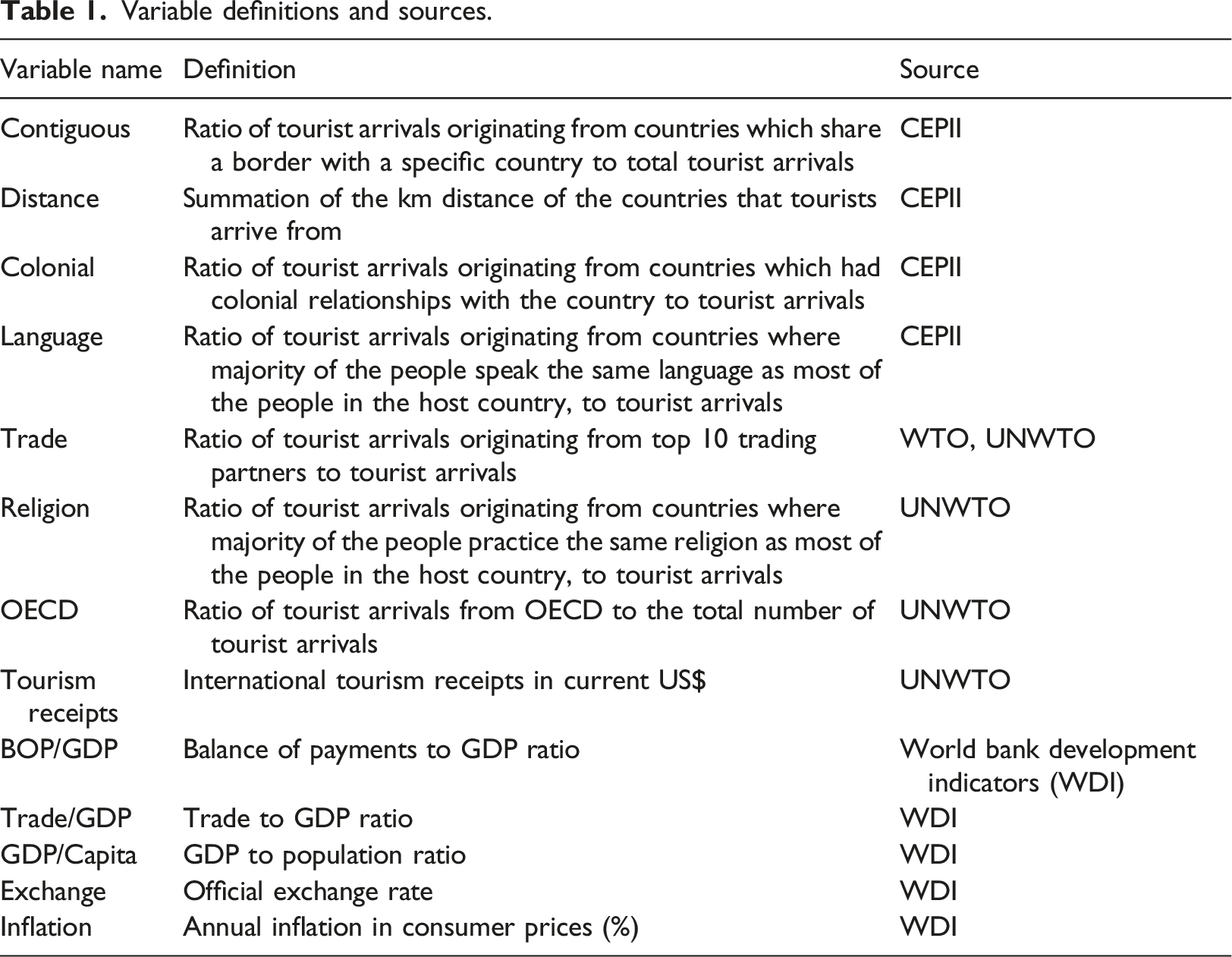
Variable definitions and sources.
Empirical model and analysis
Tourism demand is mostly considered as a form of international investment/trade. Accordingly, modeling tourism receipts would be similar to having a tourism demand or bilateral trade/financial asset flows model. We employed the inverted demand for housing prices model, extracted from the recent literature review by Wu et al. (2017) as follows:

In this paper we identify the importance of the origins of the tourism demand we suggested it can be a good proxy to capture taste and preferences on the tourism demand. Therefore, we have incorporated the following hypothesis.
H0: Does tourism demand origin affect the tourism revenue
To test this hypothesis, we have incorporated several variables created for the paper. We have employed, Distance Trade, Contiguous, Religion, Language, OECD variables, capture the characteristics of the tourism demand origins. For instance, trade is a variable capture, to what extent tourism demand is originated from the top 10 trading partner of the destination country. Similarly, Religion (language) is a variable created to what extent the tourism demand flew from the countries practicing (using) same religion (language) with the destination country. And Contiguous is a variable created to what extent the tourism flows are originated from a neighboring country.
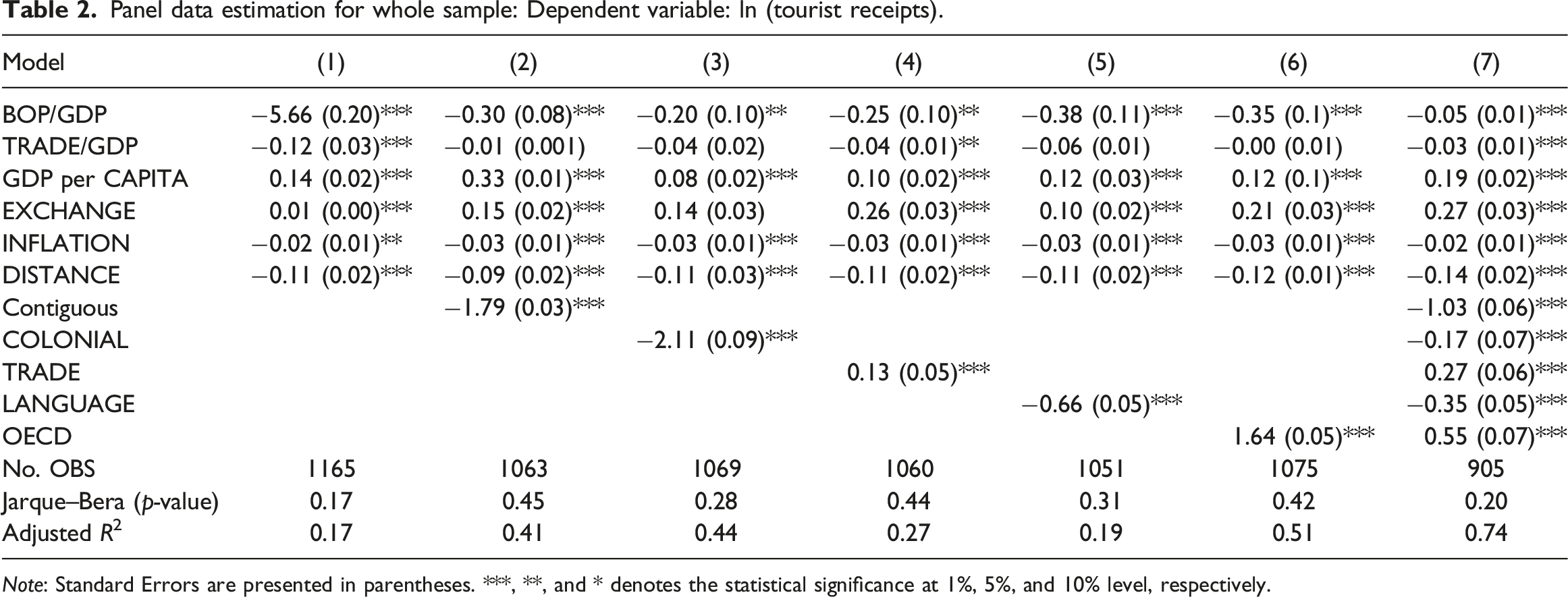
Panel data estimation for whole sample: Dependent variable: ln (tourist receipts).
Note: Standard Errors are presented in parentheses. ***, **, and * denotes the statistical significance at 1%, 5%, and 10% level, respectively.
Table 2 contains results pertaining to the estimation of seven different model specifications of equation (1). Model 1 shows the results of a model with all baseline variables, leaving aside the control variables. Each of these variables is then added sequentially in the regression equation and the results are inserted in Models 2 to 7. Model 7 shows the estimation result of the full model. At first glance, 2e find the BOP/GDP variable has a negative and significant coefficient (−5.71), indicating that country has a higher BOP/GDP deficit (say 1%), the receipts per tourists gets lower, with an estimation of 5.71%. Similarly, the trade openness has a negative impact on tourism receipts, but it is not significant enough in the following estimations. Inflation and exchange rate variables have negative and positive and significant effects as it is expected. As prices go up, tourism demand decreases. Exchange rate (higher values means the depreciation of the destination country currency) has a positive effect as it makes the destination country markets cheaper and tourism revenues are getting higher. GDP per capita has positive and significant impact, as the destination country is richer the tourism receipts are higher. Institutional quality has a positive impact on tourism receipts as it is expected. If tourists feel that country is secure, they intend to spend more.
In models 2–7, we have tested the new variables we have created. We have focused on the distributional pattern of the tourists and how do they affect the tourism receipts. In model 2, we have added the proportion of the tourists coming from contiguous (sharing same border) countries. The coefficient is negative and highly significant and in model 3 we have employed colonial variable, created as a portion of international tourists coming from same colony has negative and statistically significant coefficient. Both variables represent as if the tourists and tourism destinations have same cultures, their consumption patterns are different or not. Our results suggest that “similar culture” does make a negative impact on expenditures. This is most likely due to less motivation to spend as tourists may experience similar goods and services in their origin countries. Our results imply that tourists who share the same cultures and languages with the destination countries tend to spend less than whom do not.
Trade variable (proportion of the tourists coming from trade partners) positively and significantly affect the tourism receipts, indicating that as the tourists coming from trading partners (include the business tourism) tend to spend more. Our result is supported by literature as past studies have shown that trade flows between countries play a stable and crucial role on tourism flows (Balli et al. 2016). Our findings extend that trade volumes increases tourism receipts, irrespective of whether immigrants from a trading partner are present in the host country or not.
The effects of OECD variable on tourism receipts per tourist are positive and significant in all models. This result implies that as the proportion of tourists coming from rich countries (OECD) increases, the tourism receipts per tourist increases. Rich people tend to spend more money, which is in line with the inverse demand functions as income of customers increases, the demand (so does the spending) increases.
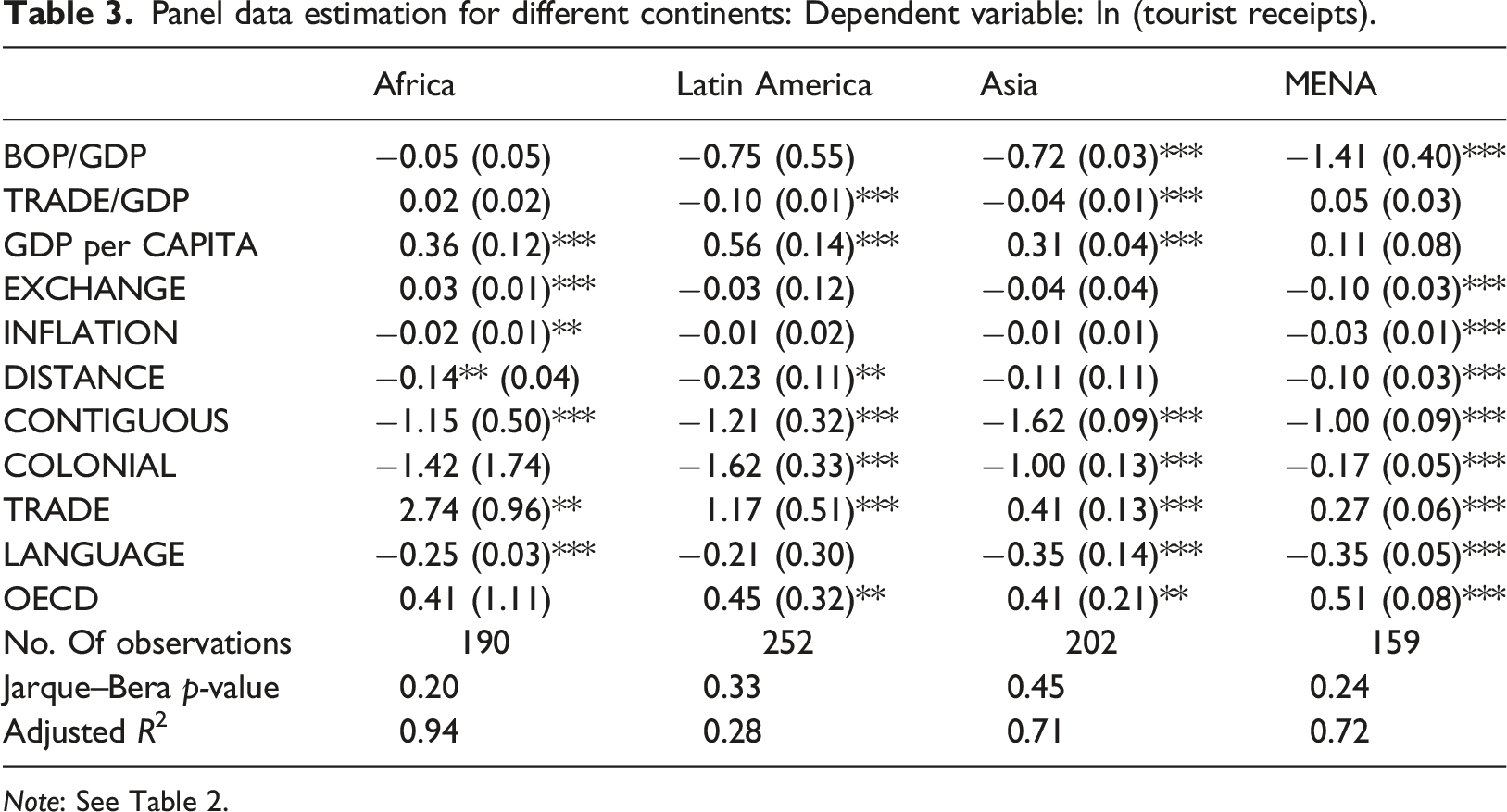
Panel data estimation for different continents: Dependent variable: ln (tourist receipts).
Note: See Table 2.
The dynamic panel data model
Main motivation corroborated by literature for this phenomenon is the satisfaction obtained from prior trips and their perceived attractiveness of the places (Um et al., 2006). Static model estimations such as equation (1) suffer from a loss of dynamic information. It can lead to model misspecification problem if we omit the persistency effect in tourism demand/receipts. Empirical consequences of this misspecification are that it may lead to overestimated coefficient values, as these values capture both immediate/direct and lag/indirect effects. We take this issue into consideration by estimating a dynamic panel data model that incorporates the lag of the dependent variable, along with other variables’ lags, as explanatory variables.
The dynamic panel data model for the tourism flows can be represented as follows:
1

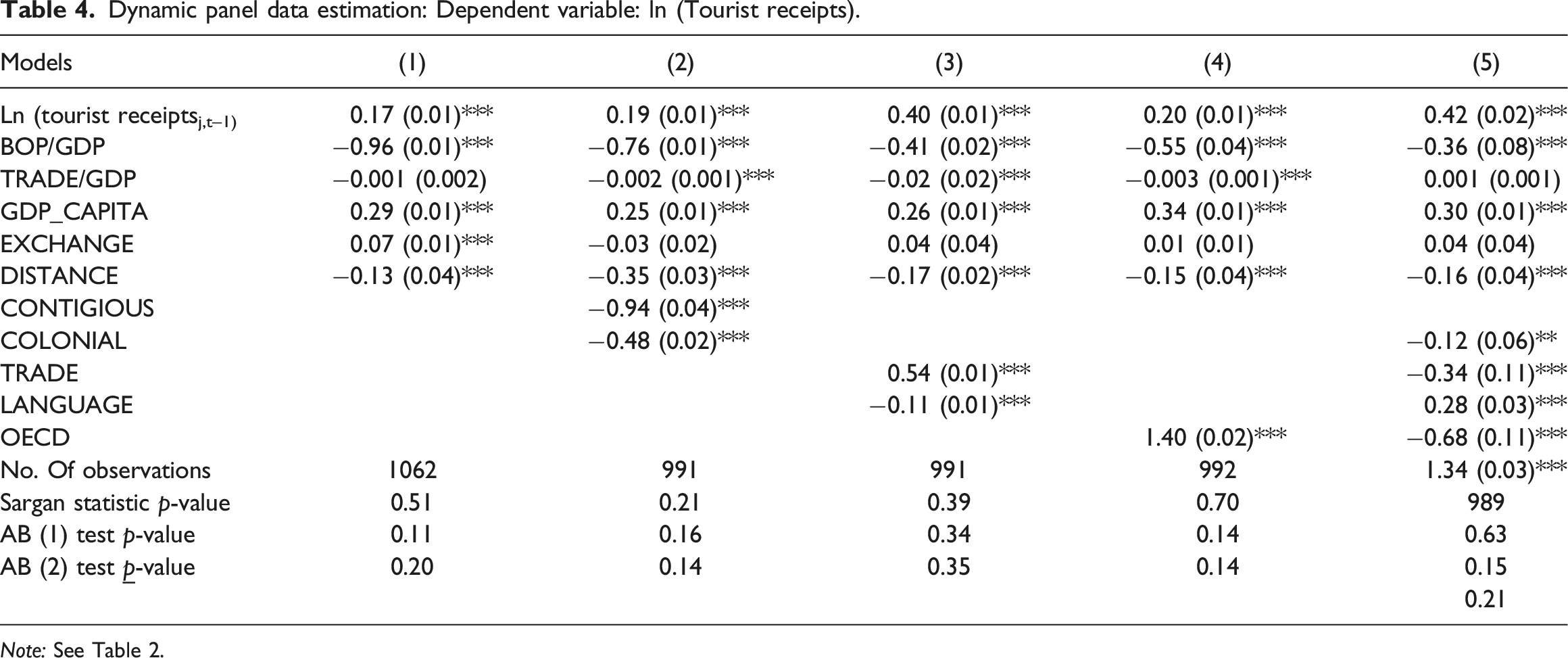
Dynamic panel data estimation: Dependent variable: ln (Tourist receipts).
Note: See Table 2.
Table 4 shows that the lag value of the independent variable is significant, supporting the persistency effect of the tourism receipts. In addition, we find that the results presented in Table 4 are consistent with main findings that we discussed earlier for Tables 2 and 3 The baseline equation variables are statistically significant. Tourism receipts decrease with tourists coming in from shared-border countries, same language speaking countries and from those countries with whom the host country shares a colonial relationship. Tourism receipts increase with more tourists coming in from the OECD countries and from those countries which share a large volume of trade flows with the host country.
Concluding remarks
In this paper, we have thoroughly investigated the cultural and trade patterns/characteristics of countries on tourism receipts. Novel to the literature, we measure the quality of the tourist receipts. Adopting from tourism demand theory, we show the taste and preference of the international tourists’ matter. We investigate the origin of the countries tourists come from and proxied it as “taste and preference.” We simply connect that tourism receipts per tourist is related with origins of the countries that tourists come from. More specifically, when tourists are originated from rich economies (OECD), the tourism receipts increase. However, if tourists originated from a neighboring country, per tourist expenditure decreases. This might be due to the alternative tourism arrangements or resembles of the culture/climate make the tourists reluctant to spend more. Regarding the business tourism, receipt per tourist increases when tourists originated from trading partner countries. This might be related with business travelers, since business tourism is a function of bilateral trade between countries, hence the expenditures of business travels are higher compared to leisure travelers.
Our findings have important policy implications and draw interesting directions for future research. Tourism department of countries need to focus on more rich economies in their advertising campaign and mostly countries that are “ethnically/culturally different” from their originals. Focusing on the trade partner economies would also increase the quality of tourists.
Footnotes
Declaration of conflicting interests
The author(s) declared no potential conflicts of interest with respect to the research, authorship, and/or publication of this article.
Funding
The author(s) received no financial support for the research, authorship, and/or publication of this article.
