




Abstract
Many tourism studies leverage the hedonic price model to gauge tourists’ willingness to pay for diverse attributes of short-term rental properties. However, when this estimation is applied to the temporal analysis, it can be biased if variables varying with time, such as term structure effects in short-term rentals, are omitted. This paper introduces a repeat sales Airbnb ADR (average daily rate) index to track the change in quality-adjusted rentals of Airbnb properties over time in Auckland, New Zealand, while factoring in the term structure. The findings confirm that using repeat sales data from Airbnb listings can significantly mitigate the bias linked to time-varying attributes. Results demonstrate that when the term structure is not considered, the ADR calculated by the hedonic method may be overestimated by 0.2% per day of the tenancy term. The inventive Airbnb ADR repeat sales index enables the assessment of Airbnb rental trends, taking into account changes in the term structure of leases. This new index can potentially enhance Airbnb listings by incorporating the effects of lease term structures.
Keywords
Introduction
Airbnb and other short-term rental platforms typically offer accommodations at higher daily rates compared to long-term rentals. This is justified by the fact that landlords would need to charge a higher rate to compensate for potential income loss from long-term contracts. Coles et al. (2017) provide evidence that profits in short-term rentals are significantly lower than in long-term rentals when considering vacancies. Leick et al. (2022) also evidenced the spillovers from Airbnb-based accommodation to traditional accommodation. In housing economics, this phenomenon is referred to as the lease term structure effect or lease length effect. Rental rates for residential spaces vary across different term structures, with hotels and lodging occupying the shorter end, followed by weekly furnished housing and long-term rental housing for residents (Horn and Merante, 2017).
However, the term structure effects are often overlooked when analysing the Airbnb rental market using rental indices or hedonic pricing models. Neglecting the term structure effect in short-term home-sharing rentals like Airbnb can be misleading, especially considering their impact on residential rents. This research note advocates developing a repeat sales Airbnb average daily rate (ADR) index to track the quality-adjusted changes in Airbnb rentals over time using Auckland, New Zealand, as a case study. The results demonstrate that the term structure effect on Airbnb listings is crucial in avoiding omitted variable bias from time-invariant unobserved quality. Furthermore, this note hypothesises and confirms that during substantial macroeconomic disruptions, such as the pandemic that drastically curtailed Airbnb’s tourist demand, the price recalibration for a rental unit transitioning to residential rentals is less marked. This observation remains consistent when holding term structure effects and other factors constant (Llaneza and Raya Vilchez, 2022).
Research design
Identifying housing and neighbourhood attributes can be challenging in Airbnb datasets, where exact property addresses are often undisclosed. Such data limitation always creates omitted variable biases. To this end, a method called repeat sales analysis has been developed in this research note. This method looks at how the ADR of the identical listed property changes over time, taking into account factors like housing quality (Boto-García, 2022), property locations (Wong et al., 2018; Eugenio-Martin et al., 2019) and switching-option value of leases (Yiu and Cheung, 2021). To begin with, the hedonic pricing model (HPM, Model 1) is used as a baseline analysis with ADR as the dependent variable

The term structure effect in short-term leases is influenced by two factors: vacancy risk and expected rental risk. In short-term leases, the expected rental risk is usually insignificant compared to the vacancy risk and transaction costs. For example, if we compare thirty daily leases to a single 30-day lease with the same total number of days leased, the former would have 30 times higher leasing and transaction costs. As the length of the stay increases, we would indeed expect the ADR to decrease. This is because the marginal costs associated with cleaning and rotation decrease with the length of the stay. Longer stays also provide more certainty and stability for the property owners, which could further contribute to lower ADRs. Moreover, short-term leases are more likely to have vacant days between two leases. When the probability of vacancy is high, longer-term leases are preferred. The lease rates for the term structure are determined by the conflicting forces of vacancy risk and expected rental risk. Whether the overall effect is positive or negative is an empirical question.
To the best of our knowledge, this is the first note that directly emphasises and demonstrates the repeat sale method introduced by Bailey et al. (1963; referred to as BMN) to short-term listing and control for temporal-invariant property attributes that examine the term structure effect based on Airbnb listing information. The BMN index assumes that the property characteristics and implicit prices of the same property remain invariant between the first listing (t1) and the second listing (t2), as shown in equation (2)

The term structure change between listings into the repeat sales model is further incorporated to build the RS_ADR

Empirical results
The results of HPM baseline model, HPM term model and term × year model.
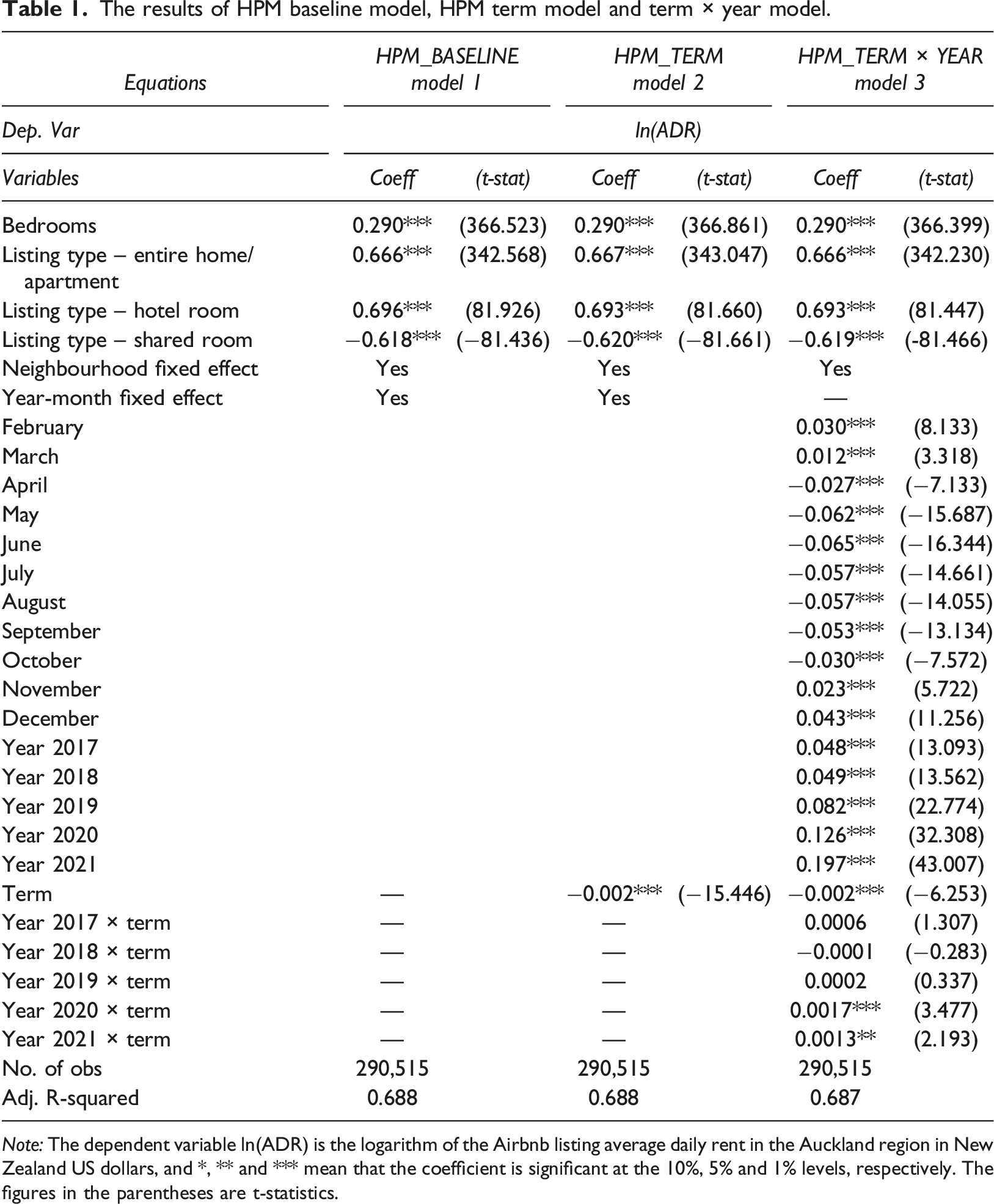
Note: The dependent variable ln(ADR) is the logarithm of the Airbnb listing average daily rent in the Auckland region in New Zealand US dollars, and *, ** and *** mean that the coefficient is significant at the 10%, 5% and 1% levels, respectively. The figures in the parentheses are t-statistics.
The results of repeat sales models.
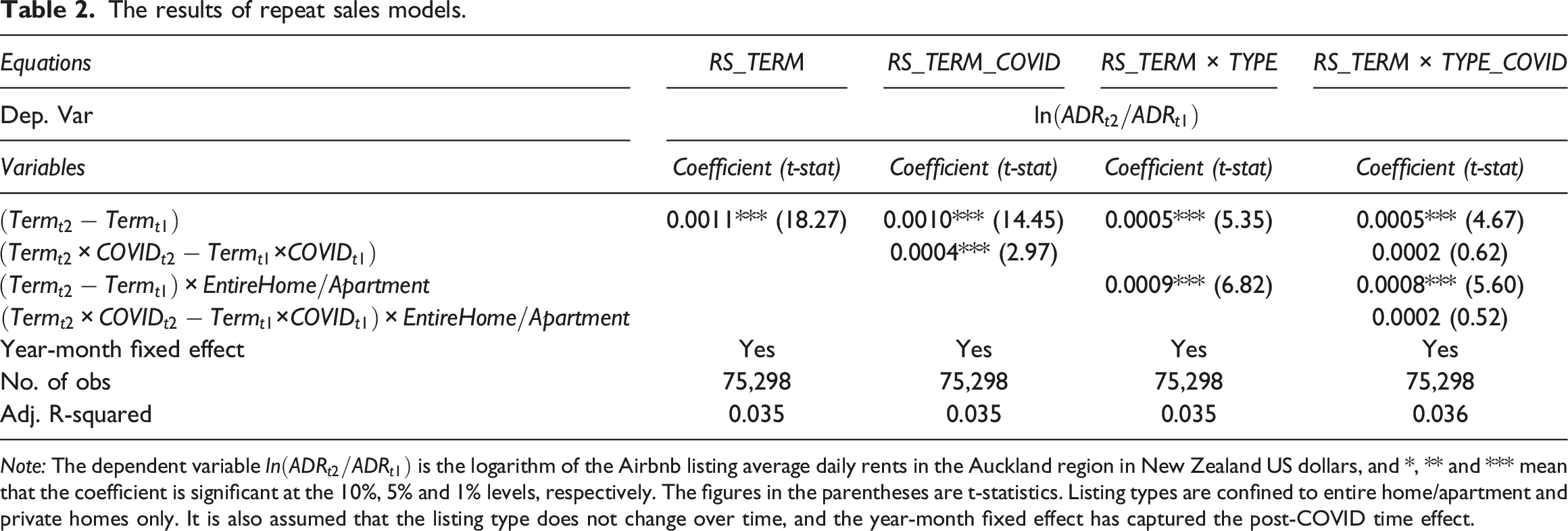
Note: The dependent variable
Likewise, the RS_TERM × TYPE Model demonstrates that the listing type of entire home/apartment positively moderates the term effect on ADR compared to the private room type. Combining these models, the RS_TERM_COVID × TYPE Model indicates a more substantial moderating effect of the entire home/apartment listing type on the term effect following the pandemic outbreak. However, the post-COVID moderating effect becomes statistically insignificant. The results of the four repeat sales models confirm the switching-option hypothesis: all else being equal, the conversion from short-term to longer-term accommodation, particularly for entire home/apartment listings that are easily converted to residential leasing, results in a more positive term effect after the pandemic outbreak.
In addition to examining the post-COVID term effects on ADR, this research note also considers the differences between the ADR indices estimated by the hedonic and repeat sales models with and without considering the term structure effects. Figure 1 displays the four ADR indices: the hedonic model baseline (HPM_BASELINE), the hedonic model with term effect (HPM_TERM), the repeat sales method (RS_BMN) and the repeat sales method with term effect (RS_TERM). Both methods overestimate the ADR when the term effect is ignored, particularly in the post-Covid period. ADR indices by hedonic and repeat sales models. ADR indices of Airbnb listings in the Auckland region of New Zealand from 2016 to 2021 – compare the hedonic baseline (HPM_BASELINE) with the hedonic term model (HPM_TERM), the repeat sales baseline model (RS_BMN) and the repeat sales term model (RS_TERM). The average ADR (rebased 201,601 = 100) is included in the plot for reference. However, it is crucial to recognize that relying solely on averages when calculating the average daily rate (ADR) may have its limitations. One notable limitation is that the average ADR does not take into account the influence of quality and repeated sales. As a result, the presence of extreme values, whether they are exceptionally high or low, within the dataset can heavily distort the calculated averages. This serves as a typical drawback of relying exclusively on averages for analysis purposes. Source: data from AirDNA (2021).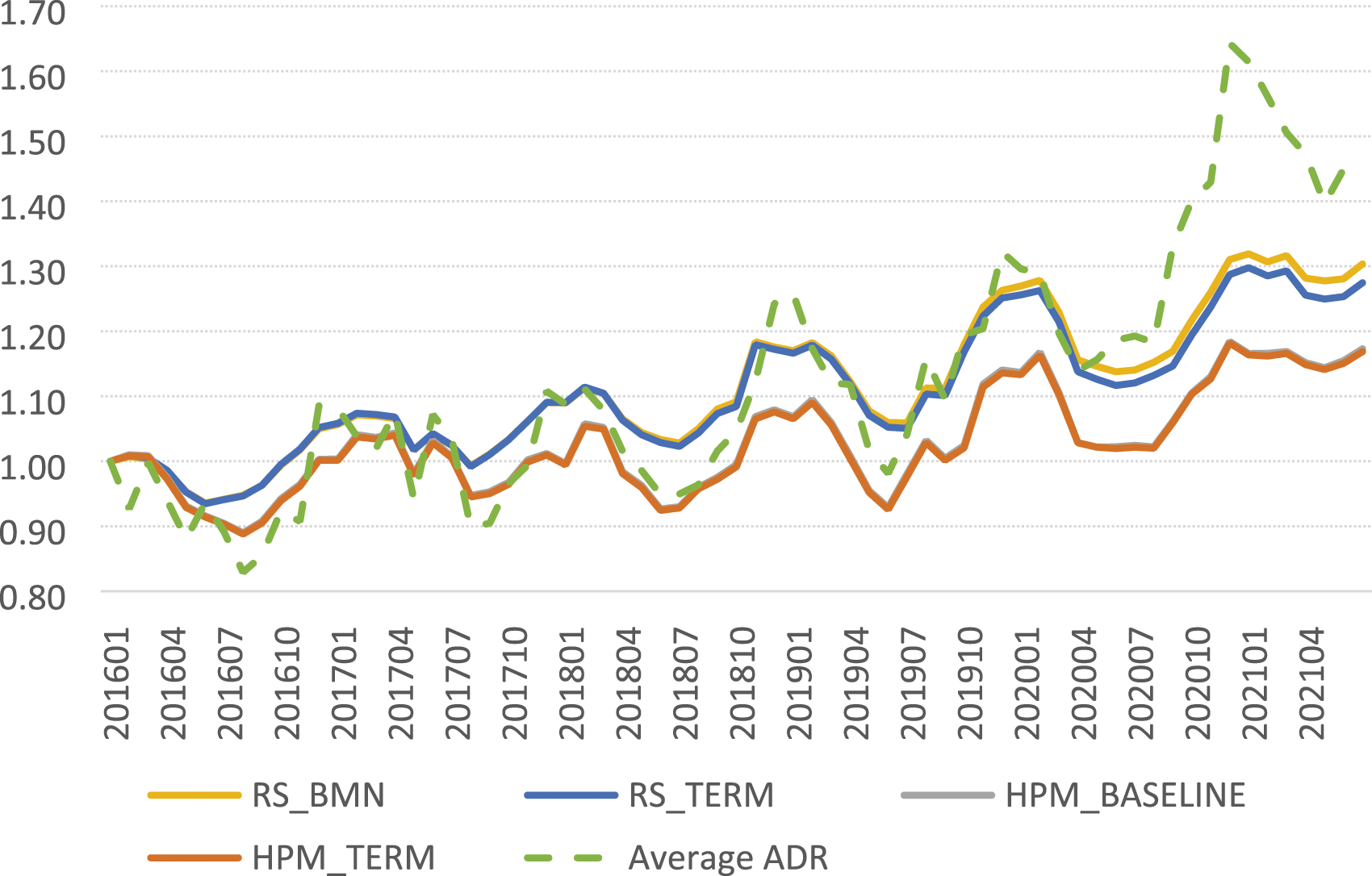
This result aligns with empirical findings that, during the pandemic, demand for longer-term accommodation increased, leading to higher ADR indices when the term effect is not accounted for. The non-linearity of the lease term effect can also be shown by the U-shaped curve in Figure 2. Scatterplot of the term structure of Airbnb ADRs at the Auckland, New Zealand, from 2016 to 2021. Source: AirDNA (2021).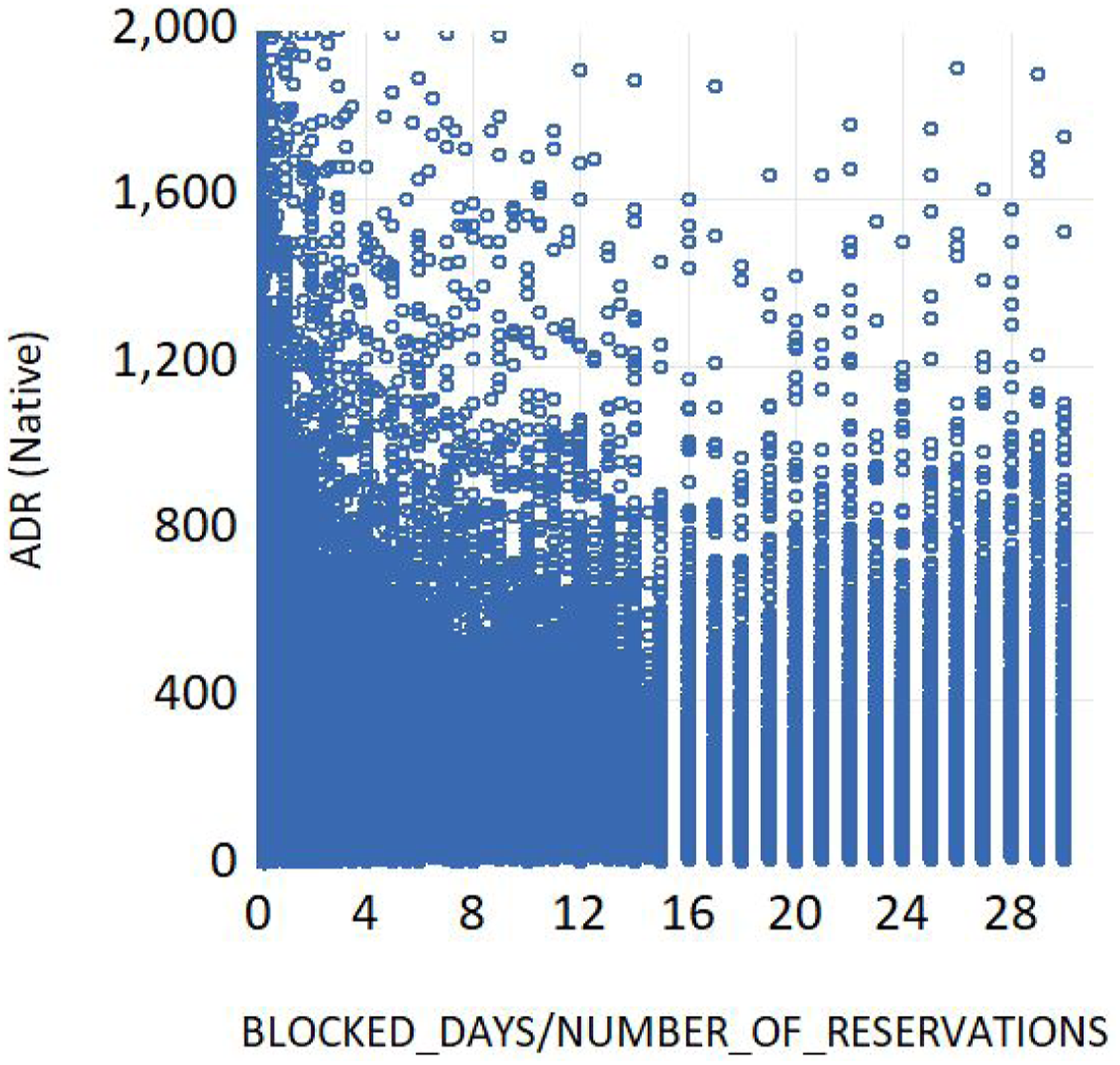
Conclusions
This research note applies a novel indexing technique and incorporates rental term structure effects for estimating the temporal short-term rental analysis. Specifically, this note addresses the need to control for leasing term structure by developing a term-adjusted Airbnb ADR index using the repeat sales method. The findings demonstrate that ADR hedonic indices can be overestimated if the term effect is disregarded, particularly in the post-COVID period when the ADR for longer-term accommodation increases. Results also highlight the issue of omitted variable bias in hedonic price studies on Airbnb, a well-known concern in the housing economics literature.
In practical terms, the hedonic pricing model offers an effective methodology for analysing temporal rental pricing trends for Airbnb properties. However, this model operates under the assumption of consistent pricing across all property attributes and necessitates an extensive data collection process. This requirement can prove both resource-intensive and impractical. Moreover, any overlooked property characteristic could lead to distorted results. In contrast, the repeat sales model, as proposed in this study, enables us to track the same property’s prices over time to construct the Airbnb rental index. This method inherently mitigates the risk of omitting key characteristics and circumvents the need for exhaustive data collection, making it a more feasible choice for Airbnb’s diverse platform where comparable data may not always be readily available.
Indeed, it is essential to acknowledge that however, the repeat sales model has its limitations. Although it inherently controls for constant property characteristics, it may overlook variables that change over time, potentially leading to an omitted variable bias. For instance, changes in property features or the surrounding area between transactions could affect property values and introduce bias into the model. Further adjustments, such as those suggested by Melser (2023) through a spline regression approach or Yiu and Cheung (2022) through an improvement-value adjusted repeated sales (IVARS) method, could be applied as potential remedies to these limitations of the repeat sales methods. Despite these challenges, the repeat sales model’s ability to track specific changes in rental prices over time provides a more accurate reflection of market trends. This approach offers valuable insights beneficial to both hosts and guests on Airbnb’s platform, thereby aiding them in making informed decisions. By balancing the strengths and weaknesses of both the hedonic pricing and repeat sales models, we can better appreciate the unique value each model brings to the analysis of rental pricing trends.
Without considering factors such as the pandemic outbreak as a source of exogenous variation, the heterogeneous price effects observed in short-term rentals within the hedonic price model could lead to misleading results due to omitted variable bias. Therefore, incorporating term structure effects are considered the gold standard for studying price adjustments in short-term rentals. This research note is opening up a new research agenda focused on applying repeat-listing methods and its alternative in short-term rentals and highlighting the significance of the term structure effect in rental markets – an aspect that is often disregarded in existing studies pertaining to Airbnb or other short-term rental accommodations.
Supplemental Material
Supplemental Material - Airbnb pricing and term structure: A temporal analysis of omitted variable bias and repeat sales method as remedies
Supplemental Material for Airbnb pricing and term structure: A temporal analysis of omitted variable bias and repeat sales method as remedies by Ka Shing Cheung in Tourism Economics.
Footnotes
Acknowledgements
The author would like to express his deepest gratitude to Associate Professor Edward Yiu and Professor Kelvin Wong for their invaluable insights and discussions on applying the term structure research in Airbnb. Their expertise and thoughtful perspectives have greatly enriched this work. Their willingness to share their time and knowledge has been a significant contribution to this research. I am truly grateful for their support and guidance throughout this study. Their input has not only enhanced the quality of this journal article but also deepened our understanding of the subject matter. Thank you for inspiring me to think more critically and creatively about this research.
Declaration of conflicting interests
The author(s) declared no potential conflicts of interest with respect to the research, authorship, and/or publication of this article.
Funding
The author(s) disclosed receipt of the following financial support for the research, authorship, and/or publication of this article: This research was supported by University of Auckland Business School Faculty Research and Development Fund (Ref: 3722103) and The University of Auckland Early Career Research Excellence Award 2022 (Ref: 3726886).
Data availability statement
The Airbnb dataset is proprietary to AirDNA, and the use of the dataset is subject to the Terms and Conditions stated at 
Supplemental Material
Supplemental material for this article is available online.
Note
Author biography
References
Supplementary Material
Please find the following supplemental material available below.
For Open Access articles published under a Creative Commons License, all supplemental material carries the same license as the article it is associated with.
For non-Open Access articles published, all supplemental material carries a non-exclusive license, and permission requests for re-use of supplemental material or any part of supplemental material shall be sent directly to the copyright owner as specified in the copyright notice associated with the article.
