




Abstract
The effect of tourism growth on tourism destinations’ income inequality is an important question for policymakers. In this study, we explore if this relationship is affected by economic and financial development and their interactions. We find that tourism growth affects a country’s income inequality differently. Post-redistribution, tourism growth eases income inequality in the lower economic development regime but may worsen income inequality in the upper economic development regime. However, tourism growth helps to alleviate income inequality in the lower financial development regime but may also lessen income inequality in the upper financial development regime. We also find some evidence that improving opportunities to access finance does a better job of helping to utilise the effect of tourism growth on easing income inequality in more developed nations rather than their counterparts. In line with these, our results also indicate that inflation tends to have different effects on income inequality, subject to the selection of thresholds. Our results are drawn from a dynamic panel threshold approach across 71 developed and developing countries during 1996–2016.
Keywords
Introduction
International tourism has been used as a policy tool to generate economic growth, with the ultimate aim to improve living standards for whole sections of the local population. It can play a vital role in poverty alleviation in less developed nations as it promotes the improvement of basic infrastructure and accelerates human capital accumulation. Furthermore, it can also stimulate economic diversification and trigger structural change and tertiarization (e.g., Deller, 2010; Li et al., 2016). Moreover, international tourism is also an important contributor to developed economies, contributing an average of 4.4% of GDP, 6.9% of employment and 21.5% of service exports in OECD countries in 2018 (OECD, 2020). Many empirical studies find that tourism growth tends to stimulate domestic demand, create job opportunities and generate foreign exchanges and can therefore be considered a driving force for economic growth, as summarised in Pulido-Fernandez and Cardenas-Garcia (2021). The above forms the well-known tourism-led economic growth hypothesis in the literature (e.g., De Vita and Kyaw, 2017; Scheyvens, 2007).
However, international tourism may also have adverse effects on societies as identified in the tourism literature (e.g., Cardenas-Garcia et al., 2015; Mahadevan and Suardi, 2019; Nadal et al., 2004). The essence of tourism development can be debated from various perspectives. Anthropologists, sociologists and psychologists tend to argue that tourism development should focus on the protection and maintenance of cultures, traditions and values of the tourism destinations, whereas it seems that is not always the case. From an economic perspective, developing countries promote international tourism to generate fast economic growth, while a large proportion of tourism employment remains low-paid seasonal employment. The same also applies to developed countries as large enterprises in the service sector tend to enjoy more benefits than their workers. Hence, social welfare aspects should be examined instead of economic growth. The distributional issue arises organically as it directly affects income inequality.
The relationship between international tourism and inequality has been well discussed in the literature from various aspects. There has been a long tradition of investigating seasonal variation in tourism demand from foreign tourists, particularly in cold-water tourism destinations, and seasonality-induced inequality as tourism demand directly contributes to employment and may also affect capital investment in tourism and tourism-related sectors (e.g., Baum, 1999; Fernandez-Morales et al., 2016; Nadal et al., 2004; Turrion-Prats and Duro, 2019; Wanhill, 1980). It is commonly believed that tourism seasonality causes adverse effects on the economy through different channels (Fernandez-Morales et al., 2016). Nadal et al. (2004) explore the intra-year variation of tourism arrivals to the Balearic Islands (Spain) through the Gini coefficient as an indicator of seasonality. They find that economic variables, such as GDP per capita, relative prices and nominal exchange rates, have an important impact on the seasonal pattern of tourism demand and hence can further affect the Gini coefficient.
In the same vein, other studies have attempted to measure and analyse the causes of seasonality using different methodologies at the disaggregate level. Fernandez-Morales et al. (2016) investigate tourism seasonality in the United Kingdom by disaggregating the tourism demand by market segments and looking into the decomposition of the Gini index as a measure of annual seasonal concentration. They find that seasonal patterns associated with particular market segments differ significantly at the disaggregated level. In particular, international tourists exerted less seasonality than domestic tourists through the sample period from 2007 to 2013. Furthermore, not all international origins have the same seasonal pattern, among which EU15 as the dominant international origin indicates the lowest seasonal concentration. The closer the countries of origin, the less seasonally concentrated they were among the European tourists. Turrion-Prats and Duro (2019) adopt a similar approach to identify the determinants of seasonality for Spain’s main markets of origin. They find common seasonal patterns across the main markets of origin, France, Germany and the United Kingdom. In particular, home and destination temperatures, income levels and relative prices have significant impacts on the former patterns, whereas international tourists have different sensitivities to changes in the determinants of seasonality. The British market is heavily influenced by changes in national incomes; the German market is very sensitive to variations in relative prices, while the French market is sensitive to both national income and relative prices.
More recently, tourism studies have attempted to empirically test if international tourism triggers income inequality in tourism destinations at the national level (e.g., Alam and Paramati, 2016; Croes and Rivera, 2017; Nguyen et al., 2021; Oviedo-Garcia et al., 2019; Fang et al., 2021). The primary mechanism through which international tourism can contribute to the economy overall is that it generates pro-poor income growth and therefore alleviates poverty. Alam and Paramati (2016) conclude that tourism policy should offer more opportunities to the poor through tourism-related activities. If disadvantaged groups are excluded from the former activities, international tourism may indeed worsen income inequality. Croes and Rivera (2017) further state that the income gap between the rich and the poor will be reduced only if tourism activities generate new jobs or better-paid jobs for the poor, as the low-skilled workers benefit from higher wages and vocational skill building. However, Mahadevan and Suardi (2019) argue that even if the economic benefits of tourism spread to the whole society, its impact on income inequality is still ambiguous. This is because rich people could still benefit more from inbound tourism given their high socio-economic status which put them in a better position to deal with domestic inflationary pressure (e.g., Alam and Paramati, 2016), currency appreciation (e.g., Du et al., 2016) and economic vulnerability (e.g., Nguyen and Su, 2020) likely induced by international tourism.
On the other hand, Cardenas-Garcia et al. (2015) find some empirical evidence that international tourism affects tourism destinations differently, subject to the country’s stage of economic development in alignment with the famous Kuznets curve of income inequality theory (e.g., Iyigun and Owen, 2004; Kuznets, 1955). According to this theory, income inequality increases when economic growth emerges in a country, whereas as economic development continues, income inequality reaches its peak first and then declines. In other words, the stage of economic development is a crucial determinant of income inequality but the relationship between the two is non-linear. Therefore, international tourism may affect income inequality in developing and developed countries differently. However, empirical findings on the impact of international tourism on income inequality are still unclear after taking into account countries’ economic development stages. The study of Fang et al. (2021) observes a statistically significant negative impact of tourism on income inequality in developing countries. Whereas they find tourism has no significant impact on income inequality in developed countries. Chi (2021) finds that tourism worsens income inequality in developing economies but has no effect on developed ones. The findings of Oviedo-Garcia et al. (2019) show that international tourism has no impact on income inequality in the Dominican Republic, a developing country. Ghosh and Mitra (2021) find that inequality in highly developed countries is unaffected by tourism income.
We argue that there is another factor that has not been adequately discussed in the literature but may also affect the relationship between international tourism and income inequality. This factor is financial development. Demirguc-Kunt and Levine (2009) argue that financial development greatly affects an individual’s economic opportunities, such as opportunities to start a new business or access more education, which further influences the individual’s social status, income and wealth and hence in aggregate affects income inequality in society. Therefore, better access to finance can expand economic opportunities for disadvantaged groups and mitigate the intergenerational persistence of income inequality as discussed in Greenwood and Jovanovic (1990). A well-run and fair financial market makes accessing education less dependent on an individual’s social status, which has the potential to substantially improve the human capital divide across different income groups and helps to alleviate income inequality. However, Greenwood and Jovanovic (1990) also argue that the rich reap a bigger proportion of the benefit from financial development, whereas the poor receive very little. Therefore, improving the quality of financial institutions can potentially widen income inequality. In particular, in the early stages of financial development, only a small proportion of people benefit, hence income inequality increases first. After a certain level or stage of financial and economic development, further financial development starts to reduce income inequality. This forms the so-called financial Kuznets curve hypothesis, suggesting an inverted U-shape relationship between financial development and income inequality (Greenwood and Jovanovic, 1990; Kim and Lin, 2011). Additionally, financial development and economic development are intertwined but they may not always move in the same direction. Therefore, under the different stages of economic development, financial development may or may not reduce income inequality and vice versa.
In this paper, we aim to systematically evaluate the relationship between international tourism and income inequality taking into account countries’ different stages of economic and financial development. Furthermore, we explore how financial development and economic development interact with one another and assess their ultimate impact on the relationship between international tourism and income inequality. Our study contributes to the existing literature from various aspects.
Firstly, we intend to enhance the theoretical link between tourism development and income inequality by incorporating the role of financial development. In the existing tourism literature, studies related to financial development and inequality, or economic growth, are rather limited. Although financial development is an essential element to facilitate tourism destinations’ growth-enhancing effects, only a handful of studies focus on the importance of financial absorptive capacity in tourism destinations (e.g., De Vita and Kyaw, 2016; 2017). We are keen to investigate whether financial development alters the impact of tourism expansion on income inequality differently under alternative economic development regimes. As tourism expansion attracts foreign investors to invest as they see new opportunities (e.g., Endo, 2006; Lopez et al., 2023), foreign investment can be important in situations where the domestic economy faces financial restrictions. On the other hand, foreign investment is also likely to crowd out domestic investment if access to finance is an obstacle to domestic firms. Therefore, we suspect that tourism expansion and financial development jointly affect income inequality, while their impact is non-linear and complex.
Secondly, in order to properly evaluate several non-linear relationships discussed previously subject to different economic and financial development stages, we adopt a new dynamic panel threshold method developed by Seo and Shin (2016). The threshold model has been widely used in the tourism growth literature (e.g., Chang et al., 2012; Chiu and Yeh, 2017; Tang, 2021), but it is rare in the tourism-inequality nexus. In contrast to some well-known linear dynamic panel methods using the GMM estimator (e.g., Ahn and Schmidt, 1995; Arellano and Bover, 1995; Blundell and Bond, 1998) and panel Granger-causality approaches (e.g., Dumitrescu and Hurlin, 2012; Grossman et al., 2014), the dynamic panel threshold approach allows us to take into account non-linear asymmetric dynamics. It can be argued that income inequality is history-dependent. However, countries may have distinct dynamic paths conditional on their particular (or unique) circumstances. It can be the case that the dynamic feature of income inequality is strong in some countries but weak in others. The linear dynamic panel method cannot capture this aspect. More importantly, tourism may exhibit different effects on income inequality once this asymmetric dynamic has been incorporated. To the best of our knowledge, Chiu et al. (2021) is the only existing tourism study that used the dynamic panel threshold method of Kremer et al. (2013) to explore the impact of globalisation on inbound tourism. None of the existing works attempted to use the dynamic panel threshold method to evaluate the impact of tourism on income inequality. Furthermore, the method of Seo and Shin (2016) allows for both endogenous regressors and threshold variables. Therefore, our analysis in this paper sheds some light on future tourism research to cope with non-linear asymmetric dynamics and endogeneities.
Lastly, our empirical analysis reflects multiple dimensions of the non-linear dynamics between international tourism and income inequality through alternative threshold variables (economic development and financial development in turn). Evaluating this complex non-linear tourism-inequality relationship can result in important practical merits, which could assist policymakers to design better pro-poor tourism policies subject to country-specific characteristics aiming to narrow the income gap between the rich and the poor. In particular, there exists a critical value of the threshold variable, such that tourism growth either affects the direction or the magnitude of income inequality differently, whereas the joint effect of tourism and financial development may also show the alternative sign of different magnitudes. Understanding the threshold effects and potential interactions between international tourism and tourism destinations’ financial development provides a new perspective for policymakers to evaluate the effectiveness of tourism policies and tourism-related foreign investments. By doing so, any dividend generated from international tourism could be targeted more towards pro-poor economic growth.
The remainder of this study is organised as follows. The next section provides a brief literature review of the tourism-inequality nexus including the theoretical underpinning of our study. We then introduce the econometric method, estimation procedure and data. After that, we report estimation results and robustness checks. Next, we discuss the policy implications derived from our results. The last section concludes by highlighting the limitations of the study and potential future research to address them.
International tourism and income inequality
Costs and benefits of tourism-led economic growth
The relationship between international tourism and economic growth has been well discussed in the existing literature (e.g., Zhang and Jensen, 2007). From a theoretical point of view, tourism-led economic growth is in alignment with the well-known export-led economic growth theory which emphasises the importance of export-oriented trade policy on economic growth through resource allocation based on comparative advantages. It is undoubtedly true that international trade increases economies of scale and triggers technological improvements in less developed countries and regions. International tourism as a crucial component of services exports serves a similar function of expanding the existing internal market and improving economic efficiency (Balassa, 1978). In theory, tourism is viewed as a means of transferring wealth from more developed countries and regions to poorer countries and areas. In particular, tourism destinations with cheaper prices on tourism products have comparative advantages over other countries according to the Heckscher–Ohlin model (e.g., Morley et al., 2014). Furthermore, the relative price of tourism products in tourism destinations in comparison to foreign countries can explain the flow of international tourists through the technology gap in the Ricardian model (Zhang and Jensen, 2007). Nevertheless, international trade is likely to drive up income inequality regardless of a domestic country’s income level. According to the Heckscher-Ohlin model, the abundant factor is beneficial to international trade, whereas the scarce factor trails in significance. Groups that control the tourism-related abundant factors are more likely to share a bigger proportion of the benefits from international tourism. Hence, international tourism may in fact increase domestic income inequality in both developing and developed countries.
Furthermore, Tosun and Jenkins (1996) conclude the costs and benefits of international tourism are not shared equally. In pursuing tourism expansion, countries open themselves up to the forces of globalisation. Tourists have been diverted into more remote countries and regions along with economic resources. However, the rise of the tourism industry may induce social and environmental costs that need to be considered. Migration of workers to the tourism destination is common in both developed and developing countries as these workers move to tourism destinations searching for opportunities. So, the development or redevelopment of tourism can introduce migrant workers, which may disrupt the domestic labour force when imported labour is used, particularly if the domestic economy is facing a high unemployment rate. Moreover, a sizeable proportion of the labour force in developing countries is less educated and hence has fewer necessary skills for high-paid jobs in the tourism sector. Hence, these occupations are filled by foreigners; while, in contrast, these positions are largely filled by domestic workers in developed countries. Mowforth and Munt (1998) further argue that inequalities may be increased between developed and developing countries due to systemic distortions favouring the rich, as proposed by the dependency theory of political economy. Traditionally, tourism is considered to bring the redistribution of national income by dividing the world or a country into tourist-generating destinations and tourist-receiving regions. However, it can be argued that rich people may still benefit more from inbound tourism given their high socio-economic status and ability to handle adverse effects caused by international tourism, such as currency appreciation and increased inflation in tourism destinations (Alam and Paramati, 2016; Du et al., 2016). Hence, developed countries or more developed regions within a country are more likely to be net beneficiaries of tourism.
Tourism policy and income inequality
Existing tourism studies have attempted to provide more detailed explanations regarding the relationship between international tourism and income inequality. Scheyvens (2007) argues that tourism helps to promote economic growth but does not trickle down to benefit poor people. This is because neutral tourism policies may deliver neutral economic outcomes. However, neutral economic outcomes may indeed increase the income gap between rich and poor people in society. Schilcher (2007) further argues that to ensure pro-poor tourism, economic growth must deliver disproportionate benefits to the poor to reduce inequalities. To achieve this goal, strong institutions are required to regulate the tourism industry and distribute assets to facilitate pro-poor tourism. Croes and Rivera (2017) further suggest that the income inequality between the rich and the poor will only be reduced if tourism activities can generate new or better-paid jobs for poor people. The mechanism behind this is that low-skilled workers could reap the opportunities of receiving better incomes and accumulating higher skills for a brighter future.
However, Schilcher (2007) also argues that strategies enhancing equity simply through shifting benefits to the poor may not be pursued in practice due to the neoliberal bias and systemic constraints of local policymakers. In contrast, industry self-regulation or government incentive strategies have better potential to be implemented on a large-scale basis. In line with this, it can be argued that if tourism-related activities help small and medium-sized enterprises (SMEs) in the tourism and tourism-related industries aiming to increase the incomes of their employees, it is consequently likely that tourism could reduce income inequality. On the other hand, if tourism-related job opportunities have largely centred on low pay jobs or zero-hour contracts, tourism may indeed worsen income inequality. Britton (1987) argues that decentralised and smaller-scale tourism can have a greater impact on improving rural living standards, reducing rural-urban migration and countering structural inequalities of income distribution in small developing countries. Long and Wall (1995) conclude that SMEs place less stress on cultural and natural environments and have more direct economic benefits for local communities than their larger counterpart. Deller (2010) further claims that if tourism and recreation development related to tourism leads to the exploitation of the working poor by the rich, growth in tourism tends to widen income inequality. In addition, Stabler et al. (2010) argue that the tourism sector is dominated by multinational enterprises (MNEs). In this case, it is difficult for local firms to enter the market. In addition, market regulations may further hinder new firms from entering the tourism sector, which is more likely to be a severe problem in developing countries due to poor institutional quality. Furthermore, MNEs have a significant cost advantage caused by economies of scale and therefore large enterprises and their managers benefit more from inbound tourism.
International tourism and economic uncertainty
As discussed previously, international tourism as exports in services is largely dependent on international tourism demand, which, in turn, is sensitive to international demand and the global macroeconomic environment. The intrinsic feature of seasonality in international tourism demand tends to expose tourism destinations to external uncertainties. Fernandez-Morales et al. (2016) conclude that seasonality in international tourism demand causes adverse effects on the economy through different channels, among which labour and income instability are prominent. More importantly, international tourism may increase tourism destinations’ economic vulnerabilities. Nguyen and Su (2020) summarise the consequences of tourism and sustainable tourism on tourism destinations’ economies and societies. They identify three main economic issues, namely, the Dutch disease effect, inflationary pressure and unequal income distribution, in addition to negative environmental externalities due to mass tourism and over-tourism. They further argue that these negative effects caused by international tourism increase economic vulnerabilities in tourism destinations, whereas domestic tourism serves the purpose of alleviating the former negative effects, as supported by empirical evidence.
To our understanding, the poor in tourism destinations are more likely to be negatively affected by economic instabilities and vulnerabilities caused by international tourism. The recent COVID-19 pandemic created high uncertainties in the global economy. The COVID-19 induced uncertainty is a big challenge to tourism destinations’ economies due to many reasons. Firstly, uncertainties reduce inbound tourism demand as consumer disposable incomes have been reduced because of the COVID-19 crisis. Secondly, uncertainties lower or prevent tourists’ incentives to travel. Thirdly, uncertainties alter consumers’ consumption patterns and further affect their decisions on taking holidays abroad. Arguably, the poor workers employed in tourism and tourism-related industries are in the worst situation since they have less diversified sources of income. If tourism demand in tourism destinations declines, the poor workers in tourism could lose their only income source, that is, wage income. Furthermore, observations indicate that unexpected events, such as terrorist attacks and disease outbreaks, have caused substantial changes to some tourism destinations. Such changes do not only affect international tourism demand but also the pattern of international travel overall. The existing skill gaps between mature and developing tourism destinations may further magnify if the price of tourism products is no longer a priority for international tourists in the post COVID-19 era, where factors such as safety, the quality of travel and healthcare are likely to become more prominent. If so, price competitive advantages in developing tourism destinations may recede and hence these countries may face even higher uncertainties in international tourism demand. The poor working in the tourism and tourism-related industries will suffer, which further triggers income inequality.
Empirical findings
Empirical studies of international tourism and income inequality have become increasingly popular, although the existing studies yield mixed results. Lee (2009) finds that income inequality is greater in tourism-dependent counties compared to non-tourism-dependent counties in the United States. The results of Incera and Fernandez (2015) show that high-income households benefit more than low-income households in the Galicia area (Spain). Income inequality has increased as the redistributive effect from the government does not compensate for the earning effects on different households. In the same vein, Alam and Paramati (2016) find that tourism increases income inequality among 49 developing economies. While on the other hand, the empirical results of Li et al. (2016) indicate that tourism development contributes significantly to the reduction of regional inequality in China, with domestic tourism making a greater contribution than international tourism. Similarly, Croes and Rivera (2017) find that tourism is pro-poor and alleviates income inequality in Ecuador. Nguyen et al. (2021) claim that both domestic and international tourism reduces income inequality, but the impact of domestic tourism is negatively affected by domestic institutional quality. The findings of Fang et al. (2021) show that tourism reduces income inequality in developing countries, whereas it has no significant impact on more advanced economies. Chi (2021) finds that tourism worsens income inequality in developing economies, whereas tourism does not have a significant effect on income inequality in developed ones. Ghosh and Mitra (2021) find that inequality in highly developed countries is unaffected by tourism income.
Overall, it seems that the impact of tourism expansion on income inequality largely depends on domestic income. It is likely that when countries are heavily dependent on tourism or tourism delivers benefits to a large group of low-income households, tourism expansion can reduce income inequality. On the other hand, in non-tourism-dependent countries or where the benefits of tourism development are not broadly diffused to the society, tourism expansion can worsen inequalities and increase the gap between low-income and high-income households (e.g., Incera and Fernandez, 2015; Schilcher, 2007).
Data and methodology
Econometric modelling
Some popular threshold methods, such as Hansen (1999), Hansen (2000), Caner and Hansen (2004) and Kremer et al. (2013) have been adopted in the tourism literature. The essence of the threshold method is that the full sample is split into two or more sub-samples based on the threshold parameter, which is considered an alternative way to deal with non-linearity. The threshold parameter can be predetermined based on theory. Alternatively, a better strategy is that the threshold parameter is endogenously determined according to the nature of the data, an advancement which has been made possible by Hansen (2000). However, all regressors have to be exogenous, which is challenging in practice as endogeneity is a common issue in empirical studies. Caner and Hansen (2004) have solved this problem by allowing endogenous regressors in the threshold regression. In addition, Kremer et al. (2013) allow correcting heterogeneity in panel threshold analysis.
Our analysis in this paper adopts a more sophisticated panel threshold method. Seo and Shin (2016) further enable endogenous threshold variables in addition to endogenous regressors, which is more advanced than other panel threshold methods adopted in the existing tourism studies (e.g., Caner and Hansen, 2004; Hansen, 1999; 2000; Kremer et al., 2013). Both the level of economic development and the degree of financial development are selected as threshold variables in our analysis following insights from economic theory. Economic development is represented by real per capita GDP which is endogenous due to the feedback effect between income inequality and the level of income (e.g., Iyigun and Owen, 2004; Kuznets, 1955). The same also applies to financial development and income inequality (e.g., Demirguc-Kunt and Levine, 2009; Greenwood and Jovanovic, 1990). The endogeneity is handled by using the first-differenced GMM estimator in Seo and Shin (2016).
In addition, Seo and Shin (2016) is a dynamic panel threshold method which includes the lagged dependent variable in the analysis. Arguably, income inequality is history-dependent and hence countries may have distinct dynamic paths conditional on their economic development stages following the Kuznets curve of income inequality. This dynamic feature can be stronger for some countries but weaker for others. However, this aspect has not received great attention in the empirical tourism-inequality literature when using linear dynamic methods (e.g., Ahn and Schmidt, 1995; Arellano and Bover, 1995; Blundell and Bond, 1998).
In more detail, the dynamic panel threshold method of Seo and Shin (2016) is briefly described as follows:



Let

Next, we test for linearity against threshold effects by performing the following test:

Bootstrap (300 replications) is used when performing the linearity test. This is because the asymptotic distribution is not valid due to the loss of identification under the
Data description
International tourism is represented by three different indicators following many others (e.g., Croes and Rivera, 2017; Chiu et al., 2021; De Vita and Kyaw, 2017). The first indicator is the proportion of international tourism receipts for travel items in GDP. 1 The second indicator is the proportion of international tourism receipts for travel items in exports. The third indicator is the number of international tourist arrivals over population. 2 All data are obtained from the World Bank, World Development Indicators (WDIs).
The overall income inequality is measured using the Gini coefficient of household market income (i.e., before tax and transfer), and the Gini coefficient of household disposable income (i.e., post-tax and transfer) from the Standardized World Income Inequality Database (SWIID) is developed by Frederick Solt (2020).
3
A high score indicates a high-income inequality in society.
Financial development is measured using the financial development index from the IMF, financial development index database, which captures the impact of the extended Kuznets curve of income inequality and financial development. 4 Inflation is measured using the GDP deflator, which is obtained from the same source. Inflation is included as price instability hurts the poor relatively more than their richer counterparts (e.g., Erosa and Ventura, 2002; Kim and Lin, 2011). The human capital endowment is measured using the human capital index obtained from the Penn World Table 10.0, which is constructed by using the average years of schooling in the population aged 25 and older.
Trade openness is included to control global economic integration and also as a proxy for market liberalisation. Real per capita GDP is the measure of economic development and population is also included to control for domestic market size. Government spending is included to account for the degree of government intervention in the marketplace and the possible use of redistributive expenditures. It is generally believed that the redistribution through the tax and transfer system is pro-poor and hence public goods provision is expected to reduce inequality; whereas the effect of public goods provision can move in the opposite direction if the tax and transfer system is manipulated by the rich using their political power (Breyer and Ursprung, 1998). Hence, the expected sign of government spending is unclear. Data for all the above indicators are obtained from the World Bank, WDI. We further include the quality of governance to represent the quality of domestic institutions. The quality of governance captures perceptions of the quality of public services, the quality of the civil service and the degree of its independence from politics, which is obtained from the World Bank, worldwide governance indicators (WGIs). A bigger value of the WGI indicates a better quality of governance.
Finally, we construct a balanced panel dataset containing 71 developed and developing countries over the period 1996–2016, covering three income groups (advanced economies, emerging economies and low-income countries) across five regions (Africa, Asia and Pacific, Europe, Middle East and Central Asia, and Western Hemisphere) following the IMF classification. The list of sample countries is laid out in Appendix Table A1. Variable definitions and summary statistics are provided in Appendix Table A2.
Empirical results
This section presents empirical results regarding the nexus between tourism expansion and income inequality. We use economic development and financial development as the threshold variable in turn. Economic development and financial development are also included as regressors since they are important determinants of income inequality as supported by theory (e.g., Demirguc-Kunt and Levine, 2009; Iyigun and Owen, 2004; Greenwood and Jovanovic, 1990; Kuznets, 1955). International tourism expansion is measured as the percentage change of tourism indicators, that is, tourism growth. We also attempt to investigate the interactive effect between tourism growth and financial development under the alternative economic development regimes. Economic development, financial development and human capital endowment are treated as endogenous in the analysis. Several robustness checks are included at the end of our analysis.
Tourism expansion and income inequality under the alternative economic development regimes
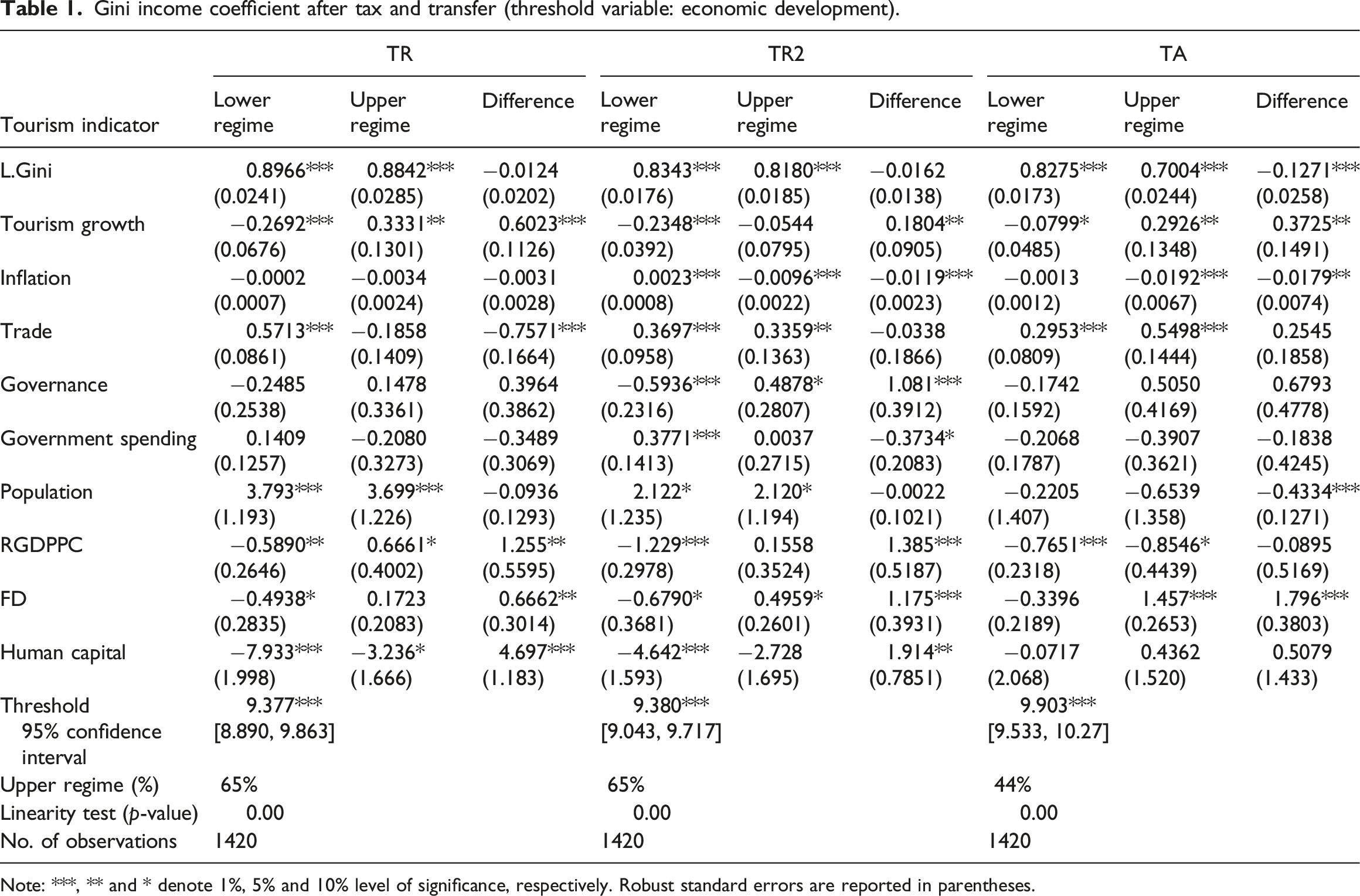
Gini income coefficient after tax and transfer (threshold variable: economic development).
Note: ***, ** and * denote 1%, 5% and 10% level of significance, respectively. Robust standard errors are reported in parentheses.
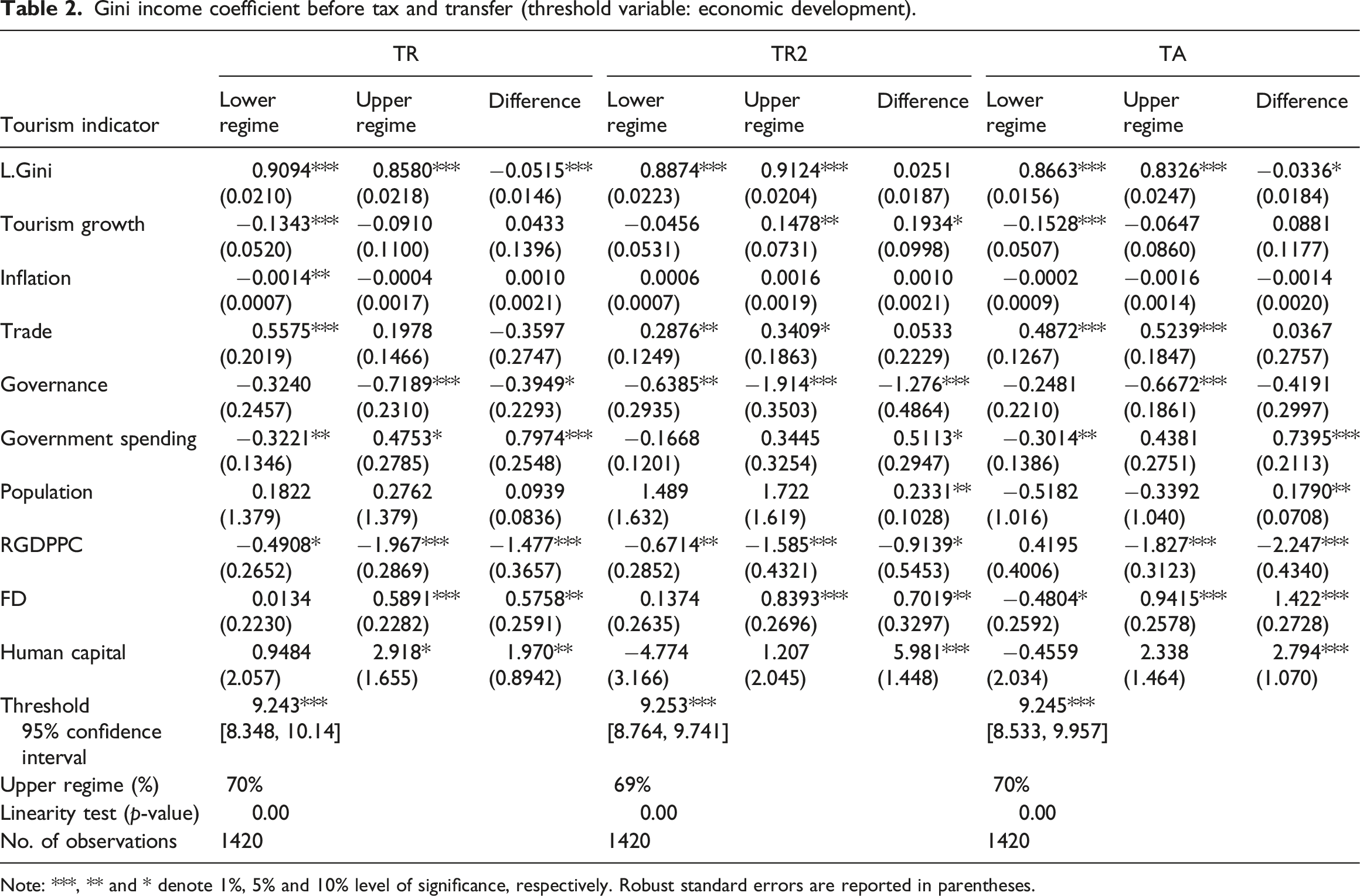
Gini income coefficient before tax and transfer (threshold variable: economic development).
Note: ***, ** and * denote 1%, 5% and 10% level of significance, respectively. Robust standard errors are reported in parentheses.
In general, we observe that income inequality is history-dependent in line with existing theories of inequality which state that established social norms and behaviours in society are hard to change quickly and substantially pre- and post-redistribution. The dynamic nature varies between the two regimes, which supports our suspicion of non-linear dynamics at play. We also observe a clear threshold effect of tourism expansion on income inequality, and the same also applies to other regressors. Pre-redistribution as indicated in Table 2, there exists a critical value for economic development. Tourism expansion is likely to alleviate income inequality or have a neutral effect below the critical value. In contrast, tourism expansion may drive up income inequality or have no impact above the critical value. Post-redistribution as shown in Table 1, we observe consistent results that tourism expansion is pro-poor in the lower regime using all three tourism indicators. However, tourism expansion worsens income inequality in the upper regime or has a neutral effect. It seems that post-redistribution, the pattern of tourism expansion on income inequality becomes clearer subject to the economic development threshold. Our findings suggest that tourism growth plays a helping hand on alleviating income inequality in poorer countries post-redistribution, whereas tourism growth may still harm income distribution in rich countries. Redistribution policy seems to work better in poorer countries than in their richer counterparts. Hence, an important finding of this study is that a minimum level of economic development may not be a necessary pre-condition for achieving a reduction in income inequality through international tourism if a fair and effective redistribution policy is put into practice at least in the short run.
The impact of economic development on income inequality is negative pre-redistribution in both lower and upper regimes, which suggests that increasing income always helps to alleviate income inequality, which does not support the Kuznets curve of income inequality. Post-redistribution, economic development tends to reduce income inequality in the lower regime but has an inconclusive impact in the higher regime. We still do not have evidence to support the Kuznets curve of income inequality. Financial development may reduce income inequality in the lower regime but tends to worsen income inequality in the upper regime pre-redistribution. The pattern persists post-redistribution.
Regarding other regressors, inflation tends to reduce income inequality in the lower regime pre-redistribution. However, post-redistribution, inflation tends to increase income inequality in the lower regime which is consistent with the findings of Alam and Paramati (2016). They find that inflation has a statistically significant positive effect on income inequality in 49 developing economies. It can be argued that countries clustered in the lower economic development regime in our analysis are low-income and some emerging economies. In contrast, our results indicate that inflation is linked with a reduction of income inequality in the upper economic development regime, arguably a group of more advanced economies. Conventional wisdom suggests that inflation in the tourism sector might be a driver of inequality, hurting workers who earn fixed salaries. 5 Tourism growth helps to alleviate income inequality, yet as the by-product, it can also increase domestic inflation which has a second-round effect on income inequality. In our case, the adverse effect of inflation partly offsets the beneficial effects of tourism on reducing income inequality. However, the impact of higher inflation on income inequality is not comparable to the one caused by tourism growth in the lower regime. This trade-off goes in the opposite direction in the upper regime: inflation contributes to income equality, but tourism growth drives up income inequality. This is a very interesting finding when considering the inequality-tourism-inflation nexus.
Market size, measured by the size of the population, is muted to income inequality in both regimes pre-redistribution. However, a large market size may induce an adverse impact on inequality post-redistribution. This is consistent with the fact that large countries or countries with high population densities are also likely to suffer from high inequality regardless of income level, for example, the United States and Brazil. Human capital endowment may worsen income inequality pre-redistribution in the upper regime but has no significant impact in the lower regime. Post-redistribution, human capital endowment can alleviate income inequality in both regimes, which seems to be a good instrument for reducing the income gap between the rich and the poor in both developed and developing countries. We also observe that trade openness seems to worsen income inequality both pre- and post-redistribution. One may argue that globalisation drives up income inequality, which does not surprise us much.
The quality of governance has a negative effect (statistically significant) on income inequality pre-redistribution regardless of economic development regimes. However, public expenditure is pro-poor in poorer countries but poor-rich in their counterparts. From a policy perspective, a country with a better quality of governance always reduces income inequality in society regardless of income level. In contrast, the impact of public expenditure is sensitive to income level. One may argue that public investment is not as productive as private investment in richer countries, whereas private investment is rather limited in less developed nations and hence public investment dominates. Post-redistribution, we find that government spending has an insignificant impact on income inequality. We also find some evidence that better quality of governance eases income inequality in the lower regime but worsens income inequality in the upper regime. However, we should be cautious before making any generalising claims as more research is needed in this area.
Given our results so far, we conduct a predictive margin analysis using the estimated marginal effects of international tourism post-redistribution for each regime reported in Table 1. Figure 1 plots the predictive margins of tourism growth on income inequality. In the horizontal axis, we use regime-specific values of tourism growth at different percentiles. For example, 0.1 indicates the value of tourism growth at the bottom 10% of the distribution in this regime and 0.5 indicates the median value of tourism growth in the distribution for the corresponding regime. Note that we do have negative tourism growth for some countries and/or in some years in our sample. The vertical axis is the predicted effect of tourism on income inequality post-redistribution. Predictive margin analysis: income inequality post-redistribution (threshold variable: economic development). Note: Each plot indicates the predictive margins for the impacts of tourism growth on income inequality in the alternative economic development regime reported in Table 1. Regimes for which tourism growth has an insignificant effect on income inequality are excluded from the predictive margin analysis.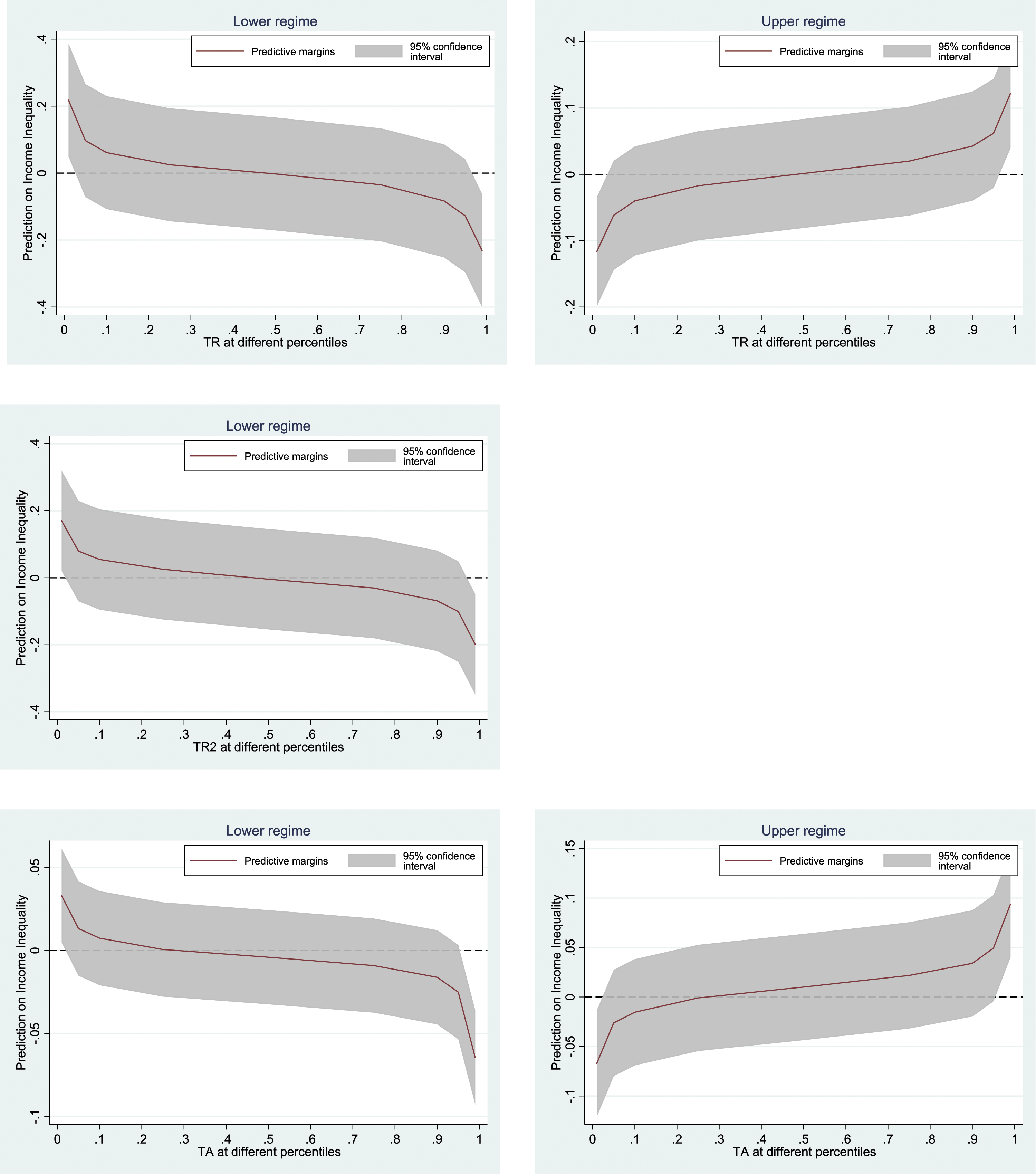
As we can see, tourism growth always reduces income inequality post-redistribution in the lower economic development regime regardless of which tourism indicator is used. In contrast, tourism growth tends to worsen income inequality post-redistribution in the upper economic development regime but has an insignificant effect when TR2 is used as the tourism indicator. Hence, we did not conduct the predictive margin analysis for TR2 in the upper regime as its effect is muted on income inequality post-redistribution.
Tourism expansion and income inequality under the alternative financial development regimes
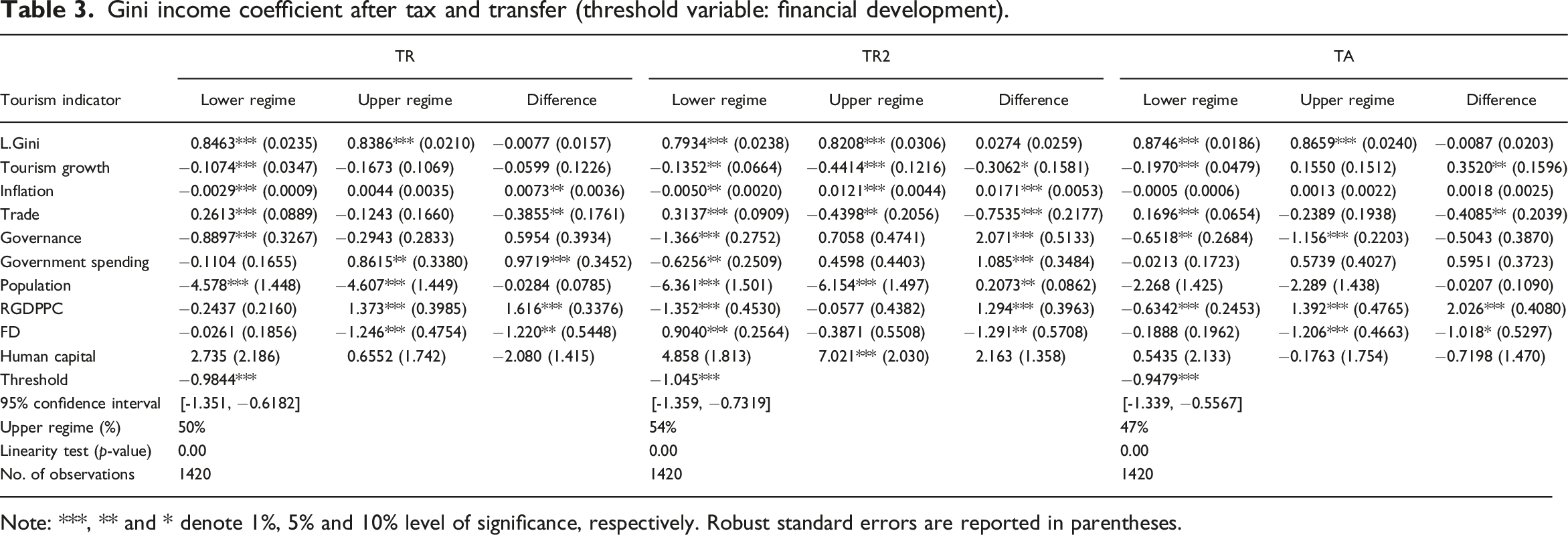
Gini income coefficient after tax and transfer (threshold variable: financial development).
Note: ***, ** and * denote 1%, 5% and 10% level of significance, respectively. Robust standard errors are reported in parentheses.
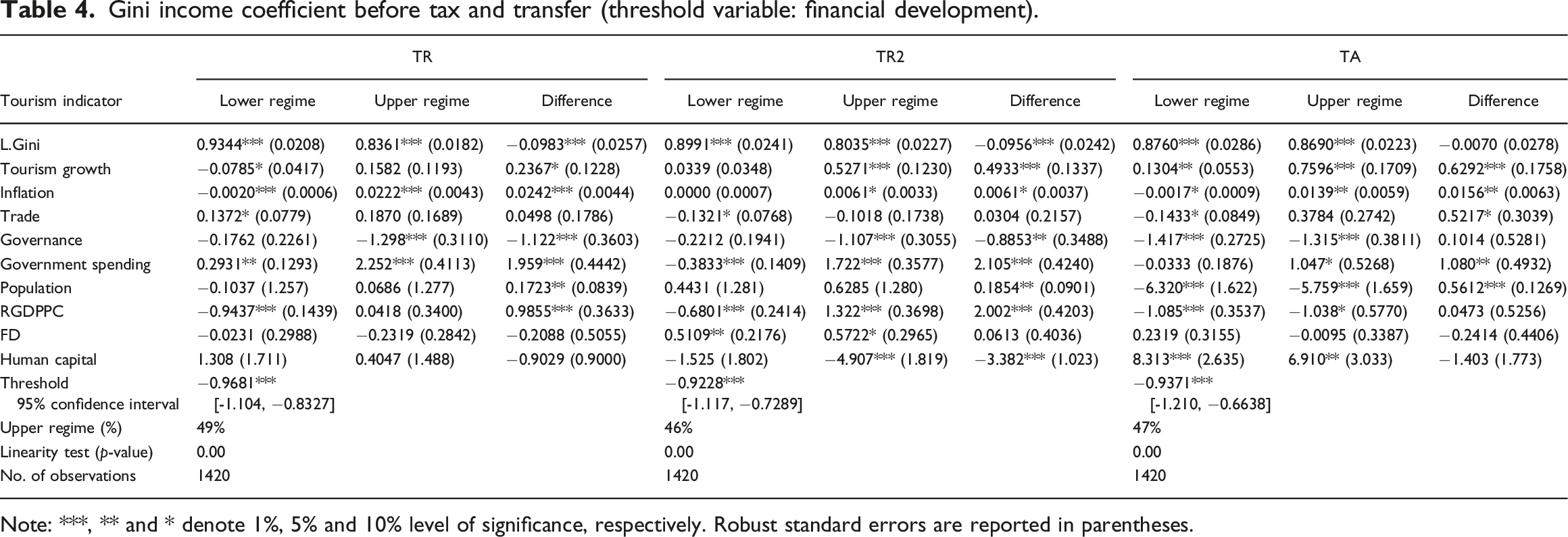
Gini income coefficient before tax and transfer (threshold variable: financial development).
Note: ***, ** and * denote 1%, 5% and 10% level of significance, respectively. Robust standard errors are reported in parentheses.
Results indicate clear threshold effects of tourism expansion as well as the lagged dependent variable and other control variables on income inequality pre- and post-redistribution. This general finding further supports the use of non-linear models when modelling the relationship between tourism growth and income inequality. The threshold effect is apparent across all three panels regardless of the tourism indicator in use. In more detail, tourism growth tends to drive up income inequality in the high financial development regime but has an inconclusive effect in the low financial development regime pre-redistribution. Post-redistribution, we observe that tourism growth exhibits significant negative effects on income inequality in the lower regime; it can also ease income inequality or have a neutral effect in the upper regime. So redistribution policies play a positive role in mitigating the adverse impact of tourism expansion on income inequality, particularly in the upper regime. We also find that the magnitude is bigger for the estimated effect in the upper regime. This suggests that tourism growth tends to do a better job of lessening income inequality when the degree of financial development is high. To some extent, this may suggest that countries with low financial market frictions provide better opportunities for poor people to participate in the tourism industry or engage in tourism-related entrepreneurial activities. The lagged dependent variable is positive and statistically significant which indicates that income inequality is history-dependent. The coefficient is also state-dependent showing non-linear dynamics.
Pre-redistribution, economic development can be pro-poor helping to alleviate income inequality in the lower financial development regime, whereas its impact is inconclusive in the higher financial development regime. In contrast, the pattern of financial development on income inequality is unclear. Post-redistribution, we observe that economic development is pro-poor below the threshold but pro-rich above the threshold. In contrast, financial development may drive up income inequality below the threshold but can ease income inequality above the threshold, which supports the existence of the financial Kuznets curve of income inequality.
This time, inflation tends to reduce income inequality below the threshold but worsens income inequality above the threshold regardless of redistribution policy. Table 3 presents inequality results post-redistribution. In the lower financial development regime, tourism growth alleviates income inequality, whereas inflation, partially driven by the tourism sector, also helps to reduce income inequality. The effects of tourism and inflation move in the same direction, which is probably the best scenario for policymakers. On the other hand, a trade-off between tourism growth and inflation does exist in the upper financial development regime where the adverse effect caused by inflation is much smaller compared to the beneficial effect of tourism on reducing income inequality. To some extent, we would not observe this interesting aspect if we always focus on countries’ level of income (i.e., economic development). However, we need to stress that our sample time period starts from 1996 and ends in 2016. During those years, most of our sample countries enjoyed a low inflation era due to many reasons such as cheap imports caused by globalisation, advances in IT and manufacturing and after the 2008/09 financial crisis, a subdued economic climate in a number of countries. In the post COVID-19 period which is characterised by relatively high inflation, we are keen to see more research exploring the relationship between inflation and tourism, as well as their effects on economic growth and income inequality in tourism destinations.
Regarding other regressors, the degree of trade openness is found to be pro-rich in the lower regime, whereas the impact is neutral or alleviating inequality in the higher regime post-redistribution. Government spending drives up income inequality in the upper regime, but the impact is inconclusive in the lower regime pre-distribution, whereas government spending can be pro-poor in the lower regime but have an adverse or neutral effect in the upper regime post-redistribution. Market size and the quality of governance lessen income inequality in both regimes pre- and post-redistribution. We cannot identify a clear pattern regarding the impact of human capital endowment on income inequality pre-redistribution, whereas the impact seems to be muted post-redistribution with one exception only.
Overall, it seems that the threshold plays a vital role in the analysis, which also supports our argument that a country’s economic development and financial development may not synchronise with the path of a country’s social progress. However, regardless of threshold variable selection, we find consistent results that tourism growth is pro-poor in less developed nations. Furthermore, there are some positive signs that tourism growth can be pro-poor in more developed countries, although this claim needs further investigation in future studies.
Same as before, we conducted a predictive margin analysis. Figure 2 plots the predictive margins for the impact of international tourism on income inequality post-redistribution in each regime reported in Table 3. Overall, we observe that tourism growth helps to alleviate tourism destinations’ income inequality post-redistribution in the lower financial development regime regardless of which tourism indicator is used. Some evidence also shows that tourism growth can reduce tourism destinations’ income inequality post-redistribution in the upper financial development regime when TR2 is used as the tourism indicator. For another two tourism indicators, tourism growth has an insignificant impact on income inequality, which is excluded in Figure 2. Predictive margin analysis: income inequality post-redistribution (threshold variable: financial development). Note: Each plot indicates the predictive margins for the impacts of tourism growth on income inequality in the alternative financial development regime reported in Table 3. Regimes for which tourism growth has an insignificant effect on income inequality are excluded from the predictive margin analysis.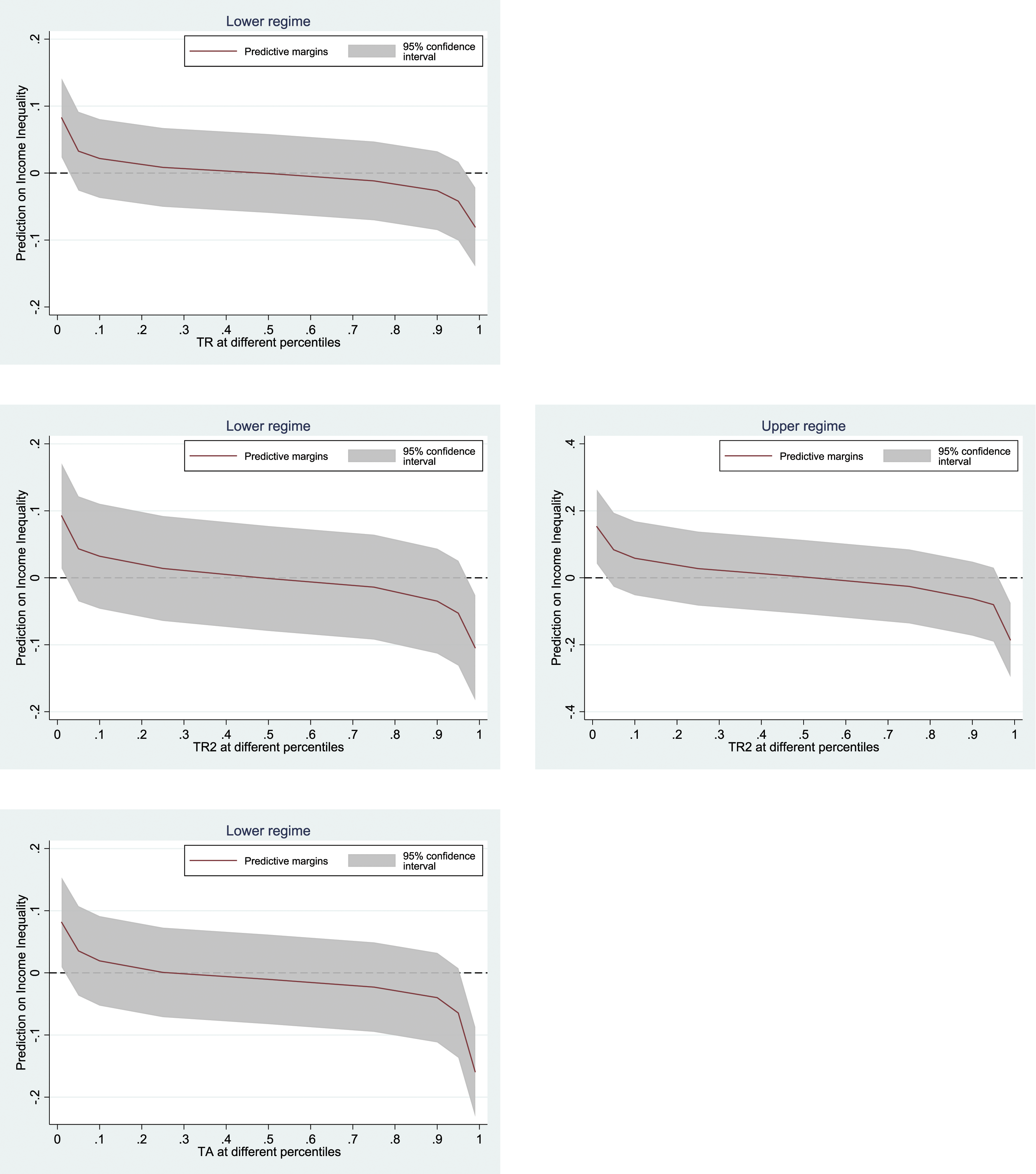
It is worth thinking about the measure of TR2 here since it behaves a little differently than TR and TA, which is also observed in Figure 1. TR2 is defined as the measure of international tourism receipts for travel items standardised using total exports. As discussed in the literature review, there may be a trade-off between international tourism and export. It seems to us that this may not be a big issue for countries with lower economic development and lower financial development regimes. However, this could be something interesting to explore more for those countries allocated in the upper economic development and upper financial development regimes. To some extent, we consider those to be the developed nations. Our conjecture here is that international tourism growth does affect exports in developed nations more significantly and hence further affects developed tourism destinations’ income inequality. Whereas the direction of the former conjecture is unclear which is beyond the scope of this paper.
Regime-dependent interactive effects
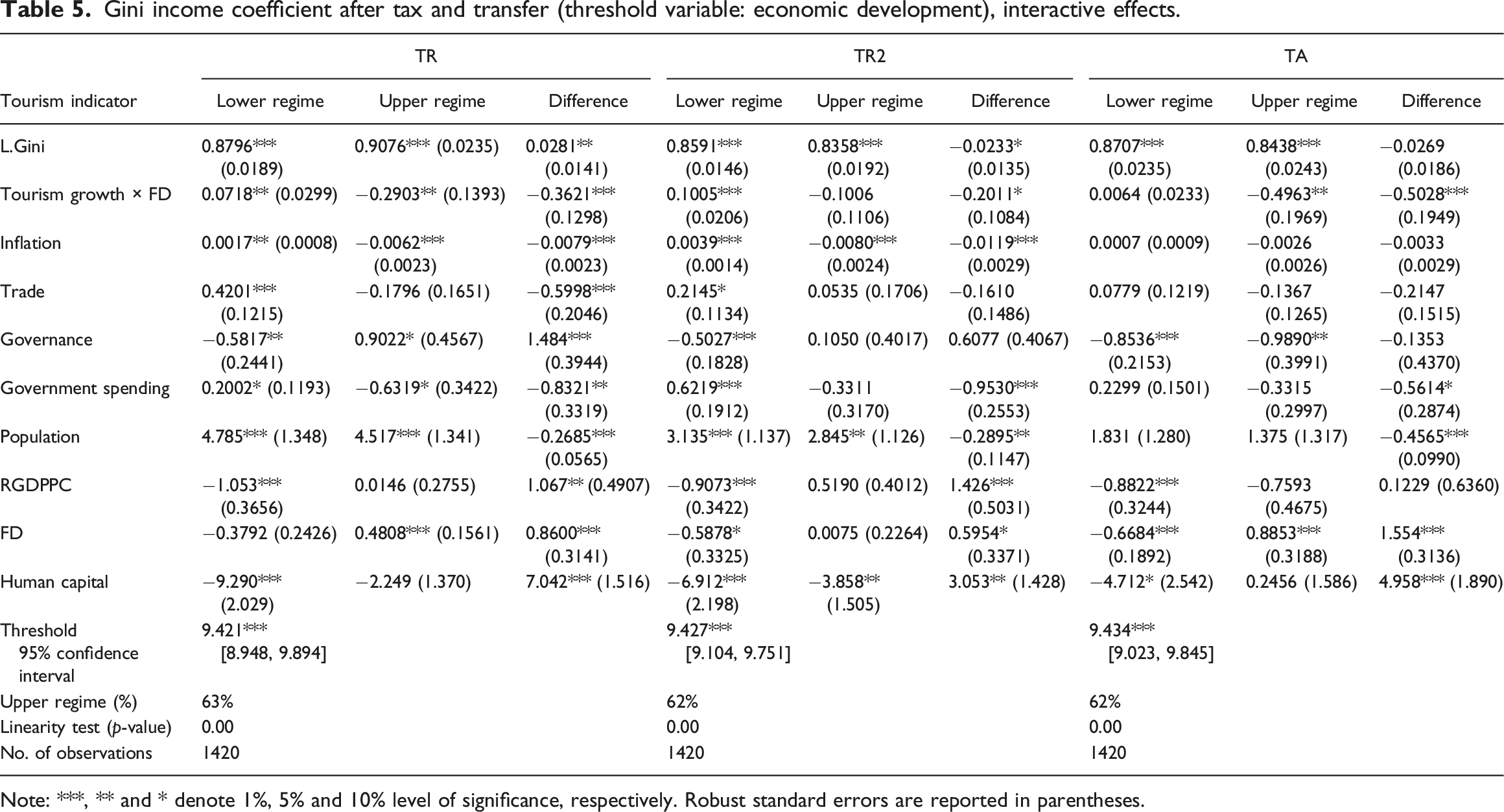
Gini income coefficient after tax and transfer (threshold variable: economic development), interactive effects.
Note: ***, ** and * denote 1%, 5% and 10% level of significance, respectively. Robust standard errors are reported in parentheses.
Apparently, the regime-dependent pattern still exists. Gini income inequality is history-dependent exhibiting non-linear dynamic features, a finding consistent throughout our analysis. The interaction effect tends to increase income inequality in the lower regime, whereas the effect eases income inequality in the higher regime. This suggests that if tourism expansion and financial development happen simultaneously in less developed countries, income inequality is worsening. In contrast, if tourism expansion and financial development happen simultaneously in more developed countries, income inequality is improving. This also supports our discussion previously that low financial market friction provides great opportunities for tourism-related entrepreneurial activities in developed nations. However, low financial market friction does not help to utilise the benefits generated from tourism expansion in less developed nations. One possible explanation is that tourism-related activities could be driven by the public sector. Less financial market friction creates competition between the public sector and newly emerged private enterprises. This type of private enterprise in developing countries is profit-driven and largely family and ethnical-oriented. Hence, they have less potential to benefit the poor more widely.
Economic development helps to narrow the gap between the rich and the poor in the lower regime, whereas it has a neutral impact in the upper regime. Financial development may reduce income inequality in the lower regime but tends to worsen income inequality in the upper regime after taking into account the interactive effect. These findings are consistent with those in Table 1. Inflation may increase income inequality in the lower regime and ease income inequality in the upper regime, which is also consistent with our findings in Table 1. Regarding other regressors, market size drives up income inequality while human capital endowment tends to reduce income inequality in both regimes. The degree of trade openness may still worsen income inequality. These findings are fairly consistent with those in Table 1. The quality of governance is pro-poor in the lower regime but unclear in the upper regime. Government spending may drive up income inequality or have a neutral effect in the lower regime, whereas its impact is neutral or pro-poor.
Robustness checks
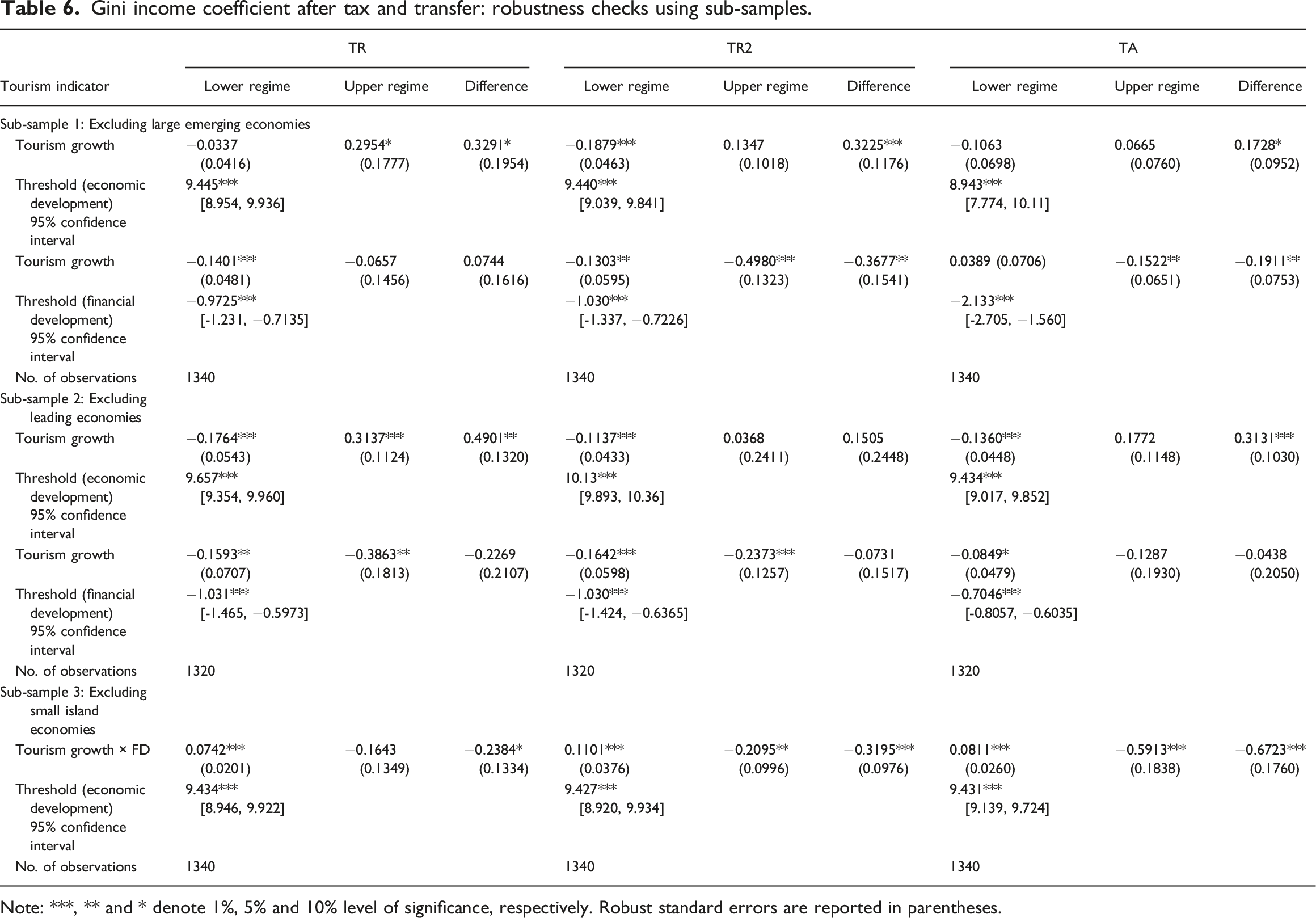
Gini income coefficient after tax and transfer: robustness checks using sub-samples.
Note: ***, ** and * denote 1%, 5% and 10% level of significance, respectively. Robust standard errors are reported in parentheses.
Lastly, we excluded four small island economies (Barbados, Dominican Republic, Mauritius and Singapore) from the full sample, striving to assess if tourism dependency affects our findings. We repeat the estimation of Table 5 considering the interactive effects between tourism growth and financial development. The estimated regime-dependent estimates of the interaction term and estimated thresholds are also included in Table 6 at the end. 8 Overall, our main results regarding the impact of tourism expansion on income inequality do not change much. When the economic development threshold is used, tourism expansion is pro-poor in the lower regime and is neutral or pro-rich in the higher regime. When the financial development threshold is used, tourism expansion is pro-poor in the lower regime. Results also show more evidence to support that tourism expansion can ease income inequality in the upper regime and the magnitude is bigger. Regarding the interactive effects, we still find a positive effect in the upper regime and a negative effect in the lower regime. Both are statistically significant.
Discussion
In this paper, we explore whether the extent of a country’s economic development (or income level) and financial development induce a non-linear relationship between international tourism and income inequality. Overall, it seems that whether tourism growth contributes to the reduction of income inequality is subject to the selection of a threshold. We also find that redistribution policies do a good job of utilising the benefits of international tourism regardless of the threshold selection. Post-redistribution, when the economic development threshold is used, tourism growth eases income inequality in the lower regime but may worsen income inequality in the upper regime. This finding is consistent with some existing empirical studies which indicate that tourism plays a good role in lessening income inequality in developing countries (e.g., Croes and Rivera, 2017; Fang et al., 2021; Nguyen et al., 2021). When the financial development threshold is used, tourism growth helps to alleviate income inequality in the lower regime. Tourism growth may also lessen income inequality in the upper regime. These are some interesting findings. The possible explanation is that increasing incomes through economic development is less effective towards reducing inequality than improving opportunities to access finance, a finding particularly important for rich countries according to our research. The mechanism behind this finding could be similar to providing aid, which may not always be a good idea.
From a policy perspective, international tourism is considered a vehicle for economic and social development, while the redistribution of income and wealth is also seen as crucial to achieving such development goals. It is undoubtedly true that government policies have a crucial effect on tourism-inequality issues. However, different focal points should be applied in policy design considering the viability and appropriateness of local socio-economic, geographic and political conditions. In developing countries, tourism development is closely related to government intervention, whereas in developed countries, tourism development is largely driven by the private sector due to the different tourism development stages of the industry. In developing tourism destinations, tourism growth is promoted and supported by investment in the tourism industry, where a significant amount of capital investment is usually required as the capital-labour ratio is low in the industry. To generate more output in the sector, increasing the capital-labour ratio is the key, as it helps to serve more tourists. In contrast, the capital-labour ratio is already high in well-established tourism destinations. Further increasing the output of the tourism industry relies on innovations and improvements in the quality and variety of tourism products, aiming to encourage higher levels of consumption per tourist.
In line with the above, governments in developing countries may have to create a convenient business environment to attract foreign direct investment for tourism development. From a policy perspective, specific national tourism policy still plays a vital role in developing countries to alleviate income inequality, whereas domestic industrial policies could be more promising in terms of reducing income inequality in both developed and developing countries. We propose that different tourism destinations should create tailored industrial policies according to the pre-existing conditions and the stage (or development) of their tourist markets. For example, ecotourism is commonly observed in developed tourism destinations, whereas cheaper tourism products are usually consumed in developing tourism destinations. Hence, industrial policies should be specially designed to factor in international tourism. In addition, specific regions in some countries are more integrated with the world economy than with other regions of the same country, for example, Shanghai in China and Ho Chi Minh City in Vietnam. Hence, a developed tourism region may exist in a developing country. Regional differences need to be taken into account when implementing national tourism policy.
Furthermore, tourism demand is unstable and changes allegiance frequently due to several reasons, such as exchange rates, inflation, changes in lifestyle, environmental issues and many others. To improve market share and build customer loyalty, tourism destinations need to work on product differentiation by introducing different forms of tourism, such as heritage tourism, cultural tourism, theme parks, urban tourism and more. In order to reduce income inequality, policymakers should work on shifting tourism demand towards less wealthy regions and areas. On the other hand, the supply side of tourism policy could also serve the purpose of alleviating income inequality. For example, many industrial cities in developed countries have been suffering economic decline and facing severe income inequality as a result of losing major traditional industries due to the COVID-19 pandemic. One possible solution could be to actively help the tourism industry recover in the post COVID-19 era. International tourism likely becomes one of the most important or valuable forms of international business in many countries given the fact that the COVID-19 pandemic has altered existing international investment strategies (UNCTAD, 2020; 2021). For developing countries, in addition to the traditional channels through which tourism generates foreign exchange and provides job opportunities, tourism expansion could also help to secure FDI and promote environmental protection, which further stimulates the development of other industries through positive spillover effects. This could be considered an indirect means to reduce income inequality but could possibly prove particularly effective.
Conclusions
In this study, we aim to investigate if the impact of tourism growth on income inequality is affected by economic and financial development and their interactions. Our analysis is based on a dynamic panel threshold method covering 71 developing and developed countries over the period 1996–2016. We find that there exists a non-linear threshold effect of tourism expansion on income inequality. More specifically, our results show that tourism growth affects a country’s income inequality differently. Post-redistribution, tourism growth eases income inequality in the lower economic development regime but may worsen income inequality in the upper economic development regime. In contrast, tourism growth helps to alleviate income inequality in the lower financial development regime but may also lessen income inequality in the upper financial development regime. We also find that inflation (partially triggered by inbound tourism demand) can have different effects on income inequality, subject to the selection of threshold variables. Our findings highlight that increasing incomes through economic development is less effective towards reducing inequality than improving opportunities to access finance in more developed nations than their counterparts. This can help to clarify some mixed findings in the existing literature. To some extent, economic development may not always guarantee an equally advanced financial market. We also find that improving opportunities to access finance is particularly useful in developed nations as an enabling factor through which tourism can help to alleviate income inequality. However, this mechanism does not seem to work in the same direction in developing countries. These findings are robust to different measures of international tourism and various sub-samples.
Our study faces some limitations. Firstly, our full sample contains only seven low-income countries given the availability of data. This implies that the conclusions for this type of country should be verified by further applications that include a greater number of countries. Due to our current data constraints, we included only a few control variables in the analysis to ensure a sufficient number of developing countries in our study, so that results could be comparable between regimes. Secondly, provided that a broader country coverage becomes available in future, it would be possible to introduce more than two regimes when applying the dynamic panel threshold method. We could then be able to produce a clearer picture of the tourism-inequality nexus that would take into account a mixture of economic development and financial development stages, for example, a 3 × 3 matrix. However, the sample size stopped us from investigating this interesting aspect and consequently, this acts as a limitation of our study.
For future research, two rewarding areas are worth exploring further. Firstly, tourism to some degree can be considered as a component of the informal sector, particularly in developing countries, as employees may not be officially registered under some circumstances. Therefore, tourism development may affect both the formal and informal economic sectors (e.g., Lv, 2020). However, our study has not been able to take into account the effects of tourism on informal economic sectors. The size of the informal sector in a particular economy may worsen or improve our findings regarding the tourism-inequality nexus discussed in this paper. To some extent, labour hired in informal sectors may play a vital training opportunity that enhances personal development through increased skills and experiences. Hence, it is likely to provide a better opportunity for getting a better-paid job in formal sectors later, which may improve income inequality. On the other hand, informal sector employment may crowd out the merit generated by tourism in the formal sector, particularly for low-paid employment in the formal sector. Therefore, income inequality is likely to worsen. It would be interesting to properly evaluate the former hypothesis given the availability of data. Secondly, tourism is generally considered as an effective means of promoting women’s participation in the labour force due to the flexible and seasonal nature of the tourism industry. More importantly, tourism expansion encourages women’s engagement in entrepreneurial activities (e.g., UNWTO and Women, 2011). Overall, it is likely that tourism development tempers gender income inequality. However, an important finding in tourism literature is that women’s working conditions in the tourism industry are much worse than those for men, and it may also be the case that women are more likely to work in the informal sector (Hall, 1994). It could be beneficial for policymakers if there would be an evaluation of the relative impact of tourism on women working in the tourism industry in future research.
Supplemental Material
Supplemental Material - International tourism and income inequality: The role of economic and financial development
International tourism and income inequality: The role of economic and financial development by Yuan Wang and Alexander Tziamalis in Tourism Economics
Footnotes
Acknowledgement
We are grateful to the editor (Professor Albert Assaf) and two anonymous referees for numerous valuable suggestions and constructive comments that helped improve this paper. Yuan Wang would also like to thank Professor Myung Hwan Seo for his help with the dynamic panel threshold method. All remaining errors are ours.
Declaration of conflicting interests
The author(s) declared no potential conflicts of interest with respect to the research, authorship, and/or publication of this article.
Funding
The author(s) received no financial support for the research, authorship, and/or publication of this article.

Supplemental Material
Supplemental material for this article is available online.
Notes
Author biographies
References
Supplementary Material
Please find the following supplemental material available below.
For Open Access articles published under a Creative Commons License, all supplemental material carries the same license as the article it is associated with.
For non-Open Access articles published, all supplemental material carries a non-exclusive license, and permission requests for re-use of supplemental material or any part of supplemental material shall be sent directly to the copyright owner as specified in the copyright notice associated with the article.
