




Abstract
The CSR literature has paid close attention to the effect of CSR on corporate financial performance (CFP), well-known as the CSR–CFP link. Based on the instrumental perspective perceiving CSR as an instrument for enhancing a firm’s performance, people began to see CSR as not only a good deed that benefits society but also a strategy that can benefit the corporation. To empirically test this instrumental perspective, many researchers have investigated whether a firm’s engagement in CSR activities indeed leads to improving the firm’s performance. Through such investigations, the CSR literature has acknowledged that there are still many issues to explore in the CSR–CFP link. The current study, therefore, is to investigate what has been done in the TH literature regarding the CSR–CFP link in the 2000s and further to provide future directions for the CSR–CFP link.
Introduction
Business’s philanthropic contributions are not a new concept but have a long history in the business world, dating back to as far as the beginning of business (Marinetto, 1999). However, the modern corporate world has taken the issue and raised it to another level by making it a fundamental responsibility of contemporary corporations to society. In fact, it was not the corporate world alone but society that initiated this movement and started to demand corporations comply with such social obligations (Garriga and Melé, 2004). As such demand from society has dramatically increased over the past several decades, the view of corporations on corporate social responsibility (CSR) has also changed from being more passive and responsive to being more proactive and preventive (Foote et al., 2010).
One particular CSR topic has generated a great interest among scholars, that is, how CSR influences corporate financial performance (CFP), well-known as the CSR–CFP link. Based on the instrumental perspective (Jensen, 2002), people began to see CSR as not only a good deed that benefits society but also a strategy that can benefit the corporation. Such a concept may be called strategic CSR (e.g., Chandler, 2019; McElhaney, 2009), integrated CSR (Freeman et al., 2010), enlightened stakeholder theory (Jensen, 2002), or creating shared value (CSV) (Porter and Kramer, 2019). All these arguments present a common base that CSR is viewed as an instrument for enhancing a firm’s performance (mostly in the long term), and the contemporary CSR literature seems to strongly embrace this instrumental perspective (Jensen, 2002).
To empirically test the instrumental perspective in the CSR context, many researchers have investigated whether CSR engagement by a firm indeed leads to positively influencing the firm performance. According to some meta-analytic studies on this CSR–CFP link (e.g., Orlitzky et al., 2003; Wang et al., 2016), there is a rough consensus that a firm’s CSR investment seems to pay off in terms of the firms’ financial benefits. However, the CSR literature has also clearly acknowledged that there are more issues to explore in the CSR–CFP link, such as many essential moderators to provide a better explanation for the link and the need for industry- or sector-specific investigations for the link due to heterogeneity across different industries or sectors (Wang et al., 2008). Moreover, there is also a measurement issue for both CSR and CFP (Galant and Cadez, 2017). Therefore, we are still far from concluding this issue.
Consistent with the general CSR literature, the tourism and hospitality (TH) literature has also paid close attention to this issue of the CSR–CFP link, especially in the past two decades, based on the data presented in the current study. Considering the particular importance of branding in the TH industry due to their intangible and experiential products which often directly relate to TH firms’ CSR engagement, CSR and its financial implications can play a critical role in the industry, thus requiring close attention from researchers. The current study, therefore, is to investigate what has been done in the TH literature regarding the CSR–CFP link in the 2000s and further to provide future directions for the CSR–CFP link.
The current study selected eight leading and relevant TH scholarly journals for the proposed investigation (in alphabetical order): Annals of Tourism Research (ATR), Cornell Hospitality Quarterly (CQ), International Journal of Contemporary Hospitality Management (IJCHM), International Journal of Hospitality Management (IJHM), Journal of Hospitality and Tourism Research (JHTR), Journal of Hospitality Financial Management (JHFM), Tourism Economics (TE), and Tourism Management (TM). The study initially reviewed the journals over the period of 2000 to 2021. However, since the first CSR–CFP study was published in 2007 in the selected journals, the articles reviewed and discussed in the current study span from 2007 to 2021. In the next section, this study presents results from this review.
Review of the T&H CSR literature
Descriptive summary of selected studies
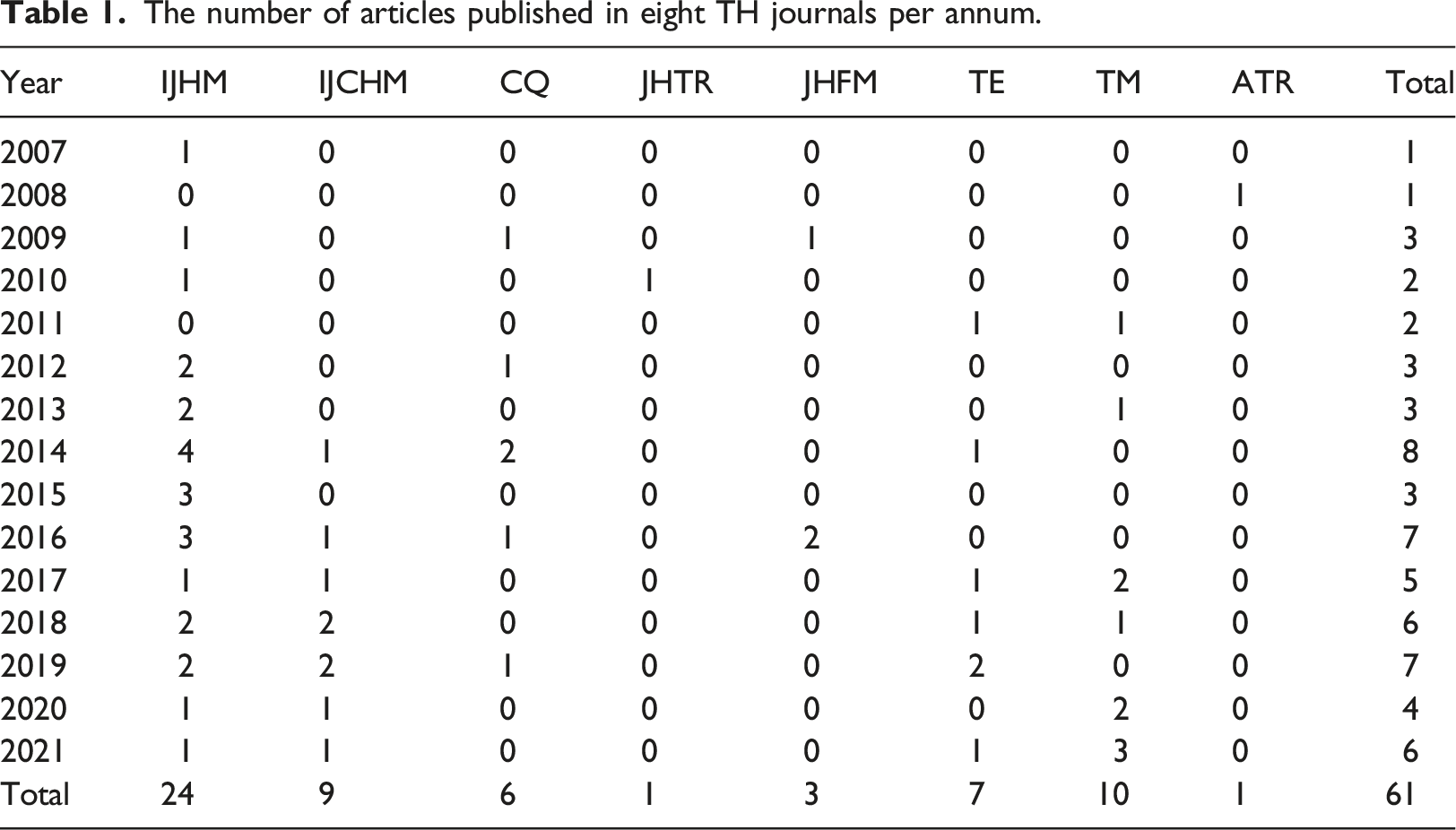
The number of articles published in eight TH journals per annum.
Repeat contributions by authors in eight TH journals.
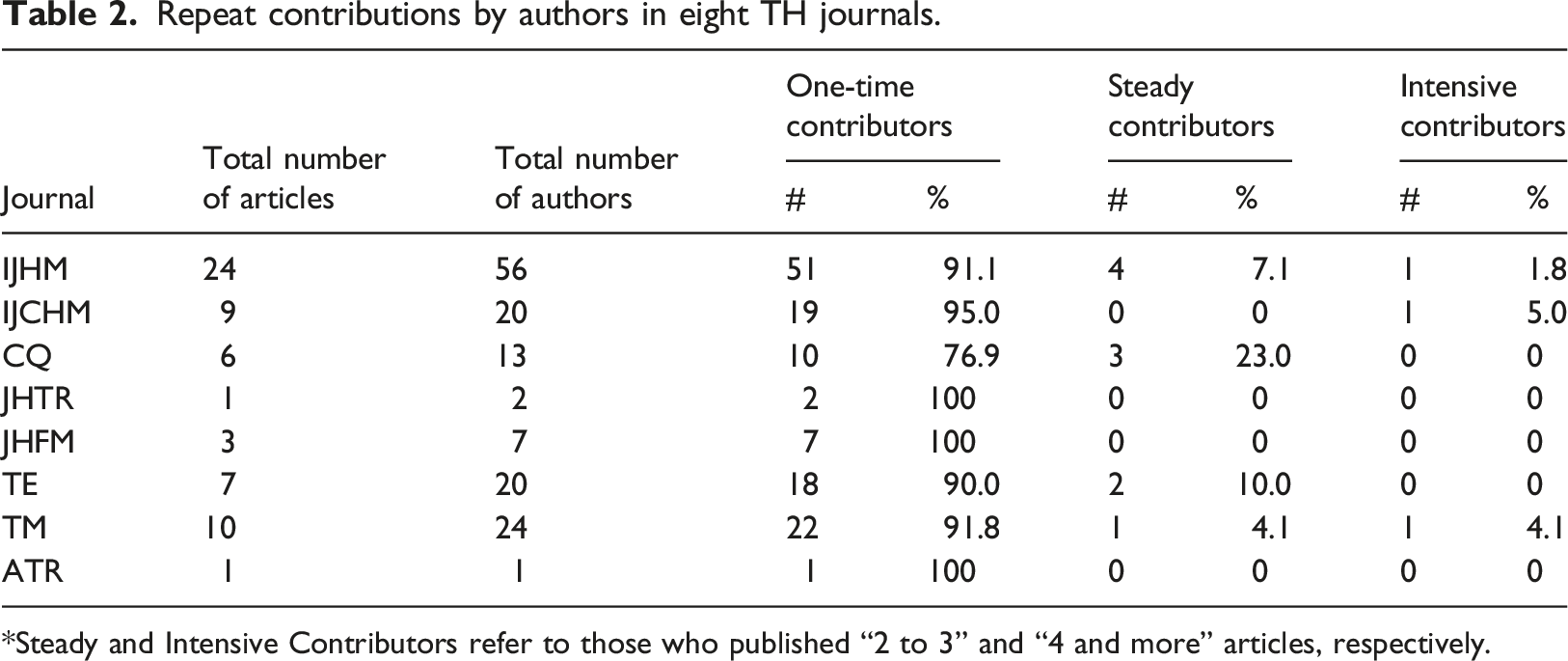
Steady and Intensive Contributors refer to those who published “2 to 3” and “4 and more” articles, respectively.
Main findings
Summary of the studies corporate social responsibility (CSR) and corporate firm performance (CFP).

By sample industry
Given the empirical research on the CSR–CFP link, Wang et al. (2008) suggested that industrial characteristics may be a vital contingency factor in understanding the mixed results. Chand and Fraser (2006) also argued that a specific industry context should be considered in investigating the CSR–CFP link. To a better understanding of the relationship, therefore, the current study provides information on the accumulated research categorized by the sample industry within the TH context.
By and large, hotel studies investigating the relationship between CSR and CFP have found a positive effect (Assaf et al., 2012, 2017; Benavides-Velasco et al., 2014; Inoue and Lee, 2011; Hussain et al., 2019; Jackson and Hua, 2009; Kang et al., 2010; Lee and Park, 2009; Nicolau, 2008; Singjai et al., 2018; Theodoulidis et al., 2017; Rodríguez and Cruz, 2007; Wang, 2014; Yeon et al., 2021a), while some researchers found the CSR–CFP link nonsignificant (Abdel-Maksoud et al., 2016; Kim et al., 2017; Robinson et al., 2016; Shin et al., 2021; Yeon et al., 2021b).
Studies focusing on the restaurant industry have yielded mixed results with respect to the CSR–CFP link. Some authors found a positive link (Assaf et al., 2017; Chou et al., 2018; Inoue and Lee, 2011; Jang et al., 2017; Kim and Pennington-Gray, 2017; Kim et al., 2017; Kang et al., 2010; Kim & Kim, 2014, 2019; Ozdemir et al., 2020; Rhou et al., 2016; Theodoulidis et al., 2017; Youn et al., 2016) while others failed to find a significant CSR–CFP link (Ham and Lee, 2011; Kim and Kim, 2014; Kim and Lee, 2020; Lee et al., 2013a; Park et al., 2017). In addition, given that less attention has been paid to an examination of an inverse or a simultaneous relationship between CSR and CFP, Choi and Lee (2018) investigated the relationship between CSR and CFP and found a positive impact of CFP on CSR, supporting the slack resource theory that posits a firm’s voluntary initiatives, such as CSR activities, could be sensitive to discretionary financial resources (Shahzad et al., 2016). There was also a study that suggested an inverted U-shaped relationship between CSR and CFP (Park and Lee, 2009).
Studies in the context of the casino industry have reported mixed results as well (Kim et al., 2017; Jackson and Hua, 2009). Kim et al. (2017) found that CSR significantly reduces casino firms’ systematic risk, supporting the positive implication of the CSR–CFP link. In a similar vein, based on Jackson and Hua (2009), CSR-oriented firms are more profitable and experience better stock returns than their counterparts without well-executed CSR initiatives. However, other studies could not find a significant effect of CSR on CFP in the casino industry (Inoue and Lee, 2011; Lee and Park, 2009).
The airline literature has also yielded mixed results regarding the CSR–CFP link. Lee and Park (2010) found that CSR positively impacts market-based performance of airline firms, and Lee et al. (2013a) found a positive main effect of operational-related CSR on CFP for airlines. However, examining the individual effects of positive and negative CSR initiatives, Kang et al. (2010) showed that positive CSR activities have a negative impact on airlines’ profitability. In addition, Lee et al. (2018) found no direct effect of CSR initiatives on CFP but suggested that airline type (i.e., low-cost vs. full-service) and economic conditions provide boundary conditions for the CSR–CFP link.
Some studies have examined the CSR–CFP link within the context of collective TH firms across multiple industry sectors (e.g., hotels, restaurants, casinos, OTAs, car-rental agencies, resorts, and cruises) (Chen and Lin, 2015; Chen, 2019b; Feng et al., 2014; Nguyen et al., 2019; Singal, 2014a, 2014b; Theodoulidis et al., 2017; Franco et al., 2020; Torres and Augusto, 2021; Wang et al., 2019; Yeon et al., 2021c). They identified TH firms with industry specification codes such as the North American Industry Classification System (NAICS) and Standard Industrial Classification (SIC) in the U.S. and China Securities Regulatory Commission (CSRC) in China. While a majority of the aforementioned studies found a positive association between CSR and CFP (Chen, 2019b; Feng et al., 2014; Kim et al., 2017; Nguyen et al., 2019; Singal, 2014a; Theodoulidis et al., 2017; Torres and Augusto, 2021; Wang et al., 2019), some studies also found no direct effect (Wang et al., 2019) and even suggested a curvilinearity of the CSR–CFP link (Chen and Lin, 2015; Franco et al., 2020), suggesting that CSR enhances CFP only up to its optimal point, and CFP decreases as CSR increases further beyond the optimal point. In addition, Singal (2014b), whose primary purpose was to examine the role of family ownership (family vs. nonfamily firms) in relation to CSR and financial conditions (measured by crediting rating), found that lagged CSR positively influenced a firm’s financial conditions measured by credit rating.
By the data used for CSR
CSR has been widely measured by reputational indices such as Fortune magazine’s ratings of a corporation’s responsibility to the community and environment, or self-developed reputational measures by surveying business professionals (Alexander and Buchholz, 1978). Data on the extent of environmental and social reporting is mostly collected through surveys in the form of either an online or mail questionnaire (Assaf et al., 2012; Benavides-Velasco et al., 2014; Chou et al., 2018; Jang et al., 2017; Rodriguez and Cruz, 2007; Singjai et al., 2018; Hussain et al., 2019; Kim and Pennington-Gray, 2017; Wang, 2014; Nguyen et al., 2019; González-Rodríguez et al., 2021), or from an in-depth interview (Garay and Font, 2012; Kang et al., 2015). The surveys are usually conducted with managers in sample industries to assess their firms’ social responsibility orientation. For example, Benavides-Velasco et al. (2014) developed the measurement items for the level of a firm’s commitment to each CSR dimension. Assaf et al. (2012), based on the extant literature (Vanclay, 2004; Lamberton, 2005), conducted a survey that asked respondents to rank from 1 (very limited reporting) to 7 (very extensive reporting) the extent of a firm’s environmental and social reporting. In addition, Singjai et al. (2018) used a mixed-model collection approach, using paper and online survey instruments, to ensure that everyone in the target population could participate. Although the survey is an important and widely adopted data collection method in the field of social science, the validity of this approach (i.e., the use of expert evaluations of corporate policies) heavily depends on the selected experts’ knowledge and experience on the subject matter (Abbott and Monsen, 1979). Besides, some scholars have employed a rating system proposed by Fortune, which has conducted a survey that covers many significant panel members including analysts, top management team, and outside directors to evaluate selected firms since 1982. However, according to McGuire et al. (1988), the Fortune ratings may not reflect the same or a similar aspect CSR because those evaluators are chosen for their expertise in a specific industry, not in CSR. Fortune’s reputation rating has been widely used for CSR studies, but its methodology fails to measure specific CSR dimensions (Waddock and Graves, 1997). Therefore, the interpretation and evaluation of CSR from Fortune may be subjective and differ from those of others who are especially interested in the CSR issue.
Social audits are another major source of collecting data regarding CSR. Social audits include a systematic evaluation of a firm’s CSR initiatives by a third-party, such as philanthropic engagement, community relations, and sustainability practices (Orlitzky et al., 2003). KLD is a representative example of social audits that focuses exclusively on assessing CSR across a range of dimensions. This index was initially constructed by employing eight CSR dimensions for S&P 500 firms in 1991. The CSR literature has recognized the KLD database as a representative measure that covers various stakeholder concerns (Waddock and Graves, 1997) with sound construct validity (Hart and Sharfman, 2015) and is relatively less subjective than other CSR measures such as Fortune reputation ratings (Chin et al., 2013). In addition, according to Waddock and Graves (1997), KLD’s rating system provides several improvements compared to the previous measurement used in earlier research. For example, KLD’s dataset includes all S&P 500 firms and more, and all companies in the dataset are rated on various factors in terms of CSP, providing a multi-dimensional assessment. Because of these reasons, KLD (which has been renamed as MSCI ESG (Environmental, Social, and Governance)) has been used by many CSR researchers in recent years in the general management literature and specifically in the TH literature (Choi and Lee, 2018; Jung et al., 2016; Kang et al., 2010; Kim & Kim, 2014, 2019; Kim and Lee, 2020; Lee and Park, 2009; Lee et al., 2013b; Paek et al., 2013; Rhou et al., 2016; Singal, 2014a & 2014b; Youn et al., 2015, 2016; Yeon et al., 2021a).
Meanwhile, researchers who employed variables regarding CSR in different ways, such as the level of corporate charity giving (CCG), pollution control investment, or green practices, have performed content analysis of firms’ CSR related information by utilizing various sources (e.g., online websites or annual financial reports) (Chen and Lin, 2015; Chen, 2019a; Wang et al., 2019; Ham and Lee, 2011; Robinson et al., 2016; Singjai et al., 2018; Yeon et al., 2021b). Since the related costs are relatively lower than other data collection methods, it has also been extensively adopted in the past CSR literature (Wang et al., 2016). However, there may be a reliability issue when firms’ own publications are the main source of information. In this case, variations in social and environmental activities may exist among firms, and their own publications may only act as an indication of corporate communication policies for their stakeholders including shareholders (Abbott and Monsen, 1979). In addition, such documents often have more public relations value than informational value and have an uncertain association with actual corporate actions (McGuire et al., 1988).
By the CSR measurement
The concept of CSR is related to various aspects of social and environmental issues (Wartick and Cochran, 1985), making it challenging to accurately measure the concept. Accordingly, the operationalization of CSR construct should be considered an essential factor and might have influenced inconsistent findings on the CSR–CFP link due to heterogeneity between studies.
Among different types of CSR measures, researchers who used the KLD database offered by MSCI ESG STATS employed positive and negative annual KLD ratings applied to publicly traded firms as their CSR measurement. For each company, the annual KLD ratings are provided as a binary (0, 1) indicator for each item with a value of “1” if the strength (e.g., retirement benefits, employee involvement, product quality, R&D and innovation, charitable giving, use of clean energy, pollution prevention, recycling, employment of the disabled, promotion of women or minority employees, etc.) or concern (e.g., health and safety issues, product safety issues, tax disputes, use of hazardous waste, regulatory problems, discrimination issues, non-representation of women or minorities, etc.) exists, and a “0” otherwise, in 13 dimensions of CSR (e.g., Community, Corporate governance, Employee relations, Diversity, Environment, Product and Human rights, etc.). Specifically, numerous studies used an aggregated measure of KLD rating scores (i.e., CSR score) by netting the sum of strength and concern ratings for each dimension (Assaf et al., 2017; Choi and Lee, 2018; Inoue and Lee, 2011; Jung et al., 2016; Kim et al., 2017, 2018; Kim and Lee, 2020; Lee et al., 2018; Lee & Park, 2009, 2010; Park and Lee, 2009; Paek et al., 2013; Singal, 2014a; Youn et al., 2015; Yeon et al., 2021a), while some researchers used positive rating scores (a summed score of CSR strengths) and negative rating scores (a summed score of CSR concerns), separately (Kang et al., 2010; Rhou et al., 2016; Youn et al., 2015). In addition, Lee et al. (2013a & 2013b) proposed CSR dimensions associated with operation-relatedness (i.e., operation-related and non-operation-related CSR activities) based on the Carroll CSR framework. Specifically, operation-related CSR consists of three factors (i.e., product quality, employee relations, and corporate governance), whereas non-operation-related CSR is consist of four factors (i.e., diversity, natural environment, community relations, and human rights).
Other researchers who conducted in-depth interviews or distributed a survey to measure CSR (e.g., Chou et al., 2018; Singjai et al., 2018; Hussain et al., 2019; Lin & Chung, 2019) apparently used a different CSR measure. For example, Rodríguez and Cruz (2007) measured the social-environmental responsibility (SER) of competing firms on a Likert scale of 0–10 through in-depth interviews with industry practitioners, while Assaf et al. (2012) measured CSR as the degree of financial, environmental, and social reporting by utilizing an online questionnaire, ranking from 1 (very limited reporting) to 7 (very extensive reporting). They selected CSR indicators based on the triple bottom line dimensions Elkington, 1994 from many different studies and documents in the extant CSR literature, including both scholarly articles and international organizations’ reports (e.g., the United Nations World Tourism Organization and the European Commission). Abdel-Maksoud et al. (2016) measured CSR by employing a five-point Likert scale on the extent to which the respondent’s hotel adopted environmental performance indicators, budgets, and incentive structures through a survey method. They used 10 measurement items and eventually obtained a unidimensional value through factor analysis. In addition, several researchers have employed certain ratios to measure CSR, such as dividing charitable giving by total revenue (Chen and Lin, 2015) or the ratio of environmentally certified properties to all properties (Dogru and Sirakaya-Turk, 2016; Robinson et al., 2016; Yeon et al., 2021b).
By the performance measurement
The operationalization issue applies not only to the construct of CSR, but also to the construct of CFP that might have caused some mixed findings on the CSR–CFP link (Wood and Jones, 1995). The current study found that various types of CFP measurements have been used as dependent variables regarding the CSR–CFP link among 61 studies in the TH literature.
Among different types of CFP measures, following Orlitsky et al. (2003), the current study distinguishes between three broad subdivisions of CFP measures that have frequently been used: (a) accounting-based performance (accounting returns), (b) market-based performance (investor returns), and (c) perceived performance (e.g., comparative measures of profitability, growth, or market share). First, according to Cochran and Wood (1984), accounting-based measures of CFP, such as a firm’s return on assets (ROA), return on equity (ROE), profit margin, or net income, generally indicate organizational efficiency from an internal perspective. A number of researchers have employed accounting-based measures of CFP as a firm’s short-term profitability emphasizing on a specific historical period (Chen and Lin, 2015; Inoue and Lee, 2011; Kang et al., 2010; Lee & Park, 2009, 2010; Lee et al., 2013b, 2018; Park and Lee, 2009; Rodriguez and Cruz, 2007; Theodoulidis et al., 2017). For example, Kang et al. (2010) employed ROA and ROE as dependent variables to measure CFP, while Jackson and Hua (2009) used a profit margin to ascertain the relative performance of CSR lodging firms and non-CSR lodging firms. Benavides-Velasco et al. (2014) used net income and net income growth as performance measures of 141 Spanish hotels. These accounting-based measures capture a firm’s decision-making and managerial abilities in its operations, not markets’ reactions to the firm’s activities (Cochran and Wood, 1984).
Second, market-based measures of CFP, such as Tobin’s q, stock return, or various risk measures, may focus more on the idea of shareholder primacy rather than stakeholder perspective in terms of the company’s success (Cochran and Wood, 1984). While accounting-based measures of CFP represent a firm’s short-term performance, market-based measures of CFP represent a firm’s long-term value, including all of its expected economic value created in the future. Especially, a number of researchers (Chen and Lin, 2015; Inoue and Lee, 2011; Kang et al., 2010; Kim and Kim, 2014; Lee et al., 2013a; Rhou et al., 2016; Theodoulidis et al., 2017) have employed Tobin’s q over some other performance measures, since it does not only implies a firm’s prior performance but also reflects its market-value incorporating future perspective, and it does not require the use of a risk adjustment (Lang and Stulz, 1994; Wernerfelt and Montgomery, 1988). For example, Kim and Kim (2014) used Tobin’s q as a performance metric to test the effect of strategy choices on shareholder value (Waddock and Graves, 1997), representing a firm’s market value over its book value (Kaplan and Zingales, 1997). Similarly, Inoue and Lee (2011) employed Tobin’s q as a CFP measure that reveals how investors evaluate a firm’s capability to generate future profits. In addition, several researchers used performance metrics related to stock price, such as abnormal returns or stock returns (Dogru and Sirakaya-Turk, 2016; Su and Chen, 2020; Yeon et al., 2021c). For example, Su and Chen (2020) conducted an event study and found that firms’ socially responsible investments generate relatively positive impacts on their abnormal returns, compared to non-hospitality firms. More recently, given that the TH industry is one of the hardest hits by COVID-19, Yeon et al. (2021c) investigated whether firms’ CSR activities can provide “insurance-like” protection to firms to preserve shareholder value (i.e., stock returns) when negative events occur. This study found the moderating impact of CSR performance on the relationship between COVID-19 and stock returns of hospitality firms, providing evidence regarding firms’ resilience (generated by their CSR investment) to external shock (i.e., COVID-19).
Third, perceptual measures of CFP, such as self-reported surveys of market share, growth, or profitability, may provide subjective estimates of a firm’s operations. These measures ask survey respondents to provide subjective estimates of the firm’s operations. Perceptual measurement instruments have been widely used in the extant TH literature (Chou et al., 2018; Hussain et al., 2019; Jang et al., 2017; Singjai et al., 2018). For example, Chou et al. (2018) used operational profits to describe improvement in capability, cost reduction, and revenue increase. Jang et al. (2017) used managers’ perceptions to assess restaurants’ financial performance. However, operations management (OM) literature, where perceptual measures of CFP are widely used, offers some implicit evidence that these measures may be problematic. Researchers have found that the average performance (as measured by perceptual measures) in the study sample is far above the industry average (Safizadeh et al., 1996), suggesting either sampling bias or systematic informant bias (Ketokivi and Schroeder, 2004).
Other than these three types of performance measures, researchers have used different measures to represent a firm’s performance. For example, some researchers have used risk measurement, including systematic risk (Kim and Kim, 2014; Park et al., 2017) and equity-holder risk (Kim and Kim, 2019), while some others employed the Sharpe ratio, which reflects a risk-adjusted return (Ham and Lee, 2011). Other researchers (Assaf et al., 2012; Chen, 2019a) used the Data Envelopment Analysis (DEA) method to measure firm performance. DEA, proposed by Banker et al. (1984), is a popular efficiency evaluation tool used in many fields. For example, Assaf et al. (2012) used a DEA efficiency to measure CFP, varying between 0 (minimum efficiency) and 1(maximum efficiency). Since DEA integrates several inputs and outputs, it provides a more comprehensive efficiency measure than simple performance ratios (Reynolds, 2003). However, as Reynolds (2003) mentioned, this approach is extremely sensitive to outliers and has no objective way of evaluating the accuracy of the analysis since it is a non-stochastic method.
By statistical analysis
As documented earlier, discrepancy exists in the results of previous literature with respect to the CSR–CFP link. This discrepancy could be caused by many issues including differences in the statistical analysis.
In the past literature, four types of statistical analysis have frequently been used: (1) Cross-sectional regression analysis; (2) Pooled regression analysis; (3) Panel data analysis including fixed- and random-effects model, and (4) Structural Equation Modeling (SEM). First, a number of researchers used the cross-sectional sample and employed regression analysis to examine the CSR–CFP link (Kim et al., 2017; Rodríguez and Cruz, 2007; Segarra-Oña et al., 2012; Zhang et al., 2014). For example, Rodríguez and Cruz (2007) used a cross-sectional data of 6189 hotels existing in Spain in the year 2001 and found that ROA increases by 0.07 as the level of social-environmental responsibility increases by 1 unit, using Spanish hotels of 3–5 stars. Zhang et al. (2014) also analyzed 2893 data points of U.S. hotel properties (cross-sectional) for the year of 2011 and discovered that eco-certified hotels demonstrated better efficiency not only for their operations, but also for their customer-driven resources. Similarly, Segarra-Oña et al. (2012) obtained data of 2116 hotels in Spain through the SABI database for the year 2008 and found better performance for ISO-certified hotels than those non-certified hotels. These cross-sectional studies, however, inevitably suffer from limited generalizability due to their nature of capturing the phenomenon at only one particular time period. Furthermore, discrepancies in their measurements of CSR and CFP in the context of a specific industry or sector can also be problematic (Griffin and Mahon, 1997). These issues would suggest the need for longitudinal analyses.
Second, a large number of researchers used the regression-based framework, including pooled regression analysis and panel analysis such as fixed- and random-effects models. Several studies employed a pooled regression analysis based on panel data (Ham and Lee, 2011; Kang et al., 2010; Lee and Park, 2010; Park and Lee, 2009; Theodoulidis et al., 2017; Wang et al., 2019). For example, Park and Lee (2009) conducted a pooled regression analysis, and their findings suggested that CSR activities impact accounting profitability in a non-linear form (i.e., U-shape), while a nonsignificant effect exists for market-based performance. Wang et al. (2019) performed a pooled ordinary least squares analysis (OLS) and found that corporate giving has no impact on CFP for travel companies, while it shows a positive and significant impact on CFP for hotels in China in terms of ROA, ROE, and sales growth. However, one of the major issues with the pooled regression analysis is that it does not discriminate between various cross-sectional units and thereby can suffer from camouflaging the uniqueness (i.e., heterogeneity) existing within each cross-sectional unit (Islam, 1995), bringing up a problem of the existence of a correlation between the error term and the regressors (i.e., endogeneity).
To overcome this shortcoming, some researchers employed a panel data analysis. A number of studies implemented a fixed-effects panel specification in an attempt to overcome estimation associated with endogeneity (Chen, 2019b; Chen and Lin, 2015; Choi and Lee, 2018; Feng et al., 2014; Kim et al., 2018; Kim & Lee; 2020; Lee et al., 2013b; Paek et al., 2013; Park et al., 2017; Park et al., 2019; Ozdemir et al., 2020; Rhou et al., 2016; Wang et al., 2019; Youn et al., 2016; Yeon et al., 2021a, 2021c). Studies used either a fixed- or random-effects model based on the results of Hausman’s (1978) specification test. For example, Lee et al. (2013b) used a longitudinal sample of U.S. publicly traded restaurant firms for 1991-2009 and used a one-way fixed-effects model (by firm) to account for unobserved factors within firms. In a similar vein, Youn et al. (2016) employed a panel data consisting of 309 firm observations of 52 U.S. restaurant firms for the period of 1991 to 2011 and conducted an empirical analysis using a one-way fixed-effects model (by year) to take into account the effect of restaurant type. Meanwhile, Rhou et al. (2016) conducted a two-way fixed-effects model (by firm and year) using a sample panel of 369 firm-year observations. In a similar vein, Park et al. (2017) performed a two-way fixed-effects model to control for potential issues caused by unobserved factors in using panel data (e.g., a firm’s idiosyncratic attributes).
In order to produce consistent parameter estimates, a fixed-effects panel specification requires strict exogeneity (Schultz et al., 2010). Therefore, some scholars used a random-effects model to examine the CSR–CFP link (Chen and Lin, 2015; Feng et al., 2014; Franco et al., 2020; Jung et al., 2016; Kim & Kim, 2014, 2019; Lee et al., 2013a, 2018). For example, Kim and Kim (2014) estimated the impact of CSR on restaurant firms’ value performance through a random-effects model. The authors conducted a Hausman test to select either a random-effects or a fixed-effects estimation approach, and the test results suggest that the coefficients estimated through random-effects estimation are more efficient than through fixed-effects estimation. In a similar context, Lee et al. (2013a) also conducted a two-way random-effects model to deal with the issue with panel data. The authors chose a two-way random-effects model over a two-way fixed-effects model since, per given year, the value of the main variable (i.e., oil prices) does not change across firms.
Some other scholars examined the CSR–CFP link in a different way using Structural Equation Modeling (SEM) (Nguyen et al., 2019; Wang, 2014; Kim and Pennington-Gray, 2017; Hussain et al., 2019; Singjai et al., 2018; Benavides-Velasco et al., 2014; Jang et al., 2017; Abdel-Maksoud et al., 2016). For example, Nguyen et al. (2019) used confirmatory factor analysis (CFA) to make sure that all required criteria are satisfied such as the uni-directionality, convergence value, and scale reliability, and examined their proposed relationships with path analysis. Hussain et al. (2019) also conducted CFA and SEM to examine the causative relations and to test their hypotheses. The results from their analyses using SEM showed that lean techniques have the highest impact on the economic performance of the hotel supply chain.
There are certainly other methods used to estimate the CSR–CFP link in the TH literature, such as comparison analysis (Jackson and Hua, 2009), partial least squares regression analysis (Kang et al., 2015), generalized least squares regression analysis (Robinson et al., 2016), and even a simple t-test (Dogru and Sirakaya-Turk, 2016; Ham and Lee, 2011), but those are not widely accepted methods.
By the relationship type (linear and curvilinear), mediation, and moderation
Researchers have advanced a variety of models to account for CSR’s influence on CFP; each proposes mechanisms through which corporate social performance has its effects. Within the TH context, researchers found a positive, negative, curvilinear, or insignificant effect of CSR on CFP. A majority of the studies examining the relationship between CSR and CFP in the TH literature have found a positive effect of CSR (Assaf et al., 2012, 2017; Benavides-Velasco et al., 2014; Chen, 2019b; Choi and Lee, 2018; Garay and Font, 2012; Jackson and Hua, 2009; Jang et al., 2017; Rodríguez and Cruz, 2007; Lee & Park, 2009, 2010; Kang et al., 2010; Kim and Kim, 2014; Kim and Pennington-Gray, 2017; Lee et al., 2013a; Nguyen et al., 2019; Nicolau, 2008; Ozdemir et al., 2020; Singh et al., 2014; Singjai et al., 2018; Theodoulidis et al., 2017; Yeon et al., 2021a; Zhang et al., 2014). These studies have concluded that socially responsible firms get a range of benefits as compensation for additional investment costs. For example, Jackson and Hua (2009) discovered that hotels and casinos that actively implemented CSR practices experience higher profitability than their counterparts, while Lee et al. (2013a) found a positive main effect of operation-related CSR on firm performance for the airline industry. Theodoulidis et al. (2017) also confirmed that there is a significant and direct positive relationship between CSR and CFP for both ROA and Tobin’s q for the tourism sector. More recently, Choi and Lee (2018) found statistical support for the reverse of simultaneous causation of the relationship, suggesting not only a positive effect of CSR on CFP but also a positive influence of CFP on CSR.
On the other hand, some studies demonstrated no relationship between CSR and CFP, and sometimes even suggested a negative relationship between the two (Abdel-Maksoud et al., 2016; Dogru and Sirakaya-Turk, 2016; Hussain et al., 2019; Ham and Lee, 2011; Kang et al., 2010; Lee et al., 2013b, 2018; Robinson et al., 2016; Shin et al., 2021). Studies that presented no relationship between CSR and CFP often suggested that there are many factors that possibly intervene in the CSR–CFP link, so it becomes pretty difficult to find statistical significance without accounting for all such factors. For example, Abdel-Maksoud et al. (2016) found that the impact of stakeholders’ pressure influences the extent of implementing environmental management control systems (i.e., eco-control systems) but does not necessarily lead to improving hotel performance. In a similar context, Ham and Lee (2011) found a nonsignificant relationship between CSR and CFP for restaurants accruing from sustainability communication through their websites. In addition, some studies found that CSR incurs additional costs that put firms at a disadvantageous position, compared to firms that do not implement CSR, suggesting a negative relation between CSR and CFP. Dogru and Sirakaya-Turk (2016) conducted an event study and found a negative relationship between the openings of LEED-certified hotels and their abnormal stock returns, suggesting that investors consider environmentally friendly investments as a cost.
Several other scholars discovered a curvilinear relationship between CSR and CFP (Chen and Lin, 2015; Park and Lee, 2009; Wang et al., 2019). For example, Chen and Lin (2015) investigated the impact of corporate charitable giving (CCG) on ROA and found an inverted U-shaped relationship between the two. This means that as corporations initially increase their CCG, their ROA increases, but later, the effect of CCG on ROA becomes negative as corporations continue increasing their CCG after an optimum point. Later, Wang et al. (2019) found a parallel result when CFP is measured by sales growth (SG). Park and Lee (2009) also examined a curvilinear relationship but suggested a U-shaped relationship between CSR and accounting-based performance. It means that CSR deteriorates a firm’s accounting performance when its CSR engagement is low, but its impact becomes positive as CSR engagement continues increasing further after a certain point.
These mixed findings from empirical studies with respect to the CSR–CFP link could be the result of failing to consider other contingent factors that potentially influence the link. Although there is likely to be evidence of a direct relationship between CSR and CFP in general, it is difficult to argue that these two variables will be related under all conditions (Rowley and Berman, 2000). Therefore, as Rowley and Berman (2000) suggested, mediating and moderating variables should be explored further to provide more nuanced explanations for the CSR–CFP link. For example, Chou et al. (2018) found the mediator role of perceived innovation and organizational resources that connected the relationship between sustainable services and an organization’s performance. Through bootstrap estimations based on SEM, Wang (2014) discovered that corporate citizenship has an indirect positive effect on business performance through a mediating role of affective organizational commitment, innovation, and customer loyalty. More recently, González-Rodríguez et al. (2021) found the mediating role of reputation in the relation between CSR and the different dimensions of hotel performance (i.e., accounting-based performance and market-based performance). Other scholars focused on potential confounding factors (i.e., moderators) and investigated their role in the CSR–CFP link (Lee et al., 2018; Lee et al., 2013a; Park et al., 2017; Rhou et al., 2016; Youn et al., 2015; Youn et al., 2016; Yeon et al., 2021a & 2021b). Scholars examined the effect of moderators such as size (Youn et al., 2015), economic condition (Lee et al., 2018), types of firms (Lee et al., 2018; Youn et al., 2016), CSR awareness (Rhou et al., 2016), geographical diversification (Park et al., 2017), corporate governance (Yeon et al., 2021b), and founding family involvement (2021a).
By theories
Research into the CSR–CFP link has been based on several theoretical arguments. A disparity in theoretical perspective could correspond to mixed and inconclusive results with respect to the CSR–CFP link. Several theoretical arguments have been frequently used in the TH literature regarding the direction of the relationship between CSR and CFP. The stakeholder theory suggests that a firm’s engagement in CSR initiatives not only satisfies shareholders but also enhances the satisfaction of various stakeholders, including customers, employees, suppliers, and local communities (Freeman, 1984). Satisfying these multiple stakeholders will create certain benefits for the firm, such as enhanced external reputation and increased retention of employees, which possibly lead to better financial performance. Many CSR researchers argued for a positive association of CSR with CFP based on this theoretical argument (Abdel-Maksoud et al., 2016; Benavides-Velasco et al., 2014; Ham and Lee, 2011; Jang et al., 2017; Kang et al., 2015; Kim and Kim, 2019; Lee et al., 2013b, 2018; Lin & Chung, 2019; Nicolau, 2008; Paek et al., 2013; Park et al., 2017; Singal, 2014b; Theodoulidis et al., 2017; Rhou et al., 2016; Yeon et al., 2021a; Youn et al., 2015). In a similar context, some scholars proposed the positive effect of CSR on CFP based on the instrumental stakeholder theory (Kim et al., 2017; Lee et al., 2013a, 2013b; Singal, 2014b; Singh et al., 2014; Youn et al., 2016), suggesting that socially responsible activities toward various stakeholders of a firm are instrumental to enhancing firm performance (Donaldson and Preston, 1995).
Other scholars (Park and Lee, 2009; Singal, 2014b; Choi and Lee, 2018) also suggested that CSR and CFP are positively associated based on the slack resource theory (or available funds theory), suggesting that CSR activities can improve due to more slack resources accumulated from prior periods (i.e., better CFP in previous periods) (Waddock and Graves, 1997). Singal (2014b) confirmed that the relationship between CSR and CFP could be bi-directional, supporting both the instrumental stakeholder theory (i.e., CSR has a positive impact on CFP) and the slack resource theory (CFP has a positive impact on CSR). Besides these, several research studies confirmed the positive relationship between the two based on the value enhancement theory (Chen and Lin, 2015; Chen, 2019b; Wang et al., 2019), a particular form of the stakeholder theory, suggesting corporate philanthropy creates value for shareholders because a company’s external image could improve due to such investment in moral issues which can positively impact CFP (Navarro, 1988; Roberts, 1992).
On the other hand, some other scholars suggested a negative association of CSR with CFP based on several theoretical arguments, such as managerial opportunism (Park and Lee, 2009) and agency costs (Chen and Lin, 2015; Wang et al., 2019). For example, according to Preston and O’Bannon (1997), better CFP would negatively impact CSR initiatives (known as managerial opportunism theory) since managers may decrease the amount of investment in CSR activities to improve an opportunity of achieving better financial performance for themselves. Park and Lee (2009) found that ROE leads to a negative CSR, which supports the managerial opportunism perspective. Based on the agency theory, Brown et al. (2006) argue that corporate philanthropy (i.e., corporate charitable giving) may be considered as an additional agency cost caused by the conflict owners/shareholders and managers regarding their firm’s philanthropic contributions. Chen and Lin (2015) also found that direct expenses associated with corporate philanthropy and/or agency costs exceed the benefits, as corporate philanthropy continues to increase beyond a certain point, and therefore CFP decreases, supporting the agency theory.
There are other theoretical or conceptual arguments used to support the CSR–CFP link in the TH literature, such as the resource dependence theory (Rodríguez and Cruz, 2007; Yeon et al., 2021b), the resource-based view (RBV) (Garay and Font, 2012; Inoue and Lee, 2011; González-Rodríguez et al., 2021), the attention-based view (Torres and Augusto, 2021), the trade-off theory (Jung et al., 2016; Jackson and Hua, 2009), the social impact theory (Lee and Park, 2010; Jackson and Hua, 2009), and the synergy theory (Lee and Park, 2009; Jung et al., 2016).
Discussion and future directions
This study is conducted to review the TH literature, specifically on the topic of the CSR–CFP link. Covering the period of 2007 to 2022, the study reviewed 61 TH articles that have been published in the eight selected TH journals and discussed seven specific topics categorized by 1) the sample industry, 2) the data used for CSR, 3) the CSR measurement, 4) the CFP measurement, 5) statistical analysis, 6) the relationship type (linear and curvilinear), mediation & moderation, and 7) theories. Here, we further discuss these topics based on review findings, focusing on suggestions for future research. 1. Based on the findings of this study, it is clear that there are still mixed findings regarding the CSR–CFP link in the TH literature and such mixed findings also appear to exist in sub-sectors of the TH industry. Although these mixed findings exist even in the context of sub-sectors of the TH industry possibly due to other issues discussed in this study (e.g., measurement and methodological issues), focusing on a specific sub-sector (such as the restaurant, hotel, or casino industry), rather than the entire TH industry collectively together, may be encouraged to obtain more reliable and valid findings, because of the existence of unique characteristics of each sub-sector even within the context of the TH industry. 2. TH researchers should attempt to perform a more comprehensive analysis, including sensitivity analysis, by examining various types of CSR (e.g., aggregated, positive and negative, and individual dimensions of CSR) and CFP measurements (e.g., ROA, ROE, stock returns, and Tobin’s q) together. We acknowledge that there is a potential challenge in trying this: Studies may find results that are inconsistent, mixed, and messy, which makes it hard to perform clean hypothesis testing. Nevertheless, such comprehensive results, even with some inconsistencies, are likely to provide richer and more helpful evidence that future researchers can more easily and effectively build on to advance the knowledge. 3. An exploration of new measurements should be pursued. For example, to proxy CFP, various types of risk or other performance measures (e.g., total business risk, unsystematic risk, systematic risk, and Sharpe ratio) may be explored along with other potential outcome measures, such as innovation, efficiency (possibly by utilizing data envelopment analysis; Assaf et al., 2012; Chen, 2019a), or even organizational culture if data collection becomes feasible. 4. Regarding CSR data, scholars including TH researchers (e.g., Yeon et al., 2021c) started using the CSRHub. The use of CSRHub should be expanded further among TH researchers. By employing a big data approach with many sources (including MSCI ESG and crowdsources), CSRHub can reduce possible problems of existing CSR data that may suffer from bias and inconsistency (Yeon et al., 2021c). Moreover, CSRHub provides CSR data for firms not only from the U.S. but also from other countries including Europe and Asia. This wider range of cross-national data can provide CSR researchers with great opportunities to conduct a comparison study by possibly incorporating a cultural dimension into the CSR–CFP context. 5. The CSR–CFP researchers should also consider the Refinitiv ESG (formerly Asset4) database. This database provides one of the most far-reaching ESG data, which covers more than 12,000 global public firms’ data across 76 countries since 2002. The Refinitiv incorporates all the ESG-related public data obtained from various sources, such as public firms' annual reports, CSR reports, and information on news sources, NGO websites, and each company’s websites. The Refinitiv ESG offers a standardized ESG index, measuring a public firm’s relative ESG performance, effectiveness, and commitment across ten categories (e.g., environmental product innovation, gas emissions, human rights, and shareholders). Depending on each category’s relatedness, these ten categories are grouped into three ESG domains (Environmental, Social, and Governance). By reflecting the different weights of these three domains (i.e., 34% for Environmental, 35.5% for Social, and 30.5% for Governance), the final ESG score is computed (Refinitiv, 2020). Due to the extensive coverage as well as the credibility of the database, the Refinitiv ESG database has been utilized or referenced in more than 1200 academic research papers in the finance, strategic management, and other management science literature for decades (Berg et al., 2020; D'Amato et al., 2022; Gibson Brandon et al., 2021). Considering the popularity of this database in the non-TH literature, it is surprising to see that the TH CSR–CFP literature has not yet employed this database, and TH researchers are strongly recommended to explore it. 6. Regarding econometrics techniques, the random-effects model requires another assumption, in addition to needing to meet the assumptions of the fixed-effects model, that the individual-specific effect is independent of all explanatory variables in all time periods (Wooldridge, 2010), which is often not the case in many firm-level CSR–CFP studies. TH researchers are recommended to pay more attention to satisfying the required assumption which may lead to preferring the fixed-effects model, but at the same time, they may be further encouraged to provide more comprehensive results by performing multiple econometrics techniques including both the fixed- and random-effects model. 7. For the statistical tool to examine the CSR–CFP link, TH researchers should understand a clear advantage of SEM compared to econometrics techniques. Overall, SEM is a collection of statistical techniques including causal modeling, causal analysis, analysis of covariance structures, path analysis, and CFA. These techniques allow a set of relationships between one or more independent variables (IVs) and one or more dependent variables (DVs) to be examined simultaneously (Ullman and Bentler, 2003). Therefore, CSR researchers can develop a more complicated or comprehensive model that links CSR to CFP including multiple paths and test it by conducting SEM. Furthermore, SEM has the benefits of using multiple observed variables to deal with sophisticated theories and taking measurement error into account (Lomax and Schumacker, 2004). 8. CSR researchers are further encouraged to adopt various econometrics techniques other than typical panel analyses such as fixed- and random-effects models. For example, the difference-in-differences (DID) method may be employed as a quasi-experimental design that can examine how a specific event or intervention (such as a new CSR campaign or implementation by a firm or a group of firms) influences outcomes (CFP) compared to a control group (counterparts that did not implement a new CSR activity). Such implementation of the DID method can not only provide stronger evidence for the CSR–CFP link but also account for a major issue that many panel analyses used for CSR–CFP studies have to deal with, namely, endogeneity (Park et al., 2021). 9. There may be further room for future TH researchers to explore the CSR–CFP link in a curvilinear context. When the link is empirically examined in a curvilinear manner, the literature has typically tested a U-shaped or inverted U-shaped relationship. However, even an S-shaped (or sigmoid) relationship may be explored if a sound and strong theoretical background and arguments exist, and appropriate econometrics techniques are employed. 10. TH researchers, when examining a U-shaped or inverted U-shaped relationship for the CSR–CFP link, should perform more detailed examinations because merely finding a significant coefficient of a squared-term of CSR (to examine a curvilinear relationship) does not automatically support a U-shaped or inverted U-shaped relationship. Various quadratic relationships other than U-shaped or inverted U-shaped relationships exist, and a significant coefficient of a squared-term of CSR only means the existence of one form of curvilinear relationship. Without plotting the exact relationship, we may not know what kind of curvilinear relationship is in fact found. It is possible that the significant coefficient may represent a convex upward, concave downward, or another curvilinear form other than a U-shaped or inverted U-shaped relationship. Therefore, when hypothesizing either a U-shaped or inverted U-shaped relationship between CSR and CFP, a presentation of the plotted CSR–CFP relationship must be provided in addition to showing the significance of the coefficient. 11. The curvilinear relationship can be further explored in conjunction with imposing a boundary condition. However, researchers should be careful when they develop such a hypothesis because a moderating effect on a curvilinear relationship is different from that on a linear relationship. While a moderating effect on a linear relationship between CSR and CFP suggests a different linear relationship between CSR and CFP according to a different level of the moderator, a moderating effect on a curvilinear relationship between CSR and CFP means that the curvilinear relationship between CSR and CFP varies according to the different degree of the moderator. For example, let’s say that a study finds a U-shaped relationship between CSR and CFP for the restaurant industry as a whole. If the study further suggests that while the U-shaped relationship holds for fast-food restaurants, the U-shape becomes either significantly flatter or more peaked, or the curvilinear relationship becomes an inverted U-shape for full-service restaurants, we can say that the restaurant type (i.e., fast-food vs. full-service) moderates the curvilinear relationship. It likely gets more complicated when dealing with a moderator of a continuous variable. For example, the curvilinear relationship between CSR and CFP may become flatter or more peaked as the value of the moderator (e.g., firm size or degree of a firm’s innovation) increases or decreases. While an examination of this moderating effect on a curvilinear relationship can be complex in terms of developing an appropriate hypothesis with proper theoretical support, if it can be constructed with sound theories and empirically presented in a clear and appropriate manner, such findings can certainly add meaningful value to the CSR–CFP literature. 12. Boundary conditions should be further investigated in a linear context, although this has been relatively well explored in the TH literature. Practically, there are an infinite number of possible moderators to be examined. While any discovery of a new moderator can add some value to the literature and practice, an important and more meaningful discovery would be to explore either a moderator that is more unique to the TH industry (e.g., franchising, capital intensity, labor issues, etc.) or a set of theoretically or conceptually coherent or related moderators (e.g., different types of business environments or multiple cultural dimensions as a set of coherent moderators). This suggestion is also well aligned with a recent study on the CSR–CFP (Ye et al., 2021) in the general CSR literature, calling for an exploration of a moderating role of cultural and social indicators for the CSR–CFP link. 13. TH scholars are encouraged to investigate potential mediators that link CSR and CFP, which does not seem to have been fully explored not only in the TH literature but also in the general CSR literature. Many potential and meaningful mediators may exist at the firm level especially regarding firm strategies, such as different kinds of innovation, differentiation, and integration. Organizational intangible assets such as culture and brand equity may also be explored as potential mediators. Especially, considering the particular significance of brand equity for the TH industry, its role as an important mediator on the CSR–CFP link may add meaningful value to the TH literature and industry.
Footnotes
Declaration of conflicting interests
The author(s) declared no potential conflicts of interest with respect to the research, authorship, and/or publication of this article.
Funding
The author(s) received no financial support for the research, authorship, and/or publication of this article.
