




Abstract
This paper extends the traditional gravity model to explain the effect of digitalization on international tourism flows to five Southern European countries, where tourism plays an important economic role. The analysis is based on balanced panel data covering the period 2004–2019. Internet-user statistics and Google Trends search data are used as a proxy for digital adoption and virtual proximity, respectively, by source markets. Results lend support to the notion that virtual proximity rather than digital adoption aided international travel, demonstrating that digitalization cannot be interpreted as a fluid and vague concept that exerts a consistent effect. Results also present evidence that Southern European countries should not be treated as a block of homogenous destinations. These findings inform stakeholders regarding the significance of digital platforms as strategic tools to empower consumers.
Introduction
The expanding network of global flows and development of complex value chains since the 1990s (McKinsey Global Institute, 2014) have been consequences of liberalization in international trade, international finance, and mobility of people (Abel et al., 2008; McGrew, 2011). Each of these factors are firmly implanted within tourism activities (Tribe, 2011; Song et al., 2012) and have contributed to increasing tourism´s global economic relevance (Azarya, 2004; Cohen, 2012), specifically in developed countries such as Southern European states, highly specialized in tourism 1 and amongst the most visited in the European Union (EU) 2 (UNWTO, 2018; UNWTO, 2021).
In parallel, tourism, as a massive phenomenon, has been a prime mover in this wave of technological transformation which replaces analog with digital technology, coined digitalization (Perelygina et al., 2002). This transformation has impacted businesses on a global scale (Sigala, 2018; UNWTO, n.d.) and positively affected tourism by reducing transaction costs and changing conventional paradigms in value creation (OECD, 2020). The increasing adoption of the digital demonstrated by the pervasiveness of Internet connectivity and the proliferation of digital technologies has determined the rise of a new digital tourism business ecosystem as well as its establishment as a vital source of knowledge and information, empowering consumers (Xiang and Gretzel, 2010) and enabling them to search, compare, and purchase within a virtual marketplace (Dredge et al., 2018), and even co-designing and co-promoting tourism experiences (Sigala, 2018).
The enhanced integration and interoperability of digital systems, around 2010, have enabled interconnectivity among digital and physical worlds and accelerated the globalization of tourism suppliers (Dredge et al., 2018). Internet access has become a vital mediator of e-commerce (Directorate-General for Internal Policies, 2011), and online search intensity between countries, which enhances virtual proximity, has been shown to significantly stimulate international trade by overcoming unawareness and lowering international trade barriers (Ma and Fang, 2021). Despite this claim, scarce consideration has been given to the influence of search engines on international trade and specifically on international tourism flows.
Given that Southern European countries are generally characterized by lower levels of digitalization (Dredge et al., 2018), which might negatively affect online purchases from source markets for international tourists by limiting the level of information that can be accessed through digital platforms (e.g., Tripadvisor), and given their seemingly similar patterns of economic dependence on tourism, it is critical to inquire into the following issues, which frame the main research questions: (1) Did digital platforms and the level of Internet use among source markets, as digitalization proxies for virtual proximity and digital adoption, influence international tourism flows to Southern European destinations? (2) If so, was this influence homogenous and equivalent for all destinations? (3) Does virtual proximity and digital adoption exert the same effect on international tourism flows? (4) Did virtual proximity and the level of digital adoption among source markets have a longitudinal effect, that is, did their impact change over the years?
To answer these research questions, this study uses Google Trends search data between 21 source markets 3 and 5 destinations 4 mediated by digital tourism platforms and employs the percentage of individuals using the Internet in the source country´s population as a measure of the capabilities of each of the 21 source markets in accessing digital tools for travel planning.
Despite the wealth of literature, no study to date has a consolidative interpretation of how digitalization mediated international tourism flows in tourism-dependent economies, a methodological gap this research attempts to fill. In addition, this paper improves upon present gravity models so as to be able to explain the effect of digital determinants at origin markets on international flows to tourism specialized economies. The econometric model is based on a balanced panel dataset comprising international arrivals over the period 2004–2019.
By achieving these objectives, this research provides implications for both methodological procedure as well as practical policy. This enhanced gravity model contributes to assessing and comparing different variables related to digitalization and capturing their direct effect on international tourism flows, rather than interaction effects. It also explores the association between different digitalization variables and tourism overdependence within the same panel data. By analyzing the effect of different digitalization factors on tourism-dependent countries that can be further developed or adapted by policymakers in the tourism sector, this research provides practical support for further advancements to overcome source market dependence and to be more successful in connecting with potential customers.
Literature review
Gravity models in tourism
Inspired by Newton´s universal law, Tinbergen (1962) first described the bilateral flow of trade between two countries as being in proportion to their gross domestic product (GDP), the mass variable, and inversely proportional to their physical distance, a proxy for transportation costs. Later, Linnemann (1966) recommended that the population size should be added as another measure of a market’s size. Generically, the original gravity model is typically specified as

One of the most likely contemporary forces to influence international tourism flows is related to the source market´s level of digitalization development and access to digital platforms, as a factor that eases information asymmetry issues (Baggio and Baggio, 2013). Allowing the source market to have access to the destination´s characteristics (e.g., service providers and key attractions) can decrease search costs (Goldfarb and Tucker, 2019) and solve issues of adverse selection.
Though the Internet and digital platforms have been used in extended gravity models to estimate their effect on tourist flows (Hoonsawat, 2016; Lopez-Cordova, 2020), it is still an emerging topic requiring further research. Hoonsawat (2016) applied an extended gravity model to a dataset on international tourism flows from 1998 to 2012, using the number of web hosts attributed to each country as explanatory proxy variables for the level of Internet penetration in destination countries and the number of Internet users as a proxy for Internet penetration in both origin and destination countries. Hoonsawat´s results showed a significant effect of Internet use by source markets in increasing the number of outbound tourists and no significant effect on the increase in the number of inbound tourists at the destination.
Lopez-Cordova (2020) developed two approaches to capturing the effect of digitalization on international tourism demand flows through the interaction of the main gravity equation variables. The first approach applied Internet use in the source market and business-to-consumer (B2C) Internet use in the destination country. The second approach used Google Trends data as a proxy for digital platforms. Despite the insightful results, the first model presents some limitations, namely, related to the short and non-sequential panel data and neither approach captures the direct effects of digitalization on international tourism demand flows. Furthermore, both studies lack a consistent approach that would enable the comparison of different variables related to digitalization and thereby capturing their effect on international tourism flows. This shows that there is still a gap that this research attempts to fill, by seeking to capture the direct influence, rather than interaction effects, of digitalization on international tourism flows. Also, neither of the referenced studies have applied Internet use and digital platforms in a more meaningful way, as proxies embodying deeper methodological concepts such as virtual proximity and digital adoption which this study purports to do. Furthermore, this research focuses on the association between digitalization and tourism overdependence and attempts to examine the effects on demand related to different digitalization variables within the same panel data.
The role of virtual proximity and digital adoption on tourism flows
The growing dependence of tourism consumers on online information (Gretzel et al., 2005) has generated a heavy trail of digital footprints that are left behind, originating “volumes of large, complex, linkable information” (Khoury and Ioannidis, 2014: 1054). Websearch data, that is, the so-called “Big Data,” provides detailed information on consumer behavior (Yang et al., 2017) and businesses on a time-series basis (Cevik, 2020). This has permitted improved decision-making based on precise information, particularly by capturing a specific search term’s relative frequency (Cevik, 2020; Shim et al., 2001), with finer geographical granularity (European Union, 2017). Research employing data based on Internet search activity has also risen considerably in the past decade and has mostly been applied to pick up on social trends as well as being used for forecasting (Jun et al., 2018), across a broad variety of subjects (e.g., health, economy, and tourism) (Cevik, 2020; Dinis et al., 2019).
During the last two decades, digital transformation has resulted in extensive changes and advantages that are impacting on international tourism flows in such ways as to make available a new computer-mediated environment that can have a decisive influence on purchasing decisions (Buhalis and Law, 2008). Although the results of online searches have been found to affect the whole decision-making process, they seem to be particularly effective for pre-departure purposes such as “travel planning, booking, and payment of tourism products” (Jacobsen and Munar, 2012: 39). Moreover, digital and online planning tools have been shown to reduce consumer search costs (Goldmanis et al., 2010; Goldfarb and Tucker, 2019) and mitigate adverse selection issues (informational asymmetries), especially through digital platforms providing rating systems that empower tourists (Sigala, 2018).
A vital part of digital transformation depends on the development of search engines and the Internet, which are part of the technological apparatus that mediates the link between travelers and destinations (and tourism businesses overall). Search engines and the Internet as a whole constitute key enabling instruments of the economy´s digitalization, which implies moving away from traditional methods to digitally based ones and therefore reorganizing our social life around digital communication and media infrastructures (Brennen and Kreiss, 2016). Concomitantly, this change requires digitization which entails an effort to convert analog streams of data into binary digits (Brennen and Kreiss, 2016). These challenges demand new approaches from tourism marketers who need to interpret the technological forces at work to promote their businesses and destinations to online consumers (Xiang and Gretzel, 2010).
Amongst digital and online data sources, consumers tend to favor meta-search engines such as Google 5 , which provides access to open data sources such as Google Trends. This open-source tool offers a dynamic collection of structured information about consumers' and businesses' searching activity on a longitudinal basis, being a valuable database to predict the values of economic variables (Choi and Varian, 2012; Varian, 2014). Therefore, research using Google Trends to capture Internet search activity has increased considerably over the past decade mostly in forecasting and now-casting models and consumer behavior (Cevik, 2020; Dinis et al., 2019; Önder, 2017).
Given the increasing importance of both tools that support digital transformation, that is, meta-search engines, which allow greater proximity between travelers and destinations, as well as Internet use, representing the number of people that are online and can participate in the digital tourism economy, two concepts emerge, that is, virtual proximity and digital adoption.
Virtual proximity in tourism was first discussed by Urry (2002) as a means of “simulating physical co-presence, especially concerning proximities around objects and events” (p. 269) and increasing the desire to travel. According to Hellmanzik and Schmitz (2017), virtual proximity “captures global interconnectedness,” which is critical to overcoming “potentially prohibitive informational asymmetries” (p. 164). Hence, search engines such as Google are fundamental tools in representing the virtual world through proprietary algorithms, which facilitate information flows and have a powerful impact on demand (Xiang et al., 2008). Therefore, virtual proximity embodies an important dimension in the smart tourism economy that calls for the integration of the two viewpoints, that is, travelers and suppliers (Lee et al., 2020), which implies increasing challenges stemming from the adjustment in distribution channels and the emergence of new media (Xiang and Gretzel, 2010).
Digital adoption is a concept developed by World Bank Group manifest as its digital adoption index 6 (World Bank, 2016), a composite indicator only available in 2014 and 2016. This index includes three sectoral subindexes covering businesses, governments, and people. It has been applied in research to expand the understanding of the supply factors that drive digital adoption for export-oriented firms and to improve knowledge in SME digitalization research (Lee et al., 2020), namely, to establish a causal link with globalization (Skare and Soriano, 2021). Notwithstanding the consideration given to digital adoption from a supply-side research perspective, there is a paucity of studies focusing on the effects of consumers' digital capabilities on the demand for international travel. These effects are captured by World Bank´s subindex covering people, which includes the Internet use indicator, which has been shown to yield benefits to prospective tourists by awarding them the capacity to perform digital activities and influence positively their decision to travel abroad (Hoonsawat, 2016). Consequently, Internet use is a suitable proxy for digital adoption from a demand-side perspective.
Despite the emerging research interest in the impact of digitalization on tourism, virtual proximity, and digital adoption, methodological concepts have been used to a limited extent in research on tourism flows, a drawback that this study tries to overcome by including them as regressors in an extended gravity model. This study sets out to uncover the effects exerted by these forces, which constitute the backbone of digital transformational effort on international tourism flows.
Model and data
To analyze the impact of digital determinants, together with macroeconomic factors, in origin countries, on determinants of demand for international tourism flows to Southern European countries, this paper extends the traditional gravity model. Thus, (Morley et al., 2014) for estimation purposes, taking logs and including the time subscript t, one can transform the original equation (1), so it becomes an enhanced panel gravity model for international tourism flows, such as

The dependent variable is based on the number of arrivals of non-resident tourists in hotels and similar establishments by country of residence, provided by the World Tourism Organization, here applied as a proxy for international flows and demand for tourist services. This indicator allowed us to extract the most complete data series for the period 2004–2019, taking France, Greece, Italy, Portugal, and Spain as destinations (j) and 21 major countries as source markets (i), resulting in a balanced panel data of 1685 observations.
The extended gravity model includes common explanatory macroeconomic variables (Tinbergen, 1962; Anderson, 1979). The GDP per capita (
In addition, a set of regressors combining source and destination characteristics such as exchange rate, common language, and the common border have been added and act as control variables in the model. Specifically, the population (
Moreover, the enhanced gravity model includes two regressors (variables) that constitute the focus of this study, that is, virtual proximity and digital adoption.
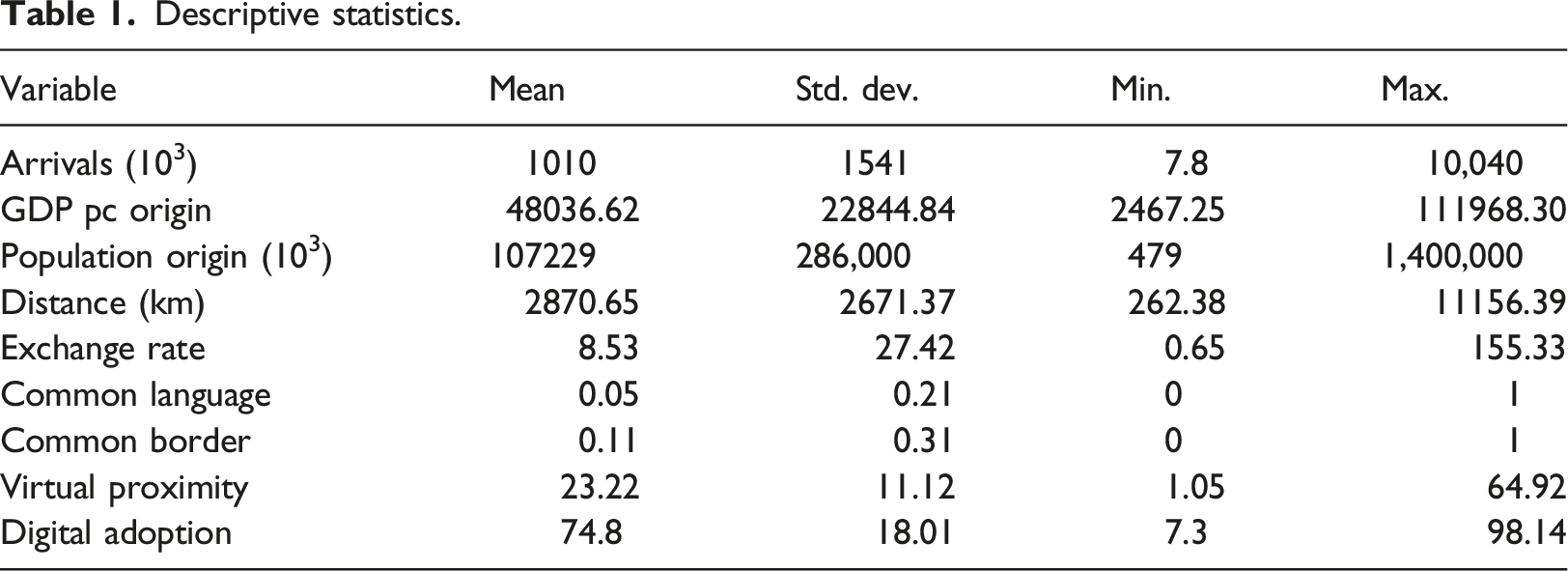
The description and source of the variables used in the model can be found in Online Appendix 1. Regarding the correlations between explanatory variables, a pairwise correlation matrix can be found in Online Appendix 2. In summary, the results do show a positive but moderate correlation (0.3694 with a p-value of 0.0000) between the variables: virtual proximity and digital adoption. Additionally, Online Appendix 2 also presents the Variance Inflation Factor (VIF) statistics. The results dismiss the presence of multicollinearity among the regressors, with all VIF values below 5.
Descriptive statistics.
Results and discussion
The estimated econometric model of equation (2) includes both time-varying (GDP per capita, population, exchange rate, digital adoption, and virtual proximity) and time-invariant variables (distance, common border, and common language). Time-invariant variables are expected to be correlated with the individual effects. Consequently, in such a scenario, the Hausman–Taylor estimator (Hausman and Taylor, 1981) arises as an appropriate econometric approach, overcoming drawbacks that a fixed or random-effects model displays 9 . Specifically, it allows identifying which explanatory variables are correlated with the unobserved random effect. In our case, the digital adoption variable was deemed endogenous. A plausible explanation relies on the fact that tourist flows are less sensitive to time-invariant factors (e.g., distance, sharing a common border, or language) when Internet usage in the source market is widespread (Lopez-Cordova, 2020), thus revealing the correlation of digital adoption with the unobserved individual effect. Moreover, Internet use in the origin country is also positively linked with the number of outbound tourists (Hoonsawat, 2016), which might enhance such a correlation.
To ensure robustness in the empirical analysis, specification tests were performed before the estimation of the model. The Breusch–Pagan Lagrange Multiplier test was applied for panel effects [Chi2(1) = 9254.44, p-value = .0000], confirming the fitness of panel data estimators to the dataset, and the modified Wald test confirmed the presence of heteroskedasticity [Chi2(105)=9325.66; p-value = .0000]. Therefore, robust standard errors should be included to bypass this issue. These statistical checks indicate that the Hausman–Taylor estimator for panel data with robust standard errors offers reliable estimations.
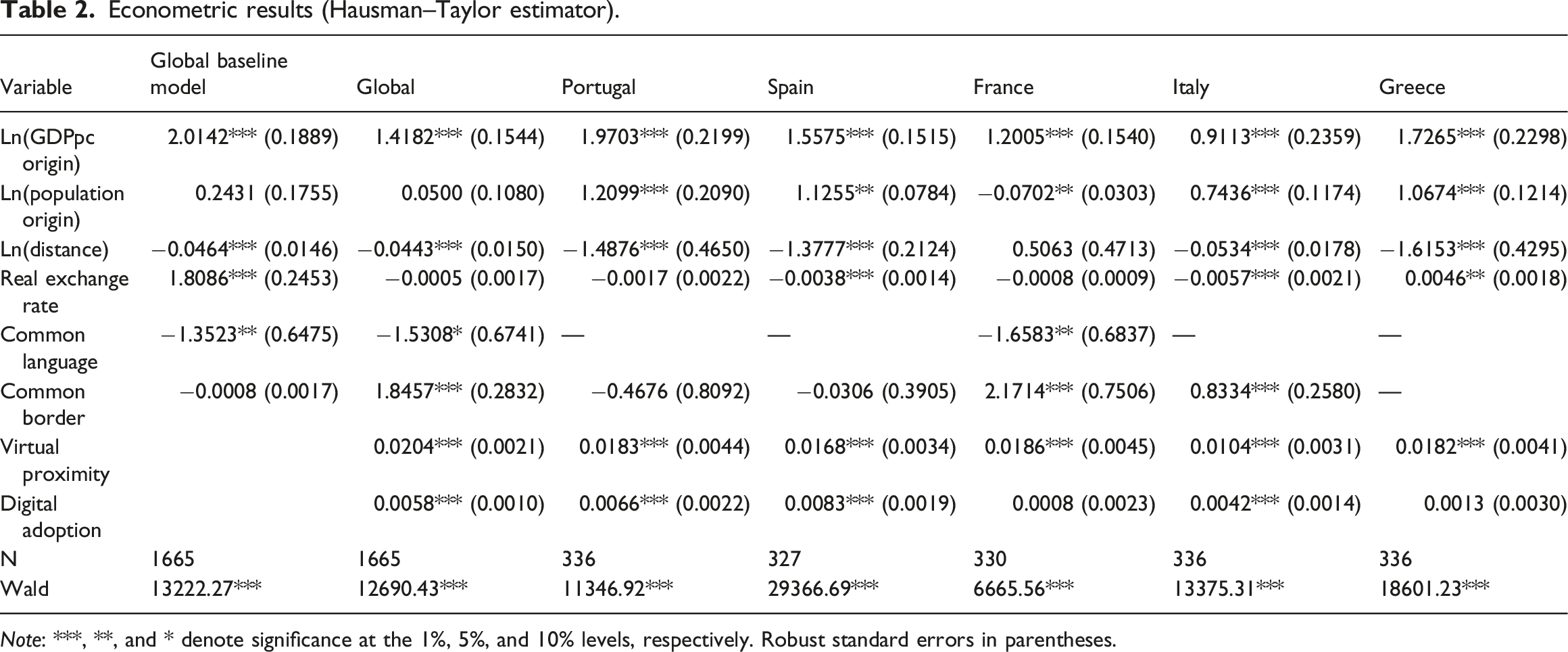
Econometric results (Hausman–Taylor estimator).
Note: ***, **, and * denote significance at the 1%, 5%, and 10% levels, respectively. Robust standard errors in parentheses.
According to the Wald test, all the regressions are globally significant at 1% and most parameters are statistically significant, both in the global and country regressions. Also, the results disclose a global effect on international demand and expose structural differences between the individual estimations and the total sample (Online Appendix 4) 10 , allowing us to refute the likelihood that Southern European destinations would respond homogenously to our model´s explanatory variables, and specifically to our special interest determinants (virtual proximity and digital adoption).
The GDP per capita, which represents the purchasing power of the source markets, has a strong, positive, and significant effect on the number of arrivals of non-resident tourists, with a coefficient equal to 1.418, indicating an income elasticity of the demand for tourism services greater than one, which is coherent with earlier results in the literature suggesting that tourism is a luxury good (Eilat and Einav, 2004; Roselló et al., 2020). Furthermore, estimations by country demonstrate that there is significant heterogeneity in purchasing responses to tourism products despite some similarities in terms of the top origin countries. One might add that the group of destinations where the number of international arrivals is (on average) more responsive to GDP per capita, that is, Portugal and Greece, structural changes from a monocultural paradigm established during the 1960s are exhibited. These were mainly sustained by “sun & sea” tourism associated with a consumer profile which is more sensitive to prices.
Results show that overall, the population size of the source market does not have a significant effect on the number of international arrivals in Southern European destinations. Despite the apparent contradiction to previous research results (Waqas-Awan et al., 2021), the estimations at the country level are all statistically significant which is seemingly related to France´s negative coefficient, possibly influenced by the importance of the Belgian market which defies the rule that a large market generates more international tourists.
As expected, distance impacts negatively on international travel (Cevik, 2020; Ulucak et al., 2020), that is, an increase in distance between two countries drives up travel costs. Yet again, despite the significant negative effect of distance on demand, the coefficient is relatively modest, which might reflect the overall importance of short-range source markets. Again, individual estimations by destination confirm a heterogeneous behavior among destinations, and France´s coefficient is not significant in explaining international tourism flows.
The coefficient of the real exchange rate is of the expected sign and not significant in explaining international tourism arrivals, thus conforming with previous research results (Seetaram et al., 2016), relating to the fact that a good proportion of our sample destination´s source markets belongs to the Eurozone. Yet again, the individual analysis (by country) shows that there are subtle differences among destinations. Portugal and France are not affected by this variable, but Spain, Italy, and Greece are moderately impacted with coefficients exhibiting different signs. Notwithstanding these distinctions, near-zero coefficients suggest low flexibility and volatility in the exchange rate.
Language commonalities do not comply with previous research outcomes where common language has a positive effect on the number of arrivals (Groizard et al., 2021; Okafor et al., 2021). Analysis by destination shows that this variable is only significant in France and with a negative coefficient. This result is most likely influenced by Belgium, which is the fourth most important source market for France. As expected, the significant coefficient of the common border factor emphasizes the importance related to the ease of travel to a bordering country (Khalid et al., 2020).
Regarding the main variables of interest for this research, both virtual proximity and digital adoption are significant and positive determinants of international tourism flows. Results reveal virtual proximity´s positive and significant coefficient (0.0204), meaning that a one-unit increase in the level of access to digital platforms expands the number of international arrivals by 2.04%. This quite surprising result indicates virtual proximity´s vital role in driving international tourism arrivals. This result clearly distinguishes virtual proximity from the previous variable, which translates an established capability (digital infrastructure) to access digital platforms, emphasizing the importance attached to the development of a digitized (information and data) environment fostered by international digital platforms (e.g., Booking.com; Tripadvisor.com). These achievements reinforce previous studies that have shown the importance for tourists of social media as “a critical way of searching for information when planning their holidays” (Almeida-Santana and Moreno-Gil, 2017: 9). Digital platforms are of fundamental importance in allowing online interactions between source markets and destinations, which introduces a new dimension that is much more related to a two-way engagement process between source markets which access and consume data/information and the destination´s capability to provide this level of digitized content through a diversity of complex digital services.
Concerning the number of Internet users in the country of origin as a supporting factor for residents traveling abroad, results show that a one-unit increase in the percentage of digital adoption (internet penetration) in the destinations’ source markets determines an increase of 0.578% in the number of international arrivals, which is quite modest, being below 1%. Although these results do not contest previous findings in emerging studies using digital variables in extended gravity models in tourism (Hoonsawat, 2016), they exhibit a lower coefficient. This is seemingly influenced by the similar average digital adoption (2004–2019) among our source markets for each sample destination, varying between 74.41% (France) and 75.22% (Greece). In addition, a comparable level of digital adoption does not determine a homogenous outcome in terms of the number of international tourists at the destination level. Also, lower coefficients are associated with countries with higher international arrivals. This relation holds to all destinations, except for Greece, which could indicate a deficient level of online content provision to match source market needs (Tourism Economics, 2019). Italy features a low level of digital adoption, but its source markets boast the second-highest Internet penetration among our sample of destinations. Therefore, it should be noted that the two digitalization variables (virtual proximity and digital adoption) reveal dissimilar effects in alleviating the uncertainty problem in source markets through information search and promotion.
Market concentration is a key issue among Southern European destinations 11 and is specifically related to short-distance European source markets. Amongst many factors contributing to greater market concentration, one might be that supporting diversification implies greater digital capability through digital platforms by source markets. Specifically, digital platforms have been shown to mediate positively the negative effect of distance to the destination country (Lopez-Cordova, 2020).
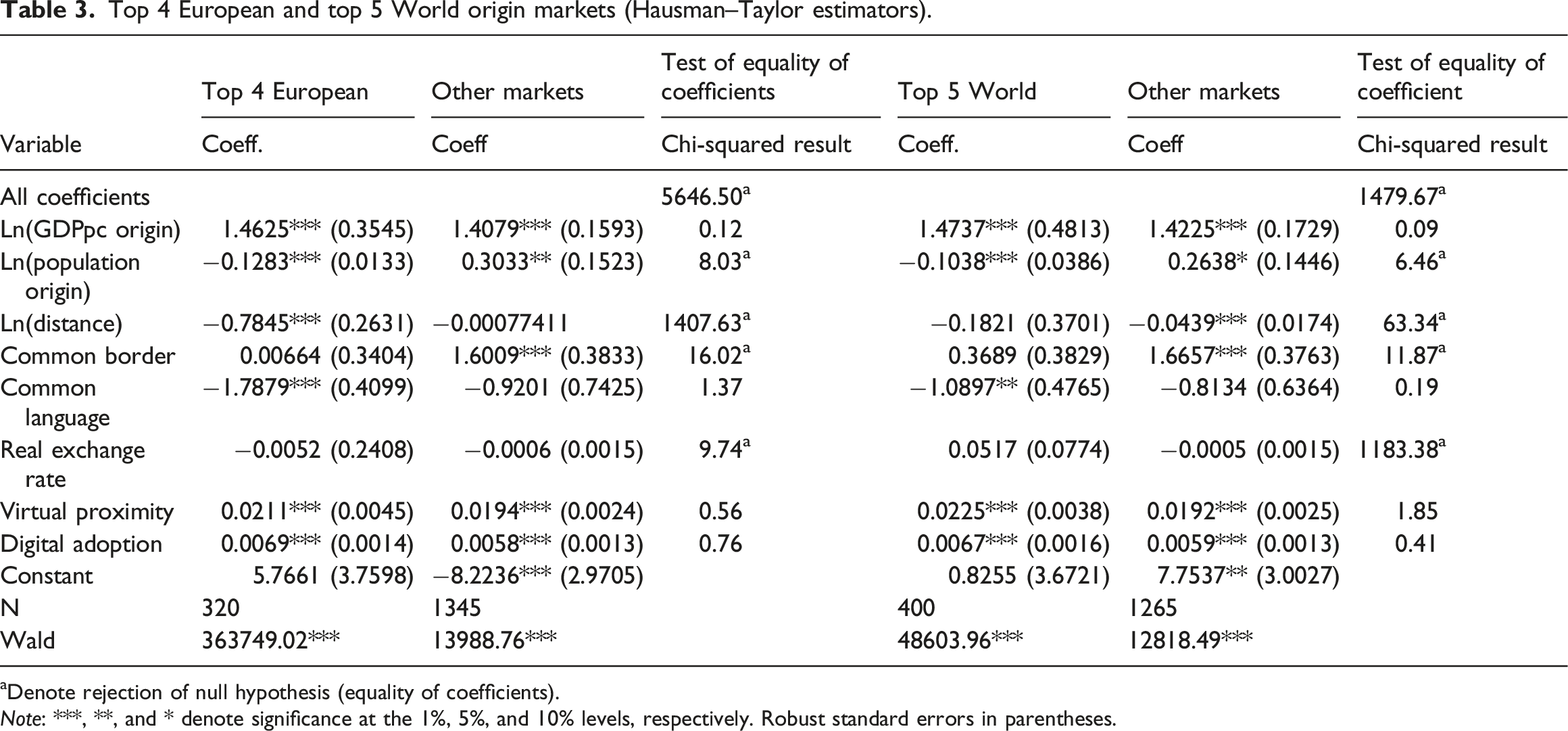
Top 4 European and top 5 World origin markets (Hausman–Taylor estimators).
aDenote rejection of null hypothesis (equality of coefficients).
Note: ***, **, and * denote significance at the 1%, 5%, and 10% levels, respectively. Robust standard errors in parentheses.
Results, in both cases, reveal that overall, the coefficients appear to be significantly different between both top source markets and the rest of the origin countries. Despite this result in both cases, individual coefficients exhibit significant equality among digitalization variables, which means that these factors did not exert dissimilar statistically significant effects between both top source markets (top 4 European and top 5 World) and the remainder of the origin countries. Although it would be expected in the case of digital adoption, given its low coefficient of variation and similar development patterns (“sun & sea” tourism), it was not expected for the virtual proximity variable. Results seem to reveal that despite the high level of concentration of demand among the top 4 European and top 5 World source countries, Southern European destinations seemingly benefit from similar levels of digital exposure on the most relevant platforms, which might also be explained by the moderate index average obtained in Google Trends which is our proxy for virtual proximity.
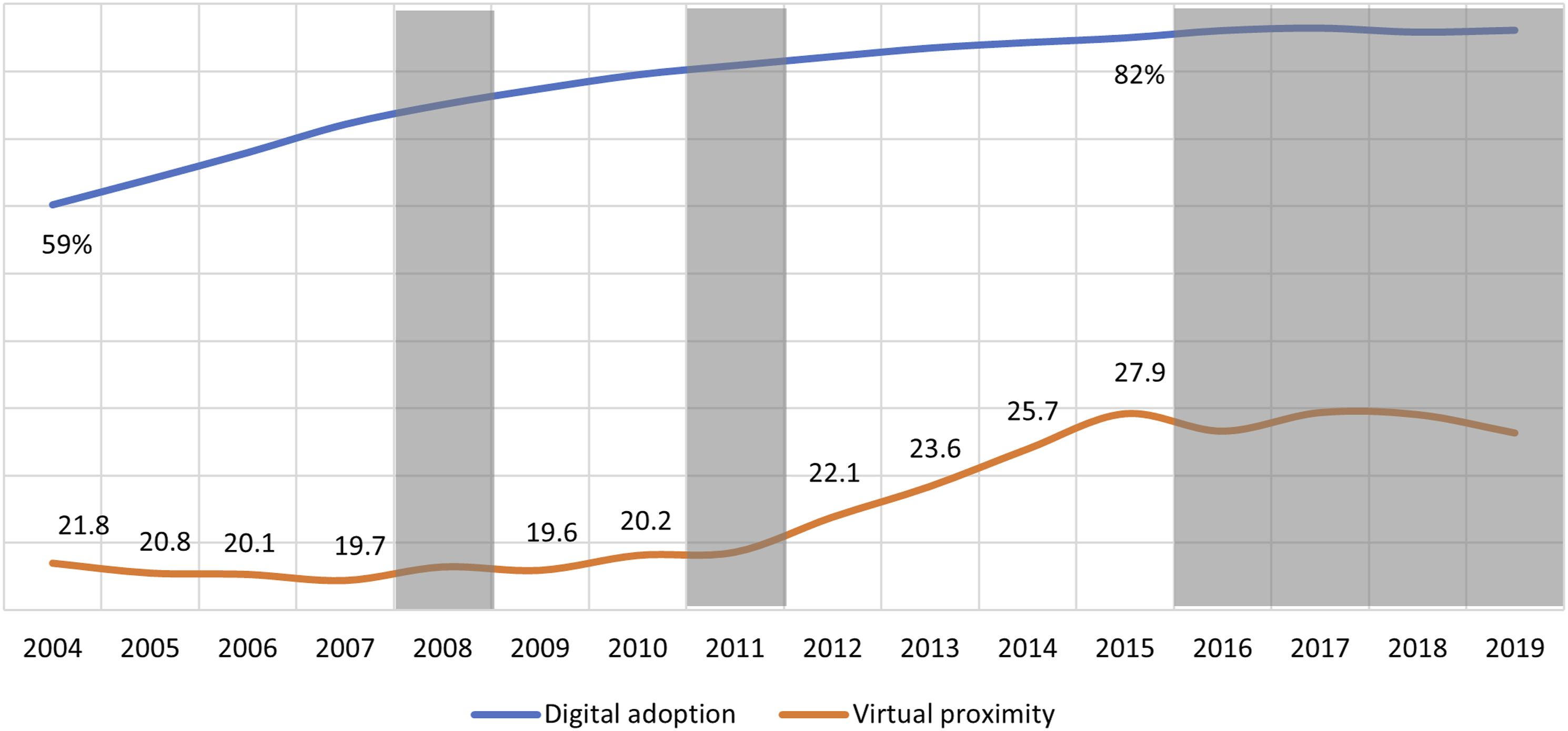
To check if our model´s digitalization variables had a longitudinal effect on international tourism arrivals, we extended the baseline model by including interaction terms of both virtual proximity and digital adoption variables with year dummies to verify whether there are different cross-sections over the time where the weight of these variables has altered. Between the two, we can observe that there has been no significant interaction influence since 2016 (Figure 1), that is, neither digitalization variables exerted a statistically significant effect on international arrivals from 2016 onward. Furthermore, data on year interaction confirms that the two variables explain different effects. Virtual proximity is reflecting a more volatile behavior of demand at the source markets (Figure 2), showing that despite the increasing level of exposure of Southern European destinations within their origin markets through digital platforms they are also subject to a highly competitive and dynamic globalized market environment. Conversely, the level of digital adoption in the source markets exhibits a much lower and smoother variation of its coefficients, which explains its non-significant effect on the number of international arrivals along with the whole time series, except for 2005 and 2015. These results support this variable´s structural (and infrastructural) implications which are evolving continuously to provide fuller geographic coverage of Internet access and increased speeds (Tourism Economics, 2019). Likewise, these outcomes can also be explained by the fact that international arrivals to the study´s destinations increased considerably more than the level of digital adoption within source markets. Year interaction coefficients with virtual proximity and digital adoption. Note. Shaded areas correspond to non-significant “virtual proximity” coefficients. Annual average virtual proximity and digital adoption. Note. Shaded areas correspond to non-significant “virtual proximity” coefficients.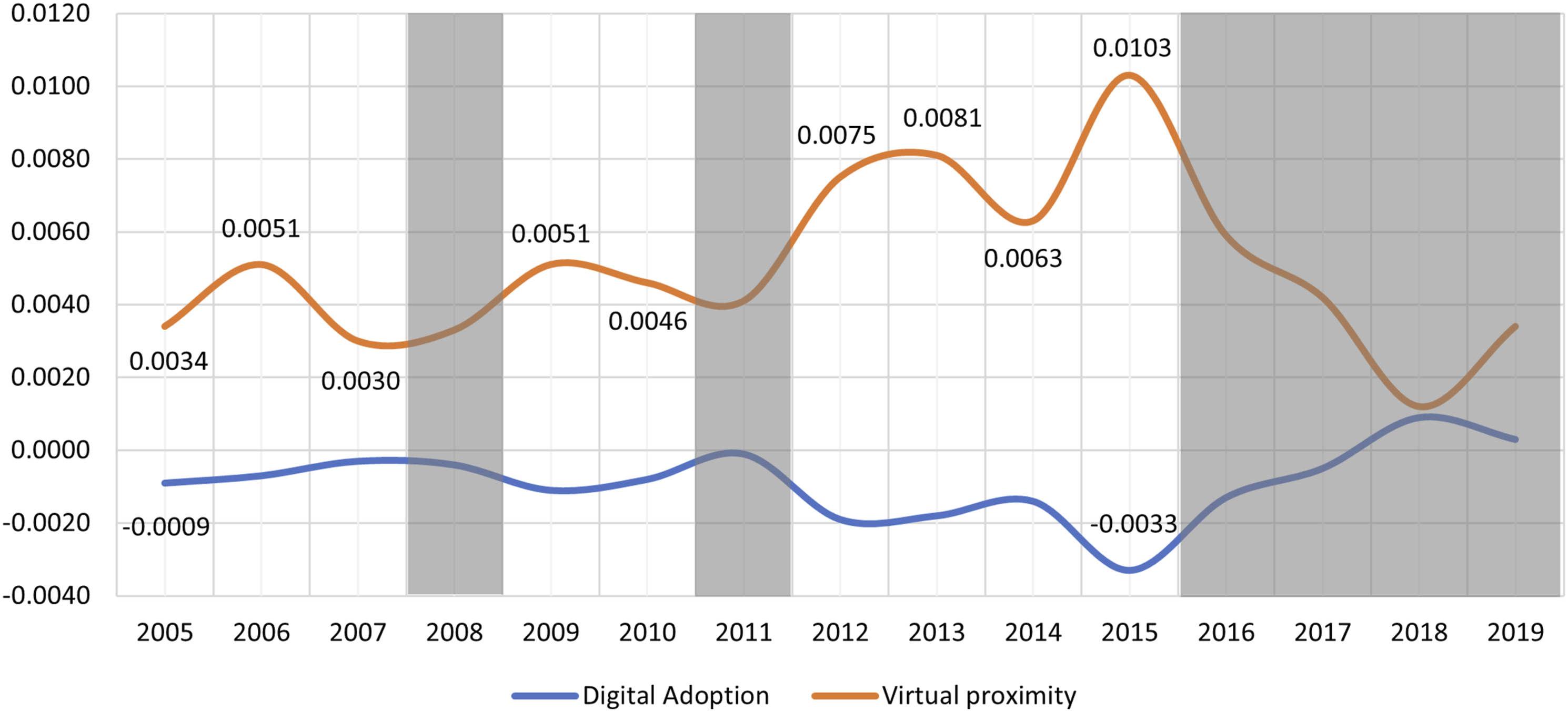
Conclusion
The results provided by this research lend support to the notion that the adoption of digital platforms in the 21 source markets has aided international travel to Southern European destinations between 2004 and 2019, which addresses the first research question of this study. Furthermore, the results obtained from the present investigation furnish evidence that Southern European countries should not be treated as a block of homogenous destinations, given the confirmed structural differences among countries and between each country and the total sample, which deals with the second research question of this study.
Additionally, both the total sample and country estimations reveal that virtual proximity rather than digital adoption has exerted an important influence on international arrivals to Southern European destinations. Therefore, digitalization cannot be interpreted as a fluid and vague concept that exerts a consistent effect. Rather than reinforcing a homogenous notion, this study confirms the differences between virtual proximity and digital adoption. While digital adoption represents the level of internet penetration and digital infrastructure deployed to access digital platforms within source markets, it does not provide the same level of influence on international tourist flows as virtual proximity, which is dependent on the digitized environment promoted by digital platforms. This finding tackles the third research question of this study.
This research also indicates that there are structural differences in international demand for these destinations over the period 2004–2019. A longitudinal interpretation of both variables throughout the timeframe of this study reveals that the level of digital adoption in the source markets did not exert an overall significant effect on international tourist arrivals but that virtual proximity did display significant and variable coefficients, reflecting different outcomes over the period 2004–2019 as well as the fickle behavior of markets, which addresses the fourth research question.
These outcomes are particularly important to public and private stakeholders given the highly competitive and dynamic environment imposed by digital globalization, which can either threaten tourism over-dependent countries with structural levels of market concentration or work on their behalf to deploy strategies that can change the target market’s perception concerning the destination´s key benefits (and features) or reach new consumers in different markets to limit the risks of market concentration. The results emphasize the importance of digital platforms as strategic environments that foster online interactions between source markets and destinations, empowering potential consumers to decide and choose where to travel.
From a practical and policy-making perspective, this research informs both public and private stakeholders regarding the significance of a bilateral process involving source markets that access and consume data/information. It also highlights the importance of strategic action to improve the destination´s competence in converting data into digital form to deliver digitized content through a diversity of globalized digital services. Likewise, this research finds a relatively similar context, portraying similar behavior among source markets, apart from their rank in terms of strength of demand, which, in turn, echoes vulnerable digital marketing strategies from a destination management perspective. There is significant equality among digitalization variables between both top source markets (top 4 European and top 5 World) and the remainder of the source countries. This outcome recommends the need to engage in an oriented strategy to be more successful in connecting with potential customers. Though Southern European destinations have developed under a highly concentrated source market dependence paradigm since the inception of mass tourism, most countries are evolving toward greater diversification due to an increasingly competitive global environment, requiring appropriate digital platforms to strengthen and diversify the level of exposure to international source markets.
This study presents an empirical application that measures the impact of digital factors within source markets on the demand for international tourism, which can be replicated by public and private stakeholders to derive policies and actions to interpret changing (declining or thriving) economic cycles in tourism-dependent destinations. This will allow the definition of differentiated strategies that look at digitalization from various perspectives, specifically from the angle of digital adoption, which is to say, the ability of source markets to access digital data through the Internet and the level of virtual proximity and digital exposure to digital platforms of destinations within source markets. Therefore, this study provides valuable insights for tourism marketers to fine-tune search engine refinement in specific source markets as well as develop new strategies to enhance search engine advertising to ensure greater exposure of businesses and destinations within source markets that are advanced in terms of digital adoption. This research also reveals the other side of the coin, when source markets are behind in digital adoption (Internet use), which calls for adjusted strategies that balance digital with conventional means of marketing and promotion.
From a methodological perspective, this study improves upon present gravity models by capturing the direct influence of virtual proximity and digital adoption on international tourism flows as well as their interaction with year dummies to determine different cross-sectional effects.
This research is not without limitations, especially when it comes to its time-frame and specification of virtual proximity. The constrained time frame which ends in 2019 was determined by the absence of available data from 2020, not allowing us to extend our lens over a wider stage which includes the impact of the pandemic. Therefore, further investigation is warranted to explore the effects of digitalization on travel along with this global disruptive phase and beyond. Additionally, future studies should broaden their search enquiries by combining specific services (e.g., flights) and destinations, which would allow more precision in capturing the level of digitalization of a destination. Finally, it would be beneficial to broaden our analysis to investigate the impact of digitalization in the destination itself to confirm the influence that digitized data and information have on international tourism flows.
Supplemental Material
Supplemental Material—The effect of virtual proximity and digital adoption on international tourism flows to Southern Europe
Supplemental Material for The effect of virtual proximity and digital adoption on international tourism flows to Southern Europe by Alexandre Guedes, Samuel Faria, Sofia Gouveia, and João Rebelo in Tourism Economics.
Footnotes
Declaration of conflicting interests
The author(s) declared no potential conflicts of interest with respect to the research, authorship, and/or publication of this article.
Funding
The author(s) declared the following potential conflicts of interest with respect to the research, authorship, and/or publication of this article: This work is supported by national funds, through the FCT – Portuguese Foundation for Science and Technology under the project UIDB/04011/2020.

Supplemental Material
Supplemental material for this article is available online.
Notes
Author biographies
References
Supplementary Material
Please find the following supplemental material available below.
For Open Access articles published under a Creative Commons License, all supplemental material carries the same license as the article it is associated with.
For non-Open Access articles published, all supplemental material carries a non-exclusive license, and permission requests for re-use of supplemental material or any part of supplemental material shall be sent directly to the copyright owner as specified in the copyright notice associated with the article.
