




Abstract
This study examines whether climate policy uncertainty affects the propensity of people to travel. To do so, we employ the Climate Policy Uncertainty (CPU) index and US air-travel data to eight regional overseas destinations for the period 2000–2019. Using time-varying causality tests to deal with the structural breaks that exist in the relationship between CPU and US air travel, we find that CPU is a major determinant of air-travel demand to all destinations examined. The results are robust when we control for macroeconomic factors, uncertainty and geopolitical risks. The findings have important implications for destination countries and tourism professionals.
Keywords
Introduction
Tourism is unambiguously one of the most important drivers of economic growth, accounting for 10.4% of global GDP (WTTC, 2021). 1 Given its importance to the global economy, and tourism destinations in particular, the factors affecting the propensity of people to travel have attracted the interest of the academic community and policy makers. To that end, there is a plethora of studies examining the determinants of tourism demand with a main focus on macroeconomic variables, or proxies of sentiment/uncertainty more recently. 2
At the same time, tourism is responsible for approximately 8% of global CO2 emissions; this includes emissions from travelling, leisure, hotels, etc. (Lenzen et al., 2018). Since tourism is such a high emitting industry, but also vulnerable to climate change (Dogru et al., 2019; Scott et al., 2019), national and global policies, aiming to tackle climate change, can have a great impact on tourism demand. This is due to the fact that such policies can increase the cost of travelling (e.g. air tickets), or raise the environmental awareness of people. As such, the latter may change their travelling behaviour by reducing trips in general, or those that require long-haul flights.
Given the increasing interest in climate change and its relevance with tourism activities, the tourism demand literature has substantially incorporated climate change factors (e.g. weather) in the relevant estimations (Liu, 2016). In that framework, tourists are revealing their preferences towards climate through travelling habits. Hence, while the rest of the controls remain constant, the analysis can forecast future trends through projected climatic conditions. Motivated by recent studies utilizing news-based indices to investigate the impact of economic policy uncertainty on tourism demand (Dragouni et al., 2016; Demir & Gozgor, 2018; Apergis and Payne, 2020), this study examines the effect of climate policy-induced uncertainty on the propensity of people to travel. To do so, the analysis employs another news-based index, the Climate Policy Uncertainty (CPU) index, recently developed by Gavriilidis (2021), and US air-travel data to eight different overseas regions for the period 2000:1–2019:10. Adopting the method of time-varying causality tests by Rossi and Wang (2019), the analysis documents that climate policy uncertainty has a major impact on tourism demand across all geographic regions examined. More importantly, the strong evidence of predictability originating from CPU for US air travel is only obtained under a time-varying approach and not under traditional constant parameter Granger causality tests, which we also perform for the sake of comparison and exhibit weak results. This is due to the fact that the standard Granger predictability framework is mis-specified in the presence of structural breaks found between CPU and the tourism-related variable (the structural breaks are identified via statistical tests). In addition, the findings remain robust when we control for macroeconomic factors, economic policy uncertainty and geopolitical risks.
The link between climate change and tourism can be theoretically explained by the mechanisms of adaptation and mitigation. In terms of the first definition, adaptation comes as a response to current or expected climatic shocks, while in terms of the latter definition, mitigation comes as a response to climate change and in relevance to the reduction of greenhouse gases (Fussel and Klein, 2005). Therefore, the vulnerability of the tourism industry associated with climate change hazards depends on the industry’s capacity to adapt in anticipation of such hazards (Brooks et al., 2005). This capacity is expected to allow the tourism industry to accommodate potential environmental risks (Adger et al., 2005; Linnenluecke and Griffiths, 2010). The implementation of adaptation strategies/policies seems to be the only means to deal with climate uncertainties (Hoffmann et al., 2009; Linnenluecke et al., 2011; Linnenluecke and Griffiths, 2012).
The contribution of the paper is twofold. First, it contributes to the literature examining the determinants of tourism demand. Specifically, it introduces a new variable, the climate policy uncertainty index, and finds that this bears an important effect on tourism demand, yet proper inferences require a time-varying approach to account for regime changes. So far, prior studies utilizing news-based indices have focused on uncertainty induced by economic policy or geopolitical risk. The advantage of using this index is that it focuses on uncertainty solely induced by climate policy, which can be unrelated to other forms of uncertainty, and whose outcomes are particularly relevant to the tourism industry. To that end, the second contribution of the study is that it adds to the growing literature on climate change and climate policies and how these may affect the tourism industry. In fact, this study is timely in view of the recent UN Climate Change Conference (COP26) and the ‘Glasgow Declaration for Climate Action in Tourism’, where businesses and countries committed to reduce emissions related to the tourism industry by half till 2030 and accomplish net zero till 2050. 3
The rest of the article is structured as follows. Next section discusses the findings of the previous studies; the section Data and methodology presents the research design of the study, while the section Empirical results presents the results. Finally, the section Conclusion presents the concluding remarks of the study.
Literature review
The climate footprint of tourism
Tourism may well be considered as a driver of global economic growth, yet this comes at an environmental cost. Over the past decades, there has been a plethora of studies examining the contribution of tourism in greenhouse gas emissions and its climate footprint. For instance, early studies by Becken (2002) and Becken and Simmons (2002) find that overseas tourists add 6% on New Zealand’s CO2 emissions and that tourist activities (e.g. air travel) consume more energy than tourist attractions. In addition, Patterson and McDonald (2004) highlight that amongst twenty five industries in New Zealand, the tourism industry is the second highest emitter. Gössling and Hall (2008) relate the footprint of the tourism industry in Sweden with its contribution to the Swedish economy. Specifically, the authors report that although tourism contributes 11% of national CO2 emissions, it only contributes 2.8% of Sweden’s GDP.
Evidence from other countries about the contribution of tourism in CO2 emissions yield similar results. For example, Gössling et al. (2010) report that emissions from German tourism account for 4.5% of national emissions. Another study by Gössling (2012) examines the energy use of tourism in fourteen Caribbean countries. The findings indicate that across all countries examined, emissions from tourism account for at least one-third of national emissions. Katircioglu (2014) finds that tourism in Turkey, during the period 1960–2010, was a major producer of CO2 emissions, while Tang et al. (2014), Tsai et al. (2014), and Durbarry and Seetanah (2015) report similar findings for China, Taiwan and Mauritius, respectively. Zaman et al. (2016), by using a sample of thirty four countries, spanning the period 2005–2013, provide evidence of tourism-induced emissions and draw the attention of policy makers for the need to promote more sustainable forms of tourism, while Zhang and Zhang (2021) also highlight the magnitude of tourism-led CO2 emissions when examining thirty Chinese provinces for the period 2000–2017.
Despite the evidence on the contribution of tourism to the environmental degradation, another view, consistent with the environmental Kuznets curve (EKC) hypothesis (Kuznet, 1955), suggests that there is a dynamic relationship between environmental pollution, economic growth and tourism. More specifically, according to Dinda (2004), there is increased environmental degradation at the early stage of a country’s economic development; however, after a threshold of economic development environmental quality increases. To that end, Paramati et al. (2017), using data from 22 developed and developing economies, find that tourism in general has a positive impact on the growth of the economy in the sample countries. Nevertheless, the effect of tourism on the environmental degradation is decreasing at a faster rate in developed countries compared to developing countries. Finally, Lee and Brahmasrene (2013), examining a sample of European countries, report a negative effect of tourism on CO2 emissions. A possible explanation for these findings may be that developed economies put more emphasis on more environmentally friendly forms of tourism; according to certain studies (Scott, 2011; Weaver, 2011) sustainable forms of tourism, such as ecotourism, can alleviate CO2 emissions.
Climate policy, uncertainty and tourism demand
Policies aiming to tackle climate change and greenhouse gas (GHG) emissions can have a major impact on tourism demand. This is due to the fact that they can affect the cost of energy, hence the cost of most tourism-related activities (electricity cost, travel cost, etc). Moreover, by incorporating such policies to their tourism strategies, countries will need to depart from the traditional approach so far of maximizing economic revenues and tourism arrivals, often at the expense of mitigating climate change (Becken et al., 2020). Nevertheless, over the past years, there has been an increasing trend of implementing sustainable practices in national tourism policies (UNWTO, 2019). In addition to the response of national tourism policies to climate change policies and regulations, the latter can also affect the economic welfare of households (Stolbova et al., 2018) and people’s attitude towards travelling; in fact, Scott and Becken (2010) argue that people might change their travelling habits shifting to more sustainable choices; for instance, tourists may replace holiday destinations requiring long-haul trips with others of closer proximity. An early study by Gössling et al. (2008) examines how climate policies, at a regional and global scale, could affect tourism demand on developing countries. The authors find that a potential global climate policy (e.g. reducing emissions from the aviation industry) would likely decrease tourist arrivals in some destinations. To that end, the authors argue that destination countries should amend their national tourism strategies in anticipation of such global scale policies. This includes the greening of the hotel sector (Hoogendoorn et al., 2015), changing tourist activities (Hoogendoorn and Fitchett, 2018) and reducing energy use (Gössling and Schumacher, 2010), amongst others.
From the above, one can infer that climate policies can have a major impact on informing national tourism policies and the attitude of people towards travelling. Another strand of the literature examines how uncertainty affects tourism demand. So far, prior research has focused on how uncertainty induced by economic policy or geopolitical risks can affect tourism demand. For example, Dragouni et al. (2016) report spillover effects from economic policy uncertainty (EPU) to US outbound tourism demand, when economic uncertainty is high. Demir and Gozgor (2018), using a sample of fifteen counties, report a negative impact of EPU to outbound tourism demand. Balli et al. (2018) employ a sample of eight countries and find that both domestic and global EPUs are important predictors of tourism demand. Tiwari et al. (2019) examine the effect of geopolitical risk (GPR) and EPU on tourism demand in India and show that GPR has a negative impact on tourism demand, which is stronger relative to that of economic policy uncertainty. Similarly, Apergis and Payne (2020) report a negative impact of both GPR and EPU when examining the US outbound demand to several regional destinations. Furthermore, a recent study by Hailemariam and Ivanovski (2021) reports a negative impact of geopolitical risk on US tourism service exports.
Given that climate policies can directly affect the cost of tourism-related activities, as well as people’s behaviour towards travelling, studying how climate policy uncertainty policy can affect tourism demand is a topic worthy of investigation. This is especially the case since uncertainty about climate policies’ outcomes is much greater compared to uncertainties induced by other policies (Pindyck, 2013).
Data and methodology
Data and preliminary analysis
To perform the analysis, we use data on overseas air-travel volume of US citizens on monthly frequency from January 2000 till October 2019 (series are seasonally adjusted using the X-11 procedure). 4 Specifically, we examine the total overseas air-travel volume, and the volume of air travelling to Europe, Caribbean, Asia, Central America, South America, Middle East, Oceania and Africa.
As it regards our novel predictor, that is, the Climate Policy Uncertainty (CPU) index, this is derived by the recent work of Gavriilidis (2021), who follows the newspapers-based approach of measuring uncertainty developed by Baker et al. (2016). 5 Contrary to the existing policy uncertainty indices, Gavriilidis (2021) focuses on climate policy-related articles from eight leading US newspapers that include the terms (“uncertainty” or “uncertain”) and (“carbon dioxide” or “climate” or “climate risk” or “greenhouse gas emissions” or “greenhouse” or “CO2” or “emissions” or “global warming” or “climate change” or “green energy” or “renewable energy” or “environmental”) and (“regulation” or “legislation” or “White House” or “Congress” or “EPA” or “law” or “policy”). 6 For each newspaper, the author divides the number of climate policy-related articles with the total number of articles in the same month. The series are then standardized and averaged across the newspapers for each month. Finally, the index is normalized to have a mean value of 100.
While CPU is the main predictor, as a control variable, we use the first principal component (PC1) derived from a host of other predictors that have been recently suggested by Apergis and Payne (2020), who analyse the role of general economic uncertainty and geopolitical risks on the same set of dependent variables (i.e. overseas air passenger travel of US citizens). Accordingly, we include the common (PC1-based) information content of the broad real effective exchange rate for the US (BREER) and industrial production (INDPR) 7 , obtained from the Federal Reserve Bank of St. Louis, the GPR index by Caldara and Iacoviello (2018), 8 and the US (USEPU) and global (GEPU) economic policy uncertainty indexes by Baker et al. (2016) 9 and Davis (2016) respectively. 10
We begin our analysis by exploring our series for the presence of unit roots; to do so, we employ the ADF-GLS test by Elliot et al. (1996), according to which the null hypothesis of a presence of a unit root is rejected at all the series (first-differenced) examined. Hence, we employ first-differenced data in our time-varying causality tests. 11
Methodology
This study adopts the method by Rossi and Wang (2019) to analyse the time-varying effect of CPU on total and eight regional overseas air passenger travel of US citizens. Due to the fact that we detect many structural breaks, this method is more reliable compared to standard Granger causality tests. Our VAR model takes the following form

Empirical results
Constant and time-varying parameter Granger causality tests in bivariate model.
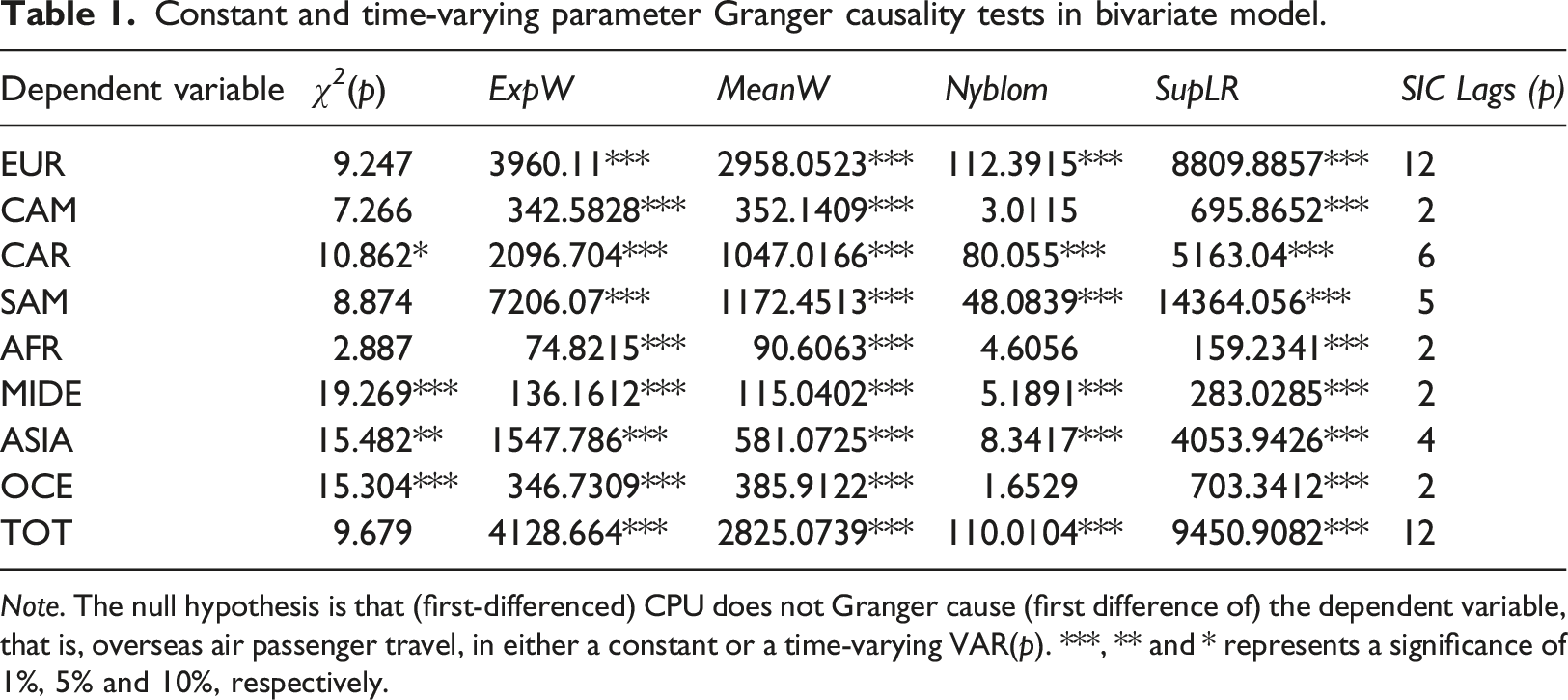
Note. The null hypothesis is that (first-differenced) CPU does not Granger cause (first difference of) the dependent variable, that is, overseas air passenger travel, in either a constant or a time-varying VAR(p). ***, ** and * represents a significance of 1%, 5% and 10%, respectively.
Bai and Perron (2003) test of multiple structural breaks in bivariate models.
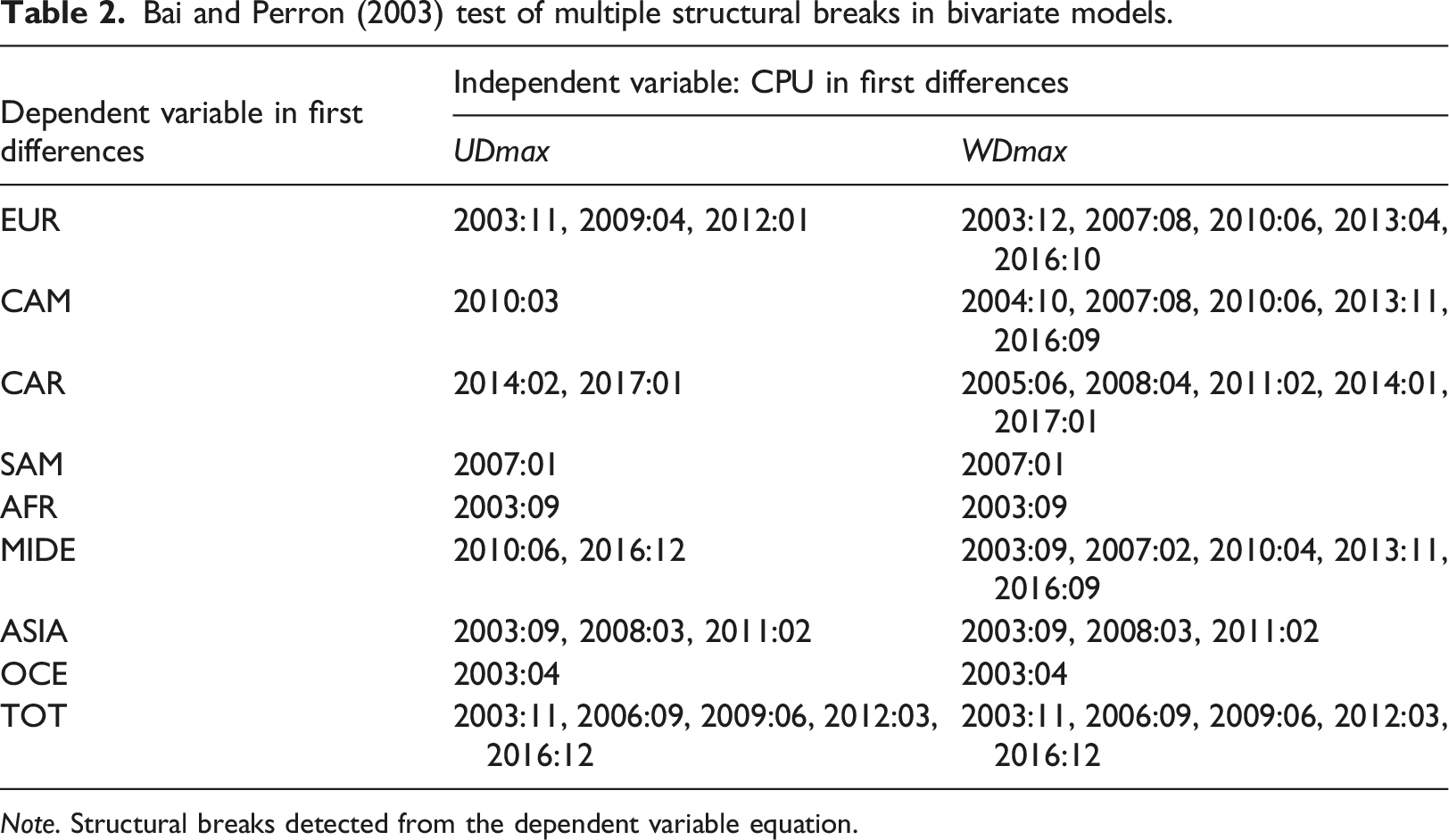
Note. Structural breaks detected from the dependent variable equation.
Given the presence of structural breaks, the use of a constant parameter model is not appropriate. As such, for reliable inference, we need to examine the ExpW, MeanW, Nyblom and SupLR tests, which are implemented on the time-varying VAR model (these results are also reported in Table 1). Based on these tests, the null hypotheses of no-Granger causality from the CPU to the various overseas air passenger travel are rejected at the 1% significance level in at least three of the four tests (barring the Nyblom test statistic at times for CAM, AFR and OCE). According to these results, the predictive ability of CPU for TOT, EUR, CAR, ASIA, CAM, SAM, MIDE, OCE or AFR is time-varying and very strong, despite the weak evidence of predictability observed when using the model with constant parameters. 14
Figures 1(a)–(i) report the Wald statistics (whole sequence) over time, indicating when the Granger causality occurs from CPU to the total/eight regional overseas air passenger travel. Time-varying Granger causality tests. Notes. Time is reflected on the x-axis. The time-varying Wald statistic is presented on the y-axis.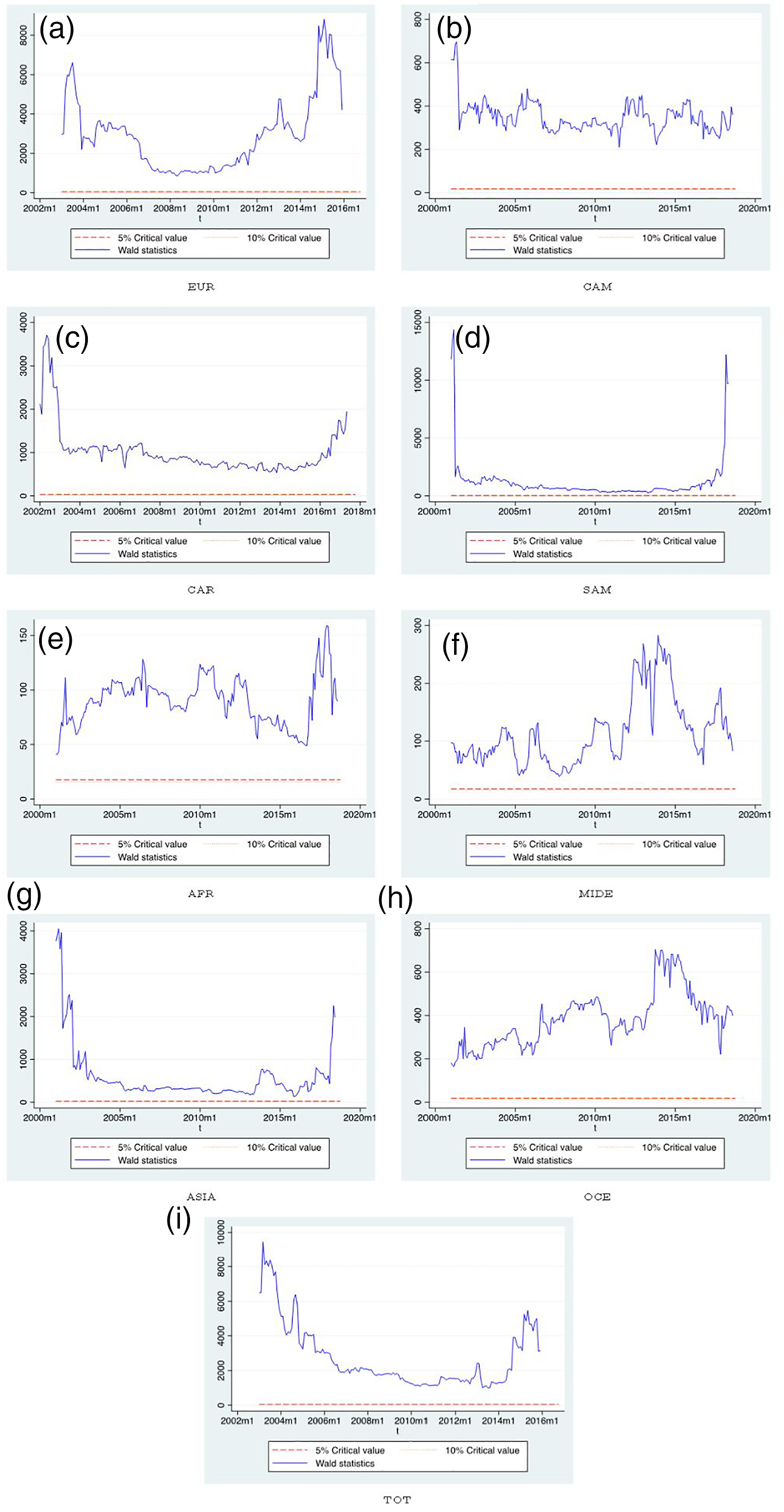
As can be seen, the uncertainty associated with climate policies is found to consistently predict the overseas tourism variables over the entire sample period. This result is not surprising given that various climate policy-related decisions were in the newspapers over this time and caused various peaks of the predictor, as observed from the annotated plot of the CPU index in Figure 2. Annotated plot of the CPU Index.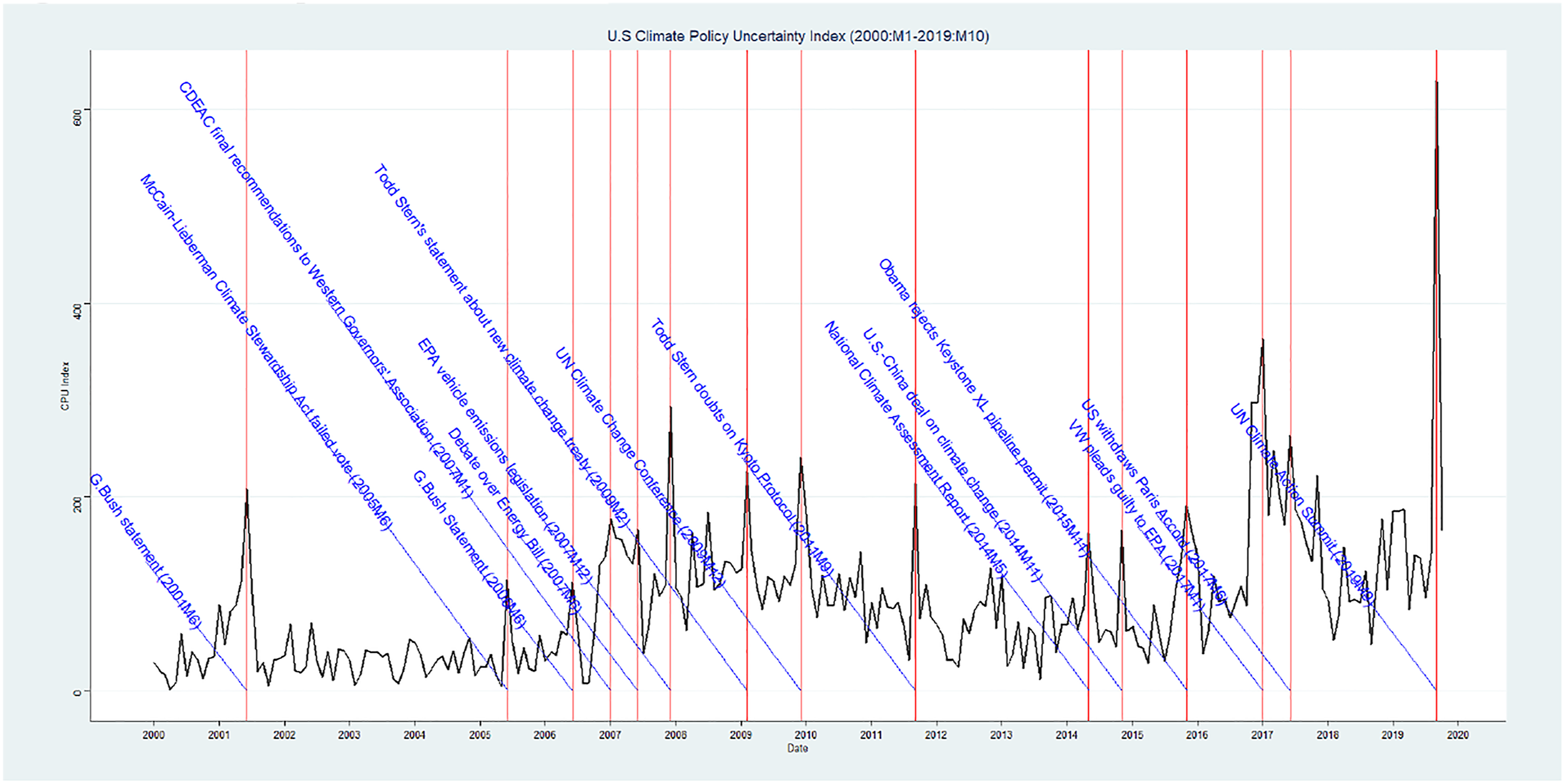
Let us investigate this evidence of time-varying causality for the total and eight regional overseas air passenger travel due to CPU in a bit more detail. For this purpose we account for the strength of predictability at specific points in time, based on the size of the test statistic, and relate it in turn with the peaks of CPU. In general, we observe that, the time-varying Wald statistic generally peaks at the beginning or end of the sample period, as well as over 2013/14–2016/17. When we compare these highs of the test statistic, suggesting higher evidence of predictability for overseas air passenger travel, with the CPU, we find that the high values of the statistic at the end points correspond to President Bush’s statement about global climate change reiterating his Kyoto Protocol rejection, and Global strikes ahead of the UN Climate Action Summit, besides due to 24 States suing the Trump administration on revoking their right to set emission standards and the Trump-administration plans to scrap Obama’s Clean Water Act reform. In addition, the other strong evidence of predictability, over 2013–2017, aligns with the publication of the national climate assessment report, US-China deal on climate change, Obama rejecting Keystone XL pipeline permit, Volkswagen pleading guilty on the emissions scandal, and of course due to President Trump announcing US withdrawal from the Paris Accord. In essence, the strength of our empirical evidence of predictability involving the tourism variable of interest conforms to the rises in the CPU, and hence is clearly not a statistical artefact, but highlights the economic value of our econometric framework.
Time-varying parameter Granger causality tests in trivariate setting.
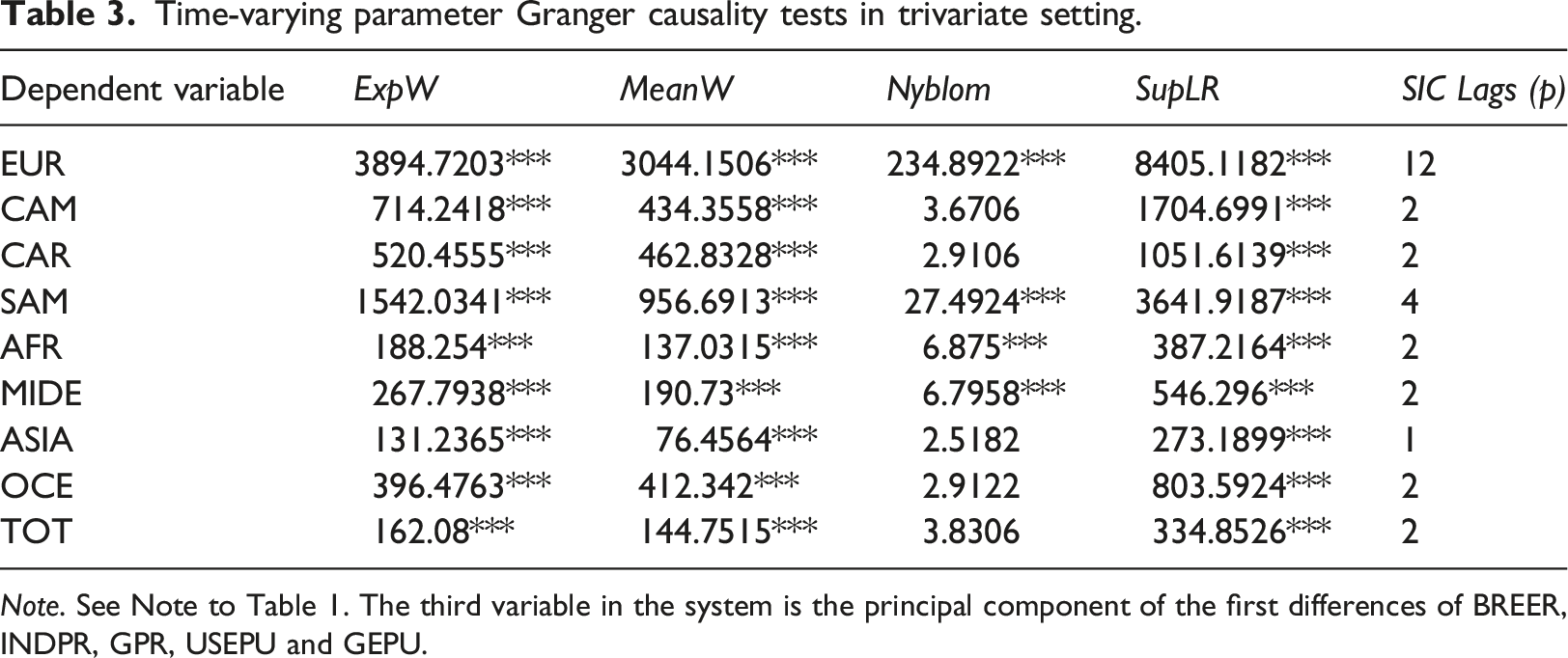
Note. See Note to Table 1. The third variable in the system is the principal component of the first differences of BREER, INDPR, GPR, USEPU and GEPU.
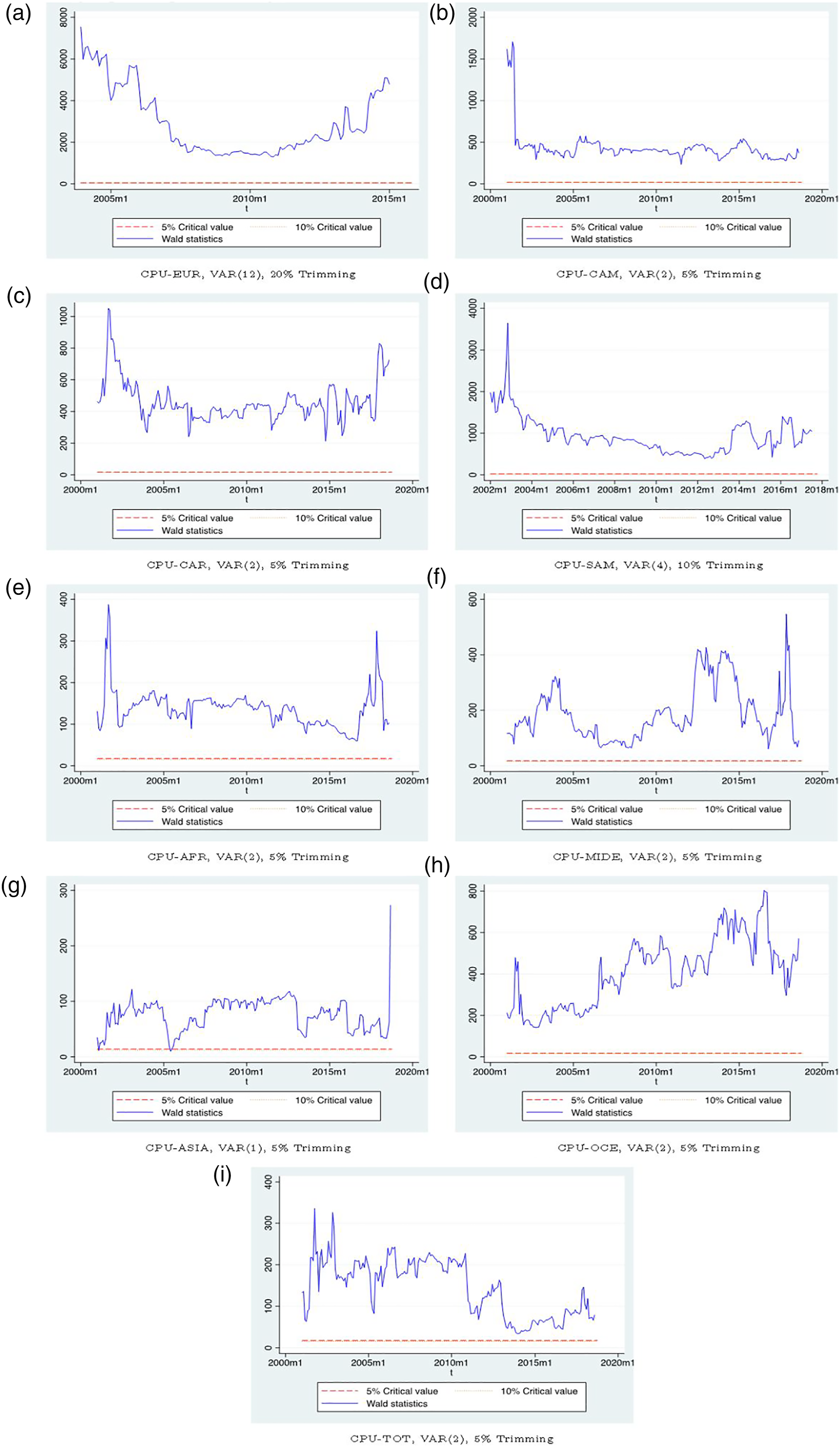
Time-varying Granger causality tests with control variable. Notes. Time is reflected on the x-axis. The time-varying Wald statistic is presented on the y-axis.
Conclusion
Tackling climate change has been at the forefront of the world community and national policy makers. Despite that tourism has been one of the most important drivers of economic growth, it is also one of the largest emitting industries. As such, uncertainty surrounding climate policies can have a major impact on the demand for tourism activities; the channels through which this can happen are mainly two. First, such policies may increase the cost of travelling and other related tourism activities, making such activities more expensive. Second, climate policies could change travellers’ attitude towards travelling by increasing their environmental awareness and hence, their propensity to travel to long destinations.
This study contributes to the growing literature of how climate change, and policies aiming to tackle climate change, affect tourism and introduces another potential determinant of tourism demand, the climate policy uncertainty index. As such, this study examines for the first time in the literature the impact of climate policy-induced uncertainty on tourism demand. Specifically, it adopts the Rossi and Wang (2019) method to analyse the time-varying impact of US climate policy uncertainty, proxied by the CPU index, on air-travel demand to eight regional overseas destinations. Our findings indicate that CPU is an important determinant of tourism demand over the entire sample period of 2000:01–2019:10. Interestingly, this strong evidence is only observed under a time-varying setting and not under the constant parameter Granger causality test. The latter yields weak results given its inability to detect multiple structural breaks in the relationship between CPU and US air-travel demand, which we detect using formal statistical tests.
The evidence presented in this study bears important implications for destination countries and tourism professionals. As policies tackling climate change are being introduced and people become more environmentally conscious, it is suggested that tourism destinations, which are more vulnerable to climate change and are affected more by such policies (e.g. distant island destinations), to try and alleviate their carbon footprint by promoting more sustainable forms of tourism. In that sense, policymakers in the tourism industry should explicitly account for climate conditions when discussing strategies to cope with climate change and gauging changing trends in tourism destinations.
To elaborate more, stakeholders in the tourism industry need to acknowledge the increasing importance of climate uncertainty; the latter can negatively affect tourism demand for certain destinations. To mitigate this adverse effect, destination countries, especially those that are more vulnerable, could shift their focus to alternative tourism activities and attractions. Moreover, uncertainty stemming from climate policies needs to be factored in the decision making process and the timing of marketing campaigns. Finally, central policy makers should encourage initiatives and training that increase the awareness of all the participants in the tourist system about sustainability and carbon neutrality.
A potential limitation of our study is that it excludes the COVID-19 period, and tourism was one of the industries that have been hit the most from the pandemic. The economic fallout from the COVID-19 pandemic has shown the need for economic diversification in extremely tourism-dependent economies. Increasing the global market share of a tourism-dependent region will require far-reaching structural reforms and reprioritizing public investments to improve resilience not only against climate change but future pandemic outbreaks as well. In addition, COVID-19 has affected tourists’ travel risk and management perceptions along with their destination selection, transportation patterns and holiday duration. To that end, tourists are expected to take fewer trips, but perhaps spend longer in their picked destinations. In fact, this may reduce the negative climate impact of the travel industry, in terms of tourism-related transportation CO2 emissions.
To conclude, future research could examine the impact of the pandemic on the relationship between CPU and tourism demand. Another potential avenue for future research could be incorporating the CPU index into forecasting models in order to improve their accuracy and predictive capacity, thus providing tourism-policy makers with an additional tool in their effort to predict tourist arrivals; yet, notion needs to be taken about the existence of structural breaks in the relationship between CPU and tourism demand.
Footnotes
Acknowledgements
We would like to thank two anonymous referees for their helpful comments. Any remaining errors are solely ours.
Declaration of conflicting interests
The author(s) declared no potential conflicts of interest with respect to the research, authorship, and/or publication of this article.
Funding
The author(s) received no financial support for the research, authorship, and/or publication of this article.

Notes
Author biographies
Prof.
Dr
Prof.