



Abstract
This study examines the effects of an unfavorable political event or environmental hostility, namely, a blockade affecting international tourist inflows, and how tourism market diversification (TMD) could mitigate the adverse effects in the case of Qatar. To quantify these effects, we adopted a standard tourism-demand model and augmented it with a Herfindahl index (HI) for the geographical diversification of tourism exports, a dummy variable for the blockade, and an interaction variable. We further analyzed the tourist inflows from various regions using regional dummies and their interaction terms to capture the different impacts of the blockade on Qatar’s inbound tourists from 46 source countries between 2006 and 2019. This study applied a panel-based differenced system-generalized method-of-moments estimation to reveal several interesting findings. First, there was a significant positive individual effect of TMD on inbound tourism. Second, during the blockade, Qatar witnessed growing tourist inflows from Asia and Australasia, the Americas, and Europe. However, the incident inevitably placed severe constraints on some tourist flows to Qatar, primarily from Middle Eastern and African countries. Moreover, although the HI has a positive impact on tourism growth, our study revealed that the interaction terms between the HI and the blockade are only statistically significant in some cases, implying that a diversification strategy cannot completely mitigate the harmful effects of a blockade on tourism due to the severity of blockade effect. Nevertheless, a TMD strategy appears to be successful at the individual level.
Keywords
Introduction
A growing body of literature suggests that international tourism can bring numerous benefits, such as infrastructure development, job creation, foreign exchange revenue, poverty alleviation, positive spillover effects for other industries, and greater overall economic growth (Saha et al., 2021). Despite its apparent advantages, however, international tourism is highly volatile and susceptible to unfavorable sociopolitical developments and environmental hostilities, such as the blockade of Qatar, the current COVID-19 pandemic, and unforeseen economic shocks like the recent financial crisis (Timothy, 2013; Zhang et al., 2021). This instability in the demand for tourism can impede the development of the sector and present risks for investors, who naturally desire returns from their investments in this sector (Issa and Altinay, 2006). What is more, when the tourism sector experiences a sharp, prolonged decline in international arrivals, the consequences can be particularly devastating. The reduced demand for tourism products and services not only affects the current local economy but also the long-term earnings prospects from tourism (Abdelkader, 2017). Policymakers therefore need to consider innovative strategies to mitigate the adverse effects of unfavorable social, economic, and political developments on the demand for tourism, such as tourism market diversification (TMD).
In particular, unprecedented events, such as political sanctions and blockades, can increase the loss of tourism revenue when a destination depends heavily on the country or countries applying the sanctions for its tourism inflows. Market diversification is therefore crucial in tourism for two reasons: First, it identifies potential new markets to target (Dundas and Richardson, 1980), and second, diversifying the target markets helps to minimize uncertainties resulting from external environmental conditions, such as adverse demand shocks and political threats (Rumelt, 1974). However, implementing a TMD strategy can be costly, so an unsuccessful diversification strategy can waste considerable financial resources (Hoskisson and Hitt, 1990; O’Brien et al., 2014). A TMD strategy therefore needs to be carefully assessed, particularly with regard to whether contingent events, such as major economic or political crises, could make it a desirable approach for achieving long-term growth (Ansoff, 1957). One way to investigate market diversification is to collect information about foreign demand (Lejarraga and Walkenhorst, 2009) by exploring the travel patterns of potential tourist markets when an unfavorable event arises.
This study makes a significant contribution by examining whether diversification of tourism markets can help minimize the adverse effects of geopolitical events on a country’s tourism industry. The current study presents two innovative research methods: The first introduces a Herfindahl index (HI) score for the geographical diversification of tourism exports to measure how diversified a destination’s tourism markets are, while the second augments a tourism-demand model that was proposed in the tourism literature (e.g., Dogru et al., 2017). Furthermore, this study proposes two augmented tourism-demand models: The first incorporates the individual effects of the HI and blockade on tourism demand and their interaction term (i.e., where the HI is multiplied by the blockade). The primary purpose of incorporating this interaction variable is to investigate whether TMD could sustain tourism growth during the blockade. To identify the effect of TMD further, the second model included regional dummy variables to estimate the economic loss of tourism demand resulting from the incident and identify geographical regions that saw the most growth in visitor numbers and revenue during the blockade. The main objective for this regional analysis is to understand how the political event impacted inbound tourists from particular regions. This current study took Qatar, which was blockaded by other Gulf Cooperation Council (GCC) countries between June 2017 and January 2021, as its case for studying whether TMD could mitigate the adverse impact of a blockade, thus helping to increase the sector’s resilience to future shocks. The tourist inflows from 46 countries of origin to Qatar over the 2006–2019 period are examined using a panel-based differenced system-generalized method-of-moment (SYS-GMM) approach.
The following section reviews the relevant literature and develops hypotheses about the blockade, tourism demand, and tourism market diversification. This is followed by sections describing the empirical methodology and results followed by the study’s conclusion.
Literature review and hypotheses development
The blockade and tourism demand
Tourism is susceptible to external shocks from unfavorable sociopolitical and economic events (see Issa and Altinay, 2006; Farmaki et al., 2015; Abdelkader, 2017; Saha and Yap, 2014; Saha et al., 2021). One such event is the imposition of strict travel visa requirements, which according to Neumayer (2006), is mainly done to protect national security interests. However, such policies have a detrimental effect on the international tourism industry. For instance, Song et al. (2012) and Li and Song (2013) quantified the effects of China’s strict visa restrictions on the country’s inbound tourism using a standard tourism-demand model, and they observed a significant economic loss and a decline in international tourist arrivals. Similarly, Neumayer (2006) developed a gravity-type model to estimate the loss in bilateral travel between two countries due to visa restrictions between 1995 and 2005 and discovered that on average, there was a 52% and 63% reduction in international visitor numbers and receipts, respectively.
Another common geopolitical tactic used by governments is to introduce sanctions or a blockade on a particular country. Sanctions often bring economic hardship for that country in order to pressure its government to concede to the demands of the sanctioning states (Allen, 2008). In this sense, sanctions and blockades are associated with, and contribute to, environmental hostility. Environmental hostility at both the micro and macro levels can render a firm, or even an entire industry/sector or economy, vulnerable (Ndubisi et al., 2020). A hostile environment refers to an external dimension that poses a threat to a firm’s viability and performance, and it is characterized by intense levels of competition, a precarious industry setting, a harsh business climate, and a lack of external opportunities (Covin and Slevin, 1989). Political sanctions and blockades can create a hostile environment for a tourism sector by portraying the sanctioned destination as a precarious tourism destination, thus causing a drop in tourism arrivals and revenues, which in turn creates a harsh business climate for tourism-related businesses within the sanctioned country. Organizations are open systems that are vulnerable to influences in their external environment (Scott and Davis, 2007), particularly when it is hostile (Ndubisi et al., 2020). Other scholars have considered environmental hostility in terms of risk, change, and competitive behavior (Lofsten and Lindelof, 2005), but it was Miller (1987) who first linked firm strategy to the management of environmental hostility, arguing that there should be relationships between a strategy and unfavorable environmental dimensions, which in this case, are tourism diversification strategy and environmental hostility in the form of the blockade, respectively.
In the tourism literature, Seyfi and Hall (2020) investigated the complex relationship between sanctions and tourism through a scoping review, and their findings revealed that sanctions can severely affect international tourism through restrictions on international flights and disruptions to financial investment and supply chains from the countries applying the sanctions. Pratt and Alizadeh (2018) performed a computable general equilibrium analysis to estimate the cost of the sanctions on Iran, and they discovered that the country lost its international competitiveness, especially when the initiating countries tightened their visa requirements for travel to Iran. Furthermore, tourism businesses are unlikely to quickly rebound after the sanctions have been lifted (Pratt and Alizadeh, 2018). It is therefore clear that hostile political measures like blockades and sanctions can have serious negative consequences for the international tourism sector of the targeted country.
Political events inevitably present risks to the international travel market, so it is worth exploring to what extent a political crisis, such as a blockade or sanction, may impede tourism development in an impacted country. The literature has mostly focused on scoping reviews of such political incidents and tourism development, but there seems to be a lack of empirical research that quantitatively measures the consequences of a blockade on the affected destination. Based on the literature discussed above, we developed the first hypothesis: H1: Political events, such as blockades, can directly lower international tourism demand in the affected destination.
The blockade and tourism market diversification
Tourism market diversification is defined as a business strategy for a tourist destination to secure sustainable tourism revenue by venturing into new or emerging markets (Can and Gozgor, 2018). Factors such as shifting political and international trends, increasing competition, and improvements in business performance are key reasons for any organization to diversify its business (Ansoff, 1957). In addition, the international trade literature provides general support for promoting a market diversification strategy because it helps sustain a country’s export earnings and allows businesses to access broader markets and provide a wider variety of products and services (Ahmed et al., 2013).
Unfavorable political events cause uncertainty in the demand for international tourism, so an increasing focus on the diversity of a country’s tourism market is crucial to improving its resilience. Moreover, if tourists mainly arrive from just a few core nations, the host country is especially susceptible to shocks and political crises in those core nations, resulting in reduced tourism revenue (Can and Gozgor, 2018). Therefore, the only way for an affected country to mitigate the effects of such a shock to its tourism sector is to diversify into other international tourist markets in friendly nations (Seyfi and Hall, 2019; 2020). According to Shepherd (2010), diversifying export markets can serve two main purposes: (i) It minimizes the risk of relying solely on a particular trading region and (ii) it helps sustain a stable income stream, thus positively contributing to economic growth. Thus, for a destination, especially one that is heavily dependent on tourism revenue, it should diversify its target tourist markets to reduce the uncertainty (Zigern-Korn and Kol, 2018).
When a country experiences political tensions with certain nations, it is logical for the government to seek to diversify its tourism markets by promoting itself as a destination for other trading partners who have no direct involvement in the current political dispute. One example of this is Russia, where political sanctions from the United States, Australia, Canada, and the European Union countries have adversely affected tourist arrivals (Rastorguev et al., 2018). Based on comparative analysis and expert evaluations, Rastorguev et al. (2018) found that incoming tourists to Russia had declined significantly, but the country witnessed an increase in the “real tourist” inflows from nations like China and Israel, which did not participate in the international sanctions against Russia. Another example is Palestine, where Israel has consistently blocked its tourism development plans by withdrawing tour operators’ licenses, withholding approvals for new hotels, and deterring training for Arab guides (Isaac, 2010). Surprisingly, while the number of Israeli tourists to Palestine declined by 33% between 1999 and 2000, the number of international tourists from Poland, Italy, and Japan increased by 96%, 76%, and 79%, respectively (Isaac, 2010).
Two studies in the tourism literature have found that TMD can lead to sustainable tourism development. First, Can and Gozgor (2018) developed a Herfindahl–Hirschman index for the market diversification of tourist arrivals to eight countries in the Mediterranean region. They used the index to investigate the relationship between market diversification and economic growth, thus confirming that TMD contributes to economic growth, particularly for tourism-oriented countries. Second, Jang and Chen (2008) studied TMD in Taiwan by applying the principles of financial portfolio theory to identify the optimal tourist market mix. They concluded that Taiwan relies heavily on Japanese tourists, so a downturn in this dominant tourism market in terms of lower tourist arrivals could impact its economic performance. Therefore, the authors stressed that for Taiwan to minimize this risk of tourism revenue losses, the government should diversify its marketing strategies to other stable tourism markets.
The literature has highlighted the importance of TMD, but any quantification of how TMD can mitigate the harmful impacts of political events on tourism is somewhat non-existent. We accordingly constructed the second hypothesis: H2: Tourism market diversification can mitigate a loss in tourist arrivals and revenue due to a blockade or political sanction.
Empirical methodology
Tourism in Qatar
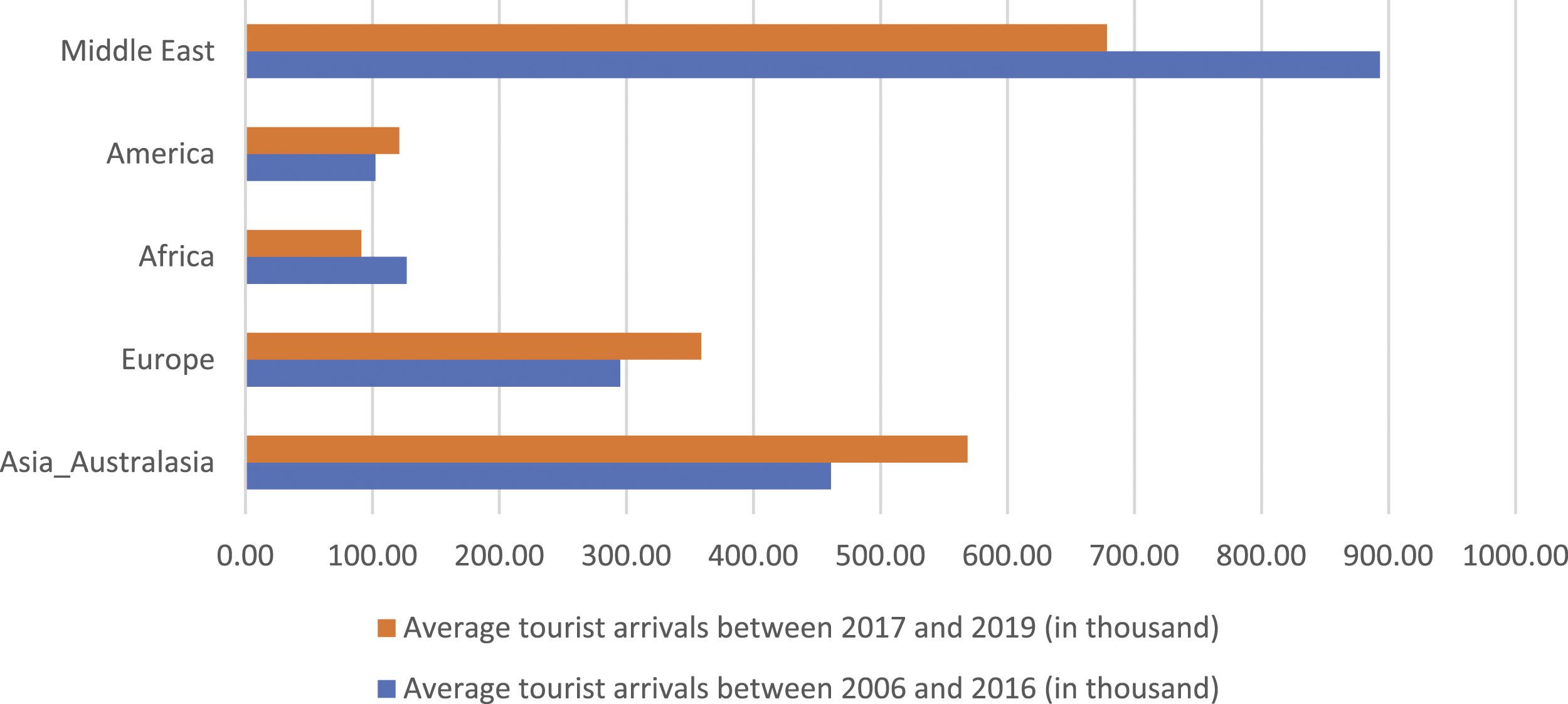
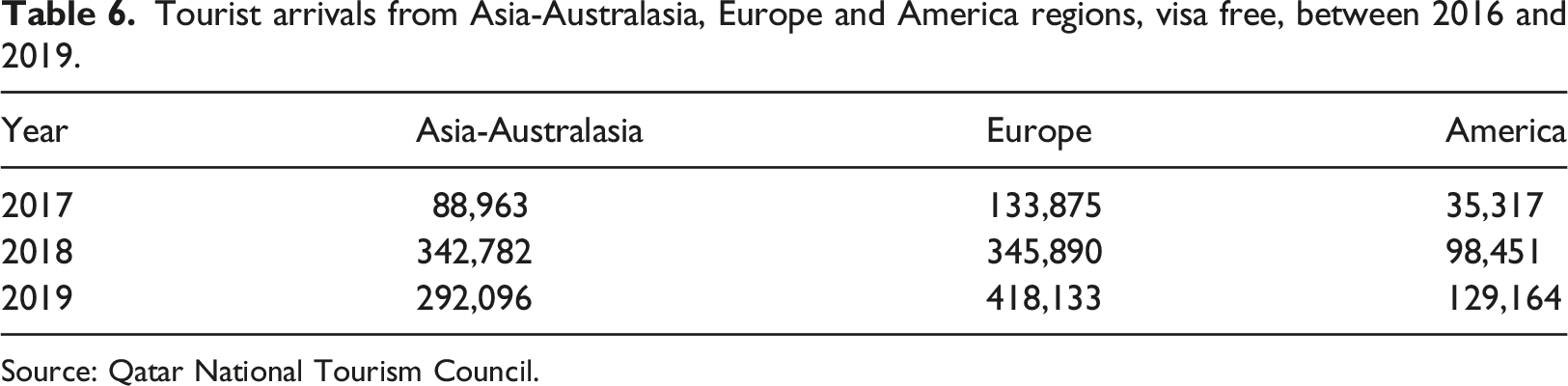
Qatar has positioned its tourism sector as being key to diversifying the country’s economy. However, despite the country’s tourism development ambitions, the industry encountered a substantial setback with the imposition of a blockade in 2017. The significant reduction in tourist arrivals due to the blockade can also be seen in Figure 1. However, Figure 2 shows how the average number of tourists from three regions grew during the 2017–2019 blockade period. In particular, the proportion of tourists from Asia rose from 22% in 2016 to 38% in 2019. International tourist arrivals and tourist expenditure in Qatar. Source: Euromonitor. Average tourist arrivals before and after the blockade by region. Source: Own calculation based on Euromonitor dataset.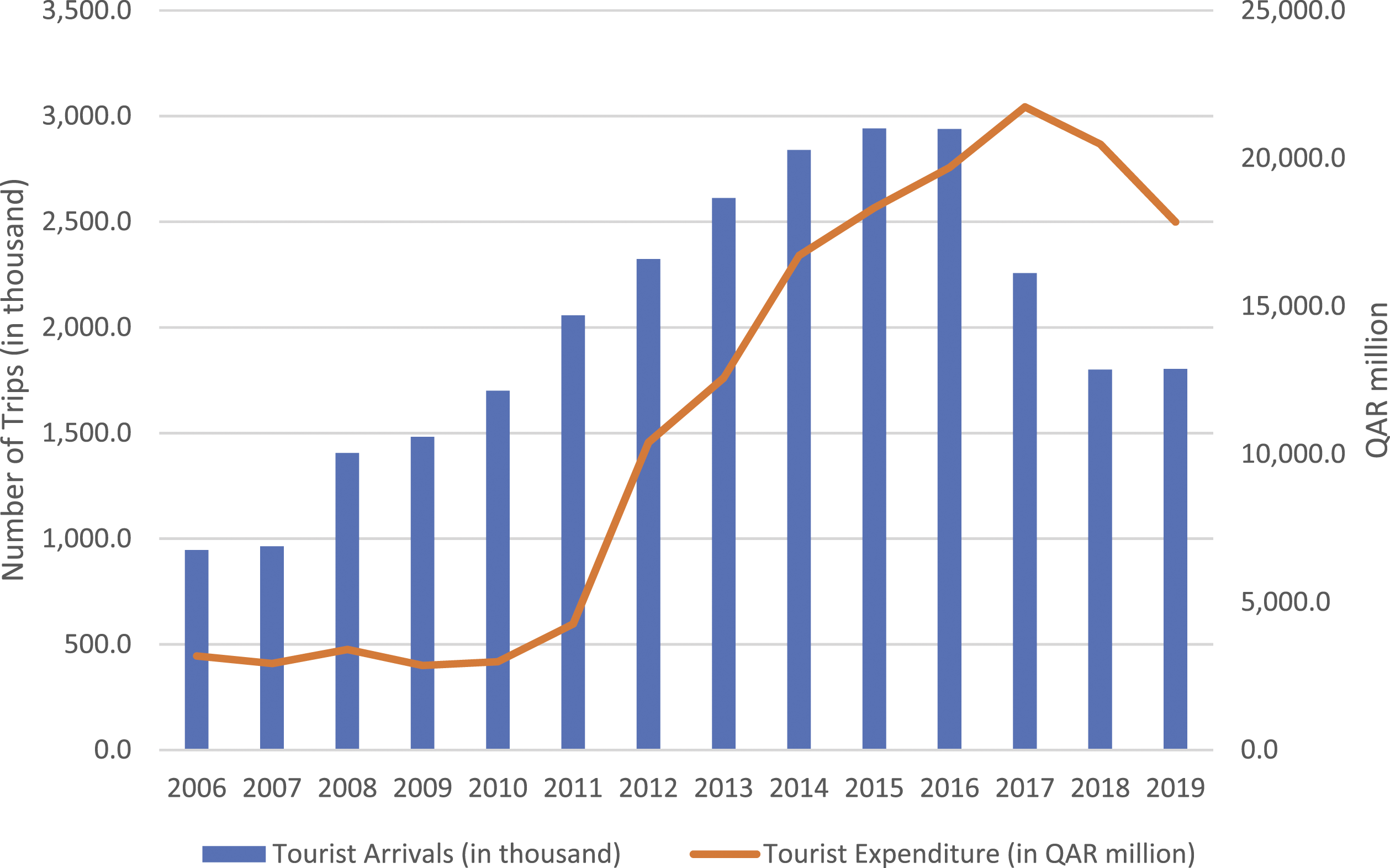
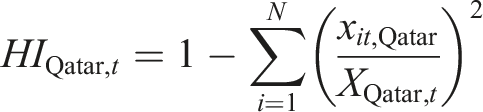
In the current paper, we modified the HI score suggested by Hinlo and Arranguez (2017) for the case of Qatar. The HI score measures the geographical diversification of tourism exports, and this is calculated as Herfindahl index (HI) score based on Qatar’s tourist arrivals and international tourism expenditure between 2006 and 2019. Source: Own calculations.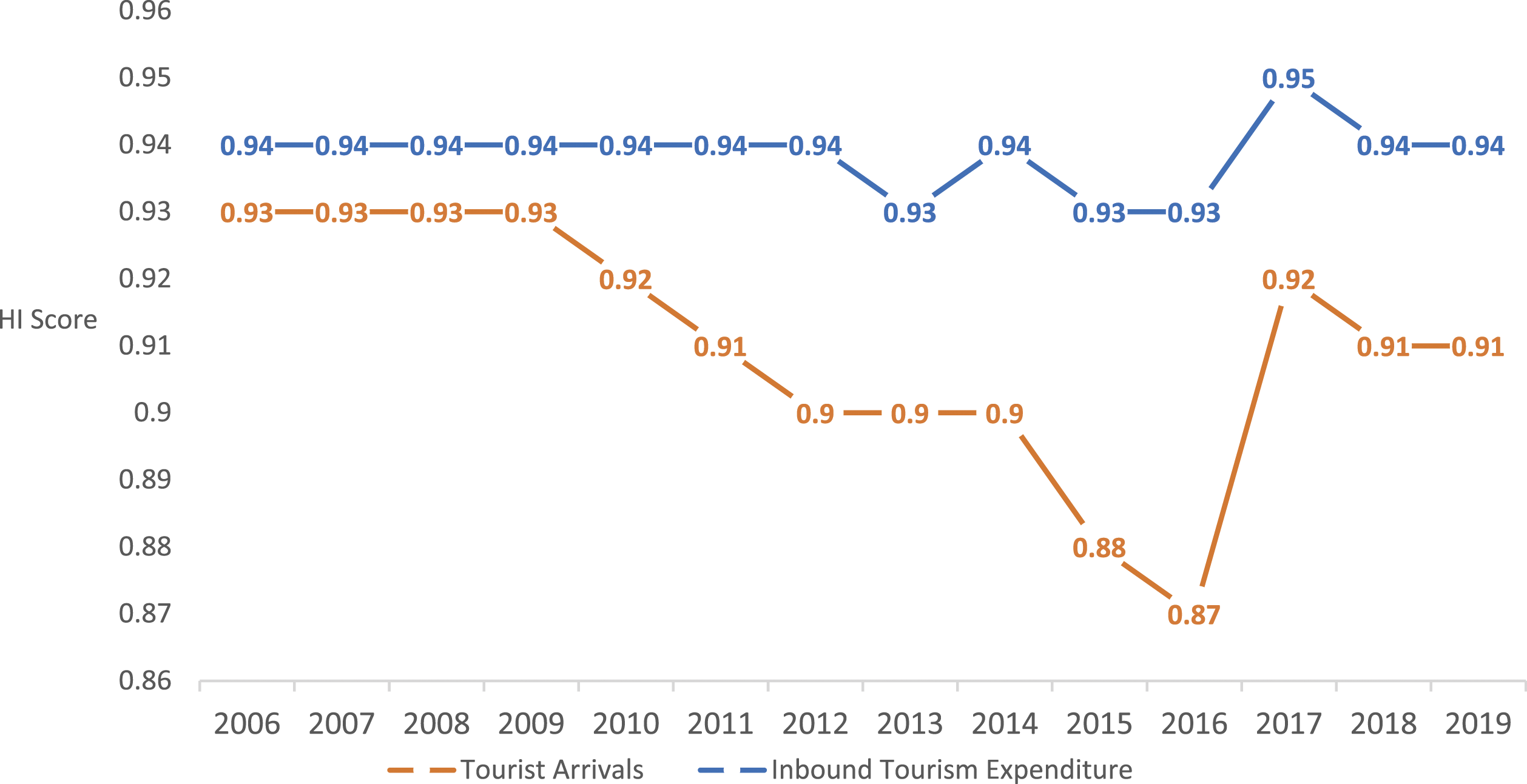
Empirical models and estimation methods
This research examines whether TMD could help mitigate the adverse effects of geopolitical events on a country’s tourism sector. We developed two augmented tourism-demand models presented below.
Augmented tourism-demand model 1:

Augmented tourism-demand model 2:

In the augmented tourism-demand model 1, the HI is used as a proxy variable for TMD, so both HI and
Despite our best efforts to include as many relevant explanatory variables as possible, it was not feasible to accommodate every single aspect due to the relatively small size of the time-series panel. To ensure consistency in the statistical analysis, we adopted differenced system GMM for this research because according to Roodman (2009), differenced system GMM provides better estimations for small T and large N panels. Roodman (2009) also highlighted several advantages to using differenced system GMM: First, the estimators can be dynamic, meaning that GMM allows for lagged dependent variables in the estimation process. Second, estimations modify the standard error of idiosyncratic errors, which may feature heteroscedasticity and serial correlation, using a two-step variance-estimation process. The GMM method not only reduces bias in estimations—it also increases the robustness of the standard errors. Furthermore, it allows the regressors to be endogenous.
Our augmented tourism-demand equations (1) and (2) can be expressed (in first-difference natural logarithms) as follows

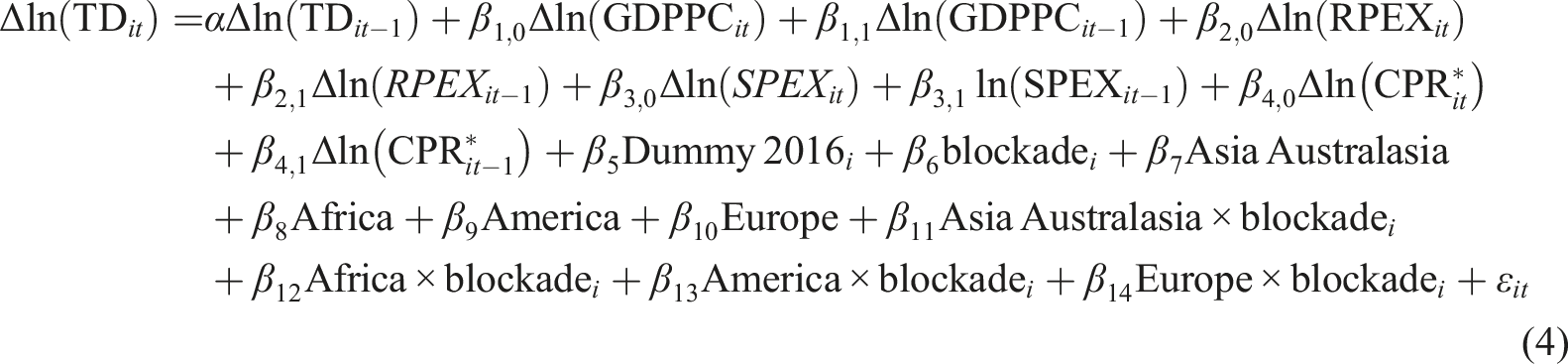
The interaction term in equation (3) measures the extent to which diversification can mitigate the loss of tourism resulting from the blockade. The marginal effects of TMD on tourism growth can be explained as follows




Data description
The augmented tourism-demand models include the following key economic indicators: tourists’ incomes, relative prices between the countries of origin and destination, substitute prices, and habit-persistence effects (Dogru et al., 2017; Song and Wong, 2008). We also constructed a dummy variable for the blockade, which was one between 2017 and 2019 and zero before 2016, to represent the years in which the blockade was, and was not, in place. In addition, international tourism flourished in Qatar in 2016, with it welcoming 2.9 million visitors, but this number plummeted to 2.14 million by 2019, following the blockade’s imposition. We therefore introduced the dummy variable Dummy2016, which was set at one for 2016 and zero for other years, to indicate the peak year for tourist arrivals before the decline began in 2017.
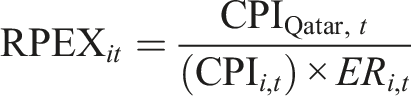
Price variables, relative prices, and substitute prices have been widely used in the literature. Akis (1998) and Dogru et al. (2017) have suggested that relative prices should be standardized according to the exchange rate to reflect tourists’ relative purchasing power when visiting a destination. Relative prices were therefore adjusted for the exchange rate (RPEX), and this can be expressed as

According to Nazmfar et al. (2019), Qatar faces strong competition from Egypt, Jordan, the United Arab Emirates, Saudi Arabia, and Turkey, all of which have an established presence in international tourism. In this research, we consider them to be Qatar’s main competing destinations for three reasons: First, these destinations are geographically close to Qatar, and second, their cultural and religious practices are similar. Third, these countries, excluding Turkey, also have rather similar physical (e.g., mosques) and environmental (e.g., weather) conditions.
This study also incorporated perceived corruption into the model as an origin–destination characteristic variable. Corruption perception is an essential indicator for capturing the institutional aspects of a country, as has been mentioned in the tourism-demand literature (Saha and Yap, 2015; Poprawe, 2015). Saha and Yap (2015), for example, argued that corruption is often rife in developing countries because state policymakers control resource mobility and preside over local and regional tourism-development planning. In contrast, limiting corruption promotes competition and gives entrepreneurs the economic freedom to pursue business activities (Saha and Sen, 2020). In other words, a low level of corruption helps businesses to flourish, and prices are reduced through increased competition. It is therefore vital to explore the effects of corruption on Qatar’s international tourism, especially as Qatar’s corruption perception ranking (CPR) is relatively low, being ranked 30 out of 180 in 2020, 1 although corruption in the country is recognized as a risk for international tourists (Nair, 2013).
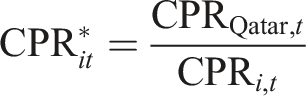
However, including an absolute measure of CPR for Qatar may not accurately reflect how Qatar’s level of corruption really influences the choices of international travelers when considering Qatar as a travel destination. Uriely (2005) argued that the concept of relative truth should be emphasized in tourism research. Positioning this within the context of economic modeling for tourism, it is perhaps more appropriate to consider the relative differences between Qatar’s CPR and those of the various countries of origin in this research because this could help explore whether such differences play a significant role in the demand for Qatari tourism. Thus, the CPR variable used in this study was based on a relative measure, which can be specified as follows
Secondary data were acquired from various international institutions, such as Euromonitor International, the International Monetary Fund, and the World Bank. In this study, two types of data were used as proxies for tourism demand: the number of international tourist arrivals (TA) and international tourists’ expenditure (TE) in Qatar. The data were based on an unbalanced yearly panel of 549 observations with 46 countries of origin from 2006 to 2019. All the explanatory variables, except for the dummy variables, were transformed into natural logarithms, so the coefficients could be interpreted in the form of elasticities. The descriptions for the independent variables and their expected coefficient signs can be found in the Supplemental file.
Before conducting the panel data analysis, the variables needed to be shown to follow a stationary process to avoid the issue of spurious regression. This research therefore adopted the test statistic of Im et al. (2003) because it allows individual processes to vary across the cross-section. The null hypothesis is that the variables contain a unit root.
Results of Im-Pesaran-Shin unit root test.
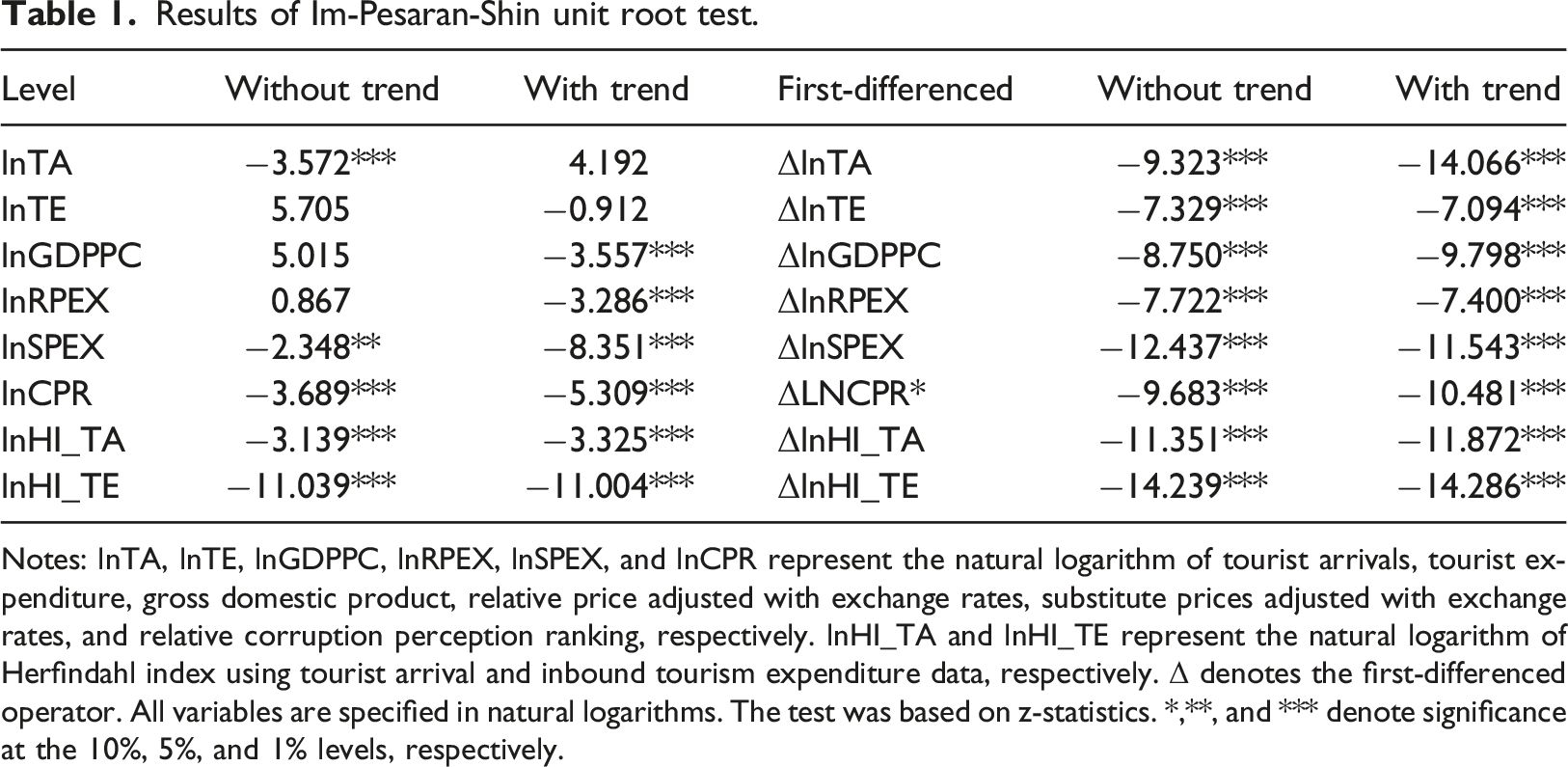
Notes: lnTA, lnTE, lnGDPPC, lnRPEX, lnSPEX, and lnCPR represent the natural logarithm of tourist arrivals, tourist expenditure, gross domestic product, relative price adjusted with exchange rates, substitute prices adjusted with exchange rates, and relative corruption perception ranking, respectively. lnHI_TA and lnHI_TE represent the natural logarithm of Herfindahl index using tourist arrival and inbound tourism expenditure data, respectively. Δ denotes the first-differenced operator. All variables are specified in natural logarithms. The test was based on z-statistics. *,**, and *** denote significance at the 10%, 5%, and 1% levels, respectively.
Empirical results
Empirical analysis of Herfindahl index and its moderation effects.
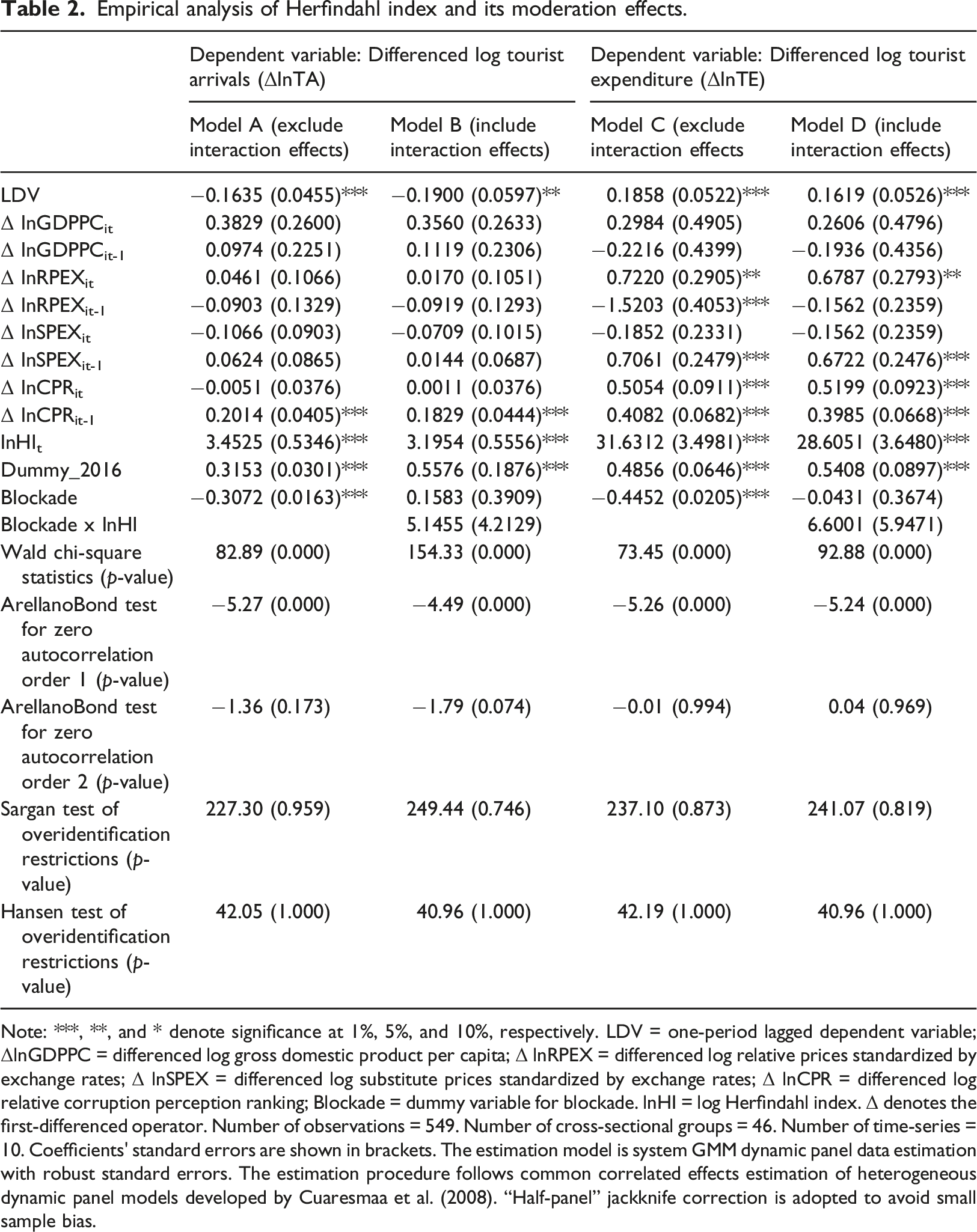
Note: ***, **, and * denote significance at 1%, 5%, and 10%, respectively. LDV = one-period lagged dependent variable; ΔlnGDPPC = differenced log gross domestic product per capita; Δ lnRPEX = differenced log relative prices standardized by exchange rates; Δ lnSPEX = differenced log substitute prices standardized by exchange rates; Δ lnCPR = differenced log relative corruption perception ranking; Blockade = dummy variable for blockade. lnHI = log Herfindahl index. Δ denotes the first-differenced operator. Number of observations = 549. Number of cross-sectional groups = 46. Number of time-series = 10. Coefficients' standard errors are shown in brackets. The estimation model is system GMM dynamic panel data estimation with robust standard errors. The estimation procedure follows common correlated effects estimation of heterogeneous dynamic panel models developed by Cuaresmaa et al. (2008). “Half-panel” jackknife correction is adopted to avoid small sample bias.
Robustness check of Herfindahl index and its interaction effect using maximum likelihood estimation of random-effects models.
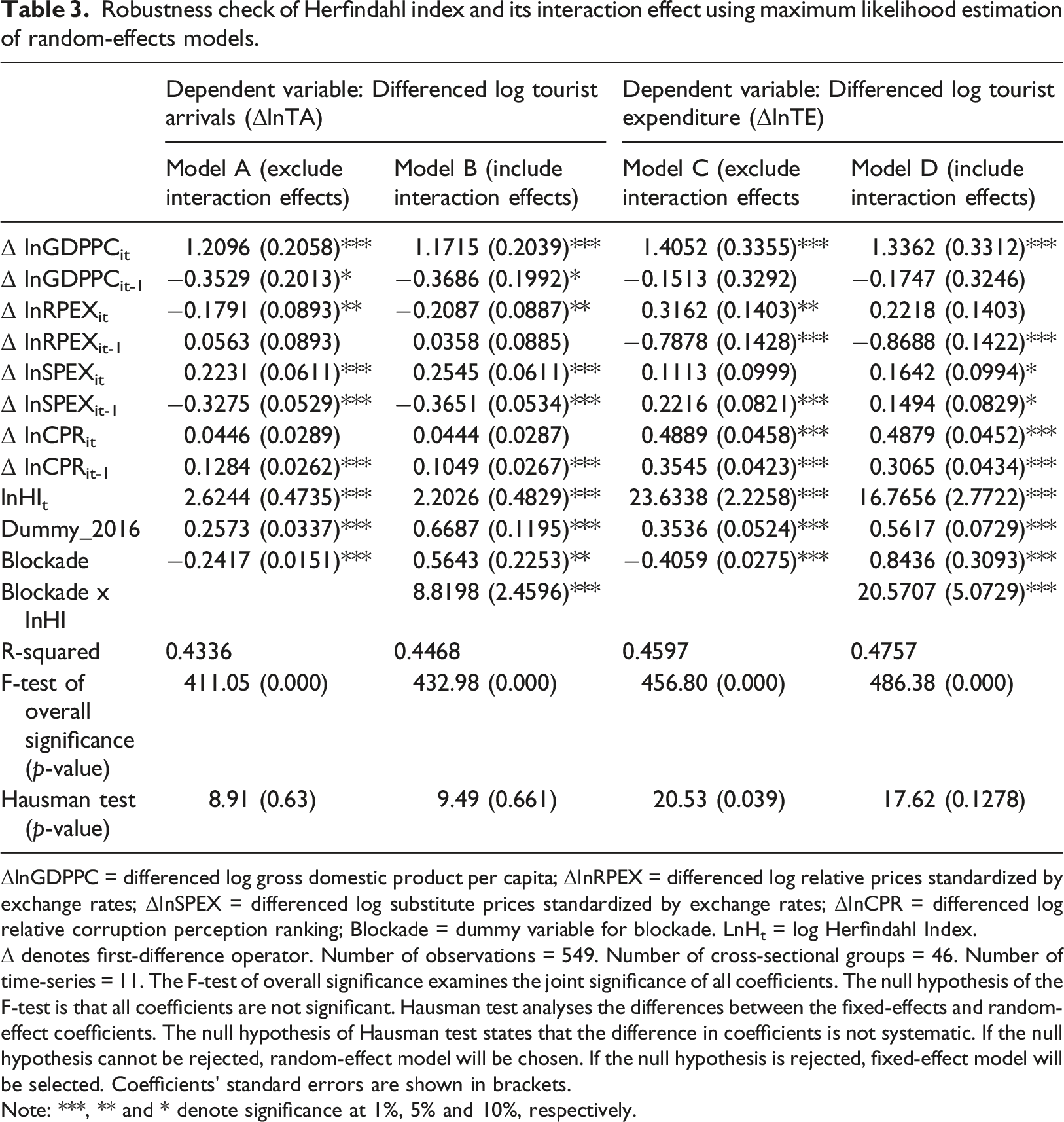
ΔlnGDPPC = differenced log gross domestic product per capita; ΔlnRPEX = differenced log relative prices standardized by exchange rates; ΔlnSPEX = differenced log substitute prices standardized by exchange rates; ΔlnCPR = differenced log relative corruption perception ranking; Blockade = dummy variable for blockade. LnHt = log Herfindahl Index.
Δ denotes first-difference operator. Number of observations = 549. Number of cross-sectional groups = 46. Number of time-series = 11. The F-test of overall significance examines the joint significance of all coefficients. The null hypothesis of the F-test is that all coefficients are not significant. Hausman test analyses the differences between the fixed-effects and random-effect coefficients. The null hypothesis of Hausman test states that the difference in coefficients is not systematic. If the null hypothesis cannot be rejected, random-effect model will be chosen. If the null hypothesis is rejected, fixed-effect model will be selected. Coefficients' standard errors are shown in brackets.
Note: ***, ** and * denote significance at 1%, 5% and 10%, respectively.
Empirical analysis of regional dummies and their interaction effects.
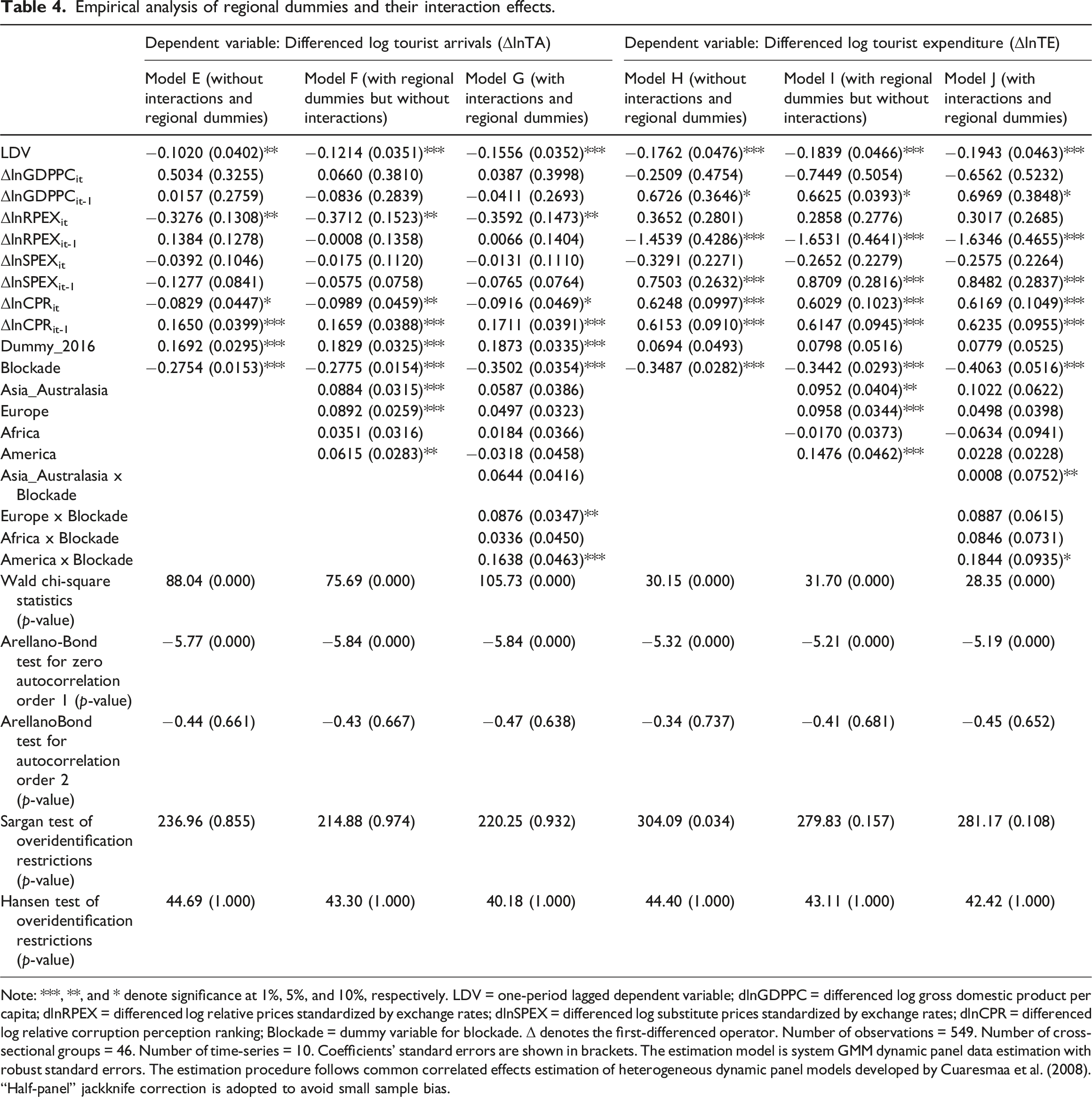
Note: ***, **, and * denote significance at 1%, 5%, and 10%, respectively. LDV = one-period lagged dependent variable; dlnGDPPC = differenced log gross domestic product per capita; dlnRPEX = differenced log relative prices standardized by exchange rates; dlnSPEX = differenced log substitute prices standardized by exchange rates; dlnCPR = differenced log relative corruption perception ranking; Blockade = dummy variable for blockade. Δ denotes the first-differenced operator. Number of observations = 549. Number of cross-sectional groups = 46. Number of time-series = 10. Coefficients' standard errors are shown in brackets. The estimation model is system GMM dynamic panel data estimation with robust standard errors. The estimation procedure follows common correlated effects estimation of heterogeneous dynamic panel models developed by Cuaresmaa et al. (2008). “Half-panel” jackknife correction is adopted to avoid small sample bias.
Robustness check of regional dummies and their interaction effects using maximum likelihood estimation of random-effects models.
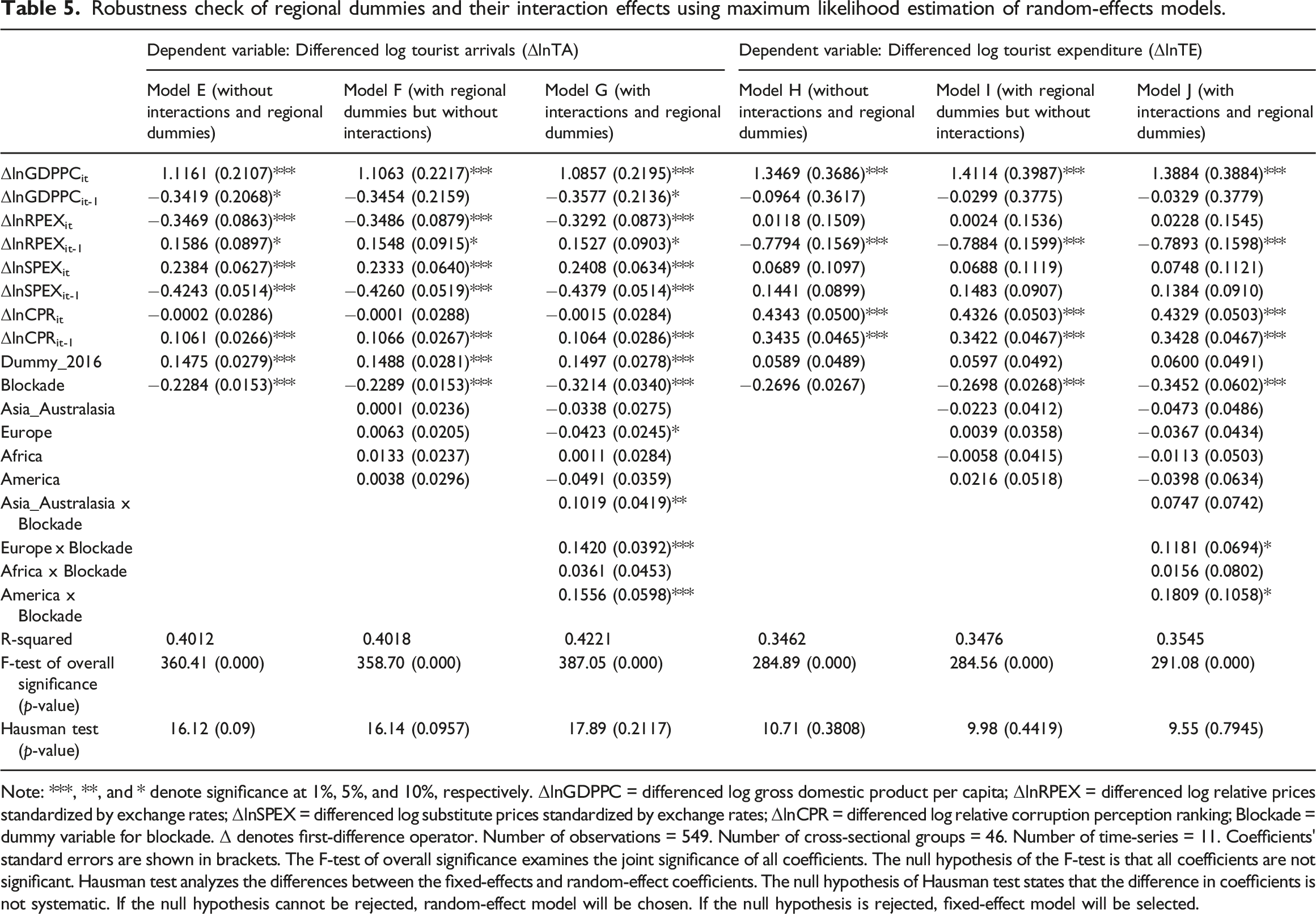
Note: ***, **, and * denote significance at 1%, 5%, and 10%, respectively. ΔlnGDPPC = differenced log gross domestic product per capita; ΔlnRPEX = differenced log relative prices standardized by exchange rates; ΔlnSPEX = differenced log substitute prices standardized by exchange rates; ΔlnCPR = differenced log relative corruption perception ranking; Blockade = dummy variable for blockade. Δ denotes first-difference operator. Number of observations = 549. Number of cross-sectional groups = 46. Number of time-series = 11. Coefficients' standard errors are shown in brackets. The F-test of overall significance examines the joint significance of all coefficients. The null hypothesis of the F-test is that all coefficients are not significant. Hausman test analyzes the differences between the fixed-effects and random-effect coefficients. The null hypothesis of Hausman test states that the difference in coefficients is not systematic. If the null hypothesis cannot be rejected, random-effect model will be chosen. If the null hypothesis is rejected, fixed-effect model will be selected.
The HI coefficients are positive and highly significant, indicating that the more diversified tourism markets are, the greater the number of tourist arrivals and tourism revenue. This result is consistent with the study of Can and Gozgor (2018), who found that tourism market diversification led to tourism growth in Egypt and Greece.
Furthermore, the interaction terms for the HI and the blockade in models B and D have positive signs, implying that diversification led to tourism growth in Qatar during the blockade. Nevertheless, the adverse effects of the blockade presented a serious impediment to the progress of tourism market diversification. Our study shows that the interaction term for the HI and the blockade is only highly significant for both tourist arrivals and inbound tourism expenditure when the maximum likelihood estimation of the random-effects model is used, while the coefficient is insignificant for the GMM panel data estimations. There is therefore some evidence to support our second hypothesis that TMD presents a means of overcoming the crisis in terms of tourism growth. In other words, TMD may not be fully effective due to the powerful negative effects of the blockade. Indeed, the damaging effects of the incident were so severe that TMD could not significantly mitigate their negative impacts.
This result is consistent with the fact that not all tourists will be able to evade the negative impacts of a blockade, despite the Qatari government implementing strategies to diversify its tourism markets. According to BBC News (19 July 2017), countries such as Saudi Arabia, the UAE, Bahrain, and Egypt closed their airspace to Qatari aircraft during the blockade, forcing Qatar Airways to cancel its flights to 18 regional cities. With these airspace restrictions, Qatar Airways was unable to transport many international travelers to Qatar.
Next, we identified the regions that could generate tourism growth during the blockade. The results in Tables 4 and 5 show that the coefficients for the Asia and Australasia, Europe, and the Americas variables were positive, so they had significant effects on Qatari tourism, despite the blockade coefficient remaining negative and highly significant. Furthermore, the interaction effects of the regional dummies with the blockade (Model G) are positive (0.0876 and 0.1638, respectively, in Table 4) and significant at the 5% and 1% levels of significance for Europe and the Americas, indicating a net gain in tourist arrivals from these regions before and after the blockade.
Tourist arrivals from Asia-Australasia, Europe and America regions, visa free, between 2016 and 2019.
Source: Qatar National Tourism Council.
The results in Table 4 also illustrate that during the 2017–2019 blockade period, the blockade’s impact on overall international tourist arrivals was negative, but the effect was less severe for tourists coming from Europe (−0.3502 + 0.0876= −0.2626) and the Americas (−0.3502 + 0.1638= −0.1864) than it was for visitors from the Middle East and Africa (−0.3502). Moreover, the negative coefficient of the blockade variable is greater than that of the interaction dummies. When we set blockade = 1 and Europe = 1, the expected change in the log of tourist arrivals from Europe was −0.1885 (−0.3502 + 0.0497 + 0.0876 = −0.1885). Similarly, the expected change in the log of tourist arrivals when blockade = 1 and America = 1 was −0.2182 (−0.3502 –0.0318 + 0.1638=−0.2182). In other words, while there was a decline in average tourist flows from European and American countries during the blockade, based on the findings, we can confirm that the adverse effects of the blockade were mitigated to an extent given the positive interaction terms for the Americas and Europe. The interaction effects for model J were also very similar to those of model G, as can be seen in Table 5.
The results confirm the severe effects of the blockade on the demand for Qatari tourism, both in terms of TA and TE. In other words, the blockade severely damaged Qatari tourism, and even the gradual growth in visitor numbers from other regions could not fully restore the tourism sector to its pre-blockade level. Furthermore, the available evidence cannot adequately lead us to conclude that TMD can significantly mitigate the loss in tourist arrivals and revenue during the blockade, mostly due to the sheer magnitude of the blockade’s effects.
The coefficient for lagged growth in tourist arrivals is negative and significant at a 5% level of significance, indicating a catch-up effect where negative growth in tourist arrivals in a previous year enhances tourist growth numbers for the subsequent year in Qatar. Thus, the estimates confirm the convergence theory of growth (Cuaresmaa et al., 2008), which also applies to the tourism sector (Haller et al., 2021). The catch-up effect retains the same sign but with a higher significance level for models E–J, as can be seen in Table 4.
The coefficients for the GDP per capita growth variable show the expected sign, indicating that higher incomes in a country of origin increase the ability of that country’s people to travel, resulting in more of them visiting Qatar. The coefficients are not significant, however.
On the other hand, a negative sign for relative tourism prices (RPEX) indicates that the higher the RPEX is, the lower the demand for Qatari tourism will be, and vice versa. Interestingly, in models E-G, as shown in Tables 4 and 5, the RPEX coefficient is negative and significant at a conventional level only for the current period, suggesting that relative tourism prices for the current year matter more than those of the previous year. Likewise, the coefficients for changes in substitute prices (SPEX) are negative but not significant. Nevertheless, Qatar’s inbound tourism declines when its consumer price index is comparatively higher than those of competing destinations because Qatar is then seen as an expensive destination compared to its competitors. The negative effect of substitute prices does not depend on time.
The relative measure of perceived corruption yielded some interesting results: First, the coefficients for relative perceived corruption are negative and significant at a conventional level of significance. In other words, a higher level of corruption in the country of origin means more of that country’s people are attracted to visiting Qatar because it is viewed as a less corrupt nation, and tourists perhaps believe they are less likely to be “ripped off.” Interestingly, the lagged corruption coefficient is positive and statistically significant, so when Qatar is persistently perceived as being more corrupt than a country of origin, it actually increases tourism income flows. This finding is consistent with that of Saha and Yap (2015), who argued that corruption can favor developing countries by greasing the wheels of the economy through bribes to help firms bypass onerous public policies and thus stimulate the tourism industry. Interestingly, the positive effect of corruption on TE seems to support the above argument.
The dummy variable for tourism data in 2016 was positive and highly significant, indicating that the average number of tourist arrivals from the 46 considered countries did increase significantly from 2006 and reached a peak in 2016 (see Figure 1). All models pass the test for the absence of AR (2) in the error term, and the estimates are all robust. Nevertheless, the AR (2) test results suggest that the models with two lags perform better than those with one lag.
Conclusions and further implications
Theoretical implications
This study has explored the extent to which political sanctions can deleteriously affect a country’s inbound tourism, even when a government has a tourism market diversification policy in place. Based on the empirical data, we performed interaction analysis to estimate the marginal impact of TMD on tourism demand during the blockade of Qatar by other GCC countries. In addition, based on an interaction analysis between the other tourism markets that were not involved in the blockade of Qatar, as represented by dummy variables in the tourism-demand model, the study found that these markets could be leveraged to mitigate the harmful effects of the blockade.
The study advances existing knowledge by contributing to the existing literature in three important ways. First, prior research has estimated how foreign travel restrictions imposed by a destination affect its own inbound tourism demand. In contrast, this study has investigated the impact of an unfavorable political event (i.e., the blockade of Qatar) that was instigated by the tourists’ countries of origin (i.e., the other GCC countries) on international travel to a destination (i.e., Qatar).
Second, we further studied whether TMD strategies could alleviate the harmful effects of the blockade on inbound tourism demand using interaction analysis. To the best of our knowledge, this paper is the first effort to explore this research direction. Indeed, modeling and estimating a TMD strategy and establishing its robustness for alleviating the adverse consequences of a blockade on a country’s tourism sector is both novel and utilitarian.
The third key contribution of this study is highlighting the effect of environmental hostility on international tourism and how TMD can potentially offset such hostility. Political sanctions and blockades create hostile environments for tourism development by portraying the sanctioned country as a precarious tourism destination. Such events can diminish inbound tourist arrivals and the associated revenues, especially from the countries imposing the sanctions, and this in turn reduces the quality of life for the citizens of the target country and creates a challenging business climate for tourism-related industries. The drop in inbound tourist arrivals and spending means that firms must compete for the business of a lower number of potential customers. Nevertheless, such environments are also often associated with opportunities for firms to expand their market share and earn greater profits through diversification and service innovation (Ndubisi et al., 2015). When competition is extremely intense, organizations typically turn their attention to differentiation strategies where they leverage their unique competencies, such as service innovation (Ndubisi et al., 2020) and market diversification (TMD in the present case). By considering the theoretical ramifications of political and environmental hostility, as well as how TMD can moderate its effect on performance in the tourism sector, this study adds to the extant literature on tourism economics, environmental hostility and munificence, and their interfaces.
Managerial and policy implications
The research adopted Qatar as a case study for investigation because the country had been investing significantly in the tourism industry over the last 10 years, but the blockade then raised serious concerns about the resilience of this industry. This study found that the coefficients for Asia and Australasia, Europe, and the Americas were positive and statistically significant, indicating that tourist arrivals from these regions increased during the blockade. However, the estimation results also confirmed the severe adverse effect of the blockade, and changes in the log of tourist arrivals expectedly declined. Therefore, based on our case study, it is clear that a blockade or political sanction can severely impact tourism development. Furthermore, using the HI as an indicator of diversification and interacting it with the blockade variable, only two out of four cases showed positive and significant interaction terms. This finding supports the notion that diversification strategies could successfully mitigate the adverse effects of a blockade on tourism demand. Thus, managers and government policymakers in countries at risk of blockades, sanctions, and other hostile geopolitical acts can turn to tourism portfolio diversification by targeting travelers from neutral countries or regions, especially those that may be sympathetic toward the sanctioned nation.
There seems to be a dearth of discussion in practitioner and policy publications on how geopolitical incidents like sanctions and blockades can lead to losses in tourism revenue, as well as how managers and policymakers in a target country can respond to such events and ameliorate the adverse implications for socioeconomic development. Our research suggests some feasible strategies and tools for practitioners and policymakers to consider. Firstly, this study broadens our understanding of how an unfavorable geopolitical incident can affect the target country. Secondly, it provides a holistic view of how such events have negative spillover effects for tourism development. Thirdly, it suggests that managers and policymakers can use diversification as an effective intervention to mitigate this damage.
A blockade or sanction is undeniably detrimental to tourism development in the target country, but it remains unknown as to whether such incidents damage the long-term bilateral trade relations between the sanctioning and sanctioned countries. As Kirshner (1997) stressed, when a state designs a sanction for another country, the cost of imposing it may outweigh the political benefits of the desired outcome. For instance, Yang et al. (2004) reported that when the US imposed high-tech export controls and import tariffs on China, these sanctions hurt the US economy more than they did China’s economy in 2000, causing nearly 1.3 million job losses in the USA but only 461,745 in China.
Future research
In our research, we introduced a HI score for the geographical diversification of tourism exports and used it as a proxy for TMD. Future research could also adopt the HI score to measure the degree of geographical diversification for the tourism markets of other destinations.
Moreover, this study applied quantitative analysis to predict the detrimental effects of a political event on international tourism, and it employed interaction analysis to estimate the effects of the blockade on tourist arrivals from regions that were not directly involved in the event. Future studies could apply this study’s model to other geopolitical contexts such as the Russia–Ukraine relations, and other instances of environmental hostility, to assess the consequences for local, regional, and international tourism performance.
Furthermore, our study is limited in terms of data availability because it is based on a single country (the target of the blockade). In the existing tourism literature, there seems to be a lack of research and discussion about how similar political incidents can cause a loss of tourism revenue for the imposing countries. The research into the interactional impacts of TMD and political events on tourism demand could be extended to a cross-country analysis by including the blockade or sanction imposing countries. As such, we recommend that future studies focus on the “reverse effects” of the blockade on the imposing countries, namely, the other GCC countries.
Ex-post evaluations of both the imposing countries and the blockaded country is also necessary. The goal of such an investigation would be to evaluate changes in the political, regulatory, sociocultural, and economic ties among the involved nations since the lifting of the blockade, as well as determine the trajectory for intra-regional tourism after the blockade.
The recent pandemic brought another type of blockade in the form of travel bans and restrictions, with adverse consequences for local and international tourism. For example, Qatar has grouped countries into three categories (the exceptional red, the red, and the green zone) based on international and local health risk indicators and the epidemiology of COVID-19 in the different countries. The unvaccinated tourists from the red and the exceptional red lists are not free to enter Qatar. Other countries have similar lists and conditions. More recently, Southern African travelers have been blocked from entering many countries due to the discovery of Omicron variant of COVID-19. So, pandemic- and other public health-related blockades/bans and the impact on local and international tourism are interesting future research directions, and it would be interesting to see how our model performs in such contexts.
Last but not least, there is need for future research on the link between blockade (including in war times) and UN Sustainable Development Goal (SDG) of Zero Hunger. A classic example is the 1967–1970 Biafra-Nigeria civil war, where Britain and Russia fought on the side of Nigeria. It was not the combined military assault of the triad, but the food blockade that took more civilian lives (especially children) in Biafra (for graphic images of the blockaded-induced hunger and starvation, see https://www.gettyimages.ae/photos/starving-biafran). We recommend a historic research design for future research in this area. We also propose that more studies investigating other nuances of environmental hostility, blockade, and political sanction will add value and push back the frontier of knowledge in the field.
Supplemental material
sj-pdf-1-teu-10.1177_13548166211070742.pdf – Supplemental Material for Can tourism market diversification mitigate the adverse effects of a blockade on tourism? Evidence from Qatar
Supplemental Material, sj-pdf-1-teu-10.1177_13548166211070742.pdf for Can tourism market diversification mitigate the adverse effects of a blockade on tourism? Evidence from Qatar by Ghialy Yap, Shrabani Saha, Nelson O Ndubisi, Saif S Alsowaidi, and Ali S Saleh in Tourism Economics
Footnotes
Acknowledgment
We acknowledge the work of our research assistants, Fathma Mehjabin and Lolwa Ali Malki. We are also thankful to the two anonymous referees for their valuable comments which improved the paper significantly.
Declaration of conflicting interests
The author(s) declared no potential conflicts of interest with respect to the research, authorship, and/or publication of this article.
Funding
The author(s) disclosed receipt of the following financial support for the research, authorship, and/or publication of this article: This research is an outcome of grant # [NPRP12S-0214–190086] from the Qatar National Research Fund (a member of the Qatar Foundation). The findings reflected this work are solely the responsibility of the authors
Supplemental Material
Supplemental material for this article is available online.

Note
Appendix
Countries that grant immediate visas upon arrival to Qatar.
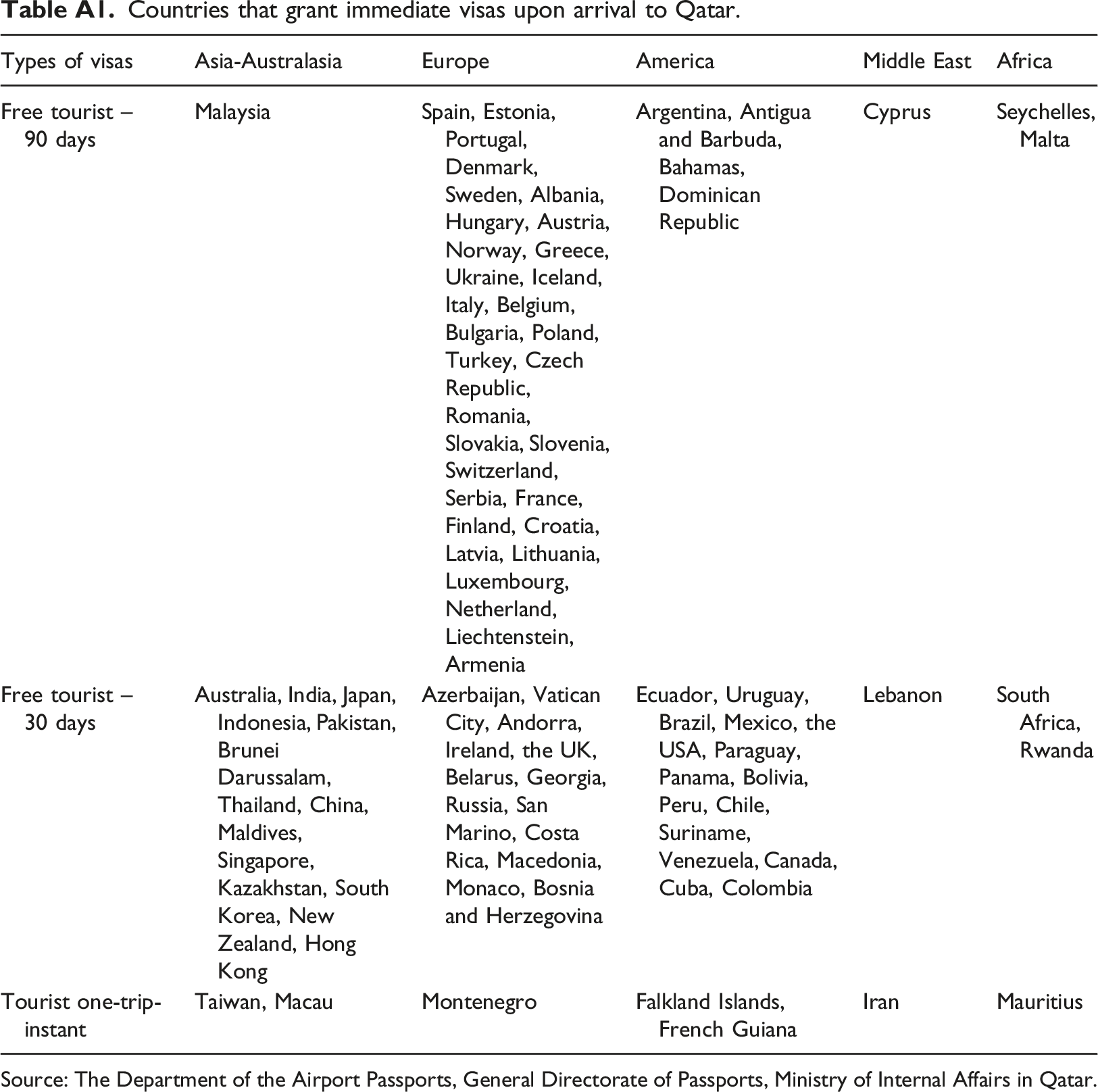
| Types of visas | Asia-Australasia | Europe | America | Middle East | Africa |
|---|---|---|---|---|---|
| Free tourist – 90 days | Malaysia | Spain, Estonia, Portugal, Denmark, Sweden, Albania, Hungary, Austria, Norway, Greece, Ukraine, Iceland, Italy, Belgium, Bulgaria, Poland, Turkey, Czech Republic, Romania, Slovakia, Slovenia, Switzerland, Serbia, France, Finland, Croatia, Latvia, Lithuania, Luxembourg, Netherland, Liechtenstein, Armenia | Argentina, Antigua and Barbuda, Bahamas, Dominican Republic | Cyprus | Seychelles, Malta |
| Free tourist – 30 days | Australia, India, Japan, Indonesia, Pakistan, Brunei Darussalam, Thailand, China, Maldives, Singapore, Kazakhstan, South Korea, New Zealand, Hong Kong | Azerbaijan, Vatican City, Andorra, Ireland, the UK, Belarus, Georgia, Russia, San Marino, Costa Rica, Macedonia, Monaco, Bosnia and Herzegovina | Ecuador, Uruguay, Brazil, Mexico, the USA, Paraguay, Panama, Bolivia, Peru, Chile, Suriname, Venezuela, Canada, Cuba, Colombia | Lebanon | South Africa, Rwanda |
| Tourist one-trip-instant | Taiwan, Macau | Montenegro | Falkland Islands, French Guiana | Iran | Mauritius |
Source: The Department of the Airport Passports, General Directorate of Passports, Ministry of Internal Affairs in Qatar.
Author biographies
References
Supplementary Material
Please find the following supplemental material available below.
For Open Access articles published under a Creative Commons License, all supplemental material carries the same license as the article it is associated with.
For non-Open Access articles published, all supplemental material carries a non-exclusive license, and permission requests for re-use of supplemental material or any part of supplemental material shall be sent directly to the copyright owner as specified in the copyright notice associated with the article.
