



Abstract
This study estimates the effect of official development assistance (ODA) on tourism demand of recipient countries for donor countries. We analyzed a panel dataset of 15 recipient countries of Switzerland’s aid from 2005 to 2017, for which data are available. We used both tourist arrivals at lodging establishments, particularly hotels, in Switzerland and hotel nights as proxies for recipient countries’ tourism demand in Switzerland. Using a modified gravity model of trade for empirical testing, we found that an increase of every US$1000 ODA to recipient countries would generate 3.6 tourist arrivals and almost four hotel nights in the following year, after controlling for the effects of GDP and population of recipient countries, the exchange rate and the distance between recipient countries and Switzerland, and trade facilitators. We conclude that ODA generates a positive externality on donor countries, namely, that recipient countries incline to increase their imports from donor countries, at least partially in the form of inbound tourism in donor countries.
Introduction
Official development assistance, colloquially known as foreign aid or international aid, has been one of the most important international transfers primarily from developed countries to the least developed countries in the aftermath of World War II. The war-torn Europe itself had, since the 1950s, been a beneficiary of foreign aid from the United States through the Marshall Plan. Besides its political goals, the Marshall Plan aimed to reestablish the post-war Europe and bolster the US influence on Europe. Over the period 1948–1951, 16 European countries received around US$13.3 billion of aid from the US, equivalent of US$143 billion in 2017, mainly in the form of grants (general procurement) for commodity assistance (Tarnoff, 2018). These aid by and large restored the post-war international order across Europe and laid a foundation for the growth of the European economy between 1950 and 1980. On the other hand, Western European countries today are among the largest donors of foreign aid, which on average accounted for 0.53% of their gross national income (GNI), amounting to US$89.3 billion in 2017. Switzerland alone contributed to US$3.1 billion in foreign aid in 2017, equivalent to 0.47% of its GNI. Switzerland is also one of the largest donor countries in terms of per capita GNI and disburses its aid to as many as 100 countries mainly in Africa and Asia.
To be considered ODA, aid flows must comply with the Development Assistance Committee requirements, yet donor countries are entitled to choose recipient countries and the form of ODA. The Organisation for Economic Co-operation and Development (OECD) considers eight different sectors or categories in which ODA is allocated: social infrastructures, economic infrastructure, production, multisector, program assistance, debt relief, humanitarian aid, and unspecified. Except for debt relief which must be in the form of financial flows, ODA in other seven categories can take the form of either financial flows or goods and services transfer from donor countries to recipient countries. The largest share of ODA is allocated in the category of social infrastructures. According to the OECD, ODA in this category “covers efforts to develop the human resource potential and ameliorate living conditions in aid recipient countries.” The economic impact of ODA on both recipient and donor countries may differ by the category of ODA. However, to examine the impact of ODA thoroughly, considering ODA as a whole is a more accurate treatment in economic analysis because there are undoubtfully spillover effects between different categories.
There is little doubt that foreign aid was instrumental in boosting economic development and social prosperity in the post-war Europe. The efficacy of foreign aid can be attributed to the stellar economic growth in Western Europe since the 1950s. Nevertheless, there is a debate in the literature on whether current foreign aid from developed countries to developing countries lives up to the goals of stimulating economic growth and ameliorating living conditions in recipient countries. Indeed, while foreign aid may be effective in the short run, divergent opinions exist regarding its effectiveness in boosting economic growth in the long run. Despite having received a considerable amount of foreign aid from donor countries such as the US, Europe, and Japan, many developing countries have not lived up to the economic growth that European recipient countries obtained in the period 1950–1980 due to the Marshall Plan. Of course, unlike European countries in the 1940s and 1950s, developing countries over the past decades have relied on foreign aid primarily for poverty alleviation, the efficacy of which thus depends also on the functioning of macroeconomic and political institutions in recipient countries (Burnside and Dollar, 2000). Because donor countries also impose many restrictions on how aid is deployed, the efficiency of ODA may be undermined. For instance, foreign aid is used disproportionately to finance infrastructure development in recipient countries, which entails good governance and institutions to ensure the success. However, there is a lack of good governance and institutions in many developing countries.
In this study, we are interested to understand how foreign aid affects the economy of donor countries through subsequent bilateral trade, particularly tourism trade, between recipient countries and donor countries. There are three main reasons why foreign aid may affect the economy of donor countries, a research direction we subscribe to yet contrasts with conventional wisdom that foreign aid is supposed to benefit recipient countries unilaterally. In the first place, one immediate justification is that foreign aid is sometimes tied to the requirements of recipient countries for purchasing goods and services from donor countries (see Brech and Potrafke, 2014). This leads to what is known as the transfer paradox, in which foreign aid is eventually paid back to donor countries through recipient countries’ imports from donor countries (e.g., Lopez, 2018; Martínez-Zarzoso et al., 2009). The transfer paradox is the direct evidence for the positive effect of foreign aid on the economy of donor countries. Second, insofar as foreign aid leads to income redistribution, a welfare effect would be generated in the sense that foreign aid will boost consumption, including tourism, in recipient countries. The income effect of tourism demand is pronounced because the income elasticity of tourism demand is usually greater than one (Crouch, 1996; Song et al., 2003). Third, as for the welfare effect, we conjecture that residents in recipient countries would gravitate toward donor countries through tourism or other business activities as an appreciation to donor countries. That is, foreign aid from donor countries is reciprocated by residents in recipient countries through traveling to donor countries. This suggests that the effects of foreign aid on recipient countries’ tourism demand for donor countries are positive, which is known as the “goodwill” effect in the literature.
Given the research gaps in the literature, we advance previous studies by verifying a linkage between ODA flow-in and tourist flow-out, thereby examining the effect of ODA on inbound tourism in donor countries. As recipient countries are developing countries, data on tourism for specific recipient countries are usually not available, because recipient countries are not the major contributors of donor countries’ inbound tourism. It is worth noting that Switzerland does not collect data on tourist receipts by tourists’ countries of origin. Furthermore, Switzerland is considered one of the most altruistic countries in the world (Berthélemy, 2006), because it provides almost exclusively untied aid without requiring recipient countries to purchase its goods and services. On the one hand, untied aid would slightly lower the effect of the transfer paradox discussed above; on the other hand, it may reinforce the goodwill effect between recipient countries and donor countries, and therefore strengthen the positive link between ODA disbursement and tourist flows from recipient countries to donor countries. Therefore, Switzerland is a suitable country to start with, which would presage a new research direction on tourism and foreign aid.
The rest of this article is organized as follows. The Literature Review section provides a literature review. The Research Methods section introduces the data and the model. The Results and Discussion section presents and discusses the results. The Conclusion section concludes the article with implications from the research findings.
Literature review
ODA and economic impacts in recipient countries
There is a major strand of research on the effect of ODA on recipient countries. In particular, researchers attempted to measure the impact of ODA on the growth rate of recipient countries as well as on their trade capacities by treating ODA as an explanatory variable. For the impact of ODA on economic growth, Burnside and Dollar (2000) concluded that ODA positively affects economic growth for countries with relatively sound governance. They found that recipient countries with well-established fiscal, monetary, and trade policies benefit the most from foreign aid in boosting their economies. Hansen and Tarp (2001) also found a positive relationship between foreign aid and economic growth while admitting that their study results are sensitive to the variables incorporated in the model. Using a standard growth model, Driffield and Jones (2013) found that ODA, foreign direct investments, and migrant remittances all have positive impacts on the growth rates of recipient countries with well-established institutions and sound governance.
Since one of the main goals of ODA is to promote economic development and welfare for developing countries, bilateral trade between donor countries and recipient countries is indispensable. Thus, some studies examined the effect of ODA on exports of recipient countries, but the results were mixed. Some studies found no evidence for positive relationships between ODA and exports of recipient countries. In this regard, Nowak-Lehmann et al. (2013) argued that the positive effect of ODA could be offset by a decrease in savings in recipient countries or by a negative effect on the real exchange rate. On the other hand, Petterson and Johansson (2013) used a gravity model with 184 countries and confirmed a positive correlation between the two. Helble et al. (2012) came to the same conclusion insofar as Aid for Trade is concerned, which is a share of ODA in the form of, for instance, technical trade-related assistance (e.g., helping recipient countries to negotiate trade agreements), trade-related infrastructure (e.g., building roads or ports), and so on. In addition, Helble et al. (2012) found that the positive effect of aid on trade is greater on recipient countries’ exports than on imports.
Instead of focusing on foreign aid per se, some studies examined how foreign aid should be properly used to propel economic and social development of recipient countries. It is not surprising that foreign aid has been used to finance infrastructure and manufacturing industries because high productivity in manufacturing could spill over to the national economy as a whole. This used to be the case in Western Europe yet may not be applicable to developing countries that lack the foundations to grow the manufacturing industry. As a matter of fact, very little foreign aid is injected in the tourism sector for developing tourism infrastructure, making the tourism industry in recipient countries unable to attract further private investment. Hence the linkage between foreign aid and inbound tourism in recipient countries could be weak due to inadequate tourism supply, which is one of the features of recipient countries’ tourism industry. Evans and Kelikume (2018) found that tourism, along with FDI and trade, is insignificant in boosting the economic growth of recipient countries in the long run, but foreign aid and remittances do have significant long run effects. This could explain why foreign aid is inadequately disbursed to finance tourism projects.
ODA and economic impacts in donor countries
In order to legitimize ODA from a donor country’s perspective, researchers examined the effect of ODA on the economy of donor countries, in particular on their exports to recipient countries. As discussed, there are several reasons with regard to why the injection of ODA into developing countries may boost exports of donor countries especially when ODA is tied to recipient countries’ purchase of goods and services from donor countries. As a matter of fact, ODA sometimes takes the form of goods and services produced in donor countries and transferred to recipient countries. Therefore, there is a positive relationship between ODA and exports from donor countries to recipient countries. Since these exports are largely in the form of goods, they have little bearing on tourism trade. However, ODA from a donor country can create a favorable image for the donor country, which resembles a situation in which one person lends money to the other in need during a financial distress. Hence the recipient is obliged to express appreciation in various forms to the lender. Such goodwill effect is widespread in the transfer of foreign aid to recipient countries. Arvin and Baum (1997) found that to generate goodwill effects a constant amount of untied aid from donor countries to recipient countries is necessary. That is, goodwill effects depend more on a steady stream of untied aid while less on the volume of foreign aid per se.
The impact of ODA on exports has been tested by several studies. To name a few, using a dataset of 19 donor countries, Wagner (2003) found that a US$1 aid can generate an export of US$0.73–2.23 from donor countries to recipient countries, depending on what estimation method is used. Martínez-Zarzoso et al. (2009) found that an export of US$1.40 in Germany is generated from a US$1 foreign aid directed towards the 138 recipient countries of German aid. The authors also found that foreign aid from other European countries slightly reduces the positive impact on German exports. Lopez (2018), who examined Switzerland as donor country, found positive returns of aid through exports, which are US$0.59 in the short run and US$1.73 in the long run generated from every US dollar of Swiss ODA provided to 95 recipient countries. In addition, these returns vary across recipient countries. In many studies that verified positive effects of ODA on the exports of donor countries, the effects that vary across different studies could be due to their different models and estimation methods.
ODA and international tourism
The effect of foreign aid on tourism trade has focused on inbound tourism in recipient countries. Yet inbound tourism may not be contributed by tourists from donor countries. In fact, foreign aid and inbound tourism have largely characterized the economies of many recipient countries. A majority of recipient countries are both small developing and open economies, such as small island developing states in South Pacific and Central America. Cheer and Peel (2011) argued that tourism is not considered a legitimate sector by many donor countries to allocate ODA. Hence, the tourism sector would still remain disconnected to the delivery of foreign aid unless, as they argued, it can demonstrate its sustainable development credentials. On the one hand, foreign aid can be used to finance infrastructure construction which would in turn help increase inbound tourism in recipient countries. On the other hand, as noted by Chao et al. (2010), the increase in tied aid in recipient countries may lower relative prices of non-tradable goods and hence increase inbound tourism. However, tourism receipts may decline because tourist demand for a majority of non-tradables such as hotels and restaurants is inelastic. Thus, it is likely that an increase in inbound tourism in recipient countries reduces the welfare of residents.
Despite the fact that recipient countries usually have a comparative advantage in tourism trade, little is known about the relationship between foreign aid and tourism consumption in recipient countries (Cheer and Peel, 2011; Hoti et al., 2007; Wade et al., 2001). Since it is believed that poverty alleviation and infrastructure investment would lay out a foundation for economic growth and social stability in recipient countries in the long run, foreign aid has disproportionately been channeled to infrastructure, health, education, and other pressing social domains. Tourism is not a direct beneficiary of foreign aid despite the fact that many recipient countries rely on tourism. On the other hand, since many donor countries see traveling to recipient countries as a form of foreign aid (Croes and Schmidt, 2007), such foreign aid does boost inbound tourism in recipient countries. There is little research on the indirect effect of foreign aid on trade, in particular tourism trade from recipient countries to donor countries. We expect a positive effect of ODA on tourism exports of donor countries to recipient countries suggested by the goodwill effect. This goodwill effect would be reinforced when foreign aid is directed to income redistribution in recipient countries. Nevertheless, these questions have remained largely unanswered in the economic and tourism literature.
Research methods
Data
To ascertain the effect of Swiss ODA on Swiss tourism exports, we constructed a panel dataset that included ODA, tourism demand indicators, and a wide range of macroeconomic variables related to tourism consumption. Of our primary concern are two different yet relevant dependent variables that measure tourism exports of Switzerland, namely, tourist arrivals and hotel nights in Swiss accommodation establishments from the recipient countries of Swiss ODA. The data of tourism exports were retrieved from the Swiss Federal Statistical Office. The independent variable of main interest is Swiss ODA, the data of which were retrieved from the Swiss Federal Department of Foreign Affairs.
Descriptive statistics.
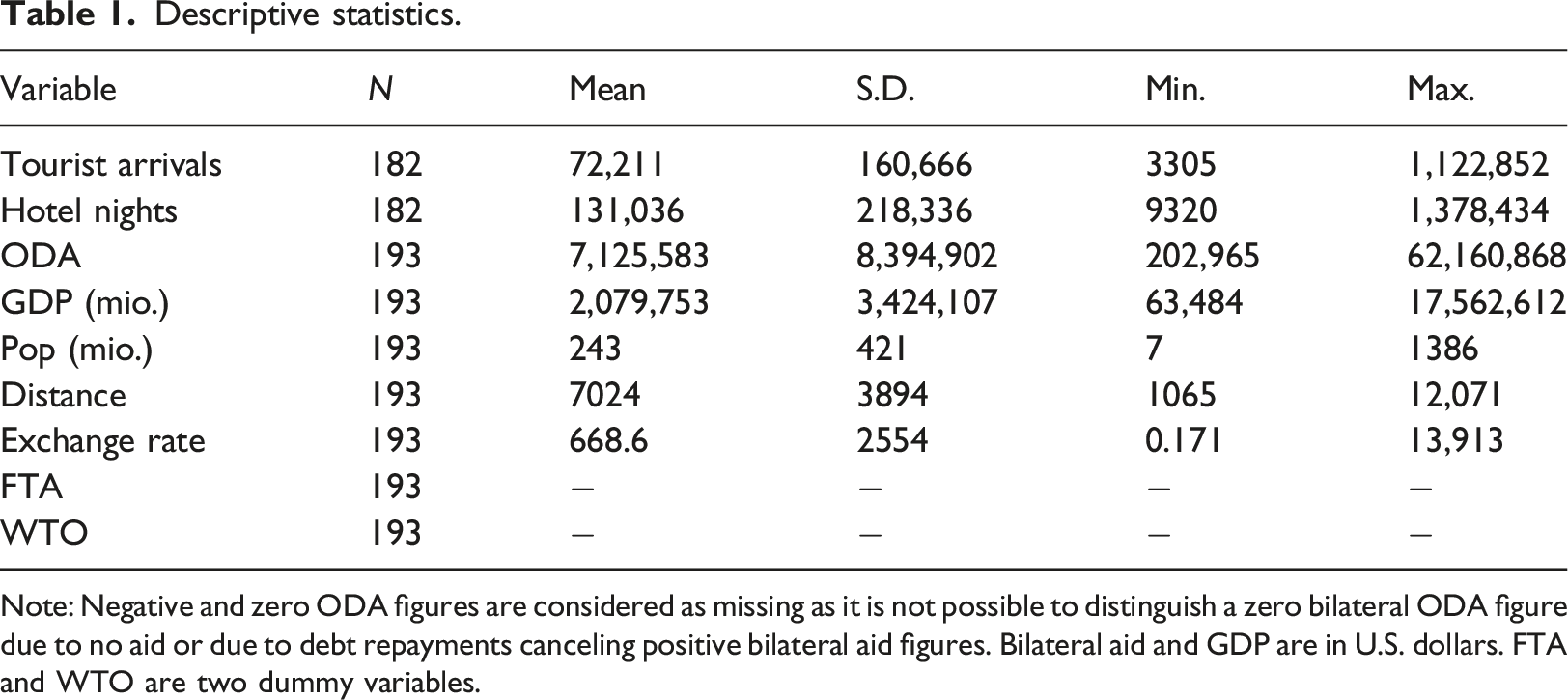
Note: Negative and zero ODA figures are considered as missing as it is not possible to distinguish a zero bilateral ODA figure due to no aid or due to debt repayments canceling positive bilateral aid figures. Bilateral aid and GDP are in U.S. dollars. FTA and WTO are two dummy variables.
Insofar as this study is concerned, it is worth noting that prices in Switzerland have remained considerably stable throughout the whole study period and can therefore be considered constant in the analysis. On the other hand, the price effects in relation to recipient countries are factored in the analysis through the use of GDP at purchasing power parity (GDP PPP). Indeed, the GDP PPP used in the present study (i.e., expenditure-side real GDP at current purchasing power parity) allows us to compare the cost of living across recipient countries at a given point in time. That being said, and since the macroeconomic literature (e.g., Blanchard et al., 2005) relates prices to interest rates that are in turn related to nominal exchange rates, we used nominal exchange rate as a control variable in this study.
Switzerland currently provides ODA to more than 100 countries, for which data are available since the 1960s. Unfortunately, the data of Swiss inbound tourism by tourists’ countries of origin in recipient countries are only available after 2004. Thus, the time dimension of our panel dataset is drastically reduced, which might impede us from generating noticeable trends, if any, in the long run. Furthermore, as far as the explanatory variable ODA is concerned, the majority of countries for which the data of Swiss inbound tourism are available do not match the recipient countries of Swiss ODA. Indeed, recipient countries are developing countries and most of the tourism data currently available concern developed countries only. Such discrepancies reduced the number of countries that can be analyzed in this study. After matching the dataset on recipient countries of Swiss ODA and the dataset on Swiss inbound tourism by country of origin, we ended up with 15 recipient countries of Swiss ODA, for which the data are complete on both tourist arrivals and hotel nights. Table 1 summarizes the descriptive statistics of the panel data of the 15 recipient countries (
When looking at the temporal patterns of our main variables of interest, ODA, tourist arrivals, and hotel nights (Figure 1), we can see that tourist arrivals and hotel nights have been increasing over the past two decades from recipient countries in our dataset. For ODA, no clear trend can be identified but the fluctuations are evident, which could explain the accelerations or decelerations in tourist arrivals and hotel nights from recipient countries. Time evolution of our main variables of interest.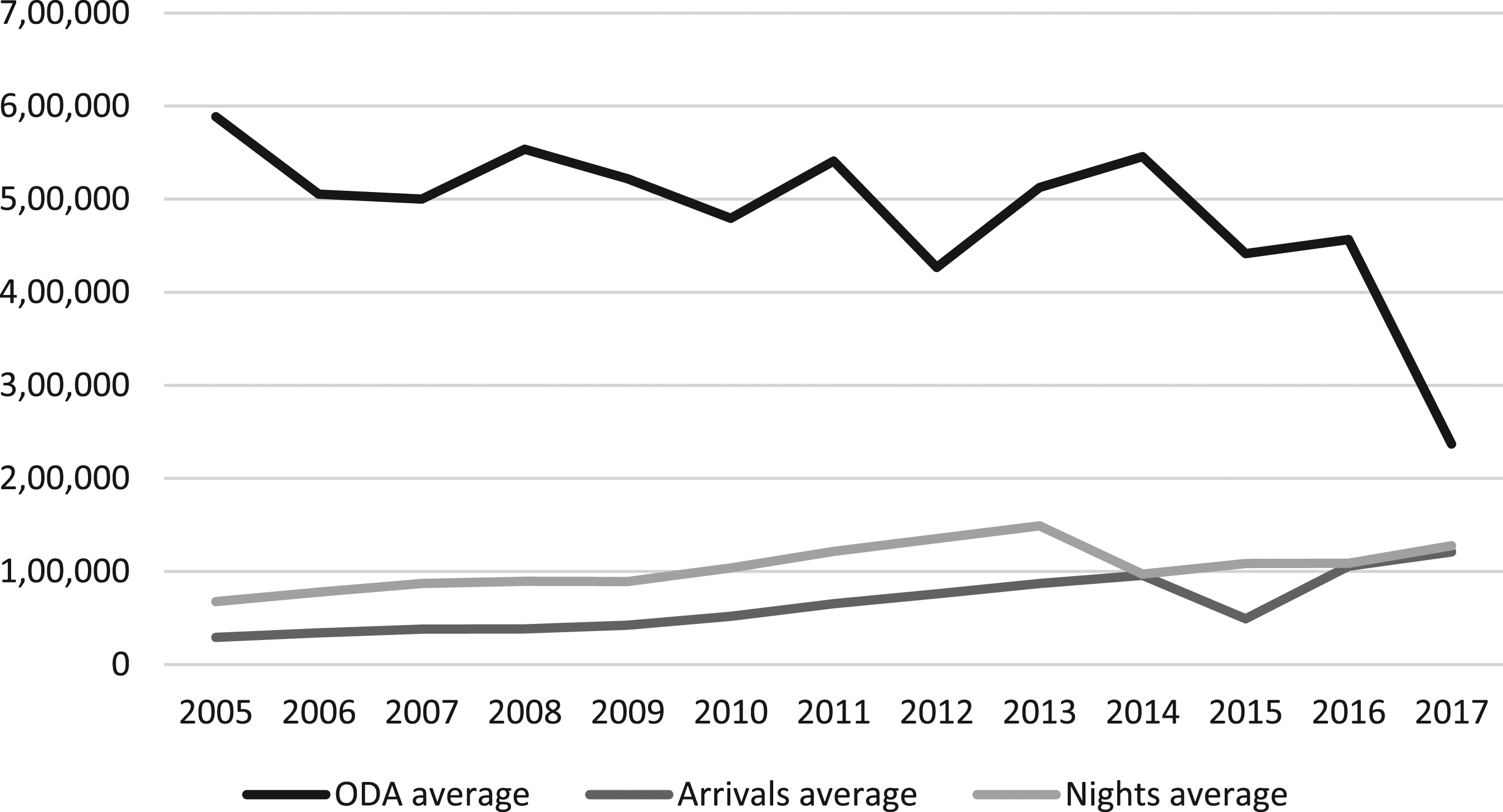
The model
Given the fact that Swiss inbound tourism is part of Swiss exports in services, we develop a model with reference to international trade theories, particularly the gravity model of trade. The advantage of the gravity model is that it accounts for the economic size and distance of two countries to explain their bilateral trade flows. Gravity models of trade are often based on the seminal work of Anderson and Wincoop (2003), who developed a method to consistently and efficiently estimate such models. Many recent studies also used the gravity model of trade in analyzing the economic impact of ODA on either recipient or donor countries’ exports (e.g., Helble et al., 2012; Lopez, 2018; Nowak-Lehmann et al., 2013; Petterson and Johansson, 2013). To increase the accuracy of the model, we modified the model to adapt to the empirical relevance of Switzerland as the single exporter of tourism to recipient countries

Finally,
Whereas the coefficients of some of the variables in the model are unequivocal as suggested in theory, others are perhaps inconclusive and could be peculiar to Switzerland as a donor country. For instance, the coefficient of GDP is expected to be significant and positive because richer countries would trade more with Switzerland, and people have higher purchasing power for tourism. However, the coefficient of population is probably inconclusive for two reasons. First, we could argue that the larger the population, the more people will travel in general, and hence there is a positive relationship between population and tourism demand. Second, highly populous countries are not necessarily rich countries, and hence this casts doubt on the effect of population on tourism demand, meaning that the population effect on tourism demand could be insignificant. Figure 2 shows that the correlation between GDP at PPP and population is rather obscure. GDP per capita and population by country 2017.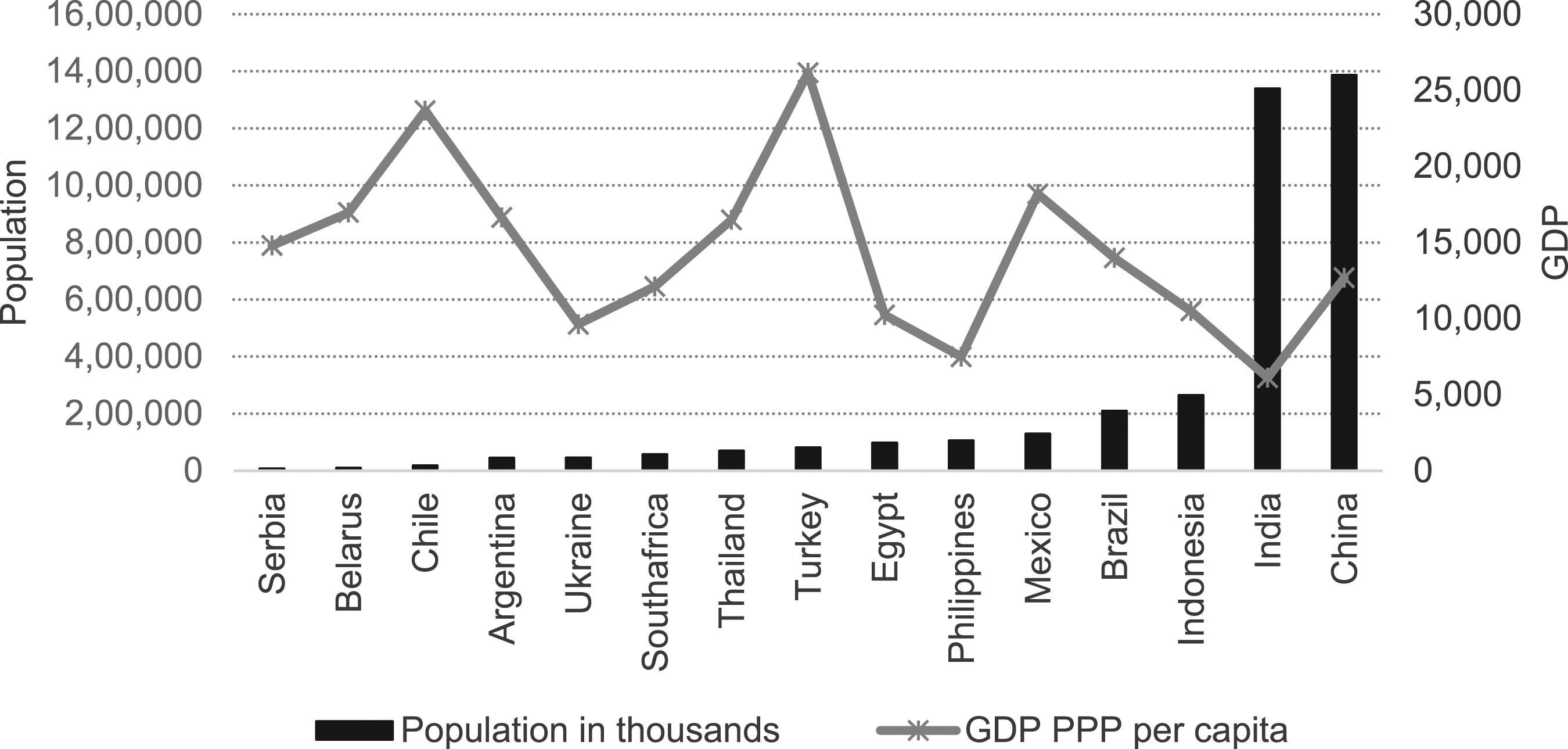
We expect the effect of distance on tourism demand to be negative or non-significant. In general, the longer the distance the higher the cost of trading with and traveling to donor countries, hence the less international tourism will be. Yet, since our dataset dates back to 2005, the effect of distance between Switzerland and recipient countries might be negligible because there is no substantial change in travel cost in a relatively short period of time. Furthermore, since several decades of traveling by air has reduced travel cost substantially which has remain relatively stable, geographical distance may not be strongly correlated to travel cost anymore. The coefficient of the exchange rate is expected to be negative, as the depreciation in a recipient country’s currency will reduce its imports, including its tourism demand in Switzerland. We expect the coefficients of the two dummy variables be positive. Indeed, in the standard gravity model of trade that involves total exports as dependent variables and multiple exporters, the effects of trade facilitators and economic openness are usually significant and positive. Many recipient countries are also open economies and rely on international tourism. It is worth noting that a recipient country’s affiliation to the WTO or to FTA with Switzerland may affect its tourism trade with Switzerland indirectly through business travel. The reason is that trade facilitators and economic openness are usually associated with trade in goods rather than services, of which tourism is a part.
Model estimation
Hausman specification test.

Therefore, we rewrite and expand the two models (1) and (2) as (non-reduced form)

Results and discussion
ODA on tourist arrivals
Official development assistance on tourist arrivals.
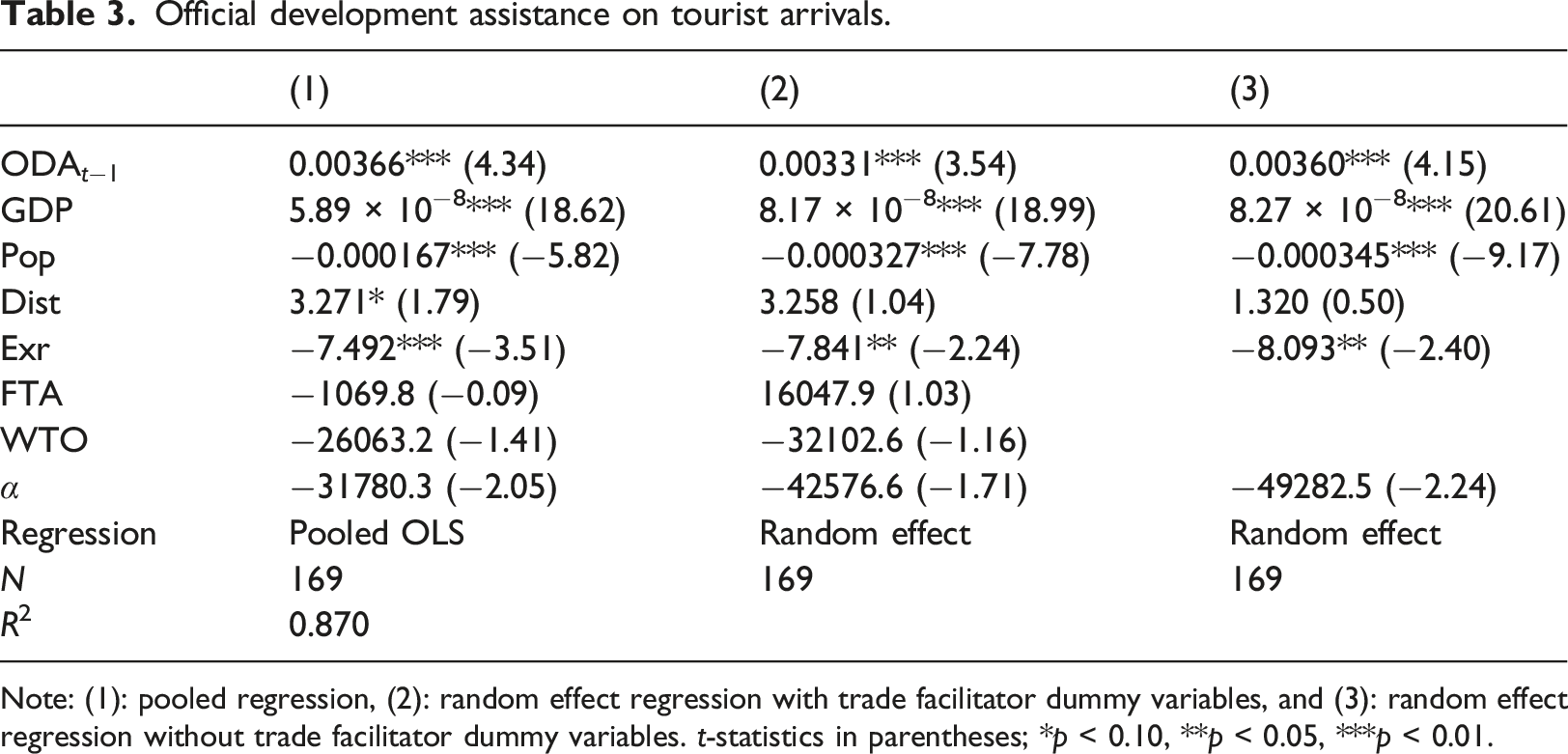
Note: (1): pooled regression, (2): random effect regression with trade facilitator dummy variables, and (3): random effect regression without trade facilitator dummy variables. t-statistics in parentheses; *p < 0.10, **p < 0.05, ***p < 0.01.
As we expected, the effect of recipient countries’ GDP is significantly positive on tourism demand. As the income of recipient countries increases, so does their demand for tourism, suggesting that international tourism is at least a normal good. Note that the size of population is negatively associated with tourist arrivals, which contradicts the hypothesis that population is positively associated with consumption in general and tourism in particular. This is perhaps due to the fact that financial aid is devoted mainly to least developed economies, where income inequality is pervasive. Presumably, traveling to expensive destinations such as Switzerland could only be afforded by a small fraction of wealthy consumers. The distance effect is insignificant. As the majority of recipient countries are far away from Switzerland, travel costs would matter more to the general population but less to wealthy tourists. As mentioned earlier, travel costs and distance are not strongly correlated as they used to be, especially in air travel. As predicted, the appreciation of the Swiss franc against the currencies of recipient countries would result in a decrease in tourism demand for Switzerland. In other words, the higher the cost of the Swiss franc, the lower the number of tourists traveling to Switzerland. Finally, having signed an FTA with Switzerland or being a member of the WTO does not affect tourism demand, because these agreements have more to do with trade for goods but less to do with trade for services as we mentioned earlier.
ODA on hotel nights
Official development assistance on hotel nights.
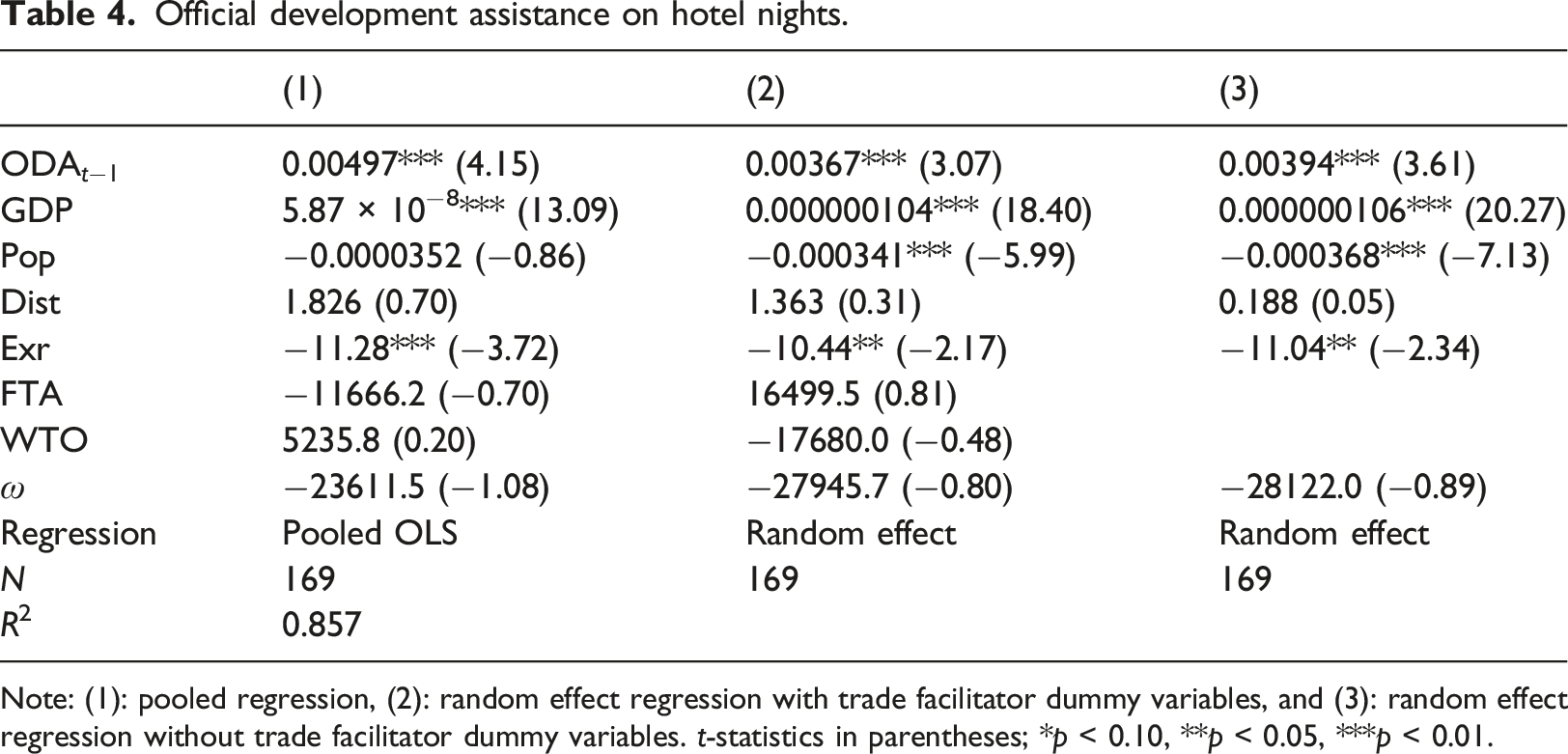
Note: (1): pooled regression, (2): random effect regression with trade facilitator dummy variables, and (3): random effect regression without trade facilitator dummy variables. t-statistics in parentheses; *p < 0.10, **p < 0.05, ***p < 0.01.
Once more, the effect of population on hotel nights in donor countries is negative (and statistically significant in specifications (2) and (3)). This is perhaps because hotel nights is a better proxy for tourist expenditure in Switzerland but not for the market size of inbound tourism. Hotel nights of tourists from developing countries is more associated with high travel frequencies of a small proportion of well-off consumers who can afford overseas travel instead of the sheer size of tourist numbers. The exchange rate has the most pronounced effect on hotel nights, suggesting that the income effect of tourism is robust at least in the short run. This result lends support to the greater effect of ODA on hotel nights than on tourist arrivals as shown in Table 3. The two dummy variables are not significant in both models, perhaps because tourism trade is trade on services while free trade agreements and economic openness are largely related to trade on goods. Therefore, we did not find evidence that recipient countries’ FTAs and economic openness can increase their tourism demand in Switzerland through business travel that is associated with trade.
Total effects of ODA
The study results confirm the positive effect of ODA on donor countries’ economy in relation to exports (Lopez, 2018; Martínez-Zarzoso et al., 2009; Petterson and Johansson, 2013; Wagner, 2003). More interestingly, this study implies that the positive impact of ODA on donor countries’ exports was perhaps underestimated in previous studies given the fact that inbound tourism was not included in the exports under investigation. One major reason is that tourism exports are difficult to measure. In a recent study, Lopez (2018) found that every US dollar of ODA from Switzerland can generate an export of US$0.59 in the short run and US$1.73 in the long run. However, if the positive impact of ODA on tourism exports were taken into account, we would expect that the impact of Swiss ODA on exports is even greater. Increasing tourism exports from a donor country to a recipient country is one extra positive externality of providing ODA. Therefore, failing to take such positive externality into account may mislead policy makers to overestimate the social cost of providing ODA while downplaying the importance of ODA to donor countries. Due to the externality, the decrease in ODA would not only hurt recipient countries but donor countries as well.
Conclusion
We found compelling evidence that foreign aid affects recipient countries’ tourism demand in donor countries. In particular, we found that an increase of US$1000 foreign aid to recipient countries would generate 3.6 tourist arrivals in the donor country while controlling for the effects of variables that may influence tourism demand. We also found that an increase of US$1000 foreign aid can generate almost four hotel nights in subsequent year. There are two explanations for the study results. One explanation is the goodwill effect of foreign aid, which can be independent of how foreign aid is used by recipient countries. As long as foreign aid is injected into recipient countries, it would create a positive externality that motivates tourists in recipient countries to choose donor countries as their destinations. Therefore, foreign aid facilities service exports of donor countries to recipient countries through inbound tourism. The other explanation builds upon the assumption that foreign aid is used for income redistribution, and hence can create a welfare effect in recipient countries. However, this welfare effect may exacerbate income inequality as foreign aid may benefits the well-off. Thus, inbound tourism is carried out by those who are disproportionately benefited from foreign aid. This can explain why the ODA effect on hotel nights is much greater than on tourist arrivals in the sense that wealthy tourists afford to stay longer.
In line with the literature of tourism demand, we found that recipient countries’ GDP has a positive effect on tourism demand in the donor country. Counterintuitively, population has a negative effect on tourism demand. This is perhaps because those in recipient countries who can afford international tourism, in particular in expensive countries like Switzerland, account for a small fraction of population on the one hand, and on the other hand this fraction is more evident in less populous countries. The model also shows a statistically negative effect of the exchange rate, suggesting that the appreciation of the Swiss franc leads to a drop in tourism demand from recipient countries. It might not be surprising that recipient countries’ tourism demand in donor countries is not related to whether the former joined the WTO or signed the FTA with Switzerland, because these trade agreements focus primarily on trade on goods instead of services, of which tourism is a part. Hence, this sort of trade facilitator and economic openness have no direct impacts on international tourism demand.
The positive effect of foreign aid on tourism demand can be attributed to reciprocity between recipient countries and donor countries. There is no doubt that foreign aid helps recipient countries grow their economy at the expense of donor countries, despite the fact that foreign aid only accounts for a small fraction of donor countries’ national income. Some studies verified a positive effect of foreign aid on economic growth in recipient countries, but there is a lack of understanding of the effect of foreign aid on donor countries. In this regard, our study has shown that foreign aid generates a positive externality for donor countries, namely, that recipient countries are inclined to increase imports from donor countries through inbound tourism. Some studies have shown that foreign aid positively affects exports of goods from donor countries to recipient countries, yet the effect of foreign aid on service exports is obscure. Our study has shown that donor countries can establish an amicable relationship with recipient countries which, in turn, increases their tourism exports. This reciprocity is manifested in imports of services, in particular of tourism, because tourism entails the flow of tourists from recipient countries to donor countries. It is tourists from recipient countries that carry the gratitude and pass it on to donor countries through traveling to donor countries.
Our study focuses on Switzerland as a donor country, because Switzerland is of particular importance for us to measure the effect of ODA on tourism demand due to its unique ODA allocation policy that reaches almost 100% untied allocation. The weight of Switzerland in the global economy is modest and Switzerland is not a top destination for tourists in developing countries, thereby eliminating a potential bias in our results. A limitation of this study is that we only focused on one donor country. If data were available for other donor countries, a similar study using a multi-donor dataset would be a great contribution to the literature, which is left for future research to address. The model and the policy implications would however be different (due to for instance displacement effects). Furthermore, if Switzerland is particularly suitable for such study for the reasons we mentioned above, we do not necessarily focus on more economically important countries. Indeed, for the latter countries, reverse causality issues may arise in addition to the difficulties to control for confounding factors.
Of course, this study could provide more insightful results if the effect of Swiss ODA on tourism exports were measured by tourism receipts. This would allow us to compare the effects of ODA on tourism exports and goods exports, because both will then be measured in the same unit. Therefore, we suggest future research focus on this issue. If so, the results could be an interesting complement to the present study.
Footnotes
Declaration of conflicting interests
The author(s) declared no potential conflicts of interest with respect to the research, authorship, and/or publication of this article.
Funding
The author(s) received no financial support for the research, authorship, and/or publication of this article.
